

The ninth-generation Toyota Hilux debuts with a BEV, a 48V mild hybrid, and a hydrogen fuel cell model confirmed for launch in 2028.
Toyota has detailed the ninth-generation Hilux, introducing the model’s first battery electric variant alongside a 48V mild hybrid diesel and confirming a hydrogen fuel cell version for 2028. The new range is offered exclusively in Double Cab format and marks Toyota’s first use of BEV technology in a body-on-frame vehicle.
The Hilux BEV is powered by front and rear eAxles producing 80kW and 128kW respectively, drawing from a 59.2kWh water-cooled lithium-ion battery housed within the vehicle’s frame. WLTP combined range is rated at 257km, rising to 380km on the city cycle. DC fast charging at 125kW or above takes the battery from 10% to 80% in 30 minutes, while AC charging via a wallbox delivers a full charge in around 6.5 hours. Payload is 710-715kg and towing capacity 1,600kg.
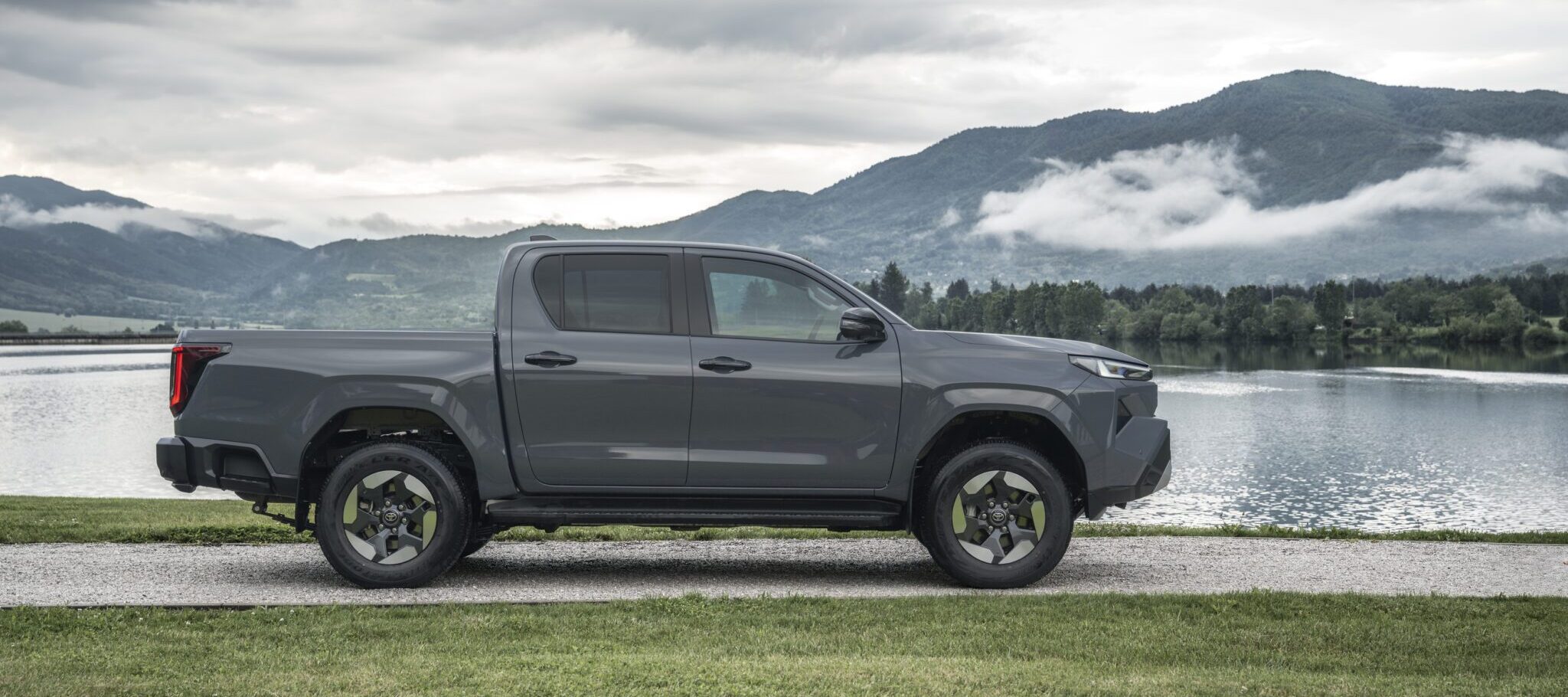
The Hybrid 48V carries forward Toyota’s 2.8-litre diesel mild hybrid system from the eighth-generation model, now available across all four equipment grades. Output is 204hp and 500Nm of torque, with fuel economy rated at 9.7-10.0 litres per 100km on the WLTP combined cycle. Payload exceeds 1,000kg and towing capacity is 3,500kg, with a 700mm wading depth maintained thanks to the motor-generator’s elevated mounting position. ICE diesel and petrol variants will be available in Eastern European markets.
Both the BEV and Hybrid 48V are equipped with Multi-Terrain Select, with the BEV marking its first application in a Toyota battery electric vehicle. The system offers five surface-specific modes — rock, sand, mud, dirt, and, for the BEV, a new mogul setting — alongside an automatic mode. Ground clearance is 309mm on the Hybrid 48V and 212mm on the BEV, with both sharing a 700mm wading depth, 29° approach angle, and 500mm wheel articulation.
The ninth-generation model receives a comprehensively revised interior influenced by the current Land Cruiser, with a 12.3-inch central display, a 12.3-inch digital driver’s combimeter on higher grades, and a redesigned centre console grouping all 4WD controls in a single accessible location. Electric power steering is introduced for the first time on the European Hilux, enabling new safety functions including Lane Tracing Assist and Emergency Steering Assist. Third-generation Toyota Safety Sense is standard across the range.
The new Hilux is backed by Toyota’s Relax warranty of up to ten years or 185,000km. BEV buyers are covered by a Battery Care Programme guaranteeing a minimum of 70% of original battery capacity for up to ten years or one million kilometres, subject to annual health checks at an authorised Toyota centre.
Why this matters:
• The Hilux BEV is Toyota’s most consequential electric vehicle announcement in years, and not because of its specifications. A body-on-frame electric pickup with genuine off-road capability—matching the 700mm wading depth and approach angles of the diesel variants—demonstrates that battery-electric powertrains can be engineered into the most demanding commercial vehicle architectures without compromising the functional attributes that define the segment. That proof point matters well beyond the Hilux itself, given the scepticism among utility vehicle buyers that electrification and genuine rugged capability are compatible.
• The multipath strategy is now spanning its widest powertrain range in a single nameplate. Mild hybrid diesel, full BEV, ICE options for specific markets and a hydrogen fuel cell variant confirmed for 2028; the Hilux simultaneously carries every powertrain pathway Toyota has committed to. That breadth is commercially coherent for a model sold across markets with radically different infrastructure, regulation and buyer expectations, but it also represents a significant engineering and cost commitment that a less globally distributed model could not justify.
• The 257km WLTP range and 1,600kg towing limit will define the BEV’s commercial viability more than any other figures. For the forestry operators, infrastructure contractors and site-based businesses Toyota is targeting, daily range is less relevant than the ability to tow equipment and return to base without an intermediate charge. At 1,600kg towing (less than half the mild hybrid’s 3,500kg) the BEV is a meaningfully different commercial proposition from its sibling, and Toyota’s candour in targeting single-location operations reflects a realistic read of where the technology currently sits rather than overstating its case.