

“What’s my RV worth?” It’s the critical question every owner faces before selling or trading in a camper—and one every savvy buyer asks when looking for a fair deal. Knowing the answer, or as close as possible, empowers you to get the best RV value when selling, or avoid overpaying for a used RV.
This guide explores the most respected valuation tools available online, which use real-time market data and key factors like brand, condition, and mileage to help you determine an accurate value for your RV—and, in some cases, a direct option to sell, trade, or consign your RV.
Full disclosure: The Good Sam RV Valuator is part of the Camping World family of brands. We’ll explain how it works alongside other respected tools like NADA Guides / J.D. Power Vehicle Valuation, so you can evaluate your options and choose what’s right for you.
How Are RV Values Determined?

Before diving into specific tools, it helps to understand how RV values are calculated.
Most RV valuation tools use a combination of:
- Recent sales of comparable models
- Wholesale and retail transaction data
- Current market demand
- Geographic trends
- Model year, trim level, and options
- Reported condition and mileage (for motorized RVs)
Dealers also factor in reconditioning costs, transportation, warranty eligibility, and local resale demand when determining trade-in values. Because of those added expenses and risks, trade-in offers are typically lower than the prices you see advertised for resale.
Understanding that distinction can help set realistic expectations when comparing private-sale pricing to a dealer’s trade-in offer.
How RV Depreciation Works

RVs depreciate over time, like other vehicles. Just like a car, the steepest depreciation occurs the moment you drive it off the lot, when it becomes used, and then over the first few years of ownership. After that initial period, the RV depreciation schedule generally slows and becomes more gradual.
Several factors influence how quickly an RV depreciates:
- RV type (motorhomes often depreciate differently than travel trailers or fifth wheels)
- Brand reputation and long-term durability
- Overall condition and maintenance history
- Mileage (for motorized models)
- Market demand and seasonality
Well-maintained RVs with documented service history and desirable floor plans often retain value better than comparable models without those advantages. Market conditions also play a role—values may fluctuate based on supply levels and buyer demand in a given season.
Considering depreciation provides important context when reviewing valuation estimates. It helps explain why your RV’s current market value may differ from its original purchase price—and why multiple tools may produce slightly different figures.
What Is My Used RV Value?
There are several RV value estimation tools that can help you find an accurate used RV value. Most work by providing your VIN or the RV’s year, make, and model. At a basic level, these RV value calculators account for recent sales to see what others have paid for a similar RV in similar condition.
Perhaps you know Kelley Blue Book as a trusted resource for automobile valuation. This tool works in a similar way to RV value calculators, but you won’t find a Kelley Blue Book for RVs—at least, not by that name. Instead, there are RV-specific valuation tools that provide similar real-time market value by sourcing thousands of previous transactions and market factors.
For example, Good Sam’s RV Value Calculator and the J.D. Power Vehicle Valuation Tool (formerly NADA, National Automobile Dealers Association valuator) are two of the most widely used and respected calculators.
Depending on your situation, each tool offers specific advantages. In fact, it’s smart to consider several valuation tools to get a well-rounded understanding of your RV’s value and what might affect it.
Below is a quick chart comparing the Good Sam Valuator tool with the NADA RV value tool.
| Feature | Good Sam RV Valuator | NADA Guides (from J.D. Power) |
| Best For | A quick, accurate, streamlined estimate and a direct connection to a sales specialist. | A detailed, granular valuation where you can add or remove specific options. |
| Process | Simple, 3-step process to get an initial offer. | Multi-screen process that allows for deep customization. |
| Result | Provides a direct offer and specialist follow-up for trade-in or sale. | Shows suggested list price, low retail, and average retail values. |
| Data | Proprietary dataset from the RV industry. | Data from the National Automobile Dealers Association. |
How the Good Sam RV Valuator Works

The Good Sam RV Valuator is designed specifically for RV owners looking to trade in, sell to a dealership, sell through a dealer — or even sell privately. Some of its advantages include:
- Made specifically for the RV industry
- Pulls from the largest proprietary RV dataset
- Incorporates real-time local marketplace demand trends
- Accesses new and used wholesale and retail RV pricing
- Accounts for unique, vintage, and customized RVs
- Is an easy-to-use, ad-free platform
To begin the process, you’ll need the following information. Be as accurate as possible, as these factors will help determine what your RV may go for.
RV Information
- Year
- Make
- Model
- Trim
- Condition
You’ll also select its condition (Excellent, Good, Average, or Fair) and answer Yes or No to a series of questions. Finally, you’ll select the nature of your inquiry.
Personal Information
- First and Last Name
- Email Address
- Phone Number
- Zip Code
You may be asked to provide additional details, such as completing a quick self-inspection to showcase more about your RV’s condition. Shortly thereafter, you will receive a price range for your RV’s value. If you are looking to sell, an RV sales specialist will contact you with an official offer that remains good for seven days. You can then easily arrange for drop-off or pick-up and choose a payment method if selling.
How to Find NADA Values
The National Automobile Dealers Association (NADA) has represented new car dealers for over 100 years. While its primary focus has always been the automotive industry, NADA Guides has also become a widely recognized source for used RV values.
In 2015, J.D. Power acquired the NADA Used Car Guide business. Today, vehicle valuations formerly known as “NADA values” are provided through J.D. Power, though many consumers and dealers still use the NADA name out of habit.
For RVs specifically, J.D. Power valuations typically include a suggested list price, low retail value, and average retail value. One advantage of the platform is the ability to research base pricing and adjust for factory-installed features and options, allowing for a more tailored valuation.
When you arrive, you’ll find a Get A Value link for consumers. Follow that link; it will take you to the JD Power RV Value website. From there, these are the required steps:
- Select RVs from the header to ensure you’re searching the proper database
- Select your RV type
- Choose from the dropdown of the Top 50 manufacturers or their complete dropdown of all RV manufacturers
- Input the make and year
- Enter your zip code
- Select RV options or choose to see Base Pricing
If you choose Base Pricing, you’ll see the suggested RV list price, the low retail price, and the average retail price. If you select RV options, you’ll see an itemized list with those three prices and how your chosen options impact the suggested NADA RV value for your used RV.
While the pricing information can be useful for research, it does not provide a direct offer or connect you with a buyer.
What Is My RV Trade-In Value?
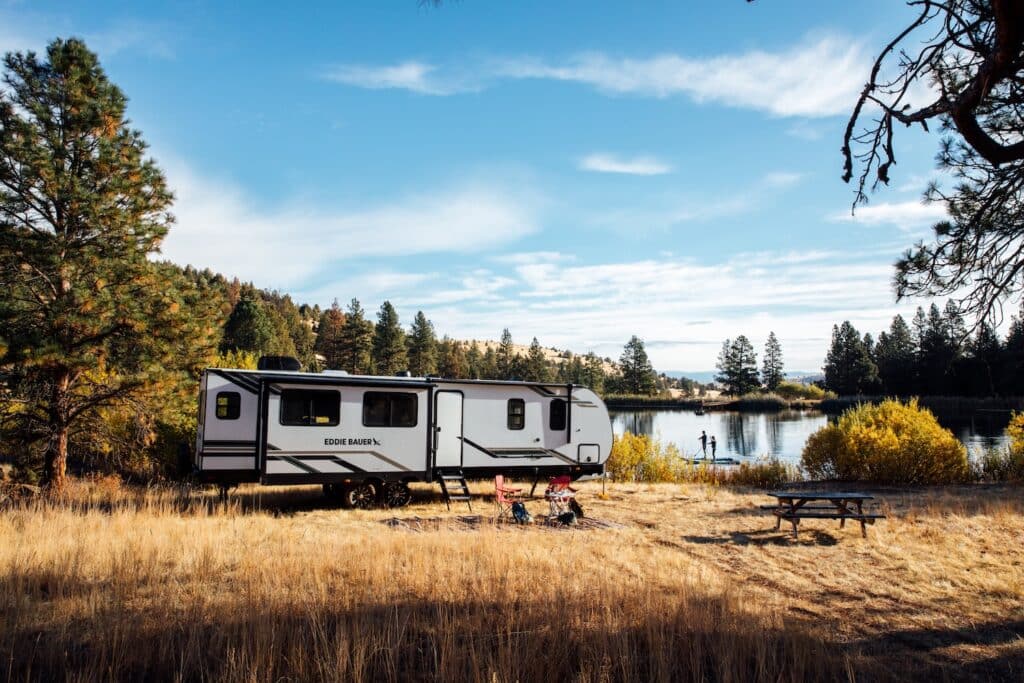
Your RV’s trade-in value is the amount a dealer is willing to offer to purchase your RV directly. Unlike retail listing prices, which reflect what a seller hopes to receive on the open market, a trade-in offer reflects wholesale market value and accounts for inspection, reconditioning, resale demand, and market risk.
As a result, trade-in values are typically lower than private-sale asking prices. However, they also eliminate the time, uncertainty, and potential complications of selling on your own. There’s no need to create listings, meet with buyers, negotiate financing, or handle paperwork independently.
For many owners, the convenience, speed, and certainty of a trade-in offer outweigh the possibility of securing a slightly higher price through a private sale—especially when upgrading to a new RV.
If you’re considering trading in your RV, using a valuation tool that connects you directly with a dealer can provide a realistic starting point and a clear path forward.
What Affects RV Value?

The valuation tools above provide a strong starting point. However, real-world market conditions and individual buyer preferences can still influence the final sale price.
Reviewing comparable listings offers helpful context, but asking prices do not guarantee what an RV will ultimately sell for. They simply show what other sellers are hoping to receive in the current market.
Beyond broad market data, consider what makes your RV stand out. Certain features may increase buyer interest—even if they don’t dramatically change the estimated book value.
Factors that can influence buyer perception include:
Upgrades — Did you recently update any appliances or make improvements? New appliances or improvements may influence the price.
Warranty/Extended Warranty — Certain warranties and extended warranties may transfer to a second owner.
Brand — Choosing a reputable RV brand may help minimize depreciation over time, preserving more of your RV’s value from the moment of purchase.
Service History — Detailed service and maintenance records show the RV has been properly cared for, reducing the risk for potential buyers.
Regional Preferences — Certain RV types or brands may be more popular in specific regions, influenced by regional climates and terrain.
Seasonal Demand — RV values can fluctuate with the seasons, with higher demand and potentially better resale value in spring and summer.
Ultimately, understanding your RV’s market value puts you in control—whether you plan to sell privately or trade toward your next upgrade.
If convenience, speed, and certainty matter most, start your RV sale or trade online today.
For owners who prefer managing a private sale, marketplaces like RVs.com can also help connect you with potential buyers.
If you’re preparing to buy a used RV, sell, or trade in, here are a few additional resources:
Do you have any questions about how to find out what your RV is worth? Let us know in the comments below.