

Support CleanTechnica’s work through a Substack subscription or on Stripe.
In the early days of the automobile, manufacturers like Renault used racing to improve the breed and attract customers. That led to a number of “one-off” cars that had a single purpose — go faster than everyone else. Beating the other guys often meant stuffing a bigger engine under the hood. Cubic inches, not aerodynamic efficiencies, were the key to getting to the checkered flag first.
Few people understood how important aerodynamics were until Colin Chapman brought his Lotus 38 to Indianapolis Motor Speedway in 1965. Prior to that, the Indy 500 had been won repeatedly by ponderous race cars powered by great, thumping Offenhauser engines. Chapman showed the world that a smaller engine in a more aerodynamic car was the fastest way around the track.
Efficiency is the watchword for electric cars for one very simple reason. Today’s batteries are much less energy dense by either weight or volume than gasoline, which has 33.7 kWh of energy available in every gallon. Simply put, most passenger car battery packs have roughly the energy equivalent of 3 gallons of gasoline or less. No wonder efficiency is so critical to making electric cars that are practical for everyday driving.
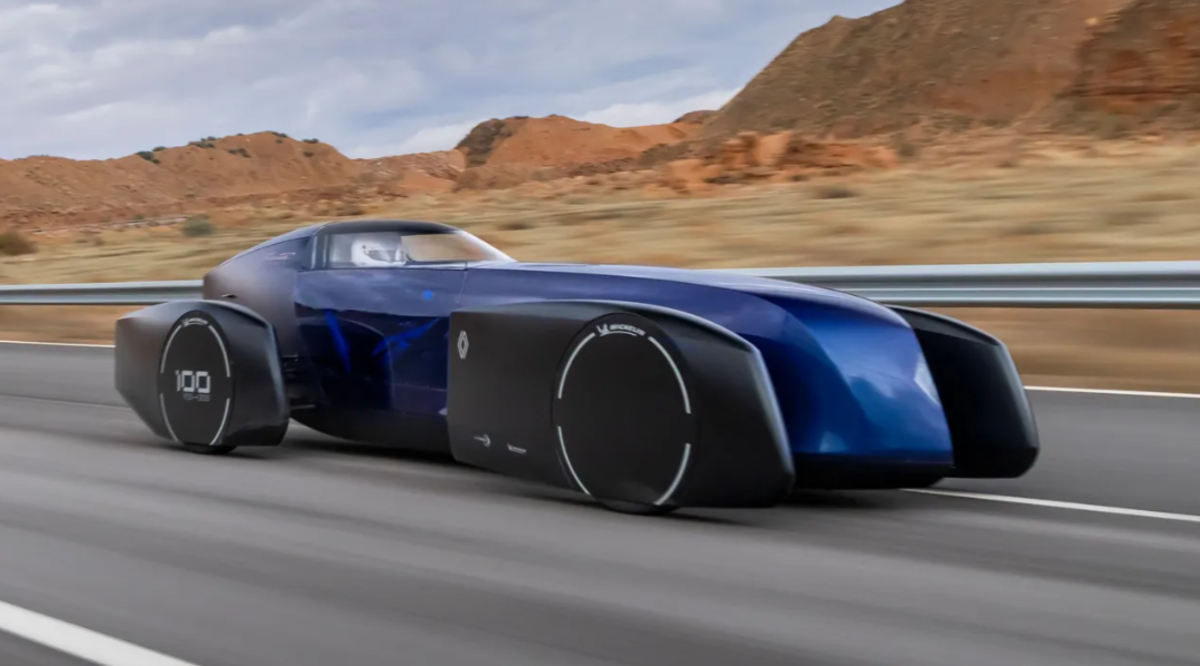
Renault has been involved in Formula One racing since 1977. During those nearly 50 years, it has learned a thing or two about aerodynamic efficiency. Today’s Formula One teams do most of their testing in wind tunnels, where every curve of the bodywork is meticulously analyzed to reduce turbulence. Building on that body of knowledge, the company has just revealed its Filante Record 2025 experimental electric car.
Shifting Priorities
In a blog post about the car, Renault said, “Today, priorities have shifted. The question is no longer ‘How fast can we go?’ but rather ‘How far can we travel intelligently?’ Filante Record 2025 is part of this shift. It is less a nostalgic nod than a way of drawing on Renault’s heritage to explore a new approach to mobility.”
Sandeep Bhambra is the head of design for Renault’s advanced design and concept cars division. He said, “Our goal is not to look backward, but to draw on our roots to meet today’s needs. We are not aiming to break a speed record; efficiency is now the target.”
The Filante Record 2025 is a learning tool, Renault says. Every element, from the shape of each detail to the materials used, was designed to concretely measure the impact of technical choices on real-world vehicle energy consumption. The project was carried out in close collaboration with Ligier for the vehicle’s construction and with Michelin for the development of ultra-low rolling resistance tires.
Add Lightness
Colin Chapman was obsessed with making lightweight cars. “Simplify then add lightness” was his motto. In an age when horsepower was king, Chapman dryly observed, “Adding power makes you faster on the straights. Subtracting weight makes you faster everywhere.” It also makes electric cars that can travel further on a single charge.
With the battery already accounting for more than half of the vehicle’s total mass, weight reduction was a central focus of the Filante Record 2025 project. Carbon fiber, composites, and optimized structures were used as the teams worked to shave off weight gram by gram in order to keep the mass of the experimental car around 1,000 kg (2,204 lb). This focus on weight was not intended to achieve an absolute feat in itself, but rather to better understand how material lightweighting influences the driving range of an electric vehicle.
Another major focus of the work was the SCx — the product of frontal area and drag coefficient — which measures aerodynamic efficiency. An initial wind tunnel session revealed excessive drag, putting the efficiency record out of reach. Designers and engineers then had to work together to re-engineer the airflow around the car by redesigning the wheel fairings, the cockpit proportions, the side surfaces, and the transitions between the central cell and the wings.
Aerodynamicist Jocelyn Merigeault said, “We first simplified the wheel fairings, a major source of drag, to achieve a cleaner, more efficient shape. From the outset, Filante Record 2025 showed a genuine predisposition for aerodynamics. Our work was about revealing that potential and aligning it with the performance objectives.”
Impact On Production Cars
Will the work on this car result in changes to Renault production vehicles? Not in any obvious way, but it will influence future battery-powered cars from the company. That’s the whole point of these kinds of experimental projects.
Drawing on its Formula 1 experience, Renault incorporated electronic control systems such as steer by wire and brake by wire to reduce weight and give the drivers more accurate control over the car. A rethinking of how to integrate the battery into the car improved weight distribution and reduced energy losses.
Renault says its goal is not to transfer those innovations directly to a future production model, but rather to observe which elements could enable tangible improvements in the next generations of electric vehicles.
Testing In Morocco
The testing took place at the UTAC Ceram test center in Oued Zem, Morocco. For nearly 10 hours, three Alpine test drivers took turns maintaining a steady speed of around 100 km/h, managing driving conditions and extracting the car’s full potential down to the finest details. Think of it as a Mobil Economy Run but for battery-powered cars.
The choice of a long, smooth track with limited exposure to weather variations made it possible to replicate conditions close to continuous highway driving. In the end, Renault Filante Record 2025 covered 1,008 km in fewer than 10 hours at an average speed of 102 km/h. The car still had 11% of its battery charge remaining, which would have allowed it to travel an additional 120 kilometers at 100 km/h.
New Record For An Electric Car
The Filante Record 2025, which used the 87 kWh battery pack from the Renault Scenic E-Tech, used 7.8 kWh of electricity per 100 km — equivalent to just under 8 miles per kWh. No production electric car exceeds 5 miles per kWh. Even the Mercedes EQXX, which is optimized for efficiency, can only manage 6.2 miles per kWh.
Of course, the EQXX is a real passenger car, whereas the experimental Renault is a single-seat, purpose-built, rolling test bed. For comparison purposes, the Scenic ETech has a range of 610 km (380 mi) WLTP, but that range drops by about 30% in sustained highway driving.
There are many parts of the Filante Record 2025 that are not suitable for production cars, things like ultra-narrow tires and carbon fiber suspension components. Still, as we say repeatedly here at CleanTechnica, the EV revolution is young. It took 30 years for gas-powered cars to adopt the self starter and another 20 years to perfect the automatic transmission.
Technological improvements to electric vehicles are happening at a far faster pace than they did for conventional cars. It’s fair to say that, every day in every way, electric cars are getting better and better, thanks to efforts like this from Renault.
Sign up for CleanTechnica’s Weekly Substack for Zach and Scott’s in-depth analyses and high level summaries, sign up for our daily newsletter, and follow us on Google News!
Have a tip for CleanTechnica? Want to advertise? Want to suggest a guest for our CleanTech Talk podcast? Contact us here.
Sign up for our daily newsletter for 15 new cleantech stories a day. Or sign up for our weekly one on top stories of the week if daily is too frequent.
CleanTechnica uses affiliate links. See our policy here.
CleanTechnica’s Comment Policy