Welcome to CERA Sports Park & Campground, where adventure awaits. Nestled in the rolling heartlands of Columbus, Indiana, our sprawling 345-acre outdoor haven beckons RVers, families, sports enthusiasts, and nature lovers alike.
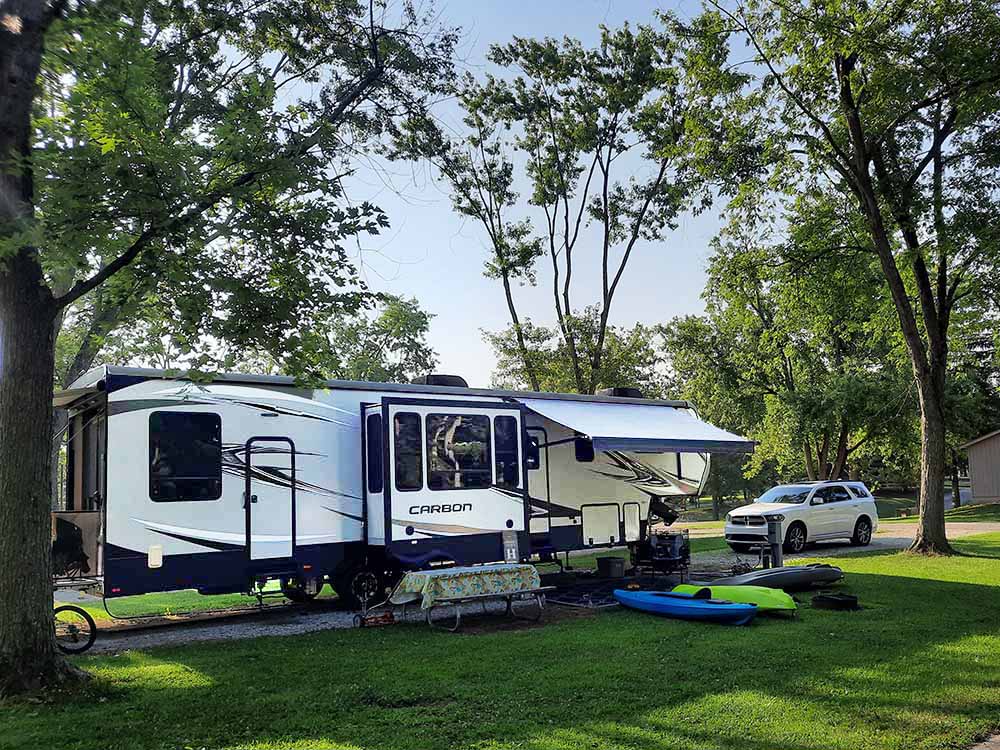
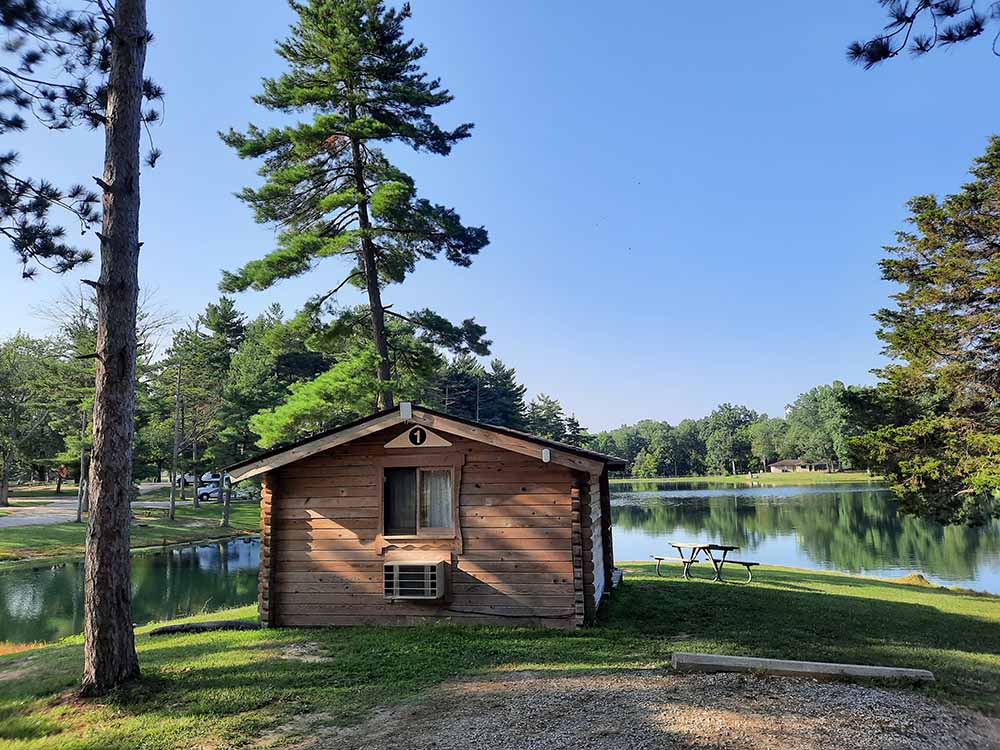
Immerse yourself in the beauty of the great outdoors with our expansive campground, boasting 324 campsites and six cozy cabins. These options provide the perfect blend of comfort and rustic charm for your stay. Whether you prefer pitching a tent under the stars, indulging in cabin comforts, or staying in your own RV, CERA Sports Park & Campground has accommodations to suit every preference.
Courtesy of Ceraland Sports Park & Campground
Pickleball, Golf, and More
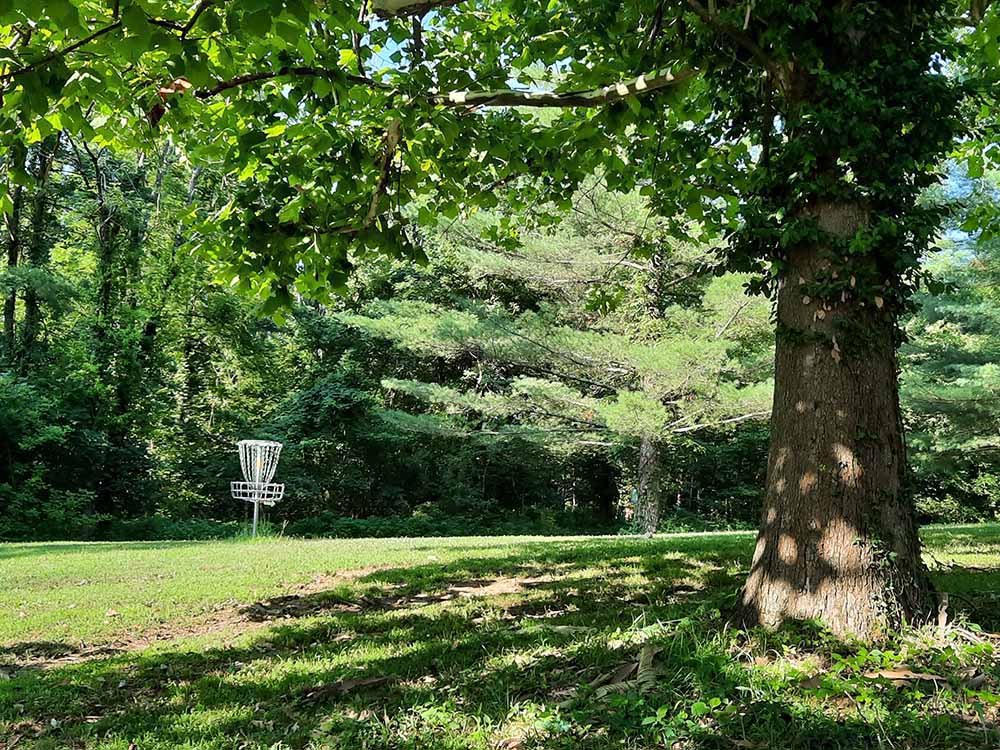
For those seeking active pursuits, our park has an abundance of recreational delights. Take on the challenge of our brand new 18-court pickleball complex, where players of all levels can showcase their skills and enjoy thrilling matches against fellow competitors. Shoot hoops on our basketball courts, perfect your putt on our mini-golf course, or embark on a leisurely round of disc golf on our scenic 18-hole course, which winds through the entire parkland.
Courtesy of Ceraland Sports Park & Campground
Cool off and make a splash at our outdoor Aquatics Center, offering refreshing relief on hot summer days for visitors of all ages. With a variety of pools and water features, it’s the ultimate destination for aquatic fun and relaxation.
Courtesy of Ceraland Sports Park & Campground
Food and Fun
After a day of excitement, refuel and unwind at The Landing, our lakeside bar and pizza spot. Indulge in delicious bites and refreshing drinks while soaking in stunning views of the serene lake. Join us on Friday and Saturday evenings for live music, adding a lively soundtrack to your lakeside retreat.
Courtesy of Ceraland Sports Park & Campground
But the fun doesn’t end there. At CERA Sports Park & Campground, we’re known for our vibrant seasonal events that promise unforgettable experiences for the whole family. Celebrate Independence Day with a dazzling firework display that illuminates the night sky. In October, don’t miss our Beer and Food Festival, BOOze N Bites, featuring an array of culinary delights and craft brews. Venture into the realm of spooky fun with Sammy’s Ghost House, a kid-friendly ghost maze, or dare to brave the chilling thrills of When Darkness Falls, our mature haunted trail experience held every Friday and Saturday night throughout October.
Whether you’re seeking outdoor adventures, friendly competition, or simply a peaceful retreat surrounded by nature’s beauty, CERA Sports Park & Campground invites you to create cherished memories in the heart of Indiana’s stunning landscapes. Plan your escape today and discover the endless possibilities that await at our premier outdoor recreation destination.
Volvo boss says the upcoming EX60 will cost about the same as the XC60 plug-in hybrid.
Using the new 800-volt SPA3 platform with new powertrains and batteries is key to keeping costs down.
It will still be expensive compared to non-premium midsize electric crossovers, but it matches luxury rivals like the upcoming BMW iX3.
Volvo needs a smaller electric crossover to slot under the large and quite expensive EX90, and one is on the way. It will be called the EX60, so it will become the electric equivalent of the XC60, but even though it’s an EV, it won’t cost more than its combustion-powered brother. It will be similarly priced to the XC60 plug-in hybrid, which currently starts at $62,445, including destination.
The EX60 will be built on the “groundbreaking” modular 800-volt SPA3 platform, which promises 15% faster charging, 35% more drive power and the ability to evolve over time through over-the-air updates. It will also feature Volvo’s 20% more energy-dense next-generation batteries that are said to make it Volvo’s longest-range electric offering, and a powertrain that is 18% cheaper than what the manufacturer puts in its current EVs, according to Automotive News.
Photo by: Volvo
Having a structural battery pack and using large megacastings for the vehicle’s shell will allow Volvo to cut costs by 25%, which is how it hopes to be able to sell you an EX60 for XC60 plug-in hybrid money. That car starts at $62,445, including destination fees. For context, the Volvo EX90 commands about a $4,000 price increase over a comparable XC90 PHEV. Getting EVs to price parity with their gas-powered counterparts is seen as key to driving more electric adoption.
The EX60 is also seen as the natural next car for today’s XC60 owners who are ready to go fully electric. But it’s also aimed squarely at the biggest players in the segment, such as the Tesla Model Y or the Hyundai Ioniq 5, both of which have achieved global success.
Volvo EX60 Taillight Teaser
Photo by: Volvo
Getting the EX60 right is really important for Volvo. The design will stick close to what we already know, so it won’t alienate potential buyers by completely changing the formula. It has been teasing the model ahead of its debut early next year and it’s probably feeling a lot of pressure to get it right, especially since it’s a bit late to the party.
Volvo is owned by Geely, which already has premium midsize electric crossovers on sale in Europe. I’ve already tried the posh Zeekr 7X, which drives very well and can charge at 400 kW, and you can already order one here starting at €52,990 ($61,200). That’s very competitive for a vehicle with luxury features such as powered automatic doors—and they work better than those on a BMW i7—which the upcoming EX60 won’t have.
But an EX60 price comparable to its PHEV variant would still make it pretty competitive. It would still be more expensive than a Model Y, the Ioniq 5 and other midsize electric crossovers, but competitively priced against premium-badged rivals, such as the upcoming BMW iX3. That’s also expected to start around the $60,000 mark when it lands in the States next year, with more affordable variants to follow.
The BMW Z4 and Toyota Supra are a lot more than just platform mates. The two are nearly identical cars, with one conspicuous difference: the roofline. Toyota’s Supra is only offered as a coupe; meanwhile, BMW has only offered its latest Z4 with a folding soft top. And even though BMW hasn’t had a sudden change of heart — and indeed, there’s no factory Z4 Coupe in the cards — it’s not like that has ever stopped enthusiasts from driving the car they want. You can stop Googling and AI-manufacturing Z4 Coupe renders; this year at SEMA, someone brought one to life.
Meet the Z4 Coupe Based on a Supra: the Zupra?
At the most base level, the Z4-swapped Supra is a pretty simple concept. After all, mechanicals and almost everything else are shared between the cars. So, bringing the car into reality should really be a matter of simply lining up a few things and getting the paint right. But, as this is SEMA, no build can simply stop at “good.” So, it’s probably no surprise that there’s a lot more than a bumper swap going on here. A mess of carbon fiber decorates the front, sides, and rear of the car, and 20-inch BBS LM-R wheels front M-badged brake calipers done up in red paint. In back, a roundel decorates the “trunk” lid, along with a carbon fiber spoiler. Quad-exit exhaust tips — with a polished finish, which is a bit of an unorthodox take and looks neat — sit below aftermarket, M4 CSL-inspired taillight designs that seem to borrow the cool Laser technology.
Inside, too, changes have been made to reflect the car’s new badging. New Recaro seats featuring red stitching replace the old Toyota thrones. BMW and M badging now decorate the steering wheel, and new paddle shifters appear to be lifted straight from the G8X M Series vehicles. There’s some new jewelry under the hood, too. Fittingly, the Supra’s B58 engine receives a new carbon-laden engine cover.
What’s In a Name
While an obvious name for the project would be simply “Zupra,” simplicity clearly wasn’t a guiding principle behind the build. The project’s full name is “GW29CS Zhüpra,” and the “CS” stands for “clown shoe.” Which is at least somewhat a misappropriation of the term. While “clown shoe” correctly refers to the original M Coupe (which was based on the contemporary Z3 Roadster), this is stylistically much closer to the Z4 M Coupe that followed. It donned a much more coupe-typical figure that the “Zhüpra” seems to share. The original M Coupe was a shooting brake, which is where the “clown shoe” title came from. Semantics aside, you have to appreciate the amount of dedication that went into the build. But really, this build just makes us pine for a factory, G29 Z4 M Coupe even more. The gallery below has more pictures.
The best sites to check used RV prices are NADA Guides (J.D. Power), RVTrader, RVT.com, and Facebook Marketplace. These platforms let you compare dealer values, private listings, and live market trends so you can find a fair, accurate price before buying or selling your RV.
Maybe you’re buying, maybe you’re selling — or maybe you’re just curious what your rig is worth. In any case, knowing your RV’s fair market value can be key. (It can even help you understand how much to charge if you’re renting out your RV on RVshare!)
And while there are many different places to check your RV’s value online, the best practice is to check multiple trusted pricing sources. That way, you’ll have a more holistic picture of the situation — and a more accurate final figure.
From understanding depreciation to knowing when to invest in a professional RV appraisal and more, we’ve got you covered with all the details. Read on to learn about the best places to check used RV prices, as well as what you can use that information for once you have it.
Why It’s Important to Check Multiple RV Price Sources
While it may be tempting to do a one-and-done check-in on your RV’s sale price, the truth is, RV prices vary widely depending on a large spectrum of factors. Those factors include:
Make
Model
Condition and maintenance level
Any aftermarket upgrades or remodels
Your region (where you live)
What’s more, a dealership is very likely to offer you a different purchase or trade-in price than a private buyer — and each of those parties is likely to use different valuation tools with slightly different algorithms.
Long story short: Cross-referencing RV values prevents you from underpricing your RV when listing it on the market — or overpaying if you’re buying a used RV for yourself. So let’s get to it!
“Why do used RV prices vary so much?” Because factors like condition, mileage, season, and demand all impact market value — that’s why checking multiple sites helps you get a fair estimate.
The Best Websites to Check Used RV Prices
Without further ado, here are the best websites to check used RV prices — and some insider tips and tricks on how to use them.
1. NADA Guides (J.D. Power)
The NADA Guides — today run through J.D. Power — are largely considered the standard, go-to resource for RV resale and trade-in values. It’s basically like the Kelley Blue Book for RVs.
To use the NADA Guides, simply navigate to the page, enter your RV’s type, make, model year, and condition, and you’ll receive instant estimates. (Of course, they are just that: Estimates. The real-world market value of your RV may vary depending on the other factors we mentioned above.)
Note: This resource is widely used by lenders and dealerships for RV pricing, so it should be one of your first stops on your RV value journey.
Pro Tip: Use NADA values as a baseline before comparing to current listings.
2. RVTrader
Once you’ve got your NADA Guide value estimate in hand, you can head to RVTrader, one of the largest used RV marketplaces in the U.S. Even if you’re not in the market to buy an RV, you can use this platform to understand how much RVs just like yours are selling for in the real world. Simply search your RV’s make and model to view hundreds of listings across the country.
This resource is a great one because it reflects real-world prices across both private and dealer sales, making it an all-inclusive, comprehensive look at used RV values.
“Where can I see what similar RVs are selling for right now?” RVTrader shows live listings, giving you the most accurate market snapshot.
3. RVshare
Yes, RVshare is the go-to platform for listing your RV for rent (or renting other peer-owned motorhomes and trailers).
But as the largest peer-to-peer RV rental platform, RVshare can also be an important resource when you’re searching for used RV values. That’s because rental pricing can reflect demand and your RV’s resale potential — not to mention how much you might stand to make in passive income by putting your rig to work in its downtime.
Pro Tip: Check what similar RVs rent for — it can inform value or help you earn income instead of selling.
4. RVT.com
Another major RV sales marketplace that’s specifically focused on used units, RVT.com is a great resource to find transparent pricing across the U.S. market. It also offers a wide range of detailed filters so you can narrow in on the rigs that most closely match your own, and sometimes you can even find sold-price data on the platform.
Pro Tip: This is a great one for comparing dealer versus private sale prices.
5. Facebook Marketplace & Craigslist
Chances are you use Facebook Marketplace and Craigslist for other used items in your life, be it thrifted clothing or household goods. These peer-to-peer markets are also great opportunities for finding private RV listings, and they are especially useful for getting insight into what the prices are like in your own, extremely local market.
Pro Tip: Although these can be useful resources, do proceed with caution — and verify any pricing details you get with NADA or RVTrader before listing your own rig for sale.
6. RVUniverse
While it’s not as well-known as competitors like RVTrader, RVUniverse is another used RV marketplace that can offer you valuable insight into your rig’s market value — especially if you’re valuing a premium or speciality motorhome. Although many types of RVs are listed on the platform, this one is best used for checking pricing on higher-end or niche models.
Bonus round! Along with the six sites listed above, you can also use the following to check (or cross-check) your RV’s value:
Kelley Blue Book (KBB): Along with cars and trucks, KBB covers towables and campers.
RVhelp.com: Here, you can find trusted repair shops that can assess condition-based value.
RVinsider.com: A great spot to read owner reviews that can influence a buyer’s perception of value.
Ready to bring this knowledge to real life? Here’s a step-by-step guide to combining these tools to get the most accurate used RV values and pricing.
Step 1: Get a baseline from the NADA Guides, since they’re industry standard.
Step 2: Compare similar active listings on RVTrader and RVT.com.
Step 3: Check to see if you can find any local prices on similar rigs on Facebook Marketplace or Craigslist.
Step 4: Adjust the figures you get based on your RV’s upgrades, mileage, and seasonality.
Voila! You’ve got your RV’s value in hand — and the opportunity to use it to sell or rent out your rig.
Pro Tip: You can track value over time, too! Keep a spreadsheet of prices to spot trends or pricing gaps.
“How can I find the most accurate used RV price?” Use a combination of NADA for base value and live listings from RVTrader and RVT.com to see what similar RVs are selling for.
Ready to Sell or Rent Out Your RV?
Once you have your RV’s value, you can use it to turn that value into real-world cash in your own pocket. And no, you don’t have to sell your RV to do it. Listing your RV on RVshare can help you earn thousands of dollars a year — passively — and you’ll still have your rig ready to go when your own hunger for adventure strikes! Our platform brings nationwide visibility, listings are easy to set up, and you can even rent your rig out while you’re waiting for it to sell. It just takes a few minutes to get started.
FAQs About Checking Used RV Prices
What’s the best site to check used RV prices?
The NADA Guides and RVTrader are two of the most accurate platforms used across the industry, while sites like RVT.com and Facebook Marketplace show current market listings.
How do I find out what my RV is worth?
Enter your RV’s details on NADA, then compare prices on RVTrader and local listings (on platforms like Facebook Marketplace or Craigslist) to find your fair, local market value.
Are NADA RV values accurate?
Yes — they’re a trusted benchmark, but real-world listings on RVTrader or Craigslist help provide the most up-to-date numbers specific to your area.
What’s the difference between resale value and trade-in value?
Trade-in values are typically lower since dealers must resell at a profit; resale values reflect what private buyers will pay.
The exterior features sleek proportions and dynamically intersecting surfaces. Among the distinctive features are the low nose, flared rear fenders and wing-inspired lighting and shimmering blue accents.
Developed under the concept of “Unlimited Glide”, the Prelude has a clean, smooth surface treatment that doesn’t rely on character lines.
Check the full gallery here.
From the official Press Release:
Exterior Design
The all-new Prelude features a low, sharp front nose and smooth, yet expressive body lines, which contribute to the uplifting sensation of gliding through the air, as well as a low and wide stance that evokes a sense of dynamic driving.
The headlight design expresses the soaring momentum, consisting of a wing-like multifunction light which features finely molded stripes that ascend outward, as well as Adaptive Driving Beam and Active Cornering Light, which enhances visibility during nighttime driving.
A smooth and clean roofline was achieved by eliminating roof molding with the use of laser brazing technology to produce the roof and the adoption of a glass-printed antenna.
The blue accents at the lower center of the front and rear fascias create an elegant flow and the low and sporty stance of the vehicle, representing the grand concept of “Unlimited Glide.” In addition, the exterior styling features meticulous attention to detail, including the flush outer door handles and a black chrome grille louver.
Interior design
Design evoking the uplifting sensation of gliding through the air was also applied to the interior of the all-new Prelude, ensuring a comfortable space not only for the driver but the front passenger as well.
The front seats were designed differently to suit separate needs: the driver’s seat is shaped to hold the driver firmly in place, making it suitable for sporty driving, while the passenger seat offers comfort together with just the right amount of feeling of being enveloped.
The concept of the all-new Prelude was expressed with the main interior color option— two-tone Blue & White — a color coordination with a high contrast of white and deep blue.
The interior design evokes a sense of exclusivity through its fine detailing, such as the softly shaded white surface material that makes it irresistible to touch, the embroidered Prelude logo that enhances the joy of ownership, and the door lining designed in consideration of smooth leg movement during ingress and egress.
Other unique interior design features, such as a low and horizontally expansive line of sight, a flat-bottom steering wheel, alloy paddle shifters, and full-graphic meters designed exclusively for Prelude, enhance a sense of anticipation for an exceptional driving experience this vehicle can offer.
Package design
As a new-generation specialty car that offers new value to the customer, the all-new Prelude features a package design that achieves seemingly conflicting qualities —specialty and versatility. In order to realize the proportions worthy of a specialty sports model with a wide, low and smoothly sculpted body, the ratio of the tire outer diameter to overall vehicle height was set at approximately 50%, which has been the standard for sports cars. The tread-to-wheelbase ratio, which greatly affects dynamic performance of the vehicle, was set to achieve both straight-line stability and high cornering performance, referencing sports models Honda has designed in the past.
In addition, a cargo space, with a large liftback opening that makes loading and unloading easy, is spacious enough to accommodate two medium-size suitcases*1. The standard 60/40 split rear seatbacks fold flat to greatly expand the available space, enough to accommodate larger items such as two golf bags with 9.5” top*2 or two surfboards*3. Moreover, the cargo space offers remarkable utility and versatility, featuring an underfloor storage compartment, convenient hooks, and a cargo floorboard that can be folded and held in place to serve as a cargo space divider to separate items in the front and the rear part of the cargo hold.
In the morning after Tesla’s shareholder meeting, shares of the company dropped significantly on market open, likely signaling a selloff from reasonable investors who objected to a vote to retain and overpay its CEO, Elon Musk, who has been responsible for a drastic drop in sales and earnings.
Tesla held its shareholder meeting yesterday, and shareholders voted on several high-profile proposals, the most-publicized of which would give CEO Elon Musk hundreds of millions of shares worth up to potentially $1 trillion, contingent upon company growth.
The headline $1 trillion has been widely reported and would be the largest payday ever for any employee of any company by multiple orders of magnitude if the company grows enough for all 12 milestone tranches to be met. The milestone tranches depend on company performance, and span over the next 7.5-10 years, with the goal of retaining Musk as CEO for that time period.
But Musk can still manage to get paid tens of billions of dollars – again, the largest payday ever for any CEO – even if the company grows slower than the S&P average. And another proposal printed 208 million shares, which the board can give to Musk at their discretion, independent of any milestone requirements.
Advertisement – scroll for more content
The vote was framed by Tesla as a necessity to retain Musk, and Musk himself threatened to leave the company if the vote did not go his way. He was probably bluffing, but it was enough to get 75% of shares to vote in favor of the incentive plan.
Many TSLA shareholders felt like they had no option other than to vote for the plan, as Musk’s incessant stock pumping with fantasies of robots and self-driving cars has been responsible for a huge run-up in share price, even as sales and earnings have dropped precipitously under his direction.
Due to Musk’s stock-pumping and the drop in earnings he’s caused at the company, Tesla’s price-to-earnings ratio is currently over 300. P/E ratio is an indication of the difference between market expectations and the company’s actual ability to make money, and lower numbers are healthier and less speculative. Most healthy companies have P/E ratios of around 20, possibly a bit more if they are in a high-growth industry.
But Musk had trapped Tesla shareholders: his lies are what led to TSLA stock being so high, and his threats to leave made shareholders fear a selloff in the event he didn’t get his absurd pay package, regardless of the benefits that might lead to in terms of company performance and stronger corporate governance. Nobody knows what actually would have happened to share price in the event that shareholders saw reason before the vote, but the common wisdom suggested a crash.
On other proposals, shareholders voted mostly lockstep with recommendations from Tesla’s captured board filled with Musk’s friends and family (and drug buddies). This included maintaining a supermajority voting requirement such that 67% of shares must agree to any change – an extremely high bar, now that Musk has been given incentives that could see his ownership share raise to over 25%.
The only significant measure on which shareholders broke with the board was a proposal to elect each company director annually – which would theoretically allow shareholders to respond more swiftly to problems in corporate governance (though they have as of yet shown disinterest in doing so).
Vote results lead to selloff in Tesla stock
Now, the market is responding to what happened yesterday, and it’s not nearly as enthusiastic as Elon Musk’s soldiers (yes, that is how one questioner referred to shareholders – they cheered, just before Musk referred to shareholders as “parasitic” in his response) in the room were.
At market open today, the stock immediately dropped nearly 5%, down 20 points from yesterday’s pre-meeting closing of $445.91 (which was already a down day for the company). The stock has moved up and down during the day, but as of this writing is at $424.
The drop was likely led by a selloff of the few investors who held out hope that shareholders might see reason. Given the news yesterday included a drastic pullback in shareholder voting rights, some shareholders might not want to keep their money in a company where they have effectively no say (this recent exodus of reasonable people probably influenced the vote results in the first place, too, as many people interested in healthy corporate governance sold their shares long ago).
The plan’s dilution may also have spooked shareholders. When new shares are printed, that reduces the value of all current shares, as all it does is cut the “pie” of the company’s market capitalization into smaller pieces. This means each share is worth less.
And the plans voted on involve the printing and granting of hundreds of millions of shares to Musk, which will dilute current shareholders. While this dilution hasn’t happened yet, the market can react ahead of time to the expectation of dilution.
Finally, the stock awards mean the company will be stuck with Musk for the foreseeable future. While this was the goal of the vote, to ensure that Musk not follow through on his threat to leave the company, he has also acted recently as the company’s chief saboteur, with most of his influence for more than a year being negative on company performance.
He’s spent $288M of his own money to cost Tesla $1.4B in lost profits and to harm the EV industry as a whole, he’s ruined Tesla’s formerly-shining brand, he’s made it harder for the company to do business overseas, he’s spread climate disinformation (and plenty of other types), he’s cost Tesla a million sales in the US alone with further drops overseas leading to cratering earnings, he pushed through a flop of a vehicle (that he’s had to sell spare inventory of to himself) and cancelled one that would have been successful, he fired the most important team in the company which caused chaos with suppliers, he’s distracted himself at all manner of other companies he owns (and with his social media addiction), he’s diverted Tesla resources to his own private companies while making threats to Tesla, he’s spent company resources to advertise for his own pay (rather than to sell Tesla products), he’s embarrassed and pushed away owners by trying to stoke civil war in other countries and engaging in corrupt government activities that killed hundreds of thousands of people… and then there’s the Nazi stuff.
That’s quite a list of fireable offenses, all within the last year or two, and it’s not an exhaustive list either. And Tesla has ten more years of that to look forward to, if this stock award runs its course.
The shareholders selling off their shares today probably held some vain hope that “Elon Musk’s soldiers” might see some amount of reason, and push back against some of the greater excesses reflected in yesterday’s shareholder votes. But alas, that did not happen.
And so, another straw has been added to the camels’ backs, with some of them finally breaking. Thus today’s selloff, as the “to the moon” enthusiasm seen in the room yesterday meets with a small semblance of reality.
The 30% federal solar tax credit is ending this year. If you’ve ever considered going solar, now’s the time to act. To make sure you find a trusted, reliable solar installer near you that offers competitive pricing, check out EnergySage, a free service that makes it easy for you to go solar. It has hundreds of pre-vetted solar installers competing for your business, ensuring you get high-quality solutions and save 20-30% compared to going it alone. Plus, it’s free to use, and you won’t get sales calls until you select an installer and share your phone number with them.
Your personalized solar quotes are easy to compare online and you’ll get access to unbiased Energy Advisors to help you every step of the way. Get started here.
FTC: We use income earning auto affiliate links. More.
Conquering Fear on Tour de France Routes By Robert Navin, #212529
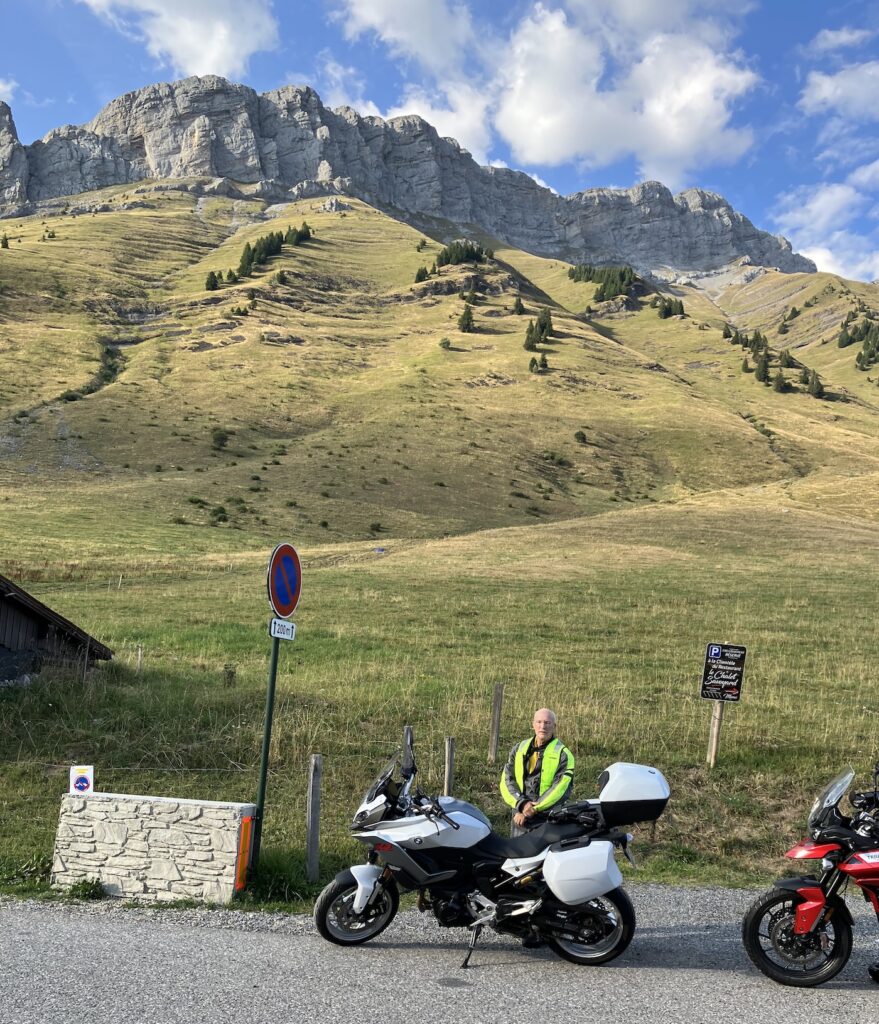
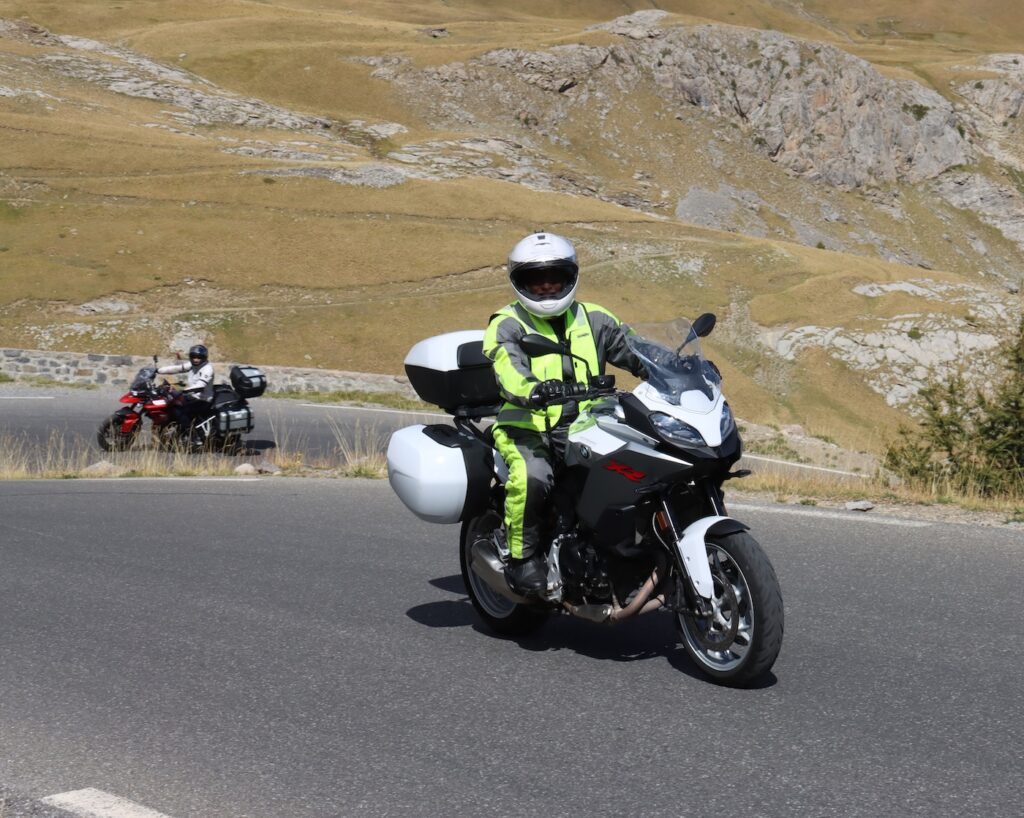
Riding a motorcycle through the French Alps to tackle the legendary twisties of Tour de France routes is a thrill tempered by a dose of fear. There’s the good kind of fear, the kind that keeps you sharp and safe, and the bad kind that can freeze you up and make things dicey. Finding the sweet spot where healthy caution meets relaxed fun is the trick. For two Americans pushing their limits on unfamiliar alpine roads, this was a two-week crash course in balancing both.
This adventure was my friend Bruce’s brainchild. At a BMW club meeting, he lit up talking about carving through the Tour de France’s alpine routes. Bruce logs 15,000 miles a year and teaches motorcycle classes, and he was hooked on the idea and excited to practice his rusty high school French in Paris. I ride maybe 3,000 miles a year when the weather’s nice, so I was curious–not sold. My near-fluent French caught his interest, though, and he waved off my skill concerns. “I’ll handle the planning,” he said. “You just show up. I’ll navigate, and if I zip ahead, I’ll loop back for you.” Sold! We booked bikes, helmets, flights and hotels for August 2022.
In late June, Bruce’s wife dropped a bomb: “Honey, you’re not going. I bought a house and you need to sell ours.” Bruce was out, and I wondered if I could handle those mountain twisties solo. After a sleepless night, I decided to go for it. My wife, ever supportive, secretly recruited my old Peace Corps buddy Mike to join me. Mike rides less than I do and called the trip “insane” months earlier. After a cash bribe from my wife and some nudging from his adventure-loving girlfriend, he was in. I echoed Bruce’s pitch: “I’ll take care of everything. Just ride. We’re a team.” Mike’s dry humor was a bonus I didn’t expect.
Bruce took the time to walk me through loading GPX files into the BMW Connected app. I practiced tight turns on the Blue Ridge Parkway and joined Cone Camp for slow-speed drills. The Harley guys showed me I still had work to do. Mike prepped too, taking two motorcycle classes and conquering Mount Lemmon.
We chose Moto-Plaisir near Geneva for our rentals. It was near the Alps, stocked with BMW motorcycles and close to an airport with direct flights from Dulles. They had 69 bikes ready when we arrived; Mike picked a Triumph Tiger GT Pro (he rides a Bonneville T100 at home) and I got a BMW F 900 XR (I’m used to an F 800 ST). The higher seats gave us both some jitters. GoPros weren’t available, but honestly, our rides couldn’t top the epic Alps videos already out there.
Our first headache turned out to be Bluetooth issues. Mike’s rental wouldn’t sync with my Schuberth R2 helmet, and while I could get TomTom directions, I couldn’t get both TomTom and Mike’s voice at once. We muddled through, with me toggling between the TomTom and the road to relay cues to Mike. Later, we ditched voice comms so I could focus on directions, which only led us astray three times. As far as problems go, it was annoying but not disastrous.
Bruce mapped out a 12-day counterclockwise route, but I flipped it to clockwise for better weather to see Mont Blanc (15,774 ft). Reversing the GPX files wasn’t easy, and I didn’t set the TomTom to a parking garage, so we scrambled to park (illegally) in Chamonix, barely making our cable car to take us up 12,605 feet. Altitude sickness hit me hard—I nearly fainted—but the clear, wind-free view of the retreating glacier was worth it. Visit soon; it’s shrinking 98 feet a year.
From Chamonix, we rode west to Annecy, south to Chambery Gap, and passes–which they call cols–like d’Allos (7,382 ft, 33-time Tour de France route), de la Bonnette (9,193 ft, 6.8% average gradient), de Vars (6,916 ft) and d’Izoard (7,743 ft). We looped around la Meije’s 13,000-foot glacier, crossed Lac du Chambon’s dam, hit Pont de Claix, Thonon-les-Bains and the Route des Grandes Alpes to Morzine, then went back to Annemasse. The northern Route Napoléon from Chambery to Gap was a historic highlight.
The passes were intensely narrow roads, some barely 1.5 lanes wide, with flimsy barriers of gravel ridges, wooden rails or just police tape where rockslides had wiped them out. At Col de la Bonnette, I dodged altitude sickness worries and a kid bombing down on a skateboard. The 70-mile view of Italian peaks was unreal, shared with motorcyclists, cyclists and even an old VW bus that passed us. A cyclist in her 50s, unfazed by the climb, snapped our photo and shrugged, “This is what we do.” It was humbling.
Col d’Izoard’s 7% gradient and 34 Tour de France appearances tested us. Mike, battling anxiety, admitted to a foot-down moment in a twisty. “Two seconds of lost focus after eight hours in the saddle ain’t bad,” I told him. His mantra: “Focus.” A pro photographer caught us in action, and we bought the shots online for posterity.
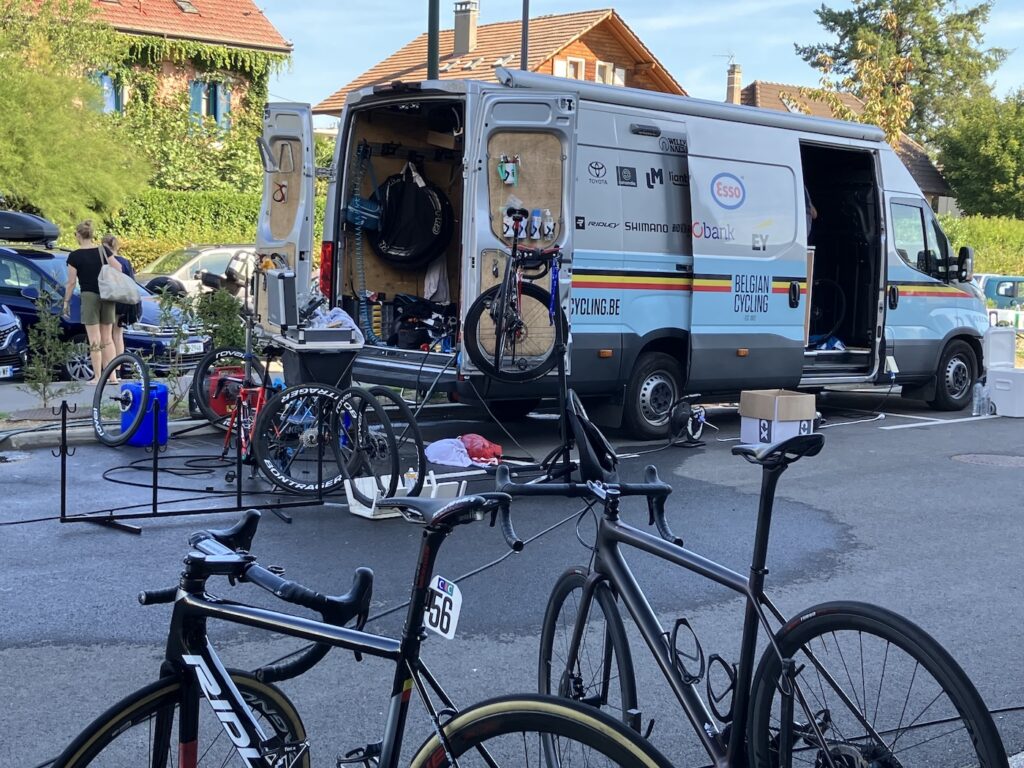
Not every highlight was a twisty. On a straight valley stretch, a Ducati rider on a bright red bike signaled, “Wanna race?” I declined, grinning as he vanished over the horizon. In Thonon-les-Bains, we shared a hotel with 70 junior Tour de France riders, all of them lean, agile and backed by seven vans and other vehicles filled with serious support crews and their tools. Bicycling is serious business in Europe!
Navigating traffic circles was tricky. France’s “ronds-points” vary; some give right-of-way to vehicles in the circle, others to those entering. Mike struggled to keep up in multi-lane circles, risking rear-enders. Toll booths were another hassle, beyond what they usually are for motorcycles; I skipped a few $2.50 tolls, earning a $115 fine from France’s Directorate of Highways after trying to sneak through with cars. Mike’s hand cramped from gripping too tight, and he dropped his bike a few times at low speeds. Moto-Plaisir charged fairly for minor damage. Fatigue and anxiety were real, but Mike’s openness let me adjust routes and offer support. Over dinner, we laughed off the stress, sticking to one riding tip a day.
My wife texted mid-trip, “Is this a motorcycle adventure or a food tour?” It was a fair point. Family-run inns served local gems like tartiflette (cheese, bacon, potato casserole), fresh caprese, sauerkraut with sausage, and baked perch with Raclette. Desserts like crème brûlée with vanilla ice cream or Calvados flaming apple tarts were unreal. One night, we ended up at a French steakhouse chain, staring at cow and sheep portraits while their kin sizzled on the grill. Lodging was tight, as Europeans flocked to the Alps to escape hot weather that summer instead of to the Mediterranean to enjoy it, making scarce the usual surplus skil lodge rooms, but Booking.com saved us nightly.
Looking back and reflecting honestly, we used four methods to manage our fear and anxiety about the trip. Mike and I were honest with each other, sharing our concerns up front and agreeing on routing and route changes along the way. We checked in with each other daily–sometimes hourly–to make sure we stayed on the same page. We learned a lesson about our gear, resolving to test everything before riding to avoid having to work around issues like subpar comms. Finally, we supported each other with reassurances and kept coaching to a minimum to keep our stress levels low. We also made sure we had fun during our time off the bikes.
Despite the fun we had, it wasn’t a perfect trip. A slower pace or an extra week would’ve boosted the fun. As Neil Peart, BMW rider and Rush drummer, put it in his book Roadshow, “Adventures suck when you’re having them.” Funny later, nerve-racking when they’re happening, but worth every twisty.
The United Auto Workers has endorsed President Joe Biden’s bid for reelection in 2024. “Joe Biden has earned it,” said union president Shawn Fain on Jan. 24 as he announced the union’s decision to back the incumbent candidate.
The Conversation U.S. asked Marick Masters, a Wayne State University scholar of labor, politics and business issues, to explain why the UAW waited until now to endorse Biden and why this endorsement matters.
Why is the UAW endorsement significant?
The UAW’s endorsement provides symbolic and substantive support for the president.
Symbolically, it shores up Biden’s backing by organized labor – a critical constituency in an election year that promises a tight rematch between him and former President Donald Trump.
Recent national polls have leaned at least slightly in Trump’s favor, which means that Biden will have to mobilize voters in key battleground states like Michigan – where the largest number of the UAW’s 400,000 active and 580,000 retired members live – to win reelection.
Substantively, the endorsement clears the way for the deployment of the political muscle of this union to help get out the vote for Biden in November. Historically, the United Auto Workers has tried to help its members and the public in general become well informed about politics and elections and sought to mobilize voters for the candidates it endorses.
Although the ranks of organized labor in the U.S., including the UAW, have generally declined significantly since their heyday in the 1950s, the United Auto Workers has a formidable network in battleground states like Michigan, where roughly 130,000 of its members reside. Biden won Michigan by 154,000 votes in 2020, while Hillary Clinton lost it by just 11,600 votes in 2016.
Unions made about US$27.5 million in contributions to Biden’s 2020 campaign. While nominally a significant amount, it pales in comparison to the amount that businesses contributed. Biden’s 2020 bid was the first ever to draw more than $1 billion from donors.
UAW President Shawn Fain announced the union’s endorsement of President Joe Biden’s reelection bid.
What led to the delay in endorsing?
Rather than make an early endorsement of President Biden, in 2023 the United Auto Workers instead voiced dissatisfaction with the administration’s policy of accelerating the transition to electric vehicles.
From the union’s perspective, the Biden administration had not given labor rights adequate protection as the Big Three automakers formed joint ventures with foreign-based manufacturers of batteries to facilitate the industry’s transition to producing far more electric vehicles.
As the union prepared for its contract negotiations with General Motors, Ford and Stellantis – the global company that manufacturers Chrysler, Dodge and Jeep vehicles in the U.S. – the UAW hoped to exert whatever influence it could over lawmakers and the companies to open the joint ventures to union representation.
But Fain made it abundantly clear at the time, as he has done again and again, that Trump was not a viable alternative. He has repeatedly said that Trump’s election in 2024 would be “a disaster.”
And to be sure, the UAW didn’t endorse Biden’s 2020 candidacy until April 21 of that year. It moved faster this time.
How did UAW members vote in 2016 and 2020?
Despite widespread union endorsements of Hillary Clinton in 2016 and Biden in 2020, a significant percentage of union members cast their ballots for Donald Trump in both elections.
In 2016, 38% of union members voted for Trump compared with 58% for Clinton, according to University of Michigan researchers. In 2020, 40% of voters in union households voted for Trump compared with 56% for Biden.
That’s in line with the UAW’s partisan breakdown in prior elections. About 60% of UAW members and retirees have historically voted for Democratic Party candidates, according to Brian Rothenberg, a former union spokesman.
In close races, support from the United Auto Workers and the rest of organized labor could prove decisive, notwithstanding that the union’s membership has fallen from 1.5 million in the late 1970s to less than 400,000 today, and that overall the union membership rate in the U.S. workforce has shrunk to 10%.
And in states like Michigan and Pennsylvania, which have numerous union members, the United Auto Workers’ efforts on behalf of presidential candidates may tip the balance. Unions had roughly 564,000 members in Michigan in 2023, according to the Bureau of Labor Statistics.
Was there a chance that the UAW could have backed Trump?
No chance whatsoever.
The United Auto Workers would have condemned itself within the Democratic Party and progressive circles if it had broken with tradition and not endorsed the party’s candidate. Endorsing Trump would have forfeited the UAW’s leverage to influence the Biden administration’s policies regarding the transition to vehicle electrification.
“Donald Trump is a billionaire, and that’s who he represents,” Fain declared before making the union’s endorsement. “If Donald Trump ever worked in an auto plant, he wouldn’t be a UAW member, he’d be a company man trying to squeeze the American worker. Donald Trump stands against everything we stand for as a union, as a society.”
I believe that endorsing Trump would also have created an irreconcilable rift in the union itself with harmful fallout. And it would have alienated Biden, who showed his support for the union’s strikers in September 2023 by standing with them on the picket line – a first for any sitting president.
Time machines – that is what MB&F founder Maximillian Büsser once thought of calling his now-famous Horological Machines. While this anecdote is apocryphal, it is easy to see how it might be taken for fact – it speaks to the dream behind the brand. Regardless of the name, 20 years ago, Büsser revealed a vision of kinetic sculptures that told the time when he debuted his brand, MB&F. It is perhaps more accurate to say that the machines told stories about time, and they still do, even now in the form of MB&F’s latest, the SP One. This, the SP part, is the third proper family in the MB&F assortment, after the Horological Machines and the Legacy Machines.
The SP in SP One is indicative of what this watch is because it stands for Special Projects, of course. Let us spare a moment to consider what MB&F itself says about the SP One. “We asked ourselves: what if we did what no one expected – an elegant, classical watch?” according to Büsser. The concept came to life in the midst of the pandemic, when MB&F decided that life is too short to live cautiously. Some years later, Special Projects is going to become another pillar for the Genevan firm.
It is no surprise that a brand with very specific aesthetics tied to specific collections would want some breathing room. Neither the Horological Machine nor the Legacy Machine, abbreviated as the HM and LM respectively, could accept just any sort of watch, much less the “elegant,” and “classical,” sort. However, in principle, there are no real hard lines that block MB&F from creating any sort of horological machine that it wants. If you consider the breadth of HM models over the past 20 years, that much should be clear. Every HM watch, and LM watch too, is a special project, in this way of thinking. However, the nature of the SP One speaks to its own identity – if MB&F tried to reimagine the LM as a HM, this might be one interpretation. Another goes back to Büsser’s words: what would a contemporary dress watch look like if given the MB&F touch?
Well, the watch looks like no classical watch we can think of, even if it is a time-only manual-winding 38mm watch cased in precious metals. Looking at the watch here, that description seems threadbare… The distinctive Y-shaped movement architecture places barrel, balance wheel and dial on show – the brand’s release even calls the case an “amphitheatre,” for the kinetic ballet. The three-dimensional movement, complete with conical gearing just to show off that tilted dial, calls attention to itself with its substance. Impressively, there are all kinds of hand-finishing touches here, including engraving – exactly what you might expect from a classical dress watch.
Another question that lends itself to speculation is where does the SP go from here? SP Two is no doubt already in progress and how it fits in with a shockingly prolific output (see the Bvlgari x MB&F Serpenti, a couple of M.A.D. watches and the Legacy Machine Longhorn editions) is something members of the Tribe will wonder about. For our part, we think the SP watches are yet another effort by MB&F to expand membership in the Tribe, but not because it is chasing growth. Many collectors like MB&F but most need a lot of luck to get one – when a specific sort of watch sparks the right feeling. If SP watches keep a relatively standard form, this collection might be what we have all been looking for.
This story was first seen as part of the WOW Legacy 2025 Issue
For more on the latest in luxury watch reads, click here.
Veterans are drawn to RVing for many reasons, including the mobility, the sense of independence, the camaraderie, and the healing power of the outdoors.
Here you’ll find everything from how to get a free America the Beautiful lifetime pass to tips on finding campground and RV park discounts. There’s also helpful info on VA benefits that support RV travel, from healthcare access on the road to adaptive equipment grants.
You’ll also discover ways to connect with veteran RV communities, clubs, and support groups, plus a list of grants and financial aid opportunities just for vets. This guide is a thank-you to veterans to help get the most out of the RV lifestyle.
So, why put together an RV recreation guide for veterans? Interesting question. For one, I’m a vet myself, so consider it an all-hands-on-deck effort. For two, I always seem to meet fellow veterans who RV while I’m on the road, and I am proud to share a spot with them around the campfire.
In short, veterans really enjoy camping and RVing, so a recreation guide makes perfect sense, especially with all the discounts out there, specifically offered to vets. But ultimately, it makes sense for several other reasons. Vets appreciate the familiarity with mobility and independence, enjoy the community and camaraderie aspect, are familiar with the practicality, and find peace and rejuvenation in the great outdoors.
Hard to argue with that. It’s impossible to serve without sacrifice, and vets need that reprieve post-service.
It’s not much, but in appreciation for that sacrifice, here is a helpful guide for veterans, so you can get the most out of your journeys. Thank you for your service, and don’t forget to check this guide before you head out!
National Parks and Public Lands Access
It wouldn’t be a proper Veterans RV guide without including our country’s national parks and public lands. Teddy Roosevelt, though not a career military veteran, led the Rough Riders in the Spanish–American War and deeply valued public lands. He played a major role in expanding national parks and conservation efforts, creating a legacy that continues to welcome returning service members. So, there’s a distinct connection there, almost a “welcome home” invitation.
Many US National Parks and federal recreation lands offer special benefits for veterans, including free or discounted entry, in addition to expanded access through the America the Beautiful Pass Program.
Free and Discounted Access for Veterans
All Veterans and Gold Star families are eligible for a free, lifetime ‘America the Beautiful’ Pass, granting access to 2,000-plus federal recreation sites.
Current service members and their dependents can receive a free America the Beautiful Pass.
Disabled vets can get a free lifetime access pass, which waives entry fees and offers discounts on other amenities at participating sites (requires proof of disability; valid for national parks and public lands nationwide).
All National Park sites with entrance fees are free for everyone on Veterans Day, November 11, each year.
Where Passes are Valid
All National Parks (like Yosemite, Yellowstone, Acadia, Grand Canyon, etc.).
National Wildlife Refuges.
National Forests.
Bureau of Land Management sites.
Sites managed by the Bureau of Reclamation and the Army Corps of Engineers.
However, the pass doesn’t waive camping fees, concessions, or fees at state parks unless otherwise specified.
Obtaining America the Beautiful and Disabled Veteran Passes
You can obtain these passes in person at federal recreation sites. However, if you prefer to handle things remotely, you can order online (typically a $10 fee) and have it mailed to you.
To order online or to obtain in person, you have to provide a valid ID and, for disabled veteran passes, documentation of a permanent disability (VA letter, proof of SSDI, or state-issued disability identification).
Thankfully, it’s not a difficult process by any means. Of course, ordering online usually means waiting a bit for the shipping. If you’re itching to hit the road, bring your documentation and pick up your pass when you reach your destination.
Park Shutdowns and Access Challenges
During government shutdowns or similar disruptions, park operations may be limited. Entrances and trails may remain open, but services like visitor centers and maintenance could be suspended.
Fee collection may be suspended throughout shutdowns or for other extenuating circumstances (rare, but things happen). Some parks may lock gates completely, while others remain accessible, with minimal maintenance and updates on road conditions and weather.
Seasonally, some campgrounds, amenities, and concessions operate on reduced schedules or close entirely.
Summary Table During Shutdown
Benefit Type
Who is Eligible
What it Covers
Notes on Access
Free lifetime pass
Veterans and Gold Star families
Entrance to 2,000+ federal sites
Valid even during shutdowns
Free annual military pass
Active-duty and dependents
Same as above, valid for one year
Disabled access pass
Disabled veterans
Same as above, plus amenity discounts
Requires documentation
Fee-free Veterans Day
Everyone
Free entry on November 11
Services may still be unavailable
Shutdown impacts
All visitors
Limited or closed facilities and less maintenance/staff
Check the park website before visit
Campground and RV Park Discounts
Keep in mind, if I listed every single RV park and campground discount for veterans on here, you would be asleep before you hit the second page. So, this is a breakdown of popular campground and RV park discounts. Even unlisted, most of these places will have some sort of discount for veterans; just be sure to check beforehand.
Veteran & Military Discounts: Many, if not most, private and publicly managed campgrounds provide special rates or free nights for active-duty military, veterans, and their families. Look for places offering discounts for weekly and monthly stays, along with complimentary amenities to honor service members.
Senior Discounts: Campgrounds will often extend discounted rates to seniors, starting at age 55 to 62. AARP memberships will often unlock additional discounts.
Membership Club Discounts: Many campground membership clubs offer exclusive discounts and perks at their respective, affiliated campgrounds.
AAA/CAA Discounts: TheAmerican and Canadian Automobile Associations offer member discounts on camping and RV park fees at select locations.
RV Clubs and Associations: Some clubs, such as Escapees RV Club and the Family RV Association (FRVA), provide member-only discounts at affiliated parks.
Seasonal and Extended Stay Discounts: Many campgrounds offer reduced rates for off-season stays or discounts for extended bookings, such as weekly or monthly rates.
Veterans-Only Campgrounds and Military Bases
Next up is an option, or options, unique to service members including active-duty service members, veterans, retirees, and their families. These are veteran-only campgrounds and available camping options on military bases. Access rules vary, but usually require military affiliation and sometimes advanced registration and/or sponsorship.
Military Base Campgrounds: Many U.S. military installations throughout the country have RV parks and campgrounds that are open to active-duty, veterans, and their families. These sites generally provide well-maintained facilities, full hookups, showers, and recreational amenities.
Veterans Only Campgrounds: Some private or non-profit campgrounds cater exclusively to vets and their families, bolstering post-service camaraderie and peer support. These parks may offer veteran-focused programs, discounts, and events throughout the year. Membership or proof of military service is necessary for entry.
Access and Eligibility
Active-duty, reserve, National Guard, and retired military personnel usually qualify for base camping.
Veterans often need proof of honorable discharge (DD214 or similar documentation).
Some campgrounds require membership in veteran organizations or military clubs.
Availability may be limited, and reservations may be necessary, sometimes well in advance, especially for popular locations or throughout holiday or seasonal periods.
VA and Military Benefits Relevant to RVing
This is a fairly extensive list if you include all of the local options available to veterans across the US. It would be all but impossible to list all of those. There are six or seven local camping/RV sources here in my own local community that offer various benefits for veterans. Trust me, mine is one of those towns where the two red lights start blinking at 9 pm.
Free and Discounted Access to Public Lands: Veterans, active-duty, and Gold Star families receive free, lifetime access to more than 2,000 federal recreation sites (national parks, national forests, wildlife refuges, and BLM lands).
Military Campgrounds and Base RV Parks: The aforementioned campgrounds and RV parks offer full RV hookups, discounted rates, and free stays for eligible veterans, including disabled veterans and Purple Heart recipients.
Military and Veteran Discounts from RV-Related Businesses: RV manufacturers and dealerships often provide military discounts on purchases. Many private RV parks and campgrounds extend 10–20% discounts to military and veterans. RV rental companies and supply retailers may also offer special pricing.
VA Healthcare and Support on the Road: Veterans using VA healthcare can coordinate care while traveling through the VA’s nationwide network, allowing access to local clinics and medical record transfers as needed.
Adaptive and Vehicle-Related Benefits: Vets with service-connected disabilities might be eligible for auto allowances and grants to modify RVs for accessibility.
Limitations on VA Loans for RVs: Since RVs aren’t classified as permanent homes, VA loans typically don’t apply. Veterans can explore alternative lenders that offer RV-specific financing options.
RVing Groups and Communities
There are numerous groups and communities available for veterans to utilize. These include social groups, online communities, and veteran RV clubs. Several cater exclusively to veterans.
Veteran-Specific RV Clubs: The Veterans Camping Association and Building for Veterans groups are two primary options, though you’re likely to find similar, smaller-scale groups on the local level as well. These groups typically focus on accessible camping and community services, organizing rallies, meetups, and various club events.
Military and Veteran Sections in Broader RV Clubs: Escapees RV Club and FRVA have dedicated military or veteran divisions with targeted resources, discounts, and social activities, offering veterans access to exclusive campground discounts, support networks, and special events.
Online Forums and Communities
Veteran-Focused Online Groups: Platforms like Facebook host numerous veteran RV groups, including “Military Veterans RV Community” and “Military and Veterans’ Discounts.” Also, you’ll find region-specific groups connecting veterans who travel or RVs. These groups share trip advice, technical RV tips, and emotional support.
Broad RV and Camping Forums with Veteran Subsections: Forums like iRV2 and other online platforms are places where veterans can discuss RV maintenance, travel routes, discounts, benefits, and lifestyle adjustments.
Community Support and Resources: Veteran RVers also find support through nonprofit organizations like American Veterans (AMVETS) and DAV, which sometimes host RV-related programs or offer information sharing covering camping accessibility and VA benefits.
Grants, Financial Aid, and Purchase Discounts
As this is a “Veterans RV Guide,” you’re probably skimming for straight-up lists. Well, here ya go:
These services cover several options for veteran RVers, including one-time automobile grants up to $26,417, separate adaptive equipment grants, transportation funding, financial assistance, housing support, case management, grants for disabled veterans, small business grants, reduced-fee loans, and VA-backed cash-out financing. To apply for these grants, visit the VA’s official website or contact a local Veterans Service Organization (VSO) for personalized assistance.
Additional Considerations
Veterans usually have to show ID and proof of service to access veteran benefits, discounts, or military campgrounds. Common documents include DD214s, Veterans ID cards, or VA health cards. Always check ahead for specific campground and/or pass requirements.
Several insurance providers offer discounts on RV insurance for veterans, including liability, collision, and comprehensive protection. And sometimes with roadside assistance perks as well. It pays to check and double-check when researching specific insurance providers.
Disabled veterans should keep an eye out for campgrounds, facilities, and parks with ADA compliance. These places will feature wheelchair ramps, grab bars, accessible restrooms, and low-entry thresholds for those who need more accessible, improved mobility.
Remember, climate and seasonal weather will impact accessibility. Plus, you should always review campground rules in advance, as things like fire bans, quiet hours, and wildlife protocols can vary widely.
Conclusion and Resources
As you can see, there are a ton of resources out there to take advantage of as a veteran. If you’re not taking advantage of every one of the resources in this Veterans RV Guide, you’re truly missing out on a wealth of information and significant savings. If you’ve served your country, you’ve earned each and every one.
Don’t forget that there are also local organizations, online forums, and groups that offer their own services as well, so be on the lookout for those. Thank you again for your service.
Have fun, stay safe, and Semper Fi.
FAQs on RVing for Veterans
1. Why is RVing such a popular lifestyle among veterans?
RVing appeals to many veterans due to its sense of independence, mobility, and the opportunity for peace and reflection in nature. It also fosters camaraderie, a value that strongly resonates with those who served in the military.
2. Do veterans get free access to national parks?
Yes. All U.S. veterans and Gold Star families are eligible for a free, lifetime America the Beautiful pass, which grants entry to 2,000-plus federal recreation sites, including national parks, forests, and wildlife refuges.
3. Are there RV parks just for veterans?
There are. Some private and nonprofit campgrounds cater exclusively to veterans and their families, offering a sense of community, special events, and veteran-focused support programs.
4. What kind of documentation is generally needed to access benefits?
Common forms include a DD214, Veterans ID card, or VA health card. You’ll need one or more of these when applying for passes, making campground reservations, or verifying eligibility for discounts.
5. Are there any RV-related financial resources or grants for veterans?
Yes. Veterans may be eligible for a range of financial support, including adaptive equipment grants, transportation funding, and housing transition aid. Details and applications are available through the VA or local Veterans Service Organizations (VSOs).