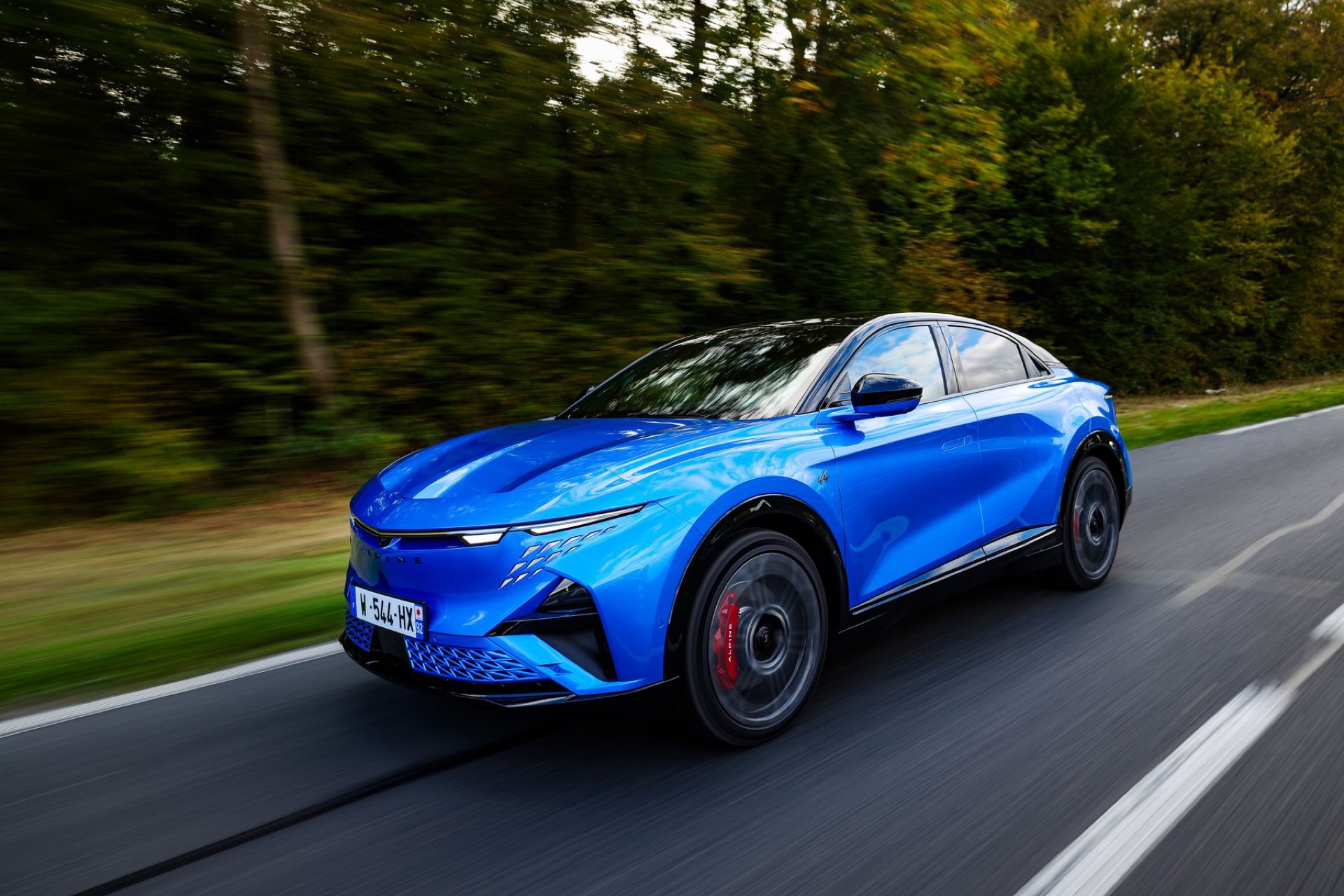
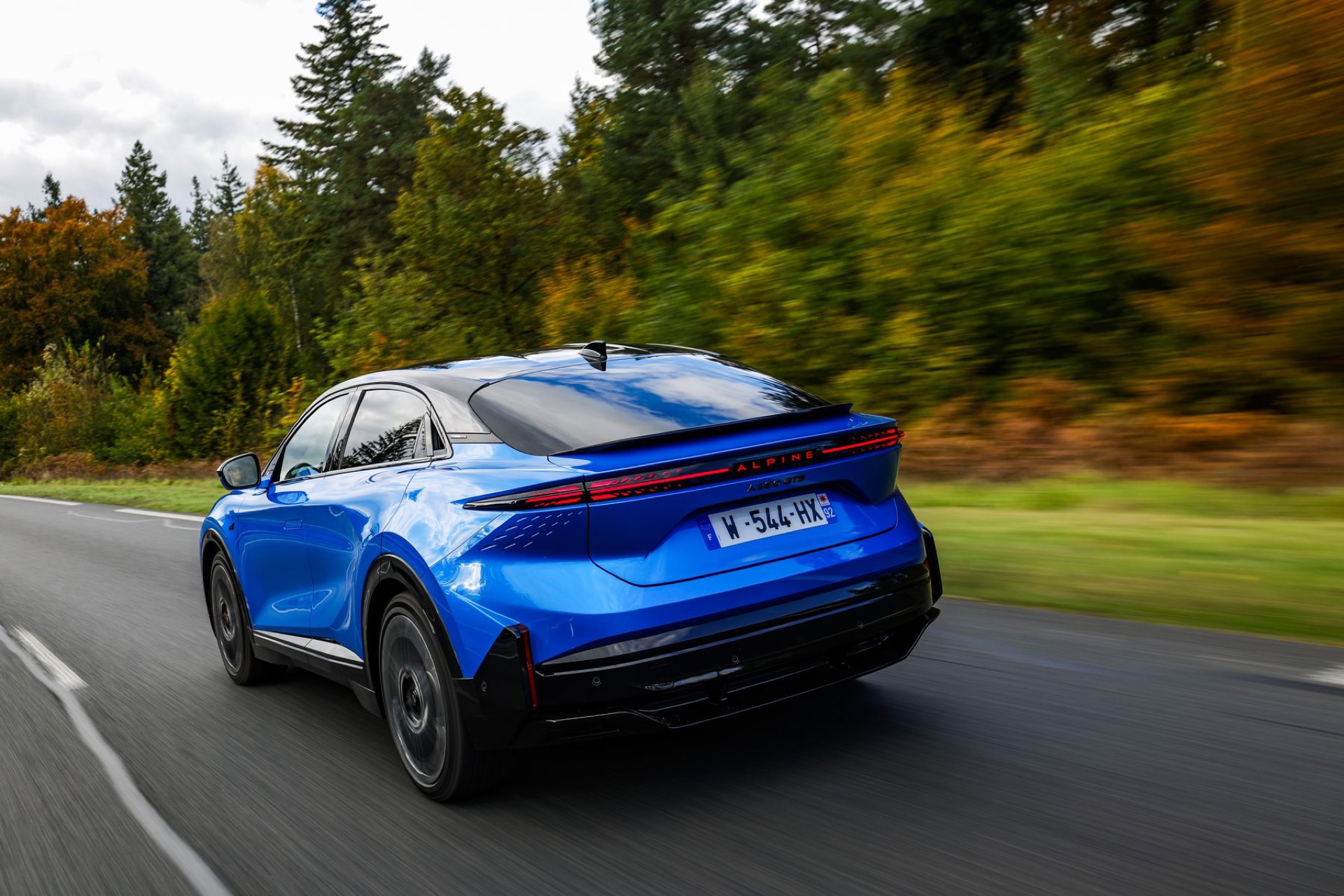
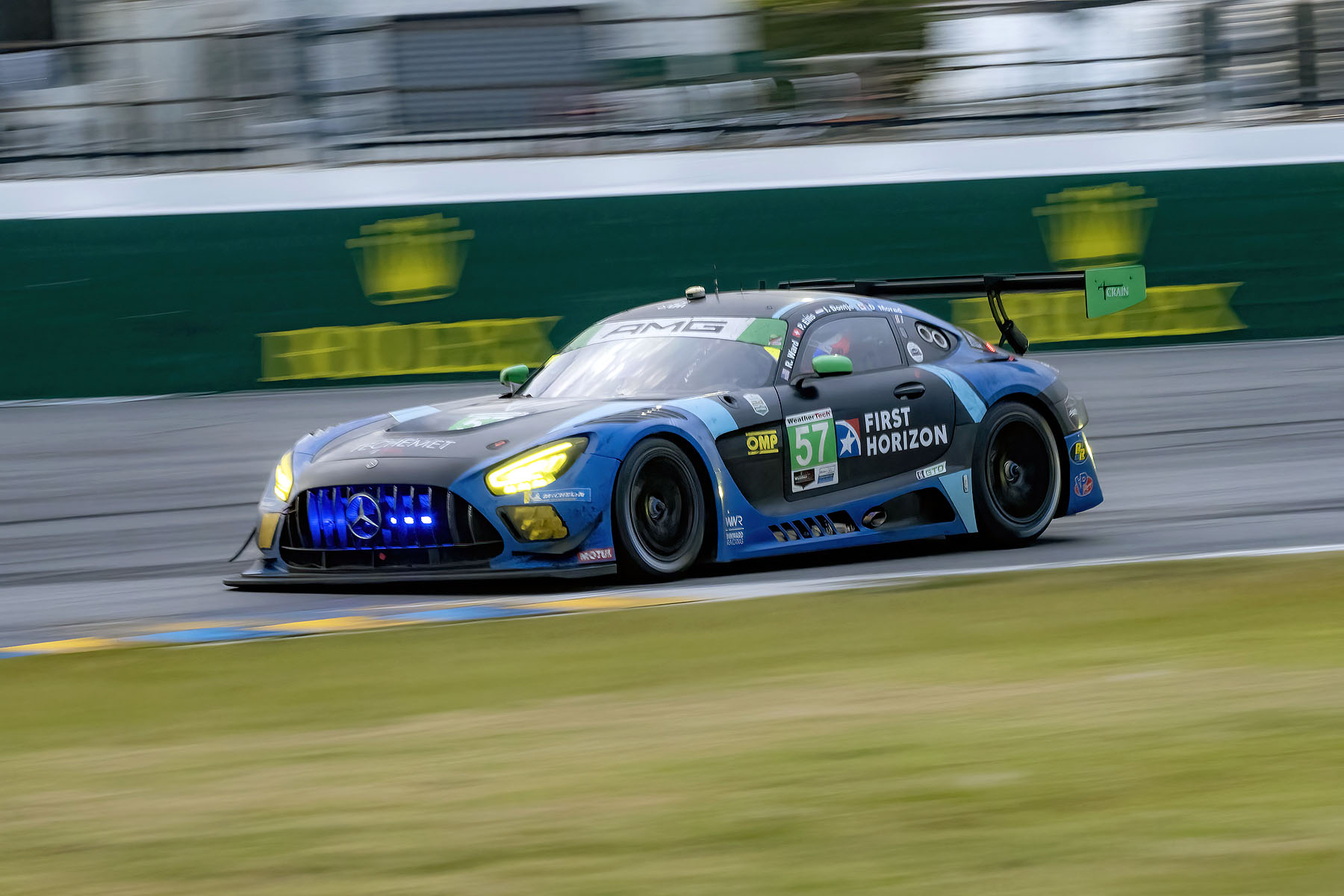
Alpine’s new electric crossover coupé, the A390, is a genuine corner-carver. It might not match the razor-sharp agility of a Porsche Macan 4, but it delivers serious driving pleasure — at a considerably lower price. Ever heard of a “blue banana”? No, it’s not some psychedelic fruit or the result of a botanical experiment gone wrong. It’s a feeling — the grin that spreads across your face when you’re driving the Alpine A390. Alpine cars are often painted in blue, and this one wears its grin up front, too. The blue banana, it turns out, comes as a double act.
Underneath, the A390 rides on the AmpR Medium platform also used by the Renault Mégane, Renault Scénic, and Nissan Ariya. Where Renault typically fits a single motor, and Nissan employs one per axle, the A390 uses a three-motor setup: a 115 kW (156 PS) EESM up front, and two identical PSMs at the rear to handle torque vectoring. “We started with a four-motor prototype, tested different configurations and software maps — the three-motor solution turned out to be the best,” explains chief engineer Robert Benetto.
It wasn’t a cheap solution, and Alpine’s dynamics engineers had to persuade upper management to greenlight it. In the end, former Renault CEO Luca de Meo gave the thumbs up. “The Alpine A390 can absolutely hold its own against the Porsche Macan Electric,” says product manager Fabrice Izzillo. It’s a bold claim, but there’s logic behind it. With 345 kW (470 PS), the French machine outmuscles the entry-level Macan 4 by 45 kW. It does 0–100 km/h in 3.9 seconds and tops out at 220 km/h.
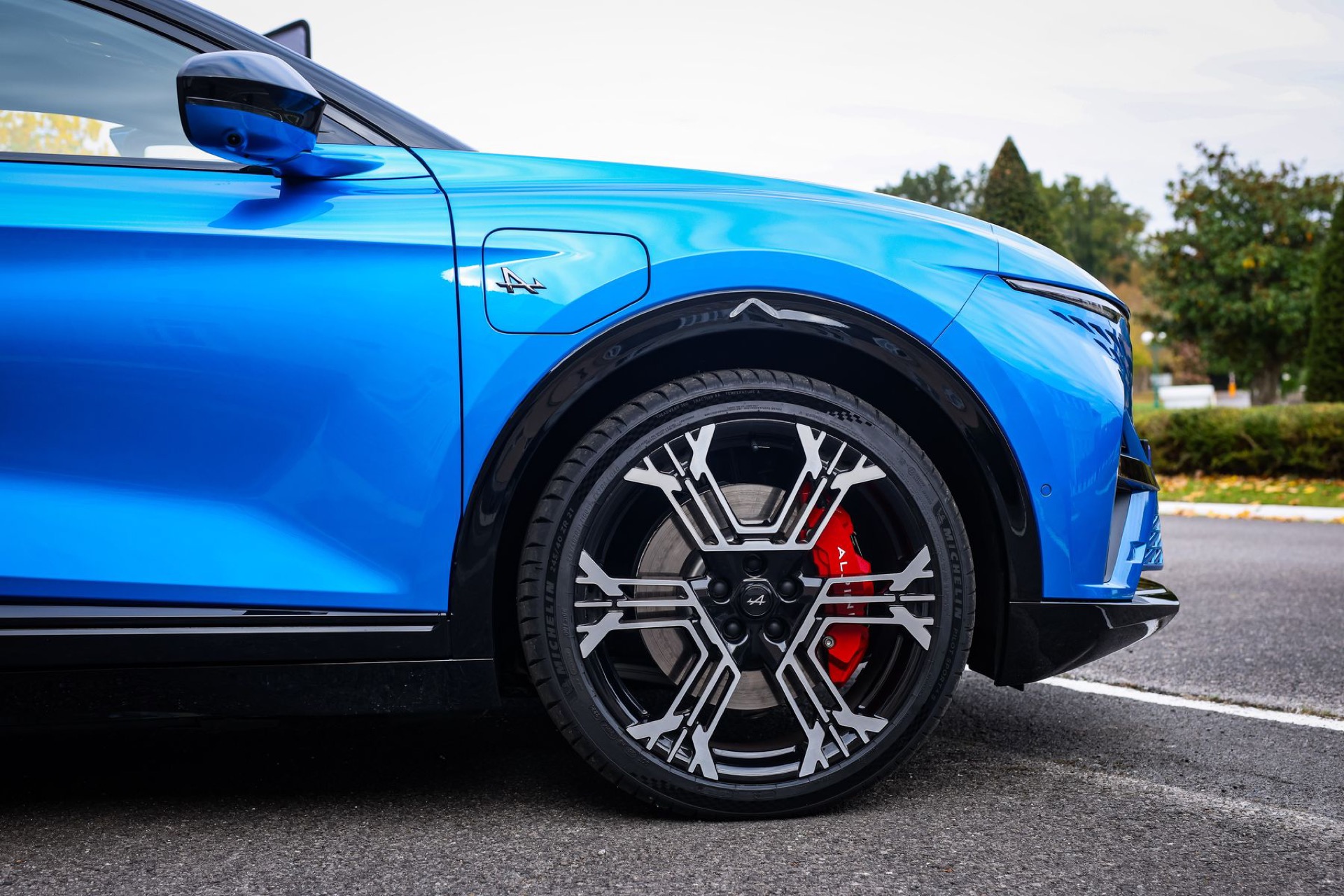
But Alpine isn’t about brute force. Its reputation rests on dynamic finesse through twisty roads. So the A390 features a sports suspension with coil springs and hydraulic bump stops, just like the A110. Stiffer anti-roll bars and bespoke dampers set it apart from its Renault-Nissan siblings. Forged aluminium double wishbones up front and a bespoke aluminium frame to cradle the twin rear motors sharpen response and add rigidity.
All that engineering work pays off. At 2,121 kg, the A390 is no lightweight, yet it feels playful and composed through corners. The front end is eager, and torque vectoring at the rear allows you to steer the car with the throttle. In Sport or Track mode, the system sends more torque to the outer rear wheel, tightening the car’s line. Even in Eco or Normal mode, it remains lively. The 824 Nm of torque certainly helps.
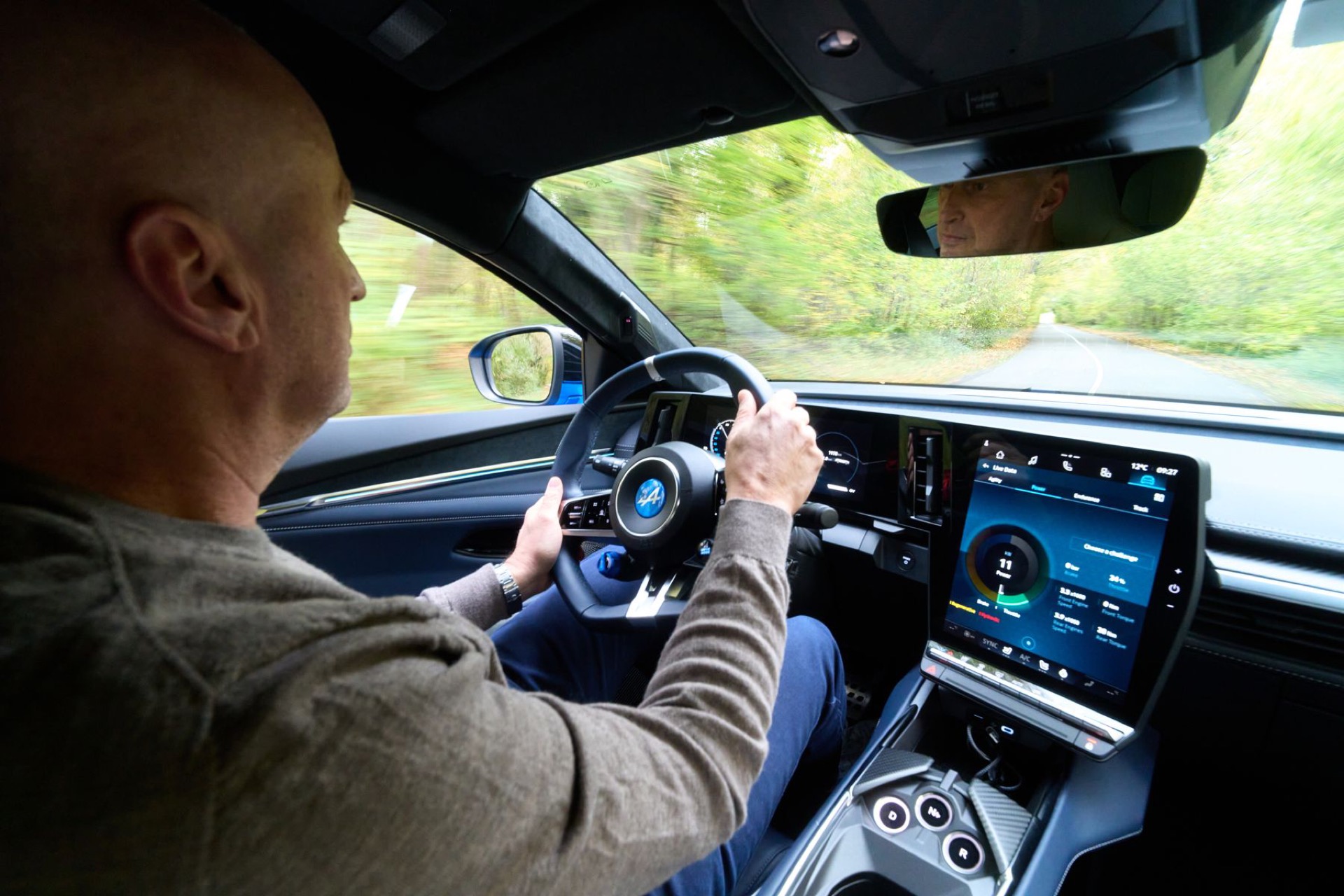
There are two fun toys at the steering wheel: a red Boost button for ten seconds of extra power, and a blue dial to adjust regenerative braking across three levels, including full one-pedal drive. The ride is firm but not harsh — just right, really. It may not quite reach the Macan 4’s apex precision, but with more power and around €6,000 less to pay, it’s a compelling offer. Go for the A390 GT (295 kW, €67,500) and you’re saving €17,100.
We recorded an average consumption of 24.8 kWh/100 km — 4.4 kWh more than claimed. The usable battery capacity is 89 kWh, offering up to 503 km on the GTS with 21-inch wheels. Max DC charging is a decent 190 kW; thanks to a standard heat pump, you can go from 15% to 80% in 25 minutes. At 11 kW AC, 20–80% takes 5 hours 20 minutes. With optional 22 kW AC, that drops to 2 hours 40.
Inside, the A390 GTS has two screens: a 12.3-inch instrument cluster and a 12-inch vertical touchscreen running Android Automotive. The interface is intuitive, and there’s some typically French drama in the sportier drive modes — G-force displays included. Why is there still a bulky physical volume knob? “We spent the budget on chassis dynamics,” says Benetto. Fair enough.
The A390 measures 4.62 metres in length and goes on sale in January. Rear-seat headroom is tight for those over 1.85 metres tall, due to the sloping roof. Boot space is 532 litres, or 1,643 litres with the seats folded — although a step in the load floor and a high lip make for awkward loading. Still, that’s a small price to pay for a car that puts such a huge grin on your face. Or as they say in Dieppe: the blue banana effect.
Alpine A390 Car of the Year Tests in Chantilly, France, on October 23th 2025 – Photo: Romain Thuillier / DPPI
SOME SAY TWO is twice as nice, and that’s undoubtedly the case for RVs with two bedrooms. Many manufacturers offer floor plans with a bunk room or second bedroom with a larger bed. Comfort and privacy can be yours, even while camping!
Two-bedroom RVs are especially great for multi-generational travel, where grandparents travel with their adult children and grandchildren, providing cozy space for everyone. They also work well if you want a larger bed for teenagers who’ve outgrown the standard RV bunk size, or you like to camp with friends and extended family.
Let’s examine our picks for the best 5th wheels, travel trailers, and destination RVs with two bedrooms.
Key Takeaways
Two-bedroom RVs offer added comfort and privacy — perfect for multi-generational families, large groups, or those seeking more spacious sleeping arrangements for teens or guests.
Available across multiple RV types — from luxury fifth wheels like the Montana High Country 381TB and North Point 390CKDS to family-friendly travel trailers like the Coleman Lantern 32BHS and Transcend 305BHT, and even residential-style destination trailers like the Springdale Villa 380DB and Sierra 41DUPLEX.
Many include upgraded amenities — such as two full bathrooms, residential kitchens, king or queen beds in both bedrooms, large lofts, and multi-zone climate control—making them ideal for extended stays or use as guest houses.
Top Fifth Wheel Two Bedroom RV Floor Plans
Modern fifth wheel frame construction allows for longer lengths, giving sufficient space for a second bedroom. Check out these two-bedroom fifth wheel RVs:
Keystone Montana High Country 381TB
Want to see the latest RVs? Subscribe to the Camping World YouTube channel, and never miss a video.
Specs
Length: 42’5”
Dry Weight: 14,364 pounds
Cargo Capacity: 2,136 pounds
Sleeping Capacity: Up to10
Luxury comes standard in the Montana High Country 381TB, which is a two-bedroom, two-bath RV. Both bathrooms feature a shower, and one has a direct exterior entrance. The rear bedroom features a queen-size bed, while the front bedroom offers a king-size bed, which can be replaced with a queen bed to create more floor space.
With a sleeping capacity of up to 10, this 2-bedroom camper also makes it easy to feed a large family or gathering, thanks to the large island, extensive counterspace, and an 18-cubic-foot fridge. The ice maker is a bonus you’ll love for cooling summertime drinks.
I appreciate the year-round travel features on this 4-season capable 5th wheel, which has been tested to perform well in temperatures as low as 0℉. Additional insulation and reflective foil keep the interior comfortable year-round, while holding tank heating pads and a heated and enclosed underbelly help prevent frozen pipes.
Keystone Cougar 364BHL
Images by Camping World
Specs
Length: 39’
Dry Weight: 11,718 pounds
Cargo Capacity: 2,282 pounds
Sleeping Capacity: Up to10
The Cougar 364BHL creates a family-friendly bunk room by combining a rear bedroom and a sleeping loft, which is open to the space below. Underneath, you’ll find a full bed. This space is excellent for large families or for multiple generations. The grandparents can enjoy the bed, while the kids sleep in the loft.
The rear bedroom even features a spare half bath with a second entrance, equipped with an LCI® SolidStep™. This makes a great mudroom for containing dirt tracked in by kids or pets.
In addition to a traditional exterior, Cougar offers unique full-body paint packages with distinctive looks, including the Hero Edition and the Midnight Edition. Another feature I love is the inclusion of a second air conditioner, featuring an 18,000-BTU Chill Cube™ air conditioner for the main space and a second quick-cooling 15,000-BTU A/C for the bedroom.
Jayco North Point 390CKDS
Images by Camping World
Specs
Length: 43’10”
Dry Weight: 16,195 pounds
Cargo Capacity: 2,655 pounds
Sleeping Capacity: Up to7
Many second RV bedrooms are bunkrooms, which aren’t always comfortable for teens or adult guests. However, the second bedroom in the North Point 390CKDS feels like a private retreat suitable for adults, with a queen bed, an attached full bath, and a second entrance.
The kids aren’t overlooked, either. Climb up the living room ladder to find a mega loft, which features three bed mats and additional storage. Children will love having this overlook and a space all their own. The tankless on-demand water heater means everyone can shower without the fear of a cold splash when the hot water runs out.
Swap out the theater seats and roll-top dinette in the living room for an extra-long “super sofa” so everyone in the group can have a comfy spot to sit or snuggle. Additionally, foodies will appreciate the kitchen, which features a 21-cubic-foot residential refrigerator, a pull-out cutting board, and a flip-top counterspace.
Forest River Sabre 36DBB
Image by Camping World
Specs
Length: 43’2”
Dry Weight: 13,243 pounds
Cargo Capacity: 3,182 pounds
Sleeping Capacity: Up to 7
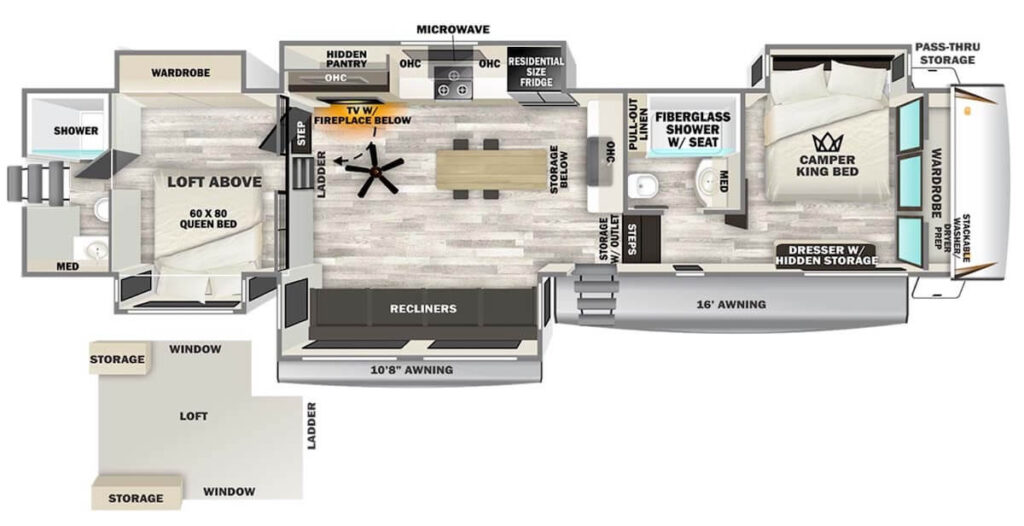
The Sabre 36DBB does things differently from other fifth wheels. First, instead of dedicating the kitchen island to the sink, the sink is moved to a side counter. The butcher block island features seating for four, with countertop extensions that add even more space. A couch with five embedded recliners is located along the campside slide. This space is great for entertaining.
Another unique feature is the headroom in the loft. I noticed many fifth wheel lofts are quite narrow, leaving room for only young children to comfortably sleep. Here, a drop-frame chassis allows extra headroom, creating a roomier loft with two storage wardrobes and windows.
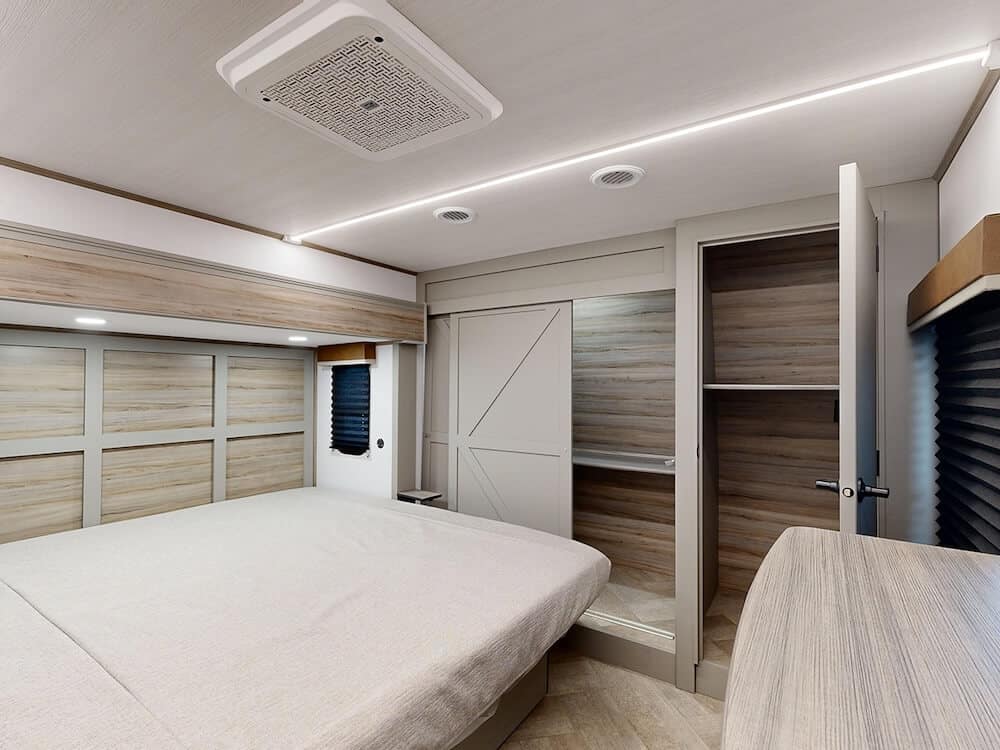
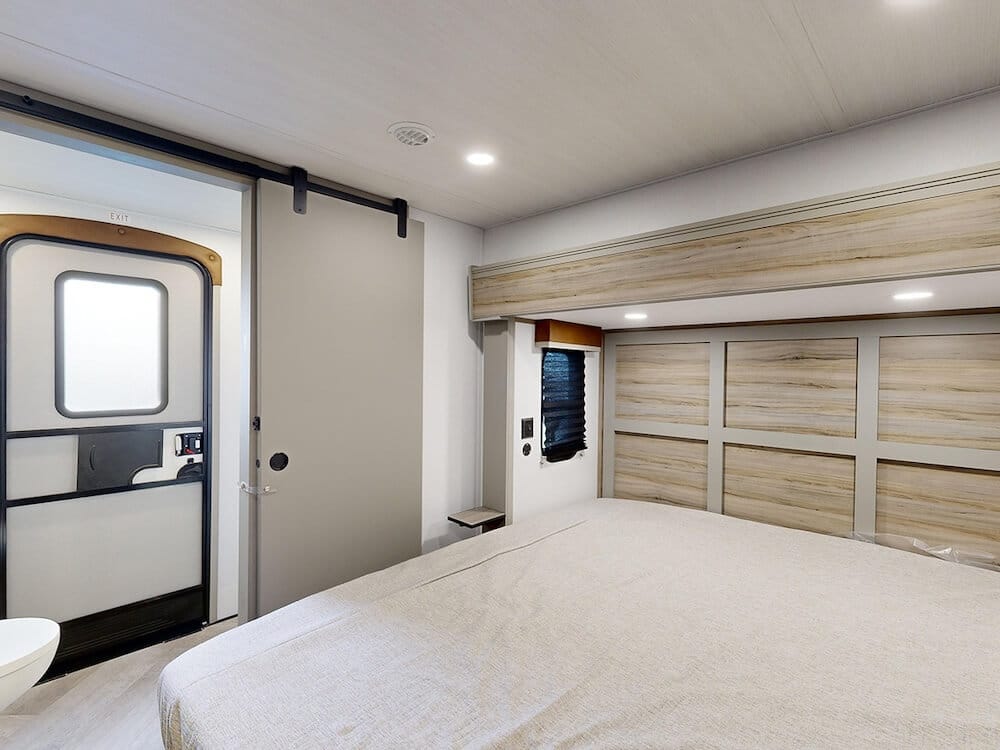
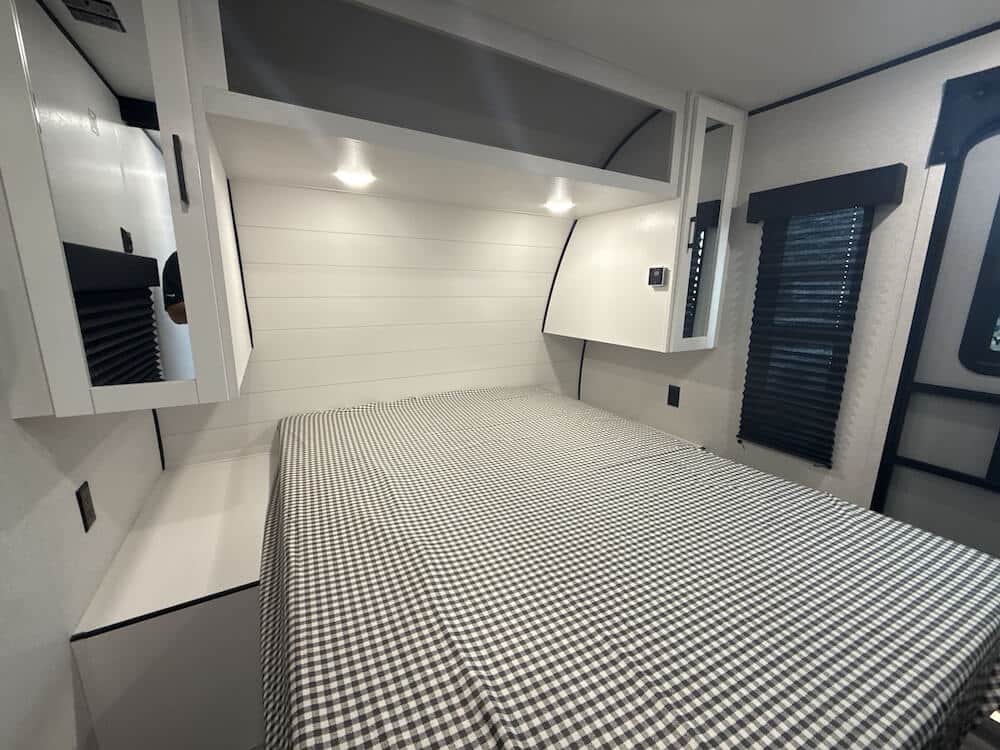
Both bedrooms have attached full baths. The front features a camper king mattress and a generously sized shower, while the rear bedroom has a queen bed and a tub basin in the shower. Families needing to bathe small children or dogs will appreciate this tub, especially since a rear door leads right into the bathroom.
Keystone Sprinter 3920DSL
Images by Camping World
Specs
Length: 42’9”
Dry Weight: 13,250 pounds
Cargo Capacity: 3,150 pounds
Sleeping Capacity: Up to 12
You won’t have to decide who gets the bigger bed with the Sprinter 3920DSL, as both bedrooms feature RV king mattresses (narrower than a traditional king by six inches). Likewise, both bedrooms have full attached baths.
In the living room, the standard furniture package features a booth dinette paired with two theater seats. However, the super sofa option provides seating for up to five, which better accommodates family movie nights in this 2-bedroom 5th wheel.
As someone who dislikes stuffy spaces, I appreciate the three air conditioners in this RV, providing ample coverage across the large interior. Additionally, it’s prepped for Wi-Fi and 4G LTE connectivity, which distributes the signals throughout the RV.
Honorable Mentions for 5th Wheels with 2 Bedrooms
Best Travel Trailer RVs with Two Bedrooms
If you prefer a travel trailer with more than one bedroom, you’ll find many options, especially with bunkrooms. Here are the top two-bedroom RV trailers with bath-and-a-half floor plans:
Keystone Coleman Lantern 32BHS
Want to see the latest RVs? Subscribe to the Camping World YouTube channel, and never miss a video.
Specs
Length: 36’11”
Dry Weight: 7,640 pounds
Cargo Capacity: 1,860 pounds
Sleeping Capacity: Up to 8
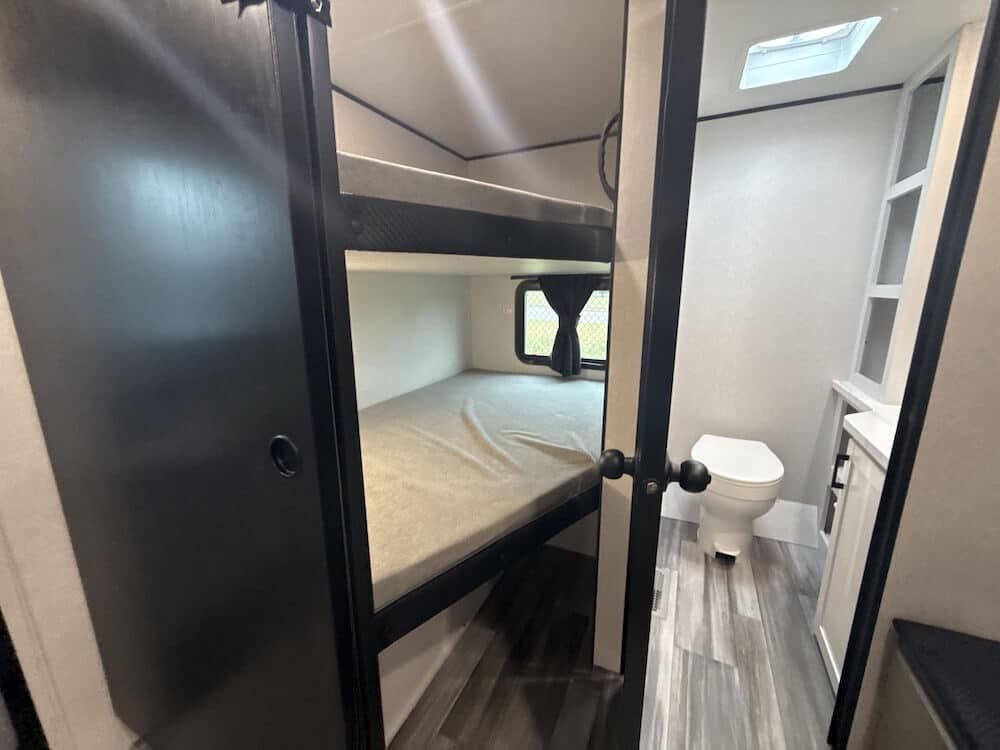
The Coleman Lantern 32BHS not only offers two bedrooms but also features two bathrooms, a rare find in a travel trailer. The rear bedroom features double-over-double bunks, which are large enough for teens and adults. The attached half bath has its own exterior entrance.
I appreciate the numerous upgraded and “oversized” features, including a 50” TV, a 16-cubic-foot refrigerator, a 30” x 40” shower, and an elongated porcelain toilet. Other conveniences that I wish my previous travel trailers had included a black tank flush, a walkable roof, an LCI® SolidStep™ entry, a tankless water heater, and electric stabilizer jacks. The little things make life easier, allowing you to enter vacation mode.
The king bed in the primary bedroom is another bonus, not always found in a travel trailer. Additionally, the front and rear pass through storage areas provide ample room for your gear, and an outside mini fridge is perfect for cold camp beverages.
Jayco Jay Flight SLX 330TBS
Images by Camping World
Specs
Length: 37’7”
Dry Weight: 7,255 pounds
Cargo Capacity: 2,045 pounds
Sleeping Capacity: Up to 8
The Jay Flight SLX 330TBS pairs a queen primary suite with a rear bunk room with an attached half bath. I appreciate how Jayco incorporated an exterior entrance into the primary bedroom, a feature I particularly enjoyed in a travel trailer I once owned. This not only offers easy accessibility, but I also appreciate the views from the bedroom and extra airflow.
Those traveling with furry companions will appreciate the extra space under the bunk beds, as it is a perfect spot to tuck crates or pet beds. The bottom bunk also lifts, providing a convenient place to store taller items when traveling. Additional convertible sleeping space is available in the living room, featuring a tri-fold sofa and a large U-dinette.
Another helpful feature is the outdoor kitchen, which features a water spray port, an LP quick connect, a refrigerator, and a designated space for storing a grill or griddle. This is conveniently located under the 20-foot power awning. Cooking outside is a breeze since this RV is fully equipped!
Grand Design Transcend 305BHT
Image by Camping World
Specs
Length: 36’11”
Dry Weight: 7,735 pounds
Cargo Capacity: 1,560 pounds
Sleeping Capacity: Up to 8
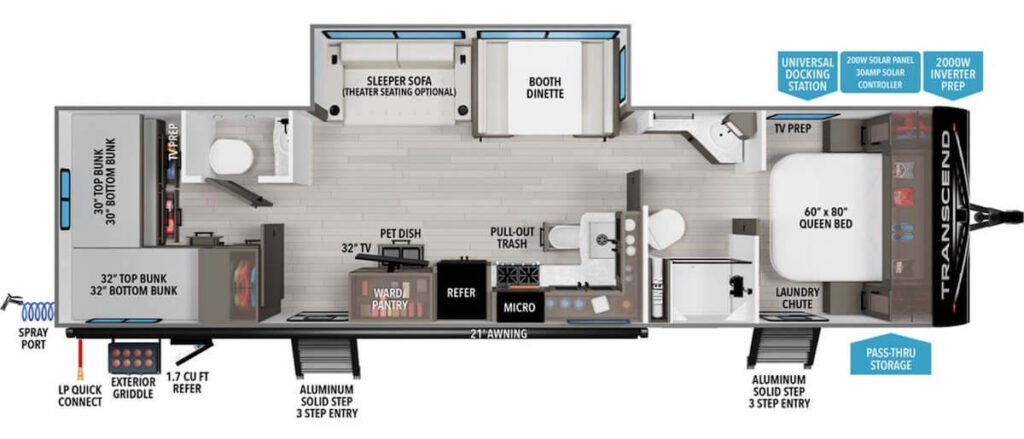
It’s hard to believe, but the Transcend 305BHT offers four bunks, as well as ample storage and an attached half bath. This layout is perfect for a large family since the kids won’t have to share beds or use convertible ones. However, if needed, the living room offers additional sleeping space in the convertible dinette and a comfortable sleeper sofa.
Another feature I like is the generously sized pass through bathroom between the kitchen and front bedroom, which has its own entrance. The laundry chute is a clever touch, allowing you to drop dirty clothes into a bag in the pass through storage below.
The 305BHT comes with a fully equipped exterior kitchen, including a griddle and a 1.8-cubic-foot refrigerator. Other highlights include JBL Bluetooth exterior speakers, a black tank flush, and a solar package with a 200-watt panel and a 2000-watt inverter.
Honorable Mentions for Two Bedroom RV Trailers
Destination Trailers with Two Bedrooms
Since destination trailers are not built to be frequently towed, these longer, heavier models often include massive interiors. Let’s take a look at some two-bedroom destination RVs:
Keystone Springdale Villa 380DB
Image by Keystone RV
Specs
Length: 42’10”
Dry Weight: 10,527 pounds
Cargo Capacity: 1,173 pounds
Sleeping Capacity: Up to 7
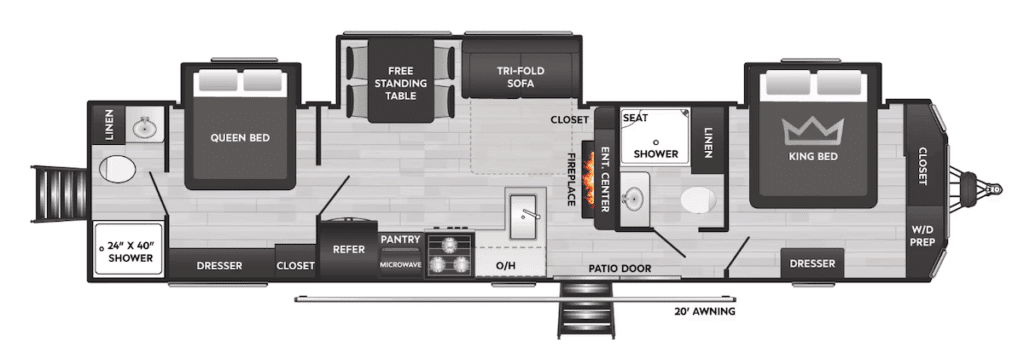
You won’t believe the storage in the Springdale Villa 380DB, from the medicine cabinets and linen closets in both bathrooms to the wall of wardrobe cabinets in the rear queen bedroom. Keystone really thought through the logistics of long-term stays in a destination trailer by supplying ample storage. There’s even a dedicated spot for your trash can.
This layout features a front king suite and a rear queen suite. Both have full bathrooms with roomy showers. A convertible tri-fold sofa adds additional sleeping space in the living room, which also offers a freestanding table and chairs. As someone who is not a fan of dinettes, I like this feature.
The kitchen is also nicely equipped, with ample counterspace, a campside window to keep an eye on the kids, and multiple cooking options, including a three-burner cooktop, a 17” gas oven, and a microwave-air fryer combo. A pull-out sprayer on the high-rise faucet also makes clean-up easy.
Forest River Sierra 41DUPLEX
Image by Camping World
Specs
Length: 40’1”
Dry Weight: 12,734 pounds
Cargo Capacity: 1,266 pounds
Sleeping Capacity: Up to 9
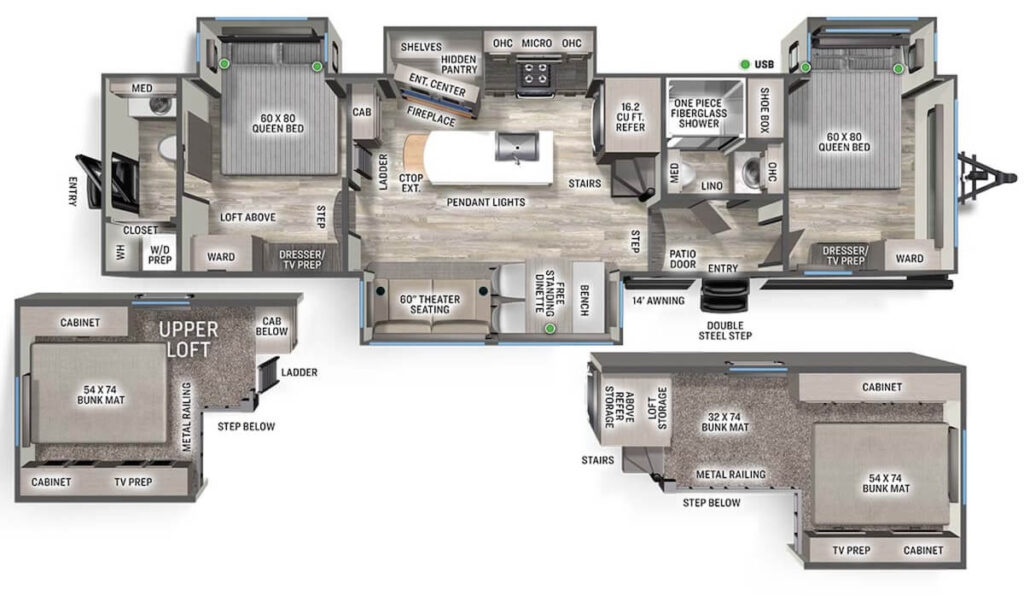
Have you ever seen a two-story, two-bedroom RV? While the Sierra 41DUPLEX doesn’t have a full second story, the dual lofts are about as close as you can get in a moveable living space. Plus, you won’t have to Army crawl to navigate these lofts, as they have a surprising amount of headroom.
When you step inside the 41DUPLEX, you may feel like you are walking into a modern loft instead of an RV. First, there’s a winding staircase, which is a fun touch. Then, there’s the modern decor, which incorporates a mixture of earth-tone colors and textures, adding more contrast than many typical white, gray, or beige designs.
In addition to the queen beds found in the dual bedrooms, the lofts come with two full mattresses and a narrow twin, providing space for large families or guests. You’ll also find a wondrous amount of storage cabinets, both upstairs and on the main floor, where a hidden storage pantry is tucked behind the entertainment center.
Honorable Mentions for Destination Trailers with 2 Bedroom Suites
Is There an RV with 2 Queen Beds?
RVs with two primary bedrooms often feature two queen beds or a queen bed and a king bed. In addition to those listed here, your local Camping World likely has several two-bedroom RVs for sale, and you can tour various models.
What RV Has Two Full Bathrooms?
While it is more common to find an additional half bath in RVs with two bathrooms, you can also find two full bathrooms. These are primarily found in longer travel trailers, fifth wheels, and destination trailers.
Can You Use an RV as a Guest House?
RVs make great guest houses. To accommodate more guests, consider an RV with two bedrooms. Larger destination trailers make for great guest houses if you don’t plan to move the rig often. However, even smaller trailers can provide your guests with a comfortable and private stay.
If you are interested in exploring more two-bedroom RVs or options with expanded sleeping capacities, check out these resources:
Which would you rather have: a private bunk room or a second bedroom with a queen or king bed? Share your thoughts in the comments below.
Kerri Cox is a teacher and freelance writer. After hating the outdoors for much of her life, an RV trip with her in-laws to Colorado changed Kerri’s life. She soon bought an RV for cross-country family trips. Her sons are now grown, so she and her husband have entered the next stage of their journey as empty nesters. She especially loves to visit mountains and national parks.
Tesla seems to be laying the groundwork for a 24/7 Robotaxi service across several states. This was hinted at by a substantial number of interesting Robotaxi-related job listings that have been posted on the company’s Careers website.
24/7 Robotaxis and Night Shift Specialists
A look at Tesla’s official Careers website shows that the company is currently looking for multiple Robotaxi Fleet Support Specialists for the Night Shift. The listing itself describes a role focused on maintaining vehicles for “smooth 24/7 operations,” hinting at the company’s next steps in its efforts to ramp its autonomous ride-hailing service across several U.S. cities.
“We are looking for a highly motivated and passionate individual to join our Autopilot Fleet Team. As Fleet Support Specialist, you will play a crucial role in ensuring that all our vehicles are in excellent condition at all times, supporting smooth 24/7 vehicle operations,” the job listing read.
The job opening is active in several regions, including Austin, Palo Alto, Orlando, Tampa, Doral, Houston, Dallas, Tempe, and Las Vegas, as of writing. This suggests that Tesla really is looking at a potential multi-state rollout strategy for its Robotaxi service, likely in the near future.
Tesla is hiring night shift Robotaxi Fleet Support Specialist in 9 cities across 5 states: Austin, Texas Dallas, Texas Houston, Texas Las Vegas, Nevada Tempe, Arizona Palo Alto, California Tampa, Florida Doral, Florida Orlando,… pic.twitter.com/Q68l5tSOtL— Tesla Yoda (@teslayoda) November 1, 2025
Musk targets major Robotaxi fleet growth by year’s end
Tesla’s Robotaxi pilot is still in early stages, but CEO Elon Musk recently hinted that substantial updates are coming soon to the Austin and Bay Area programs. Speaking on the All-In podcast, Musk said Tesla aims to expand its Robotaxi fleet to 500 vehicles in Austin and 1,000 in the Bay Area before the end of 2025.
“We’re scaling up the number of cars to, what happens if you have a thousand cars? Probably we’ll have a thousands cars or more in the Bay Area by the end of this year, probably 500 or more in the greater Austin area,” Musk said.
With just two months left in the fourth quarter, Tesla’s AI team is facing a busy ramp-up period that could mark the company’s most ambitious real-world test of its autonomous driving program yet.
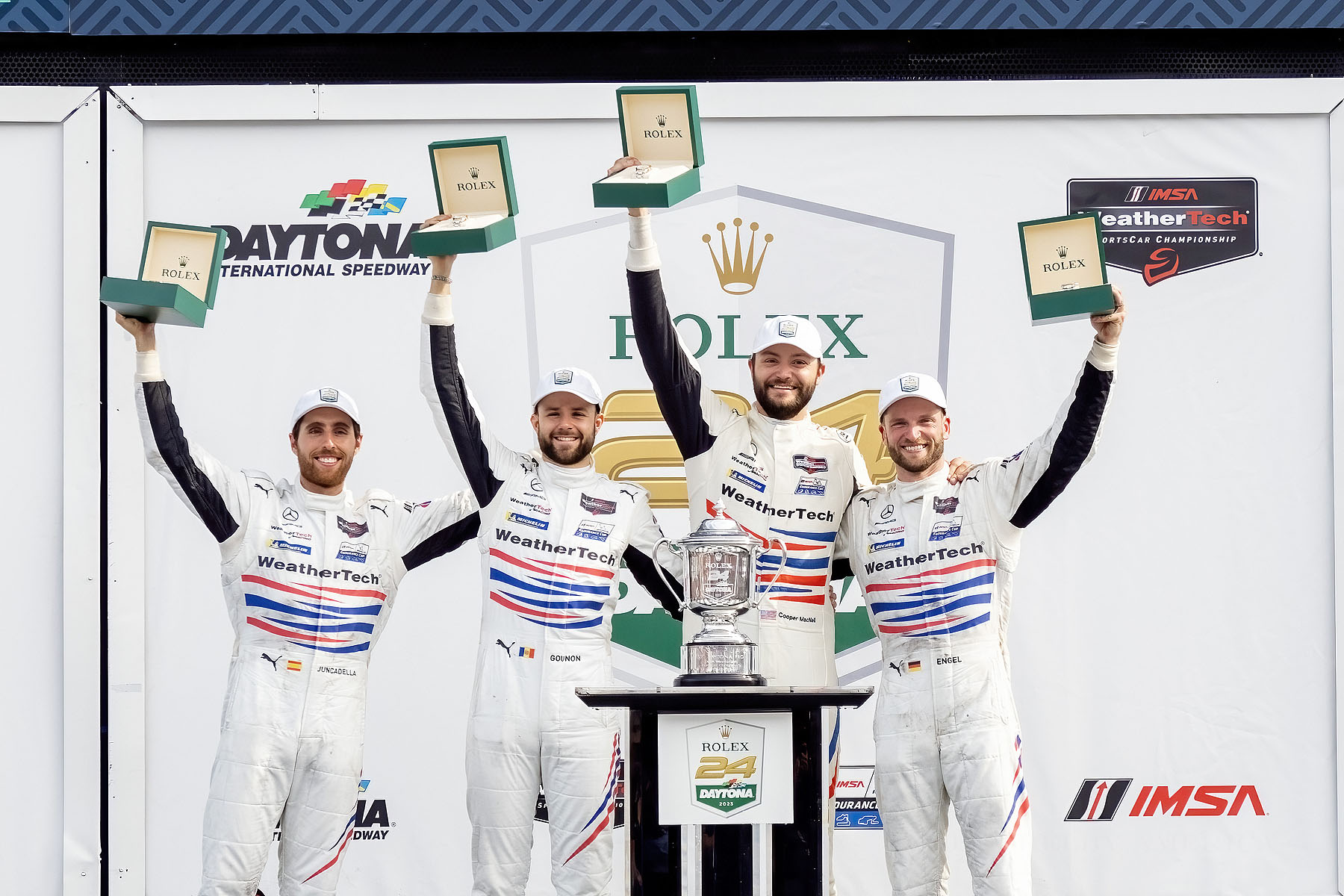
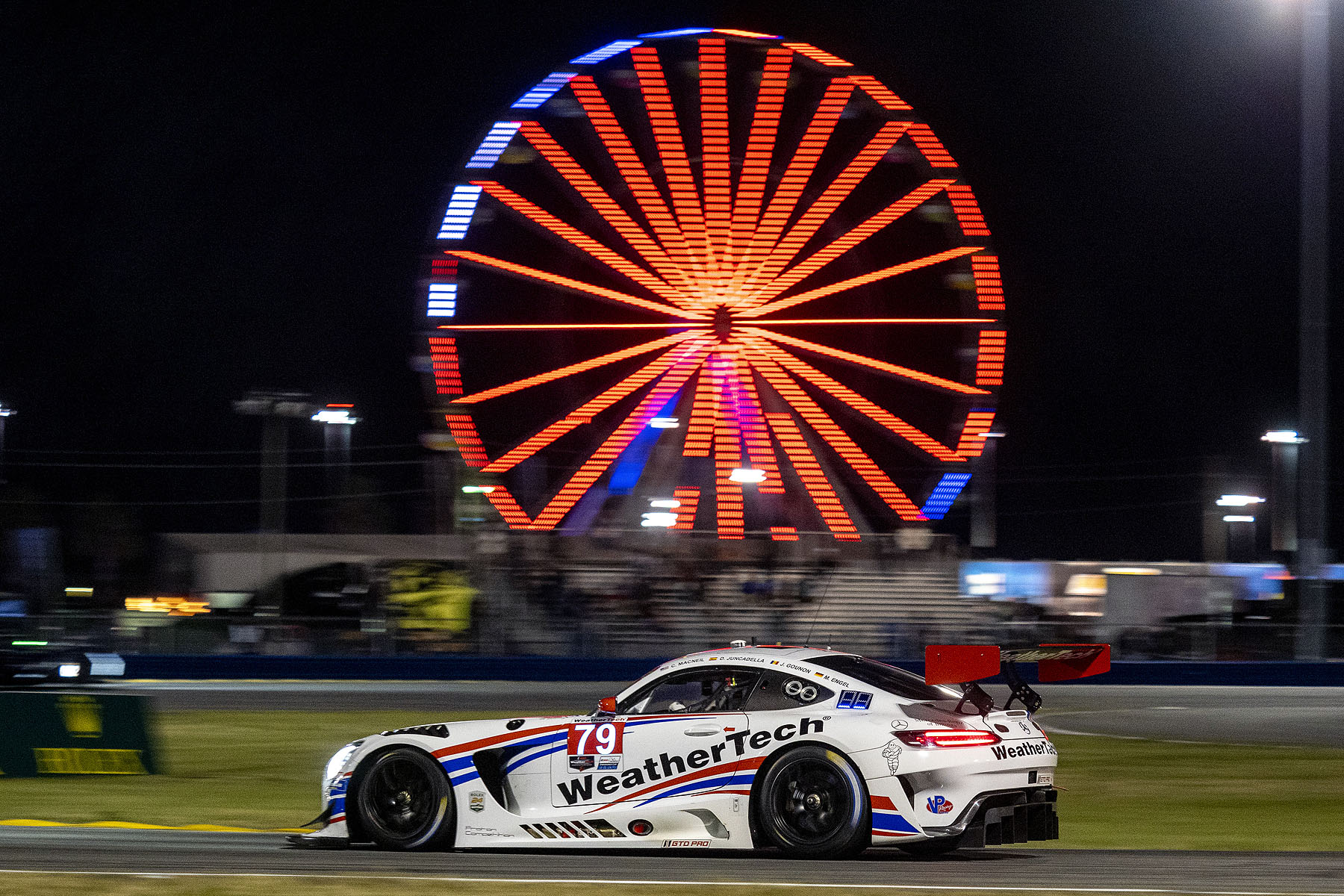
The No. 79 WeatherTech Racing/Proton Competition Mercedes-AMG GT3 team secured the first IMSA GTD Pro class victory for a Mercedes-AMG Motorsport Customer Racing team in the 61st Rolex 24 at Daytona International Speedway. The team’s drivers were Cooper MacNeil, Jules Gounon, Daniel Juncadella and Maro Engel. The victory was the second in the last three years for Mercedes-AMG Motorsport Customer Racing. Engel started the WeatherTech/Proton No. 79 from the GTD Pro pole Saturday afternoon and 24 hours later was back behind the wheel of the white, red and blue Mercedes-AMG GT3 to take the checkered flag just under four seconds ahead of the second-place finisher. The WeatherTech co-drivers combined to lead a class-high 229 race laps over the 24 hours.
Rolex 24 at Daytona, Daytona International Speedway, Daytona Beach FL, January, 2023 (Photo by Brian Cleary/bcpix.com)
Preview (opens in a new tab)
GTD PRO Class
This weekend’s race was MacNeil’s 13th and final attempt at winning the Rolex 24 in what was his final race in IMSA competition. After multiple wins at Petit Le Mans and in the 12 Hours of Sebring, MacNeil steps away having finally completed the victory cycle in IMSA’s three major endurance races. Engel earned his first Rolex 24 win in 2021 in the GTD class with Winward Racing that, for the majority of this weekend’s race, appeared in a strong position to score another victory. Team drivers Russell Ward, Philip Ellis, Indy Dontje and Daniel Morad led a total of 177 race laps and Ellis was as the wheel and locked in a close battle with the other GTD and GTD Pro leaders for the race’s final restart with less than 30 minutes to go.
As the field charged into turn one and the first few corners of the 3.56-mile road course’s fast infield section, Ellis came together with a GTD Pro competitor and the contact ended what was looking like a storybook finish for the No. 57 team. The team originally entered a fourth driver, Lucas Auer, was injured in an incident in Thursday’s opening Rolex 24 practice session. Auer had successful surgery on back injuries sustained in the incident at nearby Halifax Health Medical Center on Friday at the same time the Winward team took delivery of a replacement Mercedes-AMG GT3 chassis, which was trailered overnight to Daytona from the team race shop in Texas.
Rolex 24 at Daytona, Daytona International Speedway, Daytona Beach FL, January, 2023 (Photo by Brian Cleary/bcpix.com)
GTD Class
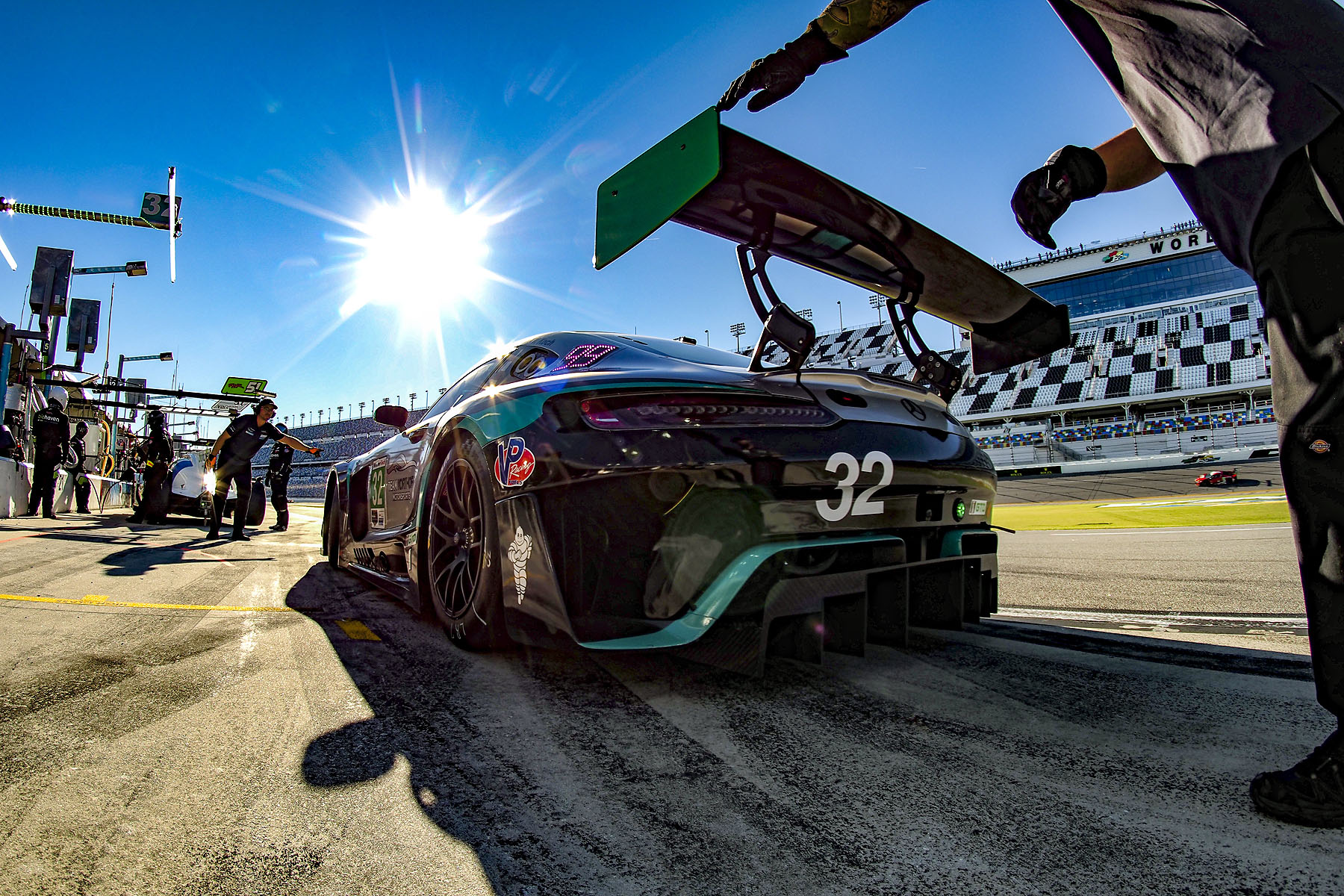
The No. 32 Team Korthoff Motorsports Mercedes-AMG GT3 team, and co-drivers Mike Skeen, Mikael Grenier, Kenton Koch and Maximilian Götz, led a GTD class-high 227 race laps, but a potentially race-winning performance came to a crushing end halfway into the 18th hour of the race at sunrise on Sunday. A front wheel bearing defect sent Grenier from the race lead to the paddock, and the No. 32 team went more than 10 laps down for repairs. The team rejoined the race and soldiered to an eventual 15th place finish.
The No. 75 SunEnergy1 Mercedes-AMG GT3 inherited the GTD pole after Winward was forced to the back of the starting grid. Team co-drivers Kenny Habul, Luca Stolz, Fabian Schiller and Axcil Jefferies were competitive from the start of the race only to be sidelined at 9 p.m. Saturday with radiator damage. The No. 75 was officially retired early Sunday morning.
See also
Rolex 24 at Daytona, Daytona International Speedway, Daytona Beach FL, January, 2023 (Photo by Brian Cleary/bcpix.com)
Mercedes-AMG Delighted
Stefan Wendl, Head of Mercedes-AMG Motorsport Customer Racing: “What a fantastic race! For our brand, to win the GTD Pro class here for our second Rolex 24 victory is an amazing success. On the other hand, we also have a teary eye because of our other customer teams. Winward Racing put in a fantastic performance to fight their way from the back of the field to the front, only to be taken out of the race by an unfortunate incident in the final hour. Many thanks to all of our customer teams and congratulations to Acura for the overall win.”
Next up for Mercedes-AMG Motorsport Customer Racing teams in the IMSA WeatherTech SportsCar Championship is the 12 Hours of Sebring at Sebring International Raceway, March 16 – 19.
This post may contain affiliate links. See our affiliate disclaimer here.
This post was not paid for by Boundless Life, and all opinions are entirely our own. We paid full price, and this is our honest Boundless Life review.
A couple of years ago, I texted Alyssa a link to a company I’d found called Boundless Life. Some friends of ours had recently gone through their inaugural cohort, and the concept seemed interesting: Boundless provides you and your family a place to live, a coworking space, a Montessori-style school for the kids, and a community of like-minded families. At the time, Boundless Life had two locations in Greece and Portugal. (They now have seven.)
It kind of sounds like the dream, right?
As I looked at Instagram photos and reels of people sipping wine in exotic places (while their kids were safe & happy in school), I couldn’t help but be jealous.
“I think we should try this when Eli is old enough,” I told Alyssa. He was only a few months old at the time.
We’d always dreamed about the idea of a year abroad with the kids, but the logistics felt daunting. Where would we stay? What about visas? Would the kids be able to make friends? How would we find childcare? Boundless Life seemed to solve these problems.
Since Eli was a baby, we put it on the back burner. (With Boundless, schooling starts at age 18 months.) However, the seed was planted.
Over the next year, we followed along with Boundless Life on Instagram and oohed and aahed over the experiences. With each post, we got more excited. They announced new locations, such as Italy and Bali, in the meantime. They were actively growing and it seemed like the real deal.
Finally, in the spring of 2023, I pulled the trigger and set up a call with their sales team.
On a Zoom call with a Boundless Life employee—a mom with kids in the program—we immediately connected. She shared with us their experiences of raising children abroad and how impactful the program had been for them. We told her about our adventures with the kids across Europe, Japan, and New Zealand and how we missed community while we traveled.
We got off the call and knew we had to do this. We signed up immediately and made a substantial ($5,000+) deposit to secure our space.
We would join their Portugal cohort in the fall 2023 semester.
We decided on Portugal because it was their first and most established location and what our Boundless sales person recommended to us. Other locations had been spun up more recently, so we liked the idea of dropping into a place that should have more established routines and processes. Whether or not this was true was TBD.
Why am I writing this article?
I haven’t seen a long-form Boundless Life review (outside of Instagram). My goal isn’t to promote the company or put them on blast, but to share our honest experience with enrolling our kids in Boundless Life. The real stuff, not the Instagram highlight reel.
I’ll share what we paid for the program, what we liked about it, and what we didn’t like. I’ll also share my thoughts on whether I’d recommend it to others and whether we’d do it again.
And last thing to note, we were not compensated in any way for the program or for sharing this review. We paid full price. This is just a Boundless Life review from a family who has gone through the program.
What is Boundless Life?
Boundless Life is a venture-backed startup focused on providing world schooling experiences for families. They currently have locations in Italy, Greece, Portugal, Spain, Montenegro, Uruguay, and Bali. They have three-month cohorts in the winter, spring, and fall that mimic a full school year as well as and shorter (4-week) summer and holiday cohorts.
In exchange for the cohort fees, you receive a family-friendly apartment, Montessori-style school program, coworking space, and community activities for families.
Boundless Life was catered towards digital nomad families as a way to travel long-term with kids (I say was because they’ve changed up some of their marketing, and our experience was mixed on whether “digital nomad” most accurately describes the target customer).
What I Liked About Our Boundless Life Experience
We will start with the good. 🙂
1. The ability to travel long-term with kids.
Over the past two years, we’ve traveled to over 12 countries with our kids (2,4). We’ve camped in rural Japan, hauled them on a long-distance flight from New Zealand to the US, and driven an RV all over Europe.
We’ve created unforgettable memories together, but only on short-term trips. We would travel for a month or two and then return to our everyday life in Colorado. The kids would be in daycare where they had friends, and we’d work during our time stateside. After doing this for a couple of months, we would get restless and plan another trip.
This life was extraordinary, but we wanted to explore whether we could create a more sustainable way to travel long-term with our kids. This way, we could make a more blended solution. Some travel, work, and life all mixed together.
For us, long-term travel would have a few components:
The ability for Alyssa and me to work 20-30 hours per week
Kids are in quality childcare that feels safe and fun
A sense of community for the kids and us
Enrolling in Boundless accomplished these goals for us.
Not only were we able to work while traveling, but the kids were well taken care of in the Boundless school. We all made amazing new friends (some of whom we’ve met up with since leaving Boundless already) all while experiencing a new place.
Excited for their first day of school!
2. We could go on endless dates.
We’ve only traveled in Europe since Ellie was born, and never had the luxury of exploring without the kids. Walking around our town or training into Lisbon for the day as a couple was such a luxurious feeling. We could explore just the two of us while our kids were safe in school.
This is easily the biggest surprise for us with Boundless and one of our favorite parts. There are monthly movie nights for the kids, so we have ready-made date nights. And in Portugal, we could easily train or grab an Uber to a nearby town or beach for day dates.
3. The Boundless Apartment
With each location, Boundless provides fully kitted-out apartments for families. This means you’ll have plenty of kid-friendly plates, cups, and bowls. Plus, the apartment feels very much catered to families.
Sometimes we book an Airbnb that claims to be family-friendly, but we are immediately met with a giant china cabinet. Boundless Life does a great job of making these spaces feel like home for families.
(Note: Boundless does not own these apartments. They have secured long-term leases with building owners and then rent them directly to Boundless families.)
Our apartment was a 7-minute walk to the education center and a 15 minute walk to the hub.
At first, Ellie didn’t love the walks to school, but once she realized we could walk with friends, that all changed.
The actual space itself was updated, modern, and very nice. Best of all, we were right underneath our friends Brooke and Tyler, who had kids the same age as ours. Being so close to friends meant spontaneous hangouts, leaving snacks on each other’s doorsteps, and tossing up and down supplies for each other. We loved this (and so did the kids).
Our unit was a 2-bedroom, but it’s possible to book anything from a one-bedroom to a three-bedroom with Boundless.
When you’re on the Boundless website, you’ll notice they have standard spaces and then something called “home plus”. Effectively, these are spaces that Boundless has determined are nicer and cost a little more. With a home plus, you might receive a bigger balcony, a yard, or something extra with your space.
What we loved most about our Boundless lodging was the weekly house cleaning.
Not a luxury we are typically accustomed to, but quickly embraced. House cleaning days were like Easter and Christmas morning all rolled into one. No dirty dishes and fresh sheets and we didn’t have to lift a finger? Yes, please (I’m being overdramatic, but it truly was great! We miss it).
If you sign up for Boundless Home Plus, you will receive twice-weekly house cleaning instead of just once.
You don’t have to stay in a Boundless apartment, but most people do. (A few people who were in Portugal longer term did have their own apartments.) When I say we loved our apartment, I mean we loved it. It was beautiful, modern, recently remodeled, and had everything we needed it.
And if it didn’t have something we needed, we could always put in a request with the Boundless staff.
4. The Daily Walks to School
Of all the things I enjoyed about Boundless, I think the walks to school were one of my favorites. Each morning the kids would go out the door and immediately see their friends. They would be so excited to walk next to them or hold hands. Not to mention, there is a large castle at the top of that mountain that we could see as soon as we stepped out of our door every morning.
This type of experience was the complete opposite of how we were accustomed to dropping the kids off at school. Previously, we would drive them for 10 minutes, drop them off at a door, and say goodbye. It would be rare for us to encounter other parents, let alone have the opportunity to engage in a conversation with them.
With Boundless, we walked with other families every day. We would congregate after drop off and talk about our plans for the day. Sometimes we’d spontaneously go get coffee or a meal or hop in a cab and go to the beach.
This is the type of community experience we had hoped for with Boundless. The ability to spend our days with other people in a similar stage of life.
5. The Community
A big reason we wanted to do Boundless was to make friends with other families who had similar values.
For five years, we hosted a conference for RV Entrepreneurs. We’d spend an entire month camped next to other nomads & entrepreneurs. We’d find ourselves going on random hikes or grabbing coffee with strangers. It was an accelerator for making friends with like-minded people and one of our favorite things we’ve ever done.
Our hope was for Boundless to be similar—and it was.
Every day, there were opportunities to connect and hang with new friends.
On Wednesdays, we would have pizza parties at one of the houses while the kids played in the yard. On Fridays, a group of us played Padel (a racquet game I fell in love with and dearly miss).
One of my favorite memories was going to a neighbor’s house for dinner. They’d prepared dough for the kids to make pizzas and we spent the evening laughing and having a great time. To have these types of community experiences while in a new country was magic.
Making pizza with new friends.
6. The Hikes*
Technically this should fall under the community section, but I’m making it its own thing. Every other Thursday Boundless coordinates a hike with team members, weather permitting. They were a huge highlight for both Alyssa and me.
I decided to skip one of the hikes along the coast and then everyone came back and said it was the best hike of their lives (I did not miss any more hikes after that).
*This does not happen in every Boundless location, but most offer at least some hikes.
7. The Boundless Teaching Staff
I’ve never felt great about dropping Ellie off at daycare. Back in Colorado, it felt like her teachers were there for a paycheck. Turnover was constantly happening in her school with staff. It was a job for people, not something they genuinely wanted to do, and the level of care reflected that. It was a nagging feeling for me every day.
With Boundless, I didn’t have this feeling at all.
Instead of someone showing up for a paycheck, their teachers were in it because they loved what they did. Teaching was purposeful for them. You could see how connecting with and teaching these children completely lit them up.
Throughout our Boundless cohort, we experienced some interpersonal issues with other kids (typical stuff you’d encounter at most schools), but I felt great about the Boundless teaching staff.
8. The Location
Sintra was walkable and very hilly, but a beautiful setting. It has a lot of history and beautiful palaces.
Before arriving I didn’t realize just how much of a tourist hub it was. Every day we’d watched hundreds of people get off the train to explore the castles and palaces. The center of town was bustling for almost our entire cohort (it did calm down in November a little bit, but we were surprised at what a major destination it was). It’s one of the most popular day trips from Lisbon.
Eating some pastel de natas in downtown Sintra
While the town of Sintra was pretty, what we loved most was access to the coast. Specifically, we fell in love with a town called Cascais. It was a 20-minute Uber ride for us each way, but worth it.
Family pic in Cascais
Cascais is an expat hub with a coastline that looks just like the Pacific Coast Highway (minus all the traffic). It has a lot of great restaurants and one of the best parks/playgrounds we’ve ever been to.
Cascais Coast Line
Toward the end of our trip, both Alyssa and I mentioned how we could easily see ourselves long-term in a place like Cascais. If Portugal hadn’t changed their golden visa requirements while we were there, we would’ve considered buying a house there. We loved it that much!
Update: Now that we’ve done a few more Boundless locations (spoiler alert, sorry!), we will have to write a post sharing which ones were our favorite! Sintra might actually come in last place…and we still loved the area.
9. The Boundless Leadership Team
One cofounder and two team leaders visited Sintra during our cohort. They met with many individual families to gather feedback and ideas on improving the program.
To me, this spoke volumes about the Boundless team and their commitment to continually improving and refining the business vision.
What I Didn’t Like About Our Boundless Life Experience
Before diving into this part, I want to share a disclaimer.
Each of these items I share below was first brought to the Boundless team while we were on-site in Sintra. They were all addressed and brought to resolution during our time there.
My approach when giving critical feedback is always to go directly to the source and, if necessary, share it publicly (via a review like this one). I intend not to knock Boundless down a peg but share my genuine experience with the program. I believe it’s essential to share both the positive and negative aspects for all families considering the significant investment of time and money to participate in Boundless.
Further, since our cohort ended, we’ve seen Boundless work to implement this feedback across all locations. And we’ve joined more cohorts with Boundless Life since then, and seen improvements as a result.
1. The Wifi at Coworking Space
Boundless Life offers a few core services (not all listed here): apartments for families, an education center, community activities, and a coworking space.
A critical component of a coworking space is usable internet.
For the first several weeks of our cohort, the internet was spotty and intermittent at the coworking space. Most days it was completely unusable.
We skipped out on hiking up to the coworking space for events like yoga because we couldn’t stick around after and work in the space and we knew it would take at least 30 minutes just to hike there and back. (Oh yes, it was a HIKE to get to this Hub, straight uphill, lots of stairs, and crowds of tourists in the way.)
Several days during this period, I watched other cohort members pack up to leave because they couldn’t work.
This was confusing because we were not the first cohort in Sintra. I would have thought this would have been prioritized and figured out in a previous cohort.
I later learned that they have cycled through various internet companies, trying to get better Wi-Fi into the space, to no avail.
The coworking space itself is a beautiful building. However, it’s older, and the walls are dense. Local providers haven’t been able to deliver fast internet consistently.
Some days the internet worked okay, others it did not (it often depended on how many people were there). During our cohort, Boundless changed providers and this did improve the internet. However, due to the initial experience, most people ended up working out of their apartments.
This was a bummer because part of the Boundless experience (we assumed) was working alongside other entrepreneurs and digital nomads. Instead, maybe 2-4 people used the space.
I spoke with a family in the Tuscany cohort (Italy) who reported having similar issues with the coworking space. He said on days when there were a bunch of people there, the internet was incredibly slow.
Our wifi at home was great and we never had any issues with it, so we often worked from home—me from the desk and Alyssa from the kitchen table. On days when the weather was good, we’d set up outside.
But we felt like there was something we were missing out on since the hub wasn’t the community workspace we were counting on.
2. The Kids’ Extracurricular Activities
Before arrival, Boundless sources a handful of extracurricular activities for the kids. If there are enough students who sign up, they coordinate the activity. Some of these activities included surfing, which was a big hit among both adults and kids within our cohort.
Another activity being offered was soccer.
We’ve always felt bad that our traveling meant missing out on group sports for Ellie. She’s so energetic, we knew she would love soccer. We had no idea that Boundless coordinated all of these extracurriculars, but we were glad they did.
Excited to try something new, we signed up Ellie. Unfortunately, she was sick during the first day, so she missed this practice. We noticed that several students dropped out after the initial practice, as they were either unimpressed or did not enjoy the first class. But we opted to send her anyway.
Since Ellie had never played before, I was excited to go and watch her learn. Growing up, my dad went to every one of my practices and games. It was always a fun bonding experience.
However, Boundless discouraged parents from attending. They didn’t explicitly say not to go, but it was more like parents shouldn’t go with a look that said, “Why would you want to go, you helicopter parent!” A few parents were still going, not eager to let their three and four-year-olds travel by car to a sports arena they’d never seen with coaches they’d never met in a foreign country.
I also learned beforehand that a Boundless staff member or teacher was not riding with them to practice. Boundless had contracted with a local transportation company to drive the kids (10-15 mins away).
This didn’t sit well with us or other parents.
A random person whom none of these kids knew was going to load them up in a minivan and drive them somewhere they’ve never been. Even though this was a vetted and preferred travel partner, it made us feel uneasy.
Nerves aside, we learned our friend would be taking an Uber to the field to watch the practice, so we opted to trust Boundless’ process and let Ellie attend anyway. No one wants to be the helicopter parent. After all, we were here in Portugal because we trusted Boundless and wanted to push our comfort zone.
Then I got these texts from our friend.
“It feels very uncomfortable.”
“They just walked into two new coaches who didn’t introduce themselves and hardly speak any English and the kids have no idea what they should be doing.” (The coaching staff changed from the first class to the second, so these coaches were new to every kid.)
“Ellie just needed to go to the potty and I’m so glad I was here to help.”
“It’s absurd that no one from Boundless is here.”
“Ellie is not comfortable participating yet. I am trying to help her at least play with the ball. The coaches are not engaging her at all. Zero percent. No attempt to help her join them.”
Then we received this picture.
Ellie is at one end of the field lying on a ball. The coaches on the other.
I immediately felt angry, frustrated, and sad.
Sad for Ellie.
Frustrated at myself for letting this situation happen.
Angry at Boundless for dropping the ball.
I immediately hopped in an Uber and went to the soccer field. I showed up as it ended. Then I rode back with the transportation company and one other parent who attended. In the car, she messaged me:
“I think it will be better to find a coach ourselves and bring him to our yard.”
Later on, I learned that when Ellie needed to go into the bathroom, our friend took her, and none of the lights worked. She used her phone as a flashlight. If she hadn’t been there with Ellie, would two strange men whom she had just met and couldn’t communicate with her have taken her into a dark bathroom?
The whole situation felt frustrating.
I think what hurt most of all in this scenario is the loss of trust we felt with Boundless. We are here in a foreign country and trusted them with the most important humans in our lives.
The story in my head is that they didn’t do a very good job vetting a soccer club partner nor did they think through the experience overall. In what world would it make sense for three and four-year-olds to ride in a van with a stranger, no parents, and no Boundless staff members?
On our ride back to the education center after the failed soccer practice, a three-year-old asked me to open her snack because she couldn’t do it by herself. This is just one of many reasons why there should have been a staff member with the kids.
After this day, every single remaining kid dropped out of soccer. Boundless apologized and tried to source another soccer partner, but it never happened.
To be fair, the business Boundless Life has chosen has a LOT of logistics. Balls will inevitably get dropped.
But when the ball is your four-year-old child, that is not acceptable.
I will reiterate that after this experience, we sat down with the Boundless Operations manager and went through this experience in detail. Apologies were given, and steps were taken to prevent this situation from happening again. It is my understanding that, moving forward, Boundless staff members will accompany the kids to these activities.
3. The Local Boundless Team
To say we were not impressed with the local Boundless team would be an understatement. There were several situations where a communication ball was dropped, either with us or with other families. Without giving all the details, we saw this a little too often:
Families had to switch apartments at a moment’s notice.
A family went without electricity and internet (they didn’t have a fridge for a week!).
A family had to relocate and book (more expensive) lodging in a nearby town due to a black mold issue that was making all of the kids sick
Multiple families had issues with their wifi not working or going out frequently
In each of these situations, the circumstances weren’t the primary issue (though mold is bad). In my opinion, it was a lack of ownership and responsiveness to address them in a timely and helpful manner. The story in my head is that there wasn’t a leader stepping in to really own these problems and bring them to resolutions quickly and effectively. We saw it happen again and again.
The first two weeks of school, everyone—kids and parents—got an awful stomach bug. Everyone was collapsing like dominoes. To stop the bug, the team decided to close the school. This was done suddenly via a WhatsApp message that caught all the parents off guard, especially since almost every kid had been through the bug already. Between the bug and the closure, our kids spent one day in school over the course of ten days.
This was partly a standard start of school, par for the course experience. However, I’ve never seen a school close suddenly due to a stomach bug. This didn’t sit well with any of the parents, particularly those of us who were working.
We were told the GM in Sintra left before our cohort started. Someone was promoted to fill that spot, and she quit (or was fired, we don’t know) before the end of our cohort. We saw her at the welcome party and then saw her once after that before she disappeared from events and group chats. I believe some of the turnover likely led to communication gaps and dropped balls.
Boundless boasts its “concierge” service, but I don’t believe they lived up to it.
We lucked out with only minor problems that needed to be addressed, such as the peephole in our door breaking and falling out. This was a five-minute fix that took nearly a month and some gentle nagging to get it fixed! We were told it took so long because the person who handles maintenance was out of town. I wonder if this was also why someone didn’t have electricity for a week?
For us, this was a little thing, but perhaps indicative of how all communication and incidents were handled.
4. The Lack of Community Facilitation
*This point is more subjective and more so something I think can be improved (versus something that went wrong).
Boundless coordinates numerous community events—like hikes, local experiences, cooking classes, potlucks, karaoke nights, etc. These are a great way to connect with other families.
However, it felt like a missed opportunity for the local Boundless team to engage more with the community. Typically, a Boundless team member would open the coworking space for the event, and we wouldn’t see them again. It was like, “Here’s the key, enjoy your meetup, bye.” Sometimes someone from Boundless wouldn’t be there at all.
For these events, there was often no introduction or context given for the night; it was just a space provided for the families to do their thing. Some games were sitting on a table, and a TV was turned on to YouTube if people wanted to sing along to videos. (But no actual karaoke machine, much to everyone’s disappointment since karaoke was listed as the activity for the evening.)
There were probably five potluck nights on the calendar during our cohort, which we, as parents, quickly came to see for what it was: a lack of effort to plan actual events.
Even the Halloween party was labeled as a “pay $20 per person” event that said, “Hey, this is a potluck, so make Halloween treats and hike for 20 minutes uphill, carrying the food and your two-year-old.” (My wife’s words, not Boundless’s.)
Meanwhile, one of the moms noticed that other Boundless locations were hosting free Halloween parties. She went to bat for the cohort and fought to get the event either catered or free as a potluck.
Credit where credit is due: These snacks were way cuter than what us parents would’ve made.
We paid $80 for our family of four to attend (which is still crazy to me, considering it was at the hub and with around 60 people there, Boundless brought in a pretty penny in profit). There were other Boundless events that felt worth it, like the parents cooking night or wine tastings, but there were definitely a few where it felt like the team was just phoning it in.
I think Boundless team members could have done a better job of engaging with these events. Kicking off the night with a few words, spending time with the cohort, etc. We left the cohort feeling like we didn’t really know or often see the team running the show.
Boundless did a great job at their opening and ending “connections” times. These were the only times when the Boundless team members actively participated and engaged with our cohort. But we were underwhelmed with many of the coordinated events in between.
5. What Surprised Me About Boundless Life
It feels weird to list this as a negative from our Boundless experience, as it was a big surprise for us.
Boundless really markets itself as a solution for digital nomad families, so we expected to meet many families who were experienced travelers working on the road or running a remote business.
Instead, many of the families in our cohort were taking a leave of absence from work, had sold a company, or were on early retirement with their kids. Of the few families who were working, many of them had never tried working remotely while traveling.
In fact, most families treated this experience less like living and working abroad and more like an extended vacation. Families were off every weekend to nearby spots in Portugal or jetting off to other places across Europe and northern Africa.
This blew us away, and something I share perhaps less as a negative and more about me wanting to hedge expectations for any other traveling families who might want to sign up for Boundless. There were only three families of the 21 in our cohort who were full-time traveling. The other 18 were new to traveling long-term, some had never been to Europe before, and many had never tried something so unconventional.
For those reasons, five families left during our cohort.
(Although one guy’s reason for leaving was “When they say concierge service, I expect to get a washcloth at 3 AM if I need a washcloth at 3 AM” so take that with a grain of salt.)
As I mentioned early, some of the core Boundless team came to Sintra to meet with families. This was why. The staff on the ground was clearly overwhelmed and ill-equipped while some families were very unimpressed and upset and rushing to leave.
Overall the crowd of people in attendance was just a bit different than we expected and we still made great friends, but just another example of how Boundless’s marketing didn’t quite match up with what we experienced.
How Much Does Boundless Life Cost?
We paid $7,112.29 per month for our three-month cohort. In total, it was $21,336.87* for the Boundless program. The pricing is changed often and will depend on whether or not you sign up for multiple cohorts (where you’ll receive a discount). They also charge prices in Euros, so you’re subject to the exchange rate at the time you pay.
What we paid included our two-bedroom apartment (with weekly housekeeping), coworking space, and education center for both kids. This price did not include the extracurricular activities or extra Boundless coordinated trips, which incurred additional fees.
At first glance, Boundless seems pricey, and it is. However, when I added up our monthly expenses to live in Colorado I realized it wasn’t too far from what we were spending in the US.
In the US, I calculated we spend roughly $5,000 for some of our “core life costs”, such as our mortgage ($2,000), childcare ($2,000), car/insurance/gas, etc ($1,000).
We calculated that we’d be spending a couple of thousand more per month, but it wasn’t as bad when compared next to each other. We wouldn’t be paying for gas, mortgage, or utilities while in Portugal because we rented out our house.
Plus, I later realized that the costs of groceries and eating out in Portugal are roughly half of those in the US (or less).
In general, I feel the value of what Boundless provided for the cost was fair.
*These prices also change seasonally and vary by location. Your prices could be much higher or lower.
Would I Do Boundless Again?
This is a question friends and fellow cohort members have asked us.
The answer, despite some of the missed expectations and setbacks, is yes.
Here are a few reasons why:
#1 It’s the only real turn-key solution for digital nomad families (at least for now).
If Alyssa and I want to travel to a new country and stay for a few months, we have numerous logistics to figure out. Where should we stay? How can we find a family-friendly accommodation? Could we invite friends along for the adventure so we aren’t alone? How can we accomplish some work while also exploring the new place?
Boundless takes care of all of this. Essentially, logistics is the primary service that Boundless offers. They vet an area & then figure out everything so you don’t have to.
Could we travel without the schooling component and coworking and community?
Sure. And we do.
While I write this we just wrapped up a month near Austin and plan to spend several more months traveling this year.
However, each new destination we plan comes with a lot of things to figure out (what neighborhood to stay, childcare, work, etc).
Boundless solves a pain point for long-term family travelers. It creates a viable option to build community AND work while you travel.
#2 I believe the Boundless Life experience will keep getting better.
While I shared some of our less-than-stellar experiences above, one thing I will reiterate is that Boundless actively listened and responded actively through all those scenarios. Not always as fast or clear as we would’ve liked, but action was always taken.
Several leaders from the company visited Sintra during our cohort and actively met with as many families as they could. In listening to Boundless share their priorities and initiatives moving forward, I believe they are willing to address problems and get better. We tuned into their recent forum and heard the staff talk about how a team member will always transport and attend extracurricular activities, which was one of the biggest problems we faced during our time in Portugal.
#3 The overall experience was positive.
Despite its ups and downs, the overall experience with Boundless Life was positive.
Our kids became close with other families from all over the US (and the world). A few days ago Ellie Facetimed with her friend from Israel who she misses dearly. She tells me all the time about her “best friends forever” from Boundless.
Eli (our two-year-old) went from saying a few words to saying everything. He made a best buddy in class and they spent all day playing cars next to each other.
I learned how to surf and got to explore Lisbon and the surrounding area with Alyssa and new friends.
We got to travel to a new country together as a family and learn about the culture, the food, and the people. Most of all, we got to do it alongside others in a new and beautiful setting.
My Takeaways About Boundless Life
Boundless has hit on a big need. They are not only serving the growing community of remote working families looking to switch it up but also the many Americans searching for alternative education options. A place where they feel safe sending their kids.
The future cohorts are booking up quickly, and demand is high. What the Boundless team has built is impressive given their short time in existence.
When I think about some of the shortcomings we experienced, I don’t chalk them up to Boundless being a bad company. I think they are a startup with some growing pains, a lot of logistics, and ambitious growth plans. Alyssa and I are following along closely to consider booking future cohorts with them (we have our eyes on Spain!).
If you made it this far in this post and have any more questions about our experience with Boundless, feel free to comment below. I’d be happy to answer any of them that I can.
FAQs
What are the Boundless Life alternatives?
While there are quite a few co-living types of companies catered towards singles or couples, I don’t know of another one catered towards families at the moment.
Is Boundless Life legit?
Yes, Boundless Life is a legitimate hospitality and educational company. They provide lodging, a Montessori-style school program, and coworking for digital nomad families.
Is Boundless Life worth it?
For us, Boundless Life was worth it because of the overall experience and the people we met. The costs are high, but fair and we have great memories of our experience.
Where does Boundless Life have locations?
Boundless Life has locations in Greece, Bali, Portugal, and Italy. They are currently expanding to Montenegro and Spain.
Is Boundless a good first school for my toddler?
Many parents in our cohort had never put their kids in a daycare or school before. Older kids adapted pretty quickly, though there were always the goodbye tears. Younger kids often did half days or a couple of days a week to adjust.
As someone who has had kids in multiple daycares and childcare options, I would say Boundless will spoil you for taking your kids to school. The teachers are amazing, meals and snacks are provided(!), class sizes are small, and they take the kids outside often. It shines compared to all of the places we’ve had our kids.
Our son was nearly two when our cohort started and he celebrated his birthday at school. (Everyone got cake and sang to him, so so sweet!) We put him in a summer daycare program leading up to Boundless so he would understand the concept of school before our time in Portugal. Personally, I think this worked out amazingly and he adjusted to school in Sintra very quickly.
Is Boundless Life Too Good to be True?
Since you’ve heard from me a lot, I also wanted to include a brief review from my better half.Alyssa also echoed most, if not all, of my sentiments above.
Before attending Boundless, we never heard a bad word about the company or anything slightly negative online. We felt it was too good to be true. Certainly, some things weren’t so Instagram-worthy (which is why we wrote this Boundless Life review!).
Like all experiences, there were ups and downs. No wifi at the coworking space was frustrating considering we were paying for a coworking space we couldn’t use. Feeling like our daughter was put in a dangerous situation was horrifying (forever grateful for the mom who attended soccer practice and could fill us in on what was happening). The way the staff handled things was just okay, even though we knew they had a lot on their plates.
There’s more I could say, but I know that even though it wasn’t perfect (nothing is), we would 100% sign up again. We actually did sign up for cohorts for 2024, but we’ve got a family wedding that’s tying us stateside for a couple of months.
If you’re considering Boundless, here are a few things to consider:
Have you traveled outside of your home country before? Will you be able to adapt to the cultural differences that come with moving to a foreign country for three months?
Do you want to slow travel and live abroad, or do you want to hop around Europe? Boundless is built for slow travelers, though many in our cohort used it as a home base for traveling to neighboring countries. (If you want to hop around more, Italy would be the location I would choose since it’s more central to all of Europe.)
Will you be working abroad? Is this okay with your employer and will you need to keep US hours? No one wants to take a 10 PM meeting on a Friday night in Portugal (shoutout to our friend Tyler though for taking these in stride and joining us for wine afterward).
Do you have at least one child to enroll in Boundless’s education center? At least one child in your household must be enrolled. I recommend enrolling all of your kids, if they are old enough.
For more information about Boundless Life, including current costs, dates, and locations, check out their website. There were good and bad parts, but I would do it all again.
Are You Considering Boundless Life?
If you’re considering joining Boundless Life after hearing about both the positive and negative aspects from our initial experience, I highly recommend it.
I’m updating this post today in 2025 as I sit in the most beautiful apartment I’ve ever had in the middle of Tuscany enjoying our fourth Boundless cohort. We gave Boundless another chance and let me just say that our experience in Sintra was the exception, not the norm.
Greece was incredible.
Montenegro was stunning.
Italy is delicious.
I’m booking a cohort in Uruguay this week.
We had a very meh first experience with the Boundless team and it set us up to be blown away by every experience since.
If you read this blog post and decide to book Boundless, all Boundless families now have a referral code. Our referral code is: ALYPAD32 Using this code will get you (and me) a discount on your upcoming reservation. We wrote this blog long before Boundless rolled out their referral program, but have heard from so many of you who booked after reading, so I hope this discount will be meaningful for you!
If you have any specific questions before committing (because as I mentioned, it’s not a cheap purchase!), feel free to comment on this post or send us an email.
The name pays tribute to Ferrari’s first win in the legendary French endurance race, achieved by Luigi Chinetti with Lord Selsdon at the wheel of the Touring-bodied 166 MM barchetta 76 years ago, in 1949.
From the official Press Release:
The F76 is a virtual project that combines Ferrari’s racing tradition with the innovation of generative design and digital technologies, opening a new frontier in the brand experience.
Designed for clients of the exclusive Hyperclub programme, the F76 is one of the digital assets of the initiative created by the Maranello-based company to support the 499P competing at Le Mans and in the World Endurance Championship, allowing clients to experience this journey alongside the official team.
Design
Created by the Ferrari Styling Centre led by Flavio Manzoni, the F76 is a design manifesto which aims to prefigure the shapes of Ferraris of the future.
It is a visionary project that sets out to redefine the boundaries of automotive design through a parametric approach where form, function and performance merge as a single organism.
Innovative solutions arising from the fusion of biomimetics, architectural principles, engineering, and computer science open new horizons in automotive design, going beyond mere styling exercises and leading to the development of several patented solutions.
Form and aerodynamics
Visually, the F76 stands out for its double fuselage, the result of a quest for maximum purity in air flow management. Wing profiles and refined geometries are designed to enhance performance and surpass conventional rules.
The separation between the driver and passenger cells, which aligns the wheelbase with the cabins, allows for a new interaction between the underbody and the bodywork, with a central channel that transforms the car’s body into a wing, making the most of ground effect.
The flows split at the front and rejoin at the rear, where a second wing sits atop the two tails, enhancing the efficiency of the unique diffuser.
The flanks feature vertical cuts reminiscent of the F80, emphasising how the inspiration that the technical-stylistic language introduced by the new supercar is destined to influence future production models.
This language is expressed in the contrast between the taut, technical lines of the wings and the sculptural body, with an aesthetic further enhanced by mathematical optimisation managed by generative algorithms.
In the central area of the fuselages, a three-dimensional livery with lateral louvres stands out, highlighting a typical element of Ferrari’s design vocabulary. The tails integrate thermal functions directly into the structure thanks to topology optimisation, which generates complex geometries to channel cooling flows and maximise heat dissipation from the internal mechanical components.
The F76 also represents a challenge in structural design: its futuristic configuration has revolutionised interior spaces and volumes, with technologies that combine traditional functionality requirements with innovative geometries produced by the generative method.
The rear is characterised by two vertical profiles that define the track’s width, while the upper wing acts as a lintel, highlighting the central channel as a conceptual “portal” to the new design language. The four iconic taillights are synergistically integrated into the wing, contributing to overall performance.
The front is dominated by a band suspended between the wings, which takes the floating splitter concept typical of the F80 to the extreme. Below this band, the fuselages dive towards the splitter, creating ramps that emphasise both the entrance to the central channel and the lateral ducts for airflow over the wheels. The two pairs of retractable headlights, positioned laterally under the suspended band, represent the link between the legacy of Ferrari’s 1970s and ‘80s pop-up headlights and the futuristic character of the F76, giving it a distinctive look inspired by tradition.
Interior Design
The interior is designed to enhance the shared driving experience: two separate cockpits, utilising drive-by-wire technology, synchronise every driving component, from the steering wheel to the pedals, allowing both occupants to experience and share sensations in real time, elevating both the emotional and technical participation in the driving experience.
The F76 project offered clients an unprecedented personalisation experience: each digital car was created by choosing from various design options, released as exclusive drops over the three years of the Hyperclub programme. Thanks to this platform, clients were able to bring their own F76 to life, becoming active members of an exclusive and innovative community where tradition and innovation meet in the name of passion.
Support CleanTechnica’s work through a Substack subscription or on Stripe.
Energy storage in the form of batteries might be kind of a “snoozer” for everyday people, and yet for many of us who are interested in energy, it is one of the more exciting aspects of the clean energy space. Battery costs have steadily been declining, and there are some promising battery chemistries other than lithium-ion.
To discuss and present on these matters, Battery Tech Europe has launched September 8–9, 2026 at Fira de Barcelona. Thousands of energy professionals are expected to attend. Of course, there will be a focus on electric vehicles, but there will also be attention paid to grid-scale storage, aerospace applications, maritime electrification, and other considerations.
Battery Tech Europe organizers David Reeks and Ken Davies answered some questions for CleanTechnica on the event.
What is Battery Tech Europe?
The first of its kind in the international events space, Battery Tech Europe is a new event focusing on growth on the next generation of emerging battery applications. The event will form a bridge from European innovation to next generation applications.
Showcasing the latest developments in Europe’s home-grown, battery technology industry, the event will focus on markets where the next 10 years of battery technology growth will be found in both stationary and mobile applications — going far beyond electric vehicles into key sectors of the industry from e-bikes to EVTOL, developing energy storage technology to downstream applications of in-use application management systems, connectivity and second life strategies.
Combining a major exhibition and a conference programme, it will showcase European innovation, look to the future and discuss pathways for solving the challenges of the sector. This pioneering event promotes European technological collaborations and accelerates the transition to a more sustainable energy model.
When is it and who will be there?
The first edition of Battery Tech Europe will take place on the 8th and 9th September 2026 at Fira de Barcelona’s Gran Via venue. Bringing together thousands of energy professionals, engineers, entrepreneurs and investors involved in Europe’s green energy transformation, in one of the continent’s most dynamic technological capitals, exploring the next generation of battery technology and high growth markets. It will bring together Europe’s leading companies and professionals in the fields of energy storage and innovative battery technology in Barcelona next year.
Why is it significant?
There is no other event in the battery technology calendar like it.
With the clear aim of prioritizing European innovation and energy independence, Battery Tech Europe will be a strategic networking opportunity between the main actors in research, industry and the public sphere, thus facilitating the knowledge transfer of the latest innovations and development policies of the sector to the market.
The event will present disruptive advances in the entire battery value chain, beyond the automotive sector. The new event will address applications in grid-scale storage, long-duration energy storage, aerospace technologies, drones, railway and maritime electrification, among others. The innovations presented will include new materials and manufacturing processes, energy management systems, and solutions linked to safety or recycling.
In this context, its conference will welcome top-level international experts who will explore the future of energy innovation in Europe and the roadmap to success for the European battery industry, from emerging electrochemistry to recycling technology.
The exhibition area will host hundreds of technology companies, R+D centers, and startups presenting the next generation of advanced materials, development and manufacturing technology, battery design and management systems, lifecycle management, digital product passports and recycling technology, among many others.
How many will attend?
5,000 battery professionals, 150 exhibitors and 100+ expert speakers and panelists.
What is Fira de Barcelona?
Perhaps best known today as the venue for the annual Mobile World Congress — the world’s leading mobile and connectivity event, Fira de Barcelona is not just an exhibition center, but a global hub for innovation, industry and trade, comparable to Messe Frankfurt, RAI Amsterdam, or ExCeL London. It is a place where key sectors like mobility, sustainability, tech, and design converge.
The Gran Via venue is equipped with one of the largest rooftop solar arrays in Europe, reflecting Fira’s commitment to sustainability and the energy transition. It actively supports events related to mobility, cleantech, and smart industry — including:
Smart City Expo World Congress — the leading global event on smart cities and urban innovation
Automobile Barcelona — Spain’s premier motor show
ISE (Integrated Systems Europe) — the world’s largest AV and systems integration show
Piscina & Wellness Barcelona, Alimentaria, Barcelona Wine Week, Construmat, and others.
Sign up for CleanTechnica’s Weekly Substack for Zach and Scott’s in-depth analyses and high level summaries, sign up for our daily newsletter, and follow us on Google News!
Advertisement
Have a tip for CleanTechnica? Want to advertise? Want to suggest a guest for our CleanTech Talk podcast? Contact us here.
Sign up for our daily newsletter for 15 new cleantech stories a day. Or sign up for our weekly one on top stories of the week if daily is too frequent.
CleanTechnica uses affiliate links. See our policy here.
The automotive world is at a crossroads—not just because of electrification or autonomy, but because of a deeper shift in how we think about cars. For some, the car is becoming a seamless appliance—quiet, efficient, and increasingly self-sufficient. For others, it’s still a machine to be experienced, mastered, and enjoyed.
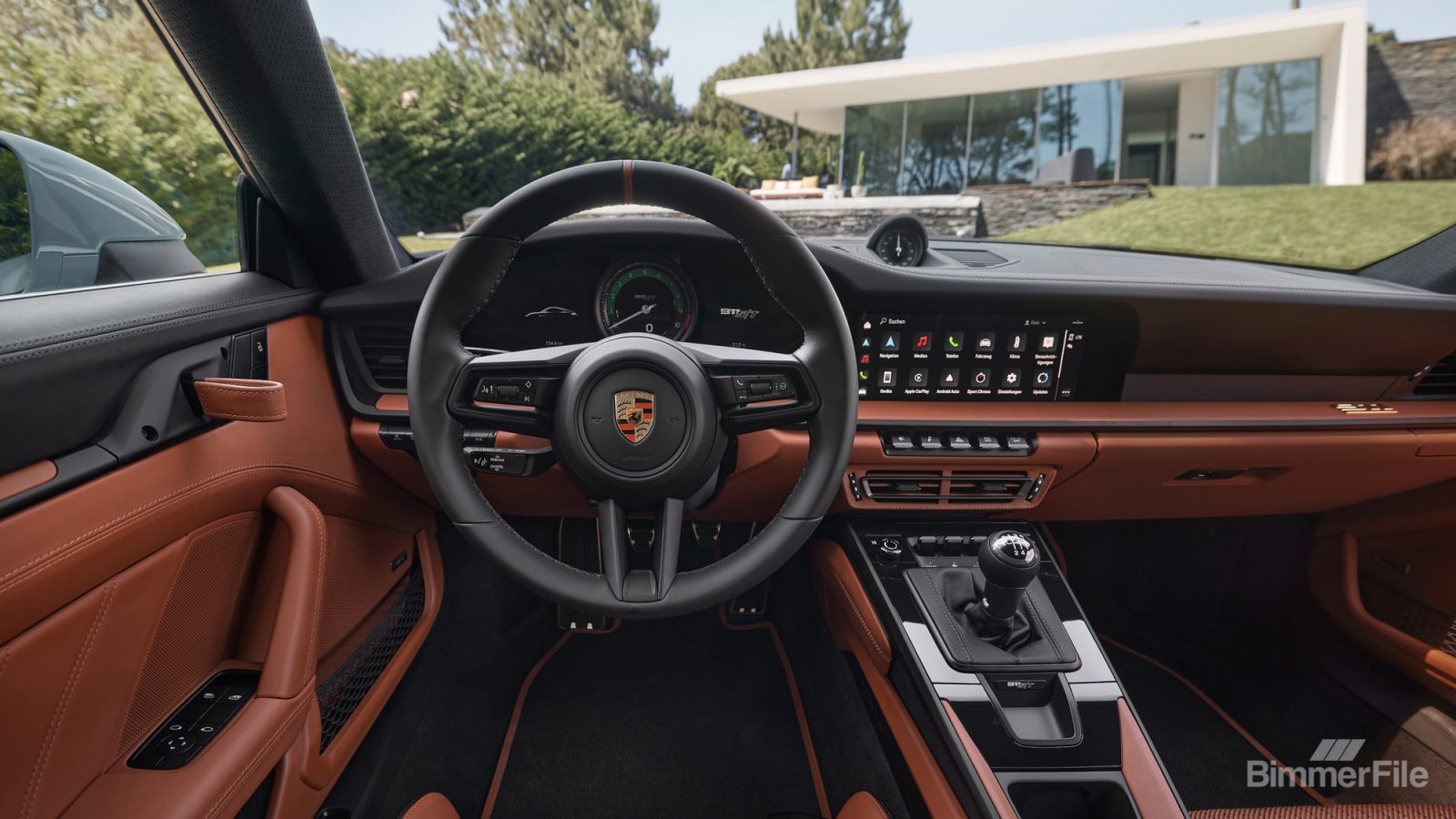
Few brands illustrate this split more clearly than BMW. On one side, the company is investing billions into its Neue Klasse EV platform, aimed at buyers who want the latest in efficiency, digital tech, and hands-off driving aids. On the other, BMW continues to feed its most loyal audience—the ones who value connection over convenience—with cars built for mechanical engagement.
The proof is in the numbers. Nearly half of U.S. M2 buyers choose the manual transmission, an astonishing figure in a market where automatics dominate. The Z4’s recent U.S. sales surge has been driven almost entirely by the addition of a manual gearbox, proving that when BMW gives people the option to truly drive, they respond.
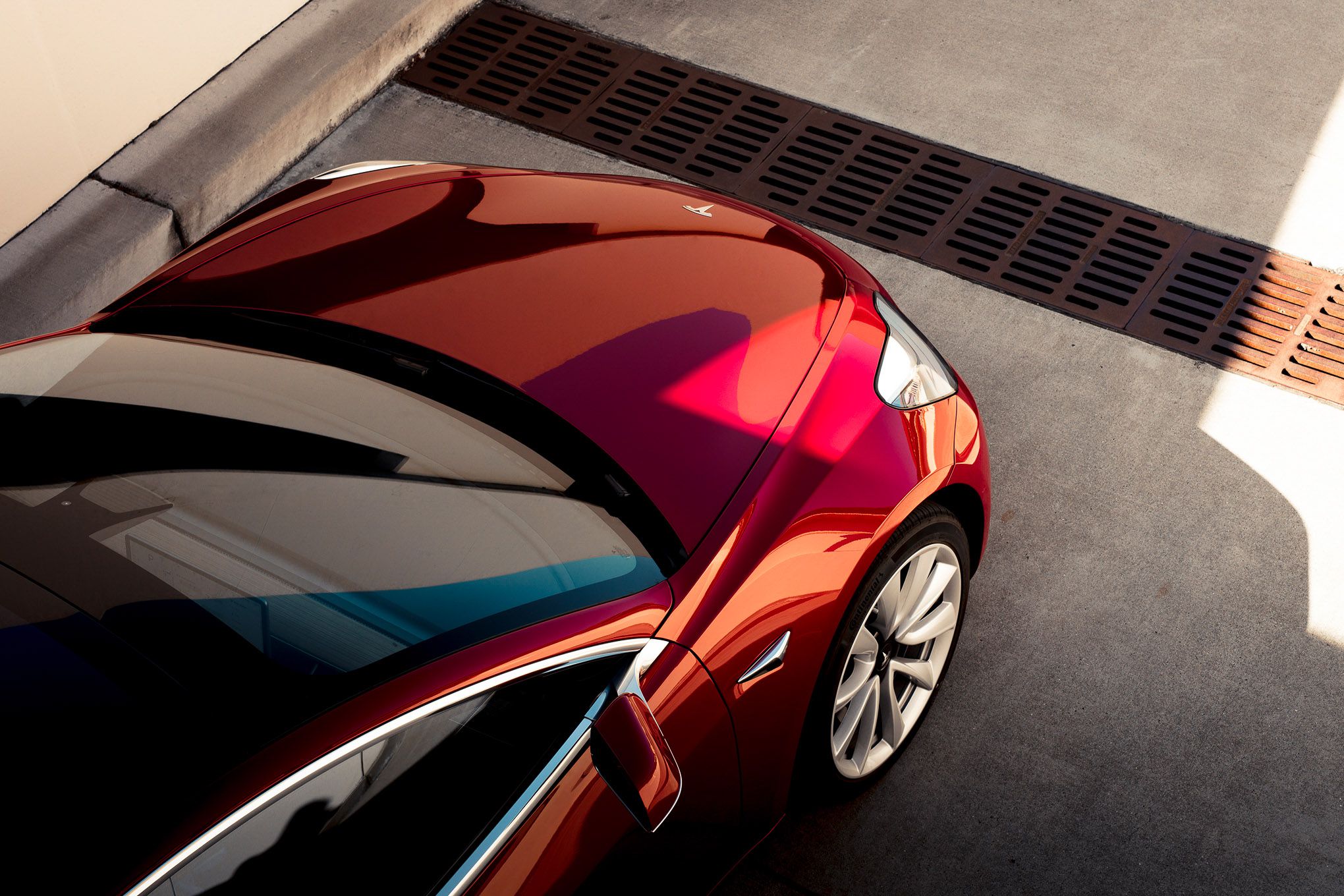
The Tesla Model 3 is a great example of an automotive appliance that delivers so much of what most consumer are looking for.
There’s no denying the appeal of cars designed to minimize effort. Silent electric drivetrains, smooth automatic gearboxes, and advanced driver-assistance systems make commuting easier and less stressful. For the majority of buyers, these cars “just work” in a way that older, more mechanical vehicles never could. BMW’s upcoming Neue Klasse sedans and crossovers will lean heavily into this—offering quick acceleration, long range, and a digital-first cockpit experience.
For many customers, that’s exactly the point. They don’t want to think about driving any more than they want to think about how their dishwasher works. The car is there to provide reliable, efficient transportation, ideally with the ability to handle more of the task itself over time.
But there’s another BMW customer—one who wants every drive to matter. This is the buyer who understands the difference between hydraulic and electric steering feel, who finds joy in perfectly timed downshifts, and who chooses a car for the way it makes them feel rather than the way it syncs with their phone.
BMW has leaned into this group in key places. The M2’s manual take rate isn’t just a fun statistic—it’s a loud signal that engagement still sells. The Z4’s stick-shift revival has transformed it from a niche player to a sales bright spot in the U.S. And BMW’s M division still offers manuals across several models, even as most rivals have walked away from them entirely.
At the top of the market, this appetite for connection is mirrored in the industry at large. Gordon Murray’s T.50, Porsche’s 911 S/T, Pagani’s gated-manual hypercars, and Ferrari’s forthcoming F40-inspired tribute all speak to a desire for cars that demand something of the driver. They are the horological equivalent of a hand-built mechanical watch—objects of art and craft that ask you to participate in their function. Just as the quartz revolution in the 1970s gave the world watches that were cheaper, more accurate, and more convenient, the rise of automation and electrification has given us cars that are faster, quieter, and easier to live with. But in both worlds, the machines that endure—the ones that stir real passion—are the ones that wear their complexity and imperfection as a badge of honor. A manual gearbox, like a finely made movement, isn’t about necessity anymore; it’s about the tactile satisfaction of being part of the process. And in a time when technology can do almost everything for us, that human connection has never been more valuable.
BMW’s challenge—and opportunity—is to serve both worlds without alienating either. The Neue Klasse lineup will cater to the majority who want a frictionless, appliance-like experience, while M cars and special projects keep the flame alive for those who want more than just speed and silence.
The split is likely to grow sharper as regulations, technology costs, and market forces push most automakers toward automation and electrification. The risk is that the enthusiast’s corner of the market could become a boutique niche, with higher costs and lower availability. The reward for keeping it alive is brand loyalty that lasts decades, not just lease cycles.
The new 2 Series is a great example of a BMW built for the mass market, devoid of historical BMW dynamics and dominated by synthetic feedback, while delivering great performance, comfort, and efficiency.
The question is whether this dual path is sustainable. Building a manual transmission sports car isn’t cheap, especially when volumes are low. But what we’re seeing suggests that demand isn’t going away. In fact, the more the world moves toward automated, appliance-like vehicles, the more valuable the analog experience becomes.
The original BMW 1M and the G87 M2 are both excellent examples of BMWs from their era that deliver immersive experiences that demand active engagement.
The automotive world is diverging into two paths: one toward the appliance car, and one toward the driver’s car. BMW is one of the few brands straddling both, with the Neue Klasse promising efficiency and digital convenience, and the M division doubling down on involvement and mechanical purity.
For the majority, the future will be quiet, smooth, and largely automated. But for the rest—for the ones who still want to row their own gears, feel the road through their fingertips, and hear an engine sing—the manual M2, the stick-shift Z4, and the next generation of driver-focused BMWs are proof that the joy of driving isn’t dead. It’s just becoming more intentional. And in a world of appliances, that might be the ultimate luxury.
A big thank you to Feedspot for featuring this blog on their list of the top 20 supercar blogs and websites for supercar lovers to follow in 2018. There are various other blogs that you can follow for awesome contents there. Check out the full list here and don’t forget to subscribe to them for weekly updates.
-Why don’t you go for a Range Rover this time?
-Range Rover…No man!
Their fuel efficiency rating is very bad
I can’t afford that much fuel
-How good it would have been if they made a hybrid SUV
-Yeah mate! I would be awesome
After some months:
Range Rover: We got your back. Check out our showroom and take your Phev
-Wait…What is Phev?
Range Rover: We heard you and made our first hybrid SUV
-Really?! Take my money right now!
A hybrid SUV from Range Rover! Is that true?
Yes, you read that well. Land Rover finally decided to launch their plug-in hybrid SUV. It will be available for 2019 as the facelift version and they named it the Range Rover Phev. Two types of Phev will be available, the Autobiography (P400e) and the Sport. With that coming, one thing is sure. More people will consider the brand now as for once, they will be able to afford to drive a Range Rover on a daily basis.
So, what exactly is the Range Rover Phev and how it is different from the others? Well, let’s take a deeper look at it.
So, what are the Phev features?
As we have mentioned above, the hybrid version will be available for the 2019 model year. The model has several upgrades to it. For the Phev, weird to say, but there is a downgrade in power and torque but we can say it is still reasonably fast and comfortable. Ah, and yes, it is still very capable off-road.
The first and most obvious change is the front grille. The new Phev will be using the same updated grille as the Velar. But what is unusual is the fact that the charging port is integrated into the front grille. This was not easy for the manufacturers but somehow they managed to do it. I must admit that not only the Phev looks more futuristic with this but also it gives a clean look.
The second upgrade is at the back, most precisely the Phev is benefiting a new set of taillights and tailpipes. These days, taillights are getting pretty complicated but we must admit it once again, they are quite cool and pleasing to look at. Don’t get fooled with the new set of tailpipes. This is a hybrid so the beautiful exhaust sound might be gone or decreased. It can go completely silent if you are driving only on the batteries.
Coming to the Range Rover Phev main feature that differentiates it from its brothers. Yes, the hybrid system. The Phev features a lightweight Ingenium engine along with an electric motor that delivers 102 hp. The duo is combined with a large 13 kWh capacity battery that is charged through the port in the front grille. On a full charge, the Range Rover Phev can go up to 31 miles without any CO2 tailpipe emission. The vehicle is completely silent in EV mode.
The interior is pretty much the same as the Velar, that is the dual-screen in the centre console. The different part is the back, where things get really comfy and luxurious. There is both a short and long wheelbase available for the P400e. But both features rear infotainment system with electronically reclining seats and the centre seat folds to unveil more luxury amenities.
Surprisingly enough, the boot space has been slightly reduced. This is due to the fact that the battery for the hybrid system is located just below the floorboard. But it is still more than you expected. If for any reason, space is not enough, you can still fold down the back seats and get massive boot space. The floor is higher by 44 millimetres and space has come down by 98 litres.
The new Range Rover Phev can fully charge itself in only 14 hours (this depends on your local power supply). You can also set a timing for when your Phev will charge itself. You can also get the help of the intelligent routing system available. The upper touchscreen will display charging points on your route and it will also show you the most efficient routes that you can take. Another amazing feature that the Phev possesses is the intelligent plug-in hybrid display. This will basically allow you to see how efficiently you are driving and it will also show you real-time data on how the electric motor is working with the conventional combustion engine. Pretty cool, right!
What’s under the hood?
Under the hood is a 2.0L turbo-petrol engine that combines with the 102 hp electric motor to make a good 404 hp and 295 lb-ft of torque. The Phev is not as powerful as the other Range Rover models but it is still enough power for you to enjoy both on-road and off-road. The Phev will do 0 to 62 mph in 6.4s, which is good for an SUV this big. It can achieve a top speed of 137 mph (220 km/h). The all-wheel-drive SUV uses an eight-speed automatic gearbox.
What it’s like to drive?
You can switch between hybrid or completely electric depending upon your choice. You get the same driving feeling as any other Range Rover and in EV mode, it is completely silent. The Phev is as good on city road as it is off-road. There has been no compromise on its off-road capabilities at all. In other words, it is still a mighty Range Rover that bears its name proudly.
How much would it cost to own?
Well, the Phev is in the same price range as its brothers and we can say that one will be getting a lot of vehicle and tech for the price. The Range Rover Phev starts at around $95,150.
There are other Phev models that have not been covered in this review, namely the Range Rover Sport Phev and the Land Rover Plug-In Hybrid. The starting MSRP is $78,300 for both.
If you like our article on the Range Rover Phev, please share it with your friends and family. It really helps us to keep creating awesome contents for you. Also, if you have questions, tips, recommendation or anything else, feel free to write it down in the comments section and we will try our best to reply to all of them. Don’t forget to subscribe to our newsletter for hot supercar related news and also to be the first one to know when we upload a new blog.
Get ready for summer, or as we like to call it, #100DaysofCamping. Did you know there are 100 days between Memorial Day and Labor Day? That means long trips, short trips, quick getaways, and all kinds of camping fun on the calendar.
A Thousand Trails Camping Pass is the best way to make the most of #100DaysofCamping. For a limited time, Good Sam Members save $200 off a Thousand Trails Camping Pass! Click here to buy, or keep reading to learn more about all the great locations you can visit with a camping pass!
One hundred days gives you time to cover a lot of ground, and luckily, Thousand Trails has camping destinations in some of the most popular travel destinations. If you don’t have a bucket list, you may turn to the internet for ideas. One list compiler is U.S. News & World Report, which regularly compiles “bests” when it comes to summer vacation options, so we will take a look at those and highlight attractions and camping options.
U.S. News & World Report likes to categorize destinations, so they have all kinds of lists like Best Historical Towns, Best Small Towns, and Best Beach Vacations.
Camping at Thousand Trails Verde Valley
For small towns, their list includes Lake Tahoe, Sedona, and Bar Harbor, while the best historical towns include Gettysburg, Philadelphia, and Williamsburg. From a Lake Tahoe standpoint, camp with us at Tahoe Valley Campground and plan to kayak, jet-ski, or paddleboard beautiful Lake Tahoe; hike the many trails; or check out Vikingsholm Castle, a 38-room Scandinavian-style mansion built in 1929. Sedona, set among the beautiful Red Rock Canyon, offers hiking trails, healing vortex visits, a wine trail, and some wildlife parks worth a look-see.
Camp with us at Thousand Trails Verde Valley to explore Sedona and the surrounding area. Bar Harbor, the quintessential New England harbor town, offers Maine lobster meals, proximity to the spectacular Acadia National Park, and whale-watching opportunities. There are three camping options here: Mt. Desert Narrows, Narrows Too, and Patten Pond.
Historical towns include Gettysburg, with camping options at Drummer Boy and Thousand Trails Gettysburg Farm. Must-dos here include a tour of the Gettysburg National Military Park and Visitor Center, a stroll through charming downtown Gettysburg, and, of course, a ghost tour since Gettysburg is considered a paranormal hotspot. Another Pennsylvania option is Philadelphia. And a day trip to Philly means you can choose to stay at the equidistant New Jersey’s Thousand Trails Chestnut Lake or Pennsylvania’s Thousand Trails PA Dutch Country camping locations. In Philadelphia, you must enjoy a classic Philly cheesesteak while taking in Independence National Historical Park, nicknamed America’s most historic square mile. Virginia’s Historic Triangle includes Colonial Williamsburg, Jamestown, and Yorktown and is a great place to visit when camping at Thousand Trails Williamsburg. In addition to the historic sites, there are hiking and biking trails, zipline adventures, and Busch Gardens® Williamsburg theme park.
If sun and sand are on your summer agenda, consider the list for Best Family Beach Vacations. They include: Monterey, California, with a variety of beaches and the Monterey Bay Aquarium (camping spots include Marina Dunes or Santa Cruz); Cape May, New Jersey, for a classic Jersey Shore trip and the charming Cape May with its historic Victorian homes, known as the Painted Ladies (Thousand Trails Chestnut Lake,Thousand Trails Lake & Shore, or Thousand Trails Sea Pines are camping options here); and St. Augustine, Florida, where you can enjoy 40 miles of sandy beaches and take in the highlights of America’s oldest city including the St. Augustine Pirate & Treasure Museum, Castillo de San Marcos National Monument, and the St. Augustine Lighthouse and Maritime Museum. Camp at Encore Bulow for a St. Augustine adventure.
Thousand Oaks Natchez Trace.
Road trip the Oregon Coast with the many lighthouses, beach towns, hiking trails, and iconic Haystack Rock at Cannon Beach (there are four coastal campgrounds along the way). Travel the heartland and make stops in Wisconsin, Indiana, and Illinois while visiting big and little cities including Madison, Wisconsin, Chicago, Illinois, and Indianapolis, Indiana, as well water-related destinations like the popular Wisconsin Dells and Michigan’s Harbor Country, which has beaches and wineries. Check out upstate New York’s Adirondack Region and stay at one of our Lake George area campgrounds. Do beach and city with a visit to Boston and our Cape Cod campgrounds. Or head south and check out Nashville (Thousand Trails Natchez Trace) or Memphis (Thousand Trails Cherokee Landing)
Get started on your agendas and make your reservations — #100DaysofCamping fun will go by in the blink of an eye.
Getting a Pass
For a limited time, Good Sam Members save $200 off a Thousand Trails Camping Pass. Click here to buy and start planning your summer fun!
Disclaimer: If you purchase a single-region Thousand Trails Camping Pass (“Camping Pass”) by June 9, 2024, you will receive a $200 discount off the regular $725 annual fee. The $200 discount is only good for the first year. The single-region Camping Pass includes use of the Thousand Trails campgrounds in one of five regions for one year. Terms and conditions apply. Click here for details.
In addition, you may choose to pay the annual fee in 12 monthly installments, provided that you commit to a two-year agreement. For complete terms and conditions, please click here. Taxes not included. This offer cannot be combined with any other discounts or promotions. Usage is subject to length of stay restrictions. Must sign a Camping Pass Agreement. Offer is only available to new customers. Amenities vary by property. Existing members, employees of MHC Property Management, L.P., and its affiliates and residents of MN, MS, and SD are excluded from this promotion.
If you purchase a Thousand Trails Camping Pass through our website or call center and are not satisfied with your Thousand Trails Camping Pass for any reason during the first 30 days after you sign the purchase agreement or after you stay at a campground for not more than two consecutive nights, whichever comes first, you may cancel your purchase agreement and receive a refund.