It has often been said that, if
there’s anything constant in this world, it is change. And when you are on the
go, as travelers always are, change happens more often.
Camping in Chicken, Alaska
Nothing illustrates this more than this
incident in Chicken, Alaska. We were newbies in RVing. We successfully drove
across the Alaska Highway from Calgary, Alberta to spend a cool summer month in
Alaska. But we returned to the Lower 48 on a different route through Chicken,
Alaska, the Top of the World Highway to Dawson City in the Yukon, and then the
Glacier Highway in British Columbia.
I distinctly remember the trauma of taking a
shower in Chicken, a little town of 32 in summer and seven in winter. I thought
I had enough Loonies (Canadian coins) for a hot shower at the campground. I
ended by rinsing with cold water at the sink in a room with no heater in the
cold of fall. I made a mistake and put all of them all at once in the
beginning, I was supposed to put each one before each segment ran out. I had to
learn to be more flexible. We were in a different “home” every few days.
Using Public Transportation in Mexico
City
Then I remember the folly of resisting
local ways. During our 2009 three-week tour of Mexico, we parked our RV in
Teotihuacan where the most visited pre-Hispanic ruins of the oldest
civilization in North America are located. It is 25 miles northeast of Mexico
City. One day, we took the public bus to tour the metropolis. With a population
of 18 million, it is one of the most congested cities in the world. We loved
our tour of Catedral Metropolitana, Templo Mayor, Plaza de la Constitucion, Palacio
Nacional, and the Avenida Central shopping area, ending our day with a visit to
the only authentic castle in North America, Chapultepec.
To get back to Teotihuacan, we needed
to take the train to get to the bus station. But I was horrified to find that
men and women rode in separate carriages to prevent chances of unwanted
encounters. I didn’t want to be apart from my husband, so we hailed a taxi
instead. Bill lost his cell phone and a lot of money and time going through all
the city traffic in that cab. It was good that we made it to the last bus to
Teotihuacan. But I should not have resisted local ways.
Stopping in Guangzhou, China
One year I went to Melbourne, Australia
to babysit my youngest grandson. The cheapskate that I am, I opted for the lowest
fares with long layovers in Guangzhou, China. I thought not only would I save money, but I would also get to tour the second-largest
Chinese city after Shanghai. Unfortunately, I discovered the seven-hour layover
wasn’t long enough because I needed two hours each way to get to Guangzhou. I
decided to spend those seven hours with my laptop instead.
Sadly, its battery was down to almost
zero. It just so happens that I also have a mechanical aptitude near zero. I
could not get my chargers to work. Luckily, I discovered that my husband had
put a portable one into my bag. That
plus help from a millennial Chinese couple saved me. But when I finally sat
down, I was dismayed. I had forgotten that Facebook is banned in China. I turned
to surfing, only to find that every search landed me in an unfamiliar site,
totally in Chinese. My isolation was complete. I should have brought a book.
It is hard to make a woman in her
seventies to be more flexible. But I love to travel so I would have to keep on
trying. I must be better prepared, arm myself with prior knowledge, and, most
of all, have a great attitude when something unexpected happens instead.
Piper Sandler boosted its Tesla (NASDAQ:TSLA) price target to $500 from $400, maintaining an “Overweight” rating after a research trip to China.
The firm cited Tesla’s leadership in artificial intelligence and robotics as central to its thesis, even as Chinese electric vehicle makers grow more competitive. Analysts concluded that Tesla is still the benchmark that competitors rely on for innovation.
A China visit
During its visit, Piper Sandler met with several Chinese EV manufacturers, many of which are vertically integrated and expanding rapidly. Analysts noted that these “fast followers” represent Tesla’s most significant competitive challenge. However, executives from multiple companies acknowledged Tesla’s foundational role in shaping the industry’s direction, TipRanks stated in a report.
One automaker told Piper Sandler that “without Tesla going from 0 to 1, we can’t go from 1 to 100,” highlighting the Elon Musk-led company’s enduring influence. Analysts said the remarks reflect both admiration and dependence on Tesla’s early innovations, particularly in areas such as battery integration, vehicle software, and AI-powered features.
As we predicted last week, we have another $TSLA price target increase going into quarter end – this one from Piper Sandler to $500 from $400. Piper defends TSLA’s FY2025 multiple of 230x, pointing to AMZN’s 200x+ multiple from 2012-2025. Piper is looking for $TSLA 3Q delivs of… pic.twitter.com/tzLQHZ8P1s— Gary Black (@garyblack00) September 22, 2025
Tesla’s leadership
Piper Sandler’s report emphasized that while Chinese automakers are formidable in design and production, they look to Tesla for advancements in “real-world” AI applications. Tesla’s focus on autonomous driving and robotics continues to distinguish it from competitors, making the company Piper Sandler’s top investment idea in this space.
“Building AI-enabled machines requires data, talent, chips, and engineering prowess. Tesla compares favorably vs. the Chinese on all of these fronts,” Piper Sandler analyst Alexander Potter stated in a note.
Piper Sandler also shared some of its expectations for Tesla this year, stating that it is estimating that the company will delivery ~495k vehicles this third-quarter, possibly attaining a new all-time record. The firm, however, stated that its 2026 outlook for Tesla is shakier, as the EV maker could just hit ~1.9 million units, which could include as many as 350k affordable “Model 2” vehicles.
For decades, BMW assiduously avoided ever building a motorcycle that could be directly compared to the models of other manufacturers. Sometimes this resulted in idiosyncratic excellence, like the 1985 K 100 RS; sometimes it sent their engineers down a bit of a rabbit hole. The average age of a BMW buyer, meanwhile, remained around 50 years old. But a 50-year-old in 1985 had cut their teeth on air-cooled Japanese or worse, British, bikes. A 50-year-old rider in 2005 grew up on FZR600s and GSXRs.
In 2006, the General Director of BMW Motorrad, Hendrik von Kuenheim, threw caution to the wind and built the S 1000 RR, a transverse four-cylinder, aluminum-framed, conventionally suspended sport bike that, from the spec chart, was directly and favorably comparable to the offerings from Japan down to the price point.
While sport bike riders greeted the bike with enthusiasm, it confused the branding a little for the Aerostich adventure customers because now the brand wasn’t just for stodgy riders, it was for racers, track day enthusiasts and, of course, bike night poseurs.
While these dynamics convulsed the BMW faithful, the S 1000 RR cast a beacon throughout Germany beckoning the brightest and most dedicated to come and work at BMW. The adoption of the S 1000 RR into BMW’s arsenal planted acorns inside the company; their roots would eventually grow and split decades-old traditions and permeate the organizational chart at BMW Motorrad to the highest level.
Twenty-odd years after the BMW gang walked out of the first S 1000 RR design meeting, BMW has gone from being the stodgiest of brands to the absolute height of exuberant sport riding. This is easy to do in advertising. It is much harder to do in actuality.
All of this led to me arriving at the Cremona Race Circuit in Italy in the middle of the World Superbike weekend. It wasn’t clear to me what event I was attending because, as it turned out, an event like this–at least in this moto-journalist’s 30-odd years of experience–had never been attempted, much less by BMW!
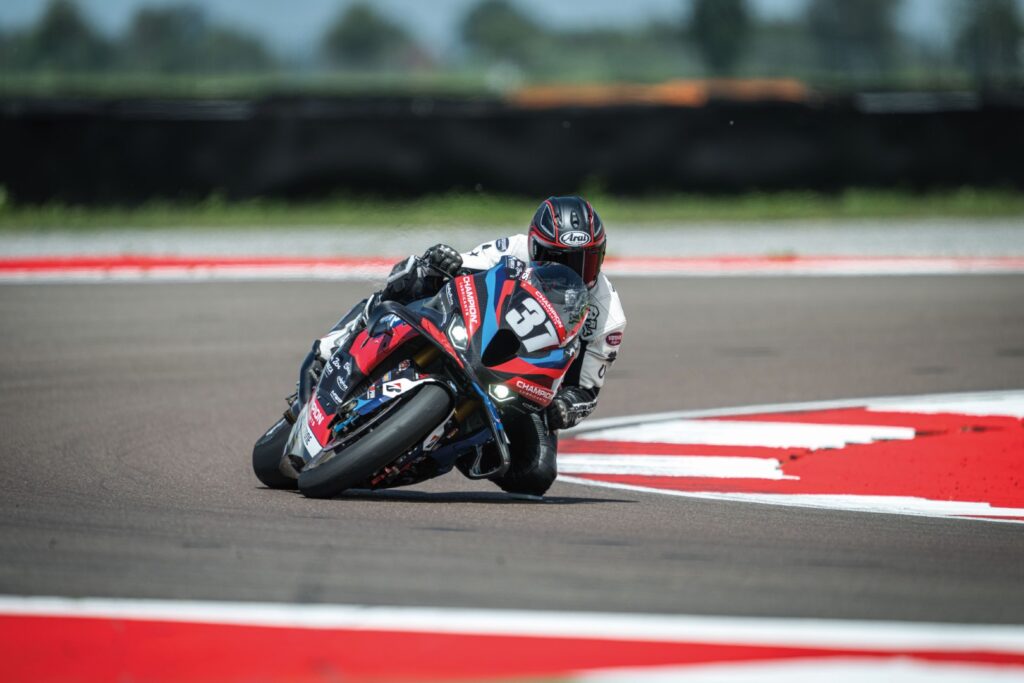
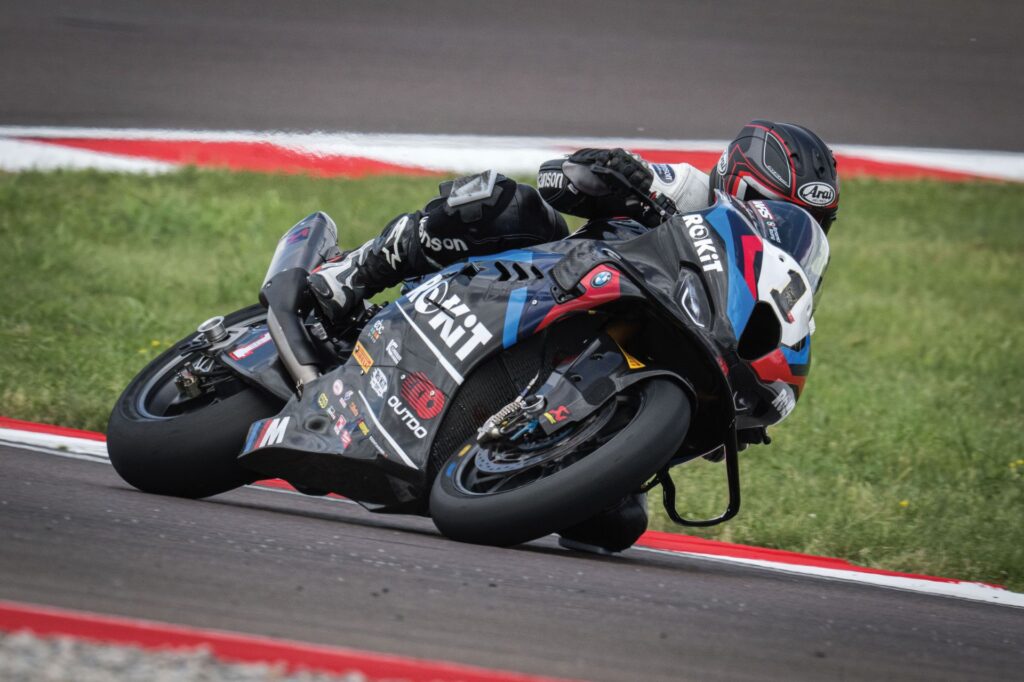
We were given relatively unfettered access to the ROKiT World Superbike Team with reigning world champion Toprak Razgatlioglu and Michael van der Mark as well as the techs, execs, and mechanics for the team. Also in attendance were a dozen BMW Motorrad execs, project managers, software engineers and the like, along with execs and mechanics for alpha Racing. Alpha has a direct supply of BMW base parts (engines, etc.) from which they build various iterations of M 1000 RRs, including their MotoAmerica Stock 1000 bike (which I previously tested) as well as a superbike version, which Cameron Beaubier is using to lead the MotoAmerica Superbike championship.
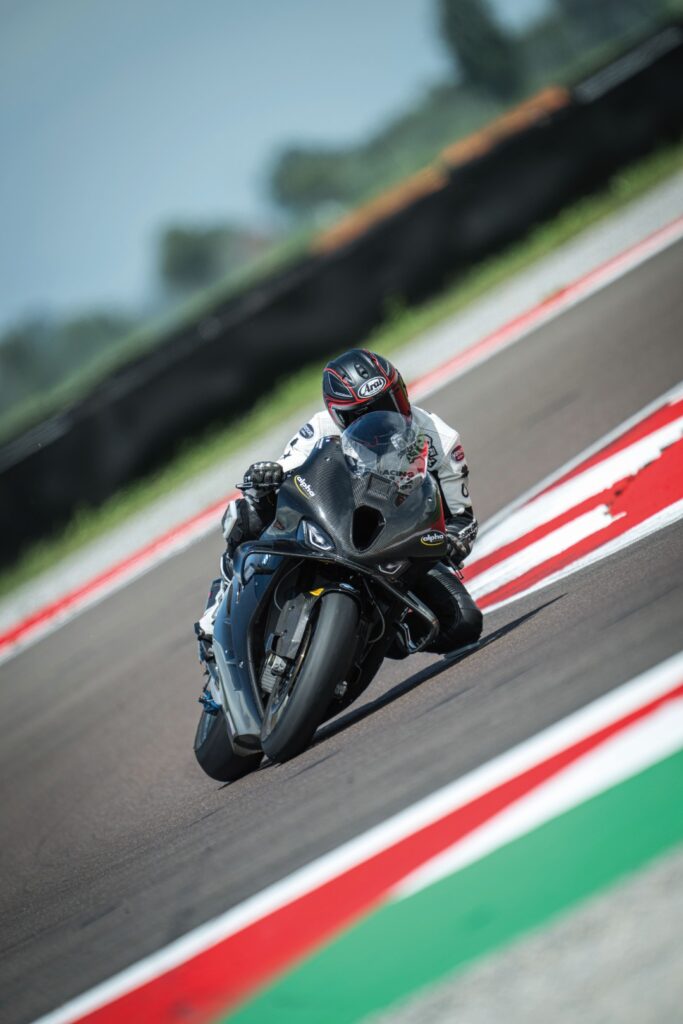
While reveling in the pageantry of the World Superbike weekend, I was preparing to suit up the following day to ride the M 1000 R, M 1000 XR, M 1000 RR, alpha Superstock, alpha Superbike, World Endurance bike, and…Toprak’s factory World Superbike!
If all that wasn’t enough, every BMW or alpha employee I chatted with, from the CEO of BMW Motorrad Markus Flasch to BMW Project Manager Aline Lorch or her husband Andreas (vehicle control software), were not only huge motorcycle enthusiasts, but would be riding on the track with us. Markus, using that oak tree planted 20 years ago, had apparently been thinking for a year since he took the top seat of doing the ultimate track day, not just for us spoiled journalists but for his own people as well. Many of the staff new to BMW over the last 15 years came in no small part because they wanted to work for the company producing the excellent S 1000 RR. You can’t fake that type of love of motorcycle joy–it’s written into the mitochondrial DNA or it’s not. If your whole company loves motorcycles, you are more likely to release M series bikes and less likely to release the 1978 R 45.
BMW was abundantly clear this day was not a press launch, which is convenient, as it would have been like trying to drink from a firehose. Also, showing a non-Germanic flexibility, the Monday riding schedule was thrown in the shredder as there was an impending rainstorm, temporarily held at bay by the Apennine mountains, but, once that obstacle was overcome, our track would quickly get wet. The four race bikes (two alpha bikes, the World Endurance bike, and the factory World Superbike) would be restricted to an out lap, a hot lap, and an in lap.
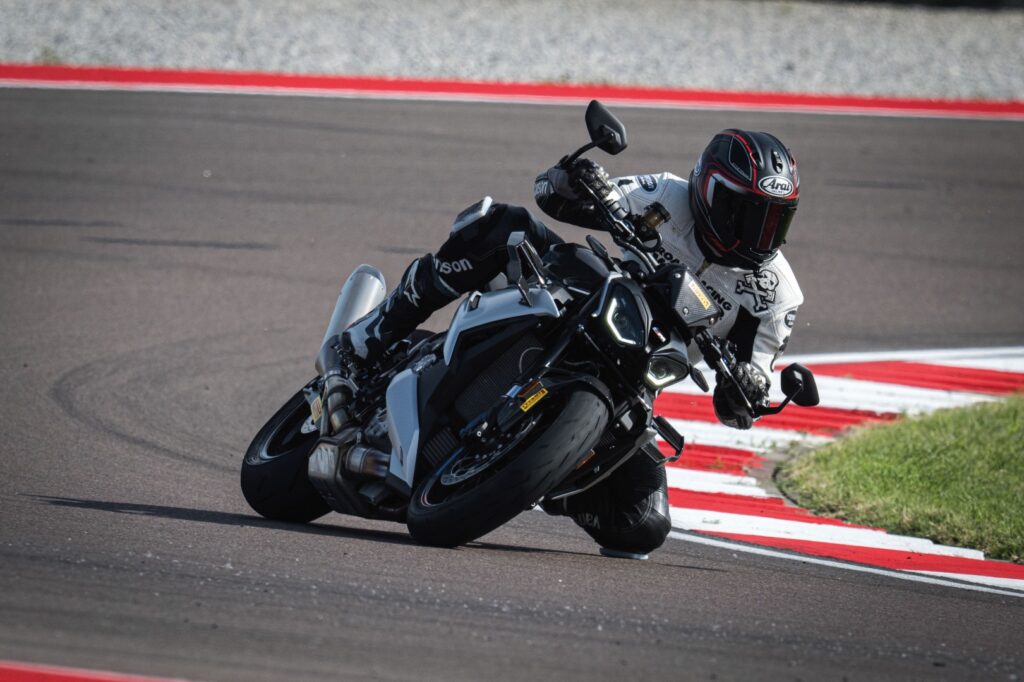
We were rocking Pirelli soft slicks on all the race bikes (and the M 1000 RR) and they reversed the shifting on all the bikes but the XRs. I decided to try to ride only GP-shift bikes until the end of the day and to work my way from slowest to fastest. I started the day on the M 1000 R, the naked version of the S 1000 platform but sporting some nicer parts to take it to the “M” specification to follow their famous sporty car branding.
M 1000 R
I had always been M 1000 R curious, but I thought I would ride one on the street sometime, not the Cremona racetrack. The M 1000 R is pretty fancy. It has carbon wheels, aerodramatic downforce via winglets, and blue caliper brakes. It’s got a lot of support in the suspension, so there is a lot of spring and a lot of damping. All of that means it feels great on a racetrack. I am not sure how it would be on a dirt fire road, but I would be happy to find out sometime! Despite being a roadster with low tube handlebars, they reversed the shifting, so it felt really natural at the track. There is only one long straight at Cremona, so the lack of a fairing meant there was only one place on the track where the wind blast was trying to rip my head off. The bike handled riding at a racetrack very well.
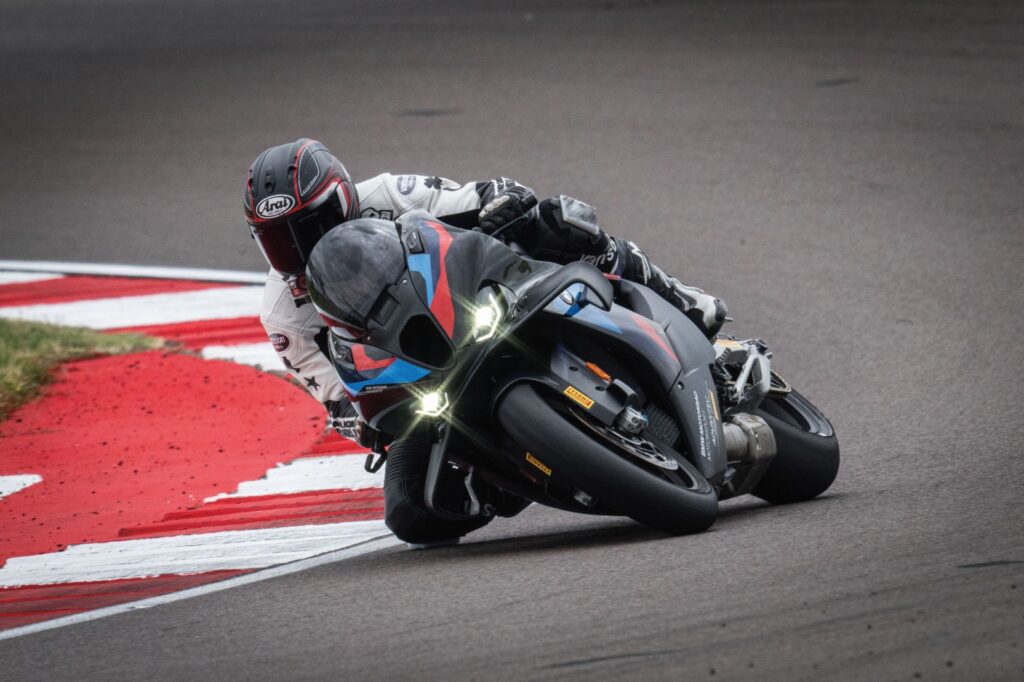
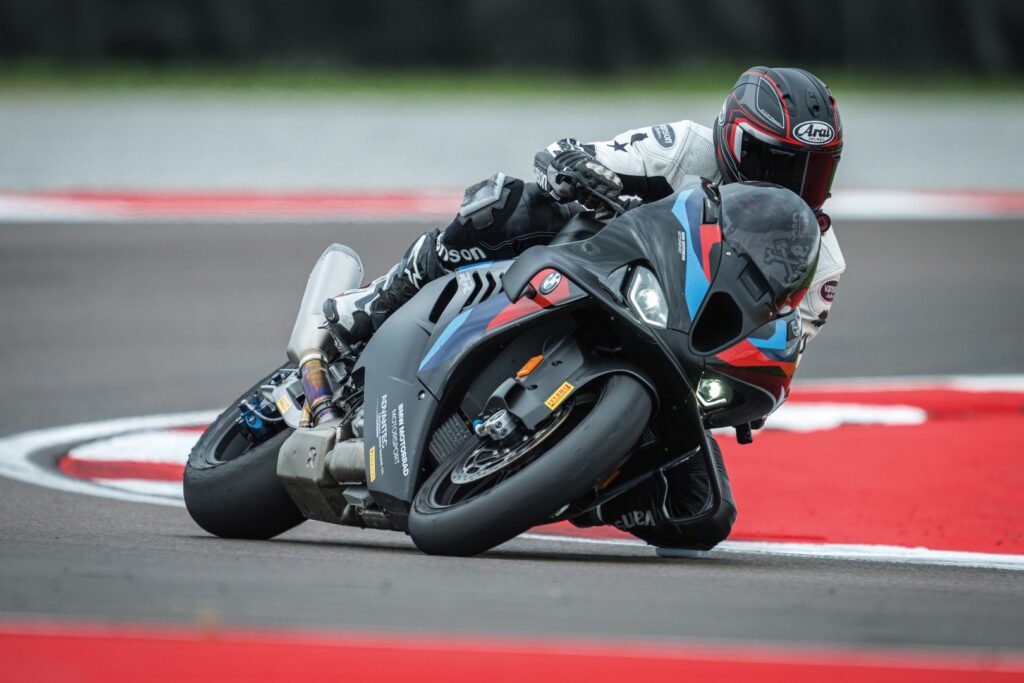
Even on my first laps, when the track topography was still a mystery, I could corner pretty hard on the Pirelli Corsa tires, which quickly came up to temp and started balling up nicely. Tube bars make for a slightly awkward riding position, but as I was trying to learn the track as well, I just started laying off the brakes and throwing the thing into turns. I was knee-down on every turn on lap two.
I think, perhaps, that even the ridiculous-looking winglets were working. As I would shift my weight back onto the seat, coming onto the back straight, the bike would get a little speed wobble, but if I kept the power on and the speed increased, the bike grew more stable. I mean, I wasn’t exactly following the proper scientific method, but I relate the anecdote nonetheless.
If we were riding around the spectacular mountain roads of Italy, the R is the one I would grab. The only thing that would make the bike a little better for multi-day rides would be a little frame-mounted fairing and maybe hard bags–but there isn’t any reason to shy away from tracking your M 1000 R to learn just how capable the platform can perform.
M 1000 RR
There was a little bit of a free-for-all grab bucket vibe to get one of the stock BMW M 1000 RRs. These bikes had Pirelli 0-compound soft slicks, requiring the bike to be on stands with warmers if it wasn’t on the track. The pit crew stayed busy.
As I go about my daily life, I try to maintain some level of self-awareness, so it was amusing to be aware of the stock $41,000 M 1000 RR being, you know, kind of plain compared to the race bikes sitting on the other side of the garage.
In an absolute sense, the M 1000 RR is exceptionally fancy. It’s got a ton of carbon parts and, even as a street legal production Euro 5+ compliant motorcycle, it’s not built to a low price point, so it doesn’t have many component compromises. It’s got really nice electronics with dynamic traction control and wheelie control. The auto blip electronic throttle valves meant I only had to use the clutch leaving pit lane and even if I got lost on the track and needed to downshift mid-corner at 50 degrees of lean, the bike would sort it out for me.
I don’t know if it was the Italian sunlight and the Italian track and the Italianish slicks, but the bike was working really well. Jumping from the R to the RR, I thought it would feel more natural given my proclivity for clip-ons, but at first the RR felt cramped because the R has tubular handlebars bars; it’s a lot roomier. The other thing I realized was how the R lulled me into a lazy and lugging style of street bike riding by leaving it in third in the slower turns and letting the torque pull me out of the apex. The RR reminded me to drop to second for the tighter turns and smudge rubber on the track with the TC and just rev the nuts off of it through the tight turns.
The bike itself is pretty amazing. It’s an expensive motorcycle, but it works like an even more expensive motorcycle. It steers quickly because of the carbon wheels. There is no chatter. The electronic strategy for the engine braking makes for drama free corner entrances, even with late auto blip downshifts to second. The suspension provides a lot of support, so it’s possible to ride harder than most people can imagine on the stock bike and still have a wide safety margin to avoid having to replace any of those gorgeous carbon body panels.
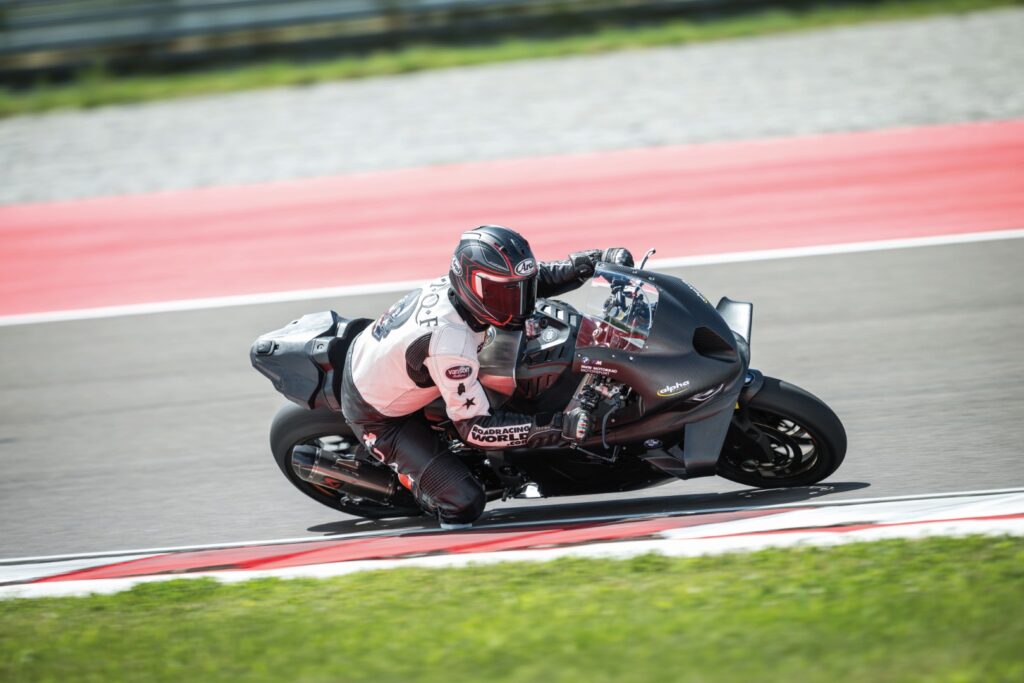
alpha Racing M 1000 RR Superstock
My father used to say, “I’d rather be lucky than good.” In the summer of 2024, I was fortunate enough to have an alpha Racing M 1000 RR Superstock bike almost to myself for a day at Sonoma Raceway in California.
The typical production race bike build means buying a showroom bike and then removing the insanely expensive catalytic exhaust, bodywork, lights, handlebars, rear sets, suspension, engine covers and, perhaps, wiring harness and ECU and myriad other parts, then putting them in a pile in the garage. You tell yourself you are going to sell all of it, but you never do.
alpha receives bikes from BMW with, in effect, an engine, frame and cooling system, then finishes them with a bespoke wiring harness, ECU, suspension, bodywork, handlebars, etc. The net result is an expensive bike presenting as a bargain because you don’t need to buy all the stock parts you end up throwing away.
I was only going to get three laps around Cremona on the Superstock bike, but I knew what to expect. I knew it was light and fast and the ECU programming was going to be great. I knew the ECU strategy meant only two throttle bodies would open off-idle at full lean–making a funny noise–but as soon as the suspension was loaded and I took away lean angle, the other two butterflies would open and the bike would accelerate as hard as the wheelie control and traction control would allow. The Pirelli slicks allow for a lot of acceleration, so the bike goes HARD out of turns.
Cremona Race Circuit is pretty flat, so there were not a lot of topography-induced wheelies and even when that happened, the ECU intervention to limit the power was smooth. The fueling on the stock emission-compliant M 1000 RR is impressive but, it’s no match for a track-only flash with rider-friendly richness on the injectors. With the extra weight of the street bike shed, the alpha bike almost felt nervous until I realized the turbulence was me putting extra steering input into the bars. Once I realized how much faster the alpha bike steered compared to the stock M 1000 RR, the wiggles went away.
Lap times have an inflection point where each increment faster costs more and more money, and also requires more and more rider talent. The alpha Racing superstock bike is well off the flatlands on that cost-and-performance inflection point, but the vast majority of riders would be hard-pressed to see a lap time difference between that bike and, say, the BMW World Superbike. Two of the riders who are good enough are Jayson Uribe and Andrew Lee. They are currently tied for points and both on OrangeCat Racing’s alpha BMWs, leading the 2025 MotoAmerica Stock 1000 class. That bike starts at $51,500 plus tariffs and shipping and such, but for pure racetrack lebensfreude, it is a good value because it costs only 25% more than the stock M model.
alpha Superbike M 1000 RR
I jumped off the alpha Superstock build and onto the alpha Superbike build. This bike has a different frame, swingarm, electronics, a higher performance–but still factory BMW built–engine, and a whole host of other upgrades. It also costs a cool $116,000 MORE than the Superstock bike. At this price you are well up the curve on diminishing returns but, if you want to lead the points in the MotoAmerica Superbike championship with a top rider like Cameron Beaubier, who has won three out of four 2025 Superbike races at press time, it might be the least expensive bike capable of winning a MotoAmerica Superbike race.
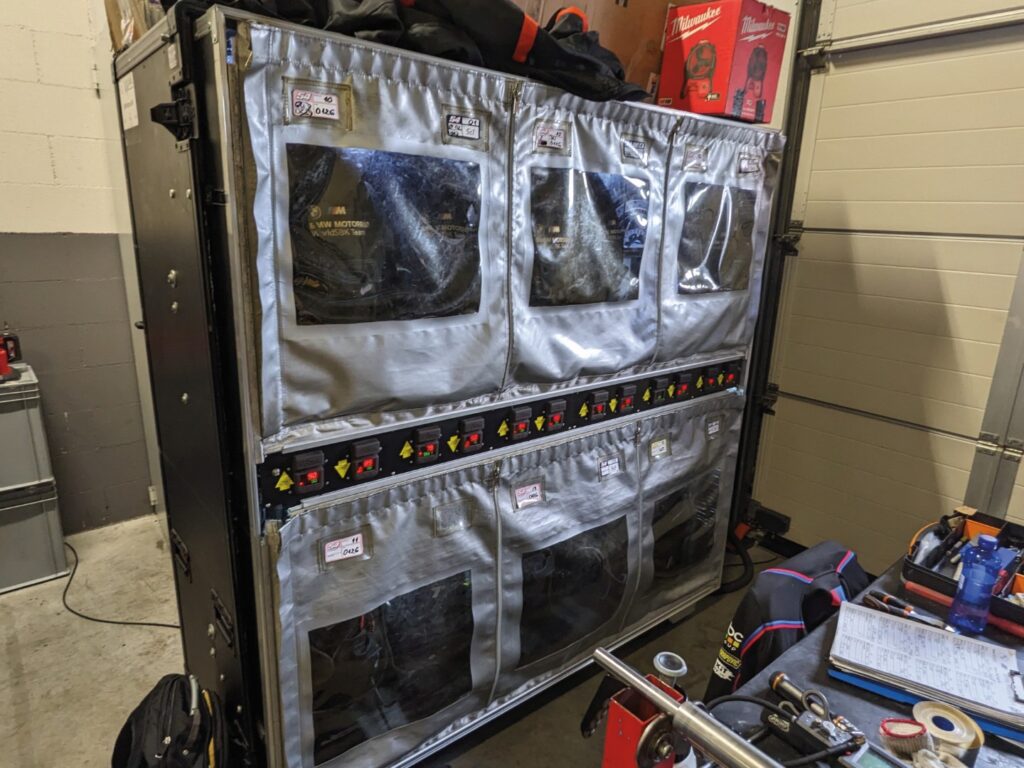
There are tire warmers that you wrap around the wheels, and then there are tire warmers that you place the whole rims inside. This is the latter.
To prepare Beaubier’s BMW, alpha Racing flies an electronics tech from Germany to America for each round of the series to optimize the electronics mapping. Serendipitously, I sat with Michiel Rietveld (also a track and street rider)–that very technician–at dinner and he told me all about the mapping process.
But first, a brief history of race bike electronics. Twenty-five years ago, when we went from carbs to fuel injection on race bikes, the mapping was pretty simple, as we were only working on ignition curves and air/fuel ratios. Those were pretty much solved problems by 2005. Then we started getting traction control to help riders get on the throttle earlier in the corner. In the beginning that was just done through spark kill based on the delta of the crankshaft speed (the system currently still used on dirt bikes with TC), but then we started adding wheel speed sensors, then Inertial Measurement Units, and electronic throttle valves (butterflies), which means the grip throttle is only a signal generator for the engine control unit ultimately deciding, based on programmed coefficients (base maps) and then dynamic signals (wheelie, slide, roll, pitch, yaw) exactly how much to open the actual engine butterflies.
Although most series prohibit GPS inputs to ECUs (which would allow referential position track mapping, e.g., “if the rider is on this bump do this but if the rider missed the bump do that”), so the hack to get to turn-by-turn engine mapping is to create strategies based on meters past the start/finish line with an automatic reset to the finish line each lap to account for long laps or running off or something like that.
Michiel told me about the turn-by-turn mapping available on the alpha Superbike, so I asked if they were using a different traction control (which, remember, is a 3-D map of lean angle, rpm, throttle position, and gear, plus deploying spark kill, butterfly modulation and split throttle body strategy) per gear per corner.
“Usually if we have a good TC strategy for second or third gear it is the same for the whole track, but we spend a lot of time on engine braking,” he said.
We riders used to manage the corner entrance four-stroke slide, which is also when the rear tire surface temperature is at its highest, with manual clutch modulation and setting the idle on the bike high. Then we invented slipper clutches with tunable springs and ramps and clutch pack thickness, but then we got to those electronic throttle valves and (when we can pry control of those ETVs away from the killjoys at the EPA and European Union) allowing all sorts of chicanery. On our older BMW race bikes, we would burn up an $800 clutch in about 10 hours of racetrack use because the plates started slipping so much at corner entrance. Now our clutches last a whole season because the throttle valves are opening slightly to control the corner entrance and the clutch stays fully engaged unless something really bad has happened.
With spec tires (used in many series) and performance balancing in World Superbike, it is harder and harder to find a place on the track to give your rider an advantage. Corner entrance and apex, greatly assisted by the confidence of a stable back end of the bike, means there is an advantage to be gained by flying a guy from Germany to the USA for each round to look at the data traces and change a few numbers on a configuration file because of the advantages over not doing that. They even have engine braking maps with grip throttle position, gear, RPM, and distance from start/finish.
I asked him, “Do you ever think ‘I could just remote desktop into the bike from Germany and do the same thing without the jet lag?’”
“I’ve done it before, but it’s better when I can hear everyone talking at the track,” smiled Michiel.
This will all seem quaint in a couple more years when we have AI doing multifactor regression analysis on massive data sets and automatically configuring the ECU, kind of like they are already doing in MotoGP, including incorporating 3-D track scans. But all the maps were already built for this bike, so the first thing that struck me was the extra lever on the right grip. Because, for the first time in my 42 years of riding, I encountered a bike with neutral underneath first gear (or on top of it depending on how you are looking at it) with a lockout so the shift pattern is N – 1- 2 not 1- N – 2. This is, of course, to avoid losing a race by hitting neutral unintentionally.
Is the alpha Superbike better than the alpha Supersport bike? Yes it is, but remember at this point we are sharpening a straight razor. Riding the Superbike made me realize there were little bits of movement on the Supersport bike which were absent on the Superbike. That stability, which is an incredibly complex blend of tensile material strength, tire, spring, damping, weight distribution, split throttle body opening off the apex, engine braking, all of it, just communicates to the rider that it is fine to brake later, turn harder, lean more, and to get on the gas earlier. Confidence = encouragement = faster lap times. Then a top talent like Cameron Beaubier can extract the maximum performance out of the race package and, when he does that, he wins the American Superbike races.
We can empirically quantify what the extra money gets you, not including the tuning and setup budget, at Road Atlanta on May 4, 2025. Cameron Beaubier was 0.4 seconds a lap faster than any other Superbike, winning the race by 2.3 seconds over 19 laps. Notably, he was also two seconds a lap faster than Uribe and Lee, who were P1 and P2 on alpha Superstock bikes on the same day.
If the rules allowed it, there isn’t a top team racing in the world not willing to happily pay $100,000 for two seconds a lap.
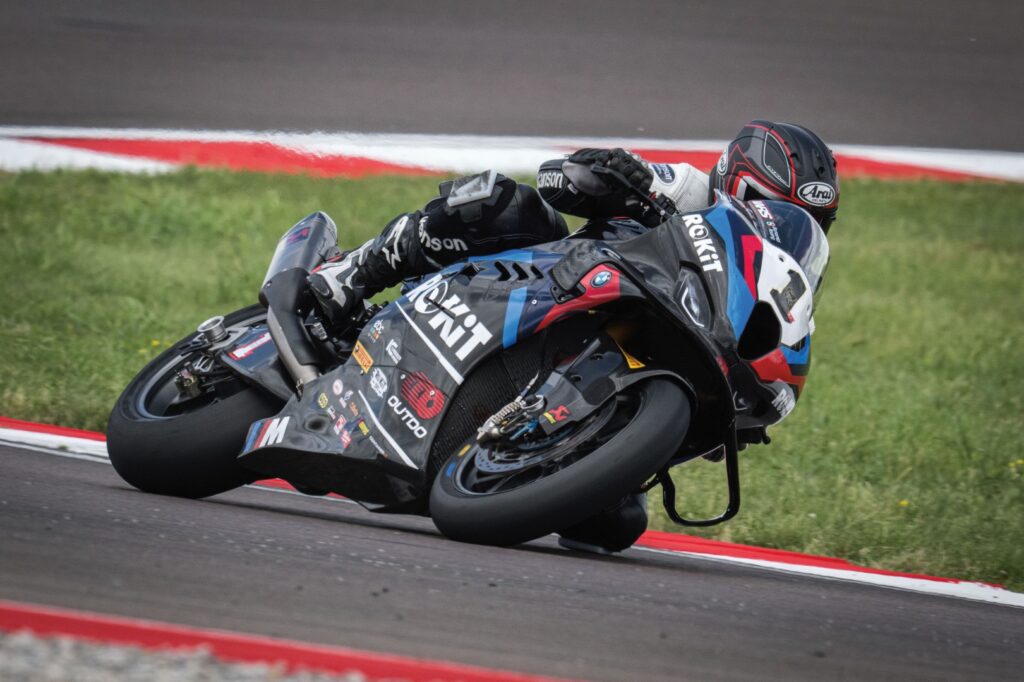
The Unobtainium ROKiT BMW 2025 World Superbike (Toprak’s bike)
There are moments in my personal journey where I have to take a moment to appreciate the rare air I am breathing. Standing in the ROKiT World Superbike garage–in my leathers– impatiently waiting for the most expensive three laps I’ll ever turn, I stopped to consider that this M 1000 RR wasn’t just a bike; it was the physical manifestation of a huge system which all had been choreographed and timed for an ephemeral six minutes.
“Neutral is at the bottom of the shift pattern, you need to thumb the lever on the right grip to get the bike in neutral. It’s GP shift. There is a rear brake lever for your left thumb if you want it. This is one of Toprak’s three bikes, so please don’t crash it.” At least I think that’s what the crew chief said. I was too busy absorbing the technical details of the support systems. Another example is that the engine control unit does so much heavy lifting (maybe not when I am riding it, but certainly when Toprak is) it gets its own air vent to keep it cool.
Race tires only work within a specific temperature range and the carcass of the tire is designed to work at a specific pressure, which can change if the tire gets hotter or colder. Whereas surface temperature of a tire will jump in milliseconds, the carcass has a few more seconds of thermal mass to it. Thirty years or so ago we adopted electric tire warmers to bring race tires up to temperature before the start of the race, and it is common to obsess over cold tire pressure, off-the-warmer tire pressure, and off-the-track tire pressure, all cross referenced with tire temperature to make sure the pressure and the rubber temperature are within their designed operating range.
In the World Superbike garage they want NO pressure rise from the warmer to the track, which means they store the wheels–with the tires mounted–in an oven with a tire warmer mounted to not only bring the thermal mass of the tire but also the rim to the ultimate pressure and temperature they want to run on the track.
Toprak’s bike is fitted with endurance-style quick-change systems front and rear–meaning the spacers are captive to the wheels and there are ramps on the bottoms of the front forks with the front fender mounted on swivels. A front wheel, even with its HUGE 335mm front rotors, can be installed in seconds with the calipers in place. The rear is simpler, with a captive underslung caliper and ramps.
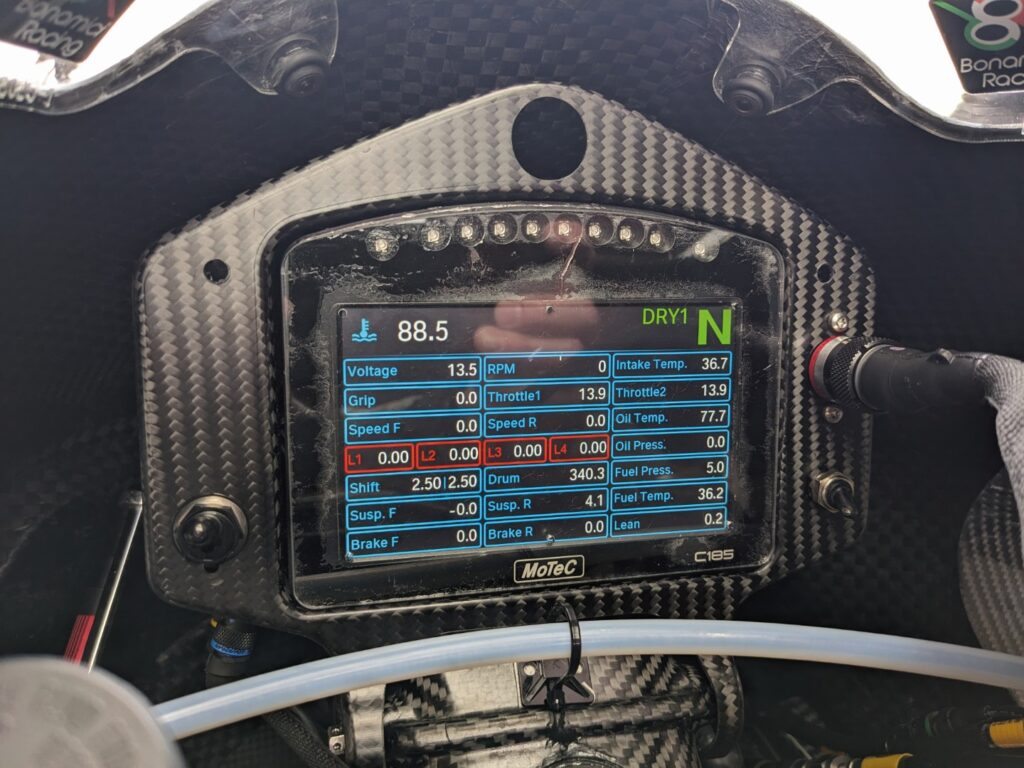
While the bike sits on stands with no wheels installed (they’re still in the oven), an umbilical cord of a network cable drops from the ceiling to the dashboard, which is monitoring the health of the electronics system and sensors. Standing around the bike with a laptop would create unnecessary traffic by the bike, so the computers monitoring the data are in the back corner of the garage.
Virtually all road racing series have rules. Although I personally find performance-balancing rules (different manufactures get different RPMs and fuel flows to make the slower bikes more competitive) to be a bit dysgenic, I understand it makes for better spectacle. Up to the limits of the rules, the components on Toprak’s bike are clearly of the best possible quality. The heat-dispersing Brembo front brake calipers are $16,000 each. The brake discs are not only huge, but thick. The backing plates on the brake pads resist warping. The carbon subframe, the electronics, the carbon bodywork–everything is the highest quality available, and then it is assembled by some of the finest mechanics in the world.
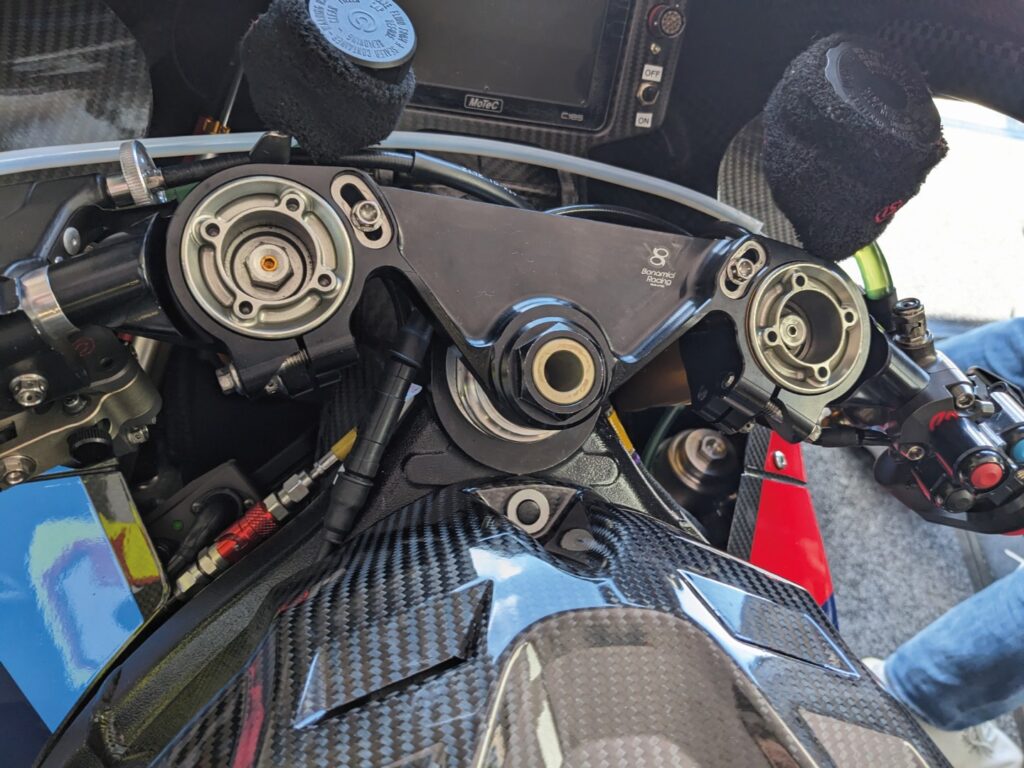
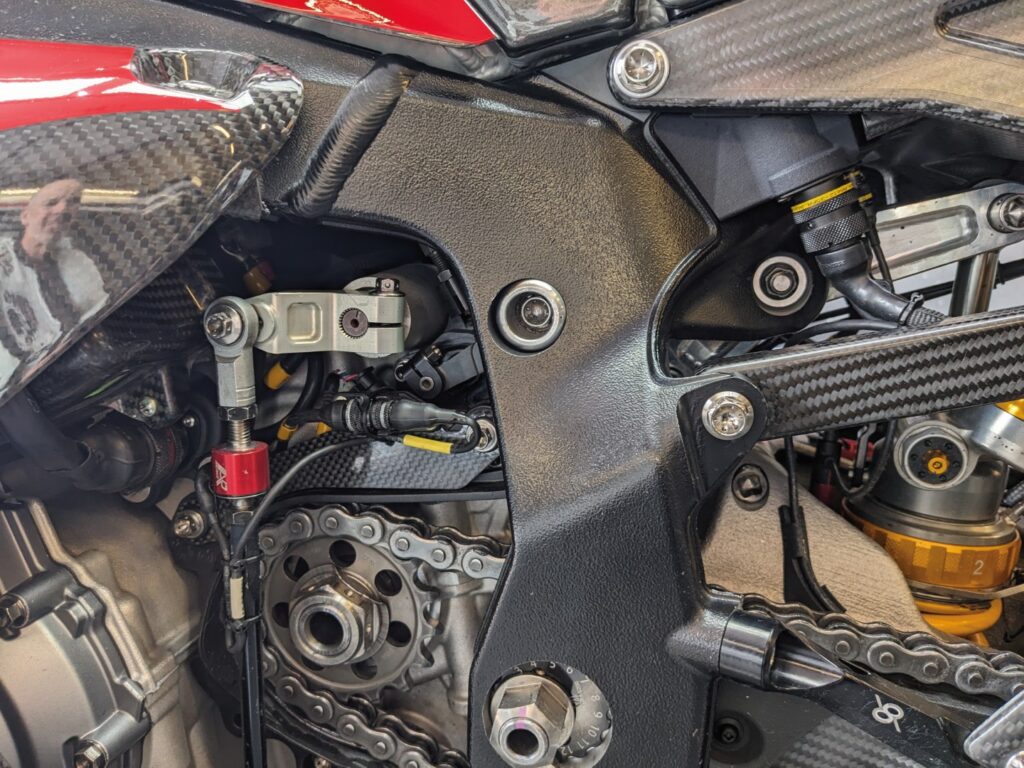
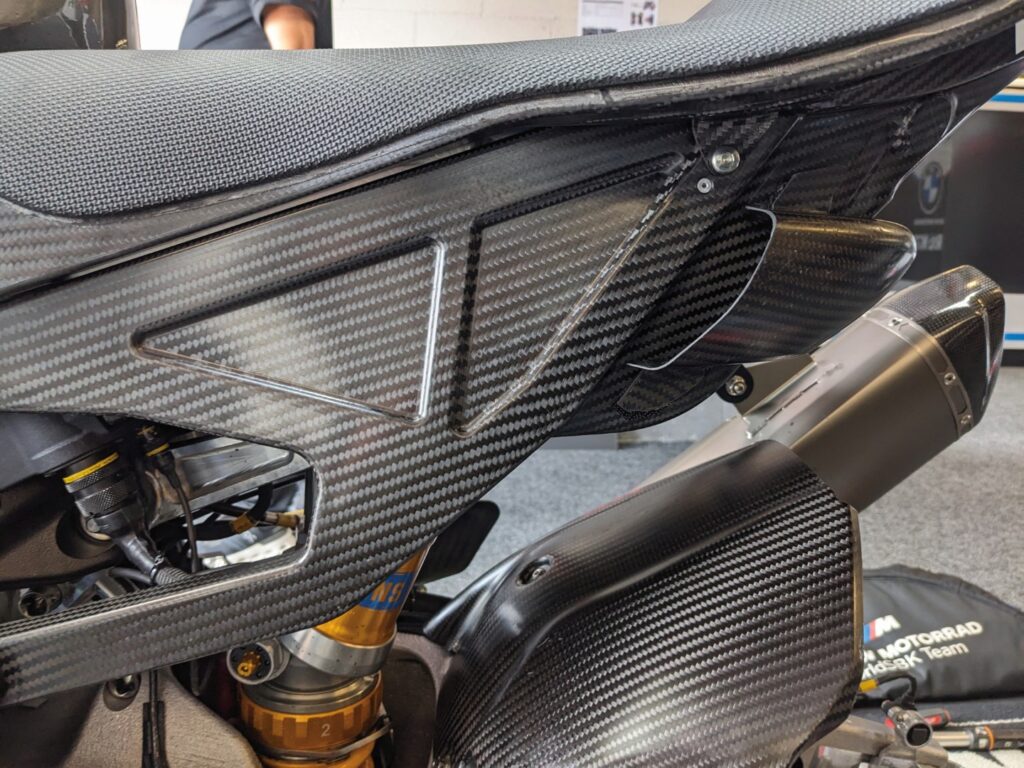
Despite all the bolts and axle nuts being drilled, safety wire is not popular on bikes that have to be serviced both quickly and copiously. Note the red shift position transducer, the carbon fiber subframe, the robust metal electrical connectors, and the adjustable swingarm pivot set neutral and forward. The artist is discernible in the reflection in the carbon on the left.
When the bike arrives at the track, the electronics engineers and suspension engineers refine the set up based on Toprak’s feedback and the myriad sensors collecting data on the bike allowing for fine tuning of engine braking, traction control, and power trim, while also fine-tuning spring and damping set-up on the top-end Öhlins forks and shock. After two days of programming and set-up, the mechanics get to the garage on Monday morning and mount new Pirelli slicks and put them in the oven to warm and carefully measure fuel into the tank. Not including the initial engineering, just to get to my three laps required over 200 hours of combined preparation work on the bike for this moment. “Please don’t crash it,” indeed!
They carry the wheels fresh from the oven and effortlessly install them on the bike, then send Toprak out to take one sighting lap to ensure all systems are go.
I knew I only had three laps. Aware I had never crashed at a press launch, I said as much just before I swung a leg over the bike. I wanted to balance the sheer exhilaration of the highest quality three laps of my racing career.
“Let us push you out of the pits a bit before you drop it into gear to save wear on the transmission,” I heard a mechanic say.
This Superbike transmission has the N – 1 – 2 shift pattern and the lockout lever to find neutral. In the last 20 seconds of waiting, I wondered if the internal ratios for the transmission were different from the alpha or M bikes I had been riding; over the exhaust note and with helmet and ear plugs installed, I called out, “Toprak! First or second for the slow turns?”
“Second!” he shouted as the mechanic started pushing me forward. I tried to shift to first as gently as I could and off I went.
Robert Pirsig famously went crazy riding a Honda 250 and contemplating the concept of quality on a cross-country motorcycle trip as immortalized in Zen and the Art of Motorcycle Maintenance. In the modern world of CNC, Autocad, de minimis shipping from China, well-intentioned and misguided vehicle regulations, and lowest common denominator design criteria, a perfect product benefitting from perfect service and perfect preparation for use in exactly the right moment and in exactly the right conditions is a rare thing indeed.
Every component is the highest quality one can get for production-based racing. Between the brakes, engine, ECU, and the lightest and/or strongest chassis with fully-developed vehicle dynamic software, mapped corner by corner for this track, the bike is crazy easy to ride.
The ergonomic position felt immediately comfortable for my 5’10” frame, with the foot pegs, levers, and clip-ons just where I wanted them. Aware I only had 39 turns to experience this exquisite machine, I put it on my knee on the first turn out of the pit lane. The steering was perfectly neutral. It didn’t steer fast or slow, and there was not a twitch or wiggle to the input. It was like the bike was on a gimbal. As I went back to the throttle for the first time, at 50-odd degrees of lean in second gear, I wondered what superbike horsepower was going to be like.
At first touch, the electronic throttle bodies only open on two cylinders, giving a nice crackle through the exhaust pipe and just the tiniest bit of rotation from the rear of the bike. As I took away lean angle, the ECU steadily opened the other two butterflies until all four were singing in a powerful, resonant chorus simply eating the next short straight almost before I could get back up on the seat.
We don’t call them “brakecycles,” but if you think about it, the brakes have more relative energy work to do than engines around a race track. I thought I had been riding on very good to excellent brakes all day before I experienced World Superbike brakes. Not only are they subtly responsive to allow holding just the right pressure on the tire and keep the fork in just the right spot into the turn, but they basically don’t heat up. I mean, they do, but the heat has no bearing on how the brakes work. Not just from turn to turn, but at the end of the sixth-gear back straight, braking hard down to second gear, the feel from the brakes doesn’t change from first pull to the apex. Then again, just the brakes on the WSBK BMW cost about half of an entire new M 1000 RR.
It has no movement in the chassis, ever. There is no slip, no slide, no reflection of energy from the tire to the bars, no little oscillations–just solid confidence. Imagine walking up a stone staircase instead of wood. All those little movements are just absent, with the bike imploring you to turn later, open the throttle earlier, lean more, brake a deeper on the side of the tire… and the bike never moves. The capabilities of the bike are so high that, in my one hot lap, there wasn’t a question of exploring those limits. I simply enjoyed the blisteringly fast but totally linear engine, the incredibly sharp but perfectly stable handling, and the enormously powerful but totally linear brakes. The ECU maps were ubiquitous, so I didn’t have to remind myself to trust the wheelie limitations, power trim, or traction control. The confidence was just there.
Toprak can find the limits of this bike, but there are probably fewer than 30 other riders in the world who wouldn’t run out of talent before this bike, assiduously prepared by premier technicians, using the best equipment, runs out of capability.
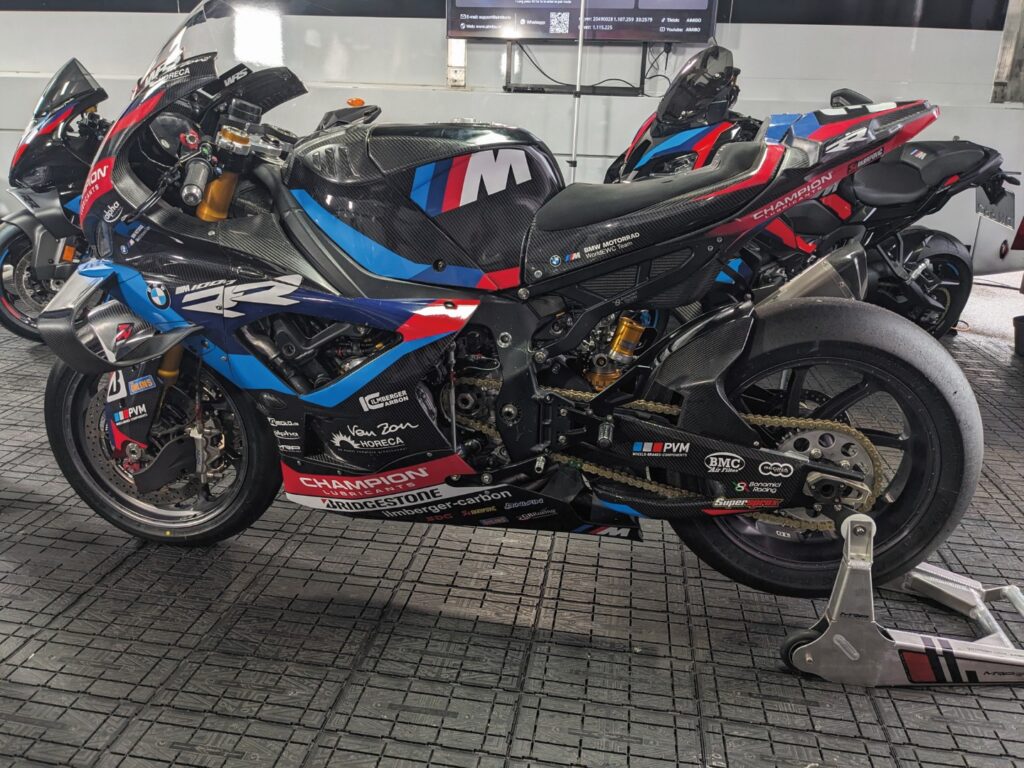
World Endurance M 1000 RR
Fresh from a race at the Le Mans 24-hour the weekend prior, BMW drove this World Endurance bike from France to Italy to allow us to gawk at it and ride it for three laps. On any other weekend, this bike would have been my primary focus, as my cultural love in road racing is endurance racing. For a three-lap test–and sitting next to all the sprint bikes–I was appalled at my reacting to her like she was a plow horse at the Kentucky Derby.
That said, the bike is incredibly trick and dripping with technology. It also had the larger 24-liter World Endurance tank, which extends under the seat and seemed to place me a little higher up than the other race M 1000 RRs. Also, this bike was rolling on Bridgestones and the rest of the fleet was rocking Pirellis, so it’s a little tough to ascribe the handling feeling on the Endurance bike to its character rather than just being on tires with a different carcass, shape, and compound.
All that said, the Endurance bike had a unique feel that took a few turns for acclimation. It was stable, but steered slower than the sprint bikes. We often have to compromise our endurance bike race set up from a “fast lap” mindset to a “make sure there are still tires left to go fast before it runs out of fuel at the end of a stint.” This sometimes means putting more emphasis on rear wheel mechanical traction than a more front end steering setup.
I’d like to think that Hendrik envisioned its transformation of the BMW ecosystem when he embarked on the S 1000 RR project two decades ago. On these two days, when the boundaries between work and passion blurred, when the thrill of the ride transcended job titles and status, the experience was a celebration of BMW’s spirit of motorcycling and a reminder of their acceptance of the challenge of competing toe to toe with the world’s best.
Comments about Sam’s article? Join the conversation in the MOA member forum.
There are tire warmers that you wrap around the wheels, and then there are tire warmers into which you place the whole rims. This is the latter.Despite all the bolts and axle nuts being drilled, safety wire is not popular on bikes that have to be serviced both quickly and copiously. Note the red shift position transducer, the carbon fiber subframe, the robust metal electrical connectors and the adjustable swingarm pivot set neutral and forward. The artist is discernible in the reflection in the carbon on the left.
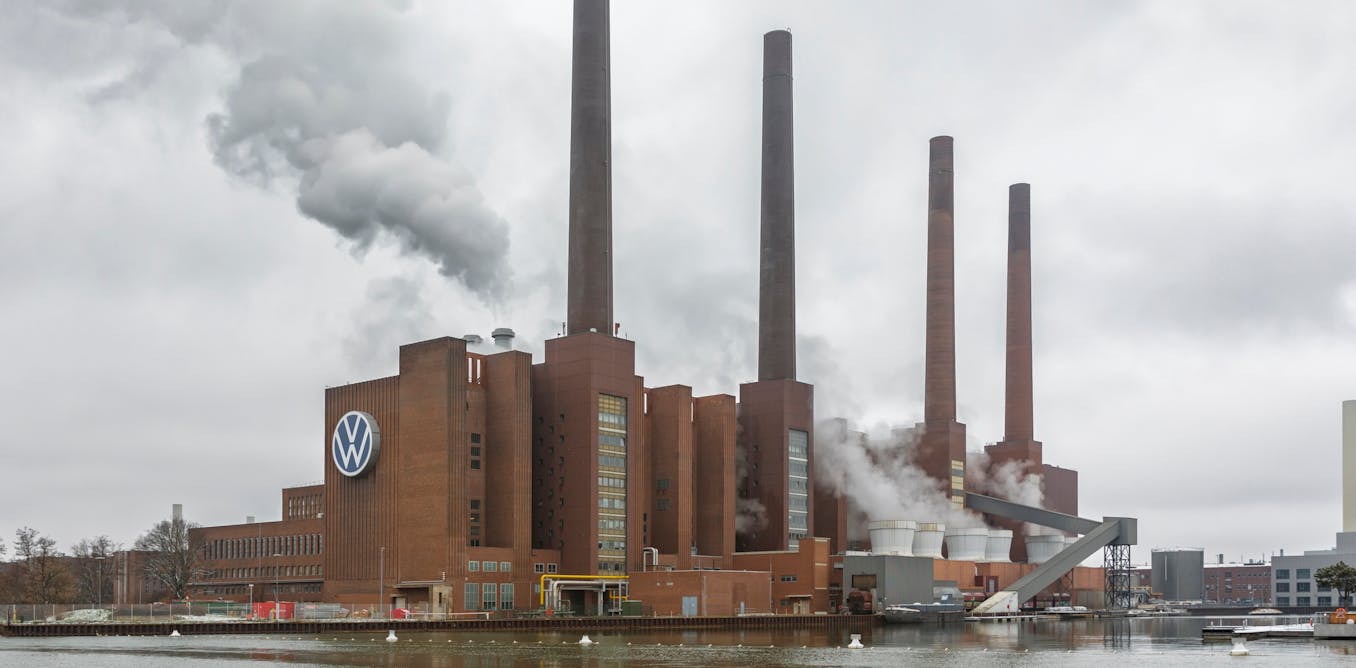
In late October 2024, Volkswagen’s works council announced that the group’s management was considering closing three factories in Germany, which would lead to the loss of tens of thousands of jobs, as well as a general reduction in salaries. On October 30, the group announced a 63.7% fall in third-quarter net profit. With more than 200 billion euros in debt, Volkswagen has become the most indebted listed company in the world. Its sales are down and its costs (notably for energy, personnel and research and development) have soared.
How did Europe’s leading carmaker, the largest industrial employer in Germany and a symbol of its style of capitalism and harmonious co-management between shareholders and unions, get to this point? As a result of a series of strategic errors, baroque governance and toxic management practices.
A German model
Austrian engineer Ferdinand Porsche founded Volkswagen in May 1937 in response to Adolf Hitler’s request for a “people’s car” (literally, a Volkswagen in German). The result was the Beetle, a robust, practical and economical vehicle that went on to sell over 15 million units, succeeding the Ford Model T as the most successful car in the history of the automobile.
However, by the end of the 1960s, the Beetle’s design (which included an air-cooled rear engine and rear-wheel drive) was showing its limitations. The company’s salvation lay in the acquisition of its competitors Auto Union and NSU, merged into the Audi brand, which brought along their expertise in the design of front-wheel drive vehicles. Volkswagen then became a genuine group, and the Golf (which had a water-cooled front engine and front-wheel drive), launched in 1974, was the symbol of its renaissance.
Direct Auto.
In the 1980s and 1990s, the Volkswagen Group expanded rapidly through acquisitions, with the purchase of Spain’s Seat in 1988, the Czech Republic’s Škoda in 1991 and then England’s Bentley and Italy’s Lamborghini in 1998. The group also acquired MAN and Scania trucks, Ducati motorbikes and Bugatti hypercars. Its share of the European market rose from 12% in 1980 to 25% in 2020. In 2017, the group overtook Toyota as the world’s leading carmaker for the first time. Volkswagen was then at the height of its glory, with a somewhat arrogant slogan: “Das Auto” (The Car). But the group’s fall was to be significant.
The “dieselgate” affair
The grain of sand in the company’s gears came from the United States. In 2015, the federal Environmental Protection Agency revealed that the Volkswagen TDI type EA 189 diesel engine emitted up to 22 times more nitrogen oxide (NOx) than the current standard. Volkswagen then admitted that, since 2009, it had equipped its vehicles with “rigging” software capable of identifying test phases and reducing NOx emissions during them. Under normal circumstances, the software is inoperative, which makes the vehicles pollute much more than advertised, constituting fraud vis-à-vis the authorities and deception vis-à-vis customers. The EA 189 engine was sold in more than 11 million of the group’s vehicles, spread across 32 models.
The scandal was resounding. As legal actions multiplied in the United States and in Europe, Volkswagen’s share price fell by 40% on the Frankfurt stock exchange. The chairman of the group’s management board was forced to resign. In 2024, before all of the judgements have been handed down, it is estimated that the affair has already cost Volkswagen more than 32 billion euros.
Anxious to redeem itself at a time when the image of its diesel engines had been irreparably tarnished, Volkswagen launched a colossal plan to convert to electric vehicles, announcing a 122 billion euro investment in 2023. But its first electric models are not competitive enough with Tesla’s or with Chinese manufacturers’, and are struggling to convince in a market that has been generally depressed since the Covid-19 pandemic.
A sluggish business model
More generally, since at least the early 2000s, the core of the Volkswagen Group’s strategy has been relatively clear – and indeed shared by most of German industry, with the active support of former chancellors Gerhard Schröder and Angela Merkel: to sell German quality manufactured using Russian gas to Chinese customers. Two events tipped this model toward the abyss: the European embargo on Russian gas following Moscow’s invasion of Ukraine, which caused the cost of energy to soar, and, above all, China’s desire for a self-sufficient automobile sector.
In the 1970s, Volkswagen was one of the very first Western manufacturers to invest in China. It led the local market for more than 25 years. In the mid-2000s, while almost all Shanghai taxis were Volkswagens, every Chinese Communist Party dignitary had to be driven in a black Audi A6 with tinted windows. Volkswagen even specifically designed extended models of the A6 according to the wishes of the party, and Western expatriates in Beijing also bought black A6s with tinted windows, knowing that no policeman would risk bothering them for fear of having to deal with an influential political figure.
When Beijing growls
In recent years, however, the Chinese Communist Party’s instructions to its citizens – and its dignitaries – have changed: they must now drive Chinese cars. This reversal is particularly problematic for the profitability of the Volkswagen Group. Audi had become its main source of profits, and most of those profits came from China. Those days are gone, not to mention the fact that Chinese manufacturers such as BYD – largely supported by their government – have developed electric vehicles, against which the Volkswagen Group has had a hard time justifying its higher prices.
On this subject, it is amusing to recall that the “Made in Germany” label, which for decades ensured the worldwide success of German products, was originally a mark of infamy demanded by 19th-century British industrialists, who resented seeing mediocre German copies of their products sold at low prices. In order to continue selling in Great Britain, German manufacturers had to systematically label their products “Made in Germany”, which at the time aroused much the same suspicion as “Made in China” can today. But the wheel has turned, and now it’s Chinese products that are rapidly earning their spurs.
Constrained governance
In addition to the stagnation of Volkswagen’s strategy, the group’s governance is particularly problematic. Volkswagen’s founder, Ferdinand Porsche, had two children: a daughter, Louise, and a son, Ferdinand (nicknamed Ferry). In 1928, Louise married the lawyer Anton Piëch, who ran Volkswagen’s main factory from 1941 to 1945. Ferry, for his part, greatly expanded the Porsche sports car brand, which was founded by his father in 1931.
For decades, the Piëch and Porsche cousins engaged in a bitter competition for control of Volkswagen, which reached its climax in 2007 when Porsche attempted to take over the Volkswagen Group, which was 15 times its size. The failure of this effort, led by the Porsche family, resulted instead in Volkswagen’s takeover of Porsche.
[There are already over 120,000 subscriptions to The Conversation newsletters. Subscribe today for a better understanding of the world’s major issues].
The central figure in this turnaround was Ferdinand Piëch, Louise’s son, who began his career with his uncle Ferry before joining Audi and first becoming chairman of the Volkswagen Group’s management board in 1993, and then its supervisory board in 2002. Holding in-depth knowledge of the group (and of Porsche, in which he held a 13.2% stake), Ferdinand Piëch gained the support of the German state of Lower Saxony, where Volkswagen is headquartered and which holds 20% of its shares. The state’s former minister-president was none other than Gerhard Schröder, German chancellor from 1998 to 2005.
This tangle of family struggles and political influences did not make for serenity within the Volkswagen Group’s management bodies. In addition, management practices were often toxic.
A toxic management culture
Influenced by family rivalries and an arrogance that stemmed from being the world’s number one, Volkswagen’s management culture drifted in a direction that could best be described as toxic during the era of Ferdinand Piëch.
Known for his intransigence, ambition and authoritarianism, Ferdinand Piëch frequently sacked managers he judged to be underperforming. It is even said that when a subordinate presented him with a problem he had failed to solve, Piëch’s favourite response was, “I know the name of your successor… ” He did not hesitate to follow through on this threat, which may explain why some managers took reckless risks, particularly during dieselgate.
Since the affair, several chairmen of the Volkswagen Group’s management board have called for the emergence of a new corporate culture that is more decentralised and encourages people to speak out, even as whistleblowers. But changing a culture is one of the most difficult managerial tasks, and the urgency of Volkswagen’s situation will not make it any easier.
What does the future hold for the company? The collapse of its revenue from China, its lack of success in electric vehicles, the still emerging fallout from dieselgate, its colossal debt, and its need to overhaul strategy, governance and culture are nothing short of titanic obstacles.
However, just as a former General Motors executive stated in the 1950s, that “what’s good for GM is good for America,” we can assume that Germany will never give up on Volkswagen. Thanks to the company’s success – but also because of its contradictions – Volkswagen has become a veritable German myth.
Italian design house Zagato has partnered with Capricorn, a German automotive & motorsport technology company, to announce the launch of their first in-house hypercar.
The Zagato hypercar will be unveiled alongside its name reveal on October 10th at the Zoute Grand Prix in Belgium. Ahead of the unveiling, Zagato and Capricorn have released the first teaser image of their upcoming hypercar.
While the teaser image doesn’t showcase many details, what catches the eye’s attention is the gullwing-style doors. Other details also include the wing mirrors that extend far beyond the front haunches. The interiors of the car are still under wraps, although a glimpse of the three round instrument gauges can be seen.
Neither Zagato nor Capricorn have revealed the technical details of the upcoming hypercar. However, they do mention that it will be a driver-focused, lightweight hypercar, offering an analogue experience.
Andrea Zagato, President, Zagato, stated, “Zagato’s first hypercar introduces a new segment of collectables, designed to enhance the driving experience beyond the contemporary and classic categories. Zagato’s bond with the racetrack spans more than a century, ever since the Gran Turismo category brought racing cars that could also be enjoyed on the road.” He further added, “This hand-built production series embodies the fusion of two DNAs – German precision and Italian beauty – forging an even stronger identity: a true synthesis of timeless design and drivability.”
Production of the Zagato hypercar is expected to begin in the first half of 2026 and will be built by Capricorn (the team that built the Apollo IE’s carbon fibre monocoque). The Zagato hypercar will be hand-built and limited to just 19 examples worldwide.
Bugatti’s Tourbillon hypercar, with its carbon-fiber chassis and V-16 plug-in hybrid powertrain generating 1,775 hp, seems nearly perfect—but Bugatti has found a way to elevate it even further: adding eight exhaust tips.
That’s more than the famous six exhaust tips of the iconic Type 57SC Atlantic and serves as a nod to the two banks of eight cylinders forming the V-16 engine. Also included in the package—whose name is French for “Thoroughbred Team”—are unique designs for the front splitter, rear diffuser, and rear wing, the latter featuring small endplates.
The wheels, measuring 20 inches at the front and 21 at the rear, are also new and shaped to direct more air to the rear radiators. Additional carbon-fiber accents enhance the vehicle’s exterior, while inside, the package includes unique trim options plus a performance seat for the driver with improved bolstering to handle high g-forces.
Production of the Tourbillon doesn’t begin until 2026, but future owners are already being invited to customize their cars. In addition to the Équipe Pur Sang package, buyers have a myriad of options to choose from, including 23 exterior colors, 20 leather options, 10 Alcantara options, and seven carpet colors.
Bugatti Tourbillon with Équipe Pur Sang package
Powering the Tourbillon is a naturally aspirated 8.3-liter V-16 engine paired with three electric motors—two at the front and one at the rear. The V-16 alone produces approximately 986 hp, while the electric motors contribute an additional 790 hp, bringing the total system output to 1,775 hp.
Working in tandem with the electric motors, Bugatti estimates the Tourbillon will accelerate from 0-62 mph in 2.0 seconds, 0-124 mph in under 5.0 seconds, 0-186 mph in under 10.0 seconds, and 0-248 mph in under 25.0 seconds. Top speed is electronically limited to 276 mph, but Bugatti has hinted that at least one version of the Tourbillon might surpass 500 kph (310.7 mph).
Just 250 examples will be built, each priced from around $4 million. Pricing for the Équipe Pur Sang package hasn’t been announced but will almost certainly run into the six figures.
Getting locked out of your RV is an exercise in frustration. Especially if it’s one of those finicky, standard locks some manufacturers think are actually useful. If you have no backup options, no hidden key, nor spare key taped to the side wall in the glove compartment (in the case of trailers with tow vehicles), it’s enough to ruin your day.
The thing is, being on the wrong end of a locked door is fairly common, even when keys aren’t involved. Ever forget the code on the keypad, anyone? Dead batteries, jammed locks, and malfunctioning electronic keypads round out the rest of this disheartening tale. Regardless of the lock type, it pays to stay calm and be prepared, in case this ever happens to you.
Speaking of being prepared, there are a few worthwhile solutions so you never again have to shuffle your feet in embarrassment while the locksmith does their thing—solutions for both conventional locks and electronic keypads. Some are laughably simple, the forehead-slapping kind. Others are more intuitive, yet no less important to know.
Understanding RV Lock Systems
Let’s get the details out of the way first. If you’re locked out of your RV, it helps to understand the intricacies of your lock system. Even your standard, basic lock is surprisingly complex, and you’re not entirely without options if you have a couple of thin wires lying around.
Standard Handle Lock w/Deadbolt: This is a basic mechanical lock integrated into the door handle. It’s often paired with a separate deadbolt for additional security.
Paddle Deadbolt Lock: These are heavy-duty mechanical locks with a flat “paddle” handle that includes a hardened steel deadbolt.
Cam Lock: This is a flush-mounted, cylindrical, mechanical lock that uses a rotating cam to secure panels.
Keyed-Alike Lock Set: Not necessarily a lock, but more of a set of locks, handles, and deadbolts that all use the same key for convenience.
Keyless Keypad Locks: Electronic lock that’s unlocked with a numeric code on a keypad—typically battery-powered with a backup, physical key option.
Fob/Remote Lock: Wireless, electronic lock using a key fob, like on your vehicle, or another remote for unlocking. These are often paired with deadbolts.
Bluetooth Smart Lock: An app-controlled lock that connects to the app on your smartphone via Bluetooth. May include geofencing or remote access.
Global Lockset: A specific brand of mechanical handle locks with deadbolts, identified by a “G” marking.
Lever Lock: Mechanical lock with a lever handle instead of a knob; less common but more tamper-resistant.
Barrel Bolt/Sliding Lock: A simple, manual slide bolt for internal securing, often an optional, secondary measure.
Pin tumbler Lock: Your basic, standard keyed cylinder lock mechanism found on many RV handles and cams.
A lot more than you thought? Well, some are more common than others, and a few are fairly rare, though they are all applicable within the RV lock set market. The first step in avoiding being locked out of your RV is knowing your locking mechanisms and how they work.
“Ours’s will unlock enough to open door but lock itself back when you shut it. I Have to make sure I turn lock all the way to unlock and it will not do that. I purchased two spares and keep one in the truck and one hidden outside side that I can get if needed.”
–Cannon07, Grand RV Forums
Alright, nobody wants to read a novel on getting locked out of your RV, so I’m combining some of these sets of RV lock types into single categories, though that doesn’t mean the methods listed are inaccurate. The goal is to reduce redundancy. You’re welcome. I can be nice every now and then. Here goes:
Mechanical Keyed Door Locks
This category includes the standard handle lock (with deadbolt), the paddle deadbolt lock, the Global lockset, lever lock, and generally any lock with pin/tumbler mechanisms. These are traditional key-operated locks primarily for main entry doors.
Check for Spare Keys: No-brainer—first thing you do. If you don’t have a spare set, you need to have one. You can lock them in a secure spot in your vehicle or on a magnetic hide-a-key box hidden on the RV frame.
Alternative Entry Points: Check any other doors, windows, emergency exits, or even storage or pass-through compartments that can access the interior. Just avoid getting stuck.
Roadside Assistance: Good Sam, AAA, and some RV insurance providers offer lockout help. Be sure to provide your RV model for compatibility confirmation.
Mobile Locksmith: The last resort alternative. Cost is $50 to $150, depending on location and complexity.
Mechanical Keyed Compartment Locks
It’s not always about being locked out of your RV. Locking yourself out of your compartments is a thing as well. These are typically cam lock or keyed-alike lock sets with flush or rotating locks. Storage bays, cargo areas, panels, etc., are all included. The standard key you’ll hear more about than any other is the CH751.
Verify Key Compatibility: If keyed alike, test other compartment keys or a universal CH751 key, if you have one. It’s not unheard of for RVers to hit their neighbors up and successfully unlock their compartments.
Inspect for Overrides: Gently check if the lock has a manual release tab or if the compartment is accessible via an adjacent bay.
Use a Spare or Master Key: Retrieve from your main key set or a hidden spare; if lost, note that many factory keys are interchangeable. Again, check with other RVers nearby (if applicable). If alone or boondocking, consider the hammer (Just kidding).
Seek Professional Help: If none of the above does the trick, don’t get the hammer. Instead, contact an RV technician or locksmith. The cost is usually cheaper for compartments.
Keyless Electronic Locks
Photo courtesy iRV2 member LBZYA.
Keyless keypad locks, fob/remote locks, and Bluetooth smart locks all fall under this umbrella. If you lock yourself out of an RV with a keyless entry system installed, you might instinctively assume it’s harder to bypass. Not necessarily.
Reset or Use Backup: Enter the default code (usually found in the manual and often 0000), or the last four of the serial number. Use the physical backup key you forgot about two years past (if you remember where it is), or replace the batteries via the external access panel.
App or Remote Troubleshooting: Reconnect the keypad to the app, and charge your phone if necessary.
For fobs, test the range or try and replace the battery.
Manual Override: Look for a hidden key cylinder (common on keypads) or emergency release; consult the lock’s brand app or website for instructions specific to your model.
Contact Manufacturer Customer Service: Brands like Furrion or Bauer often provide 24/7 help and support, and could potentially do an electronic bypass via your phone or by contacting a local RV technician.
“We installed one of these on our NP and love it. They sell them on Amazon too. https://www.rvlock.com/.”
–Rodney27505, Jayco Owners Forums
Manual Sliding Locks
Last but not least, we have the manual sliding locks, which usually include the barrel bolts and sliding locks. These are generally simple, including an internal slide bolt or latch, and are often secondary to the primary locks. Some RVers have these installed as an aftermarket addition for extra security purposes.
Check Engagement: Check to see (if it’s visible) whether or not there’s a small gap between the bolt and the bolt hole. If so, you can potentially slide it back using a card. You can use something heavier, but be gentle with it.
Access From Alternate Side: Look around for any other potential access points, as with one of the tips above. If you find one, get inside and unlock it.
Avoid Force: Spray some WD-40 on a visible, accessible bolt or another type of lubricant and try to work it open.
Professional Assistance: Rarely needed for these (RVers usually find a way), but call an RV repair service or a locksmith as a last resort. This is often resolvable without the need for tools.
Alternative Entry Methods
Some of these are covered in the above, but being locked out of an RV isn’t as hopeless as being locked out of a car or a residential home. RVs simply aren’t as secure as residential homes or even vehicles. There are surprising access points and methods for getting that frustrating lock open.
Accessing through windows or vents:
Check for unlocked or partially open windows.
Remove screens carefully to avoid damage.
Use a slim tool to unlatch windows from the outside.
Compartment access:
Some storage compartments connect to the RV interior.
Use compartment keys or tools to gain entry, then crawl through (if safe).
Risks and precautions:
Avoid breaking windows unless necessary (it’s kind of expensive).
Ensure no security alarms are triggered. RVer of the week at your campground!
If you have an alarm on that think or a more elaborate security setup (for ED-209, call a pro immediately), it’s probably best to call in a professional. That’s better than waking up the entire campground after your late dinner and a movie trip to town.
Preventive Tips to Avoid Future Lockouts
The best part about being locked out of your RV is not being locked out of your RV. I think that makes sense…maybe. Prepare accordingly, and you won’t have to worry about it. For those with a fancy electronic keypad, make sure you regularly keep it updated and record your code in a super secret location. Before you head out on your trip, check the battery level and test the keypad, just to be sure.
Even if the battery is looking good, replace it annually or before you go on a long trip. Duplicate keys for conventional locking systems and always store them securely. Consider a hide-a-key box and locate it somewhere out of sight, not right out in the open, begging anyone to come along and give it a try.
“With the door open you can remove plug which is the middle of the door and using a 5/16 socket you can turn the nut to adjust so that the door opens when the handle has traveled about half the full pull.”
–tom chelbana, iRV2 Forums
Consider weatherproof covers to keep moisture and debris out of your locks. If keys just aren’t your thing and you prefer something high-tech, upgrade your system to a keyless, wireless entry or a keypad system with a backup key. Never toss your manufacturer’s manual. You never know when you might need the valuable information inside.
If all else fails, contact roadside assistance for RV-specific help. That’s what they’re there for, and that’s what you pay them for. Also, consider talking to other RVers or even the campground hosts to find help or an alternate universal key. Plus, they may know the area better than you do, who to call and when, etc.
In a worst-case scenario, secure your RV as best you can and seek an alternative shelter for the time being or until you can get someone out there. Make sure you document the issue for insurance or warranty claims in case any damage occurs. Consider adding a lockpicking set to your tool bag, at least for the standard locking mechanisms.
Conclusion
Getting locked out of your RV isn’t necessarily the end of the world. Where there’s a will, there’s usually a way. If you boondock in remote areas, you may need outside assistance, but with proper preparation, you should never encounter such a situation.
Always check for alternative entryways, spares, batteries, and/or codes if need be. Lockpicking simple locks isn’t as difficult as it sounds, and there are plenty of walkthroughs on YouTube and other sites. Lastly, feel free to share your story if you’ve ever been locked out of your RV, especially if it’s particularly embarrassing. Those stories are the best kind!
Support CleanTechnica’s work through a Substack subscription or on Stripe.
They say the best and only way to stop a would-be dictator from amassing power is to fight back, and so props to the Danish offshore wind developer Ørsted for suing to resume work on its 704-megawatt Revolution Wind project off the coast of Rhode Island. The successful lawsuit puts hundreds of working households back on the job while also answering the Energy Department’s desperate plea for more power generating capacity, and it signals a reprieve for the 2.6 gigawatt Coastal Virginia Offshore Wind project, too. So, what’s not to like?
The US Department Of Energy Wants More Offshore Wind, Not
What’s not to like is the US Department of Energy. On August 18 the agency announced the launch of the new “Speed to Power” initiative, aimed at stimulating private sector investment in new power generating capacity on the nation’s grid. In accord with White House policy, though, Speed to Power stipulates that project proposals must involve “reliable” resources, which is Trumpspeak for coal, oil, natural gas, nuclear, hydropower, geothermal, and biomass. In other words, everything but wind and solar power.
To underscore the exclusion of both wind and solar resources, over the summer, the Energy Department affirmed that marine energy also fits into the “reliable” slot, even though the fledgling industry — waves, tides, and currents — is years away from the mass market for generating capacity. A lone, 100-kilowatt wave energy demonstration project at the Port of Los Angeles is the only sign of activity so far.
That’s not a typo. Though scalable to the megawatt level, the capacity of the wave energy project is currently 100 kilowatts. Meanwhile, the domestic offshore wind industry deploys mature, proven technology along with a well-developed supply chain covering 40 states and thousands of working households, with commercial-scale projects underway and more to come. During the four-year tenure of President Joe Biden alone, 11 new offshore wind farms passed through the approval process and entered the project pipeline, totaling 19 gigawatts in capacity.
There Goes 19 Gigawatts And Counting, Down The Drain
If Energy Secretary Chris Wright was really serious about adding more gigawatts to the nation’s power generation profile, he could try to prevail upon US President Donald Trump to walk back his war on the offshore wind industry, but that’s a non-starter. Upon taking office in January, Trump stopped the Interior Department from issuing new offshore wind leases. He also deployed the Environmental Protection Administration, the Department of Justice, and the Department of Transportation to claw back offshore wind projects that were already approved, including seaport upgrades.
That’s where Revolution Wind comes in. As of August 22, the project was 80% complete, with all of the offshore foundations in place and most of the turbines installed. Then Interior Secretary Doug Burgum abruptly issued a stop-work order citing unspecified national security concerns.
If you’re wondering why those security concerns were not addressed during the years-long approval process for Revolution Wind, that’s a good question. Unless something brand new has suddenly popped up over the horizon, those concerns were addressed. Of course they were! On September 4, the Ørsted subsidiary Revolution Wind, (a 50/50 joint venture with the Skyborn Renewables branch of Global Infrastructure Partners) sued Secretary Burgum and other officials in federal court, asserting that “an extensive environmental, national defense, and safety review covering every conceivable aspect of the Project’s development and construction” had already taken place over the course of three different presidential administrations, culminating in 2023 with the “consensus decision of 15 federal and state agencies that the Project is both safe and consistent with federal and state law.”
The US Offshore Wind Industry Wins, For Now
Revolution Wind’s argument was more enough to convince federal judge Royce C. Lamberth (a Reagan appointee, for the record) to rule in favor of resuming the offshore wind project.
“Lamberth, a senior judge appointed by Republican President Ronald Reagan, said the Trump administration had offered contradictory reasons for issuing its stop work order, and that the explanations offered weeks after the halt were ‘the height of arbitrary and capricious’ government conduct,” Reuters reported on September 22.
On its part, the Interior Department accepted the ruling — for now — with egg on its face. “As a result of the Court’s decision today, Revolution Wind will be able to resume construction as BOEM (the U.S. Bureau of Ocean Energy Management) continues its investigation into possible impacts by the project to national security and prevention of other uses on the Outer Continental Shelf,” said an Interior Department spokesperson in widely reported remarks.
The governors of Rhode Island and Connecticut hailed the judge’s ruling, though politely.
“I will continue to engage with the federal government and pursue every avenue to protect this important economic engine and lower long-term energy costs for the people of Rhode Island,” stated Rhode Island Governor Dan McKee.
“Today’s ruling allowing Revolution Wind to resume work is extremely encouraging for workers and our energy future. We will continue to engage with the federal government on a durable path forward for this project and on shared energy priorities,” echoed Connecticut Governor Ned Lamont.
What Now, Coastal Virginia Offshore Wind Project?
For the most part, Trump’s war on working households in the offshore wind industry has targeted projects under the purview of coastal states with Democratic governors. In addition to Rhode Island and Connecticut, projects in New Jersey, New York, Maryland, and Massachusetts have been put at risk — or killed off entirely, in the case of New Jersey’s Atlantic Shores project.
The outlier is the Republican governor of Virginia, Glenn Youngkin, whose support for the 2.6-gigawatt Coastal Virginia Offshore Wind project appears to have acted as a protective shield against interference. That could change after Election Day in November, though. Youngkin is term-limited, and if the Democratic candidate carries the day as expected, then the CVOW project will fall neatly into the target area of Trump’s war on the offshore wind industry.
Or not, as the case may be. Word on the street is that the domestic offshore wind industry is breathing a sigh of relief now that the Lamberth ruling has forged a pathway for fully approved projects to proceed without further impediments. If all goes according to plan, that will includes CVOW, which has passed the halfway mark towards a completion goal of 2026.
Sign up for CleanTechnica’s Weekly Substack for Zach and Scott’s in-depth analyses and high level summaries, sign up for our daily newsletter, and follow us on Google News!
Advertisement
Have a tip for CleanTechnica? Want to advertise? Want to suggest a guest for our CleanTech Talk podcast? Contact us here.
Sign up for our daily newsletter for 15 new cleantech stories a day. Or sign up for our weekly one on top stories of the week if daily is too frequent.
CleanTechnica uses affiliate links. See our policy here.
Before you apply for BMW financing, it’s important to have a firm grasp on your budget. Regardless of whether you want to buy a car or if you prefer a lease, you’ll have upfront and monthly expenses. The experts at Fields BMW Northfield have put together this guide for both options.
Budgeting Tips for Buying a Car
Purchasing a vehicle involves a down payment, which is usually about 20% of the sticker price. Additional upfront costs include title fees and sales tax.
Throughout the life of your loan, you’ll pay a principal plus interest every month. The principal is based on the price of the model you choose to buy, and the interest depends on your credit score and macroeconomic factors. To budget for a loan, look at your income, basic monthly living expenses, and your current cash situation to find out how much you can afford upfront and in your monthly payments.
How to Budget for a Lease
Leasing comes with fewer upfront costs. You’ll need to put down a security deposit, the first month’s payment, and some taxes and fees. Monthly lease payments are usually less than loans since leases are based on the vehicle’s anticipated depreciation rather than sticker price. Lower upfront and monthly costs still mean you’ll have to identify what you can afford, but overall lease costs are likely less than purchasing.
Expenses to Consider for Both Loans and Leases
On top of your BMW financing package, you’ll need to budget for basic car expenses like insurance, fuel, routine maintenance, and state and local registration. If your home or work charges for parking, include that in your budget too.
See the Experts in BMW Financing in Northfield, IL, Near Chicago
We offer flexible BMW financing terms for all sorts of budgets and credit scores. Stop by our BMW dealership near Chicago, IL. We’ll help you find the luxury model of your dreams and get a great financing offer!
There will be no restriction on how many times you can fill up your car a day with RON 95 petrol under the Budi95 subsidy scheme, which sets the price of the fuel at RM1.99 per litre from September 30.
According to finance minister II Datuk Seri Amir Hamzah Azizan, Malaysians eligible for the fuel will be allowed to refill their vehicles as many times a day as they see fit, as the Malay Mail reports. The ministry also issued a statement on the matter earlier this evening, as seen in the image at the end of this story.
However, he said there will be measures in place that will prevent abuse and profiteering. “You can refill as many times as you want. What we are looking at is unusual behaviour and people trying to abuse the system by topping up repeatedly in a short span and reselling fuel. That is what we will block,” he said at a media briefing today.
“Basically, they cannot refill every ten minutes. We will ensure there’s no abuse,” he said. He said that MyKad verification at petrol stations, combined with back-end data analytics will allow the government to flag abnormal refuelling patterns. If necessary, the system can temporarily halt subsidised transactions linked to the same card until checks are made.
Amir Hamzah said that besides verifying MyKad at pumps or via digital apps and that driving licences were valid, protection measures will include ensuring petrol stations’ systems detect if refill patterns are abnormal and rejecting ICs that don’t match the national registration database. He added that the public should report stolen or lost ICs to prevent misuse.
He added that preventing leakages is a key goal of Budi95, with the government looking to plug leakages in its RON 95 subsidy, which has ballooned to nearly RM20 billion a year. According to finance ministry data, more than 20% of that was consumed by foreigners, businesses and from smuggling activities.
“Every ringgit saved is important and if we don’t control these leakages, honest Malaysians end up paying the price. The money we save will go back into welfare programmes like Sara and more,” he said.