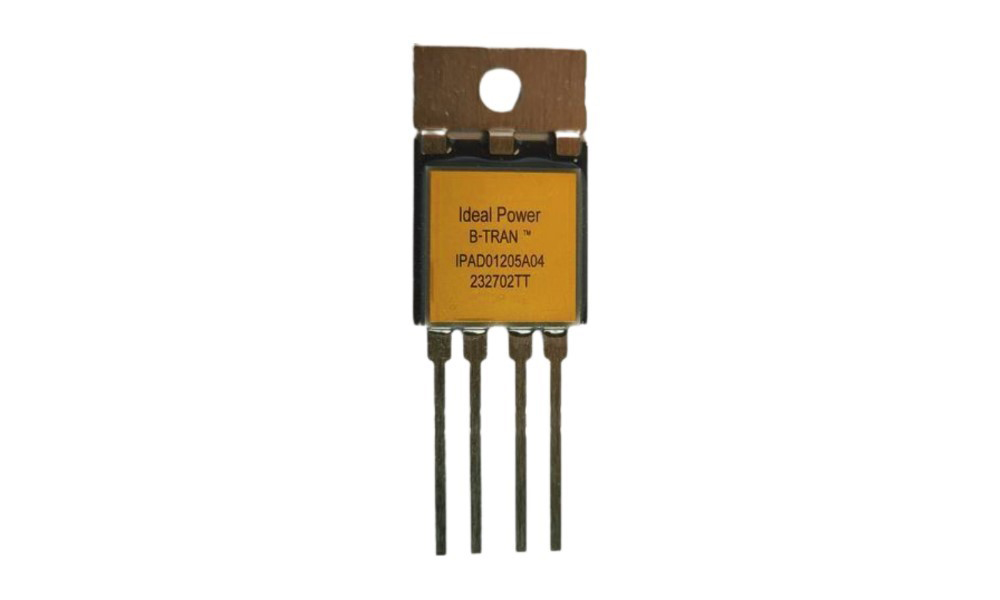
Ideal Power has the power rating of its discrete B-TRAN bidirectional semiconductor power switch from 50 A to 75 A. The company says that the higher rating is supported by extensive internal and third-party testing, and no design or packaging changes were required.
While the official rating is now 75 A, the device has been subjected to long-term, continuous testing at up to 150 A. The discrete B-TRAN and the SymCool power module—which uses the same B-TRAN dies—are both targeted at solid-state circuit breaker and EV contactor applications.
Ideal Power expects to announce an increase in the SymCool module’s power rating later in 2025, with updated technical documentation. Ideal Power’s B-TRAN technology is a double-sided, bidirectional alternating current (AC) switch. The company syas B-TRAN improves performance compared to conventional power semiconductors by reducing conduction and switching losses, simplifying thermal management, and potentially lowering operational costs in switching and control circuitry.
Owning a BMW means experiencing engineering precision with every drive, so deciding between OEMvs. aftermarket parts is an important choice. Each path has benefits and drawbacks that influence performance, longevity, and overall satisfaction.
For many drivers, the decision often comes down to balancing cost against the peace of mind that comes with a part designed specifically for their vehicle.
Understanding OEM Parts
Original Equipment Manufacturer car parts, often shortened to OEM, are made by or under contract with the same company that produced the original component in the vehicle. They match the part that came in the car when it left the factory.
This creates a sense of continuity since fit, material quality, and specifications are in keeping with the original design. Owners often gravitate toward OEM because it feels like a direct replacement, leaving little uncertainty about compatibility.
For BMW owners who value a consistent driving experience, OEM parts can represent a way to maintain the brand’s identity without compromise.
The Appeal of Aftermarket Parts
Aftermarket parts are produced by third-party companies unaffiliated with the automaker. These parts can range from cost-effective alternatives to high-performance upgrades, depending on the manufacturer.
The aftermarket world is diverse, offering everything from simple replacement air filters to specialized exterior accessories designed to give a vehicle a more aggressive look. Price often draws attention first, but availability and vast selection also play a part.
Some owners enjoy the flexibility to customize their vehicles in ways that OEM offerings cannot match.
Price Differences Between OEM and Aftermarket
One of the biggest influences driving this debate is price. OEM parts usually come at a premium, reflecting the strict standards under which they are produced. Aftermarket parts often cost less, which makes them attractive for repairs on older vehicles or for budget-conscious drivers.
The difference in price can be considerable when replacing items like belts and hoses, which must be swapped out periodically as part of routine maintenance.
However, while aftermarket components can save money upfront, their quality can differ greatly. This is why research becomes important before making a purchase.
Fit and Compatibility
BMW vehicles are designed with precision, so the way a part fits matters. OEM components are engineered to fit perfectly since they mirror the original design. Aftermarket parts may also fit properly, yet the risk of minor variations exists depending on the brand.
These differences might seem small, but a component that doesn’t line up perfectly can cause additional wear or lead to a less refined driving experience.
For interior-focused parts like interior accessories, exact fit can influence comfort as well as aesthetics, which is why many owners lean toward OEM replacements in those cases.
Performance Expectations
Performance is at the center of BMW ownership. OEM parts maintain factory specifications, which means a vehicle performs the way it was originally intended. Aftermarket parts, on the other hand, sometimes exceed stock standards.
For example, a performance-focused aftermarket air filter could increase airflow, resulting in more engine responsiveness. While this appeals to some drivers, others prefer the predictable reliability that OEM components deliver.
The choice ultimately comes down to whether an owner prioritizes factory precision or customized performance.
Warranty Considerations
Another big factor in choosing between OEM and aftermarket relates to warranty coverage. Automakers typically support OEM parts under existing warranties, which gives drivers reassurance when something goes wrong.
Aftermarket parts may or may not fall under a warranty, depending on the company that manufactures them.
While this does not necessarily disqualify aftermarket parts, it is something to weigh carefully when making a decision, especially with high-value components that impact engine performance or safety.
Long-Term Value
BMWs are vehicles designed for longevity. Owners often keep them for many years, enjoying their blend of comfort and precision. Using OEM parts can support that long-term ownership by maintaining consistency in build and design.
Aftermarket parts may also last, but quality differs by manufacturer. For routine items like belts and hoses, aftermarket options might serve just as well for a fraction of the price. For structural or performance-critical items, however, OEM replacements might better support the car’s value over time.
Aesthetic Customization
When it comes to personalization, aftermarket parts distinguish themselves. From unique exterior accessories that change the car’s look to custom interior accessories that help customize the cabin to individual taste, the aftermarket world offers an impressive selection.
OEM options, by contrast, typically focus on factory styling and modest updates. Some owners prefer keeping the clean, original look that OEM brings, while others enjoy experimenting with designs and finishes that set their car apart.
Both paths offer value, depending on how the owner views their vehicle: as a collector-worthy model or a canvas for creativity.
Availability and Access
Availability can also impact a driver’s choice. OEM parts may require ordering from authorized sources, which sometimes takes longer. Aftermarket parts are widely distributed and can be found through numerous suppliers, which adds convenience for drivers looking for quick repairs.
For maintenance-related items like air filters, this accessibility can make aftermarket options appealing. Still, many owners value the consistency that comes with sourcing directly from the original manufacturer, even if it means waiting a bit longer.
The Emotional Factor
The decision is not purely practical. Many BMW owners feel a strong connection to their vehicles and want to preserve the spirit of the brand. Using OEM parts can become a way to honor that connection by keeping the car as close to original as possible.
Others take pride in customizing and fine-tuning, which makes aftermarket options more appealing. In this way, the OEM vs. aftermarket debate extends beyond simple economics and enters the area of personal identity as a driver.
Making the Right Choice for Your BMW
Choosing between OEM and aftermarket parts is less about right or wrong and more about what fits an owner’s goals. Some drivers value authenticity and consistency, which makes OEM replacements the natural choice.
Others see opportunity in customization, affordability, and experimentation through aftermarket parts. Both approaches carry advantages depending on the situation, from routine replacements like belts and hoses to aesthetic updates with interior accessories.
At the end of the day, the decision reflects how each owner wishes to experience their BMW, whether by preserving its factory integrity or by exploring new dimensions of performance and style.
Get Rid of Rodents for Good With These Tips From an RVer
Fall is the time of year when mice and rats sneak into RVs, looking for a safe, warm place to raise a family. A place that’s preferably close to food resources and water. A place exactly like your RV. Unfortunately, they can often live completely unnoticed until at least a few of them have moved in. At that point, you’ll usually find their pellet like droppings or urine in drawers and cabinets, and you might seem some dark streaks around the bottom of interior walls. By the time you see an actual mouse or rat, these critters can be really difficult to get rid of. However, you’ll need to get on it fast because mice and rats can cause a lot of damage to your RV very quickly.
What Doesn’t Work
Over years of RV life, I’ve had the opportunity to try a lot of different methods for getting rodents out of the RV and keeping them out. I’ve found some methods are better than others. Before I fill you in on which are the best methods to rid your RV of these pests, let’s take a look at three things that don’t work when it comes to dealing with rodents in an RV.
3 Methods That Don’t Work
Ignoring them and hoping they’ll go away on their own. They won’t.
Irish spring soap: Some rodents seem to be deterred by the Irish Spring scent, but others are attracted by it.
Ultrasonic rodent repellent plug-ins: While ultrasonic rodent repellers can work for a little while, rodents get used to them. Especially if there’s a chance they can get a free meal or safe place to build a nest.
The “folk remedies” (smelly stuff, flashing lights, ultra-sounds, etc.) don’t work, at least not for long. Many report success with various of these methods, but I believe they are just lucky, or haven’t been infested yet. — db4570, iRV2 Forum Member.
3 Rodent Control Methods You Should Avoid
Live traps: Live trapping is by far the most humane method of catching mice. However, live trapped mice should be released at least 2 miles from where their caught or they’ll find a way back home. That means inside your RV. For this reason live traps aren’t a very good method for controlling rodents in an RV.
Glue traps: Glue traps are plastic plates that hold a super sticky substance. They’re inhumane because any small animal that stumbles onto a glue trap becomes stuck to it. This includes mice and rats, but also includes reptiles, amphibians and birds. But no matter what species of animal gets stuck in a glue trap, it suffers greatly before it finally dies.
Rodent Poison (rodenticide): Commonly available rodent poisons include anticoagulants that thin the blood, poisons that produce a buildup of gas or calcium in the blood, and nerve toxins. Any of these can cause a slow and painful death. Not only that, but pets and/or wildlife (owls, eagles, racoons, coyotes) can be poisoned by eating rodents that have consumed rodenticide. For these reasons, mouse and rat poisons are inhumane and should be avoided.
4 Proven Methods That Get Rid of Mice in Your RV
1. Put the attractants away
Mice and rats are wild animals that depend on their ability to scavenge to find sources of food. That said, they’re really curious, and will investigate anywhere that might provide them with a nibble. If they don’t find food, they generally move on. Now, keep in mind, a rodent’s idea of food is different than yours or mine. For them, good sustenance can be a dog food kibble, a small seed, or a lick of peanut butter left of a knife. With that in mind, if you don’t want to attract mice, you’ll need to think from a mouse’s perspective. Here are some ways to keep mice and rats from feeling welcome:
Avoid leaving dishes unwashed overnight
Dispose of trash before bedtime
Keep pet food and treats in an air-tight, rodent proof container
Don’t leave pet food dishes out overnight
Keep food in upper cabinets or in the refrigerator
Clean up accidental spills and grease spatters immediately
If you feed birds, install seed catchers under bird feeders and keep bird seed in a rodent-proof container
2. Clean up any messes
Rodents are curious, and if they can smell that another member of their species has been somewhere, they’ll be drawn to investigate that place. For this reason, you should clean any areas where mice or rats have been with an antibacterial cleaner. Plus, rats and mice sometimes carry diseases that can make you very sick. Therefore, it’s a good idea to put on some rubber gloves and a mask before you start cleaning. A mask is especially important if you think you might be dealing with deer mice because these are the ones that carry dust-borne Hantavirus, a potentially deadly respiratory virus.
3. Block potential entry points
Rodents are amazingly flexible and can squeeze themselves through any hole that they can fit their head into. Therefore, you’ll need to look carefully for possible entry points. The most common place for mice and rats to gain entry into an RV is often the utility cabinet, but rodents can also gain entry to the RV through rooftop vents. They can also wreak havoc in the engine bay of a motorhome by chewing wires and lining air filters with nesting materials.
I inspect the underside of the MH on a monthly basis, and seal anything that may provide an entrance point with expandable foam and steel wool where appropriate. I also remove any potential food sources from the coach when in storage … absolutely everything.
JBright, iRV2 Forum Member.
Block all possible entry points on and under the RV (such as around sewer hoses or electrical cords) with steel wool and spray foam (where it makes sense to use it). On the roof, line the refrigerator vent with hardware cloth to prevent access there.
Spray engine bays with rodent repellent spray or sprinkle liberally with peppermint oil. Reapply every 30 days.
4. Set traps
Heavy-duty snap traps provide a highly effective and “relatively humane” solution to mice that are inside your RV. Nut butter or seed butter topped with a dog or cat kibble seems to be irresistible to both mice and rats, so they make an effective bait.
Last October, when I put my coach in covered storage I set half a dozen snap traps around the outside of the coach as well as many inside and around the generator. For the first 2 months I would catch 1 to 3 mice a day. — Soppy, iRV2 Forum Member.
Final Thoughts About Dealing With Mice and Rats in Your RV
Mice and rats can multiply quickly, so if you store your RV for the winter, it’s a good idea check on it a few times over the off-season. That way you can get on top of any rodent problems while they’re still small. However, not leaving attractants around, using rodent repellents, and blocking access points will go a long way to keeping rodents out of your RV.
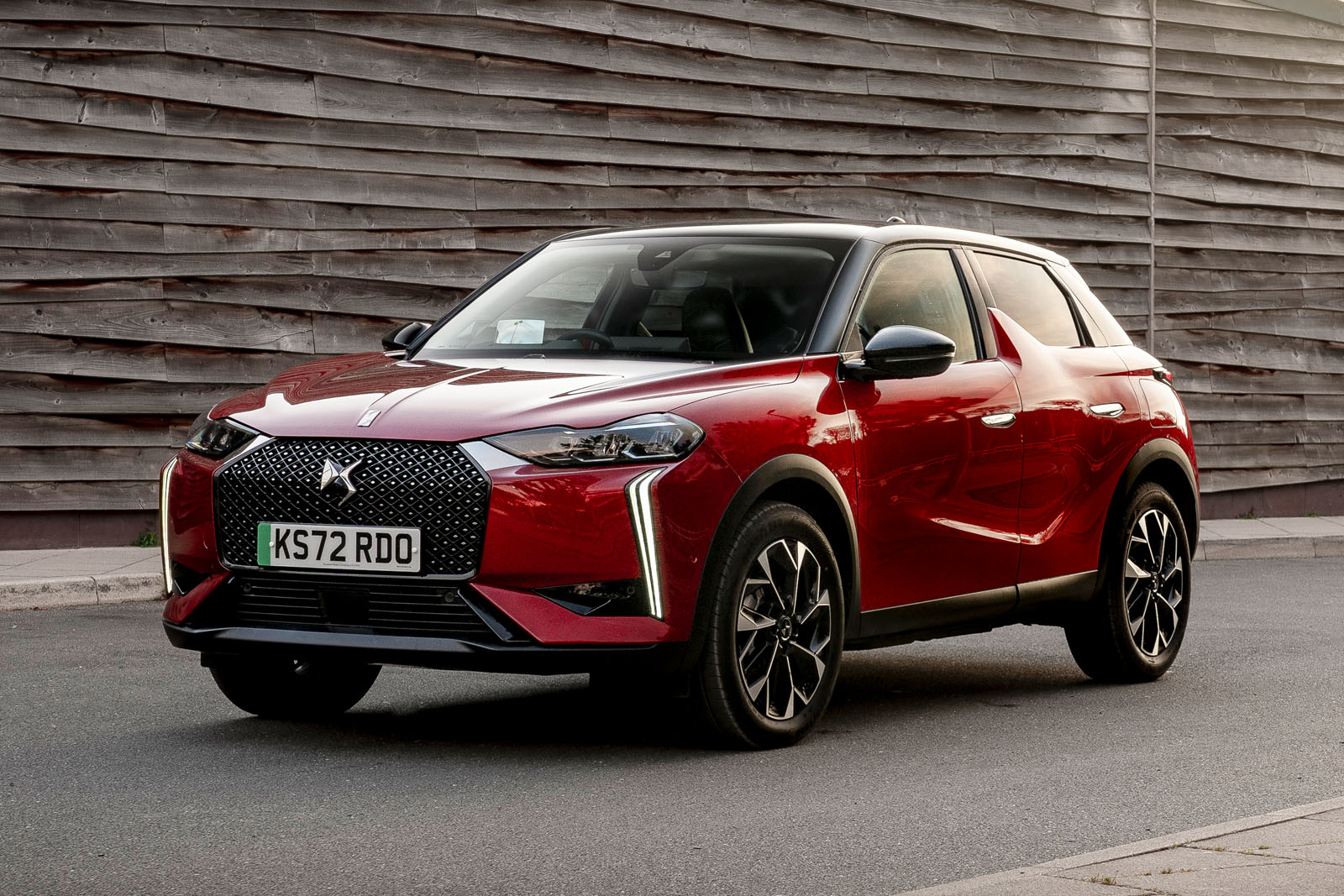
DS boss Xavier Peugeot has hinted that a replacement for the brand’s smallest model, the 3, is on the horizon – but suggested that it won’t be easily pigeonholed into a traditional segment.
The high-riding DS 3 supermini is up for renewal, having been launched in 2018 as the second model from the then newly independent DS marque.
Sharing its platform and powertrain line-up with the similarly sized Vauxhall Mokka, Jeep Avenger and Peugeot 2008, the DS 3 has played a crucial role in helping Stellantis’s French premium marque to establish a foothold in the European market – particularly in the UK, where it has been by far the brand’s best-seller.
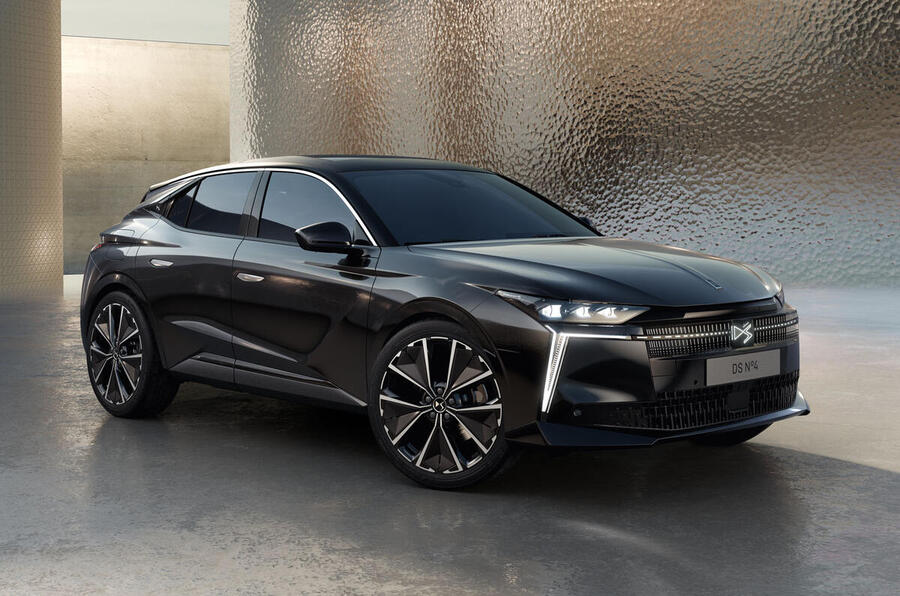
Xavier Peugeot suggested the brand plans to maintain a small car offering, but hinted that – like the new DS N°8 saloon-SUV – a successor to the 3 would be likely to straddle traditional segments in a bid to both stand out in a crowded segment and appeal to different demographics.
“There is room for a premium car in the small, medium or large segments, but I think we should also probably invent some new segments, if we can,” he said. “There is room in the various segments for a premium player.”
He stopped short of giving any concrete details of DS’s plans for a new entry model, but DS product director Audrey Amar said Xavier Peugeot is always asking her to “invent a new concept” for upcoming cars and suggested that future models will follow the N°8 in straddling various market segments.
She said: “When you look at previous segments, it was very clear that you had B-hatch, B-SUV, C-hatch, C-SUV… Now it’s not that obvious any more.”
Amar added that the N°4, which occupies a similar footprint to the likes of its Audi A3 and BMW 1 Series rivals but adopts more of an SUV-inspired silhouette, is “the beginning of this new segmentation”.
“ICE and combustion will never disappear. Never,” said Jochen Goller, member of the board of management of BMW AG for customer, brands and sales. With that single line, BMW underlined a strategy we’ve been tracking for months: a dual future where combustion and electric power coexist, and profitability comes from flexibility, not absolutes.
That philosophy is now codified in BMW’s decision to consolidate its entire lineup onto just three platforms:
Combustion-only platform: A dedicated ICE architecture for entry-level cars. These will continue to serve markets where EV adoption lags and infrastructure is unreliable. BMW knows that across regions like India, the Middle East, and Eastern Europe, petrol-powered cars will remain critical for sales well into the 2030s.
Multi-energy platform: Designed to carry petrol, hybrid, and EV drivetrains, this is where volume sellers like the X5 and 5 Series will live, offering BMW the ability to meet wildly different market demands with a single model family.
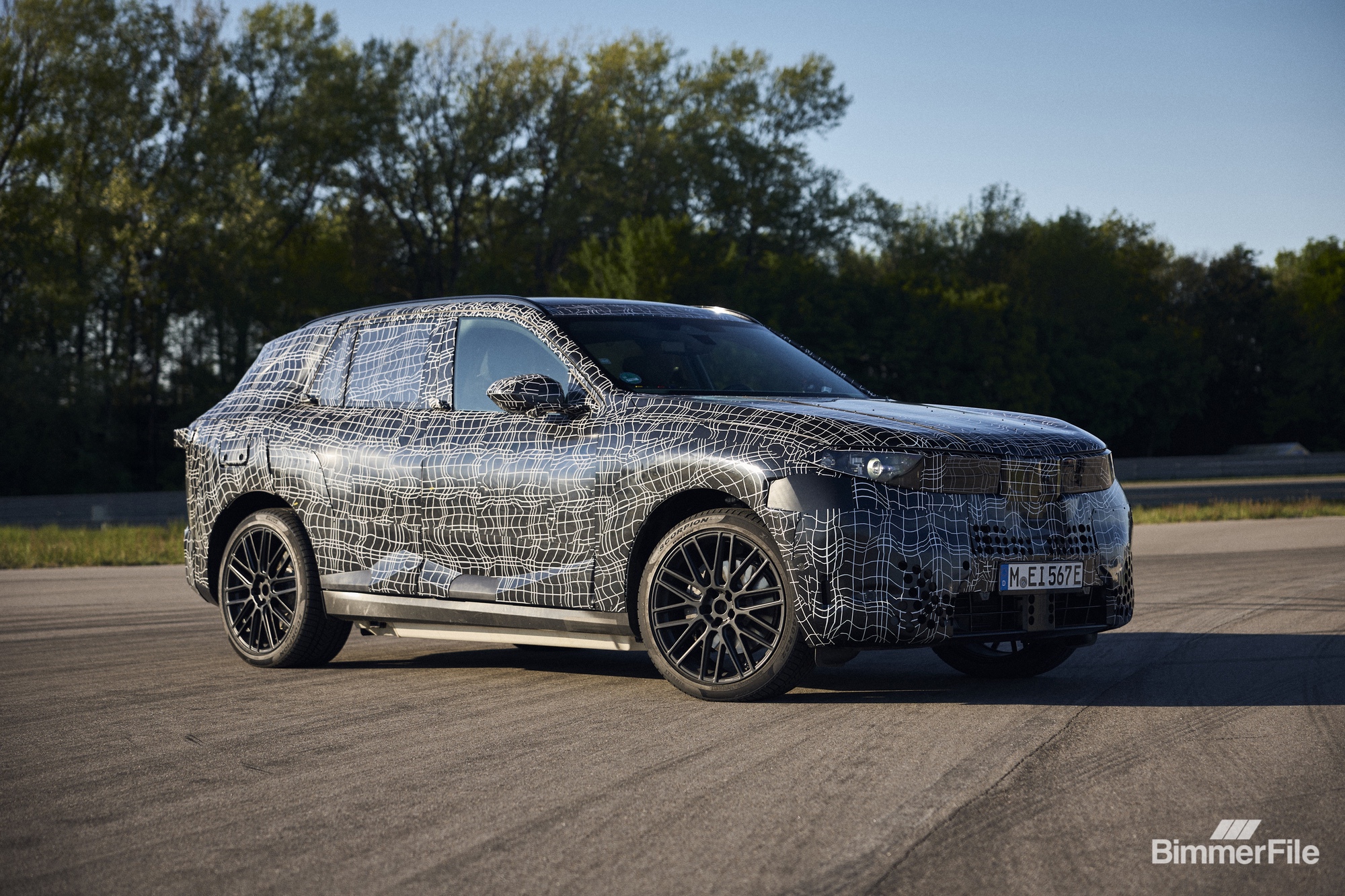
Neue Klasse EV platform: BMW’s future tech flagship. The NCO platform is kicking off with the just announced iX3 and the i3 sedan this spring. The Neue Klasse will deliver lighter packaging, faster charging, new battery chemistries, and the “Heart of Joy” superbrain software that defines BMW’s EV future.
How Core BMW Models Fit
3 Series / X3: Both will split identities. Neue Klasse versions (NA0 i3 sedan/touring, NA5 iX3) launch from 2025–2026, while ICE equivalents (G50 3 Series, G45 X3) continue until the mid-2030s. Customers in the EU and Asia will see EVs first, while petrol and hybrid versions remain essential in markets like the US and Middle East.
5 Series / X5: Expect overlap here too. The NC0 i5 is planned for 2030, while the next-gen X5 (G65, due 2026) will run through 2033 with both combustion and BEV variants, including a planned hydrogen option.
7 Series / X7: The G70/i7 pairing already shows BMW’s dual strategy. Future i7s (ND0, from 2029) will sit on Neue Klasse, while ICE-powered 7s and V8-driven X7s (G67, 2027–2034) will continue in most markets.
8 Series: The next 8 Series (G75–G77) will carry ICE drivetrains until 2033, with Neue Klasse BEV versions (ND0-based i7 GT-style derivatives) coming in late 2020s and early 2030s.
BMW’s Smaller Offerings
The big question here is how BMW will split certain models across these three platforms. Entry-level crossovers like the X1 and 2 Series could become ICE-only, while others may go dual-path or EV-only depending on regional demand. Production plans we’ve seen (NB0 i1, NB5 iX1, NB8 i2) confirm Neue Klasse small cars are coming, but whether BMW maintains ICE X1s alongside them is still up for debate.
The Takeaway
Despite ICE continuing “indefinitely”, BMW isn’t backing away from EVs. Neue Klasse is arguably the company’s most ambitious technical leap since the 1970s. But Goller’s words make clear that BMW sees a future where EVs and ICE cars run in parallel. For drivers, that means the inline-six, the V8, and even a future M3 with a petrol engine aren’t going anywhere. For BMW, it ensures profitability across every global market, no matter how uneven the transition to electric proves to be.
G-STAR launches Anatomic Denim, a bold new move that merges design innovation, visual storytelling and art into one cohesive statement. Conceived around the anatomy and movement of the human body, principles central to the denim brand since the introduction of the G STARElwood in 1996. The project spans three pillars: a new denim collection, a global campaign by Jordan Hemingway, and an art installation in the form of a monumental Anatomic Denim Gorilla by Darwin, Sinke & van Tongeren.
The Campaign: Movement in Its Purest Form
At the heart of Anatomic Denim is a cinematic and photographic campaign by cult director and photographer Jordan Hemingway, renowned for his visceral style and collaborations with Gucci, Prada, and Maison Margiela. The imagery features athletes from gymnastics, pole dancing, cycling, and calisthenics, but with all their usual apparatus removed. No rings, no pole, no bike. What remains is the human body in motion, clad in denim, engineered to move with it.
“From the very first call, I knew this one would be special”, says Hemingway. “G-STAR is a brand with real heritage but what makes them exciting is their appetite for reinvention and boundary-pushing. This project was exhilarating in every sense, full of creative and technical challenges that demanded invention. Working closely with their team to solve them wasn’t just rewarding — it was a joy.”
The Product: Anatomic Denim
Designed to follow and enhance the body’s natural form, the new Anatomic Denim range is the next evolution of G-STAR’s pioneering approach to fit and construction. The Contor offers a futuristic take on the Arc, defined by architectural lines and a sculpted fit. The Kitoh pushes anatomy further, with engineered seams that trace musculature to emphasise shape and motion. Finally, the G-STAR Elwood — the original icon — is reimagined for 2025 with refined anatomical tailoring.
“Anatomic Denim is the next step in G-STAR’s denim evolution, designing not just for the body, but with it in mind,” says Gwenda van Vliet, Chief Brand Officer at G-STAR. “Merging our 3D legacy with art, science and craftsmanship, we bring denim to life in a raw, expressive, unmistakably G-STAR way.”
The Art: The Denim Gorilla
Completing the project is The Denim Gorilla, a 3.5-meter sculpture created with Darwin, Sinke & van Tongeren, celebrated for their mastery of fine taxidermy. Entirely crafted from denim, the piece explores anatomy and structure on a monumental scale. It is now on display at the Art Zoo Museum in Amsterdam and has taken center-stage during Amsterdam Fashion Week and CIFF Copenhagen.
Shot by renowned filmmaker Jordan Hemingway, the campaign features four athletes: a gymnast, a pole dancer, a cyclist, and a calisthenics performer, each without their usual apparatus. What remains is anatomy in motion. And denim, built to move with it. View the video below.
The Anatomic Denim collection is available from September 23, 2025, with prices ranging from EUR 119.95 to EUR 300 at select retailers and at g-star.com.
For more on the latest in lifestyle, culture and fashion reads, click here.
Recently, our RV air conditioner started to act up. At first it was just a little squeak, but soon enough it turned into a full-fledged moan that we couldn’t ignore. Still, we let it go for a couple of weeks…until finally the fan quit working entirely.
Honestly, I couldn’t be too mad. The A/C lasted a good long time and we were running it pretty much constantly, even with it acting up. Still, I wasn’t thrilled to be left with no air conditioner in the summer heat.
The good news? We were actually able to get our A/C up and running again fairly easily. If you’re facing this same problem, I’ve laid out a list of things we have done to attempt to fix RV A/C units, both this time around and in the past.
How an RV Air Conditioner Works
Before we go any further, I feel like I should explain what I know about how RV air conditioners work. Having this information will help you better understand what is going on with your unit and how you might solve the problem.
An RV air conditioner has three systems:
Electrical System — This provides power, usually 120-volt A/C when plugged into shore power or a generator, sometimes supported by an inverter.
Refrigerant System — This uses a compressor, condenser, and evaporator coil to circulate refrigerant and transfer heat out of the RV.
Airflow System — This relies on fans, filters, and ducts to move cooled air inside and hot air outside.
If one of these systems fails, the whole unit can stop cooling effectively. I make it my goal to figure out which system isn’t working properly before I make any repairs.
Common RV Air Conditioner Issues
Some of the RV air conditioner problems we have faced (like last weekend’s problem) have been super simple fixes. Others have been a bit more complex. Below is a list of some of the symptoms we’ve experienced and the issues that can cause each symptom. Hopefully, it helps you narrow down what is wrong with your unit.
The Unit Won’t Turn On
This is often caused by power supply issues, tripped breakers, or faulty wiring. It’s happened to us a few times, and it was always a flipped breaker.
Blows Warm Air
This could be low voltage, a bad capacitor, dirty coils, or refrigerant leaks. Dirty coils were the issue when we had warm air coming from our vents.
Uneven Cooling
We’ve experienced uneven cooling a number of times. Blocked ducts, clogged filters, or weak fans may be the cause of this symptom.
Freezing Up
This is the most common RV A/C issue we’ve had. Typically, it is caused by restricted airflow, dirty filters, or a malfunctioning thermostat. Cleaning our filter tends to solve the problem.
Excessive Noise
Excessive noise was what we were experiencing until our fan stopped. In our case, it was the fan needing some grease. That said, it could also be loose components or worn bearings.
Water Leaks Inside
Generally, we see this after the A/C freezes up, which just means it’s thawing and the thawed ice is dripping inside. That said, if you have a water leak when the A/C is not frozen, it could be condensation drainage issues or clogged drain pans.
Step-by-Step Troubleshooting
So, how do you fix your broken RV air conditioner? Depending on the symptoms the A/C is presenting, I like to try the troubleshooting steps below.
Check the Power Supply
If your A/C unit doesn’t seem to be trying to turn on, you’ll want to make sure it’s actually getting power. Remember that it is pretty easy to accidentally flip a 30-amp breaker—especially when running the A/C—so it should be one of the first things you check out.
Shore Power or Generator Output: Verify that your RV is plugged into a working 30-amp or 50-amp outlet. If using a generator, ensure that it’s running properly and is producing enough wattage.
Circuit Breakers and Fuses: Check your RV’s breaker panel. A tripped breaker or blown fuse will shut the A/C down. Reset breakers carefully and replace fuses if necessary.
Low Voltage Issues: RV parks sometimes have poor electrical infrastructure. If the voltage dips below 105 volts, your A/C can struggle or refuse to run. Use a voltmeter or a surge protector with a display to check.
Inspect the Thermostat
We’ve never actually dealt with thermostat issues, but if your RV air conditioner won’t cycle on or doesn’t respond correctly, the thermostat may be to blame. If you believe the thermostat might be the issue, check the things below.
Battery Check: Many RV thermostats run on batteries. Replace them if dead.
Loose Wiring: Remove the cover and check for disconnected or corroded wires.
Settings: Make sure it’s set to “Cool” and that the desired temperature is below the current room temp.
Clean or Replace the Air Filter
I can’t tell you how many times we’ve forgotten to clean our RV air conditioner air filter. The result? A super dirty filter and a frozen A/C unit. Luckily, this is a super easy fix:
Remove the filter cover inside your RV.
Wash reusable filters with warm soapy water or replace disposable ones.
Clean them every 30 days of use to maintain airflow.
Examine the Airflow
If you’re having issues with poor or uneven airflow and your filter seems clean, you may be dealing with another blockage down the line. We have found blankets blocking vents, crushed ductwork under our bed, and a friend once found a circle of cardboard blocking some of his ductwork.
Vents and Registers: Make sure they are open and not blocked by furniture or belongings.
Ductwork: Check for crushed, kinked, or disconnected ducts in ducted A/C systems.
Fan Operation: Listen for the fan motor. If it’s weak, noisy, or not running, it may need replacement.
Inspect the Coils
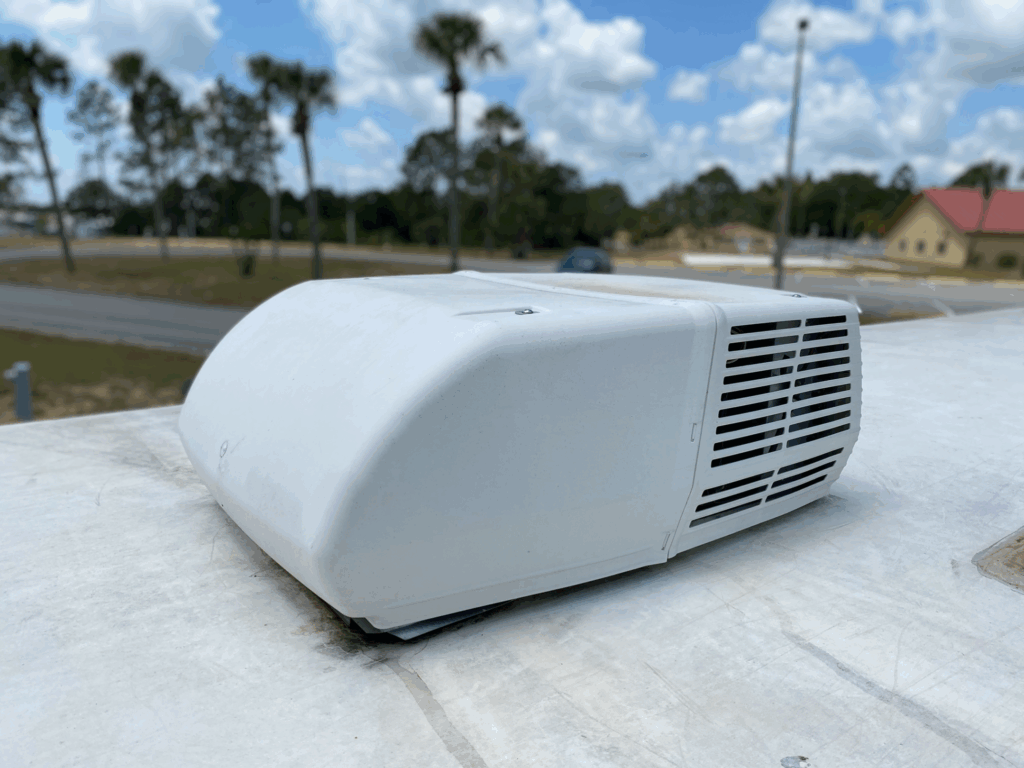
RV air conditioner coils will get dirty over time. Dirty coils will cause your unit to freeze up and work inefficiently. For this reason, you’ll want to clean them regularly. Keep in mind, your RV air conditioner has two main coils: the evaporator coil (inside) and the condenser coil (outside, on the roof). Both should be cleaned gently, and bent coils should be combed back into place.
Test the Capacitors
Capacitors are small electrical components that help the compressor and fan motors start up. A weak or failed capacitor is a very common issue in RV A/C units. We are lucky in that we’ve never had this issue, but if you think you might, you can use the info below to diagnose and address the problem.
Symptoms of a Bad Capacitor:
Humming sound but no fan or compressor start.
Unit tries to start but shuts down quickly.
Intermittent cooling.
Testing
Use a multimeter with a capacitance setting. Compare readings to the rating on the capacitor label.
Replacement
Capacitors are inexpensive and relatively easy to swap out if you’re comfortable with electrical repairs.
Safety Note: Capacitors hold a charge even when power is disconnected. Always discharge them before handling.
Look for Refrigerant Problems
Unlike residential systems, most RV air conditioners are sealed units. This means they are not designed to be recharged like a car A/C system, and if your RV A/C loses refrigerant, it will likely need to be replaced.
Signs of Refrigerant Loss
Warm air despite running continuously.
Frost buildup on coils.
Reduced cooling capacity over time.
Unfortunately, if you suspect a refrigerant issue, you’ll need a professional HVAC technician or just replace the unit entirely if you’re comfortable doing so.
Address Excessive Noise
Noisy air conditioners can be irritating, especially in the confined space of an RV. Besides, as we learned recently, some noises can be signs of problems.
Rattling
If your unit is rattling, you’re probably dealing with loose screws or panels. In this case, try tightening hardware.
Grinding and Squealing
Grinding or squealing noises are probably worn fan motor bearings. Motor replacement may be necessary, but if you’re lucky, you can get away with greasing the bearings like we did.
Buzzing and Humming
Lastly, if you hear buzzing or humming you might be looking at failing capacitors or electrical components. As mentioned above, replacing a capacitor isn’t a huge deal.
Fix Water Leaks
Water dripping inside the RV is usually condensation that isn’t draining properly. Unfortunately, a puddle of water on the RV floor is very likely to lead to some water damage. Besides, you do want to make sure the water isn’t getting in due to poor seals.
Check the Drain Pan: Located under the evaporator coil. Clean it of dirt and debris.
Unclog the Drain Line: Use compressed air or a plumber’s snake to clear blockages.
Seal Gaps: Ensure the A/C gasket between the unit and roof is intact to prevent rainwater leaks.
Preventative Maintenance Tips
Preventive maintenance is my best friend. I do my very best to stay on top of all my RV maintenance so I don’t have to deal with unexpected issues while I’m out trying to enjoy a cool destination. My RV A/C is included on my maintenance schedule.
I try to make sure to…
Clean filters every month during heavy use.
Inspect and clean coils every season.
Check roof seals annually to prevent leaks.
Use a surge protector to avoid electrical damage.
Run our A/C periodically in storage to keep components lubricated.
Cover the unit in winter to protect from debris and snow.
When to Call a Professional
I am all about DIY RV repairs. In fact, I’ve fixed almost every issue we’ve had with our rigs. That said, there are a handful of RV air conditioner problems that should be addressed by a professional.
I recommend calling for help if…
You suspect a refrigerant leak.
The compressor is not running despite a good power supply.
You’ve replaced capacitors and checked wiring with no success.
You’re uncomfortable working with electricity.
Emergency Cooling Alternatives
Being without A/C in the middle of summer was a nightmare. Honestly, absolutely nothing we did came anywhere near matching the cooling power of our air conditioner. That said, we did find some things that helped a bit until we got the A/C up and running again.
We parked in the shade, kept roof vents open, used fans to help improve airflow, and put Reflectix on our windows to block out sunlight. We had considered purchasing a swamp cooler or portable A/C unit, but we didn’t end up needing to do that. It is also possible to put a window unit in an RV window, but it will need to be held up by something, and some RV parks will frown on putting an A/C in the window.
I know from experience that losing your RV air conditioner while you’re out trying to enjoy your travels is a major bummer. Fortunately, we are almost always able to fix the problem on our own. Use the tips above and you might be able to do the same!
Between exclusive concept to reality cars like the Speedtop and Skytop and adventurous new upcoming products like the BMW “Rugged” off-road SUV, BMW has really dipped its toes into the small-volume segment. We’ve learned recently that the brand plans to continue exploring niche models with great interest. A precedent that arguably began with 2022’s 3.0 CSL has led to more bespoke and exclusive models in the past three years than in most of BMW’s cumulative history. And in exclusive talks with Bernd Koerber, Senior Vice President BMW Brand and Product Management, we learned the Bavarians are just getting started.
BMW Will Introduce New Niche Models
Koerber starts out breaking down BMW’s basic brand strategy. First, the automaker focuses on getting the volume segments right. Specifically, models like the 3 Series. “Once we have the volume segments right, we started to look at, ‘what can do with M? How do we deal with niche cars?’” he says. He goes on to include cars like the Skytop and Speedtop, cars that were “small series, very much in the focus of the last two or three years.” Why, exactly, does BMW continue to do things like this instead of invest in more democratized platforms? It’s simple, and obvious: brand pedigree.
If Koerber’s words are gospel, there’s a lot to look forward to, though. “There will be a lot to see, without going into specifics, where we pay into unique areas, things that pay a lot into the brand,” Koerber says. He claims that makes BMW “different from competitors who stay in the mass segments,” which is true. No rival has developed — and subsequently produced — something on the level of Skytop or Speedtop. Even the 3.0 CSL has no real comparison across the rest of the German brands, although Porsche’s more heritage-driven models could perhaps be in the same conversation.
Special Models Make BMW Stand Out
It’s good to hear Koerber hint at more special BMWs being on the way. It’s doubly nice to hear that there’s a focus on brand heritage. Most of this also directly ties into what Koerber said regarding wagons coming to the U.S. market. In fact, his words are almost exactly mirrored on the subject. When speaking of extreme touring models coming to the U.S., he claimed doing so pays into the brand. While that could mean some exotic Touring iterations coming Stateside, it also sounds like BMW is cooking up a hell of a variety dish over the next few years. And, interestingly, the usual competitors seem to be nowhere in sight. We can’t wait to see what Koerber and the brand have prepared for us.
So, you’re in the market for a new set of wheels, huh? Exciting times! But before you rev up that engine and hit the dealership, let’s pump the brakes for a sec and talk about something crucial: should you buy or lease your next vehicle?
Image Credit
It’s a question as old as time (or at least as old as cars), and one that doesn’t have a one-size-fits-all answer. But fear not, because I’m here to break it all down for you so you can make the best decision for your driving needs. Whether you’re thinking of buying or leasing a Toyota, Vauxhall, or any other vehicle, this guide should help you make the right decision for you.
Buying: Owning the Road
The Lowdown:
When you buy a car, you’re in it for the long haul. You pay for the entire cost of the vehicle, either upfront or through financing, and it’s yours to keep until the wheels fall off (hopefully not literally).
Pros:
Ownership – You’re the boss. The car is yours, plain and simple.
No Mileage Limits – Drive as much as you want without worrying about pesky mileage restrictions.
Customization – Want to paint your car hot pink and install a disco ball on the ceiling? Go for it! It’s yours to customize to your heart’s content.
Cons:
Higher Monthly Payments – Buying typically means higher monthly payments compared to leasing.
Depreciation – Cars lose value over time, and when you buy, you’re on the hook for that depreciation.
Maintenance Costs – As the owner, you’re responsible for all maintenance and repair costs once the warranty expires.
Leasing: Testing the Waters
The Lowdown:
Leasing is like renting a car for an extended period. You pay a monthly fee to drive the vehicle for a set term, usually two to three years, after which you return it to the dealership.
Pros:
Lower Monthly Payments – Leasing typically comes with lower monthly payments compared to buying.
New Car Every Few Years – Love that new car smell? With leasing, you can upgrade to a brand-spanking-new model every couple of years.
Fewer Maintenance Worries – Since you’re driving a new car under warranty, maintenance and repair costs are often covered.
Cons:
Mileage Restrictions – Most leases come with mileage limits, and exceeding them can result in hefty fees.
No Ownership – You’re essentially renting the car, so you won’t have any equity built up at the end of the lease.
Fees and Penalties – Returning the car early or exceeding wear and tear limits can lead to additional fees.
A Word on Sustainability: Considering Environmental Impact
In today’s world, where climate change and environmental conservation are at the forefront of many conversations, it’s essential to consider the impact of your vehicle acquisition choice on the planet.
Buying:
Long-Term Ownership – Buying a car often means keeping it for many years, which can lead to higher overall emissions compared to leasing.
Potential for Eco-Friendly Choices – When buying, you have the option to choose a fuel-efficient or electric vehicle, reducing your carbon footprint over time.
Leasing:
Frequent Upgrades – Leasing allows you to drive newer, more fuel-efficient models more frequently, potentially reducing emissions over the long term.
Manufacturing Impact – However, it’s important to acknowledge that leasing may contribute to increased manufacturing demand for new vehicles, which has its own environmental consequences.
Image Credit
How to Decide: A Roadmap
1. Assess Your Driving Habits:
Do you rack up a lot of miles each year?
Do you like having the latest features and technology?
Are you the type to get emotionally attached to your vehicle?
2. Crunch the Numbers:
Compare the total cost of buying vs. leasing over the same term.
Factor in monthly payments, maintenance costs, and potential resale value.
3. Consider Your Lifestyle:
Are you planning any major life changes in the near future?
Do you need flexibility in your vehicle situation?
4. Test Drive, Test Drive, Test Drive:
Don’t just rely on specs and reviews. Get behind the wheel and see how each option feels in real life.
FAQs: Your Burning Questions, Answered
Q: Can I negotiate the terms of a lease?
A: Absolutely! Just like buying, leasing terms are negotiable, so don’t be afraid to haggle.
Q: What happens if I want to end my lease early?
A: Ending a lease early typically incurs early termination fees, so be sure to read the fine print before signing on the dotted line.
Q: Can I buy the car at the end of my lease?
A: Most leases offer the option to purchase the vehicle at the end of the term, but it’s important to weigh the pros and cons before making a decision.
Final Thoughts: The Road Ahead
At the end of the day, whether you choose to buy or lease depends on your individual needs and preferences. There’s no right or wrong answer, only what works best for you and your wallet.
So, take your time, do your research, and hit the road with confidence knowing you’ve made the right choice for your next automotive adventure.
Mansory has unveiled its latest conversion project called the “Equestre”, based on the Ferrari 12Cilindri. With the unveil, the new Mansory Equestre has become the world’s first complete vehicle conversion of Ferrari’s latest 12-cylinder GT offering. The car is set to make its public debut at the Monaco Yacht Show 2025.
The Mansory Equestre follows the Pugnator, introduced last year, based on the Ferrari Purosangue. The Equestre will be offered in both Coupe and Spider versions. The complete conversion consists of plenty of carbon fibre and a host of other aesthetic and technical upgrades.
Starting off with the design, the 12Cilindri-based Equestre features a bespoke purple paint scheme with matching-coloured forged carbon fibre body panels all around. This includes the enlarged air intakes, the front hood, extended wheel arches and the rear apron – all of which are made entirely of carbon fibre. The Equestre also features newly designed ultra-light single-piece forged “VF.5” design rims finished in gloss black. There is also a Tricolore strip running through the centre of the entire car.
While the interior of the launch vehicle features grey Alcantara with contrasting purple appliques, Mansory will offer its customers a vast range of personalisation options to choose from. Other features on the Equestre include a carbon-leather sports steering wheel with integrated shift indicators, aluminium pedals and quilted floor mats, to name a few.
Powering the Mansory Equestre is a heavily modified version of the 6.5-litre naturally aspirated V12 engine. The upgraded engine is tuned to produce 755 BHP and 730 Nm. The car also features a new four-pipe exhaust system with valve control.