9.2 C
London
Thursday, May 14, 2026
Home Blog Page 95

Dodge Ram 1500 TRX Buyers Guide

0
Dodge Ram 1500 TRX Buyers Guide


When the 2021 Ram 1500 TRX was introduced, it redefined the high-performance off-road truck segment, setting a new standard for power and capability. As a high-performance variant of the fifth-generation Ram 1500 (DT) pickup, the TRX was inspired by the Ram Rebel TRX concept, which debuted at the 2016 State Fair of Texas as a design and engineering study. 

Consumer interest and demand led to Ram announcing on June 1, 2018, that the TRX would enter production for the 2021 model year. Built to challenge and surpass the long-dominant Ford F-150 Raptor, the TRX was not just another off-road truck—it was a statement of brute force and extreme engineering.

At the heart of the Ram 1500 TRX was the supercharged 6.2-liter HEMI V8, delivering a staggering 702 hp and 650 lb-ft of torque. This Hellcat-derived powerhouse allowed the TRX to sprint from 0 to 60 mph in just 4.5 seconds, making it the quickest production truck at the time. Power was routed through an 8-speed automatic transmission to all four wheels, ensuring exceptional off-road capability. 

The truck featured Bilstein Black Hawk e2 adaptive shocks, 11.8 inches of ground clearance, and the ability to ford up to 32 inches of water, making it a formidable machine in extreme terrains. It was built with high-speed off-roading in mind, excelling in the desert, mud, and rugged trails.

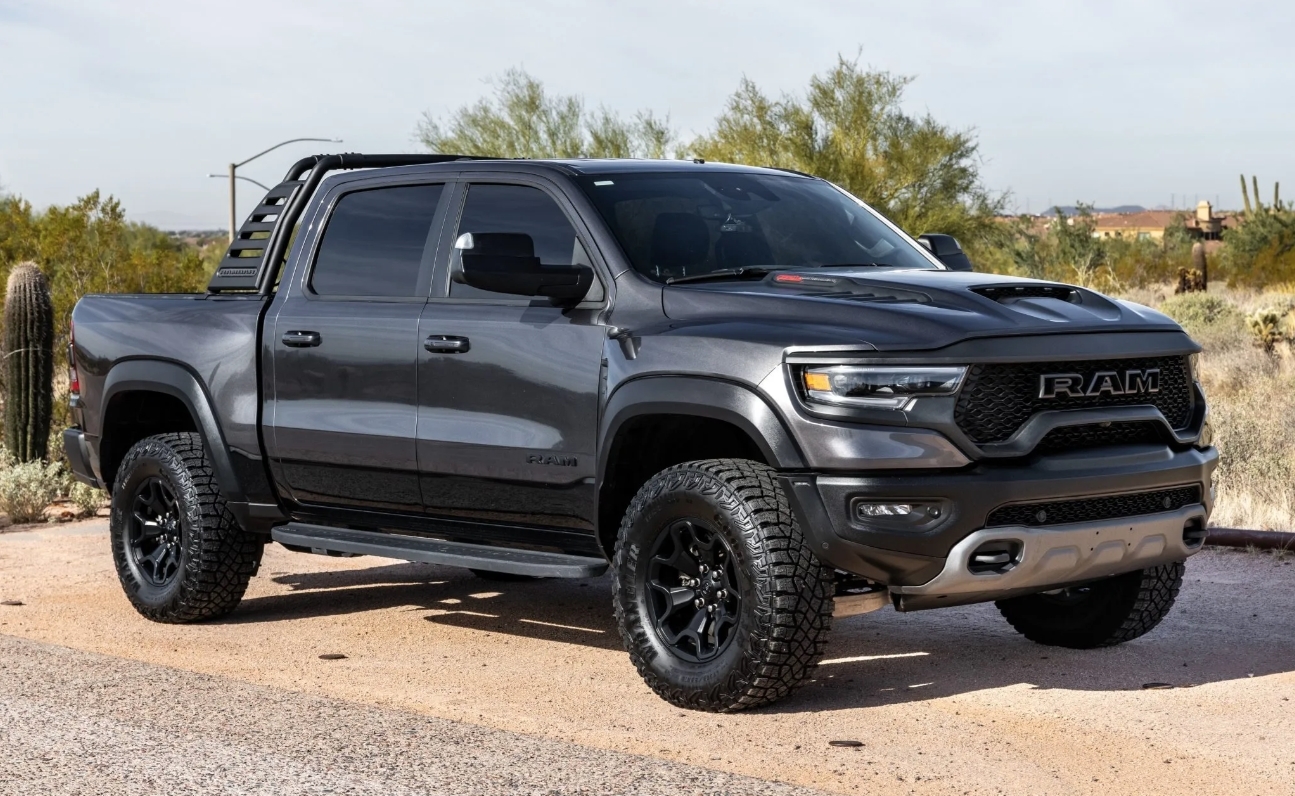
The TRX’s exterior design was as aggressive as its performance. Sitting 8 inches wider than a standard Ram 1500, it accommodated massive 35-inch all-terrain tires. A bold front grille with oversized air intakes, a functional hood scoop with LED marker lights, and flared fenders reinforced its muscular stance. The truck also featured active air vents, skid plates, and adaptive LED headlights, ensuring it looked as intimidating as it performed.

Inside, the Ram 1500 TRX combined rugged durability with luxury. The driver-focused cockpit featured leather, suede, and carbon fiber trim, particularly in the TRX Level 2 Equipment Group. A 12-inch Uconnect touchscreen dominated the dashboard, providing performance telemetry, navigation, and entertainment options. 

Features like performance-bolstered seats, a digital rearview mirror, a head-up display, heated and ventilated seating, and a 19-speaker Harman Kardon sound system made the TRX as refined as it was powerful. While built for extreme performance, the TRX did not sacrifice comfort or technology.

The Ram 1500 TRX was produced from 2021 to 2024, with production ending on February 16, 2024. The final model year was cut short as Ram transitioned early to its 2025 truck lineup. The TRX was discontinued due to stricter emissions regulations, making it the last Hellcat-powered Ram truck.

Throughout its run, the TRX faced competition primarily from the Ford F-150 Raptor and Raptor R, which aimed to match its off-road prowess and power output. Other challengers in the high-performance off-road truck segment included the Chevrolet Silverado ZR2, GMC Sierra 1500 AT4X, and the Toyota Tundra TRD Pro, though none matched the sheer power and capability of the TRX.

Despite its production ending, the Ram 1500 TRX remains one of the most extreme and iconic performance trucks ever built, leaving behind a legacy of raw power, advanced off-road engineering, and unmatched dominance in its class.

Model Changes (Breakdown by Year)

2021 Dodge Ram 1500 TRX

The 2021 Ram 1500 TRX marked the debut of Ram’s high-performance off-road truck, setting a new benchmark in its segment. 

Photo by CarBuzz

As the inaugural model, it came standard with a 702 hp supercharged 6.2L HEMI V8 engine, delivering exceptional power and performance. Designed for extreme terrain, the TRX featured off-road suspension, advanced Bilstein Black Hawk e2 adaptive shocks, and a 12-inch Uconnect infotainment system. 

In addition to the standard model, Ram introduced the Launch Edition, a limited-run variant with only 702 units produced. This exclusive edition featured a unique Anvil Gray exterior, the Level 2 Equipment Group, beadlock-capable wheels, and special badging, making it a highly sought-after collector’s model.

The 2021 Ram 1500 TRX had a starting price of $70,095. Adding the TRX Level 2 Equipment Group, which included amenities like heated and ventilated leather seats, a heated steering wheel, and interior material upgrades, added $7,920 to the base price. As a result, a fully equipped TRX could reach prices in the mid to high $80,000 range.

2022 Dodge Ram 1500 TRX

For the 2022 model year, Ram introduced two special editions of the TRX: the Ignition Edition and the Sandblast Edition. The Ignition Edition, limited to 1,003 units, featured an exclusive Ignition Orange exterior, special graphics, and orange interior accents. The Sandblast Edition, with 1,202 units produced, came in a Mojave Sand exterior color, unique graphics, and Light Frost interior accents.

The 2022 Ram 1500 TRX had a starting price of $72,965. Ram introduced two special editions that year: the Ignition Edition, which started at $93,280, and the Sandblast Edition, which had a base price of $98,285.

2023 Dodge Ram 1500 TRX

For the 2023 model year, Ram introduced the Lunar Edition and the Havoc Edition as special variants of the TRX. The Lunar Edition, limited to approximately 1,000 units, featured a Ceramic Gray exterior with unique interior accents. The Havoc Edition, with around 1,500 units produced, stood out with its Baja Yellow exterior and Prowler Yellow stitching inside.

The 2023 Ram 1500 TRX had a starting price of $81,395, the Lunar Edition started at $108,340, and the Havoc Edition.

2024 Dodge Ram 1500 TRX

For the 2024 model year, Ram introduced the Final Edition to mark the end of TRX production. The Final Edition, limited to 4,000 units, featured exclusive colors such as Delmonico Red, Night Edge Blue, and Harvest Sunrise, along with Satin Titanium beadlock-capable wheels and unique interior finishes. 

The 2024 Ram 1500 TRX had a starting price of $96,340. Ram also introduced the Final Edition, limited to 4,000 units, priced at $119,620.

Dodge Ram 1500 TRX Common Problems

While the Ram 1500 TRX has hardcore off-road capability, it is not without its issues. Owners have reported various mechanical and electronic problems, some of which can impact drivability and long-term reliability. Common concerns include drivetrain noises, CV axle issues, infotainment glitches, and software-related recalls. 

Below is a list of the most frequently reported problems with the TRX:

Driveline Clunk: Owners have noted clunking noises during stop-and-go driving or when shifting between drive and reverse. This issue persisted despite dealership inspections, with some attributing it to drivetrain components.

Front CV Axle Problems: Incorrect CV (constant velocity) angles, especially after suspension modifications, can lead to clunking noises, vibrations, and reduced power transmission. This misalignment may cause premature wear on the driveshaft and CV joints.

Rear Driveshaft Clunk: Some TRX owners have experienced clunking or thudding sounds from the rear driveshaft, potentially due to worn or damaged components, loose hardware, or improper alignment.

Uconnect Infotainment System Glitches: The 12-inch Uconnect touchscreen has been reported to freeze, drop Bluetooth connections, and behave erratically. While dealers attempted fixes, issues often persisted until over-the-air updates were implemented.

Electronic Stability Control (ESC) Software Issues: A software malfunction in the anti-lock brake system could disable the ESC, increasing the risk of a crash. This led to recalls affecting Ram 1500 trucks from various model years, including the TRX.

Turn Signal Malfunction: Some 2023 and 2024 Ram 1500 models were recalled due to a malfunction in the turn signal’s self-cancellation function, potentially causing the signal to remain on unintentionally after a turn, which could confuse other drivers and lead to accidents. 

Recalls

2021 to 2024 Ram 1500 TRX vehicles

Electronic Stability Control (ESC) Deactivation (Recall No. 85B / NHTSA 24V653) 

A software malfunction in the Anti-lock Brake System (ABS) control module could disable the ESC system, increasing the risk of a crash. This recall affects approximately 1.23 million Ram 1500 trucks from the 2019 and 2021-2024 model years.

Turn Signal Malfunction (Recall No. A1B / NHTSA 23V-636) 

The turn signal’s self-cancellation function may fail, causing the signal to remain on unintentionally after a turn, potentially confusing other drivers and increasing the risk of an accident. This recall affects certain 2023-2024 Ram 1500 models.

Rearview Camera Display Failure (Recall No. 97A / NHTSA 23V-654) 

A software issue in the infotainment system may prevent the rearview camera image from displaying when the vehicle is in reverse, reducing rear visibility and increasing the risk of a collision. This recall affects certain 2022-2023 Ram 1500 models.

High-Pressure Fuel Pump Failure (Recall No. 01A / NHTSA 23V-263) 

The high-pressure fuel pump (HPFP) may fail, potentially leading to an engine stall while driving and increasing the risk of a crash. This recall affects certain 2021-2023 Ram 1500 models equipped with a 3.0L diesel engine.

Trailer Reverse Steering Control Module (TRSCM) Software Issue (Recall No. 14A / NHTSA 23V-059) 

A malfunction in the TRSCM may prevent the rearview image from displaying when the vehicle is placed in reverse, decreasing driver visibility and increasing the risk of an accident. This recall affects certain 2021-2023 Ram 1500 models.

Owners can check for open recalls by entering their Vehicle Identification Number (VIN) on the official Mopar Recall Lookup website or by contacting an authorized Ram dealership.

Maintenance and Ownership Costs

Owning a Ram 1500 TRX comes with high maintenance and ownership costs due to its supercharged 6.2L V8, off-road suspension, and heavy-duty components. Regular oil changes, tire rotations, and brake inspections are required every 8,000 miles, while major services like spark plug replacements and suspension upkeep add to long-term costs. The Bilstein Black Hawk e2 shocks and 35-inch all-terrain tires are expensive to replace, and fuel consumption averages 10–12 MPG, making gas a significant expense. 

Keep in mind, insurance premiums are higher than standard half-ton trucks. Despite these costs, the TRX remains a capable off-road performance truck.

8,000-Mile Service (or 6 Months)

  • Oil change

  • Oil filter replacement

  • Tire rotation

  • Brake pad, rotor, and drum inspection

  • Fluid level check and adjustment

  • Multi-point inspection

20,000-Mile Service (or 12 Months)

30,000-Mile Service

  • Cooling system and hose inspection

  • Fuel injection and throttle body service

  • Lubricate all non-sealed steering linkage, ball joints, suspension joints, half shafts, and u-joints

60,000-Mile Service

  • Spark plug replacement

  • Transmission fluid and filter inspection/replacement if necessary

  • Transfer case fluid inspection and service

  • Differential fluid inspection and service

90,000-Mile Service

  • Engine coolant replacement

  • Serpentine belt inspection and replacement if necessary

  • Comprehensive vehicle inspection

Here is a rough estimate of typical service costs associated with the Dodge Ram 1500 TRX:

  • Oil Change – The TRX’s high-performance engine requires synthetic oil. Dealerships typically charge between $100 and $145 for an oil change. Some dealerships offer packages, such as three oil changes with tire rotations for $218. Independent shops may offer similar services at competitive prices, often between $80 and $120.

  • Minor Service – This includes an oil change, tire rotation, and a multi-point inspection. At a dealership, costs range from $200 to $400. Independent shops may charge between $150 and $300, depending on the specific services included.

  • Major Service – Encompassing comprehensive inspections, fluid replacements, and component checks, major services at dealerships can cost between $800 and $1,500. Independent shops might offer these services for $600 to $1,200, depending on the extent of the service and parts used.

  • Tires – The TRX is equipped with 35-inch all-terrain tires such as the Goodyear Wrangler Territory tires. A set typically costs between $1,500 and $2,500, depending on the brand and specifications. Dealerships may charge a premium for installation, while independent shops might offer more competitive rates.

  • Brakes – Replacing brake pads and rotors on all four wheels can be costly. Dealerships have quoted prices around $2,000, with parts accounting for approximately $1,500 of the total. Independent shops may provide similar services for $1,200 to $1,800, depending on the parts used and labor rates.

  • Clutch – The Ram 1500 TRX comes equipped with an automatic transmission; therefore, it does not have a clutch that requires maintenance or replacement.

Options List

When purchasing a Ram 1500 TRX, the available options can significantly impact overall resale value. While the standard TRX is already well-equipped with a 702 hp supercharged 6.2L HEMI V8, Bilstein Black Hawk e2 adaptive dampers, and 35-inch all-terrain tires, several key packages and standalone options can make it even more desirable

The most popular configurations typically include the TRX Level 2 Equipment Group, which adds premium features such as leather-trimmed seats, a 19-speaker Harman Kardon audio system, ventilated front and rear seats, and advanced driver-assist features. This package makes the TRX more comfortable for daily driving while also increasing its long-term desirability.

For those looking to maximize the off-road performance, beadlock-capable wheels are a popular option, allowing for better traction in extreme conditions. Additionally, the Bed Utility Group adds a deployable bed step, adjustable tie-downs, and LED bed lighting, improving practicality for truck owners who use their TRX for hauling.

Aesthetic options include graphics packages that add bold hood and bedside decals, further distinguishing the truck. Buyers could also opt for a dual-pane panoramic sunroof, allowing the cabin to have more openness.

For safety and convenience, the Advanced Safety Group adds adaptive cruise control, lane-keep assist, and pedestrian emergency braking, making the TRX more livable in daily driving scenarios.

While the base TRX remains an excellent option for those focused purely on performance, selecting the right packages and options enhances comfort, functionality, and resale value. TRX models with Level 2 Equipment Group, beadlock-capable wheels, and premium safety features tend to be more sought after in the used market. Whether prioritizing off-road capability, luxury, or daily usability, the right option choices can make a significant difference in ownership satisfaction.

Key Options

Dodge Ram 1500 TRX Price and Value

The Best Dodge Ram 1500 TRX to Buy

When choosing the best Ram 1500 TRX, several factors come into play, including model year, available options, and overall condition.

For buyers looking for the most updated version, the 2024 TRX Final Edition is the best choice. As the last year of production, it includes all updates from previous years and comes with exclusive colors, Satin Titanium beadlock-capable wheels, and unique interior accents. Its limited production run of 4,000 units adds to its desirability and potential resale value.

For those prioritizing features over exclusivity, a TRX with the Level 2 Equipment Group is ideal. This package adds leather-trimmed seats, a 19-speaker Harman Kardon audio system, ventilated front and rear seats, and advanced driver-assist features, making it the most well-equipped version.

When it comes to market stability, all Ram 1500 TRX from 2021 to 2014 should be a safe hack. As long as you find one that’s a clean example with no bad history. 

In addition to model selection, the condition and mileage of the TRX are critical factors. A well-maintained, low-mileage truck with documented service history will hold its value better. It’s important to check for recalls, suspension wear, and drivetrain issues, as these trucks are often used for off-road driving.

Conclusion

In summary, with a starting price of around $100,000, the Ram 1500 TRX is a top choice for those seeking a high-performance off-road truck. It delivers extreme power, rugged capability, and advanced technology, making it one of the most exciting trucks in its class.

While alternatives like the Ford F-150 Raptor and Raptor R, the TRX stands out with its supercharged 6.2L V8, aggressive design, and exceptional off-road performance.

For those looking for a balance of raw power, off-road dominance, and modern features, the Ram 1500 TRX remains a solid choice.

Car Hacking Shortcuts

  • Look for models with the Level 2 Equipment Group 

  • Opt for the Final Edition or special trims for exclusivity and long-term appreciation

  • Model years from 2021 to 2024 are safe for hacking

  • Prioritize well-maintained, low-mileage trucks with a clean service history


Source link

Dispersed Camping in Oregon | RVshare

0
Dispersed Camping in Oregon | RVshare


We hadn’t tried much dispersed camping before buying our van this past spring, but we had been dreaming of the freedom and opportunity that it might offer us. Although we have been traveling for over 5 years, we found ourselves often tied to pull-through, full-hook-up sites with our large fifth-wheel. Part of our draw to vanlife is the accessibility to go more off-the-beaten-path and the potential off-grid capabilities. We had a blast this past summer camping across Oregon in our RAM 2500 Promaster van, visiting places we weren’t able to get to in our 42-foot fifth wheel, but have been on our bucket list for years.

Since we knew almost nothing when we started, we want to break down what dispersed camping is all about, how it’s different from boondocking, why Oregon is such an awesome spot for it, and what it’s like camping in a van compared to a bigger RV. We know it isn’t for everyone, but we have found it’s our favorite way to travel now!

What is Dispersed Camping?

Dispersed camping means camping on public land outside of developed campgrounds, typically on National Forest or Bureau of Land Management (BLM) land. We hadn’t heard of dispersed camping when we first started out on the road, and we realized that it may have been because we started our full-time travel journey on the East Coast, where there are fewer opportunities for this kind of camping.

There are no amenities, no reservations, and often no cost. Sometimes, we got lucky with a vault toilet or even a big trash can, but we quickly realized it is important to be self-contained when considering dispersed camping. Because there are no amenities or official campsites, that means there are no reservations. It’s hit or miss on what kind of spot (if any) is going to be available. At first, this made us anxious, but then, as we got more comfortable, it became sort of like a fun quest to find a great spot!

We used to frequently overlook these options because we liked the convenience of full-hookup sites when we were traveling in our fifth wheel. We have been seeing an increase in dispersed camping on our social media channels, especially in Utah and the PNW. This is because these areas have more USFS and BLM land.

Dispersed Camping vs. Boondocking

Boondocking and dispersed camping aren’t always the same, which was something we learned when we began looking into places to camp this past summer.

  • Dispersed camping: Camping on undeveloped public land, typically forests, deserts, or other natural settings.
  • Boondocking: A broader term, meaning camping without hookups. It could be on public land or in places like parking lots or truck stops.

So while all dispersed camping is boondocking, not all boondocking qualifies as dispersed camping.

Why Oregon is Perfect for Dispersed Camping

We love Oregon’s diverse landscape and it is one of the reasons why we have spent so much time here since parking our home-on-wheels over four years ago. Oregon offers a huge variety of landscapes and tons of public land. We found that we could camp in the high desert outside of Bend, OR or in the lush rainforest on the wet side of Mt. Hood. We could park down by the beach on Route 101, or find ourselves in the Eastern Oregon painted hills.

Highlights:

Camping at Sno-Parks in Oregon During Summer Months

Most people think of Sno-Parks as winter-only areas for snowmobiling and skiing, but in the summer months they become deserted and are a legal place to camp (up to 14 nights in most cases. Sno-Parks are state-managed parking areas that require permits in winter for snow sports access. But from May through October, these permits aren’t required, and camping is often allowed.

These were our favorite spots to camp this past summer.

  • White River West (Mt. Hood): Great views of the mountain, paved and has a vault toilet that was recently renovated. We love this spot because the river is right outside of your door, in the fall the trees turn gold against the white mountain and blue sky. It is our top spot for stargazing or to catch a glimpse of the Northern Lights.
  • Gold Lake (Willamette NF): Close to nearby lakes and pretty flat, which made it easier to park our van.
  • Thousand Springs Sno-Park (near Crater Lake): This might be our favorite from this past summer. It was paved, flat, had clean vault toilets and even had WiFi! It was only 15 minutes to the entrance of Crater Lake. We ended up staying here for an entire week!

Camping Along Highway 101 in Oregon

Oregon’s coastal Highway 101 offers some of the most scenic roadside camping in the state and we fell in love with falling asleep next to the rocks and waves of west coast beaches. We were shocked to see that there are several pullouts, forest roads, and a few more developed areas where overnight parking is allowed. Our words of warning here are to look for signs that indicate no parking. Online resources and word-of-mouth become quickly outdated as rules and regulations around overnight parking shift and change.

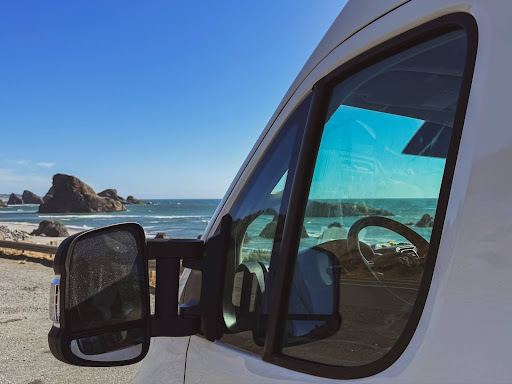
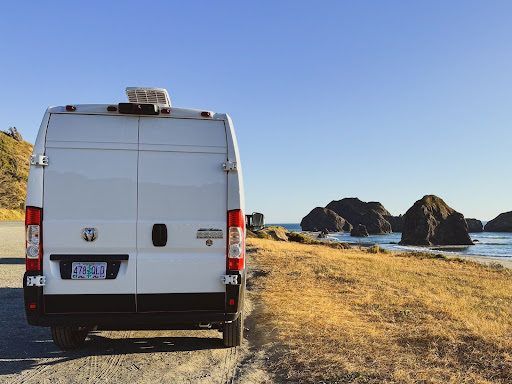
RV campervan at a dispersed camping site on highway 101 next to the Oregon Coast

Dispersed Camping in a Van vs. a Big Rig

We have learned over our years of traveling that setup and rig size dramatically affect how we travel. Camping in our van is more flexible, it’s simpler and offers an ease of access to more places, but it means that we don’t often have all of the luxuries we have in our fifth-wheel. Our big rig takes more preparation to travel with. We consider our route more mindfully, but we also have more amenities, like our washer and dryer.

Rules, Etiquette & Safety

We want to acknowledge that dispersed camping and boondocking regulations are changing with the increase of travelers on the road. We feel strongly that it is our responsibility to take care of each other and the areas we travel to, which means we follow the laws in each city and state we visit, we practice leave no trace principles, and we are respectful of the people and places we visit.

Final Thoughts

We found that dispersed camping was our favorite way to explore in our van this past summer. We loved the calm and quiet of the sno-parks, the easy access on the coast, and the general spontaneity of landing when and where we wanted during our travels, which Oregon offers in abundance!

Helpful Resources


Source link

Designing for an iconic marque

0
Designing for an iconic marque


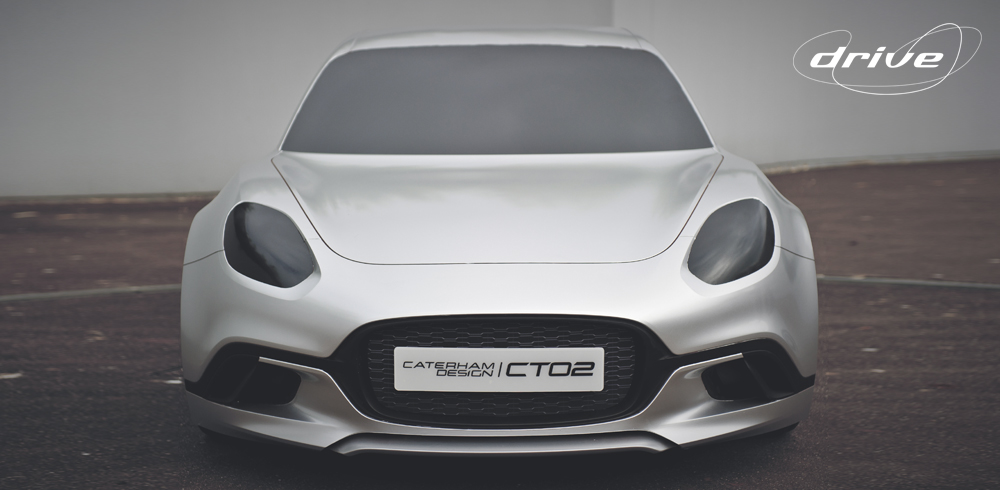
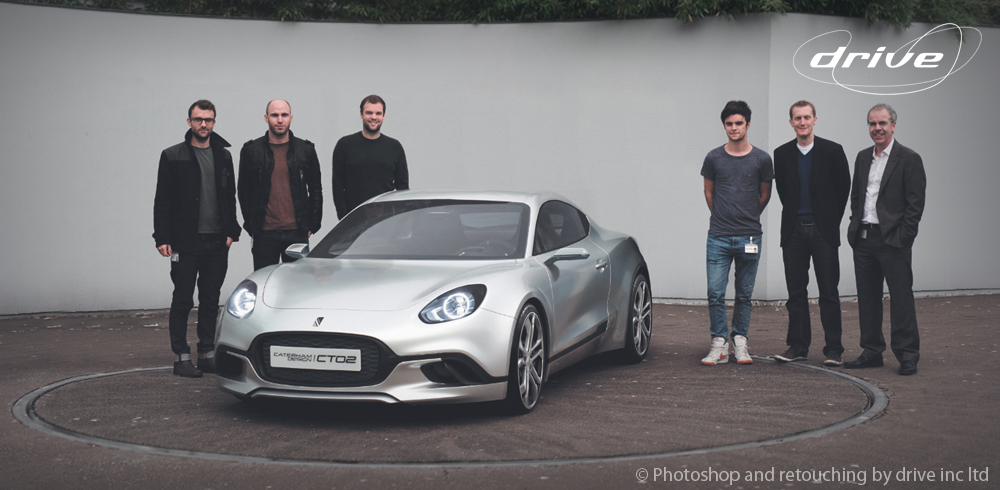
It is now 10 years since drive were designing for an iconic marque – Caterham. With the Caterham C120 now being mentioned in Russell Hayes new book Alpine – French Speed and Spirit, here is the background to Drive’s involvement with Mark Przeslawski’s insight.

Designing for an iconic marque

So where did it start for us at Drive?  It goes back 5 years to an initial meeting with Caterham in Hethel, Norwich.  The original project became a distant memory as aspirations changed with the introduction of a partner in major manufacturer Renault, a completely new package and advanced aluminium construction.   As the engineering package was developed at Caterham and Renault bases, Drive’s design team were seconded to work at the Renault R&D headquarters in Guyancourt, Paris, forming an important conduit for the Anglo-French alliance.

Arriving at Renault, Drive’s close team of designers and digital modellers with Caterham’s studio engineers, were allocated space within the Alpine facet of the complex, an impressively large studio with several clay plates.  It was one of the most exciting environments to work in, with the presence of some of the Renault concept greats dotted around the place; the Alpine A110-50, DeZir, and Twingo to name a few.

Sharing the studio space, facing each other were the C120 and AS1 clay models, two cars showing great potential with their two respective design teams working on them.  If I could sum up the entire studio atmosphere, including the Alpine team, it would be passion.  Passion was what drove these concepts forward.

The Drive design team lived, breathed and dreamt C120, flying out to France in the early hours of Monday morning and returning on a Friday evening for 6 consecutive months. Some weeks were tiring, stressful and occasionally deflating, with our attempts at the French language appreciated, even if laughed at by the canteen staff.  Our commitment, comradery and passion pulled us through every time, to be part of history, taking part in something that would bring a British sports car brand into a new era.  The sad demise of the joint venture was a bad dream.  For a long time we couldn’t believe that with all the effort everyone put into the project and with it so close to being realised, there would be no exciting moment of that first drive.

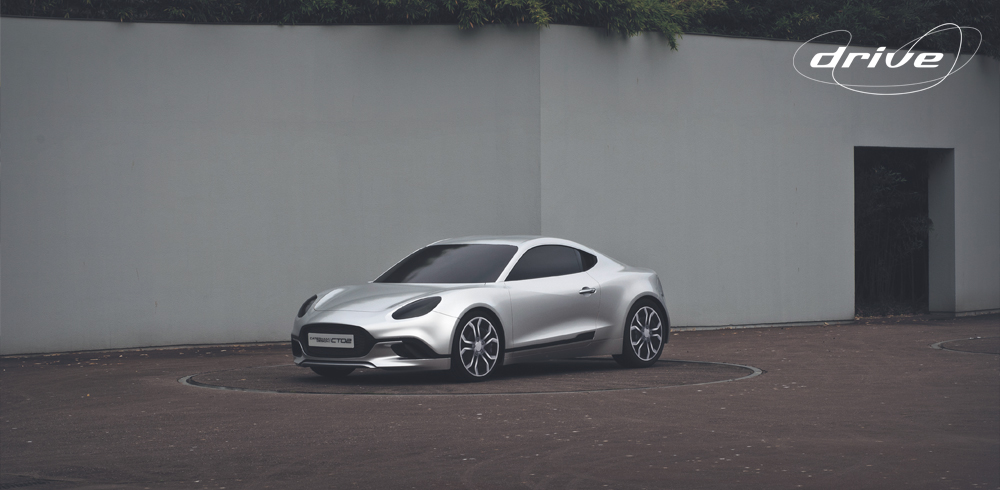
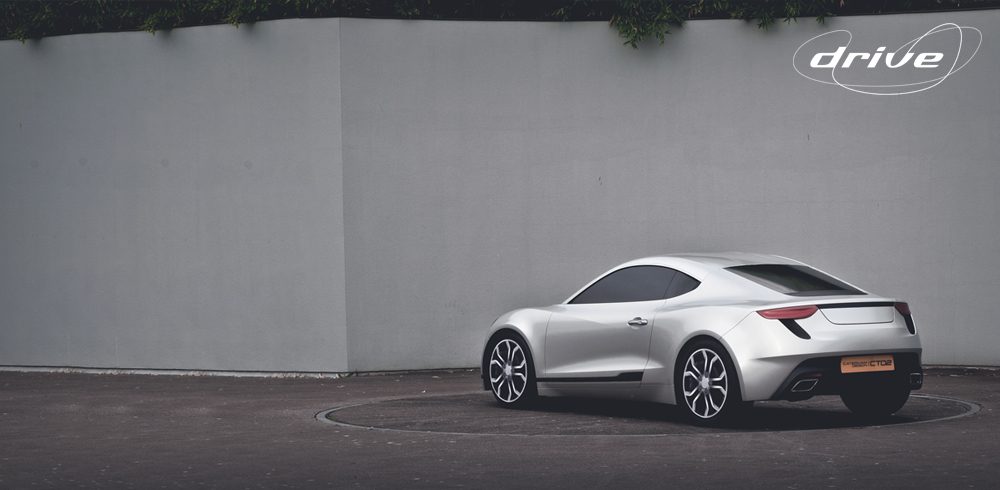
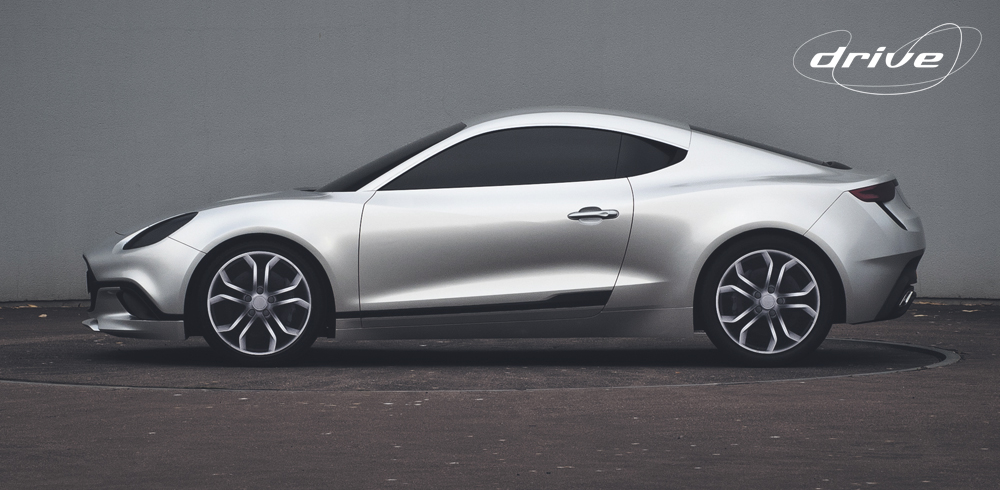
Caterham C120

So enough about our emotions….what of the car itself?
Biased I may be, but I believe there is no doubt that this is a great looking car, with fantastic proportions and pure surfacing.  So how is it a Caterham? What defines the character of a Caterham? At Drive we aren’t just a hired arm that draws cars, we extract and develop core brand DNA, establishing a clear aesthetic direction that our clients understand and can incorporate in their brand’s future.

Establishing this new brand aesthetic was no easy task. Caterham was clearly defined by the Seven, a car with a cult following and essentially unchanged from the original design. First of all the C120 was to be a completely new package, and one that a Caterham has never used before – a mid-mounted engine.  This already moved the vehicle far away from the instantly recognisable visual cues of a Caterham 7 (long bonnet, front engine), so we knew we would have to evoke that Caterham feeling in other ways.  We were also aware that the C120 was to be an everyday car, as well as a weekend toy, aimed at taking on the more premium market of Porsche, Audi and BMW.  With this in mind the language the car spoke was critical, this was to be the line in the sand for Caterham; a fresh modern interpretation of a historic brand.

The car is designed as a complete entity from front to back, a holistic approach.  Starting with the overall proportion, it is lithe, nimble and carries no excess weight whilst remaining visually planted in stance.  The front rakes back from the iconic Caterham nose to a short rear overhang.  The arch lines communicate some of the iconic Caterham 7 design gestures, the combination of the long diving front agile arch line and the rear pert, perfectly poised line evokes the similar feeling you get from looking at a 7.  It looks alive, on its toes and ready to be driven.

Caterham C120

The car also feels like a complete entity, it is not a case of projecting design features on the side rear and front which can often make cars look disjointed, features and graphics encompass the wheels, giving it visual strength and a sense of purity, a holistic approach.

Caterham C120

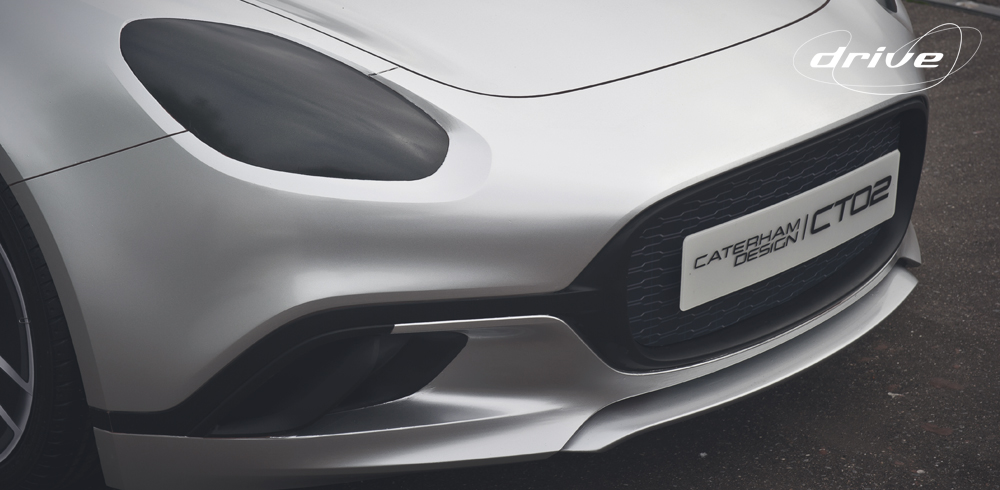
The front displays an approachable face, not too aggressive, but a well-balanced and open eyed character that evokes the same feelings you get from the 7. It’s serious enough not to be taken lightly.  Everything works together to deliver maximum performance whist interpreting the Caterham design philosophy for the 21st century.  Everything is there for a reason too, from the central grill, splitter and side intakes, designed for function hinting at influences from Caterham motorsport, such as their former Formula 1 division.

Caterham C120

Caterham C120

Following down the side of the car, the iconic side exhaust and graphics that you commonly see on most 7s is interpreted by a graphic that follows all the way from the central nose through to the side intakes and onto the body side. The surfaces and body side is all about losing as much visual weight as possible, with surfaces sculpted away whilst retaining a sense of beauty and tension.  Moving towards the rear the stance of the car is exaggerated to show the power moving through the rear axle, with large arch blisters further enhancing this visual width.

Caterham C120

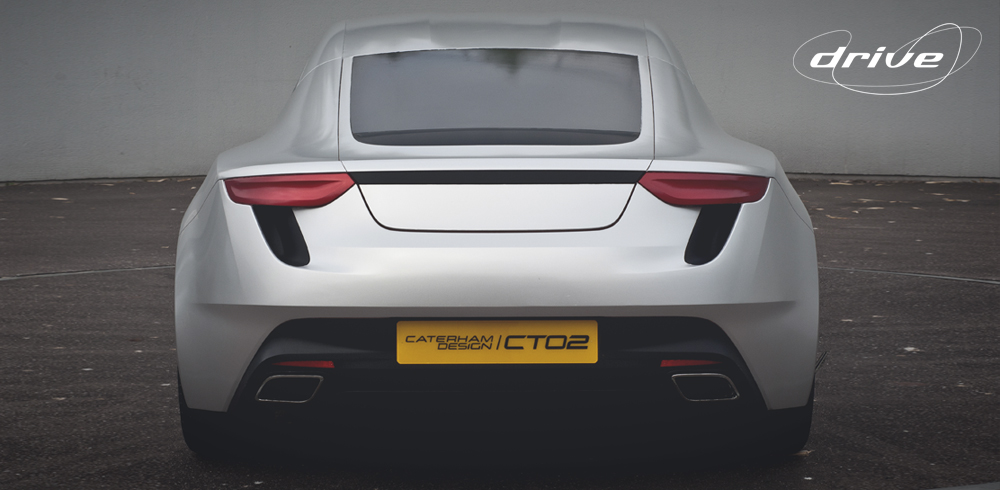
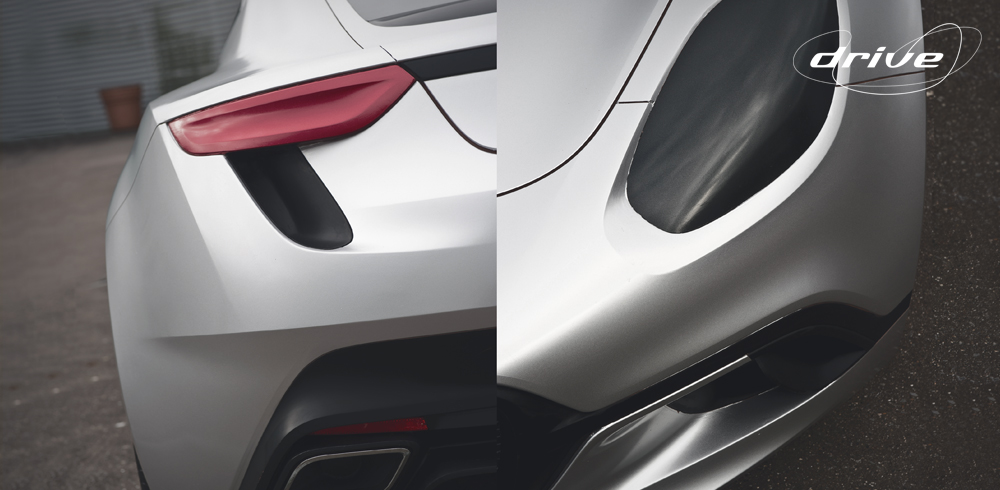
The rear completes the strength of the car, hinting at the DNA of the 7 in a very modern and crisp way.  Lamp positions are high as is the integrated spoiler, not only gain better performance but to give the car a sense of agility.  Simple, clean lines make up the rear to further emphasise as much visual width as possible.  Heat exits at the base of the rear screen and under the rear floating lamps, were all necessary to manage heat for the mid-engine package.  Moving lower down, the number plate is located within the diffuser trim allowing the upper surfaces to be as clean as possible and retain some of that Caterham 7 box like rear end feeling.

Caterham C120

Caterham C120

Working with the Alpine team was a pleasure, we had our moments of course, whilst fighting for certain design features and gestures that related to each of the cars providing much discussion and debate!   For a program that relied heavily upon financial necessities of sharing the complete running platform and common parts such as lamps, the result is two concepts that side by side have a totally different attitude, stance and feeling.   Quite an achievement.

Sadly what you are seeing here is only a point in time and is not the finished article, I can tell you… it only got better!  When you see those fantastic shots of the Alpine darting around the Alps or parked in the Italian sunshine at Villa d’Este in Lake Como….. imagine the Caterham C120 hammering through the roads of Norfolk or poised in the car park at the Linton Travel Tavern!

Caterham C120

Day dreaming – how it might have looked had it gone in to production.

I could probably carry on talking about this car, the design and just how special we feel it is, for an eternity.  It was a landmark project for Caterham, Drive and our team; something none of us will forget and I only wish you could see on the road.

#AlpineA110 #CaterhamC120

Images courtesy of Caterham Cars


Source link

Which electric cars have the most range?

0
Which electric cars have the most range?


  • For 2025, dozens of EV variants top 300 miles of range
  • The top dozen contains pickups, SUVs, crossovers, sedans, and a hatchback
  • Standouts like Lucid Air and Hyundai Ioniq 6 manage market-leading range without huge battery packs

Less than a decade ago, 300 miles seemed like the holy grail for EV driving range. Now, even as the overdue reality of plentiful charging infrastructure and speedy roadside charging begins to take shape, some new EVs promise 500 miles of range.

EVs got to 300 miles with the Tesla Model S in 2016. In the years since then there’s been no turning back—especially as fast-charging infrastructure has lagged, and adoption of EVs beyond California and the “smile” states has brought cold-weather range concerns

Now there’s a whole crop of EVs with U.S. EPA ratings topping 350 miles, including several that top 400 miles. In 2023, 270 miles was the median, and it may soon be 300 miles.

2024 Rivian R1T

2024 Rivian R1T

You may also notice that there’s no shortage of trucks on this list. The gigantic Cadillac Escalade IQ has arrived, and big-battery Max Pack versions of Rivian’s R1S and R1T electric trucks both top 400 miles. And more are on the way.  

Getting the top range on many of these vehicles comes at a steep price, too. GMC, for instance, makes the larger 205-kwh battery pack a $9,995 option on the Hummer EV 3X Pickup on top of its $106,945 base price. That results in “GM-estimated” EPA-cycle ratings of 381 miles, or 359 miles with the available Extreme Off-Road Package. Those are unofficial though as the huge battery pack throws the Hummer into the medium-duty truck weight category with commercial trucks. 

Not every EV offering well beyond 300 miles of range is expensive, and there are some noteworthy standouts. For instance, the 2025 Chevrolet Equinox EV is rated at 319 miles of range, and GM is now delivering examples that carry a $34,995 base price. 

2025 Chevrolet Equinox EV

2025 Chevrolet Equinox EV

We limited this list to vehicles that had official EPA range and efficiency ratings available at the EPA’s FuelEconomy.gov site as of March 27, 2025, making exceptions for vehicles that are currently being delivered—like the Tesla Model 3 Long Range RWD. 

Likewise, to avoid repetition, we’re only listing the top-range model of each nameplate. It should be noted, for instance, that the entire Lucid Air lineup lands above 350 miles. 

EV range: weight and cost matter

Many of these vehicles achieve their range with huge battery packs that store enough energy to power houses (or commercial buildings) for days, and in pragmatic terms their battery packs cost (and weigh) as much as gasoline compact cars. 

If you’re thinking lean and green, this should definitely spark new questions about whether we need so much battery capacity and range, when many EVs are second or third cars tasked with daily commuting.

The list shows minimum price (including destination and mandatory fees) for that amount of range, as well as the curb weight and battery pack size for context. Generally, heavier vehicles mean a larger pack and more energy used.
All that said, here’s our list of the top twelve 2025 EVs with the most range. 

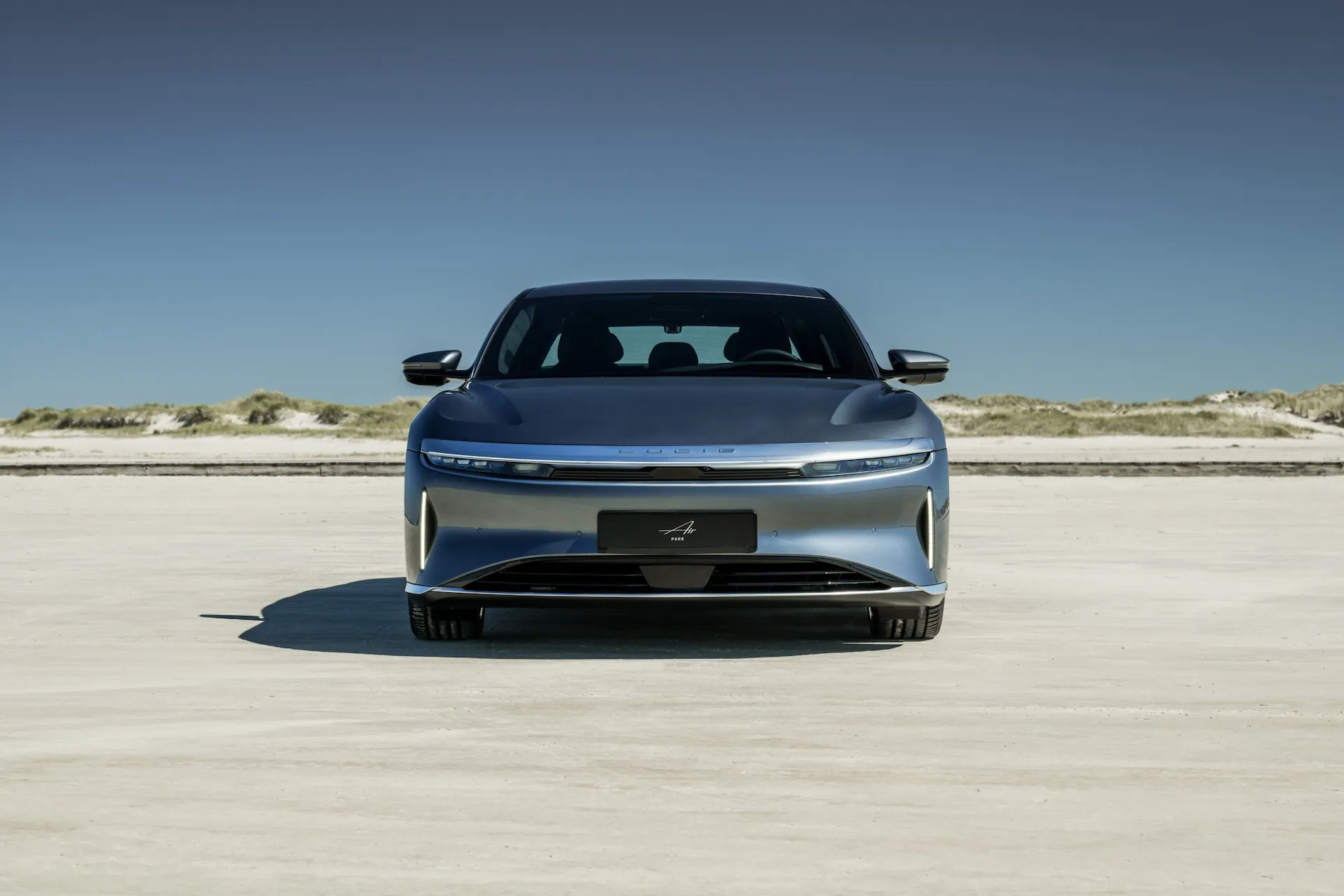
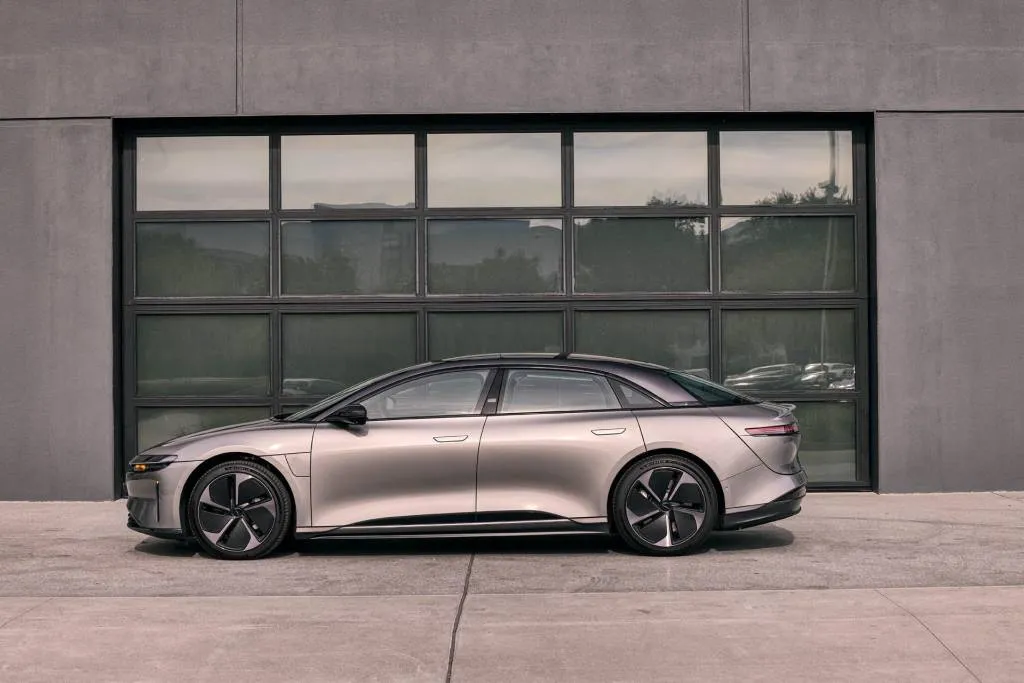
2024 Lucid Air

2024 Lucid Air

2025 Lucid Air Grand Touring

EPA range: 512 miles (19-inch wheels)
EPA combined efficiency: 3.8 mi/kwh
Curb weight: 5,204 pounds
Price: $112,400

2025 Chevrolet Silverado EV

2025 Chevrolet Silverado EV

2025 Chevrolet Silverado EV RST,
2025 GMC Sierra EV Max Range Denali

EPA range: 460 miles
EPA combined efficiency: N/A
Curb weight: 8,800 pounds (est.)
Price: $97,895 for EV RST, $97,990 for EV Denali

2025 Cadillac Escalade IQ test drive review

2025 Cadillac Escalade IQ test drive review

EPA range: 460 miles
EPA combined efficiency: N/A
Curb weight: 9,100 pounds (est.)
Price: $129,990

2025 Lucid Gravity Grand Touring

2025 Lucid Gravity Grand Touring

EPA range: 450 miles (20-inch wheels)
EPA combined efficiency: N/A
Curb weight: 5,919 pounds
Price: $96,625

2025 Rivian R1T

2025 Rivian R1T

EPA range: 420 miles (22-inch wheels)
EPA combined efficiency: 2.6 mi/kwh
Curb weight: 7,300 pounds (est.)
Price: $85,700

2025 Rivian R1S

2025 Rivian R1S

EPA range: 410 miles (22-inch wheels)
EPA combined efficiency: 2.5 mi/kwh
Curb weight: 7,200 pounds (est.)
Price: $91,700

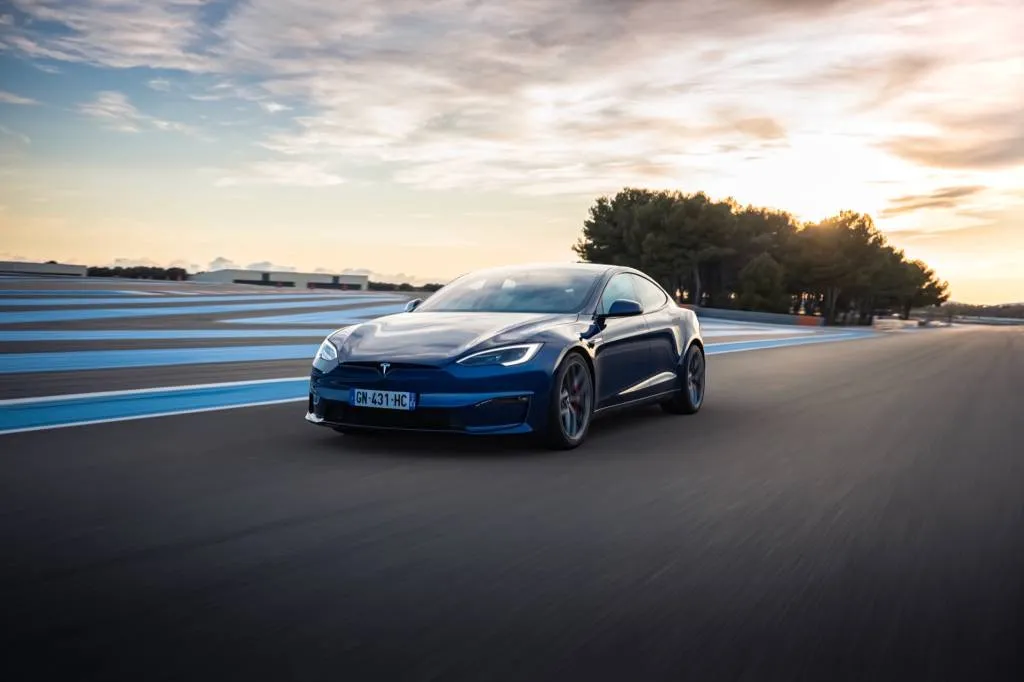
2024 Tesla Model S. - Courtesy of Tesla, Inc.

2024 Tesla Model S. – Courtesy of Tesla, Inc.

EPA range: 410 miles (19-inch wheels)
EPA combined efficiency: 3.6 mi/kwh
Curb weight: 4,560 pounds
Price: $81,630

2025 GMC Hummer EV

2025 GMC Hummer EV

EPA range: Est. 381 miles (22-inch wheels, $9,995 Extended Range Battery)
EPA combined efficiency: 1.6 mi/kwh
Curb weight: 9,000 pounds (est.)
Price: $116,940

2925 Mercedes-Benz EQS

2925 Mercedes-Benz EQS

EPA range: 371 miles (21-inch wheels)
EPA combined efficiency: 2.8 mi/kwh
Curb weight: 5,600 pounds (est.)
Price: $128,500

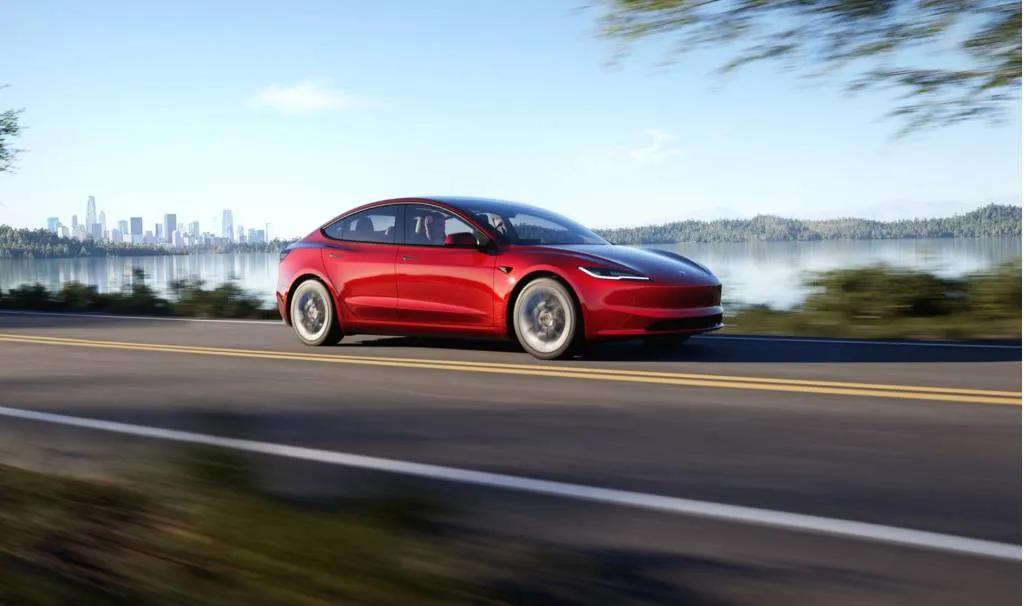
2024 Tesla Model 3

2024 Tesla Model 3

EPA range: 363 miles (18-inch wheels)
EPA combined efficiency: 4.1
Curb weight: 4,054 pounds
Price: $44,130

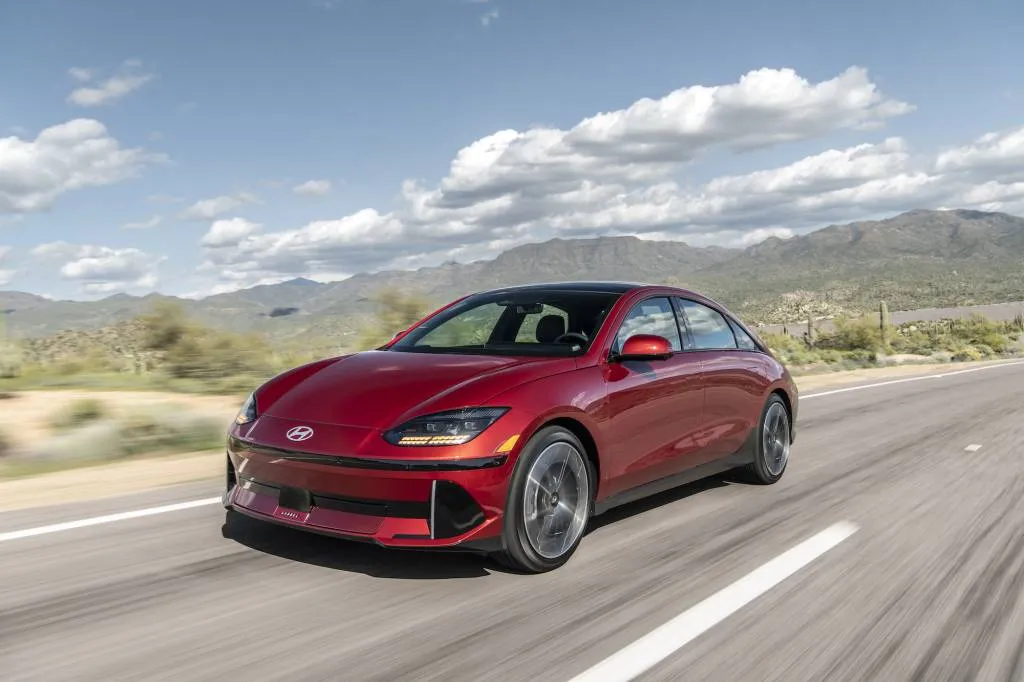
2025 Hyundai Ioniq 6

2025 Hyundai Ioniq 6

EPA range: 342 miles (18-inch wheels)
EPA combined efficiency: 3.9 mi/kwh
Curb weight: 4,376 pounds
Price: $43,850

2025 Polestar 3

2025 Polestar 3

EPA range: 350 miles (21-inch wheels)
EPA combined efficiency: 2.8 mi/kwh
Curb weight: 5,720 pounds
Price: $68,900


This piece originally ran Nov. 17, 2024, before full model year 2025 availability in some cases. It’s now been updated for that.


Source link

900hp G90 M5 Tuned by MANHART

0
900hp G90 M5 Tuned by MANHART


“Salud”


TXSTYLE's Avatar


Drives: M8 Gran Coupe Comp & X5M Comp

Join Date: May 2013

Location: The Burbs – N TX


900hp G90 M5 Tuned by MANHART


BIMMERPOST

BEASTLY!

Quote:


As expected, Manhart left the electric motor untouched. The added grunt comes from upgrading the twin-turbo 4.4-liter V8. In stock form, the “S68” produces 577 horsepower, supplemented by another 194 hp from the electric motor. Together, the seventh-generation M5 makes a mighty 717 hp. Not enough? Manhart will gladly raise the combined output to 897 hp.
Torque also climbs significantly, from the standard 1,000 Newton-meters (737 lb-ft) to a massive 1,200 Nm (885 lb-ft). Manhart doesn’t mention reinforcing the eight-speed automatic to cope with the added stress, suggesting the M Steptronic gearbox can handle the higher load.
The MH5 900E package extends beyond the reworked V8. Manhart gives the M5 a carbon-fiber body kit that makes the sports sedan even more imposing. Up front, it gains a spoiler lip and canards, while beefier side skirts, a new diffuser, and a trunk-lid spoiler add to the look. An extra roof-mounted spoiler completes the package.
The factory BMW alloys are also gone, swapped for Manhart’s 22-inch forged wheels wrapped in chunky 295/30 front and 315/30 rear tires. These can be paired with Manhart’s lowering springs for extra stance, or with a KW-developed coilover kit.
BMW M5 Tuned To 900 Horsepower Is A Family Supercar https://share.google/VfKUHfUrhJkNyoCIF


__________________

https://flic.kr/p/2qXdfdU


Last edited by TXSTYLE; 09-07-2025 at 03:43 PM..


Source link

Smart textiles may soon be able to control devices or monitor health

0
Smart textiles may soon be able to control devices or monitor health


Imagine adjusting the temperature of the air conditioning or skipping a song in your car, not by fiddling with a screen or voice command, but simply by swiping your hand across the fabric of your seatbelt.

It sounds futuristic, but this is the direction automotive design could be shifting towards — away from screens and buttons, and towards multi-touch textiles that sense your gestures and respond to them.


Read more:
Interior design of the future will seem like magic


I am an interaction design professor and director of a research lab that develops smart textile technology. These textiles can transform how people interact with everyday objects and materials, including car interiors, by embedding touch-sensing stitches directly onto fabric elements.

These fabric-based interfaces can sense gestures like swipes, taps and presses, offering a safer and more intuitive alternative to touchscreen systems.

Touch screens and textiles

Advances in technology have led to the proliferation of screens for control and feedback in cars. In luxury cars, these screens are progressively becoming more advanced. Elon Musk’s Tesla, for example, has famously moved most vehicle controls onto a central touchscreen.

the inside of a car showing the steering wheel and touch screen
The interior of a Tesla Model 3.
(Shutterstock)

While this makes for a sleek interior, it’s not necessarily safer or easier to use.

My colleagues and I conducted a user study that showed how interacting with touchscreens while driving can significantly increase distraction and lane deviations. You have to take your eyes off the road, locate the button (while the car is moving and vibrating) and confirm the change, diverting your attention from what really matters.

As a multidisciplinary team of researchers — from electrical engineering and computing to art and design — who study human-computer interaction, we explored 3D-embroidery technology and computational design of e-textile sensors.

Inspired by traditional crafts, smart materials can be used to incorporate interaction as part of the process itself. In this way, we are able to digitally design multi-touch embroidered sensors (stitched using conductive thread into automotive materials like leather) to support wireless gesture-based control.

Technologies like 3D printing and laser-cutting help manufacture and prototype new products. Similarly, we have developed new fabrication methods in smart textile design, from e-sewing and e-serging to WovenCircuits.

These novel techniques support the integration of electronic threads while machine sewing, serging and overlocking, or weaving with little to no need for post-fabrication assembly of sensors or other parts.

A video showing how the smart seatbelt works.

Touch control

Voice input is a popular method for controlling devices and machines, but in vehicles, it’s neither reliable nor safe. Voice recognition technology has come a long way, but is still considered by scholars as an “unfulfilled promise.” For voice input to perform well, the user needs to be a native English speaker, in quiet surroundings and have a clear voice.

While voice input may work well during the software development and testing of those systems, real-world scenarios are different. Think of a user with loud children in the back seat, people with different accents, or what happens when driving through a loud construction zone.

Rather than using voice, screens or other inputs, our lab researched whether a car’s interior could become the interface. We digitally embroidered e-textile sensors onto faux leather seat and steering wheel covers and seatbelt pads.

For proof-of-concept, we designed three prototypes that control media while driving, with touch-sensing stitches that could play or pause audio, skip to the next track and adjust the volume. Our design was wire-free, relying solely on conductive thread, connected via Bluetooth and fully customizable to any vehicle.

Future applications

Our research lab develops touch-responsive interactions with everyday objects as part of a larger push towards designing interactive interior spaces. This is also known as “interioraction” and near-future “decoraction”.

A video showing how digital weaving can help make smart home furniture like a rug that detects when people step on it or a seat cover that corrects posture.

From stained-glass animation that act as information displays to interactive garments that support people with physical disabilities, some of these designs go beyond aesthetics and functionality. They open up new ways to think about usability, accessibility, and the way we design future tech.

E-textiles have applications that range from delivering health care to transforming any kind of object into a smart one. Circuits can be sewn into pre-existing textiles or rugs can be woven to detect accidental falls and send signals. Seat covers can detect pressure to subtly correct posture.

In these ways, smart textile designers are making future technologies less intrusive and more accessible and fun to interact with.


Source link

ZENITH’s New Chronograph is Inspired by ’60s Mid-Century Interior Design

0
ZENITH’s New Chronograph is Inspired by ’60s Mid-Century Interior Design


(USM)
(USM)

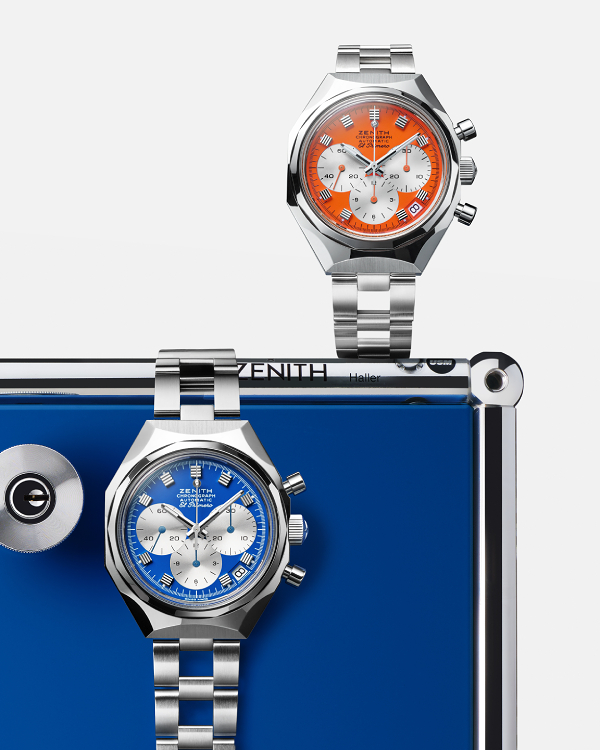
If you’ve never heard of USM Modular Furniture, here’s a quick crash course. Founded in 1885, the Swiss designer and manufacturer became a household name only in 1963, when it introduced the USM Haller System. Built on a steel ball-and-tube skeleton, the modular design allowed for infinite reconfigurations, with vibrant glass panels that captured the spirit of the ‘60s—think the explosion of colours in pop art and psychedelia.

Nearly 60 years later, Zenith has teamed up with USM to release a limited-edition watch inspired by the ‘60s. Its design philosophy was sparked by a single question: 

“What might these two icons of Swiss craftsmanship have created together back then?” 

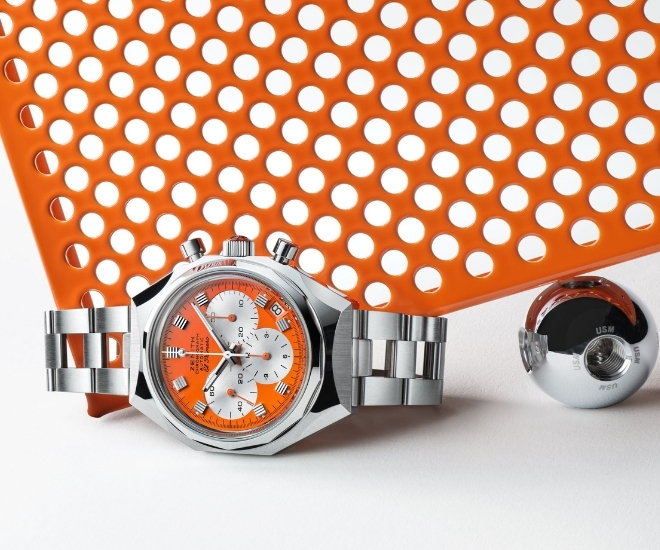
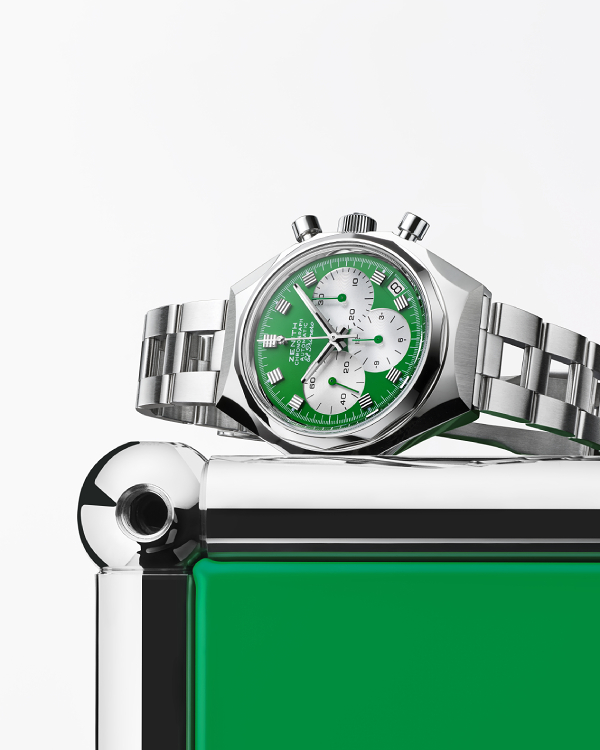
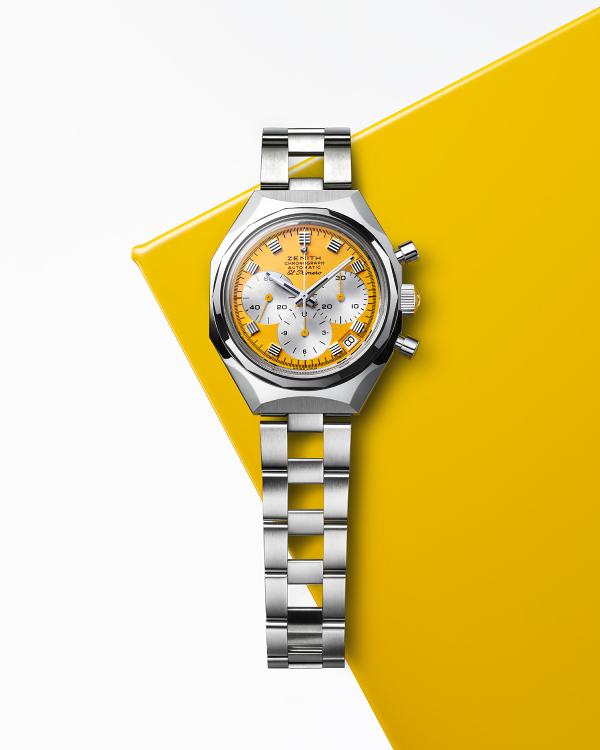
The answer is a vibrant, integrated sports bracelet watch that plays with geometry and angles.

Gentian Blue and Pure Orange (ZENITH)

The foundation is the skeleton of the 1969 Zenith DEFY, a fitting starting point for this creative fusion. Chrome-plated steel tubes and ball joints of the Haller System are mirrored through a compact 37.3 mm stainless steel case, while its octagonal form and fourteen-sided bezel scream classic ‘60s. Vintage pump-style chronograph pushers flank the right side of the case, reinforcing that rugged, asymmetrical silhouette that has endured across generations.

Green ZENITH
Green ZENITH

This interplay between contour and angular shapes is contrasted by square hour markers with horizontal grooves, lending the piece even greater architectural edge. But Zenith fans will know that these design elements aren’t novel.

Golden Yellow (ZENITH)

So What Is?

Where the new DEFY Chronograph USM separates itself is through its movement. This is the first time a chronograph has entered the fray of the original DEFY line. Three silver subdials finished with fine concentric circles overlap each other boldly. This not only adds textural depth within a vibrant, solid-filled dial, but doubles as a subtle nod to USM’s iconic handles. Now pay attention to the second hand, it’s also tipped with a miniature USM Haller ball joint.

(ZENITH)
(ZENITH)

Inside beats the automatic El Primero 400 calibre—a choice that feels poetic given its lineage traces back to the El Primero 3019 PHC of 1969, the world’s first automatic high-frequency chronograph. Running at a frequency of 5hz, the movement also allows a water resistance of 100m and 55 hours of power reserve.

The DEFY Chronograph USM will be available in four punchy dial colours: Gentian Blue, Golden Yellow, Green, and Pure Orange. Each is limited to just 60 pieces, making this collaboration as exclusive as it is vibrant.

This article was first seen on ESQUIRE SG.

For more on the latest in luxury watch reads, click here.


Source link

From the Front, Behind, or Alongside?

0
From the Front, Behind, or Alongside?


the BIR Management Committee under CIR Liway Chato

 
The UP
Alumni Association recently gave me a Distinguished Alumnus Award for “Leadership
in IT Development (Public and Private).”
 That has inspired me to write about governance and management. I have written about travel and leisure, retirement and renewal, and health and longevity.

Let me start to write about leadership in this new category. The three directional phrases represent differing leadership styles.
Leading from the front is directive, behind, delegative, and alongside,
participative. To illustrate each, I use examples from my stints in different
organizations.    

Leading
from the Front

Directive
leadership rests on a leader who provides clear directions, makes strong
decisions, and communicates openly. Think of a military commander, leading his
troops into battle. Not being clear may prove disastrous.

It may be less
obvious, but the same thing is true in startups like  Megalink, the consortium of banks that first enabled
members to share ATMs. AS GM, the Board gave me one goal: to launch ahead of
BancNet, a rival consortium.

Since there
were no such existing switches in the Philippines, I had to go to countries that
had already succeeded in doing so. Their examples gave me enough information to
lead from the front.

When we were
ready, I presented a risk analysis to the Board. The system was not perfect, but
no system ever does. I felt the risks were minimal and I included ways to
mitigate them. They agreed with me. We launched ahead of BancNet.

Later we
also became the largest consortium at 32 member banks.   

Leading
from Behind

Delegative
leadership requires that a leader empower people to take ownership and
responsibility for their work. He/she acts as a mentor, coach, or facilitator. 

This type of
leadership is best suited in industries that depend on its people’s talent,
creativity, and innovation. Organizations in advertising, design, or product
development are examples. 

I came
closest to using this style as MD in SAP Philippines when we were introducing
the end-to-end German ERP software in the country. The groundbreaking product
had successfully powered leading companies elsewhere in the world.

The
salespersons in the Sales Team have individual styles in covering territory and
convincing organizations within it to make his/her quota. I was ready to help
open doors, establish CEO-CEO relationships, and provide support and guidance
when they asked.

It was even
more so for the Technical Support Team. I did not come from the technical ranks,
but I assured them of the technical resources. I discovered they needed moral
support more, especially in managing conflicts with regional support teams.

Leading
Alongside the Team

This
participative leadership style emphasizes the team most. The leader works
closely with members and there is much collaboration, shared responsibility,
and consensus building.

Prime
examples are non-profit organizations that usually include many volunteers, educational
institutions that involve numerous constituents, or government agencies that handle
large numbers of people.

In BIR, the IT
group had a thousand people and worked with hundreds of consultants. When I
joined them, they had already organized into implementation teams.

I was not
brought in to stall their progress. I worked alongside the team leaders. I focused
on working with top management to inspire the huge organization to embrace the impending
major change. The system was successfully installed less than two years later.

The
Most Effective Style

In American culture,
organizations value individualism, efficiency, and results. As such, they may
lean towards the directive leadership style. In the Philippines, we emphasize collectivism,
group harmony, and relationship-building which may favor a participative style.

These are
generalizations, however. Individual organizations within both countries may
vary. In the end, the most effective leadership style is situational. It depends
on a particular team’s maturity and the nature of the work, not just organizational
culture.

In SAP, for
example, even if I practiced delegative leadership with the sales and technical
teams, I led from the front with the marketing team. After all, I was the chief
storyteller for a small company of less than 30.

As the chief
marketing officer, I handed down clear marketing goals. I also clearly stated the
messaging intended for each specific audience. The marketing team applied them to
the recommended, using appropriate media.

There is not
one style that bests the others. Different situations, teams, and organizations
may require all three styles. The most effective leaders must have all three at
their disposal. In other words, they must lead from all sides.


Source link

Rolls-Royce Arcadia Droptail – Car Body Design

0
Rolls-Royce Arcadia Droptail – Car Body Design


From the official Press Release:

This coachbuilt commission takes its name from the mythical realm of Arcadia, a place depicted in Ancient Greek mythology as ‘Heaven on Earth’ – a land renowned for its extraordinary natural beauty and perfect harmony.

Rolls-Royce Arcadia Droptail DesignRolls-Royce Arcadia Droptail – Car Body Design

Like the haven that inspires its name, Arcadia Droptail was envisioned by the client as a serene space characterised by reduction, material depth and tactility that would serve as a refuge from the complexities of their business life.

Rolls-Royce Arcadia Droptail DesignRolls-Royce Arcadia Droptail Design

In capturing the theme of tranquillity, Coachbuild designers embarked on an exploration of design, sculpture and architecture from the client’s favourite regions around the world. This included the precision and richness of modernist tropical sky gardens seen in Singapore, Indonesia and Vietnam as well as British ‘Biomimetic’ architecture, where organic forms and material honesty are celebrated.

Rolls-Royce Arcadia Droptail DesignRolls-Royce Arcadia Droptail Design

In addition to these references, the client was also inspired by the motor car itself and the purity of the Droptail design concept.

The commissioning client insisted that their Coachbuild motor car should be absolutely faithful to the earliest hand-drawn sketch they were first presented with in 2019.

Rolls-Royce Arcadia Droptail DesignRolls-Royce Arcadia Droptail Design

It was the profile of this  contemporary projection of the roadster body type that resonated so strongly with the commissioning client. They were particularly compelled by the motor car’s bold, low stance, ensconcing cabin design and dramatic body lines.

They also immediately recognised the nautical inspiration behind Droptail’s ‘sail cowls’: named after their resemblance to a yacht’s jib, these sharp, angular forms rise behind the doors and curve gently inwards, subtly directing the eye to the motor car’s occupants.

Exterior Design

In order to fulfil the client’s ambition to honour Droptail’s form, Rolls-Royce Coachbuild designers developed a calm, natural duotone colourway for the motor car’s coachwork.

Rolls-Royce Arcadia Droptail DesignRolls-Royce Arcadia Droptail Design

The client’s aspiration was to define a timeless white, appearing as a solid colour at first glance, but creating a level of intrigue upon further study under natural light. To achieve this, the main body colour is a solid white infused with aluminium and glass particles.

Rolls-Royce Arcadia Droptail DesignRolls-Royce Arcadia Droptail Design

This not only creates an effervescent shimmer when the light strikes the coachwork but, upon close inspection, creates the illusion of unending depth in the paint. Rolls-Royce specialists developed a more faceted, striking metallic using larger sizing of aluminium particles. The client was very particular and involved in their request for the Bespoke silver to contrast against the white, not only in colour, but also in terms of intensity.

In a key departure from the other three coachbuilt Droptails in this series, the carbon fibre used to construct the lower sections of Droptail is painted in the solid Bespoke silver colour rather than left fully or partially exposed, visually ‘lifting’ the motor car in profile to intensify its lithe, dynamic intent.

Rolls-Royce Arcadia Droptail Headlight and grilleRolls-Royce Arcadia Droptail Headlight and grille

In tribute to the brilliant mirror finish of brightwork on historical Rolls-Royces, which particularly fascinate the client, the exterior grille surround, ‘kinked’ vane pieces and 22-inch alloy wheels have been fully mirror-polished.

While Arcadia Droptail’s exterior palette is rich in subtle detail, its primary intention is to celebrate the form and proportions of the coachwork. The client was particularly compelled by Droptail’s clean, monolithic surfacing and bold use of negative sculpture – features that are amplified by the motor car’s muted paint colours, which reflect sunlight and cast dramatic shadows, highlighting Droptail’s many subtle design gestures.

Interior Design

As the exterior of Rolls-Royce Arcadia Droptail celebrates the motor car’s form, the interior is a deeply personal reflection of the client’s individual aesthetic, reflective of the style they have curated in their residences and business spaces around the world.

Rolls-Royce Arcadia Droptail Interior DesignRolls-Royce Arcadia Droptail Interior Design

Arcadia Droptail’s colour palette and material treatment was envisioned to be a truly personal statement and instantly recognisable as a personal signature of the commissioning client.

Rolls-Royce Arcadia Droptail Interior DesignRolls-Royce Arcadia Droptail Interior Design

Wood development was central to Arcadia Droptail’s interior and the client’s focus, whose very specific expectations concentrated on the texture, grain, colour and richness of the material itself. The client shared many examples of preferences and inspiration from architecture, residences and classic cars, to guide Rolls-Royce Coachbuild designers and material specialists.

Rolls-Royce Arcadia Droptail Interior Design Wood texturesRolls-Royce Arcadia Droptail Interior Design Wood textures

Santos Straight Grain was eventually selected as the most modern statement, based upon its rich texture and visual intrigue, which is derived from its unique, interlocking grain pattern.

Using this high-density hardwood on Droptail’s interior posed a significant challenge for the marque’s craftspeople. Santos Straight Grain has one of the finest grain types of all the wood species used within a Rolls-Royce – if not handled with the greatest care, it easily tears when machined and ‘checks’ (a crack that appears parallel to the grain) during the drying process. Despite the challenges of working with this delicate material, Santos Straight Grain is used throughout Droptail, including the aerodynamically functional rear deck section, where the grain of the open pore veneer is laid at a perfect 55° angle. To achieve a perfect composition over complex geometry, Rolls-Royce artisans used a total of 233 wood pieces throughout Arcadia Droptail, with 76 pieces applied to the rear deck alone.

Given that Arcadia Droptail will be used internationally, including some tropical climates, specific attention was paid to developing a protection system and testing process for the exterior wood surfaces. Coatings used on superyachts were initially considered but rejected given that they require regular servicing and re-application. Instead, a Bespoke lacquer was developed that requires just one application for the lifetime of the motor car.

Rolls-Royce Arcadia Droptail Interior Design Wood texturesRolls-Royce Arcadia Droptail Interior Design Wood textures

To validate this coating, Rolls-Royce specialists conceived a unique testing protocol wherein veneer pieces were subject to a punishing cycle inside a specialist machine simulating global weather extremes. This involved spraying sample wood pieces with water intermittently, between periods of leaving them to dry in darkness and exposing them to heat and bright light.

This was repeated for 1,000 hours on 18 different samples before the marque’s specialists were satisfied with the endurance of the pieces. In total, the wood pieces and protective coating required more than 8,000 hours of development.

White Leather

The leather interior is finished in two entirely Bespoke hues, named after the client and reserved exclusively for their use. The main leather colour is a Bespoke White hue, continuing the exterior paint theme, while the contrast leather is a Bespoke tan colour, developed to perfectly complement the selected wood.

Rolls-Royce Arcadia Droptail Interior DesignRolls-Royce Arcadia Droptail Interior Design

The interior also includes the exquisite shawl panel that unites all four Droptail motor cars and is the largest continuous wood section ever seen on a Rolls-Royce motor car. In Arcadia Droptail, it is made in the same Santos Straight Grain open pore veneer as the rear deck, book-matched at the same 55° angle, with individually shaped leave stripes running seamlessly into the door linings. CAD tools were used to map the placement of each wood piece, and although it appears to be constructed from just two mirrored sections of veneer, this panel alone is made up of 40 sections, each digitally mapped before being fixed to the motor car.

Applying wood to the complex curvatures of Droptail’s interior required Rolls-Royce engineers to develop an entirely new substructure for several components. The dramatic geometry of the dashboard, door linings and central cantilevered ‘plinth’ armrest had to be incredibly rigid to ensure the stability of the wood pieces once they were laid in place. Engineers called on carbon fibre layering techniques used in Formula 1 motor racing to develop an incredibly stiff base onto which the wood could be applied, ensuring that it remained secure regardless of the dynamic extremes the motor car experienced.

The bespoke timepiece

The Santos Straight Grain veneer fascia incorporates a clock conceived and developed by Rolls-Royce Coachbuild designers and craftspeople. This expression of haute horlogerie is the most complex Rolls-Royce clock face ever created: the assembly alone was a five-month process, which was preceded by more than two years of development.

Rolls-Royce Arcadia Droptail Interior Bespoke TimepieceRolls-Royce Arcadia Droptail Interior Bespoke Timepiece

The clock incorporates an exquisite geometric guilloché pattern in raw metal with 119 facets. This is a symbolic nod to the marque’s heritage; as the client first saw a preview of the motor car in late 2023 – the year when Rolls-Royce celebrated its 119-year anniversary. The specially designed clock face also includes partly polished, partly brushed hands and 12 ‘chaplets’ – or hour markers – each just 0.1mm thick. To ensure the readability of the timepiece, specialists gave each chaplet an infill bridge and painted them by hand using a camera capable of magnifying an image by up to 100x.

While many haute horlogerie methods were used to develop the timepiece, the testing and validation standards at Rolls-Royce are higher than those of the watch world. This required the marque’s specialists to draw on an expansive palette of materials. For example, instead of anodizing the timepiece’s minute marker, which is common practice in watch manufacturing, it is finished in a ceramic coating chosen because of its stability over time as well as its aesthetic merits. Small areas of the coating were laser-etched away to reveal the mirror finish of the aluminium material beneath it. Like every piece within the timepiece, including the Bespoke ‘double R’ monogram, they were individually machined from solid stainless-steel billet and polished by hand prior to assembly.

Themes from the clock are paired with the instrument dials, sharing materials, techniques and execution. They feature the same repeated guilloché pattern, as well as brushed and polished brightwork and frosted white inserts, recalling the colourway of the motor car.

Official Statements

“The Rolls-Royce Arcadia Droptail wonderfully demonstrates the true nature of a Coachbuild proposition in completely transforming the character of a motor car. Each Droptail commission reflects a deeply personal understanding and interpretation of a foundational design. With Arcadia Droptail we witness daring in minimalism and subtlety, informed by the lifestyle of an individual who has a unique appreciation for British luxury. In creating this historic motor car, we once again prove our peerless abilities in synthesising and executing Bespoke design at its highest level.”
Anders Warming, Design Director, Rolls-Royce Motor Cars

“The significance of Rolls-Royce Arcadia Droptail lies in its subtlety. It is a projection of an individual who values clarity and precision in all areas of their life – from their passion for fine cuisine, their highly curated personal and professional spaces and affinity with contemporary design. This motor car is one of the most faithful expressions of an individual’s personal style and sensibilities we have ever created within the Coachbuild department. In capturing their spirit, we reveal a unique appreciation for simplicity, serenity and beautifully restrained elegance – one that was a privilege for me to have been a part of.”
Alex Innes, Head of Coachbuild Design, Rolls-Royce Motor Cars

(Source: Rolls-Royce)


Source link

Lyft’s Robotaxi Era Has Finally Arrived

0
Lyft’s Robotaxi Era Has Finally Arrived


Lyft has always been the second-fiddle in the ride-hailing world. Its presence has always been shadowed by that of Uber—and that’s despite it technically being first to market in the 2000s under the Zimride branding. And as the old saying goes: if you’re not first, you’re last.

That’s why Lyft has decided to take a page out of Uber’s book. The ride-hailing app wants to secure its place in the future by launching its own autonomous robotaxi offering into the increasingly populated AV market. That’s been heating up for a while, but now autonomous test rides are coming to Atlanta.

Welcome back to Critical Materials, your daily roundup for all things electric and tech in the automotive space. Also on deck: China is cracking down on EV trolls and false advertising, and Tesla reveals how many owners are opting for Full Self-Driving. Let’s jump in.

30%: Lyft Readies Up In Robotaxi War


Lyft May Mobility

Photo by: Lyft

Autonomous ride-hailing isn’t new. Companies have been throwing money at the tech for years—some have proven to be fairly successful thus far, while others have thrown in the towel early on. Then there are the newcomers that seek to use variations of already-commercialized tech and a massive fleet of cars to collect training data to get ahead quickly.

Lyft just happens to be the latest company hopping onto the robotaxi train before its business model becomes trampled by robots on wheels. Its bid to take on the likes of Waymo (which has partnered with Uber in Austin, Texas), Tesla, Amazon’s Zoox and the like will soon dispatch a fleet of Lyft-branded Toyota Sienna hybrids to the streets of Atlanta to kick things off.

Lyft has been adjacent to the AV game for a while. It tried this before with Hyundai’s Motional venture and Ford-backed Argo AI; both of which didn’t exactly pan out. Its newest effort relies on a lesser-known company called May Mobility, which has an interesting take on how its vehicles make decisions on the road.

The company calls itself an Autonomy-as-a-Service (AaaS) platform, meaning that it enables other providers to launch AVs using the tech developed and maintained by May that can quickly integrate and scale based on a partner’s needs. May Mobility says that its “Multi-Policy Decision Making” rationale is what makes its software the ideal choice for an AV provider focused on safety at its core.

It justifies this by explaining the Minimum Risk Maneuver decision-making process that simulates multiple “what-if” scenarios—will that pedestrian cross the street? Will that car merge into my lane?


May Mobility decision-making process

Photo by: Lyft

It will then instruct the host vehicle to take the safest possible course of action based on the variables in the world around it and how it predicts how things could play out in the environment.

TechCrunch sheds a bit more light on the partnership:

Lyft’s deployment with May Mobility comes a month after the company announced a deal with China’s Baidu to launch robotaxis in Europe next year. Lyft CEO David Risher has also said the company would work with Mobileye to deploy Mobileye-powered vehicles on the Lyft app in Dallas “as soon as 2026,” with “thousands more AVs/other cities to follow.” 

Not all of Lyft’s AV partnerships have panned out. The company previously launched a robotaxi service—always with a human safety driver behind the wheel—in Las Vegas via a partnership with Motional. It had a similar agreement in Austin and Miami with Argo AI.

Interestingly, May Mobility is also one of Uber’s partners. The duo is set to launch robotaxis in Arlington, Texas later this year.

The bigger question is whether or not Lyft has the resources to compete with all of the other providers currently preparing for battle in what could shape up to be a crowded industry. Lyft has struggled with inconsistent profitability and operational challenges for its human drivers over the last few years. It’s not clear how long Lyft can afford to shred capital to fund its robotaxi experiment.

But on the flip side, if Lyft doesn’t get ahead of competitors doing the same thing, it could easily sink in the long run.

60%: China Takes Aim At False Advertising and Internet Trolls Causing EV ‘Chaos’ 


BYD Seal 6 DM-i Touring (2025) im Test

Photo by: BYD

On Wednesday, China drew an abundantly clear line in the digital sand that’s intended to squash automakers with deceptive marketing practices and internet trolls alike.

The country’s Ministry of Industry and Information Technology has begun a three-month “special rectification” crackdown that takes aim at automakers and online actors who are spreading false advertising, fabricated content, as well as the organization and manipulation of online content that misrepresents cars built by domestic brands. In short, they’ve had enough with the lies in an uber-competitive industry and are committed to taking action.

Here’s the scoop from Bloomberg:

Chinese regulators have launched a three-month campaign to crack down on advertising practices carried out by automakers and media companies that they describe as illegal and which may have contributed to “online chaos.”

The offenses include carmakers exaggerating the specifications and quality of their vehicles and batteries, according to a document released Sept. 10 by six agencies including the Ministry of Industry and Information Technology and the Cyberspace Affairs Commission.

Some media companies have also used reviews and model testing to blackmail manufacturers for favorable feedback, it said.

China’s EV industry is in a bit of a panic right now. Margins have been gutted and the numbers game that many brands have been accused of playing has finally reached critical mass. Regulators have watched this take place in real-time and realize that many of the tactics that brands have been relying on to advertise is now undermining both safety and quality.

MIIT and other agencies involved in the special crackdown will require brands (both automakers and online platforms) to “rectify irregularities” related to misleading information and advertising. This even includes media companies that stand accused of blackmailing manufacturers.

China hasn’t said what the punishment will be. But a statement from the China Advertising Association warned in a statement that the maximum penalty for the offenses is up to two years of imprisonment, plus fines. Yeesh.

90%: Tesla Says Half Of Model S and X Owners Are Buying FSD


Tesla Model S Model X Refresh Hero 2025

Photo by: Tesla

Tesla’s Full Self-Driving has long been the automaker’s crown jewel up-sell. An $8,000 software option that promises your car will one day be able to chauffeur you around (maybe). But how many people are actually paying for it?

That number has long been a big fat question mark. But in an interview with Jay Leno, Tesla’s VP of Vehicle Engineering, Lars Moravy, let an internal estimate of how many people are actually buying FSD into the open. It turns out that the automaker’s luxury segment is pulling a lot of weight with more than half of all buyers opting for FSD, according to Moravy.

“The take rate has gone up from single-digit percentages on all our cars. We’re in the teens,” said Moravy. “On [Model] S and X, it’s over 50% [to] 60%.”

Historically, Tesla has never really been open about its take-rate for FSD. One survey estimated the overall percentage of folks who purchased FSD after trialing it was around 2%. Musk said that the rate was actually “much higher,” but didn’t specify what that number actually is.

Over the last year, Tesla sold 69,830 units of the Model S, Model X, and Cybertruck. This means the estimated take-rate of FSD in Tesla’s luxury models would be somewhere in the neighborhood of 35,000 and 42,000 vehicles. Now, we know that Tesla’s entire fleet is “in the teens,” according to Moravy.

Tesla also sold 1,679,263 Model 3 and Model Y in the same time period. This would estimate that between 185,000 and 275,000 Model 3 and Y buyers either purchased or subscribed to FSD, or between 11% and 17%.

Let’s talk cash. If all of Tesla’s new buyers were subscribing to FSD, that’s anywhere between $21.8 million and $31.4 million in annual recurring revenue. More than likely, the majority of Model S and X buyers are working the cost of FSD into their vehicle purchase—hence the introduction of the new “Luxe Package,” which could account for as much as $336 million in additional one-time revenue for Model S and X buyers. Realistically, it was likely much lower than that since before the Luxe Package bundled FSD in as a mandatory add-on.

The problem for automakers is that vehicle autonomy is currently a cash-burn. General Motors knew this with Cruise, and Waymo has been sinking money into it for longer than most. But Tesla has been living on the promise of “eventually” for a while now, offering owners just a taste of partial autonomy to hold them off. It has also been able to fund its autonomy ventures by convincing customers to pay for an incomplete feature that, in some cases, is not expected to actually be fully autonomous using hardware currently installed in the vehicle.

It’s also only natural that Tesla’s lower-priced models have a lower adoption rate—when the software feature is nearly 20% of the vehicle’s cost, it might be hard to justify buying outright.

Tesla does still pitch FSD as the future for both driver safety and company profit. Elon Musk has long said that the real value of Tesla is in its ability to deliver on autonomy, but that vision has slipped down the road for nearly a decade. If Tesla can deliver on that promise, it can only hope that the take-rate will increase, too.

At the same time, hands-free driving systems are catching on quickly as a must-have feature. GM and Ford’s respective Super Cruise and BlueCruise are seeing higher and higher take rates, use during road trips and overall demand among consumers. If Tesla can’t stay competitive there, it doesn’t bode well for the autonomous future Elon Musk wants.  

100%: Are Robotaxis Headed For A Bubble?


Tesla Robotaxi service launches in San Francisco with safety drivers

Photo by: InsideEVs

AI-this, AI-that. It’s all we hear about lately. We’ve been warned that the AI bubble could burst at any time, but that hasn’t stopped companies from implementing it wherever the buzzword fits.

When it comes to driving, however, it’s not quite the same as throwing written slop at an email to your colleague. We have to remember that software is being used to control 4,000-pound cars that need to make safe decisions. That’s part of the reason why there’s just so much money being invested into the compute needed to train these models.

Lyft’s latest move shows that more and more companies are pivoting their business models to slot into the AV race as quickly as possible, which is great for MaaS providers like May Mobility, but could spell disaster for employees, shareholders and folks who rely on the company’s services if there’s ever a time when the company decides to pull the plug.

What do you think—are robotaxis at risk for the AI bubble? Let me know your thoughts in the comments.


Source link