Boondocking is a wonderful way to experience true off-the-grid living. However, it can come with challenges … and in the late-summer those challenges are amplified. But don’t be discouraged! Here’s what every RVer needs to plan for when boondocking in the late-summer months.
Boondocking rewards you with an extra level of freedom over full-hookup or resort RVing. Being able to go the extra few miles to get away and be with nature is truly special.
Along with this special feeling, however, comes special challenges. Boondockers are aware of these challenges and not only accept them but welcome them. Most experienced boondockers are well-prepared for the challenges and situations that can arise on a trip.
Having no services evokes the obvious need for water, power, and sanitary requirements. Even late-summer brings the added sun and heat we love so much. This heat adds some extra things to consider while boondocking.
Challenges of Late-Summer Boondocking
The obvious challenge is keeping cool. An RV sitting in the sun all day can become an oven. Staying cool can become an issue if not prepared for late-summer boondocking.
Water is another consideration. Both humans and pets will require extra water throughout the day. Additional showers may be necessary as well. Your water storage won’t last as long as during the cooler months. Once the water supply runs out the trip is over until you can find more fresh water.
That means that water storage will be increased—as will fuel storage. If you use a generator as many do for boondocking, the additional A/C run time can greatly increase your fuel usage.
Wildlife always has to be a consideration when camping and even more so if you are in remote areas. During late-summer everything is active, including some creepy crawlies and serpents that hide for the colder months.
What Every Camper Needs for Boondocking in the Late-Summer
Being prepared is always beneficial and when boondocking it is a necessity. What every camper needs to know is no matter how prepared you are things can still go wrong. Put yourself in the best position by thinking about these important factors.
It’s Going to Be Hot!
This is what summer is all about, sunny days and high temperatures. Late summer is no different. Most RVs are equipped with air conditioning systems, however, they require AC power to operate. This means they won’t run off of your battery power.
Thank you for subscribing to the RV LIFE newsletter, keep your eye on your inbox for updates.
Generators are commonplace for most boondockers and solve a lot of problems associated with being off-grid. Keep your generator serviced and running at its best to help prevent problems.
Running the A/C for extended periods and even through the night may be an unfortunate reality when boondocking in the late-summer. Always keep other boondockers in mind. Chances are they don’t want to hear your genset humming away at all hours. That means finding a location where the noise won’t affect other RVers’ experiences. That said, don’t underestimate the amount of fuel you will need to have on hand to keep your generator running.
If air conditioning isn’t an option or you don’t have a generator, you have to be smart about climate control. Leaving your rig parked in the direct sunlight is going to make for a sweaty night of tossing and turning.
Look for shade and be aware of the direction of the sun. If you can keep your RV cool during the hottest parts of the day it will be much more comfortable inside.
Water … More Water
Water can be the limiting factor to a boondocking trip. Late-summer temperatures require us to consume more water in order to stay hydrated. Pets are included in these calculations and when combined, this can mean many extra gallons of water.
Always overestimate water consumption. You won’t be sorry you did. Keep water stored in the shade and easily accessible. If you have pets, make sure they have a large bowl or gravity-fed water dish that stays cool in the shade as well.
Onboard freshwater supplies may not last as long as usual during late-summer boondocking. If you are outdoors and active, additional showers may be a nice option. Having full tanks and topping them off whenever possible—even if it’s just a few gallons—is something every camper needs to do.
Who Wants Hot Soup on an Even Hotter Day?
Along with your cold drinks, you are going to want easy-to-make refreshing meals. Lighting up the stove on a hot day is going to increase the temperature inside your RV. Sitting beside a fire cooking isn’t really refreshing either.
Pack foods that can be eaten cold or require little preparation. Lots of fruit to help hydrate and refresh in the late-summer is always nice.
Shade Can be Hard to Find
Most RVs have awnings, and during the summer and late-summer they are needed on a regular basis. If you don’t have one consider adding it to your RV. If you do have one make sure it’s in good condition and working properly.
Shade can be provided by tarps, blankets, vehicles, and lots of other stuff you will have with you. Being able to block direct sunlight, especially during peak hours, is going to be key to a comfortable summer day.
The Good Life
Boondocking might just be the ultimate getaway. Your RV has all the comforts of home, and you’re away from the hustle and bustle of RV parks and city life. The extra challenges are so worth it and if you prepare for your trip it’s pretty easy. Late-summer heat can be both a blessing and a curse, so be prepared if you’re going boondocking before fall arrives.
The event will offer a driving experience for owners of Ferrari’s first ever supercar in the stunning surroundings of the Italian Dolomites between October 1st and 5th 2024.
The Ferrari GTO event is the second edition of the Legacy Tour, following up on the F40-themed maiden outing in 2023.
The F40 Legacy Day event saw 39 teams exploring a route that wound its way from Forte dei Marmi through the Apuan Alps and Tuscan countryside to Maranello.
The Legacy Tour 2024, on the other hand, starts from Val Rendena and crews will have the Dolomites as their backdrop until the final day of driving when they arrive in Maranello.
The GTOs will be welcomed at the Prancing Horse headquarters where Ferrari Classiche’s experts and some members of the original GTO development team will reveal the car’s secrets.
The cars will then be displayed inside the factory before the GTO Legacy Tour 2024 officially concludes with a parade at the Fiorano Circuit.
GTO owners wishing to take part in the GTO Legacy Tour should contact their official Ferrari dealer by the end of April.
About the Ferrari GTO
The Ferrari GTO was unveiled at the Geneva International Motor Show in 1984. The power of its V8 turbo engine, its Pininfarina lines and advanced composite bodywork instantly won public acclaim.
The GTO was the first Ferrari to sport a longitudinally mounted V8 with twin turbos. The 2.8-litre capacity coupled with its eight cylinders earned it the unofficial 288 moniker, while its official name is a reference to the legendary 250 GTO of the early 1960s.
Initially, Ferrari aimed to build just the 200 examples required to be granted homologation for Group B racing. However, major changes subsequently made to the rules resulted in Ferrari pulling out of the championship.
The GTO, however, has gone down in history as Ferrari’s first ever supercar and has since been joined by the F40, the F50, the Enzo Ferrari and the LaFerrari. It also proved such a success that 272 were built before its production run ended.
Gladstone Ecofest, with the motto Repowering Gladstone, has a history of promoting environmental issues, but also difficulty attracting electric vehicles to the event. Locals seem reluctant to display their Teslas (yes, there are some in this huge coal export hub). The fact that the event is sponsored by major energy companies firmly committed to fossil fuels might be part of the problem. The Gladstone Library fully electric Kia Niro EV was a notable exception.
The Gladstone Library fully electric Kia Niro EV
So, when my friend Arthur Hunt suggested I attend, bring my Tess, and invite some friends, I thought, “What an adventure!” The reception, as I have mentioned previously, was fantastic! Organiser extraordinaire Anna Hitchcock, Coordinator, Gladstone Conservation Council, had warned us that we would be mobbed, and we were, even after I managed to up the number of cars attending from 2 to 7. Anna had to go back to the Council and ask for more space — a good problem to have.
We were mobbed by the curious.
She said that we would have to have deep technical knowledge to answer the questions of the “car nuts and revheads” of Gladstone, and that they “would be impressed by our cars.” Well, I thought, we have Sam and Rado with us, so that handles the technical stuff. We actually didn’t seem to attract the diehard, V8 car buffs, and we seemed be answering normal questions around range, charging time, and costs. She was right about this though: We’re a bit insulated from this change here in Central Queensland.
There ended up being 8 electric vehicles in our display — 4 Tesla Model 3s, 1 Tesla Model S, 2 Hyundai Kona EVs, and 1 BYD E6. Only one car was local. We ended up parked next to Sam Moran’s 2022 Tesla 3 Performance — a humbling experience for our Tess, who I now describe as an antique (2019 build SR +). My wife explains that our car came out on the first fleet. (That is, the first fleet of Tesla transporters to Australia in 2019).
Majella answering questions about Tess.
We encouraged open access to our car, and I don’t think there was a moment when there wasn’t someone sitting in the car. Parents found it difficult at times to remove their youngsters from the screen.
During the day, hundreds of people went through the display, including lots and lots of kids. The 12–25 year olds really knew their stuff and played with the screen like pros. They were really excited to see the car and to sit in it. And then there were those who were too scared to sit in it. Fart mode got a good workout.
Paul and his BYD E6.
I did my talk about the rapidity of the uptake of EVs globally. Ironically, I spoke after the Toyota talk on self-charging hybrids. I managed to catch up with the speaker later in the day and we had “the chat.” He clarified that Toyota’s hybrids self-charge when using regen braking. Good point. He also informed me that the Toyota BZ4 EV will be in Australia soon. Even better point. Bill Robertson Toyota is a major sponsor of Ecofest, and a supporter of green hydrogen, which they expect will have a major role in repowering Gladstone.
Company manager for noodoe Sam Moran (check out his interview here) made the observation: What was a little surprising was the lack of a DC fast charger in Gladstone, especially when considering the calibre of the energy companies with considerable presence locally — including Origin, Santos, and Shell.
Some DC fast EV charging stations in Gladstone would be a great initiative to encourage the uptake of EVs locally. Origin and Shell have been making some effort recently with their activity in the EV charging infrastructure space. If they can get their ducks in a row, hopefully by the next Gladstone Ecofest, we might see a new fast charger or two in town.
Gladstone is a port city undergoing change. The change is from exporting fossil fuels to exporting renewables. Fortescue Future Industries is setting up a massive green hydrogen export hub here to repower Gladstone. For this vibrant city, the future is bright, and green.
Do you have problems with the electronic system in your BMW? BMWs are considered some of the best cars in the market in terms of technology and performance, but like any car of this generation, they are controlled by electronics. If something is not working as expected, like your iDrive system is not responding as it should, the dashboard is blinking, or the battery dies, it can be inconvenient at best and affect your vehicle’s performance at worst. Here is a list of some of the most common problems in electronic systems of BMWs, and how you can deal with them.
Effective Solutions for BMW Electronic Problems
Solving Battery Drain and Charging Issues: A professional voltage test can reveal whether the battery needs to be replaced or not. BMW batteries have an average lifespan of four to six years. If your battery dies often, then your alternator should also be checked to see if it is charging the battery.
Fixing iDrive System Issues: Pressing the volume/power button for at least 30 seconds can help to reset the system and eliminate minor issues. It is also important to check for software updates and get them installed from a certified BMW service center, as this would also enhance the system’s performance. If the iDrive is still unresponsive or slow, the internal hard drive may need to be replaced.
Resetting Faulty Electronic Steering Lock: Switching off and turning on the battery can sometimes help to fix the faulty electronic steering lock. If the problem continues, a technician can check the steering column module and either update or fix it. Many BMW car owners have decided to install an ESL emulator to get rid of constant steering lock issues.
Addressing Dashboard Warning Lights: You should take your vehicle to a professional for a scan which will identify the exact issues that are causing the warning lights to remain on. If the problem is due to a bad sensor or loose connection, then fixing or replacing the problematic part should remove the warning. In some cases, a software reset is called for to clear up false alarms.
Fixing Parking Sensor and Backup Camera Problems: Sometimes minor detection problems can be solved by cleaning the sensors or the backup camera lens. If the issue continues, a mechanic should check whether the wiring of the sensor is damaged. BMW often rolls out updates for the software that makes parking assist systems more accurate and less prone to failure.
Transmission Control Module Glitches: If your BMW’s transmission shifts roughly, takes time to change gears, or goes into ‘limp mode,’ it may be due to the transmission control module. You can use a scanner to look for any error codes on the car. Sometimes minor problems with the TCM can be solved by a software update. If the module is defective, however, then it has to be repaired or replaced.
Fixing Failed Lights: Sometimes, the headlights or the tail lights may flicker or fail to turn on fully in BMWs. This is commonly attributed to bad wiring, faulty control modules, or bad LED components. The first step is to check the bulb connections since poor connections due to loose or corroded contacts can lead to flickering. If your BMW is equipped with adaptive headlights, then the problem might be in the control module, which may require reprogramming or replacement.
Visit Ultimate Bimmer Service for All Your Electronic Needs
At Ultimate Bimmer Service, we know how much of an inconvenience it is to have an issue with the electronics of your BMW. That is why our expert technicians ensure that they diagnose your car effectively, install the best software, and repair any electrical issues. If you have problems with the iDrive system in your BMW, or you are seeing dashboard warning lights that refuse to go off, we have the correct tools and know how to repair it. We are conveniently located in Carrollton, TX and offer our services to all BMW drivers in the region. If you are facing any electrical issues, do not wait for them to escalate further. Visit our workshop now and we shall get your BMW performing as it should.
* BMW X6M Car image credit goes to: Brandon Woyshnis.
Code P060C OBD II is a rare code that could jump-scare you as a car owner. Losing cognitive abilities on the road sure sounds scary to me. Code P060C indicates a major failure in your car’s intelligence system. Let’s look into the reasons and resolutions for this critical issue in onboard diagnostics.
What Does the P060C Code Mean?
P060C code means “Internal Control Module Main Processor Performance”; basically, the code indicates a damaged brain for your car. While turning on the ignition, several internal controllers conduct self-tests individually. Any error during these tests will be detected and stored by your car’s powertrain control module (PCM) as code P060C. The controller area network compares all individual signals from individual modules to ensure functionality before registering code P060C.
However, the malfunction indicator lamp (MIL) in your car turns on when the controller irregularities are detected multiple times. This critical damage to the PCM can reduce your car’s performance considerably and serve as an erroneous pointer for other malfunctions.
What Are the Common Symptoms of P060C?
As P060C is an issue that affects the internal processor, the symptoms can vary through a range of issues, such as:
Limp mode / Reduced power
Rough idle or stalling
Transmission problems
No start or intermittent starting
Poor fuel economy
Dashboard warning lights
All the symptoms mentioned above can be confusing and may lead to misinterpretation of other potential issues.
What Causes a P060C Code?
P060C code may point to various causes. The common causes for the issues may include any of the following four reasons:
Programming error or faulty controller
A malfunctioning power supply relay or controller fuse
Circuits or connectors in the CAN that are open or shorted
Not enough ground for the control module
How to Diagnose the P060C Code
Diagnosing a P060C code is tricky and requires an expert’s eye to pinpoint the issue. Since the error is an issue with the internal control module’s main processor performance, the brain of your car, multiple errors will be detected by an OBD scanner. This is due to the false DTCs from corrupt data. Also, misinterpretation of sensor inputs and failure to properly log or store trouble codes can give you a false alarm.
Therefore, while scanning for OBD II codes due to any of the symptoms mentioned in this article, readers are advised to follow the procedure mentioned below:
Check for ECM/PCM power supply codes first
Use proper diagnostic equipment (OBD scanner, DVOM, and vehicle manuals/diagrams)
Record freeze frame data (mandatory for *intermittent issues)
Clear codes and test drive
Intermittent code detection
Refer to Technical Service Bulletins (TSBs)
Check power supply fuses and relays
Inspect wiring and grounds
Inspect controllers for physical damage
Why is an accurate diagnosis for P060C important?
Since the issues arising due to the code P060C are similar to various other OBD II codes, a proper diagnosis is necessary. The ICM and PCM errors, such as:
Internal Control Module Memory Check Sum Error
Programming Error in PCM
Error in Internal Control Module Keep Alive Memory (KAM)
Internal Control Module RAM Error
Internal Control Module ROM Error
PCM Processor Fault
Control Module Performance
Internal Control Module Monitoring Processor Performance
Lost Communication with ECM/PCM
Lost Communication with the ABS Control Module
Karolina Grabowska/Pexels
How to Fix the P060C Code
Once the diagnostics are complete and the error is confirmed as P060C, it can be fixed according to the point and cause of the error. Repair or replace damaged wiring, fuses, or components that are shorted or interfering with the power supply. Check if the manufacturer has provided any updates or bug fixes. If any of this is available, choose the update. In other cases, try reprogramming the unit. If the above steps fail to fix the error, go for the replacement of the PCM.
Moreover, it is important to conduct multiple scans and test drives after fixing the problem. Such post-repair tests can ensure that the problem has been completely resolved.
In Conclusion
P060C is a major error in the internal control module’s main processor performance. Special care is needed for persistent issues, such as reduced power, transmission problems, etc. Since the P060C error in the main processor may lead to a rough idle or stalling of the vehicle, drivers/owners need to secure the car using roadside assistance services in the Way app instead of self-diagnosing on the road. Get a comprehensive examination at your trusted service center to diagnose the error for P060C and fix it.
The post P060C Code: Diagnosis and Fixes appeared first on Way Blog.
This year, a 1996 Ferrari F50 GT1 won the “Best of Show” award at The Quail. It is one of the rarest modern Ferraris that was built to race in the GT1 class. Rumour has it that someone offered $100 million for it!
The Ferrari F50 GT1 was intended to compete with the McLaren F1 GTR, but the project was cancelled. Initially, six cars were planned, but only three chassis were completed. This one here is chassis 001, which has been in the custody of the very first owner, Arthur Zafiropoulo. It is said that he swiftly turned down the offer.
The F50 GT1 is based on a carbon fibre monocoque chassis. It features carbon bodywork with a roof scoop, a large rear wing, a diffuser, a low front splitter and black Speedline wheels.
The 4.7-liter V12 engine was upgraded to produce 750 hp at 10,500 rpm and 380 lb-ft at 7,500 rpm. The engine is hooked up to a 6-speed sequential gearbox.
I’m going to attempt to pin down just five places that made me fall in love with camping in Colorado. This was a difficult task, and I’m probably going to spend the next few days kicking myself for not cheating and including a half dozen other campgrounds along with these.
Because, really, you can just head to the mountains here and find an amazing place to camp. When I’m driving to a hike, or for a weekend in the mountains, I constantly marvel at the good luck I have to live here.
When I camp, I look for a few things. I’m a sucker for a gorgeous location, which isn’t hard to find around here! I’m also a mom of four, so I look for family-friendly amenities, or nearby activities for people of all abilities from toddlers on up. We don’t mind roughing it, but I’m not generally a completely primitive camper (I like a bathroom!). I’ve done both tent camping and RV camping at different places around the state.
So here are five places to get you started on exploring Colorado. This is definitely not an exhaustive list, it’s just a jumping-off point. I also included some nearby campgrounds for each, to give you some choices and backups.
Also, it seems like more and more people are discovering the joy of camping in Colorado. If your campground of choice offers reservations, I’d grab them. You don’t want to wing it and show up to discover all the spots are full, although we do have dispersed camping in many areas as well.
YMCA of the Rockies, Snow Mountain Ranch
YMCA Snow Mountain Ranch helped me recapture the feel of being a kid at summer camp, but I got to experience it with my own kids! Snow Mountain Ranch is in Granby, Colorado, just to the west of Rocky Mountain National Park. In fact, you can drive to the park in about 20 minutes. The ranch is in a valley, with sweeping views of the Rockies in the distance. You might spot elk, deer, and even moose in the area. It’s what people who’ve never visited the state imagine when they picture Colorado.
Our family first discovered Granby and the surrounding area when we were looking for smaller, less expensive places to take our four kids skiing. The Granby Ranch ski resort has lift tickets that are much more affordable than fancier resorts like Breckenridge or Vail. Also, the resort is small enough that I felt comfortable sending my older kids off to ski without worrying about losing them in a crowd.
I’m also in love with the views, hiking, and activities around Granby in summer. But then in the fall, you get the striking bright yellow aspens and other foliage. I can’t pick a favorite season here (or anywhere in the mountains in Colorado, really!)
Snow Mountain Ranch is about a two-hour drive from the Denver area. The best route is to take I-70 West to Highway 40 West towards Winter Park. Follow 40 over Berthoud Pass, through Winter Park and Fraser, to the ranch, about 12 miles past Fraser. RVs are allowed on Berthoud Pass, but it’s a winding, steep road with lots of switchbacks. I’ve had to make several stops for carsick people on the drive! Take it slow, and check weather reports ahead of time during winter and spring to avoid snowstorms. There is an alternative route through Silverthorne, but it adds an extra hour to the drive.
Why I Love It
This is one of my favorite places to take my family. There’s so much to do on-site at the YMCA that you could spend your entire stay just on the grounds. But Granby is also close to Grand Lake with its boating and water activities. It’s also close to RMNP, and you could make this camp your home base to explore the park.
Why It Stands Out
The YMCA has camp activities, including archery, an aerial challenge course, arts & crafts, mini-golf, hiking, roller skating, horseback riding, and planned activities. In winter, you can go dogsledding and ice skating. You can make meals at your campsite, but there’s also a cafeteria and a restaurant with burgers and other grill items. This is also a great option for family reunions or larger groups.
Best Time to Go
Like I said, I love every season in the mountains! However, summer or early fall are the best times to go and enjoy all of the outdoor activities in the area. If you can go after Labor Day Weekend, you’ll miss a lot of the summer crowds since kids are back at school.
Camping Options
Snow Mountain Ranch has pet-friendly RV and tent campsites. Some sites have full hookups, while some have electric and water hookups. There are laundry facilities and showers available. Campsites can accommodate RVs or trailers up to 40 feet in length, and have a picnic table, a fire ring, and free WiFi.
Responsible Camping
Although this is a privately-owned, well-maintained campground, you should still leave no trace when you pack up at the end. Don’t forget to do one last sweep to clean up any pet waste or trash. Make sure to pack away any food after meals so you don’t attract wildlife.
Pro Tips
The waterfall hike is a fairly short hike with a good-sized waterfall at the end. I also enjoyed the arts and crafts because everyone could spend an afternoon creating, and they each had a unique souvenir at the end of our trip! Some activities, like crafts and horseback riding, have an extra fee on top of your campground fees, while others, like hiking, are free.
Runners Up
The campgrounds inside Rocky Mountain National Park have more basic amenities. Moraine Park Campground is the only one with electric hookups, and the rest of the campgrounds do not have any hookups. These are beautiful campgrounds that put you close to RMNP attractions, but they do fill up quickly.
If you can’t get a reservation inside the park, you can also look for campgrounds in Grand Lake to the west of the park, or Estes Park to the east.
Piñon Flats Campground, Great Sand Dunes National Park
This ranks as one of the top most-scenic campgrounds I’ve ever had the good luck to visit.
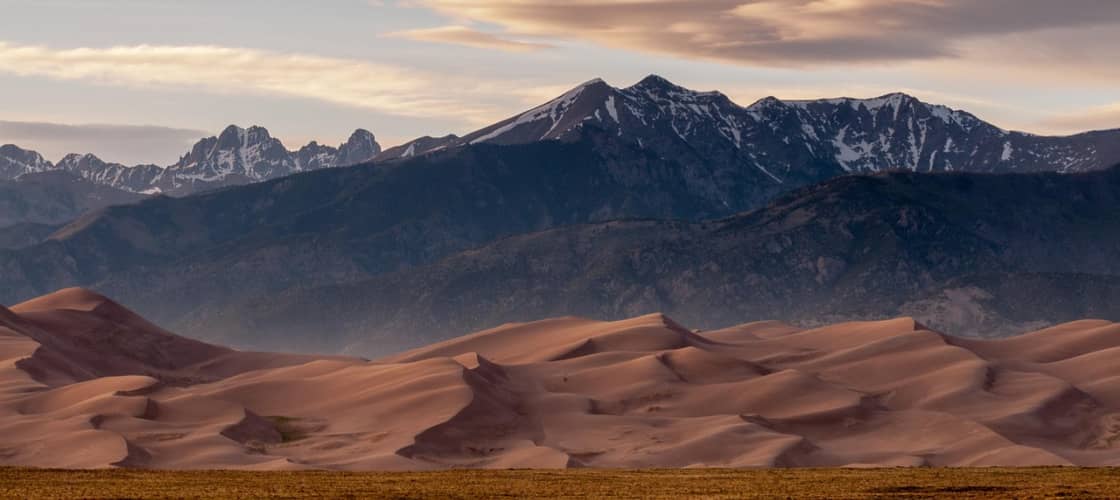
Piñon Flats is the only developed campground inside Great Sand Dunes National Park, and I still remember when we first pulled up to our campsite there. I didn’t realize until we arrived that you can see the dunes looming right in front of you from your site. They’re very close – in fact, you can walk over to the dunes pretty easily from the campground. The Rocky Mountains tower in the background behind the barren-looking sand dunes, which are the tallest dunes in North America.
Why I Love It
The landscape here is so unique, and this is a view of the Rockies that you won’t get anywhere else.
Why It Stands Out
Because these are sand dunes, they’re constantly moving and changing. There aren’t any marked hikes or trails – you can just start wandering. You can also go sand sledding or sandboarding down the dunes – there are several places nearby that rent sleds and boards. You can try your own sled or snowboard, but they don’t work as well as those made especially for sand.
In late May and early June, Medano Creek runs through the bottom of the dunes. Kids love splashing in the water and riding the surge waves that roll through pretty frequently. If you want to get to the dunes while the creek is flowing, be ready to remove your shoes and wade the creek, or wear water shoes like Tevas or Chacos. This unique beach area has even been named one of the best beaches in the U.S. by Travel & Leisure … not bad for a landlocked state like Colorado!
Best Time to Go
Late May and early June are the best times to visit and enjoy the creek as well as the dunes. You’ll also be there before the heat of summer. However, the tradeoff is that this is the busiest time at the park, and you may experience long lines and crowds. You’ll need to make campground reservations well in advance.
Late fall is also a good time to visit – you’ll find fewer crowds, but the creek will likely be dry.
Camping Options
Piñon Flats has tent and RV camping. There are no hookups, showers, or other amenities. Sites have a tent pad, a fire ring, and a picnic table. There are bathrooms available with flush toilets, and there is a dishwashing sink and potable water. There are outdoor rinse showers at the Dunes Parking Lot during the summer months.
Responsible Camping
As with any camping, be sure to deposit all your trash and leave your site clean before you leave. Also, be sure any campfires are completely extinguished before going to bed, or before leaving your campsite. There are bear boxes at each campsite, so be sure to pack up and store food or other smellables before going to bed or leaving your site.
Pro Tip
One of the strangest tips we got before going was to hike in socks…and it worked surprisingly well! The socks provide some protection for your feet – the dunes can get hot. But the sand doesn’t get in them in that annoying way it does when it fills up your shoes. Give it a try!
Also, get to the dunes as early as possible, especially in warmer months. We explored at about 8 am, and by the time we were headed back to our campsite for lunch, the sand was already heating up. Go early, and relax at your campsite, or head to the Visitor Center, or hike to Zapata Falls later in the day when it’s hotter.
Runners Up
If you can’t get a reservation inside the national park, Oasis Campground is right ouside the park. It has full hookups, showers, a playground, a restaurant, and sand sled and board rentals. You can also try campgrounds in Mosca and Alamosa.
Morefield Campground, Mesa Verde National Park
It’s true, I have another national park on this list. But Colorado’s national parks are incredibly unique and each is well worth a visit! The cliff dwellings at Mesa Verde National Park are startling the first time you see them – kivas and buildings with windows and entire communities that seem to spring out of the cliffs themselves.
Mesa Verde is about 30 miles from Durango and roughly a 7-1/2 hour drive from Denver, in southwestern Colorado. It’s part of the Colorado Plateau, and there are several overlooks where you can look across the valley to the La Plata Mountains. While the main focus of the park is the cliff dwellings, take some time to stop and look at these views!
Why I Love It
You’ll learn about the history and ingenuity of the Ancestral Pueblo people, and how they carved out a living in this part of Colorado. My kids found this park just as fascinating as the adults did, and getting up close to these dwellings made history and culture come alive for them.
Why It Stands Out
This UNESCO World Heritage site has more than 5,000 archeological sites, including 600 cliff dwellings, pit houses, kivas, and towers. You can see many of these sites from stops along a driving tour, so people with mobility issues can still see many of the structures without needing to hike.
Best Time to Go
Mid-fall, after Labor Day, is a great time to visit. Temperatures begin cooling down after the heat of summer, and crowds fall off as kids go back to school. And while kids from all over can appreciate this park, my Colorado kids got even more out of it after learning about the Ancestral Puebloan people in 4th grade when they studied the state’s history. If I could, I’d send every Colorado 4th grader here to bring their textbook alive.
Camping Options
You can camp in a tent or RV at Morefield Campground, which has electric hookups. There is a well-stocked camp store, a restaurant that serves pancake breakfasts, laundry, showers, and a gas station. There is also a kennel in the camp village – a great option if you want to do a lot of hiking or explore the dwellings, because pets aren’t allowed in most of those areas.
Responsible Camping
Be sure to leave a clean campsite behind you and that any campfires are fully out before you leave your site or go to bed. There are wild animals, including bears, in the region, so be sure to secure all food and other smelly items when you’re not at your campsite.
Pro Tip
Sign up for a tour to get an even closer look at the cliff dwellings and make the most of your visit. Tours are ranger-led, for a nominal fee. The Cliff Palace Tour is best for families – you’ll be climbing short ladders and walking uneven steps.
Runners-Up
If you can’t get a reservation inside the park, there are lots of campgrounds in Durango to check out. Actually, even if you do camp inside the park, set aside some time to explore this historic town!
Clear Creek RV Park, Golden
I’ll be honest – I haven’t personally camped at Clear Creek RV Park because it’s close to my home. But we’ve had guests visit us who stay here, and I’ve spent time in the park with them. It’s a great option because it offers year-round RV camping and seasonal tent camping. It’s a 20-minute drive from Denver, so this makes a good home base to explore the city and the Front Range. You’re also close to Red Rocks Park and Amphitheatre, and you can walk into Golden from the campground.
Why I Love It
This isn’t a secluded campground. You’re right on a popular walking path, next to Clear Creek. But if you want to be closer to urban adventures and Denver, this is your spot! In the summer, you can rent tubes a short walk away and hop into Clear Creek to cool off (this was a popular activity with my kids). During the holidays, the walking path and nearby Golden Welcome Center twinkle with lights. You’re also close to the Golden History Museum and to the shops and restaurants in downtown Golden. The Coors brewery is just a short drive away as well.
Why It Stands Out
This campground is next to a creek so you get a little taste of nature. But mostly, it’s close to Denver and about half an hour from Boulder. If you want to explore these Colorado cities, this is a strategic spot.
Best Time to Go
As with many Colorado destinations, early fall is a good time to visit! The heat begins to die down, and crowds head back to school. However, if you want to take advantage of tubing in the creek, summer is better.
Camping Options
There is tent camping here during the summer, and RV camping all year. The campground has full hookups, showers, and laundry and is close to a pool, playground, walking trails, and downtown Golden.
Responsible Camping
Because everyone is close together in this park, be ready to be a good neighbor! Observe quiet hours from 10 pm to 8 am each day, and be mindful of your pet (and their barking).
Pro Tip
The Colorado School of Mines has a free Museum of Earth Science with gem and mineral exhibits and. a scavenger hunt for kids. It’s a lesser-known museum that’s a fun, free place to explore for an hour or two.
Runners up
The Dakota Ridge RV Resort is another of our RVing guests’ favorite spots. It has full hookups, a pool, and a clubhouse with fitness equipment and a game library. The resort is available for camping year-round. Chatfield State Park is also a nice option that puts you a little closer to nature, but still just 20 minutes from Denver.
Turquoise Lake, Leadville
I love the town of Leadville! It’s a mountain town, but not a resort-style town like Vail or Breckenridge. You’ll still feel a lot of the town’s mining history when you walk the streets of downtown. It’s also close to Turquoise Lake, a beautiful mountain lake with fishing and boating (although I like to just sit in my beach chair and read there!). The view of the lake, with the soaring, snowy mountains beyond, is just perfect.
Turquoise Lake is about two hours from Denver. Take I-70 west and exit at Copper Mountain. Follow Highway 91 into Leadville, and then follow signs for Turquoise Lake Road (County Road 4).
Why I Love It
I love this area for the scenery, full stop. You can walk the Turquoise Lake Nature Trail, which is an easy, flat 1.2 miles to the lake and back. When you reach the lake, you can connect with the Turquoise Lake Trail, that goes 6.4 miles along the shore.
Why It Stands Out
Watch for wildflowers in summer, and changing leaves in fall. If you’re fishing, you’ll likely catch mackinaw or rainbow trout. Also, while you’re in the area, check out the Leadville National Fish Hatchery and the trails that begin there. Twin Lakes is also a fun stop, about half an hour away. You’ll find a small downtown with some shops, and more hiking and fishing at these lakes. The Interlaken Trail near Twin Lakes is one of our family favorites.
Best Time to Go
Because the lake is so high, early summer may still be cold and even snowy. July and August are perfect, and the elevation keeps the area from getting too hot. Early fall is also beautiful with striking fall foliage.
Camping Options
There is tent and RV camping available at developed campgrounds around the lake. There are several, similar campgrounds around Turquoise Lake, so nab any one of them that’s available! Start with Molly Brown, but if those are booked, you can click the other campgrounds on the map. These are primitive sites, with no hookups, vault toilets, a fire ring, and a picnic table. Dispersed camping is also allowed in the nearby Mount Massive Wilderness.
Responsible Camping
Make sure to leave no trace when you pack up camp. Pick up trash and any pet waste, and make sure your campfire is completely extinguished. There are wild animals in the area, so be sure to keep food and other smellable items like sunscreen and lotion secured.
Pro Tip
Because this is a nice getaway from the Denver area, weekends tend to be busier than weekdays. For fewer crowds, camp during the week or after Labor Day when school is in session. There are also several popular events during the summer, including the Leadville 100 and Leadville Boom Days. If you’re not planning to attend those events, pick a different time to visit to avoid the crowds from these popular days.
It was really hard to narrow my favorite camping spots down to just five! In my opinion, you can go just about anywhere in the Rocky Mountains in Colorado and find camping among some of the most amazing scenery in the world. Just be sure to help us keep it amazing – pick up after yourself, be aware of any fire restrictions, and make absolutely sure any fires are completely out before leaving. I stick my hand into the ashes – if it’s too hot to do that, my fire’s not all the way out! We’ve had some devastating fires in this state, so being careful of that is really important.
Fortunately, Colorado is a place that practically begs you to get outside and do stuff! Whether you’re heading to the mountains to hike, raft, fish, or try another outdoor activity or whether you’re headed to Denver or Boulder for fun, you’ll find a campground and an RVshare vehicle that’s suitable for you!
If you need help planning your road trip, check out our resources for planning the perfect road trip!
A high-performance supercar that redefines the boundaries of speed and power. Performance: • Top Speed 351 Km/H (218 Mph) • Acceleration 0-100 Km/H (0-62 Mph) in just 2.9 Seconds. • Acceleration 0-200 Km/H (0-124 Mph) in just 8.8 Seconds. • Braking 100-0 Km/H (62-0 Mph) 31 M This supercar is a symphony of precision engineering and unbridled power, designed to deliver an unparalleled driving experience. With its lightning-fast acceleration and incredible top-end speed, the Titanium will have you carving through corners and leaving the competition in the dust. Prepare to redefine the limits of what’s possible on the open road. The ZEV Titanium is the ultimate supercar for the true driving enthusiast. If you live for the thrill of the chase and demand the very best, this supercar will transform your daily commute into an adrenaline-fueled joyride. Get ready to experience the pure exhilaration of uncompromising performance.
Rwanda will be the first African country to have a local automotive company that will produce a supercar entirely made of Titanium and Carbon Fiber, thanks to the collaboration with the renowned Icona Design Group, the Italy-based design studio.
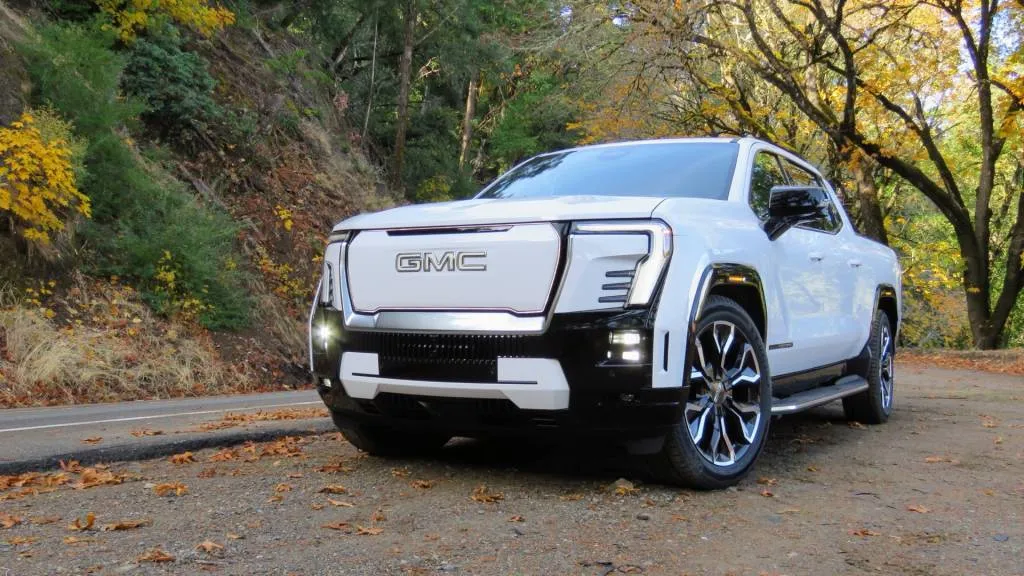
Sierra EV Denali stands out with a GM-estimated 460 miles
Midgate setup allows flexibility for items nearing 11-feet long
Versatility from air suspension, rear-wheel steering, Super Cruise
“I’ve been on that route, and it’s not one for a full-size pickup—let alone one weighing nearly 9,000 pounds.”
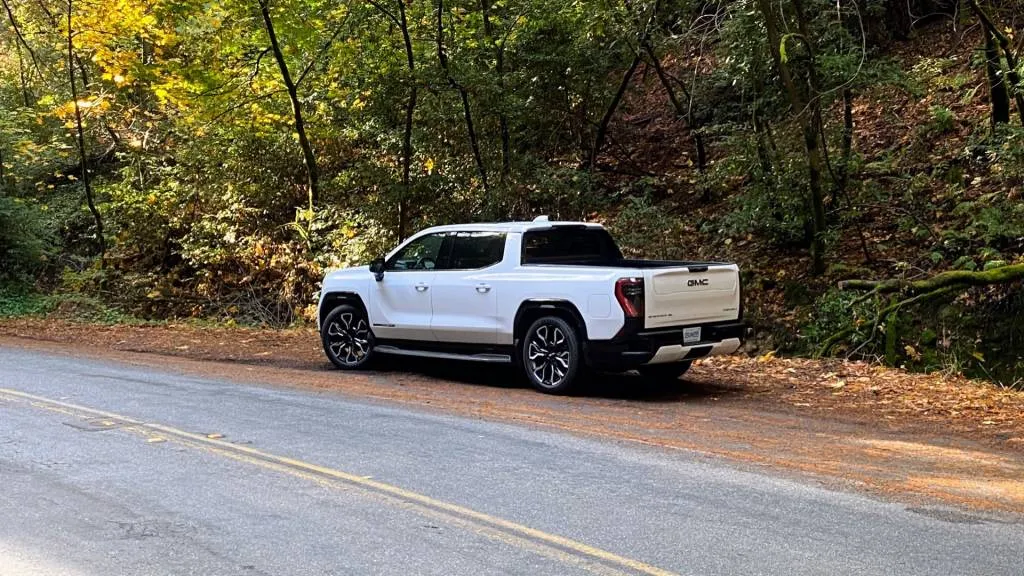
That was what I noted, partly in disbelief, to my co-driver as we were shown into a 2025 GMC Sierra EV and sent off to wind up through narrow Bay Area Redwood highways and stretches of Skyline Boulevard.
Memory served well about the roads; the route included some undulating ribbons of asphalt on ridges that I’d enjoyed thoroughly in a little Volkswagen GTI years earlier. But I completely underestimated the Sierra EV.
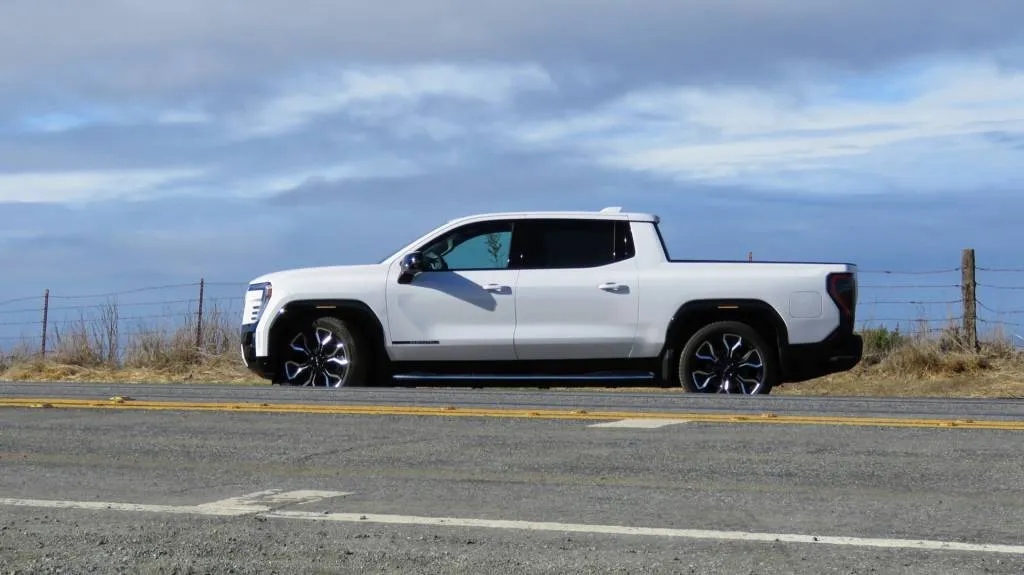
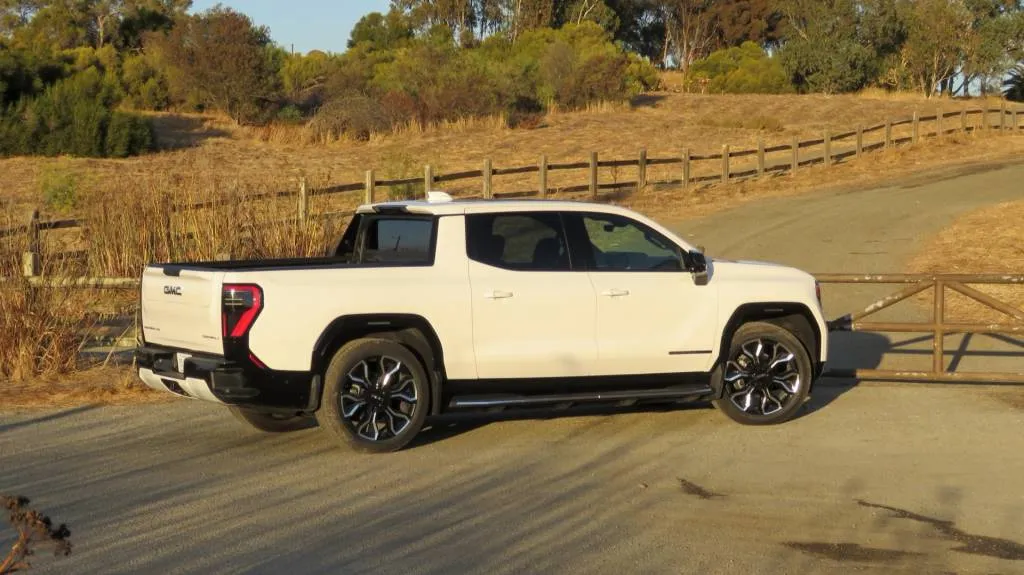
At about 233 inches long and 84 inches wide not counting mirrors, the big electric truck wasn’t so nerve-wracking for tackling narrow lanes. I could place it with precision, thanks to rear-wheel steering that pivots the rear wheels at a small angle opposite the fronts in low-speed hairpins. Instant torque delivery from the Sierra EV’s dual-motor system meant we didn’t lose momentum up the hills, while the air suspension kept us feeling even-keeled. Strong regenerative braking (Normal and High) kept our speed right as it should be on the steep downhill grades.
2025 GMC Sierra EV Denali
I went into the day knowing well this truck’s lofty range claim of 460 miles and how quickly it accelerates—and I didn’t need further proof that it can blast quietly to 60 mph in 4.5 seconds (or better, it seems). But GMC nudged us along the kind of route I never would have chosen, including plenty of those curves, some towing, some in-the-dirt play with the rear-wheel steering demonstrating the astonishing maneuverability and camera views, and an exercise with CrabWalk mode, which points the rear wheels in the same direction as the fronts. And it turned us loose with the challenge of fitting a whole lot of outdoor-fun gear into the Sierra EV in a hurry.
By the end of the day, I felt schooled. GMC hasn’t made a quirky design statement (that’s the Cybertruck), aimed for the outdoor lifestyle crowd (that’s the R1T), or simply made an electric version of its top-selling truck (that’s the F-150 Lightning).
The GMC Sierra EV sits next to the GMC Hummer EV in the GMC lineup, and the brand essentially separates the two by saying that if the Hummer EV pickup is the “it” truck, the Sierra EV is the “do it” truck. As a product, it’s a more impressive accomplishment for the market, and if you’re looking for the most cargo versatility for large items, and the most range for towing, hauling, and doing trucky things, this is it.
2025 GMC Sierra EV Denali
2025 GMC Sierra EV Denali
2025 GMC Sierra EV Denali
2025 GMC Sierra EV: Big range for a “do it” truck
The 2025 GMC Sierra EV has some of the market’s highest range ratings, not because it’s a standout for efficiency but because it goes big on its battery packs. Both battery packs are dual-layer, with the capability to stitch the two layers together in series to allow 800-volt DC fast-charging. The Max Range’s 205 kwh, it achieves range ratings of 460 miles, and the Extended Range’s 170 kwh affords 390 miles. The Max Range number is “GM-estimated,” because that super-sized pack throws the Sierra EV into a medium-weight category that doesn’t apply to EPA ratings.
Over nearly 90 miles of widely varied street and highway driving, we saw 1.9 miles per kwh according to the Sierra EV’s trip computer—suggesting we might still see 390 miles of range or more in this type of driving.
The huge battery opens up possibilities. The Sierra EV can tow up to 10,500 pounds with the Extended Range pack or 10,000 pounds with the Max Range pack, and while it might halve the range, that’s not so much of an issue here.
2025 GMC Sierra EV Denali
2024 GMC Sierra EV Denali Edition 1
2024 GMC Sierra EV Denali Edition 1
Sierra EV can tow comfortably, find space for gear
In a short loop with a 5,500-pound trailer, the Sierra EV seemed mostly unfazed by the load, still capable of accelerating quicker than a fully loaded minivan. On a loop with two full-acceleration taps, it averaged just 1.0 miles per kwh, according to the trip computer—still indicating that 200 miles of range is possible with a horse trailer or large boat.
Max Range versions like the one I drove deliver up to 760 hp and 785 lb-ft of torque, via two permanent magnet motors that are designed and built by GM. Extended Range versions have essentially the same hardware, other than the battery pack, but make 645 hp and 785 lb-ft.
2025 GMC Sierra EV Denali
Those power numbers, and the 4.5-second acceleration time for the Max version, are only delivered when in Max Power mode. The Sierra EV also has Normal-Tour, Off-Road, Tow-Haul, and a customized mode. GM would not say what peak power is in any of those other modes.
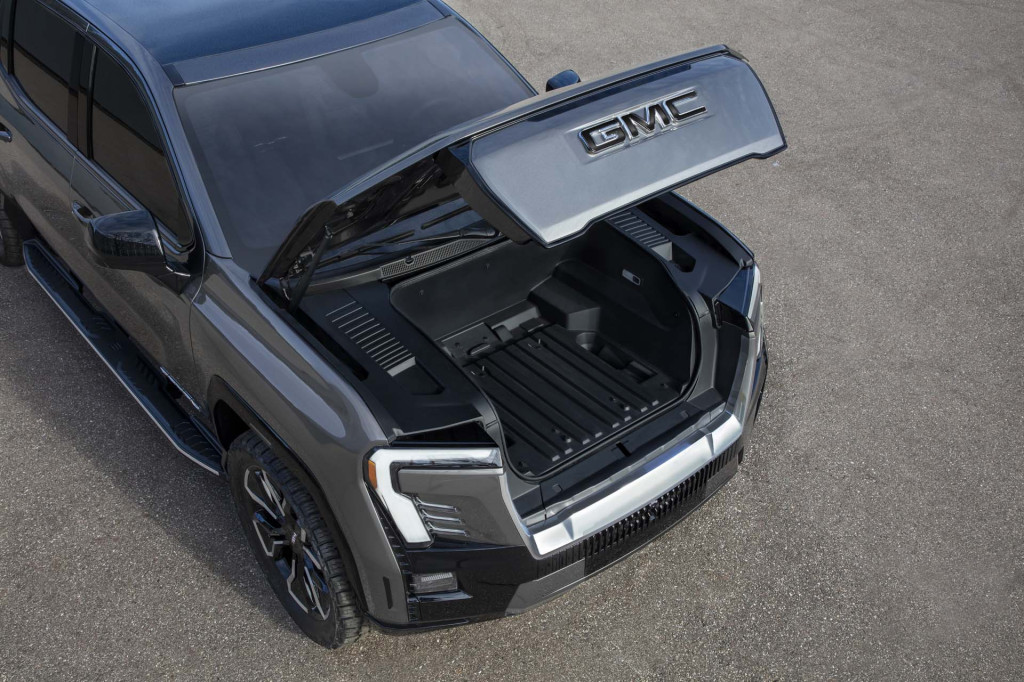
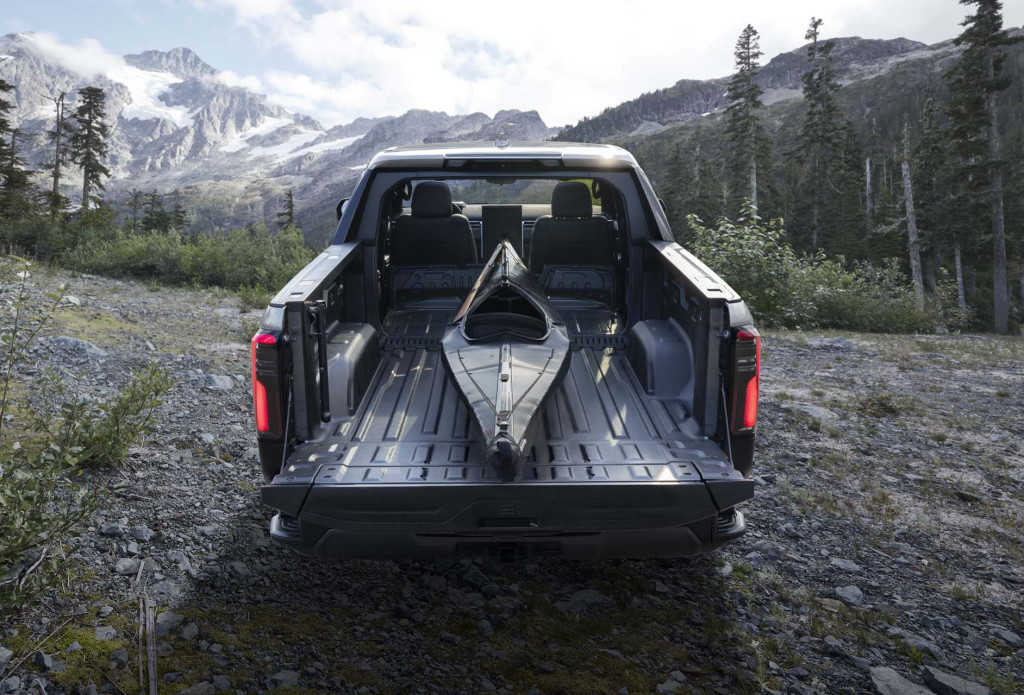
The Sierra EV has an 11.0-cubic-foot frunk—called the eTrunk here, with a cupholder, a drain, weatherproofing, and more. But the surprise cargo-versatility star here is the Midgate. In just a few minutes you can convert the backseat area into an expansion of the cargo bed—creating a 9-foot-1-long space with the tailgate locked, or a 10-foot-10 space with the tailgate down and the flip-down tailgate load step used to backstop long items—like a kayak.
Engineers emphasized that the Midgate isn’t meant as a solution to only use once in a while, rather something you might use daily. While it’s not weatherproof, of course, it’s a great solution for bringing gear a few miles to a launch point—without having to get specialized carriers—and you can leave one of the backseat positions in place while using it.
2025 GMC Sierra EV Denali
2025 GMC Sierra EV Denali
2025 GMC Sierra EV Denali
Sierra EV Denali is expensive, but very well equipped
The GMC Sierra is very closely related to the Chevrolet Silverado EV RST, but there are some key differences in how it fits into the EV market and the truck market. In 2024, the Sierra EV was only offered in its top Denali trim, with what’s essentially “the works”—the biggest battery pack, the air suspension, rear-wheel steering, and a feature set that’s one of the most luxury-focused among full-size pickups.
For 2025, there have been only some slight price changes, the addition of the Extended Range version, and 20 miles more for the Max Range version due to some efficiency improvements to the motor units themselves. My day was spent with the top Sierra EV Denali version, in Max Range form, costing at least $100,495—including the $2,095 destination fee but not any additional accessories for towing and storage.
The Sierra EV Denali includes the air suspension, rear-wheel steering, a panoramic sunroof, heated-and-cooled front seats, leather upholstery, a heated steering wheel, heated outboard seats, a head-up display, wi-fi hotspot compatibility, and seven-speaker Bose audio. There’s also wireless charging cleverly integrated into a sliding center console tray, plus plenty of USB-C ports and a 120-volt AC cabin outlets. In addition there’s the 7.2-kw AC Offboarding Power station that might eliminate the need to take that small generator out to the campsite or job site.
I didn’t get the chance to charge the Sierra EV as part of this brief test drive. Peak fast-charging rates are listed as 350 kw for the Max Range pack and 300 kw for the Extended Range pack. GM says that on a 350-kw CCS connector it will recover up to 100 miles of range in just 10 minutes, and it’s said before that either of these packs will get from 10-80% in about 40 minutes. GMC integrates a battery preconditioning feature to help achieve peak rates; it works with the native navigation trip planner or via the press of a virtual button.
2025 GMC Sierra EV with GM Energy suite
Ready for backing up the home, not Apple CarPlay
In the give-and-take of EV living, the Sierra EV also includes the capability to output 10.2 kw AC, potentially eliminating the need to tote around a generator. And starting with the $1,699 PowerShift charger, owners can outfit their home with GM energy components that could use the Sierra EV to help backup the home—including PowerBank home energy storage.
While the GMC Sierra EV Denali shares much with the Chevrolet Silverado EV, one of the most pronounced cabin differences is that the Sierra EV gets a 16.8-inch portrait-oriented system instead of the Chevy’s landscape orientation. Just like in the Silverado EV and other new GM EVs, it’s made with Google built-in, including the capability to run Google-ecosystem apps—but there’s no Apple CarPlay or Android Auto compatibility or integration.
2025 GMC Sierra EV Denali
GM’s Super Cruise is also included (for three years) in the Sierra EV, allowing hands-off driving plus semi-automated lane changes on more than 750,000 miles of mapped roads and highways—with maintained driver attention. Super Cruise also now works when towing. With the 5,500-pound load, I engaged the feature briefly and found steady lane positioning and solid speed control using the regenerative braking. But it’s still not a perfect system or one to rely on all the time; when I attempted to use the system to cruise on US-101 around Palo Alto, it kept disabling itself as it couldn’t see the faint-and-inconsistent lane markings that we had no issue seeing.
GMC has managed to accommodate tall people so well in front and in back, allowing plenty of headroom and a great view outward. Seats are plush yet supportive front and rear.
The cabin is super-quiet, aided by three things: an active-noise cancellation function for the Bose audio system, additional noise padding underneath compared to GMC’s other models, and acoustic side glass. It adds up to the ambience of a luxury vehicle.
That ambience holds in this Denali version, with fine stitching details in the front perforated seats, patterned speaker grilles, laser-cut wood trim, and a tight fit and finish throughout. We’ll see if these standards hold for the less-expensive versions to come.
2025 GMC Sierra EV Denali
More GMC electric trucks on the way—but when?
GMC has said that more affordable Sierra EV AT4 and Elevation models are due in 2025, although it hasn’t confirmed whether that will be for the 2025 or 2026 model year. GM also hasn’t given an update on when it plans to ramp up production of these trucks at its Lake Orion, Michigan, plant where it ceased building the Bolt EV nearly a year ago. Until then, output will be limited.
But it’s easy, also, to envision an even more kitted-out version of the Sierra EV with magnetic ride—to quell the hold-on-tight, amusement-park-ride feeling you get in the Sierra EV when accelerating rapidly on imperfect pavement. Perhaps those are the changes that will elevate this platform for the upcoming Cadillac Escalade IQ.
GM has overcome lots of preconceptions—including my own—and shown what a great electric truck it can make. Now it needs to make more of them.
Nissan and Honda announced fusion recently. By the end of 2023, the Renault-Nissan Alliance, which had existed since 1999, is usually described as having come to an end. Common structures, such as the jointly created purchasing company, are dissolved. However, the relationship between the two companies continues (along with the third partner, Mitsubishi) in the form of collaborative projects. How can we understand the end of the Alliance combined with a relationship that persists through projects? To explain this phenomenon, it is necessary to analyse the overall dynamics of the relationship, from its origins to the crisis it has undergone.
The Renault-Nissan strategic alliance, forged in 1999, has been a subject of extensive study, particularly as it faced a major crisis in 2018. The arrest of CEO Carlos Ghosn and development director Greg Kelly in Japan, on charges of misuse of corporate assets and tax fraud, shook the partnership to its core. Yet, the alliance endured, with Mitsubishi joining as a third partner. Understanding its trajectory – its operations pre-crisis, the turmoil of the crisis, and its survival – required a fresh lens. We sought to provide such insights by interviewing key stakeholders in France and Japan, culminating in our research published in the journal M@n@gement.
The foundations of the Renault-Nissan alliance
Initially dubbed “The Alliance” by its founders, the Renault-Nissan partnership can be assessed through strategic alliance theory, which emphasises three core principles:
Complementarity: Alliances thrive when partners possess complementary capabilities.
Relational capital: Trust and collaboration deepen over time, fostering a seamless working relationship.
Learning dynamics: As firms learn from each other, their mutual dependence diminishes, often limiting the alliance’s lifespan.
However, the Renault-Nissan alliance defied these norms. At its inception, there were elements of geographical complementarity – Renault’s strength in Europe contrasted with Nissan’s presence in the United States and Asia. Operationally, Nissan excelled in quality production but struggled with cost and project management, while Renault demonstrated superior project oversight but lagged in quality control. Yet, these synergies were overshadowed by the reality that Nissan was on the brink of bankruptcy, burdened with $20 billion in debt. It was Renault, not Nissan’s preferred partner Daimler-Benz, that took the risk. The two companies had little mutual understanding at the outset, making complementarity an overstated premise.
As the alliance reached its 20-year mark, the firms had ample time to learn from each other. Yet, the 2018 crisis revealed a startling fragility. Decades of collaboration unravelled almost instantaneously, raising questions about the substance of their relational capital. One senior executive reflected: “It remains a question for me: why are these organisations so fragile?”
The Renault-Nissan dynamic
To fully understand the Renault-Nissan dynamic, we turned to alternative theoretical frameworks. We explored concepts from interpersonal relationship theory and project management.
While corporate alliances differ from personal relationships, both are, fundamentally, forms of relations. Interpersonal theories highlight two key insights:
Relationships are ongoing, inherently “unfinished business” (Duck, 1990).
The future takes precedence over the past, as even long-standing relationships can dissolve when forward momentum ceases.
Modern corporations operate within a framework of “projectification”, where projects are defined by clear objectives and finite timelines. Unlike relationships, projects are “finished business.” This dichotomy between open-ended relationships and finite projects proved instrumental in analysing the Renault-Nissan partnership.
The Alliance as a “project of projects.”
Carlos Ghosn’s framing of “the Alliance” as a new management model offers critical insight. He envisioned it as a strategic alliance without a defined endpoint – neither a merger nor a temporary collaboration. This vision materialised through joint projects. As a Renault manager said: “Ghosn had this genius. He focused everything on projects. As soon as we got out of there, things went wrong.” The Alliance began with a joint initiative in Mexico shortly after the signature. It was within the framework of the project itself that complementarities were built. “At the beginning, we focused on determining how to collaborate effectively. Roles were matched, with a leader and a co-leader assigned to each area,” said the Renault manager. “We were aware that Nissan had a strong focus on quality and strict adherence to schedules. Their approach was known to be uncompromising. When we began working together, we assigned a Renault co-leader in recognition of this. In terms of cost management, Renault was more structured and drove its projects with profitability objectives. Consequently, cost control was managed by Renault.”
The Renault-Nissan partnership operates as an overarching, indefinite project sustained by finite, goal-oriented collaborations. Its structure reflects the broader trend of projectification but with a unique twist: an “unfinished project” supported by discrete, finished projects.
The 2018 crisis, however, tested this model. Tensions arose from divergent priorities. The French government, a Renault shareholder, pushed for a merger – an ultimate conclusion to the alliance – which Nissan resisted. Compounding the strain, Renault and Nissan pursued electric vehicle development separately, undermining joint progress. As a Nissan manager said: “Today, exchanges only occur on projects. We no longer have the purpose; the trigger for exchanges has completely changed.”
To recover, the alliance returned to its foundational model, emphasising collaboration on electric vehicle projects. The focus on shared initiatives restored momentum to the larger, open-ended relationship.
The Renault-Nissan case enriches our understanding of strategic alliances and project management:
Complementarities can emerge over time: Rather than existing from the outset, they may develop through joint projects.
Relational capital is future-focused: The strength of an alliance lies more in its shared vision than its historical ties.
Projectification’s dual nature: The interplay between infinite and finite projects can sustain complex relationships.
Interestingly, this framework may extend beyond corporate alliances to interpersonal dynamics. Couples, for example, could be seen as “projects of projects,” with their longevity dependent on shared goals and mutual perceptions of fairness.
Going back to Renault-Nissan, the Alliance has ended in its institutional form, but the relationship between Renault and Nissan continues through time-limited (finished) projects. It will be interesting to keep observing the dynamics of this relationship. Will it gradually unravel, with the two partners increasingly engaging in projects with other automotive companies and a progressive decline in joint initiatives? Or will the two partners be able to maintain some form of collaboration through concrete joint projects without a form of unfinished perspective?
The European Academy of Management (EURAM) is a learned society founded in 2001. With over 2,000 members from 60 countries in Europe and beyond, EURAM aims at advancing the academic discipline of management in Europe.