15.6 C
London
Tuesday, May 12, 2026
Home Blog Page 107

The Three Most Important Soft Skills You Can Develop

0
The Three Most Important Soft Skills You Can Develop


a meeting of the UPAA Board in Arizona

Hard skills are the
technical abilities and knowledge needed to perform a job. Driving a car is a
complex skill, for example. On the other hand, soft skills are personal traits
that are just as important. If you are not the driver, for example, be a
polite, patient, and helpful passenger.

Soft skills are becoming
essential in the workplace. Together with good hard skills, you will have more
skills than your colleagues and stand out. Three became extremely helpful when
I sought to develop them.

The Three Most
Important Soft Skills

Here are the top three
soft skills that can help immensely:

Effective
Communication

Clear and concise
communication is the foundation of successful relationships and collaboration.
It delivers what you intend to say well, avoids misunderstandings, and builds
trust.

It includes paying full
attention, clarifying issues, and providing constructive feedback. It also necessitates using simple language, avoiding jargon, and tailoring the message to the
recipient.

Lastly, it is helpful to
remember that non-verbal communication strengthens or detracts from your words.
Body language, tone of voice, and facial expressions should not convey the
opposite.

Problem-solving and
Critical Thinking

We are brought into the
workplace to do routine tasks and solve problems when they
arise. Analyzing problems, identifying solutions, and making informed
decisions is a big part of the job.

First, it demonstrates
initiative. Brainstorming to generate a variety of ideas and solutions is a
first step. It includes gathering sufficient data and evaluating information
for decision-making.

Second, it means being
able to adapt to change. Flexibility and openness to new ideas and approaches
will help you find your way through analyzing problems and finding solutions.

Emotional
Intelligence

This soft skill is
crucial to building solid relationships and prospering in challenging
situations. It involves understanding and managing your emotions while doing
the same for others.

It requires
self-awareness of how emotions usually influence behavior. It also requires
empathy, understanding the feelings of others, and putting oneself in their shoes.

In addition, it means
developing healthy coping mechanisms during stressful situations. While
emotions are still poorly understood or managed, such situations
can arise.

How to Develop
These Soft Skills

NCR, IBM, and
SGV-Accenture trained me well in hard skills. Fortunately, they also included
basic training programs for soft skills. I tried to grow them more by joining
organizations, attending special soft skills training programs, and reading
books.

Joining Organizations

To improve my public
speaking skills, I joined the Toastmasters program. This ongoing workshop helps people develop confidence, clarity, and persuasiveness in oral
communication. The program also gives much practice time for active
listening, nonverbal communication, and conciseness. Most of the lessons apply to all types of communication. Being concise has helped my writing.

Both the debate format
and the table topics (for impromptu thinking) became vital in developing
problem-solving and critical-thinking skills. Evaluating others’
speeches and program participants was a weekly opportunity to practice
emotional intelligence.

Aside from Toastmasters,
other organizations, including those I was allowed to lead and a couple I even
founded, gave me more opportunities to practice all three soft skills. I
recommend joining groups like alumni associations, industry associations, or groups
in a parish.

Attending Helpful
Training Programs

There are special
workshops that provide more than the essential soft skills training programs
offered by companies. If you can, look for special programs on:

Informed Decision-Making

Creative Thinking

Thinking Outside the Box

Structured Problem-Solving
Techniques (such as root-cause analysis, mind mapping, or decision trees)

Mindfulness and Meditation
(Stress Management)

Assertiveness Training (the
Middle between Aggression and Passivity)

When you choose a
training program, consider your learning style, goals, and budget. Also, select
those led by experienced trainers. Finally, make sure you spend your time and
money on those that provide opportunities for practice and feedback as part of
the program.

Reading Books

Reading articles and books
is my go-to learning style. Reading allows me to take as much time as I need to
mull over the ideas presented in the comfort of my chair or bed.

I asked Gemini to name
the best book for each soft skill. Here is what the Google AI app gave me:

1. “How to Talk So
Kids Will Listen & Listen So Kids Will Talk” by Adele Faber and Elaine
Mazlish. This classic book may focus on communication with children, but the
lessons apply to all relationships.

2. “Think Like a
Freak: The Radical Economics of Everyday Life” by Steven D. Levitt and
Stephen J. Dubner. This book challenges conventional thinking and encourages
readers to approach problems from new perspectives.

3. “Emotional
Intelligence: Why It Can Matter More Than IQ” by Daniel Goleman. This
groundbreaking book explores the importance of emotional intelligence and
offers practical strategies for developing it.

But I was most pleased
with Gemini’s last recommendation. As I mentioned in my article on personal
branding, the book was my Bible when I was working in the Philippines.

Stephen Covey’s
“The 7 Habits of Highly Effective People” offers timeless principles for
self-awareness, empathy, and effective communication. I read and reread the
book and was even asked to deliver talks about it.

By developing these
three essential soft skills, you will be better equipped to succeed in your
career. They will help you build strong relationships with superiors,
colleagues, and clients in whatever size of a setting.


Source link

Pick up Truck in 5 days – thoughts on automotive design

0
Pick up Truck in 5 days – thoughts on automotive design


In this tutorial, you will learn how to create a complete pickup truck design in 5 days!

As a student, it has always been a great challenge for me to create a design proposal from three different views. Not only must the same idea be presented from three different perspectives, but all three views should also have the same proportions, colors, etc. For me, that has always been very challenging, and it still is today.

In this example project, I want to show you the process of making a complete vehicle proposal in less than one week. You will learn how to make a complete car design proposal that contains three views at a reasonable time. This ability is essential for working in the auto industry, where it is important to deliver qualitative results in a short time. 

In this tutorial, I will use a very easy way of CAD: just using lines without creating 3D surfaces. This saves time and can be performed even without much CAD knowledge. This is a special technique, and it is not a rule to be followed, but it should give you an idea of how to speed up our design process. It’s very helpful for beginners as well as professionals. 

Now, if you follow the steps below, you can design a full pickup truck proposal in less than one week.

Day 1

Having a good side view is essential since all further steps will be built on this side view. Before this step, draw some side views and select an idea. This side view is the base and is more important than anything else. When you start a new project, focus only on making the side view. Don’t care about the front and rear ideas yet. Not a single perspective drawing is necessary. 

In this step, pay special attention to the right proportion and balance. This can take some time, so don’t rush. Choose a reference to get the overall dimensions right. Just use a real car image from the internet as a base. After correcting the proportion and balance in Photoshop, refine the shapes and paint in some color. 

Day 2

Now that you have a good side view, it is time to go into 3D. Do not generate real 3D surfaces, but instead, focus on a line model. Use a free version of Autodesk Alias, as it is a common program in the automotive industry. Upload your sketch in the software and trace the lines. When retracing the lines in 3D, try to stay as close as possible to the original sketch. Be very accurate and do not change anything. 

After you have drawn the lines on a 2D plane, pull them into a 3D space. To get the right dimension for width and certain curvature, it is helpful to use an already existing 3D model as a base. Or if you can’t find a suitable one, just use a blueprint. A good source of free 3D models is Grab.com. It is always good to have templates to guide you.

Day 3

After you are satisfied with the line model, you can choose three views. You should choose views that describe your design in the best possible way.

Do not over-dramatize your view. Rather, try to take a view that conveys the most information to the viewer.

Take a screenshot and increase the contrast to make the lines more visible. Print them out on real paper and choose a size that makes it comfortable for you to sketch.

Now, you can start drawing an idea for the front and rear of the vehicle. When sketching, do not waste so much time. It is ok when some areas in the sketch remain empty.

Day 4&5

Next, it’s time to scan your sketches and load them onto Photoshop. Now the advantage of this technique becomes apparent. You no longer have to worry about proportion, balance, or perspective because all the information is already included in the line model based on the side view from step one. That saves you a lot of time. 

You can now invest this time in making a cool rendering. If you are not completely satisfied with your design yet, do not try to change. Try to finish your design and bring it to an end. If you’ve executed the steps correctly, congratulations! You have finished a complete pickup truck design in less than one week!

Car Design 1:1 Coaching


Source link

Mercedes in talks to use BMW engines for future petrol cars

0
Mercedes in talks to use BMW engines for future petrol cars


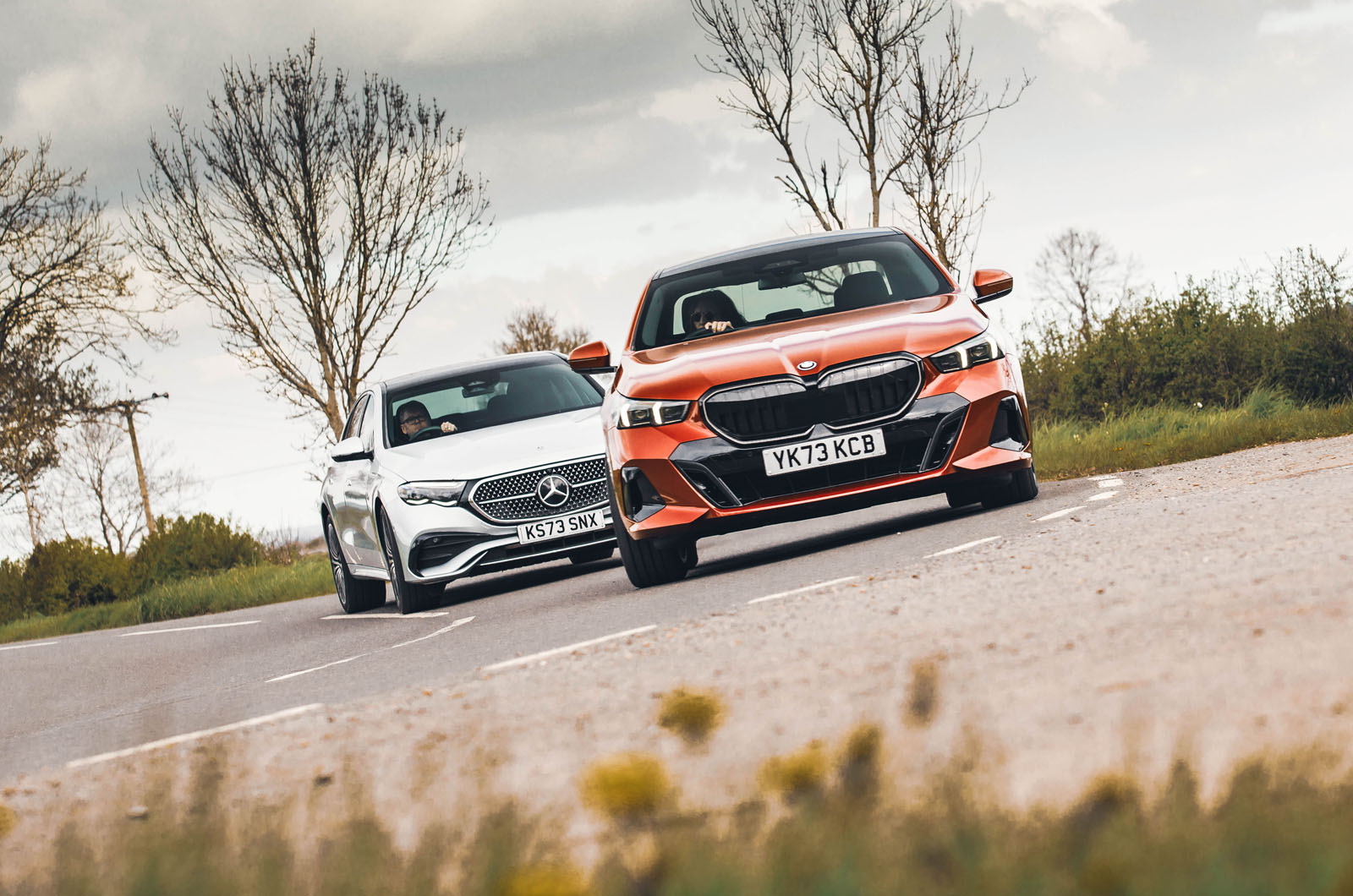
Mercedes-Benz is in advanced talks about potentially using BMW’s four-cylinder petrol engines for a wide range of future cars, as part of a radical rethink of its ICE strategy prompted by slower-than-expected take-up of its EVs.

A Mercedes source has told Autocar the two firms are already at high level of planning and negotiations, and an announcement on whether it will go ahead expected before the end of the year. Autocar has approached BMW for comment.

The potential tie-up – first uncovered by Germany’s Manager Magazin – would have BMW providing a new generation of petrol engines for use in Mercedes models ranging from the CLA through the GLA, GLB, C-Class, E-Class and GLC to the upcoming ‘Little G’.

The agreement between the rival companies is being framed as a “strategic step to cut development costs”.

For Mercedes, it would secure a Euro 7-compliant engine supply – crucial to the continuation of ICE models – while helping it to expand plug-in hybrid offerings without further heavy investment in four-cylinder engine development.

The move comes as Mercedes phases in its new turbocharged 1.5-litre four-cylinder M252 engine, developed in-house in Germany but produced in China by Horse, a joint venture between Geely and Renault.

Already offered in the new CLA, the M252 engine is offered with three outputs – 136bhp, 163bhp and 190bhp – and combined with a an eight-speed dual-clutch automatic gearbox housing a 27bhp electric motor.

However, insiders note that while the M252 is well suited to mild-hybrid applications, it isn’t currently engineered for PHEV or range-extender use – a gap that a BMW-supplied engine could potentially fill.

Said engine is rumoured to be a turbocharged 2.0-litre derivative of the four-cylinder B48 engine, which is used in almost every current BMW and Mini model line.

Likely to be produced at a factory in Steyr, Austria, the B48 is claimed to offer greater scope than the M252, as it’s packaged for both longitudinal and transverse layouts, giving Mercedes more flexibility across its both its compact and mid-sized models.

The proposed partnership could also extend to global production hubs, including a potential shared engine plant in the US to sidestep rising import tariffs.

Should the deal go ahead, it would mark a historic first: two of Germany’s luxury car makers sharing engines and potentially even gearboxes in the longer term.


Source link

BMW Motorrad unveils 2026 R 1300 RS and RT

0
BMW Motorrad unveils 2026 R 1300 RS and RT


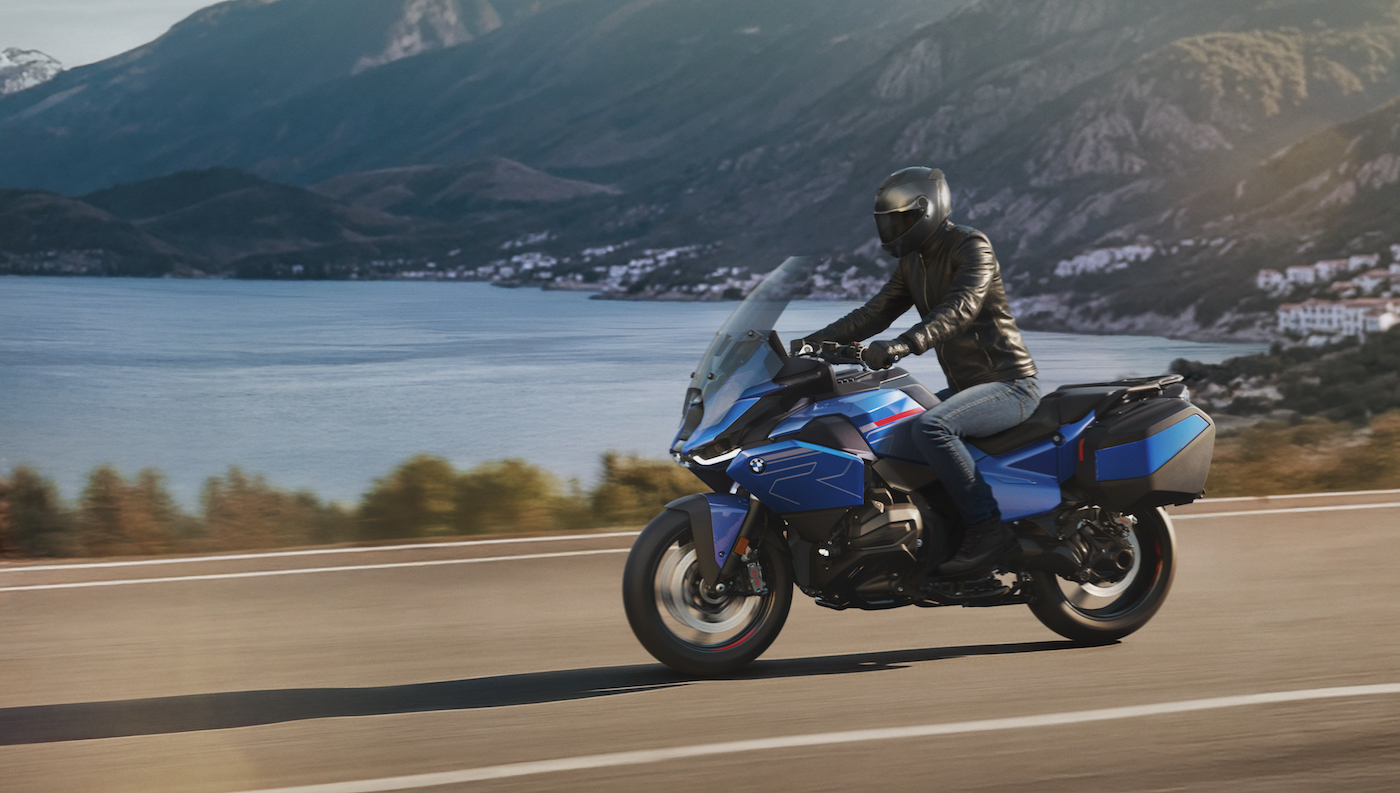
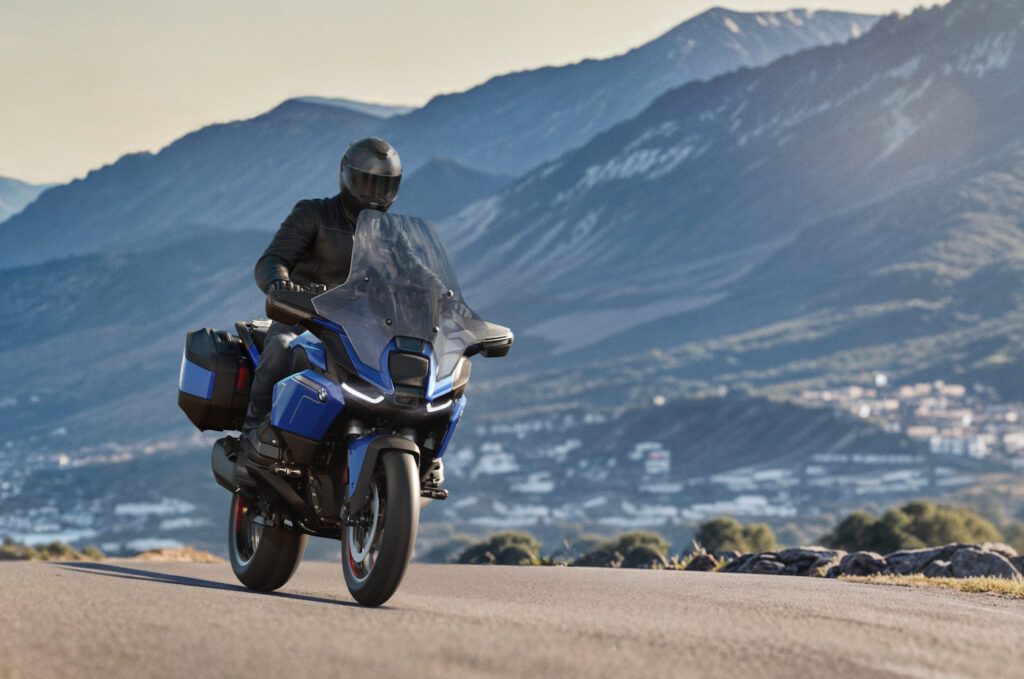
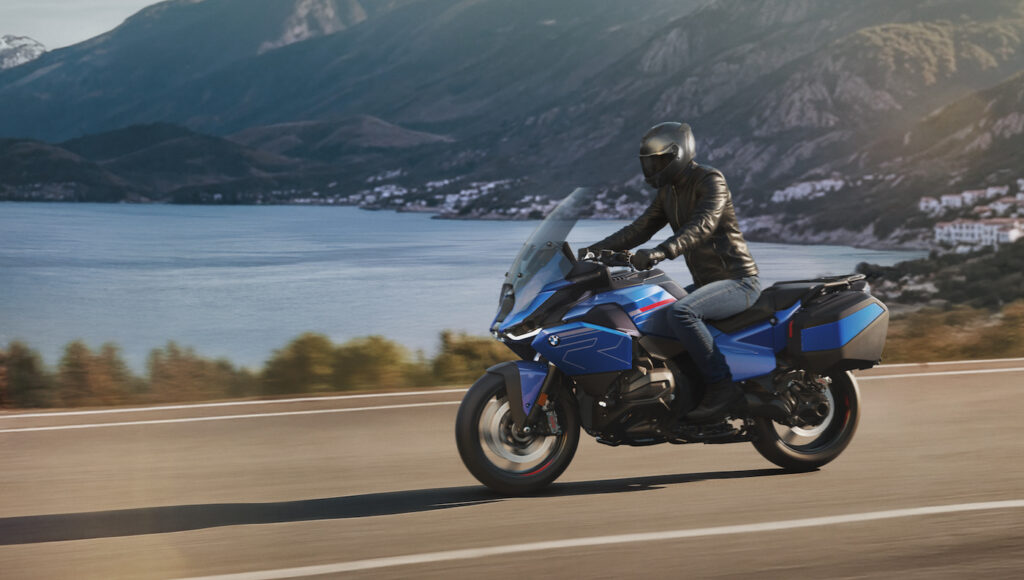
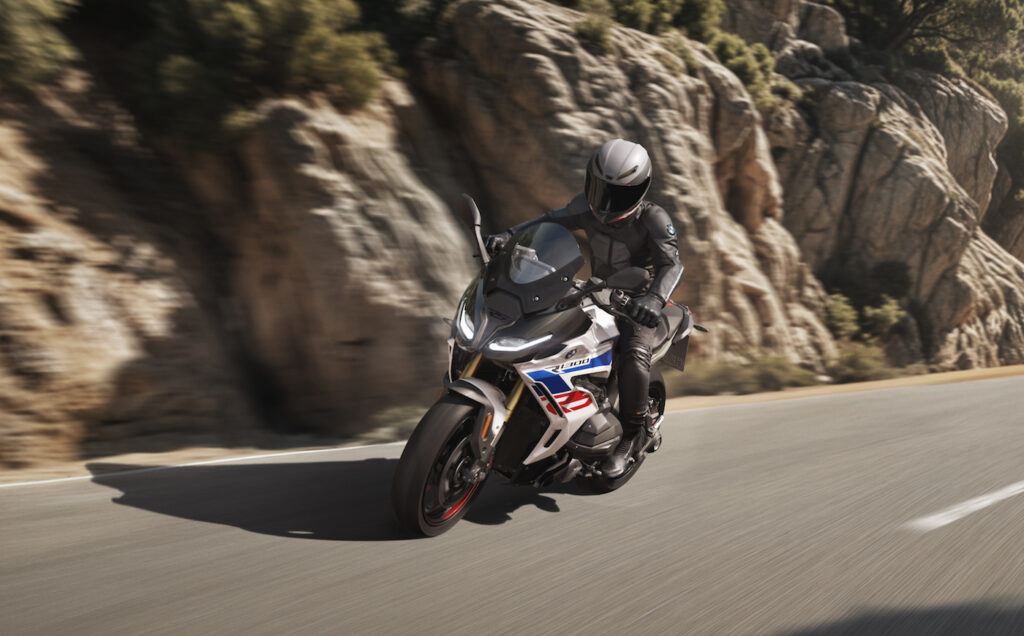
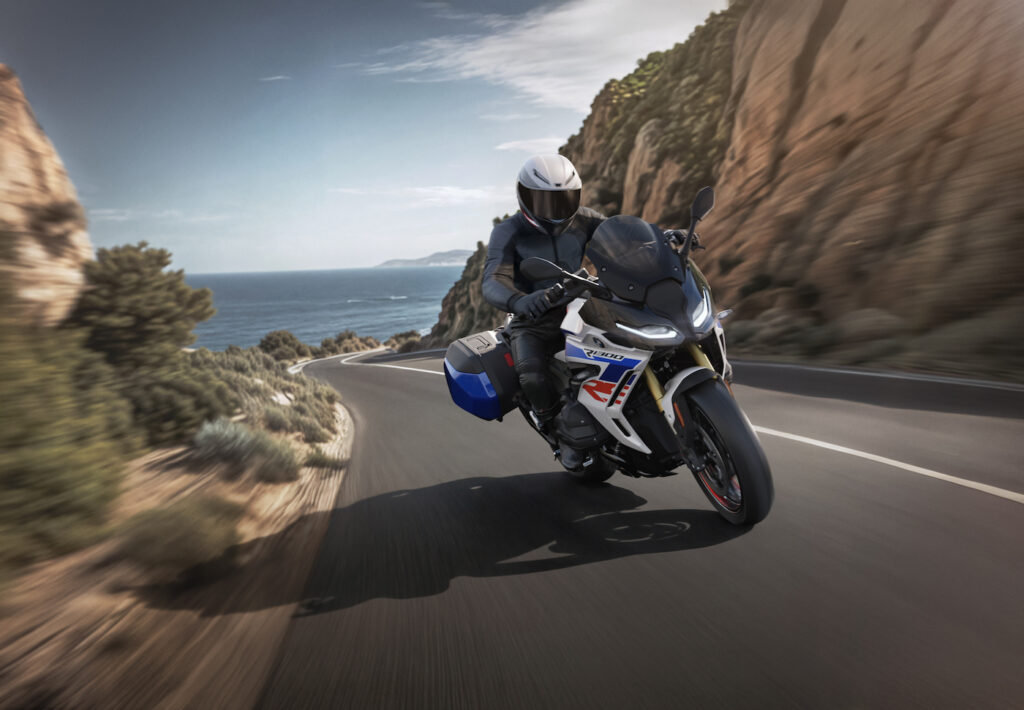
BMW Motorrad USA introduced the 2026 R 1300 RT and R 1300 RS, motorcycles designed to elevate touring and sport-touring experiences. Both models feature BMW’s 1,300cc liquid-cooled boxer engine and advanced technology, but cater to distinct riding styles; long-distance comfort for the RT and sporty nimbleness for the RS. Both are set to launch in late Q3/early Q4 2025, and clearly aim to improve BMW’s standing in their respective segments.

Both the R 1300 RT and RS are powered by a re-engineered 1,300cc air/liquid-cooled boxer engine, producing 145 horsepower at 7,750 RPM and 110 lb-ft of torque at 6,500 RPM. These are both significant improvements over the previous generation’s 136 hp and 105 lb-ft. BMW’s ShiftCam technology presents an impressive torque curve for solo or two-up riding. The engine’s 13.3:1 compression ratio and recalculated valve timing enhance smoothness and fuel efficiency, despite the increased power. A lightweight stainless steel 2-into-1 exhaust ensures compliance with future emissions standards while delivering a refined sound.

The optional Automatic Shift Assistant (ASA) is a standout feature for both models, automating clutch operation and gear shifts for effortless riding. In “D” mode, ASA delivers smooth, perfectly timed shifts. In “M” mode, manual shifts via the foot lever maintain dynamic control.

The Touring Icon: R 1300 RT

Priced at $22,495 (plus destination), the R 1300 RT holds up expectations of BMW’s long-distance touring focus on on comfort, stability and cutting-edge technology. “We’ve taken the touring icon to a new level—lighter, more accessible, and more dynamic,” said Harald Spagl, Project Manager. The new RT’s redesigned steel main frame and aluminum rear frame reduce weight and centralize mass, improving handling over its predecessor. The EVO Telelever front and EVO Paralever rear suspension, with 5.9 and 6.2 inches of travel respectively ensure stability. Performance and stability are enhanced by optional Dynamic Chassis Adjustment (DCA).

As always, the RT’s design prioritizes comfort for both rider and passenger. A 10.25-inch TFT display with navigation, standard Riding Assistant (Active Cruise Control, Frontal Collision Warning, Lane Change Warning), and riding modes (Rain, Road, Eco) greet the rider. Optional Dynamic and Dynamic Pro modes increase over-the-road options. The Comfort Passenger Package, with heated seats, grips AND BACKREST, elevates two-up touring, while expandable luggage (27–33 liter side cases, 39–54 liter top cases) adapts to city or highway needs. A low 30.7-inch seat height and adjustable ergonomics mean just about any rider can take advantage of the new RT.

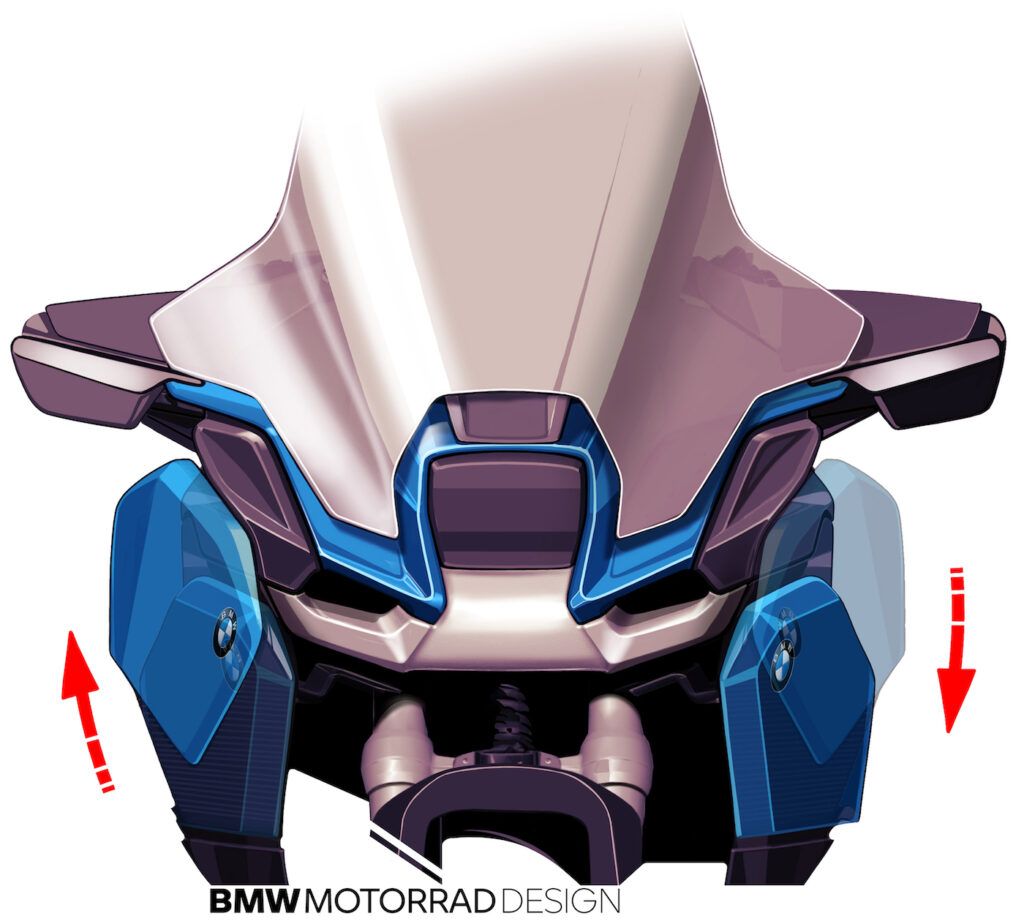
BMW has incorporated its experiences with the S 1000 RR into the R 1300 RT in the form of adjustable side trim and optional Variable Wind Deflectors to optimize airflow. A cylinder fairing keeps feet dry, and a Prop-Up Aid simplifies center stand use. Four color styles (Alpine White, Style Triple Black, Style Impulse, and Option 719 Camargue) offer aesthetic variety.

The Sport-Tourer: R 1300 RS

Starting at $17,150 (plus destination), the R 1300 RS is a sportier counterpart, prioritizing (somewhat) dynamic performance above touring capability. “The RS is designed for dynamic riding without sacrificing comfort,” said Hauke Glässing, Project Manager. Its 145-hp engine matches the RT’s, but is tuned for agility. To further enhance performance, the RS is equipped with a new 47mm upside-down fork (5.5 inches travel) and BMW’s popular EVO Paralever II rear suspension (5.1 inches travel). The RS introduces a world-first, a general production upside-down fork with adjustable spring rate via optional Dynamic Suspension Adjustment (DSA).

The RS’s sporty ergonomics position the rider forward over the front wheel, with a wider, flatter handlebar for better control during aggressive riding. Its 6.5-inch TFT screen offers connectivity, though it’s about 60% the size of the RT’s. Standard features mirror the RT’s, but the Style Performance variant adds an even sportier suspension, DTC-Shift, and precision milled components for track-inspired flair. Luggage options (26–29 liter side cases, 39 liter top case) and a 5-to-8-liter tank bag support touring.

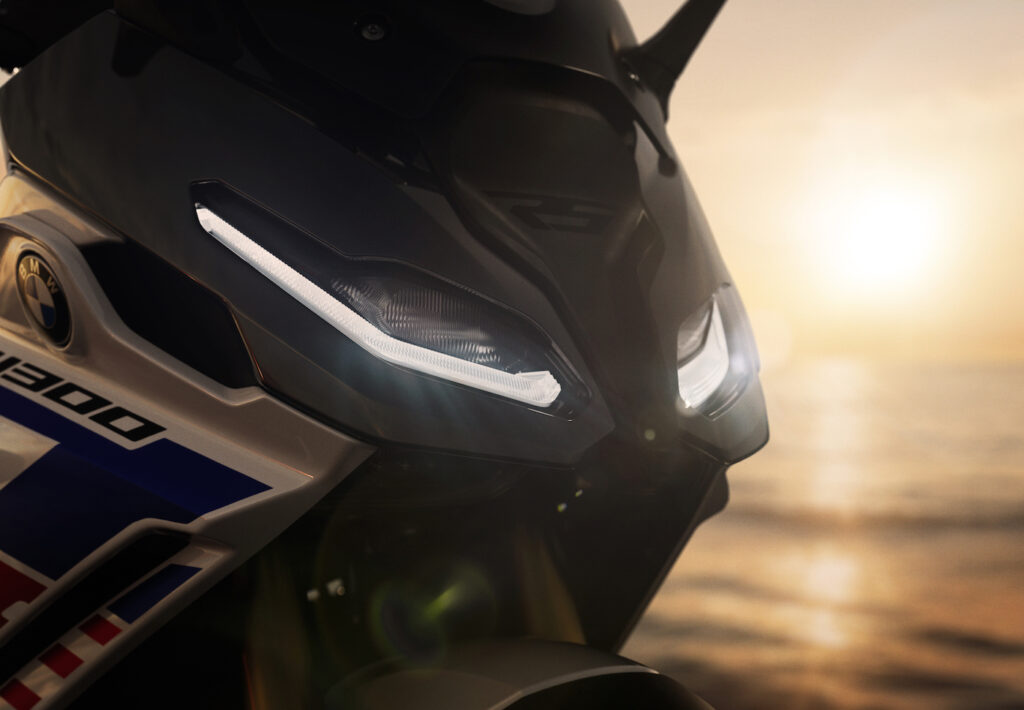
The RS’s aerodynamic fairing is optimized for its top speed of 152 MPH. A compact LED headlight and optional Headlight Pro for cornering illumination enhance lighting and visibility. Four color styles (Racing Blue, Style Triple Black, Option 719 Cuyamaca, and Style Performance) cater to bold tastes.

True to their model history, the R 1300 RT and R 1300 RS, share the same 145-hp, 110 lb-ft boxer engine and optional ASA, but they have different purposes, price tags and design cues to cater to a wide variety of riders. The RT, priced at $22,495, is a premium tourer built for long-distance comfort, boasting a larger 10.25-inch TFT display with a Connectivity Hub and advanced safety features like Lane Change Warning, which the RS lacks. The RS, at $17,150, targets sport-touring enthusiasts with its agile handling and lower cost, achieving a higher top speed of 152 mph due to its lighter aluminum die-cast rear frame and sportier tuning. Suspension systems further differentiate them: the RT’s EVO Telelever and Paralever prioritize stability, while the RS’s 47mm upside-down fork and EVO Paralever II offer precision, especially with DSA’s adjustable spring rate, a first for production motorcycles. Ergonomically, the RT’s forward-leaning yet relaxed posture, with a minimum 30.7-inch seat height and passenger-focused features like the Comfort Passenger Package, suits extended two-up journeys. The aggressive, front-wheel-oriented stance and 31.1-inch seat height of the RS enhance control for solo rides, with less emphasis on passenger comfort.


Source link

THINKIN’ ‘BOUT THE TIMES I DROVE IN MY CARS. – Rants

0
THINKIN’ ‘BOUT THE TIMES I DROVE IN MY CARS. – Rants


As I sit here writing on this sunbaked Saturday, I can hear the big-block V8s with their snarling open-pipes growling up and down Woodward Avenue because, yes, the “Dream Cruise” is happening right now. It’s the classic “run-what-you-brung” grassroots celebration of the car and its essential role in the American culture, and there’s really nothing else quite like it.

This event is, of course, in stark contrast with the corporate greed-fest going on in Monterey and Pebble Beach this week, like The Quail – with single admission tickets going for $1600 (although it was at least double that in the resale market) and the Concours d’Elegance at Pebble Beach on Sunday.

These two automotive events couldn’t be more different from each other. The Detroit-centric “Cruise” is brimming with whimsical, self-styled customs, V8 hot-rods and muscle machines from multiple eras, while the events during “Monterey Car Week” are fueled by corporate entertaining (with a few car reveals thrown in for good measure) catering to the invited moneyed swells, or the freelance attendees who wandered out there on their own.

As an added dimension to the proceedings, the vintage racers running out at Laguna Seca are operating at a different financial stratum entirely, happily throwing around multi-million-dollar machines with glee, because if anything should go wrong and they have to fix a bent car, it would constitute only a mere blip to their ultra-flush balance sheets. “Monterey Car Week” is indeed a different world.

But as dream-like and bucolic Carmel and its surrounds are during “Monterey Car Week,” the antiseptic nature of what goes on out there seems to be getting more removed from reality each and every year. The cars are perfect, the people in attendance are properly credentialed – both personally and professionally – and the settings are breathtaking. It’s all good for the people who can afford to enjoy it. But in the end, the proceedings hold little interest for me.

Detroit. As longtime readers well know, the Chevrolet Corvette has played an inexorable role in my ongoing car addiction. I’ve been honored to have experienced some of the most famous and spectacular Corvettes ever built in period and in real time. Those experiences are forever etched in my mind, and for reasons I’ll explain later, I think it’s high time I give you a glimpse into Corvette history, because for me, it never gets old.

THINKIN’ ‘BOUT THE TIMES I DROVE IN MY CARS. – Rants

(GM)
The 1959 Corvette Sting Ray racer photographed at the GM Styling viewing courtyard in 1960. 

The 1959 Corvette Sting Ray racer. As I’ve stated many, many times in these pages, this machine is my all-time favorite car. I first saw it one blistering summer afternoon in our neighborhood in 1962, and I will never forget that day. I was still in my bike-riding days back then, but I remember resting with my buddies on a corner in our neighborhood after a long, hot day of riding around aimlessly – we did that often back then – when we heard a rumble and roar coming from off in the distance. I knew right away that it wasn’t motorcycles and that it was more than one of whatever it was – and just then a pack of the most stunning cars we’d ever seen burst around the corner and came rumbling right past us – the sun glinting off the barking pipes and the canopy of trees shimmering off the perfect mirror finishes of the paint jobs. This “horsepower train” was led by the 1959 Corvette Sting Ray racer in Silver, followed by the XP700 Corvette (a “bubble-top” show car with side pipes also in Silver – it was Mitchell’s favorite color), the first Mako Shark Corvette and a concept called the Corvair Super Spyder (also in Silver), a wild, racing-inspired show car with dual cut-down racing windscreens and three pipes curling out and around each side in the back. 

(GM)
A rare photo of the Corvette Sting Ray racer in its original red livery, taken at Elkhart Lake, Wisconsin, in 1959.

(GM)
The Corvette Sting Ray racer as it appears today.

(conceptcarz.com)
The Corvette Sting Ray racer “live” at a car show.

(GM)
The 1959 Corvette Sting Ray racer and the 1963 Corvette Sting Ray production car photographed at the GM Styling viewing courtyard in the fall of 1962.

(GM)
Bill Mitchell photographed with the 1959 Corvette Sting Ray racer and the 1961 Corvette Mako Shark at the GM Technical Center test track, 1961.

They were so loud we couldn’t even hear ourselves screaming whatever it was we were screaming, but after a split second to think about it we took off, pedaling our guts out after them. It was apparent that these machines were heading for our part of the neighborhood – and as we tried to keep them in sight, I realized they were turning on to my cross street…

We came around the corner and saw them pull into a driveway, exactly one block from my house. We stopped right at the end of the driveway with our mouths gaping down to the asphalt, as the drivers of the other cars handed the keys to the driver of the Sting Ray and he took them up to the front door where a woman collected them. Then, an Impala pulled up and the four men got in it and were gone, leaving the cars sitting in the driveway all lined up ticking and spitting as their pipes started to cool. This became the Friday afternoon ritual in the summer, because that’s the way Bill Mitchell wanted it. GM’s legendary design chief liked having a selection of his toys to play with on the weekends, and I was lucky enough to live just a block away from him.

All of those cars were special, but the ’59 Sting Ray racer was by far my favorite the moment I laid eyes on it. If you’ve ever had the pleasure of seeing it in person, it is a stunning machine. (Although for those who haven’t, you might not be prepared for how compact it is.) 

Its taut, beautifully rendered lines absolutely glow in Mitchell’s favorite color – German racing “silver arrow” metallic – and as I said, to this day it remains my all-time favorite car. A favorite story? When Ed Welburn took over the reins of GM Design many years ago, the first thing he did was order the restoration of the ’59 Sting Racer, which had fallen into neglect and in desperate need of rejuvenation. And the GM artisans did a phenomenal job bringing it back to its previous glory. But the one area they didn’t touch? The seats, because Ed wanted them to remain in their original condition, in honor of all of the famous people who sat in them. An exquisite touch, and it remains the jewel of GM’s collection of historic vehicles.

No, I don’t count myself as one of those famous people, but I did have the honor of riding shotgun in the ’59 Sting Ray racer several times with Bill Mitchell at the wheel. The memory remains as technicolor vibrant as if it happened yesterday.

(GM)
The wild 1958 Corvette XP-700 concept from GM Styling.

(GM)
Another angle of the Corvette XP-700. 

1958 Corvette XP-700 concept. This wild Corvette concept was the first car I rode in with Bill Mitchell at the wheel. Some may not like the looks of this beast, but it was surprisingly alluring in person. The one thing I can report is that its “bubble” top – which was an infatuation of Mitchell’s at the time – redefined the concept of “solar gain” as it baked your brains out in the summer sun. And that was fine with me, because to ride around in that cool, futuristic machine was a treat beyond words. The XP-700 eventually disappeared. Why? It became the underpinnings of the next car…

(GM)
The 1961 Corvette Mako Shark I. 

1961 Corvette Mako Shark. The Mako Shark concept (XP-755) was another thing altogether. This machine bristled with remarkable details, like the “gills” that doubled as sequential turn signals, the glorious side pipes and, of course its bubble top. But the most remarkable characteristic was its fantastic paint job, which mimicked the gradations of a Mako Shark. That paint job was mesmerizing back then and amazing in every sense of that overused word. Today, this machine is in desperate need of a full restoration, but that paint job remains its signature. How did this all come about? One of the countless anecdotes from the Mitchell era was that he caught a Mako shark on a fishing trip in Florida and had it mounted on a wall in his office. He kept telling the designers that he wanted the paint job on the Mako Shark concept to look exactly like the shark on his wall, with the same color gradations. After Mitchell rejected several attempts at painting the XP-755 and amid growing frustration, a few designers sneaked into his office late one night while Mitchell was out of town and removed the shark from his office wall. They then had the paint shop paint Mitchell’s prized catch exactly like the latest version of the paint job on the Mako Shark concept. They then put the shark back up on his wall and presented the new paint job on the Corvette Mako Shark concept to Mitchell, who pronounced it “perfect.” 

(GM)
The paint job is truly wild – and stunning – on the Mako Shark I.

(GM)
The 1961 Corvette Mako Shark I as it appears today.

(GM)
The 1961 Corvette Mako Shark 1 and 1965 Corvette Mako Shark II, photographed at the GM Technical Center in Warren, Michigan, in 1965. 

1962 Corvette Convertible. Going by the specs, this GM PR car was nothing special. It was white with a black top and black interior, and it had the 300HP 327 V8 with a four-speed gearbox. Standard fare for a Corvette back then. But it was the Corvette that we “borrowed” almost every weekend, and it was the machine that burnished “Corvette” in our collective consciousness forever.

(GM)
The 1963 Corvette Sting Ray remains one of the most iconic automobiles ever built. 

Ed Cole’s 1963 Corvette Sting Ray. We got to know Ed (and Mitchell, of course) through our father, who was in charge of GM PR from 1957-1979. Ed took note that my brother Tony and I were totally into cars, so he often would send over cars for my brother to drive. One year he sent over his personal driver, which was a 409-powered Impala with a 4-speed. The only other 409 in existence was in “Dyno” Don Nicholson’s hands at the NHRA finals. Needless to say, we had a blast mopping up everything in sight on Woodward Avenue that weekend. But the most memorable car that Ed sent over was his personal 1963 fuel-injected Corvette Sting Ray coupe in Sebring Silver (with a 4-speed gearbox, of course). The new Sting Ray had been announced, but there were none on the street yet, except for Ed’s company car. To this day, the Sting Ray was one of the most dramatic and memorable auto introductions of all-time, and driving it that weekend was like piloting a rolling space ship. No other car said “The Future” like the first Corvette Sting Ray. It was simply spectacular.


(The DeLorenzo Archives)

Watkins Glen, 1964. The “Zora-ized” Corvette Sting Ray coupe as it appeared at the SCCA Driver’s school that summer. Note the straight pipes out the back.

The 1964 “Zora-ized” Corvette Sting Ray. By early summer of 1964, my brother Tony’s automotive bug started to seriously turn toward sports car racing. He innocently asked “big” Tony if we could order a Corvette company car for the summer, and little did he know that the adventure was just beginning. As my brother said: “He made two errors: 1.) He agreed to do it and 2.) He let us order it!” And order it we did: A Black/Black 1964 Corvette Sting Ray Coupe with Heavy Duty finned drum brakes; Heavy Duty gearbox; knock-off aluminum wheels and radio delete. Little did our father know that Tony planned to take it to SCCA Driver’s School in Watkins Glen, New York. So, the moment we got it we took the interior carpeting out, took the bumpers off, removed the spare tire carrier, and then we had a roll bar put in and we were good to go. Or so we thought. While Tony was sitting at his desk at Chevrolet Sales Promotion (his summer job) a few days later the phone rang. This is how he remembers it:  

“Hello?” 

“Tony, this is Zora Duntov.” Yikes, it was the God of the Corvette calling. “Your father has ordered a heavy-duty Corvette. Who is going to drive it?”  

“Um… He is?!!”  

Silence.  

“Who is going to drive it?”  

“Um, I am.” 

“What are you going to do with it?”  

“Uhhh… I’m going to go to SCCA driver’s school at Watkins Glen.” 

“Ok.” 

And “God” hung up. But not before requesting that we drop the car off at Chevrolet Engineering in Warren so he could “take care of a few things.” Two weeks later we went back to get the car, and Zora took Tony out to the little test track that sits inside the Tech Center. And there it was, it was the same Corvette but it sat lower and it was wearing the biggest Goodyear Blue Streak racing tires that could fit inside the fenders on the knock-off wheels. Zora also pointed out that the stock exhaust system underneath now had flanges just in front of the mufflers. Those flanges had been put on by Bill Mitchell’s famous Styling Garage mechanic, Ken Eschebech, so that once we got to Watkins Glen, we could attach 4′ long straight pipes designed to hang on special hangers, so that they would shoot straight out the back. Because, well, you can’t run a Driver’s School at Watkins Glen with standard mufflers, right? Zora was a genius.

But those changes were just the tip of the iceberg. The car had been completely gone through, including the brakes, the suspension and sure enough, the engine. In retrospect, we were convinced that Zora had the engine yanked, gone through and tweaked, because the thing was a rocket. 

That trip to Watkins Glen was an adventure unto itself. We arrived very late one night at the rustic Glen Motor Inn, and the one and only Vic Franzese checked us in, but not before he could show us his beautiful Lotus 11. The school went exceptionally well for Tony; at one point the Chief Instructor went to ride a couple of laps with him and emerged muttering something like “he’s doesn’t need any more instruction” – and that was the beginning of his racing life. The return trip was eventful, too, as were so tired by the end of the weekend that we said, “screw it” and left the straight pipes on, rattling hearts and bones all the way back. 

There’s more to this story. It was getting toward the end of that summer, when dad informed us that the car had to go back to Chevrolet to be put back into stock condition. It turns out that our oldest sister’s boyfriend at the time, who lived in Chicago, had expressed interest in buying the car. We took the roll bar out, piled the stock components in it and voila! It returned two weeks later as if none of it happened, with dad saying: “When that car comes back to the house, don’t touch it!” We didn’t. The sad end to this chapter? The guy in Chicago had it for two days. On the second night it was stolen, stripped – and totaled.

Dollie Cole’s “Bluebird” 1965 Sting Ray convertible. Ed Cole was the brilliant engineering genius and true enthusiast who was one of the creators of the small block Chevrolet V8 and who led GM Product Development in its heyday. Ed is a true icon of the industry. Dollie was his radiant wife, a fierce defender of all things Ed and a fiery enthusiast in her own right. She roared around Bloomfield Hills and Birmingham – two northern suburbs of Detroit – in her ’65 Nassau Blue Corvette roadster with a white interior, a removable hard top, a 4-speed and side pipes. Dollie also had a lead foot and drove the hell out of it. She famously dubbed it her “Bluebird.” Ed stuffed a big-block 396 V8 in it months before the engines were released to the public. She let Tony borrow it on several occasions. It was quick and suitably loud. 

(GM)
The 1965 Corvette Mako Shark II, another stunning machine from GM Styling.

The 1965 Corvette Mako Shark II. What can be said about this machine other than the fact that Bill Mitchell and his handpicked designers turned the dial up past “11” to come up with one of the most iconic Corvette shapes of all time? The obvious successor to the Mako Shark I, the “II” bristled with spectacular details that even today – in its “Manta Ray” guise – resonate mightily. 

(GM)
The Mako Shark II transformed into the 1969 Corvette Manta Ray, which is how it appears today.

(GM)
The 1969 Corvette Manta Ray photographed at GM Styling in Warren, Michigan.

(The DeLorenzo Racing Archives)
Wilmot Hills, Wisconsin, May, 1967. Tony DeLorenzo’s first race in a Corvette – and first win in “A” Production – came at an SCCA Regional in Wilmot Hills, Wisconsin, in this brand-new 1967 L88 Corvette Sting Ray roadster sponsored by Hanley Dawson Chevrolet in Detroit. It was also the first time a 427 Cobra encountered the new L88 in an “A” Production race. This well-traveled Sting Ray is one of the most valuable Corvettes in the world not named “Grand Sport.”

The 1967 Corvette 427 L88 racing car. Tony began his racing career in something much more realistic and affordable than a Corvette, which turned out to be a ’65 Corvair. We started out pounding around at our local track here in Michigan – Waterford Hills – and from there it was on to Nelson Ledges, Ohio, and Mid-Ohio; a one-time event at an airport in Grayling, Michigan; Lime Rock Park, Vineland (New Jersey); and on and on. Two years later Tony talked Hanley Dawson, who owned Hanley Dawson Chevrolet in Detroit at the time, into sponsoring a Corvette in SCCA Racing. And after he agreed to do that, we ordered one of 20 L88 Corvettes made in 1967, in Black, of course (it actually turned out to be the first one built that year). I’ll never forget going down to the dealership after it arrived and taking it around the block. The thing was a monster in every sense of the word, and the sound that L88 made was spiritual. The first weekend we had it we installed a roll bar, replaced the stock exhaust system with a set of “OK Kustom” headers (from Flint), added a set of “Torq-Thrust” American Racing wheels, a set of Firestone racing tires, and we removed the windshield, cut the windshield posts down and put a plexiglass windscreen on. The debut race – and win – for Tony and that famous L88 Corvette came six weeks later in an SCCA Regional race at an obscure road race track in Wilmot Hills, Wisconsin. He went on to qualify for the SCCA Runoffs with that car, and then it eventually disappeared. It surfaced again, and after Tony documented its authenticity, it was restored back to its street configuration; then it was returned to its racing configuration – with Tony driving it in the Monterey Historics – then back again to its street configuration. This has become one of the most valuable L88 Corvettes in existence, and I think the last time it changed hands was for just under $3 million.

The 1969 Corvette “Daytona GT” L88 convertible. After the Owens/Corning Fiberglas sponsorship came to fruition, we had the idea of building a limited-run of street Corvettes that would be branded as “Corvette Daytona GTs.” We build a prototype, which was based on a Black/Black (of course) Corvette convertible powered by a 427 L88 and equipped with our competition headers and side pipes, our FIA-specific Plexiglas covered front headlights, American “Torq-Thrust” wheels and racing tires. We even displayed it at the Detroit Auto Show at Cobo Hall that year. From the “Best Laid Plans” File, the demands of our burgeoning – and successful – racing effort overwhelmed everything else, and the Daytona GT idea fell by the wayside. But that wasn’t exactly the end of the story. The car was stored at my parent’s house, and I was tasked with keeping it in running condition, which I performed with relish. Needless to say, a Black/Black L88 Corvette with open side pipes caused quite a stir on Woodward and the surrounding environs. It was the quintessential Bad Ass machine. What happened to it? A Lufthansa Airlines co-pilot befriended Tony at Daytona, and he eventually asked if he would consider selling him a OCF-prepared Corvette. A deal was reached, and the Daytona GT was converted to OCF Corvette Racing specs. But not before Randy Wittine, the brilliant GM designer who created all of our iconic racing team liveries back then, came up with a wild “psychedelic” paint job for it that was drop-dead gorgeous. (Pictures exist somewhere, but they haven’t turned up.) Tony and I dropped it off at Detroit’s Metro airport, and watched it being loaded on to a Lufthansa freighter. That pilot proceeded to terrorize the equivalent of German SCCA national racing with that monster, humbling the usual assortment of Porsche 911s in the process. The car ended up back in the states somehow and is now used for vintage racing. Another Corvette life well-lived.  

And that’s the High-Octane Truth for this week.

(GM Styling)
Bill Mitchell pulling out of his driveway on Bradway Boulevard in Bloomfield Village, Michigan, in the 1959 Corvette Sting Ray racer. He drove his favorite cars all the time.


Editor’s Note: Click on “Next 1 Entries” at the bottom of this page to see previous issues. – WG



Source link

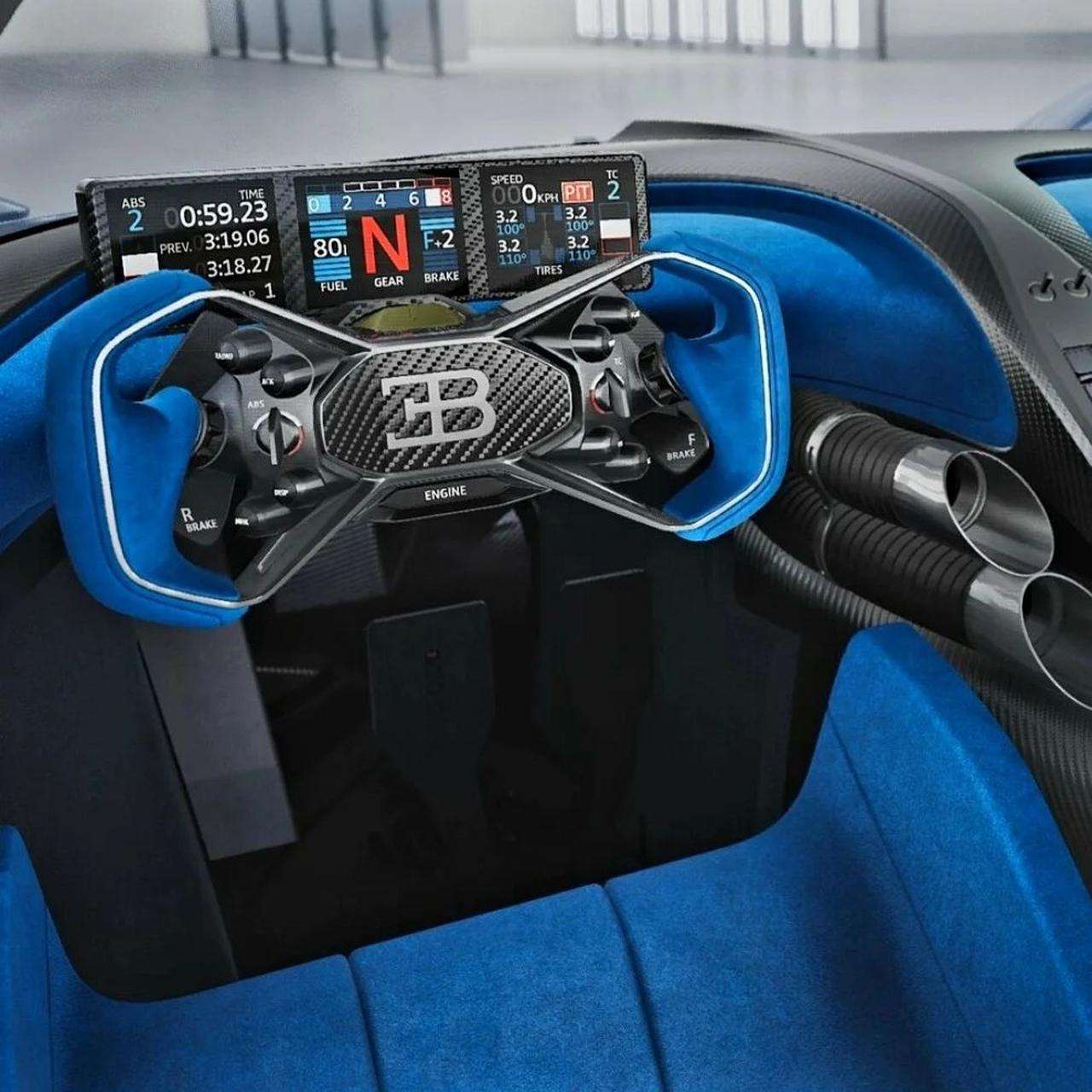
A road-legal Bugatti Bolide in the works, courtesy Lanzante

0
A road-legal Bugatti Bolide in the works, courtesy Lanzante


The Bolide is the most extreme hypercar ever made by Bugatti. Limited to just 40 units, the Bolide is a pure track-focused hypercar. However, Lanzante, a British automotive company, is said to be working on converting the Bolide into a road-legal hypercar.

The news was confirmed by the brand’s CEO, Dean Lanzante, at the Goodwood Festival of Speed. Lanzante stated that the Bolide has enough in common to warrant a street-legal conversion.

Bugatti Bolide-COTA-shakedown-2

Lanzante stated that while it’s not easy to convert track-only vehicles into road-legal models, there are a few criteria that can help make it possible. He stated, “We are trying to build cars that are genuinely usable”.

Bugatti Bolide-delivery-USA-2

Talking specifically about the Bolide, Lanzante mentioned how the engine will pass emissions, while the car itself has a really user-friendly gearbox and a high build quality, which will help them with the conversion. The only thing, however, will be replacing the tyres. The Bugatti Bolide comes with track-focused tyres that last just 37 miles and cost $8,000 each.

Lanzante hasn’t given any official timeline on when they will reveal the road-legal Bugatti Bolide.

Bugatti Bolide-production-spec-configurator-4

To reiterate, the Bugatti Bolide comes with an 8.0-litre quad-turbocharged W16 engine, paired with a 7-speed dual-clutch transmission. The powertrain produces 1,825 BHP, allowing the hypercar to sprint from 0-60 mph in 2.2 seconds and just 12.1 seconds to reach 249 mph.

Source: Carbuzz


Source link

Tunnel Mountain: Banff’s Premium Camping Destination

0
Tunnel Mountain: Banff’s Premium Camping Destination


There are countless RV destinations to visit within the states, but sometimes it’s fun to venture a little further north. Canada is covered in gorgeous landscapes, mountains, lakes, and forests. And one of its most beloved outdoor destinations (Banff National Park) isn’t too far from the US border. This makes it the perfect destination for campers of all kinds.

If you’re looking for the best place to stay near the park, that has to be Tunnel Mountain Trailer Court. There is a network of campgrounds in this area to accommodate all the visitors who want to stay close to Banff. But the Trailer Court is the most popular (and the most well-equipped) spot for RV campers.

This is a huge park that has enough space to accommodate hundreds of trailers (and motorhomes, too). There are also plenty of amenities to go around, so you won’t have to rough it’ll be able to enjoy some modern comforts even as you camp in the sprawling wilderness of Banff. Tunnel Mountain is the perfect getaway for anyone who loves the beauty of the great outdoors.

Overview

Tunnel Mountain Trailer Court is located at Tunnel Mountain Road, in Alberta’s Banff National Park. It’s right in the heart of Banff, so you’re perfectly situated to explore many of the most famous landmarks and attractions.

This campground doesn’t come with any lakeview sites, but you’ll never be too far away from waterfront recreation! There are several rivers and lakes nearby to enjoy. Some noteworthy ones include the branching Bow River, the interconnected Vermillion Lakes, and the massive Lake Minnewanka to the north.

As we mentioned earlier, Tunnel Mountain Trailer Court is just one of many camping options in this region. There are hundreds of tent sites available in the nearby Tunnel Mountain Village (I and II), but these are more primitive sites. At most, they come with electric hookups, but most don’t even have that. So if you’re visiting Banff in an RV, you’ll want to head for the Trailer Court.

This RV Park is huge, with 322 sites available. All come with full hookups for water, sewage, and electricity so you can camp in comfort. Several sites can also accommodate big rigs, so don’t be afraid that your RV will be too big for this park. RVs up to 50 feet long are welcome here.

The rates here are also very competitive! Because this is such a popular area, you might have expected to pay top dollar to get a site. But on the contrary, Banff is approachable to everyone who loves camping. The large, full-service sites at Tunnel Mountain Trailer Court only cost $42.50 per night. This is quite a bargain for such a well-situated campsite.

Additional fees may apply depending on what you do during your visit. You may need to pay an entry fee to get into Banff National Park, and/or gain access to the shuttles. Discounts and bundles are available though, so be sure to peruse your options before you arrive!

For more information about this RV Park and additional camping options in the area, visit the official website at parks.canada.ca

Amenities

A variety of RV types at Tunnel Mountain Trailer Court.A variety of RV types at Tunnel Mountain Trailer Court.

Next up, let’s cover some of the amenities you’ll gain access to during your visit. The full hookups are one of the biggest appeals of this campground. Having easy access to fresh drinking water, electricity, and your own bathroom are huge benefits in such a heavily wooded area.

But the campground itself also has other amenities for all guests to enjoy. There are spigots with fresh water in several locations, as well as an on-site dump station for those who need to service their RVs. Showers and restrooms with flush toilets are also on the premises. This is a perk for anyone who is tired of navigating their small RV bathroom!

The roads in this RV park are all paved, making it easy to reach your campsite and park. The sites are mainly gravel, but they are level and well-maintained. Picnic tables are also at your site for a little extra work space! Large trees grow throughout Tunnel Mountain Trailer Court, offering shade and extra privacy to campers.

Accessibility is also an important feature to the creators of this campground. Several campsites are accessible to those with disabilities, and the public facilities are designed with them in mind as well.

There are also plenty of opportunities for education and entertainment! Park employees regularly host events that are open to the public. Some of these include guided hikes, theater shows, showcases about current conservation projects, and lessons about the wildlife of this park. Canada’s indigenous people also play a very important role here, so there are several programs and opportunities to help guests learn about Banff’s human history (past and present).

Banff is a massive park with so many points of interest. If you want to explore without hauling your RV everywhere you go, you’re in luck! A variety of biking and hiking trails are easy to access from the campground. Additionally, shuttles and public transportation are available at multiple points. There is a shuttle service that runs within Tunnel Mountain so you can easily catch a ride.

The shuttle can take you to the nearby town of Banff, which is just a couple miles away. Parking here is limited, so riding the shuttle is usually the most hassle-free way to get there. Additional routes connect to popular lakes, mountains, and canyons. Check out the park shuttle page for more information about routes and schedules.

Nearby Activities/Attractions

Now we can get to the real meat of the matter! Banff is a wonderland of outdoor adventures and it draws in visitors from all across the country.

If you want activities that are right on your doorstep, look no further than Tunnel Mountain itself! This peak overlooks the city of Banff and you can easily reach the trailhead from your campsite. The trail is only 1.5 miles long, but be prepared for a fairly steep incline at certain parts.

If hiking isn’t your style, no worries! There are plenty of other ways to enjoy the beauty of Banff. Visitors can view it from the sky by riding the aerial Banff Gondola or taking a scenic route around the Vermillion Lakes Drive.

Even if you visit during the summer, Banff can get pretty chilly. Warm up by taking a trip to the Banff Upper Hot Springs. These natural pools are rich in minerals and the perfect temperature for a nice relaxing soak.

Another extremely popular destination in the area is Lake Louise, which is a bright blue glacial lake surrounded by mountains and hiking trails. Chateau Lake Louise is a historic building on the lakeshore that is also worth a visit while you’re there!

Kayakers enjoy Lake Louise.Kayakers enjoy Lake Louise.

And if you need a break from outdoor adventures, you can always explore the town of Banff and visit one of the many museums, tea houses, art galleries, and retail shops. Millions of people visit this area every year, so there are all kinds of attractions to explore.

Once again, to accommodate all the visitors in this area, Banff offers plenty of cuisine options. There are tons of great restaurants in the main town, but once you venture further away, the dining choices become few and far between. But there’s no shortage close to your campsite! Some of the best options include:

Reviews

With all of these factors in play, it’s easy to see why Tunnel Mountain Trailer Court is such a hit with guests. But exactly how well does it rank in the grand scheme of things?

Well according to users of RV LIFE Campgrounds, this park is a 9.2/10! That’s an impressive score, especially when you look at how many people have reviewed it over the years. More than 250 people have left feedback, and yet its still overwhelmingly positive.

Guests remarked that they loved the size and cleanliness of their RV sites. The full hookups were a draw for many people as well. Nearly every review also mentions the great location within Banff. Whether you hike, bike, or catch a shuttle, this is an excellent central location that gives you easy access to the park.

If you want to get the most out of your RV adventure in this gorgeous park, then Tunnel Mountain is the place to go! To find out more information from real guests, visit RV LIFE Campgrounds. Here, visitors provide detailed breakdowns of their experience, offer tips, and share photos from their trip. It’s a great resource to anyone who is planning their next road trip.

Related Articles:


Source link

Mastering Touch Commands: A Guide to Utilizing the BMW 7 & BMW i7 Infotainment System

0
Mastering Touch Commands: A Guide to Utilizing the BMW 7 & BMW i7 Infotainment System


Mastering Touch Commands: A Guide to Utilizing the BMW 7 & BMW i7 Infotainment System

Welcome to Passport BMW’s Blog! Today, we’re excited to share some expert tips on how to harness the power of touch commands in the BMW 7 and BMW i7. The cutting-edge infotainment system in these luxury vehicles offers an intuitive and seamless experience, making your driving journey even more enjoyable.

The Art of Touch: Navigating the Infotainment System

The first step in mastering touch commands is understanding the layout of the infotainment system. Both the BMW 7 and BMW i7 boast a high-resolution touchscreen display situated elegantly in the center console. To get started, simply activate the vehicle’s ignition and allow the system to boot up.

Once the infotainment screen is active, you’ll be presented with a home screen featuring various widgets and app icons. Navigation, multimedia, communication, and vehicle settings are among the key categories easily accessible from this main menu.

Intuitive Gestures: Navigating through Functions

Using touch commands is as easy as using a smartphone, thanks to the intuitive gestures employed in the BMW 7 and BMW i7 infotainment system. Let’s explore some basic gestures to streamline your interaction:

  1. Tap: A quick tap on the screen is the equivalent of selecting an app or an option. It’s your primary way of interacting with the infotainment system.
  2. Swipe: Swipe gestures allow you to scroll through lists, browse menus, and view additional options. Swipe up, down, left, or right to move through different screens.
  3. Pinch to Zoom: When viewing maps or images, pinch your fingers together to zoom out and spread them apart to zoom in.

Navigate Effortlessly: Utilizing the Touch Navigation

BMW’s navigation system is both comprehensive and user-friendly. To set your destination using touch commands:

  1. Tap on Navigation: Locate and tap the Navigation icon on the home screen.
  2. Enter Destination: You can enter your destination by tapping the address bar and using the on-screen keyboard. Alternatively, you can use voice commands for a hands-free experience.
  3. Select Route: After entering your destination, the system will provide you with multiple route options. Swipe through the routes and tap on your preferred choice.
  4. Start Guidance: Tap the “Start Guidance” button to begin your journey with turn-by-turn directions and real-time traffic updates.

Entertainment at Your Fingertips: Controlling Multimedia

The BMW 7 and BMW i7 offer an impressive array of multimedia options, and you can control them with ease using touch commands:

  1. Audio Control: Tap the “Media” or “Audio” icon on the home screen to access the audio control panel. You can adjust the volume, change tracks, browse playlists, and switch between different audio sources.
  2. Bluetooth Connectivity: Connect your smartphone via Bluetooth by tapping the “Phone” icon. Access your contacts, make hands-free calls, and stream music effortlessly.
  3. Apple CarPlay/Android Auto: If your vehicle is equipped with these features, simply connect your compatible device via USB and follow the on-screen instructions.

Personalizing the Experience: Customizing Settings

One of the greatest advantages of the BMW infotainment system is the ability to customize it to your preferences. To access and modify vehicle settings:

  1. Tap on “Car” or “Vehicle” Icon: This will take you to the settings menu specific to your car.
  2. Explore Settings: Swipe through the available options, such as lighting, climate control, driver assistance features, and more.
  3. Personalize to Your Liking: Make adjustments as needed to suit your driving style and preferences.

The BMW 7 and BMW i7 infotainment system presents a world of convenience at your fingertips, allowing you to control various functions without taking your eyes off the road. By mastering touch commands, you’ll elevate your driving experience and unlock the full potential of these remarkable luxury vehicles.

As always, Passport BMW is here to assist you with any questions or technical support you may need. Happy driving, and may your journeys be filled with seamless connectivity and enjoyment!

Before we conclude this guide, we have a special treat for you! To complement the information shared here, we have prepared a detailed video demonstration on how to use touch commands in the BMW 7 and BMW i7. Watching the video will give you a visual walkthrough and make it even easier to grasp the features and functionalities.

In this comprehensive video, our BMW expert will guide you through each step, showcasing the various gestures and touch commands you can use in the infotainment system. You’ll learn how to navigate through menus, set your destination using the navigation system, control multimedia, and personalize your vehicle settings.

By watching the video, you’ll gain a hands-on understanding of the touch commands, enabling you to make the most of your BMW’s advanced technology.

So, grab your popcorn, sit back, and enjoy the video! Feel free to replay it as many times as needed until you feel confident using the touch commands like a pro.

Remember, if you have any further questions or need additional assistance, our friendly team at Passport BMW is always here to help.

Happy driving and enjoy your BMW 7 or BMW i7 to the fullest with its state-of-the-art touch commands!


Source link

Deep dive: Bugatti Tourbillon aerodynamics

0
Deep dive: Bugatti Tourbillon aerodynamics


The Bugatti Tourbillon’s standout feature is an 1,800-hp plug-in hybrid powertrain built around a high-revving V-16, but Bugatti didn’t forget about the aerodynamic work needed to make use of the immense power on tap.

The goal was to surpass the Bugatti Chiron in slipperiness, Paul Burnham, chief engineer for the Tourbillon, said in a video posted on Bugattis’ YouTube channel Thursday. Lower aerodynamic drag will be necessary to match—or perhaps surpass—the top speed that defined the Chiron and its predecessor, the Veyron.

A major change compared to the Chiron is the Tourbillon’s smaller greenhouse, which reduces the new car’s frontal area. But much of the development work focused on smaller details in order to optimize airflow across all surfaces.

Bugatti Tourbillon aerodynamic testing

Bugatti Tourbillon aerodynamic testing


Aerodynamic development work started with computational fluid dynamics (CFD) simulations, before moving to wind-tunnel testing. That process, which began about 15 months before the Tourbillon’s June 2024 unveiling, started with a half-scale model made from over 250 3D-printed components, and studded with over 100 pressure taps to measure airflow.

Engineers moved up to full-scale prototypes in early 2024. By that time much of the development work had already been done with computer simulations and small-scale tests; putting a full-scale car in the wind tunnel mainly served to validate that work, Burnham said in the video.

The aerodynamic bodywork is draped over a new chassis that shares nothing with the Veyron and Chiron platform. The clean-sheet opportunity allowed engineers to package the new naturally-aspirated 8.3-liter V-16, along with an 8-speed dual-clutch transmission and three electric motors. This setup replaces Bugatti’s long-serving quad-turbocharged 8.0-liter W-16, and is expected to get the Tourbillon from 0-60 mph in just 2.0 seconds.

The design, meanwhile, aims for timelessness by eschewing flashy trends. Instead of a digital screen, for example, it features an intricate mechanical gauge cluster for the driver, something designers hope will remain appealing well into the future.

Production of the Tourbillon is scheduled to start in 2026. Just 250 examples—all of which are spoken for—are planned.

Prices start at about $4 million.


Source link

Crowd-Free Trails in Glacier National Park

0
Crowd-Free Trails in Glacier National Park


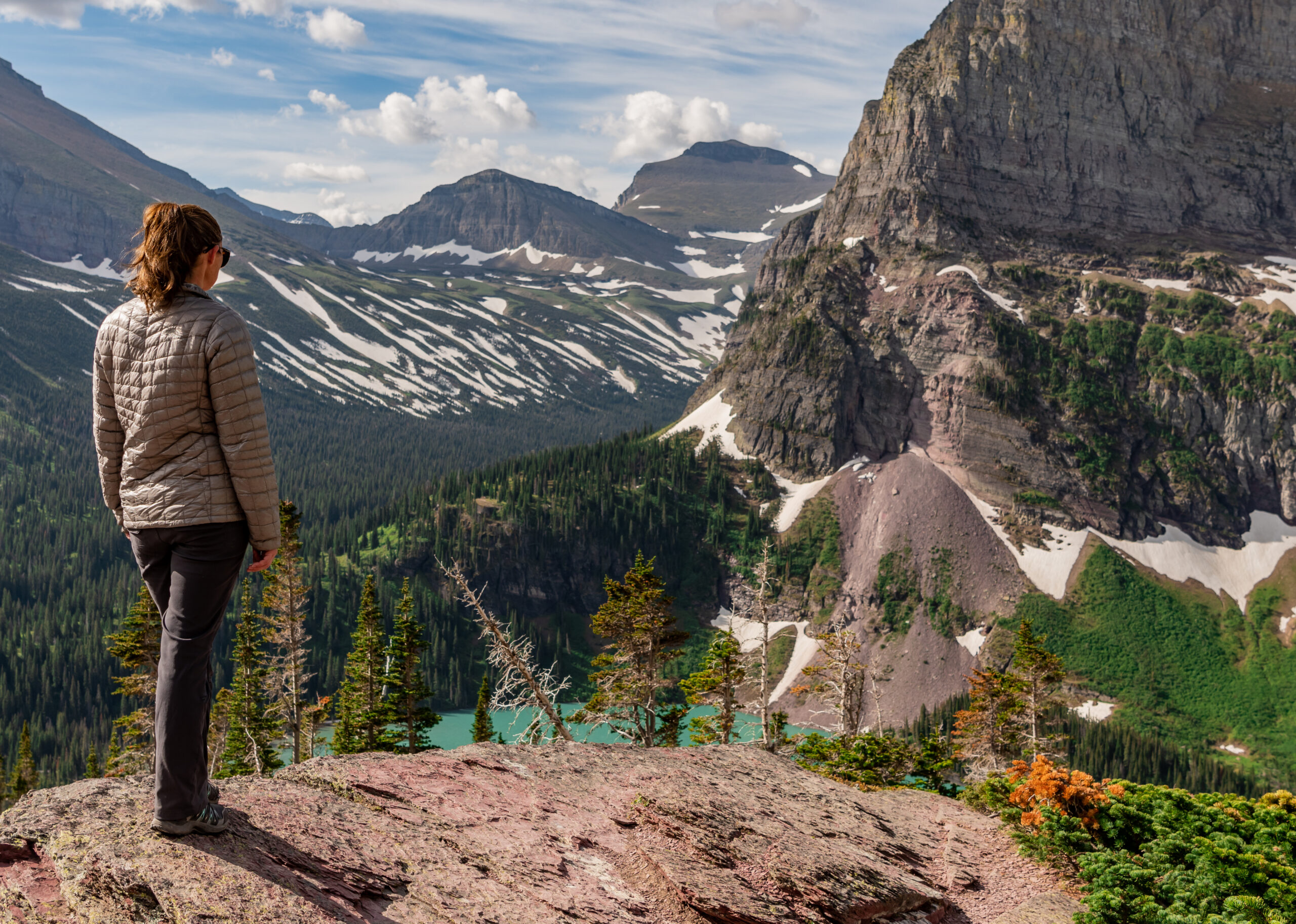
Even among an absolutely breathtaking suite of American national parks, Glacier National Park is an exception. With soaring snow-topped peaks, shining alpine lakes and stunning stands of forests, this northern Montana park (which technically extends all the way into Canada) truly feels surreal in its level of beauty. 

Because it’s so far north, though, many of the most beloved sights in Glacier National Park are only accessible for a very short window of time—mostly just July and August. Couple that with an annual average of three million visitors, and you can quickly understand why some of its most beautiful hiking trails are also among the most crowded. 

Fortunately, it is possible to enjoy the majestic scenery of Glacier National Park—without the constant presence of strangers in your photos. We’ve coupled with AllTrails to bring you the best hidden gem crowd-free hiking trails in Glacier National Park (and many others, which you may have seen on the blog lately!). And, of course, we’re always here to help make it clear that RV camping is the very best way to enjoy any outdoor adventure destination with all the creature comforts of home.

Best Crowd-Free Trail Suggestions by AllTrails

If you’re on this page, it’s safe to assume you’ve heard of AllTrails, the all-in-one app that puts the great outdoors in your pocket. Along with the trail maps, user reviews and other helpful information available to its free Base members, AllTrails offers upgraded paid services—and they’re well worth their weight in gold.

For example, AllTrails Plus members can download trail maps ahead of time so they’ll be ready to go once you’re out of signal range, along with offering wrong turn alerts to keep you heading in the right direction. Better yet, an annual AllTrails Plus membership is now available at a 30% discount to our readers, but only for a limited time—so don’t hesitate!

Alright, without further ado, let’s get to the recommendations!

Skip Avalanche Lake; Try Kootenai Lake Instead

Not every trail on AllTrails has more than 26,000 reviews (and a star rating that darn close to five), but Avalanche Lake does. And to be honest, from the photos, it’s pretty easy to see why: at the destination viewpoint of this moderately challenging hike, which is less than six miles long and sees under one-thousand feet of elevation change round trip, you’ll arrive at a pristine, mirror-like alpine lake fed by multiple waterfalls. It’s pretty hard to imagine anything more beautiful.

However, that’s exactly the set of reasons that Avalanche Lake is also one of the most crowded trails in the park, with potentially thousands of visitors clomping along the trail all on the same day. A solution: head for Kootenai Lake via the Wateron Valley Trail instead, and enjoy a very similar hiking profile with far, far fewer interlopers.

This trail to Kootenai Lake is also just about six miles round-trip and is slightly flatter than Avalanche Lake Trail, putting it on the slightly lower end of moderately challenging. As you make your way through the lush valley between towering stands of trees, chances are good you might run into wildlife such as deer or even moose, which famously call this area of the park home, and you’ll also have the opportunity to cross a stream on a wooden bridge. When you arrive at the lake, you’ll again be greeted by the reflections of the surrounding mountains, as well as the clouds floating through the blue sky above and the water below. Best of all, compared to Avalanche Lake’s 26,000 reviews, this trail has a whopping 24 total. Which is to say, if you’re looking for peace and quiet, congratulations: You’ve found it.

Here’s what real-life hikers have to say about Kootenai Lake via the Wateron Valley Trail:

  • Beautiful trail. Quiet and woodsy.
  • Very easy hike with minimal elevation and great views all around!
  • Wilderness at its best.

Before You Go Considerations 

Every outdoor adventure has safety considerations to keep in mind. Here are a few for Kotoenai Lake.

  • Be bear aware. Glacier National Park is one of the premier homes of grizzly bears in the lower 48, and black bears live here too. Visit the NPS website for information about how to spot the difference—and what to do should you encounter either kind.
  • Wear long pants and sleeves. Because this is a trail less-traveled, it tends to be more overgrown than others. Keeping your body covered helps guard you against any irritating plants as well as ticks and, of course, the sun.
  • Make sure you’ve packed right. Water, snacks, and sun protection are key—and bear spray can’t hurt when you’re this deep in the northern mountain wilderness, either.

Skip the Highline and/or Grinnell Glacier Trails; Try Beaver Pond Loop Trail Instead

For those looking for a more rugged adventure, Glacier National Park treks like the Highline Trail or Grinnell Glacier Trail have a compelling appeal. Both of these trails figure in the double-digits as far as mileage, and each sees more than 2,000 feet of elevation gain along the way. Of course, the views they offer, including up-close encounters with glaciers and waterfalls as well as sweeping park vistas, make them worth every step and drop of sweat.

They are, however, overflowing with visitors—and not accessible for newer hikers, those who aren’t acclimated to elevation gain, or those traveling with kids. For a crowd-free hiking trail inside Glacier National Park that offers lakeside views as well as passing through aspen groves and wildflower-filled meadows, AllTrails recommends Beaver Pond Loop, decidedly on the easy side at just over three round-trip miles and only a few hundred feet of elevation change.

Although it might not be as dramatic as some of the other trails in the park, Beaver Pond Loop is pleasant and relaxing—and let’s be real, in a place as beautiful as Glacier National Park, the stunning views truly are everywhere you look. Like elsewhere in the park, wildlife encounters are common here, perhaps especially because it’s a trail less traveled by.

Here’s what real-life hikers had to say about their experience on Beaver Pond Loop:

  • Very peaceful.
  • Gorgeous brisk hillside walk.
  • Very quiet relaxing trail for a morning hike.

Before You Go Considerations 

Even easy hikes require preparation up front! Here’s what you need to know.

  • Consider a satellite device. Beaver Pond Loop is in an extremely remote part of Glacier National Park, and chances are very good you won’t have cell signal. Even on easy hikes, accidents can happen, and a satellite device puts help just a call or text away.
  • Consider the season. While during the long winter many parts of Glacier National Park are simply snowed over and inaccessible, even during the warmer months, weather can be unpredictable—and after rain, trails can be excessively muddy. Be sure to bring the right gear for any kind of conditions you may face, and check the weather forecast often.

Post-Hike Resources for Glacier National Park 

While visitors could easily spend weeks in Glacier National Park without seeing all of its majesty, there’s plenty else to enjoy while you’re in this neck of the woods, too. (For starters: Check out the best local RV campgrounds, both inside and outside of the park, from rugged adventuresome options to more luxurious digs.)

The nearby towns of Whitefish and Columbia Falls are chock-a-block full of fun food options, art galleries, and good vibes. We recommend a stop at Montana Coffee Traders for your quick caffeine hit in the morning, and a nice hearty post-hike dinner at Whitefish Lake Restaurant—whose views prove that all the best ones aren’t just inside the park.

Additionally, keep in mind that although Glacier National Park is, of course, stunning, it’s hardly the only vast wilderness in this area worth exploring. If you’re taking a longer RV trip, consider making stops at nearby Helena National Forest, Lewis and Clark National Forest, or Flathead National Forest. (That’s the best part about RV camping: It makes long trips into a breeze so you can see even more while staying comfortable!)

We sincerely hope you get a chance to take advantage of the stunning beauty of Glacier National Park, truly one of our national treasures—and that you’ll book an RVshare vehicle to do so. It’s the best way to enjoy rugged adventures from a cozy position, and since they’re owned by real people, RVshare rigs are always well-loved and homey. (Psst: Just don’t forget to download AllTrails before you get to the park—or about that 30% discount we mentioned!)


Source link