3.8 C
London
Tuesday, May 12, 2026
Home Blog Page 117

Using the right tool for the job, even if it’s a small bike that isn’t even a BMW

0
Using the right tool for the job, even if it’s a small bike that isn’t even a BMW


This is an edited version of Dustin’s story which ran in the July 2025 issue of BMW Owners News. To see the full story and more photos, take advantage of a full membership with the MOA and get the magazine every month!

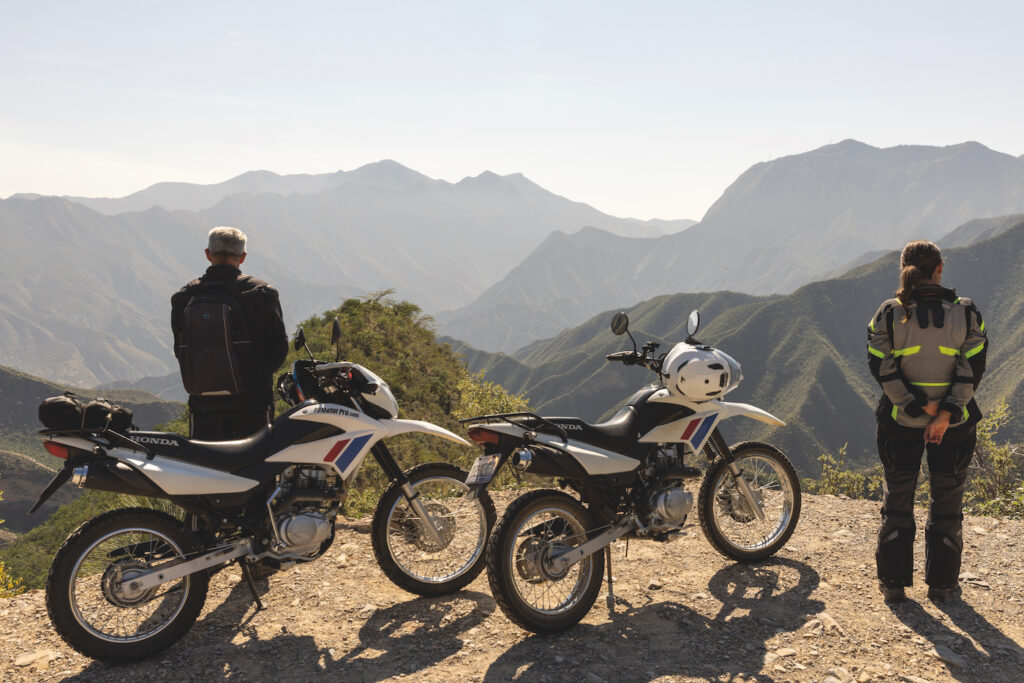
I often think back to riding in the Sierra Gorda Mountains of Mexico, ripping around on a little Honda XR150L last November. It reminds me of needing the right tool for a particular job.

A lot of us look down on smaller bikes (pun intended). For some reason, we all think we need a big bike. A bigger bike means more speed. Sure, on highways, I want a 1250 under me to rip past trucks. On forest service roads–great, let’s tear around some corners and show what this bike can do! But on crazy single-track or steep shale hills, I’ll take a 150–250 cc bike any day. It has more maneuverability, less momentum and is easy to pick up when I drop it.

Many people won’t believe how amazing a small bike is until they try one. If you want to experience the benefits of off-road riding on a small bike, look no further than François Deroeux. François is a professional motorcycle coach who’s competed in events like the Baja 1000. Since retiring, François now lives in the high Mexican mountain range of the Sierra Gorda, where he shows people the benefits of riding small bikes. When Janel and I visited Mexico last year, we had the privilege of riding with François for a full week on tiny Honda XR150Ls.
San Joaquín is located in the heart of the Sierra Gorda, about 170 miles from Mexico City. Waking up in our small hotel high in the mountains, as the sun rose over the mountains, Janel and I listened to roosters announcing the dawn, an occasional dog barking, and birds singing from the trees. It was a refreshing change from the noise of Mexico City.

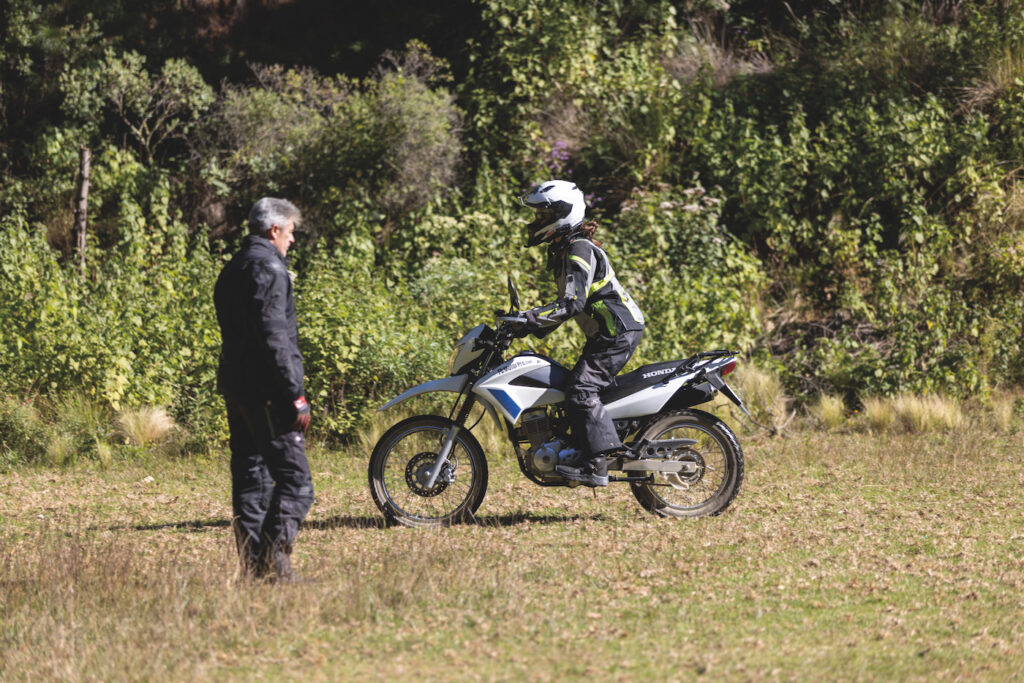
Later, as I geared up for my ride with François, he pulled up in a van and started unloading three XR150Ls. Janel was feeling poorly, so she wouldn’t join us on our first day together. I found the XR150L instantly impressive. It was comfortable, and at 5’9″, my feet touched the ground, and the handlebars were at the perfect height.

“Ready?” he asked. I nodded, and we were off.
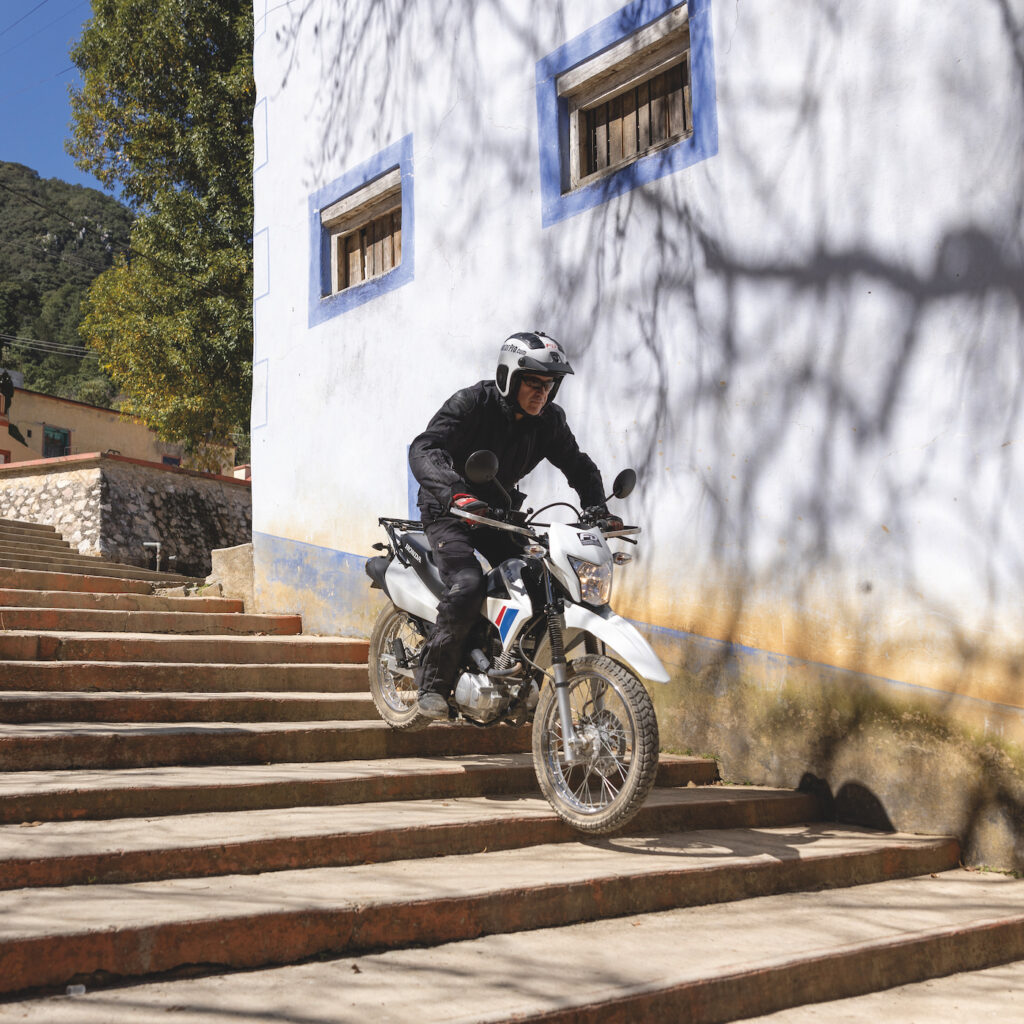
My first challenge was descending the steep mountain roads out of San Joaquín. I was taking it slow and adjusting to the bike as François jumped off the stairs and did stoppies, all while waving at locals who clearly knew him well.

“I hope you’re not expecting me to do all that today,” I joked.

“No, no,” he said. “We’ll go as fast or as slow as you want. Too easy–we make it harder. Too hard–you tell me. There are many places we can go.”

From there, we rode single-track trails, dirt roads and even ruins where we slid around on gravel. The XR150L was incredibly easy to toss around. Sure, on the pavement, it lacked punch, but on the trail–the bike’s true domain–it shined.
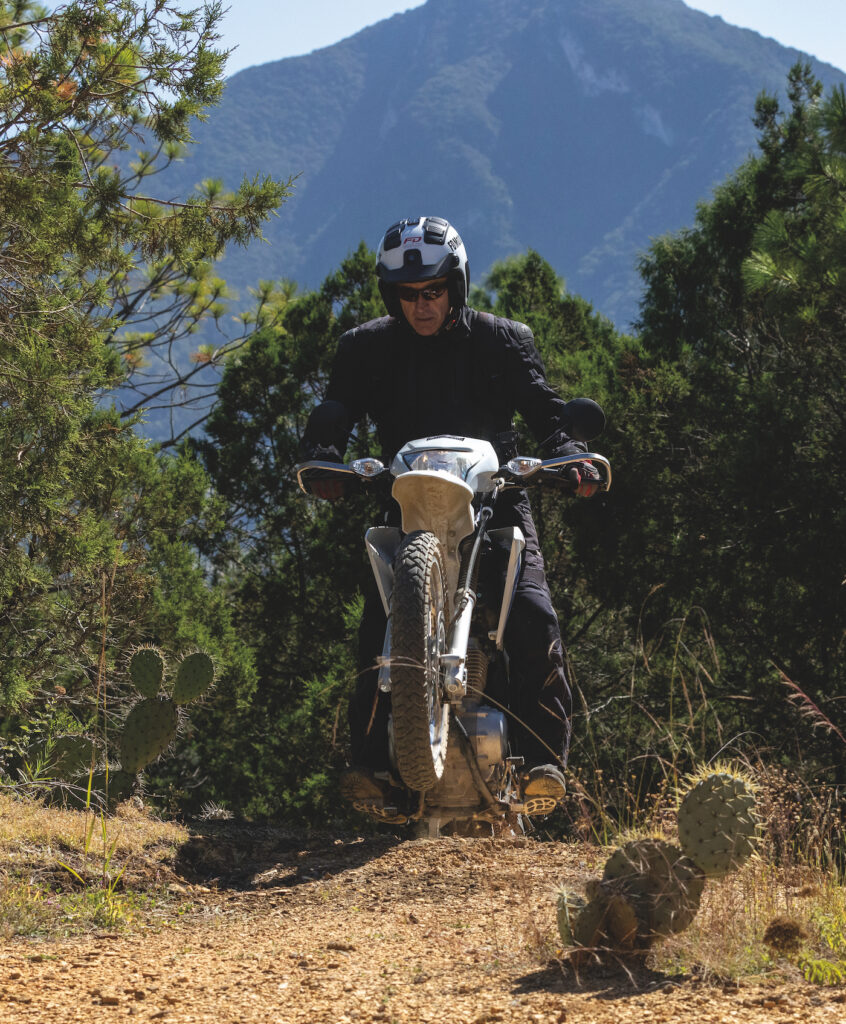
At one point, I lost focus and rode into an agave plant, where I dropped the bike. Being so light, I stepped off, picked it up and moved on. No sweat, no strain. François and I spent the day riding trails in the mountains and small towns. In El Doctor, we relaxed in the square under Day of the Dead decorations that still hung about the town, chatting about riding.

“People think they need big bikes,” he said. “It makes no sense. Small bikes take you everywhere. Tomorrow, we will get Janel out, and she will really see the advantage of having a smaller bike.”

Our drinks finished, we continued to play around with the bikes in the town, riding down steps and over the cobblestone streets. As the sun was getting low in the sky, we decided to head back to the hotel.

The next day, Janel was geared up and ready to ride. François and our guide Juan (the “Mexican Buddha” from earlier stories) went to breakfast with Janel. The market vendors in San Joaquín greeted François like family. We were served fresh orange juice and empanada-like treats stuffed with meat and veggies while trading riding stories.
At a nearby soccer field, François had a conversation with Janel about her limited off-road skill level, then walked her through what she would be doing. He spent his time making sure she was comfortable, let her know she could drop the bike anytime without shame and encouraged her to have fun. A short while later, Janel was standing on the pegs, weaving through cones like she had been doing it for years. In less than an hour, François had given Janel the confidence she needed to hit the dirt, winning high praise from someone who battles anxiety. François and the XR150L had clearly won her over.

“He’s really good!” she said to me later, “The little bike makes it so much easier to learn.”

With Janel feeling confident, we descended a steep paved road to a hydro plant that was car-free. Occasionally, François would veer us onto dirt paths to test out Janel’s new skills. Later, we were sitting on the bikes having a quick snack when François came over and pointed at a valley in front of us.

“We are going to go down one side and back up the other.” He said in his strong accent. “There are two water crossings, so great for photos.”
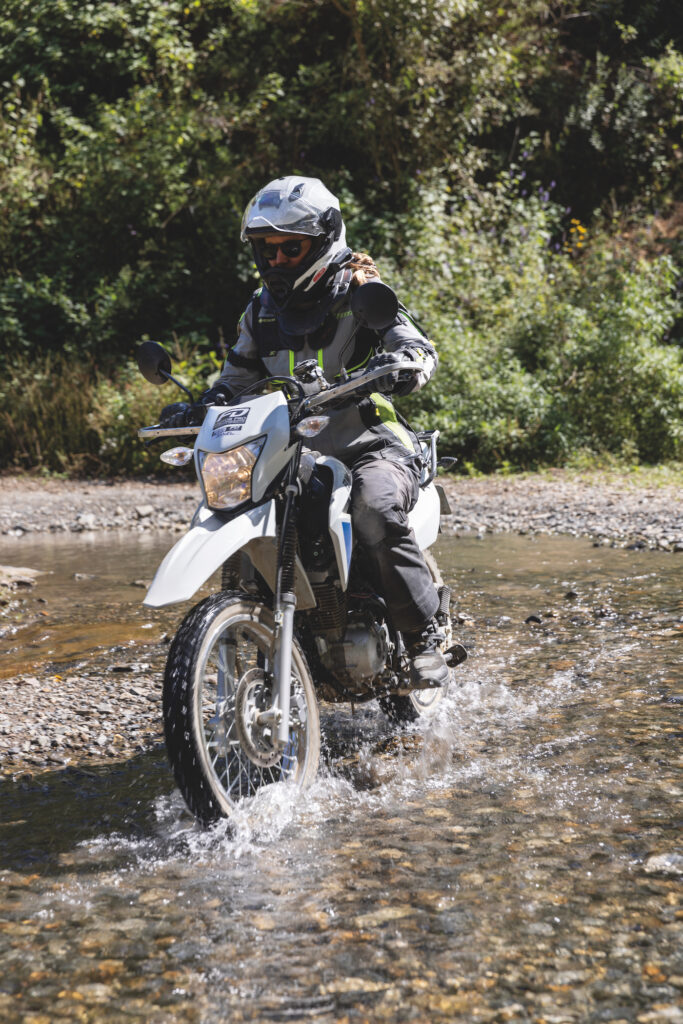
I saw Janel’s face pale when she heard “water crossings.” I reassured her, “It’s no big deal.”

We hit the dirt road and headed down into the valley. To say it was steep would be an understatement. Rocks littered the road, and rain had washed out the sides of it. Cars had driven on it, and in some places, the sand was as slippery as ice. I couldn’t believe cars drove on this road! The switchbacks were so steep that the corners were paved so vehicles wouldn’t get stuck.

I stayed behind Janel to make sure she was okay as François led the way. Janel made the odd stop to catch her breath and refocus, but we finally made it to the first water crossing without incident. The water was slowly flowing and about a foot deep with some rocks, but nothing too intense.

I pulled up next to Janel, and she looked at me and said, “I don’t think this is for me.”

I called François back to chat with Janel. He took his time to explain to her that she could do it and that she was on the right bike to make it through with ease. After the talk, Janel seemed a bit more motivated, and then, out of nowhere, she tore across the water crossing like it was no big deal. She was so focused she even forgot to stand up. When we came to the second crossing, she rode through it with ease. From there, we climbed back up the steep valley, each of us stalling a couple of times. Again, on such a small bike, it was no big deal to get started again.
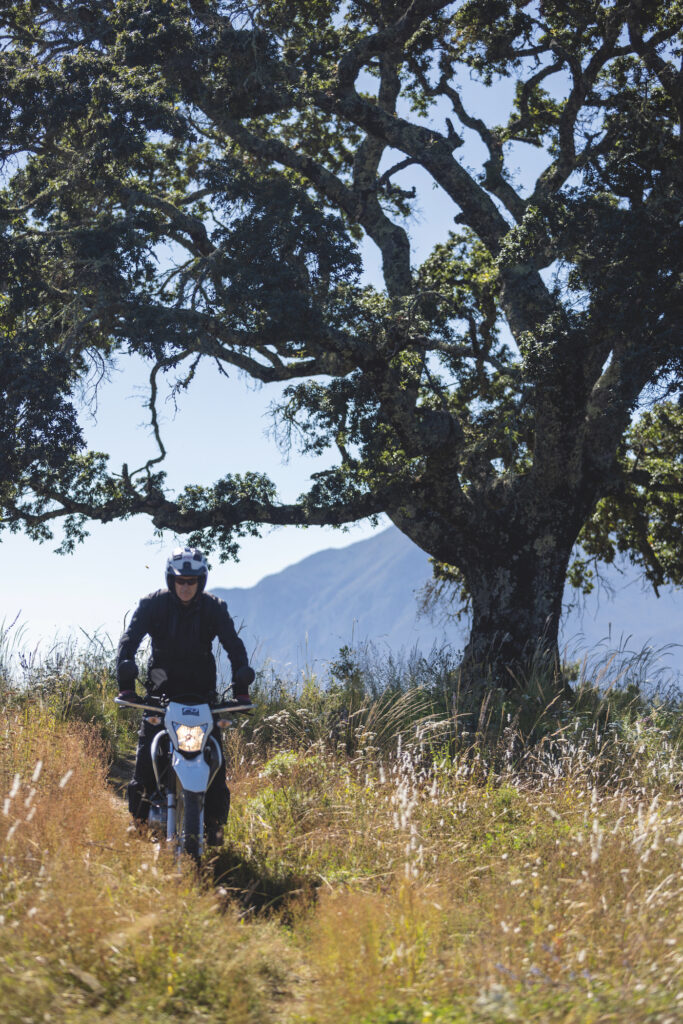
We rode for four more days, exploring diverse terrain, tackling new challenges, and taking in the incredible scenery. That first day, I had asked François why he used small bikes, but with every trail we rode, the answer became clearer. Small bikes allow skill growth, confidence, and access to places you’d never reach on a 650 or 1250. If I’d had an XR150L in Virginia City, I might’ve finished the poker run. Instead, I had to give up. I didn’t have the right tool for the job.

Some of us might scoff at small bikes, but seriously–check your ego, stay humble, and try one out. No matter how big your bike is, you are riding, and that’s what makes us cool.

MotoDiscovery, one of the world’s first motorcycle tour companies, has been running tours in Mexico for over four and a half decades. Partnering with François and his company, FD Motor Pro, they offer an eight-day tour through the Sierra Gorda, complete with riding lessons and breathtaking scenery. There are many instructors out there, but with François, you’ll get your money’s worth. Hit the dirt on small bikes, and you’ll never look back.

Source link

Charged EVs | Standex’s high-voltage reed relays meet new peak high-voltage testing standards

0
Charged EVs | Standex’s high-voltage reed relays meet new peak high-voltage testing standards


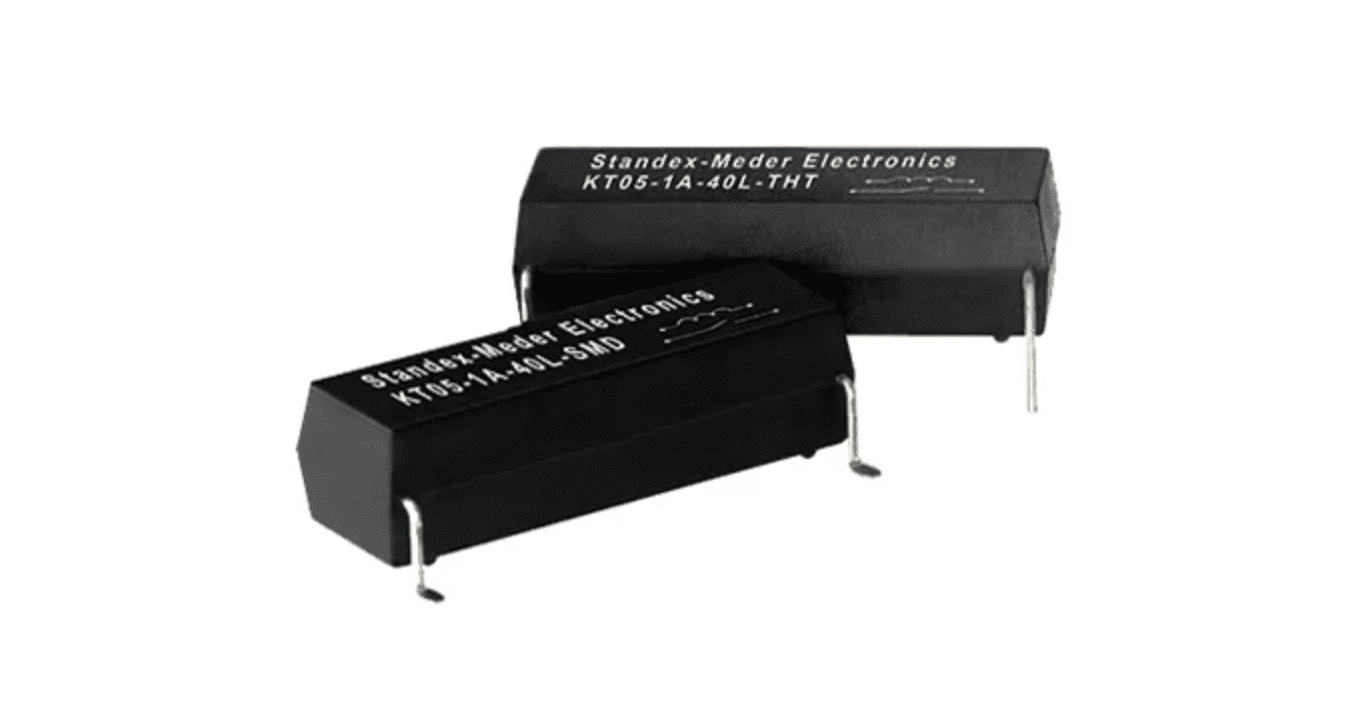
Standex Electronics, a supplier of custom-engineered electromagnetic components, has announced that its high-voltage reed relays now meet new peak high-voltage testing standards.

Standex does not perform high-voltage testing services, but its advanced relay technology supports applications that require compliance with the latest high-voltage testing benchmarks.

Standex’s high-voltage reed relays are engineered with hermetically sealed rhodium or tungsten contacts, offering reliable and long-life operation. Switching times are below 1 millisecond and breakdown/stand-off voltage levels up to 15 kVDC. These features make them well-suited to use in automated test equipment (ATE), medical devices, electric vehicles and alternative energy systems.

Designed for environments requiring low leakage currents and high insulation resistance, the relays deliver above 10 TOhm insulation resistance and low contact resistance in the range of tens of milliohms. They are suitable for ARC testers, battery management systems, pre-charge circuits or electrosurgical generators.

Source: Standex Electronics


Source link

Designing for a startup car company

0
Designing for a startup car company


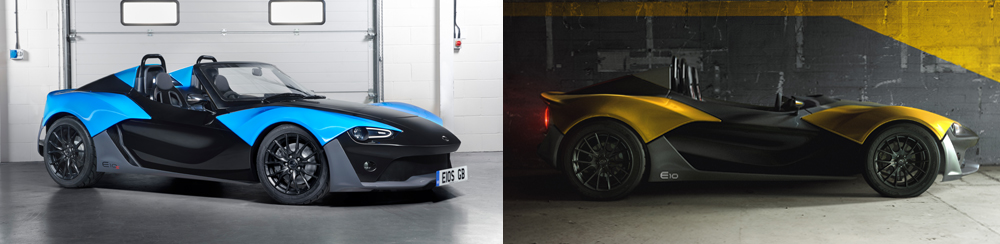
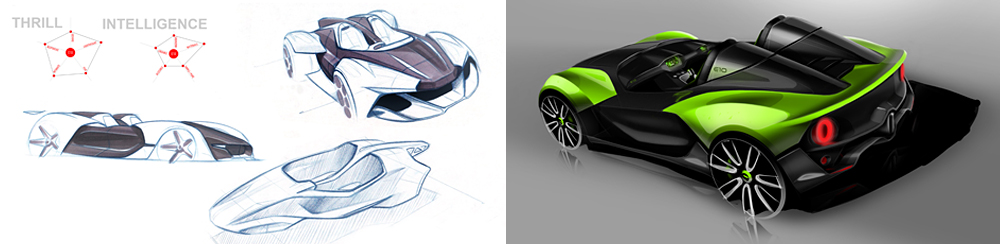
Zenos Cars engaged Drive to design their first mid-engined, track-focused, road-going performance car, the E10, because of our experience designing for a startup car company. Built around a monocoque made from recycled carbon fibre, the E10 was designed to embody Zenos’s brand values of belonging, thrill, and intelligence. Resulting in a new British sports car brand.

The E10 concept marked the culmination of an intense design and development period.  Drive and Zenos worked hand-in-hand to lay down the foundation for a “lightweight, affordable, fun to drive” car, that fitted a new range of thrilling and accessible sports cars.

The company founders Ansar Ali and Mark Edwards, explained their unique market proposition and we extracted a few key words that would define their brand.  Drive had to create a design language that would embody all of their aspirations, for a completely new British sports car brand.  The E10 would be a mid-engined, carbon fibre tubbed car priced at less than £25,000.

Drive Design initial Zenos E10 sketches
“Drive’s strength was their listening, understanding and articulating the market and our type of customer needs – the way they interrogated, challenged and interpreted them were in alignment with how we saw it.” Ansar Ali

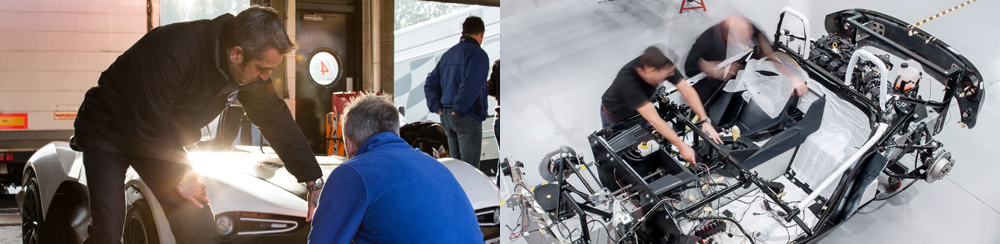
A challenges during the initial design process was achieving the delicate balance between a friendly, approachable look fitting the brand values, with a thrilling, lightweight track day car.  With  affordability in mind, Drive wanted to highlight the innovation of the carbon composite material and reflect the intelligence of the styling.  The break up of panels, wings and tub allowing ease of production and lower repair costs compared to the single clam mouldings used on competitor products.   Drive’s designers, working closely with engineers and composite manufacturers Bright Lite Structures,  developed the final break down of parts and assemblies.

The close relationship between Drive and Zenos, and the openness of the management team were key to ensure that the design and business needs aligned at every stage of he project.

Designing a car for a start up company
“For us Zenos was an extremely exciting project; it’s not very often that you get the opportunity to build something from scratch, to help launch a new brand and start up company and have so much influence on it,” Chris Longmore.

The public’s response to the car’s design was measured by the 40 deposits taken from customers before they had even seen it run.  This justification of the product, only raised the pressure to deliver on their promise to have the production model ready for January 2015.  Drive and Zenos launched into a rapid production development phase sensitive to the fact that the car’s appearance couldn’t alter significantly, but taking the opportunity to tune the car’s character and balance.

This phase involved working with suppliers on feasibility whilst ensuring manufacturing costs were kept on target keeping to the business plan and budget.  The secret of the E10’s affordability relative to its performance, is off-the-shelf Ford components engine, gearbox, and brakes.  The innovative composite tub made from recycled carbon fibre that offers 70 per cent of the lightness and stiffness of pure carbon-fibre for a tenth of the cost.

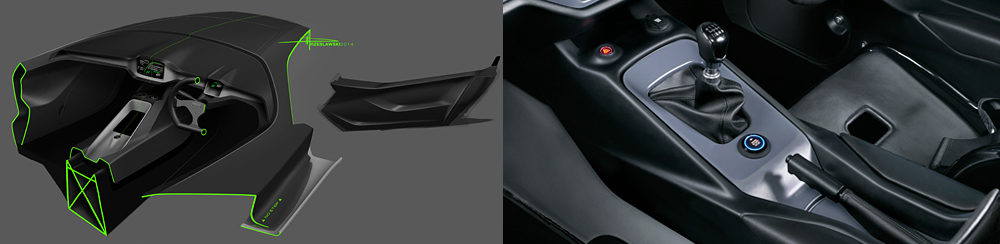
Designing for a startup car company - interior

The interior’s design, built around the ideal driving positon, the quality of the panels and fit had to exceed what would be expected at the cars price point.  This approach saw Zenos Cars has take more than 110 deposits and a first year production run being approximately 70.  For Zenos’s founders Ansar Ali and Mark Edwards, the E10 represents the culmination of a dream.For Drive Design, it provides a mobile showcase for its design strategies for startup companies searching for the kind of collaborative, ground-up design approach that only Drive can deliver.

Designing for a startup car company

“Drive completely believed in and understood our vision right from the beginning. They committed themselves in every respect to developing the design of the E10, and helped us deliver a car that looks fantastic, great handling and well engineered” Ansar Ali. The Zenos E10 project is the essence of what we do at Drive.  We understand designing for a startup car company like Zenos.  We help them take their idea through to production whilst understanding their business needs.


Source link

Kia unveils EV4 Sedan and Hatchback exterior design ahead of world debut

0
Kia unveils EV4 Sedan and Hatchback exterior design ahead of world debut


The EV4 is designed to broaden the brand’s EV lineup, offering a fresh take on the compact electric segment with a strong focus on design and aerodynamics.

Kia EV4 SedanKia unveils EV4 Sedan and Hatchback exterior design ahead of world debut

The EV4 follows Kia’s Opposites United design philosophy, characterized by sharp lines, bold technical details, and a balance of contrasting elements. Both models feature a distinctive EV Tiger Face front-end design, vertically oriented headlamps, and Kia’s Star Map lighting signature.

Kia EV4 SedanKia EV4 Sedan

The EV4 sedan has a streamlined silhouette with a low hood, long-tail design, and a roof spoiler, enhancing aerodynamics and visual dynamism. A two-piece rear spoiler, vertical light units, and a clean bumper design contribute to a wide, modern stance.

TKia EV4 HatchbackKia EV4 Hatchbackhe EV4 hatchback shares design elements with the sedan but has a more solid, versatile look, featuring black vertical C-pillars, robust fenders, and sharply sculpted rear lines. The bold C-pillar trim emphasizes its proportions and adds a strong visual contrast. The lower body sections are characterized by the application of geometric patterns.

Kia EV4 SedanKia EV4 Sedan

The EV4 GT-Line variant introduces sportier design elements, including wing-shaped front and rear bumpers and triangular-patterned 19-inch wheels, reinforcing a more dynamic and futuristic character.

(Source: Kia)


Source link

( Tanzania) Kaypee Motors KP-A72

0
( Tanzania) Kaypee Motors KP-A72


The KP A72 is an all-electric pickup truck, locally manufactured by  in Tanzania. 

It’s designed to be efficient, affordable, and sustainable, targeting businesses in East Africa with its utility electric mobility solution. 

Locally Built: The KP A72 is manufactured in Tanzania, reducing import costs and promoting local industrialization.

All-Electric Powertrain: It features a durable battery system with low energy consumption.

Motor: 15Kw.

Battery: 96v 210Ah Lithium battery.

Charging: Full charge uses 10kWh, providing a 150km range at a cost of  $1.36.

Operating Cost: The KP A72 is significantly cheaper to operate (approximately 94% cheaper) than traditional mini trucks with internal combustion engines.

Payload: It’s suitable for carrying fast-moving consumer goods (FMCG), agricultural products, parcels, and general cargo.

Durability: The vehicle is built to withstand the rough roads and high-duty cycles common in African markets.


Source link

Saying Goodbye to This, My Travel Blog

0
Saying Goodbye to This, My Travel Blog


I published
my first post on this blog on January 29, 2010, eight months after we started
full-time RVing. Almost fifteen years later, I am posting this 590

th
post. It is also my last.

The
End of Our Travels

2018, we sold
our RV and settled at Viewpoint in Phoenix, Arizona. We continued traveling via other modes, so I changed the blog title but retained the domain
rvcruisinglifestyle.blogspost.com. 

These blog
posts went viral (up to35,000 views) on this blog:

  1. Debating the Pros and Cons of the RV Cruising
    Lifestyle
  2. Operationalizing Phase 2 of RVing in North Carolina
  3. Finding Christmas on Florida’s Treasure Island
  4. Going Up the East Coast
  5. Turning Wounds into Wisdom: Georgia
  6. Discovering More in New Mexico
  7. Reliving WWII in the Philippines
  8. Looking for a Base in Arizona
  9. Traveling Light in an RV?
  10. We RVed Fulltime for 8 Years. Here are the 10 Things
    We Learned
  11. Leaving No Stone Unturned in the Canadian Rockies
  12. 10 New Landmarks in Charming Mazatlan

The blog became a rich source of material for my two
travel books:
Carolina: Cruising to an American Dream and Cruising
Past 70: It’s Not Only About Outer Journeys. It’s Also About Inner Ones.

My husband and I returned from our last trip together
in May. He did not join me on a short solo trip to the Philippines in August.
We also canceled our 16th-anniversary trip to Leavenworth, Washington. Yes, we will
no longer be the wanderers we once were.

The Beginning of the End

In mid-2021, during the height of the COVID-19 pandemic, I was invited to write as an expert contributor for Travel Awaits, a travel magazine for the 50+ by the 50+. The magazine was experiencing a growth spurt at a
time when no one could travel, but retirement dreams soared.

I needed more time to write for two publications, but I did not have the heart to deactivate my blog. Instead, I wrote articles for the magazine and republished them on my blog.

Of the 60+ articles I wrote, the following went viral (150,000+ clicks):

  1. 6 Quaint Small Towns to Visit North of Anchorage,
    Alaska
  2. 6 Charming Small Towns to Visit in Southern Alaska
  3. 5 Things My Husband and I Practice in Retirement to
    Keep Us Young

Under the magazine’s leadership, my writing improved. However, I discovered that having
non-original content negatively impacted my blog. From 4,000 views per post, it
dwindled to 1,000.

When travel returned,
the magazine’s readership fell. It was bought by new owners, who redefined the
content with their writers. I am still on the roster but no longer actively
contribute. They republished some of my articles, but all writers’ retirement
pieces were removed.  

As trips became less frequent, I began writing on my blog about other topics (retirement and renewal, health and longevity). After my leadership award, I also wrote about leadership and management. My views dropped to less than 300 per post. I am no longer true to my niche. My writing needs a new home.

A New
Platform

While
writing for Travel Awaits, I was unaware that the blogging world had also changed.
The plummeting views have been traced to frequent Google algorithm changes, even
for the most popular blogs. It wasn’t just that I needed original content
(although I am sure that contributed). Bloggers turned to newer business
platforms.

Two of the
most popular ones are Medium and Substack

Medium is a single membership model with
over one million paid subscriptions. Editors recommend articles to their vast reader
base. The onus is to write quality articles about in-demand topics.

On the other
hand, Substack has four million paid subscribers distributed among its 20,000
or so writers, an average of 200 per writer. Writers are responsible for
promoting their writing and signing up subscribers.

Gemini, Google’s AI, helped me narrow my choice to one question: Should I spend my time writing quality articles or promoting my writing to subscribers? I don’t have the time to do both, as I want to work on my two new book projects.

It is time to deactivate this blog, even if I have yet to decide. Goodbye, Blogspot, Google’s blogging platform. Thank you for being a good home for my travel writing.

Thank you
all for sticking with me through the years. I hope to see you again on my new
platform or when one of my books is published. I wish you all a Merry Christmas and a
Happy New Year!


Source link

DESIGN STILL MATTERS, PART IV. – Rants

0
DESIGN STILL MATTERS, PART IV. – Rants


By Peter M. DeLorenzo

Detroit. In the midst of the summer doldrums (and my excruciatingly frustrating recovery, by the way), a bolt of lightning has arrived from Modena, Italy. A glorious spark that should give auto enthusiasts hope that all is not lost with this dismal business at this juncture.


Before I get to this beautiful automotive revelation, let’s review the current state of the business, shall we? Automobile manufacturers and their suppliers alike have been tossed into the Swirling Maelstrom by a series of arbitrary and maliciously capricious tariffs that threaten to decimate this business as we know it. To what constructive end? I’ll answer that for you: There is no constructive end, despite what certain auto CEOs are spewing in public to assuage the blithering stumblebums in Washington. (That the current auto CEOs are twisting in the proverbial political winds is flat-out pathetic. Where do they stand on anything? It depends on what week it is.)


Remember, all of the moves being made in Washington are based on the “finger-snap” mentality as practiced by the entrenched politicos, which revolves around the theory that turning a giant industry – part of the foundational industrial fabric of this nation – around is just a matter of making a few pronouncements and the rest will “just work itself out.” It doesn’t matter that it takes years to build production-ready plants and to develop supplier participation to form an efficient supply chain. This is after this industry sank hundreds of billions into developing an EV manufacturing and retail scenario, which is, all of a sudden – poof – gone with the wind. But according to Washington politicos, it will just work itself out. As if.


Where does that leave the consumers, who, this just in, determine the futures of these car companies? Not in a good place, as you might imagine. Sure, the car companies thrived as of late because of buyers trying to get ahead of whatever tariffs will be unleashed. But the ugly undertone to this business has now surfaced in the form of 72- and 84-month payments, with an average retail price for vehicles pushing $50,000. And even more alarming? One in five new car buyers have signed up for $1,000 per month payments. Is this sustainable? No, of course not.


This industry is headed for a dead reckoning, a scenario where sales plummet for any number of factors, including the most important one: it just costs too damn much to get into a new vehicle. The manufacturers insist they’re hard at work addressing the affordability issue, but when will these efforts come to retail fruition? 2026? 2027? Not. Soon. Enough.


Meanwhile, in other news, Nissan is still trying to insist that it will survive, pretty much singing from the same songbook that it has for years. But is it just whistling past the graveyard? Count on it.


And then there’s Stellantis, which is desperately trying to walk back the monumental mistakes that the company made over the last few years. Giving Tim Kuniskis control over basically everything in North America is a hugely positive step, but he will be racing against time in rebooting the Dodge performance envelope. That’s one thing, but dealing with – aka rolling back – the egregiously misguided Jeep pricing won’t be as easy. “A hard rain’s a gonna fall” out in Auburn Hills, I’m afraid.


As for Ford, its CEO is trying to project himself as being in tune with the “working man,” which is laughable, but as long as the company keeps offering employee pricing for everyone (now converted to “0 percent” financing -WG), it will continue to stay afloat, apparently. (Speaking of Jim “I’m a genius just ask me” Farley, it has been widely reported that while speaking at the recent Aspen Ideas Festival, Ford’s CEO said that AI will replace “literally half of all white-collar workers in the U.S.” Well, now here’s an idea, Jim... why don’t we start with you?)

And GM’s ICE portfolio is formidable, but its giant EV offerings are headed for disaster. “Too Big, Too Heavy, Too Much” is not necessarily a long-term marketing strategy. As for its future EV portfolio, as I’ve stated repeatedly, the new Chevrolet Bolt will have to be a grand slam home run. Anything less will be a crushing disappointment.


All that being said, you would think this business is steadfastly delusional and free of any hope whatsoever, and the aforementioned points give us plenty of reasons to think that.


But as I hinted at the beginning of this column, every once in a while, a bolt of lightning comes down from the heavens – or in this case, Modena – to remind us of just how glorious this business can be.


First of all, design still matters in this business. In fact, it is the one ingredient going forward that will separate the real players from the pretenders. Remember, this business is first and foremost a fashion business, so, look, feel and stance count for absolutely everything. Secondly, emotionally compelling design is the proverbial straw that stirs the drink, and it can’t be faked or “phoned-in.” A machine either has it, or it doesn’t.


Yes, design is crucial, and as much as the full-zoom, mid-engine supercars of the day have a certain appeal – the Ferrari 296 GTB and Daytona SP3 being my personal favorites – the enduring allure of the classic front/mid-engine, rear-wheel-drive coupe remains my favorite. And up until this point in time, the most elegant and emotionally compelling execution of that form was the Ferrari Roma, which made its debut in 2019. But that was six years ago, and Ferrari has decided that the time is right to introduce its successor.


The new Ferrari Amalfi is “a blend of modern elegance and performance,” according to Ferrari PR minions, but that doesn’t do it justice. Not even close. This successor to the Roma (we weren’t even close to being tired of it! -WG) is powered by a twin-turbo V8 that delivers more power and performance than the Roma. The new engine control unit, advanced turbocharging management and new pressure sensors push the twin-turbo V8 to a maximum power of 631HP at 7,500 rpm and 561 lb-ft of torque between 3,000–5,750 rpm. Ferrari claims a 0–100 km/h (0–62 mph) sprint in 3.3 seconds and a top speed of 320 km/h (199 mph). You can watch the intro video here


The Ferrari Roma was one of my all-time favorite machines from the Italian sports car manufacturer. But the Ferrari Amalfi is all that and much more. Ask any designer, and he or she will always say it’s about proportion and stance. The Amalfi has all of that, and then some.


The Ferrari Amalfi is an elegantly emphatic reminder to the True Believers in this business that Design still matters. If what you’re working on doesn’t move your personal needle as a designer or an engineer, then something isn’t right. Do something about it. Make it better. Make it ring true to yourself.


It’s also a reminder to auto enthusiasts everywhere that there are still True Believers at work in this business who believe in bringing emotionally compelling designs to the street. Designs with that unmistakable look, feel and stance; designs that will resonate for years to come.


Thank goodness for that.


And that’s the High-Octane Truth for this week.

DESIGN STILL MATTERS, PART IV. – Rants(Ferrari images)


Source link

2026 BMW 5 Series Technology, Design, and Performance Features

0
2026 BMW 5 Series Technology, Design, and Performance Features


2026 BMW 5 Series Technology, Design, and Performance Features

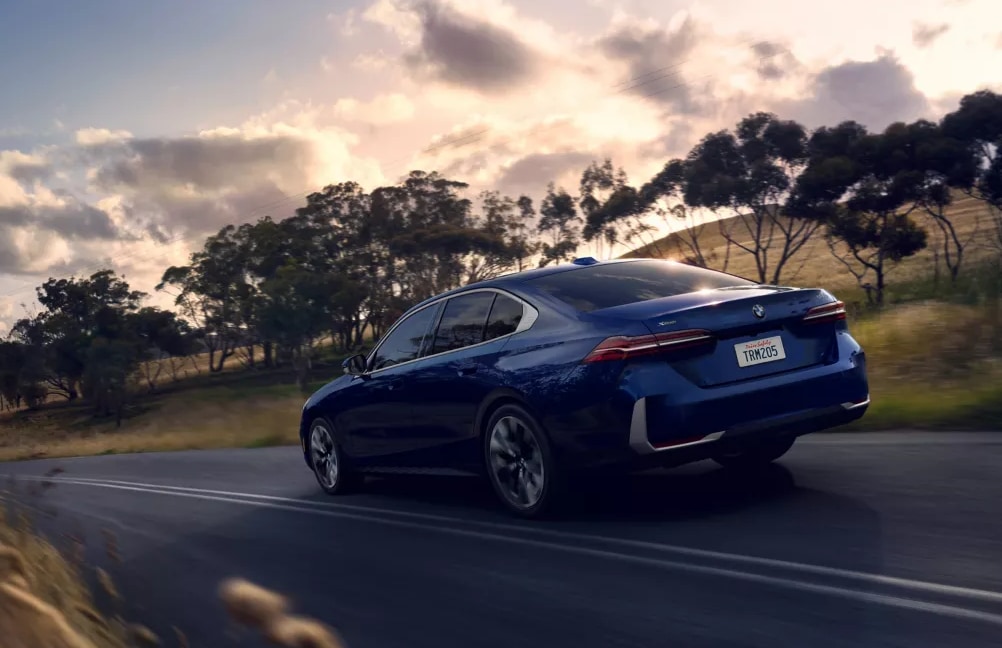
Luxury sedans everywhere are striving to keep up with the 2026 BMW 5 Series. Its innovative technology, elegant design, and powerful performance are the envy of the automotive world. Set your expectations higher than ever before and learn more with the team at Fields BMW Northfield.

Cutting-Edge Technology

Smart technology is everywhere inside the 2025 BMW 5 Series, guided by the BMW Operating System 8.5, an intelligent system that makes it easy to adjust your vehicle settings, find your navigation route, and choose your infotainment options. The BMW Curved Display™ easily syncs with your smartphone and even gives you access to AirConsole video games. With the 12-speaker, 205-watt Harmon Kardon Premium Sound System, you’ll enjoy an intense and balanced audio experience.

Impeccable Design

New BMW models always lead the pack in luxurious design amenities, and the 2026 BMW 5 Series is no exception. You’ll get to choose between four vegan synthetic leather options to go with your standard moonroof, but for even more elegance, you can upgrade to a model with the available Sky Lounge Panoramic Roof.

Stunning Power

The 2026 BMW 5 Series lets you choose the power you command with two engine options:

  • 0-liter BMW TwinPower Turbo inline four-cylinder engine
  • 0-liter BMW TwinPower Turbo inline six-cylinder engine

You’ll be able to accelerate from zero to 60 mph in as little as 4.1 seconds. If you opt for a model with xDrive® (the intelligent all-wheel drive system), you’ll have the benefit of enhanced traction when the road or weather conditions change.

Experience the 2026 BMW 5 Series Near Chicago, IL

A luxury sedan like the 2026 BMW 5 Series needs to be driven to be believed. Stop by our BMW dealership near Chicago, IL, to experience one in person. Our financing experts will be ready to customize a lease or loan offer just for you, so contact us to schedule your test drive appointment today!


Source link

£1500 off Renault, Nissan, Citroën, Vauxhall EVs as grant list grows

0
£1500 off Renault, Nissan, Citroën, Vauxhall EVs as grant list grows


He also noted that the Japanese firm has three new EVs on the way, referring to the Sunderland-built electric Juke, Qashqai and Leaf – the last of which is due imminently and is in a “very strong position” to benefit from the maximum £3750 grant.

Meanwhile, the UK-built Citroën e-Berlingo and Vauxhall Combo Life Electric have been awarded the lower discount. This is likely to be because their batteries come from abroad, while the Nissan Leaf’s battery will be supplied by the AESC factory next to Nissan’s Sunderland plant. 

The government has not given any indication of when to expect the next batch of ECG-eligible EVs, but many sub-£37k EVs – including many from Asia that are unlikely to be deemed eligible on the basis of their manufacturing and export CO2 footprints – have already been discounted by their makers.

Unlike with the previous Plug-in Car Grant (PiCG), buyers don’t need to register for the discount; instead, the ECG is automatically applied to the sale price of the eligible models.

Transport secretary Heidi Alexander said: “This summer, we’re making owning an electric car cheaper, easier and a reality for thousands more people across the UK.”

To qualify for the grant, car manufacturers’ models must meet science-backed emission-footprint criteria, while the individual model lines must be priced under £37,000 in entry-level trim.

Which discount a model receives – either £1500 or £3750 – is determined by its environmental impact: how much CO2 is emitted in an EV’s production and assembly, along with the emissions footprint of its battery manufacture. Threshold levels have yet to be made public.

While any manufacturer can apply for their car to be included in the scheme, it’s thought that, due to this criteria, cars produced in Asian countries will not be eligible for the ECG.

Worries about manipulation of the scheme have already been raised. For instance, sources have revealed to Autocar that car makers will be able to self-register EVs to receive the ECG.


Source link

One Beast of a Beauty – Car Design Blog

0
One Beast of a Beauty – Car Design Blog


One Beast of a Beauty – Car Design Blog

If there’s one car that has captured my heart in 2017, it’s the newly designed 2017 Kia Sportage.  For me, it is the epitome of “luxurious looking” sports SUV.  Beautiful side-view lines, an aggressive , yet elegant, front profile with the piercing Headlight lenses, and the gorgeous Tail Lights which give the illusion that the car is in motion, even when parked.

I know we have all been discussing (with much surprise) about the renaissance of KIA in the recent years.  We ask, as we stutter, “who? how? what the… when did a Car Design Prince kiss the ugly Kia frog and turn it from a mundane, boring pile of aluminum to an amazing beauty with a striking balance of aggressive looks and elegance?”

The 2017 Kia Sportage is a perfect example.

NOW FOR THE NITTY GRITTY!


FRONT
2017 Kia Sportage - CarDesignBlog.com

Upon first look, you are met with a front profile that exudes a presence and lets you know “I am here!”  The now-familiar Kia front grille, flanked by the headlights with the piercing lenses, lets you know that this isn’t just an ordinary Crossover SUV. 

There is a significant distance between the ground and the headlights (marked with the yellow arrow), which makes the bumper and grille look very bulky, but it works.  Reminds me of an alligator staring at you!  It also helps protect the beautiful headlights during a minor-to-mid force front collision.

One awkward area is the foglight area (circled in yellow):  They look ok with the actual fog lights that come with the higher trim models, but the low trims have no fog lights.  That space is just blank, sitting on the bumper, begging NOT to be noticed.


LIGHTS

HEADLIGHTS
2017 Kia Sportage - CarDesignBlog.com

No doubt, one of the best elements of the 2017 Kia Sportage.  The round lenses, along with the subtle signal lights, while impressive on their own, are given more prominence by the fiberglass-looking enclosure.  If only Kia added the words “Sportage” on the side (marked with the arrow), they will be ranked up high with coolness with headlights of BMWs, Maseratis and the likes.

2017 Kia Sportage - CarDesignBlog.comTAIL LIGHTS

The tail lights are equally exciting, carrying over to the side panels, a trend which was impressed upon the public by the Kia Optima.  The Sportage looks like it’s in motion, even when parked.  Again, like the headlights, when it comes to classiness, the Tail Light is a close match to a high-end luxury automobile such as the Porsche or the Jaguar SUVs.

FOG LIGHTS

Three trims (LX, EX and SX): 2 of them look nice with the lights and the accent lines underneath the lights (EX and SX).  The LX is the awkward looking area mentioned above. (Ok, fine, it doesn’t look as awkward on the black color Sportage… but only on black!).  The SX has the 4-light-foglight (that exists on other Kia SX trims, such as the Optima)  that look like they can light up a baseball field. 

2017 Kia Sportage - CarDesignBlog.com

SIDE

The side view profile of the 2017 Kia Sportage is streamlined, with subtle chrome accents and the piece above the back windshield.  The rear windows end in more of a rectangle, giving the impression of a roomy interior.

2017 Kia Sportage - CarDesignBlog.com

BACK
2017 Kia Sportage - CarDesignBlog.com

The back outline of the 2017 Kia Sportage mimics the front, with the narrow top, and the wide panels.  The Tail Lights are spread apart with a good distance, providing an amply sized stage for the Kia emblem to shine.

Everything looks nice, EXCEPT!!! A question here for KIA: What is the deal with the middle, red, cheesy plastic piece between the Tail Lights (circled in yellow)? That piece has Got To Go!

There is a version with a chrome piece covering part of it, which actually looks much nicer.  KIA, do us a favor and include that chrome piece on all trims.


INTERIOR

Very sporty!  Lots to like here; too many to elaborate individually, but, here’s a list of a few:

  1. Sporty steering wheel, with the hollow “U” shape at the bottom giving it a kick-up-a-notch
  2. Nice big screen (of course, with the navigation package).  May want to check if they have a version with just Android Auto or Apply CarPlay (7″ screen?)
  3. Great lighting of the dashboard in the dark
  4. Seats look great with the sporty stitching
  5. Higher trims come with the dual color interior (not crazy about the tan color)
2017 Kia Sportage - CarDesignBlog.com

DISLIKES

Fortunately, not much.  There are (only) 2 dislikes: the first is just a nuisance; the second is a big disappointment!

2017 Kia Sportage - CarDesignBlog.com

The First, the nuisance: the knobs for the Volume and Tune are tiny.  Alright, no big deal, hence it’s just a nuisance.

The Second… have to pause here and shake my head with disappointment.  It’s not JUST on the ’17 Sportage; Kia seems to be moving backward in time when it comes to this element of the instrument cluster.  I’m talking about the fuel and temperature gauges.  While the older models were square lights, which looked very cool, the new models seem to be going back to the cheesy red dials, which cheapen the instrument cluster and make it look like an old (or even new) Ford.  Come on, Kia… You have to go back to the lights!


IN CONCLUSION

Overall, the 2017 Sportage is a big win for Kia; great design, great drive, awesome technology, and a Solid 9.75 out of 10 in my book!


Source link