Driving a BMW is an exhilarating experience in itself, but did you know that you can further enhance your driving pleasure by upgrading your vehicle with additional features over the air? BMW has embraced cutting-edge technology and introduced the revolutionary BMW ConnectedDrive Upgrades. These upgrades allow BMW owners to equip their applicable models with optional features even after the initial configuration and production of the car. In this blog, we will delve into the exciting world of over-the-air upgrades, discussing how they work, the benefits they offer, and the various options available.
What are BMW ConnectedDrive Upgrades?
BMW ConnectedDrive Upgrades is a forward-thinking concept that enables BMW owners to personalize their driving experience. Unlike traditional upgrades, which often required visiting a dealership, these upgrades can be seamlessly delivered to your car through a secure online connection. This means that your BMW can evolve over time, adapting to your changing preferences and the latest technological advancements.
How do BMW ConnectedDrive Upgrades work?
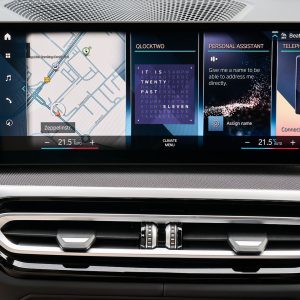
The process of upgrading features in your BMW is surprisingly straightforward. Once your vehicle is connected to the internet, you can access the BMW ConnectedDrive Store directly from your in-car infotainment system or through the BMW Connected app on your smartphone. From there, you can browse through a wide array of optional features available for your specific BMW model.
Each upgrade is carefully designed to integrate seamlessly into your vehicle’s existing systems, ensuring a smooth and hassle-free user experience. With just a few taps, you can unlock new capabilities and take your BMW to new heights of performance, convenience, and safety.
Lifetime vs. Limited-Time Upgrades
When it comes to BMW ConnectedDrive Upgrades, you have the flexibility to choose between lifetime upgrades and limited-time upgrades. Lifetime upgrades provide you with access to the upgraded features for as long as you own the vehicle. On the other hand, if you are curious about trying out certain features before committing to them indefinitely, you can opt for limited-time upgrades. These give you the chance to experience the enhanced capabilities for a predetermined period, after which you can decide whether to make the upgrade permanent.
Embracing Trial Offers
BMW is always keen on ensuring customer satisfaction, and that’s why they offer free trials and special test offers for some features. These trials provide a risk-free opportunity for BMW owners to sample the benefits of a particular upgrade without any upfront commitment. By test-driving these features, you can assess how they align with your driving habits and lifestyle, allowing you to make informed decisions about their long-term adoption.
Popular BMW ConnectedDrive Upgrades
The BMW ConnectedDrive Upgrades catalog boasts an impressive selection of features designed to cater to diverse preferences. Here are some popular upgrades that have captivated BMW enthusiasts worldwide:
BMW Enhanced Bluetooth: Seamlessly integrate your smartphone with your BMW for hands-free calling, audio streaming, and access to your favorite apps.
BMW Advanced Real-Time Traffic Information (RTTI): Stay ahead of the traffic with real-time updates on congestion, accidents, and road closures.
BMW Remote Services: Control various functions of your car remotely, such as locking/unlocking, climate control, and finding your parked vehicle.
BMW Concierge Services: Access a personal concierge for assistance with restaurant reservations, travel bookings, and more.
BMW Head-Up Display: Project important information, such as navigation directions and speed, directly onto the windshield, enhancing driving safety.
The BMW ConnectedDrive Upgrades have revolutionized the way we interact with our cars. With the ability to equip your BMW with additional optional features over the air, you can continually enhance your driving experience, ensuring your vehicle remains up-to-date with the latest advancements. Whether you opt for lifetime upgrades, limited-time offers, or trial opportunities, the power to personalize your BMW is now at your fingertips. Embrace the future of driving and take your BMW to new heights of luxury, convenience, and innovation. Upgrade your BMW and unlock its boundless potential today!
In this episode of the RVing with Joe & Kait podcast, we chat with Ethan Wayne, son of legendary actor John Wayne, about how growing up on remote film sets shaped his love for the road and his unique entry into vanlife.
Ethan shares stories from his early days as a stuntman, how traveling with his dog Finn inspired his van builds, and why he chooses to stay in his Storyteller Overland during cross-country trips for the John Wayne Cancer Foundation. We also dive into the mission behind the Grit Series trail runs, the Foundation’s impact on cancer care, and how vanlife has helped him slow down, simplify, and embrace life with more calm and gratitude.
I love the fact that some trips are horrible and you’re hot and sweaty and you’re dirty and you’re uncomfortable – and other ones are just amazing. So it really helped me just chill out, relax.
Ethan Wayne on camper van life
Ethan Wayne on Vanlife and Carrying the John Wayne Legacy
Where to listen
If you enjoyed this episode of RVing with Joe & Kait, please leave a review on Apple Podcast or Spotify. It would mean a lot to us. Thank you!
Episode Guest
Ethan Wayne is the president of John Wayne Enterprises and Director of John Wayne Cancer Foundation.
John Wayne Enterprises’ mission is to preserve and protect the name, image, and likeness of John Wayne by associating the John Wayne brand with quality and timeless products and experiences that embody the spirit of John Wayne and give back to the community.
The mission of the John Wayne Cancer Foundation is to lead the fight against cancer with courage, strength, and grit. John Wayne Cancer Foundation funds novel and innovative programs that improve cancer patients’ outcomes and save lives through research, education, awareness, and support.
Resources Mentioned in this Episode
Key Highlights
RVing Since Childhood: Growing up on Western film sets in remote locations, Ethan Wayne’s earliest memories involve traveling and living in RVs.
From Stuntman to Soap Operas: After the loss of his father, Ethan was introduced to the film industry through stunt work on The Blues Brothers, Knight Rider, and BJ and the Bear, eventually landing an acting role on The Bold and the Beautiful.
Building Community Through Travel: Ethan emphasizes the camaraderie found in the vanlife community, particularly within the Storyteller Overland group, where friendships often start with just spotting another van.
Why He Chose Storyteller Overland: Climate control for his dog Finn, no generator, and reliable build quality made Storyteller an ideal upgrade from his self-converted camper van.
Lessons from the Road: RVing has helped Ethan slow down, embrace discomfort, and appreciate the freedom of movement, even during “bad” travel days.
Every Vanlife Trip Isn’t Perfect and That’s Okay: Ethan reflects on the less glamorous side of RV travel – from sweltering nights and muddy dogs to unexpected mechanical issues – and embraces it all as a meaningful part of the journey that makes the rewarding moments even more worthwhile.
Camp With a Cause: Some of the John Wayne GRIT Series runs are held in remote, scenic locations that naturally align with RV travel. These events offer a chance to plan a stop that blends the outdoors with the opportunity to support cancer research and connect with a like-minded community.
📞 Book a Call with Joe
Whether you’re buying your first RV, planning your next trip, or exploring the RV lifestyle, I’m here to help. With experience in full-time and part-time RV living, including overseas adventures, I’ll guide you through everything—from choosing the right RV to planning unforgettable trips and embracing the freedom of the road. Get personalized advice to make informed decisions, avoid common pitfalls, and create the RV experience that’s just right for you. Learn More.
You’ve been dreaming of it, planning and saving for it, and yet sometimes, the costs just get away from you. You know what we’re talking about. Millions of Americans travel during the holidays, but how much is it really costing us? Some costs, like airplane tickets and hotel reservations, are obvious. What you might be missing are the hidden costs, the ones that sneak up on you. We’ll break down the cost of traveling during the holidays so you can plan smarter this year.
How much does it cost to travel within the U.S. during the holidays?
Flight ticket prices start to go up around 50 days before departure, according to Google Flights. Similarly, in the weeks before Christmas and New Year’s, hotel prices in the U.S. go up by about 2% or more compared to the same time the year before, even when hotels aren’t packed.
And that’s just the big stuff. What often gets missed are the smaller, last-minute expenses you don’t even factor in. This includes airport parking, seat selection, baggage fees, food at the terminal, rideshare surges, or even pet boarding fees back home. They may not show up on your airline confirmation, but they’ll put a dent in your holiday budget.
Take airport parking, for instance. It’s one of the most overlooked travel expenses and one that sees a price spike during the holidays. Based on Way’s airport parking reservation data, average offsite parking prices increase by 8% during the week of Thanksgiving compared to the week before. For Christmas week, prices climb even higher, around 12% above the prior week’s average. This means if you’re flying out of airports like DEN, LGA, JFK, ORD, or EWR, which already have very expensive parking rates, you can expect to shell out quite a bit. Onsite lots are often priced even higher, and they fill up quickly, leaving late-bookers with fewer and more expensive options.
If you’re planning to take a train to your destination, surge pricing can impact how much you’ll end up spending. Amtrak also uses dynamic pricing, and users have reported fare increases before Thanksgiving and Christmas.
Driving might seem like a good idea because average U.S. retail gasoline prices dipped to just above $3.00 per gallon in late 2024, about 20 cents lower than in 2023. What you must consider, however, is how many other people have the same idea. AAA projected 71.7 million people would travel by car during the Thanksgiving holiday week in 2024. This is about 1.3 million more than in 2023. And if you’re in a city like NYC, Boston, Seattle, or DC, you can expect double the traffic, according to INRIX. They forecast that December 22nd would be the worst day for road travel in 2024.
What does the average American spend on travel during the holidays?
It might be the season to be jolly, but traveling during the holidays takes a serious chunk of change. Research shows that people in America spend an average of $3,294 on their longest holiday trip. That’s around three-quarters of the annual average travel spend, which the Savvy Nomad puts at $4,600 (for three domestic trips).
Now consider all those unexpected expenses you don’t usually factor in: airport parking, tolls, pet-boarding, extra gas because of all the traffic. We’re sure there’s more. If your wallet ends up feeling a little lighter in January, you’re not imagining it!
Why everything costs more during the holidays
No, you aren’t imagining it. Travel does get costlier during the holidays, thanks to two reasons:
Everyone’s got the same idea as you, and therefore, travel surges during Thanksgiving, Christmas, and New Year’s. A study conducted by Talker for IHG Hotels & Resorts revealed that almost 8 in 10 Americans travel to be with family during Thanksgiving, Christmas, and New Year’s. Due to this increase in demand, airlines and travel accommodation providers see it fit to increase their prices.
Most airlines, hotels, reservation platforms, and ride apps now use dynamic pricing to adjust their prices during peak periods to increase their revenue. This means that as the holiday season gets closer, the combination of high demand and limited supply will drive up room and airline costs. Not just that, companies may also increase the cost of ancillary services like seat selection or baggage.
Google Flights data from 2024 shows that the cheapest time to book flights before the holidays is 58 days before the departure date. For instance, in late 2024, the average round‑trip Christmas airfare was $406, 4% higher than at the same time in 2023. What this means is that you must book your flight at least by the end of October; if you wait till November or December to finalize your holiday travel plans, you may end up spending more on flight tickets.
Flying vs driving vs train: What’s cheaper (and what’s not)
When it comes to holiday travel, the cheapest option depends on distance, group size, and how early you book. Here’s how the numbers stack up.
Driving
Driving is often the most cost-effective option for families or a group.
According to MoneyGeek, the average cost per mile for a mid-size sedan is $0.81, which includes gas, maintenance, insurance, and depreciation
For a 500-mile round trip, that totals about $330. Split between four passengers, it comes to just $82.50 per person.
Fuel alone for the same trip would cost $69–$86, based on July 2025 national gas prices of $3.46 per gallon
Best value: Families or small groups traveling regionally (under 600 miles round trip).
Flying
Flights can be quite cost-efficient for solo travelers but tend to be the priciest during peak holiday season; more so for families and large groups.
The average domestic ticket was $830 in 2024, while international flights averaged $1,630 a ticket.
Add-ons like checked bags, seat selection, and airport parking can raise costs by another $75–$125 per traveler.
This means that a family of four’s total airfare can easily exceed $3,000, especially in the two weeks before Christmas.
Best value: Solo travelers or couples booking well in advance on competitive domestic routes.
Train
Train travel is priced slightly more reasonably with fewer hidden fees, especially for solo or city-to-city travel.
On the Amtrak Northeast Corridor, the fare from Boston to Washington, DC, ranged from $110 (business) to $260 (first).
Ticket prices for longer routes, like Chicago to Los Angeles, ranged from $200 (coach) to $1,150 (private room) for a round trip.
Train pricing tends to increase closer to departure, but is typically more stable than airfare.
Best value: Solo travelers or duos on short-to-medium city routes with flexible travel windows.
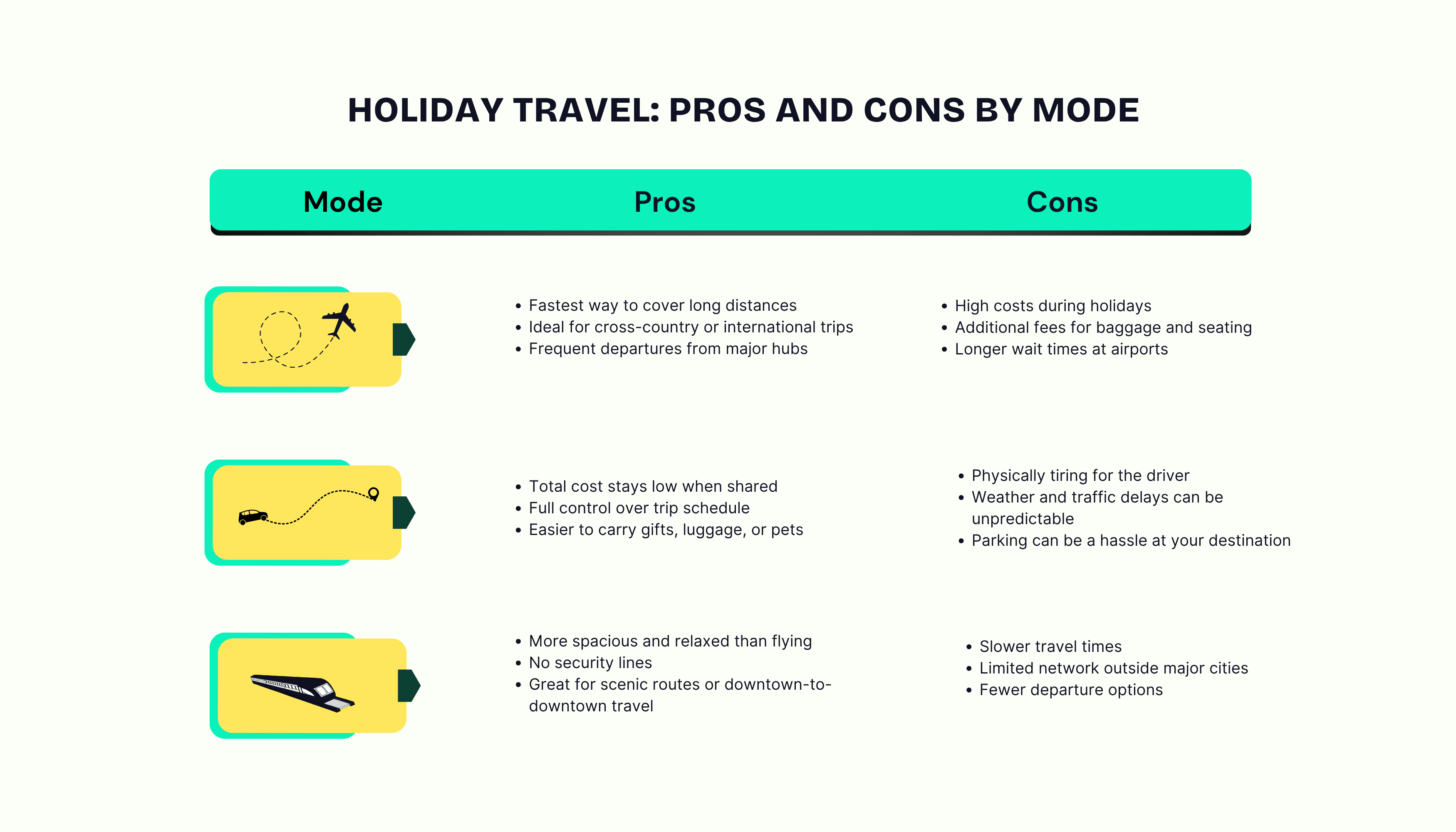
We’ll break down the pros and cons of each of these modes of travel in the table below:
What’s the smartest way to travel for the holidays?
There’s no one-size-fits-all mode of travel when it comes to the holidays. It all depends on what your priorities are and what your specific situation is. If it’s a last-minute trip with your family and the dog, then a road trip would be ideal. If it’s just you and your partner traveling to Hawaii, you have to catch a plane and start planning and booking now!
At the heart of it, the best choice for you depends on three basic factors: your budget, your distance, and how flexible you need your schedule to be.
What matters most is planning as early as possible and choosing what fits your version of a peaceful holiday journey. Because getting there shouldn’t cost more energy than the trip is worth.
The post Holiday Travel Ain’t Cheap: What to Expect in 2025 appeared first on Way Blog.
British firm Garagisti & Co is making headlines with its first hypercar. It is called the GP1. Only 25 units are being built, each with a price tag of $3.9 million.
The Garagisti GP1 is a truly analogue hypercar that looks contemporary, albeit with a few retro touches. It was designed by Angel Guerra, the former exterior designer at Bugatti and Rimac.
The car has a sleek profile with massive vents on the sides, a front fascia reminiscent of the Pininfarina Battista and a rear section that reminds us of old Lamborghinis. It even has quad exhausts. The interior has a twin cockpit design with a central spine similar to the Carrera GT.
The GP1 is based on a carbon monocoque. Instead of sticking a large wing on it, Angel opted for ground-effect aerodynamics, and hence the large rear diffuser. It features Ohlins suspension, while the brakes have been sourced from Brembo.
Powering the GP1 is a 6.6-liter naturally aspirated V12 engine developed by Italy-based Italtecnica. It develops 778 hp and 516 lb-ft of torque. The engine is mated to a 6-speed manual gearbox that sends power to the rear wheels. The company is targeting a dry weight of 1,000 kg.
F82 M4 Complete Model Life Production Data,… finally!
Instagram: @mdataworks
Read on for all the numbers on Models, Colours, Interiors, Special Editions and an interactive app so you can filter by various options.
Five years on from the end of F82 M4 production, and some seven years since Sickfingas excellent F80 analysis, Im happy to share the detailed production stats for the F82 M4.
BMW produced a worldwide total of 57,382 F82 M4s (a 43% increase on the 40,092 E92 M3 Coupes produced). The 57,382 F82 M4s were made up of the following models:
32,041 x M4 – 3.0L Twin-Turbo (S55), 431 PS / 425 hp
22,141 x M4 Competition – 3.0L Twin-Turbo (S55), 450 PS / 444 hp
2,173 x M4 CS – 3.0L Twin-Turbo (S55), 460 PS / 453 hp
828 x M4 GTS 3.0L Twin-Turbo (S55 with water injection), 500 PS / 493 hp
199 x M4 DTM 3.0L Twin-Turbo (S55 with water injection), 500 PS / 493 hp
*RoW = Rest of World, NA = North America, LHD = Left Hand Drive, RHD = Right Hand Drive
The first F82 M4s were built in February 2013 when a batch of 24 pre-series cars were produced. The very last F82 M4 rolled off the production line over seven years later on 9-June-2020.
The Colours
Several colours received new paint codes through production, for example Sakhir Orange (B50) became Sakhir Orange 2 (C1H) (from Q2 2016 builds onwards). These changes were typically due to supply chain issues and in the case of Sakhir Orange, BMW issued the following change notice:-
Details of change: Sakhir Orange changes option code to C1H, and the name changes to Sakhir Orange II.
C1H Sakhir Orange II metallic paint Added All M3,M4 models Replaces B50 Sakhir Orange. The colour is identical to B50.
Ferrari Red (U90) also received a new paint code, but rather than call it Ferrari Red 2, BMW decided to change the name completely to Rosso Corsa so that it matched the official Ferrari name for the colour, and gave it the paint code P7K. The final Ferrari Red (U90) F82 M4 was produced in September 2018, the first Rosso Corsa (PK7) in October 2018.
The Interiors
DCT vs Manual
Just 9% of F82 M4s were produced with a Manual Transmission with only North America showing any significant demand.
Carbon Roof vs Sunroof
As with the Manual Transmission, a sunroof / moonroof was most popular stateside.
M4 CS
BMW produced a total of 2,173 F82 M4 CS. That number compares to 1,263 F80 M3 CS and 2,381 F87 M2 CS.
The initial press articles for the M4 CS in early 2017 suggested BMW would make around 3,000 M4 CS. That may well have been the target, however within a year of those articles, new WLTP emissions regulations were implemented across Europe that ensured no further F82 M4 CS could be produced for that market beyond May 2018.
Whilst existing stock could continue to be sold, the final F82 M4 CS destined for Europe was produced on 28-May-2018, a good 18months before the final F82 M4 CS (US spec), rolled off the production line in November 2019.
Clearly those regulations had a huge impact on BMWs ability to meet that initial target
Sono Motors is a young, vibrant and energetic electric car company currently looking for an Automotive Surface Designer (f/m/x). Based in Munich, Germany, the company prides itself on its work culture and fresh approach. Team members have more responsibility for the whole picture and are able to have a great impact. This dynamic start-up requires all members to contribute and take initiative to have a hand at developing the processes and the infrastructure of the organization.
RESPONSIBILITIES
You will be part of our innovative Design team, actively and responsibly shaping a future where every car is electric and shared
Independent development of attractive and innovative exterior and interior design drafts, taking into account functionality and series implementation
Supervision of Alias / ICEM concept phase and series production with drawings / renderings and self-generated 3D data
Responsibility for ensuring the necessary workflows in the design process in 2D and 3D as well as creation of sketches and renderings
Independent creation of benchmarks and comparison of competitors
Interdisciplinary support and management of projects (engineering / marketing / branding etc.)
Coordination with engineers and relevant interfaces as well as ability to work efficiently and creatively on multiple programs and projects at once
Successfully completed degree in automotive, transportation or product design or equivalent
2+ years of experience in a similar position with comparable tasks in the automotive environment
Very good knowledge in CAS and Poly (ALIAS, Blender, Maya, etc.) to create own CAS data
QUALIFICATIONS
Independent and structured way of working and willingness to take responsibility and lead projects
High team and communication skills as well as open and curious personality
Fluent in English and German and very good knowledge of the relevant Microsoft tools
Sustainability is close to your heart, you like to swim in the open ocean and stand by your successes and mistakes
HOW TO APPLY
Please apply via the link below or visit the company website. Applicants must provide a portfolio of work as part of their application. Applications and CVs are only accepted via the job link.
See also
WHAT TO EXPECT
A visionary team in a rapidly growing, young company
No deadlocked processes and hierarchies, but a lot of courage and free space to shape things at a mobility provider for an oil-free future
Our proSono platform offers you the chance to pitch and realize your own projects – your ideas are welcomed, not feared
A culture of appreciation, in which we celebrate successes as well as mistakes
Flexible working hours as well as an open, modern office with little paper but Trello & Slack instead
Organic bread flatrate, free drinks, vegan catering service, etc.
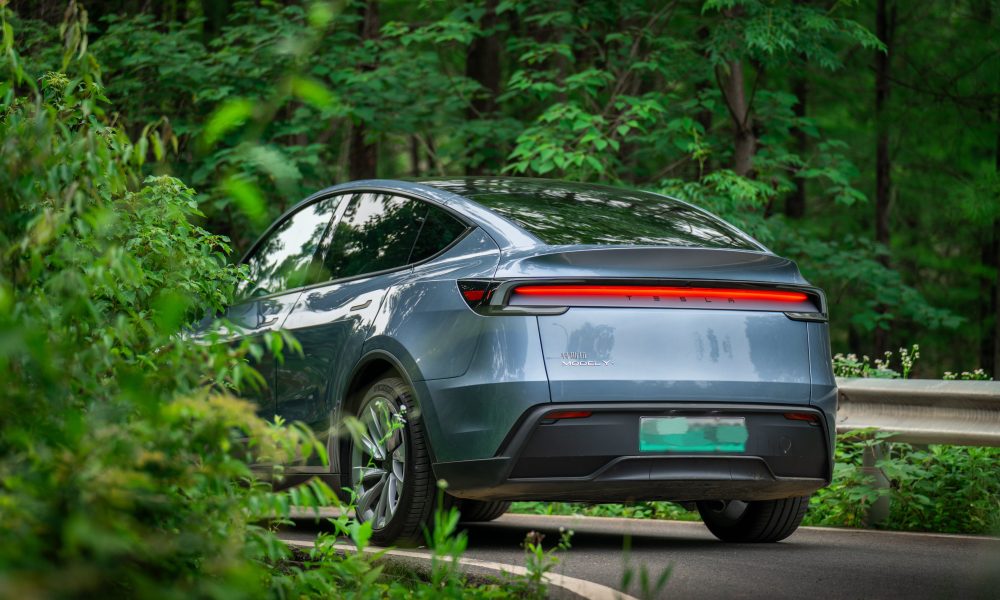
Tesla CEO Elon Musk detailed the changes that are expected to come with a massive Full Self-Driving (FSD) update, which is set to roll out sometime in September, he revealed earlier this week.
Tesla has been refining its FSD suite for years, but it has never been as good as it is now. The focus is to get the suite to a point where interventions are no longer needed and drivers simply become passengers, as they will not be responsible for paying attention to the road.
Elon Musk teases crazy new Tesla FSD model: here’s when it’s coming
That version of FSD will come eventually, but not next month. However, there are dramatic improvements that will come with next month’s FSD update that will roll out to the public, Musk said:
“The FSD software update next month will be a major step-change improvement for rare conditions.”
The FSD software update next month will be a major step-change improvement for rare conditions
Additionally, he provided specific details on what would change, hinting that the need for a driver to pay attention will be “substantially reduced,” but there are some “complex intersections, heavy weather, or unusual events” that will still require drivers to assume responsibility for the car:
“This will substantially reduce the need for driver attention, but some complex intersections, heavy weather or unusual events will still require attention.”
This will substantially reduce the need for driver attention, but some complex intersections, heavy weather or unusual events will still require attention.
Note, the Austin robotaxi FSD build is ~6 months more advanced than what is available in cars in America and there are…
We have been teased about these types of updates before, but usually they involve some kind of mention of FSD being ready for unsupervised driving “by the end of the year.” Musk did not mention that here.
There is also the fact that Tesla has another FSD build in Austin for the Robotaxi suite that is more advanced than what is available to the public. It has performed well, Musk says, making claims that there are times when it feels “eerily human.”
Tesla Q2 2025 vehicle safety report proves FSD makes driving almost 10X safer
The improvements in FSD capabilities in subsequent releases are usually very evident. As Tesla continues to refine the suite for the public, it gains more confidence and becomes smarter through the collection of data and the use of neural networks.
The only thing left to wait for is the release itself, and we are hopeful it will roll out to the public in September, as Musk says.
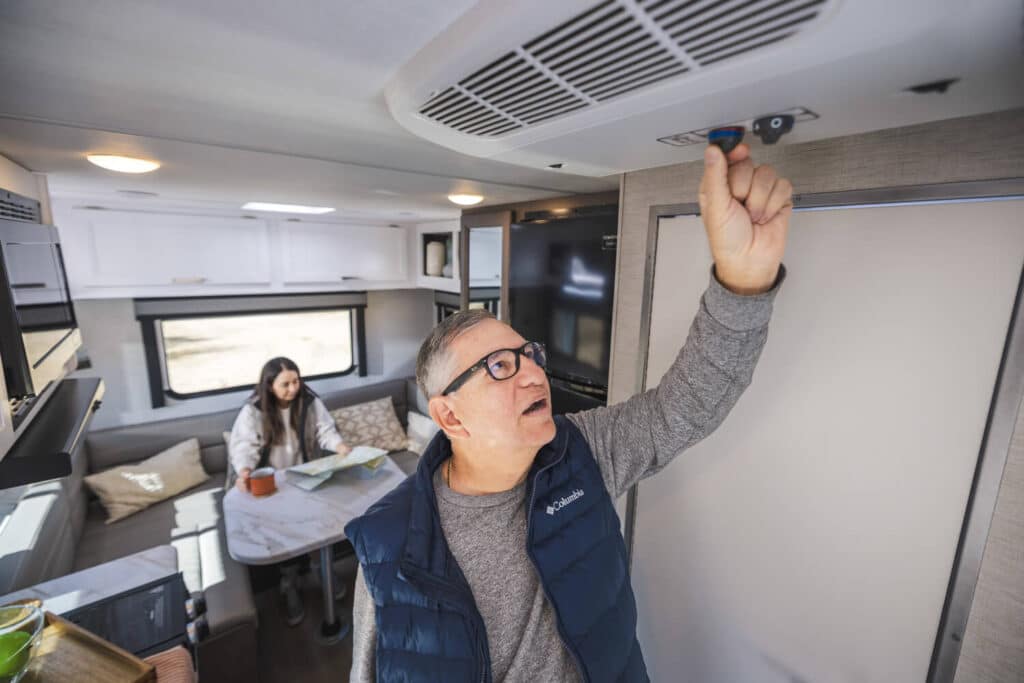
A FAILING AIR CONDITIONER quickly leads to uncomfortable camping. As the temperature inside an RV rises, most of us get desperate to find a solution to why our RV AC isn’t working. Our first suggestion? Find somewhere indoors with AC, grab a cool beverage, and dive into this RV air conditioner troubleshooting guide!
Key Takeaways
Common RV AC issues include power failures, tripped breakers, poor cooling, short cycling, water leaks, and strange noises or smells. Each symptom often stems from electrical problems, dirty components, airflow blockages, or thermostat malfunctions.
Thorough troubleshooting requires specific tools and careful inspection of power sources, filters, ductwork, coils, and electrical components. Technicians recommend letting the AC run 20–30 minutes before testing to get accurate readings.
If DIY fixes don’t resolve the problem—or you suspect serious issues like refrigerant leaks or compressor damage—it’s time to schedule professional RV AC service. Regular maintenance is key to preventing costly repairs and keeping your RV cool and comfortable.
Common RV Air Conditioner Problems
Image by Camping World
These are some of the most common RV air conditioner problems that require troubleshooting:
Not turning on (or turns on and trips a breaker shortly thereafter)
Lack of cooling capacity or blowing warm air
Short cycling
Water dripping inside
Performance varies by location
Strange noises and/or foul odors
Are you experiencing another problem? Drop us a comment below so we can provide further troubleshooting assistance!
Depending on your issue, you may need the following RV tools to troubleshoot your air conditioner:
Digital multimeter with built-in AC/DC amperage clamp.
Surge protector to guard against shore power issues.
Anemometer to test airflow.
Flashlight and/or mirror to inspect ductwork (can also use endoscope-style attachment for cellphone).
1-2 probe-type thermometers to measure discharge and return air temperatures.
Fin comb set and a vacuum cleaner with a duster brush attachment to straighten and/or clean coils and fins. Compressed air and a blow gun can also be used, with care.
Small flathead screwdriver or dental pick for removing screw covers on the ceiling assembly.
Driver/drill and drill bit set for disassembling and reassembling components.
Calculator to accurately determine acceptable ranges.
Technician Tip: When diagnosing an A/C, we have to let it run for 20-30 minutes because as it warms up, the pressures inside it will build. This causes the amperage to climb, but it is also the point where the A/C is at peak efficiency. By allowing it to “warm up” before testing the amps, volts, and temperatures, we can be certain our numbers are extremely accurate.
How To Troubleshoot an RV Air Conditioner
Let’s examine these common RV AC issues one by one, providing helpful causes and troubleshooting tips for each. Let’s start with the most obvious: a lack of power.
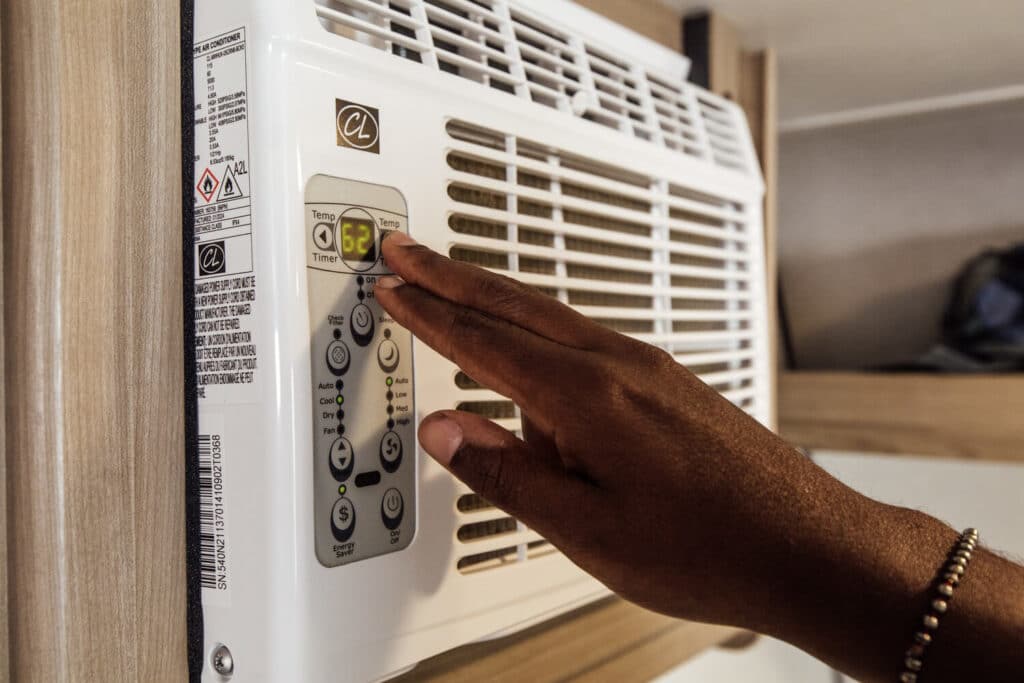
AC Is Not Turning On
Image by Camping World
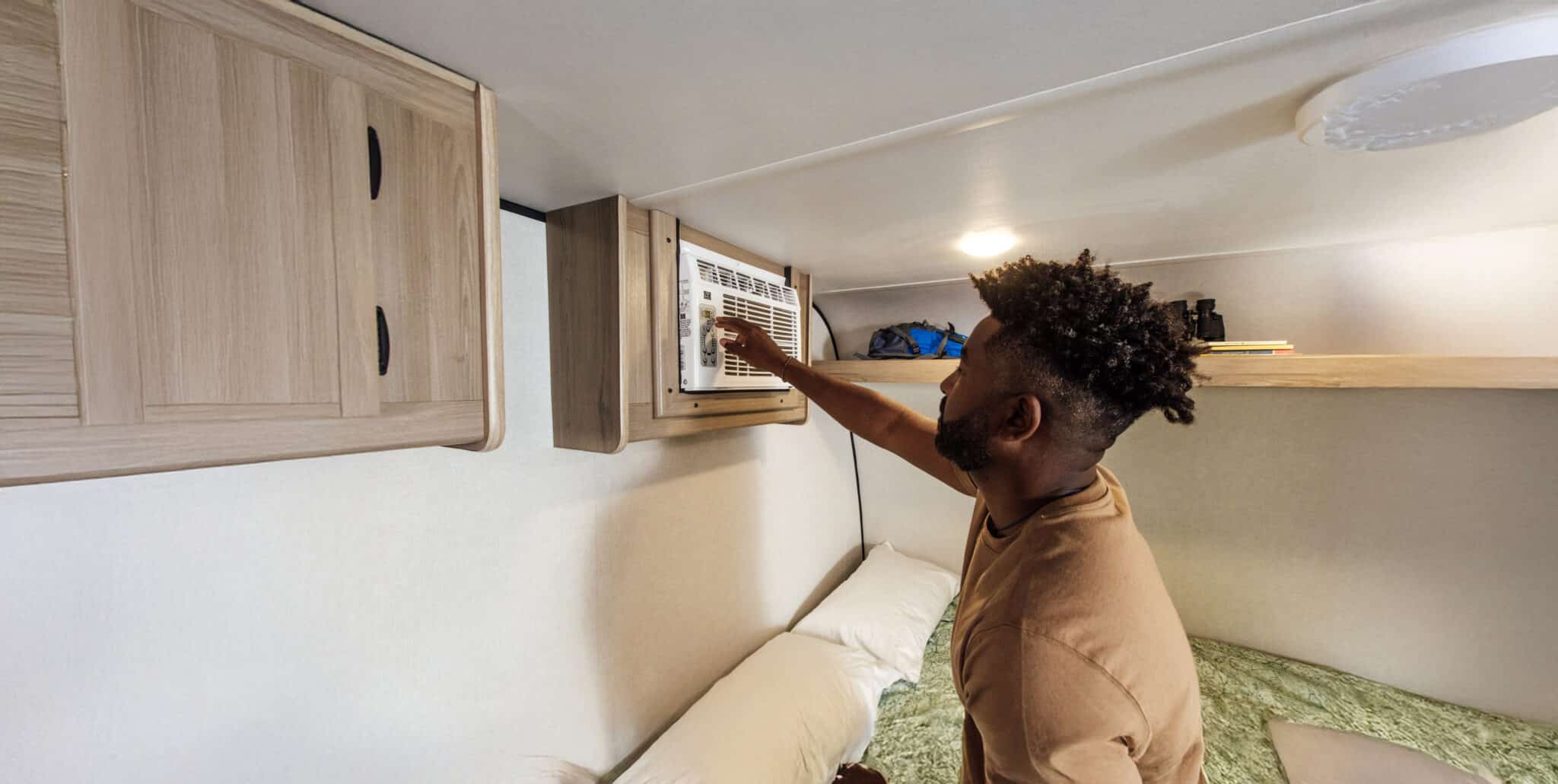
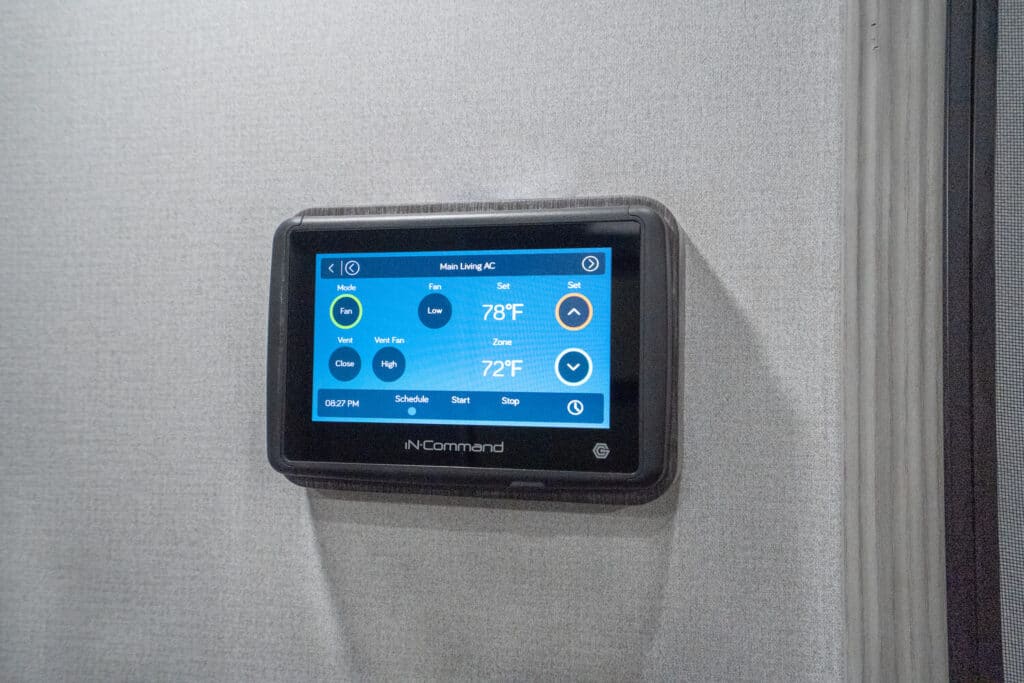
While an AC’s fan and compressor rely on 120VAC power (from shore power or a properly-sized generator), the thermostat and AC controls typically require 12VDC power from your RV’s battery bank.
For starters, most RVs—except for a handful with larger solar/battery systems and soft-starting ACs—must be connected to shore power or a generator to run the air conditioning system. So, first check you’re actually connected to the proper power source (30 or 50 amp or an adequately sized RV generator).
If you are connected but your thermostat isn’t turning on or nothing happens when you change the controls directly on the interior panel, you may have a 12VDC electrical issue. This can lead us back to your battery bank, converter, or wiring.
Solutions:
Check the power at the pedestal. Is the breaker on? Can you measure sufficient voltage according to the outlet’s power rating?
Check battery voltage, clean terminals, and ensure the security of battery cables.
Checked for blown fuses and/or tripped breakers.
Ensure the battery disconnect is on.
Troubleshoot issues with your RV converter.
AC Keeps Tripping a Breaker
Image by Camping World
Depending on the BTU rating and number of AC units on your RV, it’ll either be rated for 30 or 50-amp shore power. Air conditioners with a higher BTU rating—and RVs with multiple ACs—will require more power than smaller campers.
To power your AC, you’ll need to plug into a shore power connection—or a generator—that matches your RV’s power requirements. Theoretically, you can plug a 50-amp RV into a 30-amp source or a 30-amp RV into a standard 120VAC outlet. However, don’t expect to enjoy the full benefits of air conditioning because the RV will be limited to the outlet’s capacity. Adapters don’t increase the available power; they only allow a plug to fit a different size outlet.
If your AC turns on but trips a breaker shortly after, you’re most likely overloading the system. Are you trying to run the microwave simultaneously? Did you forget to power off your AC before turning on the hair dryer? Is your gas/electric water heater set to the electric mode? Is there an issue with an A/C component? Power demands add up quickly, and RV electrical systems don’t function exactly like your home.
Furthermore, issues like a worn start capacitor, low voltage, electrical spikes, and miswired outlets can cause problems with your RV air conditioner and the entire electrical system. These unseen issues could trip a breaker at the pedestal or inside your RV.
Solutions:
Use a surge protector to guard your RV against low/high voltage, miswired pedestals, and other electrical issues.
Limit other 120VAC appliance usage while running your RV air conditioner.
Employ a Camping World Certified Technician to inspect the start capacitor and replace it, as needed, to prevent excessive current draw.
Technician Tip: An AC start capacitor stores a lot of electricity and is designed to release it very quickly, as soon as it has a pathway to ground. If you open the protective enclosure around the capacitor and accidentally touch the terminals, YOU can become that pathway.
AC Doesn’t Keep RV Cool
Image by Camping World
Our next potential issue is an RV that doesn’t cool or blows warm air. The fan has power and blows air, but the interior temperature never drops to the thermostat’s setpoint. It just keeps blowing warm or mildly cool air.
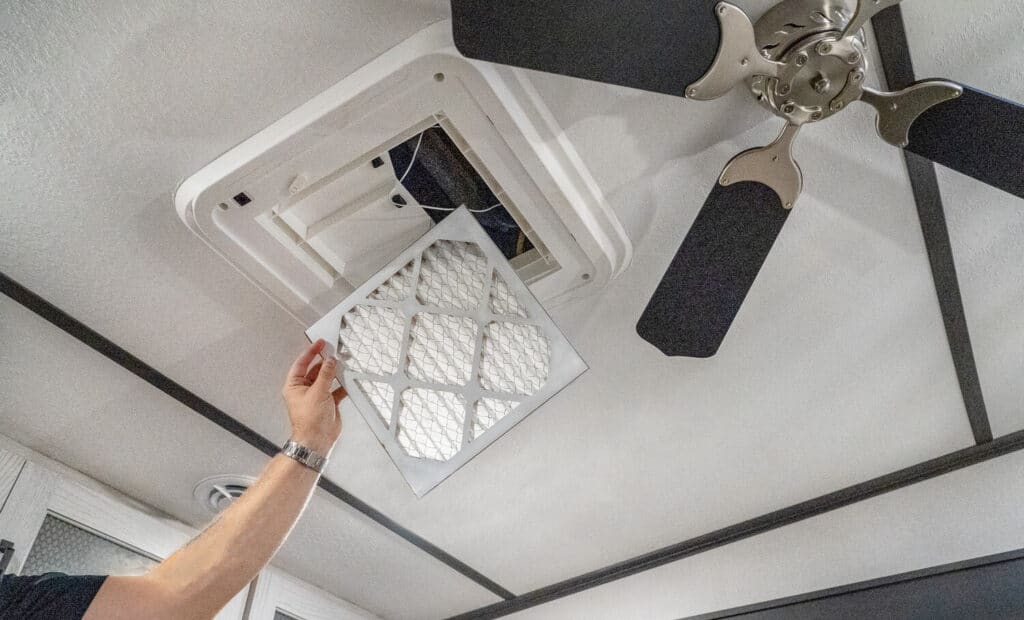
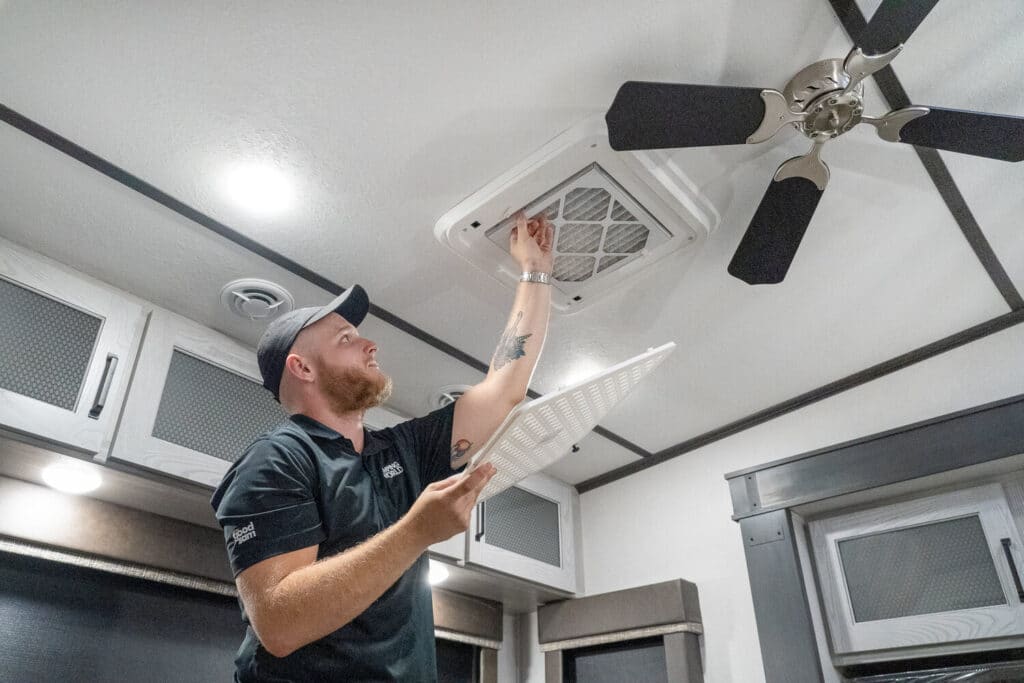
The first potential issue is a dirty or clogged filter, which can reduce airflow over the evaporator coils by as much as 50%. A dirty filter can also lead to dirty coils, reducing your air conditioner’s efficiency.
That dirty air filter can also cause evaporator coils to freeze due to a lack of airflow. Low refrigerant can also cause this issue, often resulting from a small leak in a factory-sealed rooftop air conditioning unit.
Additionally, you could feel warm air from your A/C vents because of holes in the system. In ducted systems, foam or coil collars can leak or separate, which allows cold air to escape into the return air space or roof cavity before it’s directed through the ductwork and into the room.
Solutions:
Clean air filters to ensure adequate airflow.
If you see ice on the coils above the filter, turn the A/C off for 30 minutes. Then, run the fan to ensure the coils are thawed before restarting and monitoring performance.
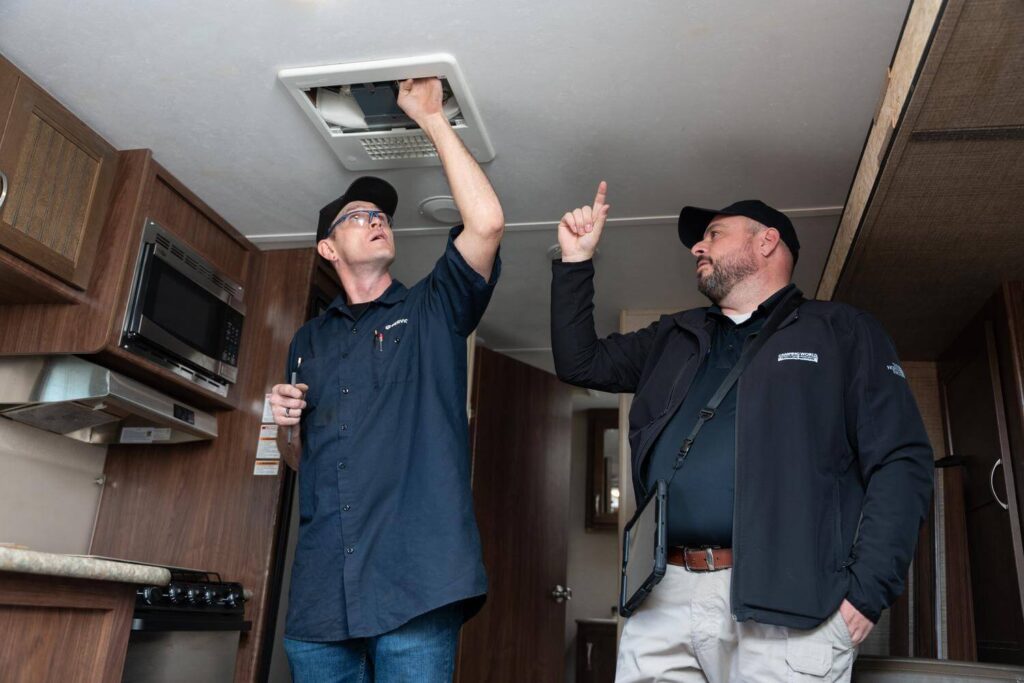
Remove the interior A/C cover and inspect for leaks or separations where the return air supply could be mixing with warm air. Inspect inside the ductwork for holes, collapsed areas, or separations that allow cold air to be lost or blocked. Use HVAC foil tape to seal problem areas.
RV Air Conditioner is Short Cycling
Image by Camping World
Here’s how a standard RV air conditioner normally works: the fan starts running after you turn it on and set the thermostat to a temperature lower than the current room temperature. A few seconds later, the compressor kicks in. Once your desired temperature is reached, the compressor cycles on and off periodically to maintain it efficiently.
Short cycling occurs when your compressor turns on and off more frequently than normal. It could be caused by low voltage from a campground power source, a broken or malfunctioning thermostat, a worn start capacitor, frozen coils, or a lack of airflow.
Overcooling is another common cause that’s often overlooked because it results in icing, which causes many to inspect for a dirty filter and coil issue. It occurs when the thermostat is turned down excessively. When the air temperature drops at night and everyone is sleeping, they breathe and perspire a considerable amount of humidity inside the RV. The A/C is able to get really cold, but the result is often significant ice buildup.
Technician Tip: Overcooling can also happen during the day on RVs with a second A/C, especially if the biggest A/C possible was installed instead of the best size for a given application—more common in aftermarket, DIY installations.
On especially hot summer days, campground voltages have been known to drop below 105 volts, which can overheat your compressor and cause it to shut down.
Solutions:
Use a digital multimeter to check campground voltage to ensure it’s above 108 volts. If it is not, consider switching parks or using an autoformer.
Maintain your RV battery monthly and replace the batteries in battery-powered AC thermostats at least twice a year.
Consider relocating the thermostat if it’s on an outside wall. It can also be moved if it’s positioned near a hot appliance like the stovetop, or in a location where an AC vent blows directly on it.
Water Drips Inside from the AC
Image by Camping World
You walk through your RV and feel water drip on your head. No, you’re not imagining things. This is an unfortunate issue leading to RV air conditioner troubleshooting, but the cause can typically be traced to one of four possibilities: a dirty or clogged filter, an impacted drain pan or line, improper installation, or a broken pump.
Ductwork leaks, separations, or impingements can also lead to condensation and dripping if cold air leaks into the return air plenum. On some models, a worn-out or overtightened gasket presses the drain hole into the rubber roof membrane, preventing water from passing through.
Solutions:
Clean air filters and coils to ensure adequate airflow.
Inspect the drain pan and line. Remove dirt and debris that is preventing proper drainage.
Ensure proper alignment of the exterior gasket over the roof opening to prevent leaks.
Check that the compression of the exterior gasket meets the manufacturer’s recommendation—typically 50% compression.
Remove the interior A/C cover and inspect for leaks or separations where the return air supply could be mixing with warm air. Inspect inside the ductwork for holes, collapsed areas, or separations that allow cold air to be lost or blocked. Use HVAC foil tape to seal problem areas.
Schedule an AC inspection to have the pump, gasket, drain pan, and other components professionally inspected.
Read our complete troubleshooting guide for this issue:
Technician Tip: Most drain pans are integrated into the A/C chassis, which means that damage may require a complete replacement of the entire roof unit portion. Alternatively, Tiffin and Airstream are two manufacturers known for using A/C drain pans with hoses or pumps.
AC Makes Strange Noises and/or Emits Foul Odors
Image by Camping World
RVs are subject to significant bumps and vibrations as you drive, not to mention the environmental exposure when camping, driving, or in storage. Bolts and screws can come loose, bearings can dry out, mold or mildew can grow, wasps, mud daubers, rodents, and others can nest in the A/C, etc.
All these things—and more—can lead to strange noises, vibrations, foul odors, or even complete RV air conditioner failure.
Solutions:
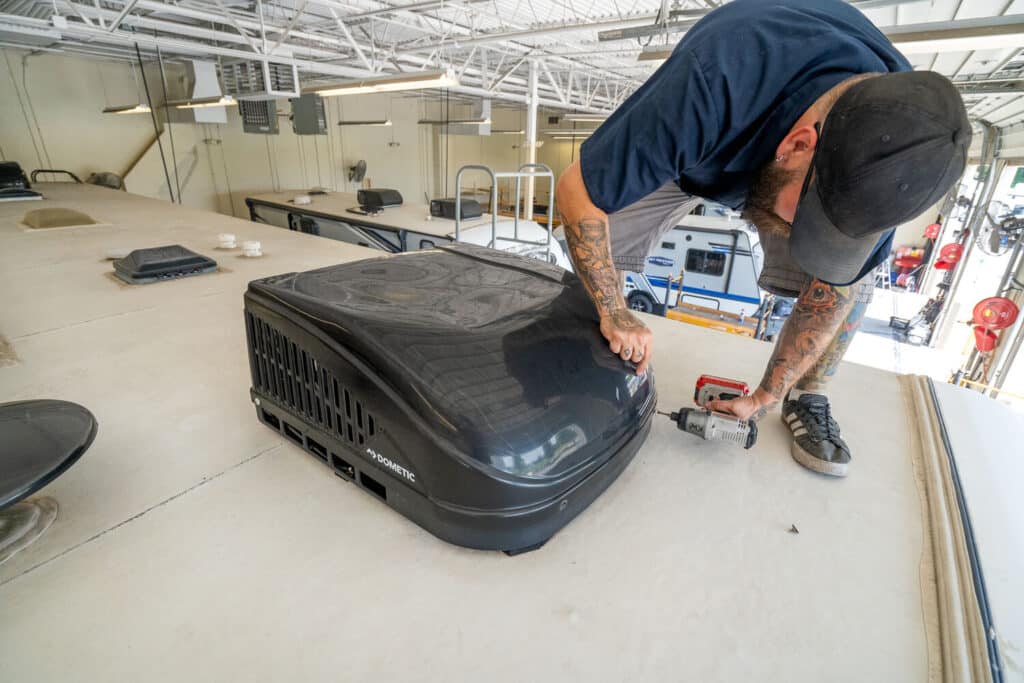
Check/tighten mounting bolts, adhering to the manufacturer’s torque specifications. Some tighten from above, requiring the removal of the A/C shroud. Most tighten from inside, requiring the removal of the entire ceiling assembly cover to access the bolts.
Ensure the fan blades aren’t rubbing against the housing and realign the set screw as needed.
Listen for a high-pitched squeal signaling dry motor bearings. Consult the A/C manufacturer about the proper oil type, amount, and lubrication method.
Flush the drain pan with a 50/50 diluted white vinegar solution and rinse thoroughly with clean water to remove algae.
Spray a non-corrosive coil cleaner on the fins and rinse with water at low pressure to remove mold growth—AKA “black crud.”
Technician Tip: Full-strength automotive antifreeze, ethylene glycol, actually has cleaners and protectants suitable for plastics, copper, and aluminum. This makes it a great cleaner and protectant for cleaning fins. It also lubricates them, making combing much easier.
When Should I Get My RV AC Issues Diagnosed?
Image by Camping World
Regular cleaning and inspection are the best ways to keep the air conditioner in your RV working at peak efficiency. A diligent air conditioner maintenance routine will catch many minor issues.
However, if you’ve neglected maintenance or tried your share of RV air conditioner troubleshooting without success, it’s time to contact a Camping World Certified RV technician. But let’s also summarize the most common aforementioned issues that require additional attention.
After some testing, you suspect:
A worn start capacitor
A refrigerant leak
A broken pump
An under (or over) compressed gasket
Drain pan or A/C chassis damage
Suspected compressor issue or motor failure
Burnt wiring smells
In truth, any air conditioner problems in your RV could require professional assistance. If you are outside your comfort zone for DIY troubleshooting and repairs, contact a certified technician to inspect your air conditioning system.
Having other RV issues? Use these other troubleshooting resources:
Did these RV air conditioner troubleshooting tips resolve your issue? Let us know if we can provide further assistance in the comments below!
Tucker Ballister is our Content Strategist. He grew up RV camping in a Fleetwood Bounder with his parents and has lived and camped in two motorhomes and two travel trailers of his own. His current RV is a 2025 Forest River Campsite Ultra 26BW, which he loves taking on adventures with his wonderful partner and furry companion from their home base in Western North Carolina. Check out his adventures, gear reviews, and outdoor advice at thebackpackguide.com.
Barely a month goes by without a carmaker announcing a new lap record at the Nürburgring Nordschleife. Yet these times mean little to customers, and the image boost from combustion or electric lap records is increasingly negligible.
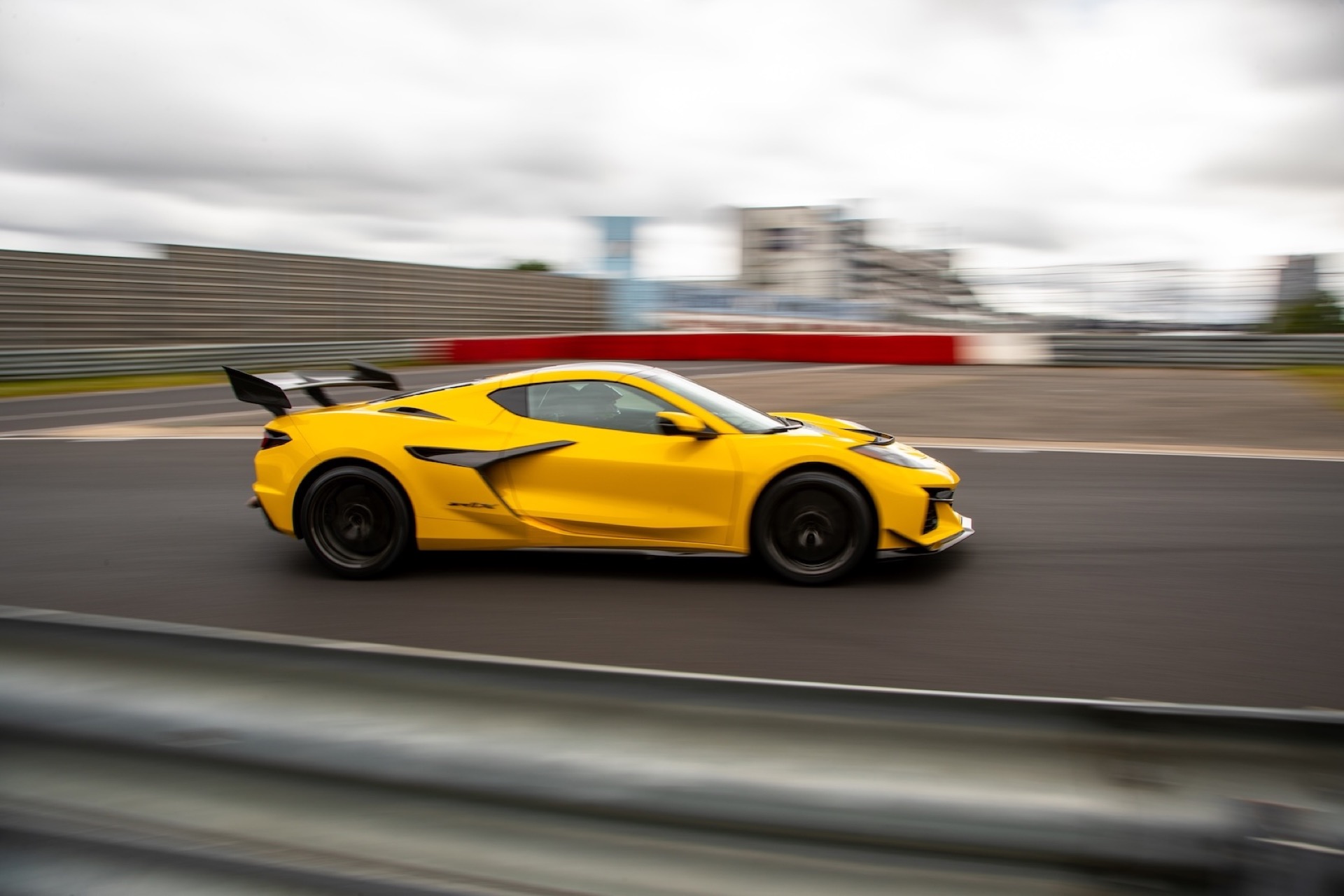
Just before July turned to August, another headline dropped: General Motors, with its prestigious sports car, the Corvette, had set new lap times at the Nürburgring with its ZR1 and ZR1X models. Not an outright record, nor even one for a category of sports cars—rather, GM is now celebrating the comparatively meaningless title of fastest American manufacturer at the infamous Eifel circuit. “No carmaker has ever attempted a lap record at the Nürburgring like this before,” claimed GM president Mark Reuss. “From development and production to the Nürburgring’s Green Hell, we’ve shown there are no limits to what GM engineers and vehicles can achieve.”
Once hailed as one of the toughest and most important test tracks in the world, the Nürburgring Nordschleife has long been a pilgrimage site for manufacturers, tyre companies, chassis engineers and suppliers. The 20-kilometre track and surrounding B-roads have hosted decades of endurance runs and development laps. But over time, the focus shifted towards a dubious arms race of lap records. Stefan Bellof’s legendary 6-minute qualifying lap during an endurance race remained unbeaten for over 30 years—until carmakers began inventing niche categories in which they could claim new ‘records’ and showcase supposed sportiness.
The smaller the niche, the easier the record. In June, Volkswagen proudly announced that the Golf GTI Edition 50 was the fastest production VW on the Nordschleife. Given VW doesn’t offer true sports cars, the GTI was the obvious—if underwhelming—candidate. Its lap time of 7:46.13 would likely have left the Corvette ZR1X test drivers yawning. Driver Drew Cattell completed the same course in 6:49.28 in a Corvette with up to 1,250 PS from its 5.0 and 5.5-litre twin-turbo V8s—almost a minute faster.
Renault and Honda spent years battling over the title of fastest front-wheel drive car, with the Mégane RS Trophy often just edging out the Civic Type R and Mini JCW—each lapping in just over 7:40. But all fall far behind VW’s electric prototype, the ID.R, which in 2019, with ex-Porsche driver Romain Dumas at the wheel, completed a lap in 6:05.34. That was a counterstrike against Nio, whose EP9 lapped the ring in 6:45.90 in 2017 with Peter Dumbreck. Though the EP9 isn’t a series-production car, Rimac reclaimed the electric production car crown in 2023 with the 1,900 PS Nevera: Martin Kodric posted a 7:05.29 lap. The current Nevera R has since broken 24 records in one day, including 0–400 km/h in 25.79 seconds—2.04 seconds faster than the previous best.
Porsche, too, loves flaunting lap times around the globe, especially on the Nordschleife. In June, however, its records came from Atlanta and Abu Dhabi—also not absolute records, but best times for production EVs. The 1,100+ PS Taycan Turbo GT with optional Weissach Package was the tool of choice. While it’s unlikely anyone will take a four-door electric coupé for hot laps, one or two quick rounds on track tyres suffice for marketing. Mercedes, meanwhile, parades its AMG One, which holds the Nordschleife supersports car record at 6:29.09.
Currently, Porsche’s Taycan holds electric production car records at circuits including São Paulo, Shanghai, Laguna Seca and Nürburgring—at least until Xiaomi’s SU7 Ultra beat its Nordschleife time of 7:07.5 by around three seconds. Porsche had previously traded electric lap time punches with Tesla, whose Model S Plaid, driven by Tom Schwister, clocked a 7:25.23 in 2023. In 2021, Tesla had no real Nürburgring presence, but it soon had Weissach on alert.
Despite the marketing frenzy, Porsche holds the real record—one not created via category manipulation. In 1983, the late Porsche factory driver Stefan Bellof set a 6:11.13 in a 956 during qualifying. That record stood until 2018, when Timo Bernhard shattered it in a Porsche 919 Hybrid Evo LMP1 car with an extraordinary 5:19.55.
This post may contain affiliate links. See our affiliate disclaimer here.
If you’d asked me a few months ago what I knew about Grand Cayman, the answer would be… that it is an island in the Caribbean maybe? This and the fact that “offshore accounts in the Caymans” are something people talk about in movies.
However, we spent a month falling in love (yes, 30+ days) with Grand Cayman this winter.
I’ve been to countless beaches and a handful of countries in our travels, but Grand Cayman quickly became my number one favorite place in the world.
If you are considering a trip to Grand Cayman, stop reading this and go book it now. You will regret nothing.
If you’re traveling with kids, you are in for a real treat. We’ve taken our two and four-year-old to 14+ countries, and Grand Cayman was THE most kid-friendly place we’ve ever been. I’ll share more about why below (but trust me, your kids will love it).
Our First Cayman Sunset
After spending a month beach and activity hopping, I’m sharing a list of things to do with kids in Grand Cayman along with tips for visiting this gorgeous island.
Where to Stay in Grand Cayman
Grand Cayman is not a big island. To drive from one end to the other would take us less than an hour. However, where you stay will impact how much you can walk and the types of activities nearby.
We stayed in an area called Seven Mile Beach. This is the most popular area on the island and is very walkable. If I were to go back, this is the area I would stay again.
Seven Mile Beach is known as one of the most beautiful beaches in the world! And it lives up to the hype with completely clear water that stays calm. We would spend mornings paddle boarding across the water, sometimes stopping at a nearby hotel to grab coffee and muffins before paddling back home.
Why do I recommend staying on Seven Mile Beach? (Other than the fact that the beach is incredible)
Morning walks on the beach
We did not rent a car for most of our time on Grand Cayman. (We rented when people came to visit us!)
On Seven Mile Beach, we could walk to restaurants and access everything we needed within a short distance. Our favorite restaurant was Paradise Pizza. They have incredible brick oven pizza and a cool outdoor seating area where our kids befriended some of the local cats. Plus, as my wife noted, they had amazing gluten-free pizza and we could walk there without ever leaving the beach.
Seven Mile Beach is on the west side of Grand Cayman, making it the perfect place to catch a sunset on the beach.
Literally no filter. Just pure sunshine and magic.
Where we stayed on the beach was one of the skinniest points of the island, so we could walk the width of the island in less than ten minutes, even pushing the double stroller. We could watch the sunrise over Camana Bay (which I’ll share more about in a minute) and watch it set from our private beach.
Seven Mile Beach is the busiest, most touristy part of the island. We would see multiple cruise ships port each morning. Our VRBO had a private beach area, but the rest of Seven Mile Beach was very busy on these days.
If you want a quieter pace, I’d recommend Rum Point.
It’s about a 45-minute drive (or 20-minute boat ride) from Seven Mile Beach and has a few nice restaurants and beaches. If we weren’t traveling with kids, I’d consider this area for a peaceful getaway. Rum Point is also right next to Starfish Point, another cool spot I’ll mention below.
However, if traveling with kids, most activities and restaurants are centered in the Seven Mile Beach area. If you stay in Rum Point, you will likely need to rent a car.
Where to Stay on Seven Mile Beach
There are a lot of hotels and short-term rentals in Seven Mile Beach. While we were there in February and March, some of the nightly hotel rates were as steep as $2,000 per night! If you’re traveling with a larger family or group, I recommend looking at short-term rentals for a better value.
We stayed at a friend’s VRBO at Laguna Del Mar, a centrally located condominium complex on Seven Mile Beach. The complex has a pool, gym, tennis courts, and epic grill setup. Some of our favorite nights involved grilling while the kids played in the pool and eating at the picnic tables before catching the sunset on the beach.
To say we loved our stay at Laguna Del Mar would be underselling it. It was paradise. We could walk across the street to dozens of restaurants, walk the pedestrian trail to Camana Bay and play in the splash pads, or walk along the beach for miles.
Our friend recently renovated his 3-bedroom unit at Laguna Del Mar, and you can rent it here on VRBO. Can’t recommend Andy’s place enough! We stay in a lot of Airbnb spots around the world, and hands down, this was our favorite stay…ever.
The Best Hotel in Grand Cayman
Based on more than 1,000 reviews, the Kimpton Seafire Resort is the #1 rated hotel in Grand Cayman. I can attest to the fact that the resort is absolutely beautiful.
We have stayed at multiple Kimpton hotels over the years, and when given a choice, they are our favorite hotels (mostly for the service, attention to detail, and amenities).
We heard the Kimpton Seafire Resort in Grand Cayman had a private waterpark, so we took the kids to play one day. During the offseason, they allow non-guests to purchase day passes. However, they just let us in for free as it was closing in 30 minutes (what did I tell you about Kimpton!?).
How much does the Kimpton Seafire Resort cost?
It depends on the season in which you’re visiting. Off-season for Grand Cayman starts around April, so you will find lower rates from then on. It was peak season when we visited during February, so a room costs as much as $2,000/night.
Shocking, yes. Still packed with people? Yes.
For a budget-friendly option, you can book the Holiday Inn on points for cheaper than you can book a hotel in Amarillo. (It was under 18,000 points per night!)
Read More: Travel Hacking: How We Travel for (Almost) Free
Renting a Car In Grand Cayman
Depending on where you stay in Grand Cayman, you may or may not need a car rental. Seven Mile Beach is a very walkable area. However, you will need a vehicle if you want to visit places like Rum Point or the botanical gardens. We rented a few vehicles during our stay to go on day excursions.
We rented from Andy’s Rental Car, which has two locations in Grand Cayman (one at the airport and one at Seven Mile Beach). I felt the prices were reasonable and the staff were kind and fair. I would rent from them again if when we come back.
Other Transportation Options in Grand Cayman
If you don’t rent a car, you have a few other options for getting around in Grand Cayman. One option is to stand on the side of the road and hail a bus. They run up and down Seven Mile Beach and will stop and pick you up. Each ride is a few bucks in cash and it’s definitely the cheapest option for getting around.
I say stand on the side of the road because there aren’t very clear bus stops, but you can flag down the bus easily. They aren’t traditional buses, but large vans that are clearly labeled.
There are also plenty of cabs around the island you can call. You will see them driving around and can flag one down as well.
Lastly, there is a water taxi service that departs from Camana Bay that you can take over to Rum Point. You can view their departure times and fares here.
Best Things to Do in Grand Cayman with Kids
1. Visit Camana Bay
On paper, Camana Bay is an outdoor shopping area boasting al fresco restaurants and waterfront dining. But it’s so much more. There are shops, Foster’s (think Whole Foods, but island style), a marina where tours and boat rentals take off through the mangroves, and endless water features. No playgrounds were walkable from our VRBO, but Camana Bay has two splash pads our kids lived in all month!
We walked over here shortly after arriving, and we were blown away.
It felt like a little paradise tucked away on the island. The first thing I noticed was how many families with young kids there were. They were everywhere. As we’d learn, many of these families live here as expats (but many visit too).
The pedestrian walkway goes over the busy main road so you walk through a gorgeous garden to enter Camana Bay.
We ended up in Camana Bay every single day for a few reasons:
1. The splash pads. The kids loved these and they are shaded most of the day. During warmer days, it was a great area to hang out for a while. Grab coffee from Jessie’s Juice Bar Cafe (or Starbucks if you’re basic…like me…it’s right next to the splash pad, what can I say?)
2. It was a beautiful walk to start our days.
Instead of simply making an overpass to Camana Bay, they constructed an entire jungle. You’ll see wild parrots, chickens, lizards, iguanas, and all sorts of wildlife just on your walk over the bridge. We made this part of our morning ritual.
3. Grocery shopping.
There’s a handful of grocery stores near Seven Mile Beach, but we frequented Fosters. Fosters is basically like a Whole Foods on the island. It is very nice and expensive. Cayman in general is expensive, but $10 for a bagged salad blew our minds.
However, their prepared food section is great and one of the cheapest ways to grab a meal in Grand Cayman! We would grab a barbequed chicken, freshly grilled burgers, roast veggies, salad bar (way cheaper than buying a bag), curries, and more.
4. Great restaurant selection
Our favorite spot was called Agua. Their dessert was incredible, and they had a great atmosphere for eating out next to the water.
Agua and many of the other restaurants were very nice, but since seating is offered outdoors, they were kid-friendly, too. Casual clothing like a sundress and sandals would be fine. We tried most of the restaurants along the waterfront, and Gelato & Co. also offers amazing desserts.
(I mean, we tried real food, too…but the dessert game is STRONG over here!)
5. “The Island”
The Cayman Islands are made up of three primary islands: Grand Cayman, Little Cayman, and Cayman Brac. Grand Cayman is the most popular one with tourists, but another island is popular with locals. It’s the small, clearly manmade sand island in Camana Bay.
Playing on the little island
Connected by a bridge, this little island was a kid-friendly paradise. Every day, the local Montessori school would let out, and all of the kids would play on the island while their mothers chatted.
Ellie would love to go during this time to make new friends and play hide and seek or catch the crab or whatever the girls were playing.
2. Go to Starfish Point
This is on most lists of “things to do in Grand Cayman” for good reason. We took a few trips to Starfish Point because the kids liked it so much. It’s a really shallow beach area where you can see tons of starfish in the water and touch them (though it’s important to never take them out of water). The water is generally calm, but since it’s on a point, you can escape any wind by walking to the other side.
You’ll see lots of tour boats come out to this point and on busy days, a food boat (like a food truck, but a boat) will setup too. It’s a great little spot to spend the day.
Starfish Point is almost an hour’s drive from the Seven Mile Beach area but a very pretty and easy drive to make.
Pro tip: A fresh fruit and juice stand is on the drive. I highly recommend grabbing some fresh mango pineapple juice and banana bread!
After hanging out at Starfish Point, you can drive to Rum Point for lunch. It’s too far to walk, but you could bike.
There’s a beachfront restaurant and bar with a shallow water area for kids to play in. We ate here several times and had great meals (Minus the one time we ordered ceviche and got food poisoning. Steer clear of the ceviche. Order the Colada Colada instead).
3. Spend a Day at the Queen Elizabeth II Botanic Park
Botanical parks may be hit or miss with kids, but we visited this one twice. It’s a little pricey, and you’ll need a car to get there. Otherwise, we would’ve visited more!
The flowers and trees were beautiful, and an incredible playground and splash pad were inside for kids. Plus, there is an entire sanctuary area for the large blue iguanas.
Walking around, you can see parrots flying and iguanas in the paths. I would budget for around a half-day visit to the Botanic Park during a stay in Grand Cayman.
It cost us 60 Cayman Dollars for two adults, a four-year-old and a two-year-old (the youngest was free). They playground was a highlight for the kids. It was mostly shaded and included this four-story platform with swings and seating so you can climb to the top and see panoramic views of the island.
The garden is “divided” into multiple different gardens The Floral Colour Garden was my favorite. There’s also hiking trails to get from one side of the gardens to the iguana sanctuary.
We love to visit botanical gardens in every country we visit and this was one of the best ones for the family. There’s no food inside the garden (at least it wasn’t open when we visited) but you can bring in your own food. Just watch out for iguanas who WILL steal your food or bite you to get it.
4. Explore the Cayman Turtle Centre
The Turtle Centre has been a staple in Grand Cayman for decades. It’s a popular excursion when cruise ships arrive in port, and for good reason. It’s a great place to spend a day exploring and walking around. Snorkeling in the park (along with a couple of water slides) is also available if your kids are a bit older or good are swimmers.
We spent 3-4 hours walking around, checking out the turtles (even petting some) before leaving. Our two-year-old’s highlight was seeing them feed the nurse sharks on site. It’s a great spot for a day trip with kids.
The biggest surprise of the turtle centre was the food. The jerk chicken meal was:
Big enough for the four of us to split. Amazing value.
The BEST jerk chicken on the island. My wife wanted to go back just to eat that chicken again. 10/10.
5. Beach Hop
One thing I loved about Grand Cayman was how easy it was to find isolated areas of beaches without large crowds. Starfish Point and Seven Mile Beach typically have crowds, but we also found it easy to escape and find a secluded spot.
One of our favorite beaches was called Spotts Beach. It’s a great spot for snorkeling and seeing sea turtles. Both times we visited Spotts, it wasn’t very crowded, and we had much of the beach to ourselves. Going early in the morning is a great time for spotting sea turtles. If you have the gear to snorkel, it’s possible to spot octopus, sea turtles, and more.
Another great beach area is “Public Beach,” which is over by Kimpton Sea Fire Hotel. There are a couple of nice playgrounds to hang out at over here, right along the beachfront.
For snorkeling and a secluded beach, try Smith’s Beach or Smith Barcadere. The beach is small and quiet with plenty of shade trees around. There are large rock formations you can climb on to look into the bright blue waters. This beach is very close to George Town, where the cruise ships port.
6. Pet Sting Rays at Sting Ray City
I know what you’re thinking; I’m good, Heath. No need to pet a stingray.
However, there’s a series of shallow sandbars off the coast of Grand Cayman where you can comfortably pet and experience the stingrays. I was apprehensive about a four- and two-year-old. Was it safe? Would they care? After reading a bunch of reviews on Trip Advisor, we opted to give it a try.
As it turns out, the stingrays there are incredibly docile. The tour guides have names for each stingray as they see them daily. They’ll even let you hold them.
Our four-year-old was terrified and did not want to get into the water, but it was still a fun trip for the adults while the kids hung out in the boat. This area gets crowded while cruise ships are in port, so I recommend checking the cruise ship schedule for a day when there aren’t as many boats.
My wife noted that the water is often considered 3-4 feet deep, depending on conditions. It was windy the morning we visited, and she put on a life jacket since the waves would go over her head. (She’s 5’2″)
7. Listen to Live Music at Peppers Restaurant
One of our kids’ highlights was listening to music at Pepper’s Restaurant on Wednesday nights. They’ll have a band set up and play cool island music. The kids dance and have a good time, and the food is great. We ended up coming back to Pepper’s on several occasions.
Honorable Mention
When my family visited us, we rented a large SUV and drove the entire island perimeter. We found a shipwreck, saw the Blow Holes, ate at Tukka (which was amazing, but there’s one nearer to Seven Mile Beach too), and saw the undeveloped side of the island. We wanted to visit the Parrot Sanctuary, but it was closed the one day we made it to the far side of the island! It was a great day, but not the most kid-friendly and involved a lot of being in the car.
Is Grand Cayman Worth Visiting?
If you haven’t already realized it from this post, we loved Grand Cayman. Not only would I go back, but I’ve been actively pitching Alyssa to move there since we left.
If it wasn’t the #1 most expensive place to live in the world, we may actually consider it. If you’re on the fence about visiting Grand Cayman, you should book a trip to this incredible island.
I’m happy to answer any questions below regarding planning a trip to Grand Cayman. Just drop a comment.
FAQs on Visiting Grand Cayman
What is the best area of Grand Cayman to stay in?
Seven Mile Beach is by far the most popular area to stay in when visiting Grand Cayman. It has a high density of restaurants and activities and a beautiful beachfront.
How expensive is Grand Cayman?
Grand Cayman is ranked as the #1 most expensive place to live in the entire world, according to Expatistan. While we were there, paying $100 for a meal for two people was not uncommon. The groceries and meals at restaurants will definitely give you sticker shock once you arrive. One Cayman dollar is $1.25 USD, so your credit card bill will feel the currency exchange!
What is the best time to visit Grand Cayman?
The best time to visit Grand Cayman for weather reasons is from December through February. The weather is pleasant and consistent. However, if you go later in the shoulder season (April-May), it will be less crowded with tourists, and rates are cheaper.
Are US dollars accepted in Grand Cayman?
Yes, we could pay in USD or a credit card for every restaurant and store we visited. Most items are marked in Cayman Islands Dollars, but there is no problem with using a credit card.
Can I drink the water in Grand Cayman?
The water is safe to drink in Grand Cayman, provided by desalinated seawater made on the island.
Is Grand Cayman safe?
Grand Cayman is very safe. Not once did we ever feel in a not safe environment. Our kids could run around freely and be kids during our entire stay.
What language is spoken in Grand Cayman?
English. Grand Cayman is a British Territory so the official language is English, the primary language everyone on the island speaks.
What to do in Grand Cayman With Kids
Grand Cayman is perfect for young families. We often feel like restaurants or stores are annoyed when we walk in with young kids, but we always felt welcome in Cayman. Even when our daughter spilled her entire drink all over the floor at a restaurant, the staff was so kind and helpful. If you’re looking for a tropical vacation with young children, I cannot recommend Cayman enough!