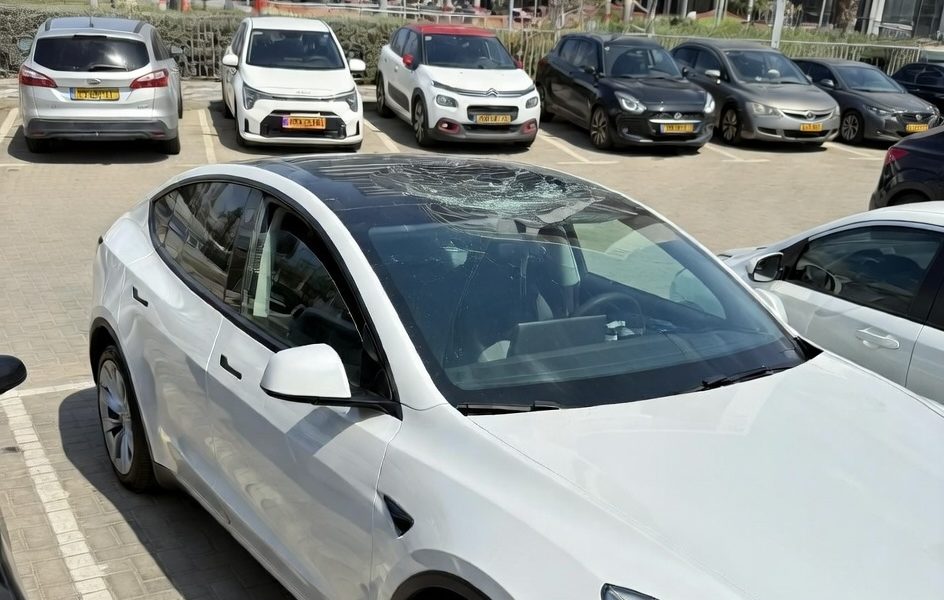
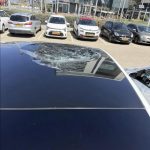
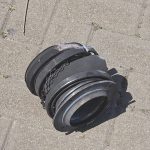
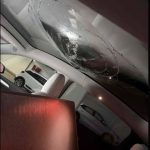
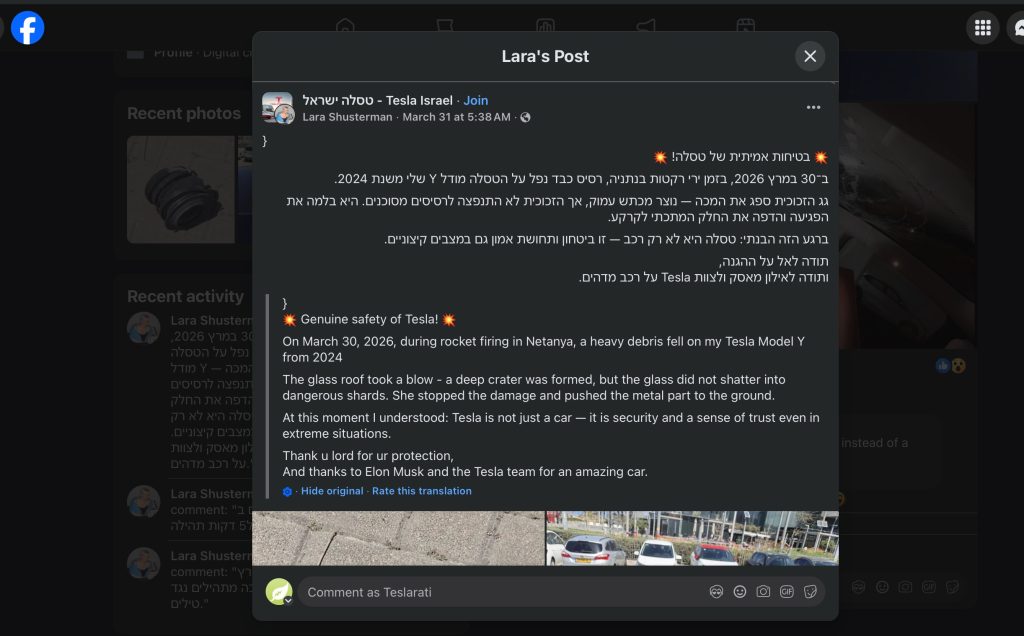
On March 30, 2026, Lara Shusterman was in Netanya, Israel when Iranian ballistic missiles triggered air raid sirens across the city. While she remained in safety, her 2024 Tesla Model Y did not escape untouched. A heavy piece of missile debris struck the car’s massive glass roof, leaving a deep crater but without shattering. In a Facebook post to the Tesla Israel community the following morning, Shusterman described what happened: “The glass did not shatter into dangerous shards. She stopped the damage and pushed the metal part to the ground.” She closed by thanking Elon Musk and the Tesla team for building what she called “security and a sense of trust even in extreme situations.”
Netanya is a coastal city in central Israel, roughly 18 miles north of Tel Aviv and has been among the areas most frequently struck during Iran’s ongoing missile campaign, following coordinated U.S. and Israeli strikes on Iranian military infrastructure. Falling shrapnel from intercepted missiles is a common occurrence.
Source: Tesla Israel Facebook Group
The incident is a testament to Tesla’s structural engineering. Tesla’s glass roof is designed to support over four times the vehicle’s own weight. That strength has shown up in real-world accidents too. In 2021, a Model Y in California was struck by a falling tree during a storm, with the glass roof holding firm and the cabin remaining intact. In another widely reported incident, a Tesla Model Y plunged 250 feet off the cliff at Devil’s Slide in California in January 2023, with all four occupants, including two young children, surviving.
Disturbing details about Tesla’s 250-foot cliff drop emerge amid initial investigation
Tesla officially launched sales in Israel in early 2021 and captured over 60 percent of Israel’s EV market in the first year. The brand’s foothold in Israel remains significant. Tens of thousands of Teslas are now on Israeli roads, making incidents like Shusterman’s easy to corroborate. On the same week her Model Y took the hit, the U.S. Space Force awarded SpaceX a $178.5 million contract to launch missile tracking satellites, a separate but fitting reminder of how intertwined the Musk ecosystem has become with the realities of modern conflict.
The post Tesla hit by Iranian missile debris in Israel appeared first on TESLARATI.
We’ve seen a few one-off specs of the Pagani Utopia since production began. The Coyote comes in a special livery, while the Utopia Roadster “La Nonna” gets subtle exterior modifications. Now, another one-off Utopia has been spotted prior to delivery.
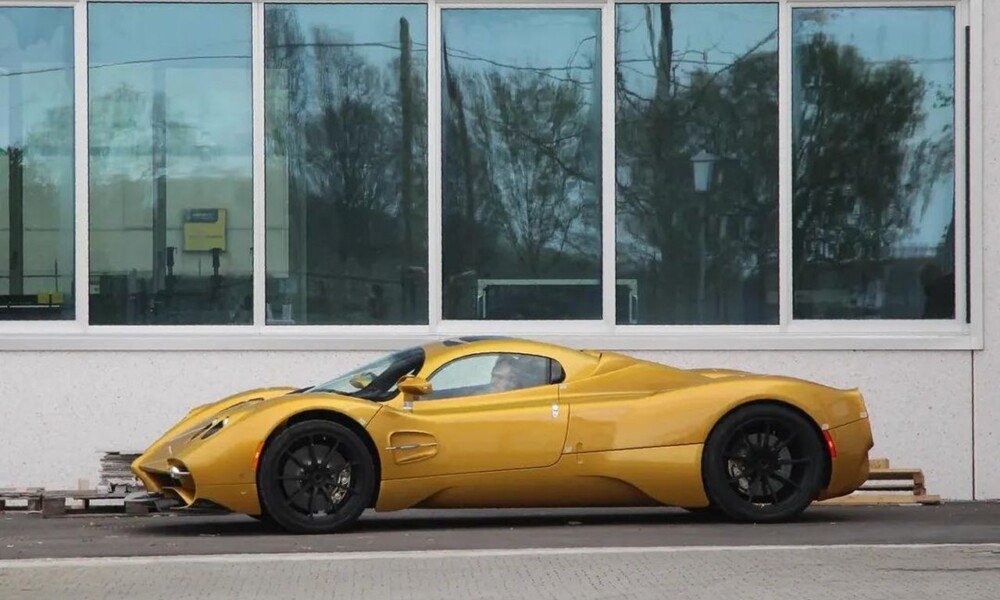
The latest one-off Pagani Utopia has a gold exterior. It’s a single-tone spec with minimal exposed carbon fibre surfaces. The unique bit on this particular example, though, is its headlights. A closer inspection of the spy images reveals Huayra R-style units. Unlike the regular Utopia, which has dual LED projectors housed inside a glass casing, this car has a body-coloured housing with exposed projectors.
We don’t expect any mechanical changes, though. It will be powered by a 6.0-liter twin-turbo V12 engine, which produces 864 hp @ 6000 rpm and 811 lb-ft of torque @ 2800-5900 rpm. Pagani offers a choice of a 7-speed automated manual and a proper H-pattern manual transmission.
We use cookies on our website to give you the most relevant experience by remembering your preferences and repeat visits. By clicking “Accept”, you consent to the use of ALL the cookies.
Support CleanTechnica’s work through a Substack subscription or on Stripe.
On Wednesday, April 1, the 22nd World Car Awards announced the winners for 2026. EVs swept every category. Every year, a panel of journalists from around the world votes on finalists and winners in each category. While the test drives happen in California in the fall, the vehicles come from around the world — although, they need to be offered in more than one market to compete. The award show happens in New York in the spring, prior to the New York Auto Show.
The Mazda EZ-6/6e, which is available as a PHEV and a BEV, won 2026 World Car Design. This design was originally developed for the Chinese market and was not present at the awards show. The vehicle has more recently been introduced in Europe and Australia. While the EZ-6 was not on display at the awards show, I had a chance to see it in Guangzhou, and I thought it was a sporty, appealing design.
Nio Firefly won 2026 World Urban Car. This car was also not at the awards or auto show, but I saw it in Guangzhou last fall. The premium subcompact makes sense for a World Car award, as this type of vehicle is well suited for European roads. Quality materials, RWD, modern tech, and more space on the inside than its exterior dimensions would suggest make it well suited for people who want a premium car but do not want a large car.
The Hyundai IONIQ 6 N won the 2026 World Performance Car. Of note, the regular IONIQ 6 has been discontinued in the US, but the 6 N is still offered for 2026. However, as Hyundai shifts in the US toward more hybrids and body-on-frame SUVs, with heavy localization, its future is a bit uncertain. The IONIQ 6 N win follows the IONIQ 5 N taking the same award last year. Both were present at the auto show, offering a ride along behind the Hyundai booth with Brazilian professional race car driver Gianfranco Casadei. I sat down in the car assuming that the artificial noises would be a bit tacky. However, they are subtle and seem to provide useful feedback for what the motors are doing. When driving an electric car, sometimes it can feel a bit isolated, and you end up taking a corner a little faster than you probably should. The feedback helps with that. Although, it can be turned off, along with the fake shift points. Overall, the IONIQ 6 N embraces the software defined vehicle concept to be heavily customizable to driver preferences or track conditions. I also like that I can sit upright in the back of the aluminum roof model without my head hitting. It could be both a useable family car and a track toy. Having ridden in it, I understand why it won.
The Lucid Gravity won the 2026 World Luxury Car award. The Saudi-made vehicle designed in California was also on the EV test track and show floor. On the test drive, it felt well put together and quiet with a smooth ride. While it reminds me more of a tall station wagon than a traditional crossover or SUV, it was surprisingly spacious inside with high quality materials.
The BMW iX3 Neue Klasse won both 2026 World Electric Vehicle and overall 2026 World Car awards. In addition, BMW’s Chairman, Oliver Zipse, who could not attend, was named the 2026 World Car Person of the Year. The model was at the award show, and I was hoping to get a better shot of it, but it did not appear again on the auto show floor. BMW did not have an official corporate presence at the show — although, a BMW dealer had a few models on display. Currently, this model is not available in the US, but it is anticipated soon. Overall, BMW took a very global approach to the development of the Neue Klasse. Different parts of the world came together to make a car that still feels very BMW. While in Guangzhou, they highlighted much of the technology within the car, as seen in the second half of the video.
World Car Insights
In addition to the awards, the organization released research on what consumers are looking for most from a car in 2026:
Affordability
Efficiency
Quality
Safety
Overall, these make sense in the current environment. All relate back to affordability. Efficiency makes vehicles more affordable to operate. Quality makes vehicles more affordable to maintain. Meanwhile, active safety can prevent costly accidents, while greater affordability can allow more people to drive safer new cars.
These motivations get back to the need for access to affordable, efficient, high quality global EVs that also get top marks on safety tests.
Photo by: Larry Evans
Feeling Isolated From Progress
The strength of EVs in the awards felt very promising. EVs are increasingly the best vehicles available in the world, regardless of class.
However, you couldn’t help feeling a bit isolated from the progress. The Firefly and Mazda EZ-6 are not offered here. We are getting the iX3 after much of the world, and it may not get the emphasis it gets in the global markets that collaborated to create it. The top car design and urban vehicle are not offered here. Hyundai discussed a strategy shift toward hybrids in the US, with increasing localization, while the future of the winning IONIQ 6 N looks somewhat uncertain.
On a panel a day earlier, Republican Senator Bernie Moreno said that he would introduce legislation to block Chinese cars from being built in the US, in addition to blocking imports. At a panel later in the day, the dealer group NADA and industry lobbying group AAI both pushed for blocking Chinese cars and highlighted a return to ICE vehicles. I’ll get into the show more, but the somewhat limited overall offerings were not as encouraging as past shows.
The feeling of isolation is growing. But the world is moving forward.
Sign up for CleanTechnica’s Weekly Substack for Zach and Scott’s in-depth analyses and high level summaries, sign up for our daily newsletter, and follow us on Google News!
Advertisement
Have a tip for CleanTechnica? Want to advertise? Want to suggest a guest for our CleanTech Talk podcast? Contact us here.
Sign up for our daily newsletter for 15 new cleantech stories a day. Or sign up for our weekly one on top stories of the week if daily is too frequent.
CleanTechnica uses affiliate links. See our policy here.
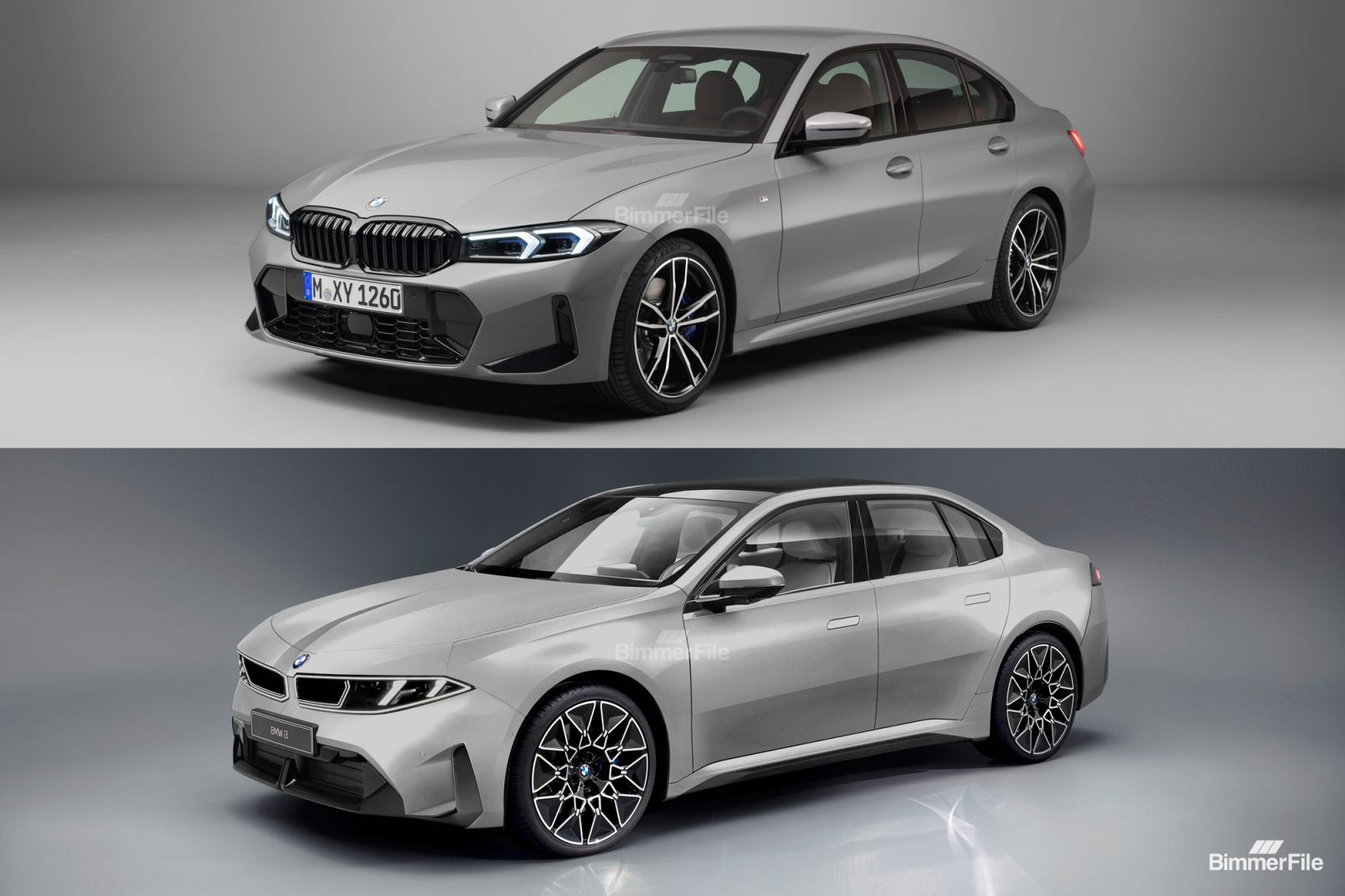
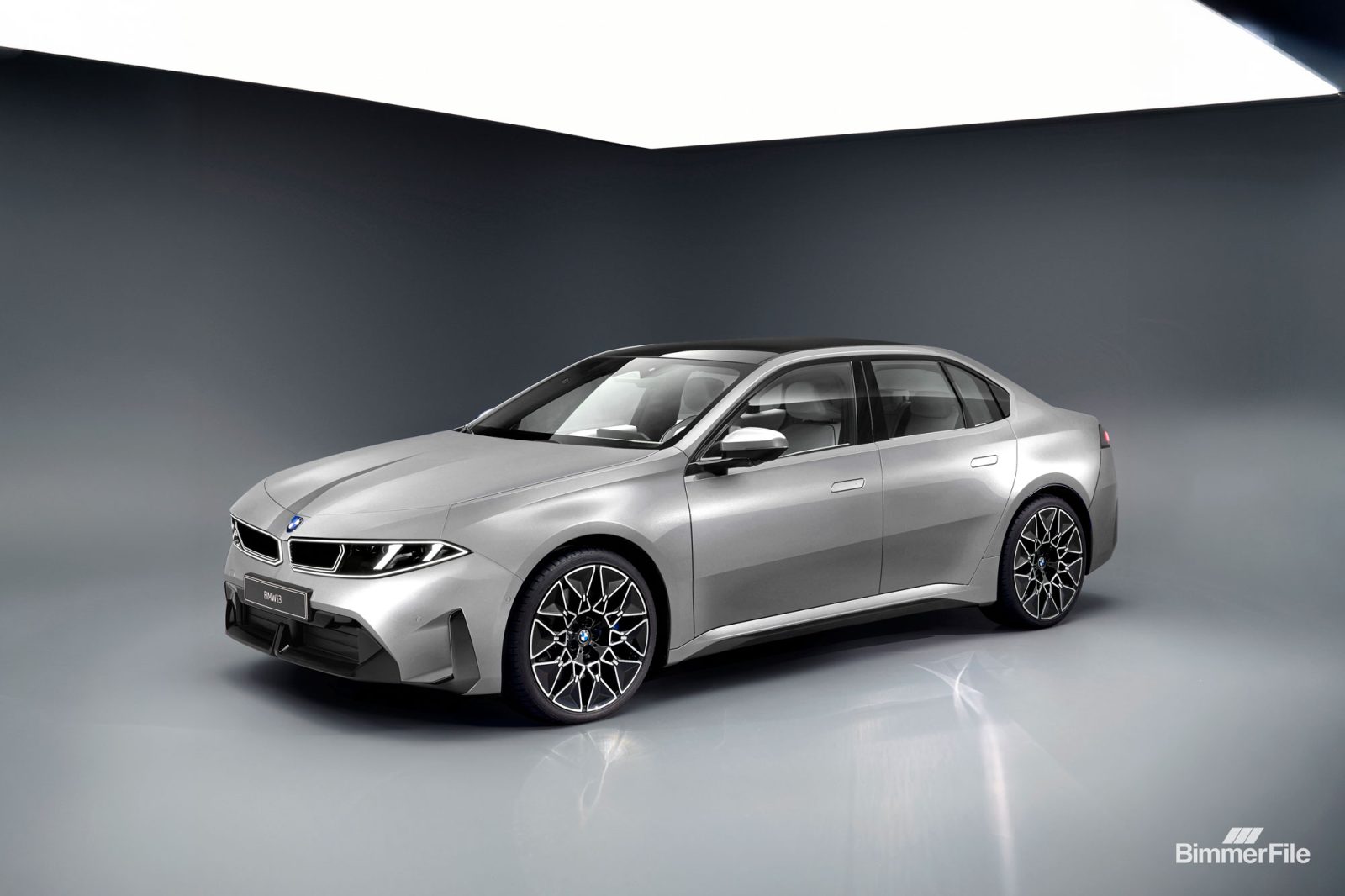
With the i3, BMW’s next generation 3 Series is partially here. The fully electric BMW i3, built on the Neue Klasse platform, represents a clean-sheet rethink of the brand’s most important car. But it is only half the story. Alongside it, BMW is preparing a petrol-powered successor to today’s 3 Series, code-named the G50, that will carry the formula forward in a very different way.
We’ve been tracking this dual-track strategy for years, but now it is finally coming into focus. BMW is not replacing the 3 Series with a single car. It is redefining it with two fundamentally different models that will share nearly identical design.
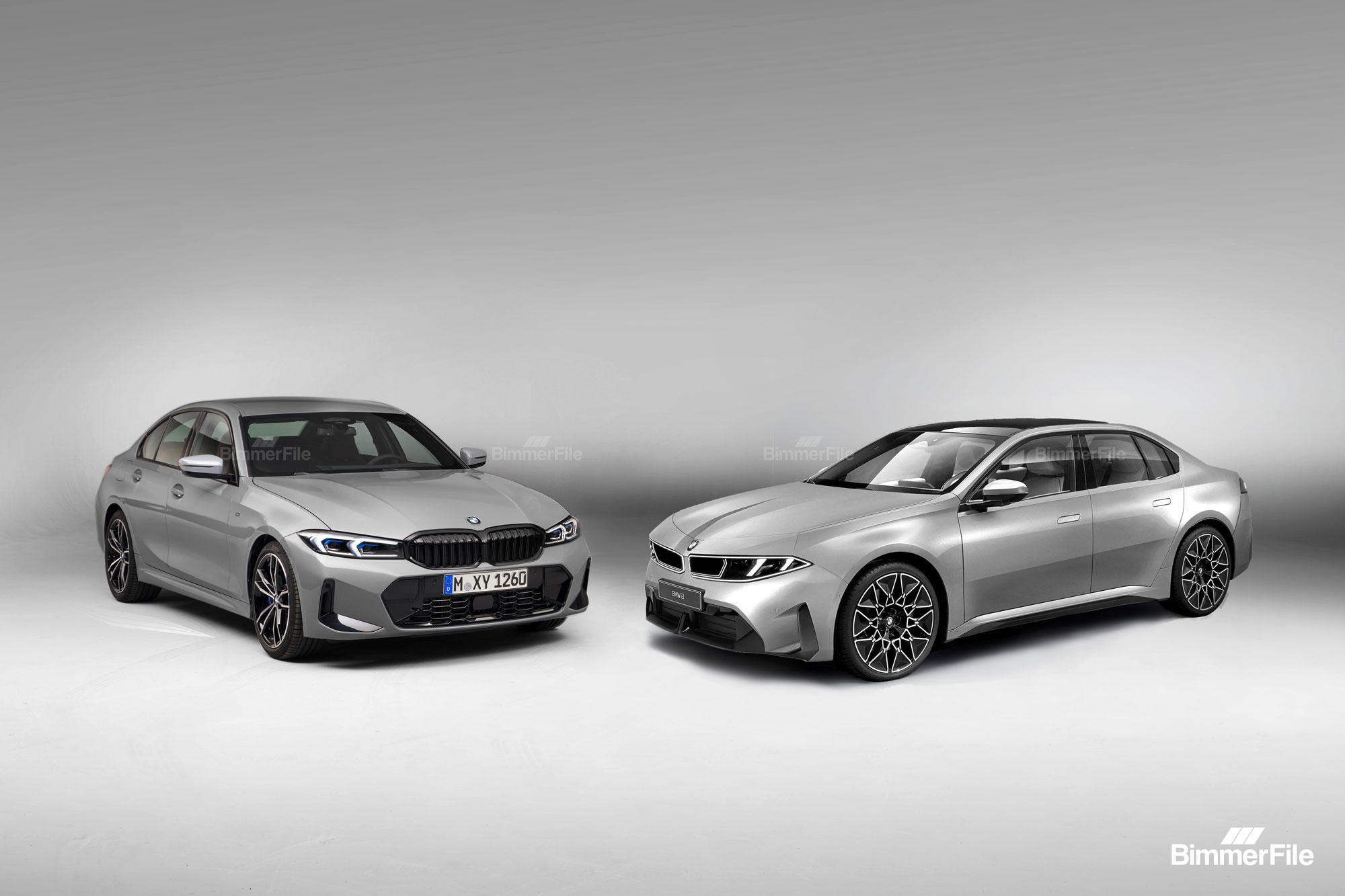
From the outside, that shared identity will be almost seamless. The new BMW i3 and the upcoming G50 are expected to look nearly identical, down to their proportions, lighting signatures, and overall stance. BMW is deliberately aligning the design of both cars so that, at a glance, they read as the same 3 Series.
Underneath, they are anything but.
The BMW i3 and Neue Klasse Platform
Alongside the all-electric i3, BMW is preparing a petrol-powered 3 Series code-named the G50. At its core, this car will be a heavily reworked version of today’s G20, continuing on the CLAR platform with updated versions of the B48 and B58 engines.
These are not carryover engines in the traditional sense. Expect meaningful revisions to meet stricter EU emissions standards, along with incremental gains in efficiency, refinement, and hybrid integration. This will be the most advanced and likely the final evolution of BMW’s current combustion 3 Series formula.
From an engineering standpoint, it is evolution rather than revolution. From a design standpoint, it is something else entirely.
The G20 will become the G50 and take on the i3’s design language.
The G50: A New 3 Series Built on CLAR
If you’re expecting the G50 to look like a facelifted G20, think again. BMW is planning to align it almost entirely with the design of the new i3.
That means the same proportions, the same front-end treatment, and the same lighting signatures that define the Neue Klasse look. Park the two cars next to each other and most people won’t be able to tell which one is electric and which one isn’t.
The i3 is a clean-sheet EV built on BMW’s Neue Klasse architecture, with a flat battery, new electronics, and an entirely different approach to packaging and dynamics. The G50 continues with a longitudinal engine layout, rear-wheel drive bias, and everything that has defined the 3 Series for decades.
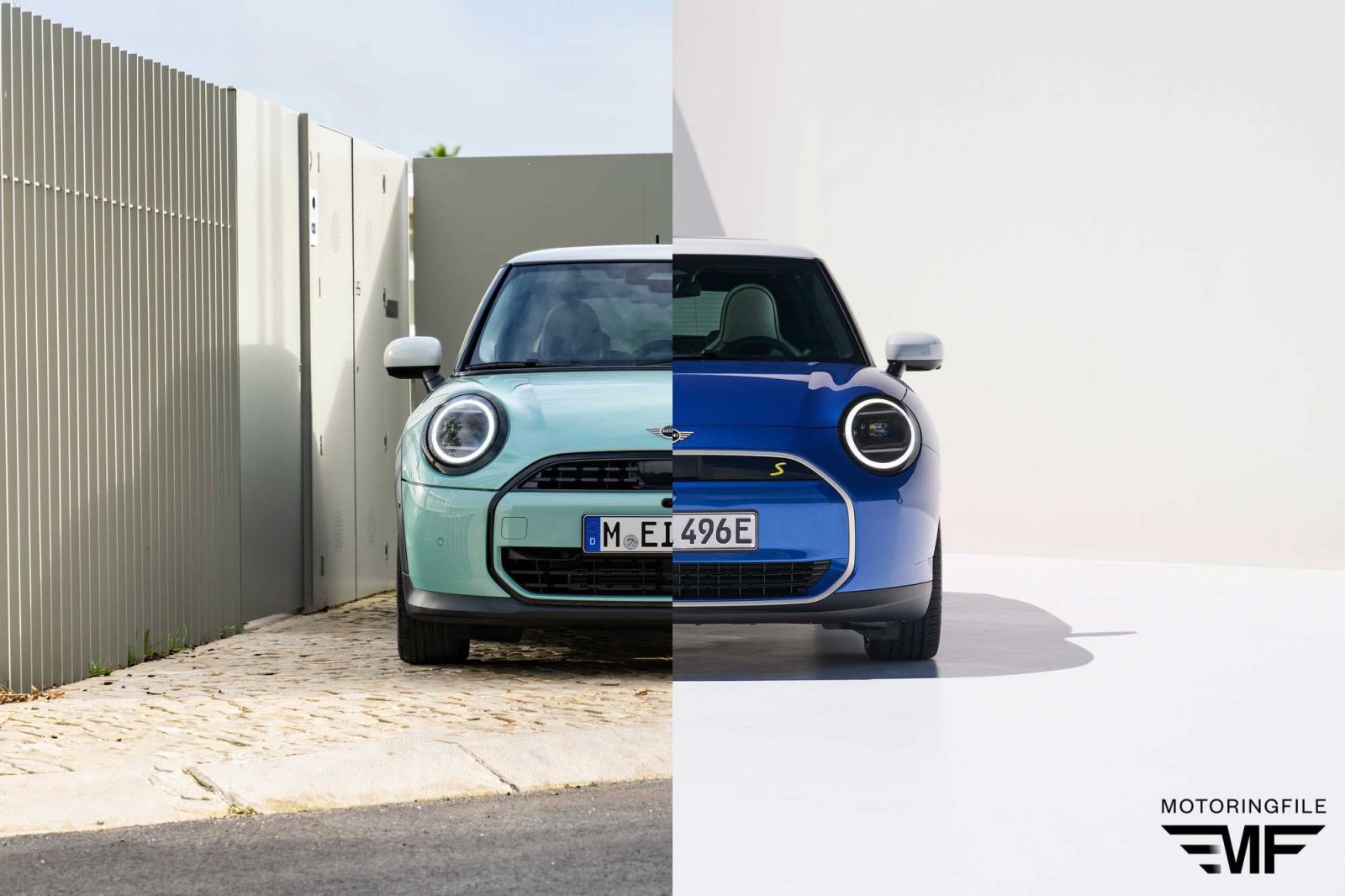
The F66 ICE and J01 EV MINI Coopers. Identical styling on two very different platforms.
Why The Dual Strategy?
For years, moving to an EV meant buying into a different design language and, in some cases, a different identity altogether. BMW is removing that friction. Instead of asking customers to choose between two different interpretations of a 3 Series, it is offering one design with two fundamentally different ways to power it.
It is a strategy MINI began exploring with the latest Cooper, where electric and combustion versions share nearly identical design cues despite completely different architectures. BMW is now applying that thinking to its most important model. The theory is that customers will be able to make a choice that’s simply about drivetrain and not design not any different from choosing between diesel or petrol in years past.
What This Means for the Future of the 3 Series
What makes the G50 particularly interesting is what it represents in the broader context of BMW’s lineup.
This is not just another mid-cycle update. It is the continuation and likely the final full evolution of the combustion-powered 3 Series. The B48 and B58 engines will live on here, refined and optimized to meet regulatory demands while preserving the performance characteristics enthusiasts expect.
At the same time, the car will adopt a design that belongs to BMW’s future rather than its past.
That creates a unique moment where the most traditional version of the 3 Series looks almost identical to its most forward-looking interpretation.
Two Paths, One Identity
The i3 represents where the brand is going, with a clean-sheet platform and a new approach to software, electronics, and electrification. The G50 represents where the brand is today, refined to its highest level but still rooted in familiar engineering.
What ties them together is design.
For the first time, BMW is separating what you see from how the car is engineered. Two completely different cars will share the same face, the same stance, and the same identity.
The Real Question
This raises a question that goes beyond specs or platforms. If two cars look the same but are fundamentally different underneath, what actually defines a 3 Series?
BMW seems to believe the answer is not the engine or even the platform. It is something more intangible, something tied to design, balance, and the overall experience. We are about to find out if that belief holds up. Because for the first time, the future of the 3 Series and its past will be parked side by side.
Launched earlier this week, the Tesla Model Y L is finally available to order on the Malaysian website, and with that comes official pricing for the six-seater electric SUV. The car costs exactly as estimated, retailing at a nice round RM260,000 nett, or RM262,615 on-the-road without insurance.
This makes the L RM17,550 more expensive than the regular Premium Long Range AWD, which is about the same as in Australia – although the reverse is true in Thailand. As with any other Tesla, the car is available with several cost options, including any colour other than the standard Stealth Grey.
One of the most expensive is the new hero colour called Cosmic Silver, an almost champagne gold hue that replaces Quicksilver and costs a whopping RM11,000, joining the similarly-priced Ultra Red (other colours include Pearl White Multi-Coat and Diamond Black at RM5,000, as well as Glacier Blue at RM7,500). As for the interior, the optional white has been replaced by Zen Grey, remaining at RM5,000 (black is no cost).
Available solely in Premium AWD trim. the Model Y L is 177 mm longer (4,969 mm) and 44 mm taller (1,668 mm) with a 149 mm longer wheelbase (3,040 mm) than the five-seater Premium model. This frees up space for a pair of third-row seats, with the roofline also being pushed upwards towards the rear to add some decent headroom.
Step inside and you’ll notice that the second-row bench has been swapped out for captain’s chairs with power-retractable armrests, heating and ventilation, leading to a 2-2-2 seating configuration. The power-folding rearmost seats are also more substantial (with proper headrests) than the third-row pews in the standard seven-seater (2-3-2) version, currently only available in the US and Europe. Meanwhile, the physically larger body delivers a maximum cargo room of 2,539 litres, versus 2,138 litres for the standard Model Y.
Aside from the slightly hunchbacked roofline, the Model Y L is differentiated on the outside through a jutting rear spoiler and unique 19-inch Machina wheels with a Y-spoke design. You can’t spec the 20-inch Crossflow alloys available on other Model Y Premium models.
Other new bits include more substantial power-adjustable, heated and ventilated front seats – now with extendable thigh support – as well as adaptive dampers (first seen on the full-fat Performance model) to replace the standard frequency selective shocks. The sound system has also been expanded from a 15-speaker to an 18-speaker setup, still with a subwoofer. The twin Qi wireless chargers have been upgraded to 50W and now feature cooling via air cond vents.
Beyond all that, the Model Y L is pretty much the same as every other Model Y Premium, with textile interior trim, faux leather upholstery, a 16-inch infotainment touchscreen, an eight-inch second-row touchscreen, a panoramic glass roof, ambient lighting, eight exterior cameras (still no full 360-degree view) and a hands-free opening tailgate.
In terms of driver assists, the Model Y L continues to come with basic Autopilot, which includes Level 2 semi-autonomous driving functionality. Enhanced Autopilot, which adds automated lane changes, park assist and remote park assist (which Tesla rather facetiously calls Dumb Summon) costs an extra RM16,000, while the dubiously-named (and non-functional in Malaysia) Full Self Driving add-on is double that at RM32,000.
Aside from the extra space and seats, the Model Y L also gains a larger 82 kWh NMC battery for a range of 681 km on the WLTP cycle, versus 629 km for the Model Y Premium LR AWD. The dual-motor 462 PS (340 kW) setup enables the car to get from zero to 100 km/h in 5.0 seconds (two tenths of a second slower than the regular model) on its way to a top speed of 201 km/h.
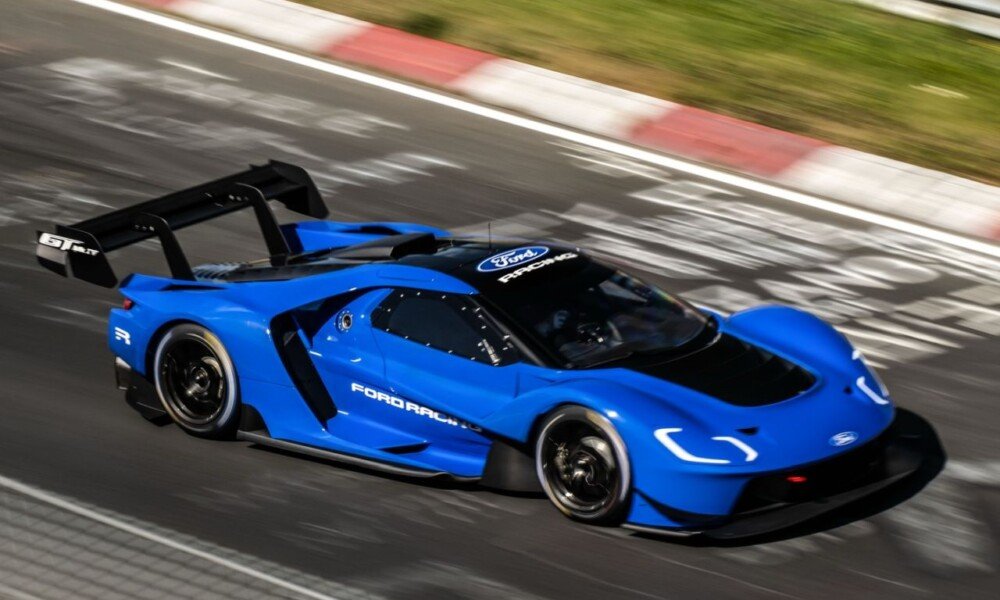
Last week, the Ford Mustang GTD was spotted at the Nurburgring. Now, a Ford GT Mk IV was seen doing quick laps of the track, raising speculations about an imminent lap record attempt.
The Ford GT was captured on camera by automotive photographer Bas Fransen and shared on Instagram. “Do we have a new lap record Ford? I witnessed a new lap record attempt at The Nordschleife today,” he wrote. To which professional race car driver Misha Charoudin replied, “6:15”.
Someone clearly has been monitoring the lap times on a stopwatch, and even though it may not be accurate, we do get a rough idea of where the Ford GT Mk IV slots on the leaderboard.
The Ford GT Mk IV is a limited-edition track car powered by a twin-turbo EcoBoost engine. It has an estimated output of 800 hp and comes with a racing transmission. Only 67 examples were built and offered to customers at $1.7 million a piece.
The automotive industry is evolving quickly. Features like adaptive cruise control, automatic emergency braking and lane-keeping assistance are no longer limited to luxury models. They are becoming standard across passenger cars and commercial vehicles alike.
These technologies are part of the advanced driver assistance systems (ADAS), a group of systems built to help drivers stay safer and more aware on the road. In this blog, we’ll take a closer look at how ADAS works, what sensors it relies on, and why proper calibration is essential for accuracy and safety.
Advanced driver assistance systems (ADAS) refer to a group of technologies designed to improve driving safety and reduce the risk of accidents. These systems use tools like cameras, radar and onboard sensors to monitor the road and track what’s happening around the vehicle. When they detect a potential hazard, they can warn the driver or step in with limited automatic assistance, such as braking or steering support.
Today, ADAS features are standard in many new electric vehicles as well as conventional models. A few key ADAS safety features include:
Automatic Emergency Braking (AEB): This system detects vehicles, pedestrians, or obstacles ahead and can apply the brakes if the driver does not respond in time. It is designed to prevent front-end collisions or reduce the severity of impact when a crash is unavoidable.
Adaptive Cruise Control (ACC): Adaptive cruise control goes beyond traditional cruise control by automatically adjusting speed to maintain a safe following distance. It is especially useful in highway traffic, where stop-and-go driving can increase fatigue and delayed reaction time.
Lane Keep Assist (LKA): Lane keep assist helps drivers stay centered by detecting lane markings and providing gentle steering correction if the vehicle drifts. It can be helpful during long drives, but it works best when lane lines are clearly visible and road markings are well maintained.
Blind Spot Monitoring (BSM): Blind spot monitoring tracks vehicles approaching from behind in adjacent lanes and warns drivers before a lane change. Many systems also provide additional support during highway driving, where blind spot collisions are more common.
Which Sensors Are Used in ADAS?
ADAS relies on several different sensor types, and each one plays a specific role. Some are better at recognizing detail, like lane markings and road signs, while others are designed to measure distance and speed more accurately. Because driving conditions vary so widely, this combination helps improve ADAS accuracy. The most common sensors used in ADAS include:
Cameras (front, rear, and side-facing): Used to detect lane markings, traffic signs, pedestrians and other vehicles. They provide detailed visual information.
Radar (short-range and long-range): Measures the distance and relative speed of objects, especially useful for adaptive cruise control and collision detection.
Ultrasonic sensors: Typically used for close-range detection, such as parking assistance and low-speed maneuvering.
Lidar (in select vehicles): Uses laser pulses to create a detailed 3D map of the surroundings, found in many autonomous vehicles.
Infrared or night vision cameras (in some models): Designed to detect pedestrians or animals in low-light conditions.
Wheel speed sensors: Monitor how fast each wheel is rotating, helping support stability control and braking systems.
Steering angle sensors: Track the direction of the steering wheel to assist with lane-keeping functions.
Yaw rate and acceleration sensors (part of the vehicle’s inertial measurement unit-IMU): Measure vehicle rotation and movement to support stability and traction systems.
ADAS Sensor Limitations
Even the most advanced sensor systems can struggle under certain conditions. ADAS relies on clear data to function properly, and anything that interferes with that data can affect how the system responds. Here are some ADAS limitations drivers should be aware of:
Poor weather conditions: Heavy rain, snow, fog or ice can reduce visibility for cameras and interfere with radar signals. In these situations, the system may delay alerts or temporarily disable certain features.
Sensor misalignment: Impacts, suspension adjustments or windshield removal can alter the precise alignment of forward-facing cameras. An ADAS-compatible windshield replacement ensures the glass is installed correctly and the system is recalibrated to factory specifications.
Glare and low light: Direct sunlight, reflections off wet pavement or sudden transitions between bright and dark areas can affect camera-based systems. Detection accuracy may drop when lighting conditions change quickly.
Obstructed sensors: Dirt, mud, road salt or even a small crack in the windshield can block a camera’s field of view. Radar sensors mounted in the grille or bumper can also be affected by debris buildup.
Faded or unclear road markings: Lane-keeping features depend on visible lines. Construction zones, worn paint or poorly marked rural roads can make lane detection inconsistent.
Why ADAS Calibration After a Windshield Replacement Matters for Safety
For vehicles equipped with ADAS, windshield replacement affects more than visibility. Many ADAS features depend on windshield-mounted cameras, and those cameras require exact positioning to function correctly. When the windshield is replaced, even small changes in mounting height, angle or camera bracket placement can impact how the system reads the road.
Skipping windshield calibration after getting an auto glass replacement service can compromise the accuracy of driver assistance features. Calibration ensures the camera is correctly aligned according to the manufacturer’s specifications. When everything is properly aligned, features like lane assist and collision alerts perform more consistently. For vehicles equipped with ADAS, this step is not optional. It plays an important role in maintaining overall safety performance.
Key Takeaways
ADAS has become one of the most significant safety advancements in modern vehicles. Automatic emergency braking and blind spot monitoring are built to help in situations where drivers may not react quickly enough. When everything is working as it should, they can add a real layer of protection in everyday driving.
That said, ADAS depends on accuracy. Sensor cleanliness, alignment and proper calibration after repairs all affect performance. When drivers and fleet operators treat ADAS as part of the vehicle’s safety equipment, not just a convenience feature, it delivers far more value.
BMW just made it easier to justify keeping your car at the dealer after the free maintenance runs out. As of March 1, 2026, any BMW or MINI that’s 37 months old or more automatically qualifies for the company’s Value Service Program — competitive, dealer-level pricing on common maintenance items, done by certified technicians using genuine parts. No exceptions based on model or chassis, no confusing gaps in coverage. The moment your complimentary maintenance period ends, Value Service picks up right where it left off.
It’s a direct play to win back owners who’ve been taking their out-of-warranty BMWs to independent shops. And depending on where you live, the pricing gap might be smaller than you expect.
What BMW Value Service covers and how to check pricing
The program is BMW’s answer to the age-old problem of owners drifting to independent shops once the complimentary maintenance runs out. The pitch is competitive pricing benchmarked against local market rates, but with certified BMW technicians and genuine parts. There’s also a 2-year warranty on parts, which is something most independent garages can’t match.
Services covered include the usual suspects: oil changes, engine air filters, cabin microfilters, front and rear brake pads and rotors, windshield wipers, and spark plugs — up to 11 services in total at participating locations. The good news on participation is that over 90% of BMW and MINI dealers are enrolled. Specifically, 94% of BMW centers and 96% of MINI centers are in, and more than 95% of those offer the full slate of services. So unless you’re in a particularly remote area, your local dealer almost certainly qualifies.
Pricing is transparent before you commit. You can check what a specific service costs by entering your VIN on the BMW Value Service or MINI Value Service website, or directly on your dealer’s own site. No surprises at the counter. The program also ties into the MyBMW and MINI apps, so you’ll get service alerts pushed to your phone when something’s coming due, followed by Value Service offers. It’s a small thing, but it removes the guesswork around timing.
One other thing worth noting: the program covers vehicles up to 20 years old, which BMW says puts roughly 80% of BMWs currently on U.S. roads within eligibility. ALPINA models are excluded from the program entirely.
Whether this beats a trusted independent shop in your area will depend on where you live and what they charge. But for owners who’ve been avoiding the dealer purely on cost concerns, it’s worth pricing out.
A tripling of French Tesla registrations may sound impressive, but measured against 2023 it is essentially flat. By Stewart Burnett
Tesla recorded some noteworthy year-on-year gains in Europe during March 2026, with France up 203% to 9,569 units, Norway up 178% to 6,150, Sweden up 144% to 1,447, and more modest increases across Belgium, the Netherlands, Italy, and Spain. The broad recovery follows a February in which European registrations returned to growth for the first time in over a year, driven by the rollout of refreshed, lower-priced versions of the Models Y and 3.
Tesla’s 2025 sales crash in Europe, during which its market share was cut by nearly half, was unprecedented—a perfect storm of political backlash against Chief Executive Elon Musk’s far-right political activities, a stagnant product lineup, and rising competition from both continental and Chinese automakers. The effects of this were particularly acute in Germany, the region’s largest auto market, where sales fell by 48%.
It should be emphasised, then, that March’s year-on-year gains are being measured against some of the weakest months in the automaker’s recent history. Notably, French registrations of 9,569 units in March 2026 came within three units of a December 2023 record, suggesting the brand has, over two years, essentially held its French ceiling while the broader European electric vehicle (EV) market expanded by 68%.
At the same time, Tesla is clearly taking some steps to address the criticisms levelled against it. The refreshed Model Y, internally designated Juniper, has addressed some of the issues European buyers had raised around ride quality and range, and its lower entry price has reopened the consideration set for buyers who had ruled out the brand on cost.
Tesla began delivering the Model Y Juniper in Europe in March 2025
The damage wrought upon the brand by Musk himself may prove more pernicious. In several key markets, the consumers most likely to have switched away from Tesla on political grounds were also those most likely to have been early adopters, leaving a loyalty base that skews older and less politically engaged than the brand historically attracted.
Tesla had a golden opportunity to cast Musk away during 2025; numerous reports at the time alluded to internal discussions about his prospective departure. Instead, the company’s board and stakeholders approved an unprecedented US$1tr compensation package for the controversial executive. Compensation will be awarded based on the automaker successfully passing a range of milestones, including the deployment of one million robotaxis worldwide and reaching a market cap of US$2tr.
The Iran conflict has introduced a new variable to Tesla’s recovery prospects. Gasoline prices across Europe have risen significantly since the Strait of Hormuz blockade began in late February, and inquiry volumes for EVs and hybrids have increased at multiple dealerships. Renault’s Dacia France chief Olivier Mornet also recently described an uptick in online and in-person enquiries.
In the US, the picture remains weaker. Tesla sold 41,300 vehicles in March, down 7.9% year-on-year and representing its sixth consecutive month of declining domestic sales. First-quarter US deliveries of approximately 119,900 units were 12.5% below the equivalent period in 2025. Wall Street consensus for global Q1 deliveries sits at around 365,000 vehicles, with some analysts, including UBS, having cut forecasts further to roughly 345,000.
Update: Tesla has confirmed that global Q1 deliveries came in at 358,023 vehicles, up 6% year-on-year but essentially flat against Q1 2024, and roughly 50,000 units below what Tesla produced in the same period. That production-delivery gap points to building inventory, and the pressure is likely to intensify; thousands of ex-fleet Teslas are expected to enter the used market in the coming months, competing directly with new sales at the lower end of the range. Production rates may need to come down unless demand materially improves.