5.2 C
London
Tuesday, May 12, 2026
Home Blog Page 13

How We Handle Laundry While Living in an RV Full-Time

0
How We Handle Laundry While Living in an RV Full-Time


Laundry is one of those everyday things that looks a little different when you live full-time in an RV. Without a washer and dryer in the camper, it takes a bit more planning and flexibility, especially for a family of four like ours. Dirty clothes add up quickly, and laundromats can get expensive fast. 

Doing laundry while living in an RV full-time can feel complicated at first, but with a few simple routines and tips, it quickly becomes manageable. Over time, we’ve figured out a system that works for us, keeps clothes under control, and doesn’t completely take over our lives or our storage space! Here’s how we handle laundry while living in an RV and how we try to keep it affordable.

Our Big Trick: We Keep Wardrobes Simple

One of the biggest adjustments to RV living was cutting way back on clothes. Storage is limited, and the more clothes you have, the more laundry you’re creating. Fewer clothes means laundry happens more often, but each load is smaller and more manageable. It also makes putting clothes away much easier, which is a win in a small space.

Each of us keeps a small, practical wardrobe focused on:

  • Comfortable everyday clothes
  • Layers for changing weather
  • One to two nicer outfits
  • One to two sets of pajamas or sleepwear
  • Outerwear

Our youngest, Emmett, is the hardest when it comes to getting rid of clothes. He gets attached to things, and his clothes space is always our biggest struggle, especially because he always wants to wear the same clothing items but doesn’t want to get rid of anything. Oh, what fun it is to be raving with children haha. 

Campground Laundry Rooms (When Available)

When we stay at campgrounds with laundry facilities, we usually take advantage of them. This is often the easiest option, especially when we’ve gone a bit too long between washes. However, it can sometimes be the most costly. Some campgrounds definitely price-gouge for both washers and dryers, but I guess that’s the price of convenience and having laundry so close by.

These facilities can also be smaller than your average laundromat, so being mindful of when you go helps. We try to avoid busy times and make sure we stay on top of our wash and dry timers so someone isn’t waiting on us.
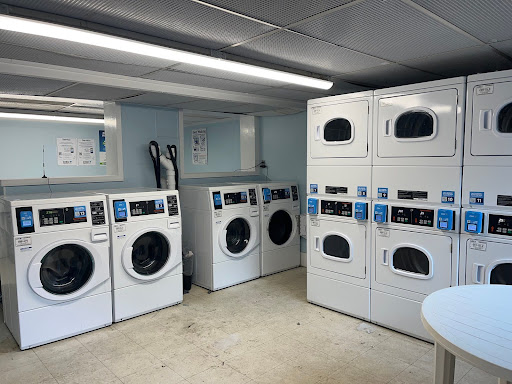
A nicer laundry room at a RV campground
A nicer laundry room at a campground

A few things we’ve learned:

  • Machines vary a lot in quality, so we always check them first and make sure they actually work before stuffing them full of clothes and adding your detergent. 
  • Some can be costly, so we check pricing before starting a load. 
  • We keep a small stash of quarters since some facilities don’t have tap-to-pay or laundry apps. 
  • We bring our own detergent to avoid buying overpriced single-use pods. 
  • Always check when the laundry facilities open and close because I  can’t tell you how many times we’ve gone to start a load only to realize the laundry room closes shortly after, meaning we wouldn’t be able to complete a full wash and dry cycle. We love it when campgrounds offer 24-hour laundry facilities! 

Laundromats Are a Reliable Go-To

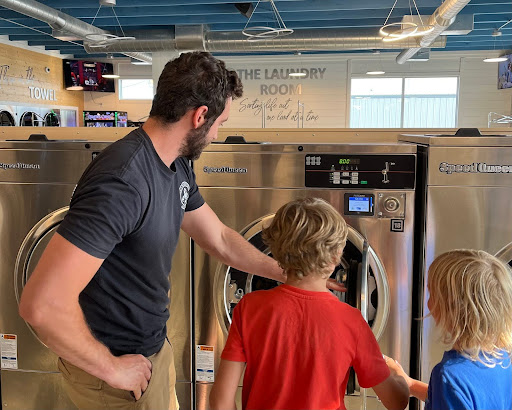
When campground laundry isn’t an option, laundromats are our backup, and honestly, they’re sometimes faster. Being able to wash and dry multiple loads at once helps us catch up quickly. Sometimes laundromats can even be cheaper than campground laundry, especially if they offer larger machines or occasional discounts. We transport our laundry in a large laundry bag and are eventually wanting to get these convenient and storage-friendly collapsible laundry baskets! 

We usually try to combine laundry errands with grocery trips to make the outing more productive since we’re already out and about, especially when we’re having to venture pretty far for a good laundromat. 

Things we do at laundromats:

  • Bring something to do while we wait. Normally, we each bring a book to read, or Anthony and I will play a game of chess. The boys have even done schoolwork on their tablets while we wait for the clothes to finish.
  • Fold everything right there so it doesn’t pile up back at the RV. This is huge. We like to get it done there so we avoid wrinkles and don’t have to deal with folding in our small living space later.

Things to consider:

  • Laundry budget and payment options – some laundromats are nicer than others and can be more expensive. Always check reviews for pricing, machine condition, and payment types (quarters, app, or card). 
  • Parking lot size – if you’re planning on bringing your rig, make sure the laundromat has room to accommodate your RV. This is something we run into on travel days when we need to do laundry and have to check if parking is available.

Doing Small Loads Inside the RV

Our RV is small, and since we boondock often, having an RV-sized washer and dryer just isn’t realistic or necessary for us. Some larger or more luxurious RVs and fifth wheels have washer and dryer hookups, but we don’t and many smaller RV setups require a little more creativity.

For quick washes like undergarments, swimsuits, or a few essentials, we sometimes wash items right in the RV sink. This can be as simple as hand washing the old-fashioned way or using a small portable RV collapsing washer. We purchased one from Amazon that works well, stores easily, and is perfect for smaller items. For these smaller loads, we air-dry our clothes either outside on our fold-up drying rack or inside on hangers. This method isn’t ideal for full loads, but it’s incredibly helpful between laundromat trips.

We also have a foldable drying rack that’s helpful when clothes don’t fully dry in the dryer, and we don’t want to pay for another cycle or when we do wash small items inside the RV sink. It’s also great for hanging bathing suits or towels after the pool.
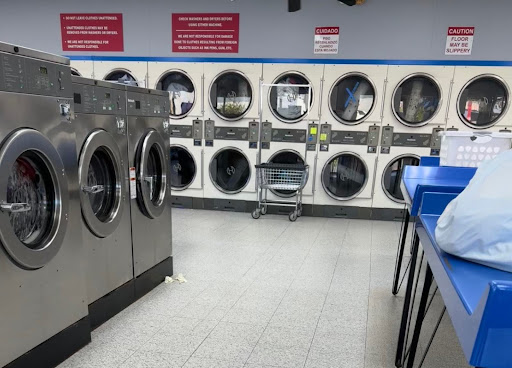
laundry day at a laundromat as an rv family full-time on the road
laundry day at a laundromat

How Much Does Laundry Cost While RVing?

One thing many people don’t think about before hitting the road is how quickly laundry costs can add up. In a traditional home, you rarely think about it because you’re using your own washer and dryer. On the road, though, you’re usually paying per load.

Typical laundry costs we’ve seen:

  • Washers: $2–$5 per load
  • Dryers: $1.50–$5 per cycle
  • Campground laundry rooms are often the most expensive due to convenience

For a family of four like ours, a full laundry day can easily cost anywhere from $10 to $25 depending on where we are and how many loads we’re washing. And that’s just for one laundry day. We typically do laundry at least twice a month, sometimes more if needed, so those costs can add up quickly.

These prices are just estimates, and we’ve found that larger machines can sometimes fit multiple loads at once, which helps save money even if the upfront cost is higher.

A few ways we try to keep laundry costs down:

  • Washing multiple loads at once using larger laundromat machines
  • Air drying clothes when possible
  • Doing small hand washes in the RV sink for essentials
  • Staying on top of laundry so it doesn’t pile up into a huge laundry day

Like many things in RV living, it’s just something you learn to work into your travel budget.

Laundry Becomes Part of Your Routine on the Road

When you’re living full-time in an RV, laundry quickly becomes something you plan around. Travel days, longer stays, boondocking, and even the weather all play a role in when it gets done. We’ve learned the hard way that putting it off just means more to deal with later.

After a rainy week, we know we’ll have extra towels from wiping down the RV and muddy clothes to deal with. Bigger items like comforters and blankets take more time, so we try to plan those loads ahead. If we’re heading somewhere remote or planning to boondock, we make sure everything is washed before we go. But when we’re staying in one place for a while, we can be a little more relaxed and space it out

Staying Organized Makes a Huge Difference

In a small space, laundry can get out of hand quickly if it’s not managed. Staying organized helps keep the RV from feeling cluttered and chaotic. As I mentioned earlier, we fold and put clothes away as soon as they come out of the dryer. Having a designated spot for dirty clothes is just as important. Over time, we’ve tried a few different hampers, from narrow plastic ones that crack to fabric bags that don’t stay upright. Check out our previous article for more RV organization tips! 

Right now, we use a wicker hamper that sits in our shower and works really well for our setup. It still leaves us space in the bathroom, and when we need to use the shower, we just move it out (along with our kitty’s litter box) since we don’t use the shower very often. 

In Conclusion 

Laundry on the road definitely takes more effort than tossing clothes into a washer at home, but it’s just another routine we’ve adjusted to. Like everything else with RV living, it’s about finding what works best for your family and being willing to adapt. It may not be perfect, but it’s manageable, and it’s a small trade-off for the freedom and experiences that come with living life on the road.

If you’re thinking about full-time RV living, laundry might seem like a big hurdle at first and sometimes a costly one, but trust us, it quickly becomes just another normal part of the journey that you learn to budget for.


Source link

Rolling Like A G: A Datsun 240Z On 305s

0
Rolling Like A G: A Datsun 240Z On 305s


This article was originally published on Speedhunters October 26th 2020

I don’t think there’s a single person among us who would say 2020 has gone to plan. Feel how you wish about the reactive measures that governments around the world have taken in response to COVID-19, but they’re here for the foreseeable future.

Virus ignored, socially and politically, it’s also been one hell of a year. I’m not sure about you, but the lens I view world news in has shifted from ‘what’s new?’ to ‘what now?!’. But silver linings exist within most forms of calamity, and the world slowing down has, in the very least, provided all of us with more time and more perspective.

With life outside of automobiles becoming more troubling by the hour, our beloved hobby has become a very welcome and needed haven of normalcy. Quarantines have made the streets barren, and with race tracks feeling the squeeze of social restrictions, they’ve been practically begging people to come and use them.

If showing your car is a priority, then 2020 hasn’t been your year, but those who want to drive their cars have found themselves in a somewhat fortunate situation.

Enjoying The Ride While It Lasts

As it has for all of us, 2020 has thrown Tim Corbin, the owner of this 1972 Datsun 240Z, a series of curveballs. Instead of focusing on those wild pitches, however, Tim has used the extra hours they’ve afforded to enjoy the car he’s built more than he would’ve been able to had the world been operating at full speed.

Because normally his life involves considerable amounts of travel, Tim has always been the type to drive his car rather than look at it sitting still. In fact, the first time I saw the car, it was parked outside the show, and had I not walked out when I did, I would have missed it.


The seasons here in Ontario, Canada, can be pretty short, so staring at the car behind a velvet rope has never been anywhere near a priority. Like many with this same mindset, Tim’s also not much for social media. He uses it, sure – it’s an almost unavoidable entity at this point – but his use centers around connecting with others who have similar interests.

As a result of no real desire to enter shows, or overly broadcast the car, it keeps a relatively low profile despite, in my opinion, being one of the best looking Z cars in the province.

When Life Offers Stillness, Be Still

This car is, at its core, perfect Speedhunters subject matter: It’s honest, tidy, and most importantly, extremely usable.

Power options for Datsuns are plenty – even within Nissan’s own family of engines – but Tim didn’t buy this car to strip it of its character or occasional whiff of unburnt petrol.


An L28 remains under the hood, and it’s the same one Tim purchased the car with. Unfortunately, shortly after he took ownership, a pesky oil leak led to a diagnostic teardown. While apart, Tim had the motor stroked to 3.0-litres, and on reassembly, triple Mikuni carbs were fit to a Mikuni manifold.

The straight-six symphony is piped through a titanium exhaust fabricated by the same talented madman behind this 1JZ-powered E46 M3. Plans were laid to do some headwork on the engine this year, but given 2020’s unpredictability, well enough has been left alone for now.

Driving the car more made Tim realize that there was really no reason, currently, to change a motor that’s proving to be quite well sorted.


So, anticipated headwork downtime was replaced with well-enjoyed seat time.

It’s A G Thang

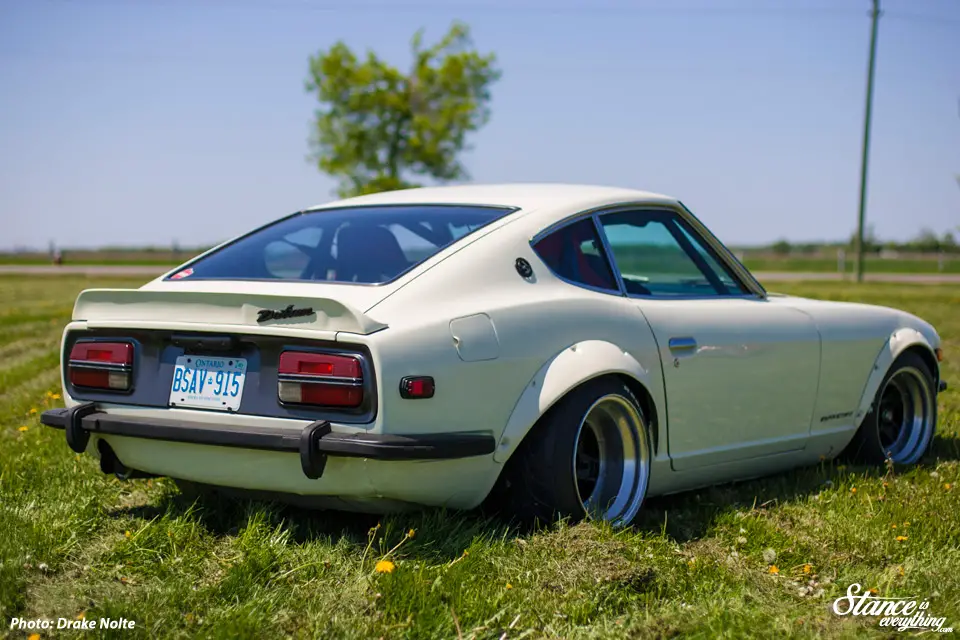
While processing these photos, I found myself really taking in how impactful the G-nose front end is to the overall design of the 240Z.


When paired with the right modifications, like the authentic Marugen Shoukai Works fender, lip, and spoiler package, the Z looks almost exotic.

Overall, there isn’t really a single modification to this car that I would deem out of place.

‘Timeless’ is a bit of a feature-writing hyperbole, but cars like this are where the look originated, and in this setting, they are truly a timeless usage.

Equal era-appropriate care has been taken inside; Bride seats of a fitting vintage are fastened to the floor boards, backed by an Autopower roll bar. A simple Nardi wheel and woodgrain shift knob provide driver touch points.


Techno Toy Tuning provides many of the suspension updates, including a triangle strut tower brace under the hood, and a more traditional 2-point brace in the rear.

Ground control adjustable coils bring the ride height down and are paired with Tokico Illumina shocks. The front control arms are billet pieces from FutoFab, and the rear arms are once again Techno Toy Tuning.

Cruising around, the ride is as you might expect – firm but not bone-jarring. It responds to being pushed on the track, but doesn’t punish on the street.

Leaving A Mark

The Z doesn’t exactly walk lightly thanks to very wide 15-inch Watanabe wheels affixed over Wilwood discs up front and factory drums in the rear.


From both a visual and performance perspective, Tim isn’t much a fan of aggressive stretch, so finding tires that fit both the wheels and flares wasn’t an easy task.

After searching high and low, Pirelli P7 Corsa Classic tires were selected due to their availability in healthy 235/45R15 up front and an insane 305/35R15 in the rear.

The P7 is actually a tire designed for rally applications, and getting a set imported and fitted required a hoop or two to be navigated. But I’d wager you all agree they were well worth navigating; the stance of this car is an absolutely function-oriented thing of beauty.

I do try my best not to be an envious man, but as I rode shotgun, I couldn’t help but feel jealous that Tim had this car to help him get through the ridiculousness of 2020. It’s hard to focus on the news when a straight six under the hood is begging you to push the throttle down just that little bit more…

Gallery


Source link

How the bizarre Nissan Primera paved the way for the Qashqai

0
How the bizarre Nissan Primera paved the way for the Qashqai


Nissan’s last Primera was a symbol of a company losing its way.

Although it emerged after Nissan’s rescue by Renault and the triggering of new boss Carlos Ghosn’s masterful turnaround plan, its bones were formed before its maker’s near-extinction and recovery.

The last generation Primera was the third iteration of a model specifically designed to appeal to European tastes. But by the time it was launched in 2001, we pesky Euros were aiming our buying power elsewhere, mainly in Germany’s direction.

This was the era of what motor industry marketing types described as “the flight to premium”, buyers fast discovering the delights of BMW, Mercedes and Audi, whose cars were (usually) better made, decidedly more prestigious and perversely, cost less on a lease because they depreciated more slowly.

All of which meant that mainstream manufacturers had to fight harder to tempt customers into a sale. Most cars in the excitingly labeled “D” segment in which the Primera played were mostly sold into fleets, whose managers allowed their colleagues far more choice than in the days when they were issued with a Ford Cortina, like it or not.

For user-choosers, as those offered a selection of company cars became known, the Primera would have been an increasingly hard sell against a car with a double kidney grille.

The original 1990 Primera did reasonably well – certainly better than the potato-stodge Bluebird that it replaced – with its shapelier style and a remarkably good chassis. Nissan ripped off a couple of BMW design cues, including the Hofmeister kink curved rear side window and badge-flanking twin grilles, while for the second-gen Primera, BMW’s design policy of consistent, incremental change was also followed.

The result was to turn the blandly European style of the 1990 P10 original into the slightly tidier Euro-bland look of the 1996 P11 follow-up. A P11 facelift in 1999 introduced Nissan’s “flying wing” twin grilles, these still more redolent of a BMW. Like the P10 the P11 handled well, its way with corners underlined by British Touring Car championship wins in 1998 and 1999.

Laurel-festooned exploits on the track were not enough to tempt would-be BMW buyers however, and for the third P12 Primera Nissan abandoned its BMW-ish design strategy and aimed for the bold.

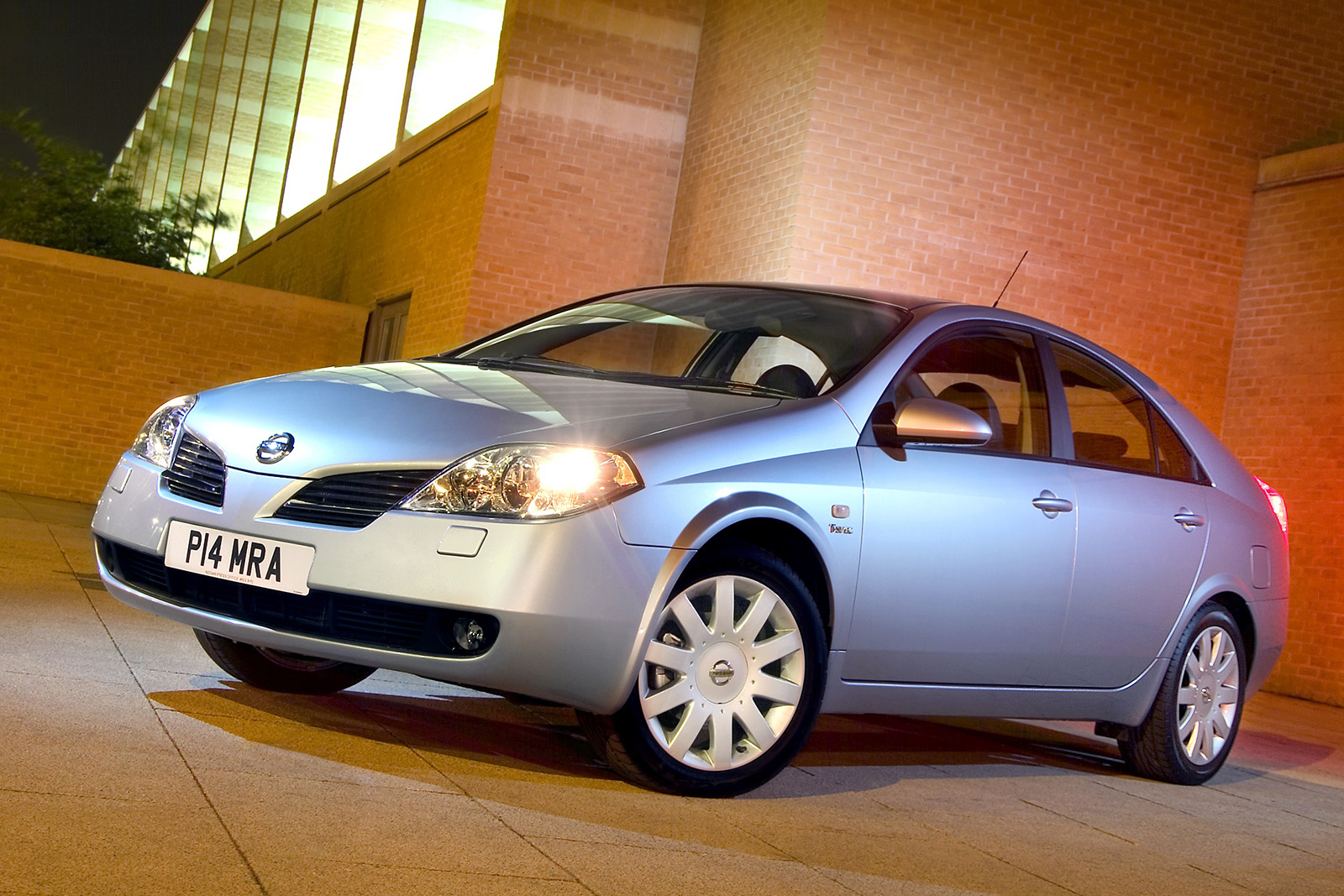
The design programme was led by the photogenic Stephane Schwarz, who even starred in a TV ad for the car too. His aim was to apply a coupe silhouette to a family car without sabotaging its space and flexibility. While the earlier Primeras had been offered as saloon, hatchback and estate, this one came only as a hatch or a wagon. Its sizeable tailgate revealed a boot big enough for a spot of flatpack hell, the cabin large enough for backbenchers to lounge and wonder at the Primera’s spacecraft dashboard architecture.

A Primera pilot now faced the same featureless grained plastic moulding as the passenger, topped with the graceful arc of a binnacle housing centrally arrayed instruments.

Beneath these were a big screen, and below that a near horizontal deck of knobs and buttons, also arranged in an arc. Back in 2001 this was novel, as was the Nissan’s provision of kit. The aim was to tempt those premium brand flirts not only with fresh design but plenty of high-tech equipment too.


Source link

See the 2025 BMW X3 Near Upper Marlboro, MD | Features Review

0
See the 2025 BMW X3 Near Upper Marlboro, MD | Features Review


See the 2025 BMW X3 Near Upper Marlboro, MD | Features Review

 2025 BMW X3

We could try and lay out all the reasons that the 2025 BMW X3
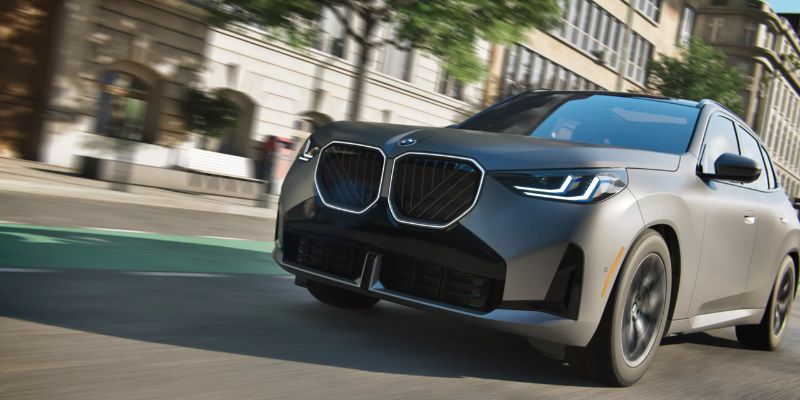
is the talk of the town — but we don’t want to keep you here all day. This SUV will give you the versatile performance capabilities and purposeful design you’re looking for in your next car. Still not convinced that the new BMW X3
is the right choice for you? Check out our model overview.

Highlights of the 2025 BMW X3

Performance

 2025 BMW X3 performance

A SUV should be able to deliver robust performance capabilities without sacrificing ride quality, and that’s where the new X3 succeeds. The new X3’s 2.0L turbocharged inline-four engine provides drivers with a maximum of 2.0L inline-four, 255 horsepower and 295 lb-ft of torque. Consider its precise handling and silky-smooth ride quality via available all-wheel drive, and you’ll wonder why you don’t already drive a X3. This car also offers the following:

  • Adaptive suspension
  • BMW Driving Dynamics Control
  • Dynamic Stability Control

Technology

2025 BMW X3 technology

The technology included in the new X3 is already so effective at keeping your passengers entertained, so you’ll be amazed at how safe it keeps them, too. BMW offers available features and safety systems designed to help you avoid accidents and to protect you and passengers from harm. On top of safety, the technology included in the new X3 offers a variety of options for enhanced multimedia integration and connectivity. For more information on standard and available technology features, see this list:

  • Automated emergency braking with forward-collision warning
  • iDrive 9 infotainment system
  • Active Blind Spot Detection

Design

2025 BMW X3 design

BMW has a tendency to produce eye-pleasing SUVs, but eye-pleasing doesn’t begin to describe the new X3. Whether you’re hauling just a few bags or a small army, the X3 has you covered by providing 5 seats that, when folded down, reveals a maximum cargo space of up to 67.1 cu ft. While the interior of the new X3 is undoubtedly spacious, it’s all undeniably comfortable thanks to a number of available upgrades. For more information on standard and available design features, see this list:

  • Ambient Interior Lighting
  • 18-Way Power Front Seats
  • Panoramic Moonroof

Buckle up in the X3 near Upper Marlboro, MD

Get a firsthand look at the 2025 X3 when you visit Passport BMW. We can show you the features we didn’t cover here, or you can take a look at other new BMW cars for sale
near Upper Marlboro, MD. We also offer a number of new BMW specials
that our sales team will be happy to tell you about during your test drive.

*MSRP: Starting price represents the manufacturer’s suggested retail price (MSRP) for the trim. The MSRP does not include destination and handling charges, taxes, title, license, options, and dealer charges. Actual prices are set by the dealer and may vary. Photo is for marketing and example purposes only. Photo may not reflect starting MSRP or trim level.\n**EPA-estimated MPG for City/Highway for 2025 BMW X3 . Actual mileage will vary. Displayed MPG is based on applicable EPA mileage ratings. Use for comparison purposes only. Your actual mileage will vary, depending on how you drive and maintain your vehicle, driving conditions, battery pack age/condition (hybrid models only) and other factors.


Source link

Kia UK appoints David Hilbert sales director

0
Kia UK appoints David Hilbert sales director


David Hilbert will return to Kia UK as sales director next month taking responsibility for retail and fleet performance across passenger cars and commercial vehicles.

Reporting to Simon Hetherington, commercial director at Kia UK, Hilbert will oversee sales operations while working closely with the brand’s dealer network to sustain recent growth.

Kia UK ended 2025 as the fourth best-selling brand in the market, achieving a 5.6% market share with 113,436 vehicle registrations.

This performance made the UK subsidiary Kia’s strongest market in Europe, with 2026 expected to mark the first full year of commercial vehicle sales alongside continued passenger car growth.

Returns to drive UK sales

Hilbert rejoins the UK business following his role as marketing director at Kia Europe since January 2022, where he led brand development, digital innovation and communications strategy.

During his time in Europe, he supported the rollout of Kia’s ‘Plan S’ strategy and played a key role in major product milestones, including the EV6 securing European Car of the Year and the Kia PV5 winning International Van of the Year 2025.

He also contributed to the launch of Kia’s PBV business, which is now being introduced into the UK market as part of the brand’s wider commercial vehicle strategy.

Hilbert previously served as marketing director at Kia UK between 2016 and 2022 and was recognised in Marketing Week’s Top 100 most effective marketers.

Hilbert, commenting on his appointment, said: “I am thrilled to be joining Kia UK once again, after a rewarding few years at Kia Europe. I am also excited to take on a new challenge and apply my skills to lead the sales department for Kia’s best performing market in Europe.

“Kia UK consistently delivers progressive sales success year-on-year in a challenging and volatile market. It will be my keen focus to maintain this impressive track record.”

De Silva pursues new opportunities

Hilbert replaces Sanka De Silva, who has held the sales director role since March 2025. De Silva joined Kia in 2017 and held several positions within the business, including marketing director, before moving into sales leadership.

During his tenure, De Silva supported the launch of Kia’s PBV programme in the UK and contributed to the brand’s continued market momentum. He now leaves the business to pursue a new opportunity in the automotive sector.

Simon Hetherington, commercial director at Kia UK, said: “Kia UK’s success can be partly attributed to the consistency and longevity of the senior leadership team. Reappointing David into our business as sales director is a strategic move to ensure we maintain our long-term strategy planning and delivery ability, alongside our award-winning partnership with our dealer partners.

“David has developed a great reputation within Kia to date and I’m proud to have him back as a senior member of Kia UK.

“My thanks go to Sanka for his determination, hard work and loyalty to the Kia brand for nearly 10 years and we wish him our very best wishes for the future.”

Ensure you always receive AM insights. Make us a preferred source of news on Google


Source link

The 8 Best Composting Toilet for RVs

0
The 8 Best Composting Toilet for RVs


This post may contain affiliate links.

Before we even bought our first RV, we decided we wanted a composting toilet for the RV. Traditional RV toilets sounded scary – especially the part about dumping sewage from the black tank out through a hose. (As we later found out, dumping the black tank really isn’t so bad!)

We read countless articles about different kinds of RV toilets, and composting toilets stood out to us (well, to me) as the obvious choice.

In the end, our adventure with a composting toilet lasted only two weeks. In retrospect, we shouldn’t have gone from a residential toilet straight to a bucket toilet, but …. live and learn. With over 10 years of RVing experience now, we prefer either a portable camping toilet or a cassette toilet.

That said, we’ve used several types of RV toilets and want to share what we’ve learned. A composting toilet could have worked well for us if we’d known a bit more at the time.

To help you decide if it’s right for you, here’s everything we know about composting toilet for RVs – including the 8 best composting toilets available to RVers.

What is a Composting Toilet?

The 8 Best Composting Toilet for RVs

A composting toilet is a type of toilet that doesn’t use any water for flushing. Instead, it usually separates the liquids (#1) from the solids (#2) to prevent your waste from turning into sewage. (That’s where the smell comes from.)

The liquids go into a container, which can be emptied on its own into a toilet, or diluted and sprinkled onto the ground.

The solids get mixed in with peat moss, coconut coir, or some other organic medium. This dries them out, keeps odor down, and starts the decomposition process for your waste, which eventually turns it into compost.

When the compost bin fills up (which can take a few weeks), you can empty it into a compostable bag and toss the whole thing into the trash.

Why use a Composting Toilet in your RV?

There are several benefits to using a composting toilet in an RV. That’s why we were so convinced at first that we needed one! Here are the main reasons why we wanted a composting toilet.

Eliminate the Black Tank

Our Class A RV came with a Dometic® 310 China Bowl Stool connected to a 40 gallon black tank. We figured we’d need to dump the tank every 7-10 days or so with the two of us living in it full time. That’s a lot of trips to the dump station to empty sewage from the black tank. (Granted, we’d still need to go to the dump station to empty the gray tank, but this would let us go longer between trips.)

Also, remember that scene in RV with the sewer line explosion? We’d heard so many horror stories about dumping the black tank that we were wary about trying it at first. Using a composting toilet in your RV allows you to skip that whole process, since your waste isn’t entering your RV’s holding tanks at all. There’s no need to deal with sewage in the “stinky slinky.”

Save Fresh Water

Composting toilets do not require water. They are dry toilets that use organic materials to treat human waste. For us, that meant the 75 gallon fresh water tank would last longer for showers, dish-washing and of course for drinking (which we run through a water purification system – read our Berkey Review).

If you’re boondocking or dry camping out in the wild, you know that water is a precious resource. We thought that if we could save the water we might otherwise use to flush our toilet, we could stay out longer especially if it’s an epic spot.

Increase Gray Tank Capacity

Not using the black tank for a traditional RV toilet would give us the option to combine it with the gray tank and use it as an overflow. This would allow us to increase our gray tank capacity. Again, the fewer trips to the dump station, the better.

For those taking on a DIY van build, you may be install a bigger gray tank or use that valuable space for other components.

Other Benefits

  • Reduced Odor: This wasn’t our experience, but we’ve read a lot from people who have found that their composting toilet smells less than their traditional water-flush RV toilet. This is because you’re separating liquids from solids, and it’s the combination of both that create that sewage smell.
  • Eco-friendly: Because you aren’t using fresh water to flush, you’re not only preserving water to allow you to camp longer – you’re using less water in general.

The Best Composting Toilet for RVs

1. Nature’s Head Composting Toilet

Cost: $1,035 (check current price)
Solid Capacity: Full time for two is approximately 3 to 4 weeks
Liquid Capacity: 2.2 gallons
Features: 12 volt fan
Warranty: 5 years
Made in USA

The Nature’s Head is the most popular composting toilet on the market. It’s relatively easy to install (as long as you can vent to the outside in your RV), as it has a 12-volt fan to keep odors down.

It’s not the most expensive (nor the least expensive) composting toilet on the market, and it’s lightweight and has a smaller footprint than other brands.

The customer service is reported to be excellent which is always important when spending this kind of money on a product that you’ll be using daily.

Nature’s Head was the brand we were seriously considering before we tried the composting bucket toilet.

2. Air Head Dry Composting Toilet

Cost: $1,095 (check current price)
Solid Capacity: Full time for two adults is approximately 60 uses for 1 month
Liquid Capacity: 2 gallons
Features: 12 volt fan
Warranty: 5 years
Made in USA

The Air Head markets itself as the most compact composting toilet available. The cost and capacity are similar to the Nature’s Head, but the footprint of this toilet might work better in a smaller RV.

3. Trelino Composting Toilet

Cost: $315-$630 (check current price)
Solid Capacity: 1.6-2.6 gallons
Liquid Capacity: 1.2-2.6 gallons
Warranty: 2 years

Trelino composting toilets are compact, easy to use, and available in three sizes—small, medium, and large—ensuring it fits seamlessly into any camper setup. The Trelino Evo composting toilet model is very popular in smaller RV with limited space. The smallest Trelino Evo measures 13 x 15.4 x 11.7 inches, while the largest measures 13 x 15.4 x 16.9 inches. We’ve met a few Class B van owners who use the Trelino Evo S in their camper and rave about how much they love it.

4. Separett Composting Toilet

Cost: $989 (check current price)
Solid Capacity: Full time use for a family is approximately 3 weeks
Liquid Capacity: 50L ejector tank
Warranty: 5 years

Separett is a manufacturer in Sweden that makes several urine diverting composting toilets for use in RVs. The model that is commonly sold in the U.S. is the Separett Villa 9215.

5. Sun-Mar Urine Diverting Toilet

Cost: $639 (check current price)
Solid Capacity: n/a
Liquid Capacity: n/a
Features: 12 volt fan
Warranty: 5 years for the tank, 3 years for all other components

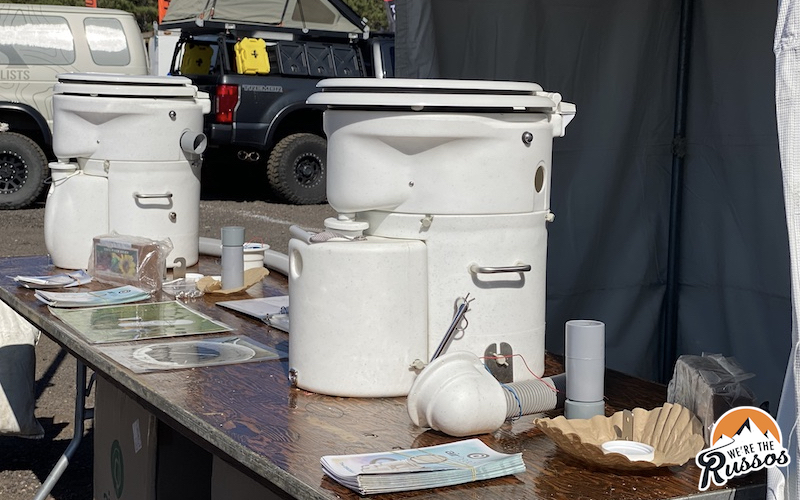
Sun-Mar has several types of composting toilets. The Sun-Mar GTG is their urine diverting toilet and the least expensive model. This design is similar to most composting toilets: a bottle for liquids, a holding container for solids and whatever organic matter you choose to add, and a small fan to divert odors outside.

Other composting toilets by Sun-Mar takes things a step further and focuses on optimizing the composting process. They’ve patented a special Bio-Drum with an evaporation chamber that helps speed the breakdown of solids into compost. There’s no need to empty the liquids, since the toilet evaporates them for you!

6. OGO Origin Composting Toilet

Cost: $984 (check current price)
Solid Capacity: 25-30 solids uses
Liquid Capacity: 2.4 gallons
Features: Electric Agitator System
Warranty: n/a
Manufactured and Assembled in Ohio

We discovered the OGO composting toilet while checking out a customer camper van build. This composting toilet has several features worth highlighting including an electric agitator, liquid level sensor and an optional drain kit to divert the urine into the RV’s black tank.

7. Compo Closet Cuddy Composting Toilet

Cost: $650-$750 (check current price)
Solid Capacity: 3.9 gallons
Liquid Capacity: 1.7 gallons
Features: 12 volt fan
Warranty: 2 years

Compo Closet offers two composting toilet models: Cuddy Lite and Cuddy. The Cuddy Lite is described as “a no-fuss, easy-to-manage portable toilet option that doesn’t need water, power or chemicals to operate,” while the Cuddy is “completely self-contained and ideal for full-time off-grid living or extended travel.” Both models include a battery-operated LED indicator that alerts users when the 1.7-gallon urine tank is nearing capacity, helping prevent overflows.

8. Bucket Composting Toilet

Cost: $10+
Solid and Liquid Capacity: 5 gallons

This was the first (and only) composting toilet we tried, because we couldn’t find a good place to vent a more elaborate setup in our first RV.

It’s by far the most affordable option, especially if you don’t care much about how it looks in your bathroom. We dressed ours up with a box to hide the bucket and put a toilet seat on top, but you can go pretty simple with this one if you’re feeling adventurous.

While you can use a bucket composting toilet without diverting the urine, it requires figuring out the the right material such as sawdust to dry everything out and prevent bacterial growth. When the bucket is full, just empty into a trash bag and start over again!

To divert the urine in a bucket composting toilet, you will need to buy an aftermarket urine diverter. At $65, it is still more affordable than the urine diverting toilets listed above.

The bucket toilet wasn’t for us in the long run (we like our portable RV toilet), but if you’re interested in using one as a composting toilet for your RV, check out The Humanure Handbook.

Things to Consider Before Getting a Composting Toilet for Your RV

1. Space

The first thing we did was measure the available space to install a composting toilet in the RV. These toilets can get pretty expensive, so it’s very important to measure twice (or more) to make sure the toilet will fit before you buy.

2. Installation

Many composting toilets require ventilation and power for the fan. You’ll want a way to wire the fan into your onboard electric system, and also a good place to route the vent hose from your bathroom to the outside. Be aware that this generally means cutting a hole in the wall of your RV.

3. Organic Material

To put it simply, organic material is what helps dry your poop and turn it into compost. It’s a very important part of the process! Make sure you have a place to store materials such as sawdust or coco fiber, which can take up a lot of space. Another thing to consider is sourcing. Will you be camped in places where you can buy these materials as you run out?

4. Cost

There is a significant difference between the $10 DIY bucket toilet and the $1,000+ composting toilet. After taxes, shipping and installation, an RV composting toilet could end up costing a lot more than expected. Make sure it’s worth it to you before you invest.

5. Dumping

No matter which toilet you choose for your RV, you’re going to have to empty it somewhere. (If you find a way around this, let us know.)

Dumping a composting toilet is different than dumping a traditional toilet.

While you don’t have a black tank of sewage to manage, you still have to find an appropriate place to dump the liquids. This might mean carrying a bottle of your pee through a parking lot to a public toilet or pit toilet to dump it. There is also the option to connect the liquid diverter to the grey tank system in the RV.

For the solids, you’ll need to empty the bin into a bag for disposal in a trash can. Make sure to check with the waste management company in your area for proper humane waste disposal. If you’re looking to add the solid waste to a compost pile, make sure to do your research. Properly composting human waste has different temperature requirements among other things. Again, you will want to check the local ordinance on composting human waste.

6. Capacity

As with any RV toilet, a solo traveler or a couple will take more time to fill up a composting toilet than a big family. If you have lots of people making “deposits,” it’s very possible that you could fill up the solids bin before the waste has had time to turn into compost. Something to keep in mind when thinking about the emptying process.

Composting Toilet FAQs

If you’re just looking for some quick answers to your most burning questions about composting toilets, you’ve come to the right place. Here are some short and sweet answers to all of the most common questions about composting toilets that we can think of.

How does a composting toilet work in an RV?

Basically, a composting toilet separates liquids from solids, which means that you don’t end up with any sewage.

You’ll have a separate liquid tank, which can be dumped in any public toilet or sewer drain, and a solid compost bin, where your solid deposits get mixed with composting material to form humus. (NOT to be confused with hummus—this is just the organic material you find in fertilizer that helps plants grow.)

How do you use a composting toilet?

In much the same way that you use a regular toilet, except that you do have to be careful not to mix any liquids and solids together when you “go.” This can be more difficult for women than for men.

When you’re finished, the flushing process is similar, except that you’ll use little to no water. You’ll also have a hand crank or something similar to mix your newest solid waste in with your composting material.

How much does a composting toilet cost?

$10 – $1,000+. As with just about anything in the world of RVers, you can spend as much or as little as you want. We’ve seen toilets as simple as a 5-gallon bucket full of sawdust, with a makeshift seat on top, all the way to an elaborate toilet that runs on electricity and costs thousands of dollars.

The composting toilets listed above are actually a good representation of what’s out there in terms of price for urine diverting composting toilets.

What is a composting toilet system?

It’s a system for using your toilet to compost your waste! All joking aside, a composting toilet is a means of turning your waste into usable material, conserving drinking water, and avoiding the need to dump any sewage from your RV’s black tank.

Do you have to empty a composting toilet?

Yes. With a composting toilet, liquids and solids go to different places. You’ll need to empty the liquid bottle more often, since it’s got a smaller capacity and isn’t breaking down the way your solids are. But you will need to empty your solids, too.

And here’s how …

How do you empty a composting toilet?

Liquids can be dumped into a public toilet or sewer, or diluted and scattered on the ground (depending on where you are).

Solids will slowly decompose in your tank until they’re well on their way to becoming fertilizer. At that point, just put the whole bin’s worth of “stuff” into a compostable bag and toss it in a dumpster.

What do you do with composting toilet waste?

There’s not much you can do with the liquids (apart from dumping them), but you can do some cool stuff with the compost that comes from your solid waste. Because it gradually breaks down into fertilizer, you could use it on any plants you travel with, or on a home garden if you still have a sticks and bricks home.

Of course, you can also just toss it. The choice is yours.

How often do you have to empty a composting toilet?

This depends on how many people you have, and how much all of those people eat and drink. On average, we’ve seen that liquid bottles tend to fill up in 2 days or so with 2 adults using the toilet full time. Solids take longer—maybe 2-3 weeks for 2 adults.

Summary

Overall, composting toilets can be a great option for RVers. They aren’t as portable as a porta-potty or a cassette toilet, but they’re a more portable option than the traditional porcelain (or plastic) bowl. They are enormous water-savers, and can be more pleasant to dump than other RV toilets (though you will likely be dumping liquids more often).

If you’re trying to decide what kind of toilet to use in your own RV, check out our articles on other traditional RV toilet alternatives: cassette toilets and portable toilets.


Source link

Hyundai Boulder Concept – Car Body Design

0
Hyundai Boulder Concept – Car Body Design


The Boulder Concept previews Hyundai’s first fully-boxed body-on-frame architecture – a new platform confirmed to underpin a production midsize pickup truck to be delivered by 2030.

Hyundai Boulder ConceptHyundai Boulder Concept – Car Body Design

The concept was developed by Hyundai Design North America, the brand’s Southern California-based studio, with a focus on off-road capability and utility.

Hyundai Boulder Concept Design SketchesHyundai Boulder Concept Design Sketches

The exterior is shaped by Hyundai’s “Art of Steel” design philosophy, which draws on the material properties of steel – strength, formability, and durability – to inform its sculptural surfaces and precise lines.

Hyundai Boulder ConceptHyundai Boulder Concept

The overall silhouette is an upright two-box form with a commanding greenhouse and dual safari-style fixed upper windows.

Hyundai Boulder ConceptHyundai Boulder Concept

Coach-style doors open access to both seating rows, while a low-profile roof rack incorporates steel webbing between the rails for additional cargo capacity. The exterior finish is rendered in Liquid Titanium.

Hyundai Boulder Concept Design SketchesHyundai Boulder Concept Design Sketches

Among the concept’s off-road focused-features are 37-inch mud-terrain tires (37×12.50R18 LT), a tailgate-mounted full-size spare, and approach, departure, and breakover angles optimized for uneven terrain.

Hyundai Boulder ConceptHyundai Boulder Concept

A double-hinged rear tailgate opens from either side, and a power drop-down rear window accommodates long loads. Reflective material is integrated into exterior elements such as tow hooks and door handles to aid identification in low-light conditions.

Hyundai Boulder ConceptHyundai Boulder Concept – Car Body Design

The interior prioritizes physical switchgear – knobs and buttons – within easy reach, alongside robust materials at high-wear touchpoints such as grab bars.

Hyundai Boulder Concept InteriorHyundai Boulder Concept Interior

The cabin also features fold-out tray tables. A software-driven real-time off-road guidance system is available to assist navigation over difficult terrain.

Hyundai Boulder Concept InteriorHyundai Boulder Concept Interior

Hyundai has confirmed that future body-on-frame production vehicles are set to be designed, developed, and built in the United States using Hyundai-produced U.S. steel.

Hyundai Boulder Concept at the 2026 New York Auto ShowHyundai Boulder Concept at the 2026 New York Auto Show

Hyundai Boulder Concept at the 2026 New York Auto ShowHyundai Boulder Concept at the 2026 New York Auto Show

(Source: Hyundai)


Source link

WOW Singapore Spring 2026 Issue On Newsstands Now

0
WOW Singapore Spring 2026 Issue On Newsstands Now


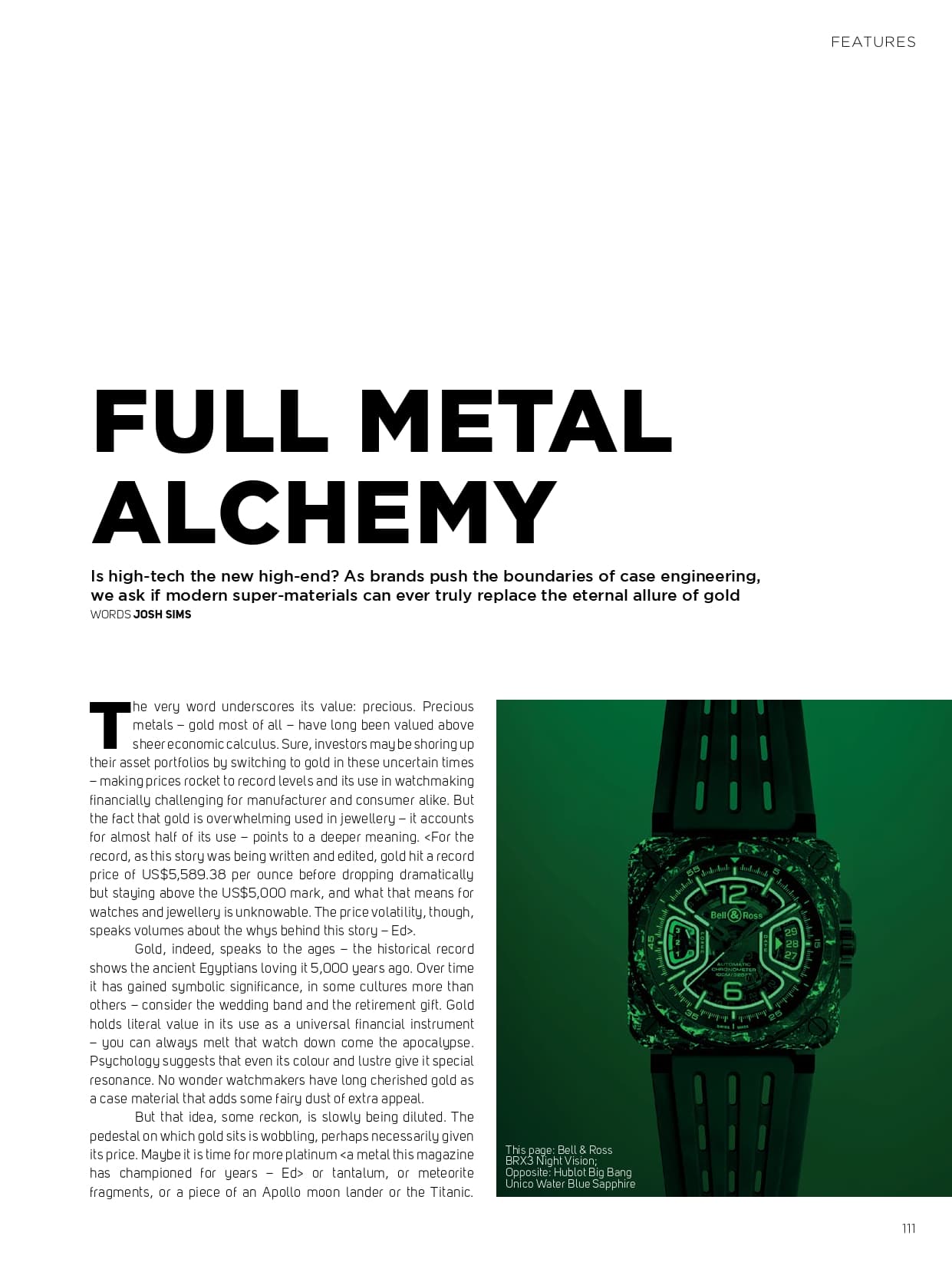
WOW Singapore’s Spring issue champions the “Hidden Gems” of horology — moving away from market hype toward the joy of discovery, anchored by the timeless Blancpain Villeret Quantième Complet.

The Spring 2026 issue of WOW (World of Watches) Singapore arrives at a pivotal moment for the industry. As the dust finally starts to settle on the novelties of 2025, the magazine turns its focus toward the concept of “Hidden Gems.” In an era where “hype” often dictates desirability, WOW #83 invites collectors and enthusiasts to rediscover the intrinsic value of watches that may have been overlooked by the mainstream spotlight.

Date With Destiny: Blancpain Leads the Charge

Gracing the cover of this issue is the Blancpain Villeret Quantième Complet Phases de Lune. A masterpiece of classical horology, the Villeret collection represents the very soul of Blancpain. In an industry recently obsessed with sports-chic steel, the Quantième Complet serves as a reminder of the elegance and technical sophistication of the complete calendar and moonphase complications. It is a watch that embodies the issue’s theme: timekeeping gems that do not need to shout to be heard.

Second Thoughts and Overlooked Greats

Central to the issue are the editorial features “Known Unknowns” and “Second Thoughts.” In the latter candid roundtable, the editors of WOW’s various editions discuss the watches they initially missed or unfairly dismissed. Alongside the retrospective look at horological “dark horses” of 2025 in “Known Unknowns,” WOW provides a refreshing perspective on collecting, suggesting that sometimes the most rewarding watches are the ones that take time to grow on us.

Exclusive Interviews and Deep Dives

Rexhep Rexhepi: One of the most respected names in independent watchmaking today, Rexhep Rexhepi, shares insights into his “lifetime in watchmaking.” From his early days at Patek Philippe to the meteoric rise of Akrivia, Rexhepi discusses the philosophy of finishing and the future of the artisan.

The New Precious Materials: Beyond gold and platinum, what materials are on the verge of becoming the next “precious” commodity in watchmaking? WOW explores the rise of advanced ceramics, tantalum, and unique alloys that are redefining luxury in the 21st century.

Opening Act: With the watch world preparing for the major fairs in Geneva, Editor-in-Chief Ashok Soman reflects on the “Opening Act” of 2026. The issue explores the shifting dynamics between the giants at Watches and Wonders and the plucky challengers at alternative shows like Time to Watches and Chronopolis.

“This issue is about the thrill of the find,” says Ashok Soman. “We wanted to move past the noise of the secondary market and get back to what makes us love watches in the first place — the craftsmanship, the history, and the surprise of discovering something truly special that isn’t on everyone else’s wrist.”

For more on the latest in luxury watch reads from WOW, visit LUXUO.com.


Source link

Find the Best Portable Waste Tank for RVs

0
Find the Best Portable Waste Tank for RVs


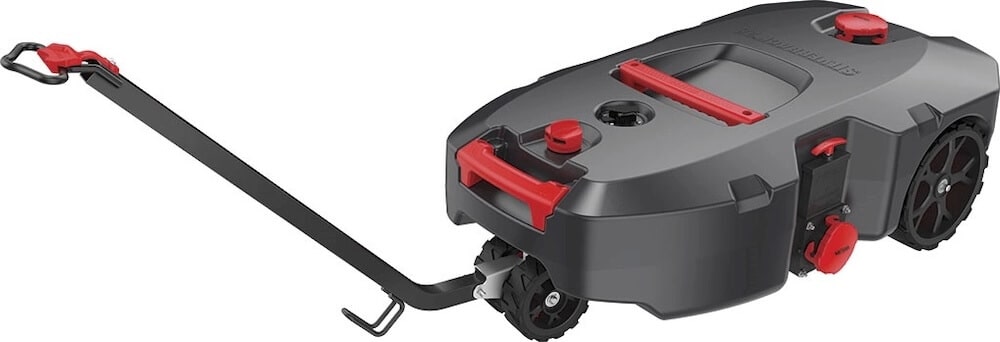
IF YOU’RE TIRED of breaking camp just to visit the dump station, it’s time to invest in a portable RV waste holding tank. But with multiple brands, capacities, and feature sets on the market, picking the right one isn’t always straightforward. While other guides cover what a camper tote tank is and how to dump a black water tank, we’re here to help you compare the top four brands side by side — and find the best match for your rig.

The short answer: For most RV campers, the Camco Rhino is the best all-around portable waste tank, thanks to its ready-to-use kit, integrated tank rinser, and exterior storage options. But it’s not the only strong choice. Barker’s Blue Boy leads on raw capacity and rough-terrain performance, the upcoming Valterra Silverback brings modern monitoring with a fill-level window, and Thetford’s Titan series is the ergonomic pick with its AutoStop overflow gauge. The right tank for you comes down to your rig size, terrain, and how you plan to transport it.

Below, we break down sizing, standout features, and the mounting hardware you’ll need so you can choose with confidence.

Key Takeaways

  • Size Matters: A tank capacity equal to or slightly larger than your RV’s smallest holding tank (usually the black tank) helps you avoid multiple trips or unmanageable weight.
  • Feature-Driven Selection: Prioritize tanks based on your specific terrain and tech needs, such as pneumatic tires for gravel roads, integrated rinsers for easy cleaning, or level gauges to prevent messy overfills.
  • Transport & Storage: Towable models with hitch loops make it easier to transport to dump stations, and bumper or ladder mounts keep waste storage out of basement compartments.

Is the Largest Portable RV Waste Tank the Best?

Thetford portable rv waste tanks
Image by Camping World

The most common mistake is buying a tank that’s too small—leading to multiple trips to the dump station—or too large—so you can’t even move it once it’s full. Your portable RV waste holding tank should ideally have the same capacity, or slightly higher, as your RV’s smallest holding tank, which is usually the black tank.

  • For small travel trailers or weekend trips, a 21 to 25-gallon tank is usually sufficient. 
  • Mid-sized trailers often find the 28-gallon size to be the sweet spot. 
  • For larger rigs or families, a 36-gallon RV portable waste tank is often necessary. 

Full-timers or those boondocking long-term might need even more capacity, but remember that water weighs roughly 8.3 pounds per gallon. When choosing one of the largest portable RV waste tanks, ensure it’s towable so you can use a secondary vehicle to get it to the dump station.

Who Makes the Best Portable RV Waste Tanks?

Obviously, the best portable waste tank for RV use depends on your needs, but our top three competitors are made by Camco, Barker, and Thetford.

Camco

camco portable rv waste tanks
Image by Camping World

The Camco Rhino portable RV waste tanks are widely regarded as some of the best options because they are made of blow-molded, UV-stabilized HDPE that resists the sun without leaking or cracking. Depending on where you shop, you’ll find several sizes available: 21, 28, 32, and 36-gallon capacities. 

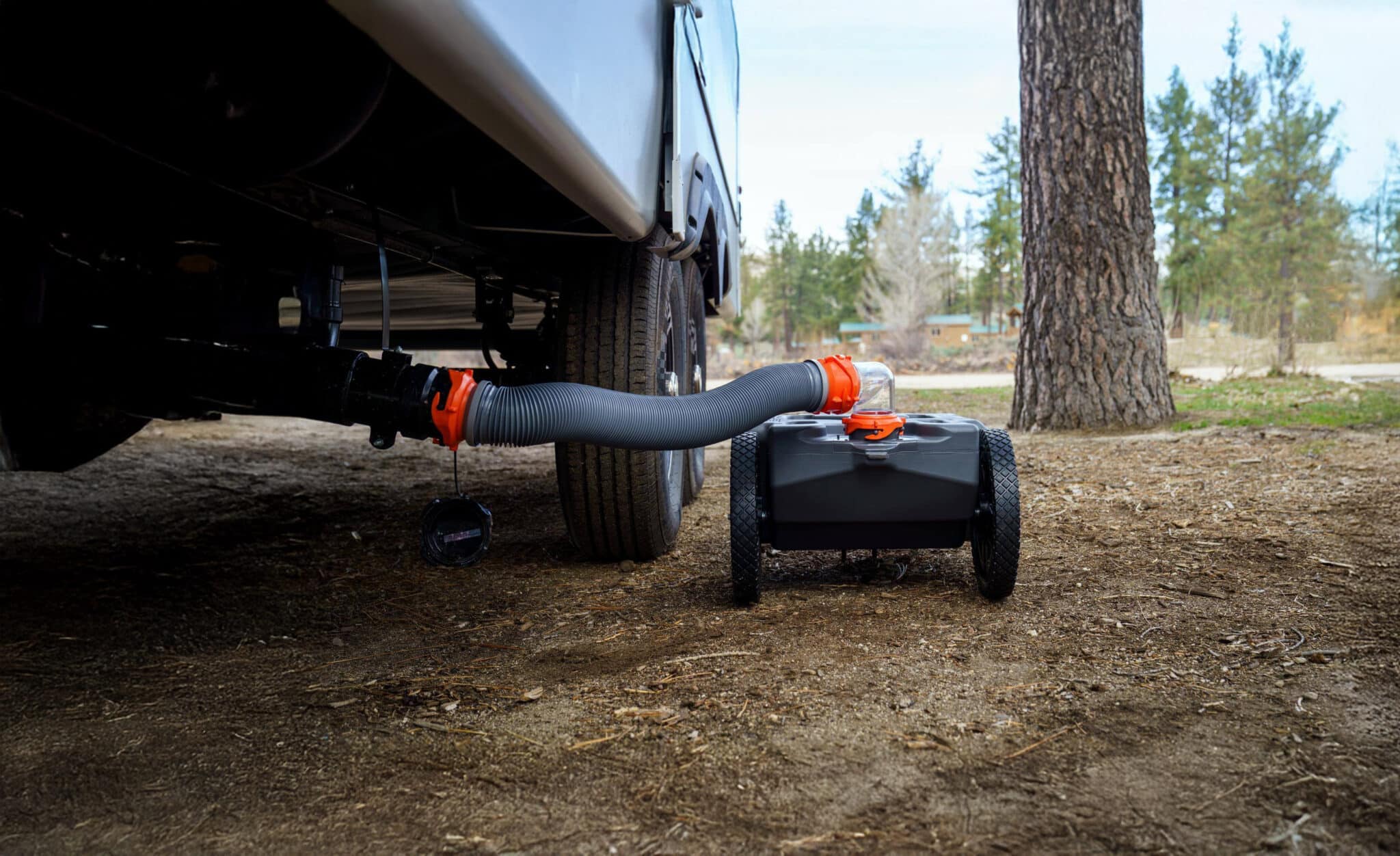
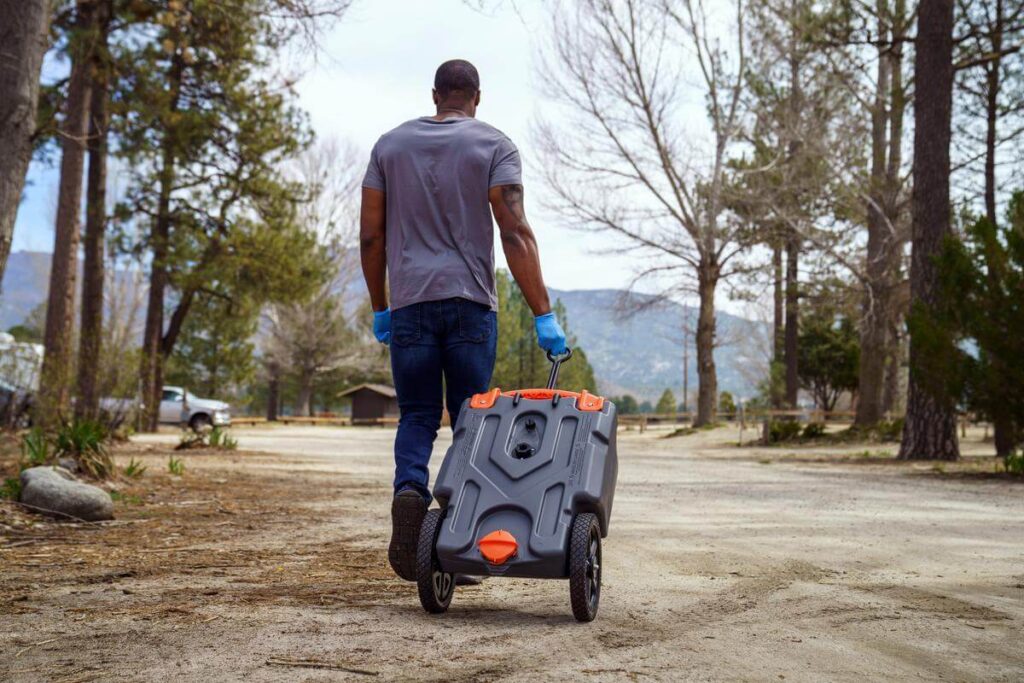
The smaller models boast two no-flat wheels, while the larger models upgrade to four-wheel configurations. Many are also sold as complete kits, coming with a short sewer hose, clear elbows, and a tow bar. They are also designed with an integrated tank rinser, an integrated hook for hanging on an RV ladder in transit, and additional grooves to help strap them in place. 

Barker

Barker "Blue Boy" holding tank
Image by Camping World

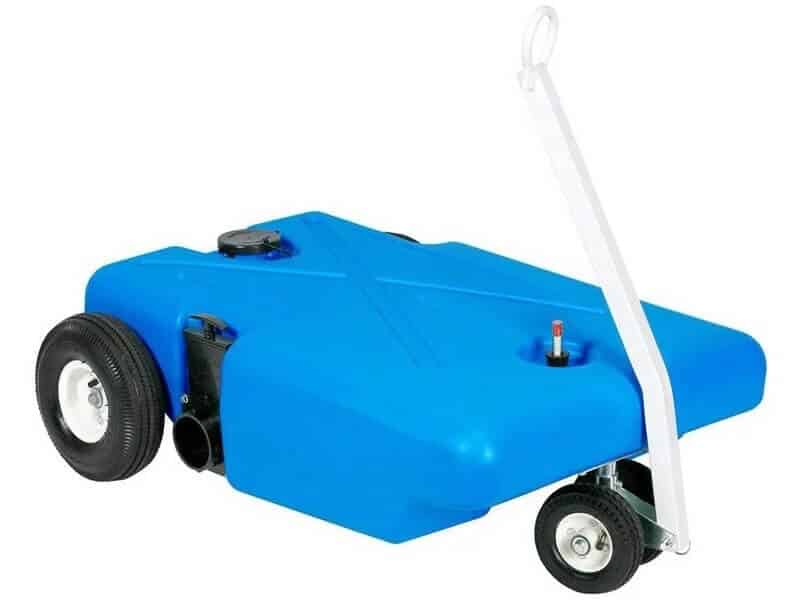
Affectionately known as the “blue boy” totes, the Barker portable RV waste tanks offers similar variety. You’ll find several sizes: 16, 25, 30, 32, and 42-gallon capacities. Their largest portable RV waste tank is built for heavy loads, featuring pneumatic air-filled tires rather than plastic wheels. 

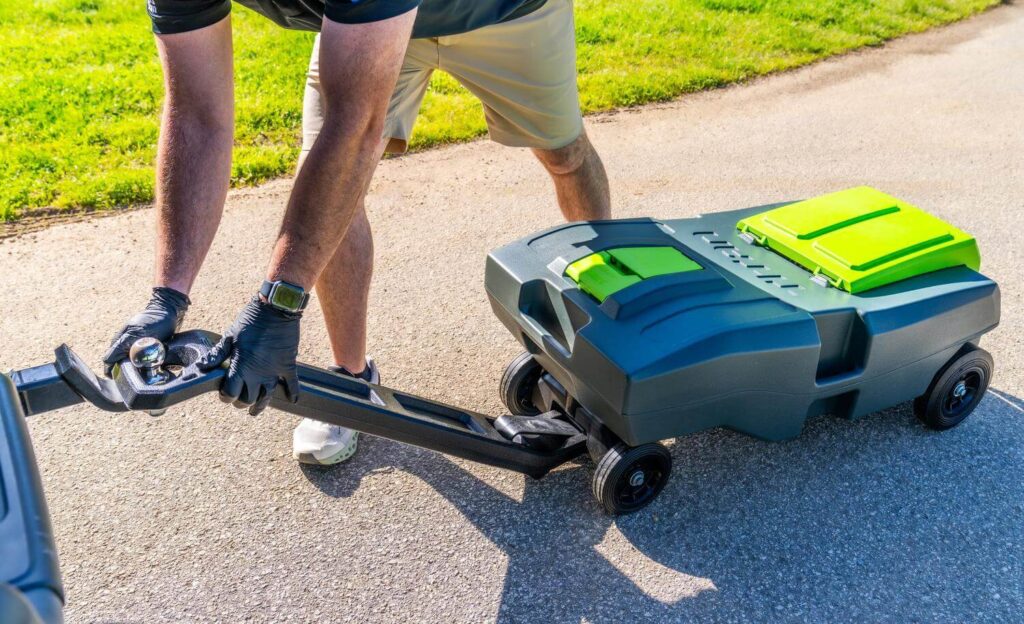
The added maneuverability of a 4-wheel portable waste tank for RVs makes it easier to position under your RV outlet, thanks also to 360-degree rotating front wheels. It also features a built-in pull handle with a tow loop on top, making it easy to slip over a hitch ball to pull to the dump station.

Valterra

Valterra portable waste tank for rv camping
Image by Valterra

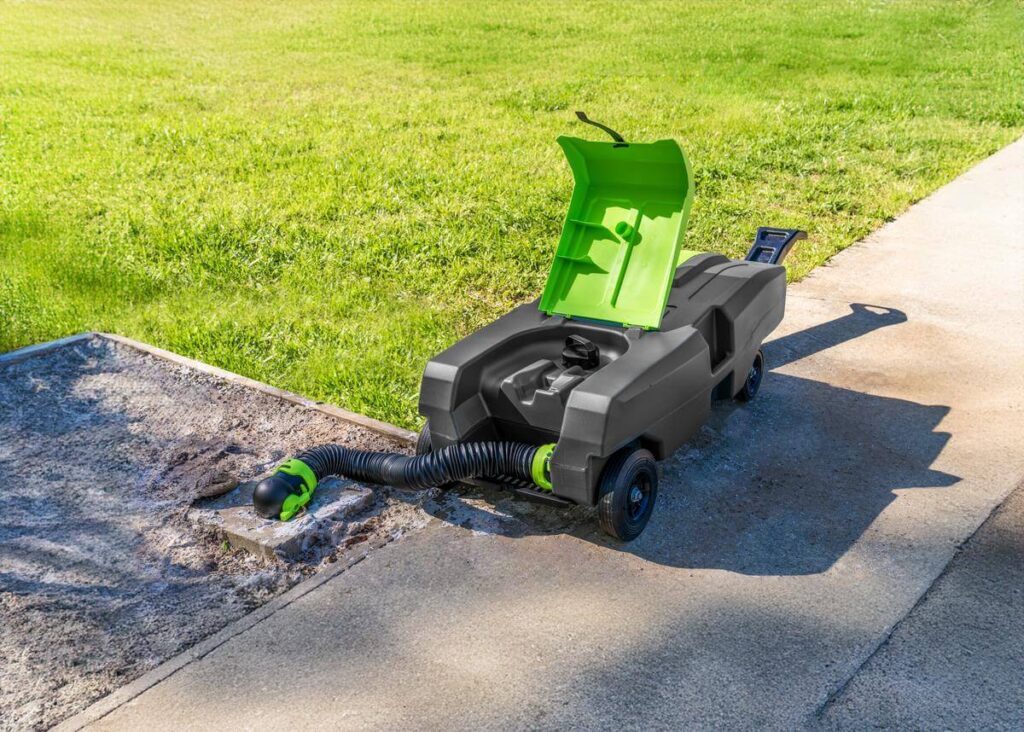
Set to launch May 1st, 2026, Valterra’s new Silverback portable RV waste tanks are “state of the art.” They’ve innovated to deliver an improved portable holding tank experience. That starts with a Clear View window to prevent you from ever overfilling again. For cleaning, an integrated 360-degree sprayer serves a similar function to an RV black tank flush.

The four-wheel configuration with its “Tow-N-Pull” handle makes it easy to maneuver, even when full. And the tow loop at the top fits multiple hitch ball sizes. Plus, they added a directional vent to reduce smells and a central handle to make lifting the tank easier.

Thetford

Thetford portable rv waste tanks 2
Image by Camping World

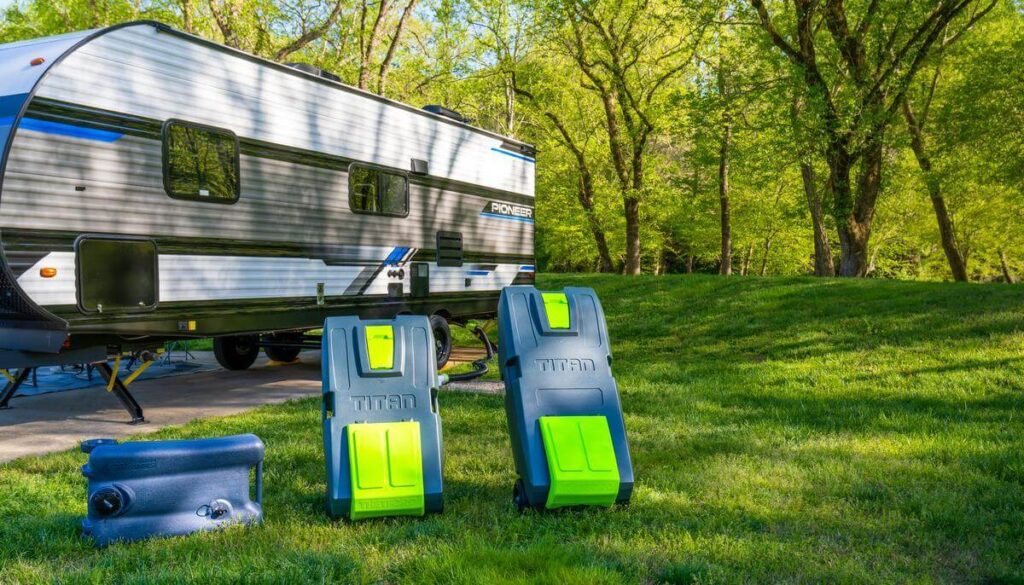
The best Thetford portable RV waste tanks are known for their ergonomics. Many include a large handle and an AutoStop level gauge to prevent overfilling. Their Titan series tote tanks are arguably their most popular, available in two and four-wheel configurations. They also offer multiple sizes: 12, 21, 27, and 35-gallon capacities.

Portable RV Waste Tank Comparison

Here’s a side-by-side look at the top four brands for 2026.

Brand / Model Capacities (gal) Wheels Standout Feature Best For
Camco Rhino
★ Best Overall
21, 28, 32, 36 2 no-flat (small models)
4-wheel (large models)
All-in-one kit with hose, elbows, tow bar & integrated tank rinser Campers who want a ready-to-use package with easy exterior storage (ladder hook & strap grooves).
Barker Blue Boy
Best Capacity & Terrain
16, 25, 30, 32, 42 Pneumatic air-filled tires (large models)
360° rotating front wheels
Largest capacity on the market (42 gal) with pneumatic tires for rough terrain Large families, boondockers, and anyone towing over gravel or uneven ground.
Valterra Silverback
Most Innovative
TBA (launches May 1, 2026) 4-wheel with “Tow-N-Pull” handle Clear View fill window, integrated 360° sprayer, & directional vent Tech-forward RVers who want real-time fill monitoring and easier cleaning.
Thetford Titan
Best Ergonomics
12, 21, 27, 35 2-wheel and 4-wheel configurations AutoStop level gauge prevents overfilling Campers who prioritize overflow protection and comfortable handling.

💡 Sizing tip: Match your tank to your RV’s smallest holding tank (usually the black tank). Water weighs roughly 8.3 pounds per gallon — a full 42-gallon tank tops 348 pounds, so make sure larger tanks are towable.

Which Portable Holding Tank Should You Choose?

Man attaching portable waste tank for RV to trailer hitch
Image by Camping World

Deciding on the best portable RV waste tank depends largely on your rig’s capacity and how you plan to transport the tank to the dump station. Each major brand offers specific advantages tailored to different types of campers.

If you want a complete, ready-to-use kit with integrated features…

Choose the Camco Rhino. These tanks are ideal for those who want a one-stop shop, as they often include the necessary hoses and fittings. They are the best choice if you plan to store your tank on the exterior of your rig, thanks to the integrated ladder hook and dedicated tie-down strap grooves. The built-in tank rinser also makes it a top pick for those who want an easy cleaning process without buying extra parts.

If you need the largest portable RV waste tank on the market, or if you frequently navigate rough terrain…

Choose the Barker Blue Boy. With a capacity reaching 42 gallons, Barker is the go-to for large families or long-term boondockers. The standout feature here is the pneumatic air-filled tires on larger models, which provide a much smoother tow over gravel or uneven dirt roads than standard plastic wheels. The 360-degree rotating front wheels also make it the most maneuverable option for heavy loads.

If you want the latest innovations and “state-of-the-art” monitoring…

Choose the Valterra Silverback. This is the best choice for Rvers who are tired of guessing their tank levels, as the Clear View window explicitly prevents overfilling. If you appreciate a deep clean, the integrated 360-degree sprayer acts like a built-in black tank flush. While these are set to launch May 1st, they are positioned as the most modern towable portable RV waste tanks available, featuring a universal tow loop that fits multiple hitch-ball sizes.

If you prioritize ergonomics and overflow protection…

Choose the Thetford Titan. Thetford is well-known for the AutoStop level gauge, which is a lifesaver for avoiding messes during the drainage process. Their Titan series is highly rated for its rugged build and large, comfortable handles, making it the best-rated RV portable waste tank for those who want a heavy-duty feel with simple, clean operation.

Buying Tip: Online vs Local

When searching for a portable RV waste tank nearby, there are benefits to buying in person. These oversized tanks often come with high shipping costs. Checking stock at a local RV retail specialist allows you to test the weight and wheel quality before you commit. Look for ready-to-use kits to ensure you have all the necessary parts from day one.

Must-Have Hardware: Mounting and Storage

Once you’ve picked your tank, you have to decide where to put it. You definitely don’t want an RV portable wastewater tank sitting in your pass through storage.

  • Bumper Mount: These metal brackets allow you to securely strap the portable waste tank to your 4-inch-square rear bumper.
  • Ladder Holder: Many Camco models come with an integrated hook, but you can also buy a dedicated waste tank carrier that hangs the empty tank off your rear ladder.
  • Undercarriage Storage: For a cleaner look, some use an undercarriage waste tank storage rack, though these are often custom-installed or rig-specific.

Check out these additional RV waste and plumbing resources: 

Who gets your vote for the best portable RV waste tank? Let us know in the comments below!


  • Tucker Ballister headshot

    Tucker Ballister is our Content Strategist. He grew up RV camping in a Fleetwood Bounder with his parents and has lived and camped in two motorhomes and two travel trailers of his own. His current RV is a 2025 Forest River Campsite Ultra 26BW, which he loves taking on adventures with his wonderful partner and furry companion from their home base in Western North Carolina. Check out his adventures, gear reviews, and outdoor advice at thebackpackguide.com.

    View all posts


Source link

Tesla hit by Iranian missile debris in Israel

0
Tesla hit by Iranian missile debris in Israel


On March 30, 2026, Lara Shusterman was in Netanya, Israel when Iranian ballistic missiles triggered air raid sirens across the city. While she remained in safety, her 2024 Tesla Model Y did not escape untouched. A heavy piece of missile debris struck the car’s massive glass roof, leaving a deep crater but without shattering. In a Facebook post to the Tesla Israel community the following morning, Shusterman described what happened: “The glass did not shatter into dangerous shards. She stopped the damage and pushed the metal part to the ground.” She closed by thanking Elon Musk and the Tesla team for building what she called “security and a sense of trust even in extreme situations.”

Netanya is a coastal city in central Israel, roughly 18 miles north of Tel Aviv and has been among the areas most frequently struck during Iran’s ongoing missile campaign, following coordinated U.S. and Israeli strikes on Iranian military infrastructure. Falling shrapnel from intercepted missiles is a common occurrence.

Tesla Model Y glass roof shattered from a piece of falling Iranian missile debris
A piece of Iranian missile debris that struck Lara Shusterman's Tesla Model Y in Netanya, Israel on March 30, 2026, after being intercepted by Israeli air defenses.
Tesla Model Y glass roof shattered from a piece of falling Iranian missile debris

Source: Tesla Israel Facebook Group

The incident is a testament to Tesla’s structural engineering. Tesla’s glass roof is designed to support over four times the vehicle’s own weight. That strength has shown up in real-world accidents too. In 2021, a Model Y in California was struck by a falling tree during a storm, with the glass roof holding firm and the cabin remaining intact. In another widely reported incident, a Tesla Model Y plunged 250 feet off the cliff at Devil’s Slide in California in January 2023, with all four occupants, including two young children, surviving.

Disturbing details about Tesla’s 250-foot cliff drop emerge amid initial investigation

Tesla officially launched sales in Israel in early 2021 and captured over 60 percent of Israel’s EV market in the first year. The brand’s foothold in Israel remains significant. Tens of thousands of Teslas are now on Israeli roads, making incidents like Shusterman’s easy to corroborate. On the same week her Model Y took the hit, the U.S. Space Force awarded SpaceX a $178.5 million contract to launch missile tracking satellites, a separate but fitting reminder of how intertwined the Musk ecosystem has become with the realities of modern conflict.

The post Tesla hit by Iranian missile debris in Israel appeared first on TESLARATI.


Source link