10.3 C
London
Monday, May 11, 2026
Home Blog Page 2

15 Things You Didn’t Know About RVing Full-Time

0
15 Things You Didn’t Know About RVing Full-Time


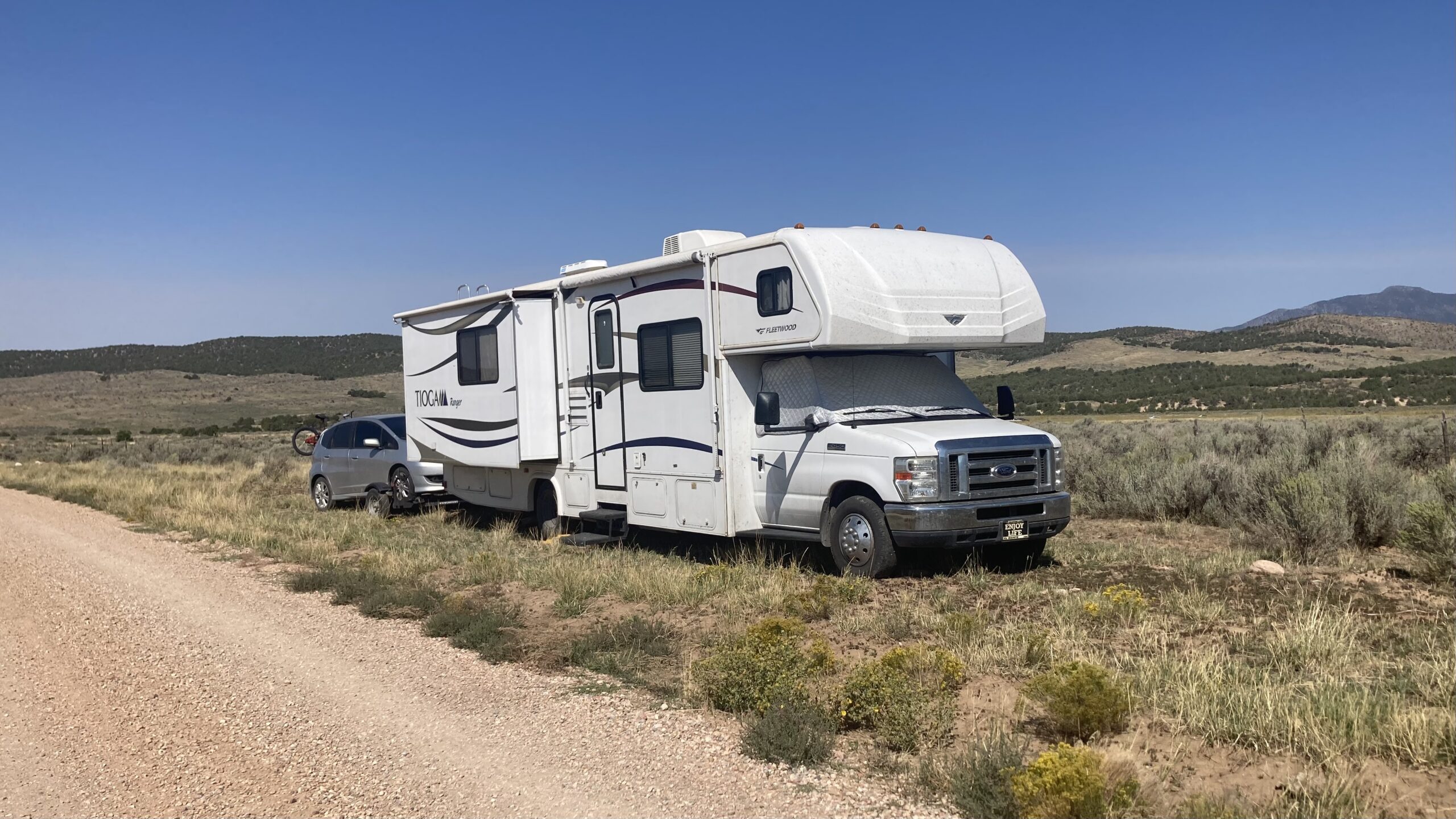
In my opinion, full-time RV living is a dream come true. The freedom to travel wherever I want wherever I want is absolutely magical, and the ability to park my home in the middle of some of the prettiest places in the country is a huge bonus.

Yes, I adore the full-time RV lifestyle. That said, we did have some surprises come our way over the first few years of living the RV life, and they weren’t always good surprises either. 

If you’re hoping to hit the road full time, you may be wondering what to expect and how to live in an RV. Read on to learn 15 things you may not have known about full time RV living, so you can decide whether this lifestyle is right for you. 

What Is Full-Time RV Living?

As you might have guessed, full time RV living entails living in an RV full time. Some people park their RVs and live a stationary RV lifestyle. That said, I highly recommend traveling as you experience RV life. RV living is ideal for those who work remote jobs, those who have long stints to travel in between contracts, and retirees. It’s best for adventure-focused travelers who understand that living on the road will throw you curve balls from time to time. 

15 Things You Didn’t Know About RVing Full-Time

Before you hit the road full time, it’s a good idea to know what to expect. Here are 15 things you’re definitely going to want to be aware of. 

1. You’ll Spend More Time Planning Than You Expect

Listen, I cannot tell you how many countless hours I’ve spent sitting in front of a computer planning routes, finding and booking campsites, and adjusting for weather. Fortunately there are plenty of apps and tools that help make this task easier. 

I recommend: 

  • Campendium
  • RV Life Trip Wizard
  • iOverlander
  • RV Life Campgrounds

2. Not Every Campsite Is Created Equal

You might think, “A campsite is a campsite. I’ll just book what I can get.” Unfortunately, you’d be very wrong. Not all campsites are created equal, and it is important to do your research and make sure the campsites you book will work for you.

Make sure your campsite is long enough for your rig and has the hookups you wish to have. You’ll also want to take a peek at the amenities available in the campground. 

3. The Way You Travel Will Change

Before we got on the road full-time, we tended to travel fast. We would drive for 12 or more hours in a day and would spend a couple of nights in a place and call it good. Once we moved into the RV, we quickly realized that we could slow down. Now we never drive more than 4–5 hours in a day and we will spend weeks in a single location to make sure we soak it all in. 

4. Internet Access Takes Planning

Admittedly, staying connected to the internet while traveling is much easier now than it was when we got on the road over a decade ago. That said, it does still require some planning. Personally, I recommend investing in Stralink for the most reliable internet you can get on the road (and even in the middle of nowhere). That said, if you don’t want to do that, you can definitely get by with a hotspot or two and a cell booster. 

5. Limited Storage Space Changes Your Habits

I’ve never really been a hoarder, but living in an RV has made me a true minimalist out of necessity. I think hard before bringing another item into our home-on-wheels, and I always look for stackable, collapsible, and multi-use items whenever I can. 

6. Daily Tasks Look Different on the Road

My husband loved that he didn’t have to mow the lawn anymore when we moved into the RV. That said, yard work was replaced by other chores and tasks. Dumping tanks, refilling the fresh tank, and managing power usage all became things we had to think about on a regular basis. 

7. You Can Still Cook Real Meals

Yes, RV kitchens are smaller, but that doesn’t mean you have to change the way you eat. Very little changed about what or how we cooked when we started living in the RV. You can absolutely make all of your favorite foods no matter where you roam. Just make sure you have the right tools on hand!

8. Costs Can Be Flexible

Okay, one of my favorite things about RVing full-time is the ability to adjust our living costs from one month to the next. Because we can choose where we stay, we can pick free or inexpensive campgrounds when we’re trying to save money, and splurge when we have the funds to do so. We can also easily adjust our fuel usage and food choices based on what we have to spend. 

9. You’ll Discover Places You’d Normally Miss

Because RVing allows us to wander off the beaten path and stop on a whim, we have discovered all kinds of hidden gems and unique places. Small towns have been my favorite stops and we’ve driven some of the prettiest scenic routes out there.

10. Weather Impacts Everything

As a full-time RVer, it is so, so important to keep a close eye on the weather. We won’t travel in heavy rain, high winds, or snow and ice, so we have to plan our travel days accordingly. Additionally, weather can impact when we decide to visit a national park or go on a hike, and we might choose to make certain preparations if a big storm or super cold weather is headed our way. 

Our first year on the road was a lonely one, but then we discovered just how amazing the RV community is and we haven’t stopped making travel friends since. We make friends with our RV neighbors by inviting them to our campfires. We also attend social events in campgrounds to meet new people, and we have attended several rallies where we have made new friends. Of course, all of this socialization is totally optional, so you can decide to stay inside and keep to yourself if that’s what you prefer!

12. Maintenance Is Part of the Lifestyle

Here’s the thing: RVs see a lot of bumping and bruising. This means they require a lot of maintenance and repairs. Because I can’t afford to take my RV to the shop every time I turn around, I will do most small fixes and regular upkeep myself. I use YouTube videos to learn how and then just dive right in. 

13. You Don’t Have to Commit Forever

Choosing to travel in an RV doesn’t have to be a forever commitment. You can start by trying the experience on for size with an RV rental. If that goes well, you can get an RV of your own and start traveling full-time for as much or as little time as you see fit. Only enjoy it for a couple of months? That two months of cool experiences you wouldn’t have had otherwise!

14. The Right RV Setup Makes a Big Difference

Having the right RV matters a lot when you’re living and traveling full-time in your rig. The layout is incredibly important, so make sure you pay attention to how things will work in your day-to-day life as you’re shopping around. Pay attention to the storage space, sleeping spaces, and available workspace. 

15. It’s More Comfortable Than Most People Expect

Many people think of camping when they think of RVing, but it’s actually not like camping at all. You’ll have your own private space, which is climate controlled and contains all of the creature comforts you’d have in a house. Additionally, because you have all of your stuff onboard, you’ll be able to maintain familiar routines, despite hopping from one place to another. 

Pros and Cons of RVing Full-Time

Still not sure if full time RV living is for you? Consider these RV living pros and cons when making your decision. 

Pros

  • Flexibility — When your house has wheels, you can move it whenever and wherever you please. 
  • Scenic travel — You’ll be able to park in some of the prettiest places on earth and call those places your yard.
  • Cost control — Your cost of living is totally up to you, and adjusting just requires a change in travel plans. 
  • Unique experiences — By traveling in an RV, you’ll be able to experience all kinds of amazing and unique things!

Cons

  • Planning required — We do a lot of planning. This takes time and effort and can get tedious. 
  • Maintenance — Obviously, you do have to maintain your home-on-wheels. This can be a pain and can get expensive. 
  • Limited space — The most obvious drawback? A distinct lack of space. Make sure you’re okay being cozy with those you live with. 

Is Full-Time RV Living Right for You?

Of course, those aren’t the only things to consider. Also think about the things listed below. 

People who are best suited to full time RV living include the following: 

  • Those with flexible schedules
  • People who love to travel 
  • Those who can roll with the punches and solve problems on the fly
  • People with a remote work lifestyle or retirees

RVing full time is not ideal for the following people:

  • Those who prefer routine and stability
  • Families who need a large living space
  • Those who are tied to a stationary job with little flexibility

How to Try Full-Time RV Living Before Committing

I could list pros and cons and RVing full time tips all day, and it still wouldn’t tell you for sure whether or not full time RVing is for you. The best way to know for sure? Try it for yourself! Don’t worry though, you don’t have to go out and buy an RV right off the bat. 

Start with a Short-Term Rental

The first thing I recommend doing is to rent an RV and take it out on a quick trip to learn the ropes and get a feel for what you’re looking for in an RV. This is the best tip I can give about RV life for beginners. 

Test Different RV Types

If you enjoy your first trip out, figure out what worked about that rig and what didn’t, and rent another rig that you think might work better. Keep doing this until you find the best RV type and floorplan for you and your family. 

Plan a Multi-Stop Trip

Once you know what RV works best for your crew, plan a longer multi-stop trip in a rental rig. This will let you get a better feel for what it’s like to live in an RV full time.

Ready to find the best RV for you? Pick out a rental RV today!

While you’re trying on rigs for size, keep in mind that full time RVing can be flexible. It doesn’t have to be all or nothing, and it doesn’t have to be done a certain way. Instead, RV living is all about putting power into your hands, giving you the option to choose where you live, how long you stay there, and how much you spend on living expenses.

If that sounds like something you want to have, I highly recommend renting through RVshare to give the RV lifestyle a spin and decide whether it’s for you. 

FAQs

What is full-time RV living like?

This is a broad question that is difficult to answer. Basically, you have the power to make it look however you like. Want to travel all over the country? Go for it! Prefer to stay in one region? That’s fine too. Want to spend as little as possible? That’s totally doable. Like to splurge here and there? That’s cool too!
In any case, expect less storage space, more time together as a family, a different set of chores, community when you want it, isolation when you prefer that, an ever-changing view, lots of maintenance, lots of adventures, and lots of problem solving.

How much does it cost to live in an RV full-time?

This is also totally up to you. You can change your cost of living through your campground, fuel, and food choices. I’ve met families who live on less than $2,000 a month in their RV. I’ve also met families who say they wouldn’t budget less than $8,000 a month. We tend to fall somewhere in between, but our budget does fluctuate with the season because we tend to be more stationary in the winter.

Is RV living cheaper than a house?

It can be, but it isn’t always. If you’re looking to save money, I recommend sitting down and writing out a list of your current expenses versus what you will spend while living in an RV to figure out if it is actually a cheaper alternative for you.

What are the biggest challenges of RV life?

Constant maintenance, planning, and problem solving tend to be the biggest challenges people face while RVing full-time. These things require a lot of mental energy, and after a while they can definitely get to you. It helps a lot to have a slow season so you aren’t constantly moving and you have time to gather your bearings. 

Can beginners live in an RV full-time?

Absolutely! We were total beginners when we moved into our RV full time. Sure, there is a bit of a learning curve, but if you head in with patience and willingness to learn, you’ll be good to go.
Source link

Tested: 2026 Cupra Raval – Full review, price & features

0
Tested: 2026 Cupra Raval – Full review, price & features


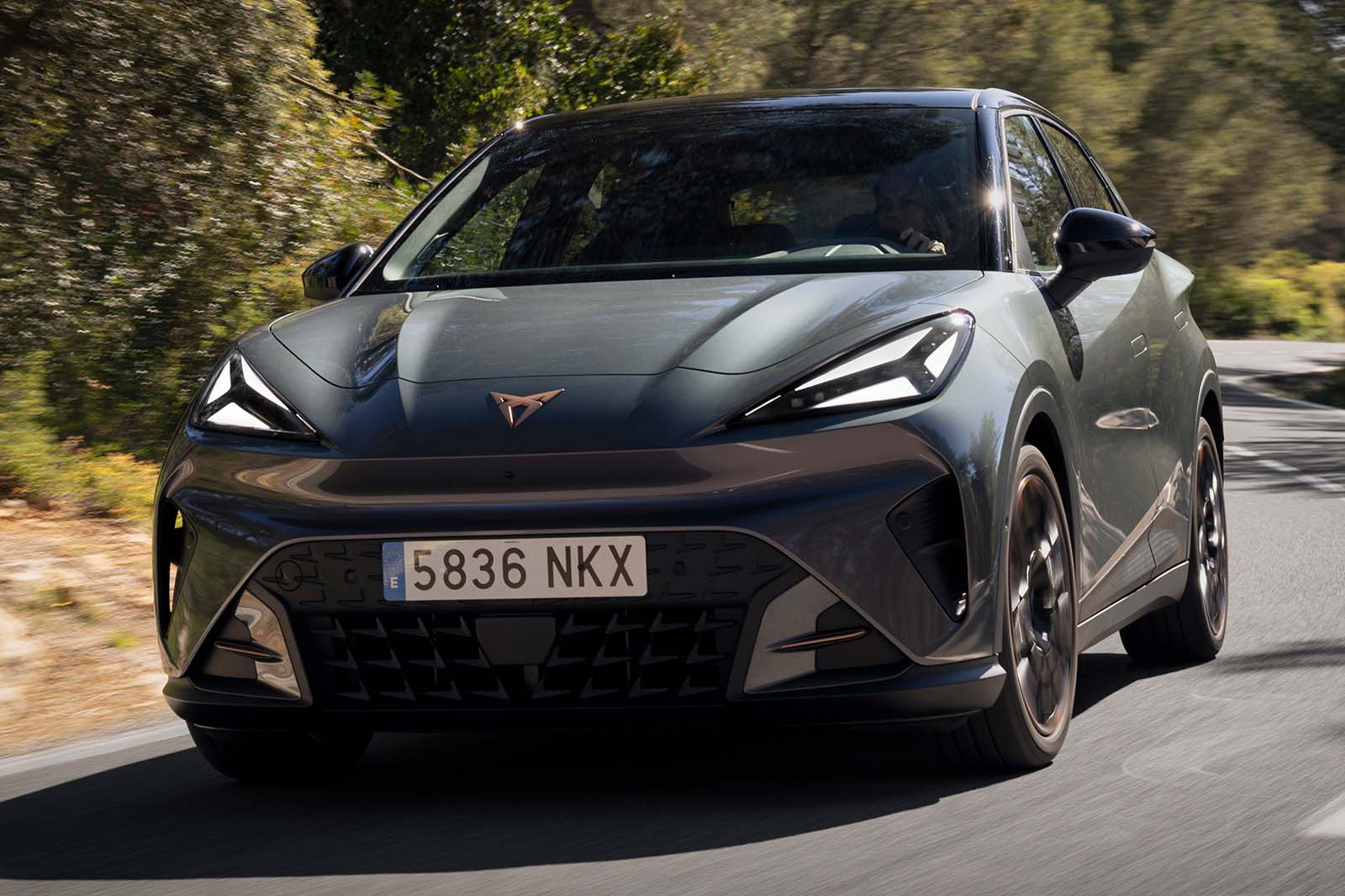
Slide into the sculpted bucket seats that you get in the VZ and this does feel like a pretty grown-up car. Fancy ambient lighting beams gentle patterns onto the doors and around the light that frames the dashboard, offering varying patterns from ‘ooh, it’s like a gently lit Tiffany lamp’ through to ‘ooh, it’s like a 90s rave’. In all seriousness, lighting does a lot of heavy lifting when it comes to modern car interiors and how manufacturers make them feel special, but the Cupra’s is impressive – especially given that you get this jazzy lighting on every trim from V2 and up.

The materials all feel smart, and the bright flashes of colour and the trademark bronze highlights around the dash all make it feel very different to anything else in the class. Is it a bit fussy? Maybe. It’s very angular and there are a lot of different material textures but Cupra has made forceful design one its chief selling points, and the interior certainly matches the exterior’s assertive lines.

It’s comfy, too. And surprisingly spacious. The electrically adjustable bucket seats on the VZ give masses of support but feel great even for longer journeys, and it’s a relief that there are straightforward, physical controls for your mirrors, windows and steering wheel adjustment.

There are still some touch-sensitive switches for climate control and volume beneath the screen, but they’re easier to use than the controversial slider controls that featured in a lot of Volkswagen Group’s bigger, MEB-based EVs. In fact, the screen and user interface is pretty good. There are shortcuts that you access by swiping down on the screen, making it easy to turn off your speed limit- and lane-keep assist, if you wish to. The big, 12.9-inch touchscreen and 10.25-inch driver’s display are clear and easy to read, and generally have quite intuitive menu readouts.

So, while a few more physical shortcut buttons would be welcome, the system in the Cupra does a good job of serving up the music, nav or system setting that you’re after, without too much muttering and prodding on the driver’s part. Naturally, wireless Apple CarPlay and Android Auto are standard on every model, and you get in-built native sat-nav on all but the rather basic entry-level Raval Origin model.

Visibility is pretty good. Slightly restricted to the rear three-quarters, but your view out is more than good enough to give you confidence in a tight spot.

There’s a good amount of space in the back seats, too. Even with the bucket seats in the VZ – which take up a bit more space than the standard seats – you can sit an average-sized adult behind a fairly tall driver and everyone’s still pretty comfortable. Especially if you’ve added the optional £580 ‘Skyline’ panoramic roof, which adds a lot of light to the rear seats. You can add that roof on any Raval other than the Origin, and it’s worth doing, we reckon. The rear windows are a bit small and it does feel a lot darker back there without the pano roof. Shame there’s no rear centre armrest, but by the standards of this class of small EV the Raval is still one of the more practical and spacious – certainly a lot more so than the Renault 5 or Alpine A290. You even get three sets of Isofix (including one on the front passenger seat).

There’s a big 441-litre boot, too, complete with variable height floor and loads of underfloor space. The boot lip is quite high, but again – by the standard of this class it’s really impressive. Only the Ford Puma Gen-E (which is slightly bigger and more SUV-ish) has a substantially bigger boot. There’s no frunk, but with a boot this big you probably won’t miss it.


Source link

Iran war drives US hybrid sales up 37% as EVs lag behind

0
Iran war drives US hybrid sales up 37% as EVs lag behind


US hybrid sales are outpacing the broader market by more than two to one since the Iran conflict began. By Stewart Burnett

US hybrid sales surged 37% in the two months following the outbreak of the Iran war in late February, handily outpacing a broader market gain of 15% over the same period, according to Motor Intelligence data. Gasoline prices topped US$4 per gallon in late April and peaked at US$4.40 in May, with diesel reaching US$5.64 the same month—putting them 60% and 54% above their January levels respectively.

Battery-electric vehicles (BEVs) have struggled to follow the same trend. BEV sales rose just 11% in the same window, 4% below the broader market pace and well down on year-earlier levels. The elimination of the US$7,500 federal tax credit for new BEV purchases has collapsed by almost half in the wake of the elimination, from a peak around 12% in September 2025, the month the credits expired. 

The divergence is sharply at odds with Europe, where higher fuel prices have driven both hybrid and BEV demand upward. UK BEV sales have exploded, rising 79% in the two months since the conflict began—far outpacing the broader market—while Germany recorded a 39% gain. Q1 2026 data from ACEA captures the full extent of the divergence: BEV registrations across 15 key European markets rose 29.4% year-on-year to nearly 560,000 units, with March alone producing a 51.3% gain as fuel price shock accelerated purchasing decisions

In all, market share for BEVs sat at 19.4% for Q1 in Europe. Hybrids and plug-in hybrids saw comparable surges, reaching market shares of 38.6% and 9.5% respectively. In combination, this would put Europe’s electrified vehicle market share at 67.5% —far ahead of the US, and even China following the latter’s winding down of tax subsidies. China came in at 61%, down from 68.3% a year prior. Greater model availability and stricter emissions regulations underpin the difference; the US has neither the affordable EV range nor the regulatory pressure that has reshaped European and Chinese consumer behaviour.

Toyota has been the primary beneficiary of the US’ surging interest in hybrids

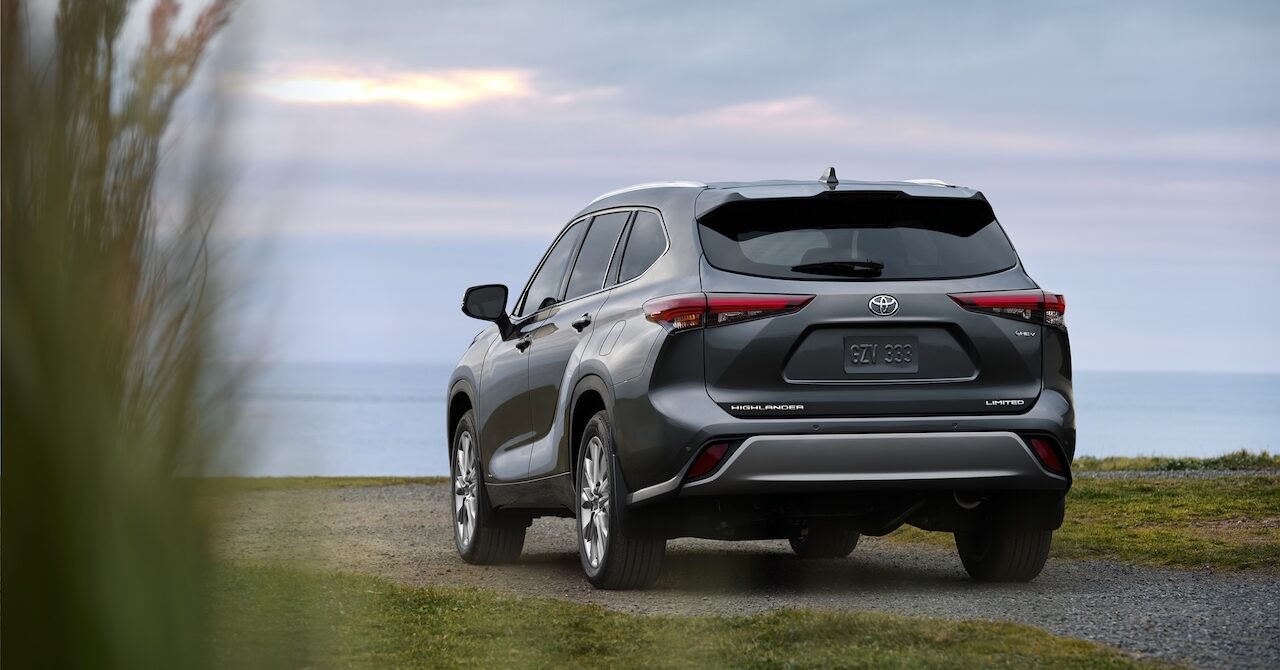
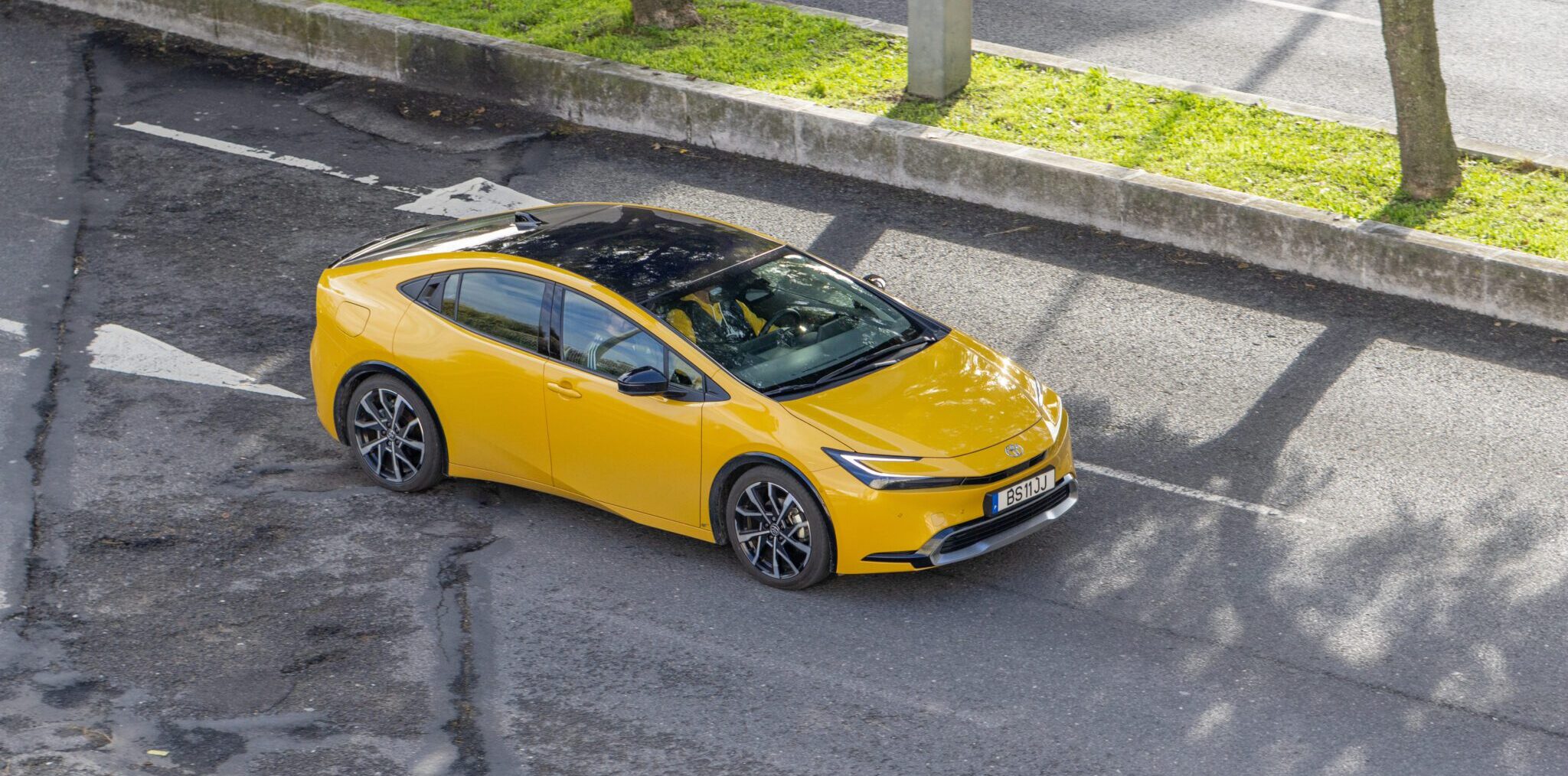
Toyota is arguably the primary beneficiary of the US hybrid surge. The company pioneered the segment with the Prius in the late 1990s and now accounts for roughly half of all US hybrid sales; its electrified deliveries—almost entirely hybrid-driven—rose 34% in the two months following the conflict’s outbreak, against 23% growth for its overall US business.

To sustain its leading position in hybrids, Toyota has committed US$912m across five US plants to expand output. The largest tranche (US$453m) goes to the West Virginia facility to reinforce hybrid engine and component capacity; US$125m will bring Corolla Hybrid assembly to Mississippi, currently an import from Japan. The investment forms part of a broader US$10bn U.S. commitment announced several weeks prior; the automaker has also intimated plans to boost its global hybrid output by 30% to 6.7 million units in 2028.

The US hybrid surge has not displaced pick-up truck demand. Large truck purchases rose 20% in March and April relative to February pre-war levels, with dealers reporting that automaker discounts—concentrated on internal combustion engine vehicles—are overriding pump price concerns for many buyers. “We’re still selling lots of pickup trucks,” one Ford, Toyota, and Stellantis dealer in Michigan told Reuters.

The energy price outlook suggests the hybrid advantage will persist. Infrastructure damage from the conflict—including strikes on Qatar’s Ras Laffan LNG complex, which experts estimate will take three to five years to fully repair—points to it taking a substantially longer time to restore fuel prices than some expect. For US consumers who have already ruled out a full BEV on price and infrastructure grounds—or having the regulatory mechanisms that made it feasible take away—that timeline may serve to reinforce the calculus for a hybrid purchase in the years to come, too.


Source link

What to Look for in a Bunkhouse RV Before You Buy

0
What to Look for in a Bunkhouse RV Before You Buy


THOR A.C.E. 32B front to back interior image courtesy Thor Motor Coach.

If you’re shopping for a bunkhouse RV, extra beds are probably at the top of your list. You may need more sleeping space for kids, grandkids, or occasional guests. But more beds do not automatically make an RV easier to live in.

A bunkhouse can look great on the dealer’s lot but turn out to be frustrating once you actually use it in camp. The bunks may be too short for growing kids. The bathroom may be awkward to access at night. The kitchen may be too cramped to feed a family without getting in each other’s way. And all the extra gear, shoes, blankets, backpacks, chargers, and snacks need a place to go. Those are the details that usually decide whether you love the floorplan or regret it.

A good bunkhouse RV does more than add sleeping spots. It gives everyone enough room to sleep, move around, store their things, and settle in without the whole interior feeling crowded. As you shop, here are the things that matter most.

  1. Bunk size
  2. Storage
  3. Bathroom access
  4. Kitchen space
  5. Fit for tow vehicle (if applicable), travel style, and campsites

Think About How You Really Camp

Before you start comparing floorplans, think about how your group actually uses an RV. Do you take quick weekend trips or longer vacations? Will the bunks be used on every trip, or only when grandkids or guests come along? Are the people sleeping there small children, teenagers, adults, or a mix? Most important, how many people will realistically sleep in the RV at the same time? Those answers can narrow the field quickly.

If you travel with pets, think about that too. Dog beds, crates, food storage, and muddy paws all take up space.

For example, a couple who mostly travels alone and occasionally brings grandkids may be perfectly happy with a simple bunk setup. However, a family that travels often, or takes longer trips, will usually need more storage, more separation between spaces, and a layout that feels comfortable for several days at a time.

It also helps to think about how the bunk area will be used during the day. Will it become a catchall for bags, laundry, gear, and toys? Will someone want a quiet place to read, nap, or relax? In some RVs, the bunk space can later double as a guest area, storage zone, or small workspace. Those details can lead you toward a very different floorplan than the one that first catches your eye.

Check the Bunk Size, Layout, and Weight Limits

An Ai image of a large adult in a cramped RV bunk bed.An Ai image of a large adult in a cramped RV bunk bed.

It is easy to check off “bunk beds” from your must-have list and move on. That is where many buyers stop looking too soon. Some bunks are roomy enough for older kids or adults, while others are really only meant for smaller children. Look at bunk length, width, headroom, and weight limits. If you can, climb in and see how it feels. Check how easy it is to reach the top bunk, and look for guard rails, ladders, privacy curtains, reading lights, charging outlets, and the actual bunk weight-capacity label.

It is also a good idea to think ahead. A bunk that works for a younger child now may feel cramped a year or two from now. If you want this RV to fit your family for more than a season or two, do not shop only for today.

Make Sure the Floorplan Works During the Day

Sleeping is only part of the equation. The RV also has to work when everybody is awake. Picture a normal morning. You’re in the galley, making coffee. Someone else is brushing teeth. Kids are digging through bags for clothes. The dog is underfoot. Can people move around without bumping into each other every few minutes? This is one thing a quick walkthrough on a dealership lot rarely tells you.

Look closely at the traffic flow between the bunks, bathroom, kitchen, and main seating area.

  • Does just one person standing in the kitchen block the whole aisle?
  • Does opening the refrigerator or bathroom door create a bottleneck?
  • Pay attention to any floorplan that relies on converting the dinette or sofa into beds every night. That may work for occasional guests, but it gets old quickly when you are doing it on every trip. It also means you lose table space and seating first thing the next morning.

The point here is that a bunkhouse can sleep a crowd and still be awkward to live in.

Don’t Underestimate Storage Needs

More people means more stuff. That’s a simple fact of life. In a bunkhouse RV, storage is not just a nice feature. It is part of the larger equation of whether the floorplan works for your crowd. Look for drawers, wardrobes, under-bunk storage, overhead cabinets, pantry space, bathroom storage, and exterior compartments.

Then ask the questions buyers often miss. Where do wet towels go? Where does dirty laundry go? And, where do backpacks land when everyone comes in from outside? What about muddy boots after a long hike? Is there a place for extra bedding, games, pet supplies, and everyday clutter? A bunkhouse with too little storage can feel messy and cramped almost immediately.

It also helps to think about the small things. Where will phones, tablets, chargers, water bottles, and shoes go at the end of the day? A good bunkhouse has room for the everyday clutter that comes with real family camping.

Look Closely at Bathroom Access

Start with how easy it is to reach the bathroom at night. If kids or guests have to cross the whole RV, squeeze past the main bed, or wake everyone up to get there, that matters more than it may seem on the lot.

Next, look closely at the bathroom itself.

  • Is there enough room to move around comfortably?
  • Does the shower fit the people who will actually use it? If you have little ones, you may need a place to manage bath time more easily.
  • Is the bathroom realistic for the number of people that will be getting ready in the morning? Counter space, towel hooks, and storage matter more here than many buyers expect.

It is also worth thinking about water use. A bunkhouse that sleeps several people can burn through hot water and fill the gray water and black water tanks quickly if the rest of the setup does not keep up.

Some bunkhouse models offer a bath-and-a-half floorplan. That is not necessary for everyone, but for larger families or those who travel often with guests, it can make mornings much easier. Just remember that a second bathroom also adds cost, weight, and maintenance.

Can the Kitchen Keep Up?

A bunkhouse may sleep more people, but that does not mean the kitchen was designed especially well. Look at the refrigerator size, pantry space, prep area, and seating. Can you make breakfast without covering every surface in the RV? Is there enough room for groceries if you camp for several days at a time? Can everyone sit down to eat without somebody ending up on the sofa with a plate in their lap? Also pay attention to the sink size and where the trash can goes. Those small details affect everyday use more than you might expect.

Outdoor kitchens can be a nice bonus, especially for family camping. Still, they should feel like extra convenience, not a fix for an indoor kitchen that is too small to be useful.

Think About Where Everyone Will Relax

Bunkhouse RV shoppers tend to focus on where people will sleep. But just as important is where people will sit once the day winds down. If the kids go to bed early, is there still a comfortable place for adults to sit and talk? If the weather turns bad, can people spread out a little, or does the whole RV start to feel like one narrow hallway?

Remember that different people keep different schedules. Someone may want to read while another person watches a movie. Someone may be up early with coffee while the rest of the group is still asleep. A good bunkhouse gives you options. A cramped one makes everyone live on the same schedule. Privacy doors, curtains, and some separation from the main living area can make a big difference here.

Don’t Ignore Towing, Driving, and Campsite Fit

A truck towing a large trailer reminding bunkhouse RV buyers to consider ease of towing.A truck towing a large trailer reminding bunkhouse RV buyers to consider ease of towing.

Interior features get most of the attention, but the RV still has to get down the road and fit where you want to camp. Bunkhouse RVs can get big in a hurry. More beds and more storage usually mean more length and more weight. That affects towing confidence, driving comfort, fuel stops, campsite options, and setup at the end of a long day.

Towables

If you’re shopping for a towable, pay close attention to loaded weight, hitch weight, and cargo carrying capacity. Loaded weight is what the RV weighs when it is packed and ready to camp, not the empty brochure number. Cargo carrying capacity tells you how much gear, water, food, and everyday stuff the RV can handle. Hitch weight is important because that weight is carried by your tow vehicle, and that affects payload. A truck can meet the tow rating on paper and still run out of payload once you add passengers, hitch hardware, cargo, and trailer hitch weight. For fifth-wheels, pay close attention to pin weight as well. That weight sits in the bed of the truck, so it can become the limiting factor faster than many buyers expect.

Motorhomes

Shopping for a motorhome? Think about visibility, maneuverability, fuel stops, and where you actually plan to camp. Weight still matters here too. Pay attention to occupant and cargo carrying capacity, and how much available weight is left once you add passengers, gear, water, and supplies. A little more room inside may not be worth a lot more stress on travel days.

Also think about where you actually plan to camp. A longer bunkhouse may offer more room inside, but it can limit your campsite options and make setup more stressful in older campgrounds or tighter state park sites. It is also worth checking whether the RV is still usable with the slides in for quick stops on the road.

Choose a Layout That Will Grow With You

Families change. Kids get bigger. Guests come and go. The reason you want a bunkhouse now may not be the same reason you keep it three years from now. That’s why flexible layouts tend to hold up better over time. A bunk area may later become a guest space, a storage area, a reading nook, or even a small workspace. A rear bunk room, fold-up bunk, or a little extra floor space can give you more options later. It is worth asking yourself if the floorplan will still make sense once your travel style shifts.

RV Bunkhouse Red Flags

A few problems show up again and again in bunkhouse RVs.

  • Bunks that are too small or have weight limits that rule out older kids and adults.
  • Storage that does not match the number of people the RV is supposed to sleep.
  • Awkward traffic flow or a bathroom that is hard to reach at night.
  • Dining and seating areas that do not realistically fit the number of people the RV claims to accommodate.
  • Poor heating, cooling, outlets, or privacy in the bunk area.
  • A floorplan built around sleeping capacity and not much else. Just because an RV can sleep eight does not mean it will be pleasant for eight people to use.

As you shop, keep asking the same question: how will this floorplan feel after a few days of real camping? Look beyond the number of beds and picture a normal morning, a rainy afternoon, and a tired evening at the campground.

Three Bunkhouse RVs

Knowing what to look for is one thing. Seeing it in action is even better. Here are three examples of bunkhouse layouts that show what livability can look like in the real world. From a Class A motorhome to a travel trailer and a fifth-wheel, each one highlights a different approach to family camping comfort.

THOR A.C.E. 32B Motorhome

Floorplan courtesy Thor Motor Coach.

The Thor A.C.E. 32B Class A motorhome stands out for the way it handles daytime livability. Its full-wall slide opens up the main living area, which makes it easier for several people to move around, relax, and use the coach without constantly getting in each other’s way.

The dedicated bunk beds give kids or guests a defined sleeping area, which is one reason this layout works better for repeat use than a floorplan that depends on constant bed conversions. Between the bunks, the power drop-down overhead bunk, the sofa bed, the dinette sleeper, and the rear king bed, the 32B offers several sleeping options for larger families or guest-heavy trips.

The rest of the floorplan supports that same family-friendly approach, especially if shared living space matters as much to you as sleeping capacity. The kitchen, pantry, and refrigerator setup work well for longer trips, and the dual air conditioners are a plus for larger crews. The 32B works well for buyers who want one coach to handle travel days, guest space, and longer family stays. MSRP: $198,380

Dutchmen Kodiak 332BHSL Travel Trailer

Dutchmen Kodiak 332BHSL floorplan bunkhouse courtesy Dutchmen RV Company.Dutchmen Kodiak 332BHSL floorplan bunkhouse courtesy Dutchmen RV Company.
Floorplan courtesy Dutchmen RV Company.

The Dutchmen Kodiak 332BHSL is a travel trailer built around one of the most useful features a family can ask for: a true bunkhouse. Dedicated bunks make it easier to travel with kids or guests without turning the main living space into a nightly setup routine. That makes this layout especially appealing for families who camp often enough to want sleeping space that stays ready to use.

Beyond the bunk area, the 332BHSL works well for practical camping. The main bedroom adds useful storage, and the kitchen setup covers the basics for family meals and extended weekends without trying to do too much in too little space. For buyers who want a bunkhouse travel trailer rather than a larger fifth-wheel, that balance may be the bigger selling point than any one feature.

The rest of the feature set continues the easy-to-live-with feel. Blackout roller shades, the 80-inch interior height, carpet-free slide flooring, tankless hot water, and power stabilizer jacks all add convenience in everyday use. MSRP: $62,040

Brinkley Model Z 2810 Fifth-Wheel

Rather than treating the extra sleeping space of a bunkhouse as an afterthought, Brinkley gives the rear room of the Model Z 2810 fifth-wheel the feel of a true second bedroom, complete with triple bunks, deep storage drawers, cubbies, and a TV. It even has its own entry door. That setup can make a huge difference because kids or guests get a space that feels like theirs, and the rest of the trailer stays calmer and more usable.

The main living area is designed for practical, everyday comfort and flexibility. The residential kitchen, trifold sofa sleeper, theater seating, and Brinkley’s sliding Dinesk setup, which can serve as a table, desk, or open floor area, give the coach more than one way to work throughout the day. That is the kind of flexibility that tends to matter more on longer trips than a simple sleeping-capacity number.

Up front, the walkaround bedroom, under-bed drawers, and washer/dryer prep add more long-term usability, while the outdoor kitchen extends the living space into the campsite. For buyers who want a bunkhouse that feels more like a second-bedroom fifth-wheel than a simple family trailer, this is the kind of floorplan worth considering. MSRP: $112,611

Choose the Right Bunkhouse RV for You

A bunkhouse RV can be a great solution when you need extra sleeping space, but bed count should never be the whole picture. The best bunkhouse is the one that still feels good after a full season of camping. It has bunks people can actually use, enough storage to keep the mess under control, a bathroom that works day and night, and a galley that can handle real meals without throwing the whole coach into disarray.

Shop for the way you actually camp, not the way a brochure makes a floorplan look on paper. Before you buy, walk through any bunkhouse with your real camping routine in mind. That’s the best way to tell whether a layout truly works.


Source link

The Ultimate Guide to the BMW X3

0
The Ultimate Guide to the BMW X3


Author:Passport BMW Team

If you’re a driver in Camp Springs or nearby areas like Alexandria, Upper Marlboro, and Waldorf, the BMW X3 is a compelling choice for your next SUV. With its perfect blend of performance, luxury, and advanced technology, this vehicle caters to the needs of local commuters navigating the Capital Beltway or heading to work at Joint Base Andrews. At Passport BMW, we understand the unique driving landscape of our community, and this guide will delve into the X3’s history, performance, design, tech features, safety ratings, and available trims to help you make an informed decision.

From the smooth ride on Allentown Road to the tech-rich interiors that support busy professionals, the BMW X3 is designed to enhance your driving experience in Camp Springs. Whether you’re running errands to the Camp Springs Shopping Center or enjoying a weekend trip to National Harbor, this guide will equip you with all the information you need about the X3 to elevate your journey.

What is the history behind the BMW X3’s enduring popularity?

Launched in 2004, the BMW X3 quickly carved out its niche in the growing compact SUV segment, becoming a favorite for drivers in Camp Springs and beyond. Its blend of luxury, performance, and practicality resonated with families and professionals alike, particularly those facing daily commutes along the Capital Beltway or navigating the local roads. The X3’s spacious interior and refined design have made it a versatile choice, helping to set the standard for what a compact SUV can offer.

How did the first generation change the automotive landscape?

The first-generation X3 was a game-changer, arriving at a time when traditional SUVs were bulky and less fuel-efficient. With a focus on agility and on-road performance, the X3 introduced a more refined driving experience that appealed to urban and suburban drivers. Its compact size made it easier to maneuver through busy streets, while its AWD capabilities provided confidence on less-than-ideal weather days, a must for Camp Springs residents dealing with occasional snow or rain. This shift towards a more dynamic and versatile SUV helped redefine consumer expectations and opened the door for more models to follow in its footsteps.

How has the X3 evolved through the years?

Over the years, the BMW X3 has undergone significant improvements that continue to enhance its appeal. Each generation has introduced advancements in comfort, efficiency, safety, and practicality. For instance, the latest models feature cutting-edge driver-assistance technologies, improving safety on busy routes like Allentown Road or Branch Avenue. Additionally, the integration of hybrid options has increased fuel efficiency, catering to eco-conscious drivers without sacrificing performance. The X3’s spacious cargo area remains ideal for family outings to Tinkers Creek Stream Valley Park or shopping trips to Camp Springs Shopping Center, making it a well-rounded choice for today’s dynamic lifestyles.

How does the modern X3 deliver both power and efficiency?

The modern BMW X3 strikes an impressive balance between performance and efficiency, making it an ideal choice for drivers in Camp Springs and nearby areas like Alexandria and Waldorf. As you tackle the daily commute along busy roads such as Allentown Road or navigate weekend getaways to the National Harbor, the X3 ensures a smooth ride while keeping fuel consumption manageable. This combination of power and economy is especially valuable for those who frequently travel the Capital Beltway or venture to local parks.

What powertrain options are available for the X3?

The X3 offers a range of powertrain options designed to cater to diverse driving styles and needs. Depending on the selected trim, you can expect a responsive driving experience that adapts well to both city streets and highway cruising. This flexibility means that whether you’re making short trips to Henson Creek Park or longer drives to Joint Base Andrews, you’ll find a setup that meets your performance expectations. For a closer look at the X3’s configurations, visit the official BMW website.

What makes the X3’s handling so confident and comfortable?

The X3 is engineered for confident handling, thanks to its precise steering and expertly tuned suspension. This means whether you’re navigating tight turns on Temple Hill Road or cruising along the Beltway, you’ll feel in control and comfortable. The responsive steering adds to the sense of connection with the road, making daily drives and weekend adventures alike an enjoyable experience, especially when encountering the variable terrain of the area.

How does the X3’s efficiency benefit Camp Springs drivers?

Efficiency is a significant advantage for Camp Springs drivers who often face long commutes. With the X3’s design, you can expect fewer stops at the pump, which is particularly beneficial during peak traffic times along routes like Oxon Hill Road. Additionally, the fuel-efficient systems contribute to a reduced environmental impact, allowing you to enjoy your drives without as much concern for fuel costs. This means more time enjoying trips to local destinations without the constant worry of fuel consumption.

What defines the BMW X3’s distinctive design?

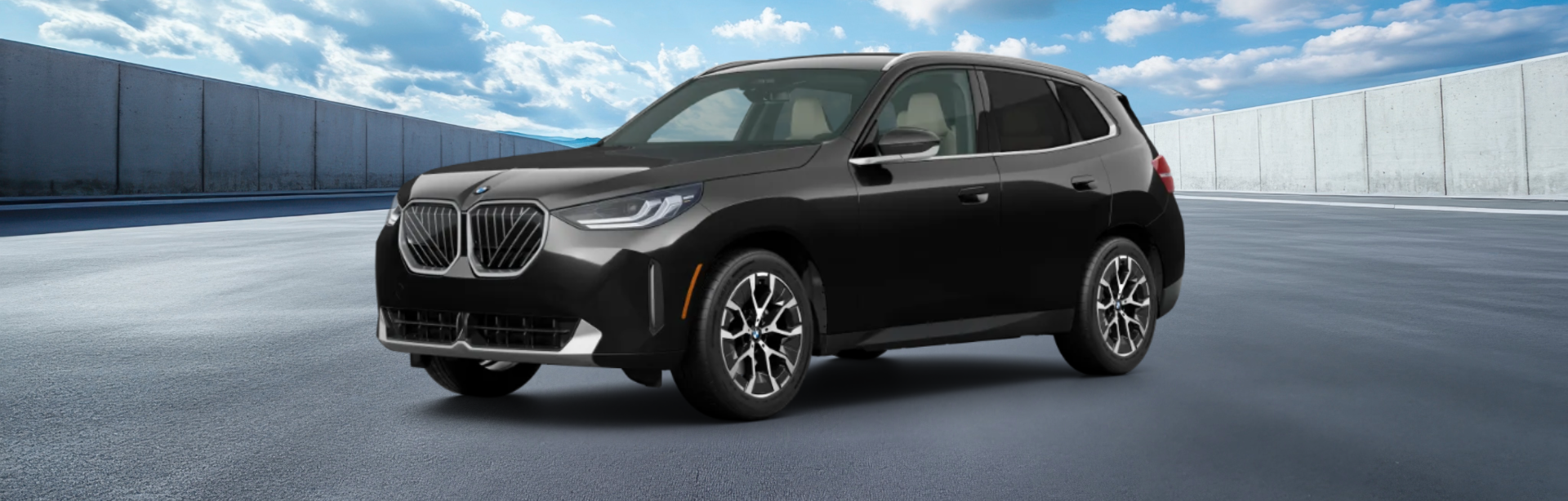
Bmw - X3 - 2026

The BMW X3 seamlessly blends rugged capability with refined styling, making it a standout choice for drivers in Camp Springs. Its bold exterior and thoughtfully designed interior ensure that you can tackle daily commutes along the Capital Beltway while enjoying the comfort and practicality you need for your lifestyle.

What are the key elements of the X3’s exterior?

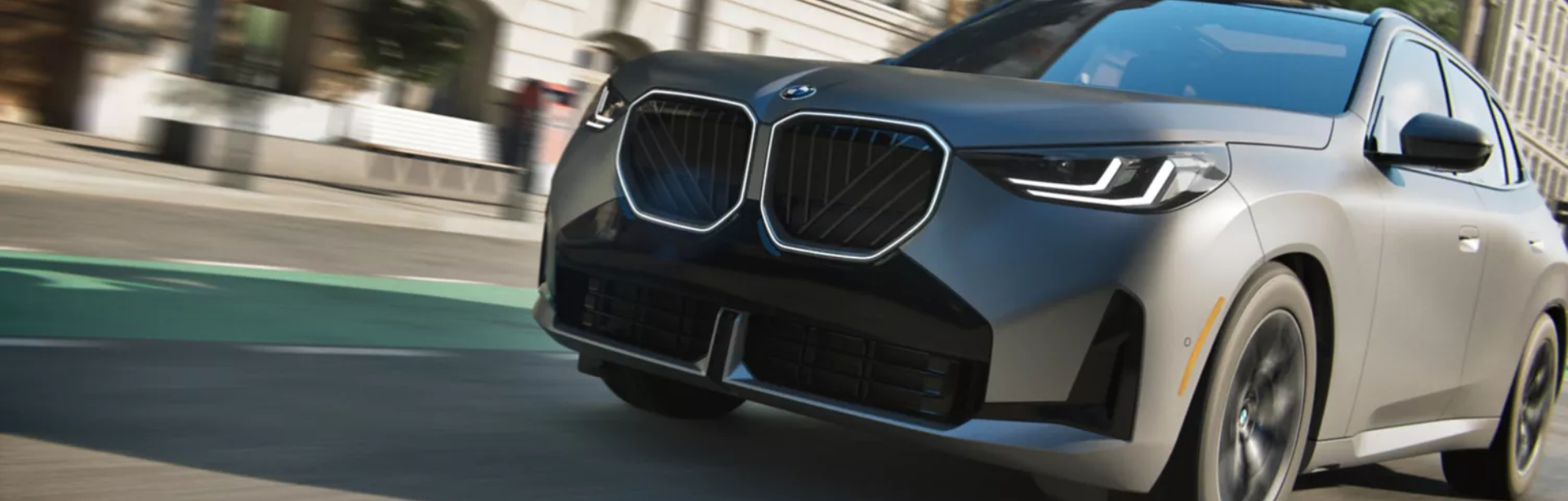
The X3 commands attention with its powerful stance, characterized by strong lines and a confident grille. Large windows and a low beltline enhance visibility, making it easier to navigate busy streets like Allentown Road and Old Branch Avenue. The LED lighting not only provides a modern touch but also ensures you can see and be seen during evening drives through neighborhoods or park outings.

How is the interior designed for practicality and comfort?

Inside, the BMW X3 prioritizes your needs with ample legroom-offering up to 40.3 inches-ensuring that both you and your passengers experience comfort on longer drives to places like Oxon Cove Park or while picking up groceries at the Camp Springs Shopping Center. The innovative honeycomb mesh design not only adds a stylish flair but also maximizes storage options, making it easy to stow away essentials for family outings or weekend adventures. With a cargo volume of 28.7 cubic feet, you can easily handle everything from sports gear to shopping bags, making the X3 a practical choice for your active lifestyle.

How does technology in the X3 improve the driving experience?

The BMW X3 is equipped with advanced technology that enhances both infotainment and everyday convenience, making it an ideal choice for drivers navigating the busy streets of Camp Springs. From seamless connectivity to practical features, the X3 supports daily errands and commutes with ease.

What infotainment and connectivity features are included?

The X3 offers a range of intuitive infotainment options designed to keep you connected while on the move. Key features include:

  • 12.3-inch Display: A vibrant touchscreen that serves as the central hub for navigation and entertainment.
  • Apple CarPlay and Android Auto: Effortless smartphone integration allows you to access apps and music directly from the display.
  • Premium Audio System: Enjoy high-quality sound with an optional Harman Kardon surround sound system.
  • Wireless Charging: Keep your devices powered without the clutter of cords, perfect for quick stops at the Camp Springs Shopping Center.

How does the X3 utilize technology for driver convenience?

Everyday driving becomes simpler with the X3’s driver convenience technologies. Features like a customizable digital cluster provide essential information at a glance, helping you stay focused while navigating busy routes like Allentown Road. Additionally, the hands-free tailgate is a game-changer for loading groceries or outdoor gear after a visit to Henson Creek Park.

Is the BMW X3 a safe and dependable vehicle?

Safety and reliability are fundamental to the BMW X3, crafted with precision engineering and advanced features designed for your peace of mind. With its innovative ACE™ body structure, the X3 provides exceptional protection in various collision scenarios. Its safety track record is underscored by a recent TOP SAFETY PICK award from the Insurance Institute for Highway Safety (IIHS). Drivers can always check the latest safety ratings on the NHTSA website.

What safety features come standard on the X3?

The BMW X3 comes equipped with the comprehensive BMW Sensing® suite, designed to enhance your driving experience while prioritizing safety.

  • Active Driving Assistant: This feature includes forward collision warning, lane departure warning, and other alerts to keep you aware on the road.
  • City Collision Mitigation: Automatically applies brakes in potential collision scenarios, providing an extra layer of safety in urban environments.
  • Blind Spot Detection: Monitors your blind spots and alerts you when another vehicle is detected, making lane changes safer.
  • Rear Cross Traffic Alert: Warns you of approaching traffic when backing out of parking spaces, helping to prevent accidents.

What does the X3’s reputation for reliability mean for owners?

The BMW X3 is renowned for its long-term reliability, supported by data from respected sources like Consumer Reports. This reliability means fewer surprise repairs and lower overall ownership costs, which is essential for busy commuters in Camp Springs who rely on their vehicle daily. With a strong resale value, investing in an X3 not only offers confidence on the road but also ensures that your investment holds its worth over time.

Which BMW X3 trim is the right choice for you?

Buy Sell Finance Lease6 - Buying/Finance

The BMW X3 comes in several trims, each tailored to meet different preferences and driving needs. Understanding the distinctions between these trims can help you select the model that suits your lifestyle, especially for drivers around Camp Springs who value both comfort and performance.

For those navigating the busy roads of Camp Springs, including Allentown Road and the Capital Beltway, the choice of trim can significantly impact your daily driving experience. BMW X3 trims typically vary in engine type, essential comfort and tech features, and unique benefits that cater to a range of driver needs.

To explore the specific differences and pricing among the available BMW X3 trims, you can visit Kelley Blue Book for detailed comparisons.

Trim X3 xDrive30 X3 M50 xDrive
Year 2026 2026
Fuel Type Gas Gas
Drivetrain 4WD xDrive All-Wheel Drive (Rear-Biased)
EPA-Est. MPG City 29 25 MPG
EPA-Est. MPG Highway 33 30 MPG
EPA-Est. MPG Combined 31 27 MPG
Engine 2.0L I4 3.0L Turbocharged Inline 6-Cylinder (B58) with 48V Mild Hybrid
Horsepower 255 hp @ 4,700-6,500 rpm 393 hp

Specifications, features, pricing, and availability are subject to change without notice and may vary by vehicle configuration. Please verify all information with the dealership prior to purchase.

Frequently Asked Questions (FAQs)

Which X3 model is best for me?

The BMW X3 xDrive30 offers a balance of performance and efficiency, making it ideal for daily commutes around Camp Springs. If you prioritize sportier handling and additional power, the X3 M50 xDrive is an excellent choice, especially for weekend adventures or highway driving.

Is the X3 family-friendly?

Absolutely! The X3 has ample cargo space and comfortable seating for five, making it perfect for family outings to local parks like Henson Creek Park or trips to the National Harbor. With advanced safety features, it ensures peace of mind on every journey.

What does the X3’s 4WD drivetrain mean for driving in Camp Springs?

The 4WD system enhances stability and traction, which is particularly beneficial during rainy days or occasional winter weather. This means you can confidently navigate local roads, whether you’re commuting or running errands.

How does the hybrid system work in the X3?

Currently, there are no hybrid trims for the X3 available. However, both the X3 xDrive30 and M50 xDrive models are designed for efficiency, ensuring you enjoy a smooth ride with excellent fuel economy for your daily travels.

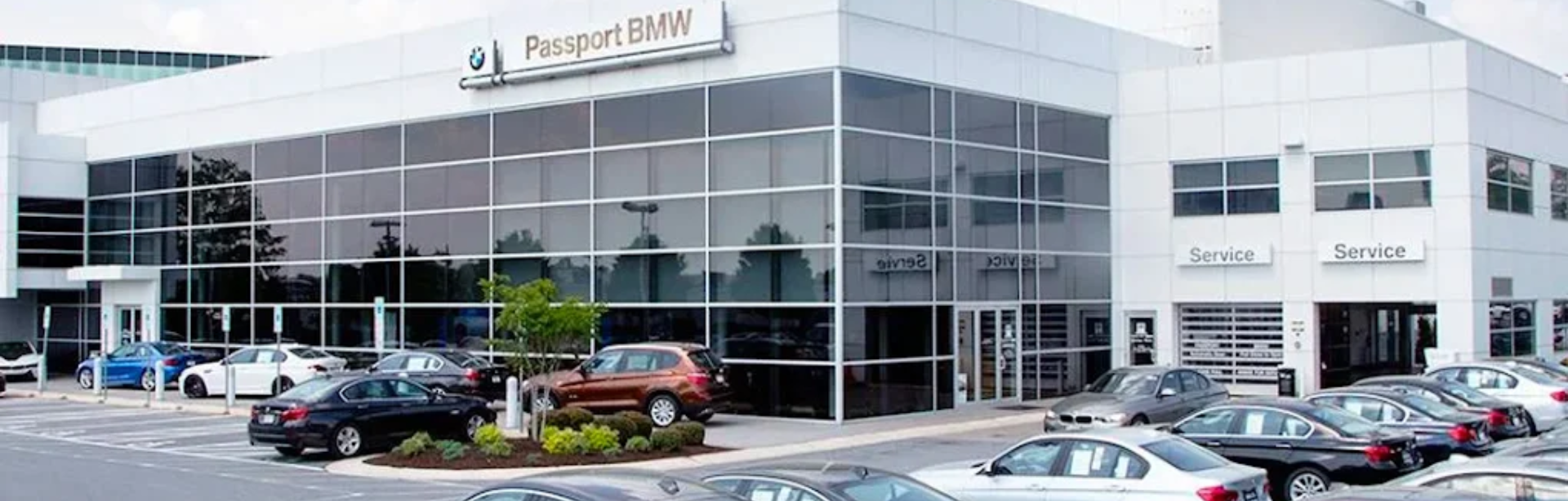
Passport Bmw storefront

Since 1991, our family-owned team at Passport BMW has been dedicated to serving our community with a superior car-buying experience. Our commitment to excellence has earned us the prestigious Center of Excellence Award multiple times, highlighting our expertise in all things BMW. We offer unique benefits like no-haggle pricing, home delivery, and mobile service vans to make your life easier. As experts, we provide detailed information and a transparent process so you can feel confident in your decisions. Trust our award-winning team to deliver the quality and care you deserve for your automotive needs.

Related Articles:

A DC Driver’s Guide to Choosing the Right BMW Dealership


Source link

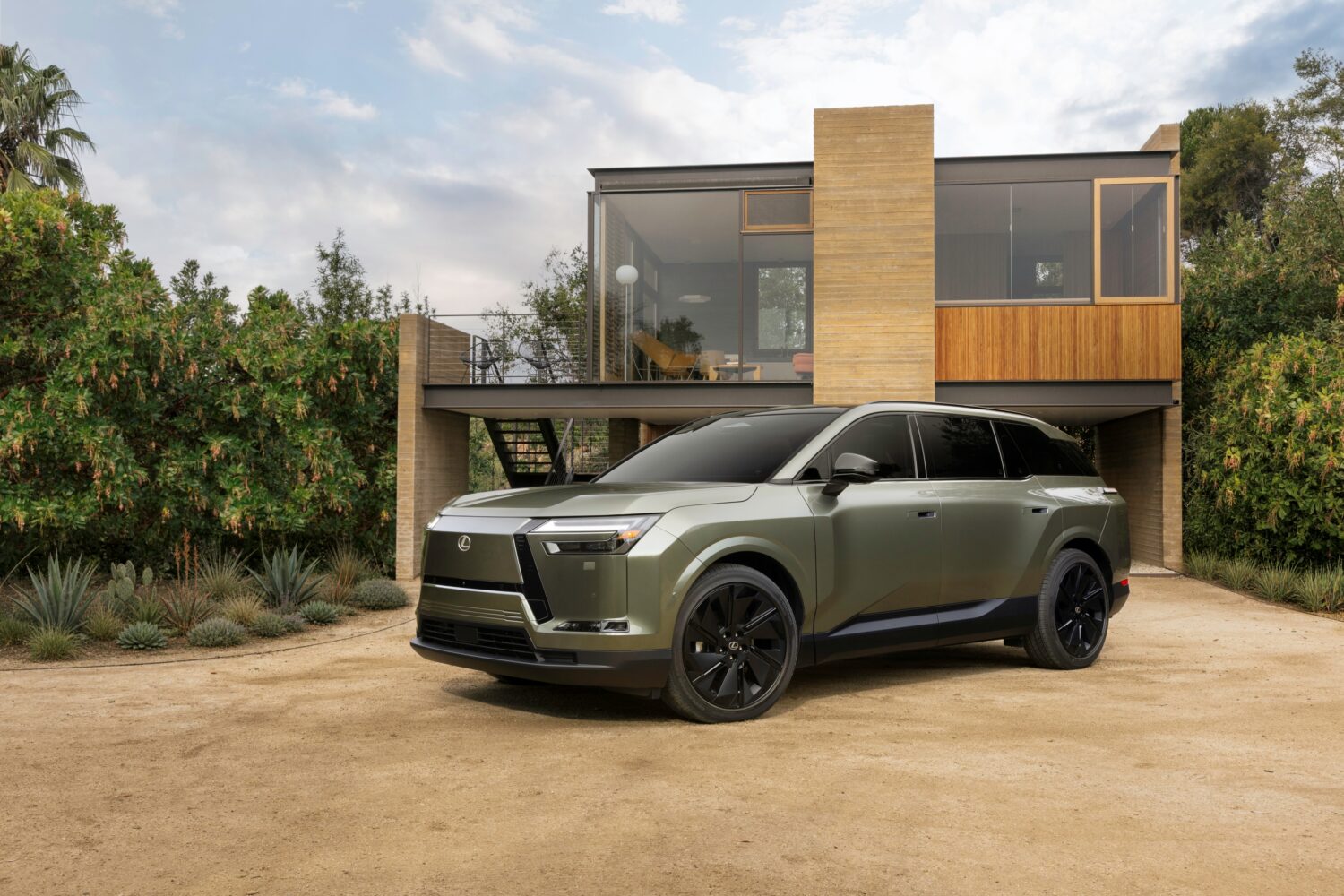
Lexus Introduces The All New Electric Three Row TZ SUV

0
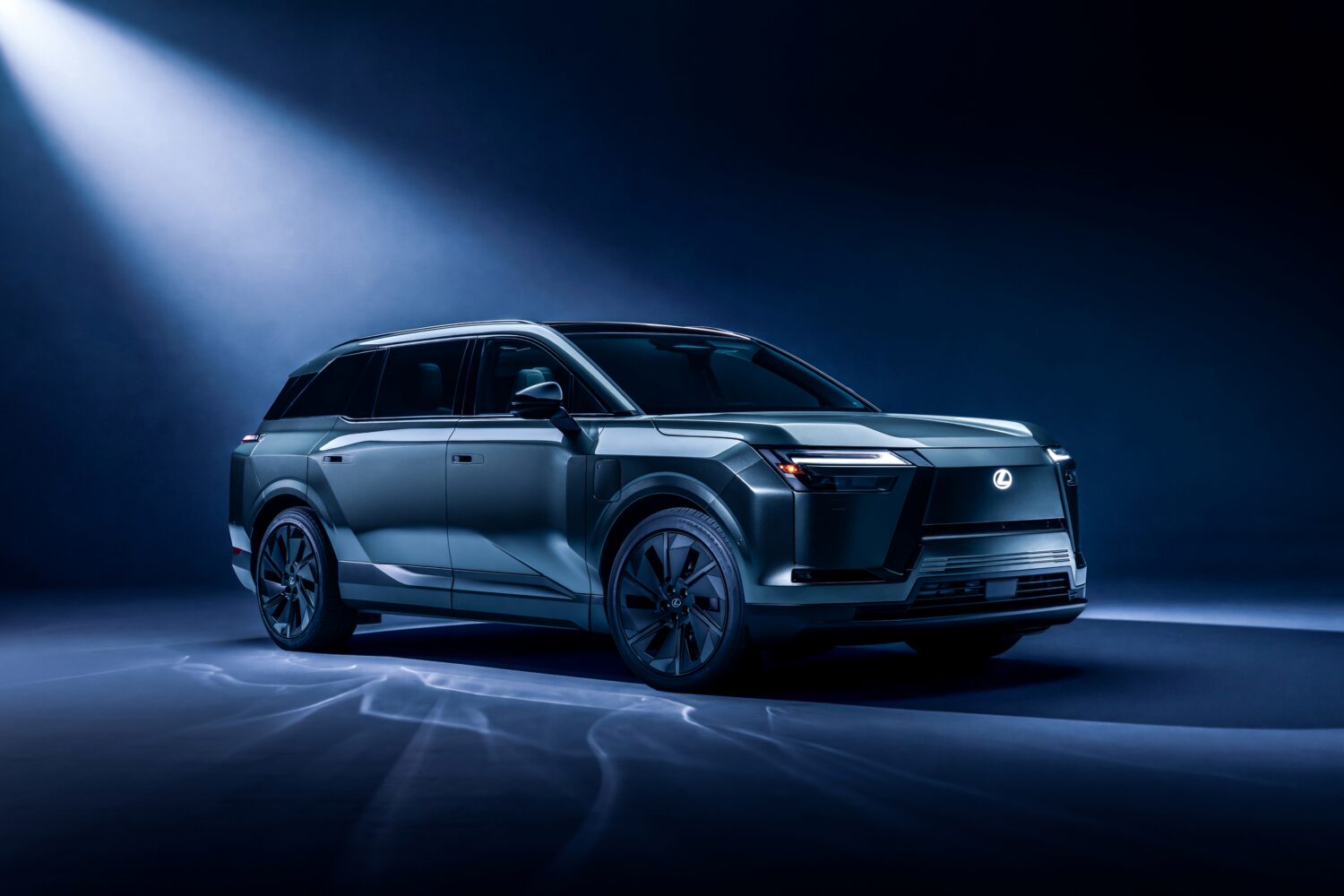
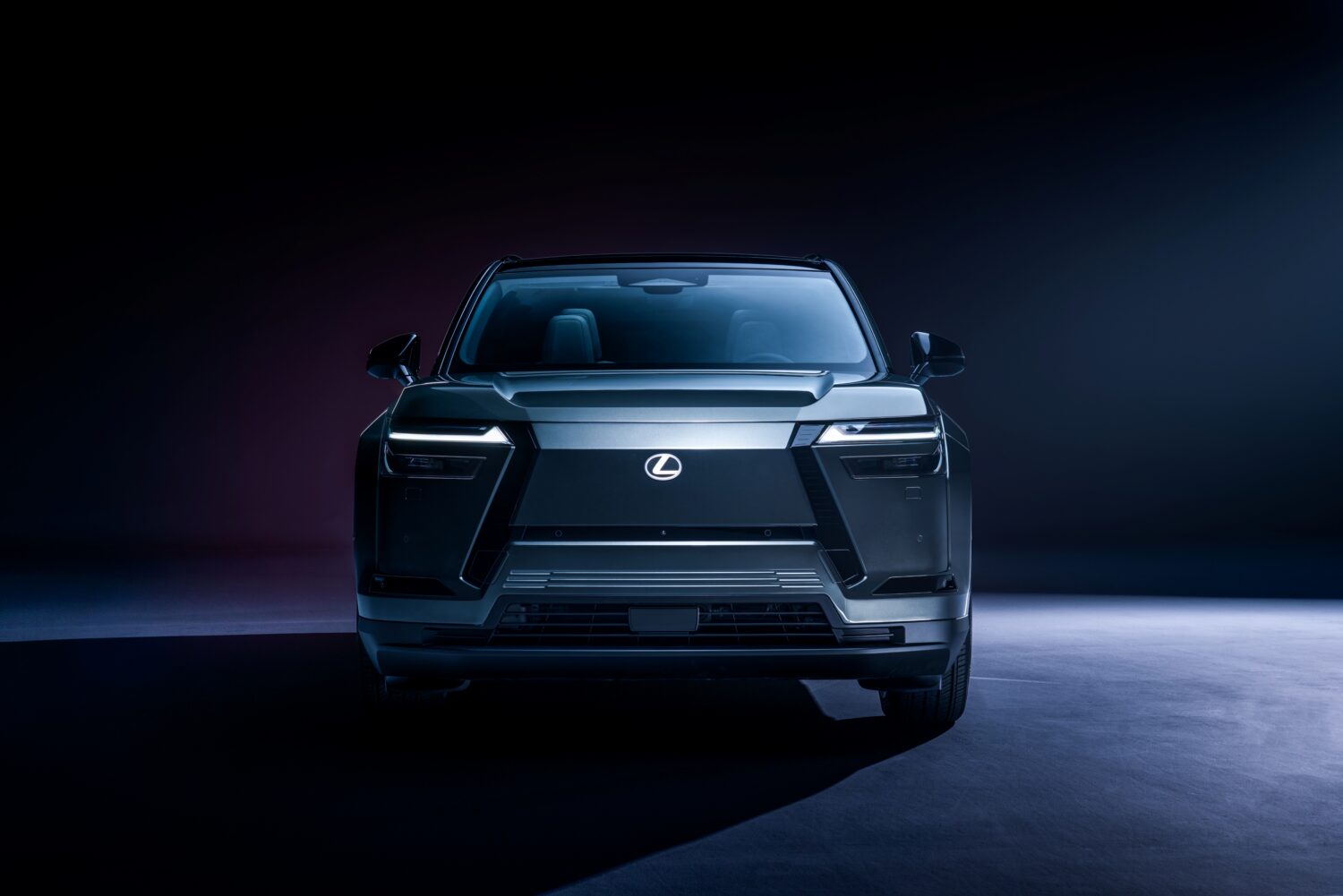
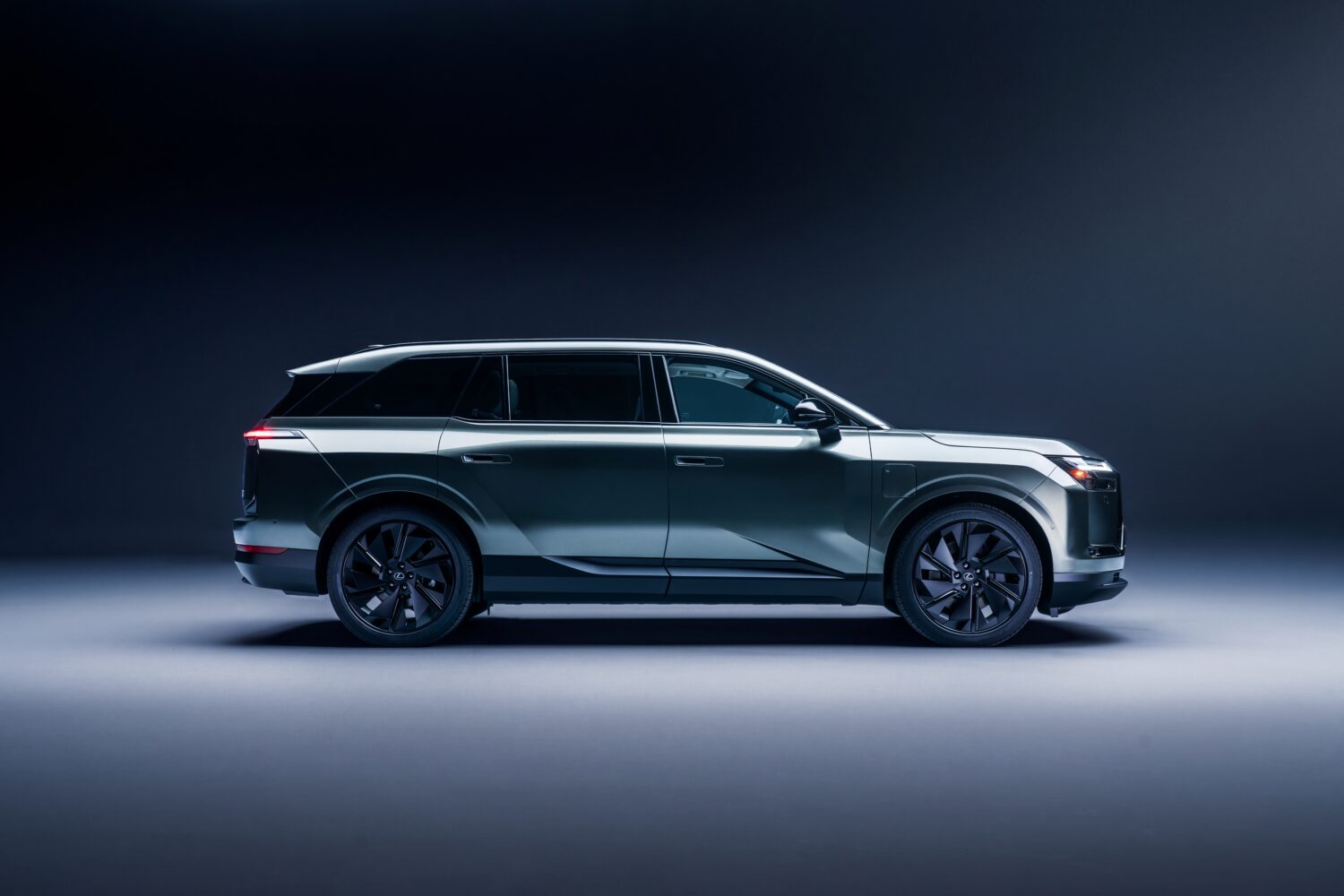
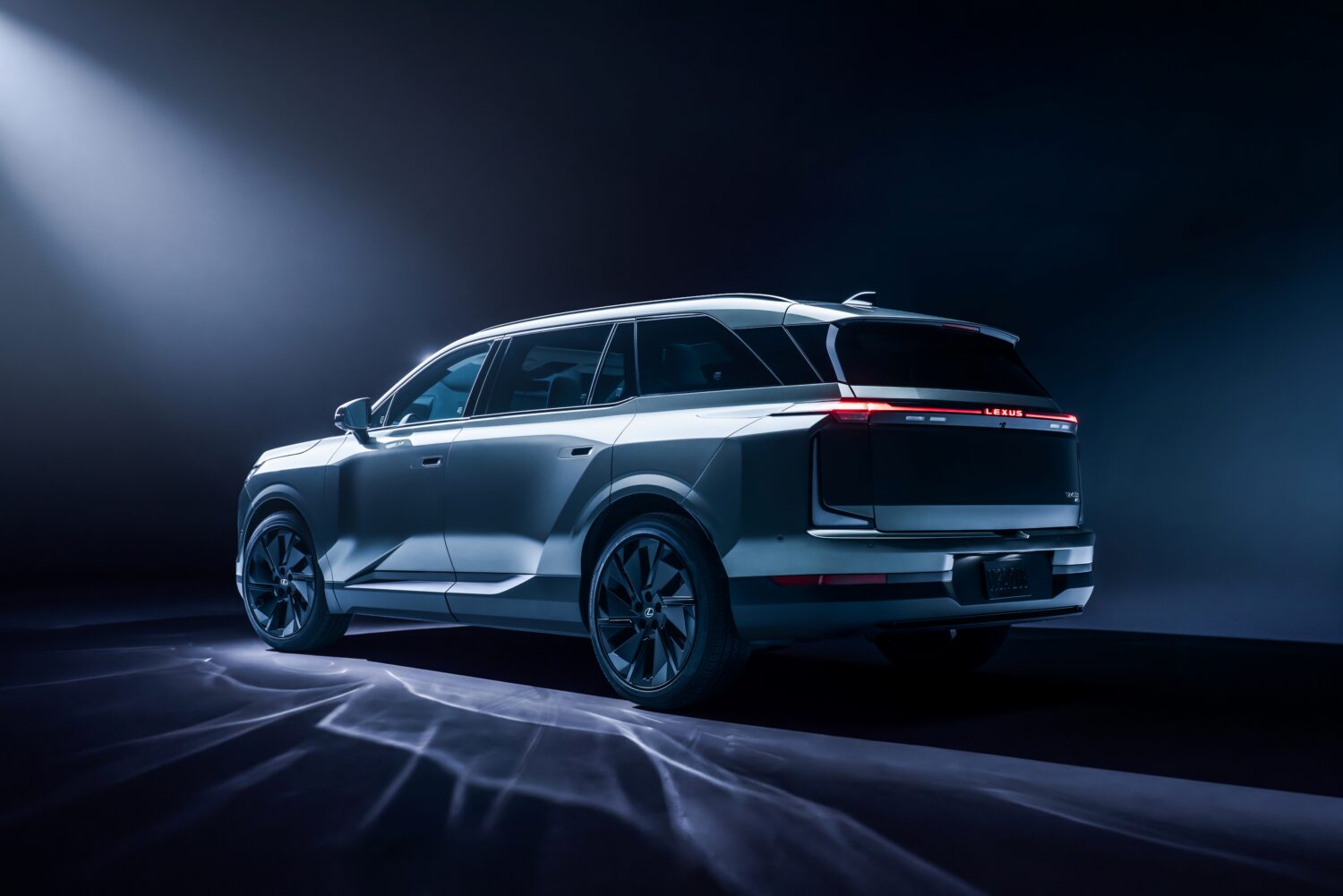
Lexus Introduces The All New Electric Three Row TZ SUV


Lexus Introduces The All New Electric Three Row TZ SUV


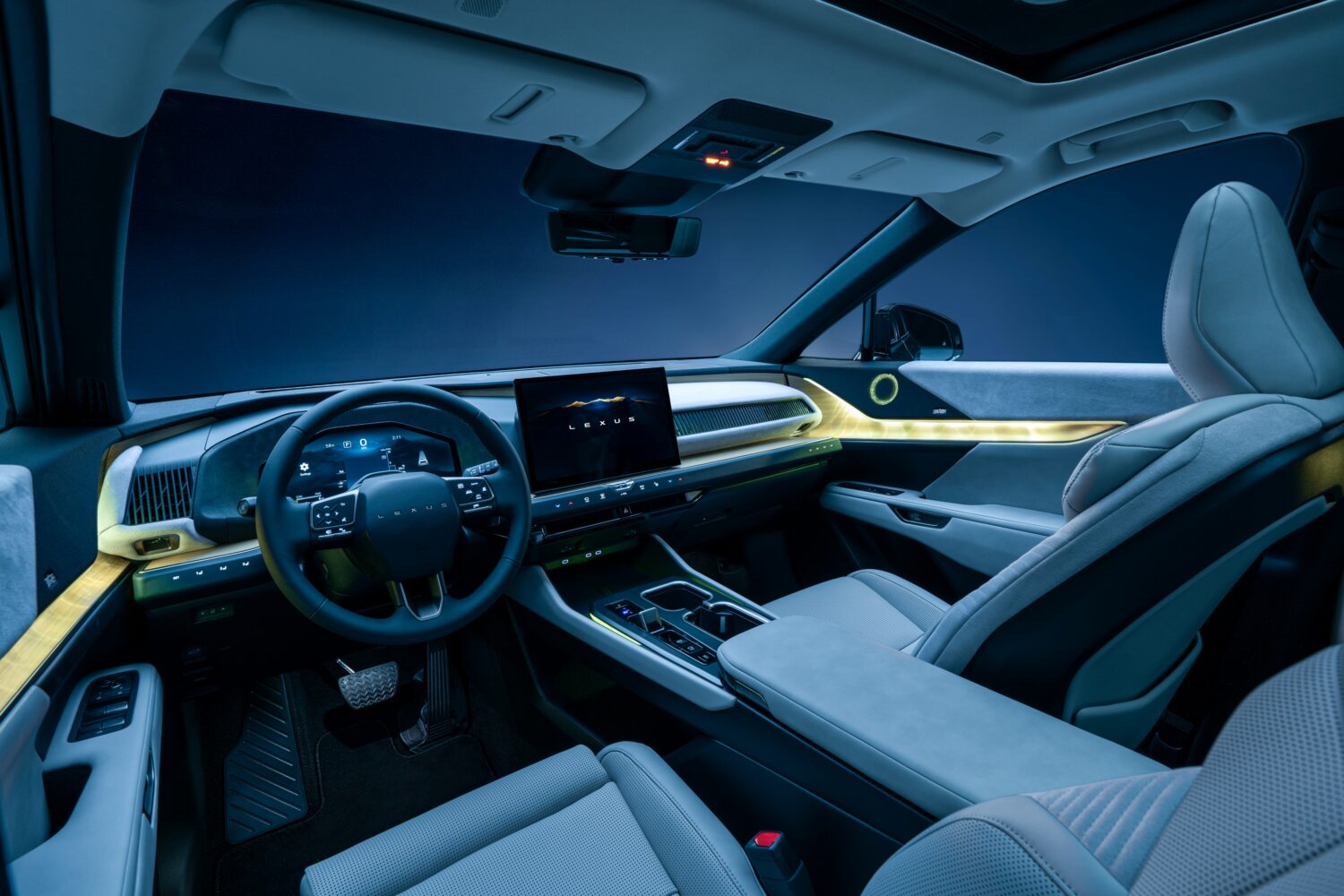
Driving Lounge Concept: A New BEV Experience

The TZ’s Driving Lounge concept redefines the Battery Electric Vehicle (BEV) three-row SUV by balancing lounge-like comfort with Lexus’ signature driving enjoyment. The dedicated platform and open cabin design provide spaciousness and quietness, allowing all occupants to relax regardless of seating position. The vehicle combines smooth BEV ride quality with engaging driving dynamics.


Its sculptural exterior balances beauty and aerodynamics, achieving top-class performance among Lexus SUVs while maximizing driving range. Interior surfaces feature Forged Bamboo, sourced from Shikoku Island, reflecting Lexus’ commitment to sustainable craftsmanship and traditional techniques. The TZ aims to enrich time spent with loved ones and evoke emotional connection behind the wheel.


Interior Opulence

A Relaxing Lounge Experience for Every Passenger

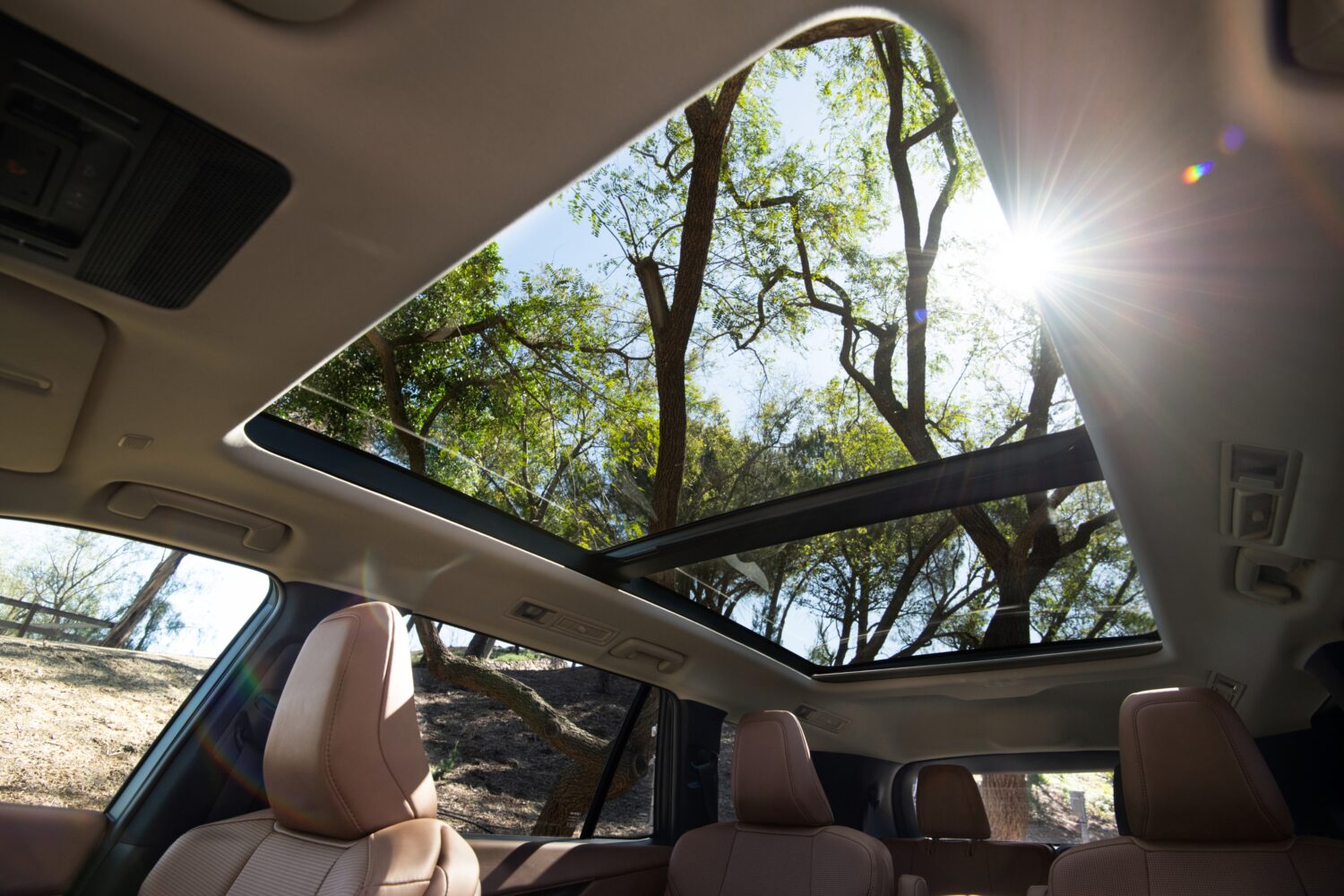
Engineers designed the cabin as an enjoyable lounge space with a low-floor, long-wheelbase layout that enhances comfort and quietness. The slim instrument panel, seats optimized for comfort across all three rows, second-row captain’s chairs, and an expansive panoramic roof create an open, inviting atmosphere for all passengers.


Commitment to Comfort and Relaxation

To achieve exceptional quietness—critical in BEVs where engine noise is absent—Lexus employed sound-absorbing materials, vibration frequency offsetting design elements, and aerodynamic mirrors to minimize wind noise. The result is the quietest cabin among Lexus SUVs, with sound directionality optimized for natural conversation clarity throughout.


Seats are designed and crafted for comfort: slim front seats balance style and support; front passenger and second-row seats offer ventilation and power ottomans (a Lexus SUV first); third-row seats provide sofa-like cushioning. Access to the third row is eased by flush seat rails and a walk-in button on second-row seats, allowing smooth entry even with child seats installed.


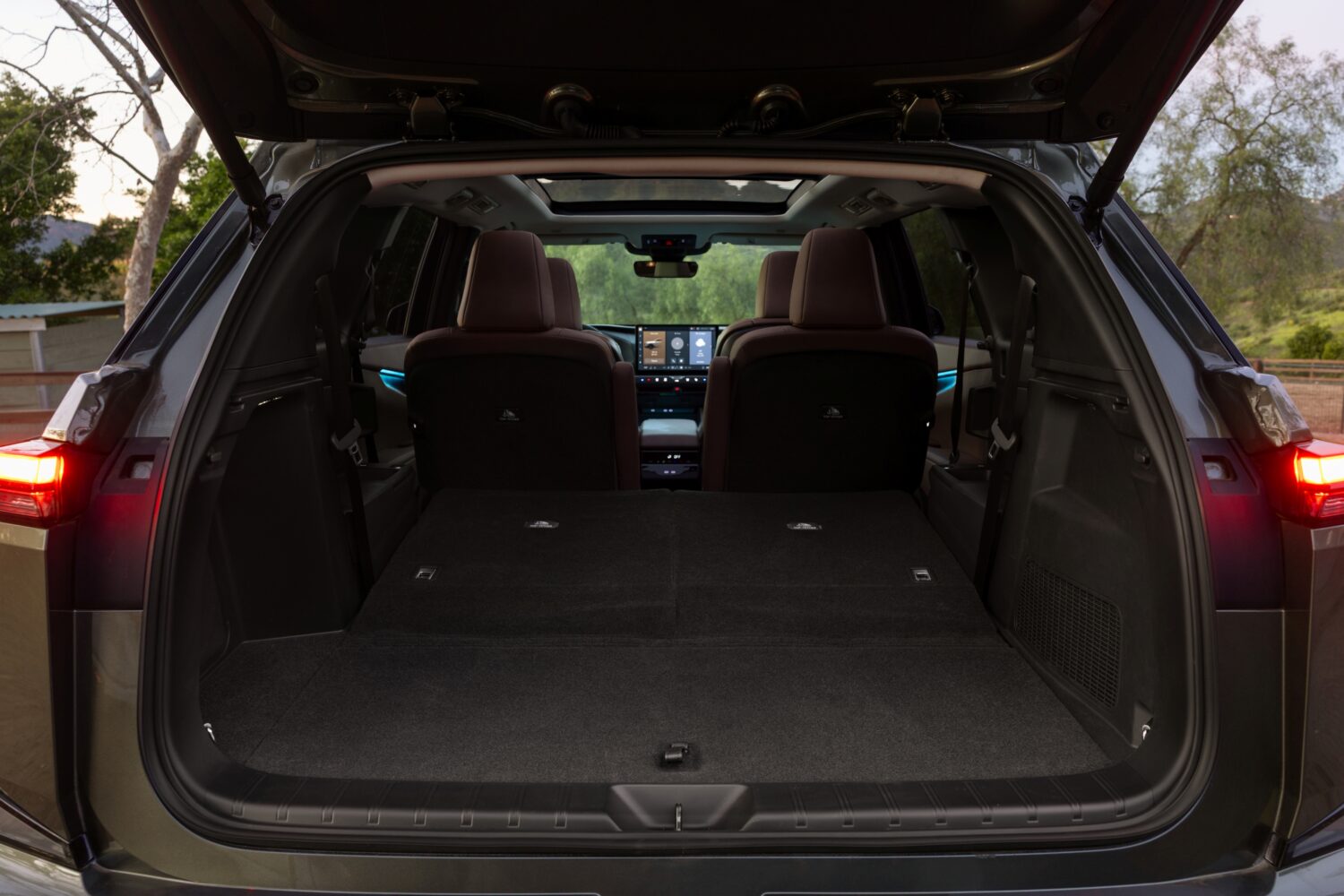
Cargo space is generous and flexible, with one-touch folding for second and third rows. Doors feature an easy-closer function for safe, quiet operation.


The Next Era of Multimedia

The latest-generation Lexus Interface multimedia system debuts in the TZ with crisp graphics, an intuitive user interface, enhanced computing power, and AT&T 5G connectivity. New features include customizable widgets on the home screen, improved “Hey Lexus” Voice Assistant, full-screen navigation on the digital gauge cluster, EV Charge Management functions—including EV Routing and EV Range Map—to support seamless electric driving, and more.


Drive Recorder records external camera footage for driver peace of mind. Available entertainment options include SiriusXM® with 360L, Integrated Streaming with Spotify®, and included wireless Apple CarPlay® and Android Auto™ compatibility.


An Authentic Lexus Atmosphere

The panoramic roof features an expansive power sunshade with a wire-driven system that preserves cabin height, maximizing headroom and offers third-row passengers ample views. Standard ambient illumination cycles LED light sources through six Japanese-inspired themes evoking natural beauty.


Switches are designed for intuitive tactile feedback while maintaining minimalist styling. A Mark Levinson™ audio system with 21 speakers delivers immersive, distortion-free sound. Climate fans are engineered for quietness and heaters on all seats provide soothing and enveloping warmth.


The front center console balances premium quality with functionality, highlighted by a large storage compartment. A rear center console provides a two-tier tray system for storage and is removable, allowing for walkthrough access between second and third rows.


Chassis and Dynamics

A Blend of Driving Pleasure and In-Cabin Harmony

The TZ combines a low center of gravity and high body rigidity, unique to BEVs, further supporting the “Driving Lounge” concept where occupants feel at ease both driving and parked. The vehicle offers exceptional smoothness, advanced posture control, selectable drive modes, and a comfortable driving experience for passengers in all three rows.


A Refined Athletic Core

Built on the TNGA platform, the TZ embodies the Lexus Driving Signature refined through over 40 performance themes. Reinforced body structure—including high-rigidity adhesives, laser screw welding, and aluminum components—delivers handling stability, torsional stiffness, and reduced weight.


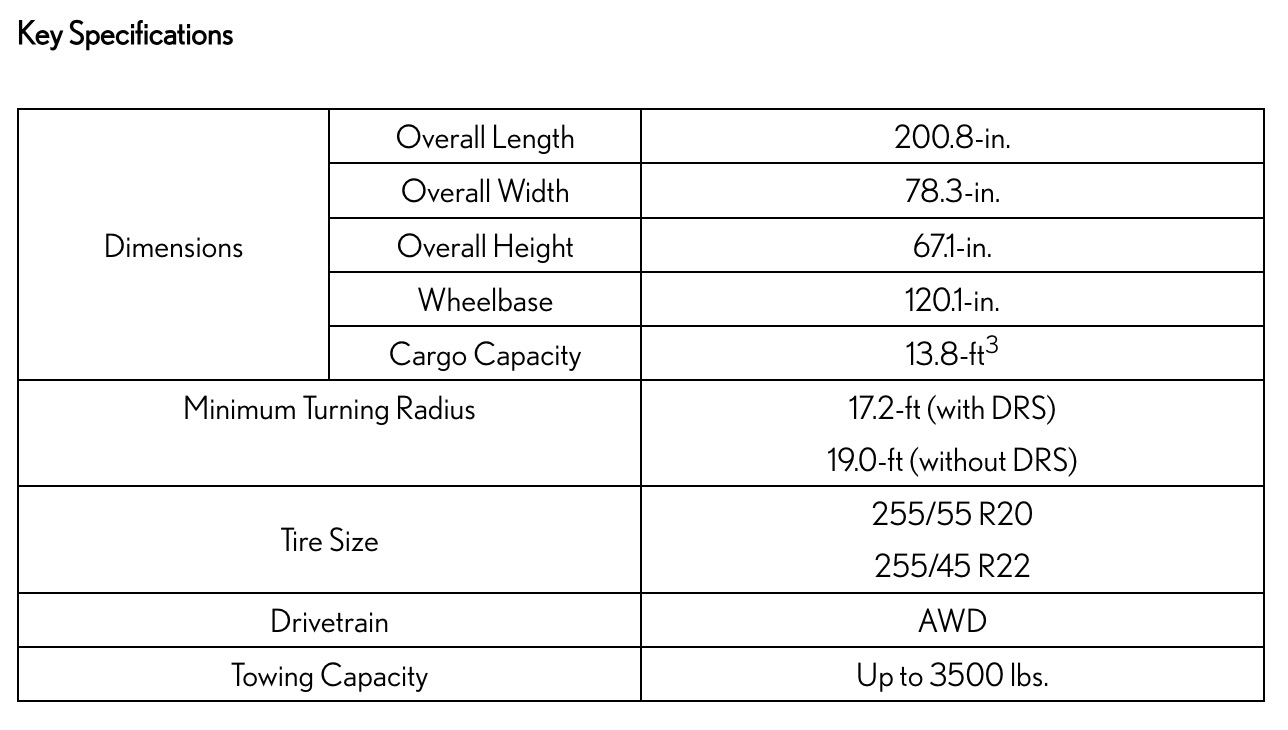
Dynamic Rear Steering (DRS) enhances maneuverability at low speeds and stability at high speeds by steering rear wheels up to 4 degrees in coordination with front wheels.


The suspension features MacPherson struts upfront and multi-link rear setup tuned for comfort on large-diameter wheels and tires.


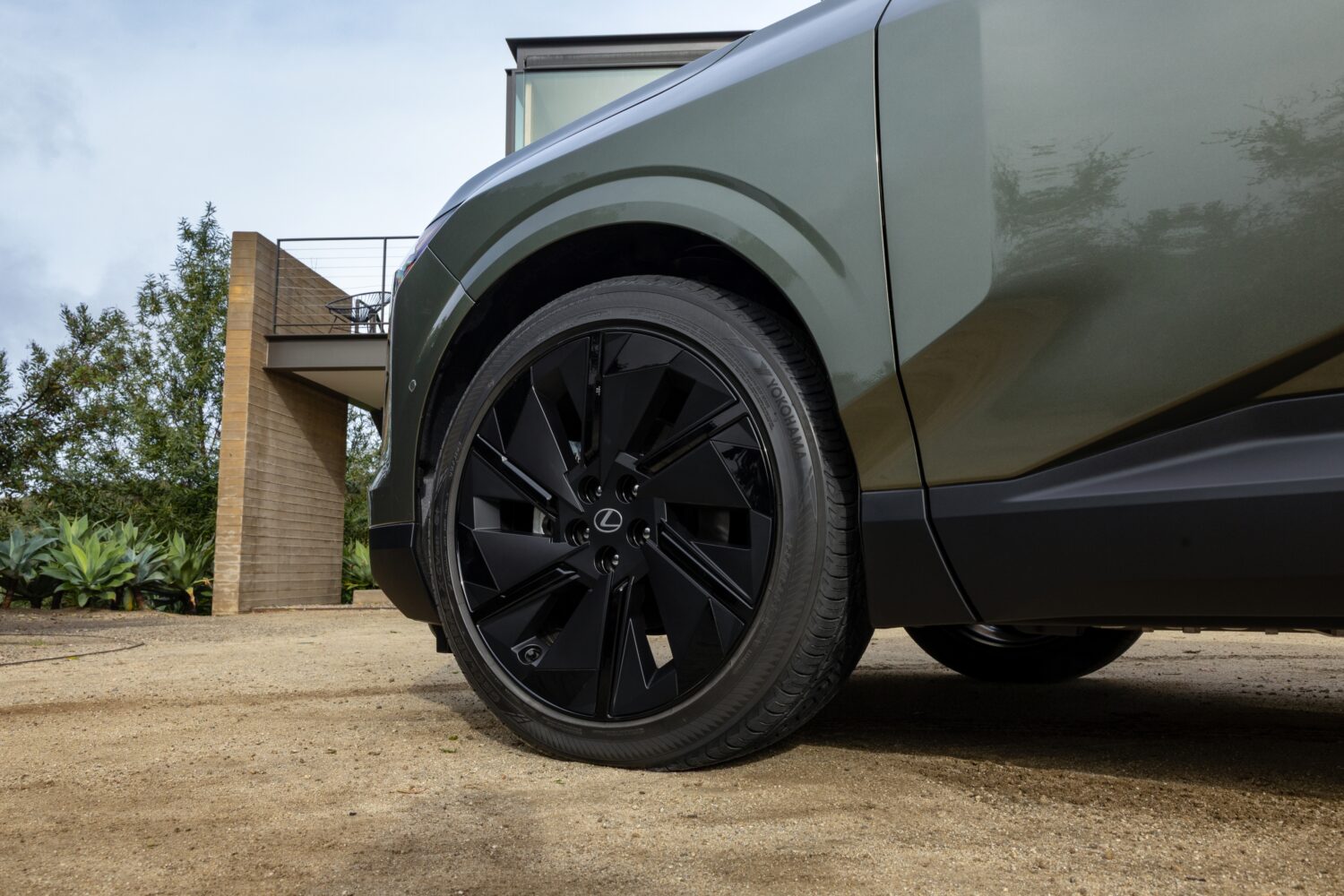
Offered in 20- and 22-inch sizes, the tires balance low rolling resistance with ride comfort and acoustic quietness and the wheels are designed to reduce tire cavity resonance. Together the wheels and tires provide a more pleasing driving experience.


An electronic brake control system provides independent front/rear hydraulic control with coordinated regenerative braking for natural brake feel and seamless transition from deceleration to cornering.


Aerodynamic refinements—including smooth airflow management around body edges, flush door handles, aerodynamic mirrors, underbody fins, air dams, and optimized wheel designs—achieve a Cd of 0.27, enhancing range, stability and reduced wind noise.


Distinguished BEV Control and Comfort

The evolved DIRECT4 AWD system dynamically distributes torque between front and rear motors based on driving conditions for linear acceleration and precise cornering. Torque ratios adjust from 60:40 to 0:100 (front:rear) during acceleration and 80:20 to 0:100 (front:rear) during cornering phases to optimize handling.


Drive modes—NORMAL, SPORT, ECO, RANGE, REAR COMFORT—feature tailored settings emphasizing rear seat comfort in REAR COMFORT mode by coordinating Dynamic Rear Steering, brake force optimization, and drive force distribution to minimize pitching and lateral motion.


Regenerative braking offers five levels of deceleration, adjustable via paddle shifters, to meet the driver’s preference. Maximum coasting deceleration is up to 0.2 G for natural speed control using only accelerator pedal modulation.

A Deeper Connection

The cockpit design offers expanded forward visibility with a low instrument panel featuring polarizing film to reduce glare. Optimized A-pillar design improve corner entry sightlines.


Active Sound Control (ASC) produces harmonically pleasing acceleration and deceleration sounds linked to pedal inputs, enhancing driver awareness through musical chord sequences that express power and dynamism.

Enhanced Charging and Power-Delivery Capabilities

The Lexus-first 2-in-1 charging port places AC and DC connectors side-by-side with a compact motorized sliding cover for convenient charging in tight spaces. The U.S. model features the North American Charging Standard (NACS) port.


Advanced battery and charging functions include:


Battery Preconditioning:Optimizes battery temperature before charging in cold conditions.

Driving Preconditioning:Adjusts battery temperature en route to charging stations.

Departure Time Preconditioning:Schedules preconditioning based on planned departure.

Optimal Charging (Auto):Learns driver habits to suggest charging schedules.

AC External Power Supply:Allows use of electrical appliances via rear AC inlet by attaching dedicated available accessory adapter.


Sculptural Beauty and Aerodynamic Performance


The Driving Lounge concept is fully realized in the exterior design following Lexus’ Provocative Simplicity philosophy—simple yet sharply defined forms harmonizing aesthetics with function.


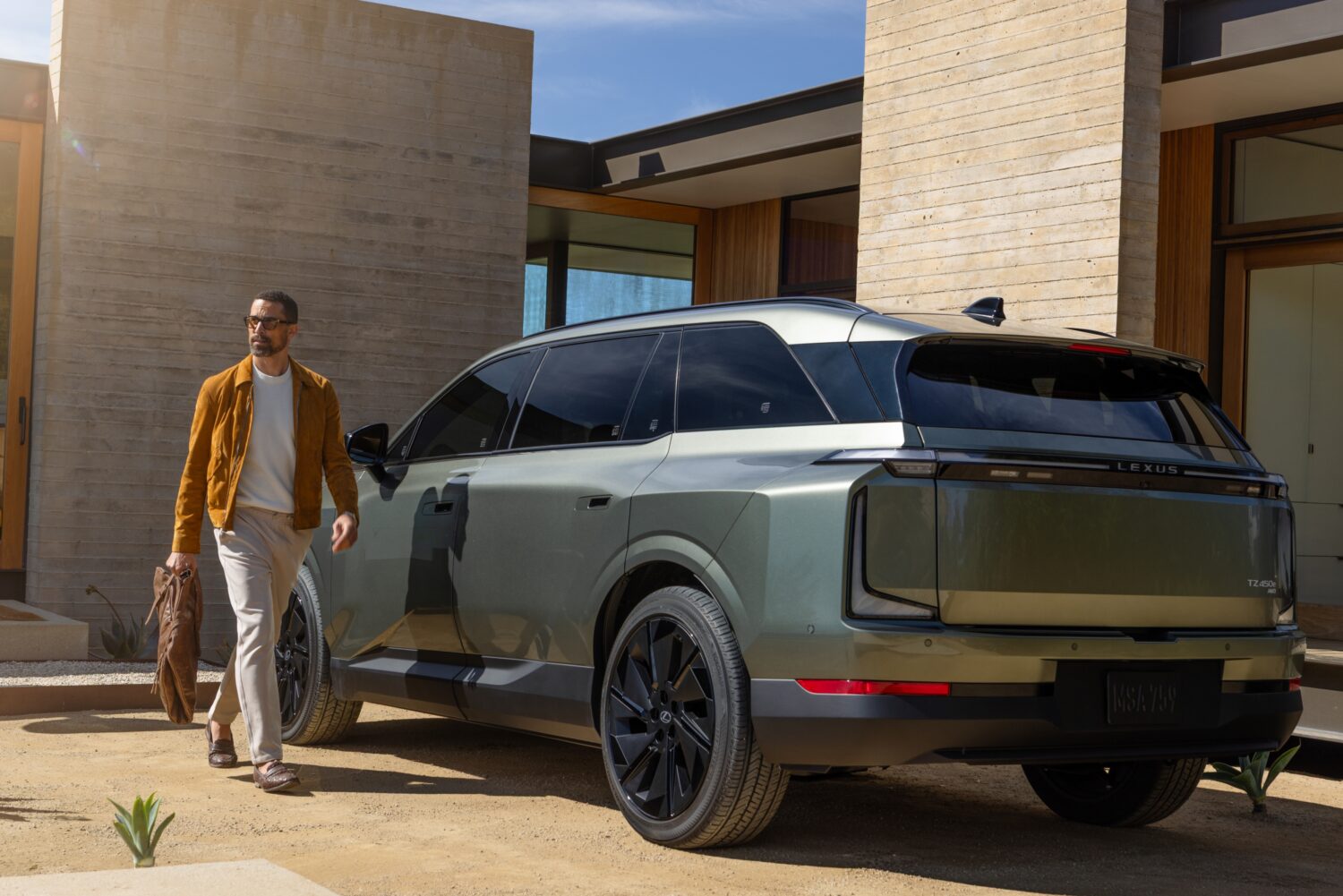
The spindle body presents a unified mass with architectural geometric graphics conveying strength. The side profile features an elongated silhouette enabled by a low center of gravity platform that balances aerodynamics with interior spaciousness. Semi-flush door handles reduce drag.


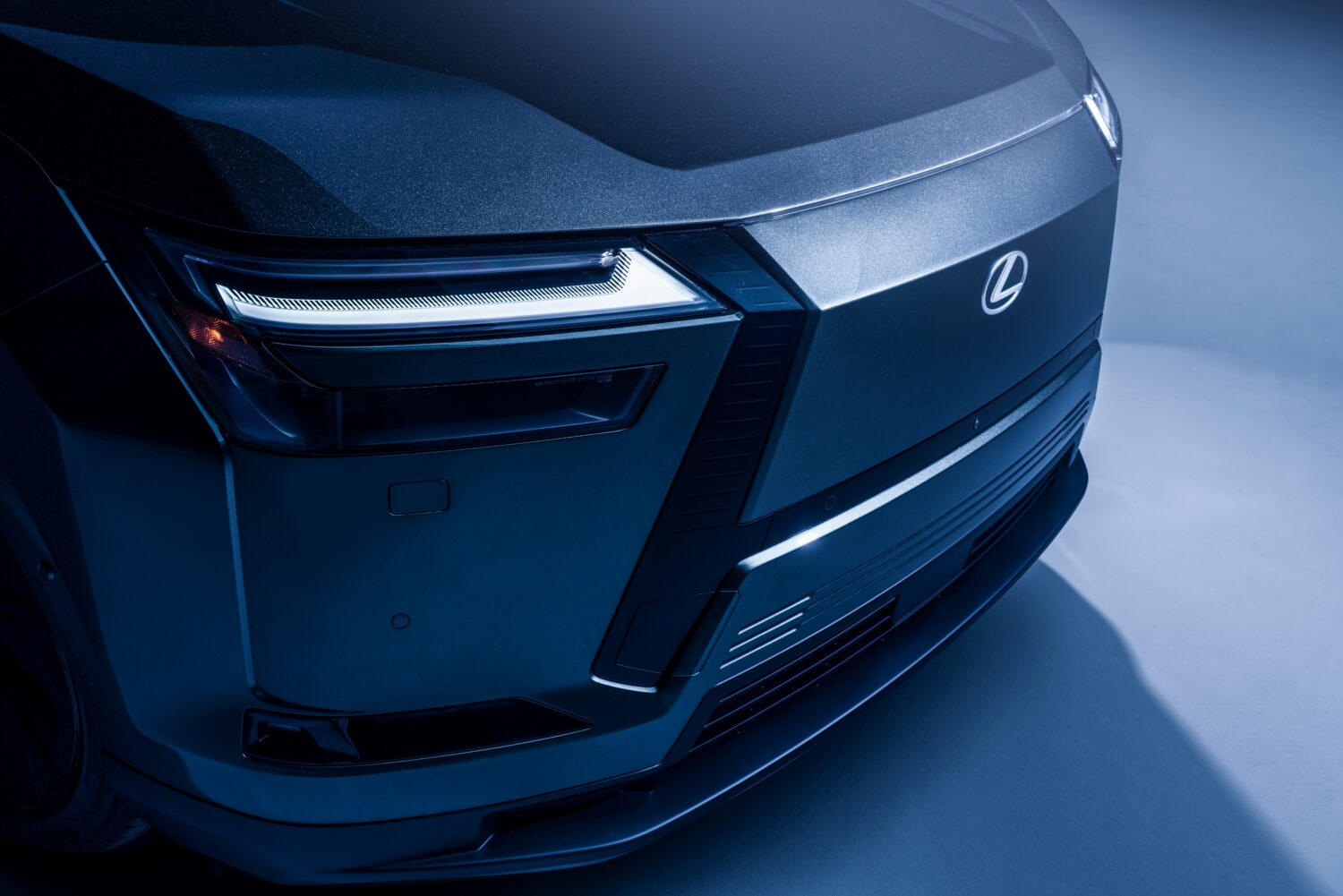
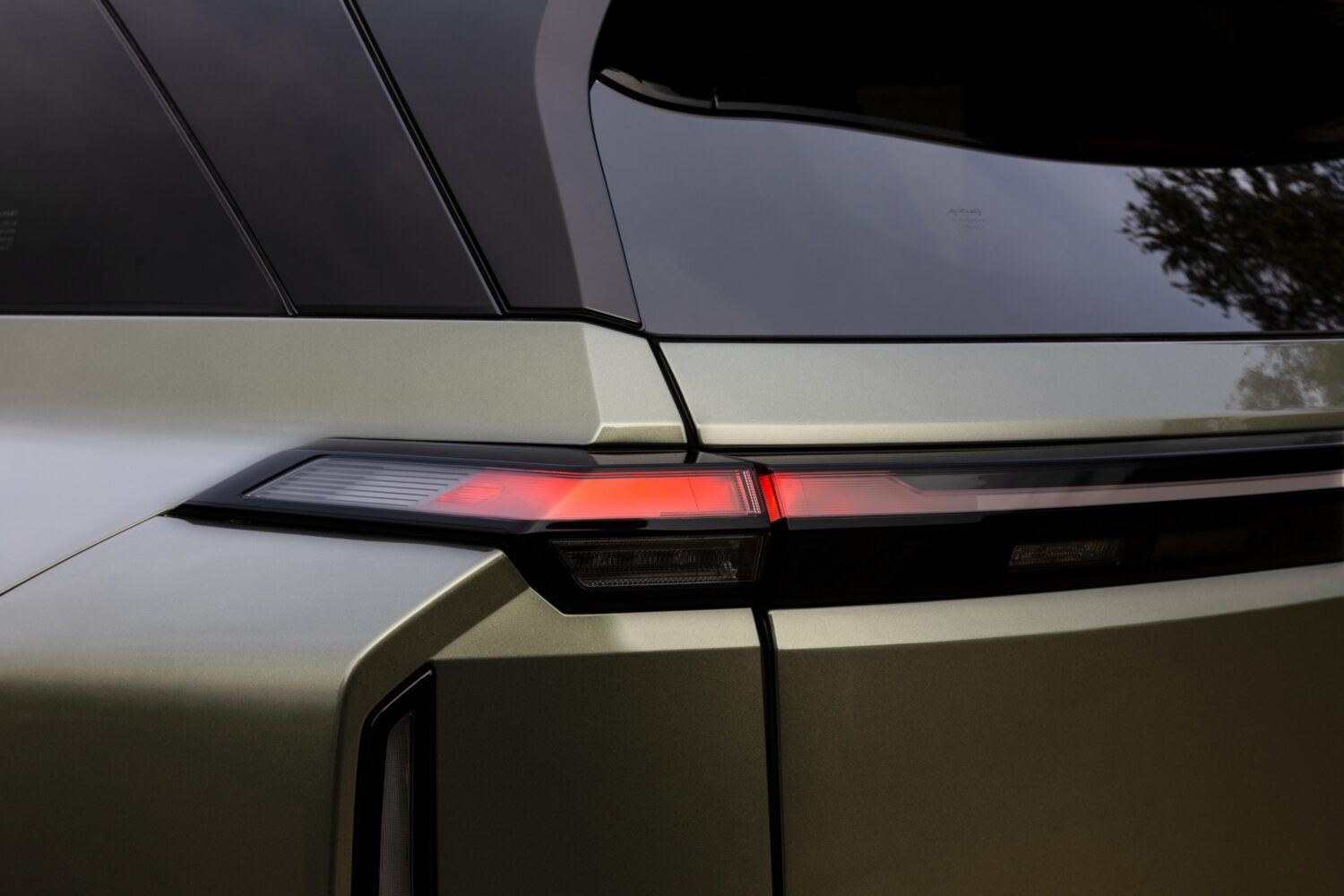
The front fascia offers a bold stance with Twin-L Signature Lamps combining L-shaped daytime running lights and turn signals. Functional sensors integrate seamlessly into styling. The rear roofline slopes for aerodynamics while preserving cabin space; pronounced fenders emphasize SUV presence alongside signature rear L-shaped lamps.


Wheel designs balance aesthetics with aerodynamic efficiency coming in both 20- and 22-inch sizes with both using resin aero covers for added visual flair set against their multi-spoke designs. The 22-inch wheels feature aluminum sculpted spokes further emphasizing refined craftsmanship and form.


A front grille illuminated emblem features an L-shaped mark filled with body color material for distinctive appearance day or night.


Aluminum roof rails combine sleek design with recycled materials to reduce environmental impact while offering accessory attachment options.


Modern Color and Design

Exterior colors include six options highlighted by the all-new Shaded Ivy—a distinct offering that combines aspects of depth, strength, beauty, and harmony with nature.


Interior palettes offer Birch (light gray), Acorn (medium tone), and Black/Dapple Gray (monochromatic gradation), each enhancing the cabin’s clean design with warm textures.


Eco-Conscious Materials and Circular Vehicle Development

Lexus integrates social responsibility into the TZ through sustainable materials and manufacturing:


Forged Bamboo:Decorative cabin surfaces made from Shikoku bamboo fibers blended into resin support circular economy initiatives while preserving traditional craftsmanship.


Bio-based UltraSuede™:Plant-derived materials used in instrument panels, seat accents, and door shoulders promote harmony with nature.

Recycled Aluminum:Roof rails and tonneau cover frames use recycled aluminum requiring less energy than conventional production methods.

Adhesive-free seat assembly structures reduce environmental impact.

These efforts reflect Lexus’ commitment to reducing CO2 emissions while supporting local industries and sustainable brand growth.


Safety and Convenience

Lexus is advancing safety technology development with the ultimate goal of achieving ”zero traffic accidents” in future mobility society. Based on the belief that it is essential to develop world-class advanced safety technologies quickly and expand their adoption across more vehicles, the latest Lexus Safety System+ 4.0 (LSS+ 4.0) comes standard in the new TZ. Embodying “The Standard of Confidence” by providing advanced safety and convenience features designed to enhance every driving experience, this version introduces more natural and human-like intervention. It reflects Lexus’ commitment to enhancing the level of confidence and safety experienced by Lexus drivers.


The system has evolved to recognize objects wider and farther than before, expanding the range of accident situations it can address. In addition, to provide continuous support even in complex environments such as urban roads, the operating range of functions and sensors has been expanded, enhancing peace of mind and convenience while helping reduce driver workload. Furthermore, as these technologies evolve, surrounding vehicle information is displayed more clearly on the meter display, contributing even more to safe and secure driving for customers.


Front Pre-Collision System (PCS) with Pedestrian Detection

Pre-Collision System (PCS) with Pedestrian Detection is designed to help detect a vehicle, pedestrian, bicyclist or motorcyclist and provide an audio/visual forward collision warning under certain circumstances. If the driver does not react, the system is designed to provide automatic emergency braking. PCS uses a camera and millimeter-wave radar for enhanced performance and reliability. Features for LSS+ 4.0 include:

Risk Avoidance Emergency Steer Assist

Designed to provide additional steering torque during an emergency maneuver initiated by the driver, enhancing vehicle stability and helping prevent lane departure. This steering support function is designed to operate when the Pre-Collision System is turned ON, the turn signal is not being operated, the speed of the vehicle is between 25-50 mph and the relative speed to the detected object is between 25-50 mph.

Intersection Turn Assist

Designed to detect vehicles, motorcycles, bicycles, and pedestrians crossing at intersections, supporting the driver with audible and visible warnings along with automatic braking when turning left for an oncoming vehicle or turning right for when a pedestrian is detected.


Full-Speed Dynamic Radar Cruise Control (DRCC) with Eco-Run Mode

Full-Speed Range Dynamic Radar Cruise Control helps maintain a preset distance from the vehicle ahead of you, from highway speeds down to a full stop. LSS+ 4.0 adds an Eco-Run mode for DRCC that is designed to help improve energy consumption by smoothing acceleration.


Lane Tracing Assist (LTA)

Lane Tracing Assist helps you center the vehicle within its lane while Dynamic Radar Cruise Control is active.


Lane Departure Alert with Steering Assist (LDA w/SA)

Lane Departure Alert with Steering Assist may alert you to inadvertent lane departures and make minor steering corrections to help keep you in your lane.


*Lane Departure Alert with Steering Assist is designed to read visible lane markers under certain conditions and provide visual/audible alerts when lane departure is detected. It is not a collision avoidance system or substitute for safe and attentive driving. Effectiveness depends on many factors, including road, weather, and vehicle conditions. See Owner’s Manual for limitations.


Road Sign Assist (RSA)

Road Sign Assist (RSA) uses the forward-facing camera to recognize specific road signs such as speed limit and stop signs. RSA provides sign information to the driver via the Multi-Information Display.


Automatic High Beams

Automatic High Beams can automatically toggle between high and low beams based on the vehicle’s surroundings.

Proactive Driving Assist (PDA)

Proactive Driving Assist (PDA) uses the vehicle’s camera and radar, when system operating conditions are met, to provide gentle braking and/or steering to support driving tasks such as distance control between your vehicle and a preceding vehicle.


Additional safety and convenience features available on the Lexus TZ include:


Traffic Jam Assist

Traffic Jam Assist technology (with an active Drive Connect trial or subscription) is designed to monitor surrounding traffic in condensed, low-speed driving situations on limited access roadways and to keep a set following distance behind the preceding vehicle. In addition to providing hands-free steering assistance, this system can automatically bring the vehicle to a complete stop then resume its path of travel as forward traffic begins to move.  Three-year Drive Connect trial included.


Lane Change Assist (LCA)

An extension of Lane Tracing Assist (LTA), Lane Change Assist (LCA) can automatically perform a lane change while using the camera and millimeter-wave radar to monitor the surrounding environment and determine a smooth trajectory.


Rear Pedestrian Detection

Designed to alert the driver if a pedestrian is detected at the rear of the vehicle and apply the brakes if needed.


Front Cross-Traffic Alert (FCTA)

FCTA is designed to detect the approach of crossing vehicles when the vehicle enters an intersection at low speed and alerts the driver via an audible alert and, on models so equipped, the Head-Up Display (HUD).


Source link

Fernando Alonso’s Pagani Zonda Roadster Diamante Verde spotted in Monaco

0
Fernando Alonso’s Pagani Zonda Roadster Diamante Verde spotted in Monaco


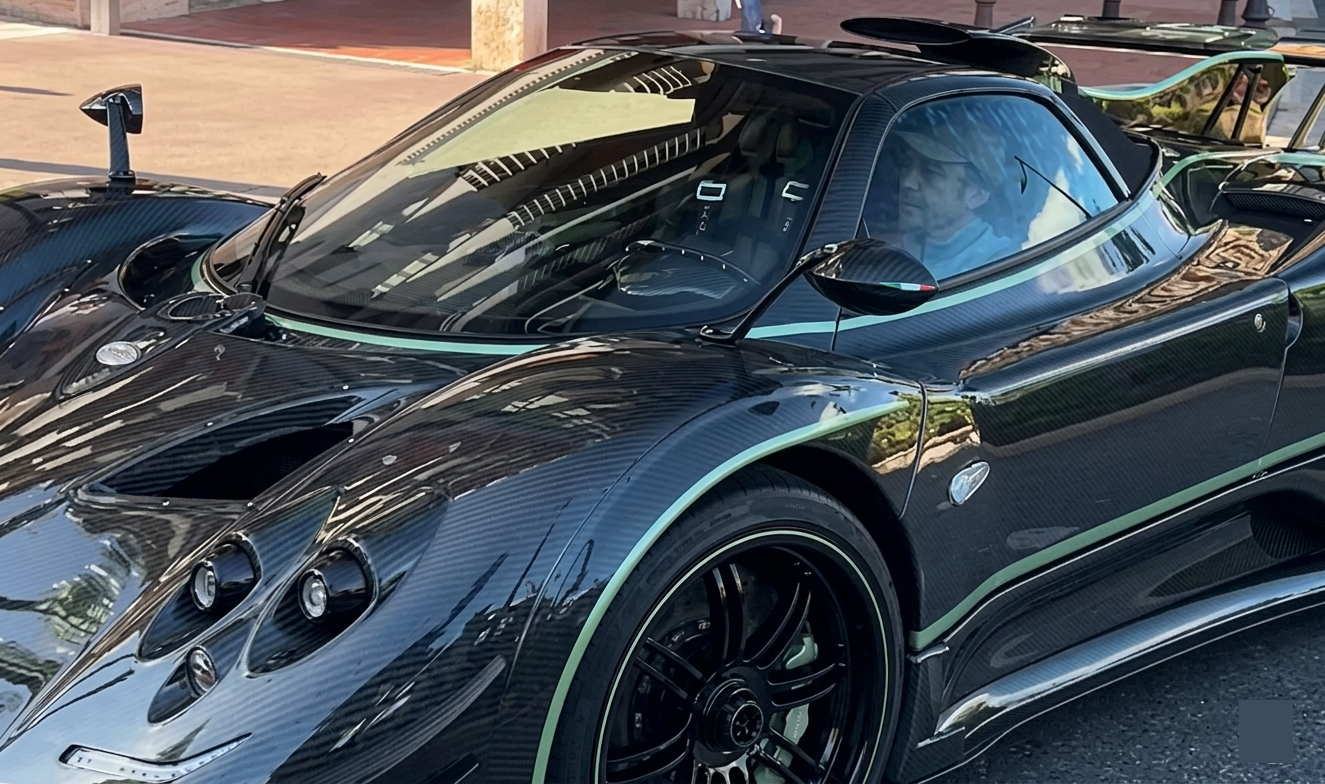
F1 driver and legend Fernando Alonso’s Pagani Zonda Roadster Diamante Verde has been spotted in Monaco. The supercar is said to be the only such example in the country.

We can see in the footage that the Zonda is calmly cruising down the streets of Monaco. While Alonso himself isn’t behind the wheel, it doesn’t stop the multi-million dollar machine from grabbing a lot of attention, especially from car spotters.

The second part of the clip gives us a quick listen to the exhaust note of the mighty V12. The sound echoes in the street and becomes louder as the supercar gains some revs. We can also hear a small pop when the car upshifts.

Being the kind of machine that it is, the Pagani Zonda Roadster Diamante Verde is dripping with carbon-fibre. Features like quad exhausts, massive rear wing, iconic headlights and taillights, ensure it isn’t missed. And bringing it to life is the phenomenal V12 engine. It is a 7.3L naturally aspirated powerhouse from Mercedes-AMG that makes 760 hp.

Source: @Restricted9


Source link

Tesla Cybertruck too safe for even Musk’s biggest critics to ignore

0
Tesla Cybertruck too safe for even Musk’s biggest critics to ignore


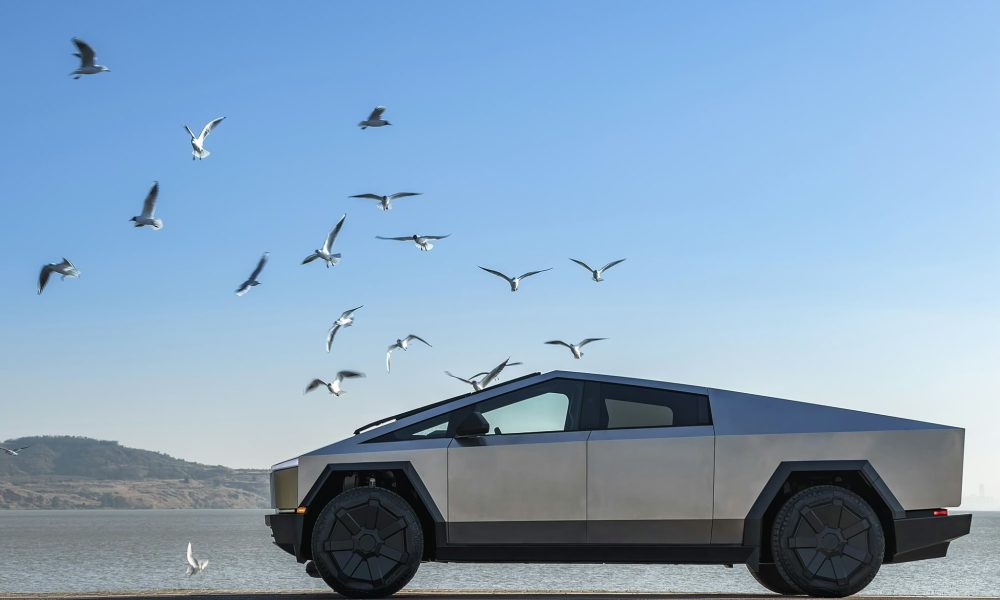
The Tesla Cybertruck is an extremely polarizing vehicle because of its potential symbolism as a political stance instead of just a pickup truck — or at least that is what many would want you to believe.

Of course, the Cybertruck is an icon of Tesla culture, and it is one of those things that never has a middle ground: you love it, or you don’t.

But maybe there is an establishment of that “grey area” happening.

In a striking illustration of engineering triumph over political tribalism, prominent Elon Musk critic Brian Krassenstein has purchased a Tesla Cybertruck, openly citing its exceptional safety as the deciding factor for his family.

The announcement on X triggered predictable backlash, yet it underscores a growing reality: the Cybertruck’s safety credentials are proving impossible for even Musk’s fiercest detractors to dismiss.

Krassenstein, who has repeatedly clashed with Musk over issues ranging from content moderation and “wokeness” to public health figures, made no attempt to hide his reservations. In his May 6 post, he acknowledged the coming criticism: “I might get hate for this too but I bought a Cybertruck.”

He stressed that the decision had “nothing to do with Elon or politics,” pointing instead to practical advantages—his existing Tesla charger, eligibility for Full Self-Driving upgrades, a returning-owner discount, and crucially, the vehicle’s strong safety profile.

With gasoline prices hovering near $5 a gallon in some areas, he also highlighted the environmental benefit of switching from a polluting combustion engine.

The numbers, data, and awards validate Krassenstein’s choice.

The 2025 Cybertruck earned the Insurance Institute for Highway Safety’s (IIHS) elite Top Safety Pick+ award—the only pickup truck to achieve this highest rating. It delivered “Good” scores across every crashworthiness category, including the challenging updated moderate overlap front crash test, while excelling in crash avoidance and mitigation systems.

The National Highway Traffic Safety Administration (NHTSA) awarded it a perfect 5-star overall rating, with top marks in frontal, side, and rollover categories. No other pickup truck holds both distinctions simultaneously.

Tesla Cybertruck crash test rating situation revealed by NHTSA, IIHS

Beyond lab results, the Cybertruck’s stainless-steel exoskeleton and ultra-rigid structure have demonstrated remarkable real-world resilience. Owners have reported surviving high-speed collisions with minimal cabin intrusion.

In one widely discussed incident, a Cybertruck endured a 70 mph sideswipe on the interstate; the driver reported barely feeling the impact while the other vehicle was heavily damaged.

Tesla’s crash demonstrations and independent analyses consistently show how the vehicle’s design prioritizes occupant protection through a fortified passenger cell rather than traditional crumple zones, giving families superior safeguarding in many common crash scenarios.

The online pile-on following Krassenstein’s post focused on aesthetics, politics, and perceived hypocrisy rather than the data. Critics called the angular truck “ugly” or accused him of selling out.

Yet his purchase highlights an inconvenient truth for polarized discourse: when objective safety metrics—IIHS awards, NHTSA ratings, and documented crash performance—point decisively toward one vehicle, even Musk’s biggest critics are forced to confront its merits.

Krassenstein’s decision reveals that superior safety isn’t a partisan issue. For parents prioritizing family protection over personal or political grudges, the Cybertruck has become too safe to ignore.


Source link

Fixing BMW DME Damage from Coolant Wiring Migration

0
Fixing BMW DME Damage from Coolant Wiring Migration


BMW cooling systems operate at 2.0 bar, generating high internal pressure that exacerbates failing sensor seals. HT-12 coolant then “wicks” through stranded copper wiring via capillary action, reaching the Digital Motor Electronics (DME). This migration causes terminal oxidation and bridge-shorts, necessitating proactive harness audits to avoid catastrophic computer failure.

Physics of Capillary Migration in BMW Wiring Looms

I’m looking at an F15 X5 that just rolled into the bay. The customer’s complaining about a rough idle, but the codes are all over the place—O2 sensors, vanos solenoids, even a generic throttle body fault. These aren’t related systems. Usually, when the DME starts throwing a “shotgun blast” of unrelated errors, I stop looking at the sensors and start looking at the harness.

I pull back the plastic corrugated loom near the Map Thermostat. There it is—that faint, sweet smell of vaporized HT-12. The outside of the wires looks dry, but the insulation feels slightly “fat.” This is the capillary effect in real-time. Because the BMW cooling system is pressurized to nearly 30 PSI, a failed internal seal inside the thermostat doesn’t just leak onto the ground; it injects coolant directly into the copper strands of the wire.

The wire insulation essentially acts like a straw. Through surface tension and high system pressure, the fluid is forced up the harness, bypassing the tightest bends. I’ve seen fluid climb three feet uphill from the water pump to the DME box. If I don’t catch this now, that fluid is headed straight for the pins that control the engine’s “brain.”

HT-12 Oxidation and DME Pin Corrosion

I’ve moved to the DME box now, located right under the cowl. I’m pulling Connector 1. The moment the latch clicks, I see it—a faint blue-green haze on the silver-plated pins. That’s Cu2​CO3​(OH)2​, or basic copper carbonate. It’s the result of BMW’s HT-12 coolant reacting with the electricity flowing through these terminals.

Under 20x magnification with my jeweler’s loupe, the damage is obvious. The silver plating is gone, and the copper beneath is beginning to “fuzz.” In a 5V reference circuit, even a tiny amount of this conductive crust creates a bridge-short. This is why the car is throwing O2 sensor codes; the coolant is bridging the power pin to the signal pin, effectively lying to the computer about what the engine is doing.

Dallas humidity doesn’t help. Once that coolant reaches the DME box in Carrollton, the moisture in our air accelerates the electrolysis. You aren’t just dealing with a leak; you’re dealing with an active chemical reaction that is eating the silver off your engine computer’s connectors.

High-Risk Wicking Sensors for Carrollton Commuters

Identifying the source is usually a process of elimination, but on these N55 and B58 engines, there are two primary suspects: the Map Thermostat and the Coolant Temperature Sensor. The Map Thermostat is the worst offender because it sits low and sees the highest pressure fluctuations during stop-and-go traffic on the PGBT or Addison Circle.

I’m looking for the “root” of the moisture. I use a UV flashlight because HT-12 has fluorescent properties. Tracing the harness back, the UV light hits a bright neon glow right at the thermostat plug. The seal hasn’t just failed; it has “shrunk” due to the constant 105∘F Dallas heat cycles, allowing the 2.0 bar pressure to find the path of least resistance—straight through the center of the wire strands.

Preventive Harness Audits for North Texas BMWs

Between January and April 2026, Ultimate Bimmer Service performed 12 preventive harness inspections. In 4 cases, HT-12 coolant was found migrating more than 12 inches into the wiring loom. In 2 cases, early detection prevented DME replacement costs estimated at $4,500 per vehicle.

These numbers tell the real story of the Carrollton failure environment. If I wait for the Check Engine Light to come on, the fluid has already reached the pins. By then, the damage is often irreversible. A preventive audit is a simple matter of pulling a few connectors and looking for that first sign of “wicking” before the capillary action completes its journey.

DME Terminal Decontamination vs. Harness Replacement

Now comes the “Point of No Return” decision. I’ve found fluid on the DME pins, but is the computer toast? I take my multimeter and check for a voltage drop across the contaminated pins. If the internal resistance is still within spec, we might have a “save.”

I start by using a specific electronic contact cleaner and compressed air to flush the connector. I have to be careful; if I push the fluid further into the DME housing, it’s game over. I’ve managed to clean the pins on this X5, but the harness itself is a different story. Once the copper strands are saturated with coolant, you can’t just “dry them out.” The fluid will keep creeping back to the pins like a slow-moving wick.

I’m recommending a new Map Thermostat and a partial harness replacement for this customer. We’ll cut out the contaminated section of the loom and graft in a new, dry section with fresh pins. It’s an intensive repair, but compared to a $4,500 DME and a full factory harness swap, it’s the only logical way to keep this car on the Dallas North Tollway without a catastrophic failure.

If you’re over 70k miles, stop by Ultimate Bimmer at 3330 Wiley Post Rd. I’ll pull your DME connectors and check for wicking in 15 minutes—if we catch it now, you save the computer.

Frequently Asked Questions

Can I detect coolant wicking if I don’t have a Check Engine Light? 

YES. By the time a CEL appears, coolant has usually already reached the DME pins. A manual inspection of the Map Thermostat or Coolant Temp Sensor plug—looking for green residue or moisture inside the plastic connector—is the only way to detect migration in its early stages before electrical damage occurs.

Is it cheaper to replace the sensor or the DME? 

YES. A replacement sensor and a preventive harness cleaning typically cost under $400. Conversely, once coolant causes internal oxidation on the DME pins, the repair involves replacing both the engine computer and the entire engine wiring harness, which routinely exceeds $4,500 in total parts and labor.

Is the car still drivable if the harness is wicking? 

NO. Capillary migration creates a high risk of an electrical short circuit on the 5V reference rail. This can cause the car to enter “Limp Mode” or stall unexpectedly in high-traffic areas like the PGBT interchange, posing a significant safety risk as the DME loses the ability to accurately calculate fuel and air ratios.

Does terminal cleaning always save the DME? 

NO. Cleaning only works if the oxidation is caught on the external pins. If the fluid has bypassed the pin seals and entered the internal DME circuit board, the silver traces will corrode from the inside out. In these cases, even a perfectly clean connector won’t fix the “ghost” faults, and a full computer replacement is the only viable outcome.

  • BMW Master Technician

    I am the Co-Owner of Ultimate Bimmer Service and a BMW Master Technician with extensive factory training and years of hands-on dealership experience. After working in dealership environments, I wanted to bring BMW drivers a better service experience—focused on precision repairs, honest communication, and without the unnecessary delays or markups.

    Every day in the shop, I oversee service quality and lead diagnostics and repairs, combining deep BMW mechanical knowledge with factory-level training to ensure your vehicle gets accurate, reliable care done right the first time.


Source link

Watch now: Grow your EV sales profitably

0
Watch now: Grow your EV sales profitably


Best practice for dealerships involved in selling and servicing electric vehicles (EVs) formed the focus of an exclusive webinar panel as part of Automotive Management’s EV Retailing Week.

The panel – available to watch online now – featured:

  • Dave Marshall, head of distribution development at Black Horse.
  • David Hawksworth, customer engagement director at Auto Trader.
  • Alexander Millinger, senior sales manager, UK and APAC at AVILOO.
  • Neil Tonks, group aftersales director at Pentagon Group.
  • Jo Thomas, group sales director at Nathaniel Cars.

As the UK’s progress towards an EV-dominated car market by 2030 continues, dealerships are increasingly being expected to promote the benefits of battery electric vehicles (BEVs) as their level of production increases. This requires dealers to develop the confidence, competence and necessary resources such as internal charging facilities to be able to sell EVs – new and used – in higher volume.

Market opportunities

The panellists highlighted opportunities that dealers should be identifying in the market.

Hawksworth identified used EVs as the biggest opportunity for dealers.

“Fleet did a lot of the heavy lifting early in the adoption cycle,” he said.

“But now we’re seeing a healthy volume of that used EV flowing through onto the forecourts, and they are still selling significantly faster than the petrol equivalents.

“We saw in March a jump of 6.5% percentage points year-on-year for leads for EVs, which counts now for 20% of the total volumes, and for new that’s up 5.8% year-on-year to around 24% total new volumes.”

Marshall agreed on used EVs, adding: “People are more aware of EVs than ever, largely because of the fuel costs and broader political and economic backdrop.

“The dealers who will get ahead will build confidence early in the buying journey, keep the information really simple and consistent. They’ll be best positioned as used EVs become more prevalent.”

Meanwhile, Tonks pointed to aftersales services as another area for dealers to engage with.

He said: “Aftersales selling for EV is evolving from servicing vehicles to maintaining their condition and actual value.

“The revenues opening up to us are definitely SMART repairs, advanced driver assistance systems (ADAS), vehicle alignment – which particularly is underperforming or untapped in a lot of dealerships – and obviously tyres as well for retail.

“More focus and investment need to go into that, and also training.”

Overcoming misconceptions

As EVs are a recent market entrant, the panel noted that preconceptions about EV customers may not be up to date, and noted elements that should be considered.

Thomas explored the need for de-mystification when it comes to EV customers.

“We have to educate staff that it’s the fear of the unknown for customers,” he said.

“The minute we take all of the complicated jargon out, and realise that it’s just another vehicle – there’s nothing more complicated to it than buying a diesel or petrol vehicle – it’s more honest to make the customer understand how easy EVs are and how economical with the current climate for people trying to save money, it’s most definitely the way forward.

Hawksworth highlighted how retailers often approach EVs as another fuel type, but that customers do not necessarily share this view.

He said: “We have to approach EVs from the customer’s perspective, not from the product perspective, because we’ve got different questions, different concerns, different fears – their fears aren’t necessarily what we think they are.

“Range anxiety was always the big one, but I think now it’s what I’d call reliability anxiety.”

This opened discussion on how the industry can better explain the nuances of EVs to customers and avoid jargon.

Millinger suggested dealers make use of diagnostic tools, noting how test results for an EV can help to make customers more comfortable with a vehicle.

“This will support dealers,” he said.

“Because they just have to think about an EV, about the brakes, the battery, the body, the quality, and that’s it. So it’s not like an internal combustion engine (ICE) vehicle where you have all these different parts; you just need the result for the battery.

“You can talk normally to the customer, like an ICE vehicle, because you have the documentation that the car is good.”

Aftersales

Discussing aftersales, the panel examined where opportunities exist for profitability beyond the sale of a vehicle.

Tonks said: “There’s definitely a shift from being schedule-driven to being opportunity-driven.

“When a vehicle comes into the workshop, every vehicle needs to be checked for any SMART repair opportunities.

“There are quite a few software updates where, if the customer refuses the update over the air, then it needs to go into the workshop. So giving that customer the confidence that they should come in because the maintenance costs will reduce.”

Thomas added: “You’ve got things like software updates. You’ve got lots of leading manufacturers, such as Tesla and BMW, where they’ve integrated paid features, upgrades and subscriptions. I don’t see why everybody can’t follow suit.”

Pricing and charging considerations

When asked how dealers can maintain their margins on used car stock, panellists noted how important it is to understand your product and buyer.

“It’s constantly watching the market,” said Thomas.

“I think you have to be really savvy about what’s going on in the market, what’s popular and what’s current that that people are looking to purchase.”

Hawksworth emphasised that dealers need to maintain confidence in their pricing to attract buyers, highlighting how EVs are often significantly underpriced by independent dealers in comparison to franchised dealers.

He said: “Independents, as an average, underprice their EVs by about £2,500 per unit, versus £900 for franchises. This is on used rather than new.

“A lot of independents have a ‘get it gone’ mindset. They just want it off the forecourt, because they don’t want the risk. They’re not comfortable with the product. But pricing that cheaply, more or less, makes that stock invisible.”

Additionally, dealers were advised to make sure that vehicles are charged on-site.

Tonks said: “If you want to sell EV vehicles, then you’ve absolutely got to display that you’re in the game in terms of EV chargers on-site.

“If EV chargers are in the wrong place where customers don’t normally go, we need to put very clear signage that we got EV chargers on-site.”

Thomas added: “It’s exactly the same as having a full tank of fuel; we wouldn’t have an ICE car on site that was light on fuel.”

“I think it’s also really important to do a practical demonstration to ensure that customers can see for themselves how easy it is.”

Final thoughts: Futureproofing

The panellists reflected on how dealers can futureproof their businesses as EVs become more dominant in the market.

Marshall pointed to the advantage of speaking from experience.

“It’s about building EV confidence into people, processes, and finance,” he said.

“One example in doing that in terms of the team in the showroom, has everyone driven an EV? Is everyone charging? To talk real-life experience, rather than theory, is really powerful.”

Millinger advised any uncertain dealers to keep up in terms of EV sales.

He said: “If you’re not trading with EVs at the moment as a dealer, you have to start yesterday. Because the market goes in this direction you don’t want in a situation where you’re left behind and just have ICE vehicles on your venue.”

Meanwhile, Hawksworth pointed to the need for effective training and strategy.

“Train the staff on EV ownership, not just EV products,” he said.

“Build a disciplined, used EV forecourt strategy. Lean into the data and pricing and sourcing to build the same expertise and instinct.

“Then formalize the battery health process to make it part of that advertising standard.”

The full recording of this panel is available to watch now.

More insights and guidance on EVs are available as part of EV Retailing Week on the AM website.

am ev retailing week webinar april 2026


Source link