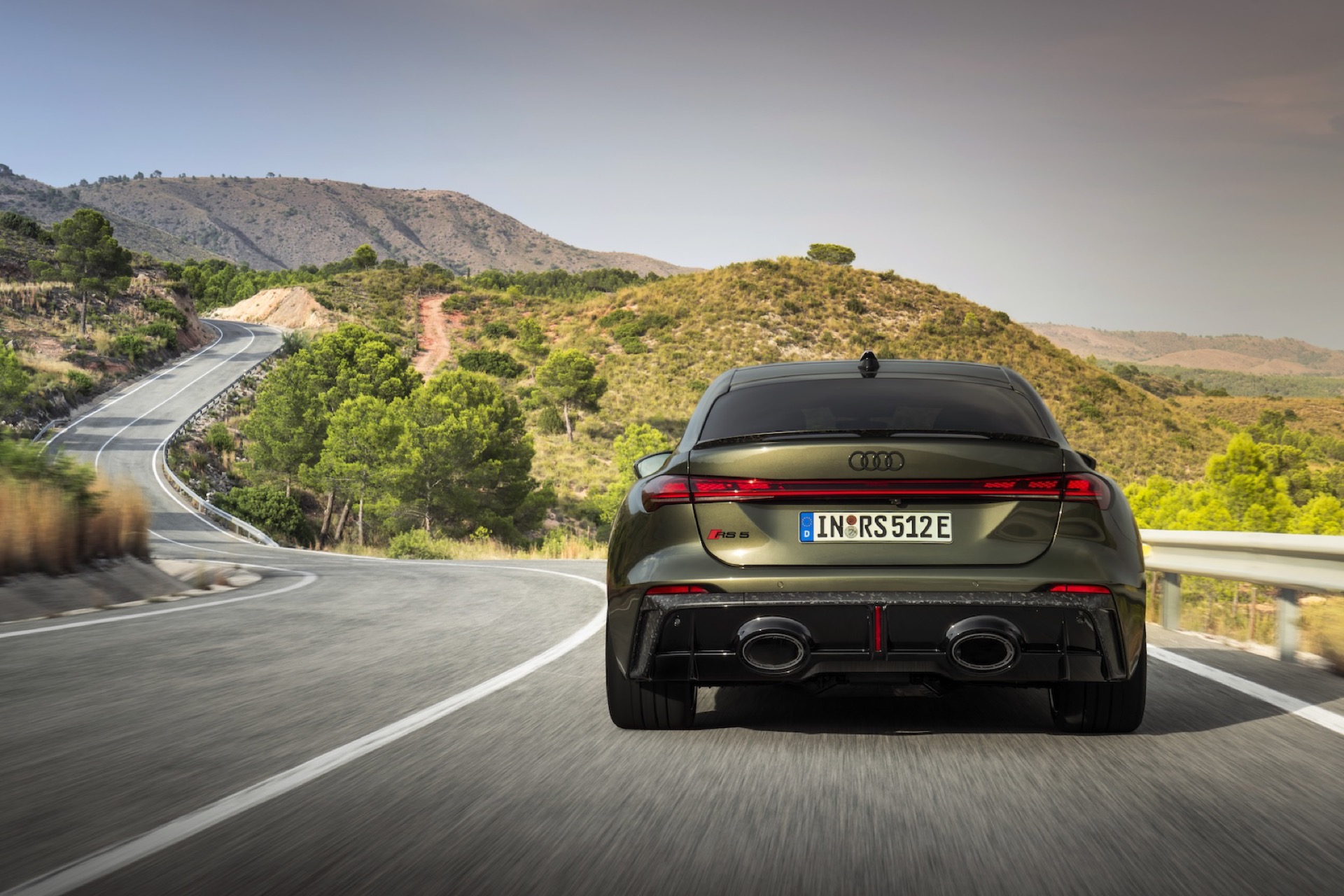
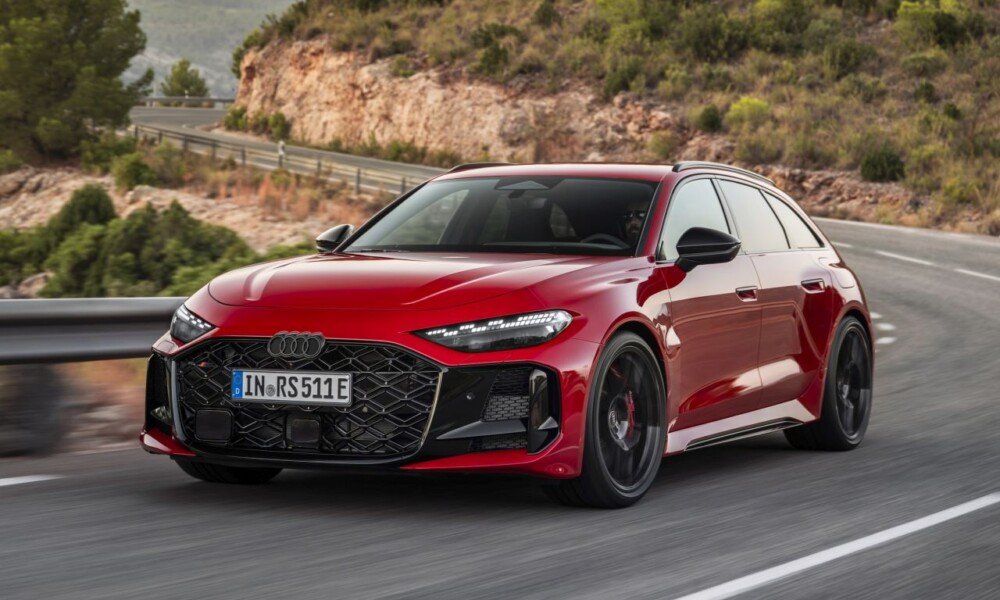
Audi is finally determined to present a credible rival to the BMW M3 and has significantly raised its game with the new RS5 generation. Alongside a far more muscular appearance, electrification boosts total output to almost 640 PS.
The current BMW M3 and M4 have left competitors scrambling. Mercedes misjudged the market with its hybrid four-cylinder C-Class AMG and is now paying a heavy price. Audi could only truly shine one class above with the formidable RS6 and RS7, as the previous RS4 and RS5 were simply too restrained to pose a serious threat to Munich’s finest. Painful for Audi Sport, especially given its long-standing dominance in the performance estate segment.
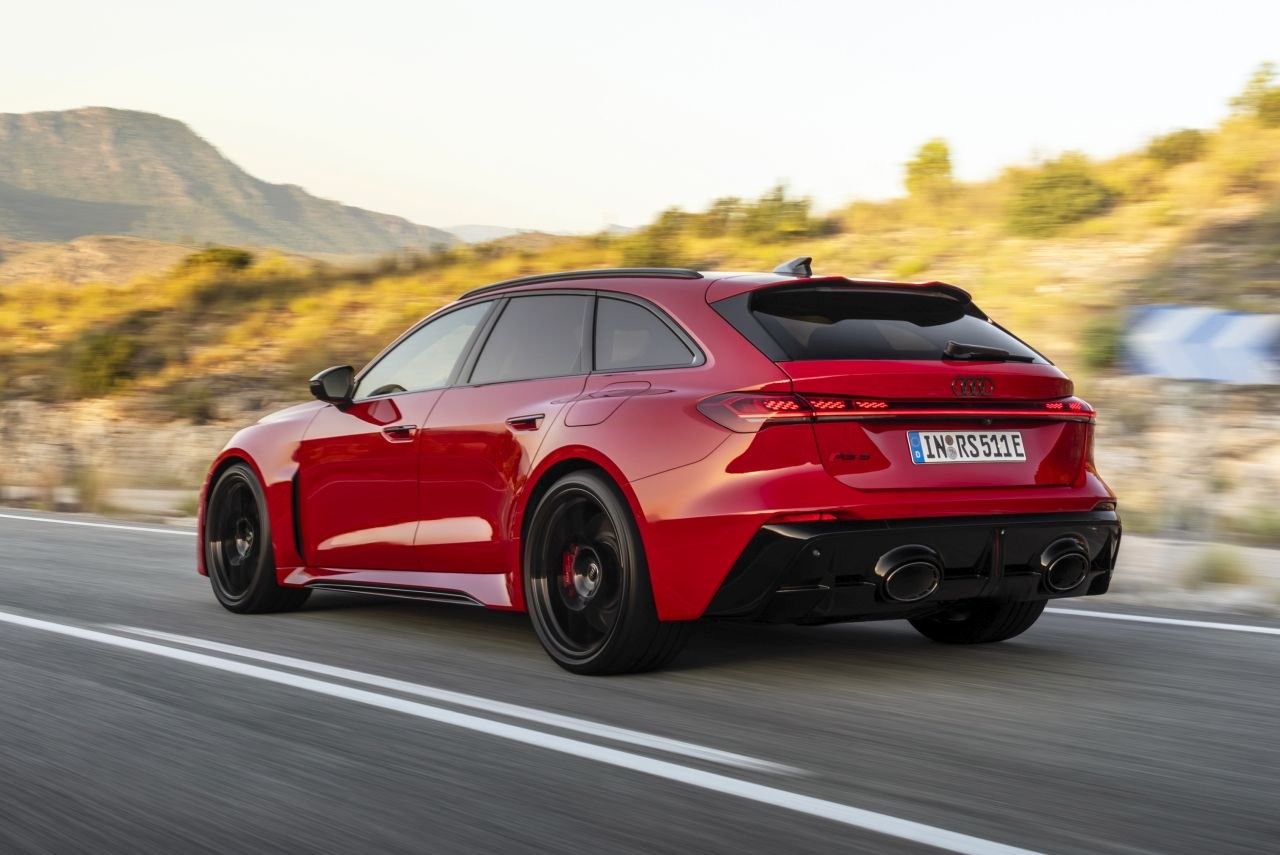
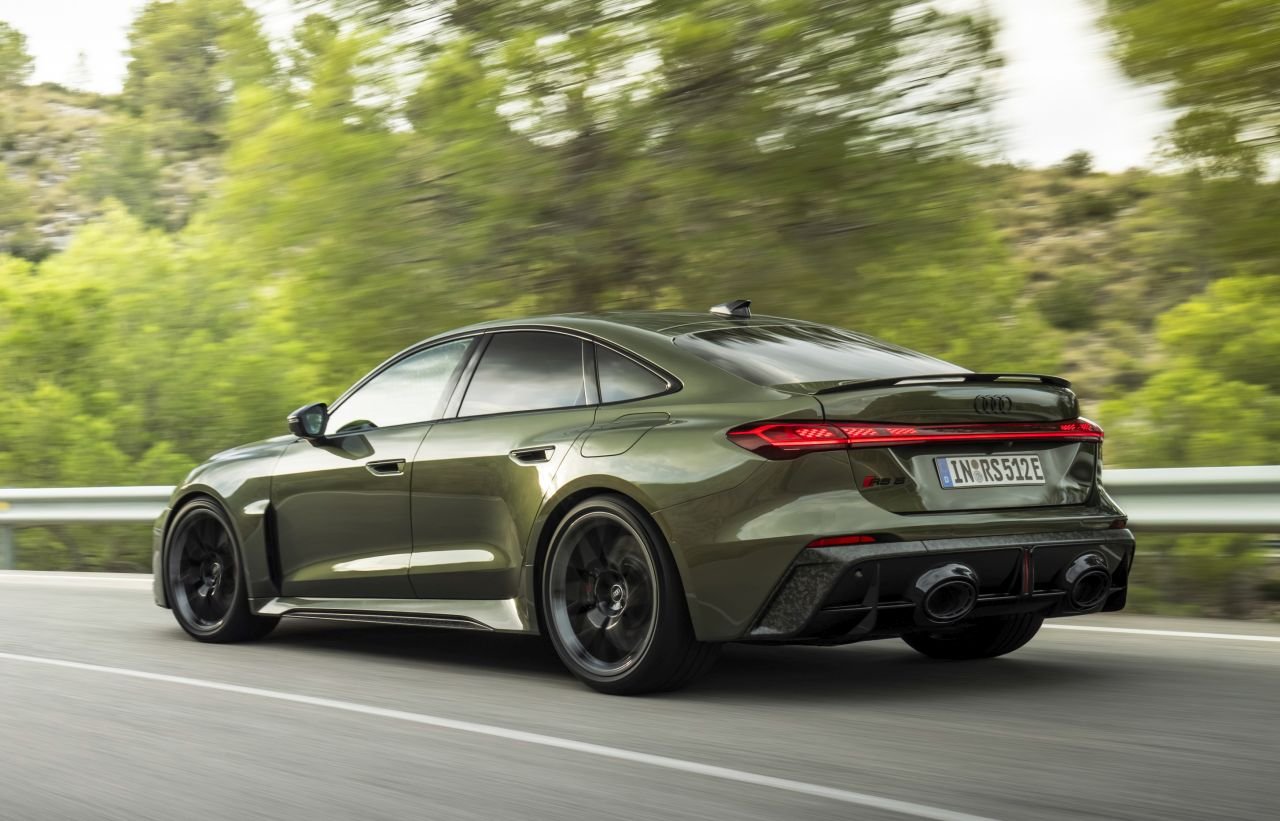
That is set to change. The new Audi RS5, available as a saloon and Avant, adopts a far more assertive design, with heavily flared wheel arches and a conspicuously bold rear apron complete with oval exhaust outlets. To avoid falling behind rivals offering up to 550 PS from BMW and 680 PS from the Mercedes-AMG C 63, Audi has not only retained its 2.9-litre V6 twin-turbo engine but added a 130 kW (177 PS) electric motor integrated into the transmission housing. The result is a combined system output of 470 kW (639 PS) and a substantial 825 Nm of torque, delivered to all four wheels.
There is one notable change. Unlike its competitors, the RS5 is now offered exclusively as a saloon or Avant. The coupé, once important for brand image and differentiation, has been discontinued, and there has been no RS convertible for several years. “The RS 5 with its innovative drivetrain concept marks the beginning of a new era for RS models,” says Rolf Michl, Managing Director of Audi Sport. “We combine the dynamic characteristics our customers value with new technologies to reach a higher level of performance, while also improving everyday usability through electric range.” Inside, the duo features RS-specific sports seats, distinctive trim details and the expected blend of performance and premium design.
Audi RS 5 Sedan
The performance figures are suitably dramatic. The sprint from zero to 100 km/h takes comfortably under four seconds, and despite a kerb weight exceeding 2.3 tonnes, the top speed reaches 285 km/h. The electronically controlled sports suspension features a wider track, 20- or 21-inch wheels and a newly developed rear differential with electromechanical torque vectoring, allowing highly variable power distribution at the rear axle. Buyers can choose between steel or ceramic brakes to rein in the considerable mass. Thanks to two-valve adaptive damping, both pitch and roll movements are reduced during spirited driving, while still offering a broad spectrum between comfort and sportiness.
The 26 kWh battery pack mounted at the rear allows the RS5 to travel up to 80 kilometres on electric power alone. Charging from an 11 kW source takes around two and a half hours. Orders are open now, with deliveries of the RS5 Saloon starting at €106,200 and the RS5 Avant at €107,200 from this summer.
America’s most famous highway turns 100 in 2026, and towns from Chicago, Illinois, to Santa Monica, California, are planning cruises, parades, rallies, museum events, and neon-lit celebrations.
For travelers in larger motorhomes, fifth-wheels, or travel trailers, exploring Route 66 is both a bucket-list dream and a logistical challenge. Much of the “Mother Road” is a two-lane patchwork of state highways, city streets, preserved alignments, and sections that have been absorbed by interstates. Most of it is manageable in a modern RV if you approach it as you would a a big-rig trip, not as a “follow every Historic 66 sign” scavenger hunt.
The safest way to do it: use interstates for the long hauls, drop onto Route 66 only for wide, easy segments, and treat tight towns as park-and-play stops, which means drop the RV elsewhere and explore in your tow vehicle or dinghy.
Why Route 66 is Tricky for Big Rigs
Route 66 isn’t a single standardized highway. It’s a collection of preserved segments, city streets, and former alignments built long before modern RV dimensions were even considered. In 2026, event traffic and temporary street closures will amplify every tight turn and parking rule.
For big rigs, the trouble usually comes from three things:
Low clearances and hard restrictions (underpasses, older structures, posted length limits)
If there’s one hazard that ends RV dreams quickly, it’s committing to a route where your RV cannot physically fit. These areas require your immediate attention.
Needles, California: K Street Underpass
Hazard: Posted 8-foot clearance underpass. Who should avoid: Every modern motorhome, fifth-wheel, travel trailer, or truck camper. This one’s not even close. What to do instead: Reroute before entering town. If navigation tries to send you across K Street, override it early and stay on a safe route.
Sitgreaves Pass / Oatman Grade, Arizona
Hazard: Posted 40-foot maximum length between Golden Valley and Oatman, plus tight switchbacks. Who should avoid: Any rig setup longer than 40 feet in length (motorhome and dinghy or tow vehicle and trailer). It can also be stressful for shorter but tall/heavy rigs. What to do instead: Use I-40 for the through-route. Unhitch in Kingman or Laughlin and visit Oatman by car.
Chicago, Illinois: Business Street Parking
Hazard: Self-contained motorhomes cannot park on business streets except while actively loading/unloading. Who should avoid: Anyone expecting to street-park downtown near Route 66 start markers. What to do instead: Treat Chicago as park-and-play. Camp at an RV park outside the heart of the city and go in by car, train, or rideshare.
St. Louis, Missouri: Chain of Rocks Bridge
Hazard: Bridge is pedestrian and bicycle only. No vehicle traffic. Who should avoid: Anyone planning to “drive” this historic segment. What to do instead: Park nearby and walk or bike it. Do not build it into your driving route.
Albuquerque, New Mexico: Street Width Restrictions
Hazard: Vehicles 90 inches or wider cannot be parked on city streets except while actively loading/unloading, and cannot be left unattended. Who should avoid: Most Class A motorhomes and some large fifth-wheels. What to do instead: Stay at an RV park and explore downtown by passenger vehicle.
Santa Monica, California: Pier Parking Limits
Hazard: Vehicles over 22 feet are directed to specific oversized parking areas (Lot 1 North). Who should avoid: Anyone assuming they can roll into general pier parking. What to do instead: Plan your Route 66 finale as a park-and-walk stop. Know exactly where oversized vehicles are routed before arrival.
Plan for Full Parks and Closed Streets
In 2026, Route 66 won’t just be a scenic historical drive. It will be a rolling series of parades, cruises, festivals, and downtown street closures.
For big rigs, the issue isn’t the crowd, it’s what crowds trigger: detours onto tight streets, blocked turns, and nowhere legal to park a 35–45-foot setup.
Plan accordingly:
Assume downtown is park-and-play. Drop the RV outside town and explore by dinghy, tow vehicle, rental car, bike, or rideshare.
Book event-weekend sites 6–12 months early. Especially near kickoff events and well-known towns.
Arrive early on parade or festival days. If you plan to park and explore, get positioned before the streets start closing.
Keep a same-day bailout campground 20–30 miles out. If traffic or closures make your original stop unrealistic, you already have a Plan B.
Lock In These Three Habits Before You Go
Before you roll onto Historic 66, lock in these three non-negotiables:
Use RV-specific routing that accounts for your exact height, weight, and total length.
Know your RV’s real numbers, with the actual height including roof accessories and the real full length including dinghy or tow vehicle. “Guessing” is how rigs meet underpasses.
Treat posted restrictions as hard limits, not suggestions. If a segment says 40 feet maximum, it means it. Do NOT push it.
Why Use RV LIFE Trip Wizard and the RV LIFE App?
Exploring Route 66 in 2026 isn’t just about mileage. It’s about avoiding known clearance traps, posted length limits, and downtown routes that don’t work for big rigs.
That’s where RV-specific routing matters.
With RV LIFE Trip Wizard, you can enter your rig’s exact height, total length (including tow vehicle, dinghy vehicle, or trailer), and weight. The system builds routes designed to avoid low clearances and other common hazards, which is especially important on a patchwork road like Historic Route 66.
It also makes the whole experience much easier. You can plan your interstate travel days, identify campgrounds 20–30 miles outside busy towns, and build in those “park-and-play” stops before you leave home.
Once your route is built, the RV LIFE app follows that same RV-safe plan on the road, so you’re not relying on a generic automotive GPS that may try to send you under an 8-foot underpass or over a restricted mountain grade.
The Bottom Line
The Route 66 Centennial is a great excuse (not that you need one) to do a classic American road trip at its peak. Big-rig RVers can absolutely enjoy it, but the best trips come from realistic expectations and smart planning.
Detour hard restrictions like Sitgreaves Pass if you are over the limit.
Bypass known clearance traps like the Needles underpass.
Treat the big cities and festival weekends as park-and-play.
Follow those guidelines, and Route 66 experience stays what it’s supposed to be: diners, neon signs, roadside oddities, and a hundred years of stories—not a daily stress test.
Share your Route 66 experiences
Do you have an interesting or frightening story or tip about traveling Route 66 in your RV? Help fellow RVers out and tell us about it in the comments.
Support CleanTechnica’s work through a Substack subscription or on Stripe.
Or support our Kickstarter campaign!
Saturday’s post about coal jobs in the US sparked a lively discussion thread, with one commenter pointing out that Trump’s own tariff policy is responsible for recent coal mine closures and layoffs in West Virginia. The law of unintended consequences is on brand for Trump, of course, but tariffs are not the only knife with which he has stabbed coal workers in the back, again.
Coal Jobs & Tariffs
Last Friday the US Supreme Court finally ruled that the bulk of Trump’s tariffs declarations are unconstitutional. The ruling is a day late and a dollar short for the millions of US consumers, businesses, and workers impacted by the chaotic seesaw of orders issuing from the White House, and that includes US coal jobs.
Trump has been focused like a thousand points of light on juicing domestic coal consumption by propping up old coal power plants, but that’s not necessarily going to save coal jobs. Mechanization and other productivity improvements have been picking off coal jobs for generations, and that will keep happening. The misbegotten tariff war adds another level of uncertainty to the picture, particularly in regards to the metallurgical coal required by the global steel industry.
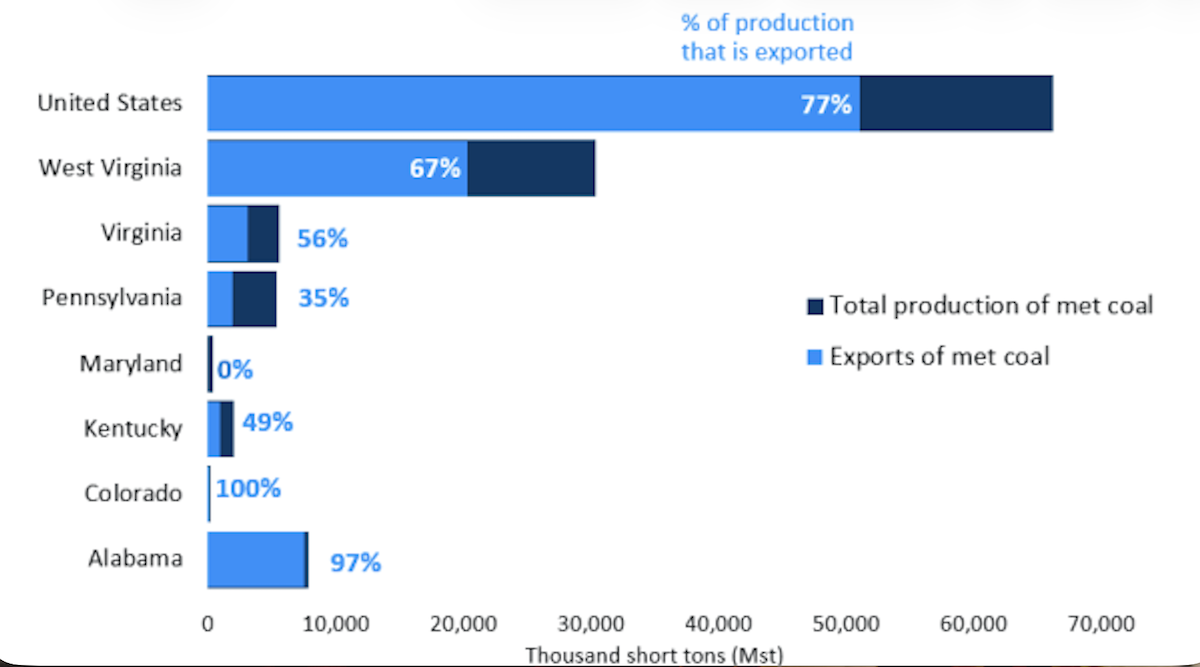
Met coal consumption in the US has been in steady decline since peaking in 1980, leading to increased dependence on markets overseas. “Consumption in 2023 was less than a quarter of consumption in 1980. Met coal produced in the United States is increasingly exported abroad,” the Congressional Research Service noted in a new report on met coal, posted on December 10, 2025.
Ruh-roh. Throw Trump’s retaliatory tariffs into the mix, and here comes trouble. As catalogued by CRS, the tariff war of February–May 2025 culminated with China imposing a cumulative tariff total of 140% on imports of met coal from the US.
The dust finally settled on May 12, when the US and China settled on a parallel tariff of 10% over the ensuing 90 days. However, US producers still got the short end of the stick. The “deal” struck by Trump enabled China to maintain a tariff rate of 25% on met coal.
Besides, the damage was already done. CSR cites an analysis by S&P Global, which indicated that US met coal exports to China dropped almost 19% in February 2025 compared to February 2024, after China imposed an initial tariff of 15%.
“Because China is the United States’ second-largest market for met coal exports behind India, sustained retaliatory tariffs on met coal could decrease demand for U.S. met coal exports and pose certain market risks to export-oriented U.S. met coal projects,” CSR advises.
West Virginia On The Ropes
Ya don’t say? In November, the US Energy Information Agency reported that US coal exports dropped 11% overall during the first half of 2025, with China accounting for 76% of the drop in met coal and 68% of the drop in the thermal coal used in power plants.
That sets a particularly grim stage for coal jobs in West Virginia, which is by far the top met coal producer in the US. As listed by CSR, in 2023, West Virginia accounted for 46% of total US met coal production, with Alabama far behind at 12% and five other states combining for the remainder.
A recent industry analysis indicates that met coal production could tick upwards this year, but that doesn’t mean a net gain for coal jobs. As described by the firm Zachs Equity Research, much of the gain is attributed to the startup of Warrior’s Blue Creek met coal mine in Alabama, along with the re-opening of two mines in West Virginia that were temporarily shuttered by fires last year.
Warrior states that its Blue Creek operation has created 300 jobs in Alabama, but that’s no comfort to West Virginia, where hundreds more coal jobs have vaporized since Trump took office in 2025. The list includes Core Natural Resource’s Itman met coal operation in Wyoming County, where the company announced 197 layoffs in June last year.
Louisville Public Media was among those noting that the Itman layoffs represented a sharp turnaround for Core.
“In its first quarter report, released on May 8, Core said the ‘long-term market dynamics for Core’s metallurgical segment remain highly promising’” LPM reported on June 7. “However, the report also acknowledged that ‘trade-related uncertainties continue to weigh on markets’ for coal.”
“President Donald Trump signed an executive order in April to boost coal production,” LPM added. “His trade policies, though, may have undermined that goal.”
Steam Coal Is Also On The Ropes
Trump’s unforced errors on international trade aside, his so-called “energy emergency” is a double edged sword for US coal jobs. Throughout the early 2000s, low-cost natural gas was the chainsaw cutting coal out of the nation’s power generation profile. More recently, a steep drop in the cost of wind and solar power has also constrained coal, but gas is still front and center in the war on coal jobs.
Take West Virginia, for example. In addition to its leading role in the global met coal industry, the state also produces steam coal for power plants, including those within its borders. In a press release dated February 17, the United Mine Workers of America pointed out that coal currently accounts for 85% of power generation in West Virginia.
That could change if a wave of new gas power plants enters the state. Pushing back against the proposals, UMWA International President Brian Sanson stated:
“Every new gas plant replaces coal generation, and that means fewer coal jobs. That’s not a theory, it’s a fact.
“You cannot claim to support coal while building competing power plants and expect workers not to pay the price.”
“These projects are sold as job creators, but the math doesn’t work,” emphasized UMWA International Secretary-Treasurer Mike Phillippi. “Gas plants operate with a skeleton crew. Coal plants and coal mines support entire local economies.”
As indicated by UMWA, gas stakeholders also have the potential to save upfront costs by piggybacking on existing coal power infrastructure, including land as well as transmission assets. If all goes according to plan, for example, the 1960s-era Fort Martin coal power plant in Monongalia County is about to get a new neighbor in the form of a 1.2 gigawatt gas power plant. The site owners, Monongahela Power and Potomac Edison, have indicated that they plan to continue operating the coal power plant at least through 2035. Though, that remains to be seen. The new gas plant is expected to come online in 2031.
Natural gas isn’t the only piggy-backer causing heartburn among coal advocates. In the waning days of the Biden administration, the US Department of Energy made the case for re-purposing coal power sites for wind, solar, and/or nuclear energy as well as energy storage. The wind and solar parts are no-goes during Trump’s remaining years in office, but keep an eye on the nation’s thirsty nuclear energy industry. Back in 2022, the Energy Department identified more than 300 operational and retired coal power plants that could host nuclear power plants, and the industry continues to enjoy the full support of the Trump administration.
Even without the looming threat of a nuclear takeover, coal jobs have nowhere to go but down. The US Energy Information Agency, for one, has indicated that last year’s upswing in domestic coal consumption was a blip. On February 10, the agency affirmed that it continues to anticipate that US power plants will use about 7% less coal this year, compared to 2025.
Photo: US coal jobs continue to decline, with Trump’s tariff war among the factors credited with mangling the all-important overseas market for domestic metallurgical coal (courtesy of Congressional Research Service).
Support CleanTechnica via Kickstarter
Sign up for CleanTechnica’s Weekly Substack for Zach and Scott’s in-depth analyses and high level summaries, sign up for our daily newsletter, and follow us on Google News!
Advertisement
Have a tip for CleanTechnica? Want to advertise? Want to suggest a guest for our CleanTech Talk podcast? Contact us here.
Sign up for our daily newsletter for 15 new cleantech stories a day. Or sign up for our weekly one on top stories of the week if daily is too frequent.
CleanTechnica uses affiliate links. See our policy here.
Motorcycle sales are flat. People don’t care anymore. Riding is just a hobby now. Back in my day…
If you’ve spent enough time around motorcyclists, you’ve probably heard some version of these laments. At the early edge of what most call middle age, I find myself in a unique spot. I am close enough to the OG riders who built many of the clubs and associations that shaped me when I was young, yet also connected to the newest wave of riders still raising a little hell on dirt and pavement. Standing between these worlds gives me a front-row seat to something important. The passion and community in motorcycling are not fading. They are changing and, in many ways, growing.
As I have evolved within my small corner of the motorcycle universe, I have learned a lot about what binds us as riders. Motorcyclists have always been misfits. Not outlaws, necessarily, just people slightly off-center while the rest of the world stays tucked inside their cars. Whether you ride year-round through whatever the sky throws at you or pick your perfect days on or off the road, you still belong to a rare group of people who truly understand a certain way of living.
For decades, clubs and meetups were the heartbeat of our community. They were where you saw new machines, met new people, and learned from riders with more experience. Then the internet arrived and rewired the entire motorcycle industry, as it did everywhere else. Honestly, it was not all bad.
The internet meant being able to hunt down vintage parts online instead of hoping a swap meet pans out, watching how-to videos, meeting riders worldwide, and discovering routes, events, and gear. These tools have made riding more accessible than ever, but rapid change can leave some feeling left behind. When the landscape shifts, it is easy to assume the culture is shrinking.
I have seen the opposite as grassroots communities form across the world. They are beginner-friendly, ego-free, and grounded in connection. If we want our long-established clubs and associations to continue thriving, this is where we should be paying attention. Not critiquing the new wave, but welcoming it, learning from it, and inviting it in.
This past year, I had the pleasure of working with two such groups: The Moto Social and Fährt. We collaborated on a series of monthly events, and what struck me was how naturally they build community. If you have ever attended a Moto Social event, you know the vibe. Riders on every kind of bike show up simply for the joy of riding somewhere new, meeting people, and sharing space with others who get it.
The crew at Fährt brings similar energy. Their events, mostly in the northeast and now expanding into the Pacific northwest, bring together road and dirt riders. They highlight small businesses, share local routes, and create pockets of community wherever they go.
What these groups are doing is not entirely new, but the way they are doing it feels refreshing and inclusive. The camaraderie forming feels genuine. It is the future of what many moto groups will become.
The spirit of riding is not fading. It is right here, growing in new corners. The people carrying it might not fit the mold of yesterday’s clubs, yet they share the same love for two wheels. All we have to do is welcome them in.
Stephen was a guest on 200 Miles Before Breakfast, the only podcast in which you get to know the MOA one member at a time. Listen to his episode now!
Seventy years ago, the first Carrera Panamericana Road Race was held and since those original races held from 1950 to 1954, fascination with the event, from fans and participants, has only grown. This year, the 35th running of La Carrera Panamericana revival race will be held from October 14 to October 20, 2022.
The race this year will start in Veracruz, make its way north towards Oaxaca, through Mexico City before passing through Quartero, Morelia, Guanajuato, San Luis Potosi, and finally culminating in Durango. Participants will cover a total of 3,610 kilometers.
The modern La Carrera Panamericana provides a host of categories that racers can enter. There is the original Panamerican Cars Group for vehicles that raced in the original Carrera from 1950 to 1954. There is also an Historic Cars category for cars built between 1955 and 1973, as well as a Classic Tour Category (1950 to 1979) and a Sport Tour Category for cars built from 2015 to 2020. Finally, there is also an Exhibition Cars category, for anything outside the other categories.
Leading up to this year’s event, Driving La Carrera has released an 8-episode documentary series titled, “To Race La Carrera”. The series brings to life what the Carrera is and provides an insider’s look at the event as a participant in what is believed by many to be the world’s last, great road race.
2016 winner Hilaire Damiron summed the Carrera up this way, “It’s the last road race in the world in which you can race seven stages of pure speed against the clock.”
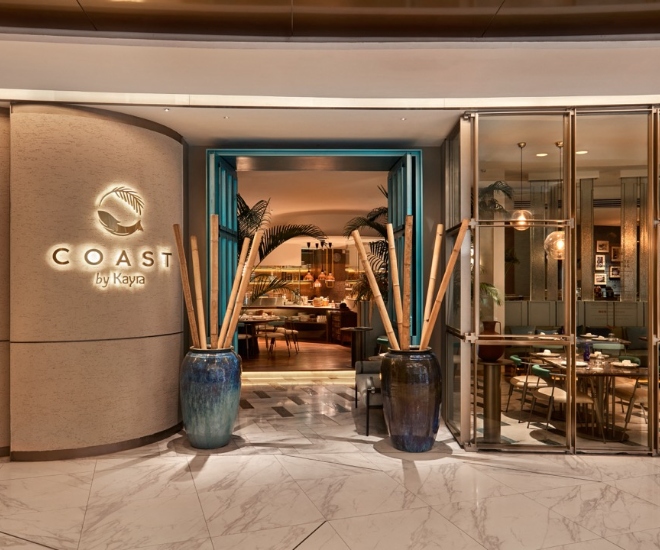
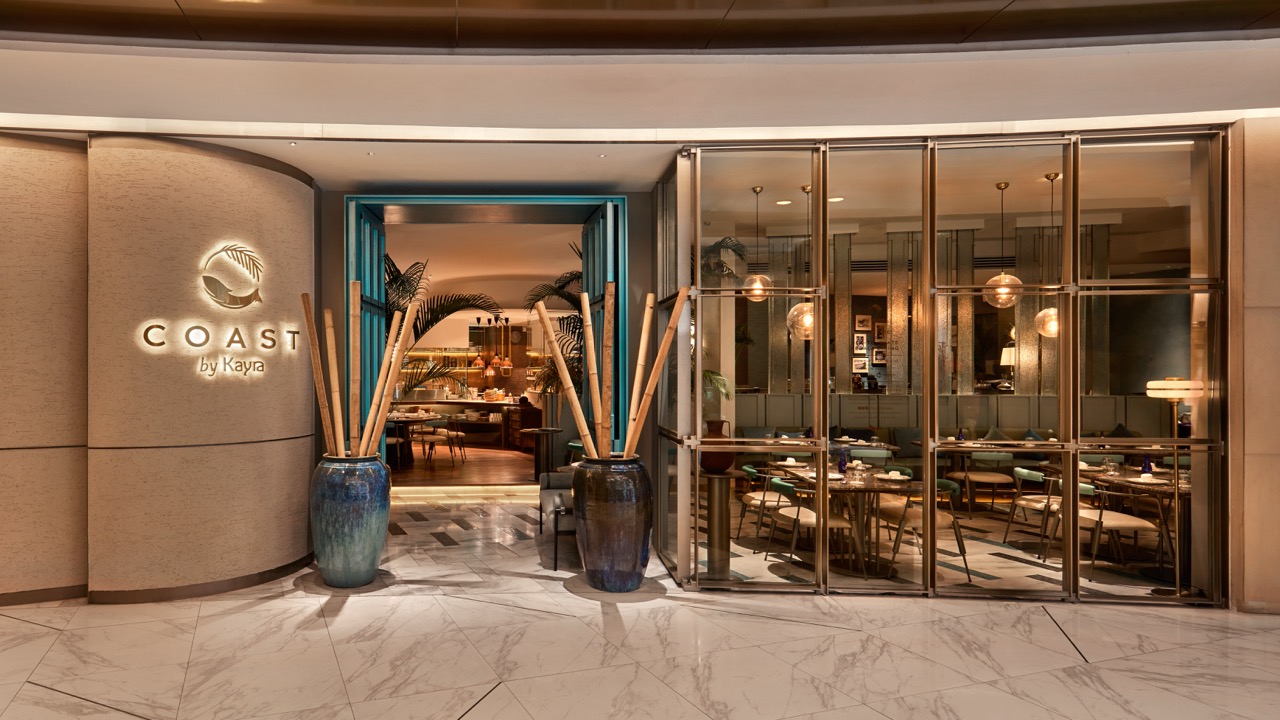
Seafood and heat are two qualities I love in my food, and Coast by Kayra in Starhill fulfils that — and so much more. Nestled in The Starhill on Bukit Bintang, the restaurant earned its Michelin Bib Gourmand status for two years running. After a team excursion there, I can understand why.
Owner Meriam Alfonso, a third-generation Keralite-Malaysian, opened Coast as a sister restaurant to the Michelin-selected Kayra. Where Kayra offers a broader Kerala experience, Coast dives headfirst into the seafood treasures of the Malabar Coast. Executive Chef Sal Sabeel sources locally from Selangor, Pahang, Perak, Kedah, and Sabah; a choice to mirror the abundance of Kerala’s shores, but with Malaysian waters.
We began our dining experience with the Lassi Chaat and Dahi Puri Shooters, which were fun and refreshing. But the Mini Appams with Sea Tiger Prawns were the ones that caught my attention. These mini appams were morsels of delight: delicate, lacy edges with soft, pillowy centres, topped with perfectly cooked prawns.
Then came the Beef Pal Kappa, a traditional Kerala comfort dish that deserves its own spotlight. The slow-cooked beef with tapioca was rich and beautifully spiced, while the accompanying tapioca base added an earthy, starchy balance to quell the spice. It’s a great Asian alternative to the Western rendition of mashed potatoes under braised beef — and it works well.
The Kerala Fish Curry and Seafood Biryani, on the other hand, both showcased the restaurant’s confidence with seafood, while the Ghee Roast Chicken was aromatic and golden. Fibre is important in any diet, and thankfully, Coast by Kayra does some pretty mean vegetables too. The Roasted Cauliflower and Local Fern Kachidi held their own. However, I do need to give a special mention to the Grape Pachadi, a sweet and tangy chutney that cut through the richness of everything else we ordered. Yoghurt and cooked grapes were not a combination I thought would go well together, but as they say, don’t knock it till you try it.
The bread service is something you absolutely cannot skip. Khameer Roti and Green Butter Herb Naan came hot, charred in all the right spots, and soft enough to mop up every last bit of curry. As with any dish that has gravy, you absolutely need some good-quality carb to pair with it.
For a team outing — or any group outing, for that matter — lunch at Coasy by Kayra worked perfectly. The menu is designed for communal dining with small plates, but they also offer Discovery tasting menus if you’re entertaining visitors or just want to sample the best of what they’ve got.
Address: Lot G03-G05, Ground Floor, The Starhill, 181, Jalan Bukit Bintang, Bukit Bintang, 55100 Kuala Lumpur
Make a reservation here.
This article was first seen on GRAZIA MY.
For more on the latest in luxury lifestyle and gastronomy reads, click here.
Fleet electrification looks simple on paper: park the vehicles, plug them in, wake up to a full battery. However, real depots are messier. Routes shift, dwell time shrinks, drivers swap vehicles, and utilities move slowly.
If the charging yard is designed without operational reality, costs show up fast in rework and downtime. Here are five costly mistakes to avoid when installing charging stations for commercial fleets.
1. Buying Hardware Before You Size the Operation
It is tempting to shop for hardware first. However, it’s advisable to start with the duty cycle instead. Map miles per day, return times and required ready time by vehicle class. Then match your power capacity, stall count and charging speed to what your routes actually demand.
If you need a starting point for planning EV chargers, think about the energy needed per shift, not just plug count. Buying fast units for vehicles that sit all night wastes capital. Buying slow units for vans that turn quickly creates bottlenecks.
Photo by Magda Ehlers on Pexels
2. Ignoring the Utility Timeline and Service Limits
Most fleet delays happen before a single charger is installed. Service upgrades, transformer capacity, interconnection reviews and permits can stretch longer than your vehicle delivery dates. If you plan as if power will be ready “soon,” you may end up paying for temporary workarounds, rushing construction or parking EVs you cannot reliably charge.
Ask early what your site can support today, what it can support with upgrades and what requires new infrastructure. Build a timeline with the utility, then back-plan construction, commissioning and driver training around it.
3. Underbuilding Conduit, Space and Future Capacity
Many fleets pilot with a handful of vehicles, then scale quickly once the numbers work. If the initial build does not include spare conduit runs, reserved panel space and room for additional stalls, expansion becomes a demolition project. This means new trenching, fresh concrete cuts and repeated downtime.
You should design the yard like it will double. Leave space for the turning radius and cable reach. Be sure to also plan for longer vehicles and for chargers that may change footprint later.
4. Skipping Load Management and Peak Demand Planning
Electric bills do not care that your fleet is going green. If vehicles plug in at the same time, your peak demand can spike and stay high. This can turn a good total cost of ownership model into a surprise.
Use managed charging to stagger sessions, prioritize critical routes and avoid demand cliffs. Make sure to align charging windows with off-peak pricing when possible. You should also monitor real usage from week one, then tune schedules as routes evolve.
5. Forgetting the Human Factors that Drive Uptime
A fleet yard is rough on hardware. People move fast, vehicles swing wide and cables get dragged, pinched and run over. If stalls are tight and lighting is weak, mistakes multiply.
Mark bays clearly, and keep parking orientation consistent. Add bollards where bump risk is real. Be sure to mount chargers where cords reach without crossing walk paths. Additionally, post simple, visible instructions, then train drivers on quick checks. Uptime improves when the setup feels effortless.
Endnote
Fleet charging succeeds when planning starts with operations. Confirm utility capacity and timelines early, and design the yard for growth with spare conduit, panel space and safe traffic flow. Use load management to control peak demand and make stations easy for drivers to use. Fewer change orders and fewer outages mean a faster payback and smoother fleet electrification for years ahead.
Maintaining your BMW properly is the key to preserving performance, safety, and long-term value. For drivers in Camp Springs, MD, and surrounding areas like Alexandria, Upper Marlboro, Waldorf, Fort Washington, Suitland-Silver Hill, Arlington, and Clinton, understanding BMW’s recommended service approach can make ownership easier and more predictable.
At Passport BMW, we’ve served Maryland drivers for decades and understand how local traffic patterns, seasonal weather, and daily driving habits affect vehicle maintenance. This guide explains how BMW’s service schedule works and how to keep your BMW performing at its best on roads like Branch Avenue, Allentown Road, and the Capital Beltway.
Why Following BMW’s Service Schedule Matters
BMW vehicles are engineered for precision and performance, but like any advanced machine, they require regular care. Following BMW’s recommended service guidance helps:
Maintain optimal engine performance and fuel efficiency
Reduce the risk of unexpected repairs
Protect long-term reliability and resale value
Ensure safety systems operate as designed
Local factors such as frequent stop-and-go traffic, summer heat, humidity, and seasonal pollen can place additional demands on filters, fluids, and braking components. Staying current with service helps your BMW adapt to these conditions while delivering the smooth driving experience you expect.
How BMW’s Condition Based Service (CBS) System Works
Modern BMW vehicles use Condition Based Service (CBS) instead of fixed maintenance intervals. Rather than relying on a generic mileage schedule, CBS continuously monitors the condition of key components using sensors, driving data, and onboard diagnostics.
The system evaluates factors such as:
Engine operating conditions
Brake wear
Time-based fluid intervals
Driving style and usage patterns
When service is needed, alerts appear in the instrument cluster and iDrive display. Drivers can check service status anytime through the Vehicle Status or Service Requirements menu, allowing for proactive planning rather than guesswork.
This adaptive approach is especially valuable for drivers in the D.C. metro area, where traffic congestion and short trips can influence service timing.
Understanding BMW Service Notifications
Primary Service Reminder
The primary service reminder is a general alert indicating that maintenance is due or approaching. It signals that one or more service items require attention.
Detailed Service Indicators
By accessing the iDrive menu, drivers can view exactly which services are needed, such as:
Engine oil service
Brake fluid service
Vehicle check inspection
Brake pad replacement
Each item displays an estimated remaining time or mileage, helping you schedule service conveniently.
Common BMW Maintenance Items Explained
While CBS determines exact timing, BMW regularly monitors the following components:
Engine Oil Service
BMW recommends oil and filter service approximately every 10,000 miles or 12 months, as determined by CBS. Driving conditions such as frequent short trips or heavy traffic may prompt earlier service alerts.
Brake Fluid
Brake fluid is a time-based service and is required every two years, regardless of mileage. This ensures consistent braking performance and system reliability.
Engine and Cabin Air Filters
BMW inspects air filters during scheduled service visits and vehicle checks. Replacement timing depends on driving conditions and filter condition, especially in areas with high pollen or construction dust.
Spark Plugs
Spark plug replacement intervals vary by engine and driving conditions and are determined by BMW service guidance and CBS data to maintain proper combustion and efficiency.
Vehicle Check
A Vehicle Check is a comprehensive inspection of major systems, including suspension, steering, brakes, fluids, and underbody components. This inspection helps identify wear early and supports long-term reliability.
What to Expect Over the Life of Your BMW
Early Ownership
During the early years of ownership, service primarily focuses on oil service, inspections, and time-based items such as brake fluid.
Mid-Ownership
As mileage accumulates, CBS may indicate additional items such as brake service, filter replacement, or component inspections depending on driving habits and wear patterns.
Long-Term Ownership
For higher-mileage BMWs, service visits place greater emphasis on inspections of cooling components, belts, suspension parts, and drivetrain systems to support long-term durability.
BMW engines use timing chains, not timing belts, which are designed to last the life of the engine when proper oil maintenance is followed.
Why Local BMW Service Expertise Matters
Servicing your BMW at a dealership familiar with local driving conditions offers added benefits. Maryland’s humidity, summer heat, and congested traffic patterns can influence wear differently than highway-only driving.
A local BMW service team understands:
How traffic patterns affect braking systems
Seasonal impacts on air filtration and climate control
Regional wear trends on suspension and tires
This insight helps ensure your BMW receives care tailored to how and where you drive.
Frequently Asked Questions
How often should I service my BMW?
BMW vehicles use Condition Based Service, which alerts you when service is required based on real driving conditions rather than fixed intervals.
Does my BMW have a timing belt?
No. Modern BMW engines use timing chains, which do not require scheduled replacement with proper maintenance.
How often does brake fluid need to be replaced?
BMW requires brake fluid replacement every two years, regardless of mileage.
Are all-season tires suitable for Maryland driving?
Yes. Quality all-season tires are well-suited for rain and light winter conditions common in the region.
How can I check my BMW’s service status?
Service requirements are displayed in the instrument cluster and iDrive system under Vehicle Status.
About Passport BMW
Since 1991, our family-owned team at Passport BMW has been dedicated to serving our community with a superior car-buying experience. Our commitment to excellence has earned us the prestigious Center of Excellence Award multiple times, highlighting our expertise in all things BMW. We offer unique benefits like no-haggle pricing, home delivery, and mobile service vans to make your life easier. As experts, we provide detailed information and a transparent process so you can feel confident in your decisions. Trust our award-winning team to deliver the quality and care you deserve for your automotive needs.
Related Articles:
A DC Driver’s Guide to Choosing the Right BMW Dealership
Mastering DC Area Driving: Why Certified BMW Service Matters
Posted in
Uncategorized |
Comments Off on BMW Recommended Service Schedule Explained
Audi has finally revealed the new RS5. It comes in both wagon/estate and sedan body styles, blending sportiness with everyday comfort and practicality.
The new Audi RS5 promises motorsport levels of performance from its improved 2.9-liter twin-turbo V6 engine. It is paired with a 174 hp electric motor integrated into the hybridized 8-speed automatic gearbox, for a combined output of 630 hp and 609 lb-ft of torque.
The internal combustion engine alone delivers 503 hp, almost 60 hp more than before. The engine uses a modified Miller cycle that offers significant advantages under partial load. It is equipped with two variable-geometry turbochargers. The various modifications have not only boosted performance but also improved the fuel efficiency by 20% under high loads.
The plug-in hybrid system includes a 25.9 kWh battery pack that gives the RS5 an all-electric range of up to 54 miles.
In terms of performance, Audi claims, the new RS5 can accelerate from 0-62 mph in just 3.6 seconds, thanks to the Quattro all-wheel-drive system with Dynamic Torque Control.
The Audi RS5 comes with RS-specific front and rear axles, sport suspension and RS-tuned steering. The car rides on 20-inch and 21-inch wheels in the front and rear, respectively and comes with optional ceramic brakes.
The car looks sporty and muscular. It features the Singleframe grille flanked by pixel LED headlamps and massive vents on the front bumper. In the rear, the RS5 gets an aggressive rear diffuser with twin oval exhausts, sleek pixel LED DRLs and slim taillights connected by a light bar.
Inside, you get a massive central touchscreen, a digital cockpit and body-hugging bucket seats with RS logos. It has a sporty steering wheel wrapped in Alcantara with a red button marked ‘Boost’.
COMBINING ADVENTURE AND LUXURY, toy haulers with side patios offer the perfect combination of versatile utility and outdoor comfort. While rare, there are perhaps no better towable campers for hauling motorized toys and enjoying outdoor living at your destinations. This article unpacks our picks for the best toy haulers with side patios.
Key Takeaways
Dual-Zone Functionality: Unlike standard toy haulers that use the rear ramp as the sole patio, side-patio models offer a dedicated outdoor living space accessible from the main cabin. This allows you to keep the rear ramp clear for loading and unloading without disturbing your relaxation area.
The 13-Foot Benchmark: For those planning to haul side-by-sides, garage length is the critical metric. Most premier models in this category feature garages between 13′ and 14.5′, ensuring enough clearance and cargo capacity for modern motorized gear.
Residential Luxury in the Wild: These units are far more than just “trailers with garages.” They represent the high end of the fifth wheel market, featuring “at-home” amenities like king-sized beds, solid surface kitchen islands, washer/dryer hookups, and even outdoor entertainment centers with dedicated grills and TVs.
What Is A Toy Hauler with a Side Patio?
Image by Forest River
Toy haulers with side patios are typically fifth wheels, although rare travel trailer models do exist. They generally feature spacious garages with heavy-duty tie-downs for storing ATVs, dirt bikes, side-by-sides, and other outdoor toys. Combine this with a spacious side patio for relaxing and unwinding, and you’ll have the perfect family adventure camper.
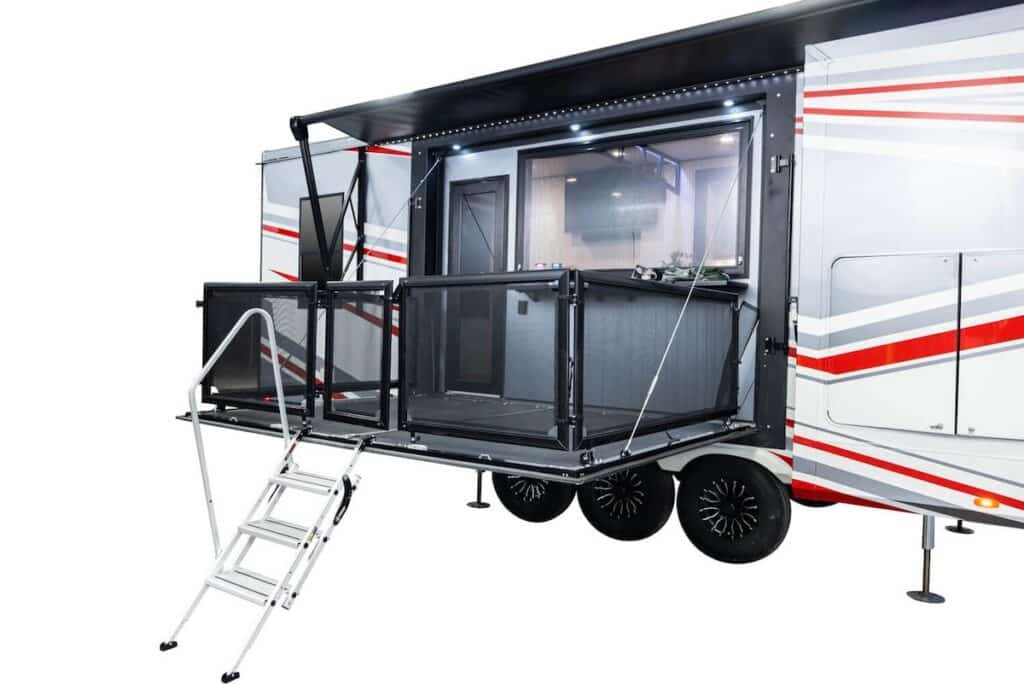
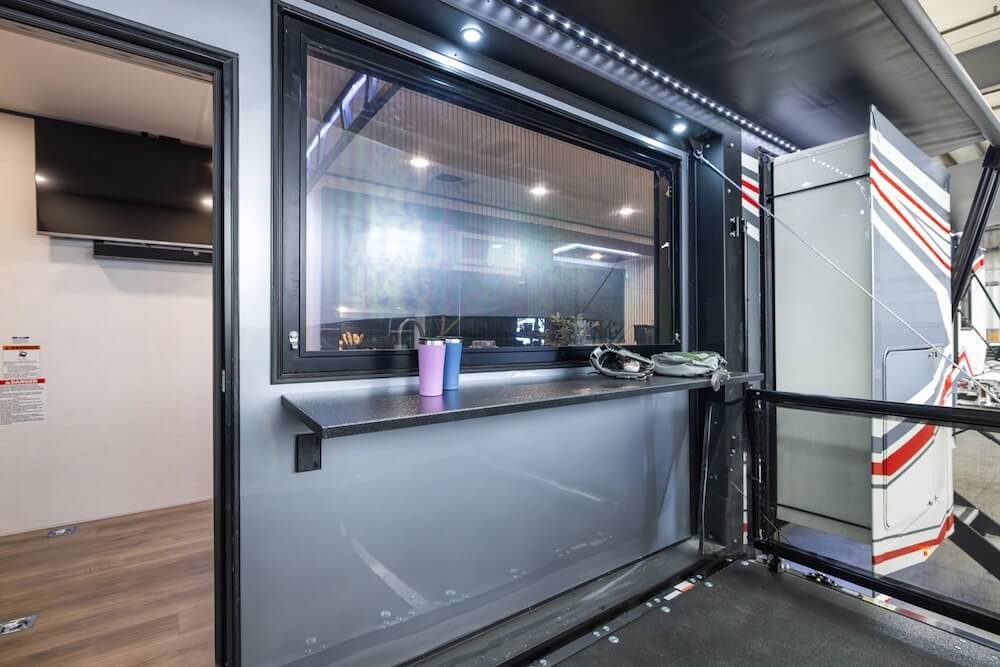
RV side patios fold out from one side and are typically equipped with an awning and railings. Some even have a mini outdoor kitchen. This extra outdoor space gives you a built-in, elevated spot to entertain and relax while enjoying nature.
While modern toy haulers typically include a rear ramp door that converts to a patio, a toy hauler with a side patio expands the outdoor living space accessible right from your RV’s main living area. Plus, it allows you to enjoy an outdoor deck while retaining the rear door as a ramp to bring toys in and out.
Top Toy Haulers with Side Patios
Are you intrigued by this rare feature on fifth wheel or travel trailer toy haulers? Enjoy our favorite toy hauler RVs with side patios.
Jayco Seismic 413
Images by Camping World
Specs
Length: 47′
Pin Weight: 3,470 pounds
Dry Weight: 15,985 pounds
Cargo Capacity: 4,815 pounds
Garage Length: 14’
Sleeps: Up to 6
The Seismic 413 stands out as a luxury toy hauler designed for RVers who want space and style. One of this year’s biggest highlights is the 14-foot garage, offering ample room for larger toys while still leaving space to spare for gear and storage.
Step outside, and the 78” x 108” side patio deck quickly becomes the go-to hangout spot, complete with an exterior TV and speakers, LED accent lighting for evening use, and a powered awning that makes outdoor living comfortable all day long.
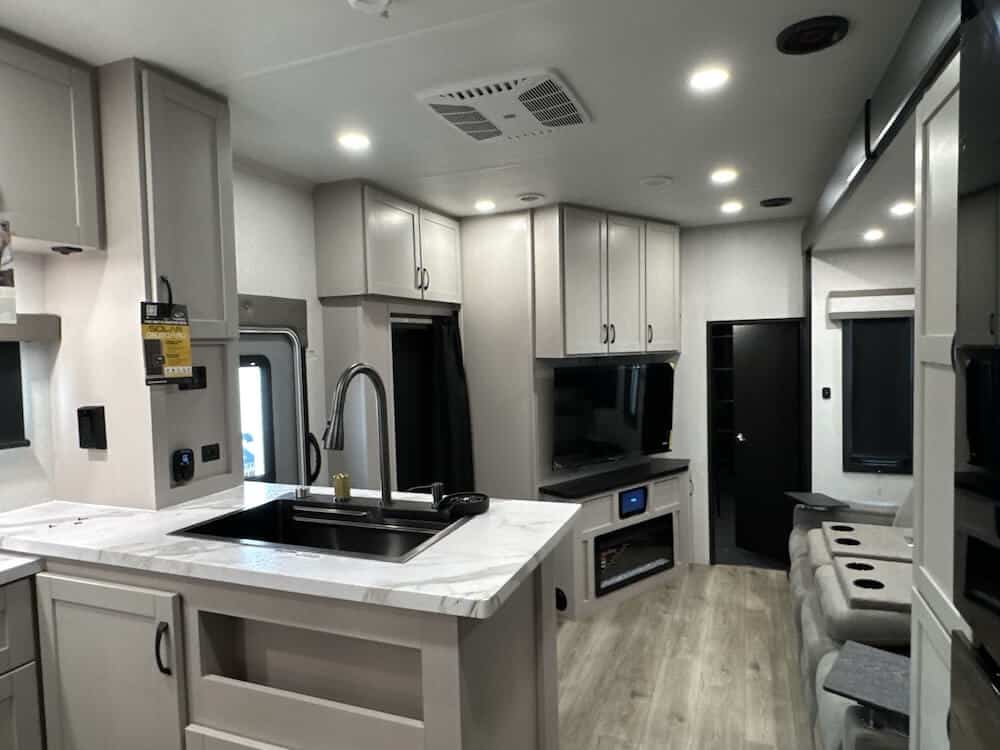
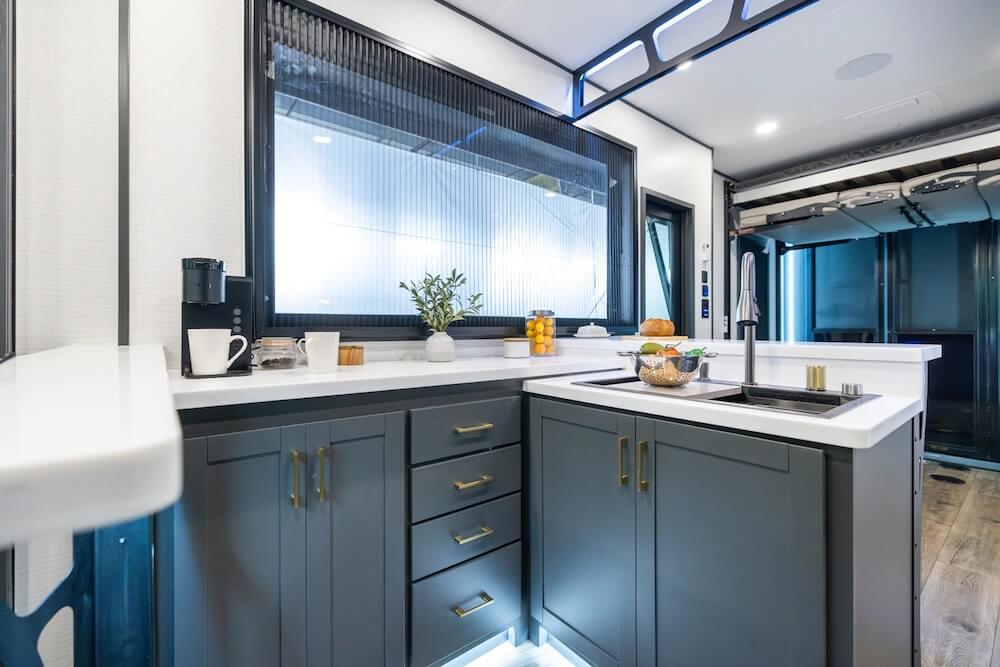
Inside, this Seismic toy hauler delivers a more residential feel than you’d expect. The kitchen is finished with solid surface countertops, stainless steel appliances, and a roomy pantry that supports longer trips off the grid or at the campground. Across from it, a reclining sofa creates a cozy place to unwind, making the living area ideal for relaxing after a day of riding, exploring, or entertaining friends.
The primary bedroom offers a true retreat with a 72” x 80” king bed and a walk-in shower, while the garage loft adds extra sleeping space above. Below the loft, washer and dryer hookups make extended stays easy and convenient. With Jayco’s Climate Shield™ weather protection package, this fifth wheel toy hauler is built to stay comfortable in changing conditions, so you can enjoy every season without compromise.
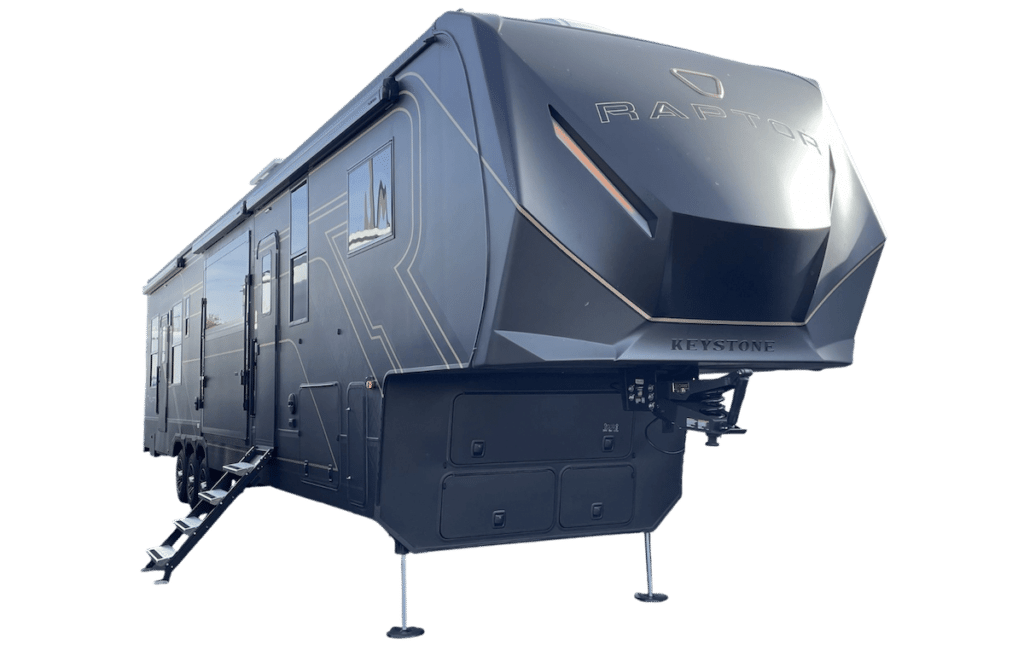
Keystone Raptor 444
Image by Camping World
Specs
Length: 46’1″
Pin Weight: 3,850 pounds
Dry Weight: 17,436 pounds
Cargo Capacity: 3,564 pounds
Garage Length: 13’6”
Sleeps: Up to 7
Built for travelers who want high-energy adventure without giving up everyday comfort, the Raptor 444 delivers a bold take on the side patio toy hauler. One of its standout features is the sliding glass door leading to the bi-fold side patio. Out here, you’ll find sturdy cable railings, a half-glass wall, an awning for shade, and exterior speakers—making it an easy transition from ride time to downtime.
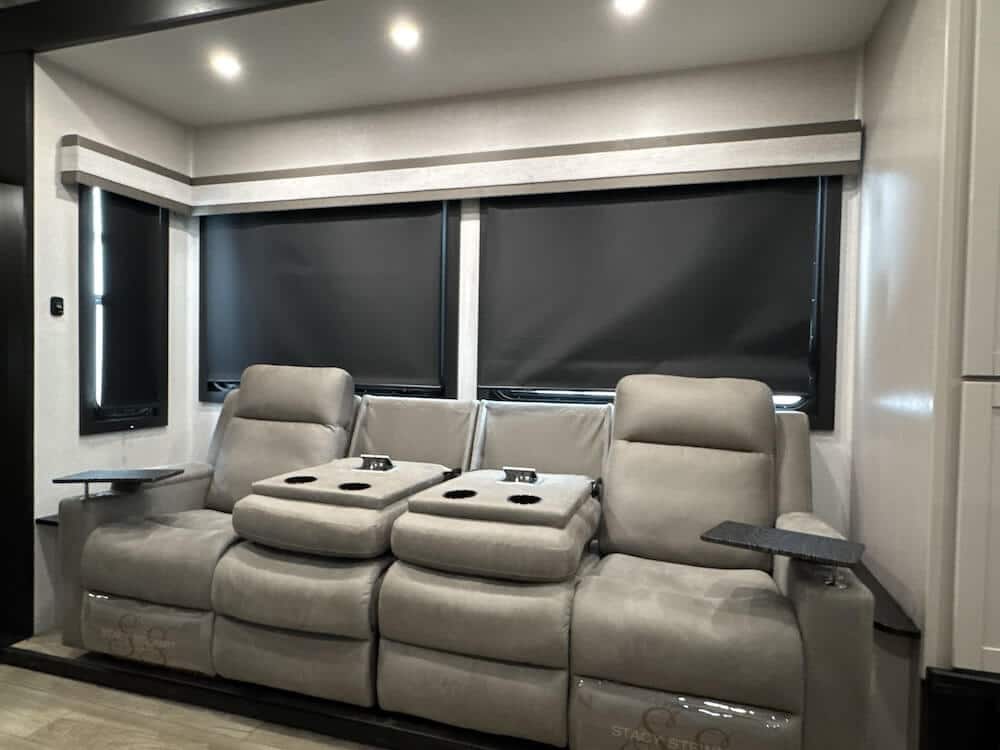
Step inside, and the Raptor 444 leans into a residential feel that sets it apart from more utilitarian toy haulers. The kitchen offers a large refrigerator, a convection microwave, and ample counterspace, providing plenty of usable prep space. Nearby, the living area features an L-shaped couch, a Smart TV, and a fireplace, creating a comfortable spot to relax after a full day outdoors.
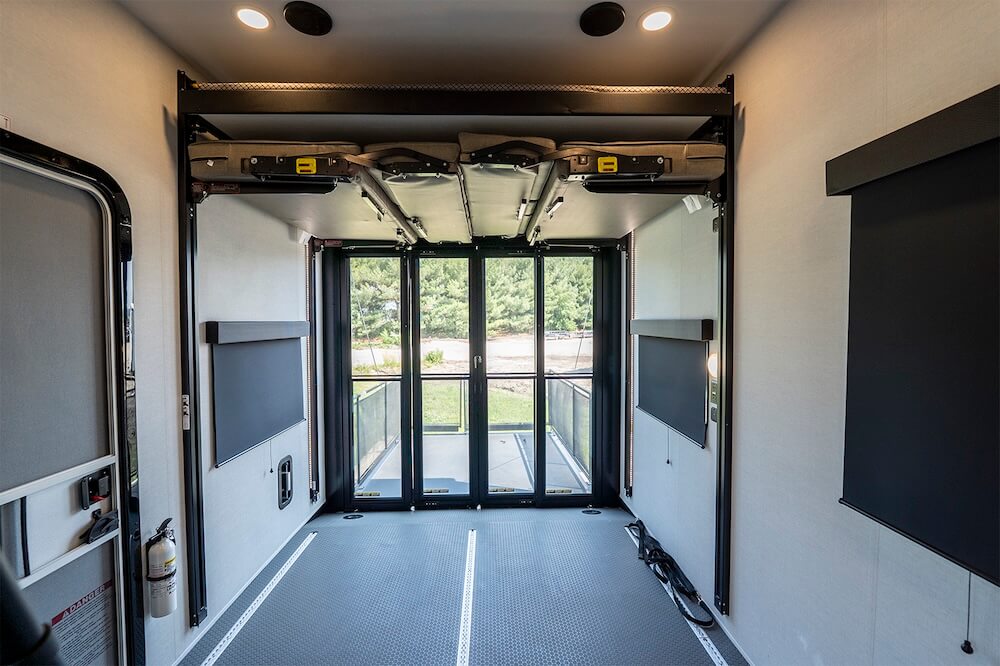
In back, the 13’6″ garage is designed for flexibility. Dual opposing sofas and a power-lift bed maximize cargo capacity and sleeping space, adapting easily to your travel needs. Two 30-gallon fuel tanks keep your toys ready for action, making the Raptor 444 a side patio fifth wheel that’s equally prepared for comfort and adventure.
Grand Design Momentum M-Class 399M
Image by Grand Design
Specs
Length: 44’10”
Pin Weight: 3,406 pounds
Dry Weight: 19,170 pounds
Cargo Capacity: 4,330 pounds
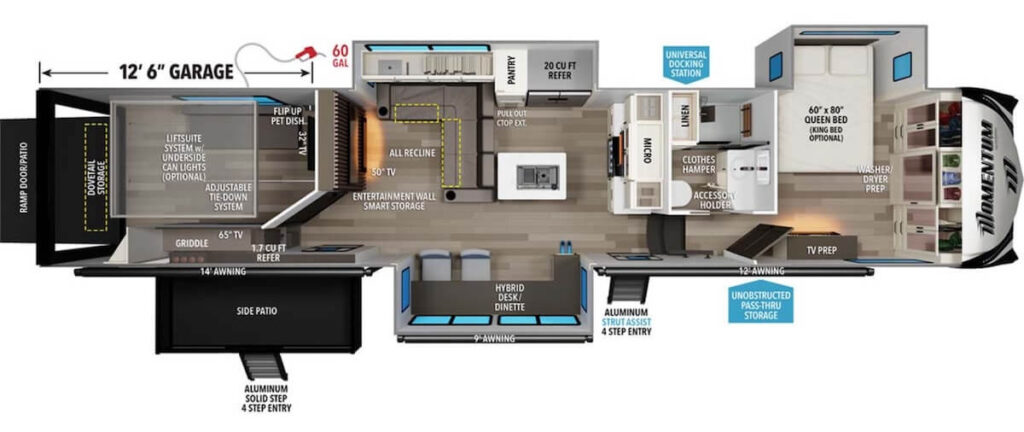
Garage Length: 12’6”
Sleeps: Up to 5
The Momentum M-Class 399M toy hauler combines luxury comfort with functional outdoor living. Its standard side patio creates a dedicated space to relax or entertain, complete with secure railings, a mounted TV, and an exterior grill, making it easy to cook and unwind without heading back inside. An awning provides shade, turning the side patio into an extension of the living space from morning through evening.
Inside, the upscale design showcases what Grand Design toy haulers are known for. The kitchen features residential-style appliances, generous counterspace, and thoughtful storage that supports longer stays. The open living area offers a comfortable place to kick back after a day of riding or exploring, making it easy to transition from outdoor adventure to indoor relaxation.
At the rear, the 12’6” garage delivers the versatility owners expect, with enough room for a variety of powersports equipment while still converting into additional living or sleeping space when parked.
With a 4,330-pound cargo capacity, this fifth wheel toy hauler is built to handle gear-heavy trips while maintaining a refined, residential feel—perfect for RVers who want premium, patio-centric features inside and out.
Axiom Vendetta V4250SP
Image by Axiom RV
Specs
Length: 47’2″
Pin Weight: 3,775 pounds
Dry Weight: 21,885 pounds
Cargo Capacity: 5,115 pounds
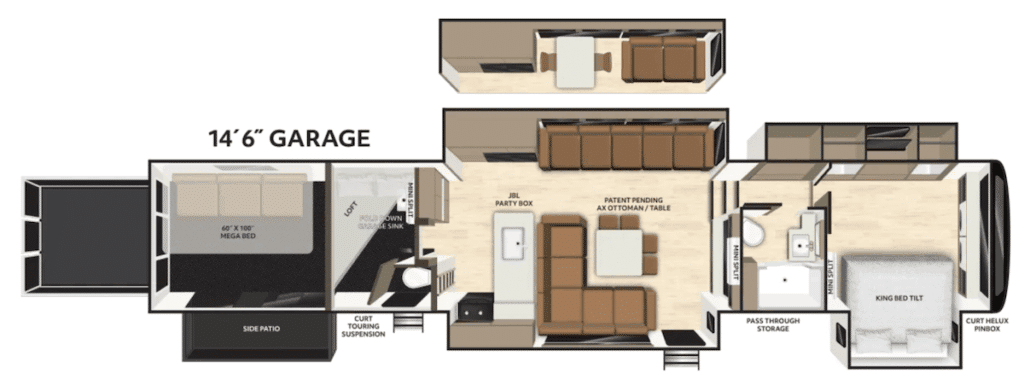
Garage Length: 14’6′
Sleeps: Up to 12
The Vendetta V4250SP redefines what a luxury side patio toy hauler can be, pairing expansive living spaces with refined design details. Its side patio creates an elevated outdoor lounge, complete with secure railings and space for a TV and a grilling setup, making it an ideal space for entertaining, relaxing, or enjoying the view at camp.
Inside, the Vendetta emphasizes a residential feel with multiple slide-outs that open the living area for maximum comfort. Plush seating and a thoughtfully arranged layout make the interior feel inviting and open, while the kitchen anchors the space with an island-style design, solid surface countertops, premium appliances, and generous storage suited for extended trips.
At the rear, the 14’6” garage offers impressive flexibility, easily converting from cargo space into additional living or sleeping quarters. With a substantial 5,115-pound cargo capacity, this 5th wheel toy hauler is designed to accommodate larger toys or additional gear without sacrificing comfort. A private front bedroom and upscale finishes throughout complete a layout that blends practicality with luxury, making this Vendetta camper with a side patio stand out for RVers who want premium features indoors and out.
Explore the availability of the Vendetta V4250 without a side patio.
Alliance Valor 42V14
Images by Alliance RV
Specs
Length: 44’11”
Pin Weight: 3,151 pounds
Dry Weight: 15,989 pounds
Cargo Capacity: 5,011 pounds
Garage Length: 14′
Sleeps: Up to 7
The Valor 42V14 delivers a blend of adventure-ready capability and comfortable living that makes it a standout option among side patio toy haulers. Its fold-down side patio provides a great outdoor hangout space with seating and relaxation after a day on the trails, making it easy to enjoy the fresh air without sacrificing convenience.
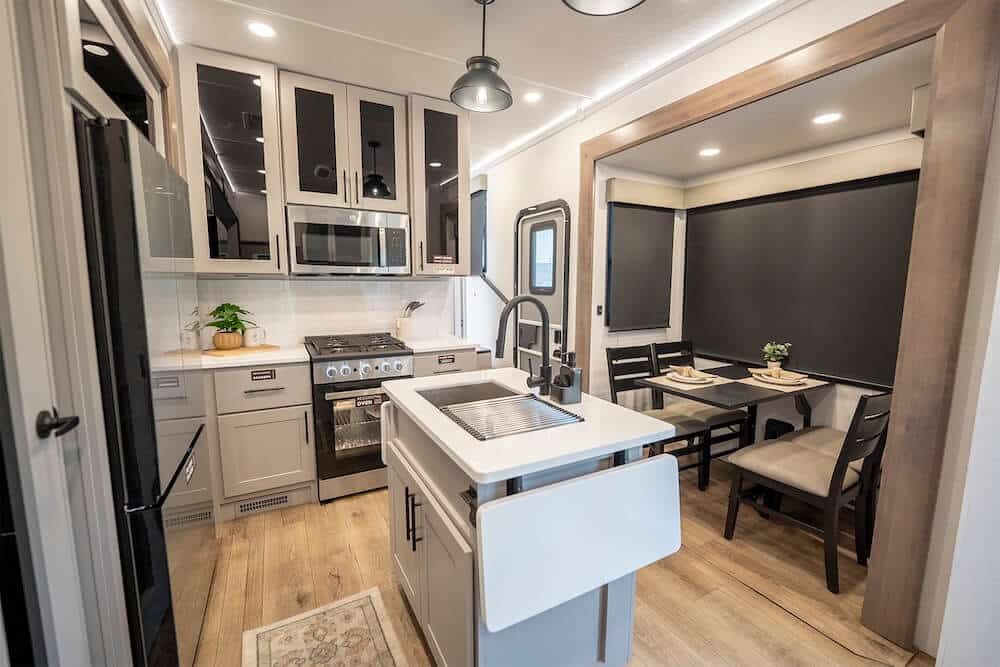
Inside, this toy hauler 5th wheel balances functional design with comfortable touches you’ll appreciate on extended camping trips. The living area features a cozy fireplace and plenty of seating, while the kitchen includes a handy island with flip-up counter extensions, a four-burner cooktop, and solid surface countertops — perfect for cooking meals after a full day outdoors.
Up front, the private bedroom offers a king bed slide for extra room and comfort, and the dual-entry bathroom includes a large shower. In the rear, the 14-foot garage provides flexible space for gear or toys, with opposing HappiJac™ sofas and a drop-down queen bed, expanding your sleeping options and making the area feel as livable as it is versatile.
With a strong 5,011-pound cargo capacity and thoughtful features like USB charging stations and commercial-grade vinyl flooring, the Valor proves that a side patio toy hauler can support rugged weekends and family camping adventures—all while keeping comfort front and center.
Forest River XLR Nitro 40BAR13
Images by Forest River
Specs
Length: 45’6”
Pin Weight: 3,480 pounds
Dry Weight: 16,949 pounds
Cargo Capacity: 4,051 pounds
Garage Length: 13’
Sleeps: Up to 7
The XLR Nitro 40BAR13 offers a perfect blend of adventurous capability and comfortable living, making it an eye-catching mid-range toy hauler with a side patio. A generous 10-foot side patio deck provides a built-in outdoor hangout space for morning coffee, afternoon game-watching, or evening cookouts. Dual TVs keep the patio party going outside as easily as inside.
Inside, this Nitro toy hauler balances rugged versatility with thoughtful design touches. The main living area features cozy seating and panoramic views, while the kitchen offers residential-style amenities and ample prep space for meals on the road. A hidden pantry behind the living room TV adds clever storage for snacks and gear.
At the rear, the 13-foot garage is ready for your favorite powersports toys or outdoor gear, and easily converts into additional sleeping or lounge space once parked. With a solid cargo capacity of around 4,050 pounds, this toy hauler can handle big bikes, ATVs, or other adventure equipment without breaking a sweat.
The front bedroom offers a comfortable 66” x 80” king bed, plenty of storage, and full-bath amenities, making it easy to freshen up after a long day outdoors. With its combination of practical features and well-designed living spaces — topped off by that entertaining side patio — the XLR Nitro 40BAR13 strikes a great balance between capability and comfort for families and thrill-seekers alike.
What Toy Haulers Have Two Patios?
Toy haulers with two patios are relatively rare. However, each rare toy hauler mentioned above features two patios. Here are a few other noteworthy models to compare:
Can a Toy Hauler Carry a Side-by-Side?
Many toy hauler fifth wheels can accommodate a side-by-side. A garage length of at least 13 feet is usually required for a standard side-by-side. Always check the garage dimensions and weight ratings to ensure your vehicle fits and your trailer and tow vehicle can safely handle the extra weight.
Whether you’re looking for adventure, luxury, or a little bit of both, these toy haulers with side patios offer the best of both worlds. These toy haulers with a side patio deck maximize outdoor enjoyment by offering extra square footage that flows into nature. Here are some additional resources:
How would you use a toy hauler with a side patio? Drop a comment below. We’d love to hear about it!
Josh has lived and breathed RVing since 2016. Launching out in a vintage Airstream, he spent 4 years trekking ’round the country in search of the greatest spaces and places in the U.S. He’s since settled a bit and has spent the past few years running a glampground in NW Montana (right by Glacier National Park). His Montana property features 5 vintage Airstreams, cabins, a tiny home, and more for guests to experience upscale outdoor accommodations. In his spare time, you might find him on Flathead Lake, troubleshooting an Airstream upgrade, or basking in other beauties of Montana.