10.9 C
London
Thursday, May 14, 2026
Home Blog Page 40

2026 Dinghy Towing Guide: An RV LIFE Exclusive

0
2026 Dinghy Towing Guide: An RV LIFE Exclusive


What Is Dinghy Towing?

Dinghy towing, also called flat towing, allows you to tow a secondary vehicle (or “toad”) behind your motorhome with all four wheels on the ground. It’s a favorite among RVers because it’s quick to set up, easy to disconnect, and makes running errands or sightseeing much simpler once you’ve parked your rig and set up at the campsite.

Not every vehicle is suited for dinghy towing. Always consult the owner’s manual before towing. If the manufacturer does not explicitly approve a vehicle for flat towing, using it can result in serious drivetrain damage that may not be covered under warranty.

With the right setup, dinghy towing is one of the most convenient ways to enhance your travel experience.

Why Dinghy Towing is Often the Best Choice

There are three main ways to tow a vehicle behind your RV:

  • Trailer towing, where the entire vehicle rides on a trailer
  • Dolly towing, which lifts the front two wheels off the ground
  • Dinghy towing, where all four wheels stay on the road

Many RVers prefer dinghy towing because:

  • It requires less equipment (after initial setup)
  • It’s faster to connect and disconnect
  • It takes up less storage space at your destination

Once upon a time I had a Class C that was too small to pull a dinghy. It [stunk]. Now, I take my toad every time I hit the road. My [motorhome] gets maybe 7 mpg and my [dinghy vehicle] gets 34 mpg. It pays for itself in local trips. It also allows each of us to do our own thing. I can go golfing while the wife enjoys hanging out at the camp. She can go to a craft store while I go fishing. Having a toad give us flexibility. — Lt Keefer on THOR Forums

Confirm Your Motorhome’s Towing Capacity and GCWR

Before towing anything, check your motorhome’s tow rating. You can usually find this information in the RV’s owner’s manual or on a sticker located near the driver’s seat or inside a cabinet. You also must check the motorhome’s gross combination weight rating (gcwr). The gcwr is the maximum weight the RV can safely manage, including cargo, fluids, passengers, etc., plus the weight of the dinghy vehicle and its contents.

Considerations for your motorhome’s towing capacity must include:

  • The weight of the towed vehicle
  • Any cargo inside that vehicle
  • Weight from added accessories like auxiliary braking systems

Part of your search for your Class C and TOAD must include the rig’s towing capacity and the TOAD’s weight, especially if you plan on using the TOAD to carry more stuff. — OMMM4747 on iRV2 Forums.

Exceeding this capacity can lead to poor handling, increased braking distances, and long-term damage to your rig. When in doubt, verify the numbers.

Choosing a Towable Vehicle in 2026

Each model year brings changes to drivetrains, software, and transmissions. A vehicle that was dinghy-towable last year may not be this year. Always confirm using the manufacturer’s documentation.

Common traits of vehicles that are dinghy-towable often include:

  • Rear-wheel drive vehicles with manual transmissions
  • Four-wheel drive vehicles with a transfer case that can be set to neutral

However, towing a vehicle not designed for flat towing can destroy the transmission or damage other drivetrain components.

Even approved vehicles may come with conditions such as:

  • Speed or distance restrictions
  • Required engine run times or pre-tow procedures

The owner’s manual is your first stop. Look for sections labeled “Recreational Towing,” “Dinghy Towing,” or “Flat Towing.”

Your owner’s manual is the definitive guide! Sometimes they make mid-year changes, so I always go by the Owner’s Manual … period. If it does not have a section about flat towing in it, then I’d assume it is NOT flat towable, at least without some kind of alteration like a transmission lube pump, drive shaft disconnect, etc. — NCC-1701A on iRV2 Forums

Some vehicles require a multi-step procedure before towing. Research this ahead of time to make sure it is something you are comfortable doing repeatedly.

2026 Manufacturer-Approved Dinghy Vehicles

Brand Models
BUICK Encore GX AWD
Envista
CADILLAC Escalade 4WD (two-speed transfer case w/ Neutral & 4WD Low)
Escalade ESV 4WD (two-speed transfer case w/ Neutral & 4WD Low)
Escalade V 4WD (two-speed transfer case w/ Neutral & 4WD Low)
CHEVROLET Blazer 4WD (two-speed transfer case w/ Neutral & 4WD Low)
Colorado 4WD (two-speed transfer case w/ Neutral & 4WD Low)
Silverado 1500 4WD (two-speed transfer case w/ Neutral & 4WD Low)
Silverado 2500/3500 HD 4WD (two-speed transfer case w/ Neutral & 4WD Low)
Suburban 4WD (two-speed transfer case w/ Neutral & 4WD Low)
Tahoe 4WD (two-speed transfer case w/ Neutral & 4WD Low)
TRAX
Trailblazer AWD
DODGE Durango AWD (two-speed transfer case)
FORD Bronco (N/A Bronco Sport)
Escape FHEV / PHEV
Expedition 4WD
F-150 4WD
Super Duty 4WD
Maverick HEV
Ranger 4WD
GMC Canyon / Canyon Denali 4WD (two-speed transfer case w/ Neutral & 4WD Low)
Sierra / Sierra Denali 1500 4WD (two-speed transfer case w/ Neutral & 4WD Low)
Sierra / Sierra Denali 2500HD / 3500HD 4WD (two-speed transfer case w/ Neutral & 4WD Low)
Yukon / Yukon XL / Denali 4WD (two-speed transfer case w/ Neutral & 4WD Low)
JEEP Gladiator 4WD
Grand Cherokee 4WD (two-speed transfer case w/ 4WD Low)
Wagoneer / Grand Wagoneer 4WD (4WD Low)
Wrangler 4WD
LINCOLN Nautilus FHEV
Navigator 4WD
NISSAN Z (manual transmission only)
RAM 1500 4WD
2500 4WD
3500 4WD
*Listings compiled by Thomas Godwin

Required Equipment for Dinghy Towing

The equipment needed for towing a dinghy vehicle, as seen between the motorhome and car connection.The equipment needed for towing a dinghy vehicle, as seen between the motorhome and car connection.

A safe and legal dinghy towing setup requires more than just a tow bar. You will need several key components, each playing an essential role in ensuring stability, safety, and compliance with the law.

Base Plate

The base plate attaches to the front of the towed vehicle and connects to the tow bar. Some base plate installations may require minor modifications to the vehicle’s trim. These components are vehicle-specific and should match the tow bar model you plan to use.

Popular brands include Blue Ox, CURT, Demco, and Roadmaster.

Tow Bar

Tow bars link the RV and towed vehicle. Choose one rated for your vehicle’s weight and ensure it is easy to use. Some offer foldable designs or tabless attachment points for a cleaner look.

Popular brands include Blue Ox, CURT, Demco, and Roadmaster.

Safety Cables or Chains

These provide a backup connection if the tow bar fails. They are required by law in the United States and Canada.

Popular brands include Blue Ox, CURT, Demco, Reese Towpower, and Roadmaster.

Auxiliary Braking System

A braking system in your towed vehicle improves stopping power and protects your RV’s brakes. Most states and provinces require it.

Popular brands include Blue Ox, Brake Buddy, CURT (RVi), Demco, and Roadmaster.

Breakaway Switch

If your vehicle separates from the motorhome, a breakaway switch automatically engages the dinghy’s brakes. This is a legal requirement in many jurisdictions.

Signal Light Wiring or Wireless Lights

You can connect your RV’s signal lights to your towed vehicle using a wired harness. Wireless LED tail lights are another option and are easier to install.

Rock Guard (Optional)

Rock guards protect your towed vehicle from road debris. Options include brush-style guards, solid panels, and split designs. Choose what fits your RV style and travel preferences.

Common Mistakes to Avoid

  • Towing a vehicle that is not approved for dinghy towing
  • Skipping the auxiliary braking system
  • Exceeding your RV’s towing/weight limit
  • Failing to follow the vehicle manufacturer’s pre-towing procedure
  • Using incompatible or improperly installed equipment

One small mistake can result in thousands of dollars in damage or a serious safety hazard. Always double-check every step.

Dinghy Towing Adds Freedom

Dinghy towing is one of the best ways to explore once you’ve reached your destination. You will not have to break down camp just to run errands, and your towed vehicle gives you the flexibility to see more of the places you visit.

With the right equipment, a towable vehicle, and attention to detail, dinghy towing is safe, legal, and highly convenient for today’s RVers.

For even more about this exclusive 2026 Dinghy Towing Guide, check out our announcements at RVBusiness, RV PRO, and Woodall’s Campground Magazine.

FAQs on Dinghy Towing

Q: Can any vehicle be dinghy towed?

A: No. Only specific vehicles are manufacturer-approved for dinghy towing. Always check the owner’s manual.

Q: Is an auxiliary braking system really necessary?

A: Yes. It’s legally required in most states and provinces and helps prevent dangerous wear on your motorhome’s brakes.

Q: What happens if I dinghy tow a vehicle that isn’t manufacturer-approved?

A: Best case? You’ll void the warranty. Worst case? Catastrophic drivetrain damage. Simply put, don’t do it.

Previous RV LIFE Dinghy Towing Guides


Source link

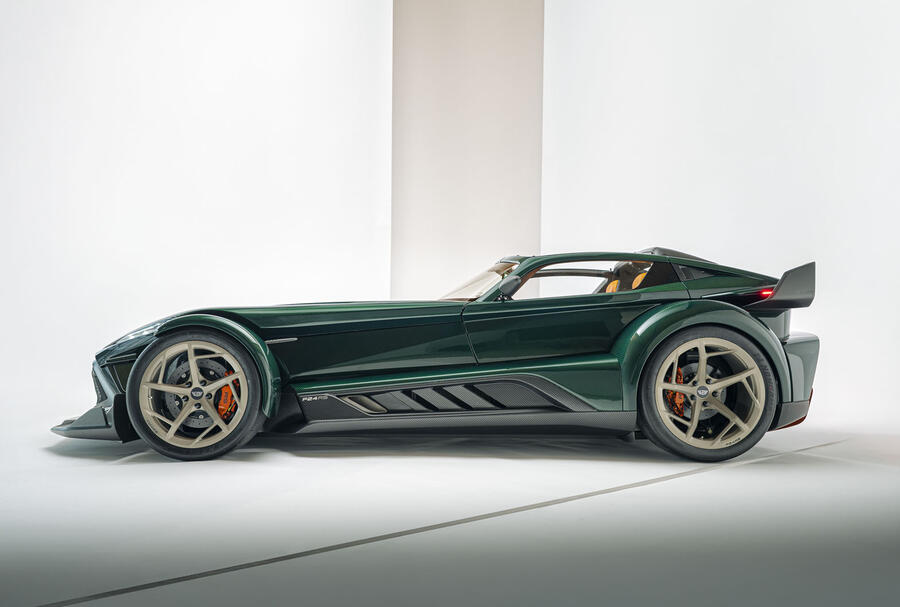
P24 RS is Donkervoort’s most extreme model ever with 600bhp V6

0
P24 RS is Donkervoort’s most extreme model ever with 600bhp V6


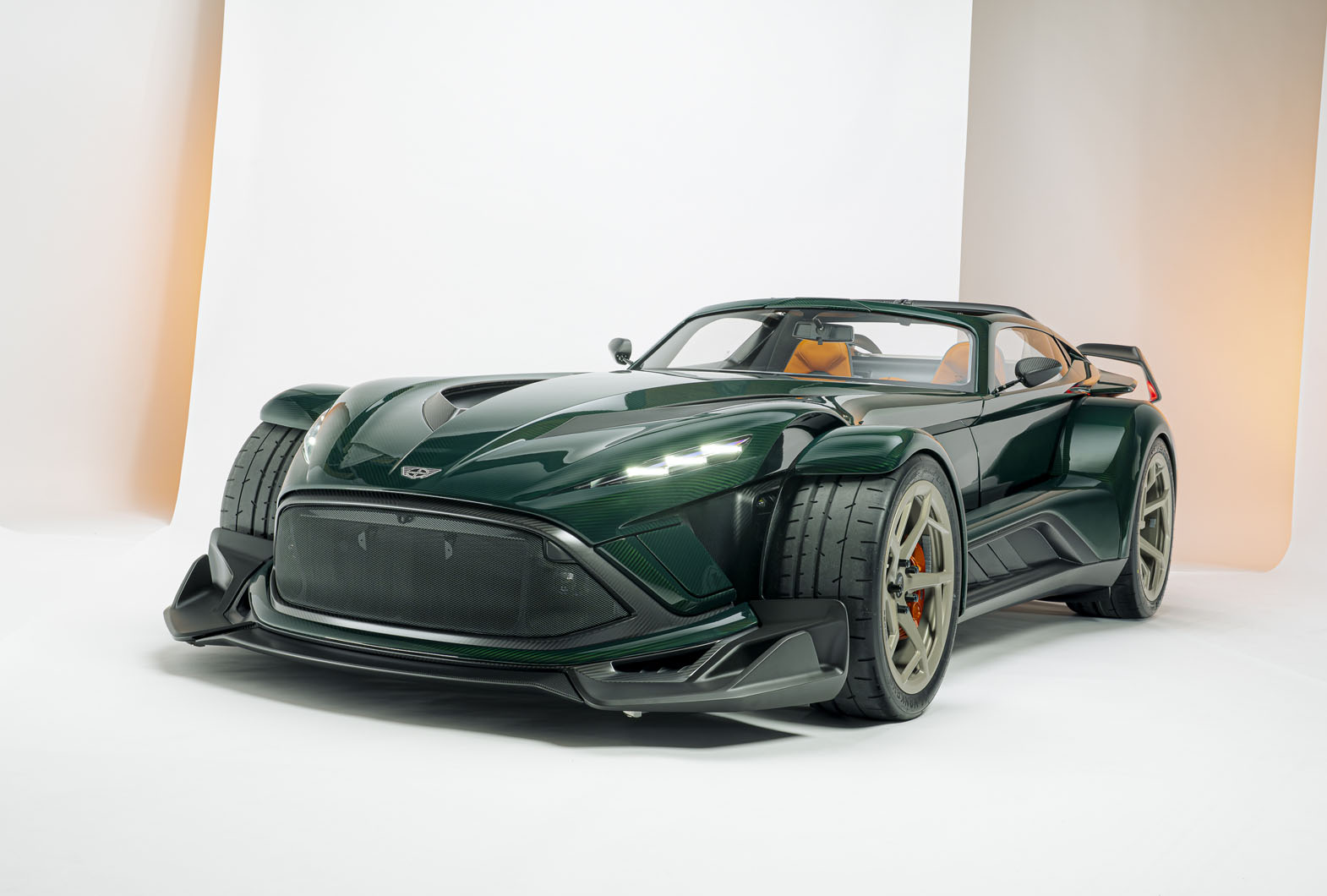
Aided by extensive use of carbonfibre throughout, especially in the chassis (which, like most of the car’s components, has been created by the maker’s Ex-Core Technologies arm), the two-seater offers a power-to-weight ratio of 758bhp per tonne – and Denis Donkervoort said: “That’s the part I’m most proud of.”

The engine is the first V6 to be used in a production Donkervoort. Because it is more compact than the Audi five-pot, it can be positioned more centrally in the car, enabling a better weight distribution. It also means a lighter five-speed gearbox – one that happens to have longer ratios – can be fitted.

Speaking about how different the Donkervoort is with a V6 supplying the power, Denis Donkervoort said: “We are still learning a lot. Every mile you drive, you gain experience. To make it simpler, in the GTO (of 2011-2021), and F22 we had our [Audi] five cylinder. The difference [with this V6] is 80hp, but this 80hp meant a different turbo, a different intercooler, different software, and already, between those models, the character of the engine is huge. It’s a new heart. It has its own character. 

“What I really like about [our] V6 is that we have put so much effort in throttle response and having no turbo lag, and that’s, of course, on a car that has a weight of 780kg kilos and 600hp is essential.”


Source link

BMW X1 Sales Lead BMW Group in Europe in 2025

0
BMW X1 Sales Lead BMW Group in Europe in 2025


BMW sales in Europe in 2025 underline a major shift in how the brand generates volume, with the BMW X1 emerging as the company’s best-selling vehicle on the continent. Once defined by rear wheel drive sedans and coupes, BMW’s European success is now led by compact, front wheel drive based models that better match today’s market realities.

BMW Group closed 2025 with 1,016,360 vehicles delivered globally. Europe was a key growth driver, with sales rising 7.3 percent year over year. Electrification played a central role in that performance. Battery electric vehicles accounted for roughly a quarter of European deliveries, and when plug-in hybrids are included, more than 40 percent of BMW Group sales in Europe were electrified.

According to Automotive News, citing data from German research firm Dataforce, the BMW X1 finished 2025 as BMW Group’s best-selling vehicle in Europe. The X1 ranked 23rd overall among Europe’s top 50 best-selling cars, recording 117,089 registrations. BMW X1 sales were essentially flat year over year, down just 0.1 percent or 86 units, a solid result given the intense competition in the compact crossover segment.

Despite narrowly missing the top 20, the X1 claimed several important distinctions. It was Europe’s best-selling luxury crossover and nearly became the best-selling premium vehicle overall, finishing just behind the Audi A3. Dataforce lists the iX1 separately, meaning total BMW sales of the X1 nameplate would place it even higher in the rankings when electric variants are included. That separation highlights how important the iX1 has become to BMW sales in Europe.

The next two strongest performers further reinforce the broader story behind BMW sales. The second best-selling BMW Group product in Europe was the MINI Cooper, which finished 37th overall with 94,574 units sold. Sales dipped slightly by 0.2 percent year over year, but the Cooper still delivered significant volume for the group.

Close behind was the BMW 1 Series, which ranked 39th with 91,931 vehicles sold. BMW sales of the 1 Series increased by 9.5 percent in 2025, making it one of the brand’s fastest-growing passenger cars in Europe despite the ongoing shift toward crossovers.

Taken together, the top three BMW Group sellers in Europe reveal a striking change. The BMW X1, MINI Cooper, and BMW 1 Series were the company’s highest-volume products in the region in 2025, and all three are built on front wheel drive based platforms. Ten to fifteen years ago, BMW sales in Europe were dominated by rear wheel drive models such as the 3 Series and 5 Series. Today, front wheel drive architectures form the backbone of BMW sales volume, driven by packaging efficiency, lower emissions, and broader mainstream appeal.

Looking at the wider European market puts BMW sales into further context. The Dacia Sandero led overall sales in 2025 with 243,676 registrations, followed by the Renault Clio with 229,778 units. The Volkswagen T-Roc rounded out the top three with 211,241 sales, underscoring the continued strength of compact, affordable vehicles and crossovers across Europe.

For BMW, the takeaway from 2025 BMW sales data is clear. While rear wheel drive remains core to the brand’s performance identity, front wheel drive based models now anchor BMW sales in Europe. The success of the BMW X1 in particular shows how effectively BMW has adapted to a changing market while maintaining its premium positioning.


Source link

Five Cars That Saved, Shaped, and Reinvented BMW

0
Five Cars That Saved, Shaped, and Reinvented BMW


Article Summary

  • Five BMWs mark turning points that reshaped the brand—from near-collapse to defining its future.
  • Each car expanded BMW’s reach: modern sport sedan (M535i), SUV success (X5), mainstream EV credibility (i3).
  • With Neue Klasse EVs coming, these past pivots explain how BMW became BMW—and what it must repeat next.

Across the decades, there have been several inflection points for BMW as a brand. With a completely new kind of car on the horizon — the Neue Klasse EVs — it’s a better time than ever to revisit how the brand got to where it is today. Through it all, five cars stand above the rest as integral to BMW’s legacy, permanently shifting both the public’s perception and the spheres in which the brand operates.

BMW 1500 and Neue Klasse

50 Years of BMW New Class, BMW 1500 (03/2011)

Probably the most important car in BMW’s history, the Neue Klasse cars of the 1960s saved the brand from the brink. Teetering on the edge of oblivion after years of lackluster sales and an aging product portfolio, the Quandt family bought in in a big way and BMW stepped up. The BMW 1500 debuted at the Frankfurt Motor Show in 1961 and immediately became a hit, spawning different variants and, arguably more central to the brand ethos, the 02 Series. The Neue Klasse cars built on the relative success of the BMW 700 that debuted two years earlier. Simultaneously, they set the benchmark for all future BMWs. It’s heavy-handed, but not completely inaccurate, to say that without Neue Klasse, BMW wouldn’t be here today. At least, certainly not how we know it.

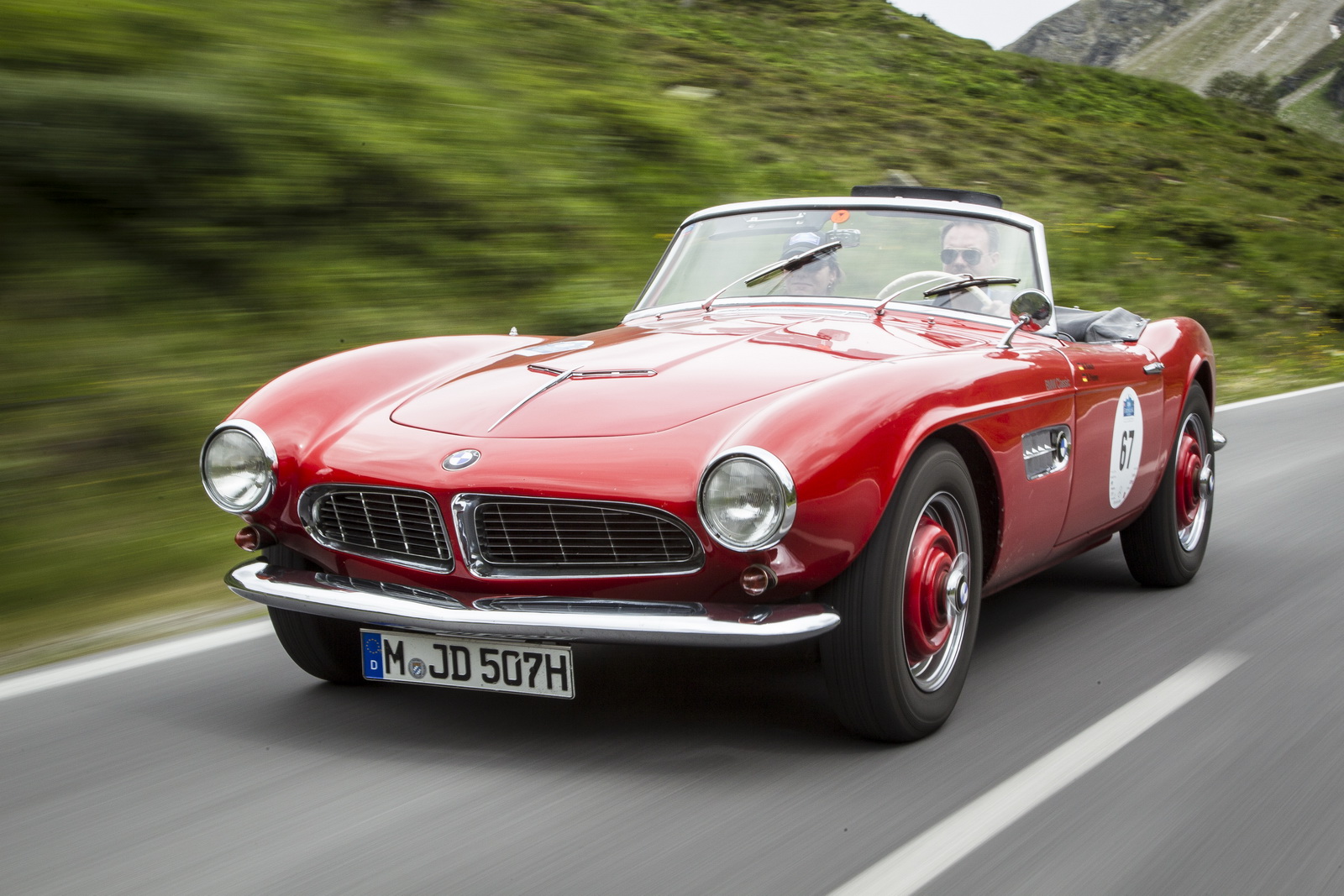
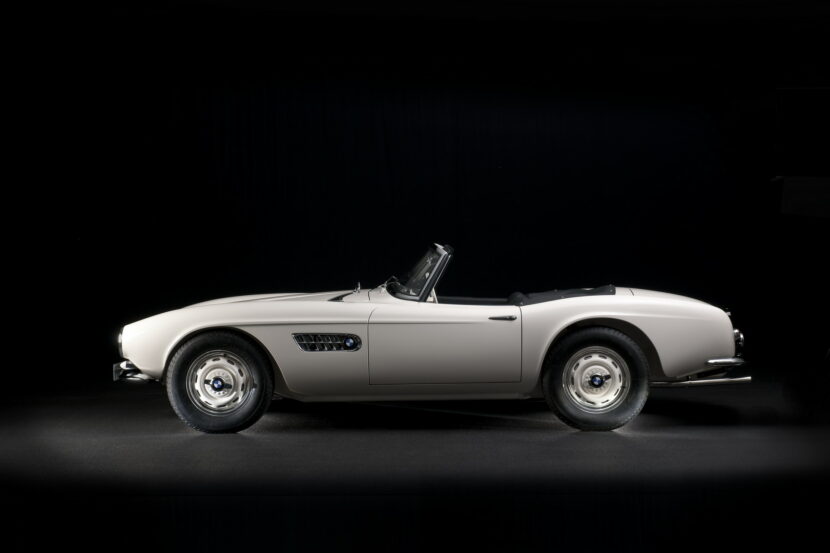
BMW 507

The word “important” is multi-dimensional. The BMW 507 shines a real bright light on that concept. You’d be hard pressed to find someone who doesn’t find the 507 remarkably pretty, and even by the brand’s own account it should’ve been a rousing success. The car’s sporting looks — backed by good fundamentals like a 3.2-liter V8 and a body mostly comprised of aluminum — had every marking of sports car royalty. Which, of course, the car did manage to achieve…but certainly not in period. The 507 sold poorly and only around 250 units made it into customer hands. Of course, the car’s icy reception meant BMW needed to change strategies — ultimately, the car nearly bankrupted the company. It set events in motion that culminated in the invention of the Neue Klasse — how much more important can you get?

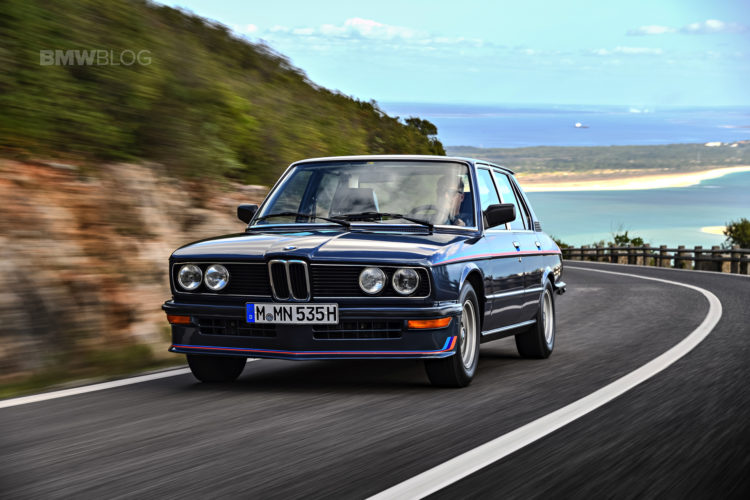
E12 M535i

The E12 M535i is distinguished for many reasons. But most key to BMW’s legacy is the fact that it was the first car from BMW M as we know it today. That is: a road-going, track-ready performance sedan that didn’t skimp on the finer things. The M535i’s ripping straight-six, combined with subtle styling updates, set the precedent for BMW M road cars that followed; most notably, the E28 M5 and E30 M3. It also arguably invented the modern luxury sport sedan. Today the “wolf in sheep’s clothing” style has maybe fallen more to the wayside. However, the guiding ethos behind the car remains very much intact nearly 60 years later. On top of an excellent driving experience and irrefutably important heritage, the fantastic 5er touts extremely low production numbers. Only around 1,650 were produced, which means values are still high today.

E53 BMW X5

Today, the BMW X5 is one of the brand’s best sellers. So, you really can’t talk about important models without at least touching on the first BMW SUV. But the E53 X5 is important for other reasons, too. Its development and release was the first look at how BMW would handle other brands it acquired; in this case, Land Rover, although later MINI and Rolls-Royce would follow, too. While the E53 wasn’t critically acclaimed, it quickly became popular with customers, with global sales cresting the 100,000 mark as early as 2001. Future generations improved on the brand’s — we’ll call it inspired — vision and today, the X5 is responsible for a sizable chunk of BMW’s sales. Naturally, the X5’s good sales paved the way for an entire stable of X models, from the X1 to the supersized BMW X7.

BMW i3

No matter how washed away the original BMW i3’s legacy may become after the Neue Klasse i3 steals its badge glory, you can’t rewrite history. The bubbly electric city car was BMW’s first mass-produced electric vehicle, and represented the culmination of lessons learned from the brand’s other electric endeavors, like MINI E and BMW ActiveE. It, with the BMW i8, was the first instance of marrying BMW with electric mobility for most customers. Construction primarily relied on recycled materials and carbon fiber from BMW’s own Moses Lake, Washington plant, another landmark achievement that set the bar for future BMW EVs. Despite vocal critics — usually those who couldn’t grasp the i3’s city car concept — the i3 was pretty well received. Eventually, over 250,000 examples found homes. In 2016, the car was the world’s third best-selling EV, after the Tesla Model S and Nissan Leaf.

Of course, this list is far from exhaustive. Plenty of other BMWs in recent and distant memory have reconfigured what we should expect from the brand. For example — the F90 M5 and its revolutionary M xDrive, facilitating hot swaps between rear- and all-wheel drive. The bottom line? BMW’s innovations are far and wide, spanning decades and almost every imaginable body style and powertrain.


Source link

Silversands Beach House Grenada – LUXUO

0
Silversands Beach House Grenada – LUXUO


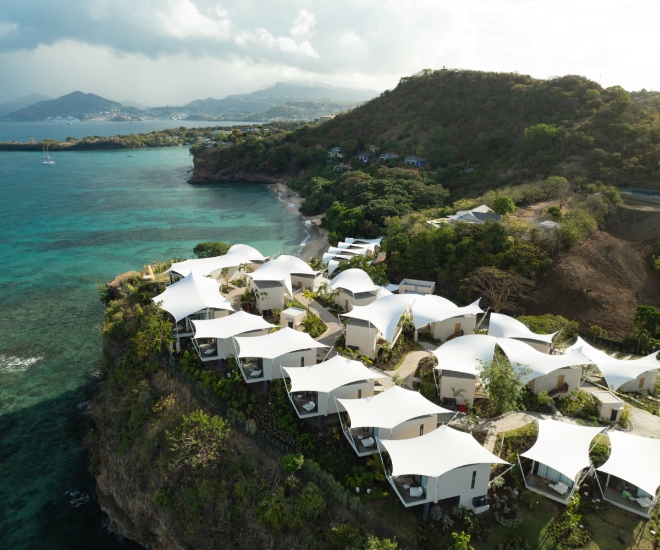
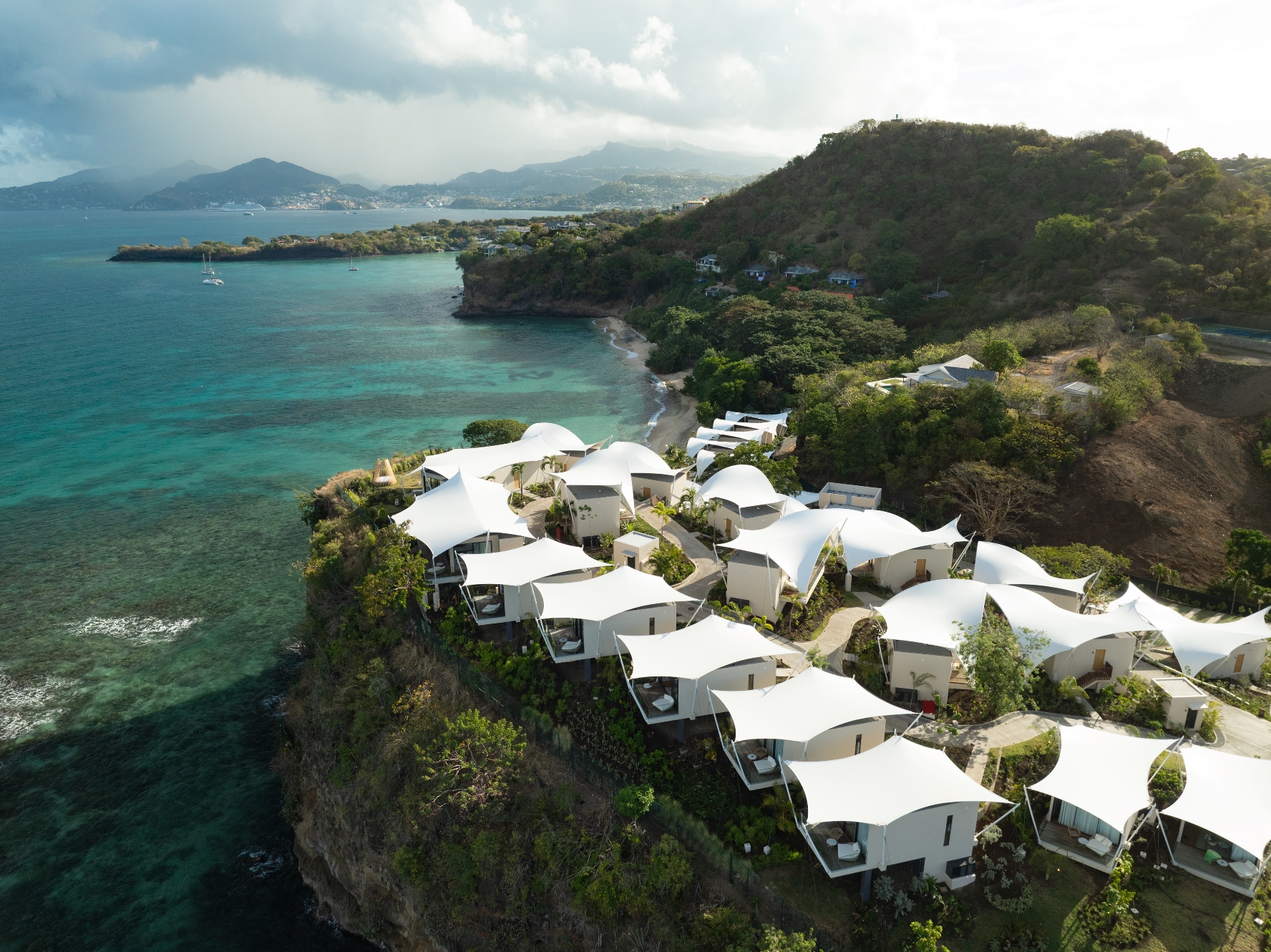
Silversands Beach House Grenada opened its doors in February, 2024. As the newest sister property to the luxurious Silversands Grand Anse, this boutique resort is set to enhance Grenada’s reputation as the premier Caribbean destination.

A Haven of Elegance and Serenity

Nestled amid lush canopies and dramatic stone bluffs overlooking the azure waters of Portici Beach, Silversands Beach House offers:

  • 28 exquisitely designed rooms and suites, from cliffside to beachside villas, seamlessly blending indoor and outdoor living.
  • A 42-foot infinity pool with breathtaking ocean views.
  • A beachfront Italian restaurant, Azzurro.
  • A restorative wellness space.
  • Authentic Design

Rooms & Suites

Every room and suite at Silversands Beach House reflects understated luxury, designed to

harmonize with the natural surroundings.

Two Bedroom Panoramic Ocean View Suites

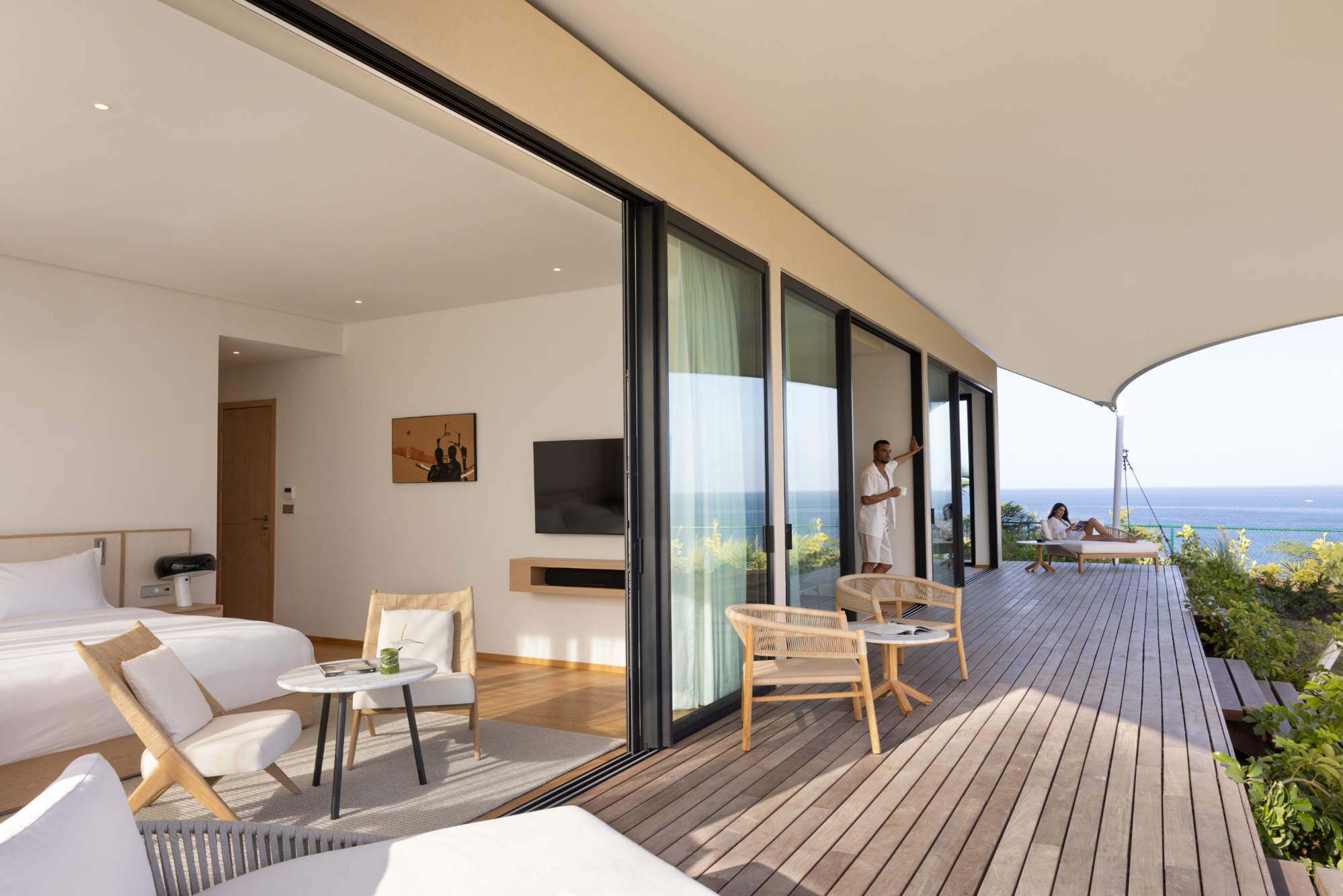
Positioned at the cliffside’s highest point, these suites offer expansive sea views, a spacious living room, kitchenette, and wraparound patio.

Panoramic Ocean View Rooms

Unrestricted ocean views, from the comfort of a suite facing

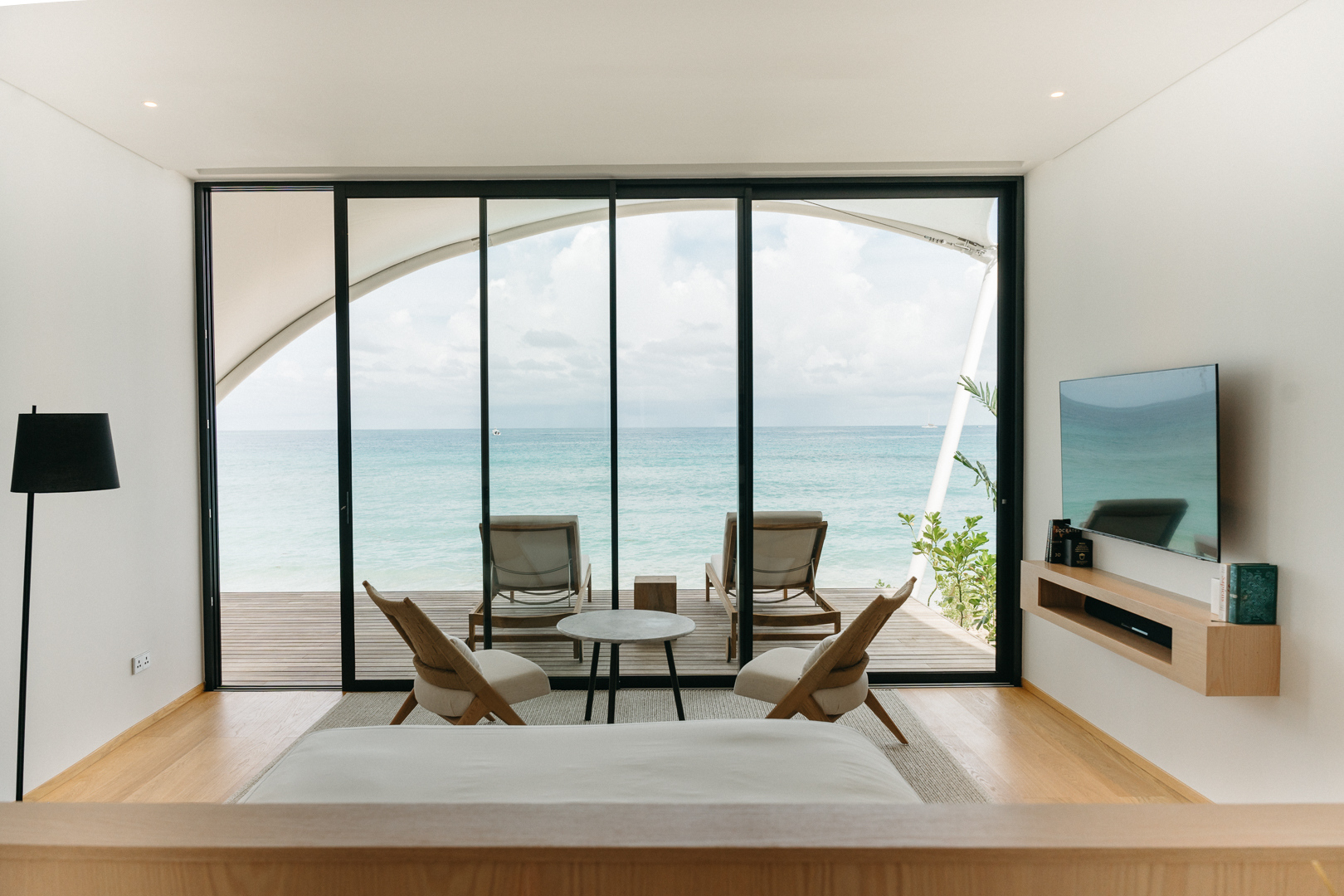
Portici Beach. These rooms feature an open-plan king bedroom, en-suite bathroom, and private outdoor patio.

Beachfront Junior Suites

Steps from the beach, these suites feature open floor plans, private

canopied patios, and ample space to relax.

Ocean View Rooms

Unrestricted ocean views, from the comfort of a suite perched on the lush hillside facing Portici Beach. Rooms feature an open-plan king bedroom, en-suite bathroom, and private outdoor patio.

Island View Rooms

Immersed in lush mountain scenery, these rooms offer a spacious king bedroom, en-suite bathroom, and private outdoor patio.

Culinary Highlights

Beach House is home to Azzurro, a beachfront restaurant combining Mediterranean flavors with Caribbean charm. Guests can enjoy freshly made pizza from a traditional oven, local seafood and premium meats.

Additionally, guests can dine at one of the three restaurants at Silversands Grand Anse. Choices include Asiatique, Grenadian Grill, the Beach Lounge, and Puro, a traditional Grenadian cigar and rum bar.

Holistic Wellness

Guests are invited to indulge in signature spa treatments at the Silversands Spa, including cryotherapy facials, ageless facials by 111-SKIN, therapeutic massages featuring Healing Stones.

Guests staying at Silversands Beach House are invited to access Silversands Grand Anse’s state-of-the-art spa, or enjoy the facilities such as a sauna, ice cave, hammam, experiential shower, beauty bar, and fitness center with Peloton room. Guests also have access to Silversands Grand Anse’s iconic 100-meter infinity pool (the longest in the Caribbean)

Discover more exceptional properties at McB REALTY by visiting www.mcb-realty.com or contacting them at info@mcb-realty.com. Follow McB REALTY on social media (Instagram, Facebook, LinkedIn, and YouTube) to stay inspired by the finest in Caribbean real estate.

For more on the latest in property and real estate reads, click here.


Source link

RV Bed Lift Kit Instructions for Easy Installation

0
RV Bed Lift Kit Instructions for Easy Installation


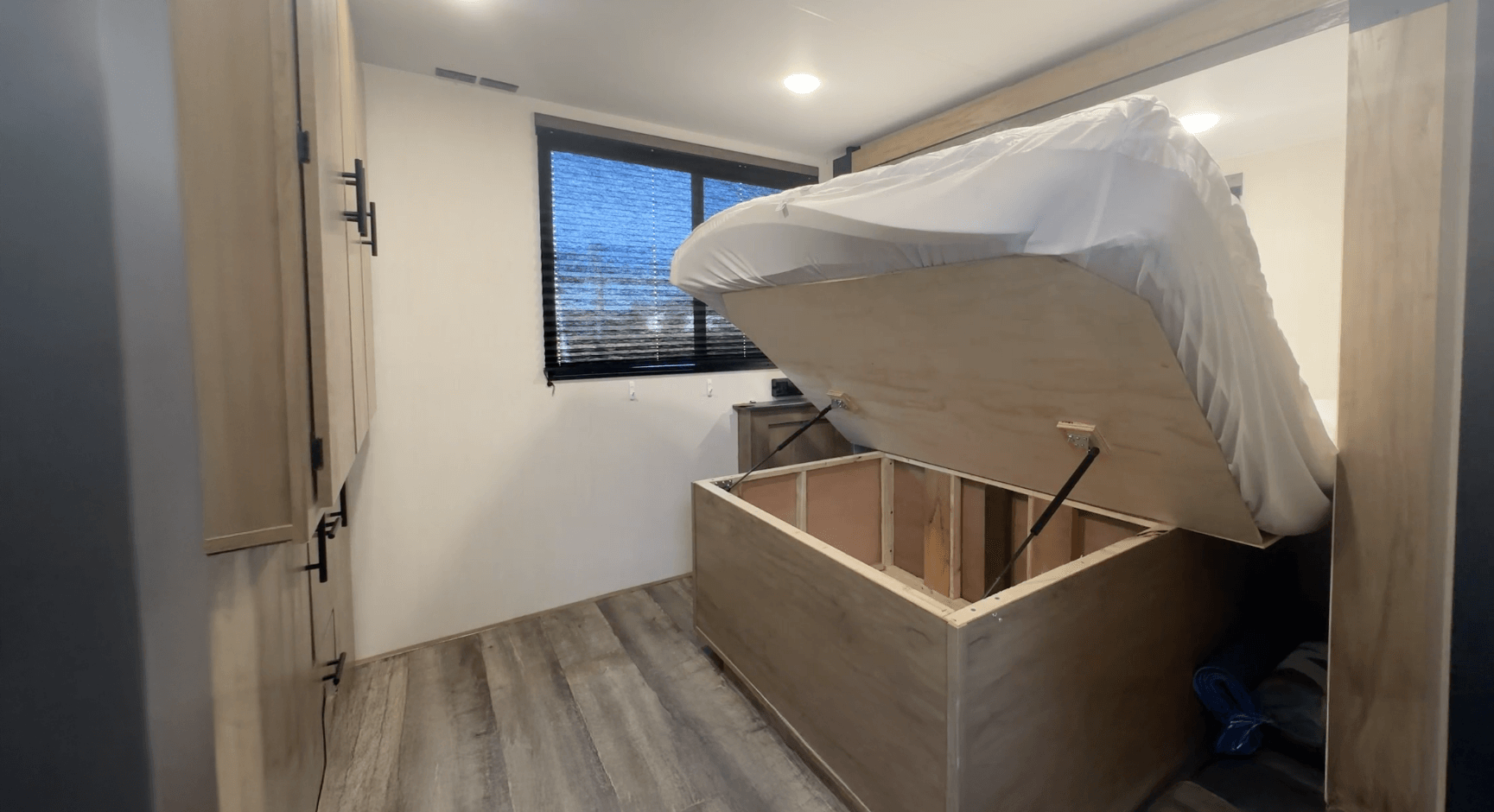
HAVING SUPPORTED ACCESS to the storage area under your RV bed might not seem like a huge selling point at first glance. But once you’re lifting a fully made bed whenever you want something out of that compartment, you might want a little help. Enter a fairly straightforward bed lift kit install for an easier way to access the storage under your bed and save your back in the process. 

From tools to prep to step-by-step pointers, we’ll walk you through exactly how to install a JR Product bed lift kit in your camper.

Key Takeaways

  • ​​Preparation and Reinforcement: Installing a JR Products bed lift kit may require reinforcing lightweight RV bed frames with wooden blocks (2×4 or 2×6) and wood glue to provide a sturdy mounting surface for the gas struts.
  • Precision Mounting: The process involves measuring and marking specific locations for upper and lower brackets—typically centered 22″ back on the platform—and pre-drilling pilot holes to ensure the struts operate vertically.
  • Testing and Final Security: After a temporary install, the system must be tested with the mattress in place before the hardware is permanently secured using wood glue, through-bolts, and screws driven from the top down to prevent mattress damage.

Images by Camping World

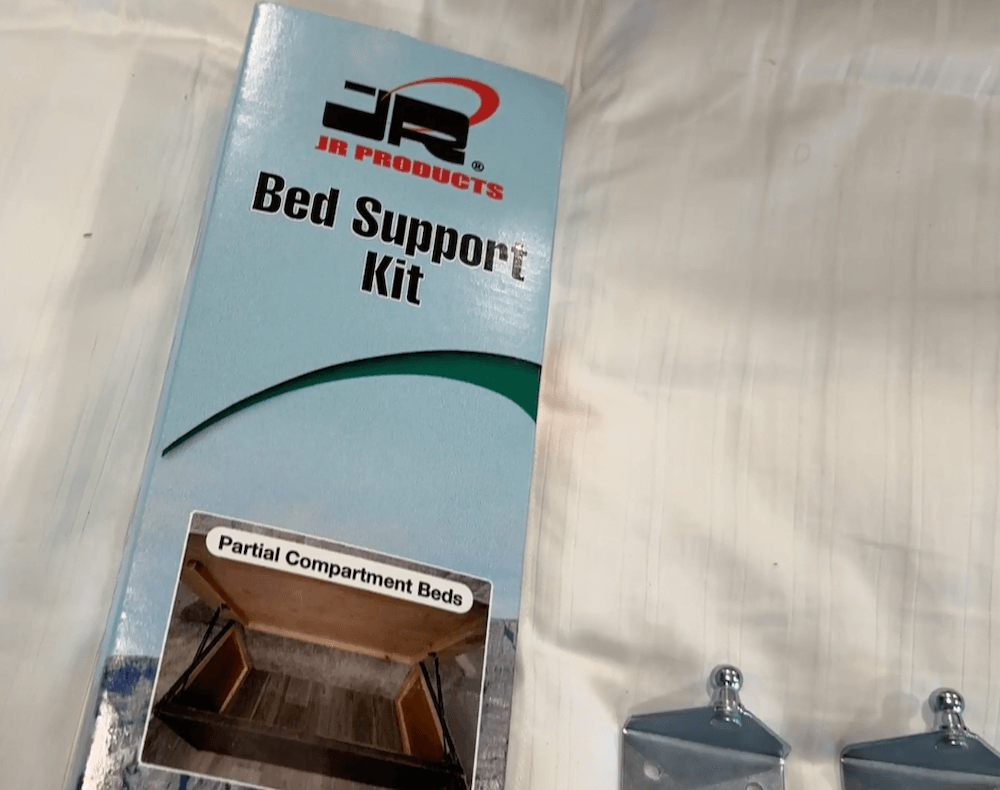
So, what do you need for this install? That starts with the bed lift kit. In this case, we’re using the JR Products standard queen size RV bed lift kit, which includes:

  • 2 gas struts
  • 4 mounting brackets (two upper, two lower)
  • 2 blocks of wood
  • All required mounting hardware
  • Bed lift kit install instructions

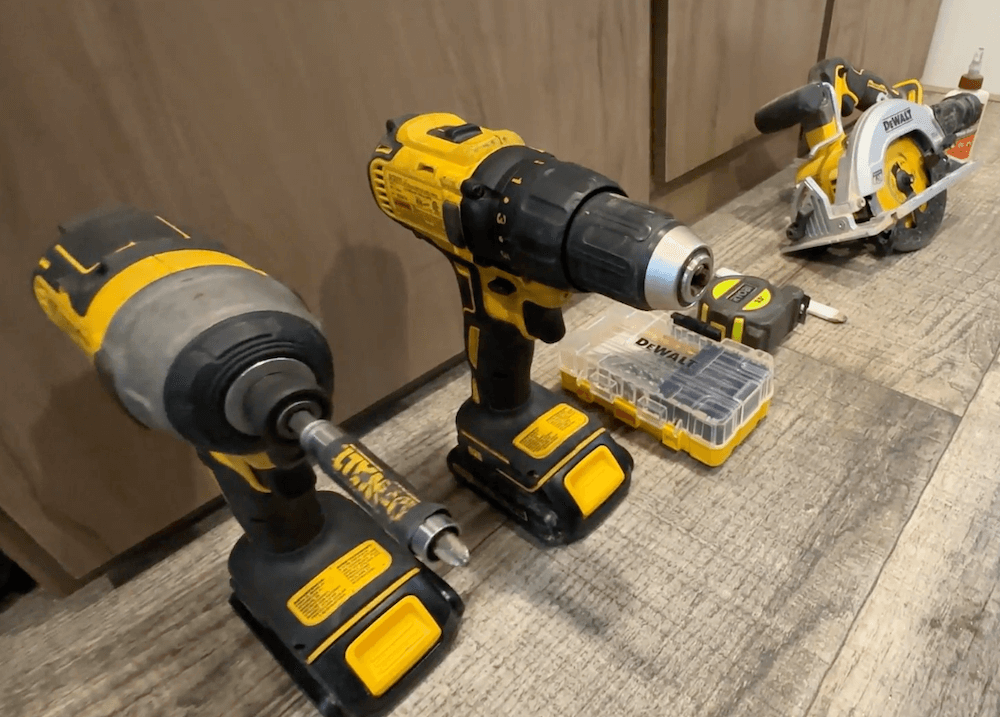
Additional supplies recommended by the camper bed lift kit manufacturer include:

  • Cordless impact driver with Philips bit
  • Cordless drill
  • Drill bit set
  • Measuring tape
  • Marker or pencil
  • Cordless circular saw
  • Construction adhesive/wood glue

While not listed in the instructions, you’ll likely need a ratchet wrench with a ⅜” socket, a small flathead screwdriver, a towel or two, and a headlamp.

Preparing Your Bed Frame

Installing wooden blocks to reinforce RV bed frame
Image by Camping World

Depending on your RV’s bed frame, you may need to reinforce it with wooden blocks, which you’ll need to secure with wood glue or additional mounting hardware. This will depend on the thickness of the bed framing used by your RV manufacturer. For lightweight builds using anything less than 2” framing, additional reinforcement will most likely be required.

Technician Tip: Consult your RV manufacturer and/or the bed lift kit manufacturer if you have additional questions about bed frame reinforcement.

If your bed frame does need reinforcement, measure the height of your bed base and cut two wooden blocks to reinforce the front corners of the bed frame for the lower brackets—we used a 2” by 6”, but a 2” by 4” should work just as well.

Mounting the Lower Brackets

Mounting camper bed lift lower brackets
Image by Camping World

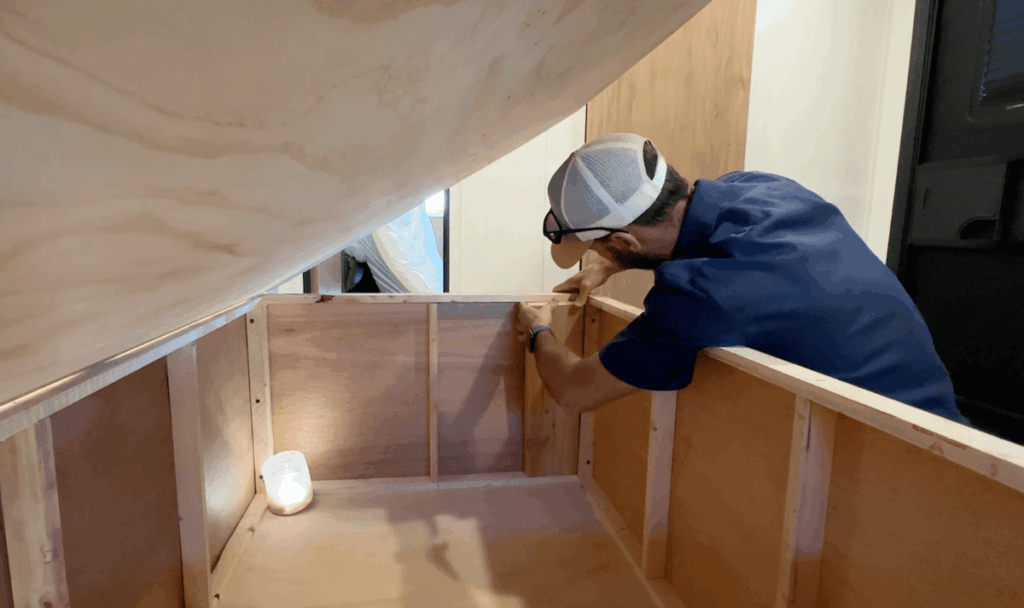
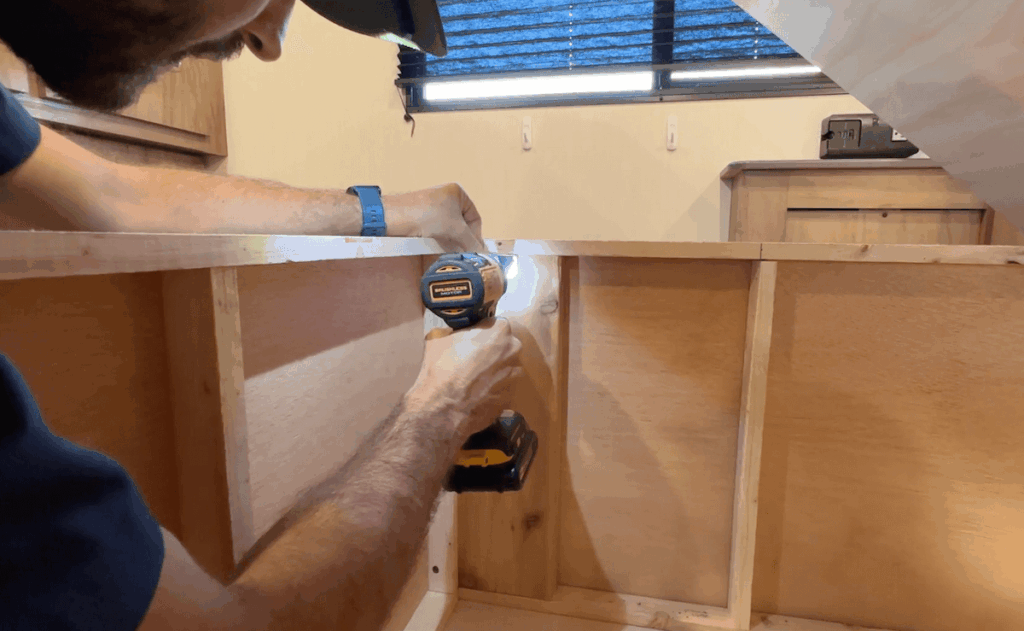
With those blocks in place, remove the mattress and prop the bed platform open to maintain easy access.

Measure and mark locations for the lower mounting brackets. For this tutorial, we worked on an RV with a partial bed platform, and the kit manufacturer recommends mounting the lower brackets roughly three inches from the outside of the bed frame. 

Use a ⅛” bit to drill pilot holes and mount each lower bracket using two of the supplied ⅝” screws. 

Hold off on installing the remaining hardware until you’ve tested that the struts operate as expected (after a later step).

Mark Locations for Upper Brackets

Marking upper bracket location for RV bed lift kit
Image by Camping World

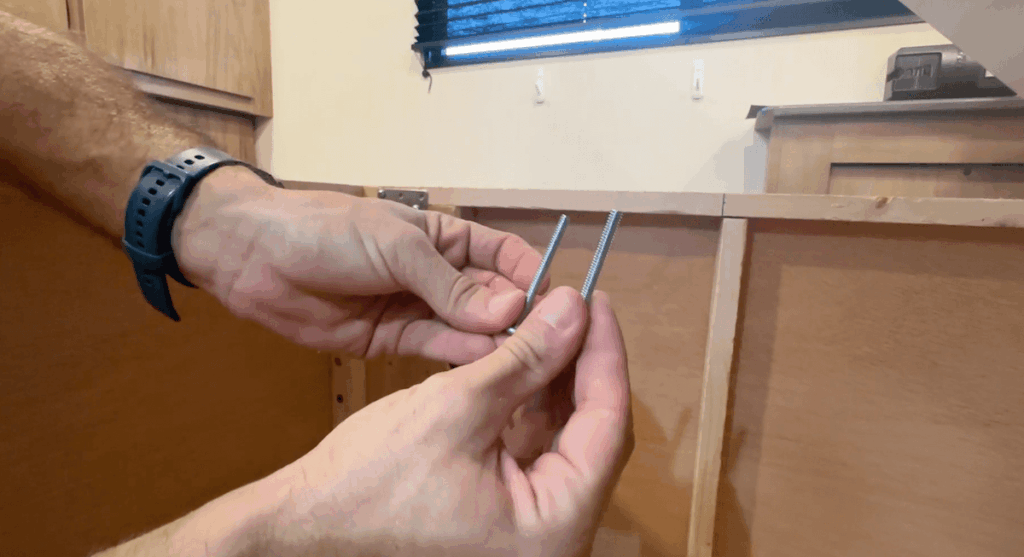
Next, mount the upper brackets to the wooden blocks using two ⅝” screws for each bracket.

Attach the lower end of the struts to the lower brackets. The rod end should be facing down. Repeat on the other side.

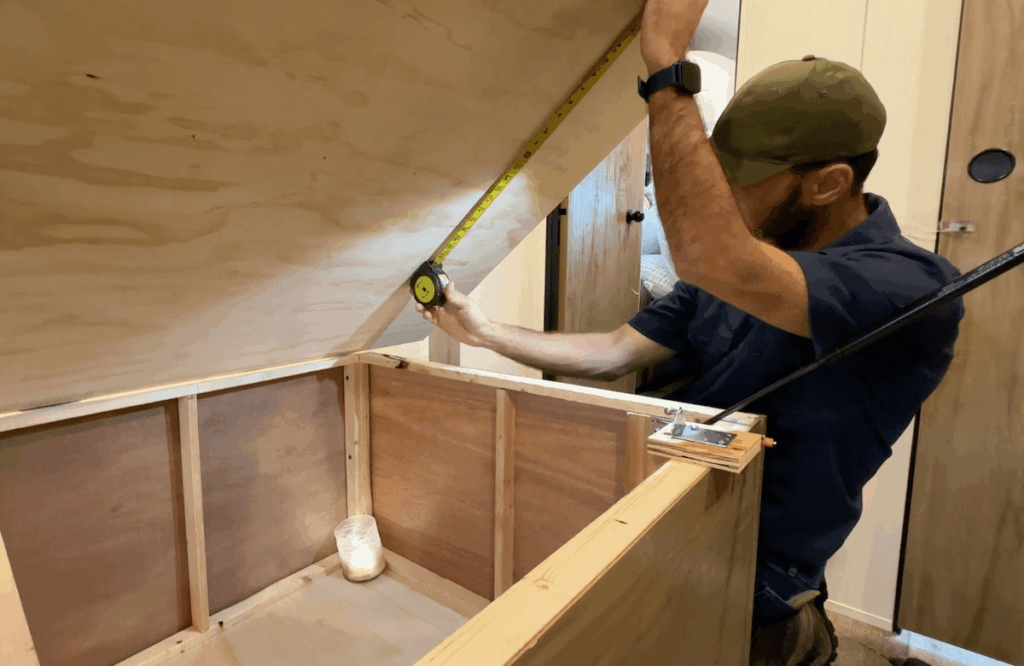
Check the bed height by measuring from the base to the edge of the lifted platform. This RV bed lift kit states that the platform should be propped so that the opening is roughly 24” tall.

Measure and mark the general locations for the upper brackets. The kit states that the upper brackets should be centered roughly 22” back from the edge of the lifted bed platform.

Temporarily Attach Upper Brackets

Securing wooden blocks to RV bed platform
Image by Camping World

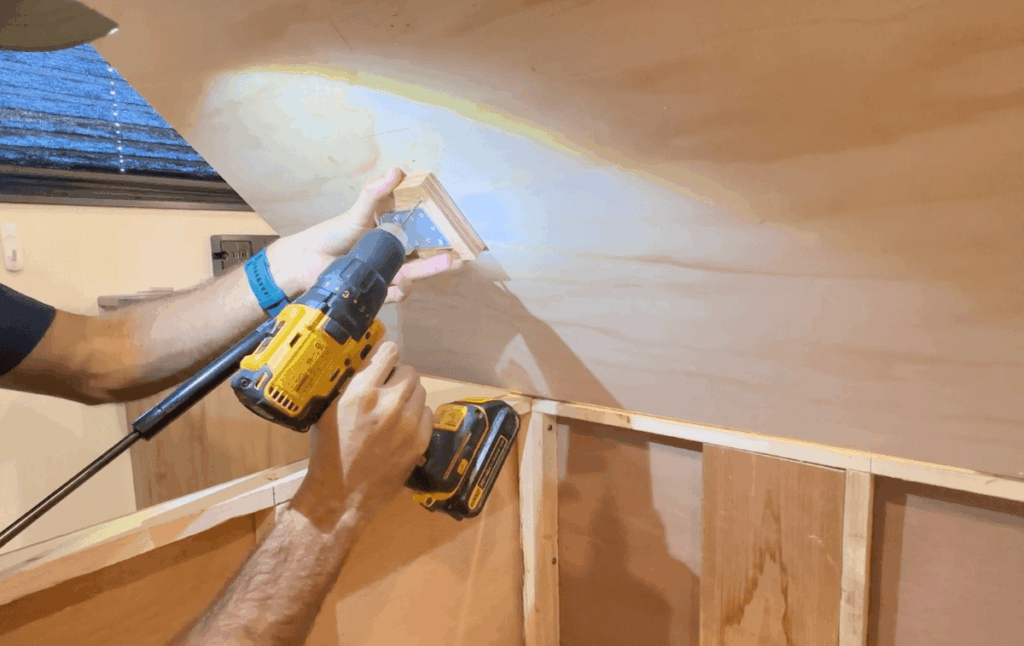
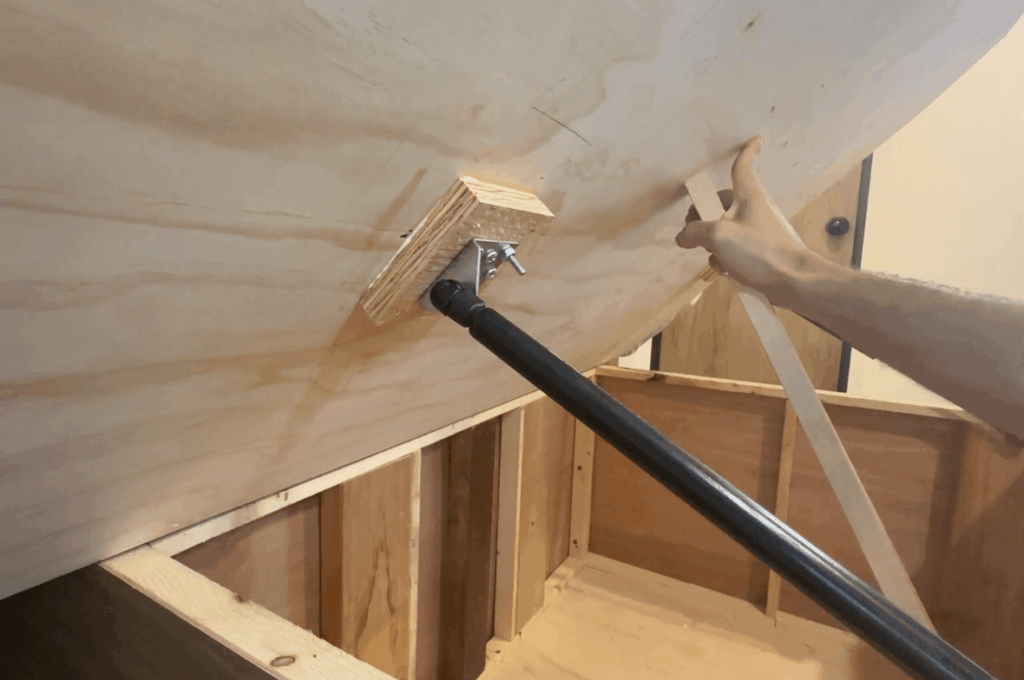
Connect the spring’s upper end to the bracket attached to the wooden block, then position the block on the underside of the bed platform. 

Keeping the strut as vertical as possible, drill pilot holes for mounting the blocks to the bed platform. 

Use a 1.25” screw to hold the block in place before removing the strut from the block and installing three more screws from the top side of the platform. This is where you’ll need that flathead screwdriver to remove the struts from the brackets.

You can then move the one screw that held the bracket in place to the top side. This eliminates sharp screw ends from protruding vertically, which could damage the mattress once it’s replaced.

Repeat this process on the other side, then sand the top of the platform to prevent sharp edges from damaging your mattress.

Test Strut Operation

Testing struts for bed lift kit for RV
Image by Camping World

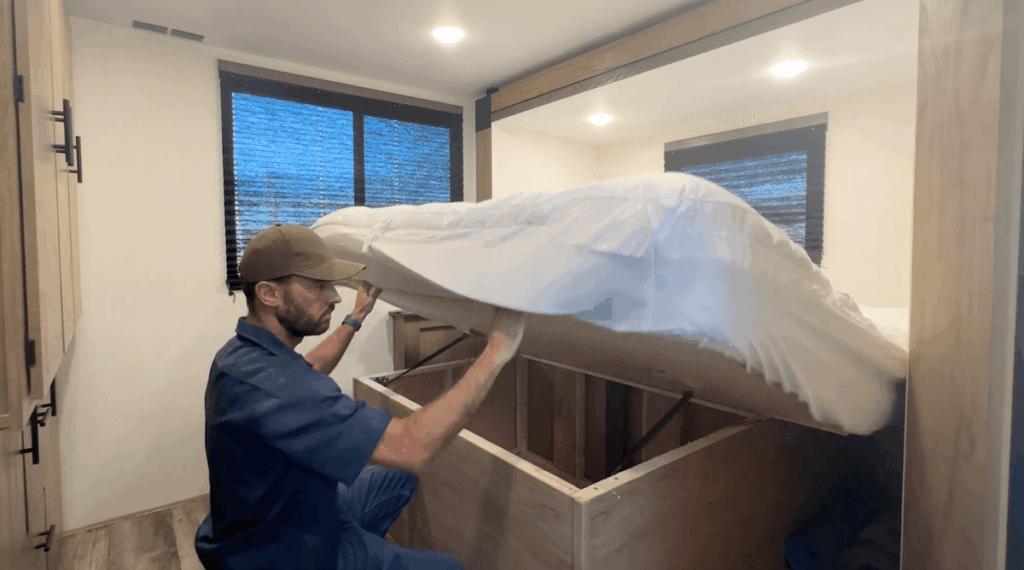
With those upper brackets temporarily secured, reconnect the struts and test them to ensure they work properly. This will require replacing the mattress, as the manufacturer recommends testing the strut operation only with the mattress in place.

We initially placed our lower brackets too low, and had to move them up so that some hardware secures to the bed frame while the rest secures to our 2” by 6” reinforcements. 

Technician Tip: If you need to make adjustments, this Camping World bed lift kit’s instructions walk you through relocating the upper or lower brackets based on your use case.

Install Remaining Hardware

Example of through-bolts that came with JR Products RV bed lift kit
Image by Camping World

Once your RV bed lift kit test is successful—adjustments or not—install the remaining hardware. This starts by removing the mattress again, propping the bed platform, and disconnecting the struts from the upper and lower brackets.

Then remove the upper blocks from the underside of the bed platform, apply wood glue, and reinstall them, first with the original four screws. Keep a towel handy to wipe away excess glue as you reinstall the blocks on both sides. 

Then, install two through-bolts from the top down and three more ⅝” screws from the bottom up into each bracket. You’ll need a larger drill bit for the through-bolts—we used a 5/32” bit—and a ratchet wrench with a ⅜” socket to secure them. 

We also recommend using wood glue to secure the block reinforcements in the corners of the bed frame before securing the bottom brackets. These also will require two additional through-bolts—with the heads installed from the outside—and one more ⅝” screw.

Reconnect Struts and Replace the Mattress

Connecting struts to finish installing lift cylinders under camper bed
Image by Camping World

With all the remaining hardware installed, the final step for installing this camper bed lift is reconnecting the struts and putting your mattress back in place. You may want to give the wood glue a few minutes to set up before closing the platform and, of course, remaking your bed to your liking.

And there you have it! We hope you found these bed lift kit install instructions helpful, and you now have a bed that only requires one hand and minimal effort to access the storage beneath it. 

If interested, use these links to shop bed lift kits or schedule professional installation:


Looking for other easy RV upgrades? Check out these resources: 

What questions do you have about these bed lift kit instructions? Let us know in the comments below!


  • Tucker Ballister headshot

    Tucker Ballister is our Content Strategist. He grew up RV camping in a Fleetwood Bounder with his parents and has lived and camped in two motorhomes and two travel trailers of his own. His current RV is a 2025 Forest River Campsite Ultra 26BW, which he loves taking on adventures with his wonderful partner and furry companion from their home base in Western North Carolina. Check out his adventures, gear reviews, and outdoor advice at thebackpackguide.com.

    View all posts


Source link

Tesla launches public Robotaxi rides in Austin with no Safety Monitor

0
Tesla launches public Robotaxi rides in Austin with no Safety Monitor


Elon Musk shared an incredible detail about Tesla Cybercab’s potential efficiency, as the company has hinted in the past that it could be one of the most affordable vehicles to operate from a per-mile basis.

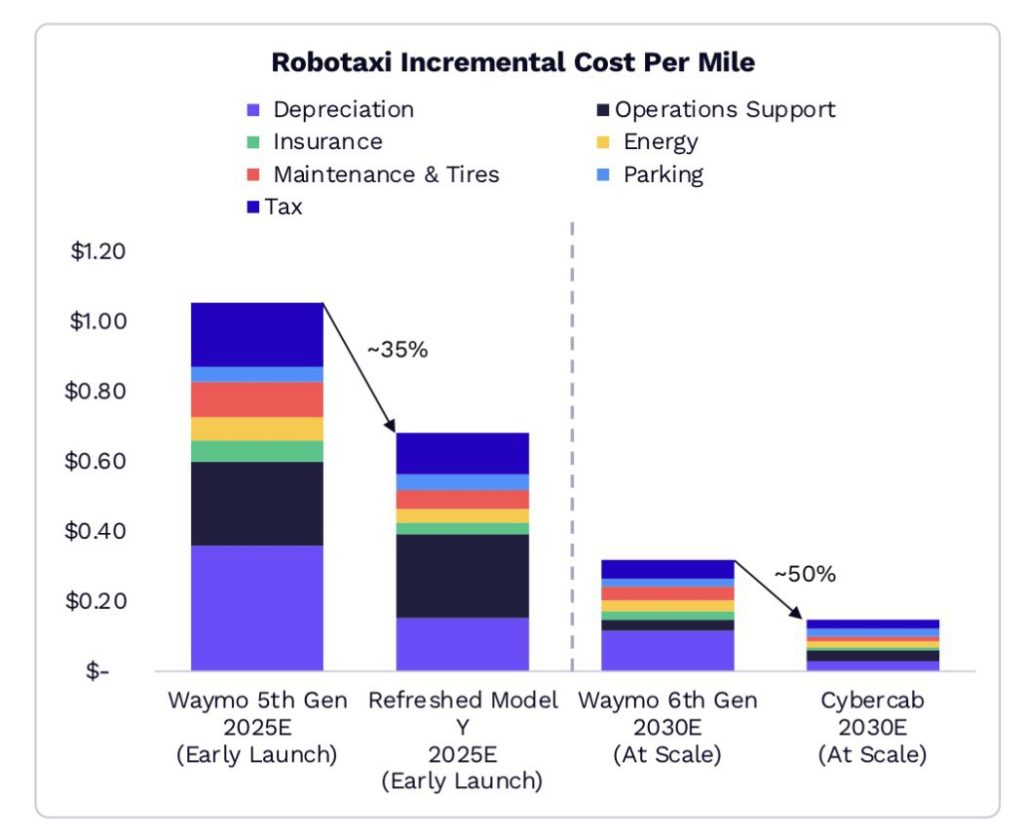
ARK Invest released a report recently that shed some light on the potential incremental cost per mile of various Robotaxis that will be available on the market in the coming years.

The Cybercab, which is detailed for the year 2030, has an exceptionally low cost of operation, which is something Tesla revealed when it unveiled the vehicle a year and a half ago at the “We, Robot” event in Los Angeles.

Musk said on numerous occasions that Tesla plans to hit the $0.20 cents per mile mark with the Cybercab, describing a “clear path” to achieving that figure and emphasizing it is the “full considered” cost, which would include energy, maintenance, cleaning, depreciation, and insurance.

ARK’s report showed that the Cybercab would be roughly half the cost of the Waymo 6th Gen Robotaxi in 2030, as that would come in at around $0.40 per mile all in. Cybercab, at scale, would be at $0.20.

Credit: ARK Invest

This would be a dramatic decrease in the cost of operation for Tesla, and the savings would then be passed on to customers who choose to utilize the ride-sharing service for their own transportation needs.

The U.S. average cost of new vehicle ownership is about $0.77 per mile, according to AAA. Meanwhile, Uber and Lyft rideshares often cost between $1 and $4 per mile, while Waymo can cost between $0.60 and $1 or more per mile, according to some estimates.

Tesla’s engineering has been the true driver of these cost efficiencies, and its focus on creating a vehicle that is as cost-effective to operate as possible is truly going to pay off as the vehicle begins to scale. Tesla wants to get the Cybercab to about 5.5-6 miles per kWh, which has been discussed with prototypes.

Additionally, fewer parts due to the umboxed manufacturing process, a lower initial cost, and eliminating the need to pay humans for their labor would also contribute to a cheaper operational cost overall. While aspirational, all of the ingredients for this to be a real goal are there.

It may take some time as Tesla needs to hammer the manufacturing processes, and Musk has said there will be growing pains early. This week, he said regarding the early production efforts:

“…initial production is always very slow and follows an S-curve. The speed of production ramp is inversely proportionate to how many new parts and steps there are. For Cybercab and Optimus, almost everything is new, so the early production rate will be agonizingly slow, but eventually end up being insanely fast.”


Source link

Bugatti Chiron puts on a Veyron costume in new teaser video

0
Bugatti Chiron puts on a Veyron costume in new teaser video


Bugatti is all set to reveal a new one-off hypercar on January 22. You first read about the upcoming Solitaire model here. We were also the first to reveal its Veyron connection, and the latest official teaser confirms that.

The new one-off is expected to be based on the Chiron and will be an homage to the Veyron. As you can clearly see in this short teaser, that’s exactly the case.

The front fascia looks exactly like the Veyron – a more modern take on the 20-year-old design. It has the classic horseshoe grille and slim headlamp units with L-shaped DRLs. The side profile with its smooth surfaces looks just like the original.

We suspect the spec on this car might also be identical to the original Bugatti Veyron 16.4 chassis no. 001. It had a two-tone red and black paint scheme and a cream interior.

The engine, though, would most likely be the latest iteration of the 8.0-liter W16 producing 1600 hp.


Source link

Two Day Itinerary in Rotorua (Redwoods Treewalk + Geothermal pools!)

0
Two Day Itinerary in Rotorua (Redwoods Treewalk + Geothermal pools!)


This post may contain affiliate links. See our affiliate disclaimer here.

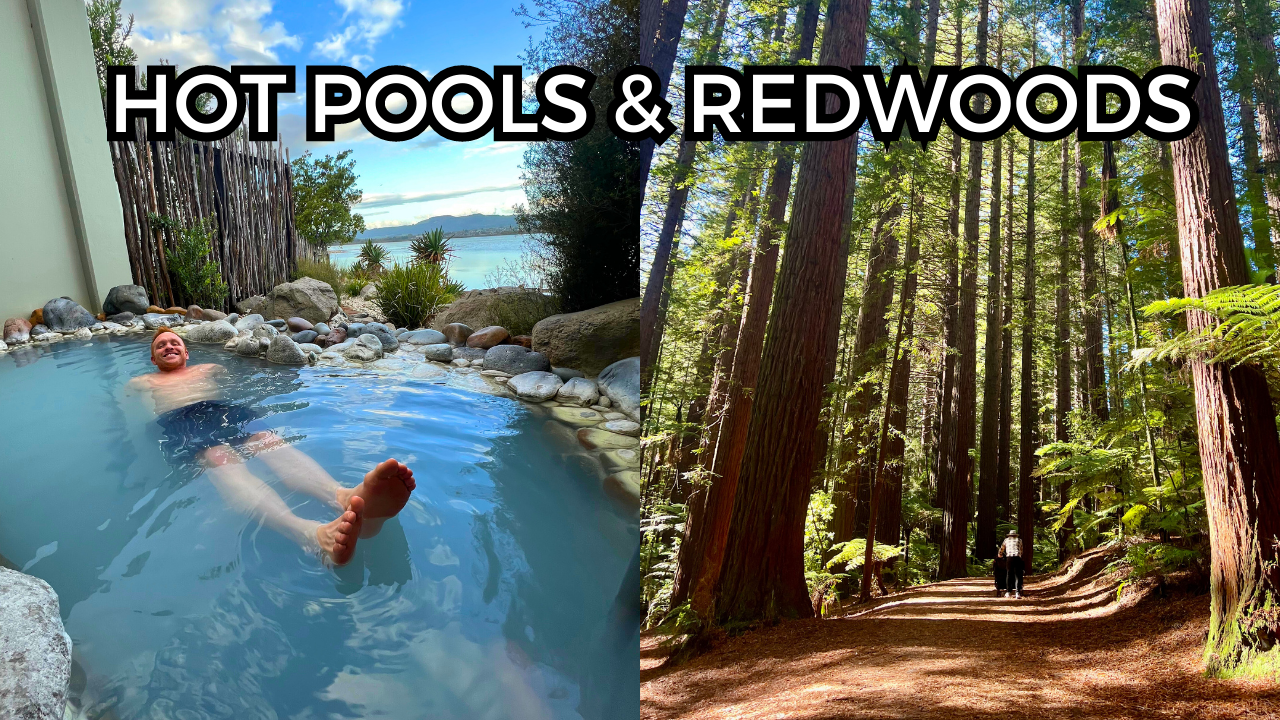
Rotorua is one of the top destinations on the North Island of New Zealand for good reason! We spent two days exploring family-friendly destinations in town including the beautiful Polynesian Spa and the Redwoods Treewalk.

We’re visiting New Zealand by campervan since it’s the best way to see the country. We rented a motorhome from Wilderness Motorhomes. We rented from Wilderness back in 2018 during our first visit to this gorgeous country and hands down, they are the best rental company in the country. (Also in the world…Europe take note!)

Geothermal Activity

Rotorua is a *literal* hotbed of geothermal activities. There are natural hot pools, creeks, boiling mud, and every type of geothermal pool you can imagine. The town itself is built in the middle of it all, giving a sniff of sulfur everywhere you go.

The thing to do is soak in the healing waters of the area. During our first visit to Rotorua in 2018, we went the natural route, walking down hot streams and soaking in questionable warm waters. This time we wanted to find something family-friendly. There are many remote, romantic hot pools where you can soak, but kid-friendly ones are much harder to find.

We chose the Polynesia Spa for its kid-friendly pools. We made a reservation for a private lake-view pool and got passes for the family pools as well.

There is motorhome parking—free and overnight—right across the street from the Polynesia Spa, so we arrived early in the afternoon and stayed overnight. This was the perfect setup to be able to shower, change clothes, and head home for the night.

The private pool was nice and hot and the kids were allowed in with us. The water was a little too hot for them, but luckily there was a small ledge of smooth stones where they could sit and splash. The private pool booking had a timer, so after an hour, we headed over to the family pools. There were three pools—two shallow pools and one large pool with a slide. The slide made it so fun and the pool was divided into a deep and shallow section so Ellie could walk around the shallow area.

Redwoods Treewalk

This was one of our most memorable nights during our first visit to New Zealand and one place we wanted to return to in the light of day.

The Redwoods Treewalk is the longest treewalk in the world. It’s a series of over 20 bridges and platforms suspending you high in the treetops. It’s a beautiful way to experience the forest and a unique experience for the family. All ages are welcome to enjoy the bridges, but you aren’t allowed to carry children. The staff will provide a special stroller. They have multiple options depending on the age of your children. It wasn’t too difficult to maneuver on the tiny bridges and it kept our 18 month old safe.

After we explored the treetops, we went to ground and hiked some of the stroller-friendly trails through the forest. It was perfect weather, beautiful scenery, and a great way to spend our morning.

Where to Stay

Being such a popular destination, there are many holiday parks near Rotorua. To stay in town, we parked at the Hinemoa Street Carpark. There were many spots in the lot for campers, but it filled up fast. We arrived around 3 PM and the parking lot was getting close to full.

There are street lights and trash in the lot and it’s right next to a park. We easily walked through the park into the downtown area. There were so many restaurants in town to choose from. We found a cozy Mexican restaurant with outdoor seating and delicious tacos that I’m still thinking about…

If you can get a spot, we highly recommend parking at the free lot in town so that you can easily access everything the town has to offer.


Source link

Looking Back: Vaulture’s Sunday Classic

0
Looking Back: Vaulture’s Sunday Classic


Do you remember the first time you became aware of approval-based outdoor car shows? I do. For me it was 2011, when Canibeat — yeah, that’s a throwback — revealed the format for the inaugural First Class Fitment.

I have to admit, when I first heard they were taking submissions and turning people away, I didn’t like it. Car shows, especially outdoor ones, were historically for everyone and always should be, right? Well… not exactly.

In 2026, I’m self-aware enough to realize my younger self, while well-meaning, was more than a little stubborn.

Or at least I was wrong and stubborn about that. First Class Fitment probably wasn’t the first to do the unique-venue, invite-only format, but at the height of the “blog era” they were part of the upper echelon of events that actually felt curated.

The logistics of their airport venue were probably a big reason for limiting participants, but Canibeat’s creator Christian’s vision for what the event could be shouldn’t be discounted.

Long before the term clout-chasing was even coined and takeovers were ruining the car community’s reputation, Christian knew the type of event he wanted to hold. As someone who created their own space to align with my own vision, it’s a bit weird I was initially so against the idea.


Today I’ve realized that events like First Class Fitment walked so later events like Vaulture’s Sunday Classic could run.

Vaulture has been holding its events since 2024. Looking to somewhat fill the void left by Engineered Automotive’s Cars and Coffee — while still being wholly unique — they picked an extremely photogenic rooftop in Yorkville — the kind of spot that makes both videographers and photographers nod in approval.


Because the rooftop can only hold so many cars in an aesthetically pleasing manner, registration and approval are required. However — and this is rare for shows like this — entry is free.

If you get accepted, you can park on the roof. If not, no big deal — you can park on the lower level of the parking structure or, if you’re fortunate enough, on the street.

To be completely honest, both vantage points offer some surprisingly cool perspectives. Full credit to the Vaulture team for securing a venue that works this well.

And on a personal note, I have to shout out my long-time friend Chris Johnston for convincing me to throw my truck into the mix and apply for the event.


Chris’ beautifully restrained Lincoln Town Car fit right in with the eclectic mix curated for that particular Sunday. To keep things fresh, the organizers generally avoid approving the same cars back-to-back, which makes each month feel distinct.

The vibe was spot on from the moment we rolled in, and I’ll absolutely be making a point to return at least once next season.


The meet wraps at noon, which leaves the rest of the day wide open. And with such a broad range of genres represented, it’s hard not to find something that resonates.

Perhaps most importantly, the conversations with everyone in attendance were as rewarding as the cars themselves. I’m older now, and being at an event where I can really connect with people matters more than ever.


The owner of this Bug and I had a really great conversation about knowing when to draw the line between patina and resto mod cleanliness.

He’s done an admirable job buffing out the vintage teal paint while adding and refining the cream accents.

I also had the chance to listen to the owner of this Porsche talk about how much of an absolute pressure the car is to drive, even in the tight streets of Toronto — where, to some Yorkville residents, it might be just a little too loud and a tad bit smelly.

The Yorkville locals who wander up to the parking structure and take a gander are rewarded with a free show and welcoming vendors.

I was only able to make this single event in 2025, and I might only make another one in 2026, but it’s nice to know an event like this is prospering in Toronto.

Events like Vaulture’s Sunday Classic prove that car culture in Toronto is alive, thriving, and full of stories worth telling. Being part of it, even for just a Sunday, reminded me why I started Stance Is Everything — to share as many events like this that I can and document a scene that continues to inspire me.

Here’s to many more Sundays like this.


Source link