8.4 C
London
Thursday, May 14, 2026
Home Blog Page 49

The First Electric BMW M3 Is Coming. Here’s What We Know

0
The First Electric BMW M3 Is Coming. Here’s What We Know


For decades, the M3 has been defined by its engine as much as its balance. From high-revving fours and sixes to turbocharged torque monsters, every generation has carried a mechanical signature that shaped how it drove and how it felt. That is about to change.

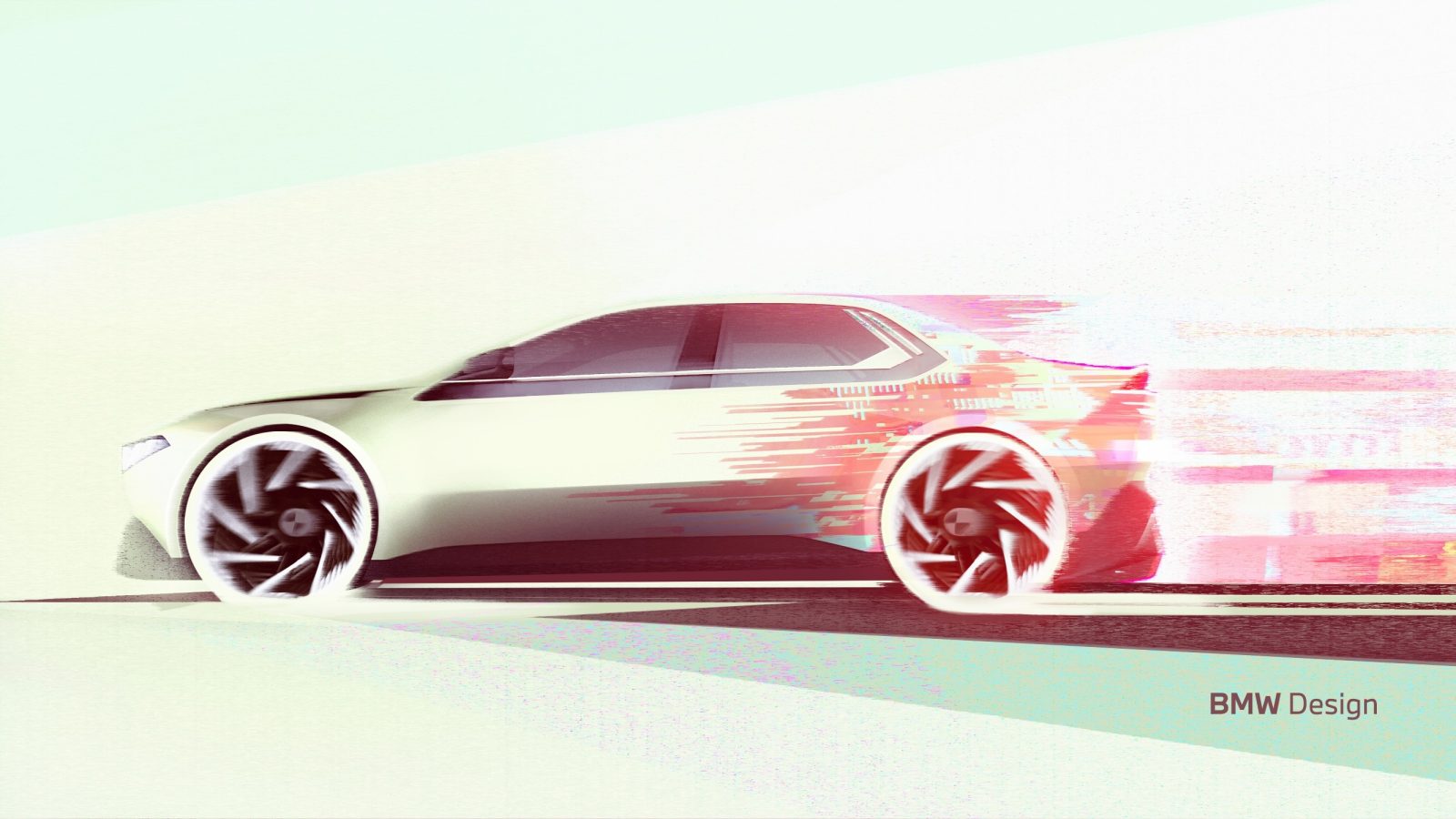
BMW M busy finalizing development of its first fully electric M3, internally known as ZA0, and while the powertrain marks a clean break from tradition, everything else suggests Munich is working hard to make this feel like a proper M car rather than an EV wearing an M badge.

A New Foundation, Not a Reinvention

The electric M3 will sit atop BMW’s Neue Klasse architecture, closely related to the upcoming electric 3 Series range internally referred to as NA0 and NA1. Production for the M3 EV is currently planned from March 2027 through October 2034, with a single variant at launch.

While the standard electric 3 Series will roll out in phases starting mid-2026, the M3 EV arrives once the platform has matured. That timing matters. BMW has been clear, at least behind closed doors, that M’s first fully electric core model cannot afford to feel experimental.

Quad Motors and a Staggering Torque Figure

Early indications point to a quad-motor layout, one motor at each wheel, unlocking fully variable torque vectoring and output figures that simply are not possible with combustion. Power should be in the 700 – 800 hp range with peak torque around 1,000 lb-ft, delivered instantly and independently across all four corners.

Straight-line pace will be brutal, but the more interesting story is how BMW M plans to use that hardware. Expect software-driven handling modes that actively shape yaw, traction, and throttle response to mimic the adjustability M drivers expect. This is less about raw numbers and more about preserving that familiar M sense of control at the limit. Powering it all will be the “Heart of Joy” processing unit previewed in last year’s Vision Driving Experience concept. The new technical architecture processes to allow engineers to finely calibrate every element of performance and feedback in ways we’ve never seen in an EV before. The promise is an electric M3 that feels as nuanced as a classic petrol version.

The BMW Vision Driving Experience mule.

Familiar M Car Design Language & Materials

Despite the electric shift, BMW is clearly aiming for continuity inside and out.

Standard equipment is expected to include full M sport seats, with optional bucket seats constructed from BMW’s newly announced natural fiber composite. The same material will appear on interior trim pieces, offering a sustainability story without leaning on glossy carbon fiber everywhere.

Other expected highlights include M design trim, M seatbelts, and a head-up display as standard. Outside, the car will wear M-specific 20-inch wheels, with optional forged 20s or a staggered 20-inch front and 21-inch rear setup. Carbon ceramic brakes remain on the options list, as do M-specific headlights.

Purists may wince at one detail. The panoramic glass roof from the standard i3 appears set to carry over unchanged, with no lightweight alternative planned for the initial launch. Why? BMW’s view is simple. With the battery mass mounted low in the floor, center of gravity concerns are largely neutralized, even if the romance of a steel roof is gone. That said we expect a carbon roof to make its way to the options sheet eventually. BMW can’t leave that money on the table for long.
Context Matters. Meet the Electric 3 Series Family

Understanding the M3 EV also means understanding the broader electric 3 Series lineup that underpins it.

The NA0 and NA1 electric 3 Series range enters production in July 2026 and runs through late 2034. It spans multiple outputs, including 20, 40, 40 xDrive, 50, 50 xDrive, and an M60 xDrive flagship. Production begins in Germany, with San Luis Potosí joining roughly a year later.

The rollout is staged. One European model launches first, followed by additional European and US variants later in 2026. By March 2027, the M60 xDrive will be available globally.

In terms of size and packaging, expect a familiar 3 Series footprint. What changes is the tech. Multifunction seats previously reserved for the 5 Series and above become available, along with expanded Iconic Glow exterior elements, panoramic glass roof as standard, and a new tiered approach to driver assistance that includes highway and city capability. Panoramic vision, an optional HUD, and Harman Kardon audio round out the tech story.

The M60 xDrive effectively serves as a bridge between the regular electric 3 Series and the full M3 EV. It brings adaptive M suspension, M brakes, an M steering wheel, multifunction seats, HUD, and HK audio as standard. Wheels start at 20 inches, sport tires unlock a higher top speed, and M-colored headlights and exterior accents add visual separation.

Our time in BMW’s Vision Driving Experience was eye opening and stomach churning

What This Really Means for M

The electric M3 will not replace the emotional appeal of a straight-six with a H-pattern manual. BMW knows that. But the ZA0 project is less about replacing the past and more about proving that M can still define driver engagement when sound and revs are no longer part of the equation. In our brief time in BMW’s Vision Driving Experience, it’s clear that BMW’s aiming for more than just outright performance but also feedback and feel.

If BMW gets the calibration right, the electric M3 could redefine what performance sedans feel like in the EV era rather than simply keeping up with it. Either way, this is the most important M3 since the original E30.

And like that car, it will likely be controversial long before anyone drives one.


Source link

H. Moser & Cie: Behind the Irreverence Lies Serious Watchmaking

0
H. Moser & Cie: Behind the Irreverence Lies Serious Watchmaking


H. Moser & Cie
H. Moser & Cie manufacture facade

What does a manufacture that makes watches out of cheese look like…or maybe that should be what could it possibly taste like, never mind how it smells! What if the same manufacture also made a watch out of plants, which were literally alive on the case so it was less a watch than the world’s first and only wrist garden?

We might also wonder about the smell of such a watch, but we digress… Of course, the benefit of making a watch case out of dairy and one that is alive (affectionately dubbed Moser Nature) is that you automatically know which watchmaker we are discussing…if the pictures and description did not spoil it.

The irony is that H. Moser & Cie’s manufacture at Neuhausen am Rheinfall looks pretty much any other contemporary watch manufacturing facility, minus the bombast of some. In many ways, it is the not-perfect- but-just-right expression of a family-owned brand that is steadfast in its independence. H. Moser & Cie., under the quietly defiant stewardship of the Meylan family, has cultivated a reputation for being technically masterful, audaciously creative and, at its best, unexpectedly funny. It is a brand that honours tradition by tastefully (sometimes) breaking its rules, proving that true luxury is, above all, rare. Alright, that is a bit much, even if it is true. Allow us to back all this up, without the help of any one H. Moser & Cie watch…

From Imperial Russia With Love

H. Moser & Cie
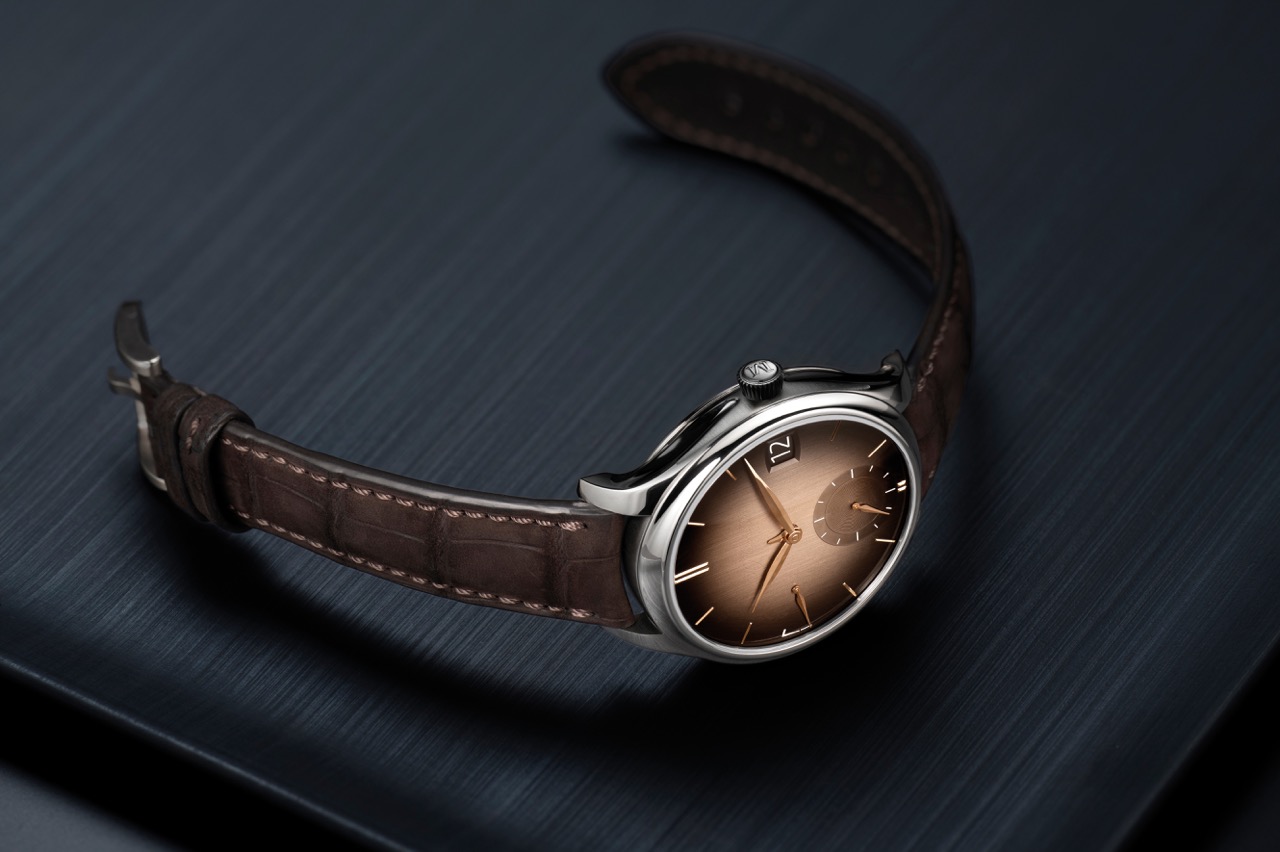
Endeavour Perpetual Calendar with smoked salmon dial

In the spirit of irreverence, let us say that the story begins not in Switzerland, but in St. Petersburg in 1828, where founder (the properly Swiss and Schaffhausen- born) Heinrich Moser established a brand that would become a favourite of the Romanov court.

An astute industrialist as well as a master watchmaker, Moser later returned to Schaffhausen, where he harnessed the power of the Rhine Falls to build a dam, powering the region’s industrial growth.

Despite the auspicious beginnings, with the brand’s museum estimating that Moser made hundreds of thousands of watches, history had other plans here. Obviously, we need not explain about the Romanovs (it did not end well) and the Swiss operations faded through a series of ownership changes in the 20th century.

For decades, the name was little more than a footnote in the history of watchmaking until 2002, when it was formally revived. The true turning point came in 2012 when the Meylan family, through their holding company MELB, acquired the brand.

Led by the charismatic Edouard Meylan, H. Moser & Cie. was reborn with a new philosophy: to be “Very Rare.” This is not just a marketing slogan; it is a mission statement reflecting its limited annual production of around 4,000 watches, its mastery of approximately 20 in-house calibres, and a proudly contrarian spirit.

H. Moser & Cie
A group of watchmakers with traditional and contemporary tools

This boldness has produced some of the most talked-about timepieces in recent memory, from the “Swiss Alp Watch,” a mechanical middle finger to the smartwatch craze, to timepieces made of the aforementioned Swiss cheese (the Swiss Mad watch, which was a powerful commentary on the legally protected Swiss Made standard and remarkably prescient about broader global manufacturing concerns). Yet, beneath the wit lies a deep reverence for aesthetic purity.

Moser’s signature is the fumé (smoked) dial—a stunning gradient of colour that darkens towards the edges, often left completely sterile, free of logos or unnecessary text. The brand’s design philosophy is one of elegant reductionism, perhaps best exemplified by its perpetual calendar, which cleverly uses a small central arrow and the 12 hour indices to indicate the month, decluttering the dial in an act of horological genius.

Engineering Independence

This creative freedom is powered by profound technical independence. At the heart of the Neuhausen am Rheinfall manufacture is its sister company, Precision Engineering AG (PEAG).

This specialist firm is dedicated to producing the most critical components of a watch movement: the balance wheel and, most importantly, the hairspring. PEAG might also manufacture other escapement components, such as the pallet fork and the escape wheel, but we did not see this ourselves.

H. Moser & Cie
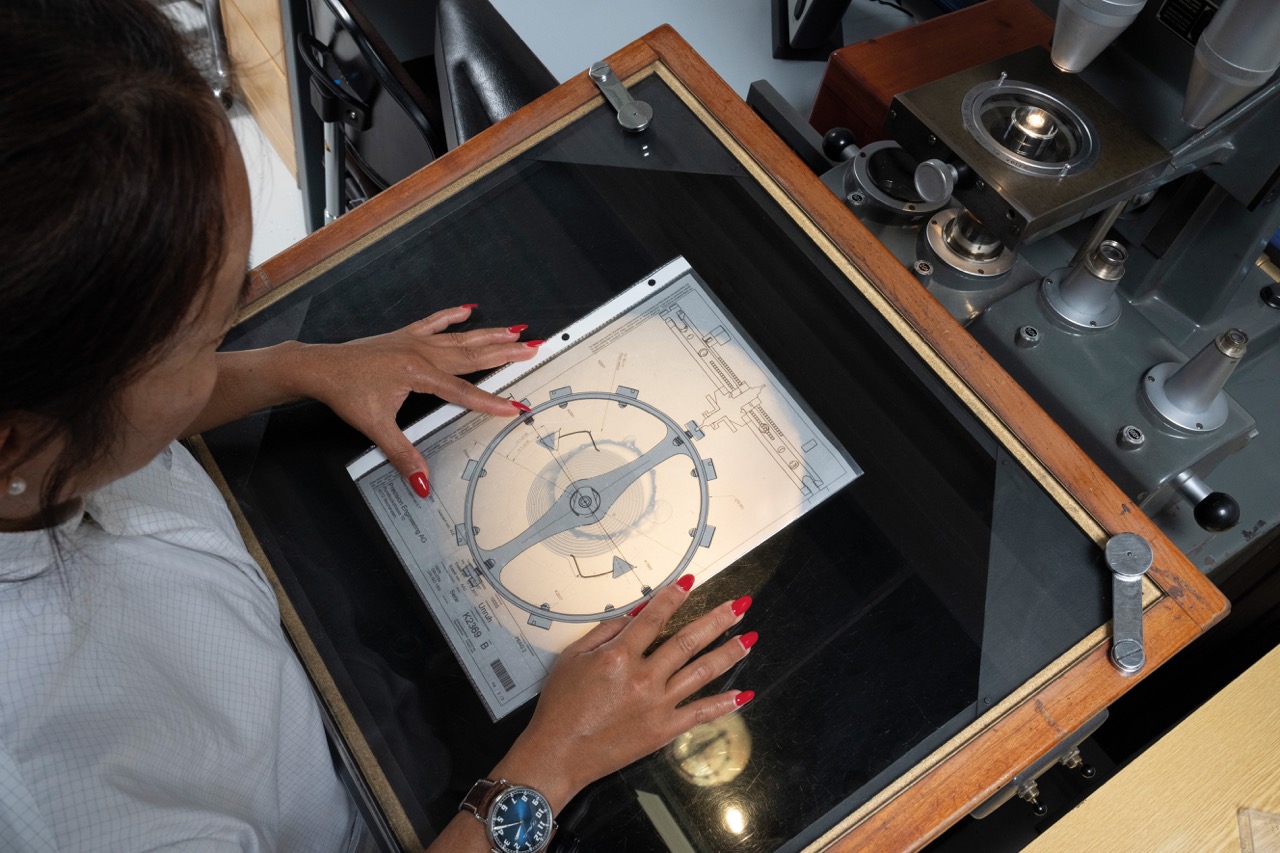
The tool for getting the hairspring in shape

The hairspring, a minuscule, spiralled wire, is the regulating organ of a watch—its beating heart, as we have sometimes waxed lyrical about. Its quality dictates the timepiece’s accuracy, yet its production is so specialised that only a handful of companies in the world have mastered it. PEAG is one of them.

The process is a marvel of patience and precision, beginning with a 0.6 mm wire of a proprietary alloy named PE5000 (which is as different to Nivarox as Nivachron is to silicon) that is painstakingly drawn over two weeks to a thickness of just 0.01 mm (we are rounding up so you will have to imagine that it is even thinner, if you can).

This wire is then flattened to be finer than a human hair (0.07 mm, if you are counting) before being meticulously hand-coiled – with the help of special tool, as shown in the images – into a perfect spiral. PEAG not only supplies Moser but also a select group of other high- end independent brands, producing up to 800 of these vital components daily.

Streamlined Production

On this note, even a dedicated maker of watches like H. Moser & Cie cannot claim to make everything. The scale simply does not match up, which is evident when you consider how many hairsprings PEAG can make.

Moser says it makes 80 per cent of its calibres,with the remainder produced by Agenhor and Vaucher. These producers, likewise are intertwined with each other, with Moser owning a minority stake in Agenhor. For its cases, Moser relies on the facilities of a Vaucher sister firm, Les Artisans Boitiers, which you can read more about in our revisit of the Parmigiani Fleurier manufacturing sites.

H. Moser & Cie
Another stage of hairspring work

Returning to PEAG, among its innovations is the Straumann Double Hairspring®, where two identical hairsprings (a challenge to find!) are paired and set to oscillate in opposite directions. This ingenious system averages out errors in timekeeping rates, achieving a level of precision comparable to a tourbillon but without its complexity or fragility. Moser also has a modular escapement, where the entire regulating organ can be removed as a single unit for servicing. This is a practical innovation, also seen at other more contemporary watchmakers, that streamlines maintenance without compromising performance.

We have spent quite a bit of time on hairsprings and the like but it should be remembered that it is not only PEAG doing the work of making components. The rest of the bridges, plates, pinions and gears are made in-house at Moser, which also shares its capabilities and capacities with Hautlence, another sister company. Like many other manufactures, there are CNC machines, computers and more traditional lathes and the like. Basically, everything you expect from T1 and T2 stage manufacturing is accounted for.

Arguably, all this is not enough to make a manufacture, and H. Moser & Cie gets the idea that people are at the centre of watchmaking. As it happens, for its anniversary this year, Moser has released a series of videos starring its own watchmakers, machine operators and museum curator.

Reimagining Complications

H. Moser & Cie
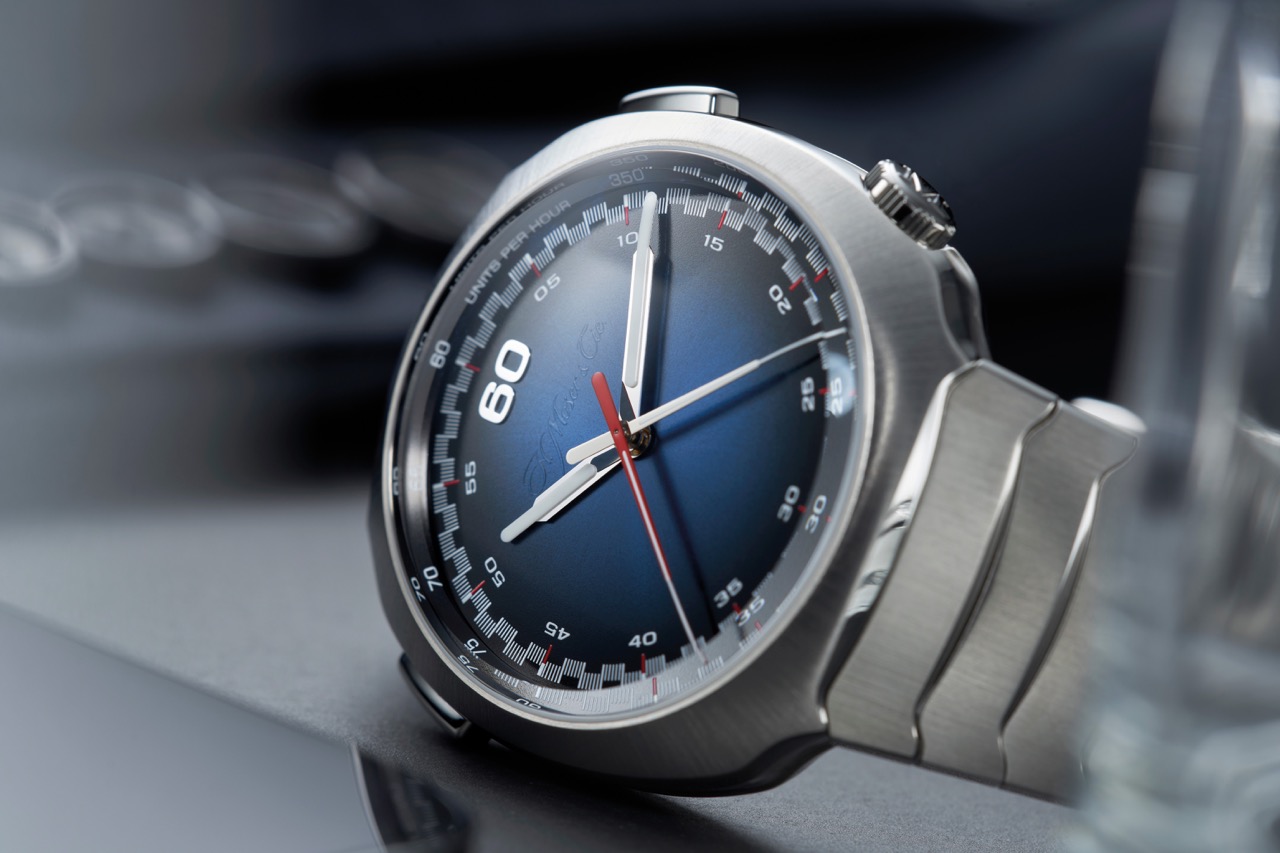
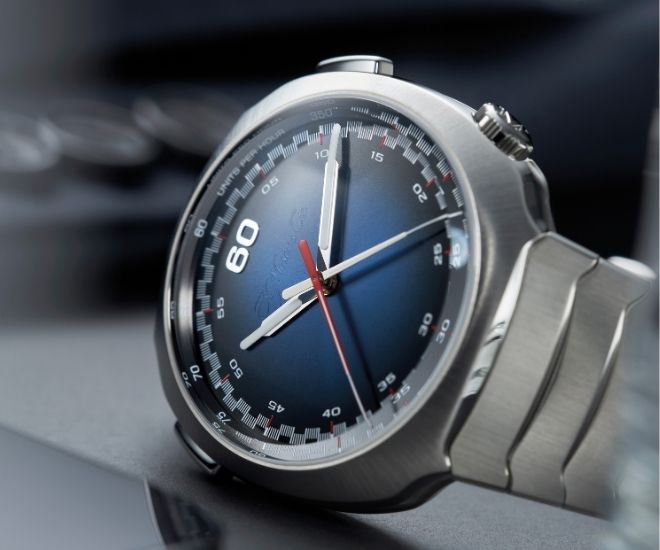
Streamliner Chronograph with funky blue dial

Moser applies its own brand of pragmatism and creativity to high horology. Minute repeaters are engineered with gongs and hammers on the dial side, not hidden within the movement, even if that might be more in tune with the H. Moser & Cie ethos.

Chronographs have been designed with the winding rotor placed on dial side, ensuring that the intricate beauty of the calibre, with its column wheels and levers, is fully visible through the caseback. On the other hand, chronographs have also been made to be to be completely centralised in display style, which is very much in keeping with the Moser way.

Each complication is reconsidered not just for function, but for aesthetic and emotional impact, reflecting the aforementioned ethos: to master time, not just measure it. This commitment to excellence has not gone unnoticed. Moser has earned prestigious accolades, including the Tourbillon Prize at the Grand Prix d’Horlogerie de Genève. In 2026, it will graduate from the incubator section of the Watches & Wonders fair to the main hall, a move that signals its arrival as a major force in independent watchmaking.

With its current facility at capacity, a new manufacture is already under construction, set to be completed in 2028. If you do visit, we recommend not skipping the museum, where the aforementioned curator will delight in telling you about the fantastic history of the Mosers. You cannot make this stuff up, but we had to skip it here, for space.

This story was first seen as part of the WOW #81 Autumn 2025 Issue

For more on the latest in luxury watch reads, click here.


Source link

BLUETTI Elite 200 V2 Review: A Compact Solar Generator for Small-Scale RV Power Needs

0
BLUETTI Elite 200 V2 Review: A Compact Solar Generator for Small-Scale RV Power Needs


BLUETTI Elite 200 V2 Review: A Compact Solar Generator for Small-Scale RV Power NeedsBLUETTI Elite 200 V2 outside of camper

When we first got our BLUETTI Elite 200 V2, we were excited to see how it would enhance our travels. Our family travels full-time in a 2021 Grey Wolf 22MKSE, and reliable off grid power is always a challenge. We’d hoped this compact solar generator might serve as a perfect addition to our main EcoFlow system. And after several months of use, we’ve learned exactly where the Elite 200 V2 shines and how helpful it has been for our small RV power needs. 

First Impressions

Right out of the box, the BLUETTI Elite 200 V2 feels well built and thoughtfully designed. At around 55 lbs, it’s not exactly lightweight, but it’s still easy enough to move around especially with the built-in side handles, which make picking it up a lot more convenient. Setup was straightforward: plug it in, power it on, and it’s ready to go! What impressed us most was how fast it charges. The combination of AC wall charging and solar input makes topping off the battery quick and convenient. During our travels, we have connected it to two 400-watt solar panels (for a total of 800 W input), and it handled the load easily. Charging performance was consistent and the system stayed cool and quiet each and every time. 

What’s in the Box

This power station comes with everything you need to get up and running right away. When you unbox the BLUETTI Elite 200 V2, here’s what you’ll find:

  • The Elite 200 V2 power station
  • AC charging cable
  • Solar charging cable
  • Grounding screw
  • User manual and quick-start guide

Bluetti Elite 200 V2 with included cords and manual

Capacity & Power

The Elite 200 V2 uses a 2,073.6Wh LiFePO4 battery, which works out to roughly 2kWh of usable power. In everyday use, that means you can keep phones and laptops topped off for a few days, run a small fan during a warm afternoon, or even use a small space heater for several hours without draining your main RV batteries. This has become really helpful when we are off the grid and trying to stretch every bit of power we can. 

It also delivers up to 2,600 watts of continuous AC output which is plenty for things like a coffee maker, slow cooker, lights, laptops, and that small space heater. It handles the quick burst of power that appliances need when they first start, like when a blender powers on. And when it’s time to recharge the fast AC charging brings it back to around 80% in about an hour so it is ready to go again without much down time. 

Using the Bluetti Elite 200 V2 outside to power our crockpot 

Cost

The Elite 200 V2 sits in the mid-range price category for compact power stations, and for its size, output, and LiFePO₄ battery, it’s competitively priced compared to similar units.

  • Typical price: Usually $799–$1,099 depending on the retailer and current promotions.
  • Bundles: Packages with solar panels or other added extras will of course cost more and typically start around $1,300. 

Real-World Use & Travel Role

The Elite 200 V2 has proven to be a reliable option for our everyday smaller power needs. We’ve used it to charge phones and tablets during long drives since our truck severely lacks in the ports and plugs department. It can run our boys’ gaming laptop, a crockpot all day, a toaster oven, and a blender while boondocking all without issue! We have even used it to power our starlink! It has also come in handy when Anthony works with power tools, running a corded angle grinder and a heat gun for camper repairs, charging other cordless tools, and even powering our son’s heat lamp for his pet gecko while off-grid. 

Bluetti Elite 200 V2 powering our starlink while camping

For a compact unit, it delivers stable power and recharges surprisingly fast, which is a huge help on travel days and while boondocking. While it can’t power a full 30 amp RV or plug into the main electrical system, that’s not its purpose. The Elite 200 V2 is designed for smaller-scale portable needs and has become our go to secondary power source, helping us save on generator fuel (when it’s been rainy or cloudy and we need to run our gas generator) and keeping our devices and gear charged when we’re off-grid.

The BLUETTI mobile app is another big plus and super helpful. It connects easily, gives real-time updates, and lets us monitor input, output, battery percentage, and estimated runtime right from our phones. When we used it to power our son’s gecko heat lamp, it was reassuring to see exactly how many days of power were left since the lamp is essential for the little geckos survival. 

Anthony using the Bluetti Elite 200 v2 to power a grinder for camper repairs

Looking Ahead

While the Elite 200 V2 is perfect for small scale portable power Bluetti is already stepping into full rig capability with its new RV5 Power Hub series. This system runs on a 48V platform and can push out up to 5,000 watts giving it enough strength to power your entire rig from the AC to your cooking appliances and other big draws you rely on when you’re completely off-grid. This is definitely something we’re eventually wanting to switch to in the future as it would eliminate our power concerns! It’s also a clear sign of where Bluetti is heading next moving from their already amazing handy portable units to fully integrated RV power solutions.

Final Thoughts

  • Overall, we’ve been very satisfied with the BLUETTI Elite 200 V2. It’s reliable, fast charging, easy to use, and backed by a user friendly app that makes power management simple. For small scale RV power needs or for anyone who wants dependable energy for travel, camping, or emergencies, it’s an excellent option. It may not run a 30 amp RV on its own like our EcoFlow unit  but it’s an outstanding addition for your everyday small power needs. 

Bluetti portable power station 


Source link

Tesla China delivery centers look packed as 2025 comes to a close

0
Tesla China delivery centers look packed as 2025 comes to a close


Tesla has captured the hearts of South Korea’s 20s-30s demographic, emerging as the group’s top-selling imported car brand in 2025. From January to November, young buyers purchased over 21,000 Teslas, putting it far ahead of fellow imported rivals like BMW and Mercedes-Benz. 

Industry experts cited by The Economist attributed this “Tesla frenzy” to fandom culture, where buyers prioritize the brand over traditional car attributes, similar to snapping up the latest iPhone.

Model Y dominates among young buyers

Data from the Korea Imported Automobile Association showed that Tesla sold 21,757 vehicles to the 20s-30s demographic through November, compared to BMW’s 13,666 and Mercedes-Benz’s 6,983. The Model Y led the list overwhelmingly, with variants like the standard and Long Range models topping purchases for both young men and women.

Young men bought around 16,000 Teslas, mostly Model Y (over 15,000 units), followed by Model 3. Young women followed a similar pattern, favoring Model Y (3,888 units) and Model 3 (1,083 units). The Cybertruck saw minimal sales in this group.

The Model Y’s appeal lies in its family-friendly SUV design, 400-500 km range, quick acceleration, and spacious cargo, which is ideal for commuting and leisure. The Model 3, on the other hand, serves as an accessible entry point with lower pricing, which is valuable considering the country’s EV subsidies.

The Tesla boom

Experts described Tesla’s popularity as “fandom culture,” where young buyers embrace the brand despite criticisms from skeptics. Professor Lee Ho-geun called Tesla a “typical early adopter brand,” comparing purchases to iPhones.

Professor Kim Pil-soo noted that young people view Tesla more as a gadget than a car, and they are likely drawn by marketing, subsidies, and perceived value. They also tend to overlook news of numerous recalls, which are mostly over-the-air software updates, and controversies tied to the company.

Tesla’s position as Korea’s top import for 2025 seems secured. As noted by the publication, Tesla’s December sales figures have not been reported yet, but market analysts have suggested that Tesla has all but secured the top spot among the country’s imported cars this year. 


Source link

M2 CS in the Rain, Neue Klasse iX3 First Drive, 2025 M5 Touring

0
M2 CS in the Rain, Neue Klasse iX3 First Drive, 2025 M5 Touring


In the latest episode of the BMWBLOG Podcast, we keep it simple: three big test drives, one conversation — and (briefly) one very confident cat. Episode 16 is all about recent seat time, from a soaked racetrack in South Carolina to sunny southern Spain, ending with real-world impressions of BMW’s newest super wagon.

We start with the BMW M2 CS, after Nate’s track day at Michelin’s Laurens Proving Grounds… in absolutely brutal weather. With standing water on parts of the course, BMW even swapped the cars off their Cup tires and onto Michelin Pilot Sport 4S rubber. Despite the conditions, the big takeaway was clear: the M2 CS feels more alive than the standard M2, with a playful rear end that’s still predictable and easy to catch — even when the grip disappears. We also tackle the question everyone asks: is the CS premium worth it, or can a standard M2 get close enough with mods?

From there, we jump into the future with a first drive of the Neue Klasse iX3. Horatiu shares impressions from southern Spain, including time at Ascari, and explains why the new platform feels like a leap forward in driving dynamics, braking smoothness, and overall tech execution. We dig into BMW’s new “Heart of Joy” approach to dynamics control, why the iX3 drives smaller than it looks, and how the regenerative braking finally feels natural enough that passengers won’t accuse you of making them carsick.

We wrap with the 2025 BMW M5 Touring, a car that delivers outrageous speed but also resets expectations. The plug-in hybrid system makes the M5 feel shockingly quick at highway speeds, and the EV range is usable enough for daily errands — but the size, weight, and price are impossible to ignore. The debate becomes less “is it good?” and more “what do you want an M5 to be in 2025?” It’s a conversation that ends up circling around a familiar conclusion: the new M5 is incredible on its own terms, even if it doesn’t feel like the M5 of 15 years ago.

You can listen to the full episode on all major podcast platforms, or watch the video version on YouTube (for the Mary Gold cameo).


Source link

What are automotive ‘over-the-air’ updates? A marketing professor explains

0
What are automotive ‘over-the-air’ updates? A marketing professor explains


Whenever automakers discover that a vehicle has a defect or does not comply with U.S. laws, they must notify the National Highway Traffic Safety Administration and mail a notice to each customer who owns or leases the affected vehicles. Automakers must also recall those cars, trucks or SUVs – which means they have to fix the defect across the entire fleet.

People with recalled vehicles usually have to schedule a visit to an authorized dealership, where a mechanic repairs the car.

But vehicles are increasingly high-tech contraptions. Although most recalls still require the replacement or repair of auto parts, such as air bags or brakes, a growing number of issues are resolved without any help from a mechanic.

All they require is an “over-the-air update.” That’s the technical term for what happens when you update any software program used by a device, whether’s it’s a smartphone or a sedan.

Over-the-air updates are especially common for vehicles that run fully or partially on electricity instead of gasoline or another fuel. These digital recalls require little or no effort. For example, Tesla regularly fixes its cars by updating its software. Its drivers often don’t have to do a thing. In other cases, a Tesla owner simply has to tap a few buttons on the car’s touchscreen.

According to the law, it doesn’t matter if safety-related fixes demand a software upgrade or a trip to the dealership. Either way, notifying the National Highway Traffic Safety Administration and all affected drivers is mandatory.

Why over-the-air updates matter

Electric vehicle sales nearly doubled from about 300,000 in 2020 to more than 600,000 in 2021. EV sales rose another 76% in first quarter of 2022 even as sales of all new vehicles dropped by 15.7%.

U.S. EV sales could be on the verge of far more growth, which would make over-the-air updates increasingly common. But drivers and investors are raising an array of safety concerns that could put the brakes on the EV market’s expansion.

Serious problems have included electric vehicles failing to start, losing power and catching fire because of battery defects.

Musk objects to the word ‘recall’

Tesla has pushed harder than its competitors to rely primarily on over-the-air updates to fix problems with its electric vehicles. Its CEO, Elon Musk, has for years publicly questioned the wisdom of calling over-the-air updates “recalls.”

A crumpled Tesla after a car crash
The government is investigating whether Tesla’s software is contributing to collisions.
AP Photos/Florida Highway Patrol

In some cases, Tesla has conducted over-the-air updates to resolve safety defects without notifying the National Highway Traffic Safety Administration or Tesla owners that a recall was underway.

Because that’s against the law, the agency has ordered Tesla to provide those details.

Tesla has used over-the-air updates to resolve, for example, issues with its windshield wipers and seat belt chimes. It has also used over-the-air updates to address problems with its partially automated driving systems. Those features are the subject of a government investigation because of a spate of crashes with parked emergency vehicles in which first responders were using warning signs, such as flashing lights or flares.


Source link

Bugatti Tourbillon prototype gets stuck in the snow

0
Bugatti Tourbillon prototype gets stuck in the snow


The Bugatti Tourbillon has been undergoing extensive testing across multiple terrains and weather conditions. We saw the hypercar being put through its paces in the sweltering heat of the UAE. More recently, VP1 (Verification Prototype) was spotted on a cold winter day in Zagreb, Croatia.

The Tourbillon has been driving around the area, which is home to Bugatti Rimac, even during the holidays. @car_spotting_croatia has been tailing the hypercar on highways, in parking lots and even in traffic, bringing us stunning images of the test mule in action.

On one such dreary winter day, the Tourbillon prototype got stuck in the snow. An image shared on Instagram shows the hypercar beached in snow that appears to be at least a foot deep. When the high-tech 8.3-liter V16 hybrid powertrain failed to extract the car, an old-fashioned spade came to the rescue.

Source: @car_spotting_croatia


Source link

US collector cancelled his Koenigsegg Jesko order; Here’s why

0
US collector cancelled his Koenigsegg Jesko order; Here’s why


It’s been a while since we got a garage update from Manny Khoshbin. In his latest video posted on YouTube, Manny reveals why he cancelled his Koenigsegg Jesko order, and no, it hasn’t got anything to do with reliability concerns voiced by some owners publicly on social media in the recent past.

Manny has cancelled his Jesko order simply because he is getting an upgrade. Since he is an old customer, Christian von Koenigsegg has agreed to allot him a Sadair’s Spear – a more exclusive, track-focused version of Jesko. It is lighter and more powerful than the standard version and is limited to just 30 units.

The hypercar features a more extreme aero package with an active, top-mounted double-blade rear wing, refined underfloor strakes, wheel arch louvres, larger canards and hood vents.

Koenigsegg Sadairs Spear-5

The twin-turbo V8 engine has been tuned to deliver 1625 hp on E85 fuel, up from 1300 hp. The car weighs 35 kg less than the standard Jesko, enhancing its power-to-weight ratio beyond 1:1.

The Sadair’s Spear holds the Goodwood Hill Climb record, completing the run in 47.14 seconds. It also held the lap record at Laguna Seca until the Czinger 21C destroyed it earlier this month.


Source link

Renault Filante Record 2025 Raises The Efficiency Bar For Electric Cars

0
Renault Filante Record 2025 Raises The Efficiency Bar For Electric Cars


Support CleanTechnica’s work through a Substack subscription or on Stripe.


In the early days of the automobile, manufacturers like Renault used racing to improve the breed and attract customers. That led to a number of “one-off” cars that had a single purpose — go faster than everyone else. Beating the other guys often meant stuffing a bigger engine under the hood. Cubic inches, not aerodynamic efficiencies, were the key to getting to the checkered flag first.

Few people understood how important aerodynamics were until Colin Chapman brought his Lotus 38 to Indianapolis Motor Speedway in 1965. Prior to that, the Indy 500 had been won repeatedly by ponderous race cars powered by great, thumping Offenhauser engines. Chapman showed the world that a smaller engine in a more aerodynamic car was the fastest way around the track.

Efficiency is the watchword for electric cars for one very simple reason. Today’s batteries are much less energy dense by either weight or volume than gasoline, which has 33.7 kWh of energy available in every gallon. Simply put, most passenger car battery packs have roughly the energy equivalent of 3 gallons of gasoline or less. No wonder efficiency is so critical to making electric cars that are practical for everyday driving.

Renault has been involved in Formula One racing since 1977. During those nearly 50 years, it has learned a thing or two about aerodynamic efficiency. Today’s Formula One teams do most of their testing in wind tunnels, where every curve of the bodywork is meticulously analyzed to reduce turbulence. Building on that body of knowledge, the company has just revealed its Filante Record 2025 experimental electric car.

Shifting Priorities

In a blog post about the car, Renault said, “Today, priorities have shifted. The question is no longer ‘How fast can we go?’ but rather ‘How far can we travel intelligently?’ Filante Record 2025 is part of this shift. It is less a nostalgic nod than a way of drawing on Renault’s heritage to explore a new approach to mobility.”

Sandeep Bhambra is the head of design for Renault’s advanced design and concept cars division. He said, “Our goal is not to look backward, but to draw on our roots to meet today’s needs. We are not aiming to break a speed record; efficiency is now the target.”

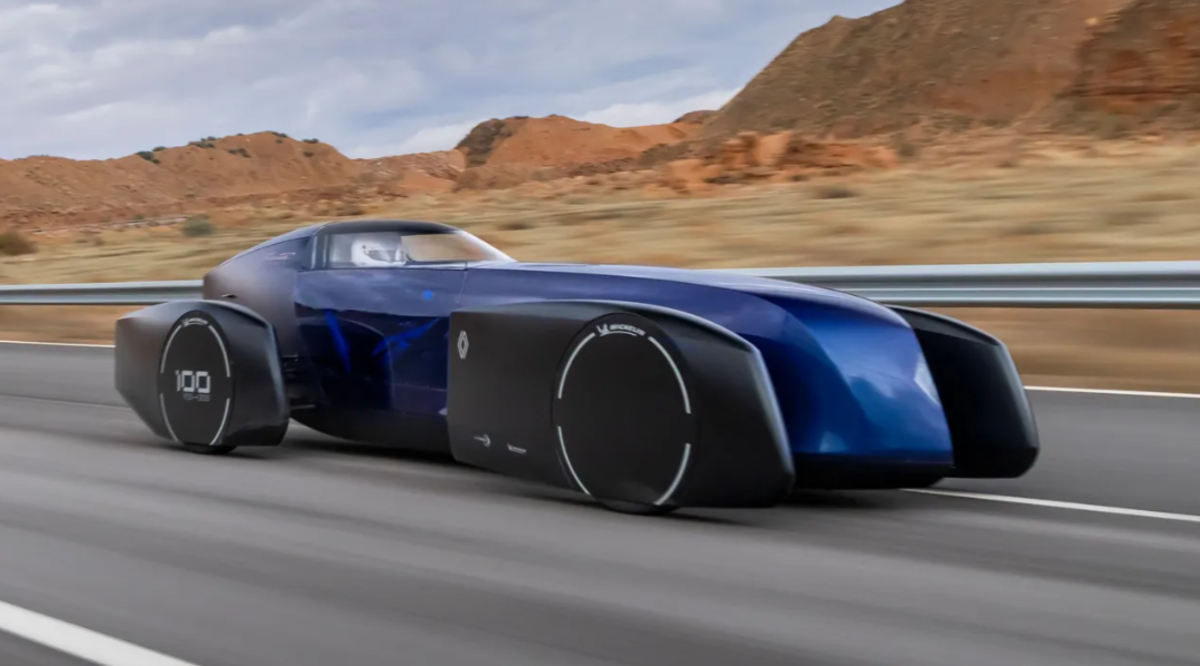
The Filante Record 2025 is a learning tool, Renault says. Every element, from the shape of each detail to the materials used, was designed to concretely measure the impact of technical choices on real-world vehicle energy consumption. The project was carried out in close collaboration with Ligier for the vehicle’s construction and with Michelin for the development of ultra-low rolling resistance tires.

Add Lightness

Batman, your electric car is ready! Credit: Renault

Colin Chapman was obsessed with making lightweight cars. “Simplify then add lightness” was his motto. In an age when horsepower was king, Chapman dryly observed, “Adding power makes you faster on the straights. Subtracting weight makes you faster everywhere.” It also makes electric cars that can travel further on a single charge.

With the battery already accounting for more than half of the vehicle’s total mass, weight reduction was a central focus of the Filante Record 2025 project. Carbon fiber, composites, and optimized structures were used as the teams worked to shave off weight gram by gram in order to keep the mass of the experimental car around 1,000 kg (2,204 lb). This focus on weight was not intended to achieve an absolute feat in itself, but rather to better understand how material lightweighting influences the driving range of an electric vehicle.

Another major focus of the work was the SCx — the product of frontal area and drag coefficient — which measures aerodynamic efficiency. An initial wind tunnel session revealed excessive drag, putting the efficiency record out of reach. Designers and engineers then had to work together to re-engineer the airflow around the car by redesigning the wheel fairings, the cockpit proportions, the side surfaces, and the transitions between the central cell and the wings.

Aerodynamicist Jocelyn Merigeault said, “We first simplified the wheel fairings, a major source of drag, to achieve a cleaner, more efficient shape. From the outset, Filante Record 2025 showed a genuine predisposition for aerodynamics. Our work was about revealing that potential and aligning it with the performance objectives.”

Impact On Production Cars

Will the work on this car result in changes to Renault production vehicles? Not in any obvious way, but it will influence future battery-powered cars from the company. That’s the whole point of these kinds of experimental projects.

Drawing on its Formula 1 experience, Renault incorporated electronic control systems such as steer by wire and brake by wire to reduce weight and give the drivers more accurate control over the car. A rethinking of how to integrate the battery into the car improved weight distribution and reduced energy losses.

Renault says its goal is not to transfer those innovations directly to a future production model, but rather to observe which elements could enable tangible improvements in the next generations of electric vehicles.

Testing In Morocco

The testing took place at the UTAC Ceram test center in Oued Zem, Morocco. For nearly 10 hours, three Alpine test drivers took turns maintaining a steady speed of around 100 km/h, managing driving conditions and extracting the car’s full potential down to the finest details. Think of it as a Mobil Economy Run but for battery-powered cars.

The choice of a long, smooth track with limited exposure to weather variations made it possible to replicate conditions close to continuous highway driving. In the end, Renault Filante Record 2025 covered 1,008 km in fewer than 10 hours at an average speed of 102 km/h. The car still had 11% of its battery charge remaining, which would have allowed it to travel an additional 120 kilometers at 100 km/h.

New Record For An Electric Car

The Filante Record 2025, which used the 87 kWh battery pack from the Renault Scenic E-Tech, used 7.8 kWh of electricity per 100 km — equivalent to just under 8 miles per kWh. No production electric car exceeds 5 miles per kWh. Even the Mercedes EQXX, which is optimized for efficiency, can only manage 6.2 miles per kWh.

Of course, the EQXX is a real passenger car, whereas the experimental Renault is a single-seat, purpose-built, rolling test bed. For comparison purposes, the Scenic ETech has a range of 610 km (380 mi) WLTP, but that range drops by about 30% in sustained highway driving.

There are many parts of the Filante Record 2025 that are not suitable for production cars, things like ultra-narrow tires and carbon fiber suspension components. Still, as we say repeatedly here at CleanTechnica, the EV revolution is young. It took 30 years for gas-powered cars to adopt the self starter and another 20 years to perfect the automatic transmission.

Technological improvements to electric vehicles are happening at a far faster pace than they did for conventional cars. It’s fair to say that, every day in every way, electric cars are getting better and better, thanks to efforts like this from Renault.


Sign up for CleanTechnica’s Weekly Substack for Zach and Scott’s in-depth analyses and high level summaries, sign up for our daily newsletter, and follow us on Google News!


Advertisement


Have a tip for CleanTechnica? Want to advertise? Want to suggest a guest for our CleanTech Talk podcast? Contact us here.


Sign up for our daily newsletter for 15 new cleantech stories a day. Or sign up for our weekly one on top stories of the week if daily is too frequent.


CleanTechnica uses affiliate links. See our policy here.

CleanTechnica’s Comment Policy


Source link

Savior Heat 7V heated gloves review for vintage motorcyclists

0
Savior Heat 7V heated gloves review for vintage motorcyclists


When it comes to winter riding, it’s hard to overstate how effectively heated gloves extend your ability to safely and comfortably control your motorcycle. I realize many modern motorcycles—certainly most new BMWs—are equipped with heated grips, but grips only go so far by warming your palms. That wind whipping across the back of your hands saps heat quickly, even through your most thickly insulated gloves. To ameliorate my frozen hands while riding, I decided to purchase a pair of battery-powered heated gloves to use this winter and went with a pair from Savior Heat.

TLDR: Based on my real-world experience using Savior Heat’s 7V rechargeable heated gloves on a vintage motorcycle, they are a decent value for the cost (between $100-150) and a handy bit of kit for anyone whose bike is not equipped with heated grips and weather protection. I expect to use them regularly this winter (2025-26).

Why I chose battery-powered heated gloves: Bikes from the 1960s and ‘70s, as I’m sure you’re aware, did not come equipped with heated grips. There are some aftermarket solutions (like Oxford Heated Grips), but if you haven’t upgraded the charging system on your beloved classic—or if it’s got a six-volt system—then running heated anything isn’t an option. When I started riding a 1976 R 90/6 back in January 2025, I simply dealt with the cold when I rode. Unfortunately, it meant I went on shorter rides less often than I’d have liked and often had to pause mid-ride (planned or not) to warm my frozen fingers.

As winter levelled its icy grip on us at the end of 2025, I found myself with not one but TWO vintage bikes—one of them with a 1966 R 60/2 with its stock six-volt electrical system. While I have upgraded the charging system on my R 90/6, I only own a heated jacket liner—not heated gloves.

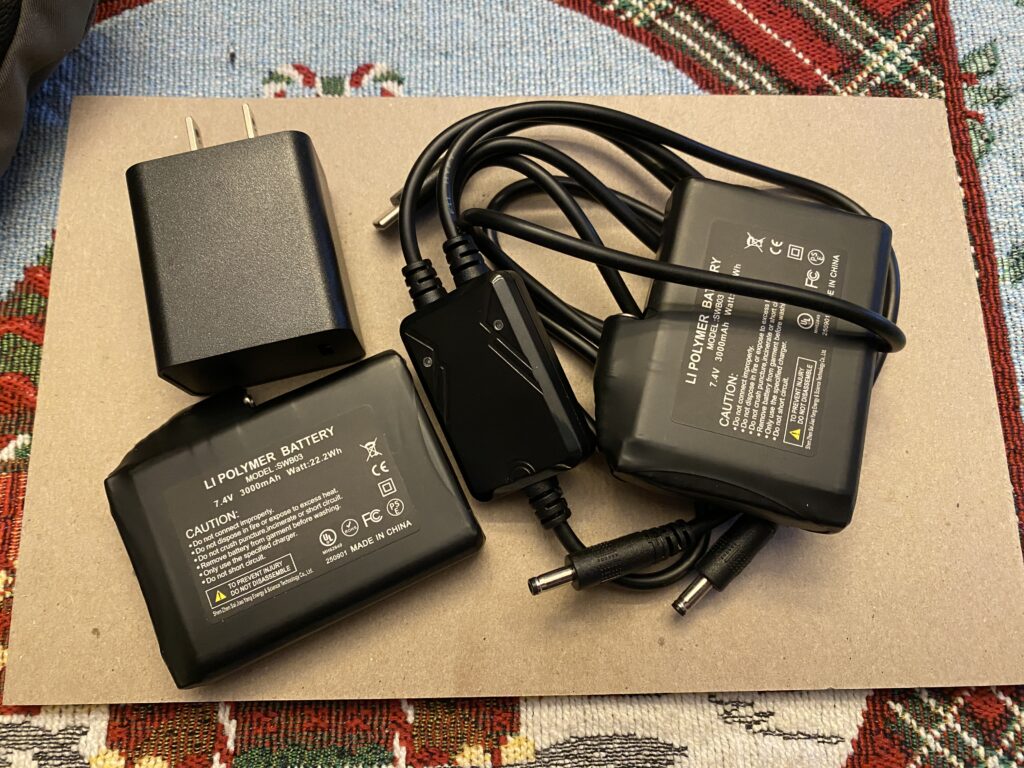
Savior Heat’s gloves come with two 7.4V, 3000mAh lithium polymer batteries, a charger and the charging cable, which charges both batteries at the same time.

What I was looking for—and what I wasn’t: I used Amazon’s abundant catalog to research various heated gloves equipped with seven-volt rechargeable batteries. My goal was to find gloves made by a company with a real website (for support and possibly spare batteries) that are at least water resistant. Because I thought I might find uses for them off the motorcycle, I started looking at gloves marketed towards skiers and snowboarders, thinking those would likely be hardy enough for motorcycling without looking like they came out of a Mad Max movie. I understood that by eschewing the armor and slide pads typically incorporated into motorcycle gloves, I was elevating my risk of injury in case of a crash, so there’s no need to write me to explain the error of my ways.

Price, sizing and the buying experience: I went with a pair of Savior Heat gloves I found on Amazon for $149.99. I ordered them in XL, but quickly found those were a bit small. Returning them through Amazon was easy, and I had a pair of XXLs in hand just a few days later. I also saved myself almost $50 by sending back the smaller pair, as the combo of size and color was on sale for a few days just before Christmas 2025. For $100, my expectations of how these gloves should perform were pretty low, so I was pleased when they turned out to work pretty well for what I was asking them to do. Worst case, if they turned out to be unsuited for motorcycle duty, I could use them for cold-weather outdoor events and probably enjoy them quite a lot.

How I use them in real-world riding: In the few weeks I’ve been using them, they’ve proven up to the kind of riding I do most often—around town, short jaunts on the freeways to get to some event or meeting, grocery runs and the like. I’m not sure long-distance riders would like them as much simply due to the fact that they’re battery-powered and must be periodically recharged. Early-morning commuters without fairings on their bikes will no doubt benefit from recharging them while at work.

Why I chose ski gloves instead of motorcycle gloves: Despite my list of requirements, I did think hard about trying Savior’s motorcycle gloves, but because I prefer to tuck my glove gauntlets inside my jacket sleeves, I stuck with the skiers’ gloves, which have the buttons and power readout on the back of the hand. The motorcycle-oriented gloves move those features to the gauntlet, which would require me to always have them outside my jacket sleeve. It’s a small thing for sure, but knowing how you prefer to wear your gear can often influence your purchasing decisions.

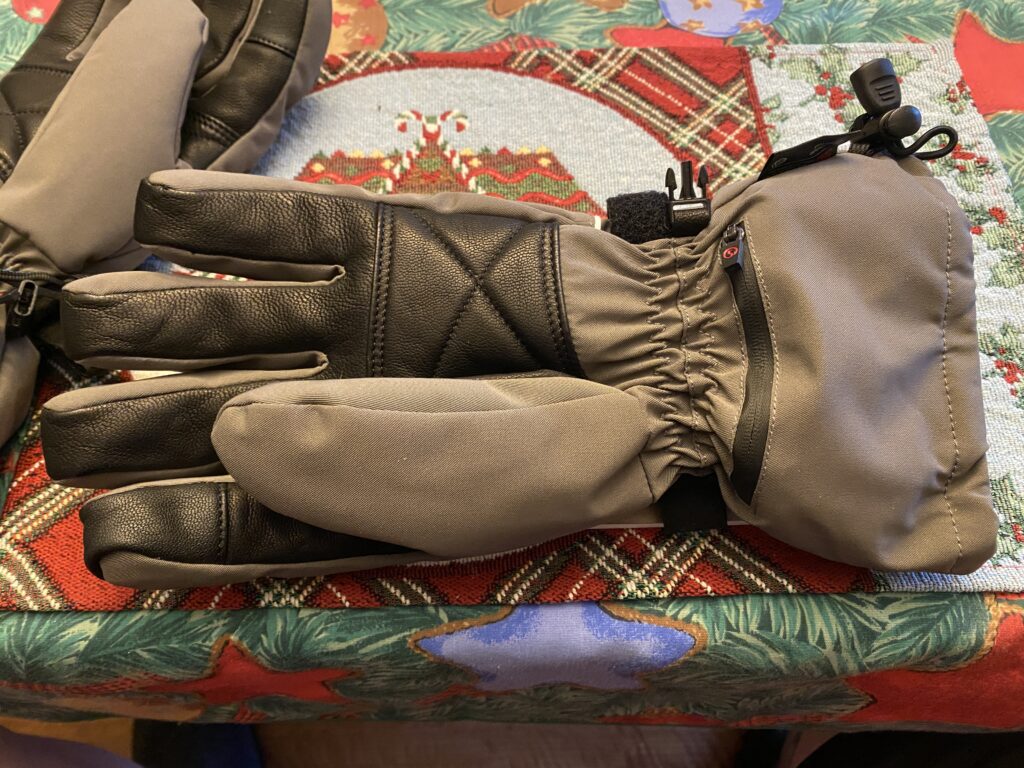
While constructed primarily of synthetic materials, the palms and fingers feature goat leather. A HIPORA layer provides waterproofness and wind protection.

Fit, dexterity and control feel on the motorcycle: The fingers have a nice curve to them—I assume it’s meant for ski poles, but a motorcycle grip isn’t that different, so they work well. Dexterity remains good at temps into the 30s—I haven’t ridden colder than that yet—and the only difficulty I encountered was in tucking in the cuff drawstring on the second glove I put on. I have this issue with my other winter gloves, so it’s not a detriment in my book, it’s simply a function of thicker-fingered winter gloves. Grip feel is adequate and I had no problems operating the buttons and controls on the bike; keep in mind that my R 90/6 has only a few buttons or switches and they are all relatively large.

Construction, materials and weather protection: The construction is typical for gloves of this type—even motorcycle gloves. Working from the inside out, you’ll find 3M Thinsulate for non-heated warmth and a HIPORA membrane to add a layer of protection from water and wind incursion. The palms and undersides of the fingers are made of goatskin, with the rest of the gloves made of synthetic fabrics. The gloves cinch at the wrist with a Velcro strap and have an elastic drawstring to close the cuff over your arm or jacket sleeve.

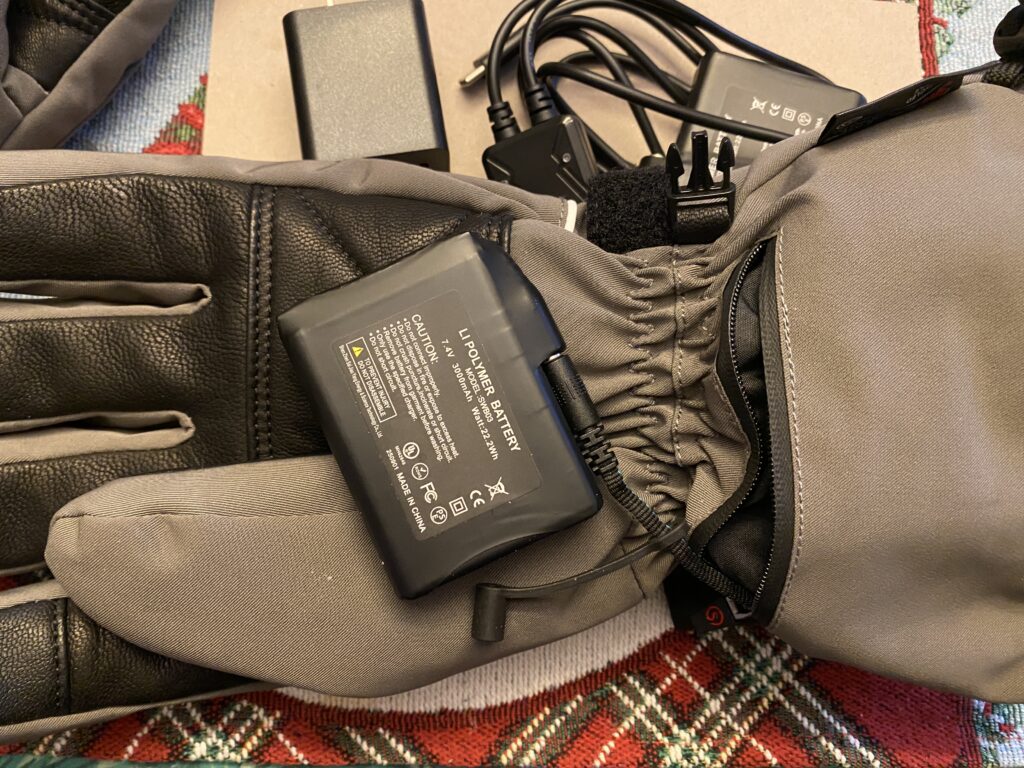
Battery design and charging details: The seven-volt battery plugs into a cord hidden in the bottom of the cuff; a waterproof zipper should keep everything secure and dry in most conditions. A nice touch is the included cap for the battery cable should you be using the gloves without the batteries plugged in. That should help prevent corrosion if any water does get into the system. The cable looks durable enough to withstand a good number of plug/unplug cycles.

The batteries, though small and flat, are dense and surprisingly heavy. Once you’ve got them installed and are wearing the gloves, the weight more or less disappears, but over the course of a long day of riding, I did notice a bit of extra wrist fatigue that I’m attributing to the extra weight. The manufacturer recommends charging the batteries overnight before first use, but I found my batteries were fully charged right out of the box. I still left them on the charger overnight because I follow instructions.

Heating levels, glove controls, battery life and overall performance: Upon first powering up the gloves with a two-second long press, they initiate in High. A nice feature is that they’ll stay on High for five minutes, then default to Medium until you turn them off. This gives you a good blast of initial heat, then balances it with longer battery life at the lower setting. The downside is that if you want them on High, you have to cycle through all the settings with short presses until you’re back on High. Turning the power off requires another two-second long press.

Control panel features a positive-click button that responds to long (2 sec) and short presses, a power output indicator and a battery power indicator.

Savior claims the batteries will output about 140° F (60° C) for up to three hours on High, about 122° F (50° C) for up to six hours on Medium and 113° F (40° C) for up to 10 hours on Low. I found their estimates for time accurate on High and Medium over the course of two weeks of riding in which I kept careful track, but keep in mind that’s with brand-new batteries and usually riding steadily for no more than 60-90 minutes at a stretch. At temperatures in the low 40s Fahrenheit, I found the Low setting inadequate, but I’m sure it would be useful on warmer rides. Savior says that lower external temperatures will affect how long the batteries last, but they don’t say at what temperature they tested the gloves to get their longevity estimates. I never drained the batteries completely in one day of riding when using primarily the Medium setting.

To be honest, I might not bother using the gloves on the Low setting—they are well insulated and on rides with temps in the 50s, I didn’t find myself wanting to turn on the heat. My typical riding isn’t long, sustained blasts on the freeways, but rather running errands around town or just riding for fun on back roads and US highways.

The buttons are easy to press with the gloves on and the readout is easy to view in any light. When you turn the gloves on and any time you change the High/Medium/Low setting, you’ll get a flash of estimated battery power remaining with a four-LED indicator. Four lights means 100% power, one means 25% power.

Savior warns you to remove the batteries from the gloves to charge them and to make sure you fully discharge and then charge the batteries once every three months to ensure they last as long as they can. I’m sure I’ll forget to do this over the summer, so it’s good to know I can buy a set of replacement 3000mAh lithium polymer batteries from their website for $53. The included charger is easy to use and will charge both batteries at the same time with the proprietary USB-C cable. I found it takes between five and six hours to charge the batteries when they’ve been used down to 25% power or less.

The gloves themselves are comfortable for all-day use, though I’m more used to gloves made for motorcyclists that don’t have quite so much insulation on the palms and bottoms of the fingers. Given the look of Savior’s motorcycle gloves, I’m not so sure they’re different than these snowboarders’ gloves in that respect, though.

Durability expectations and long-term value: Savior’s products are all made in China, which is no doubt why the cost is so low, though buying them direct from the website appears to be less costly than buying them through Amazon unless (like mine) they’re on sale when you get them. I have not had great experiences with Chinese-made gloves specifically lasting more than a couple of seasons, so my advice is to keep an eye out for the price drop and buy them as cheaply as you can. If they don’t last longer than one winter, I feel I’ll have gotten my $100 worth out of them.

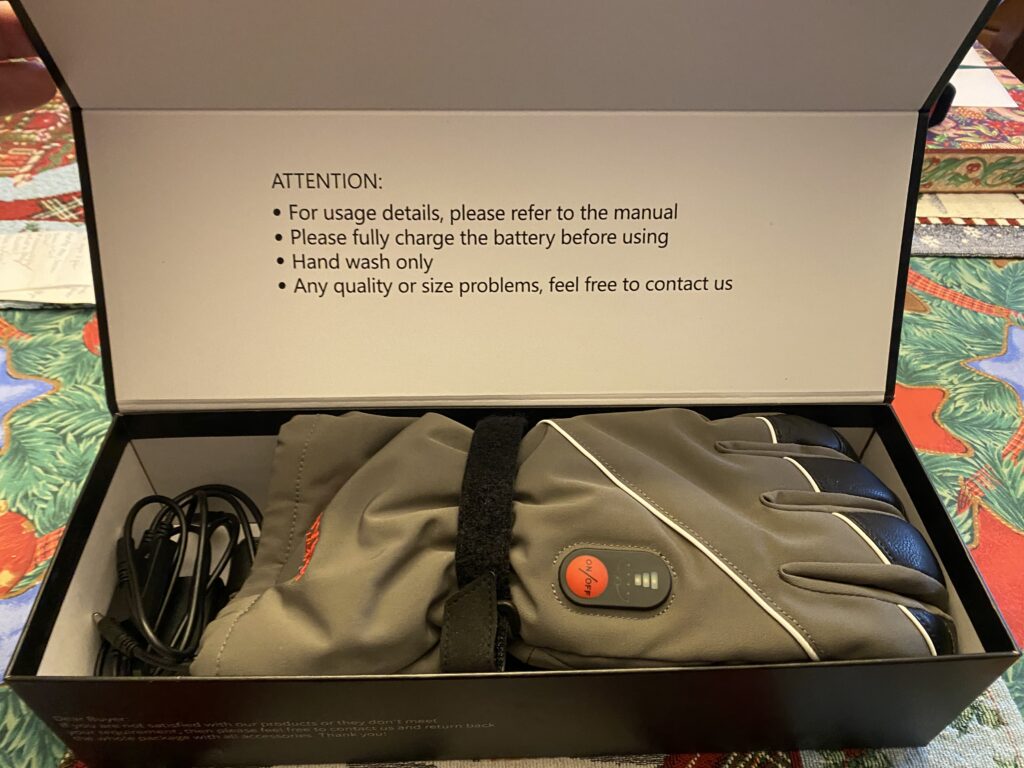
Other products, where to buy and warranty information: They have other gloves available, including ones that can be adjusted via Bluetooth. They also have gloves marketed towards hunters, mittens and a variety of glove weights for people who might not need to go skiing or ride motorcycles. Colors are limited depending on the model, with a lot of black filling out the catalog. I was lucky that the ones I wanted were available in gray or white; the gray were less expensive. It looks like most of their bulkier offerings—like the gloves I bought—come with a nice box. I typically toss these boxes into the recycling bin, but the box actually makes a nice way to store these gloves when they’re not being used, so I may hang on to the box for a while longer.

The box is nice enough to hang on to and use for storing the gloves.

Visit saviorgloves.com for more information or to purchase direct. Also available on Amazon, which I recommend for both their occasional lower prices and ease of returns/exchanges. Since I bought the wrong size first and had to return them and buy the next bigger size, I found that returning them was quite easy and the refund for my incorrect purchase was processed in just one business day. I’m not sure it would have been that easy had I purchased direct from the website despite their promise of a 30-day return/exchange window.

Savior gloves come with a 180-day limited warranty on the batteries and heating elements.


Source link