11.3 C
London
Thursday, May 14, 2026
Home Blog Page 86

What’s in a VIN? How to decode the vehicle identification number, your car’s unique fingerprint

0
What’s in a VIN? How to decode the vehicle identification number, your car’s unique fingerprint


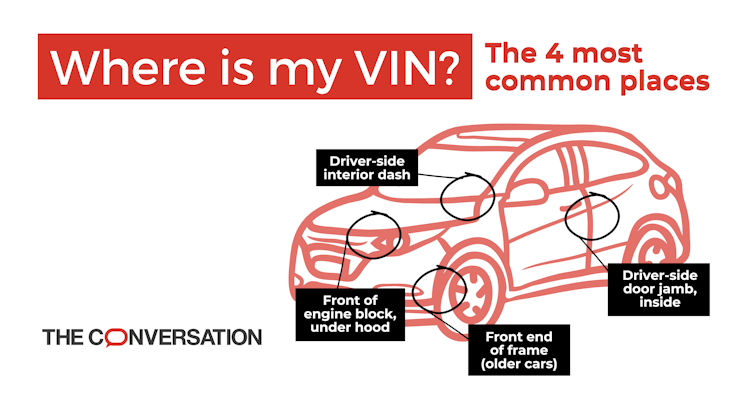
Every vehicle built after 1981 has a unique vehicle identification number, or VIN. The location of this string of letters and numbers varies, but it’s located somewhere on every car, SUV, motorcycle and truck – typically on a small metal plate or a sticker.

VINs serve many purposes. They help consumers learn about a used car’s history, including whether it was stolen, or determine whether rebates for a particular electric vehicle are available. This code appears in the paperwork necessary to do everything from insuring your car to selling it.

I research data standards and became interested in VINs while doing research for my book about the cultural history of barcodes.

Like barcode numbers, a VIN’s characters are standardized. They can tell a story if you know what to look for.

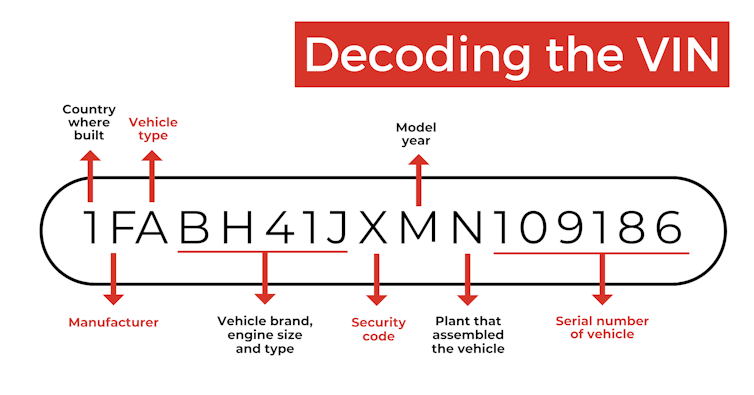
A string of numbers and letters with the heading 'Decoding the VIN'
A lot of information is packed into these 17 characters.
The Conversation U.S., CC BY-SA

What VINs can tell you

VINs can convey at least seven pieces of information.

  1. Origin
    If a VIN begins with a 1, 4 or 5, that means it’s a vehicle assembled in the U.S. Many other countries have their own unique identifier. A 2, for example, means the vehicle was made in Canada; a J stands for Japan.

  2. Manufacturer
    The second and third characters indicate the manufacturer. In some cases, the code corresponds with a line of vehicles that now belongs to a larger corporation. Dodge and Jeep, now part of Stellantis, each has its own. So does Lincoln, which became a division of Ford Motor Co. in 1922.

  3. Description
    The fourth through eighth characters provide several details, such as body type and engine type.

  4. Security
    The ninth character is a “check digit” determined by a complex mathematical equation based on the rest of the VIN’s numbers and letters. This digit, either a number or the letter X, is used to authenticate that the VIN is not a forgery.

  5. Year
    The 10th character indicates the model year. There’s only one slot for this, and not all letters and numbers are used, resulting in repetition. An R could signal either 2024 or 1994, for example.

  6. Factory
    The 11th character indicates the specific plant where the vehicle was assembled.

  7. Serial number
    The VIN’s final six characters compose a serial number that differentiates the vehicle from all others made in the same factory that are the identical type and model year.

A drawing of a car with the heading 'Where's my VIN?'
Vehicle identification number locations vary but are generally found in one of four places.
The Conversation U.S., CC BY-SA

Finding more information

Only experts can tell where a vehicle was assembled or what type of engine it has by looking at its VIN. But help is available.

The National Highway Traffic Safety Administration provides a handy VIN decoder. When I plugged my vehicle’s VIN into the decoder, the site correctly determined that my SUV is a 2011 Subaru Forester with an automatic transmission.

Of course, I already knew all that.

What I didn’t realize was that it weighs between 4,000 and 5,000 pounds, has a 2.5-liter engine and features side curtain airbags to protect the driver and passengers in the front and back seats. I also learned that this Subaru Forester was assembled in Gunma, Japan.

Those details had been invisible to me as a consumer, but they had been within easy reach ever since I bought my Forester in 2018. I had somehow driven that car well over 100,000 miles without realizing the number on the side of my driver’s seat contained some history.

Before buying the Forester, even though I didn’t know that my VIN could say so much, I did run it through a free online system to make sure it hadn’t been stolen.

To be sure, VINs won’t tell you everything you might want to know about a vehicle, such as what color it was when it rolled off the line. But if you can do a little decoding and make use of widely available online tools, they do harbor important information.

Where’s your VIN and what’s it for?


Source link

F1 driver Esteban Ocon adds a wild Mansory Revuelto to his garage

0
F1 driver Esteban Ocon adds a wild Mansory Revuelto to his garage


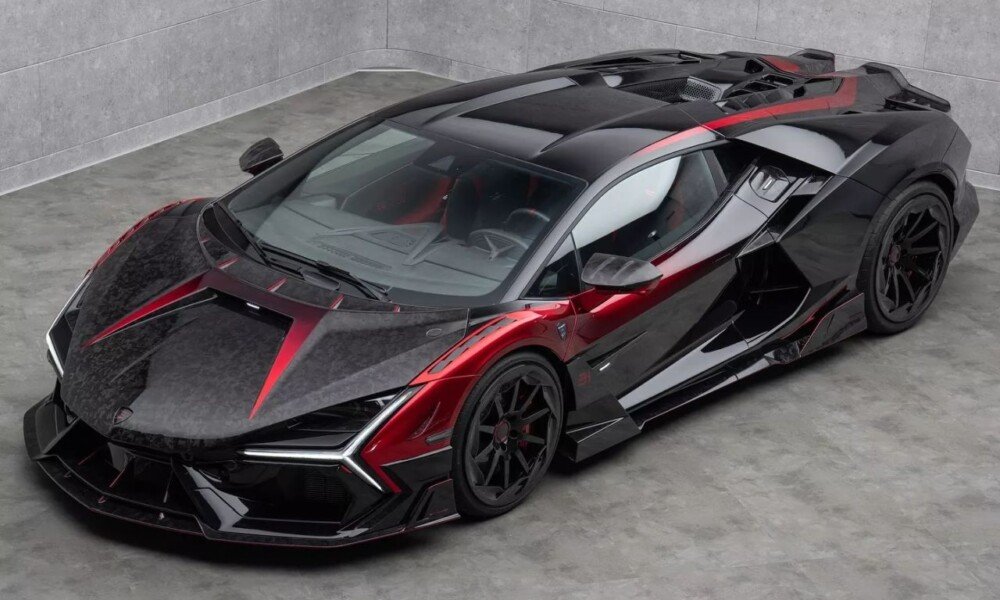
French Formula 1 driver Esteban Ocon has taken delivery of his Lamborghini Revuelto. As you can see, it isn’t a standard Revuelto but a heavily modified version created by Mansory.

Ocon’s Mansory Revuelto has a bespoke carbon fibre exterior, which is not only lightweight but also adds a unique, rather wild look. It has a unique hood crafted from forged carbon, a new front bumper with additional aero elements, and modified side skirts. The active rear spoiler is also made from forged carbon, and so is the rear bumper with its aggressive strakes.

Mansory-Lamborghini-Revuelto-Esteban-Ocon-6

The interior of the Mansory Revuelto is just as eye-catching as the exterior. It features bright red leather in combination with black Alcantara and red seat belts. There’s carbon fibre all around. Ocon’s logo can be found on the door pads and headliner.

Mansory-Lamborghini-Revuelto-Esteban-Ocon-14

The Mansory Initiate was unveiled last year. The 6.5-litre V12 engine in the Mansory Revuelto has been tweaked to produce 880 hp and 561 lb-ft, up from 825 hp and 535 lb-ft of torque. The internal combustion engine, along with the three electric motors, develops an impressive 1070 hp.

It’s unclear if Mansory has made any mechanical changes to Ocon’s Revuelto. What we do know is that the car is fitted with a custom exhaust system.


Source link

Toyota plans to build standalone halo sports car via GR division

0
Toyota plans to build standalone halo sports car via GR division


Japanese carmaker, Toyota, could be planning to build a standalone sports car. Speaking in an interview, Sean Hanley, Sales and Marketing of Toyota Australia, stated that the carmaker is confident of building a sports car independently, without needing to partner with BMW or Subaru.

The standalone halo sports car from Toyota will be built by its performance division, Gazoo Racing. He stated that while the partnerships have helped the brands learn a lot from each other, Toyota is confident of building its own halo sports car. Hanley stated, “But to answer your question, ‘can I ever see a day where we do our own independent, standalone Toyota Gazoo Racing sports performance car?’ Yes, yes, and yes.” Without commenting much on the timeline, he added, “You’ll have to wait and see.”

2020 Toyota Supra

Hanley though, did stop short of revealing whether or not the new sports car would be another Supra, or an entirely different model. However, he didn’t discount the fact entirely. He stated, “There’s no plan, but the reality is that Supra has an incredibly strong legacy statement.” Further adding, “You never say never [to resurrecting the Supra].”

Reports suggest that Toyota’s GR GT3 Concept unveiled at the 2022 Tokyo Auto Show would make it to production. Toyota’s luxury brand, Lexus, is already working on its own supercar, with LFA’s successor said to be in the works.

With the Tokyo Auto Show scheduled for late October, Toyota’s GR sports car plans could be revealed as early as next month.

Source: Drive


Source link

FALLING ILL WHEN YOU LEAST EXPECT IT

0
FALLING ILL WHEN YOU LEAST EXPECT IT


I was sick so I could only admire the Icelandic fishing town Isofjordur from the deck

The most unfortunate thing is to get
sick when you are traveling. In our sixteen years of travels, I remember three
occasions when that happened to my husband and me.


A Two-Week Cruise that Was Disrupted


The first was during the Enrichment
Voyage cruise, the two weeks when adults are allowed to join Semester at Sea, the
program that enables college students to earn credits on board a cruise ship to
get global experiences required for their degrees. Whenever we were at sea, the
college professors held courses on politics, economics, and geography of the next
country we were to visit.


Before embarking in Sweden, we had
just finished a tour of Norway, Finland, and Russia. After a port call in Copenhagen,
the cruise ship proceeded to Reykjavik, Iceland. En route to the small fishing
town of Isofjodur in western Iceland, we developed chills, fever, colds, and
cough. By then, the small clinic on the ship had become as busy as the buffet
stations. Some virus was going around. My husband braved a walking tour of the
town but, feeling worse, I stayed on the ship, taking photos from the deck. It
was good I was well enough to join the excursion at Akureyri in northern
Iceland.


A Disney Vacation that Didn’t Happen


On the first week of December 2011, we
parked our RV in Orlando, Florida, seven miles from Disney World. Finally, at
63, I was going to the theme park for the first time! The next morning, right
after breakfast, Bill felt severe chest pains. We hurried to the Urgent Care
Center right outside the Resort. They quickly told us to go to the Heart of
Florida Hospital, about fifteen minutes away. The surgeon immediately performed
an angioplasty, inserting three stents into two of Bill’s arteries, one 100%
blocked, the other, 75%.


Would you believe I had to endure a
TV show about preparing for a funeral while in the waiting room? Later, I had
to go back and forth between the hospital and the campground when I hardly knew
how to drive. I did not know anyone at the Park. Without a support system,
within a week, hives broke out all over my body. My dream Disney World vacation
turned into a horror story.


The Consequences of Long Drives


In 2013 we made a long road trip to
visit our children in Idaho, Alberta, Washington, and Colorado. To be more
comfortable we opted to take the car and left the RV in storage in Mesa,
Arizona. The first stop was Boise, then Calgary. From there to Seattle, my
husband drove twelve hours straight. Not even two days
later,
we left for a nineteen-hour drive to Denver.


That’s where a painful knot behind my
husband’s left knee progressed to his whole left leg, from the hip to his foot,
feeling numbness, tightness, and pain. At the nearest hospital, they found
several blood clots on that leg. He was given injections to break them down and
tablets to thin out his blood. It took a week before the doctors allowed him to
drive back home. Again, I had a flare-up of hives. They must be caused by
stress. After this incident, we set six hours as our maximum driving time in a
day, with a good stop after the first three hours.


Falling ill during travel is
inconvenient at best; it can be tragic at worst. We were lucky that both
cardiovascular problems happened in American urban centers. Just imagine how
terrifying and costly it would have been if we had been elsewhere where Medicare
was not available, the healthcare system was not good enough, and we didn’t
know anybody who could help us.

With health issues becoming more serious
as we age, there are several things we must do if we want to continue traveling.
Our travels should be safe, convenient, and comfortable. We must also keep our
insurance up-to-date and comprehensive. But the most important thing is to keep
ourselves as healthy as possible, ready to face the rigors of life on the road.


Source link

Rivian spinoff focuses on small EVs, “ways to move beyond cars”

0
Rivian spinoff focuses on small EVs, “ways to move beyond cars”


  • Spinoff starts with $105 million VC investment, Rivian maintains “substantial minority stake”
  • Products to be affordable, vastly more efficient than today’s cars or SUVs
  • In-house-built for core components, may share sales space with Rivian
  • Flagship product coming in early 2026

Do we really need a new generation of EVs that are bigger and heavier than equivalent gasoline trucks and SUVs, and the so-called segment creep that continues to make each successive U.S.-market vehicle larger than predecessors? 

These are tough, societal questions without easy answers, and it involves a tangle of regulations, consumer habits, and the limits of affordable technology. But a Palo Alto, California–based micromobility startup being spun off by Rivian, called Also, looks like it aims to tackle them—and, from the sound of it, give American consumers a way to just say no to those super-size products. 

In a press release announcing the venture, which Rivian had previously kept under wraps, Rivian clarified that it maintains a “substantial minority stake” in Also and “expects opportunities for future collaboration, which may include selectively using some of Rivian’s retail footprint.”

With the spinoff of the company Also secures a $105 million investment from the VC fund Eclipse Ventures, and Rivian CEO RJ Scaringe will serve as its chairman and on its board of directors. 

Also, in a page about the company, says that it will launch its flagship product in early 2026 and will initially focus on the U.S. and Europe prior to global expansion. 

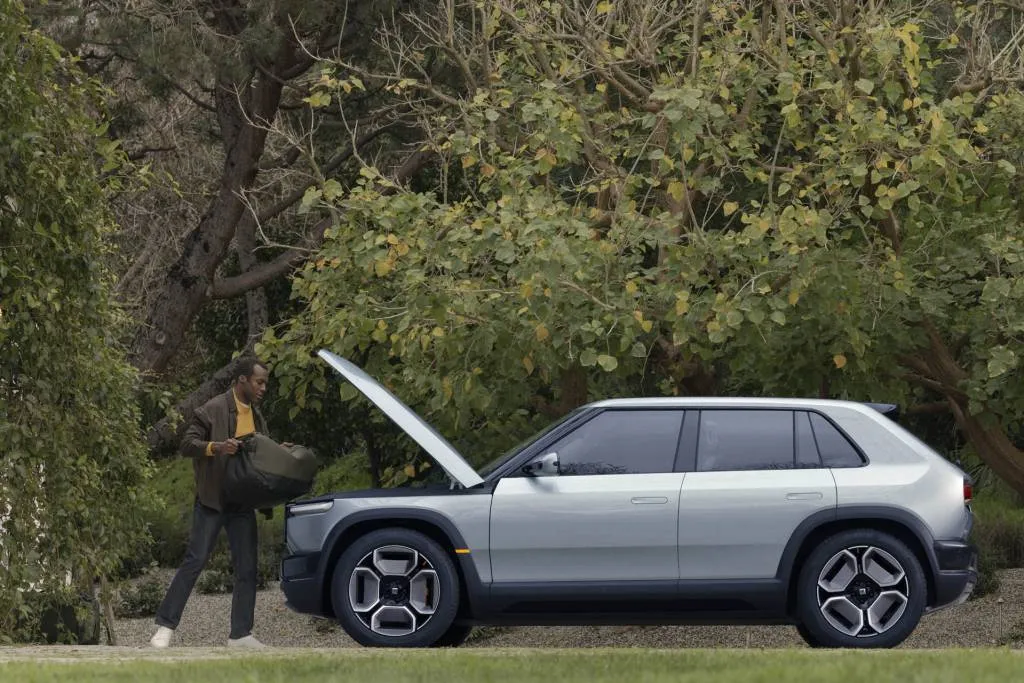
Rivian R3

Rivian R3

That product will be part of an entire range of “exciting, small EVs,” according to Also, that will be built on a vertically integrated technology platform. With everything built for the platform in-house, including motors, batteries, electronics, and software, Also claims “a user experience that is unlike anything seen in these segments before.”

“Also is building an exciting range of electric vehicles that are efficient, sustainable, and delightful to use,” the company sums. 

In job postings, Also quantifies its product targets a little bit. “Our mission is to inspire everyone to ride also—replacing many local car, truck and SUV miles with ones on vehicles that are more affordable, more enjoyable and 10-50x more efficient.”

Road transportation is the leading contributor to global CO2 emissions, Also says, while 80% of car trips are 15 miles or less and half are under 6 miles. 

Rivian continues to also set its sights toward significantly smaller vehicles than its own flagship R1T electric pickup and R1S electric SUV. Its upcoming $45,000 R2 electric SUV is on the way in 2026, while it’s also working on smaller Rivian R3 and R3X rugged hatchbacks that are set to follow. All of this comes in addition to the $5.8 billion VW-Rivian joint venture that will result in a new Rivian-based zonal architecture for future VW Group EVs.


Source link

BMW Neue Klasse Conversations – My Interviews From iX3 Munich Launch

0
BMW Neue Klasse Conversations – My Interviews From iX3 Munich Launch


BIMMERPOST

Now that most of the imaginary dust has pretty much settled from the whirlwind of a trip to Munich for the launch of the Neue Klasse, and the subsequent rush of catching up on work once back in Singapore, I’ve finally managed to sit myself down to properly catch up on the interviews we managed to bag while there. While most of the answers we got were understandably toeing the company line, it was still insightful to hear directly from the people who are fully involved in BMW’s most ambitious project to date.

For our first interview (of three), it was with Stephan Durach, BMW’s Senior Vice President for UI/UX Development. As UI/UX is something I work with on a day-to-day basis as a designer, being able to sit down with him, was a session I thoroughly enjoyed. With a number of other journalists in the room, I tried my best to put as many questions through without hogging all the time, here’s the full interview (along with questions asked by others). Apologies if it’s rather long.

Q: “Many owners (myself included) are deeply passionate about the iDrive controller, appreciating how intuitive and convenient it is to use, especially while driving. Now that so many functions are transitioning to touchscreens, what would you say to reassure those drivers and convince them of the benefits of the new system?”

A: “So actually, we’re not moving all controls to the screen. There are two perspectives to consider, and maybe it’s best to start with the iDrive controller itself. When we introduced the first generation of iDrive, the controller was a crucial part of our interaction concept. At that time, touchscreens weren’t available on the market, so we needed to find a solution for managing all the car’s functions.

Today, though, the landscape has completely changed. Applications and content are moving toward touchscreens, and the usage of the controller has dropped dramatically. In fact, we see many customers who never touch the iDrive controller at all.

At the same time, voice control has become a very strong modality. A lot of the controller’s usage in the past was for alphanumeric input — searching for an address, a phone number, and so on. Now, those tasks are almost entirely handled by speech. Customer behavior has shifted as technology has advanced, and with voice assistants becoming stronger and more capable, the necessity of the iDrive controller just isn’t there anymore.

On top of that, our current Panoramic iDrive system still keeps the most important functions directly on the steering wheel. From the right side of the wheel, you can select phone numbers, control entertainment, and more, all while keeping your eyes on the road and your hands on the wheel. The multifunction steering wheel allows drivers to manage a lot without distraction.

And when it comes to physical controls, we haven’t eliminated them entirely. There are still essential tactile elements like a volume knob, mirror controls, and a few mechanical buttons. We studied how often customers actually use different functions, and based on that data, we made the changes we felt made sense.

Finally, if you look at the screen itself, its position in the car is very different from what it used to be. Previously, design was shaped by the separation of control and display. Now, the screen is positioned much closer to the driver, making interaction more intuitive. We’re fully convinced that once your friends drive this car, they won’t miss the iDrive controller at all.”

Q: “To add to that, and I hope I’m not putting this the wrong way, there has been some pushback from consumers asking for more physical buttons to return. Do you see any change in direction on this moving forward? Perhaps having more physical buttons in the future?”

A: “You can already see that, despite the broader industry trend of eliminating as many buttons as possible, we haven’t gone down that path. In our cars, there are still a number of mechanical control buttons for the most important functions, and I’m confident they’ll remain.

So yes, while you might see some brands going toward a “touch-only” approach, that’s not the case with us. If you take a look at our cars today, you’ll still find a good amount of physical buttons for exactly these reasons.

We have about 10 million cars on the road right now, which gives us very precise insight into how people are actually using the controls, what buttons they press, how often, and in what situations. Based on that data, we’ve made decisions about which functions belong on touchscreens, which work best with voice, and which should remain physical.

That said, we’re always reevaluating. If customer behavior or expectations change, we’ll look at it again. But at the moment, we’re confident we’ve found the right balance between digital, touchscreen, voice, and physical controls.”

Q: “Looking ahead, is there any possibility for users to customize things like icon sizes or text sizes in the system?”

A: “We already offer a good amount of customisation in our products, but what we’ve observed is that customers rarely make use of it. The icons and text are already larger than what you’d find on a typical smartphone, and the interface has been optimised specifically for the driving use case.

With our Panoramic iDrive, for example, the display is designed in a way that reduces eye strain. I wear glasses myself, and because the virtual image distance is set further out, closer to how you view the road, it avoids the usual accommodation issues your eyes face when shifting between near and far vision. So we’re confident that the system already meets customer needs very effectively, especially with the panoramic setup.”

Q: “I assume this system will be used in upcoming models. Can you explain what kind of technology it uses? I noticed a 3D effect — almost like a reflection.”

A: “At the core, it’s actually well-known technology, but implemented in a very smart way. We use a matrix backlight display mounted in the dashboard, combined with a special reflective coating on the inside of the front windshield. This reflection creates a virtual 3D display that appears to hover, giving that three-dimensional effect you noticed.

It’s different from looking directly at the display, because the virtual image has a separate focal point. If you look at the lower part of the ridge field — the black belt area — you’ll see that the black print is standard in every car. Traditionally, it’s used to mask the edges of the windshield, but here it helps enhance the virtual image effect, integrating the 3D display seamlessly into the cabin.”

Q: “I’m curious about its performance in bright sunlight. How does the system hold up?”

A: “We tested it extensively in bright sunlight, and it performs exceptionally well — better than most conventional displays. The reason is that the display is always black when inactive, which minimises sun reflection. Combined with the matrix backlight technology, it can generate a high level of light intensity, making it easy to read even on very sunny days.

Also, it’s worth noting the coating on the front windshield. Many displays struggle when viewed through polarized sunglasses, but ours works perfectly with them. So even with polarized lenses, the system remains fully readable and clear.

One of the real advantages of this system becomes apparent at night. Thanks to the matrix backlight, when the display is black, it’s truly black because the light is switched off. This reduces interior light pollution compared to traditional LCDs, which emit a lot of stray light even when showing black.

The reflection technology also minimizes glare inside the car. In low-light situations, like twilight when the sun is low, reflections from conventional displays can be distracting. But because our system reflects off the windshield rather than the display itself, interior reflections are greatly reduced. In these lighting conditions, the cabin feels much cleaner, and compared to typical pillar-to-pillar displays, the light emission is very low, creating a far more comfortable experience for the driver.”

Q: “I noticed a photo showing a panoramic HUD with navigation information, while the same data is also on the central screen. How did you decide which information should appear on the HUD, and where did you draw the line?”

A: “With our panoramic system, we follow a clear hierarchy for displaying information. The central information display is the primary interface for consuming detailed information or manipulating controls — for example, moving a map or adjusting settings.

The heads-up display, on the other hand, is focused on the driver’s immediate needs. It shows the most critical information, such as navigation prompts or urgent alerts, while reducing non-essential data to avoid visual overload. Essentially, we prioritize what the driver sees based on urgency and relevance.

If certain data is already displayed on the central screen, we avoid redundancy on the HUD unless it’s critical for immediate driving decisions. As the driver approaches a key point, like a turn on the map, the panoramic system highlights the relevant information progressively. This approach ensures that the most important information is visible at the right time, while less critical details remain in the background, maintaining a clean and focused driving experience.”

Q: “First, looking at the progression of BMW’s operating systems over time, what would you say are the most important lessons the team learned from developing OS and OS 9 that were applied to OS 10?”

A: “OS 9 was a major step forward, and when you compare it to OS X, many elements of the central information display are familiar — it was very much an evolutionary development. With OS 10, particularly in our Panoramic Vision, we took a more revolutionary approach. We’re always trying to balance what users already know with areas where we can improve the experience. It’s not about change for the sake of change, but about meaningful optimization.

Another lesson from OS development is how we consider consumer electronics trends. If something has become a standard that users expect — like the design of a music player or media content interface — we often stick with it rather than reinventing it. This approach ensures consistency and familiarity, which benefits the user experience.

At the same time, we focus on optimizing how content is displayed. For instance, car controls are typically located in the corners, which frees up the central display for media, navigation, or app content. We also prioritize flexibility, making it easy to integrate updates quickly, similar to an app store, while maintaining the robustness required for automotive use. Essentially, it’s about balancing speed of integration, user familiarity, and a high-quality driving experience.”

Q: “Coming back to the lessons you mentioned with the 10 million cars in the field, I’m curious: do you see differences across markets? Is the current design influenced more heavily by the preferences of certain regions?”

A: “That’s a question we get a lot, whether behavior differs significantly across markets. To be honest, the differences are smaller than you might expect. There are some trends that emerge slightly earlier in certain regions — for example, voice assistants have been adopted more quickly in parts of Asia due to technology availability.

But overall, the time gap between markets is very short, especially in today’s digital environment. While a specific feature might pop up slightly earlier in one region, global adoption happens very quickly. So, the design of our systems is increasingly shaped by universal usage patterns rather than heavily by any single market’s preferences.”

Q: “Along the lines of the AI assistant, AI is evolving very quickly, and there are now AI companions. Are there plans for the BMW AI assistant to evolve into something more like a personal AI companion?”

A: “Definitely. There’s a lot of movement on the AI side, but in the car context, it’s crucial to have safeguards. Drivers need predictable behavior, you don’t want the AI to react unpredictably. That’s why we’re introducing AI domain by domain, starting with specific car functions where we can ensure reliability.

On our roadmap, in Europe and Western markets, we plan to integrate large language models via Alexa to enhance speech capabilities. In China, we’re partnering with Panda, and in Korea, we’re exploring another global partner. The system we’ve built allows us to select the best local partner and even swap solutions by market if needed. This flexibility ensures that our AI assistant is both reliable and tailored to the region while providing a foundation for more advanced AI capabilities in the future.”

Q: “This is more of a personal question. I’m a bit nostalgic about older BMWs, particularly the orange instrument clusters, which I’m happy to see make a return. Since everything is now virtual, is it possible to have instrument clusters that mimic the classic designs, like Mini has done with their classic display? And what about sounds, is there a way to bring back iconic engine notes?”

A: “As you saw in our presentations, the system offers a lot of possibilities for personalisation. Users can choose different colours, backgrounds, and display layouts. For example, in Sports Mode, we feature the classic BMW orange, the very colour you’re referring to.

The interface is designed to be flexible, allowing us to create both modern and nostalgic experiences. There are even more options we’re working on, though I can’t share all the details yet. But the principle is clear: we want to give drivers the ability to personalise their experience while preserving the iconic BMW character, both visually and sonically. There are a couple of more things we cannot talk about.

But as you can see, there’s a lot of flexibility there. So there will be more.”

Q: “I noticed that no engine sounds were played during the presentation. Can we expect to hear some of these sounds in the future?”

A: “I’d ask for a little patience, there will be many sporty models coming, and we’re making sure they deliver a truly emotional experience, including through sound. So, rest assured, this is something we’re taking very seriously.”

Q: “Is it possible for BMW cars to communicate with each other to avoid collisions? Could this be implemented in the future?”

A: “Theoretically, yes, it’s possible, but we’re not implementing this at the moment. Technically, it could be done, but it’s a highly complex task; for example, braking at the wrong moment could be dangerous.

That said, the BMW fleet is already connected in other ways. Cars can share information about traffic conditions, such as the end of a traffic jam, and this data is broadcast not just to BMW vehicles but to all drivers. So while direct collision-avoidance communication isn’t active yet, connected features that improve driving safety and efficiency are already in operation.”

Q: “How would you say the current iDrive system is superior to past iterations in terms of driver engagement? Some readers might argue that with more visualisation and displays, it could be distracting.”

A: “If you look at the general market today, many vehicles are dramatically increasing display size, often replacing the entire dashboard with screens. That’s not the approach we’ve taken. We carefully consider what information is most relevant and display it at the right time and in the right location.

The heads-up display, for example, is positioned directly in the driver’s line of sight, reducing the need to look down. Traditional instrument clusters are limited by the steering wheel’s position, forcing drivers to shift focus and potentially strain their eyes. By moving the instrument cluster slightly upward and away from the steering wheel, we resolve these issues and provide a clearer, more ergonomic view.

At the same time, we’ve reduced information overload in the central display. Instead of cramming many elements into a small space, we show only the most relevant data. The result is a system that is precise, efficient, and minimally distracting, providing the driver with exactly what they need when they need it, while enhancing engagement rather than detracting from it.”

Q: “With the Heart of Joy at the centre of BMW’s latest technology, were there still limitations that prevented your team from implementing certain features, or were you able to include everything you and your team wanted?”

A: “Our infrastructure and architecture, especially with what we call our ‘super brain,’ give us significant flexibility to build and integrate new features. This allows us to make decisions about adding functionality, even at a late stage, either through our own development or by partnering with other companies.

For example, in China, we’re integrating the Momenta stack into our infrastructure, demonstrating that our system is prepared to accommodate new services at any time. Because we handle software integration in-house, we can develop features ourselves or collaborate with partners efficiently.

So at the moment, I don’t see any inherent limitations. Of course, proper integration requires time to ensure security, safety, and privacy, but the system’s flexibility allows us to implement almost anything we deem valuable for the user experience.”

Q: “Okay, last question from me: what are your thoughts on ‘fake’ manual transmissions and the role of electric vehicles?”

A; “I think the way you phrased your question actually points to the core of the issue. When something is ‘fake’ or artificial, it’s immediately noticeable. One of the challenges with electric powertrains is that they deliver so much power so smoothly that it’s difficult to convey the driver’s sense of speed and engagement the way a manual transmission and combustion engine can, with its tactile feedback, gear shifts, and acoustic cues.

“That’s a tricky question. How do you convey meaningful feedback to the driver beyond just what the speedometer shows? It comes down to thinking about sound and the overall driving experience. Current concepts on the market are interesting, but may feel artificial or ‘fake.’ To truly engage the driver, we need a completely new interpretation, a solution that communicates power, responsiveness, and the sensory experience of driving in an authentic way.”


Source link

MIROS investigating brake failure as possible factor in Kajang fatal crash; one-year-old thrown out of vehicle

0
MIROS investigating brake failure as possible factor in Kajang fatal crash; one-year-old thrown out of vehicle


MIROS investigating brake failure as possible factor in Kajang fatal crash; one-year-old thrown out of vehicle

The Malaysian Institute of Road Safety Research (MIROS) is investigating the lorry involved in a fatal crash at the Kajang toll plaza, and it is focusing upon the lorry’s braking system in particular, which is believed to have malfunctioned, reported Bernama.

The MIROS crash investigation team is working to determine whether brake failure or other factors were the primary cause of the incident, according to the report.

“MIROS is working with closely with relevant authorities, including the Royal Malaysia Police (PDRM), road transport department (JPJ) and the Land Public Transport Agency (APAD) to ensure a thorough investigation. This evaluation is crucial in identifying the root cause and formulating effective preventive measures,” it said in a statement.

The crash that occurred last Saturday morning involved the aforementioned lorry, a car and two SUVs, resulting in the death of a one-year-old child and injuries sustained by seven others. Kajang district police chief Naazron Abdul Yusof said preliminary investigations revealed that the driver claimed he jumped out of the vehicle after experiencing brake failure.

MIROS investigating brake failure as possible factor in Kajang fatal crash; one-year-old thrown out of vehicle

The Bernama report cited a MIROS study from 2022 that revealed 31.9% of public and commercial vehicle operators adhered to the industry code of practice (ICOP) for road transport safety. Larger operators demonstrated a higher rate of compliance at 93.6%, while express and tour bus operators recorded compliance rates of 78% and 71% respectively.

Meanwhile, transport minister Anthony Loke stated that preliminary findings by the police revealed that the one-year-old baby was thrown out of the vehicle and became trapped beneath another vehicle in the incident, reported The Star.

The research institute said that PDRM statistics from 2014 to 2023 had shown that an average of 434 children died annually in road crashes, and stated that although the use of child restraint systems (CRS), or child seats have been mandatory in Malaysia since January 2020, CRS use remains low at 30% as of 2022.

Properly installed child seats which are suited to the child’s height and weight can reduce the risk of fatal injuries by 54% to 71% for children of up to four years of age, MIROS stated.

Looking to sell your car? Sell it with Carro.


Source link

Alpine A110R Review: Lightness Over Lap Times

0
Alpine A110R Review: Lightness Over Lap Times


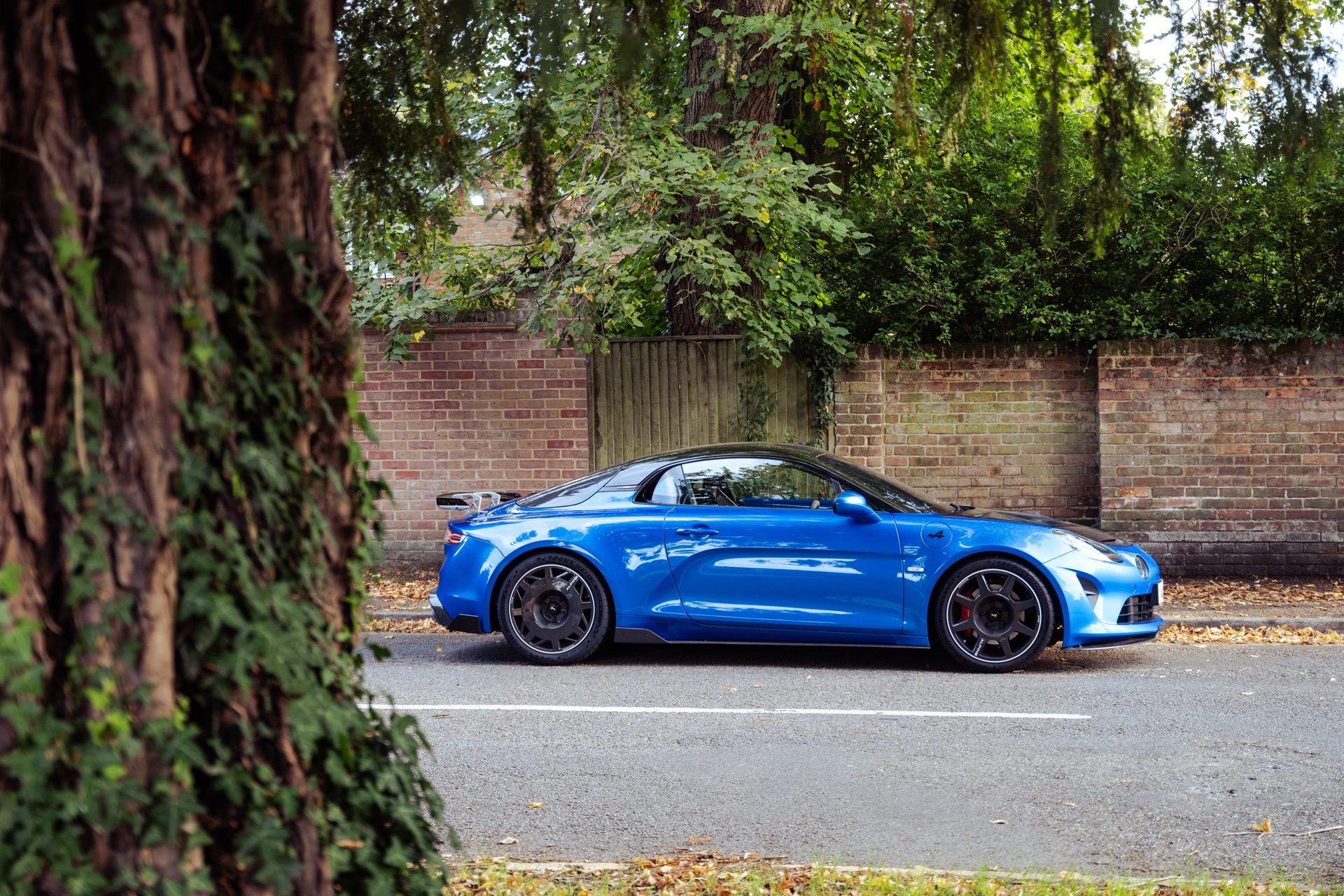
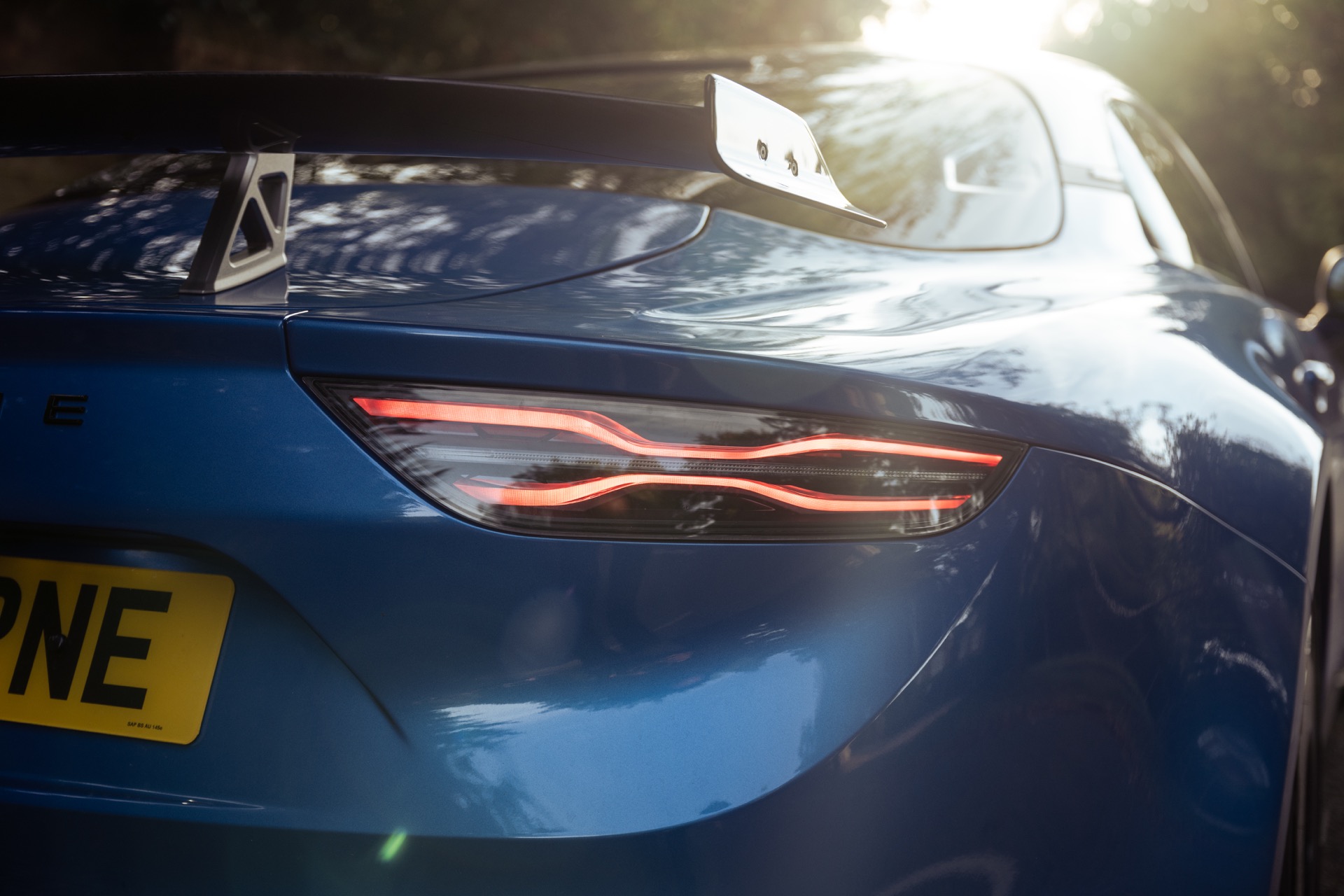
Alpine’s A110R doesn’t try to outgun the big names; it sidesteps them. Where many rivals chase numbers and Nürburgring bravado, this is a car built on feel. It’s lighter, simpler and more single-minded than the standard A110, and all the better for it.

You sense the difference within the first few metres. The A110R reacts without delay, flowing with your inputs rather than processing them. Steering is light yet communicative, throttle response is crisp, and there’s no torque-vectoring theatre or synthesised sound to flatter the driver. It just gets on with the job, cleanly and honestly, and rewards smoothness more than swagger.

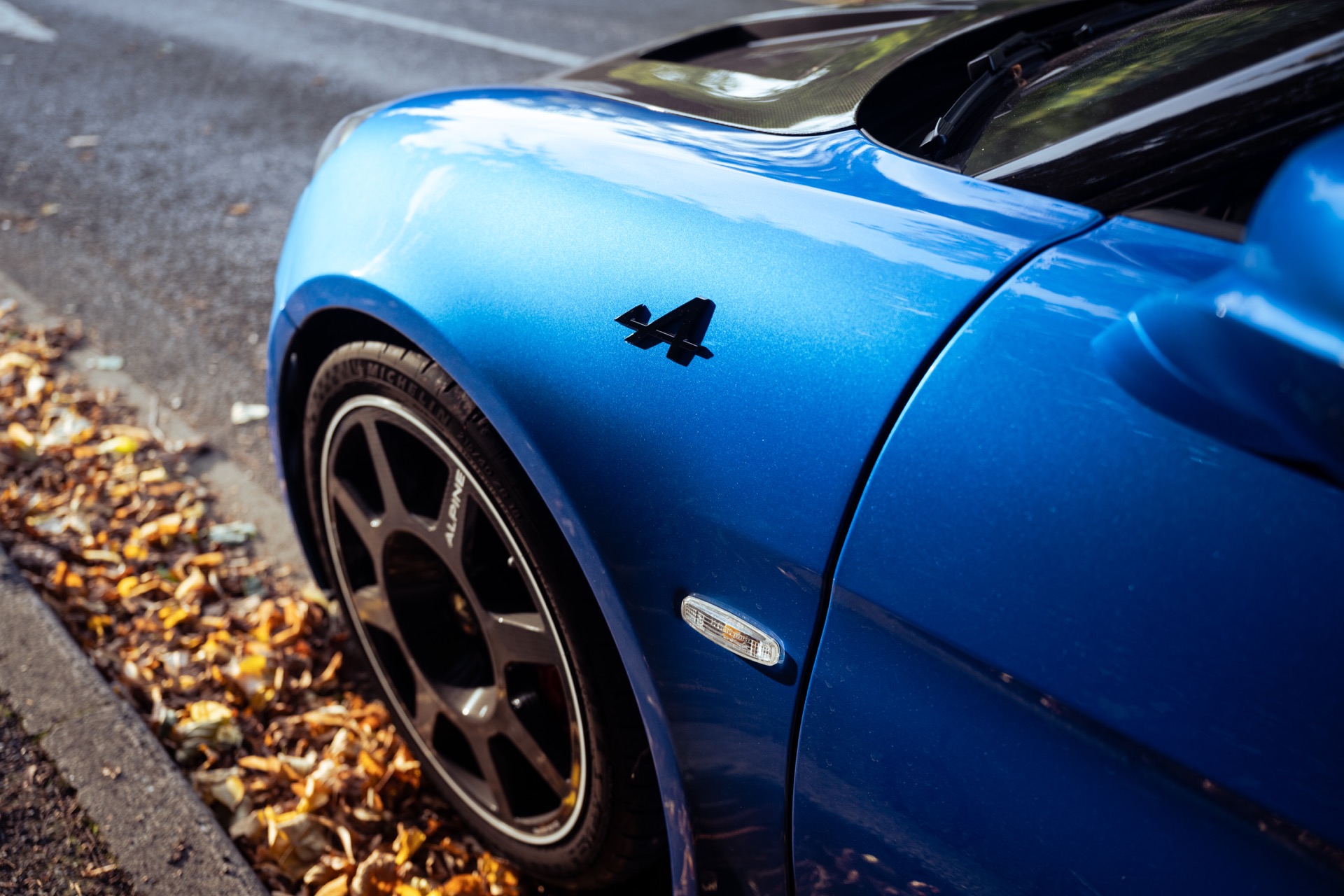
Alpine achieved that clarity the old-fashioned way: by removing mass. The R doubles down on the A110’s ethos with carbon-fibre wheels, carbon seats, a carbon bonnet and even a carbon rear window. Kerb weight lands a touch over 1,000kg, nearly 300kg less than a Porsche 718 GT4 RS. Power remains at 300bhp from the 1.8-litre turbo four, but the weight loss transforms the experience. It’s alive at any speed, not merely when you’re deep into three figures.

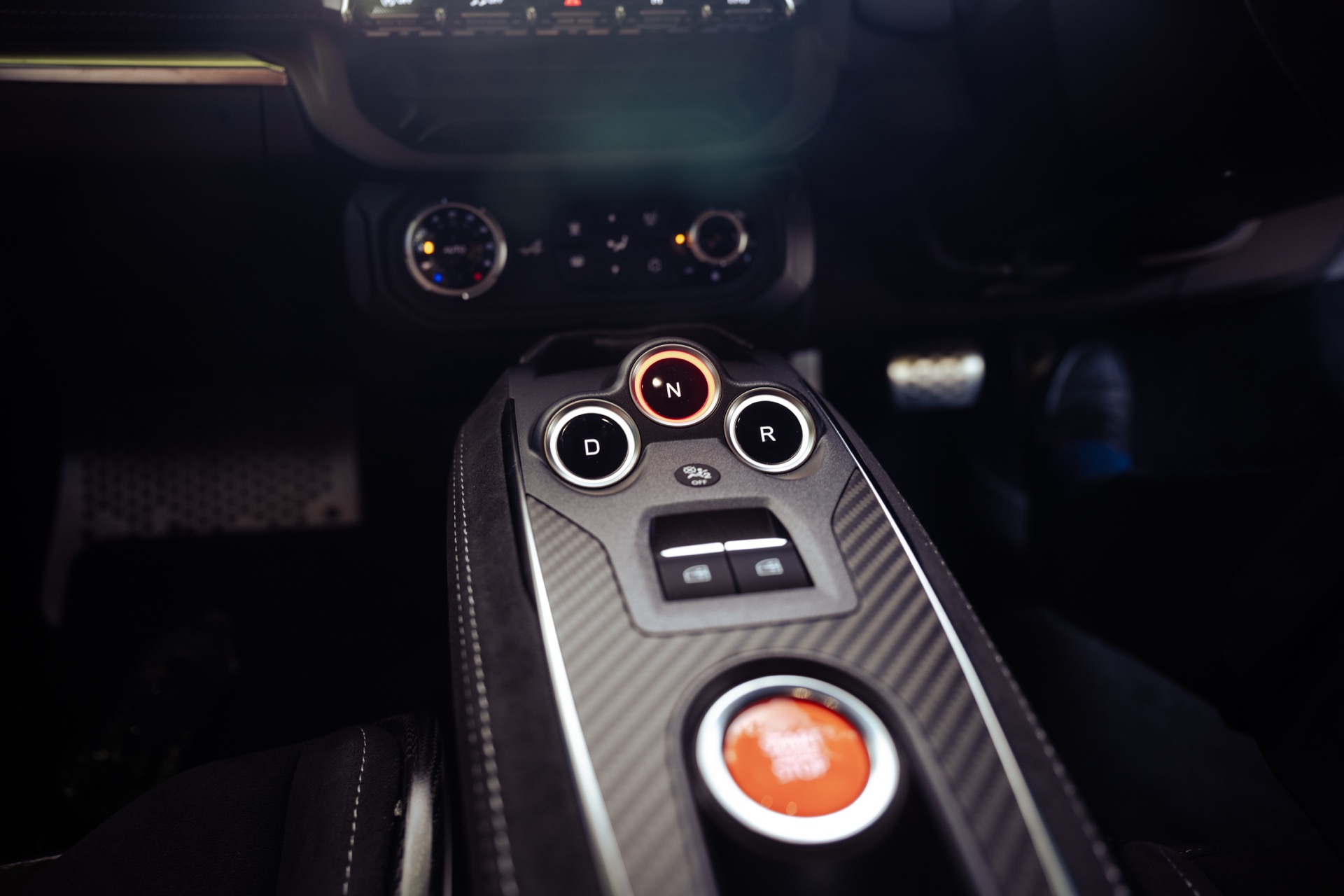
The result is a car that speaks in high definition. Front-end bite is eager, the rear is alert but predictable, and the whole chassis feels keyed into the road surface. You don’t need a circuit to enjoy it; a run to the bakery can feel like a mini special stage. It’s that rare modern sports car where less really does feel like more. It isn’t flawless, and that’s part of its charm. The driving position is idiosyncratic, visibility can is tricky, and the infotainment is a generation behind, but still host Apple CarPlay. The cabin is awash with exposed carbon, which underscores the focus but won’t suit every taste. None of it matters once you’re rolling, because the A110R’s dialogue drowns out the distractions.

GTspirit AlpineA110R 2

Crucially, Alpine hasn’t tried to turn the A110R into a Porsche rival. It’s not playing the horsepower game or chasing headline lap times. It’s about weight, balance and simplicity – values that have been quietly squeezed in an era of configurable dampers and ever-bigger tyres. If you arrive expecting GT-department polish, you’ll miss the point; lean in and you’ll find something rarer: individuality.

There’s also a sense of occasion here that goes beyond speed. The A110R makes everyday miles feel special without resorting to artificial drama. It’s quick, of course, but its magic lies in how it connects you to the surface, how it rewards tidy inputs, and how it turns modest pace into real engagement.

GTspirit AlpineA110R 22

That matters because cars like this are becoming scarce. Alpine heads towards an electric future, and focused, featherweight specials are unlikely to be part of it. The A110R feels like a swansong to an approach built on restraint and feedback. It may not dominate a spec sheet, but it nails the brief that counts: making the driver feel part of the machine.

Verdict? The A110R is the most compelling expression of the Alpine idea. It trades excess for elegance, polish for poise, and proves that lightness still wins hearts. In a market obsessed with metrics and statistics, this is the car that reminds you why you fell in love with driving in the first place.

GTspirit AlpineA110R 7


Source link

F1 personality Eddie Jordan dies aged 76

0
F1 personality Eddie Jordan dies aged 76


Eddie Jordan, the charismatic former Formula 1 team owner and television personality, has died at the age of 76.

Born in Dublin in 1948, Jordan initially pursued a career in banking before discovering his passion for motorsport. He began racing karts in the early 1970s, eventually moving up to Formula Ford and Formula Three. However, he is best known for founding Jordan Grand Prix in 1991, a team that competed in F1 until 2005.

Jordan’s team was instrumental in launching the career of Michael Schumacher, who made his F1 debut with Jordan Grand Prix at the 1991 Belgian Grand Prix. Schumacher qualified seventh but retired early in the race due to car trouble. After that he swiftly moving to Benetton, where he would go on to win the first two of his seven world titles.

Under Jordan’s leadership, the team secured four Grand Prix victories and became known for its vibrant presence in the paddock.

After selling his team in 2005, Jordan transitioned to a media career, providing F1 commentary, initially for the BBC starting in 2009. He was also briefly part of the hosting team for “Top Gear” in the last decade, alongside Matt LeBlanc, Chris Evans, Chris Harris, Rory Reid, and Sabine Schmitz.

Jordan passed away peacefully in Cape Town, South Africa, surrounded by his family. He is survived by his wife, Marie, and their four children.


Source link

Best RV Campgrounds for Your Yellowstone Adventure

0
Best RV Campgrounds for Your Yellowstone Adventure


National parks are some of the most beautiful natural areas in the country. So it makes sense that people want to camp in and around them. If you’re looking for an experience that puts you close to wildlife, geothermal activity, and scenic mountains, you’re probably looking for campgrounds near Yellowstone!

Most everyone runs off to see Old Faithful right away. It is okay, but our favorites by far were the Lamar Valley drive where we saw thousands of Bison all over the place. Really enjoyed Mammoth Hot Springs one day. Two Grizzly sightings north of Fishing Bridge in Hayden Valley, one with a cub in tow. Canyon Village has a great Visitor Information Center. I believe the most amazing view and photo opportunities was without a doubt, at the Grand Canyon of the Yellowstone near Canyon Village. Take a short walk on both the South and North sides. Paved trails and amazing views. — Don Sikkema

This park covers large portions of Wyoming and Montana so there are plenty of options when you’re browsing for a campground. Some people want an upscale resort experience, while others prefer rugged and secluded campgrounds. No matter what you’re looking for, you should find it somewhere in the list below.

We’ve compiled information about 5 stellar campgrounds near Yellowstone, each with their own unique features. They also gained our attention thanks to the great reviews they received from campers. After all, the guests are the ones who know best here! Each campground below has received enough rave reviews to put themselves on the map. And hopefully, you’ll be able to visit them and see their positive qualities for yourself.

  • Location: 210 Electric Street, West Yellowstone, Montana
  • Number of Sites: 241 sites
  • RV LIFE Campgrounds Rating: 9.4/10

We’re starting things strong with one of the best-reviewed campgrounds near Yellowstone. Grizzly RV Park is closer to a resort than anything else. The park itself is large and packed with amenities, but it’s also surrounded by businesses that specialize in dining, education, and entertainment. If you’re looking for a one-stop shop for all your campground needs, this is the place to go!

A range of hookup options are offered at this campground. Many RV sites have full hookups, but there are also smaller sites that only have electric hookups (or sometimes nothing at all). But even if you book a primitive campsite, you’ll still have access to all the park amenities that are designed to keep you comfortable throughout your entire visit.

We drove back into the park at 7 pm, which avoided crowds and also provided many wildlife viewing opportunities. We drove to Old Faithful and had front row seats. Spectacular! The visitor center closes at 8 pm so we walked around along the boardwalk. On our drive out we witnessed a gorgeous sunset and more wildlife. Being so close to the park made it easier to come and go at non peak times. — Carla T

All guests can take advantage of the bathhouses/restroom facilities scattered around the park. Many of these come with their own laundry rooms as well, although the main hub for laundry is located in the main building. Additional amenities at the Yellowstone Grizzly RV Park include an on-site convenience store, a gift shop, a conference room, a beautiful pavilion with plenty of interior and exterior seating, and a playground that’s fit for all ages.

And if you want to explore beyond the boundaries of the park, there are lots of places to eat and shop within walking distance. Take a stroll over to Pete’s Rocky Mountain Pizza or Timberline Cafe for a bite to eat. To learn more about Yellowstone itself, head around the corner to visit the Wolf & Grizzly Discovery Center.

  • Location: 22 Fishing Bridge RV Park Rd, Yellowstone National Park, Wyoming
  • Number of Sites: 325 sites
  • RV LIFE Campgrounds Rating: 8.7/10

Fishing Bridge RV Park was already one of the best-rated campgrounds near Yellowstone, but it has recently undergone a massive renovation that’s sure to make it better than ever! These changes included larger sites, a new dump station, and more showers and laundry machines for guests to enjoy. So even if you’ve visited this park in the past, you might want to come again and see everything that has changed around here.

The location of this park is also incredible. It’s perched on the shore of the massive Yellowstone Lake, which is a prime destination for anyone who loves kayaking, canoeing, and swimming. It is quite chilly though, so don’t stay in the water for too long!

This park also has the distinction of being one of the largest campgrounds in the area. There are hundreds of sites available for booking, so you’ve got a good chance of finding a spot. There are also plenty of amenities spread out around the campground so there’s enough to go around for every guest.

We checked out a day earlier than our reservation as we felt 5 nights was plenty enough for us to explore. The BIG perk to that is you just drop your tag in the exit box and you don’t get charged for unused nights! — bstanton1010

Full hookups are available at the Fishing Bridge RV Park and many of the sites are also paved with level cement parking spaces and patios. Additional amenities here include access to a nearby general store, ranger programs, interdenominational church services, an amphitheater, and the Fishing Bridge Visitor Center & Museum.

  • Location: 101 S Canyon St, West Yellowstone, Montana
  • Number of Sites: 25 sites
  • RV LIFE Campgrounds Rating: 8.9/10

Next up, we’ve got a smaller campground to explore. It’s fairly new to the scene, only opening its doors a couple of years ago. But it has already gained a reputation as one of the best campgrounds near Yellowstone! This cozy spot is located right next to the Yellowstone National Park west entrance, so it’s the perfect spot for anyone who wants to walk or bike into the park.

In fact, it’s also right around the corner from another park we talked about earlier (Grizzly RV Park). So if one camp isn’t really doing it for you, there’s another option close by. Every site here comes with full hookups for water, sewage, and electricity and you can choose between a back-in or pull-through site.

To keep guests comfortable, the park has modern bathrooms, showers, and laundry facilities within easy reach. And to go above and beyond, the Buffalo Crossing RV Park even provides care packages to each guest when they arrive! Every visitor can stop by the office to collect a $20 gift card to the Yellowstone Trading Post, a pair of tokens that can be exchanged for soft-serve ice cream, and a small themed bottle of hand sanitizer (always handy for travelers!)

There’s even a massive IMAX theater located on the property. Here, you can watch an immersive presentation all about Yellowstone, or catch current blockbuster films as well. And if you need to pick up any campground essentials, gifts, or groceries, the Yellowstone Trading Post is right at your doorstep as well.

  • Location: 30 Madison Campground Road, Yellowstone National Park, Wyoming
  • Number of Sites: 278 sites
  • RV LIFE Campgrounds Rating: 8.6/10

If you want a park that will bring you back to the basics, then the Madison Campground is a great option. The sites are RV-sized, but you’ll be taken back to the days of tent camping and campfire cooking when you stay here. There are no hookups and no internet service, yet the Madison Campground has managed to stand out as one of the best campgrounds near Yellowstone!

Despite the focus on traditional camping, there are still a few modern conveniences offered here. 14 bathrooms are located throughout the park for guest use and all of them have flush toilets and sinks with running water. Dish washing stations are also at most of the bathrooms so you don’t need to drain your RV water tanks to wash up after your meals.

Picnic tables and fire pits with grates are located at each campsite. So this is a great place to try those campfire meals you’ve been eyeing! But one of the best things about this RV park is its location. It’s on the banks of the Madison River, which is bordered by mountains on one side and thick pine forest on the other. It’s a scenic location that’s a perfect place to unwind and take in the natural beauty of Yellowstone.

Fishing licenses are available for purchase within the campground as well, so you can enjoy the river to its fullest. You’re also just 14 miles away from Yellowstone highlights like Old Faithful. For those who want an old-fashioned camping experience, Madison Campground is the place to go.

  • Location: 121 US Highway 89 S, Gardiner, Montana
  • Number of Sites: 46 sites
  • RV LIFE Campgrounds Rating: 8.4/10

Finally, we’ve got one more park to highlight. Yellowstone RV Park is located right outside the North entrance to Yellowstone, so it’s a great place to camp out if you want to explore the park from this angle. It also stands out because it’s the only campground in the area with riverfront RV sites.

This is a fairly small campground as well. This is ideal for those who are tired of the crowds all around Yellowstone and need a break from the hustle and bustle. Here, many of the sites will give you a clear view of the river and there are also a handful of tent sites on the water as well. Rolling hills surround the campground, providing a beautiful backdrop for sunrises and sunsets.

Better yet, all of the RV sites here come with full hookups so you don’t need to worry about getting stuck in a dry site if you weren’t prepared. Two well-maintained bathrooms are also located on-site with showers and laundry machines available as well. There’s even Wi-Fi and cable TV here, which makes it stand out from many other campgrounds near Yellowstone.

And in addition to everything Yellowstone has to offer, you can also explore the nearby town of Gardiner. It has its own rodeo arena, the Yellowstone Heritage and Research Center, grocery/convenience stores, and a handful of local restaurants to keep you fueled up for your adventures.

Looking for more RV parks near Yellowstone?

So as you can see, there are plenty to wonderful places to camp around Yellowstone! Feel free to share your own campground recommendations below, or visit RV LIFE Campgrounds to review your favorite spots.

Related Articles:


Source link