For BMW owners in Camp Springs looking to trade in their vehicle, it’s a savvy way to reduce the cost of your next luxury ride. Passport BMW has been a trusted name in the community for years, serving not just Camp Springs but also nearby Alexandria, Upper Marlboro, Waldorf, Fort Washington, Suitland-Silver Hill, Arlington, and Clinton. Our extensive experience and local expertise ensure that you’ll receive strong trade-in offers, tailored to the unique needs of drivers navigating everything from the Capital Beltway to the local roads around Andrews AFB.
What Factors Determine Your BMW’s Trade-In Value?
When it comes to trading in your BMW, several key factors can affect its value. Understanding these elements will help you prepare for negotiations and maximize your trade-in offer. Many drivers in Camp Springs and nearby areas often start by checking current market trends on Kelley Blue Book to gauge their vehicle’s worth.
Mileage and Condition: Generally, lower mileage and a well-maintained vehicle command higher trade-in values. Regular maintenance, such as timely oil changes and tire rotations, is crucial. For instance, if you’ve kept your BMW 3 Series in pristine condition, you can expect a better offer compared to one with high mileage and visible wear.
Model Popularity: Certain BMW models, like the X5 and 5 Series, tend to retain their value better due to consistent demand in the Camp Springs area. If you own a model that’s particularly sought after, it may fetch a more favorable trade-in price.
Market Trends and Local Demand: Trade-in values can fluctuate based on seasonal demand and local market conditions. For example, during winter months, all-wheel-drive SUVs like the BMW X3 may see increased demand as residents prepare for potentially icy conditions on roads like Allentown Road and Branch Avenue.
Vehicle History and Reports: A clean vehicle history report, showing no accidents or major repairs, can significantly enhance your trade-in value. It’s advisable to check your vehicle’s history through reliable services. This transparency can make a strong case when negotiating with dealerships.
How Can You Prepare Your BMW for Trade-In?
Preparation is key to maximizing your trade-in value. For Camp Springs drivers, a well-prepared BMW not only enhances perceived condition but also strengthens your negotiating position. Here’s how to get your BMW ready:
Clean and Detail Your Car: Start with a thorough wash and wax, inside and out. Vacuum the interior and wipe down surfaces to remove dust and stains. A clean vehicle indicates care and can significantly boost its appeal during the appraisal process.
Fix Minor Repairs: Address small issues like scratches, dents, or a broken taillight. These minor fixes can prevent appraisers from deducting value, allowing you to present your BMW in the best light possible.
Gather Maintenance Records: Compile records of regular maintenance, such as oil changes and tire rotations. Demonstrating that your BMW has been well-maintained reassures potential buyers of its reliability and value.
Research Estimated Value: Use trusted online tools like Kelley Blue Book or Edmunds to estimate your BMW’s trade-in value. This knowledge equips you with a solid baseline for negotiations and helps you understand the market.
Where Should You Trade In Your BMW in Camp Springs, Maryland?
Selecting the right dealership is crucial in enhancing your trade-in experience, as it can directly influence the value you receive for your BMW. Local dealers like Passport BMW, known for their integrity and commitment to the community, provide a transparent appraisal process that ensures all transactions are fair. This matters for drivers around Camp Springs, as it fosters trust and confidence in the trade-in process.
Convenient Location: Passport BMW is strategically located near major roads such as Branch Avenue and Allentown Road, making it easily accessible for residents from Alexandria to Upper Marlboro.
Expert Appraisers: Our team of knowledgeable appraisers utilizes comprehensive market data and tools to deliver accurate trade-in values, ensuring you receive a competitive offer.
Community Commitment: With a strong presence in the Camp Springs area, we engage with local events and initiatives, reinforcing our dedication to serving our neighbors in Waldorf, Fort Washington, and beyond.
What Are the Benefits of Trading In Locally?
Trading in your BMW at a local dealership offers numerous advantages that can enhance your overall experience. For drivers in Camp Springs, the benefits range from personalized service tailored to local driving conditions to quicker transaction times that fit seamlessly into your busy schedule.
Personalized Service: Local dealerships, like Passport BMW, possess a deep understanding of the driving needs unique to residents. They know the ins and outs of local roads such as Allentown Road and Suitland Road, and can provide insights on vehicles that perform well in the area’s climate, which includes hot, humid summers and mild winters. This knowledge ensures you receive tailored advice on vehicle features that matter most, like all-wheel drive for those occasional snowy days.
Faster Transactions: Trading in locally typically allows for quicker, often same-day transactions. Instead of waiting for days or weeks like online or out-of-area dealerships, you can complete your trade-in and drive away in your new vehicle within hours. This efficiency is especially beneficial for those commuting along busy routes like Interstate 495, where time is of the essence.
Support for the Community: By choosing to trade in at a local dealership, you’re not just making a transaction; you’re supporting a business that actively contributes to the Camp Springs community. Local dealerships often engage in initiatives that benefit the area, fostering a sense of community and connection. This support extends beyond just your transaction, positively impacting local programs and services.
Frequently Asked Questions (FAQs)
How do I know if I’m getting a fair trade-in value for my BMW?
To determine a fair trade-in value, use reliable tools like Kelley Blue Book or Edmunds to assess your vehicle’s worth. Researching resources such as Consumer Reports can provide valuable insights into market trends. Comparing offers from different dealerships in Camp Springs ensures you receive a competitive deal.
Should I trade in my BMW or sell it privately?
Trading in your BMW is often quicker and more convenient, especially with reputable dealerships. While selling privately might fetch a higher price, it demands more time and effort, which can be a hassle for busy drivers commuting from Camp Springs to D.C.
Does the condition of my BMW affect its trade-in value?
Absolutely, the condition of your vehicle significantly influences its trade-in offer. A BMW that is well-maintained and shows minimal wear will generally command a better price, reflecting its value for potential new owners in the area.
Can I trade in my BMW if I still owe money on it?
Yes, trading in a BMW with an existing loan is possible. The trade-in value can be applied toward your new purchase, and local experts can guide you through the process to ensure it’s as smooth as possible.
About Passport BMW
Since 1991, our family-owned team at Passport BMW has been dedicated to serving our community with a superior car-buying experience. Our commitment to excellence has earned us the prestigious Center of Excellence Award multiple times, highlighting our expertise in all things BMW. We offer unique benefits like no-haggle pricing, home delivery, and mobile service vans to make your life easier. As experts, we provide detailed information and a transparent process so you can feel confident in your decisions. Trust our award-winning team to deliver the quality and care you deserve for your automotive needs.
A DC Driver’s Guide to Choosing the Right BMW Dealership
Posted in
BMW Information |
Comments Off on How to Get the Most Money for Your BMW Trade-In in Camp Springs, MD
Yorkshire-focused AM100 dealer group DM Keith has acquired Europa Sheffield, strengthening its presence in South Yorkshire and expanding its aftersales capabilities in the region.
Sheffield footprint grows
Following the transition, the Sheffield dealership which is located in Suffolk Road, will retain its existing aftersales operations including Mercedes-Benz Approved Servicing while adding new vehicle sales from Changan alongside its existing Subaru offering.
The move also introduces Europa Sheffield’s specialist Mercedes-Benz servicing capability to the group’s aftersales offering in the area for the first time.
Dougal Keith, managing director of DM Keith, said: “When the opportunity presented itself to acquire Europa, I saw a fantastic dealership in a strong location with a great history of treating its Mercedes, Subaru and Mitsubishi customers right.
“That heritage will continue and prosper as part of the DM Keith family, and we’re excited to welcome Europa customers, old and new, down to the showroom in the near future.”
Aftersales drives strategy
The acquisition forms part of the group’s broader growth strategy and represents a significant investment in the Sheffield site, including real estate and local employment.
In 2024, the dealership group acquired car and motorcycle dealer group Colin Appleyard, adding four Suzuki dealerships at Bradford, Keighley, Huddersfield and Ashton-Under-Lyne. That followed the 2021 acquisition of the Leeds-based Ford and Kia franchised car retail business Ringways Group.
Founded in 1963, DM Keith is a family-owned motor retailer, headed by managing director Dougal Keith and his brother Angus. Once focused on selling Skodas, DM Keith has expanded within the last 10 years to now represent 13 automotive brands across more than 30 sites in Yorkshire, Lincolnshire and Greater Manchester.
Ensure you always receive AM insights. Make us a preferred source of news on Google
An RV rental marketplace is one where you can rent an RV directly from its owners — rather than an RV rental company. It’s another manifestation of the peer-to-peer or sharing economy we’ve seen explode over the last decade or so, the one that’s made it possible to rent out part of your home as a vacation rental, for example.
The peer-to-peer RV rental marketplace we’ve built here at RVshare allows renters to choose from a wider variety of vehicle types, as well as to enjoy the lower prices available when you’re renting directly from the owner. Below, we’ll walk you through exactly how an RV rental marketplace like ours works — and why the rentals you’ll find here are both cheaper and, in many renters’ opinions, better than the ones you find at big-box rental outfits.
RV Rental Marketplaces vs. Traditional RV Rental Dealerships: At a Glance
Before we get into the details below, here’s a quick, at-a-glance comparison table that can help you understand the key differences between peer-to-peer RV rentals and traditional dealership rentals.
RV Rental Outlet Type
RV Rental Marketplace
Traditional RV Rental Dealership
Who owns the RV?
The company
A private owner
Costs
Can be higher
Often lower
Variety
Usually only one or two RV types available
A wide variety of RV types available
Rules and Extras (mileage; generator use; insurance; etc)
Set by the company
Set by the owner (sometimes aided by the platform, i.e. insurance and roadside assistance)
How Do RV Rental Marketplaces Work?
If you’ve ever stayed in a peer-to-peer vacation rental or hopped in a stranger’s car after summoning them on an app, you already have some understanding of how RV rental marketplaces work. Just like other areas in the sharing economy, these marketplaces enable RV owners to interact directly with hopeful renters so they can earn extra money by renting out their privately owned rigs.
On the other side of the table, RV renters who use marketplaces like these benefit from a wider variety of rental options, more affordable prices, and the opportunity to connect one-on-one with the RV owners — which is to say, like-minded travelers like them.
How Do RV Rental Marketplaces Make Travel Better?
One of the main benefits of renting off a rental marketplace is simply the wide variety of vehicles available. Usually, if you’re renting from a traditional rental company, you may be able to choose from one or maybe two types or styles of vehicles — and often, each vehicle is basically in its factory setting, without too much character.
On an RV rental marketplace, you’re renting real RVs from real people. That means you can choose from Class A, Class B, and Class C motorcoaches as well as travel trailers of all shapes, styles, and sizes. And often, the rigs you’re renting will be appointed with homey touches and color. After all, the owners use that vehicle for their own vacations, too!
This makes RV rental marketplaces an especially great opportunity for those considering purchasing an RV of their own. While a dealership may allow you a test drive or two, you don’t really know what a certain RV type or style is going to feel like on a camping trip… until you camp in it. On the RV rental marketplace, you can “try before you buy,” hopping around between soft-sided pop-up trailers, enormous fifth wheels, camper vans, Class A motorcoaches, and every other type of RV out there.
And if you have a special interest in a certain make (like Airstream, for example), a peer-to-peer RV rental marketplace makes it possible to look for that specific type of RV in your community.
Why Are RV Rental Marketplaces Cheaper Than Traditional Rentals?
Along with all the variety and the hominess of the vehicles, the other main benefit of the RV rental marketplace is a lot more logistical. Put simply, peer-to-peer rentals often cost a whole lot less.
Why? Well, just like any other sharing economy service, RV owners on the peer-to-peer market aren’t faced with the steep overhead costs of running business that a traditional rental dealership is. There are no giant lights to keep on, no full-time employees to pay — none of that. Just the regular costs associated with owning an RV in the first place.
Of course, there are certain perks to having a corporate assistant in the rental agreement. For example, a private owner might not be able to afford to offer additional insurance or roadside assistance to their renter, if that renter simply walked up to the owner and asked if they could borrow their rig for a few bucks.
That’s where a platform like RVshare steps in. We help ensure that each rental transaction takes place safely and offer the extras, like insurance and roadside assistance, that both renters and rent-ees need to feel comfortable and confident during the rental period.
Tips for Your First Time Renting on the RV Rental Marketplace
Ready to try out an adventure in a rig rented from the peer-to-peer marketplace? Here are our top tips to help you pick the right rental for your needs. (Don’t forget, those needs can change — which is exactly why you can come back to the rental marketplace and get a totally different RV next time!)
How many people will be in your travel party? Different types of RVs comfortably sleep a wide range of humans, from just one or two in a cozy camper van to 10 or more in a huge fifth wheel travel trailer or Class A motorcoach. The size of your party should be one of your first considerations when choosing a rig.
What kind of trip will it be? That giant Class A or fifth wheel might be comfortable and well-appointed, but if you’re trying to get into remote, off-grid areas, it might also simply be too big and unwieldy to safely get you there. A Class B sleeper van could give you a lot more flexibility.
What kind of camper are you? Some people are all about luxurious rigs in developed campgrounds with full hookups, cable TV, wifi and the works. Others are trying to get away from all the connectivity, even if it means foregoing electricity for a few days. If you’re considering boondocking, looking for a smaller, more nimble RV with solar installed can make your adventure a lot easier.
What are your goals on this camping trip? It may sound like a strange question at first — your goal on vacation is just to be on vacation, of course! But some people like to use an RV rental marketplace as a try-before-you-buy opportunity to test out some different rigs before they make a commitment. Or maybe you’re excited to finally have a go in an Airstream, Casita, or other specific make you’re a fan of!
Key Takeaways
RV rental marketplaces allow you to rent an RV directly from an RV owner, rather than from a company. (However, these transactions are still performed through a platform, which helps increase security and takes care of extras like insurance.)
RV rental marketplaces offer cheaper rentals because there’s less overhead associated with running the business.
There’s a wider variety of types of RVs on an RV rental marketplace, as compared to a traditional rental dealership.
Additionally, the RVs available through a peer-to-peer marketplace tend to be more cozy and customized than the fleet of manufacturer-standard vehicles available from a big-box rental outfit.
Many people use peer-to-peer RV rental marketplaces as an opportunity to try out a specific type, make, model, or floor plan of RV (or several) before they commit to buying one.
Ready to book your own marketplace adventure? Browse RVshare vehicles near you now.
Do RV rental marketplaces offer insurance, or do I need my own?
While each marketplace varies, every RVshare rental comes with liability coverage up to $1,000,000 for RV owners and protection for renters as well during their trip. It’s important to check your paperwork, however, as private car insurance usually does not fully cover rental RV vehicles.
Can I rent an RV last-minute, or do I need to plan months ahead?
While it’s almost always a good idea to book as early as you can, renting off the peer-to-peer market can make it easier to find a rig that will work for your price point at the last minute.
Are there hidden fees I should watch for on RV rental marketplaces?
We work hard to make our prices as transparent as possible. However, each owner has their own fee schedule, so it’s important to check the listing. Cleaning, mileage, and generator fees can add up — but even with those costs, marketplace rigs often end up being cheaper than those rented from traditional rental outlets.
Support CleanTechnica’s work through a Substack subscription or on Stripe.
JMK Research’s report on India’s fiscal 2026 renewable additions crossed my screen and forced a wider question. If India had just added 44.6 GW of solar in a single fiscal year and reached 150.26 GW of installed solar by March 31, 2026, what did the broader global league table of wind, water, and solar actually look like? India’s totals of 150.26 GW of solar, 56.09 GW of wind, and 51.41 GW of large hydro put it at 257.8 GW of WWS capacity. That is no longer an emerging promise. It is one of the largest clean electricity systems in the world by built capacity.
The comparison is simple enough to be useful. Add up installed wind, hydroelectric, and solar capacity. Call it WWS. It is not a perfect measure. It says nothing on its own about capacity factors, curtailment, storage, transmission strength, demand response, grid stability, or the pace of electrification of transport, buildings, and industry. But it does capture something concrete. It captures what has actually been built. Towers, dams, turbines, panels, substations, and interconnections are not theoretical. Installed capacity is a rough but powerful way to map which countries and regions are physically building the backbone of low-carbon electricity systems.
Table of total of wind, water, and solar capacity along with country statistics by author.
The first thing the table should make obvious is that China is not merely ahead. It is operating in a different category. Official Chinese reporting for the end of 2025 put wind at about 640 GW and solar at about 1,200 GW. The International Hydropower Association’s latest regional profile put China’s hydro capacity at 435.95 GW. That yields a combined WWS total of roughly 2,276 GW. For context, that is about 6 times the United States and close to 9 times India. Any conversation about the global energy transition that still defaults to the US and Europe as the unquestioned center of gravity is using an old map. China is now the center of gravity in built clean electricity infrastructure.
Europe remains a huge force, and that matters because it shows what long-running policy alignment across multiple countries can achieve. WindEurope reported 304 GW of installed wind across Europe in 2025. The International Hydropower Association reported 262.7 GW of hydro. Solar is harder to pin down with one clean headline number for all of geographic Europe, but IEA PVPS put Europe at roughly 399 GW of solar at the end of 2024, and 2025 additions across the region support a rounded 2025 comparison figure of about 480 GW. That yields a total WWS base of about 1,047 GW. Europe remains enormous by any historical standard. It is still less than half of China’s total.
Chart of total of WWS by country by author
That total WWS chart tells several stories at once. China towers over everything else. Europe remains a serious clean power complex. The United States is still substantial at about 380 GW, based on roughly 161 GW of wind, 139 GW of solar, and 80 GW of hydro, but it is no longer close to the frontier. India has broken into the top tier. Brazil, at 206 GW, is clearly one of the world’s major renewable power systems rather than a side case. Canada and Spain are more substantial than many casual observers would expect. Pakistan, once the distributed solar boom is counted, becomes much more important than official grid-connected statistics would suggest. The ranking is not just a list of who is biggest. It is a map of where the physical energy transition is actually happening.
India is the trigger for the whole exercise because it changes the mental model. It is one thing to say India is growing fast. It is another to say that India’s single-year solar additions in fiscal 2026 were larger than the entire estimated solar base of many countries. A 44.6 GW annual addition is not a pilot phase. It is industrial scale deployment. India’s wind additions in the same fiscal year were about 6.05 GW, taking cumulative wind to 56.09 GW. The important point is not just speed. It is that a country with 1.464 billion people and a 2025 nominal GDP around $4.51 trillion is building a clean electricity base at a scale that places it in the first rank globally. Large-scale renewable deployment is no longer a rich-country luxury. India has made that clear.
Hydro still matters more than many wind-and-solar-centered narratives admit. Brazil is the best example in this comparison. By early April 2026, Brazil had 68 GW of solar. Its wind fleet was about 34.8 GW. Its hydro fleet remained about 103.2 GW. That yields a WWS base of 206 GW, and more importantly it yields a system with a large legacy balancing asset already in place. Canada is even more hydro-weighted, with about 82.3 GW of hydro compared with 18.4 GW of wind and 6.6 GW of solar. Europe’s 262.7 GW of hydro matters for the same reason. India’s 51.41 GW of large hydro matters too. Countries that already possess large hydro systems are not starting from the same place as solar-heavy systems. They begin the transition with clean dispatchable capacity and balancing value already embedded in the grid.
That makes the United States harder to excuse. The country has continental scale, strong solar resources, world-class wind corridors, large hydro assets, deep capital markets, strong engineering capability, major equipment supply chains, and the world’s largest nominal GDP at $30.6 trillion in the comparison set. Yet it sits at about 380 GW of WWS, with Europe ahead by about 667 GW and China ahead by about 1,896 GW. India, with an economy around one-seventh the size of the US, is already at more than two-thirds of the US total. This is not a question of lacking sunshine, wind, water, money, or technical capability. It is a question of policy coherence, transmission expansion, market design, permitting friction, and political economy. The US is not absent from the transition. It is behind in both absolute and relative terms.
Table of ratio of WWS to GDP by author
Normalizing by GDP sharpens the picture. On the comparison table, the United States lands at roughly 12 GW of WWS per $1 trillion of GDP. China lands around 110. Brazil comes in around 90. India is around 57. Spain is around 52. Canada is around 47. Türkiye is around 46. Europe is around 37. Australia is around 31. Pakistan, using a broader estimate of total solar capacity rather than only official grid-connected numbers, also lands around 110. That reordered ranking matters because it removes the comfort of saying the US is large and wealthy, and therefore hard to compare using raw totals. Once normalized for economic size, it looks weaker, not stronger. The country is building less WWS infrastructure per unit of GDP than every other major comparator in the table.
Pakistan is worth pausing on because it is both a warning about data quality and a signal of real deployment. Official utility-scale solar and even official grid-connected solar figures understate what has happened there. Analysis from Renewables First, reported by pv magazine and others, suggested Pakistan’s total solar base had reached about 32 GW by mid-2025, with the majority of that in distributed systems that standard official reporting does not fully capture. NEPRA’s official operational plant reports show a much smaller utility-scale number, and even the net-metered figures do not tell the full story. So Pakistan’s position in the table comes with a methodological note. But the broader lesson is more important. In countries where rooftop and behind-the-meter solar are growing quickly, official statistics can lag physical deployment by years. Pakistan is not a statistical rounding error. It is an undercounted solar breakout case.
Chart of ratio of WWS to land area by author
The land-area-normalized chart is useful, but it has to be read with care. What it shows most clearly is that raw territorial size does not explain renewable buildout. Spain ranks high because it has built a large wind, water, and solar system on a compact land base. China also stands out because it has combined enormous absolute scale with high deployment density across a vast territory. India looks stronger on this measure than many would expect, which reinforces the point that it is not only building a large renewable system in total terms, but is doing so with real geographic intensity. By contrast, Canada and Australia look sparse, but that does not mean they are weak performers in any simple sense. It means their very large land areas dilute the ratio, and much of that land is far from demand centers, transmission, or suitable project locations. However, it makes it clear that they have absolutely no excuses about land use. And as a reminder, a lot of Canada’s WWS is hydroelectric dams that are in very remote areas. The chart is best understood as a measure of deployment density, not of performance. It helps make one point well. If compact countries can build a lot, sprawling countries don’t have any excuses.
Chart of ratio of WWS to population by author
The population-normalized chart is one of the more revealing views because it shifts the question from who has built the most in absolute terms to who has built the most relative to the number of people their electricity system has to serve. On that basis, Canada, Australia, and Spain look much stronger than they do in the raw capacity rankings, each sitting around 2 to 2.7 GW of WWS per million people, while the United States is only about 1.1. China also looks impressive, not just because of its enormous total, but because even after dividing by 1.416 billion people it still sits well ahead of the US and Europe. India’s position changes the other way. Its 257.8 GW is enormous in absolute terms, but spread across 1.464 billion people it comes out to only about 0.18 GW per million, essentially the same as Pakistan. That does not diminish India’s achievement. It clarifies where India is in the transition. It is already a giant by total installed capacity, but still early in the buildout relative to the scale of the population it will ultimately need to support with clean electricity.
Chart of MWh of annual energy consumption per capita by author
The energy consumption per capita chart reframes the earlier renewables deployment comparisons by separating countries that have built a lot of wind, water, and solar from countries that have built enough to make a large dent in the energy demands of each person in the economy. Canada, the United States, and Australia sit high on total energy use per person, at roughly 96.9, 75.5, and 61.9 MWh per person, while India and Pakistan are far lower at about 7.4 and 3.7 MWh per person using the consistent Energy Institute primary energy series.
That matters because it shows that India’s and Pakistan’s WWS buildouts look different depending on the denominator. In absolute terms, India is already a giant at 257.8 GW of WWS and Pakistan is a noteworthy breakout case at 45.2 GW once distributed solar is counted, but against the much lower energy consumption of their populations, those deployments look less like underperformance and more like early-stage systems in economies that still consume far less energy per person than rich countries. India’s low WWS per person figure is not just a sign that it has more building to do. It is also a sign that the country is adding clean capacity before reaching the very high per-capita energy consumption levels seen in North America. Pakistan’s case is even sharper. Its WWS per person remains low, but so does its total energy consumption per person, which makes its solar surge more significant than a raw comparison with the United States or Europe might suggest. The chart therefore changes the story from a simple ranking of renewable buildout to a question of how much clean infrastructure countries have built relative to how energy-intensive their economies and societies currently are.
Chart of WWS as a ratio of per capita total energy usage by author
The composite chart that compares installed WWS capacity per person with average total energy demand per person adds an important layer to the earlier comparisons because it brings renewable buildout and energy intensity into the same frame. It shows that countries can rank well on raw renewable capacity and still look weak once the scale of the energy system they are trying to displace is taken into account. The United States is the clearest example. It has a large WWS base in absolute terms and a middling position on WWS per person, but once set against roughly 75.5 MWh of total energy consumption per person it falls to the bottom of this comparison. Spain, by contrast, rises to the top because it combines relatively strong WWS per person with much lower total energy demand per person than North America. China and Europe also look strong because they have built large clean systems without carrying the same per-capita energy burden as the US and Canada. The chart also reframes India and Pakistan in a useful way. Both look weak on a simple WWS-per-person basis, but Pakistan rises sharply here because its energy consumption per person is so low, making its distributed solar surge much more significant relative to the scale of the energy demand it serves. India also improves, though less dramatically, which underlines that its renewable buildout is happening in an economy where per-capita energy use remains far below rich-country levels. The chart is not a measure of clean energy share, because it compares installed electric capacity with total primary energy demand, but it is a useful indicator of how far countries have built clean electricity infrastructure relative to the energy intensity of the societies they are trying to power.
The country archetypes are revealing. China is the all-of-the-above scale builder, with giant hydro, giant wind, and giant solar in one system. Europe is the diverse multi-country clean power zone, held together by policy durability, interconnection, and cumulative investment. India is the breakout developing-world giant. Brazil is the hydro-plus-growth case. Canada is hydro-rich but still light on solar. Spain is a compact, high-performing wind-solar-hydro system. Australia is the solar-forward, rooftop-heavy, resource-rich case. Türkiye is a strong middle-power builder, with about 25.8 GW of solar, 15 GW of wind, and 32.3 GW of hydro. Pakistan is the undercounted distributed-solar story. The United States is the country with every structural advantage and a result that remains weak in both raw total capacity and capacity relative to GDP, punching far below its weight on key measures of the energy transition.
The wider lesson is that the global energy transition is no longer mainly a story of wealthy Western countries demonstrating technical feasibility. It is now a story of Asian scale, multiple development pathways, and increasingly uneven performance among major economies. IRENA’s 2026 capacity statistics show that solar accounted for about 510 GW of global renewable additions in 2025 and wind another 159 GW. China drove a large share of that. India is now adding at a pace that makes it impossible to relegate to the future tense. Europe remains large and serious. Brazil shows how hydro-rich systems can compound their structural advantage. The US remains important, but it is no longer plausible to describe it as leading on the physical buildout of clean electricity.
WWS capacity is not the whole transition, but it is the physical foundation under most of the rest of it. Countries that build large clean electricity systems give themselves options. They can electrify transport and buildings more easily. They can support industrial load growth with less fossil dependence. They can lower exposure to imported fuel volatility. They can position themselves for electricity-intensive industry, data centers, storage, and the parts of synthetic fuel production that may eventually make sense. Countries that move slowly are not just keeping emissions higher. They are choosing slower, more expensive, and more brittle economic pathways.
India’s breakout was the thing that crossed my screen. The deeper lesson was that the global table has changed, and the United States is behind both on the sheer quantity of wind, water, and solar it has built and on how much it has built relative to the size of its economy. The denier and delayer catch phrase should turn from “But what about China/India?” into “But what about the United States?”
Sign up for CleanTechnica’s Weekly Substack for Zach and Scott’s in-depth analyses and high level summaries, sign up for our daily newsletter, and follow us on Google News!
Advertisement
Have a tip for CleanTechnica? Want to advertise? Want to suggest a guest for our CleanTech Talk podcast? Contact us here.
Sign up for our daily newsletter for 15 new cleantech stories a day. Or sign up for our weekly one on top stories of the week if daily is too frequent.
CleanTechnica uses affiliate links. See our policy here.
It has been almost 2 years since Gordon Murray Automotive (GMA) announced its ‘Special Vehicles’ division. The Le Mans GTR and S1 LM were the first two models under Gordon Murray Special Vehicles (GMSV), which were showcased at Pebble Beach in August 2025.
We’ve been told that Gordon Murray has something special planned for this year as well. It will be another limited-edition supercar built by GMSV. It is likely to be unveiled at The Quail.
While the exact details of the new special edition are scarce, it could be an iteration of the S1 LM. Rumours suggest that production will be limited to 64 units.
The GMSV S1 LM paid homage to Gordon Murray’s original Le Mans-winning race car. It features a newly lowered roofline, a bespoke front splitter, a rear diffuser, and a dual-element rear wing. It has ultra-lightweight carbon fibre body panels and Le Mans-inspired lights. The car has a race-inspired cockpit with a central driving position.
At its heart is a 4.3-liter V12 engine, which revs to 12,100 rpm and makes over 700 hp. The engine is paired with a manual gearbox.
Unlike the upcoming model, only a handful of S1 LMs have been built. One of the first cars produced was sold at an auction for $20.6 million.
In the rarefied world of ultra-luxury, there is a quiet but profound shift taking place. The same individuals who expect bespoke, exclusive experiences in travel, finance and bespoke services are now seeking the same level of refinement in an intensely personal domain: family creation.
Enter IMA ART Fertility, the Beverly Hills–based Fertility Maison, pioneering what insiders now call haute fertility — a meticulously curated approach to IVF and surrogacy designed for private clientele and family offices. This luxury fertility concierge is available by appointment, accepting a limited number of clients. Led by Co-Founders Michelle Tang and Ron Sonnenberg, they have designed a boutique fertility suite. Operating far beyond the confines of traditional clinics, the firm has created a new category of service: white-glove fertility delivered through a Beverly Hills concierge.
For a growing number of ultra-high-net-worth private clients, fertility is no longer merely a medical journey. It is part of legacy planning — and increasingly, it demands the same level of discretion, governance and expertise as wealth management.
The Emergence of Haute Fertility
In modern fertility care, luxury is defined not by excess, but by discretion, expertise and the ability to orchestrate complex reproductive journeys with clarity and precision.
IMA ART Fertility has brought that philosophy to reproductive medicine by introducing a concept never seen in the sector: the Fertility Maison. The company describes itself not as a traditional surrogacy agency, but as a fertility family office, overseeing every element of a client’s path to parenthood with strategic coordination and absolute discretion.
From IVF planning and embryo testing to surrogate matching and reproductive legal counsel, each journey is curated through a carefully vetted network of specialists.
Haute Fertility is a new model of boutique IVF and Surrogacy designed for individuals whose time, privacy and access to assisted reproductive technologies (ART) and the best reproductive endocrinologists ensure maximised outcomes.
Clients accustomed to the governance structures of private banks and family offices are applying similar expectations in creating the next generation. IMA ART Fertility has responded by reframing IVF and surrogacy as part of a broader luxury fertility experience.
A Beverly Hills Fertility Concierge Unlike Any
Unlike conventional fertility agencies, which often operate through large administrative teams, IMA ART Fertility offers a founder-led concierge model.
Co-Founders Michelle Tang and Ron Sonnenberg personally guide clients through each stage of the process, ensuring continuity of care and highly tailored services.
This approach reflects a simple belief: that fertility journeys should feel curated rather than mass-market and transactional.
For international clients arriving for fertility treatment, the experience begins the moment they depart for California. Private transfers, luxury accommodation and discreet introductions to world-leading reproductive specialists are seamlessly woven into a broader Beverly Hills experience that includes wellness treatments, exceptional dining, and private shopping along Rodeo Drive.
The objective is not extravagance for its own sake, but an environment where clients can navigate a complex cross-border medical and legal journey with minimal stress and personalised founder-led assistance.
Discreet Fertility for a Global Clientele
The modern fertility landscape has evolved dramatically over the past 1-2 decades. Today, clients come from different continents, professional sectors and family structures. But what unites these clients is a shared expectation: privacy.
For public figures and families of extraordinary wealth, the ability to navigate fertility treatments confidentially is invaluable. IMA ART’s boutique structure allows the firm to work with a limited number of clients each year, ensuring personalised attention.
This highly selective model has become the defining characteristic of IMA ART’s haute fertility. The IMA ART journey is not scaled for volume — it is curated with a level of savoir-faire reserved for personal excellence. At its core, Haute Fertility rests on three principles: discretion, strategic coordination, and access to leading reproductive specialists.
White Glove Surrogacy
Among the services offered, white glove surrogacy has become one of the most sought-after.
Surrogacy often involves a complex interplay of medical, legal, and emotional considerations. IMA ART Fertility approaches the process with the same rigor and care that defines its concierge philosophy.
Potential surrogates undergo extensive medical and psychological screening, ensuring alignment between clients and gestational carriers.
Once matched, the firm coordinates every stage of the journey — from embryo transfer to prenatal care and delivery — through its network of reproductive endocrinologists, legal specialists and clinical psychologists.
The goal is a process that is both ethically sound and operationally seamless.
For private clients, this means fewer uncertainties and a clear roadmap toward parenthood.
Legacy Planning
Within IMA ART’s elite fertility services is what many insiders refer to as executive surrogacy — part of a broader movement sometimes described as C-suite fertility, where international principals approach family building with the same strategic planning applied to their family offices and legacy.
For principals whose lives are defined by international movement and significant responsibility, building a family can present unique logistical complexities. Surrogacy offers a pathway that accommodates these realities while maintaining medical integrity and legal clarity.
In California — widely regarded as one of the most secure jurisdictions for surrogacy — intended parents benefit from well-established reproductive law frameworks protecting parental rights and family formation.
IMA ART Fertility integrates this legal foundation with meticulous oversight, coordinating timelines, clinic appointments and surrogate care with the precision of a family office.
It is a model increasingly described as family office fertility — a structured, strategic approach to building a family that aligns with broader legacy planning. After all, for many clients, the ultimate objective is not simply to start a family but to safeguard a lineage. Or, as IMA ART’s philosophy succinctly states: “We Create Heirs.”
The White Glove Fertility Experience
What distinguishes IMA ART Fertility is not merely access to advanced reproductive technologies — IVF, egg and sperm banking, embryo screening — but the way these services are orchestrated. Each fertility journey is treated as a singular experience.
Appointments with leading IVF clinics are scheduled privately. Medication protocols and treatment timelines are monitored through secure communication channels. Clients receive continuous updates while retaining the freedom to focus on their personal and professional lives.
At the same time, the firm integrates hospitality elements rarely associated with medical care. Luxury hotels, private chauffeurs, wellness consultations, fine dining and curated experiences throughout Southern California transform what could be a stressful process into a carefully managed stay.
The philosophy is clear: when life’s most important milestones are at stake, every detail matters.
Beverly Hills: A Global Capital for Private Fertility
It is no coincidence that IMA ART was selected to establish this new era of fertility concierge services in Beverly Hills. California remains one of the most advanced regions in the world for assisted reproductive technology, supported by progressive legislation and world-class IVF clinics.
For private clients, this iconic city offers an ideal combination of legal security, medical expertise and luxurious hospitality. Within this landscape, IMA ART Fertility has positioned itself as a pioneer of white-glove fertility concierge — blending the precision of reproductive science with the service ethos of a luxury concierge.
The Future of Private Fertility
Fertility planning is becoming an integral part of life strategy for many high-achieving individuals. Individuals and couples are freezing embryos while building companies. Family Office principals are exploring IVF and Surrogacy later in life. International families are navigating complex legal frameworks across multiple jurisdictions.
These realities have created demand for something the traditional fertility system was never designed to provide: strategic oversight. IMA ART Fertility in Beverly Hills answers this demand with an approach rooted in discretion, governance and deeply personalised service.
It is fertility as a curated experience — a blend of innovation, luxury hospitality and careful planning designed for those who expect excellence at every stage of life. And within the quiet corridors of Beverly Hills, a new chapter in modern family building is unfolding.
A world where science meets white-glove service. Where legacy meets innovation — and where luxury fertility services and private fertility concierge care quietly redefine the journey to parenthood.
Read More: White-Glove Fertility in Beverly Hills, California
For more information, head to www.imaartfertility.com or reach out to ron@imaartfertility.com
For more on the latest in wellness and lifestyle reads, click here.
Designed by the Ferrari Design Studio under the direction of Flavio Manzoni, the Amalfi Spider preserves the proportions and silhouette of the Ferrari Amalfi in open-top configuration.
The design language is minimalist and sculptural, built around clean surfaces and sculpted volumes. At the front, a large air intake feeds the long hood housing the V8. At the rear, an active three-position wing is integrated into the tail.
The soft top is available in four tailor-made fabric colors and two technical fabric options, including the new Tecnico Ottanio. The distinctive weave of the technical fabric creates a three-dimensional shimmering effect. With the roof open, the fabric can extend over the tonneau and adjacent rear surfaces, creating material continuity across the exterior.
The Ferrari Amalfi Spider also introduces a new color, Rosso Tramonto, an exclusive shade with subtle orange undertones developed as a companion to the Verde Costiera of the Ferrari Amalfi.
Interior Design
The interior follows a dual-cockpit layout, with a central tunnel machined from solid aluminum housing the primary controls.
Door panels feature a sail motif integrating handles and armrests. For the first time on a Ferrari, the instrument cluster and air vents are brought together within a single monolithic cockpit unit shared between driver and passenger.
Selected interior components — including the tonneau cover, door panels and seatbacks — can be trimmed in the same fabric as the soft top, creating continuity between exterior and cabin.
The fabric soft top opens in 13.5 seconds at speeds of up to 60 km/h. Stowed, it measures 220 mm thick, preserving a luggage capacity of 255 liters with the roof closed and 172 liters open. An integrated wind deflector, built into the rear bench backrest and operated at the touch of a button, reduces cockpit turbulence at speeds of up to 170 km/h.
Powertrain
The 3,855 cc V8 twin-turbo develops 640 hp at 7,500 rpm and 760 Nm between 3,000 and 5,750 rpm, with a redline at 7,600 rpm. Drive is transmitted through an eight-speed dual-clutch gearbox. Performance figures include 0–100 km/h in 3.3 seconds and a top speed of 320 km/h. Dry weight is 1,556 kg.
Drivers have more choice than ever when it comes to car servicing. Big-name chains promise speed and convenience, while dealerships lean heavily on brand loyalty. However, more and more locals are deciding to go the way of independent workshops, and that’s for a very good reason.
There’s more to car servicing than just ticking a box in the logbook, and that’s where local expertise outperforms one-size-fits-all servicing models. You get trust, transparency, and the peace of mind that the work being done suits the way you drive. As an example, in a city like Brisbane, Australia, where daily driving conditions range from stop-start commutes to long highway runs, having a mechanic who understands both your car and the local driving environment is always a good thing.
Photo: Mehmet Talha Onuk on Unsplash
Some Roads Are Harder on Cars than Others
Wear and tear is real. Heat, humidity, short trips and uneven road surfaces all take their toll. Engines work harder in summer, brakes suffer in heavy traffic and suspension components feel every pothole and speed bump.
Generic servicing schedules don’t always account for these conditions. Local workshops, on the other hand, see the same patterns day in, day out. They know which issues show up early and which ones can wait, and that knowledge can be the difference between preventative maintenance and costly repairs down the road.
The Benefits of an Independent Workshop
Independent mechanics build their reputations the old-fashioned way, through word of mouth and repeat customers. That creates a very different servicing experience compared to large chains.
Instead of upselling unnecessary work, many independents focus on keeping cars safe, reliable, and economical to run. You’re more likely to speak directly with the person working on your vehicle, too, and explanations are usually clearer and more honest. For everyday drivers, that transparency is invaluable.
It also means you get more flexibility. Independent workshops service a wide range of makes and models, from older runabouts to new European models, without locking you into dealership pricing.
More Than a Basic Service
A proper car service looks at the whole vehicle, not just the oil and filters. Brakes, tires, suspension, cooling systems and steering all play a part in safety and performance, especially in a city where sudden storms and heavy traffic might be a part of daily life.
Good workshops take the time to look at how components are ageing and how they’ll hold up over the next six to 12 months. That forward-looking approach helps drivers budget and plan, instead of being hit with unexpected breakdowns.
This is where local experience shines. Mechanics who regularly work on local vehicles understand how quickly certain parts degrade in heat or humidity and can advise accordingly.
Building Trust
One of the biggest advantages of sticking with the same local service center is continuity. When a workshop knows your vehicle’s history, servicing becomes more accurate and efficient, and minor changes in performance or handling are easier to spot when there’s a baseline to compare against.
Over time, that relationship builds a lot of trust and confidence. You know when advice is generally preventative, and you also gain a clearer picture of what maintenance is essential over what can reasonably wait.
A Local Name To Rely On
In our example, among Brisbane’s established independent workshops, Wayne Park car servicing in Brisbane has built a reputation for consistent, no-nonsense vehicle care. With decades of experience and a focus on honest workmanship, its operation is an excellent choice for drivers who want clarity over sales pressure.
From routine servicing to more complex mechanical work, its the approach centers on keeping vehicles reliable and roadworthy in real-world conditions. That local understanding is exactly what many drivers are looking for when deciding where to book their next service.
Choosing the Right Servicing Option
Convenience should never outweigh competence when it comes to car servicing, drivers benefit most from workshops that understand local driving patterns, climatic challenges and the importance of preventative maintenance.
Whether you drive daily for work or only clock up a few miles on weekends, choosing a servicing provider with genuine local experience can extend the life of your vehicle and reduce long-term costs. In modern cities that are spread out and car-dependent, that choice can make all the difference.
It seems like Adrian Newey has been keeping busy with several projects at Aston Martin and not just the AMR26 F1 car. A video circulating on social media suggests that Newey might have just created a single-seater Aston Martin hypercar derived from the Valkyrie AMR Pro.
This wild prototype was recently spotted testing at an airfield. The car looks like a cross between a Formula 1 car and a Valkyrie AMR Pro. In fact, the design is more akin to an Indycar.
It has a sharp nose section with F1-style suspension featuring exposed wishbones and inboard dampers. A single cockpit with the halo roll-over protection device and the engine intake positioned just above the driver’s head.
The prototype single-seater hypercar has a shrink-wrapped engine cover with a shark fin that extends to the massive rear spoiler. There are F1-esque bargeboards and floor. However, unlike a modern F1 car, it seems to be powered by a naturally aspirated V12 engine.
EXPLORING the great outdoors comes with the responsibility of protecting the environments we enjoy. Whether you are a full-time RVer or a weekend warrior, adopting sustainable camping practices helps keep these natural spaces vibrant for future generations. In this guide, we’ll define “green” camping and provide real-life, eco-friendly tips to help lessen your impact on the places you camp.
Key Takeaways
Green camping shifts from a “visitor” mindset to an active protection mindset by reducing waste, conserving energy, and using sustainable gear.
Tips include using biodegradable soaps, staying on established campsites to prevent soil erosion, and transitioning to solar power to eliminate noise and chemical fumes.
Campers should choose botanical pest repellents, patio mats made from recycled plastics, and non-toxic, low-VOC sealants for RV maintenance.
What Is Green Camping?
Image by Camping World
Green camping (also known as sustainable camping) prioritizes environmental health. You shift from simply visiting a site to actively preserving it.
A green camp philosophy goes beyond the traditional Leave No Trace principles. It extends to the products you buy, the energy you use, and the maintenance of your equipment.
Being a sustainable camper means:
Minimizing waste through reusable gear.
Protecting local wildlife and vegetation.
Reducing chemical runoff into soil and water.
Conserving energy and utilizing renewable power sources.
By focusing on more sustainable camping, you can enjoy the serenity of nature while knowing you are contributing to its long-term health.
Best Eco-Friendly Camping Tips for Low-Impact Trips
Transitioning to a sustainable camping trip doesn’t have to happen all at once. Start with these foundational sustainable camping tips:
Use Eco-Friendly Soap for Camping: Traditional dish and body soaps contain phosphates and surfactants that are toxic to aquatic life. Switch to biodegradable soaps and always dispose of gray water in designated drains or at least 200 feet from water sources.
Invest in Quality Eco-Friendly Camping Equipment: Choose durable, high-quality gear that lasts for years rather than cheap, single-use items that end up in landfills.
Stick to Established Sites: To prevent soil erosion and protect native plants, always set up camp on hardened surfaces or designated pads.
Practice Smart Energy Use: Switch to LED lighting and use solar power whenever possible to reduce reliance on non-renewable energy sources.
Eco-Friendly Camping Products to Reduce Your Impact
To support your journey toward sustainable camping, eco-friendly camping equipment prioritizes safety, efficiency, and environmental protection.
Natural Rodent & Insect Repellents
Image by Camping World
Traditional pest control often relies on harsh poisons and traps that can harm non-target wildlife. For a truly green camping experience, try these botanical alternatives:
Fresh Cab Botanical Rodent Repellent: A safe, cruelty-free alternative to poisons. It uses essential oils to keep rodents away without traps or toxins.
Grandpa Gus’s Mouse Repellent Pouches: An all-natural formula that protects your RV using peppermint and cinnamon oils.
Shubug Natural 360 Insect Repellent: A 100% natural oil repellent that provides effective protection without the environmental harm associated with synthetic chemical sprays.
Sustainable Solar Products
Image by Camping World
Harnessing the sun is one of the most effective sustainable camping gear tips. Solar power offers several environmental and practical benefits:
Silent and Sustainable: Unlike gas-powered generators, solar kits produce no noise and zero fumes, preserving the peace of the wilderness.
Battery Longevity: Solar systems provide a constant, low-level charge that prevents battery degradation, reducing the frequency of battery replacements and hazardous waste.
Freedom to Boondock: Solar lets you camp in remote locations without needing to plug into the grid, further reducing your overall energy footprint.
Some of our favorite RV solar options include the Go Power Overlander 200-Watt Kit or the Nature Power 110-Watt Kit. Both offer an excellent way to transition to more renewable energy.
Eco-Friendly Patio Mats
Image by Camping World
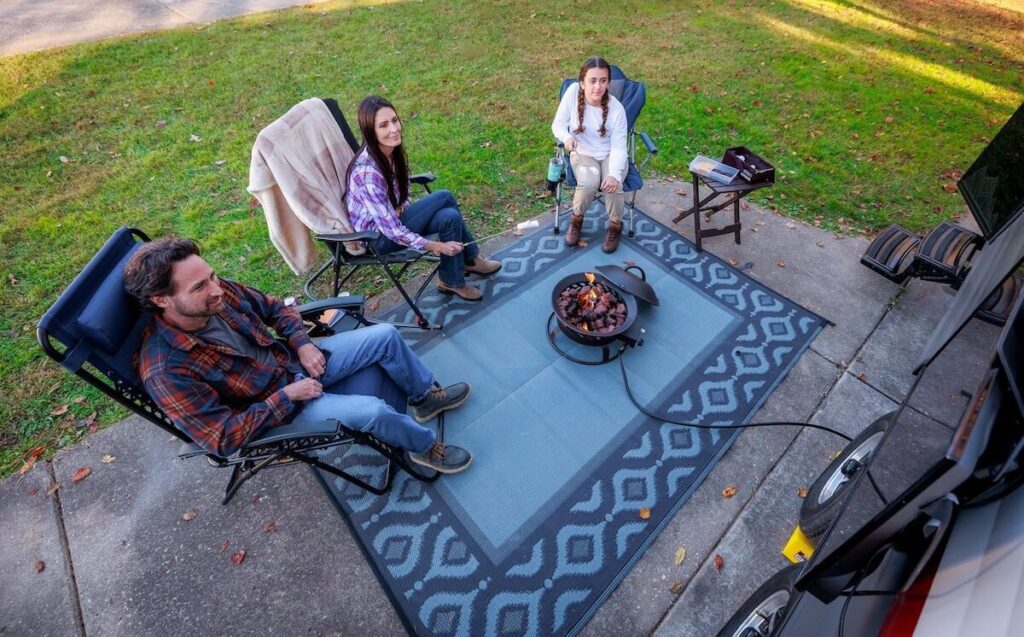
Most RVers use a patio mat. But you might as well use one that doesn’t add more plastic to the world. Venture Forward’s mats are made from recycled bottles — each 9′ by 12′ mat keeps about 80 bottles out of a landfill. They’re tough, reversible, and easy to clean.
Green RV Repair & Maintenance Products
Image by Camping World
Proper maintenance is a cornerstone of sustainability because it extends your RV’s lifespan. However, the chemicals used in repairs matter. These sealants offer more environmentally-friendly solutions than their peers.
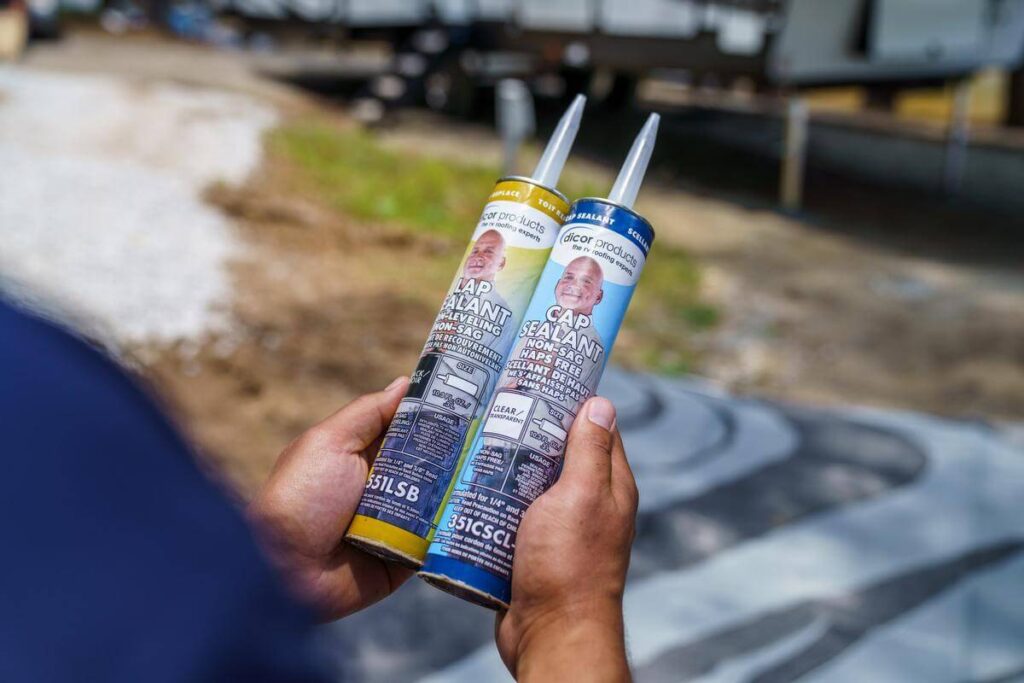
Dicor HAPS-Free Sealants: Unlike traditional sealants, these are “Hazardous Air Pollutants-free,” meaning they don’t release toxic chemicals into the atmosphere during or after application.
Alpha Systems Low VOC Sealants: “Low VOC” stands for Low Volatile Organic Compounds. These sealants have a lower toxicity level, making them safer for both the user and the surrounding ecosystem.
Ready to make your next trip a sustainable camping trip? Explore these additional resources:
Do you have any sustainable camping tips or questions? Let us know in the comments below!