5.2 C
London
Monday, May 11, 2026
Home Blog Page 120

Trying To Find A Charge At An Off-Grid Expo – E V O B S E S S I O N

0
Trying To Find A Charge At An Off-Grid Expo – E V O B S E S S I O N


What do you do when you a have a lot of travelling to do and limited access to power? You ask your mates for a hand. In the Aussie tradition of mate ship, I reached out and was offered a top-up, but it didn’t work.

Tess was attending the Goomeri Off Grid Expo, and to save money I stayed with friends 100 km away. That’s OK, you think — charge up, drive there, drive back, she’s applesit’s only 200 km. Not as simple as that. We were driving in cold weather into the rain at highway speeds, so we arrived at Goomeri with 180 km of range. Okay, you say, sharpening your pencil — if the car uses the same amount of charge getting back, it’s still okay. You will have a buffer of 50 km. However, I was expecting to allow people access to the car, and that uses charge. Being a little range anxious, I sought out a mate.

Paul drives a BYD T3 with vehicle-to-load tech, so we maneuvered the two vehicles close together and linked them up. What a great thing to be able to show the country people. These cars can share power! Sadly, it didn’t work. No top-up from the T3. Tess would not accept the charge. But hang on, we are at an off-grid expo. Surely there are generators.

Geoff from Westinghouse very kindly offered to bring over a generator and charge me up. It would make a great photo op for the trolls, I thought, charging a Tesla from a petrol generator. We got the genny going and plugged in the car. Once again, it did not work. Getting a little frustrated, we sought help from the collective hive mind of the Tesla Owners Club on Facebook.

Trying To Find A Charge At An Off-Grid Expo – E V O B S E S S I O N
Charging the Tesla from a petrol generator. Photo courtesy Majella Waterworth.

Later that day, the answer came back: the generator has to be earthed! I shared this information with Geoff and he said no problem, easy fix. Except that he didn’t have the tools and parts with him. So, no top-up from the Westinghouse generator. We had a backup backup plan — one of locals said we could charge from their house on a 10-amp socket — but that would have meant spending the evening in Goomeri and driving back in the dark.

Wet and soggy day at Goomeri. Photo courtesy Majella Waterworth.

The story has a happy ending. Tess is not still sitting in the mud at the Goomeri campground. Due to the inclement weather, we kept the car closed and so used no energy during the day. Taking it steady, we arrived home with a small buffer and Tess had a good feed from a 15-amp socket at my friend’s home while we relaxed with beers.


Source link

1967 Mini Marcos – A Look at “Elmo”

0
1967 Mini Marcos – A Look at “Elmo”


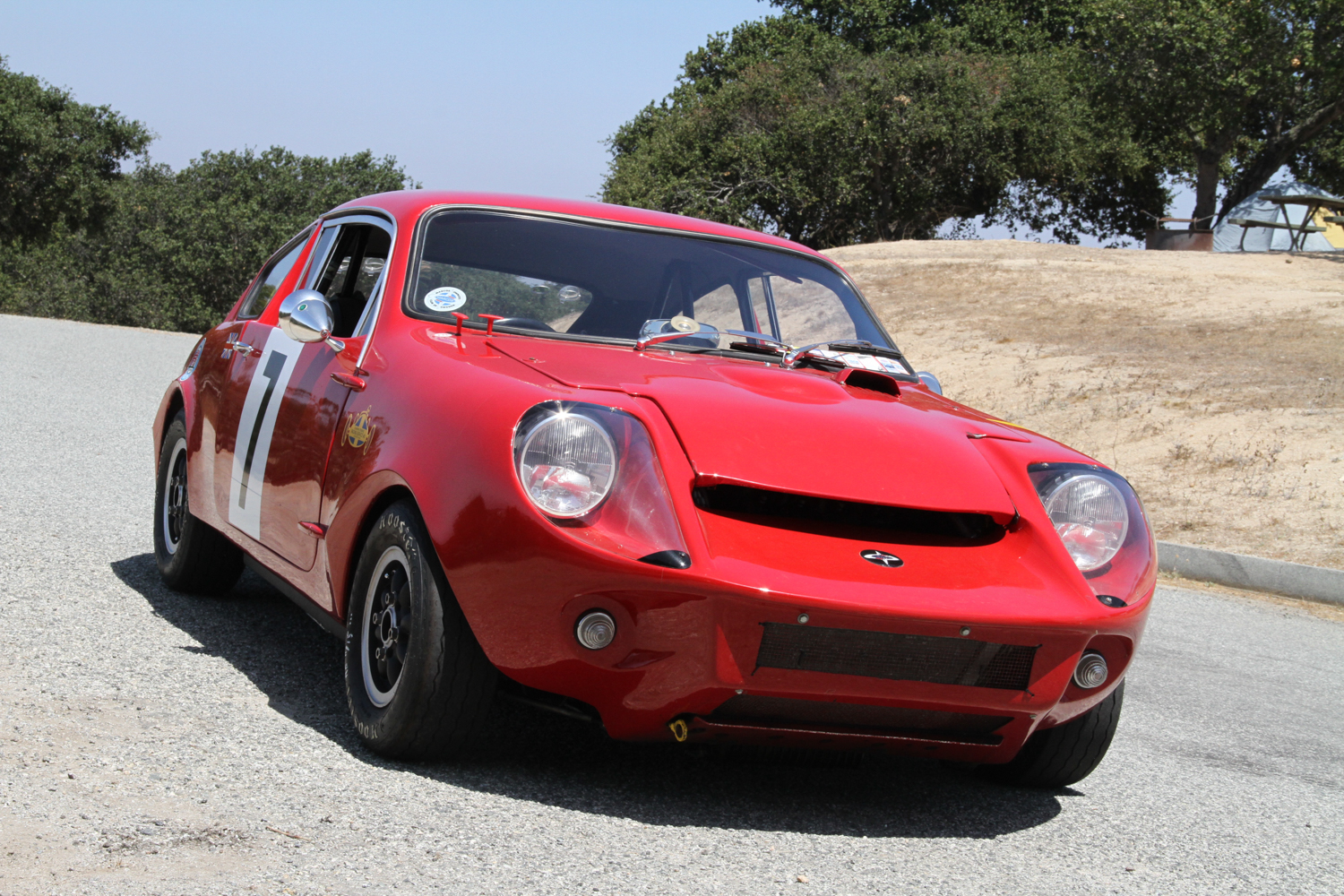
 Mini Marcos emblem Mini Marcos emblemA tiny red car is mixing it up at the Monterey Historic Races with 356 Porsches, Morgans, Corvettes, Lotuses and Alfas on the track. “What is that thing?” a fellow racer with a Ferrari on the pre-grid says. The same question has been asked at different racing events around the globe for the last five decades. The mystery car is diminutive in size and its features are not exactly what one would call beautiful. To many, it is as puzzling to identify today as it was when these cars first hit the track over 50 years ago. However, the Mini Marcos is legendary and coveted by those in the know. A fierce competitor in period, as it is today in vintage racing.

The story of the Mini Marcos began in 1959, in Dolgellau, North Wales, when Jem Marsh and Frank Costin founded Marcos Engineering. The name Marcos is derived from a contraction of the founder’s surnames (MARsh and COStin). Jem Marsh was an engineer, and his Luton, England based company, Speedex Castings and Accessories Ltd, manufactured and provided parts for Austin Sevens, based on Marsh’s successful Speedex 750 racing special.


Source link

GWM achieves dual growth in NEV & global markets, Brazil plant ready for launch

0
GWM achieves dual growth in NEV & global markets, Brazil plant ready for launch


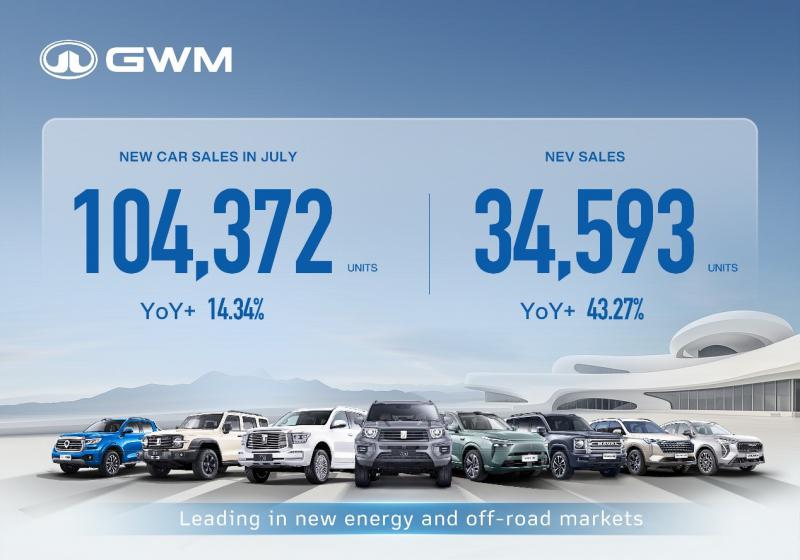
On August 1, 2025, Great Wall Motor Company Limited (GWM) released its sales data for July, with all major indicators showing consistent growth. Notably, both the new energy vehicle (NEV) segment and overseas markets maintained strong momentum.

In July, GWM sold 104,372 new vehicles, a year-on-year increase of 14.34%. NEV sales reached 34,593 units, up 43.27% year-on-year. Models priced above RMB 200,000 accounted for 33,511 units, growing 46.69%. Overseas sales totaled 41,088 units, an increase of 7.60%, while “boxy-style” vehicles achieved 44,801 units, up 17.01%, continuing to lead the boxy SUV segment.

GWM achieves dual growth in NEV & global markets, Brazil plant ready for launch

July also marked GWM’s 35th anniversary, a milestone celebrated together with over 15 million users worldwide. GWM continued to launch new products, enhance product performance, and improve market influence, with a focus on quality-driven market share. The company’s pragmatic approach and high-quality operations have garnered praise from major global media outlets. On July 20, the front page of People’s Daily  featured a report on GWM, highlighting the company’s progress in core technologies, vertical integration, and globalization, and recognizing GWM’s commitment to high-quality development. At the same time, The New York Times published an in-depth report on GWM’s Brazil plant, which is set to officially begin operations in August., affirming the brand’s image and localization success overseas. The article stated: “Its goal is to reinvent the way Brazil drives, and ultimately, the rest of Latin America, much as Chinese automakers have already done across much of Asia and want to do in Europe.”

GWM remains committed to an “All Categories, All Powertrains, All Users” positioning. In its new energy strategy, GWM focuses on plug-in hybrid electric vehicles (PHEVs) as the core technology, believing this path better aligns with its brand identity of “intelligent + off-road.” The Hi4 platform not only delivers safe and cost-effective four-wheel-drive performance, but also enhances fuel efficiency and environmental friendliness. While the broader market chased low-cost EVs, GWM remained steadfast in its value-driven approach — a strategy that has proven successful as market preferences shift.

According to data, China’s PHEV exports surged 177% in the first half of the year. From Australia to Southeast Asia, the Middle East to the EU, PHEVs are emerging as a new highlight in China’s auto exports. GWM’s Hi4-based hybrid technology is gaining popularity in global NEV markets, precisely meeting the needs of emerging markets for energy-efficient transformation. As a result, the company is seeing sustained growth in high-value model sales and a notable rise in brand reputation and trust in these regions.

In the global arena, GWM continues to push its “ONE GWM” global brand strategy, advancing a fully integrated “Global Ecosystem” model encompassing R&D, manufacturing, supply chain, sales, and service. The company now boasts over 15 million global users, more than 1,400 overseas sales outlets, and total overseas sales exceeding 2 million units. These robust system capabilities are fueling GWM’s global momentum and driving strong performance across multiple markets.

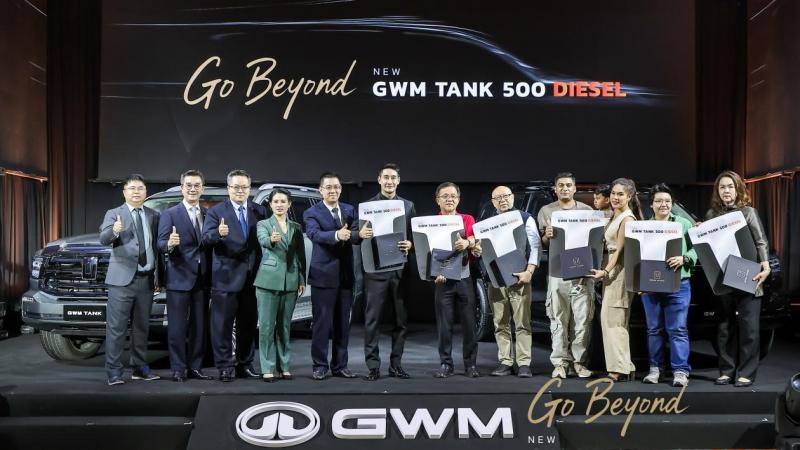
In July, the GWM TANK 300 and POER pickup supported the Peru Rally, earning the title of “All-Terrain King” in Southeast Asia. In South America, the GWM TANK 300 gained attention through engaging events, while the ORA 03 debuted in Indonesia. In South Africa, GWM received both the “Dealer Satisfaction Gold Award” and the “Best Progress Award.” The GWM TANK 500 diesel version made its global debut in Thailand, further expanding GWM’s footprint in Southeast Asia. CCTV Finance reported that Brazil has become a prime target for Chinese automakers, with GWM gaining strong recognition from local consumers. During the BRICS Summit, GWM was the only Chinese automaker invited to attend a roundtable for Chinese enterprises in Brazil. The Brazil plant is set to officially begin operations in August, becoming GWM’s third full-process manufacturing facility overseas.

As its intelligent hybrid technology continues to evolve, GWM plans to accelerate the rollout of Hi4-based models in Europe, Southeast Asia, and South America in the second half of the year, further boosting its influence in the global NEV market. With more new models built on the Hi4 platform set to launch globally, and overseas localization capabilities growing stronger, GWM is rapidly advancing toward its strategic goal of becoming a “Global Intelligent New Energy Technology Company.


Source link

Best BMW Scan Tool : ISTA vs. 3 Top OBD2 Scanner Alternatives

0
Best BMW Scan Tool : ISTA vs. 3 Top OBD2 Scanner Alternatives


Read Time:5 Minute, 39 Second

When it comes to servicing, diagnosing, and repairing BMW vehicles, dealerships and authorized BMW service centers heavily depend on a sophisticated diagnostic software called ISTA (Integrated Service Technical Application). ISTA is BMW’s proprietary tool explicitly designed to perform detailed diagnostics, repairs, module programming, and updates.  For BMW diagnostics and coding, alternatives to ISTA include YOUCANIC UCAN-II full system scanner, Autel MaxiSys, ProTool, Bimmercode/Bimmerlink, and BMW Standard Tools (which includes INPA, NCS Expert, and WinKFP). With so many options as of 2025 it can really be confusing to choose the best OBD2 scanner for BMW. So let’s take a look at what ISTA is and what it can do and then the top alternatives to ISTA.  

If your BMW dashboard has lit up like the holiday lights, the last thing you need is a visit to the dealer. So, you start looking into ISTA and BMW OBD2 scanners. Or maybe you are an auto repair shop specializing on BMW and need a good scanner for the shop. Despite its comprehensive capabilities, ISTA remains costly, complex, and notoriously difficult to master, presenting significant challenges for independent mechanics and DIY car enthusiasts.

In-Depth Look at BMW ISTA

BMW ISTA offers a dealer-level diagnostic solution that enables technicians to diagnose issues, guide repairs, and execute sophisticated coding and programming for all BMW electronic control units (ECUs). ISTA’s strength lies in its depth—it allows comprehensive analysis and management of vehicle systems and modules that are typically inaccessible with basic scanners.

However, ISTA’s availability is limited. Gaining official access usually involves a substantial investment, potentially exceeding several thousand dollars. Beyond financial hurdles, acquiring ISTA requires official dealership affiliation or certification as an authorized BMW service partner, thus significantly restricting its availability to general users.

Moreover, even professional technicians often find ISTA’s interface overwhelming. It assumes significant prior technical knowledge and extensive BMW-specific training, creating a steep and demanding learning curve. The complexity can prove problematic for mechanics or DIY enthusiasts who need efficient, quick solutions without extensive preparation. Getting access to the authentic ISTA is not only expensive, but is also a sure way to brick an expensive BMW if you have not had training on the software in the past. There are plenty of horror stories on BMW forums where owners turn their BMW’s into paper weight using ISTA and misconfiguring ECUs.

Best Alternatives to BMW ISTA Diagnostic Softaware

So now let’s look at some of the best alternatives to the best OBD2 scanner for BMW that can rival ISTA.

1.  YOUCANIC Full System Scanner

Given these significant challenges, the YOUCANIC scanner emerges as the most practical and effective alternative on the market today. Explicitly designed for mechanics and BMW owners, the YOUCANIC scanner provides comprehensive diagnostics across every BMW system—including critical modules such as the engine, transmission, ABS, airbags, climate control, and more. It parallels ISTA’s extensive capabilities while offering a far more user-friendly experience.

YOUCANIC scanner excels in providing specialized functions essential for BMW vehicles. It supports over 40 reset and maintenance functions, including oil service reset, electronic parking brake service, steering angle sensor recalibration, and TPMS resets. Notably, the scanner also offers sophisticated coding capabilities for battery registration, injector coding, and module configuration—functions traditionally reserved for expensive dealership-level tools like ISTA.

A key advantage of YOUCANIC lies in its intuitive, user-friendly interface, specifically engineered to simplify complex diagnostic tasks. Unlike ISTA, YOUCANIC is accessible to both professional mechanics and automotive DIY enthusiasts without necessitating months of specialized training or costly certifications.

Another significant benefit is YOUCANIC’s lifetime free updates, eliminating any concern over future subscription fees. Complementing these advantages are extensive online resources, detailed troubleshooting guides, and robust technical support from automotive experts, helping even beginners quickly master diagnostics.

Furthermore, unlike ISTA, YOUCANIC is not restricted to BMW vehicles. It supports virtually all makes and models, dramatically enhancing its versatility and value for professional mechanics and car hobbyists who work with diverse vehicles.

2.  Autel Scanner

Another viable option is Autel’s advanced diagnostic scanners, such as the MaxiSys MS906. While these tools are capable, achieving functionality comparable to YOUCANIC requires purchasing models typically priced above $1,000. Additionally, Autel scanners demand ongoing paid subscriptions for updates, increasing total ownership costs significantly. Autel’s customer support and availability of comprehensive resources fall short compared to YOUCANIC. Now you may be considering the  Autel MaxiCOM verions such as the MK808 but those lack many capable and special functions that you will find on the YOUCANIC scanner and are not worth considering for modern BMWs and definitively not for a mobile mechanic or small garage.

3.  Carly for BMW

For budget-conscious BMW users, Carly offers basic diagnostic and coding functionality. However, its reliance on ongoing subscriptions can rapidly escalate costs, and its usability is strictly confined to BMW and limited other makes. Thus, Carly lacks the broader utility offered by YOUCANIC and other multi-brand solutions.

Now there are other BMW scanner in the market such as the TopDon, iCarsoft, Foxwell, Xtool and ThinkCar to name a few. The diagnostics world has dozens of diagnostics tools entering the market every month. In this article, I just wanted to go over some of the most popular and capable OBD-II scan tools for BMW that are definitively worth taking a look at.

Conclusion

If you are looking to diagnose modern BMWs like the i8 shown above, then you definitively need a capable and powerful OBD2 scan tool that covers all vehicle systems and has special functions and coding capable like the three I cover on this article. Don’t get obsessed with the scanners screen size, what maters most is the software that you will get on these scan tool and some like the Carly simply utilize your phone.

For mechanics specializing in BMW vehicles and enthusiastic DIYers looking for a robust diagnostic solution, the YOUCANIC full system scanner is affordable and stands out as a great choice. Balancing comprehensive functionality, ease of use, and affordability, YOUCANIC provides dealer-level diagnostics and coding without the prohibitive costs and complex interfaces associated with ISTA. Its lifetime free updates, excellent technical support, extensive instructional resources, and broad vehicle compatibility collectively ensure unmatched value. Carly for BMW is another good option is you are mainly focused on coding but can be costly on the long run and only works on BMW. You have to pay for other brands. Also Autel MaxiCOM is worth considering but the price is closer to $1000 and you have to pay subscription after two years.

If your goal is to confidently diagnose, repair, and maintain BMW vehicles—or any car—without the limitations of dealership exclusivity or complexity, the YOUCANIC scanner represents the best available tool today.


Source link

2025 Volkswagen ID.Buzz tags nostalgia, re-ups minivans

0
2025 Volkswagen ID.Buzz tags nostalgia, re-ups minivans


  • U.S. spec is 3-row, 10 in. longer than Euro version out two years ago
  • Larger 91-kwh battery pack, higher-power rear motor
  • EPA range up to 234 miles, 10-80% in 26 min.
  • Starts at $61,545, spans to $71,545 for top 1st Edition AWD 

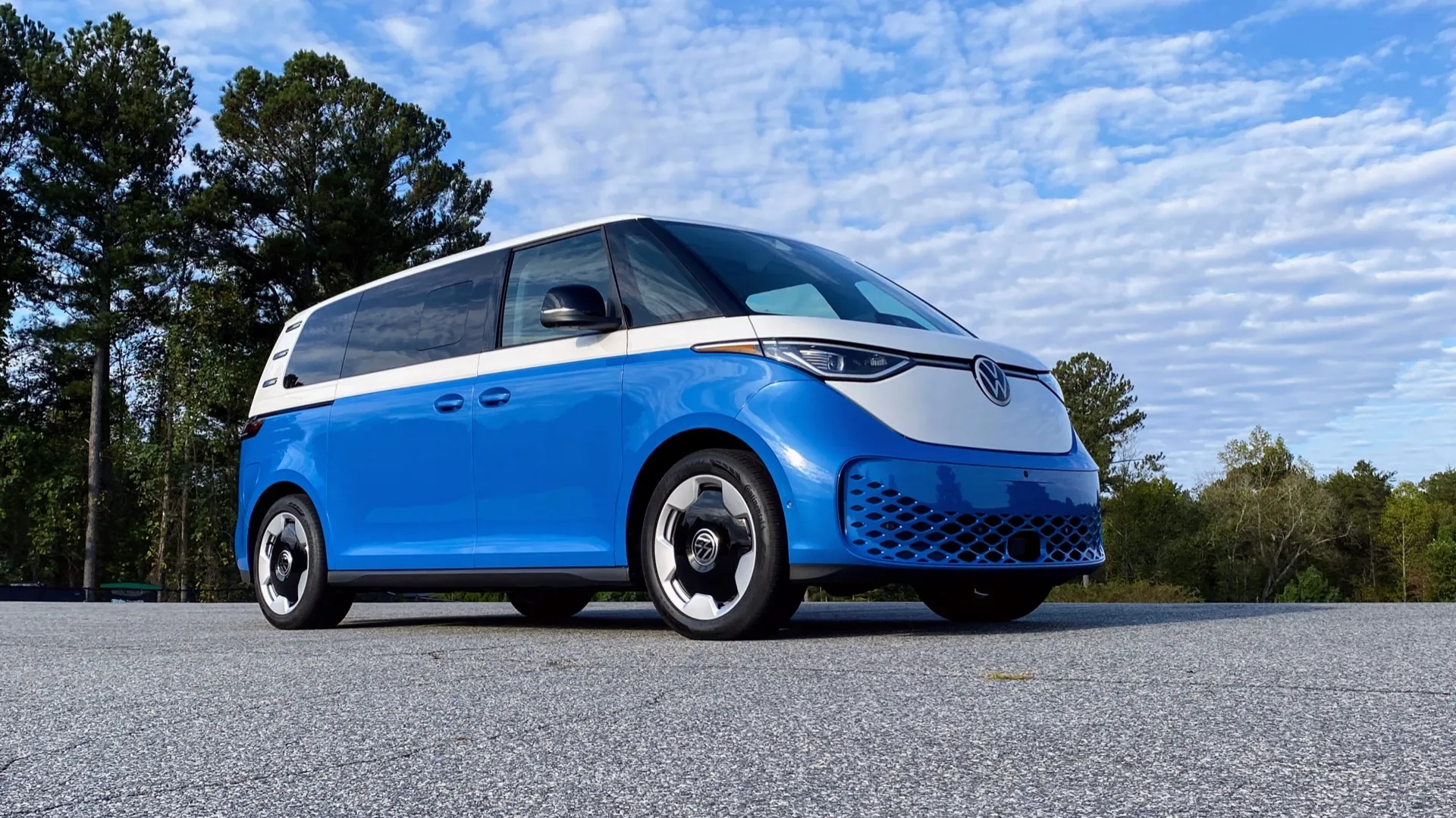
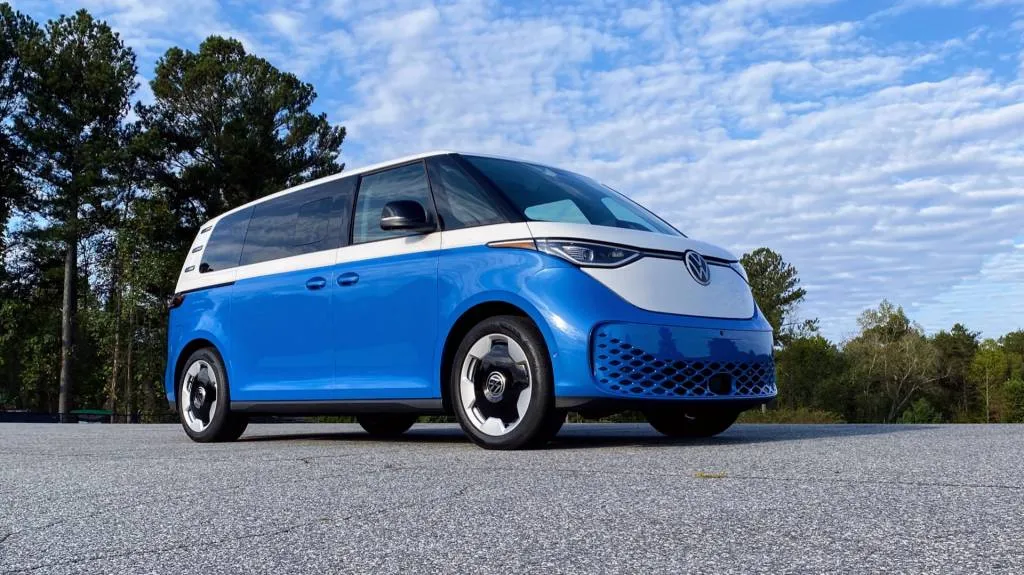
VW’s electric Bus reboot is finally arriving in the U.S.. And by design, it’s hard to imagine a better way that VW might have positioned an electric van for the past and the future, all at once. 

Everybody wants one. Sure, it’s late and it’s been wracked by decades of false starts and concept vehicles, and by now the original Hippies may have ended their traveling days. But across generations, everyone has stories and feels tinges of nostalgia upon seeing the nose of this van and the signature two-tone themes. 

This past week I drove the ID.Buzz not in San Francisco but on the rural back roads and through the suburban communities of north Georgia. Based on the diversity of questions, gawkers, and thumbs-ups—love from a tattered Tacoma, an Explorer, and a Cybertruck—it took all of 10 minutes to see that mass-market demand for this thing beyond “blue” America and counterculture hotpots is on the verge of boiling. 

2025 Volkswagen ID.Buzz
2025 Volkswagen ID.Buzz
2025 Volkswagen ID.Buzz tags nostalgia, re-ups minivans

2025 Volkswagen ID.Buzz

2025 Volkswagen ID.Buzz

2025 Volkswagen ID.Buzz

The ID.Buzz gets smiles everywhere it goes and hums above the frequency of American EV discord, whether or not it’s electric, which is no small feat this election year. Of course it’s electric, and who cares if it’s electric, all at once. 

If VW was fretting about the timing, it made me wonder if the late arrival helps this thing realize its potential—because the ID.Buzz isn’t an awkward, two-dimensional homage to the past. 

ID.Buzz styling hits highs, won’t harsh your mellow

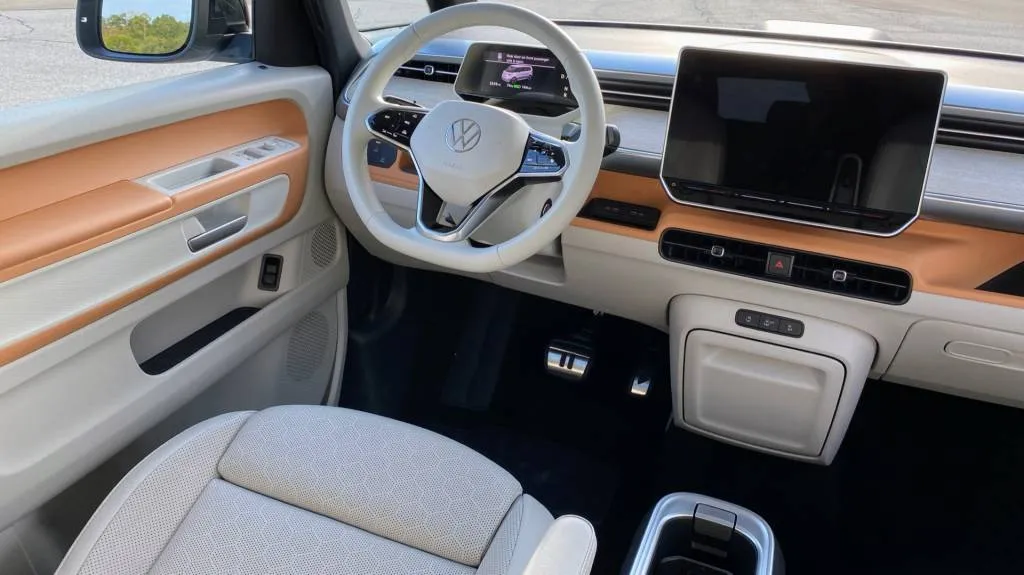
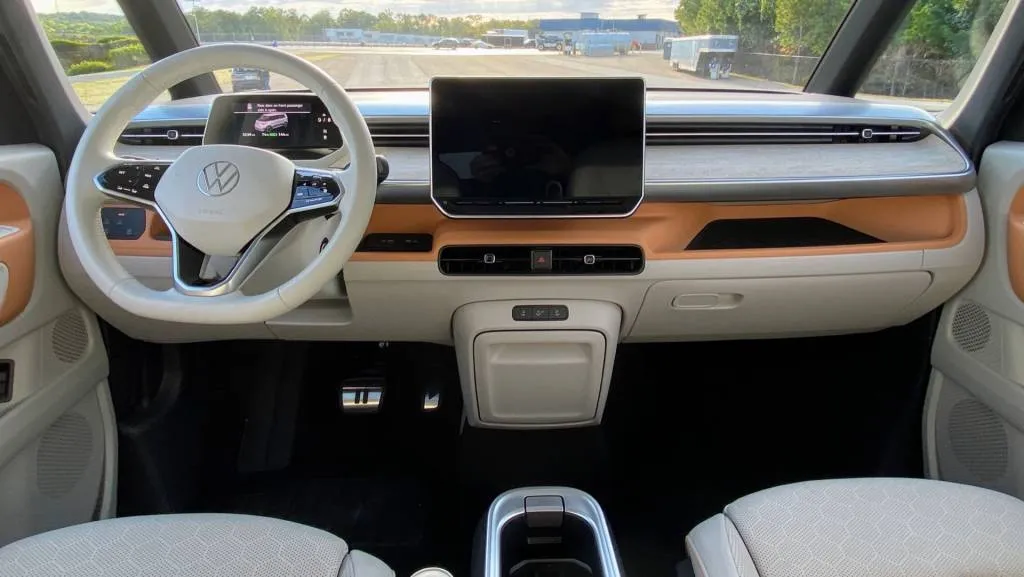
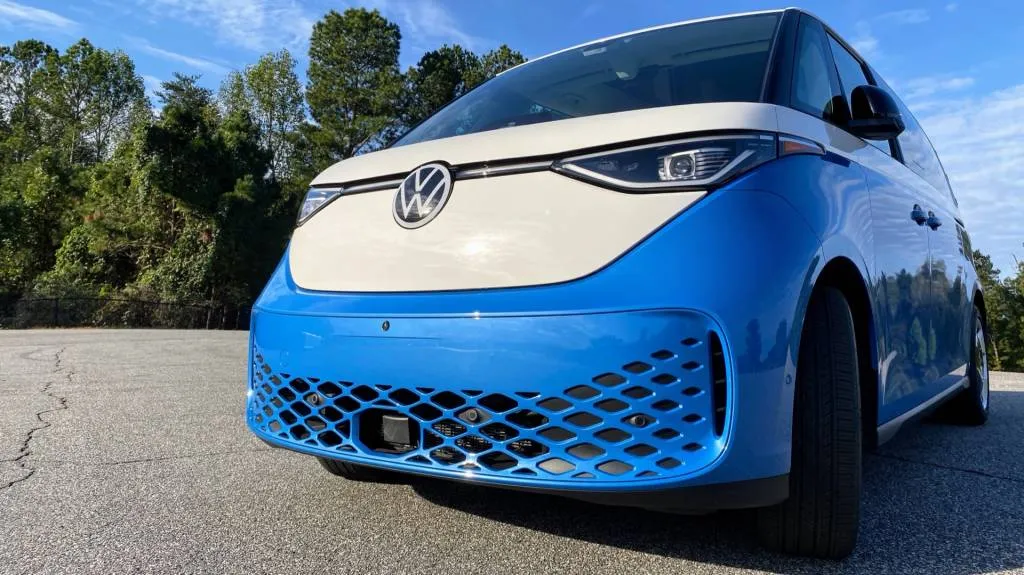
Unlike a long list of vehicles in recent automotive history—including, let’s be honest, VW’s New Beetle—the Buzz doesn’t push its retro waves so insistently that it harshes your mellow. The Buzz offers just the right amount of retro-fun on the outside, but inside the Buzz is just a great van that takes full advantage of its EV platform. 

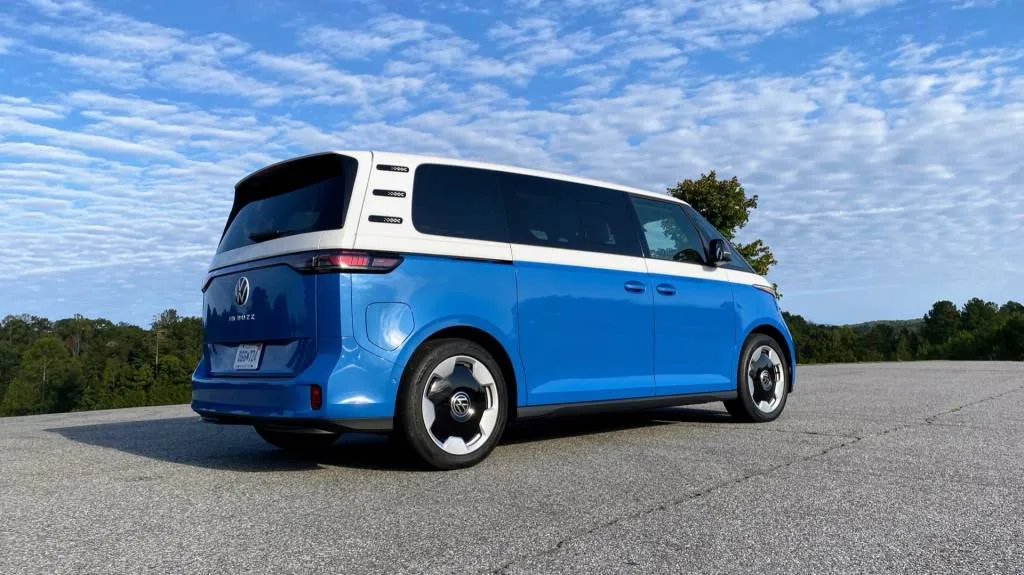
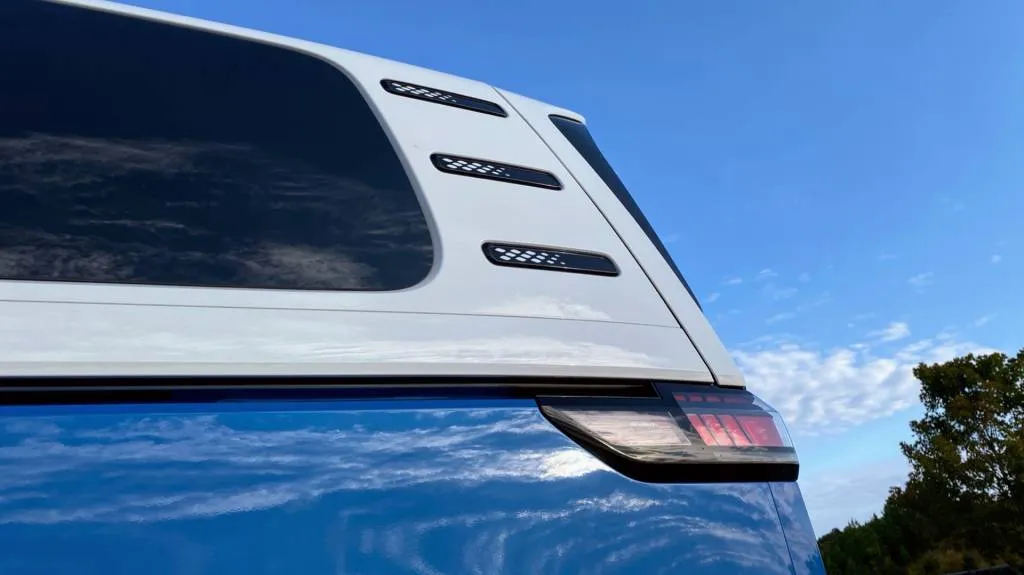
The ‘50s and ‘60s air-cooled cues may be there, but from the inside out, from any angle but the front, the Buzz is more a reboot of the Eurovan formula. It’s (almost) a flat-floor box on wheels, with three rows of seating, good for up to seven, and a huge amount of versatility and cargo space. 
2025 Volkswagen ID.Buzz

2025 Volkswagen ID.Buzz

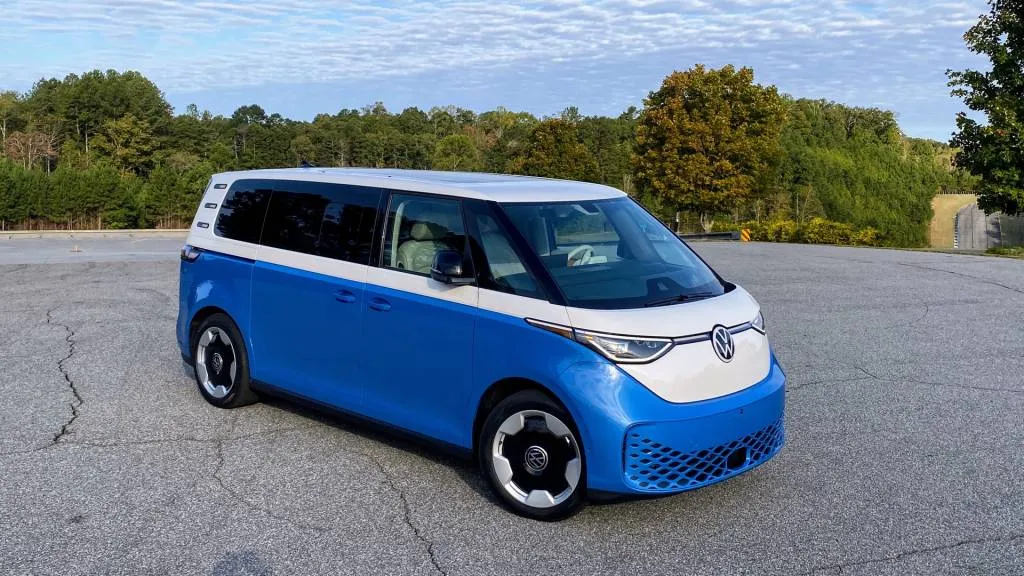
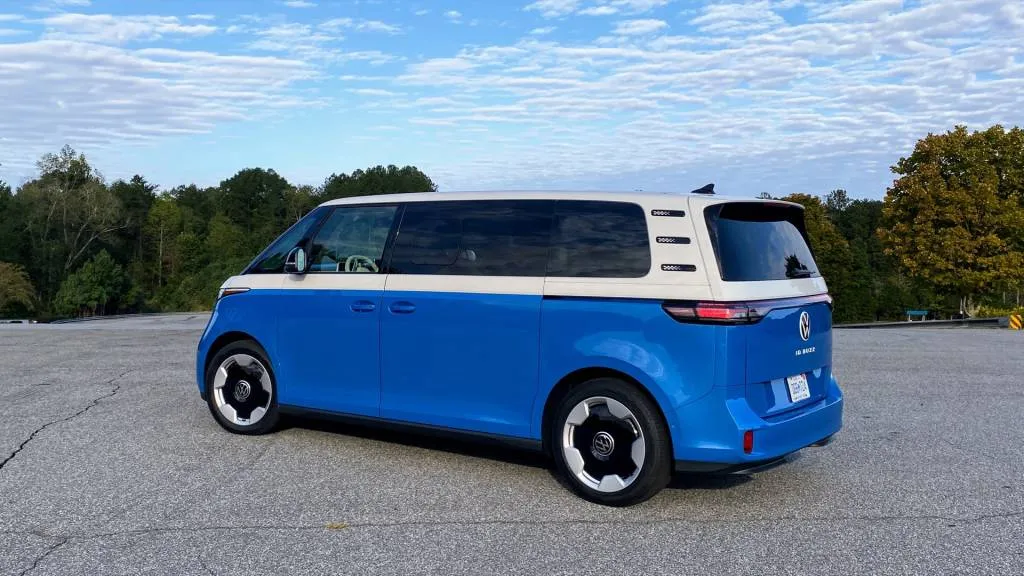
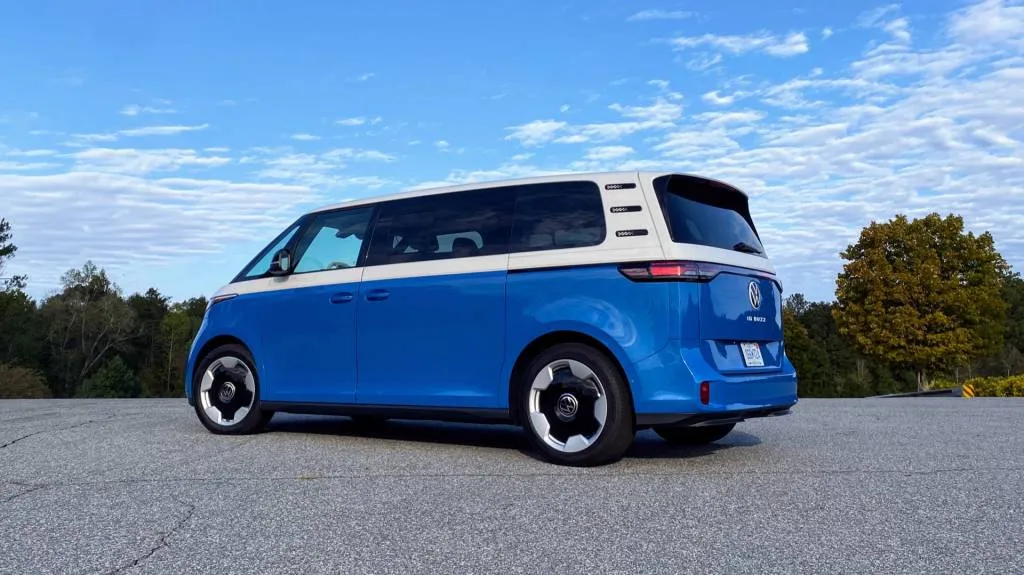
In U.S. form, the ID.Buzz is offered in a series of seven different two-tone schemes pairing various colors with white, or a Cherry Red-and-gray two-tone, or monochromatic white, gray, or black. And for now and the foreseeable future the ID.Buzz comes to the U.S. only in this three-row form, with an overall length of 195.4 inches, riding on a very long wheelbase of 127.5 inches. Its overall height of 76.2 inches makes it about 10 inches taller overall than VW’s ID.4 crossover, while still offering 6.1 inches of ground clearance that should be just fine for getting down two-tracks on the way to campsites or trailheads. 

VW ID.Buzz impressions: Quick and quiet, precise but heavy

VW decided at some point that it couldn’t launch the ID.Buzz in the U.S. with its original standard-wheelbase form factor—thus adding two long years to its arrival date. So for us, the upgrades include about a 10-inch stretch, a new infotainment interface, software improvements, and a more powerful rear motor—as well as a bigger 91-kwh battery (vs. the 82-kwh pack in those Euro versions). 
2025 Volkswagen ID.Buzz
2025 Volkswagen ID.Buzz
2025 Volkswagen ID.Buzz
2025 Volkswagen ID.Buzz

2025 Volkswagen ID.Buzz

2025 Volkswagen ID.Buzz

2025 Volkswagen ID.Buzz

2025 Volkswagen ID.Buzz

How does the ID.Buzz drive? In a word: heavy. Yes, you do feel all three tons. It’s also softly sprung, and clearly tuned more for a compliant ride than for handling. But thanks to the low center of gravity and precise steering, it’s never a handful. And if you’ve done plenty of drive time in full-size, truck-based vans and minivans alike, it’s a driving experience that’s clearly in the minivan zone. The ID.Buzz is quite wide, at 78.1 inches without the mirrors, and on the narrow Georgia backroads, with no shoulder, I appreciated its predictable behavior and easy lane placement. 

In parking lots, the same thing goes, within the reality that it’s every bit as long as some three-row SUVs. In single-motor rear-wheel-drive form as the one I drove, the turning circle is an amazing 37.4 feet, although AWD versions will raise that to 42.7 feet. Having real, old-fashioned, through-the-windows outward vision—beyond camera systems and beeping sensors—really helps. 
2025 Volkswagen ID.Buzz
2025 Volkswagen ID.Buzz
2025 Volkswagen ID.Buzz

2025 Volkswagen ID.Buzz

2025 Volkswagen ID.Buzz

2025 Volkswagen ID.Buzz

While VW hasn’t outlined any serious changes to suspension tuning in refreshing this model for the U.S., this ID.Buzz didn’t provide as much nosedive under hard braking as we experienced with a drive in the shorter version a couple years ago—perhaps a benefit of the longer body. 

The ID.Buzz gets VW’s own uprated electric drive unit (called AP550 and now used in the 2024 VW ID.4) at the rear wheels, making 282 hp and 413 lb-ft of torque. Those upcoming AWD versions will get the same drive unit at the rear wheels plus an inductive motor at the front wheels, making 99 lb-ft of torque and upping the total output to 335 hp. 

Although one editor who drove the ID.Buzz called it sluggish, I found it to be plenty perky with the single-motor setup. 0-60 mph times will be 6.0 seconds in dual-motor form, according to VW, while rear-wheel-drive versions like the one we drove take it to about 7.5 seconds. Towing capacity for the ID.Buzz is 2,600 pounds for a braked trailer, or 1,650 pounds unbraked. 

Yes, it’s heavy. Even in its leaner rear-wheel-drive form that we test-drove, it officially weighed in at just 32 pounds short of three tons. Add the dual-motor AWD setup and you’re at 6,197 pounds. 
2025 Volkswagen ID.Buzz

2025 Volkswagen ID.Buzz

ID.Buzz range and efficiency

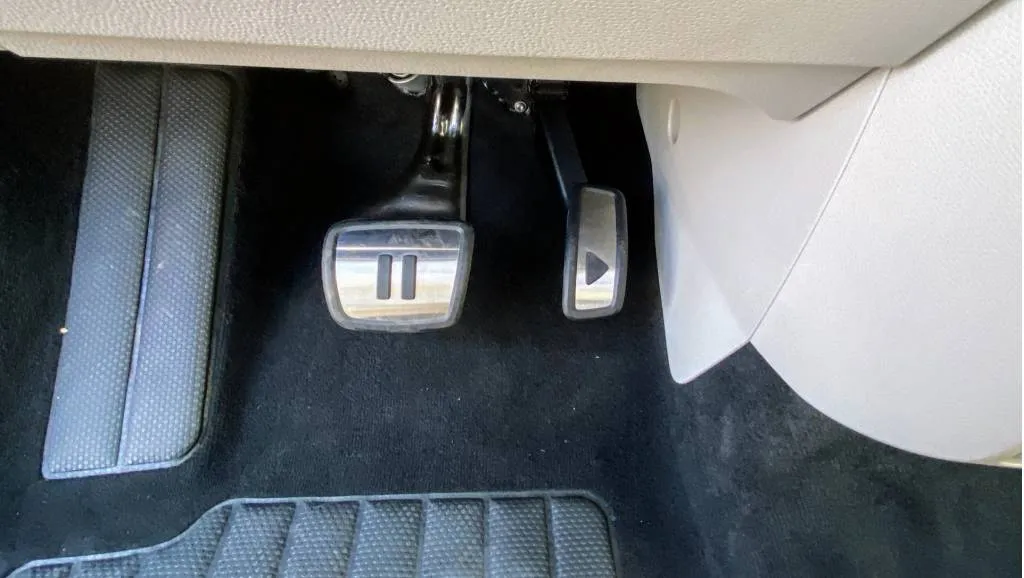
As in other VW EV products, a twist of the shifter allows access to either the ‘D’ mode, which lets you glide with minimal regeneration, or the ‘B’ mode, which dials up regen somewhat but remains quite mild. Switching the drive mode to Sport makes each of these levels slightly higher, with Sport and ‘B’ a good companion for hilly, twisty roads, but there’s still nothing quite like a one-pedal mode here. But brake pedal feel and blending are exactly what they need to be—predictable and progressive.

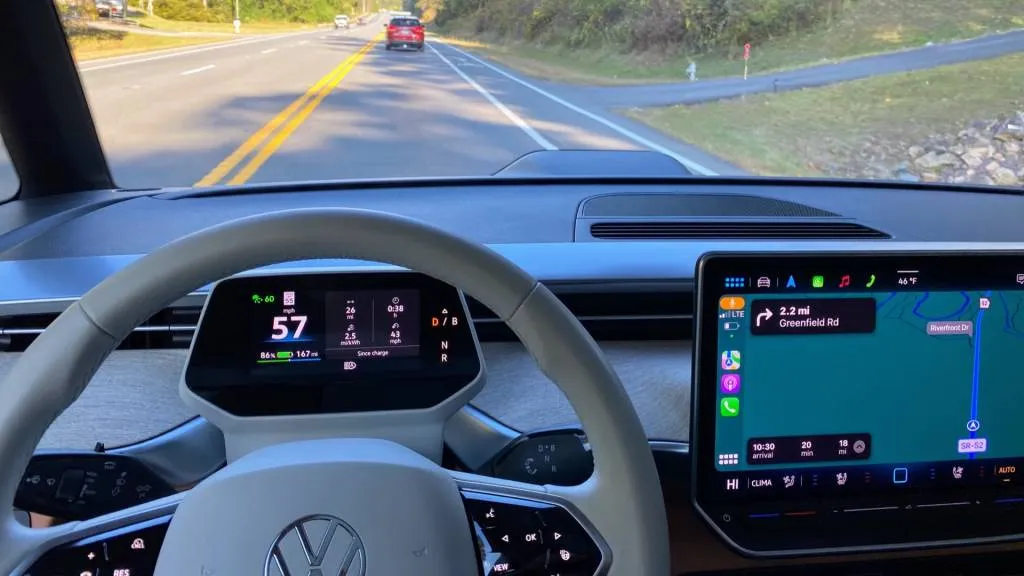
VW says that the ID.Buzz gets 2.5 miles per kwh (83 MPGe) combined, with the EPA highway cycle yielding 2.2 mi/kwh (75 MPGe). In a 110-mile loop up into low mountains, including some U.S. freeway speeds, fast-moving backroads, and mid-speed suburban streets, with outside temps around 50 degrees Fahrenheit, I averaged 2.6 mi/kwh according to the trip computer. Then, on an easygoing highway cruise, most of it pretty level at 65-70 mph, I averaged 2.4 mi/kwh.
2025 Volkswagen ID.Buzz

2025 Volkswagen ID.Buzz

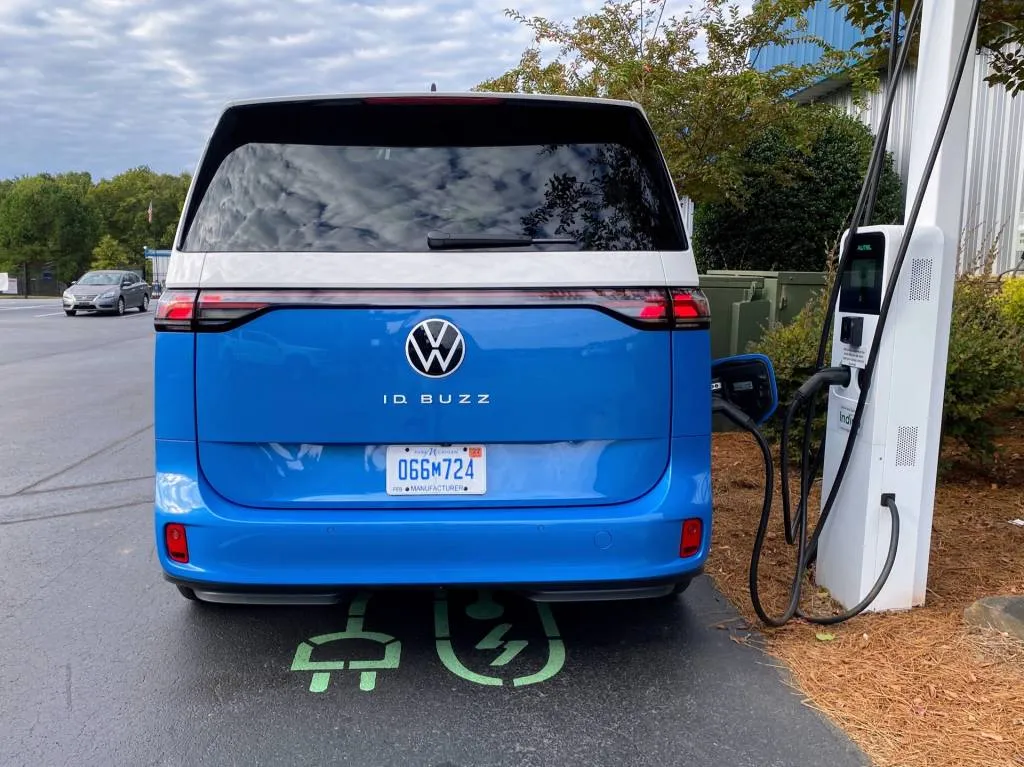
We charged the ID.Buzz, too, with Level 2 charging that flexed its 11-kw onboard charger, and with some DC fast-charging. In an experience that admittedly wouldn’t mimic what most owners would have on a road trip, we plugged a 160-kw CCS connector in at 44% and still saw a peak of 117 kw around 49%, with the state of charge reaching 90% in about a half-hour. VW says that DC fast charging at up to 200 kw enables a 10-80% charge in as little as 26 minutes.

In all, while a 100% charge amounts to as little as 191 miles according to the gauge cluster, we saw better, with our results roughly corresponding to the Buzz’s EPA range rating of 234 miles (or 231 mi. in AWD form). 
2025 Volkswagen ID.Buzz

2025 Volkswagen ID.Buzz

Trip planning is built into the native navigation system, and it will start preconditioning of the battery pack to access the maximum charge rate automatically with a charging stop along the route, or with a press of the virtual button on the screen. And if you want to bypass it all and go with the mapping app of your choice, you can still pair your phone for Apple CarPlay or Android Auto. I mixed it up between CarPlay and the built-in interface, and both sides worked great. 

Buzz bins of flexibility, space, tech here

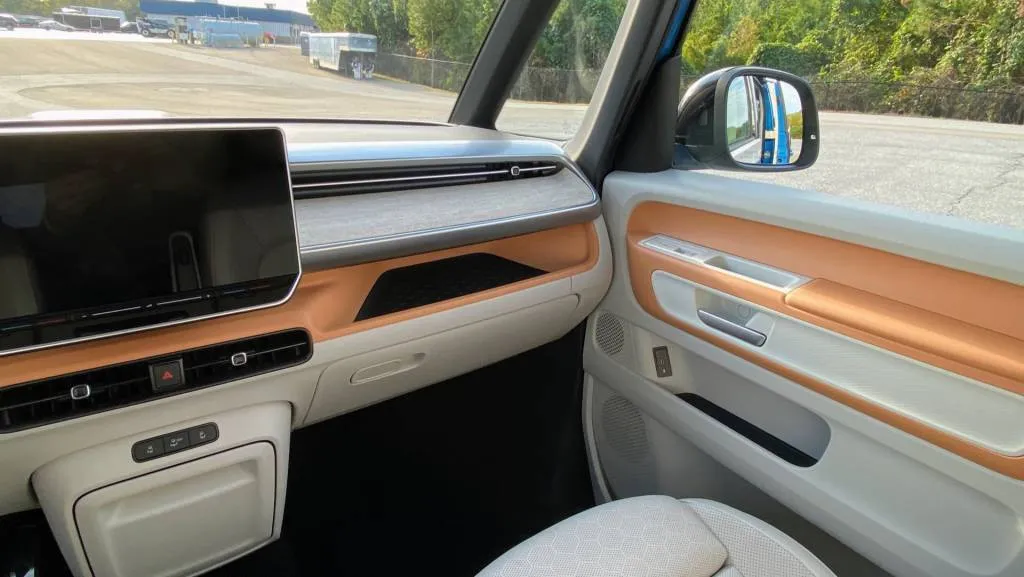
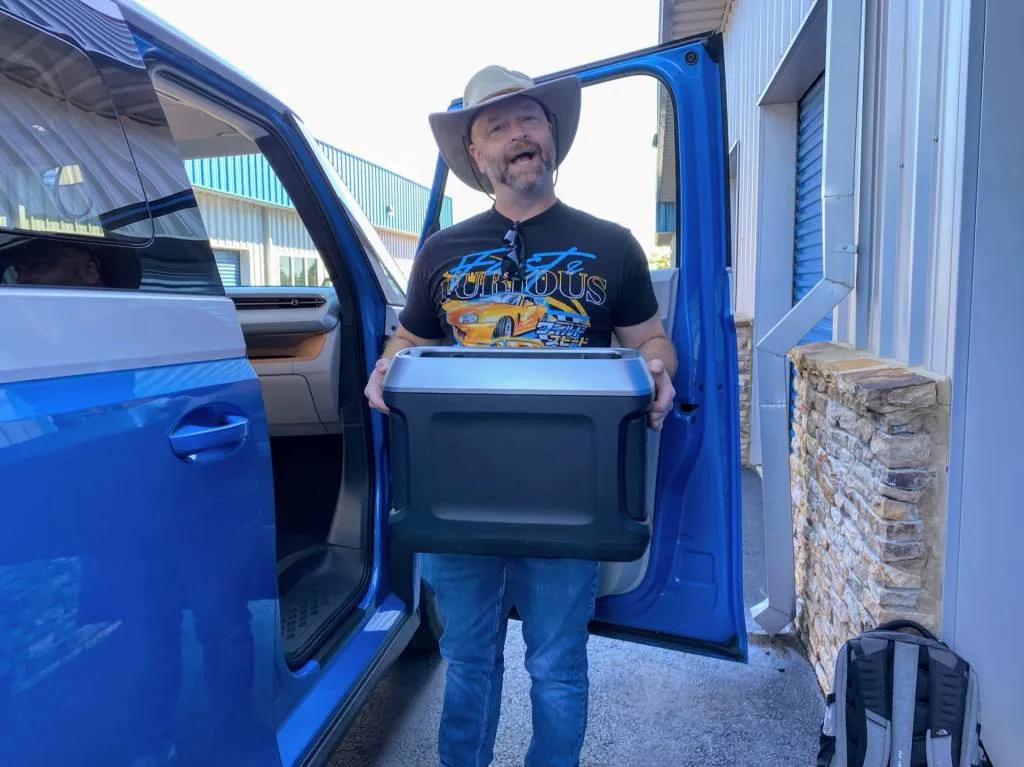
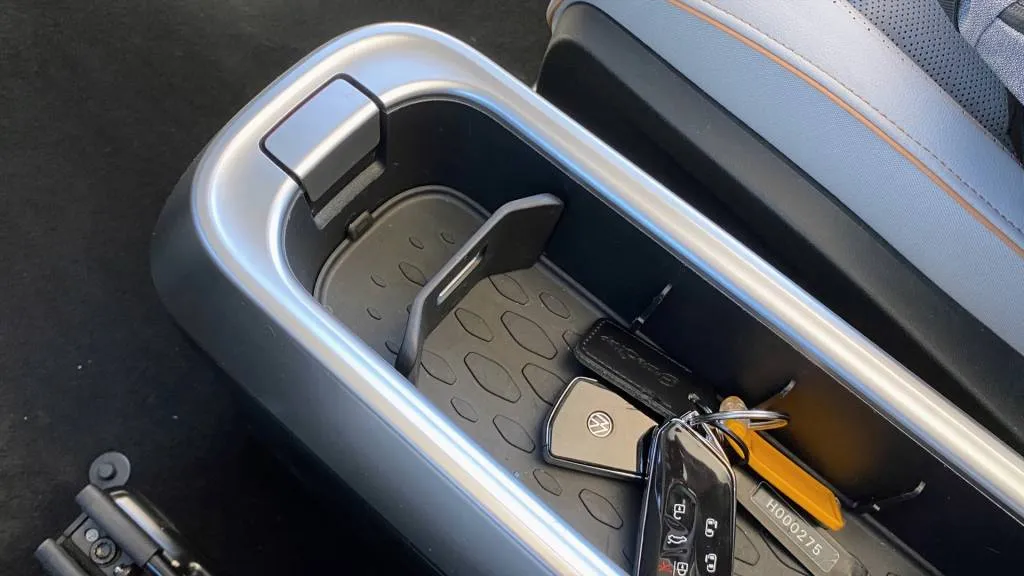
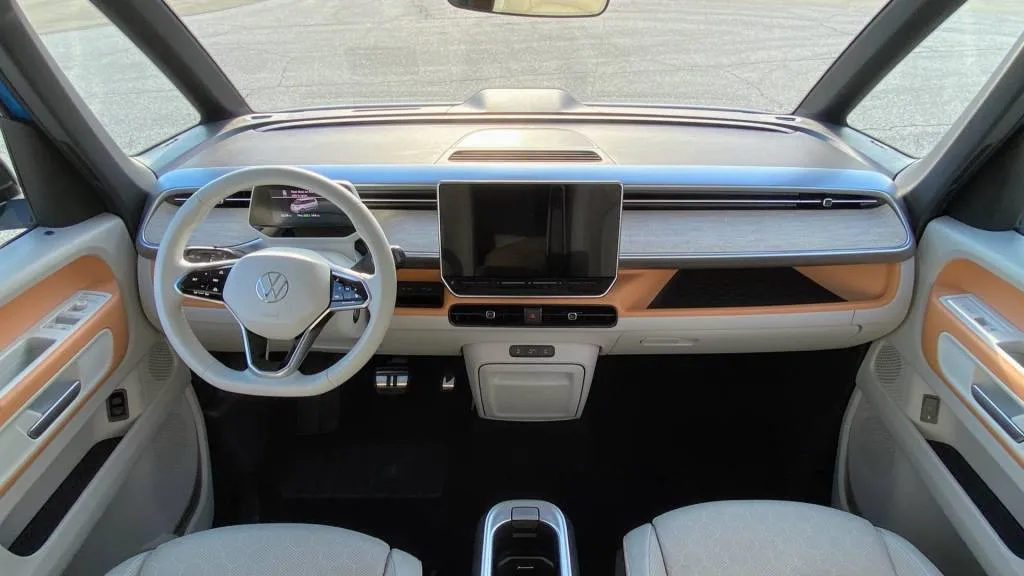
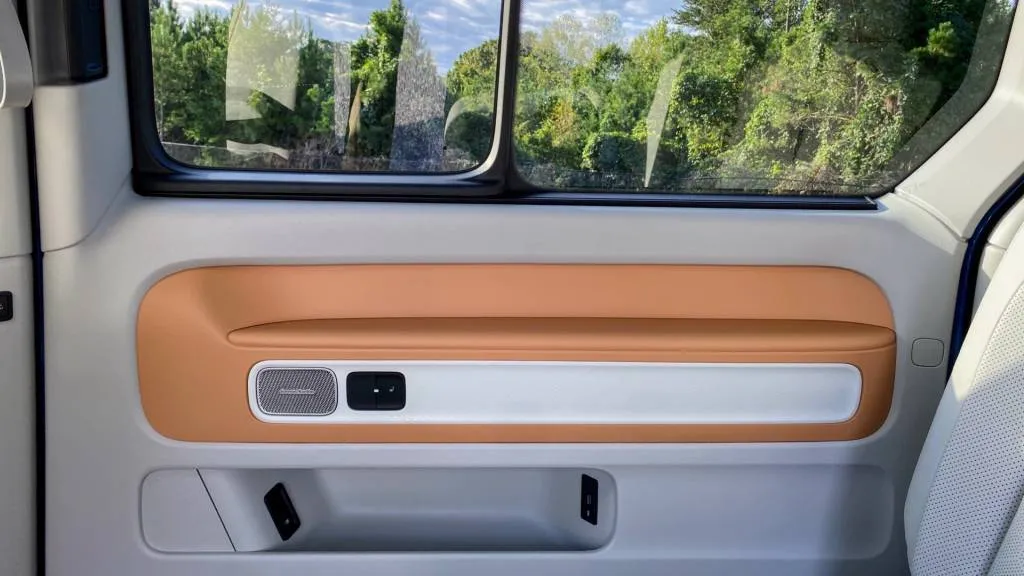
The three-row VW ID.Buzz also has a lot of flexibility in door bins and various storage places. The tall console between the front seats can lift completely out of the vehicle, as a sort of mini-cooler if you wish, and the pull-out drawer with cupholders and more storage stows away neatly to keep it feeling airy and spacious. Two levels of door bins and a dash tray give you plenty of space for the smaller pieces of a road trip. 
2025 Volkswagen ID.Buzz
2025 Volkswagen ID.Buzz
2025 Volkswagen ID.Buzz

2025 Volkswagen ID.Buzz

2025 Volkswagen ID.Buzz

2025 Volkswagen ID.Buzz

I found the grippy phone shelf just to the right of the steering wheel to be an ideal place for my phone to charge wirelessly without sliding around. And in the effort to kit this model out a bit better for three rows, there are now eight USB-C ports on board. Front seats are heated, cooled, and power-adjusted, providing an inbound armrest plus an upright driving position and the kind of back support I like for longer trips. 

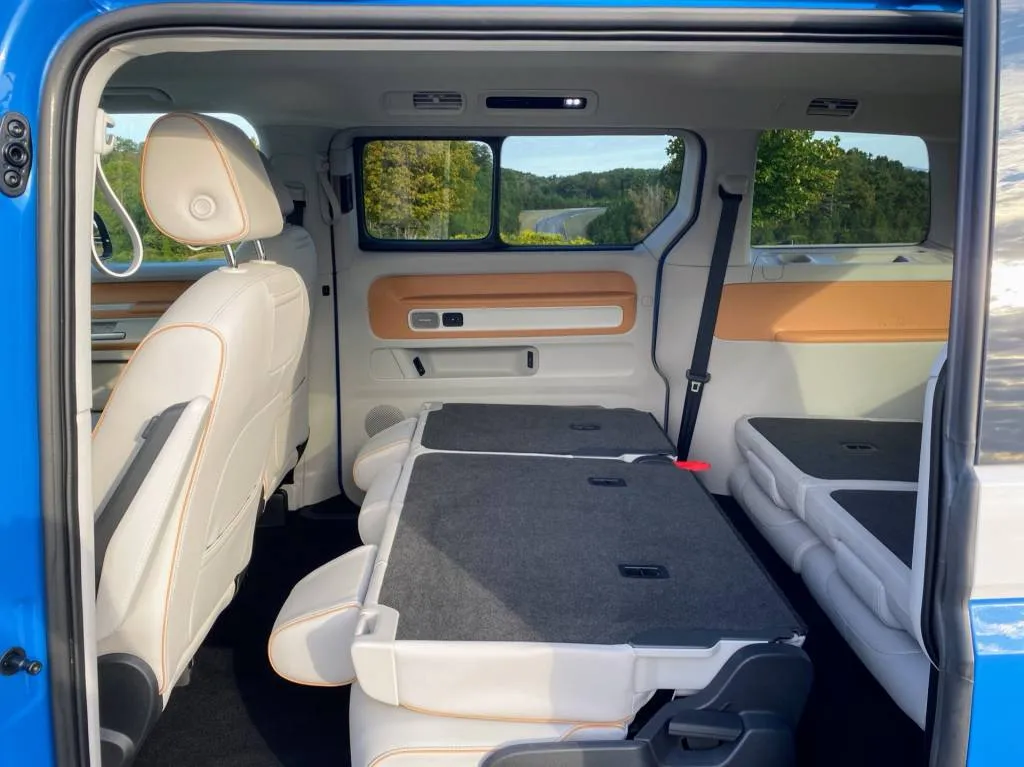
The sliding door powers open and closed in a way you’ll find absolutely familiar if you ever had premium minivans in the household—and, it just barely stays out of the way of charging-in-progress, we found. The biggest choice ID.Buzz buyers might face, other than the color, of course, will be the seating layout—trading out the middle bench in our model for second-row captain’s chairs and a six-passenger capacity (the only way for AWD versions). 
2025 Volkswagen ID.Buzz
2025 Volkswagen ID.Buzz
2025 Volkswagen ID.Buzz

2025 Volkswagen ID.Buzz

2025 Volkswagen ID.Buzz

2025 Volkswagen ID.Buzz

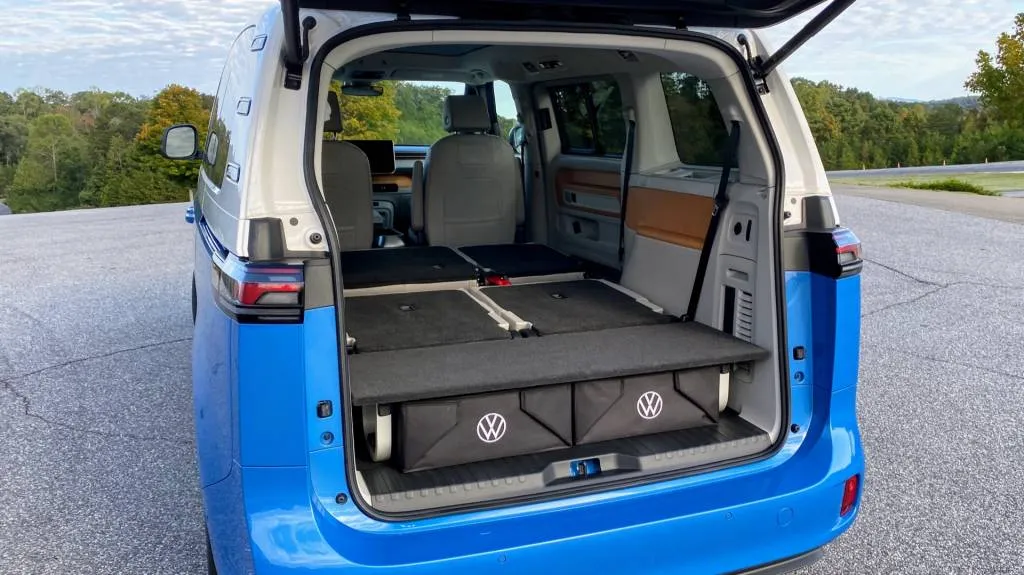
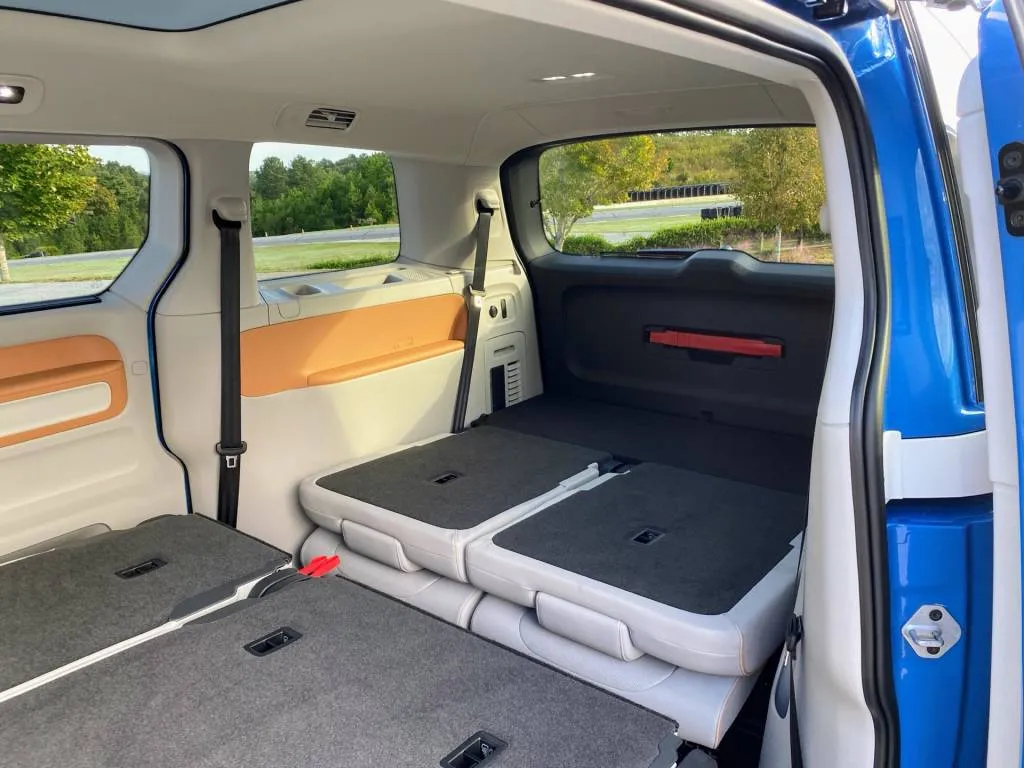
Although the far-back cargo area of the Buzz appears a little strange at first look, with baskets underneath a sturdy hinged door, the folded third row, and the folded second row all line up at the same level—save for a gap of a few inches between the second and third row. If you want to sleep in the thing, that’s nothing a good piece of plywood won’t solve. Remove the seats—they’re heavy—and the rearmost section bumps up to again require some sort of level-up, if you plan to sleep, live, or otherwise inhabit this vehicle for something other than just driving.

VW is guessing that the majority of Buzz customers will come from “large SUVs.” It boasts more interior space than the Atlas, in the footprint of a Cross Sport. VW also claims best-in-industry third-row legroom versus. other American-market vehicles. 
2025 Volkswagen ID.Buzz
2025 Volkswagen ID.Buzz
2025 Volkswagen ID.Buzz

2025 Volkswagen ID.Buzz

2025 Volkswagen ID.Buzz

2025 Volkswagen ID.Buzz

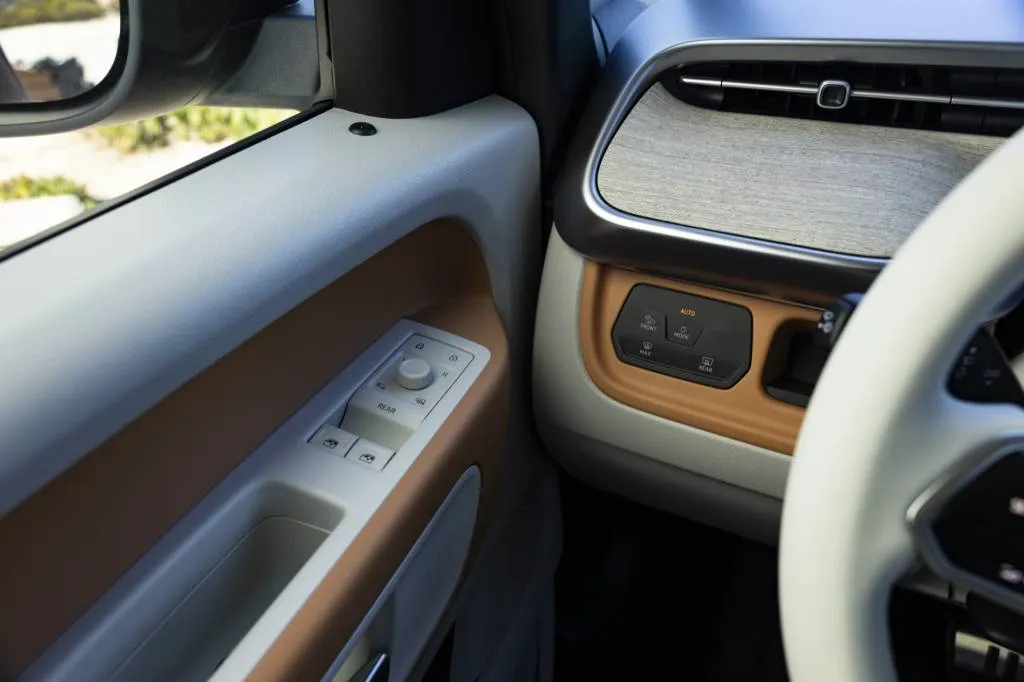
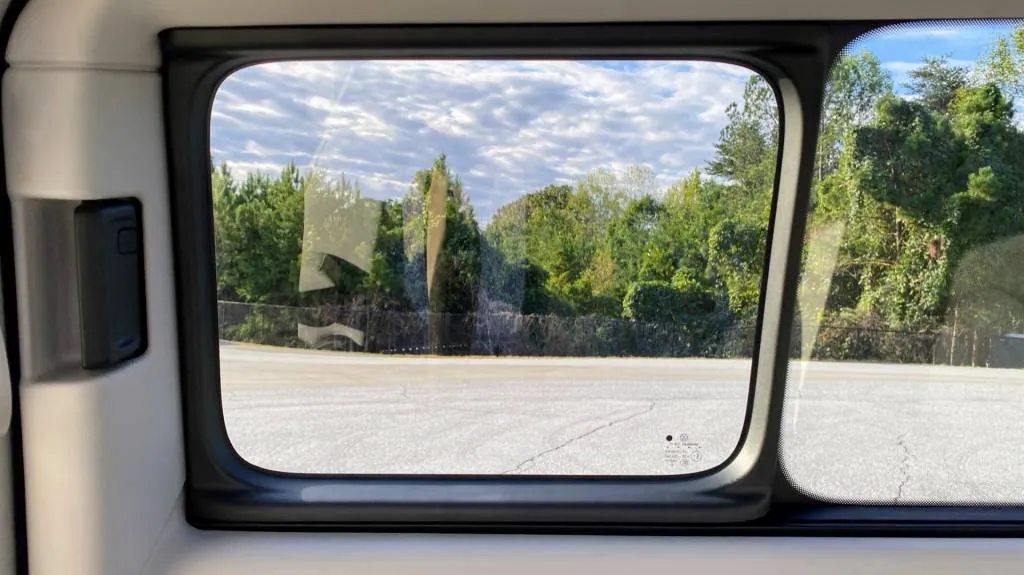
One thing VW has carried over from the ID.4 and the Euro-spec ID.Buzz is its one-fits-all power window controls, combining the front and rear window operation—for the otherwise very cool rear window-within-a-window in back—into one switch. Here it’s even more potentially overwhelming and confusing. VW, why did you subject us to this?

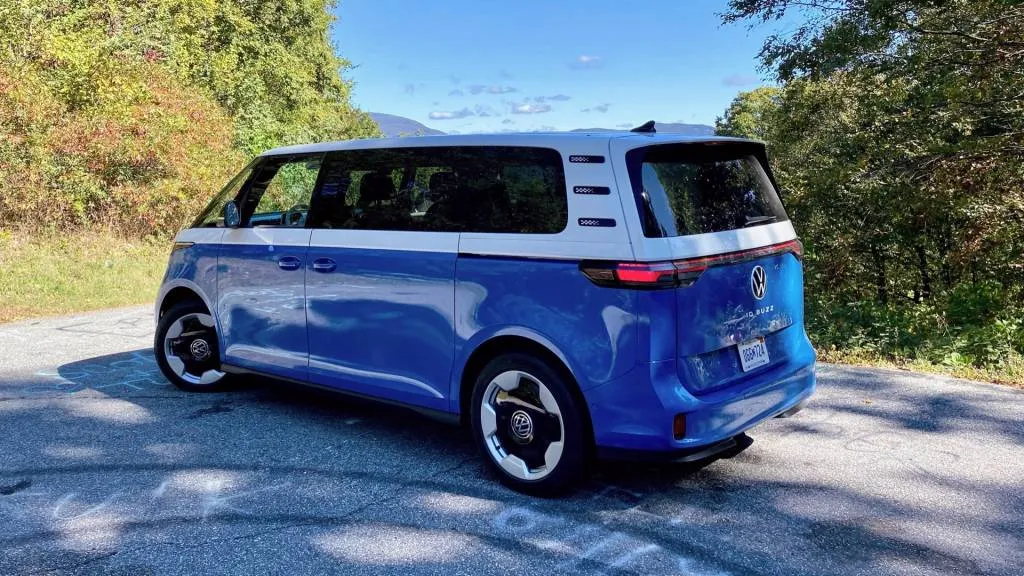
My only other dynamic gripe follows what’s otherwise a compliment—the absence of engine noise and great isolation of road-surface noise. Just above 65 mph we noticed some whooshing wind noise in the zone between the front pillar and the side mirror, which wound itself almost to a whistle by 80 mph. I should note the version I drove was still officially a pre-production prototype, so window sealing may not have been up to production snuff. 

The ID.Buzz, in U.S. form, achieves a coefficient of drag of 0.29, according to VW, and the top speed is up to 99 mph (from 90 in earlier Euro versions). 
2025 Volkswagen ID.Buzz

2025 Volkswagen ID.Buzz

ID.Buzz prices: The start of a bad trip?

The pricing and positioning of the Buzz is the only bad trip here. It’s just confounding 

Because of the way it was implemented—pragmatic interior, retro cues on the outside, but not overdone—the biggest puzzle in all of this is how and why VW sees the ID.Buzz as a niche model. 

The Buzz starts at $61,545, including the $1,550 destination fee, with the Pro S, which includes all the active-safety tech, three-zone climate control, a power tailgate and power sliding doors, heated second-row outboard seats, and the quicker, revamped 12.9-inch infotainment system. Pro S Plus versions add the retractable tow hitch, a head-up display, Harmon Kardon premium sound, and in AWD versions only, the captain’s chairs layout and a heated windshield. The top 1st Edition costs $67,045 in single-motor form or $71,545 with AWD and adds the panoramic roof and two-tone look (optional separately), roof cross bars, and floor mats. 

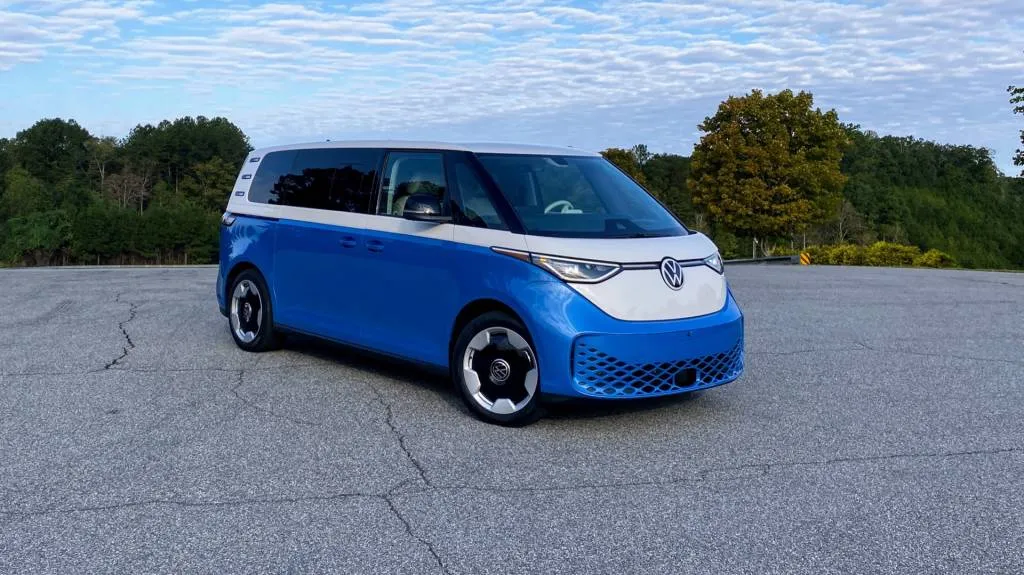
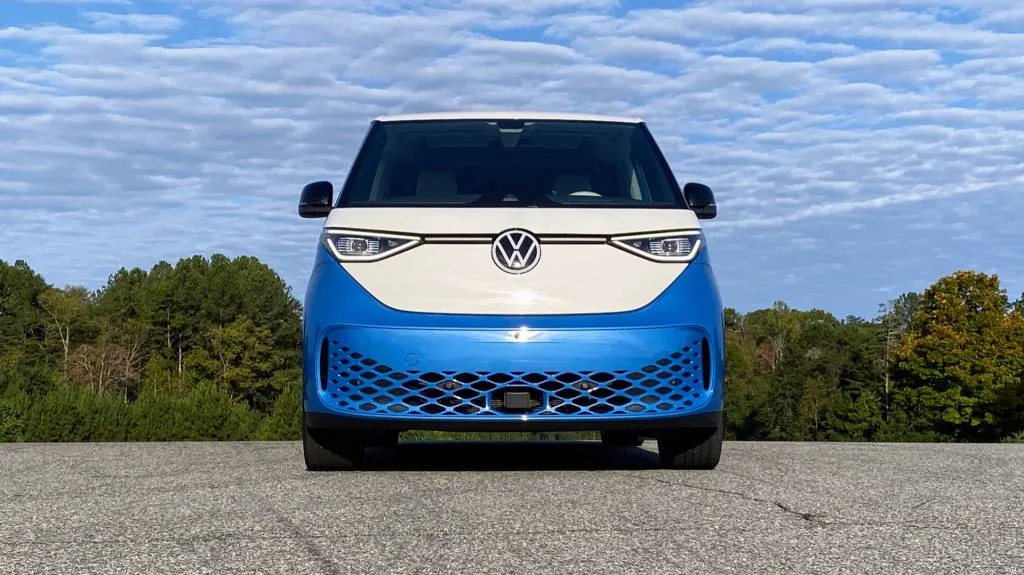
Our test ID.Buzz, a Pro S Plus in Cabana Blue and Candy White on the outside ($995 extra), with a Dune interior and the optional $1,495 electrochromic panoramic roof—huge, at 67.4 inches long and 40.8 inches wide—adds up to $67,535. That glass became a pearlescent gray as the sun shone on it. VW says that and the retractable trailer hitch are firsts for the brand in America. 
2025 Volkswagen ID.Buzz

2025 Volkswagen ID.Buzz

VW has no plans to build the ID.Buzz in the U.S. anytime soon, so there’s no hope for a $7,500 tax credit (although discount leases are likely via the EV leasing loophole). It didn’t even develop the Buzz through normal passenger-vehicle channels, instead turning to its commercial-vehicles unit to realize this product—which seems like it should have been a Golf-like project at the core of the company’s survival.

In 1965, when Microbus sales started to accelerate and get wrapped into the counterculture, the average cost of a new vehicle was about $2,650, and the admittedly no-frills Microbus lineup topped out around $2,550. According to the federal government’s official consumer price index calculator, VW’s $2,550 then would equate to about $25,400. 

Today, the average price of a new vehicle today stands at around $48,000, and VW’s choice to sell this vehicle at 25% above that clearly underscores that they see it as a premium vehicle, a niche model that may come and go. 

But in this format, the ID.Buzz could command a market of one for years. Remember when minivans made a design statement? The Chevy Astro Van, the Ford Aerostar, the Pontiac Trans Sport and the other “dustbuster” vans from GM, the Toyota Previa: This is just as head-turning, with staying power. 
2025 Volkswagen ID.Buzz

2025 Volkswagen ID.Buzz

The ID.Buzz really needed to be a just-the-basics $40,000 vehicle, sold much like Scion was selling its vehicles some years back, plus a modular interior and an endless lineup of official VW accessories. It would have sold like crazy—to businesses, to younger active types, even to families seeking to have a vehicle they can change the configuration of over the years—and it would have answered dealerships’ trepidation over the sustainability of the retail model in the EV era. 

As it is, the ID.Buzz is a great product that limits the future of the brand in the U.S. within a ridiculously narrow bandwidth. 

Will priced-out ID.Buzz buyers buy a Kia EV9 or base Rivian R1S instead? Will VW dealers behave with their markups? Let the craziness begin. 



Source link

Design Consultancies offer something different

0
Design Consultancies offer something different


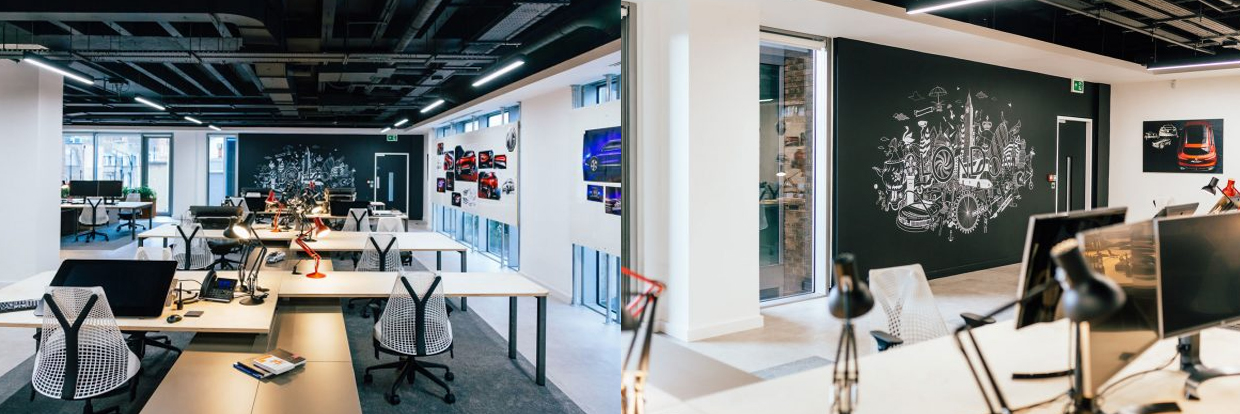
SAIC have an advanced design studio on prime Maryleborne real estate in the middle of London. The open plan arrangement with designers’ zones, review areas, chill out space and groovy chairs provides a creative environment with which to attract design talent to define the future SAIC Group products.  When I started Drive and was shown impressive facilities of OEMs like Volvo or engineering firms like Magna, it made me wonder how a design consultancy like Drive can compete with the major automotive manufacturers and their studios. The answer of course is we don’t – design consultancies offer something different.
Major car companies carry out most of their design work themselves, with dedicated design departments capable of handling every aspect of the design process.  But few companies do not use the services of external design consultancies for some smaller projects or as a validation of their internal designs, whilst many smaller niche companies use such consultancies to supplement their more limited in-house design facilities on larger design projects.

In most cases the reason we get shown around a company’s design facilities is because Drive is working with them or about to.  They see that Drive has something to offer them and they want us to work with their teams to stimulate creativity and maximise the design output.  Whether it be for market insights, a fresh design perspective or simply additional digital resource we are able to provide focussed and professional expertise.

As with the studio space, I question ‘how can we compete’ when recruiting creative talent, when automotive OEMs can offer so much in terms of employment, facilities and certainty of projects well into the future.

design consultancies

Again we don’t compete, what we have to offer is different.

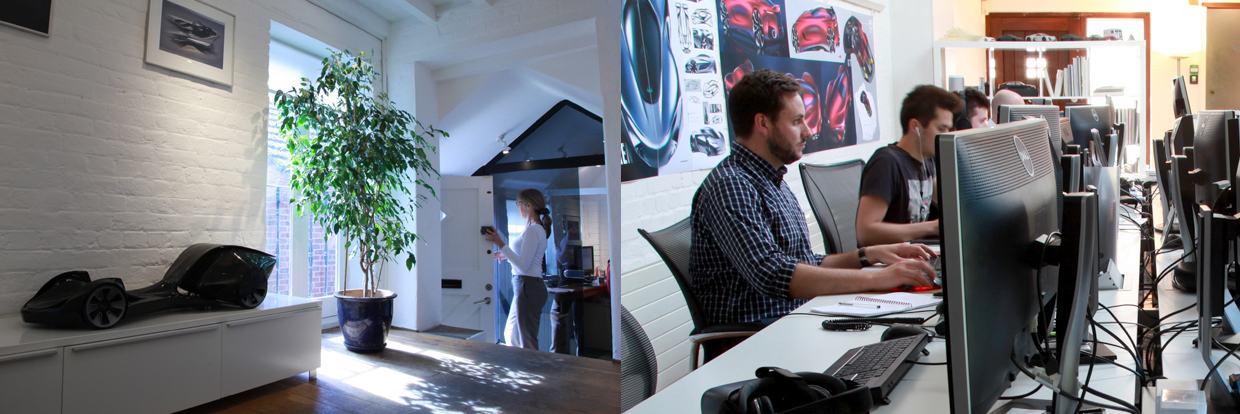
We are an efficient studio that has a welcoming, creative and professional atmosphere.  We work with numerous brands so it is unlikely that we will designing a similar face of a car or same product for long.  The type of work is varied, and is more likely to be concept ideation than production detailing.  The projects will cover a large spectrum with mobility solutions, aircraft interiors  or maybe another supercar inspired Track-tor being as likely as the next production SUV.

A consultancy environment like Drive’s isn’t for everyone, but the constant change benefits our creative team keeping them fresh, interested and gaining a breadth of experiences that differentiates them from other designers.  The very skill set that many design chiefs look for in their next hire, indeed two former Drive employees will be able relax at the new SAIC coffee bar.

It is the diverse experiences that attracts our clients and benefits their projects as they get new perspectives, fresh ideas and insight from our broad knowledge gained across different industries and clients.

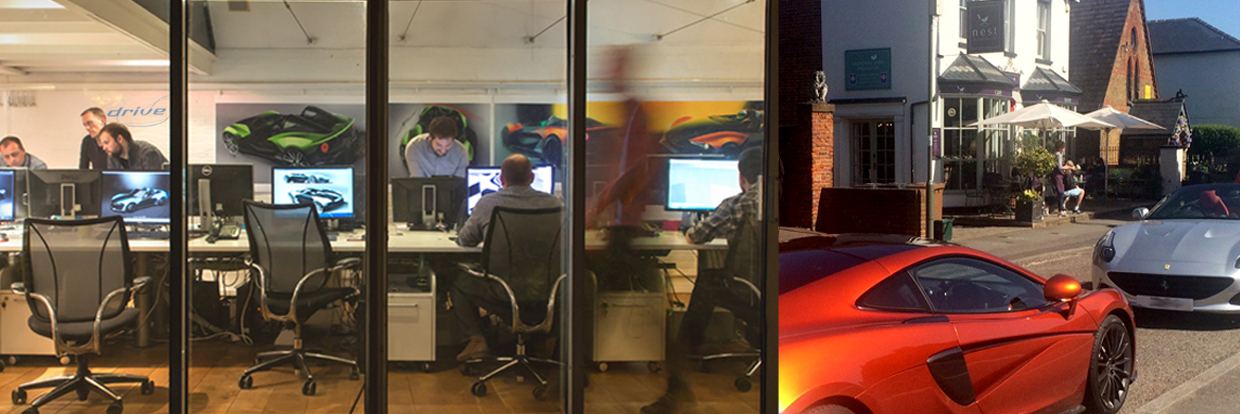
So if you are looking for some creative input for your next project or if a consultancy environment is somewhere you would like to work, come round for a chat.  We don’t have a coffee bar but we do have a fantastic café around the corner.

(SAIC Design Advanced London top image – photos source SAIC)

https://www.instagram.com/drivedesign/


Source link

BMW’s IMSA Future Takes a New Turn as We Head to Road America

0
BMW’s IMSA Future Takes a New Turn as We Head to Road America


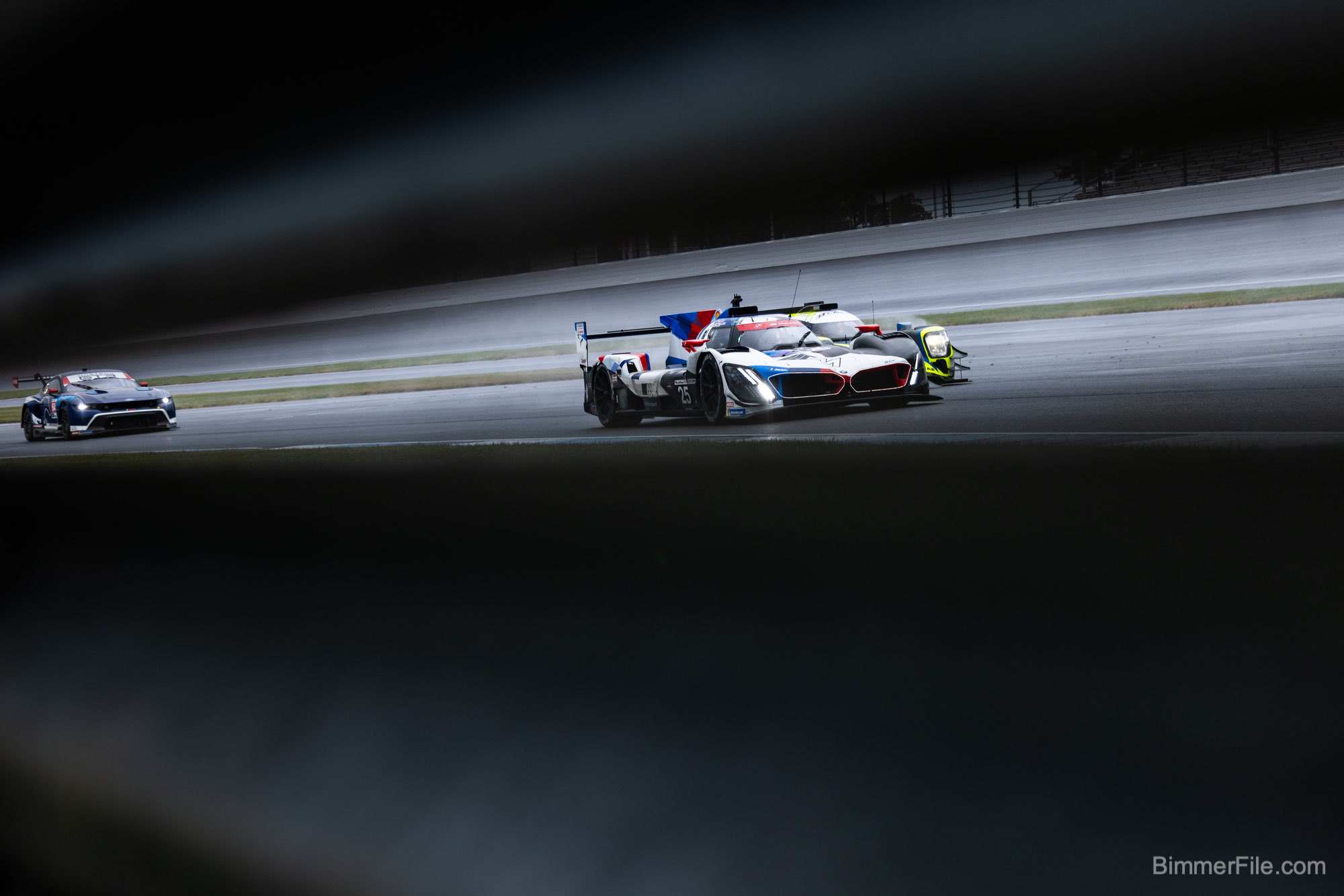
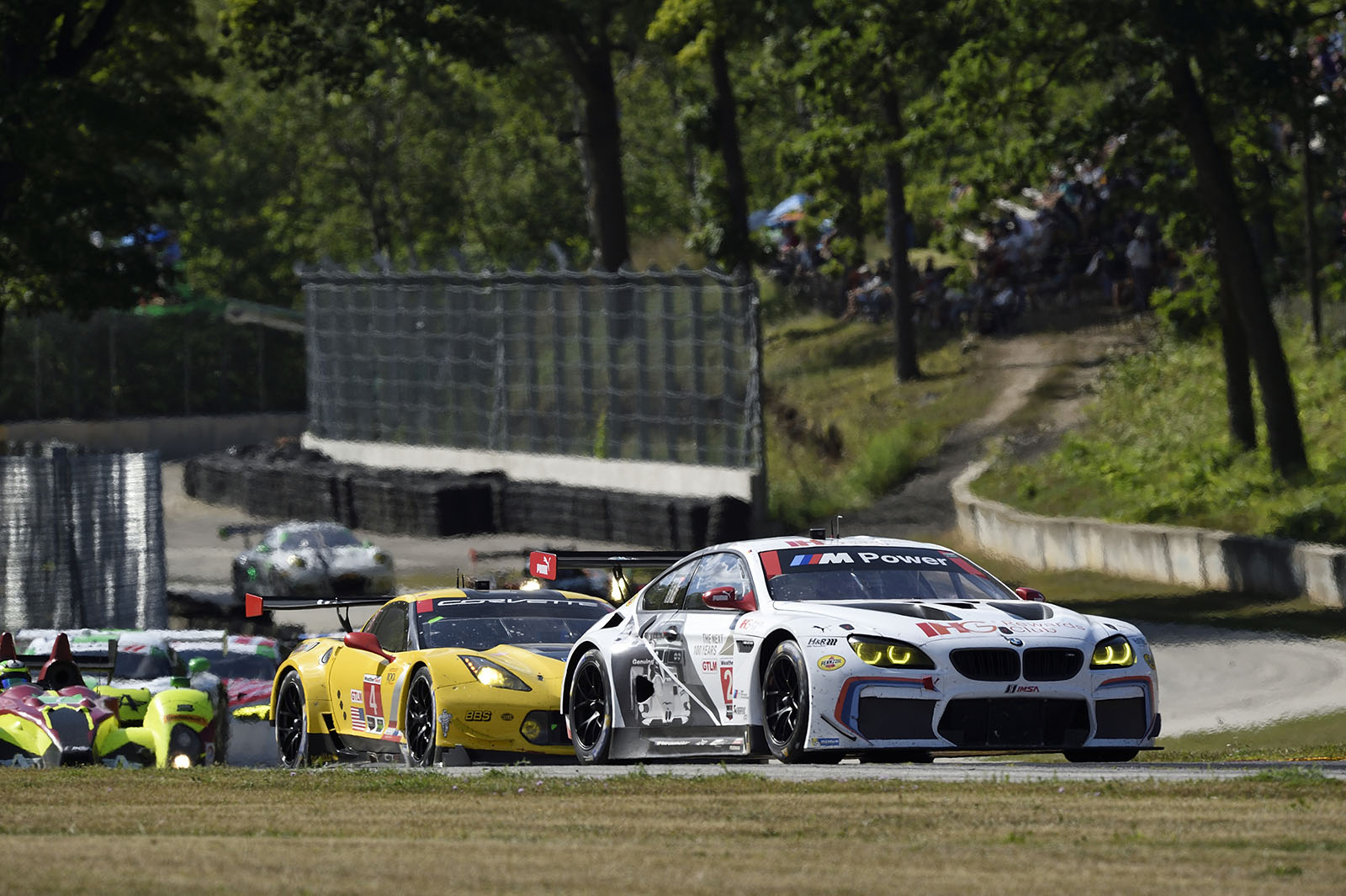
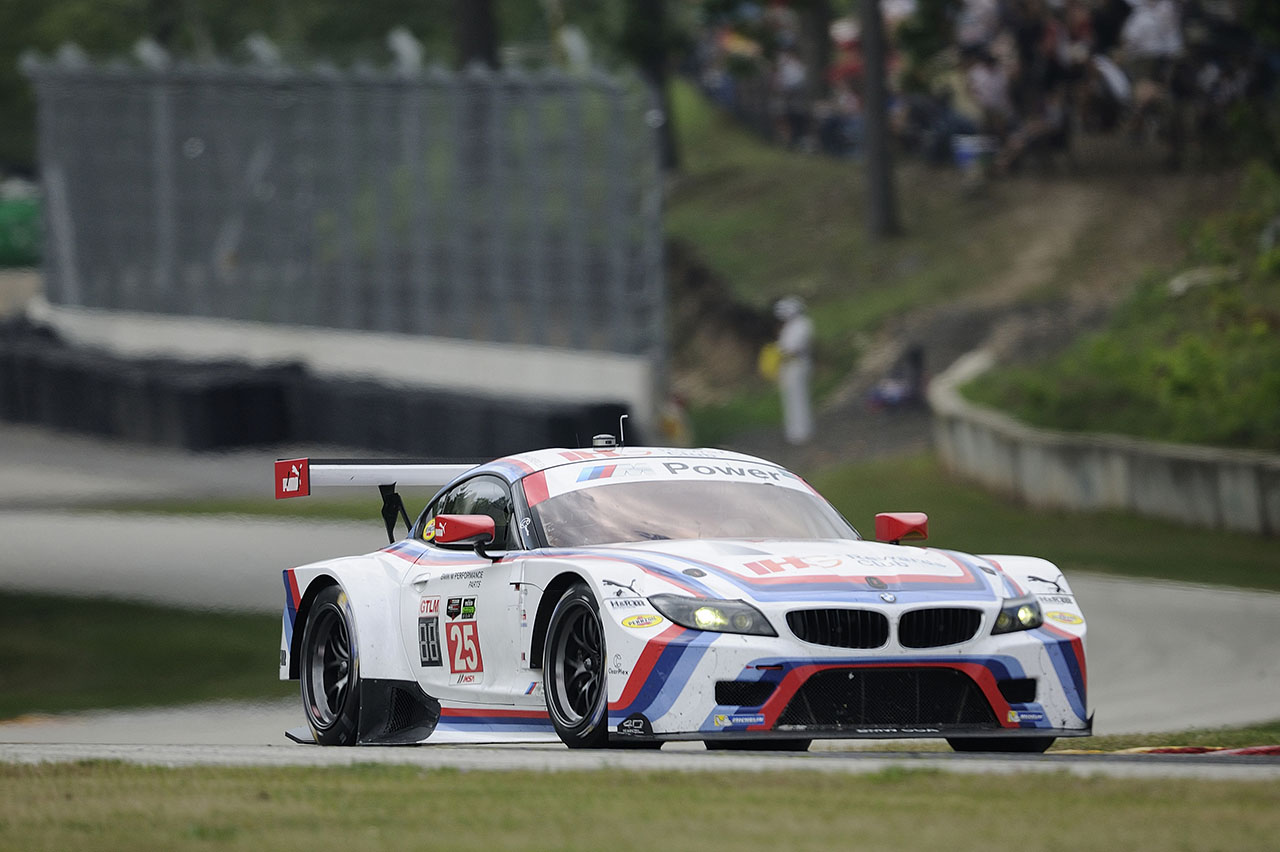
As we head north to Elkhart Lake and the storied tarmac of Road America, BMW’s racing story is poised to take a sharp turn. For fans, this weekend isn’t just another chapter in IMSA’s 2025 season, it’s one of the last times we’ll see BMW Team RLL take to the track under the Rahal Letterman Lanigan Racing banner. After nearly 20 years together, BMW and RLL are parting ways at the end of this season, marking the end of one of the most successful and enduring relationships in American motorsport.

RLL’s connection with BMW began back in 2009 and quickly became synonymous with both success and consistency in the American Le Mans Series, and later IMSA. From the screaming M3 GT2s of the early 2010s to the fire-breathing M8 GTE and now the hybrid M Hybrid V8 prototype, RLL has been the face of BMW Motorsport in North America. Together, they’ve racked up wins at legendary venues like Sebring, Daytona, and Laguna Seca. But more than just wins, RLL helped solidify BMW’s identity in North American endurance racing, bringing precision, performance, and a bit of Bavarian attitude to every paddock they entered.

But times are changing, and so is BMW’s global motorsport strategy. While nothing has been officially confirmed, Belgian powerhouse WRT is expected to expand its racing program to include IMSA next year through a new partnership with BMW in North America. WRT already runs BMW’s FIA World Endurance Championship (WEC) campaign, including the recent return to Le Mans, and this potential move would align BMW’s factory racing efforts under a single team on both sides of the Atlantic.

From a strategic standpoint, unifying operations under WRT makes sense. It allows BMW to streamline development, pool resources, and leverage data across WEC and IMSA, arguably accelerating performance gains and giving the M Hybrid V8 a competitive edge in both series. But it also means the end of an era for American BMW fans, who have grown accustomed to the familiar faces and approach of Bobby Rahal’s team.

In the official statement, BMW Motorsport head Andreas Roos praised RLL’s long-standing partnership and their role in shaping BMW’s racing legacy stateside. “The collaboration has been marked by tremendous successes and iconic moments,” Roos said. “We are grateful to RLL for their passion and professionalism.”

RLL, for its part, isn’t going anywhere. The team has expressed interest in exploring other manufacturer partnerships and possibly shifting focus to different series. Given their pedigree and experience, it’s hard to imagine them not being a force wherever they go.

IMSA
IMSA SportsCar Weekend
Road America
August 3 – 6, 2023

So as we prep for a weekend at Road America, a track that feels like home turf for BMW in the Midwest, the mood is a mix of anticipation and nostalgia. We’ll be watching the M Hybrid V8 race down the Kettle Bottoms and into Canada Corner, knowing that this chapter is closing. But if BMW and WRT’s WEC campaign is any indication, there’s plenty of excitement ahead.

For now, though, we’re savoring the end of an era. See you at Road America.


Source link

This Once-Promising Chinese EV Is Now Rotting In Northern California

0
This Once-Promising Chinese EV Is Now Rotting In Northern California


  • The Byton K-Byte was the second car planned from Chinese EV startup Byton.
  • Byton went bankrupt in 2023, with no cars ever reaching public sale.
  • Two K-Byte concept models have been spotted in Northern California.

China’s auto sector may be under fire for having too many car brands serving not enough buyers, but that sort of madness happened here in the U.S., too.

Let’s flash back to about a decade ago, or even a little before that. Tesla’s dominance wasn’t quite assured yet. The Model S and Model X were cool, but many assumed the Model 3—and anything beyond it—would be vaporware. If the future was electric, it could be anybody’s game. Venture capitalists, disgruntled or bored auto engineers in search of new pastures and science geeks sometimes came together to figure out just how they were going to create an EV that’s gonna change the world.

And from that mixture of personalities and money came some pretty interesting things. Like, do you remember Coda? Or SF Motors? Or Fisker, the first time? 

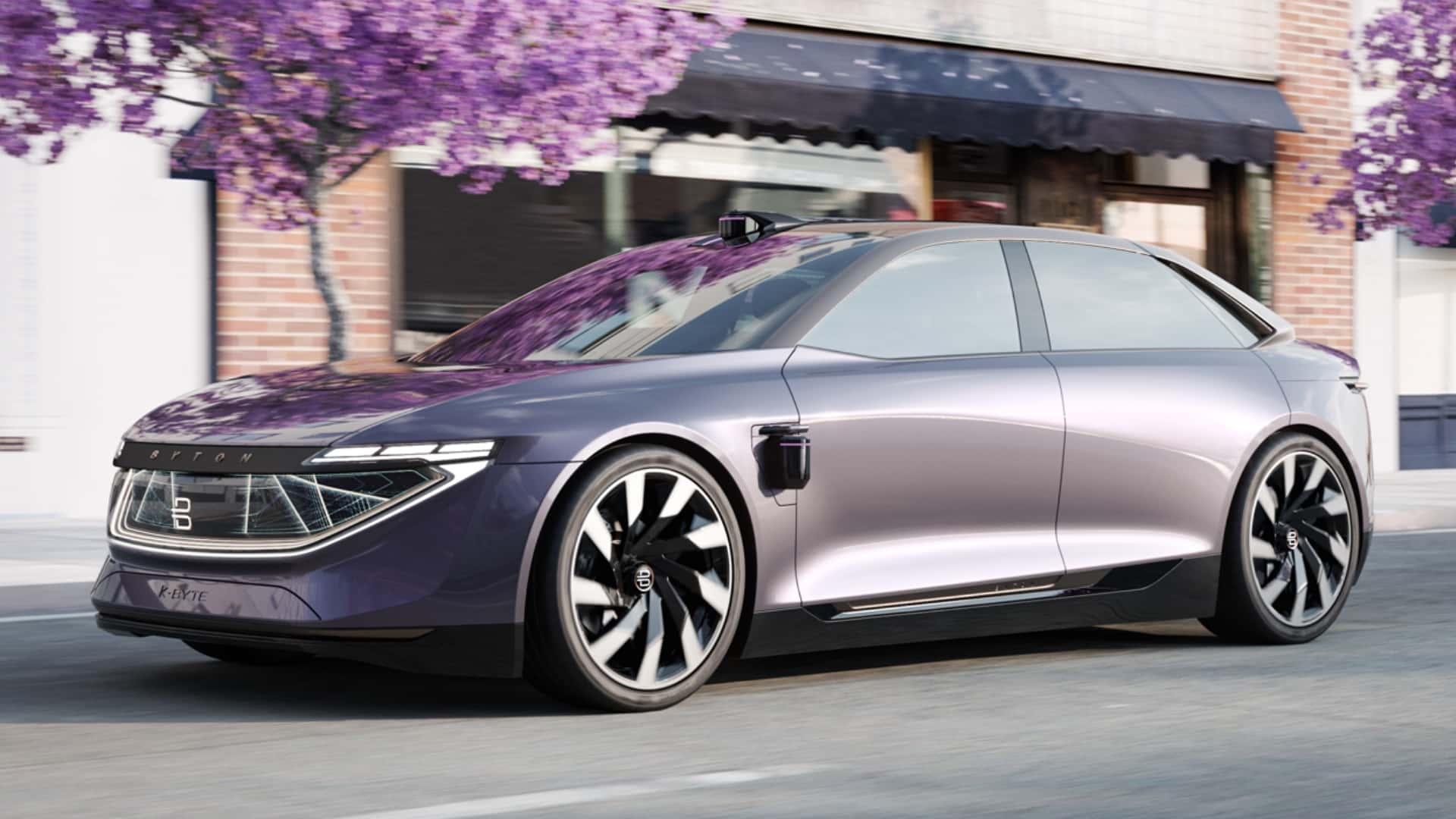
Perhaps you remember Byton—another Silicon Valley startup that failed right at the finish line. This would-be automaker had plans for at least two models. Its first model would have been the Audi Q8 E-Tron-sized M-Byte, with the K-byte made to challenge the Tesla Model S.

True, Byton was effectively Chinese, but it had an American HQ and a lot of talent and employees from outside of China. And that was well before the Chinese auto industry was as established as it is now, and before trade and political tensions with the U.S. reached a boiling point.

Back then, Byton aimed to launch here while also launching in China; it had even already secured distribution licenses in California. The brand also filed a patent for a three-seat EV with sliding doors, but not much was ever shown outside of the patent drawing. 


BYTON M-Byte

Unfortunately, the brand ran out of money and went bankrupt before the M-Byte could enter series production and distribution outside of a handful of preproduction units. Its main production partner, Foxconn, declined to pick up the torch, and no other Chinese EV company was interested in the intellectual property. Byton furloughed half of its U.S. staff in 2020, then remained a dead man walking until it failed for good in 2023. 

But weirdly enough, examples of the K-Byte sedan concept still exist.

For the past two years or so, the pictures of the two K-Byte concepts have been spotted in public somewhere in the Bay Area. But these recent pics from a few weeks ago, seen on Reddit’s r/spotted, show that these things are looking a bit worse for wear.

The two K-Byte sedans are coated in dust and have bird poop on them. The exterior paint looks like it’s lost a lot of luster.


Now, I should be clear that these K-Byte sedans weren’t ever running and driving prototypes. I talked to an ex-Byton employee to figure out the story behind these things, and they said these are likely either a non-moving styling buck or a “roller”—essentially a big remote control car that could roll itself onto vehicle display turntables or stages.

It likely doesn’t have all of the production-level running gear to get it on the stage. The nearly opaque glass suggests that these bodies likely do not have interiors, although the internet says there’s at least one unit that did exist with an interior. 

Today, Byton is barely a footnote in EV history. But it was ahead of its time, too.

The M-Byte and K-Byte both featured full-width screens; back then, it seemed kind of gaudy, but it’s not super uncommon to see this trend implemented on production cars today, like the Afeela or even the gas-powered Lincoln Nautilus. The steering wheel screen is weird, but brands like Li Auto have screens on the steering wheel, albeit not so large and obnoxiously mounted.


BYTON

These rotting prototypes make me wonder of a world that saw Byton get on the road would be like. Would it have opened the door for more Chinese vehicles on U.S. roads? Would Tesla have been as prevalent a force in the EV world as it is now? Would we be driving M-Byte crossovers and K-Byte sedans instead of the Lucid Air or Tesla Model S?

Or was Byton always destined to fail, since thus far, Foxconn’s EV efforts in the U.S. have only resulted in stalled expectations and broken promises? After all, even if Byton had some kind of Polestar-type launch, it would’ve faced anti-China tariffs anyway. 

I guess we’ll never know. Pour one out for Byton.

Contact the author: Kevin.Williams@insideevs.com 


Source link

The new BMW iX – Car Body Design

0
The new BMW iX – Car Body Design


Available in xDrive45, xDrive60, and M70 xDrive variants

Exterior Design

BMW iX Design Sketch RenderThe new BMW iX – Car Body Design

The iX continues to define a modern, electrified interpretation of the SAV, combining minimalist surfaces, aerodynamic efficiency, and bold design elements. The new edition enhances sportiness and presence with refined front, side, and rear treatments.

BMW iX xDrive45BMW iX xDrive45

BMW iX xDrive60BMW iX xDrive60

At the front, the redesigned BMW kidney grille integrates a vertical and diagonal pattern, doubling as an intelligent sensor housing.

BMW iX Design Sketch RenderBMW iX Design Sketch Render

The adaptive LED headlights feature a new, vertically oriented lighting signature, contributing to a sleek, high-tech aesthetic.

BMW iX xDrive60BMW iX xDrive60

BMW iX xDrive45BMW iX xDrive45

The clean side profile is emphasized by frameless glass doors, flush door handles, and squared wheel arches, reinforcing its muscular stance. Aerodynamic side mirrors, integrated into the lower window frame, optimize airflow while adding a refined visual touch.

BMW iX xDrive60BMW iX xDrive60

At the rear, the wide proportions are highlighted by slim, horizontal LED taillights within a clean, sculptural tailgate.

The M Sport package further enhances the athletic profile with larger air intakes, a redesigned rear apron, and vertical reflectors, creating a dynamic, aggressive presence.

BMW iX Design Sketch RenderBMW iX Design Sketch Render

The M70 xDrive variant introduces blacked-out elements, an illuminated BMW Iconic Glow grille, and exclusive 22-inch alloy wheels, reinforcing its performance-driven character.

A new range of metallic finishes, including Arctic Race Blue, Carbon Black, and Frozen Deep Grey, complements the BMW iX’s sculptural form, reinforcing its cutting-edge, all-electric identity.

Interior Design

BMW iX xDrive60 InteriorBMW iX xDrive60 Interior

The BMW iX interior blends spaciousness, minimalist aesthetics, and advanced technology. The cabin features frameless glass surfaces, floating center console, and a curved BMW Live Cockpit display, creating a modern, open atmosphere.

BMW iX xDrive60 InteriorBMW iX xDrive60 Interior

M Sport seats with microfibre/Sensatec upholstery, an M leather steering wheel, and Dark Silver trim accents enhance the sporty appeal. Premium options include a Sky Lounge panoramic glass roof, Bowers & Wilkins Diamond Surround Sound System, and ambient lighting.

Key features include:

  • BMW Operating System 8.5 with iDrive for intuitive touch and voice control.
  • 5G connectivity, BMW Digital Key, and My BMW App integration.
  • Advanced driver assistance systems, including Level 2+ Highway Assistant and Automated Parking Assistant.

Performance and Efficiency

The dual-motor all-wheel drive system has been refined for increased power across all models:

  • xDrive45: 408 hp (300 kW), 0-100 km/h in 5.1 sec
  • xDrive60: 544 hp (400 kW), 0-100 km/h in 4.6 sec
  • M70 xDrive: 659 hp (485 kW), 0-100 km/h in 3.8 sec

The battery technology has been improved, with the xDrive45 now offering a 30% increase in capacity (94.8 kWh), while higher trims feature 109 kWh packs. Efficiency enhancements include new power electronics, lower rolling resistance tires, and adaptive recuperation.

Charging speeds have increased, with DC fast charging up to 195 kW, enabling significant range recovery in minutes. The BMW iX also supports intelligent navigation, optimizing routes based on available charging stations.

(Source: BMW)


Source link

Reliability, Specs, and Tuning Guide for the Iconic M3 Straight-Six

0
Reliability, Specs, and Tuning Guide for the Iconic M3 Straight-Six


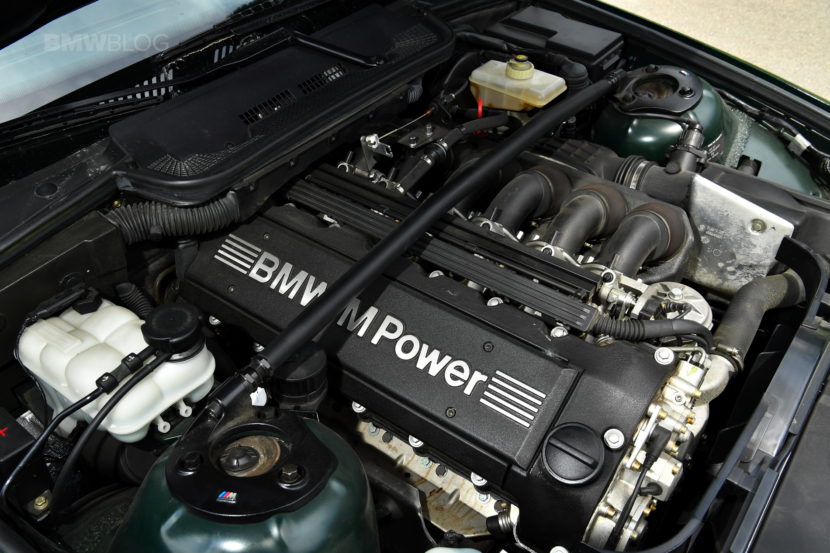
The BMW S50 is one of the most legendary straight-six engines to come from BMW M. Produced in the 1990s, it powered the E36 M3 in Europe and other markets, delivering a mix of high-revving excitement, precision engineering, and everyday usability. Today, the S50 remains a favorite for collectors, track-day enthusiasts, and tuners.

Origins and Development

S50 Engine in the BMW M3 CompactS50 Engine in the BMW M3 Compact
Image: BMW Classic

The S50 evolved from the M50 engine, which was used in mainstream BMW models like the E36 325i. BMW M re-engineered it extensively—strengthening the internals, adding individual throttle bodies, higher-lift camshafts, and raising compression. The result was a race-bred inline-six with everyday drivability.

Two main European versions were produced:

  • S50B30 (1992–1995) – 3.0 liters, 286 hp
  • S50B32 (1995–1999) – 3.2 liters, 321 hp

North American M3s received a detuned S50B30US and later the S52, which lacked some of the exotic hardware like ITBs and high-lift cams.

Technical Specifications

BMW E36 M3 with the S50 engineBMW E36 M3 with the S50 engine

S50B30 (Euro)

  • Inline-6, DOHC, 24 valves
  • 2,990 cc
  • Bore x Stroke: 86.0 mm x 85.8 mm
  • Compression: 10.8:1
  • 286 hp @ 7,000 rpm
  • 320 Nm (236 lb-ft) @ 3,600 rpm
  • Redline: 7,600 rpm
  • Bosch Motronic M3.3
  • Individual throttle bodies, single VANOS

S50B32 (Euro)

  • Inline-6, DOHC, 24 valves
  • 3,201 cc
  • Bore x Stroke: 86.4 mm x 91.0 mm
  • Compression: 11.3:1
  • 321 hp @ 7,400 rpm
  • 350 Nm (258 lb-ft) @ 3,250 rpm
  • Redline: 7,600 rpm
  • Bosch MSS50
  • Double VANOS, larger ITBs, lightweight pistons, motorsport oiling

Reliability and Common Issues

BMW E36 M3 GT engineBMW E36 M3 GT engine

When maintained properly, the S50 is a long-lasting engine, but there are some known issues:

  1. VANOS wear – Single-VANOS on the B30 and double-VANOS on the B32 can fail, causing power loss and idle issues.
  2.  Rod bearings – Less prone than the later S54, but high-rev abuse and poor oiling can cause wear.
  3.  Cooling system failures – Radiators, thermostats, and water pumps should be replaced preventively.
  4.  Throttle body sync – ITBs need periodic balancing for smooth operation.
  5.  Oil leaks – Common at valve cover gaskets and rear main seals.

Tip: Use quality oil (often 10W-60 in warmer climates), change it every 5,000–7,500 miles, and stay on top of cooling system maintenance.

Tuning Potential

The S50’s motorsport pedigree makes it a great platform for modifications:

  • ECU remap – +15–20 hp and sharper throttle response.
  • Intake & exhaust upgrades – Better breathing and a more aggressive sound.
  • Camshaft upgrades – Motorsport cams can push NA builds past 330 hp.
  •  Forced induction – Supercharger kits can yield 450–500 hp on stock internals with careful tuning.
  • Track prep – Oil coolers, baffled sumps, and lightweight flywheels are common upgrades.

Legacy

The BMW S50 is more than just a performance engine—it’s a piece of M division history. Sitting between the high-strung S14 of the E30 M3 and the S54 of the E46 M3, it blended motorsport hardware with road car usability in a way few engines have matched.

Today, well-maintained S50-powered M3s are sought after for their driving purity, mechanical sound, and connection to a golden era of BMW engineering.


Source link