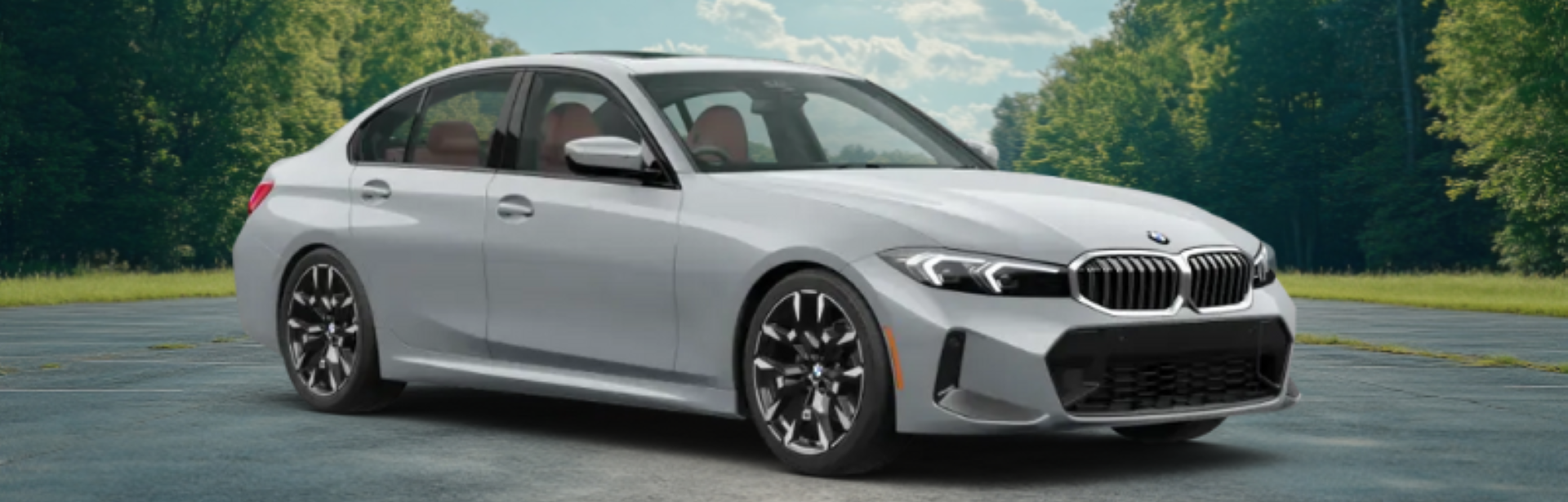
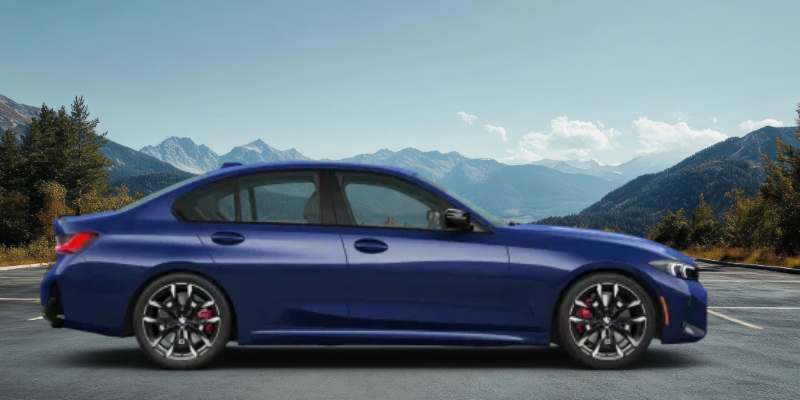
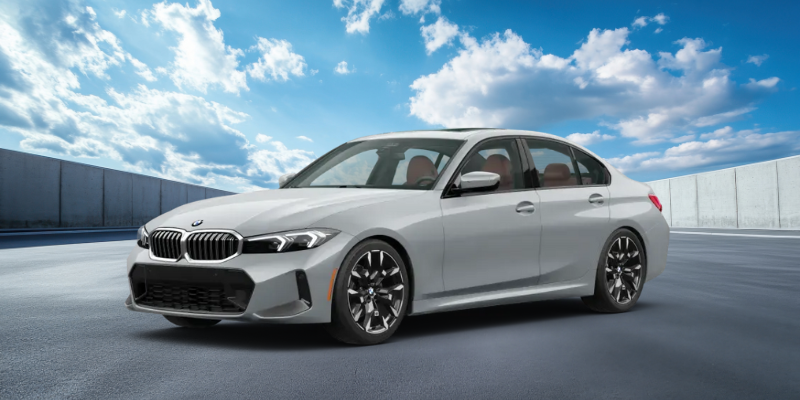
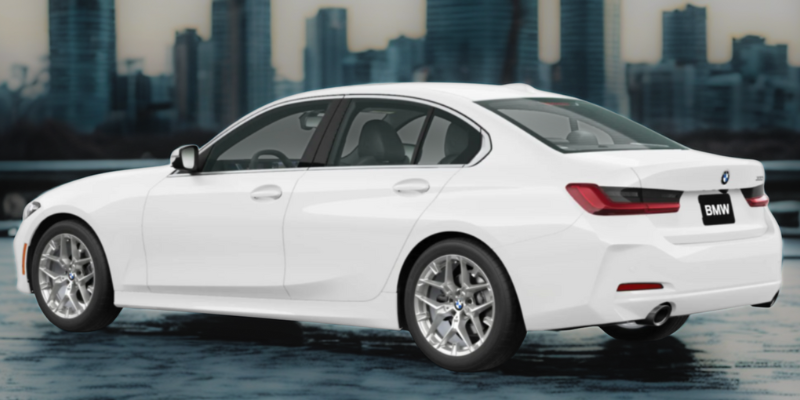
It’s hard to think of another car that’s as safe, stylish, or suped-up as the 2026 BMW 3 Series. Excelling in both form and function, it’s no wonder that so many drivers are flocking to get their hands on a set of keys for this luxury sedan. Learn more about the new BMW 3 Series in this model overview.
Behind the Wheel of the 2026 BMW 3 Series
Performance
With the 2026 3 Series, the engineers at BMW have succeeded in delivering a car that is as peppy as it is practical. Featuring a standard 2.0‑L turbocharged inline‑4 with 48‑V mild hybrid engine, this model excels at powerful, yet practical performance On top of its substantial power, the new 3 Series also offers agile handling and a smooth overall ride quality. Below are a few more available performance features of this car:
Combines a Twin-Scroll Turbocharger with Variable Valve Control (Double-VANOS and Valvetronic) and High-Precision Direct Injection
4-wheel Ventilated Disc Brakes with Anti-lock Braking System (ABS), Dynamic Brake Control (DBC) and Cornering Brake Control (CBC)
The new 3 Series’s assortment of safety and connectivity tech makes it easy for you to stay focused on the road, and for your passengers to stay focused on enjoying the ride. BMW offers available features and safety systems designed to help you avoid accidents and to protect you and passengers from harm. While you’re up front doing the driving, your passengers will likely be relaxing in the back and enjoying the wealth of multimedia options available for this model. This car also offers the following in the way of technology:
Anti-lock Braking System (ABS)
Front-passenger-seat-occupation Recognition with Passenger’s Airbag Off Indicator
Seat-mounted Front Side-Impact Airbags
Design
From the moment you lay eyes on the new 3 Series, you’ll know it’s the right car for you. The exterior of the 3 Series is draped with sleek contours which accentuate the car’s already athletic build. It’s obvious that the designers of the new 3 Series had comfort in mind when designing its interior, with the cabin of this car boasting a spacious yet intimate atmosphere. Some other design features for you to consider are:
Power-folding, Heated Side Mirrors
Multi-color, Adjustable Ambient Lighting
SensaTec Upholstery
Test Drive the 2026 BMW 3 Series near Upper Marlboro, MD
There’s no better place to familiarize yourself with the new 3 Series than Passport BMW. We can show you the features we didn’t cover here, or you can take a look at other new BMW cars for sale near Upper Marlboro, MD. Also, take a look at our new BMW specials before you visit for your test drive.
*MSRP: Starting price represents the manufacturer’s suggested retail price (MSRP) for the trim. The MSRP does not include destination and handling charges, taxes, title, license, options, and dealer charges. Actual prices are set by the dealer and may vary. Photo is for marketing and example purposes only. Photo may not reflect starting MSRP or trim level.\n**EPA-estimated MPG for City/Highway for 2026 BMW 3 Series . Actual mileage will vary. Displayed MPG is based on applicable EPA mileage ratings. Use for comparison purposes only. Your actual mileage will vary, depending on how you drive and maintain your vehicle, driving conditions, battery pack age/condition (hybrid models only) and other factors.
Posted in
BMW Information |
Comments Off on Everything You Need to Know About the 2026 BMW 3 Series
Editor’s Note: This week, Peter shares a few more “fleeting moments” from his incredible automotive life. In On The Table, BMW fans are about to get a serious jolt. The BMW 3 Series, the essence of the BMW brand for five decades, has been completely transformed. The new, fully electric BMW i3 – the next model in BMW’s “Neue Klasse” – has been revealed. And we have a new historic racing video – this week, it’s the 1964 12 Hours of Sebring. Our AE Song of the Week is “Edge Of Seventeen” by Stevie Nicks. In Fumes, Peter presents the next chapter of his series, “The Great Races” focusing on the finale of the 1966 Can-Am season, which took place at Stardust International Raceway, in Las Vegas, Nevada. The field was full of road racing all-stars. And in The Line, we have IMSA results from the 12 Hours of Sebring and MotoGP from Brazil. Onward! -WG
By Peter M. De Lorenzo
Detroit. If you’ve arrived at a certain point in your life, you realize that even the special moments are fleeting – they come and go when you want to hang on to them and make them last forever, but that’s not the way it works, unfortunately. Yet those living-color memories stick with us and last for a lifetime. It’s our life currency, in fact. No, they’re not all we have to go on, of course, but they’re certainly the most enduring, and they continue to fuel our dreams to this day.
Having led a charmed car life from an early age, my fleeting moments are indelible and, in some respects, almost unbelievable, but they’re as fresh and vivid as if it all happened yesterday.
To say I had the opportunity to experience an incredible automotive life growing up is an understatement. Our father, Tony, was leader of GM Public Relations in the company’s heyday, from 1957 to 1979. So many of the GM legends you’ve only read about – Ed Cole, Bunkie Knudsen, Zora Duntov and Bill Mitchell – just to name a very few, weren’t just historical figures, but were living, breathing, larger-than-life figures who played a role in the cadence of our automotive lives.
By the time my brother Tony got the automotive bug (he is eight years my senior), our household was crawling with the latest and fastest cars GM made. Bunkie Knudsen sent over a hot Pontiac for my mom to drive every summer, usually a red Bonneville or Catalina convertible with the highest horsepower drivetrain Pontiac offered at the time (at first 389 V8s with 3x2s, then a series of 421s). Bill Mitchell customized a ’63 Corvair for us that had the Turbo engine in it before it was even offered to the public (we, of course, took it down to the Detroit Dragway to see what it would do). And then there were the Corvettes. My, oh my, there were so many I’m not sure I can recall them all, but suffice to say, it was beyond special.
We swapped and borrowed cars and got to experience many of the legendary machines in period, which I can tell you resonates even more when I think about what’s happening today. Even Shelby Cobras borrowed from Ford PR. Again, fleeting moments. The where and the when, the what and the who, and the hot machines, always the hot machines. I have recounted many of these experiences before but not all of them. Not even close. Here are a few more.
Running up and down Woodward in Ed Cole’s personal company car – a 1961 409 Chevrolet 4-speed – which we had borrowed for the weekend. The only other 409 in existence at that time was in Dyno Don Nicholson’s drag car at the U.S. Nationals. Needless to say, it made a lasting impression with the car freaks on Woodward.
Watching on a Friday afternoon in the summer as a horsepower train made up of the ’59 Corvette Sting Ray racer, the Corvette Mako Shark I, the Corvette XP700 “bubble top” and the Corvair Super Spyder rumbled through the neighborhood on the way to be dropped off at Bill Mitchell’s house, who lived on the next block over from us. He liked to have driving options on the weekends and drove all of them.
Riding up to the corner drug store with Bill Mitchell in the original Sting Ray racer, the Corvette Mako Shark I, the Corvair Sebring Spyder and Super Spyder, and the Corvette XP700 “bubble top” concept. It sounds beyond comprehension, but it happened and I lived it. And loved it.
And just for good measure there was the little-known but memorable Pontiac XP400 concept equipped with a blown Mickey Thompson-built 421 cu. in. V8. We were told to check the oil at every gas stop – which was often over that weekend we borrowed it – because according to the guys who dropped it off, Thompson had put “drag racing piston rings in it.” That mighty XP400 used 21 quarts of oil in 2-1/2 days.
Running hard and fast down Woodward Avenue in Ed Cole’s personal 1963 Sting Ray Coupe (Sebring Silver, fuel-injected, 4-speed), before the car was officially introduced to the public. It was still one of the most memorable car debuts of all time, and that Sting Ray remains an automotive icon.
Getting our hands on a Midnight Blue 1964 Pontiac GTO before anyone knew what it was. It had dog dish hub caps and no options, but the visceral appeal was undeniable.
Driving to Watkins Glen in a fuel-injected 1964 Chevrolet Corvette Sting Ray Coupe (in Black, of course) that was personally massaged by Zora Arkus-Duntov with every high-performance option – and more – so my brother Tony could go through SCCA driver’s school. That trip was a book of experiences unto itself.
Driving from Birmingham, Michigan, to Notre Dame, Indiana, in a caravan of cars in 1965 that included a red ’65 Shelby Cobra, a White (with blues stripes) 1966 Shelby Mustang GT350, and Dolly Cole’s (Ed’s wife) personal driver: a 1965 Nassau Blue (with White interior) Corvette Sting Ray roadster (with hardtop attached). Her “Bluebird” as she called it had a pre-production 396 cu. in. V8 in it with side pipes and a 4-speed gearbox. Things were decidedly different back then…
Learning to drive a stick in a 1966 Shelby GT 350 Mustang in a shopping mall parking lot. I still shake my head at that one.
Tearing around in an early 260-cu. in. Shelby Cobra that we borrowed from Pontiac Engineering almost every weekend in the summer of ‘63. In fact, I was taught how to wash a car the right way on that Cobra.
Tony running the 1966 Marlboro (Maryland) 12-Hour in our “A Sedan” Corvair with Don Eichstaedt (a Chevy Engineer) as his co-driver. We struggled throughout the race with our pit stops, even splashing so much fuel everywhere on one pit stop – including all over me – that I ended up dumping an entire bucket of water on my head to get some of the fuel off. Comical, but we did finish a rousing 23rd overall. We flat-towed that Corvair all over the country, but it worked out.
Riding out to the test track from the Chevrolet Engineering Lobby at the GM Tech Center in Warren, Michigan, in an Engineering toy – a Chevelle with a race-prepared big block 427 V8 in it with open headers – in order to meet up with Zora Arkus-Duntov. Zora had completely gone through the 1967 Corvette 427 L88 that my brother had ordered through Hanley Dawson Chevrolet and was preparing to race, but in true understated Zora fashion he only acknowledged that he had made “a few tweaks.”
Being at Road America in 1967 with that same 427 L88-powered Corvette, the first of a total of 20 built that year. Then back again in ’68 when Tony dominated “A” Production in the SCCA June sprints. That car and that livery – Black with Blue stripe – is still my favorite of all of our racing Corvettes (see below).
Leaning over the pit wall to give pit signals to my brother at the 12 Hours of Sebring in 1968, as the ultra-low factory Porsche 907s blew by under my pit board at 140 mph.
Borrowing a Red/Black 1968 Z28 Camaro for the weekend and enthralling my high-school buddies with it. To me, it was the Camaro that was the most fun to drive, and still my all-time favorite Camaro design.
Taking our Black/Black 1969 Corvette L88 427 roadster with open side pipes out on Woodward Avenue and on the area freeways to keep it “exercised” while my brother was out of town. Talk about a bad-ass machine – that beast garnered unwavering respect out on the street. It was eventually converted to a race car and sold to a Lufthansa pilot friend of Tony’s who raced it in Europe, ruining many a weekend for Porsche drivers.
Leaving at 9:00 p.m. in a 1969 Corvette 427/390, 4-speed roadster from Detroit – with the top down – to deliver some parts to a friend who was racing a Corvair Yenko Stinger at Mid-Ohio. We – our friend Gary Cooper and I – roared down there, stopped to chat for fifteen minutes, handed over the parts, and then raced right back so Gary could get to work in the morning.
Making a run from East Lansing to Ann Arbor in my 1975 Porsche 911S Coupe – in 32 minutes flat – in June of ‘76. With the late afternoon sun behind me and extremely light traffic, I never dropped below 100 mph and went flat-out (140 mph +) for several minutes at a time. It was still the purest piece of high-performance street driving I have ever experienced. And it remains wonderfully vivid to this day.
As I said, these fleeting moments have stuck with me forever. And I have many, many more too. Don’t misunderstand, it’s not a “wallowing in nostalgia” exercise for me. Not at all. These fleeting moments have all contributed to the picture of who I am today. And every single one of you has a kaleidoscope of fleeting car moments of your own.
It’s okay to fuel our imaginations with these moments. It’s part of who we are.
And besides, we can’t know where we want to go unless we understand where we’ve been.
And that’s the High-Octane Truth for this week.
June 1968. The biggest SCCA National race at the time was the June Sprints at Elkhart Lake’s Road America. Tony won “A” Production going away in his 1968 427 L88 Corvette. Of all the cool race cars we had, it’s still my favorite.
Editor’s Note: Click on “Next 1 Entries” at the bottom of this page to see previous issues. – WG
We use cookies on our website to give you the most relevant experience by remembering your preferences and repeat visits. By clicking “Accept”, you consent to the use of ALL the cookies.
A set of new-looking door releases were spotted in the Tesla Cybercab.
Tesla committed to changing its door handles last year after regulators began to crack down on electronic releases.
It’s not clear if these new releases will make it into Tesla’s existing vehicle lineup.
Door handle technology isn’t exactly something that you expect to be excited about. It’s just something you expect to work. However, in the EV age, it’s not as cut-and-dry as just pulling a lever, and that’s gotten various automakers in hot water with regulators across the globe.
Tesla is one of those brands. Its door handles—both the ones on the outside of the car and the releases on the inside—have long been the subject of controversy. The automaker pledged to redesign them last year, and it looks like we may have our first glimpse of how the new latches could function thanks to a close-up with the upcoming Tesla Cybercab. Let’s see what’s changed.
Photo by: InsideEVs
A short look at the handles comes courtesy of a YouTube video posted by Tesla influencers Kim Java and Josh West. The video shows the duo briefly talking about the internal door release mechanism and how it functions. The Tesla blog Not A Tesla App first spotted the discussion of the door mechanism.
Now, sure, if you want to open the door on the Cybercab, you could use the button on the giant center screen. But most logical people, especially those in an emergency where there might not be power, will reach for the door. That’s where the need for a smarter, easier-to-use physical latch comes into play.
The video shows a door pull that opens upward, rather than the kind of button Tesla has historically used to pop doors.
Based on the description given in the video of how the door release mechanism functions, the new latch combines the electronic and mechanical releases together into a single progressive lever. A short pull is said to actuate the electronic release, but if the operator pulls the handle a bit further, it releases the latch mechanically. The lever also clearly has the word “Open” marked in braille to help passengers find it more easily.
Source: Kim Java/Josh West 247 (YouTube)
Photo by: YouTube
We don’t actually see this two-stage release in action in the video, but if the new latch truly does operate as described, it would signal a departure from how Teslas currently function. Historically, Tesla has separated the electronic and mechanical releases into their own controls so that the operator doesn’t accidentally pull the mechanical latch and potentially cause damage to the car’s exterior glass or trim.
To be clear, Tesla has not publicly stated that this latch is its new-style latch, or if the latch will make it into any other vehicle than the Cybercab. However, this does mark the first time that a latch like this, instead of a button, has been spotted on a Tesla. That suggests this could be the new dual-action lever that Tesla is working on implementing in its lineup.
Tesla’s chief designer, Franz von Holzhausen, told Bloomberg last year that Tesla wants to make its latches easier to use in “a panic situation.” He described a very similar mechanism:
“We actually have a mechanical release that’s basically right at the electronic one too, and we’re combining the two. So in the moment that you’re in a panic situation, the muscle memory to go to what you know is right there. So you just pull a little bit further on the lever, and you have the mechanical release. So that’s something that we’re working on.”
A single button system is easy to understand, easy to label, and potentially simple to standardize across all of its vehicles. Most importantly, it could easily save a life in the event of an emergency.
The automaker told the world that it was working to redesign its door handles last September after Bloomberg published an article that linked the door handle designs as a contributing factor to several injuries. It went on to attribute at least 15 fatalities to Tesla’s door handles later that year.
But the bigger question is whether or not these kinds of latches will make it to all four doors. The rear doors in Tesla’s cars have had hard-to-find emergency releases, like ones hidden behind a speaker grille or below a panel in the door pockets. Tesla has revised this over the years, and it isn’t the only brand to do this. In fact, other automakers have received criticism over potentially hard-to-use latches—and rightfully so, because people don’t have time to learn how to use a new system when in an emergency.
Tesla needed to make this change. Not just because it’s a smart thing to do, but because regulators around the world are cracking down on this as a safety measure.
It’s not clear if this is the updated release that will make it in Tesla’s other cars, or how this system will stand the test of the end user. But it could be a much welcomed change to anyone who has ever attempted to exit a Tesla for the first time.
Some villas offer a view. Amarta Azul commands a position.

Perched on the volcanic cliffs of Pecatu, high above the full sweep of the Indian Ocean, this four-bedroom clifftop estate occupies one of Bali’s most privileged natural addresses. In a part of the island where the coastline has become increasingly sought-after, truly unobstructed positions are rare. Amarta Azul is one of them — a residence where architecture, landscape and silence converge in rare harmony.
The staff are already present when you arrive. The chef is already planning your evening. The concierge seems to know what you will need before you do. From the first moment, the only thing required of you is simply to exist within the rhythm of the place.
Built for the Few
Amarta Azul does not advertise itself. It does not need to.
The guests who find their way here already know what they are looking for — complete privacy, intuitive service, and the rare luxury of time without agenda. This is not a villa designed for the many. It is designed for those who prefer places that feel discovered rather than marketed.
The concierge does not wait to be asked. The private chef does not follow a fixed menu. The estate itself does not impose a programme. It simply follows the pace of its guests.
The Architecture of Intention
Amarta Azul does not attempt to disappear into the landscape. It announces itself with quiet confidence.
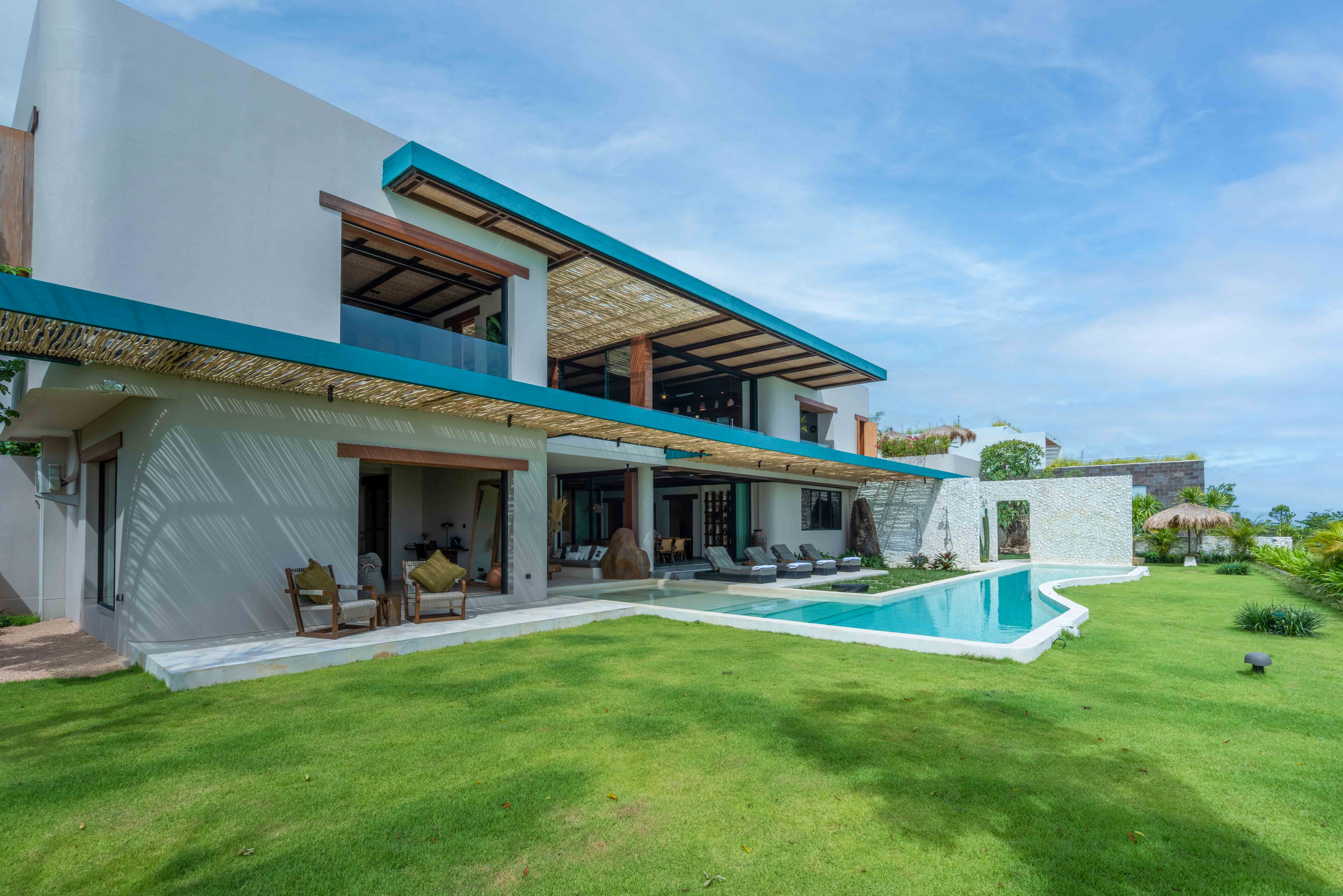
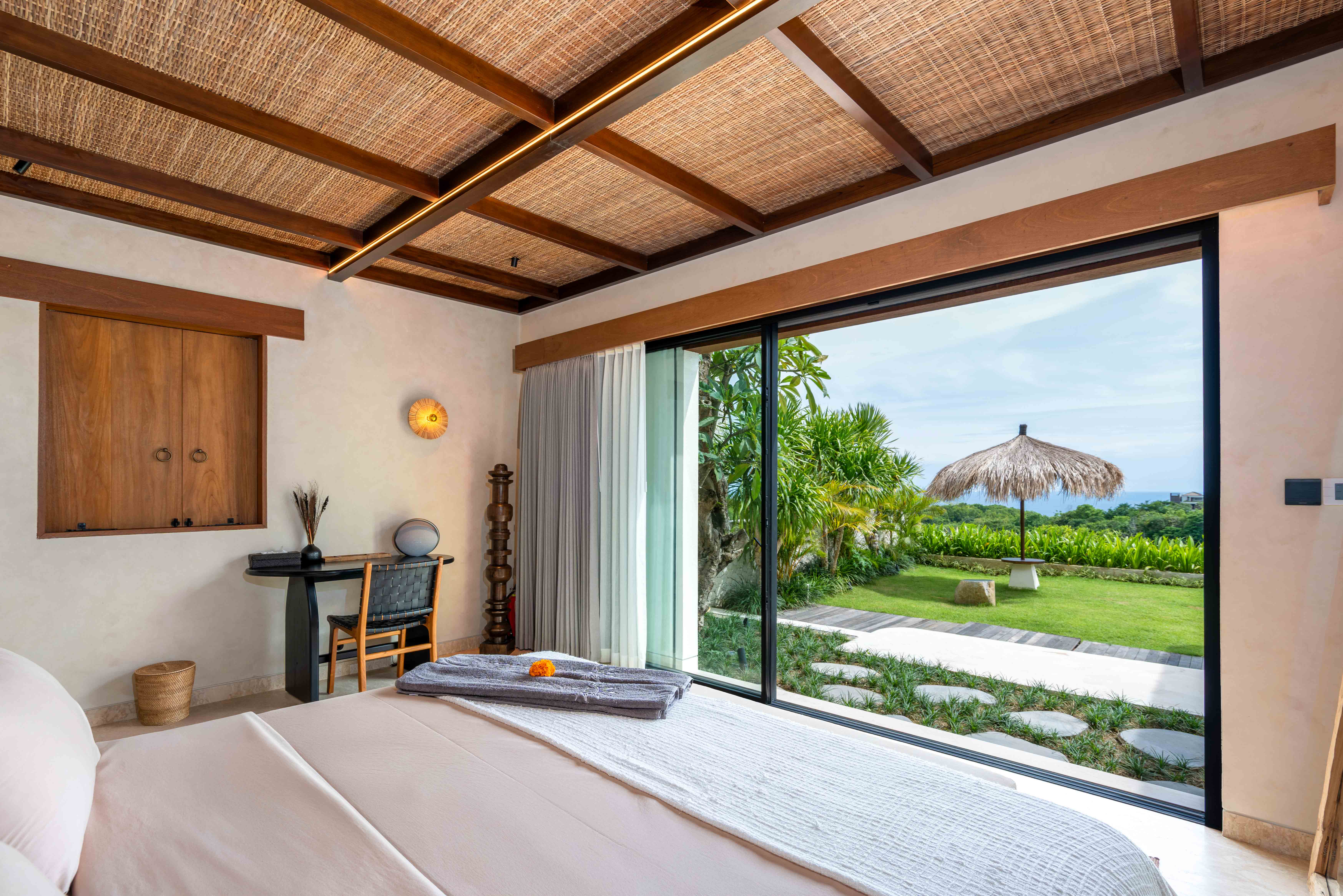
A bold multi-level silhouette descends the cliff in deliberate steps, each level angled to capture the full drama of the Indian Ocean horizon. Floor-to-ceiling glass walls stretch across the principal living spaces, turning the horizon into a permanent architectural feature.
The villa was conceived at the intersection of four design traditions: the clean purity of Cycladic form, the generous warmth of the South American hacienda, the contemplative geometry of the Moroccan riad, and the spiritual intimacy of Balinese architecture.
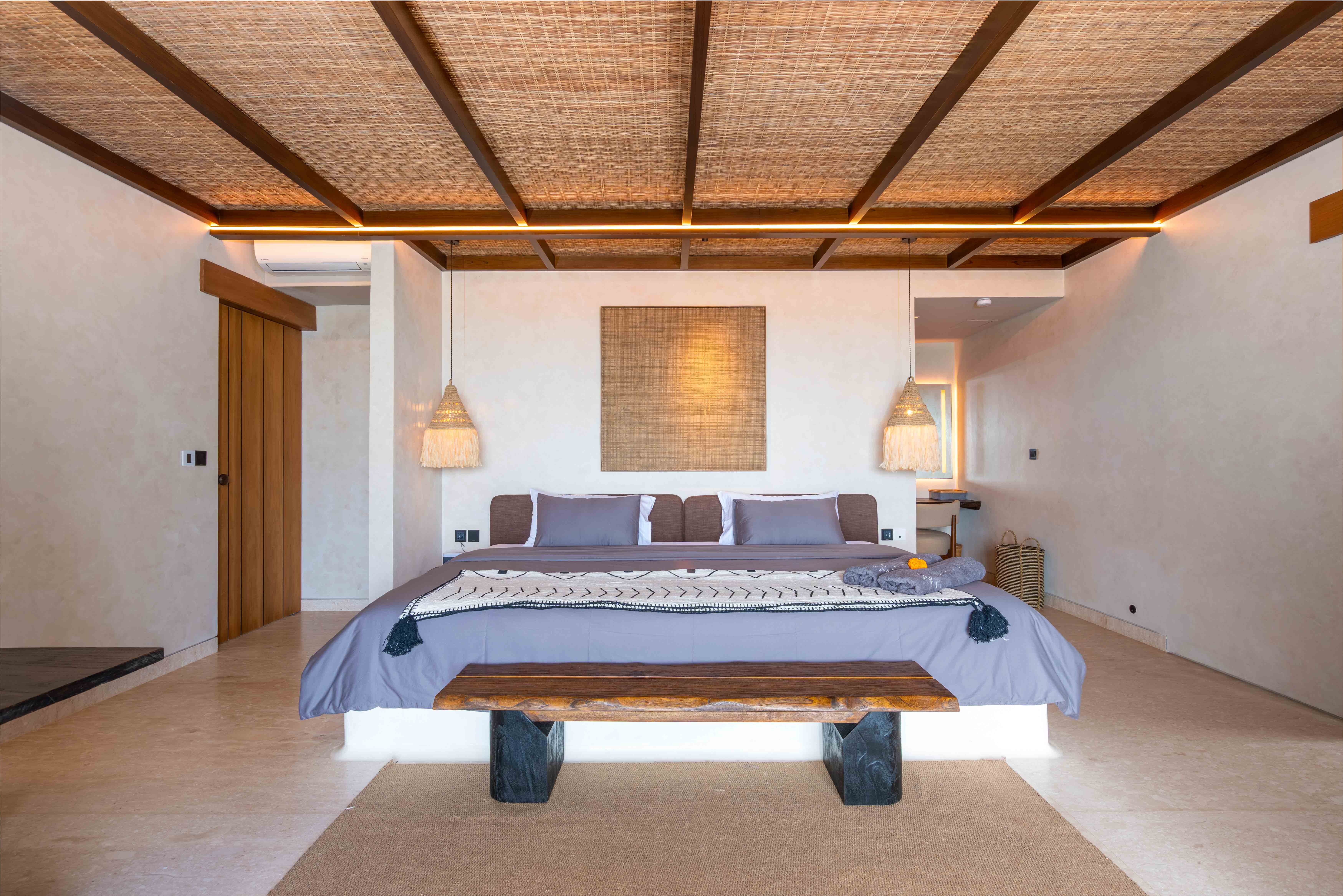
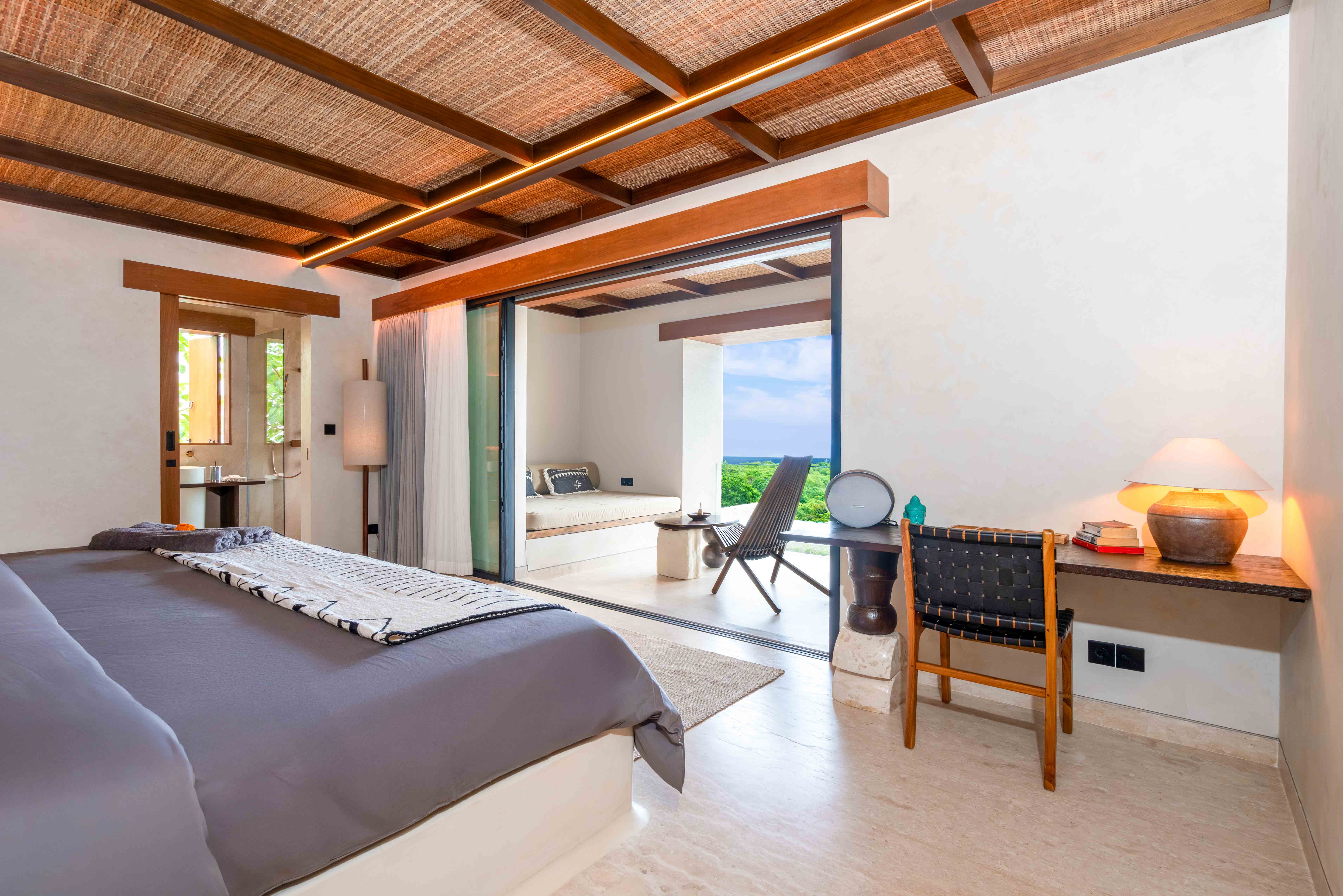
Teak, marble, onyx, rattan and brass carry the weight of these influences without ever feeling ornamental. Each material has been selected not for decoration but for permanence. The interiors extend this dialogue between worlds, balancing Mediterranean clarity with Balinese craftsmanship in spaces that privilege material over ornament. Hand-carved teak, custom marble pieces, woven rattan and aged brass accents create a tactile, refined atmosphere.
The result is an environment that feels collected rather than decorated.
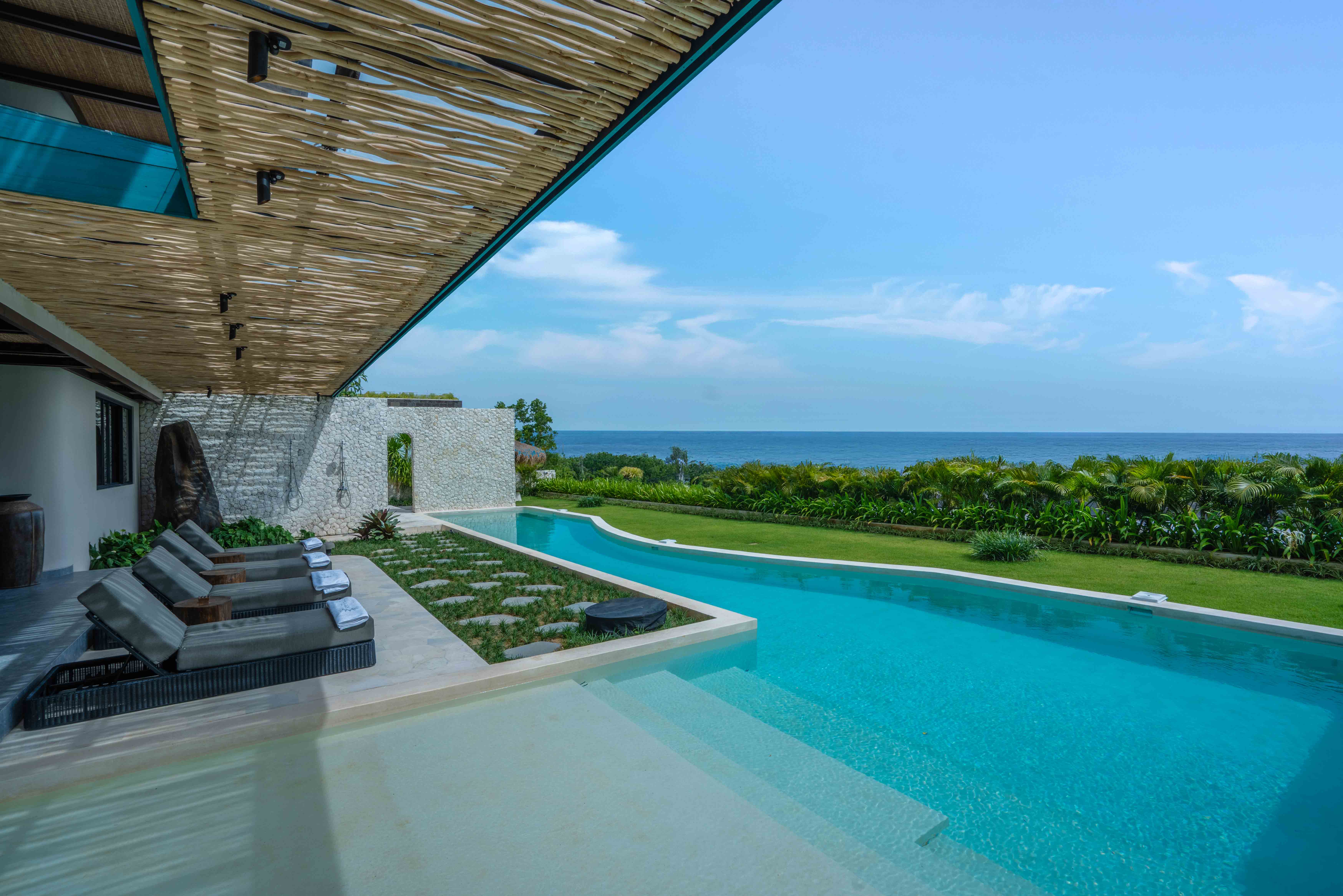
Cascading across multiple levels down the cliff face, the estate is arranged so that every principal space faces the ocean directly — a constant dialogue between architecture and horizon.
A Morning That Belongs to You
Breakfast at Amarta Azul is not an event. It is an atmosphere.
The private chef — present throughout the stay and entirely at your rhythm — prepares each morning as its own quiet ritual. The gourmet kitchen connects to the upper dining room through a hidden dumbwaiter, delivering each dish with a choreography so discreet it feels almost invisible.
There is no buffet. No fixed hour. No interruption to the pace of the morning. The day simply unfolds.
The Wellness Loft
On the first floor, a light-filled wellness loft opens toward the ocean breeze. Here, the body catches up with the mind. A fully equipped gym faces the sea, while an infrared sauna offers deep recovery after a day spent exploring Bali’s southern coast. For those who prefer to be worked on rather than to work, the concierge arranges in-villa massage treatments.
When the Ocean Calls
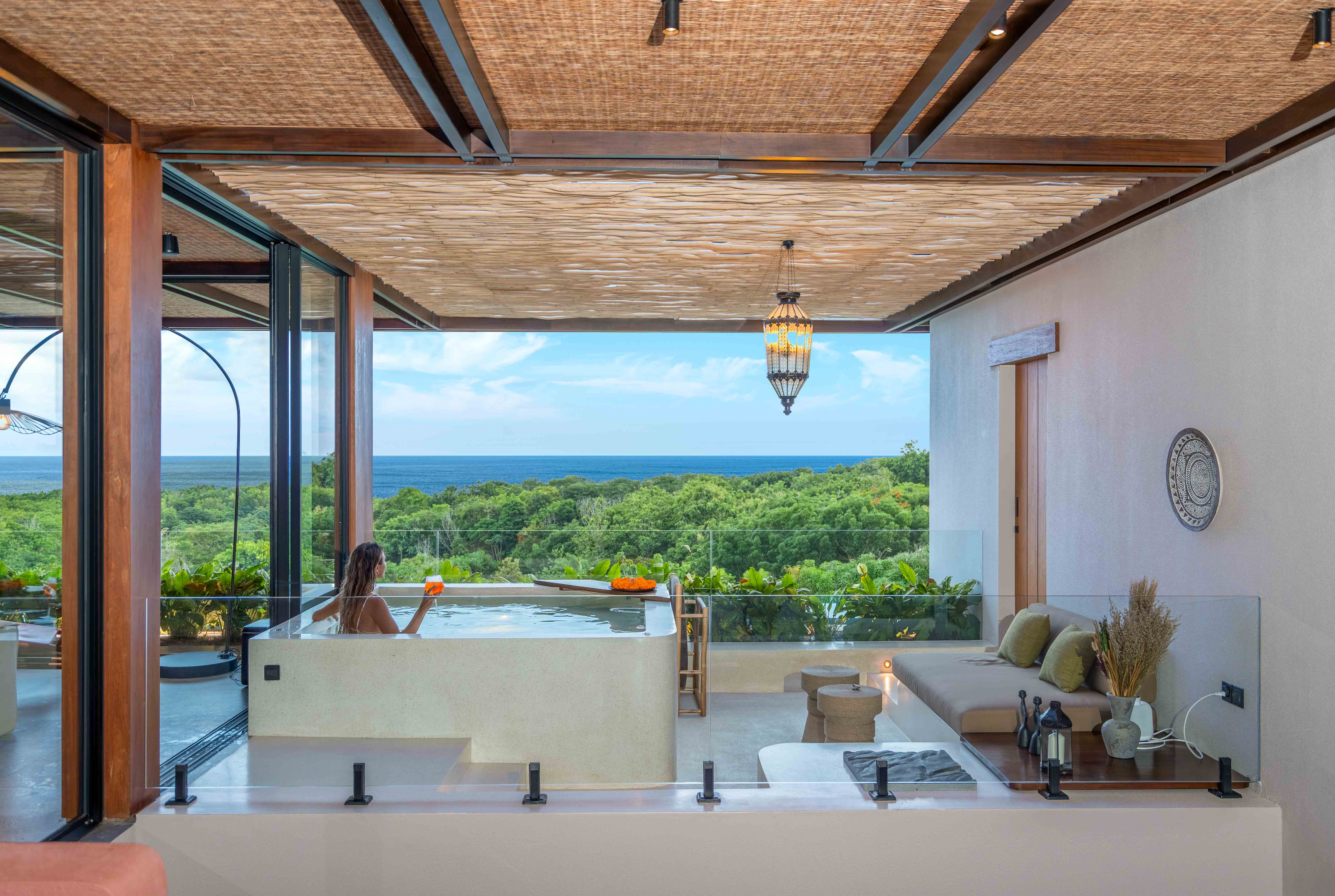
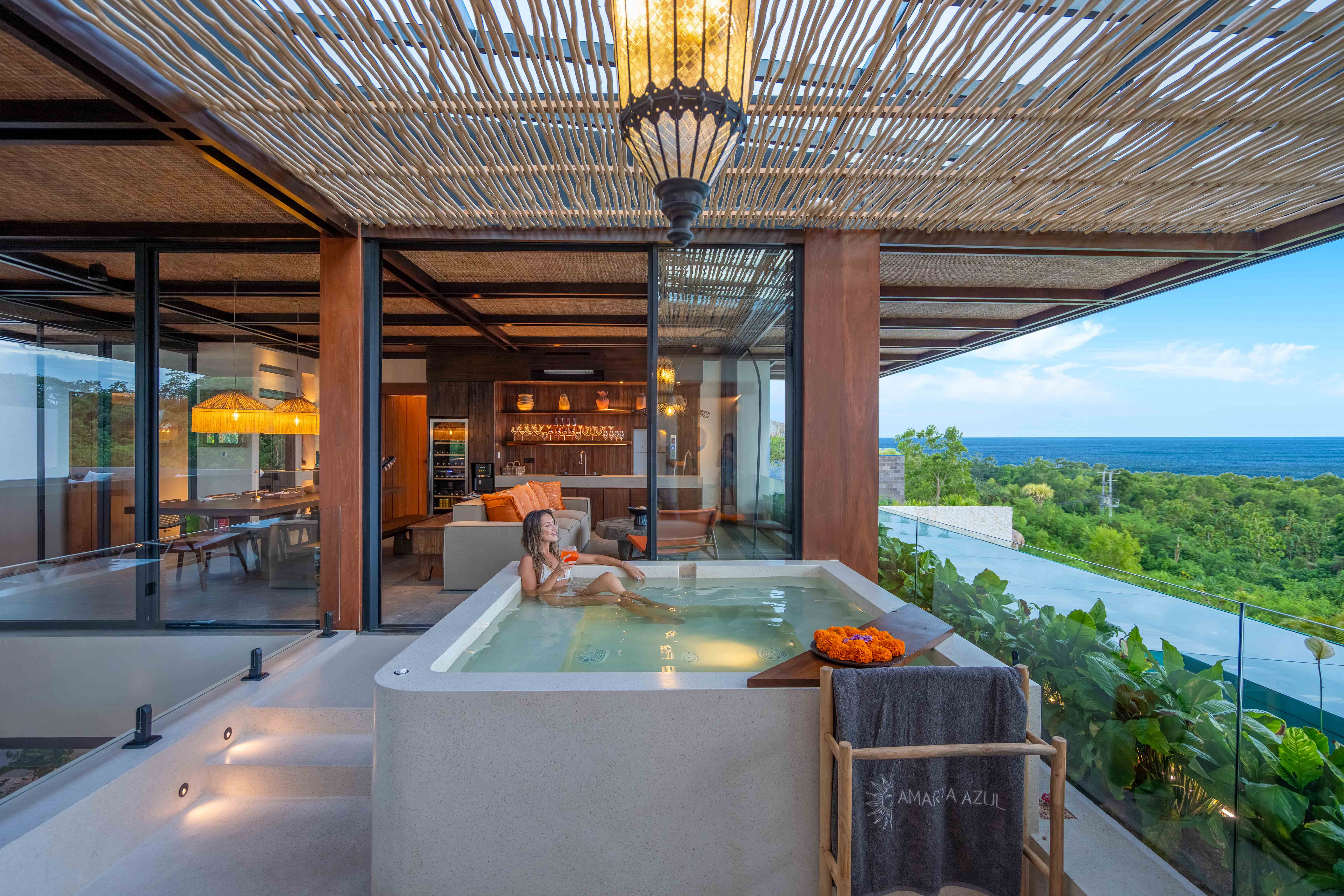
By late morning, the estate’s heated panoramic jacuzzi quietly becomes the most coveted address in the house.
Glass-fronted and suspended above the cliff, it faces nothing but open water and sky. The turquoise coastline of southern Bali stretches endlessly below, while the horizon dissolves into the vastness of the Indian Ocean. Time behaves differently here. At night, the same water reflects the stars back with perfect stillness.
Private Dining Above the World
When evening arrives, the clifftop terrace is prepared for dinner. The private chef composes each menu around the moment — the guests, the mood, the season. A table is set above the Indian Ocean as the horizon fades slowly from gold to violet to black.
Service appears when needed and disappears when it is not. No restaurant on the island can replicate this atmosphere. It exists only here, only for the guests within these walls, and only on a night that will never return in quite the same way.
Intelligence Woven Into the Fabric
What distinguishes Amarta Azul from a merely beautiful villa is the degree to which thoughtful technology has been integrated without ever being felt. Lighting adapts to mood and hour. A premium sound system extends seamlessly across indoor and outdoor spaces. A private cinema room offers an intimate retreat for evenings that call for something quieter. Every system operates with quiet precision — present when needed, invisible when not.
The estate’s environmental design reflects the same philosophy. Solar energy, rainwater harvesting and a purified water system delivering drinking-quality water directly from the tap demonstrate a commitment to sustainability that feels intrinsic rather than performative. This is a residence built not only for comfort, but for longevity.
The Address That Defines the Category
Pecatu’s clifftop corridor is not somewhere one arrives by accident. It is chosen deliberately by those who understand Bali at its most spectacular — dramatic natural beauty, genuine seclusion and a sense of remove from the world that has become increasingly rare.
Amarta Azul occupies this address at its absolute apex. From the terrace, the horizon feels less like a view and more like a private possession. Some places are difficult to leave.
Amarta Azul is the kind that makes departure feel like a mistake.
www.amartaazul.com
Informations and Booking: welcome@amartaazulcom
For more on the latest in hotel and travel reads, click here.
On today’s portentous episode of Quick Charge, we’ve got Harbinger CEO John Harris on-hand to talk through the brand’s new low cab forward EV and EREV trucks, the industry-first battery deal with Airstream, and a whole lot more!
Harbinger says its all-new HC Series Cab delivers best-in-class maneuverability with a tight, 42-foot turning circle, superior visibility from a car-like driving position that’s not compromised by the needs of an internal combustion engine, and a modular, Lego-style battery pack that addressing one of the most commonly called-out shortcomings of (most) modern EVs.
We’ve got CEO John Harris here to tell us all about it, and explore some of the ways Harbinger’s modular battery design can help dealers and fleet operators cut costs and streamline their parts inventory.
Source Links
Prefer listening to your podcasts? Audio-only versions of Quick Charge are now available on Apple Podcasts, Spotify, TuneIn, and our RSS feed for Overcast and other podcast players.
Advertisement – scroll for more content
New episodes of Quick Charge are (allegedly) recorded several times per week, most weeks. We’ll be posting bonus audio content from time to time as well, so be sure to follow and subscribe so you don’t miss a minute of Electrek’s high-voltage podcast series.
Got news? Let us know! Drop us a line at tips@electrek.co. You can also rate us on Apple Podcasts and Spotify, or recommend us in Overcast to help more people discover the show.
If you’re considering going solar, it’s always a good idea to get quotes from a few installers. To make sure you find a trusted, reliable solar installer near you that offers competitive pricing, check out EnergySage, a free service that makes it easy for you to go solar. It has hundreds of pre-vetted solar installers competing for your business, ensuring you get high-quality solutions and save 20-30% compared to going it alone. Plus, it’s free to use, and you won’t get sales calls until you select an installer and share your phone number with them.
Your personalized solar quotes are easy to compare online and you’ll get access to unbiased Energy Advisors to help you every step of the way. Get started here.
FTC: We use income earning auto affiliate links. More.
Update: The Brabus Bodo is likely to be based on the Aston Martin Vanquish. While it appears longer compared to the SL, the rake of the windscreen and the window line match that of the Vanquish. Also, the mirrors on the Bodo V12 are the same used on the V12-powered Vanquish.
March 19, 2026
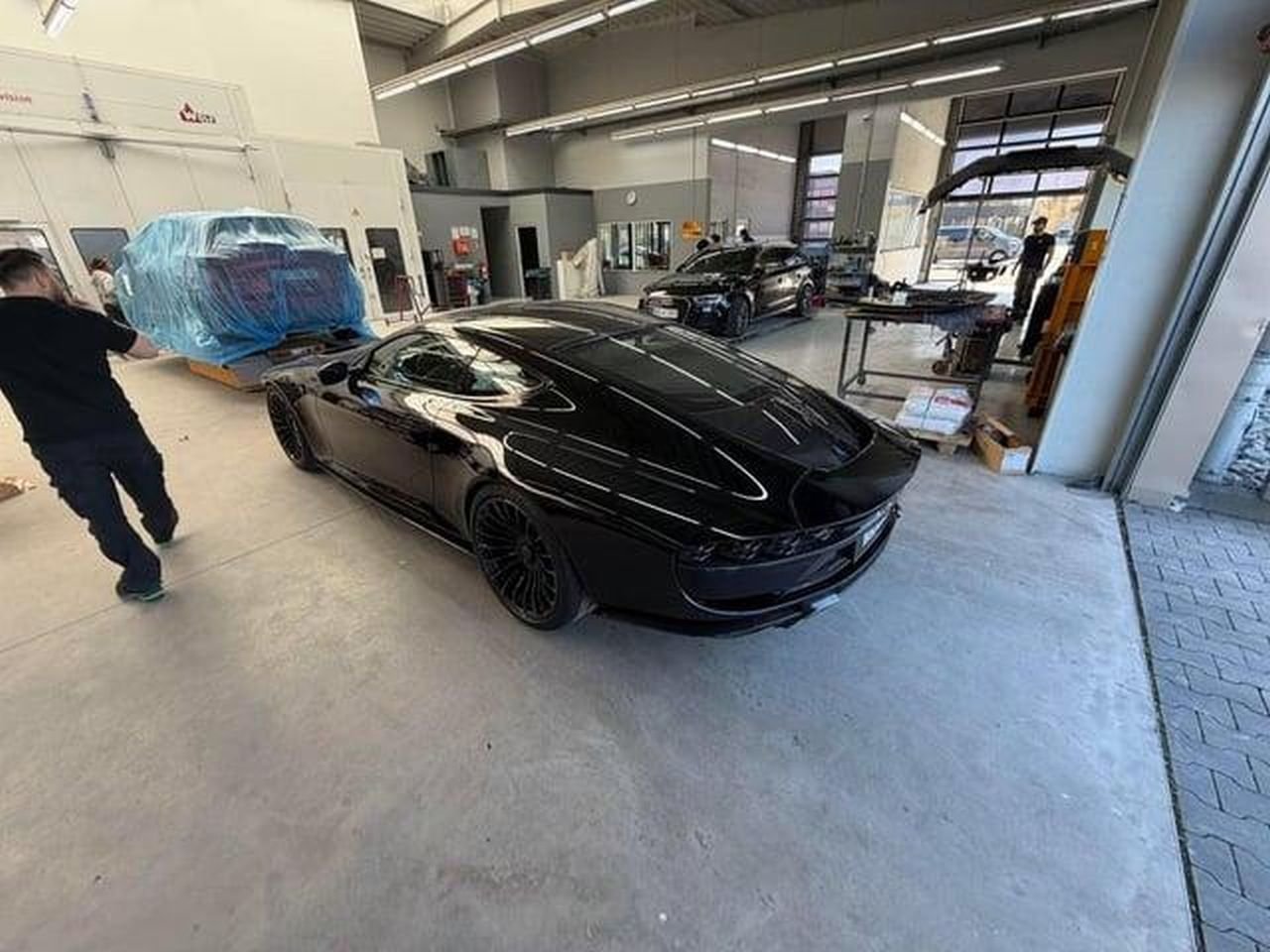
Recently, German tuner Brabus teased a new car on their social media. The teaser images didn’t reveal much, except for a unique ’77’ logo, and hinted at a sleek coupe body style.
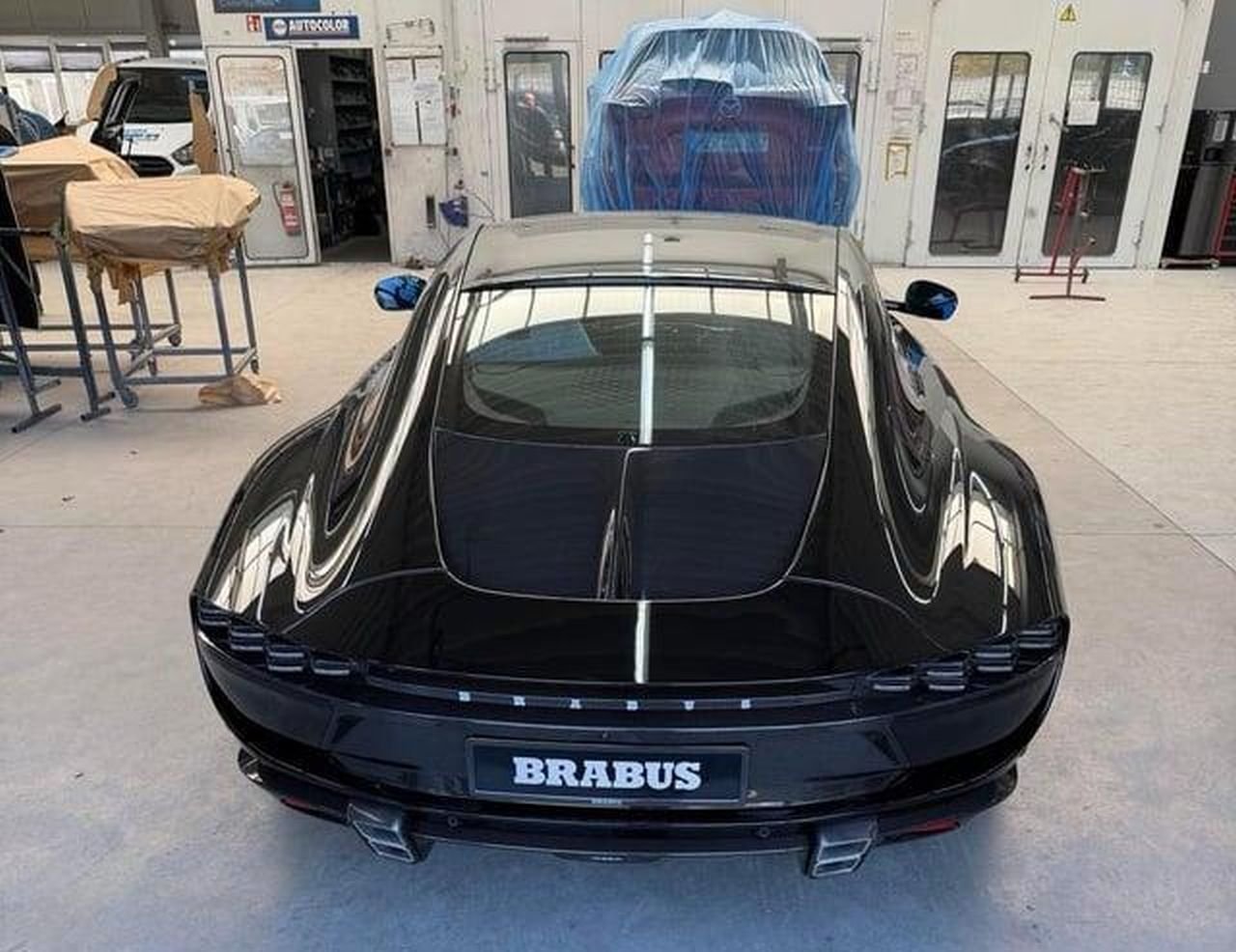
In case you’re wondering what Brabus has been up to, this is it – the Brabus Bodo, a new front-engined coupe with a sinister design, in true Brabus style. The car is named after the company’s founder Bodo Buschmann, and the ’77’ logo is a nod to the year when the company was established in Bottrop, Germany.
The Brabus Bodo is likely to be based on the new Mercedes-Benz SL. The exterior design appears to be inspired by the Vision Maybach 6 concept. It features a long hood with a prominent crease in the centre and a sharknose-style front end. It has massively flared rear fenders and a sloping roofline. The rear fascia has a unique design and features quad LED taillights with the ‘Brabus’ lettering in the centre and quad exhausts in a double-stacked configuration.
Bodo Buschmann loved the V12. He created the insane Brabus SL 7.3S powered by a 7.3-liter V12 engine. Hence, there’s a good chance that the new Brabus Bodo could have a V12 under the hood.
RV rental prices average $50-$450 per night, depending on the RV type. Class A motorhomes cost between $150-$450/night, Class B campervans $100-$350/night, Class C RVs $100-$400/night, and travel trailers $50-$200/night. Total rental costs, including gas, campground fees, insurance, and mileage fees average $150-$600 per day for a complete trip. For budget travelers, pop-up trailers or small travel trailers offer the best value, while families needing space should expect to spend $200-$300 a night for Class C motorhomes. Peak season, like summer and holidays costs 30-50% more than off-season rates, and weekly or monthly rentals are typically 15-25% cheaper than daily rates.
How Much Does it Cost to Rent an RV?
Start planning your RV adventure using this RV Rental Cost Calculator tool for a clearer idea of how much your RV rental would be.
RV Rental Prices: Complete Cost Breakdown
Let’s take a look at the different RV types and how their rental costs compare.
RV rental prices represent only 40-60% of total trip costs, with expenses like gas, campground fees, insurance, and mileage overages often catching first-time renters by surprise. Understanding the complete cost breakdown is essential so you can budget accurately and avoid financial stress on vacation. RV rental costs matter because:
Hidden fees add up fast: A $150/night Class C rental becomes $300-$400/day with gas, campgrounds, and insurance
Poor planning ruins trips: Running out of budget mid-trip could cause you to cut your trip short or spend more than you planned
Size doesn’t always equal value: A $100-a-night travel trailer that requires you to rent a $400-a-day truck costs more than a $250-a-night Class C with better gas mileage
Seasonal timing affects affordability: The same RV renting for $150-a-night in October costs $275-a-night in July — an 83% increase
Rental type impacts flexibility: Motorhomes can mean free overnight parking in areas like Walmart or rest stops, saving $30-$50-a-night vs. trailers that require a campground
The biggest mistake first-time renters make is comparing only nightly rates without calculating total costs. A “cheap” $75-a-night travel trailer requiring a truck rental at $100-$200-a-day, plus lower gas mileage, ends up costing more than a $200-a-night self-contained Class B campervan. Always calculate the all-in daily cost when budgeting for a trip.
Average RV Rental Costs by Type
Here are the average RV rental costs, depending on the type of RV you choose.
Class A Motorhomes
Class A motorhomes are the largest motorhome class. They’re the big, tour bus-style motorhomes that allow you to camp with a wide variety of amenities at your fingertips.
Class A motorhomes in California average around $275 a night to rent, although it’s not unusual to see many in the $300 range. In many other popular cities, they average about $250 a night.
Since these are averages, you’ll also find outliers for much cheaper – down to just $150 a night. But you’ll also find much more expensive rates. Some high-end rentals can go for up to $700 a night.
Class B Campervans
Class B campervans are the smallest type of self-contained RV. These are the #vanlife vans, and while they’re small, you can pack a lot in them! They’re great for solo travelers, as well as adventurous couples or very small families.
Class B campervans average about $200 a night in many popular cities, but you can find them for less than that. There are even some for rent under $100 a night. The overall price range for renting a Class B campervan is from $100-$350 a night.
Class C Campers
Class C campers are a good compromise between a large Class A motorhome and a small Class B van. They have an overhang in the front, which can be used as extra sleeping or storage space. You can find Class C campers to rent in many markets for between $175 and $200 a night. Overall, they range from $100 at the low end to $400 for newer models with lots of amenities.
Average Travel Trailer Rental Prices
If you prefer to tow a trailer rather than drive a motorhome, there are a variety of options and price ranges for that as well. Pop-up trailers are lightweight, and you can often use a crossover, SUV, or even a car to tow them. Fifth-wheel and travel trailers are much larger, and you may need a large truck to tow those. Many RVshare owners will also set the trailer up for you at your campground for an extra fee.
As a whole, trailers are less expensive than self-contained motorhomes.
Travel Trailers
Travel trailers can range from 8 to 40 feet, and their rental prices range as well. You can find travel trailers to rent for under $100 a night, but most are in the $100 – $200 range.
Fifth-Wheel Trailers
Fifth-wheel trailers are large travel trailers that you will need a 3/4-ton or 1-ton truck to pull. They are attached to the truck with a U-shaped coupling mounted to the truck bed. Fifth-wheels are often between $175 and $200 a night.
Pop-Up Trailers
Pop-up trailers are the smallest trailer category. They fold down to be towed flat on a small trailer bed. When you arrive at camp, you pop the sides and top up for a trailer that protects you from the elements. Some pop-up trailers are very basic, while others can have kitchens and even bathrooms. Pop-up trailers average about $100 a night, although many are less expensive than that.
What Goes Into the Cost to Rent an RV?
The cost of renting an RV will vary, depending on several factors.
RV class: The size and class of RV you rent will affect the rental price. In general, a large Class A motorhome is going to cost more than a pop-up trailer. Also, self-contained rigs are generally more expensive than trailers that require customers to provide their own tow vehicle.
Amenities: RVs with more amenities – full kitchens, larger bathrooms, laundry machines – will usually cost more to rent than more basic motorhomes or trailers.
Age: The newer the RV or trailer model, the more expensive it generally is.
Seasons: Busy seasons like summer, spring break, or holidays may cost more than in the off-season. As a general rule, if kids are in school, rental prices will be lower. You may also save on other prices, like admission fees, during this time as well.
Hidden Costs of RV Rentals
Along with your RV rental fees, there are a few other costs to consider when renting an RV. If you’re watching your budget, you may want to see if you can limit or eliminate these fees to reduce your RV rental costs.
Gas prices
Most RVs get much lower gas mileage than your standard vehicle, and your gas might add up to a substantial cost. You may want to calculate how many miles your trip will be, and calculate the gas mileage for the vehicle you’ll be using. This will give you a good idea of how much to budget for gas.
Keep in mind, even if you’re using your own vehicle to tow a trailer, that extra weight will also affect your gas mileage.
Campground fees
If you’ll be staying at a campground, you’ll want to budget for those fees as well. Basic campsites with no hookups are going to be a lot less expensive than RV resorts with electric, water, and sewer hookups. Resorts may also have amenities like pools, nature activities and trails, planned events, laundry rooms, showers, and more.
Cleaning fees
Some RV listings show an extra fee for any additional cleaning that’s required. If you return your RV clean and in the condition it was rented to you, you may avoid these extra charges. Discuss any cleaning fees with the RV owner to make sure you know what you will and won’t be charged for.
Mileage fees
There may also be mileage fees associated with your rental. These can vary, so make sure you understand the fees before signing your rental agreement. Some owners allow unlimited mileage for free, while others select a certain number of free miles. If you go beyond the free miles, you can be charged for the extra miles.
Generator usage
If you rent an RV with a generator, you may also be charged a usage fee. Many owners will include a certain number of free hours, and if renters go beyond those hours, they’re charged incrementally. Other owners may charge for all generator usage … and some may not charge for any.
Pet fees or deposits
Some pet-friendly rentals may require an extra deposit or have an extra fee for allowing your furry friend to travel with you.
Owners may also offer extras for additional fees. Some owners are willing to drop off and set up an RV or trailer at campsites within a certain radius of their rental. Others may include extra equipment like kayaks, fire pits, chairs, or extra linens or dishes. And some offer services like propane refills or tank dumping, so you don’t have to worry about them. Each of these extras may come with an extra fee.
How to Save Money on RV Rentals
Here are some tips if you’re looking to bring down the cost of an RV rental.
Book Early
Booking your rental 3-6 months ahead of time can save money as RVs get scarce during peak seasons. You’ll also find a better selection of affordable RVs if you allow yourself plenty of time. Plus, you’ll give yourself lots of time to compare prices on different rigs instead of feeling like you need to grab the first available RV you find.
Rent During Off-Peak Seasons
If your schedule is flexible, you can save a lot by renting during times when kids are traditionally in school. Renting an RV in September or October can mean 20-30% lower rates. Most summer destinations still have beautiful weather, and it may be less hot than the height of summer. Renting in April or May, before the summer rush, can mean 15-25% lower rates. Also, renting on weekdays instead of weekends can mean a 10-15% savings for customers.
Keep in mind that some resort areas use the off-peak season to renovate, take inventory, or allow staff to take their own vacations. If there are particular places you want to visit or eat, check ahead of time to make sure they’re open during the off-season.
Consider Weekly or Monthly Rates
If you plan to rent for a longer period, look at the weekly or monthly rates for the RV you’re interested in. Some owners offer discounts of between 15-20% for weekly rentals over the daily rate. Monthly rentals (30 days) can sometimes mean savings of 25-30%.
Select Unlimited Mileage Plans
If you plan to travel quite a bit, especially on a cross-country trip, look at the RVs that offer unlimited mileage. You can get hit with $0.35-$0.50 a mile overage fees for some rentals. Unlimited plans can cost between $50-$100 more up front, but mile overages can add up to $300-$500 on long trips. Calculate your daily mileage to see if the unlimited plan may actually be the cheaper option.
Return Clean and Full
There can be extra fees for cleaning, dumping, or filling the RV with gas after a trip. See if the rental you’re interested in charges any of those fees, and save by doing those chores yourself before returning it to the owner.
Some rentals have charges for linens, bedding, kitchen items, or outdoor gear. You can save in these areas by providing your own items, which you likely already have at home.
Consider Delivery and Setup
Some RV owners offer delivery and setup if you’re camping nearby and not planning to move. It can seem counterintuitive to pay a fee for this to save money, but sometimes the cost is worth it. You’ll save on gas both ways by opting for the owner to set up their RV for you. If you have work or scheduling constraints, having someone else do the setup also lets you arrive and get straight to vacationing. Finally, if you’re nervous about setting up an RV for yourself, having the owner do it can prevent mistakes that could cost you.
Use RVshare Instead of Traditional Rentals
Peer-to-peer rental services like RVshare can be 20-40% cheaper than using a rental company. You’ll also find more variety, including older RVs that are likely cheaper. Owners are also more likely to offer long-term rental discounts.
Key Takeaways
RV rental prices range from $50 to $450 per night, depending on the type: Class A, B, C, and trailers.
Total rental costs, including additional fees, average $150 to $600 per day for a complete trip.
Seasonal demand can increase rates by 30-50%, while weekly or monthly rentals often offer discounts.
Hidden costs like gas, campground fees, and insurance significantly impact overall RV rental prices.
Understanding all costs is essential to budget accurately and avoid financial surprises on your RV trip.
FAQs About RV Rental Prices
How much does it cost to rent an RV per night in peak season?
While it depends a great deal on what kind of RV you’re planning to rent (i.e., a small travel trailer or a large Class A motorcoach) as well as your location, during peak season, RV rentals may hover between about $150 to $300 per night, though some types may cost more or less.
What affects RV rental rates the most?
Along with season (with peak travel seasons like summer seeing higher prices) and RV type (with larger, more luxurious models fetching higher rates), geographic location as well as rental duration also have a major impact on RV rental rates and what you’ll pay overall.
Are drivable RVs more expensive to rent than towable RVs?
Usually, yes, a drivable RV like a Class A or Class C motorhome is more expensive to rent than a towable RV like a trailer. However, there may be some exceptions, such as small camper vans or large fifth-wheel trailers with slide outs.
What additional fees should renters expect when booking an RV?
It depends on where you rent the RV from, so always be sure to check the fine print. That said, common additional fees include mileage fees, insurance, cleaning fees, generator use fees, pet fees if you’re traveling with furry friends, and security deposits (which are usually refundable).
Do weekly or monthly RV rentals offer discounted pricing?
Usually, yes! Whether you rent from a traditional RV rental firm or on the peer-to-peer market here at RVshare, generally, longer-term RV rental periods offer discounts over the normal nightly rate.
If you’re ready to rent an RV for your own adventure, you can browse thousands of rentals on RVshare. You’ll find transparent pricing and owner reviews to help you make your choice. And you can filter by price, location, and RV type to find the perfect rental at the right price.
Is there anyone out there who actually hates kustom cars? I’ve been posting photos online for nearly two decades now, and in that time I’ve seen just about every kind of feedback imaginable.
Some good, some bad—but if there’s one thing that’s always stood out, it’s this: kustoms might be the most universally loved style of automotive customization.
Why? Because nearly everything we celebrate today can be traced back to the pioneers of the kustom movement.
Chopped tops? A staple. Shaved handles? Of course. Body drops? That’s just a modern take on a channel job. Shaved emblems? Nosed and decked. Metal flake, pinstriping, scallops? They set the standard.
They didn’t just influence the scene, they defined it.
From day one, California has been the mecca of kustoms. Texas, Georgia—really any place with endless sun and people willing to work with their hands—has earned its respect. In recent years, thanks in no small part to the Mooneyes show, Japan has become just as idolized.
Ontario, Canada, on the other hand, probably isn’t a place most would expect to find a thriving kustom scene. Given the length of our season—and what our climate does to classic cars—it’s honestly a bit of a miracle we have a community at all, let alone one worth showcasing.
But we do—and I’m extremely thankful for it. Truth be told, in recent years I’ve mostly been reaping the benefits of the hard work put in by London Jay and Kenny Kroeker.
If you read my coverage of Sleds North 2024, then you already know they’re the two masterminds behind the event.
“Sleds” is, technically, invite-only. But don’t get the wrong idea—Jay and Kenny are in it for the love, not the recognition. There’s no elitist mindset behind the selections.
The cars don’t need to be perfect, and drivers are just as important as show-ready builds. The goal is simple: make sure the main attraction, year after year, is kustoms. Ontario has no shortage of shows dedicated to hot rods, rat rods, muscle cars, and imports.
For 2025, the event moved two hours west of its previous location to the beautiful Plunkett Estate in London, Ontario—the former home of the Fleetwood Country Cruise In.
It’s also the venue they’ll be returning to for 2026, and from a photographer’s perspective, I have zero complaints about that decision.
The estate itself is a showpiece, featuring a cobblestone laneway, expansive gardens, and a stunning fountain out front.
Like the 2024 venue, it’s spacious enough to keep the cars close together—so there’s no mistaking that everyone is there for the same reason.
But not so close that it makes proper profile shots impossible. These are big cars, after all, and their impact is best appreciated when you can take in the whole silhouette. That means giving them enough room to breathe—positioned in a way that lets each one be properly seen.
The well-kept front lawn also serves as a perfect showcase for the vehicles that couldn’t be positioned around the fountain.
As a car guy himself, Steve Plunkett is the last person who’d complain about a bit of singed grass from a hot muffler, so owners are more than encouraged to lay their cars out.
Over the years, I’ve come to know some of these cars—and their owners—fairly well.
Take Ricky D’s Bel Air, for example. I’ve seen that car all over Ontario, and I can attest that he absolutely drives the wheels off it.
Still, it’s rare that I get the chance to interact with everyone in one place, so I have to thank Jay and Kenny for making that happen.
I did have evening plans the night of Sleds North, which threw a wrench into my original idea of staying in the area all weekend. It turned into a bit of a hit-and-run visit—but I’d still take that over missing it entirely.
Honestly, any event that gives me another opportunity to check out Matt Hayes’ 1956 Ford F100 is worth the drive. This was my second time seeing the truck in person, and I think I did it far better justice with these photos than I did in 2024.
Under a cloud-peppered sky, the Ford’s Orchid Gray Poly paint looked incredible. Surrounded by equally impeccable company, it ended up being one of my most popular photo sets on Instagram in the days following the event.
I’ve written about John St. Germain’s “Mint Merc” 1956 Mercury Monterey before for Autostrada Magazine, but Sleds North 2026 marked my first time seeing the car outside the halls of Motorama.
It’s the details that truly set this car apart. Looking at the interior, it’s hard not to feel like we’ve lost something—modern dashboards are a far cry from the class and character of a proper ’50s layout. In this case John has swapped a 50s Oldsmobile dash in place of the Mercury one.
You can’t convince me the “screen in the middle” approach is better from an aesthetic standpoint.
With my deadline to leave quickly approaching, I kept my camera firing as I made my way back to the car. I wanted to stick around a few extra minutes, but if I did, not even the 407 would’ve gotten me to my next stop on time.
If the stars align this year, I’m hoping to spend the entire weekend in London, Ontario—so I can be part of the cruise to the venue as well. Because as great as these cars look sitting still, they’re even better in motion.
More photos from Sleds North 2025 are below, and with any luck, I’ll see you at this year’s event.
Karas Plating has brought a new £1.5-million automated busbar electroplating line online in the UK, adding what the company says is the country’s widest-capacity silver-plating operation for copper busbars—components used in EV battery packs, power electronics and charging stations.
The new 2.4-meter-wide line can process up to 200 kg of product every 20 minutes and adds capacity to plate an additional 4,500 tonnes of copper busbars per year, according to the company. Karas says it can handle components up to 4.2 meters long.
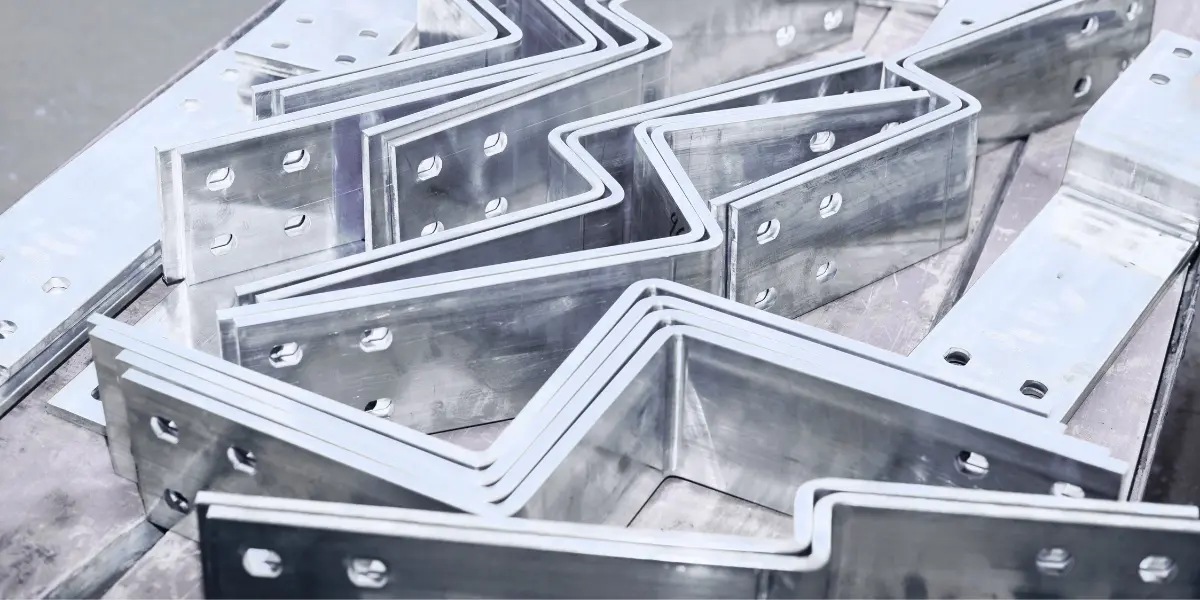
Busbars sit in a critical part of the powertrain and charging stack: moving high currents between cells, modules, inverters and charging hardware with minimal loss.
As Karas notes in a recent technical blog post, silver plating is widely used on EV busbars because it lowers contact resistance, improves current-carrying capability, stabilizes joints under vibration and thermal cycling and helps maintain low-resistance connections over repeated charge-discharge cycles. The company says silver plating can support both copper and aluminum busbars, the latter being increasingly attractive where weight reduction matters.
The new line is a reshoring move that reduces reliance on overseas electroplating while giving UK manufacturers tighter process control and shorter supply chains. Managing Director Alan Pennington said the automated line operates as an autonomous cell using LEAN principles and KPI-based process control to improve consistency and reduce silver consumption, and that Karas is achieving a defect rate of fewer than five parts per million.