15.6 C
London
Tuesday, May 12, 2026
Home Blog Page 25

Prestige M-Line Widens Choices with M7

0
Prestige M-Line Widens Choices with M7


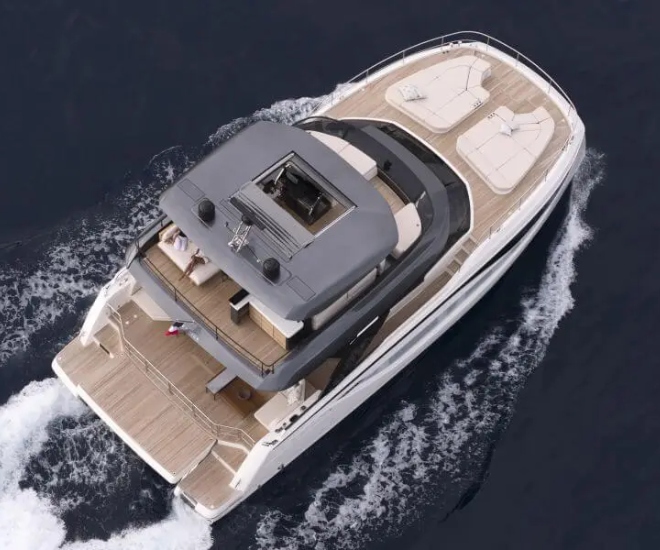
The M7 features naval architecture by France’s Marc Lombard Yacht Design Group

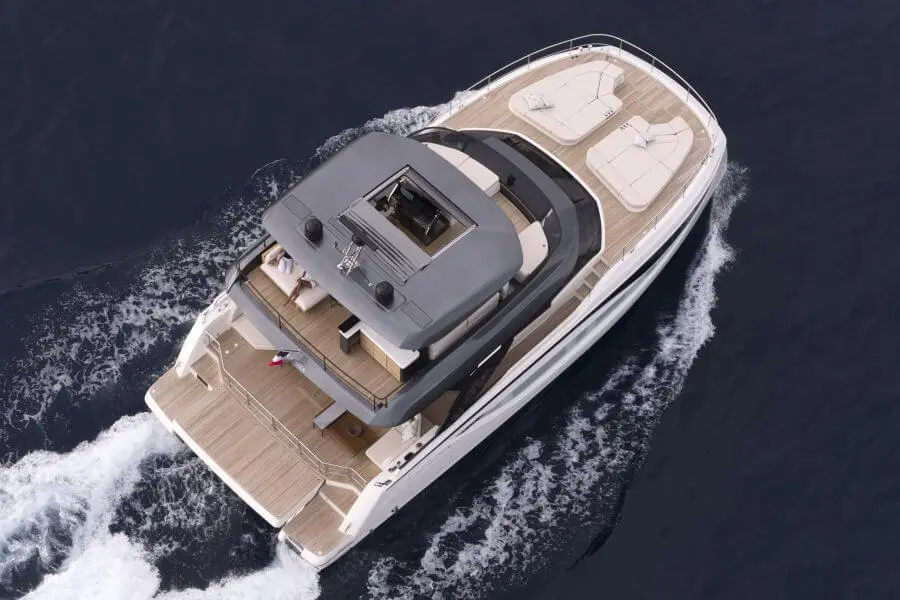
Having entered the multihull motoryacht sector in 2022 with the M48, now totalling 70-plus sales, Prestige surprised the yachting market the next year by scaling up to 65ft with the ultra-luxurious M8. Recently, the Groupe Beneteau-owned shipyard followed up with the slightly smaller but equally beautiful M7, which marries its 58ft length with a near-25ft beam.

“It’s not a secret that while we have always been very strong in the 40-60ft flybridge range, we need to grow our customer base and we want to do that in steps,” says Michelangelo Casadei, General Manager of Groupe Beneteau’s Motor Yachts Business Unit. “The M8 was a big jump. Now with the M7, we are filling out the range and showing our clients that we can grow with them, step by step.”
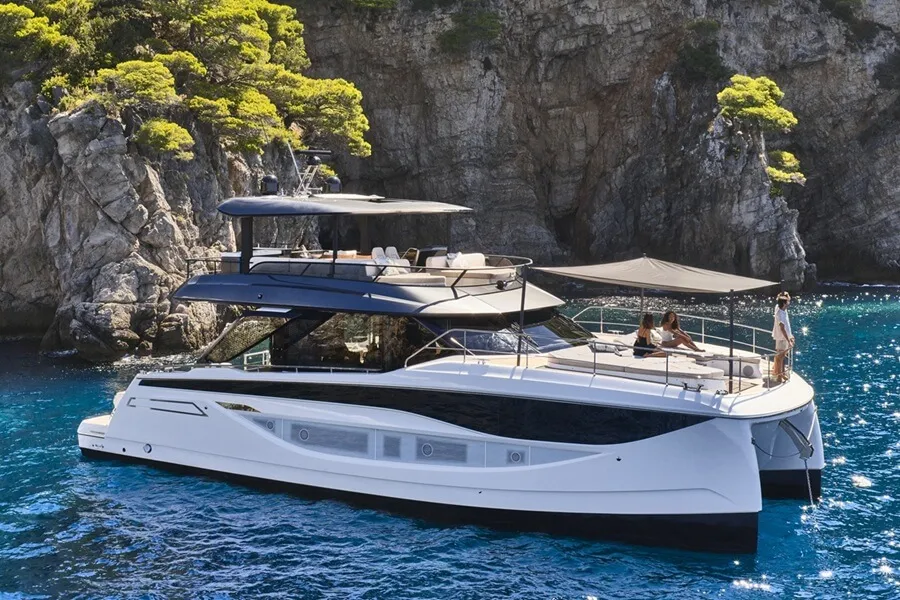
Italy’s Garroni Design handled exterior and interior design

The ‘M’ in M-Line stands for multihull, a growing sector of the motoryacht market and one in which Prestige has already made strong inroads. “We don’t hide our ambition to be the best in class in the multihull motoryacht segment. When I say multihull motoryacht, I mean something that isn’t derived from a sailing catamaran because those are completely different animals,” he explains.

“Sailing catamarans need to have a wide beam to provide a good righting moment, thin hulls to minimise wet surface, and low headroom to maximise the mast and boom above. On multihull motoryachts, you don’t have these constraints. For one, your beam can be a bit narrower overall, so it’s easier to enter a marina.
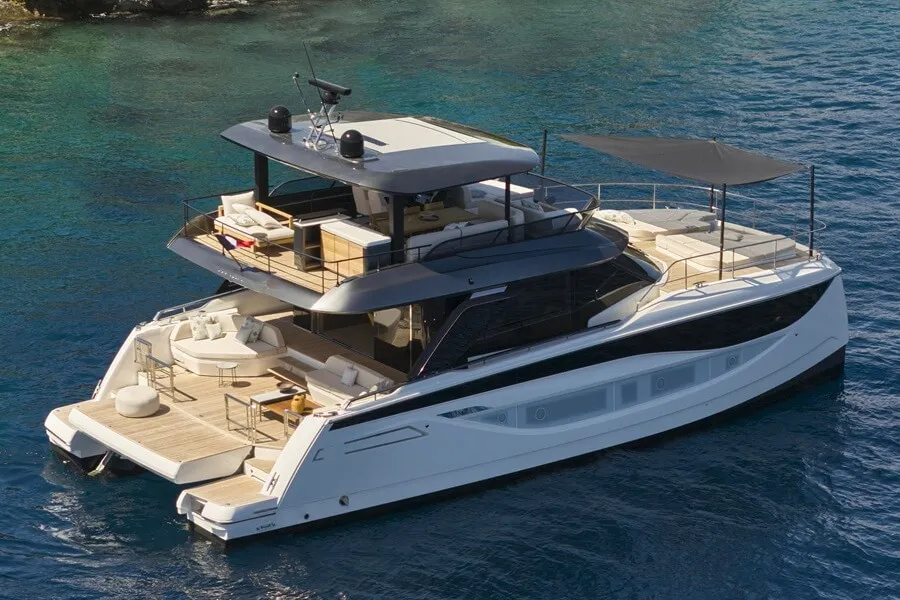
The vast hydraulic platform can be aligned with the cockpit or aft transoms, or even lower

“Also, you can have larger hulls because you can have more wet surface. This allows for more comfortable cabins with beds placed transversally looking out to the water and you can have a master cabin on the main deck. Above all, you can get good headroom because you don’t have the constraints the mast brings.”

Comfort and the quality of customer experience are the main factors driving Prestige’s development of multihull motoryachts.
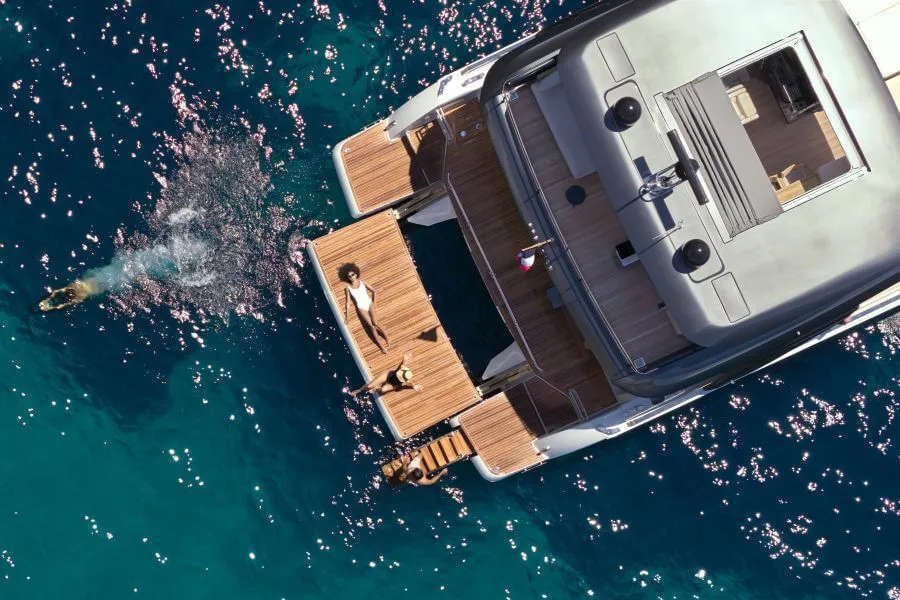
There’s also a retractable yacht ladder

“If you want to move fast, turn on your chine or like a sporty look, those are monohull features,” Casadei states. “If you want a spacious interior and an excellent quality of life with comfort and space for family living, and your typical navigation is just moving from one beautiful spot to another, then a multihull is right for you.”

GRAND ENTRANCE

The exteriors of the M7 contrast the verticality of the architectural elements with sinuous lines used in elements such as the hull glass. These eliminate the sense of bulkiness that sometimes plagues wider boats and balance out the proportions.
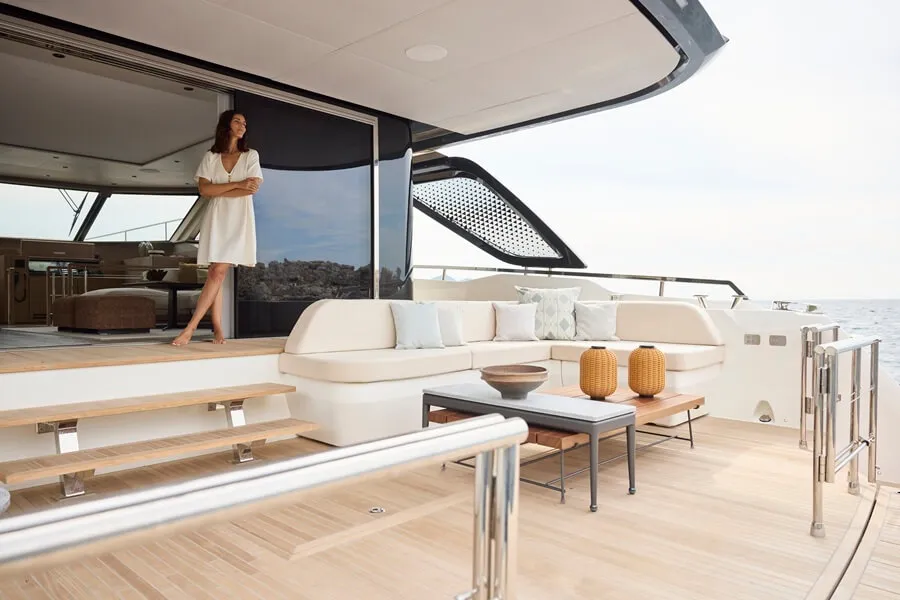
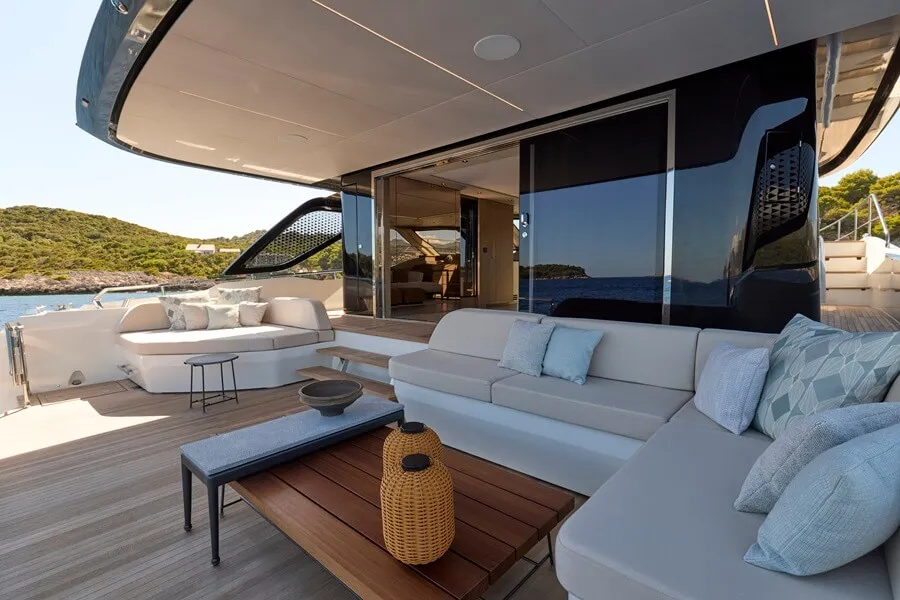
Offered with several furniture variations, the full-beam cockpit is situated two steps up from the transoms and three below the saloon

Balance and proportion – generous proportion at that – is what you feel when boarding the M7. The boat’s stability on the water is excellent, and the feeling is of quality and solidity. Symmetrically placed couches overlook a hydraulically operated central swim platform. Steps into the boat are wide, easy and feel practically palatial.

The saloon is tastefully set up like a city apartment with sectional couches to starboard and an open-plan galley to port – but just try finding an apartment with views like the ones you get through the M7’s huge floor-to-ceiling windows. The colour palette is neutral, but a variety of materials and textures keeps visual interest high.
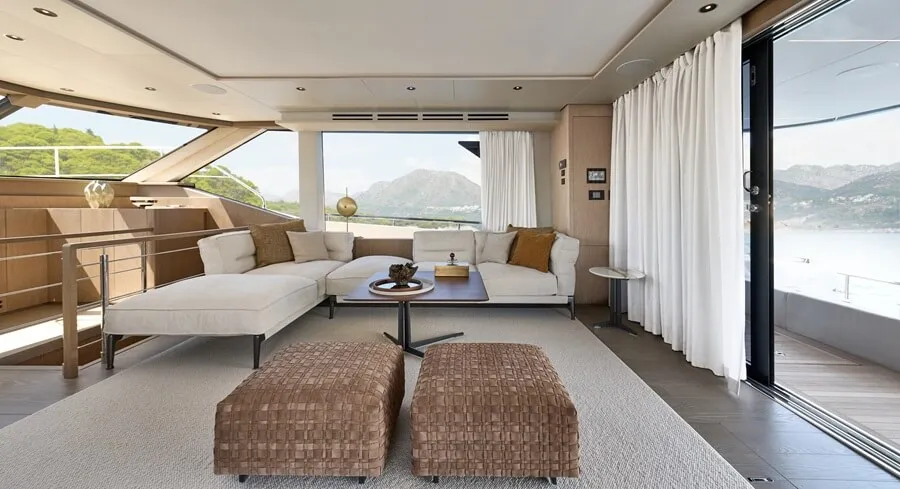
Starboard view of the saloon, where the forward helm controls can be covered

After the initial ‘wow’ effect wears off, closer inspection reveals a TV screen hidden behind a mirror, Miele appliances, and everything you need for entertaining, from a wine cellar to an icemaker.

The lower helm station is in the saloon. However, when the M7 is at anchor, the helm can be enclosed in cabinetry that matches the rest of the panelling, as this is a boat meant more for living than for navigating. All that you perceive is tonnes of space, including the headroom that Casadei mentioned, and the best sea views you can find.
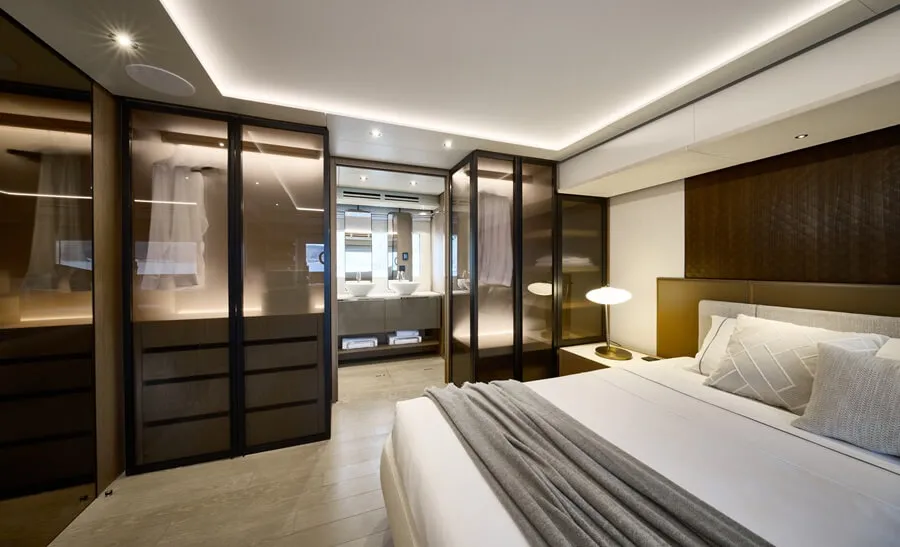
Forward, the full-width master suite with aft-facing bed includes wardrobes and a twin-sink bathroom to port

There are just four steps down to the owners’ cabin fore, a space where you can really wallow in the luxury of the 25ft beam, and enjoy the light and views through the long hull windows. The bed is aft-facing and centrally placed, and there’s plenty of room for a desk and a couch to starboard, and elegant closets with frosted glass doors to port.

Behind the closets there’s still enough space for a well-appointed bathroom with twin sinks open to the cabin, and separate shower and toilet compartments concealed behind glass doors. “This is the type of master suite you just can’t have on a 70ft monohull,” Casadei says with notable understatement.
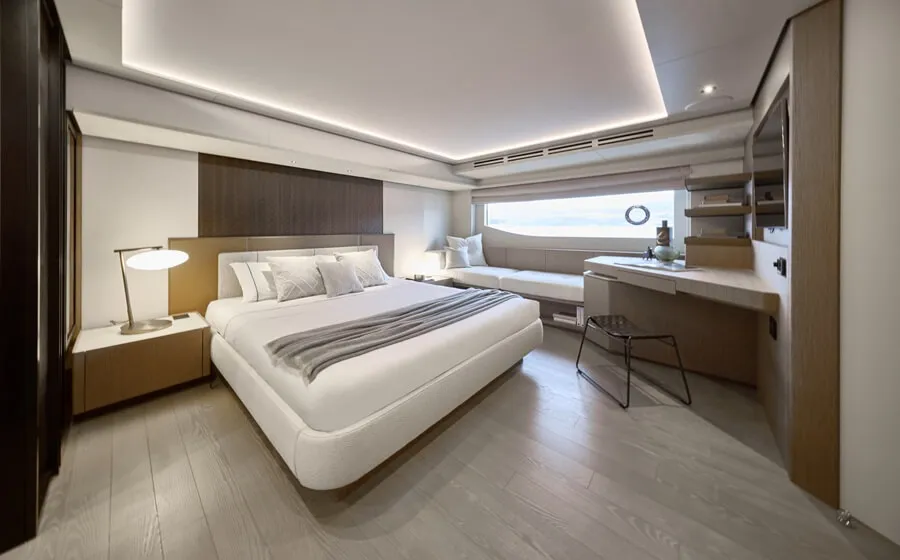
The master suite also has a daybed and a desk to starboard

Four more steps down from the master cabin is an en-suite VIP with a centrally placed bed facing port windows, a real invitation to spend too much time relaxing in bed watching the world go by. Another en-suite double cabin and a twin with bunk beds are in the second hull, accessed via a separate staircase. A crew cabin in the port hull has an independent access route to ensure guests’ privacy.

OPEN SPACES

The outdoor living features on the M7 are also exceptional. The foredeck is accessed by wide and comfortable side passages and has large sunpads with flip-up backrests and drinks holders.

Able to be shaded by a bimini, the foredeck features two large, symmetrical sunpads with integrated backrests and drinks holders

The flybridge has sunpads fore, a galley area with a grill and sink aft, and a dining area under the hardtop. The hardtop comes with the option for installing 16sqm of solar panels that can provide up to 3.6kW of energy to run the boat for up to 10 hours in hotel mode. This isn’t the M7’s only environmentally friendly feature, as Casadei points out.

“If you compare cubic living volume to wet surface, you use a third to half of the amount of installed power to get from one place to the other on a multihull motoryacht compared to a similar monohull.”
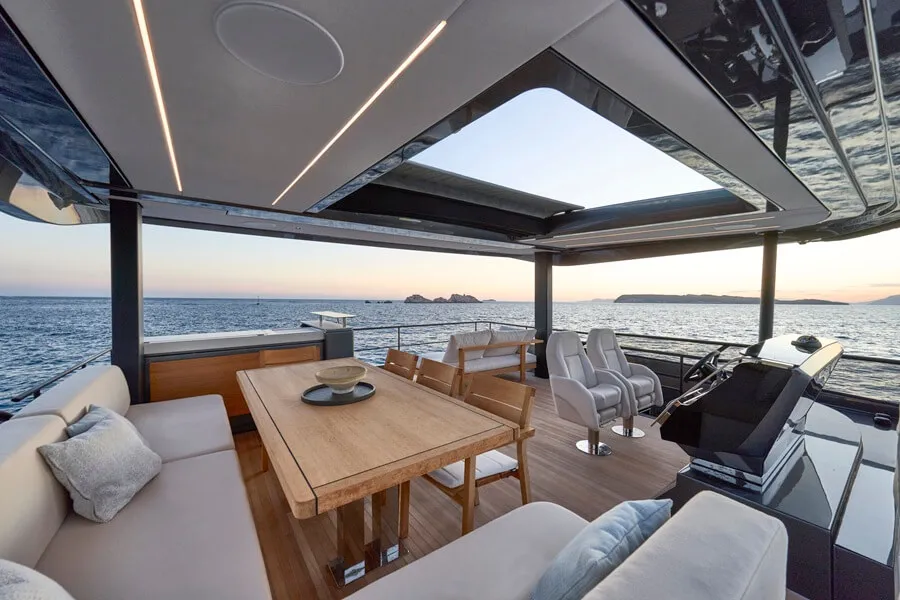
The flybridge features covered alfresco dining for eight, while to port is the yacht’s main helm station

In fact, the M7 has twin Volvo Penta D8-550 V-Drive diesel engines that lower consumption and operational costs. Plus, there’s no need for stabilisers on a multihull, so that also saves energy.

“With the M-Line we’re not just moving up in size,” Casadei says. “It’s a completely different product segment and we think that there’s a space for us to become leaders and best in class with this type of boat.”

So, is Prestige effectively splitting into two different shipyards, with the M-Line so different from the F-Line and X-Line series of monohull motoryachts?
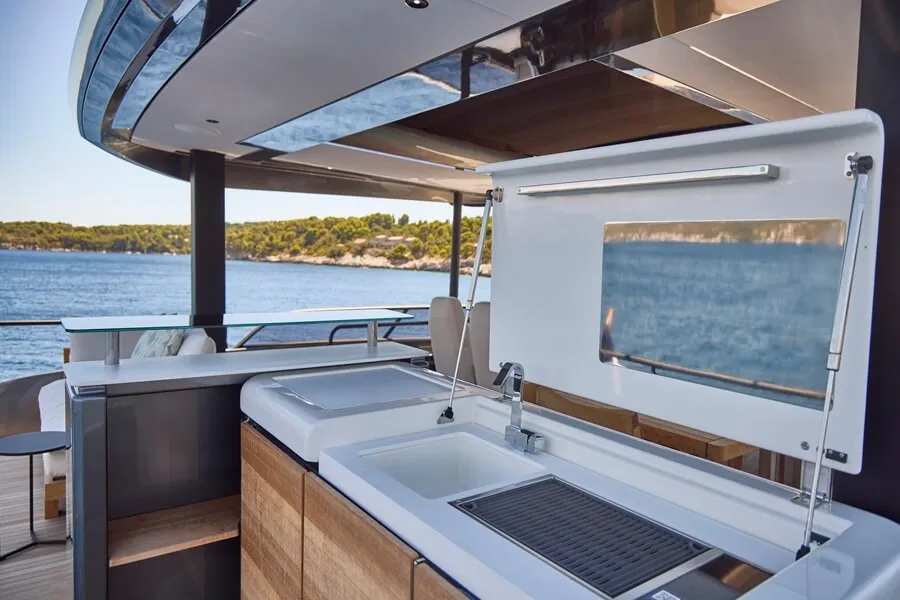
The aft end of the flybridge includes an outdoor galley with grill

“No,” Casadei emphasises. “While the M-Line is very different from our flybridge boats, we’ll keep the same brand because we think that the brand DNA of quality of life and home-like feeling is shared across the product line, albeit with a different soul.”

And maybe “soul” is the word that best captures the feeling you get aboard the M7. This is a boat where spaces, amenities and movement through the water offer all it takes to really soothe your soul.

prestige-yachts.com

Words: Clare Mahon; Photos: Prestige

This article was first seen on YACHT STYLE

For more on the latest in luxury yachting reads, click here.



Source link

Tested: 2026 Cupra Terramar – Full review, price & features

0
Tested: 2026 Cupra Terramar – Full review, price & features


This more powerful 2.0-litre TSI Terramar is comfortably the most convincing version of the car we have yet tested. The characteristics of the EA888 are as they ever were, with accessible, consistent torque delivery being prioritised over much in the way of ‘shape’ in the power curve, but it is done to impressive effect.

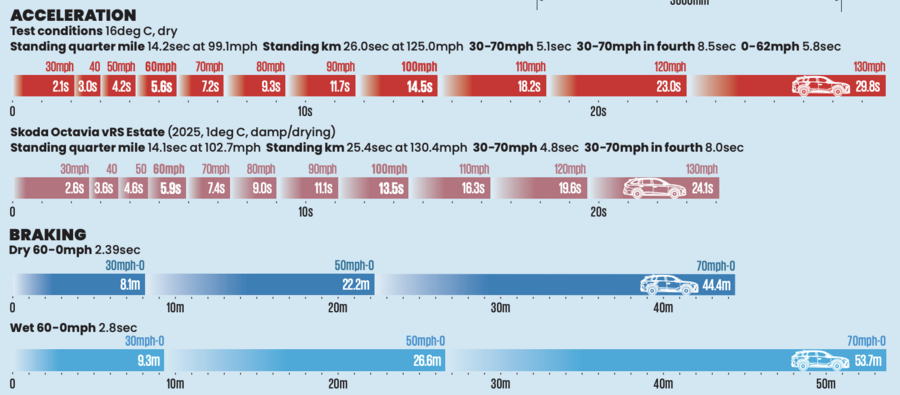
With 261bhp, and helped by a launch control function, the Terramar surged to 60mph in 5.6sec and 62mph in 5.8sec, beating the manufacturer’s 5.9sec claim. Had Cupra been generous enough to fit the Terramar with the 329bhp version of the powertrain found in the Formentor, we would expect those figures to be a second or so quicker, but even so, this is not a sluggish car, particularly by class standards, and it has prodigiously easy drivability. With four-wheel drive and good rubber, straightline traction is also never an issue, even in the damp.

The Terramar’s performance is aided by a capable dual-clutch automatic gearbox that goes about its business without fanfare. This extends to the shift paddles, which are somewhat uneventful to pull in light of the flamboyance of Cupra’s approach to cabin design elsewhere.

But perhaps that’s not worth crying over, because although you can initiate a manual mode, the car’s brain never seems to give you full control, and will always upshift at the 6500rpm redline besides.

Given the strait-laced effectiveness of the engine itself, perhaps the most memorable element of the Terramar’s performance is the synthetic engine and exhaust notes piped into the cabin. This feels more forgivable in a slightly frivolous, pseudo-sporty crossover than it does in a serious performance car like, say, a BMW M5, and the Terramar’s made-up sonic output is, in truth, among the rortiest and silliest around.

Yet pushing the mode-select button that hangs off the steering wheel and engaging Cupra mode (available only on VZ models) does up the fun factor and lends some engagement to the car’s lightly boosty throttle response and uniform delivery.

Ultimately, although the hottest Terramar is down on spec-sheet power compared with rivals from BMW, Mercedes-AMG and Mini, on the road it feels plenty quick enough and decently good fun.

At the other end of the Terramar spectrum sits the 1.5-litre e-Hybrid that makes 201bhp and 258lb ft for a fairly uneventful 0-62mph time of 8.3sec. There’s a briskness to it in both full EV and hybrid mode, and the electric motor adds a modicum of additional zip for nipping into gaps in traffic and overtaking on a motorway, but it’s by no means quick.

If you’re after more grunt then you can have the hybrid with 268bhp, but it’s dearer and less efficient when the battery is empty, which means you might as well opt for the pure petrol 2.0-litre TSI. 

The plug-in hybrid has a number of drive modes and some shifter paddles behind the steering wheel allowing you to swap cogs, but the gearbox isn’t the most refined. Most of the time the car ignores them and overrides your inputs: that might be to shut off the engine when you’re braking into a corner, or to loudly fire the engine up when you think you’re accelerating gently. There’s also a tendency for the automatic transmission to hang on to a gear for too long, which means the engine gets pretty vocal when you step on the accelerotr more abruptly. 

The hybrid powertrain works more seamlessly when you’re cruising along the motorway; in this setting it’s hushed, refined and there’s only a small amount of wind roar filtering into the cabin. Running exclusively in electric mode brings more smoothness, too, particularly at lower speeds around town. You can adjust the regenerative braking, and in its highest setting, it draws you in nicely, despite a slightly mushy feel to the brake pedal. 


Source link

Power hybrids push electric models into the background

0
Power hybrids push electric models into the background


Across volume segments, sales of electric vehicles are gaining momentum. Whether small cars, mid-size models or family vans, more new registrations now feature electric drivetrains. The situation is very different in the luxury and high-performance sports car segment. Here, manufacturers are increasingly turning back to combustion engines, often supported by hybrid systems.

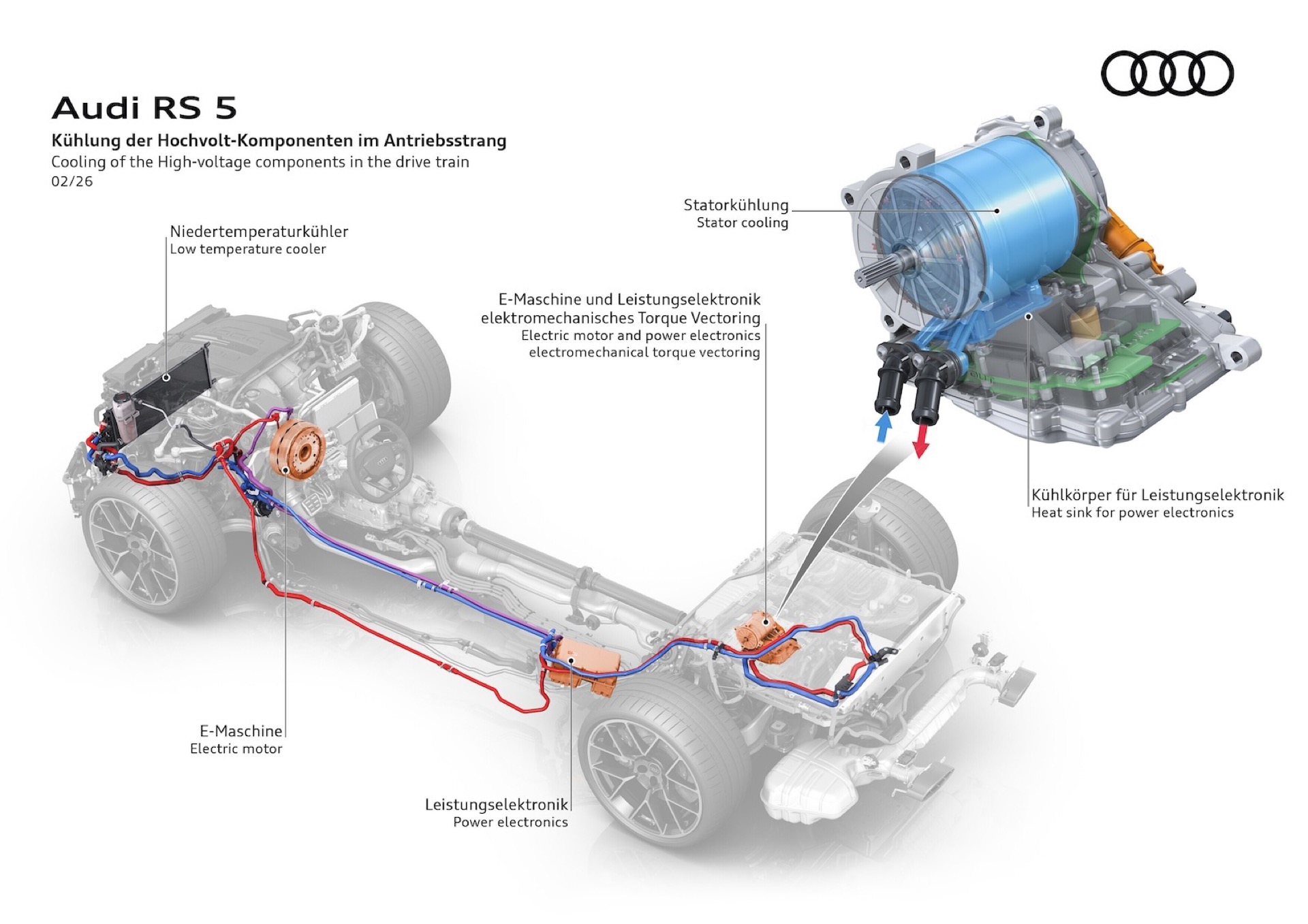
The new Audi RS5 delivers impressive performance. Where the previous RS4 was once criticised for lacking power against ever stronger rivals, the new model takes a different approach. Its 2.9-litre V6 turbo is supported by a powerful electric motor, bringing total output to 639 PS. Audi currently offers no comparable all-electric sports variant in this class.

Lamborghini has also adjusted course. Its planned fourth model line, originally set to introduce the all-electric Lanzador crossover with 1,360 PS, will now include a newly developed hybrid version of the Urus successor as well as a 2+2 coupé with plug-in hybrid power. The decision reflects clear customer demand for a high-performance V8 combined with electrification rather than a fully electric alternative.

This shift is not entirely new. Mate Rimac, CEO of Bugatti Rimac and a pioneer of electric hypercars, found demand for the Rimac Nevera fell short of expectations. His team is now working on a new hypercar that will combine a 16-cylinder engine with electric assistance rather than rely solely on electric power.

Bentley Continental 1

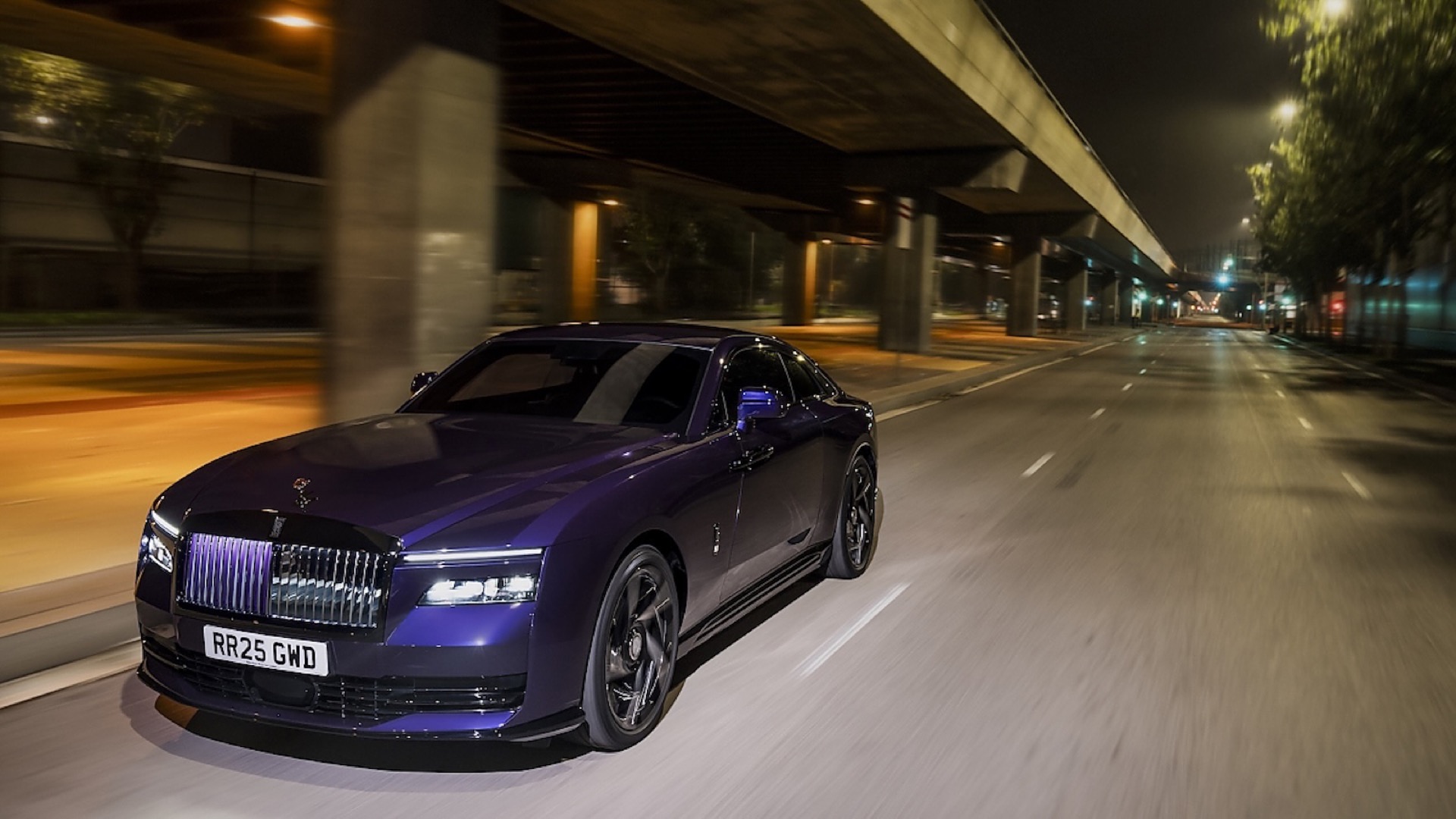
Ferrari is moving in a different direction with its first fully electric crossover, the Luce, due to debut this summer. Yet enthusiasm among traditional fans remains limited. Internally, there were also debates about whether and when a Ferrari EV was necessary. At Rolls-Royce, the Spectre luxury coupé has struggled to gain traction, while Bentley has revised its electrification strategy under new leadership. For now, powerful hybrid models are expected to carry the brand forward. Among Maybach customers, demand for V8 and especially V12 engines continues to outweigh interest in silent electric drivetrains.

The reasons are varied. Pure performance is not the issue, as electric systems deliver extraordinary acceleration. Instead, it is emotion that plays the decisive role. The sound and character of combustion engines remain central to the appeal of many sports cars. From Lamborghini’s V8s and V12s to Ferrari’s high-revving engines, these elements define the experience. Even imagining an electric Porsche 911 remains difficult for many enthusiasts.

Rolls Royce Spectre 2

At a more accessible level, similar trends are visible among brands such as Alpine, Toyota, Maserati and Alfa Romeo, which have revived powerful combustion models alongside electrified offerings. For many buyers in this segment, these cars are not primary household vehicles. Practical factors such as range or charging speed matter less than character and emotional connection.

For that reason, combustion engines are unlikely to disappear from luxury and performance cars any time soon. In many cases, they are becoming more relevant than ever.

Porsche Taycan


Source link

McLaren will sell you a Le Mans hypercar with more power than the racecar

0
McLaren will sell you a Le Mans hypercar with more power than the racecar


Last year, McLaren announced ‘Project: Endurance’, a customer partnership programme, as part of which anyone with sufficiently deep pockets can own a 2027 McLaren Le Mans Hypercar.

McLaren is entering the World Endurance Championship with an LMDh-spec machine based on a Dallara chassis. It will be powered by a twin-turbo V6 hybrid restricted to 671 hp as per the regulations.

McLaren Project Endurance Le Mans Hypercar-2

According to Which Car, the track toy sold to customers won’t be the same as the Le Mans racecar. It will be powered by the same 2.9-liter twin-turbo V6 engine. However, it won’t get hybrid assistance. With a peak output of 720 hp from the ICE alone, the customer car will have 49 hp more.

McLaren Project Endurance Le Mans Hypercar-1

Project: Endurance is a 2-year track car programme that encompasses some of the world’s best racetracks. McLaren will provide support at track events each season, enabling customers to enjoy a track session on an arrive-and-drive basis. Each owner will receive driver coaching from a race professional, with an individual pit crew and race engineers.

McLaren says customers will also have full behind-the-scenes access to the upcoming McLaren Racing LMDh programme, key team personnel and drivers. Moreover, the customers will be at the very centre of the development programme for the McLaren Le Mans Hypercar.

Source: Which Car


Source link

Learn How To Blow Out RV Water Lines

0
Learn How To Blow Out RV Water Lines


Basic RV winterization drains all water from your plumbing lines, fixtures, water pump, and filtration systems. For added protection, many RVers go a step further by adding RV antifreeze after draining. But no matter which method you choose, knowing how to blow out RV water lines with safe air pressure is the smartest place to start. It removes more water than draining alone and provides stronger protection — especially if you’re winterizing a camper for the first time.

Key Takeaways

  • More Than Gravity: Blowing out water lines with air pressure is significantly more effective, as it removes water that gravity misses.
  • The 30–40 PSI Rule: To prevent damaging your PEX lines or fittings, keep your compressor set between 30 and 40 PSI.
  • Methodical Purging: For total protection, you must open every interior and exterior fixture—hot and cold sides—individually until only air remains in the system.

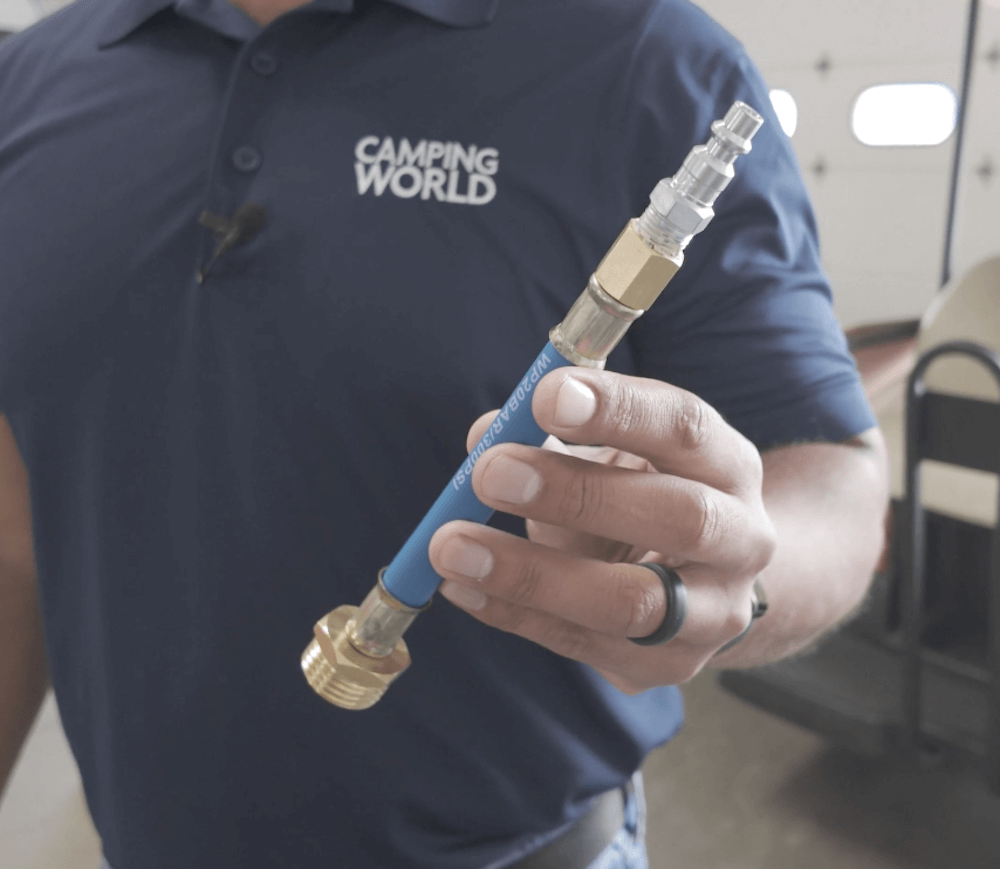
Images by Camping World

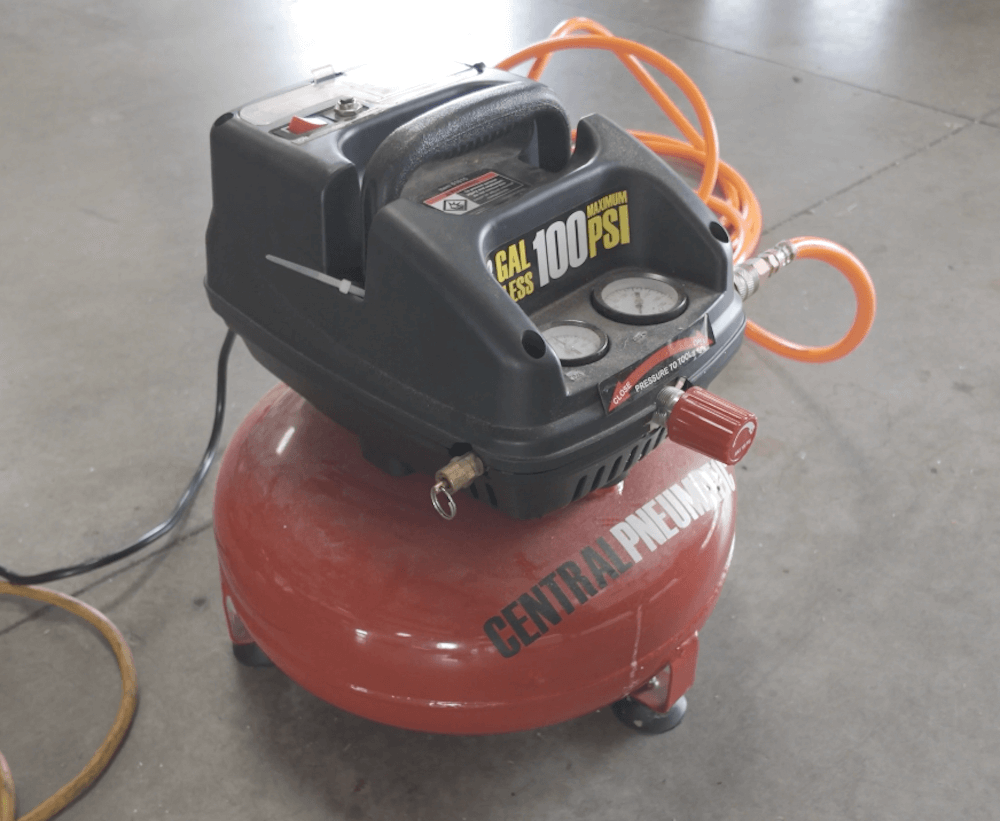
Before you begin, here are the tools you’ll need: 

While the tool list is short, there are some safety considerations to keep in mind, starting with understanding a safe PSI for blowing out water lines in a camper.

How Much Air Pressure Should Be Used to Blow Out RV Water Lines?

The safe recommended pressure for blowing out RV water lines is between 30 and 40 PSI, depending on your water heater’s make and model. The maximum recommended pressure for RV water lines is roughly 60 PSI. To avoid damage to the plumbing lines, your compressor must not exceed that pressure.

Technician Tip: Some manufacturers recommend using compressed air to drain the water heater, while others require gravity draining. It’s best to consult your owner’s manual to understand the safest method recommended by your water heater’s manufacturer.

But before you hook up an air compressor, you’ll need a suitable location to drain the water system. This is especially important if any water remains in your fresh water tank. 

Because we aren’t dealing with any hazardous chemicals, draining water onto the ground beneath it is perfectly acceptable, if your RV is on your property. Just consider where it will run and whether it could damage anything near your camper. 

For RVs in storage lots or when starting the winterization process at a campground, you may need 5-gallon buckets or a portable RV waste tank to minimize the mess. Wherever you’re completing this RV maintenance task, take the time to consider where the water will go when you start draining.

Technician Tip: Most of us consider the potable water in our water lines and fresh tank to be clean and safe. But legally, once it leaves a spigot and enters your city water hose and RV, it is considered contaminated. As such, many campgrounds, neighborhoods, and municipalities require you to capture and dispose of freshwater the same way as your grey and black water. Be fully aware of the rules where you are servicing your RV.

How To Blow Out RV Water Lines

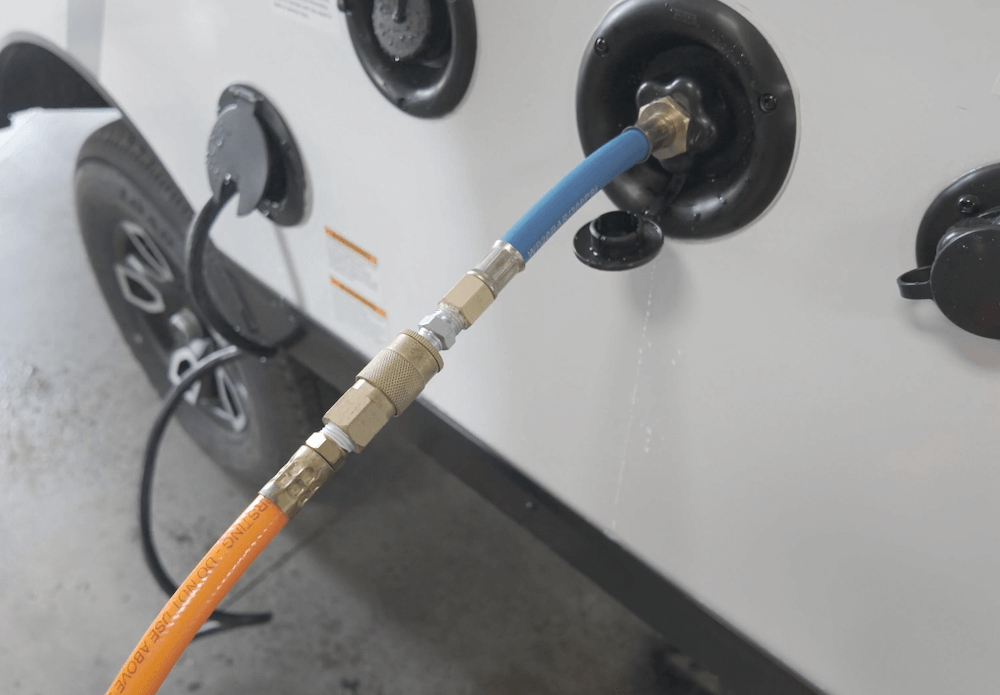
compressor hose and blow out plug connect to rv city water inlet for how to blow out rv water lines
Image by Camping World

Keeping those points in mind, follow these steps to learn how to blow water out of RV lines:

1. Connect your sewer hose to a dump station location and empty holding tanks.

2. Turn off your water heater, remove the plug to drain it, and set any water heater bypass valves to the bypass position (if your RV is equipped). As referenced above, this step varies depending on the make and model of your water heater. 

3. Remove any built-in RV water filtration systems and empty the canisters. Use a bypass valve here too, if so equipped. If not, reinstall the empty filter canister and dispose of the old filter. You will install a new one when you winterize next season.

4. Connect the compressor to your RV’s city water inlet using the blow-out hose or plug. If using a blow-out hose with a valve, ensure it’s in the open position to allow air into the lines.

5. Set the compressor to a low-pressure setting (between 30 and 40 PSI) and turn it on. 

6. One by one, open all interior and exterior fixtures (including all sinks, indoor and outdoor showers, and toilets). Open one side at a time (hot, then cold, or vice versa) and let the air pressure purge water from each line/fixture until none remains. You may need to repeat this step two or more times.

7. Open low point drains to purge any remaining water.

8. Turn off the compressor and close the low point drains.

9. Replace the water heater drain plug and ensure the water heater remains empty for the winter, left in bypass mode so no antifreeze gets in.

10. Close holding tank valves and secure your sewer hose.

Using an air compressor to blow out RV water lines is a relatively simple process, but excessive air pressure can damage  PEX lines, fittings, and other water system components. 

As we mentioned, it’s also the first step in thoroughly winterizing a camper—the next is adding RV-safe antifreeze. To learn more about that next step (or to have a Certified RV Technician winterize your RV for you), use the links below:


New to RV maintenance? Here are a few more helpful resources: 

What questions do you have about how to blow out RV water lines? Let us know in the comments below.


  • Tucker Ballister headshot

    Tucker Ballister is our Content Strategist. He grew up RV camping in a Fleetwood Bounder with his parents and has lived and camped in two motorhomes and two travel trailers of his own. His current RV is a 2025 Forest River Campsite Ultra 26BW, which he loves taking on adventures with his wonderful partner and furry companion from their home base in Western North Carolina. Check out his adventures, gear reviews, and outdoor advice at thebackpackguide.com.

    View all posts


Source link

We didn’t mean to take another month off… Six Month Business Acquisition Update

0
We didn’t mean to take another month off… Six Month Business Acquisition Update


This post may contain affiliate links. See our affiliate disclaimer here.

SIX MONTHS.

We’ve officially owned our new business for six months and this update is dedicated to detailing the progress we’ve made during our tenure as owners. Before we get into it, I have to share something I found last week (and by found I mean something that my 18-month-old pulled out of a cabinet and brought to me).

This notebook is where I take strategy notes and write end-of-year reviews and new-year planning. I found this note from early 2022. Heath and I were in the middle of a few things:

  1. Heath was still working full-time at Camping World after they bought his company but knew he would quit in June. We were trying to make a plan for how to replace that income over the course of the next year.
  2. We were finalizing zoning for our campground.
  3. Heath was trying to hire someone to create an “RV Entrepreneur Membership” where there would be events, courses, and all sorts of resources for fellow RV entrepreneurs.

But what I love about this note is my added note in cursive:

How can these be lighter?

This is a question Heath and I talk about often in business.

Campground Booking was a heavy business. There was a ton of technical work—shouldered mostly by the CTO—and endless customer support. Our podcast was a light business. Heath loved it and it required very little overhead (He’s been coming to me often about starting another one. Bug him in the comments if you’d listen).

Starting the campground was easily the heaviest business we’ve attempted. Even before breaking ground, we felt that weight. The loans, the building process, the time until opening…heavy. Starting a membership from nothing was going to be a heavy lift too. We would need to hire someone with experience to help us accomplish it.

If you’ve been following us since then, you may remember what we did to make this lighter—sold everything. Heath left his role at Campground Booking, we sold our RV Entrepreneur podcast, and then the campground property.

We took the cash from those sales to buy our new business in December…

Okay FINE, we also took that cash and lived in Italy for a bit and RVed all over Europe and went to Disneyland in Paris…

FUN WAS HAD.

chamonix france with kids

#noregrets

But we also bought RV Inspiration for $100K and it has felt like the lightest business we’ve run to date. We love that it’s all online, came with a VA who knew the business, and that we didn’t need to do all of the labor of starting something new. Plus, it’s in a vertical we know well (RVs) and we both love writing. Win, win, win.

I wanted to share this little note before jumping into this recap because it’s now June and have we hit that $10K goal yet? You’ll see 🙂


If you’re new…

In December, we bought a new business called RV Inspiration, a blog focused on renovating RVs. The business also included RenovatedRVsforSale.com, a marketplace for selling renovated RVs.

Read last month’s update: Business Acquisition Update #5: The month we didn’t touch it


What went well!

We found the *perfect* day to send our newsletters.

This, I think, sounds silly. I’ve always been of the mind that there’s no particular right day to send email newsletters. I’ve sent our H&A newsletters every day of the week and have never seen a strong correlation one way or the other.

I can’t remember why I chose Thursdays as the day to send our RVI newsletters. I think it was because it didn’t conflict with the existing email sequences, so it would guarantee people didn’t get multiple emails in a day. Plus it’s on the tail end of the week, when people are losing focus at work and happy to be distracted by an article about a pretty RV.

But in May I decided to switch this up and move newsletters to Sundays—historically our best traffic day.

One piece of life advice I’ve loved throughout the years is that you should focus your attention/efforts on what is going well, not what is doing just okay or going poorly. You can often make exponential growth happen by leveraging something that’s already going well versus trying to force something that isn’t working.

I took this and thought Sundays are already popular. Let’s post new content then and share our newsletters on Sunday too.

It’s gone gangbusters.

YARN | Better than expected, huh? | Schitt's Creek (2015) - S04E04 Girls'  Night | Video clips by quotes | 99389cbe | 紗

Since making that small switch, we’ve started having $200+ days with ad revenue spiking on Sundays and Mondays. That extra boost of traffic on Sunday has trickled through the early part of the week (a major surprise to me) and my last newsletter had double the clicks than those pesky old Thursday newsletters.

I will continue playing with this because we ultimately want to be creating and sharing 2-3 new pieces of content a week in Q3. So I’ll need to start choosing more days to send emails. Maybe Fridays? Saturdays? Mondays? 🤷🏻‍♀️ I will find out!

I wrote my first article!

One of the reasons we chose this blog to buy was because we thought we could easily write content for the site. It wasn’t until the last week of May that I finally got the chance to shift my focus and start creating content for the site.

My first article: 27 Ideas for Your RV Backsplash

I have so many thoughts on this.

1) I love that most of these articles mean looking at pretty pictures for hours. It’s like scrolling through Instagram except that it’s actually productive.

2) I have a new appreciation for Ashley—the founder—for naming the site RV Inspiration. I am SO AMPED and inspired to renovate an RV. Need to buy an old junker ASAP. Send me links.

3) I am probably going to burn myself out 🙈

I’ve written seven articles…this week… This has made me think about why I’ve never felt so inspired to write on our own personal blog. That’s some introspection for another time. Still have 5 articles to write for this summer’s content, but the list keeps growing because every new RV I find inspires more new articles.

But I’ve loved writing articles and it’s been really nice to get to write something that’s independent of our personal stories.

We’ve More Than Doubled Our Revenue!(!)

In December, the business earned $3,800. This was low compared to what the previous owner had earned in 2022 so I was instantly panic-stricken that simply switching ownership had somehow ruined the site’s income streams. Luckily that wasn’t the case! As we’ve gotten our feet under us, we’ve grown this number steadily.

In May, we earned about $9,200.

My hope is that a few of the tweaks we made in May—like the newsletter—mean that June crosses that five-figure mark!

What Hasn’t Gone So Well

We had every intention of working in May…

A theme of Heath & I traveling has always been rebooking flights at the last minute. We are somehow terrible at booking our original flights and always end up on the phone with airlines trying to change everything.

This—once again—happened returning from New Zealand. We planned to fly from Auckland to Houston, spend a couple of days getting un-jetlagged with family, then fly home. But then there was a fish fry we wanted to stay for, so we rebooked.

And then Heath said, “Are we really going to be in Texas and not go up to Dallas to visit your family?” With a guilt trip like that, how could I not rebook the flights again?

We ended up spending two weeks in Texas. We were playing in New Zealand until May 9th, so by the time we made it to our house in Colorado, the month was basically gone. We only worked two days during the whole month! We missed out on a lot of smaller projects we wanted to accomplish in May.

I think this is why we grew a little in May, but not very much compared to April.

But I will always let the business go on autopilot so that we can enjoy traveling together as a family, so it’s a sacrifice I happily made!

Expectations ≠ Reality

One rule I seem to never stop learning in business: Everything takes longer than you think. (Also applies to doing the dishes.)

These past six months, most things have taken twice the amount of time that we thought they would. If my past is any indication, I will keep re-learning this less monthly in perpetuity.

Payments are always confusing.

This may be more of a soapbox than a negative aspect of the business.

But I think it needs to be said or explained for anyone new to online business.

Below you can see our income streams outlined. Here’s how they pay out:

  • Ad revenue: paid 45 days after the end of the month
  • Listings revenue: paid about 24 hours after each purchase
  • Amazon affiliates: 60 days after the end of the month
  • Amazon bonus: first week of the month right after you earned it? (Did not expect that deposit, but awesome!)
  • Other affiliates: 30-60 days after purchase

As you can see, literally every income stream is different. So while we “earned” $9,230 in May. We won’t have all that money in our bank account until nearly the end of summer.

This can make accounting and projections confusing. Little things like paying invoices for our new website rebuild meant getting into our business bank account and checking to see if enough money was in out account.

Up until May, this was extremely difficult. Sometimes I would need to wait a week to pay invoices.

But we’ve finally reached a point where our income is high enough that we keep enough operational cash in the bank to cover any costs that come in. Perhaps I should really have this as a “what went well,” but it’s been a big stress and annoyance over the past six months so I call it a negative!

Just remember whether you buy a business or start a new one, think about how long it will take you to get paid. This is a major factor in your cash flow that I don’t think people talk about enough.

(Or just take all your payments through Stripe which pays out in 24 hours like magical money bosses.)

May Revenue Breakdown

RV Inspiration Ads: $4,360

RV Inspiration Marketplace Ads: $562

Listings: $1,519

Amazon Affiliates: $1,423 + $1,200 bonus

Other affiliates: $166

Total: $9,230

Key Takeaway

Heath and I have said “Good is the enemy of great” to each other a few times in the past few weeks.

This is a concept we are looking to attack over the summer. Our newsletters were going good, how could we make them great? Our traffic is good, how can it be great? Our listings are good—better than ever—but how can we make them grow?

One thing I’ve loved about monthly recapping our progress with all of you is that it forces Heath and me to confront so many different aspects of the business. We are looking at the numbers and the growth and seemingly small things like the day we send emails. And we’re trying to figure out what works and what needs improving.

If there’s any takeaway I’ve had from these six months, it’s the importance of taking a step back and evaluating the business. Getting stuff done is great. I’m super proud that I’ve gotten so many articles written and scheduled for this summer. It feels like progress is being made in the business.

But it’s equally important if not more important to take a step back and see what’s going good, what’s going great, and what’s not working. Make notes. Strategize on the next steps. And then start taking action again.

If you’re feeling up for it, we’d love to hear your own analysis of your business in the comments! In our dream world, sharing our good and bad experiences helps you all grow better businesses without as many mistakes as we make 🙂

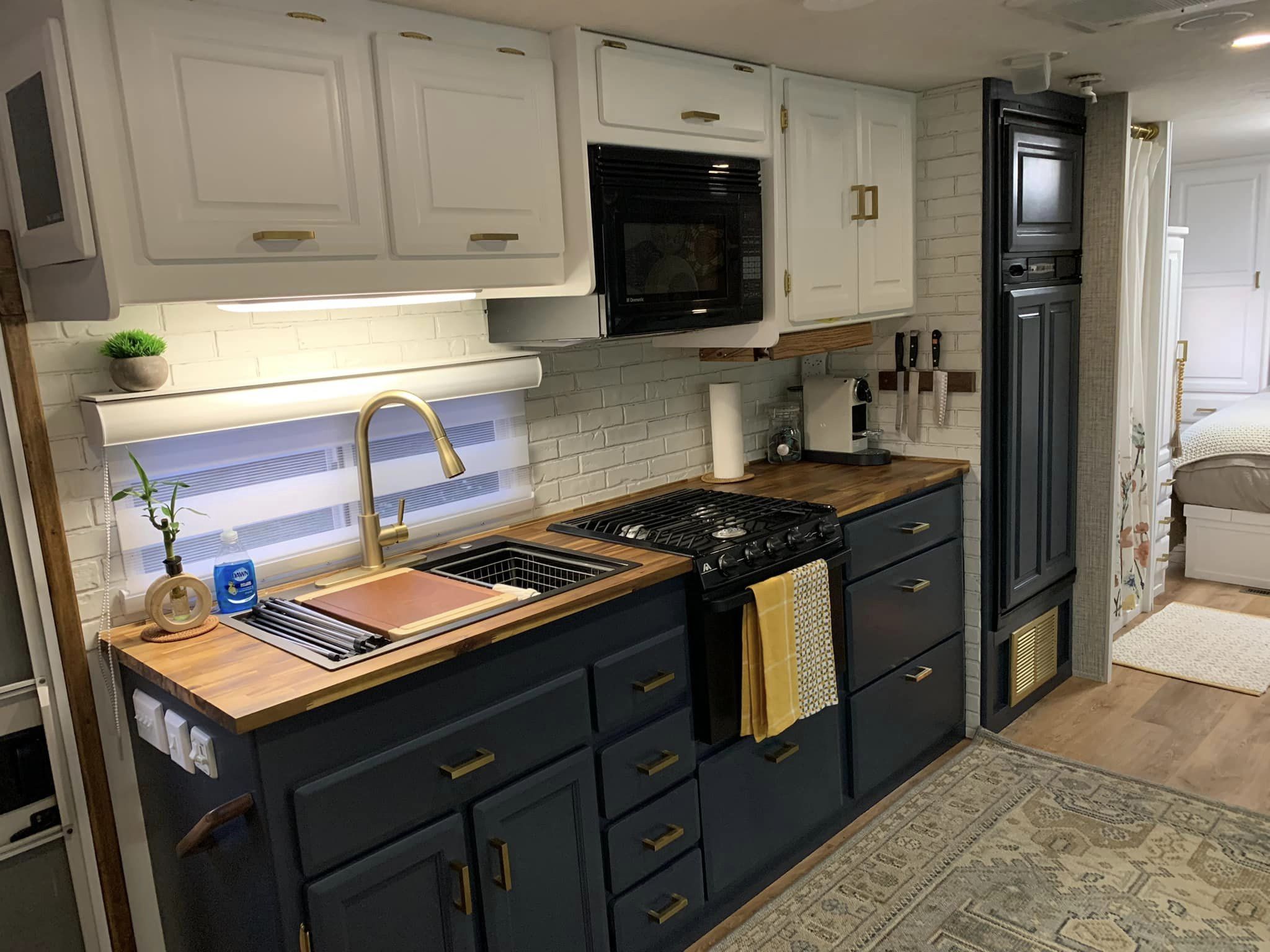
Cover Image by Lee Ann Garrett. If you’d like some in-depth info on her butcher block counters or how to properly install peel-and-stick tiles, ooooo weeee will you love RV Inspiration! 🤪


Source link

Tesla influencers argue company’s polarizing Full Self-Driving transfer decision

0
Tesla influencers argue company’s polarizing Full Self-Driving transfer decision


Tesla’s decision to tighten its Full Self-Driving (FSD) transfer promotion has ignited fierce debate among owners and enthusiasts.

The company quietly updated its terms in late February 2026, changing the eligibility from “order by March 31, 2026” to “take delivery by March 31, 2026.”

What began as a flexible incentive to boost sales, allowing buyers to transfer their paid FSD (Supervised) to a new vehicle, now excludes many, particularly Cybertruck owners facing delivery delays into summer or later.

Tesla maintains it will honor transfers for orders with initial delivery windows before the deadline and offers full deposit refunds otherwise, citing longstanding fine print that the program is “subject to change at any time.”

The reversal has polarized the Tesla community, with accusations of a “bait-and-switch” clashing against defenses of corporate pragmatism. Many owners who placed orders under the original wording feel betrayed, especially as production backlogs and new unsupervised FSD rollout complicate timelines.

However, Tesla has allowed them to cancel their orders and receive a refund.

Critics of the decision argue that the change disadvantages loyal customers who helped fund FSD development, calling it poor communication and a revenue grab as Tesla pivots toward subscriptions.

Popular influencers have amplified the divide. Whole Mars Catalog struck a measured but firm tone, acknowledging the original “order by” language but emphasizing Tesla’s right to adjust terms. He has continued to defend Tesla in this particular issue:

He criticized extreme backlash as “dramatization” and “spoiled kids,” noting the unsupervised FSD era and broader sales challenges make blanket transfers financially risky. Whole Mars advocated for polite outreach to CEO Elon Musk over the issue.

In a contrasting perspective, Dirty TesLA voiced sharper frustration, posting that blocking transfers feels “crazy” and distancing himself from “people that want to worship a corporation and say they can do no wrong.” His stance resonated with owners who view the policy flip as disrespectful to early adopters.

Popular Tesla influencer Sawyer Merritt captured the frustration felt by thousands. In a widely shared thread viewed over 700,000 times, Merritt detailed how pre-change Cybertruck orders now risk losing FSD eligibility unless their initial delivery window falls before March 31.

The controversy underscores deeper tensions—between Tesla’s need for revenue discipline and owners’ expectations of goodwill. As FSD evolves toward unsupervised capability, the community remains split: some see the change as necessary business, others as a broken promise. Whether Tesla reconsiders under pressure or holds firm remains to be seen, but it does not appear they are planning to budge.


Source link

BMW M2 M Performance Track Kit Adds Adjustable Suspension and Aero

0
BMW M2 M Performance Track Kit Adds Adjustable Suspension and Aero


When BMW M says “Track Kit,” it usually means carbon fiber and attitude. This time, it also means engineering intent.

The BMW M2 is about to receive a comprehensive M Performance Track Kit designed specifically for track-day use while remaining road-legal. Available to order in the third quarter of 2026, the package combines functional aerodynamics with what is arguably the most significant suspension upgrade ever offered through BMW M Performance Parts.

This is not cosmetic theater. It is a factory-developed attempt to unlock more of the G87’s underlying capability.

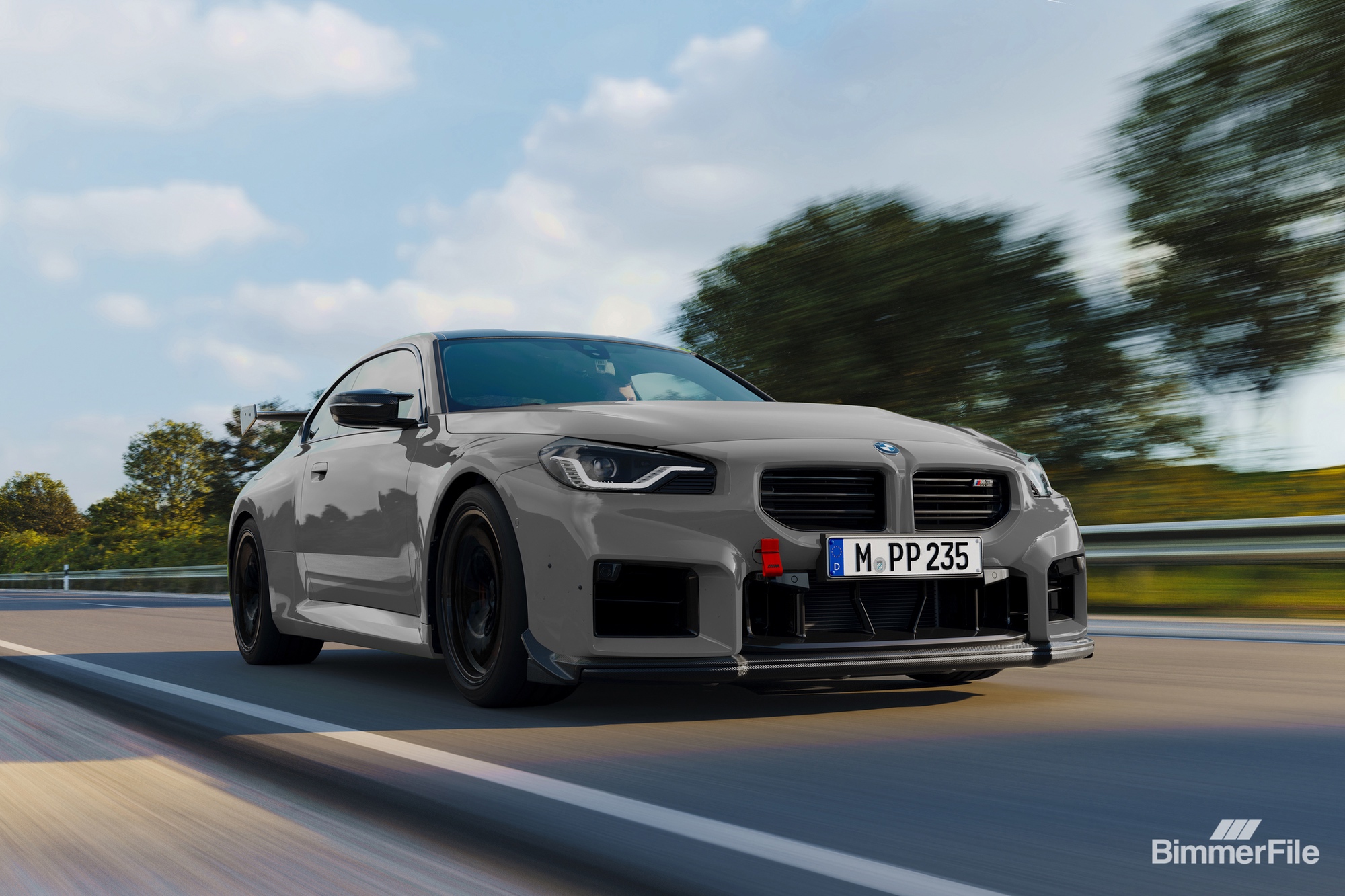
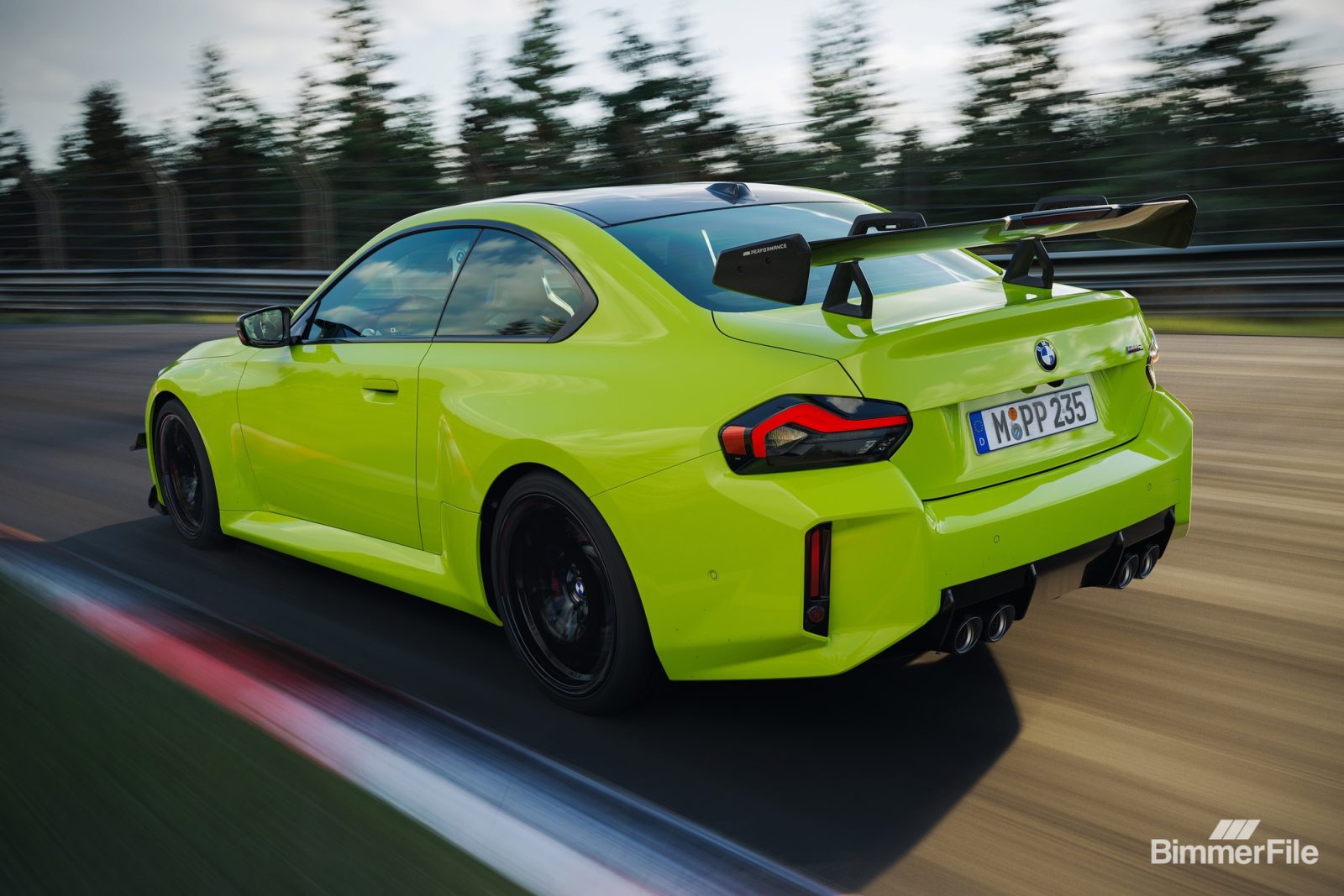
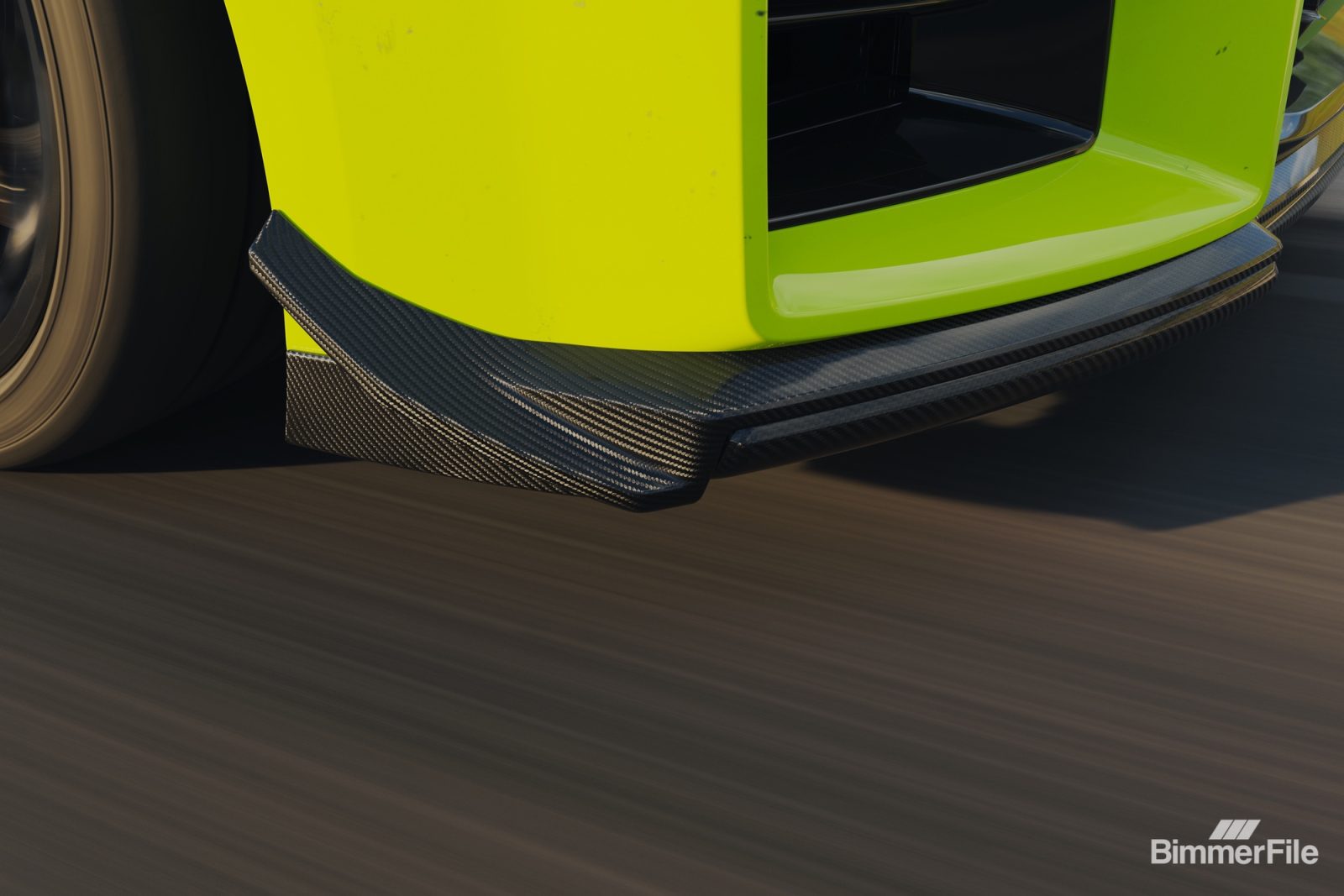
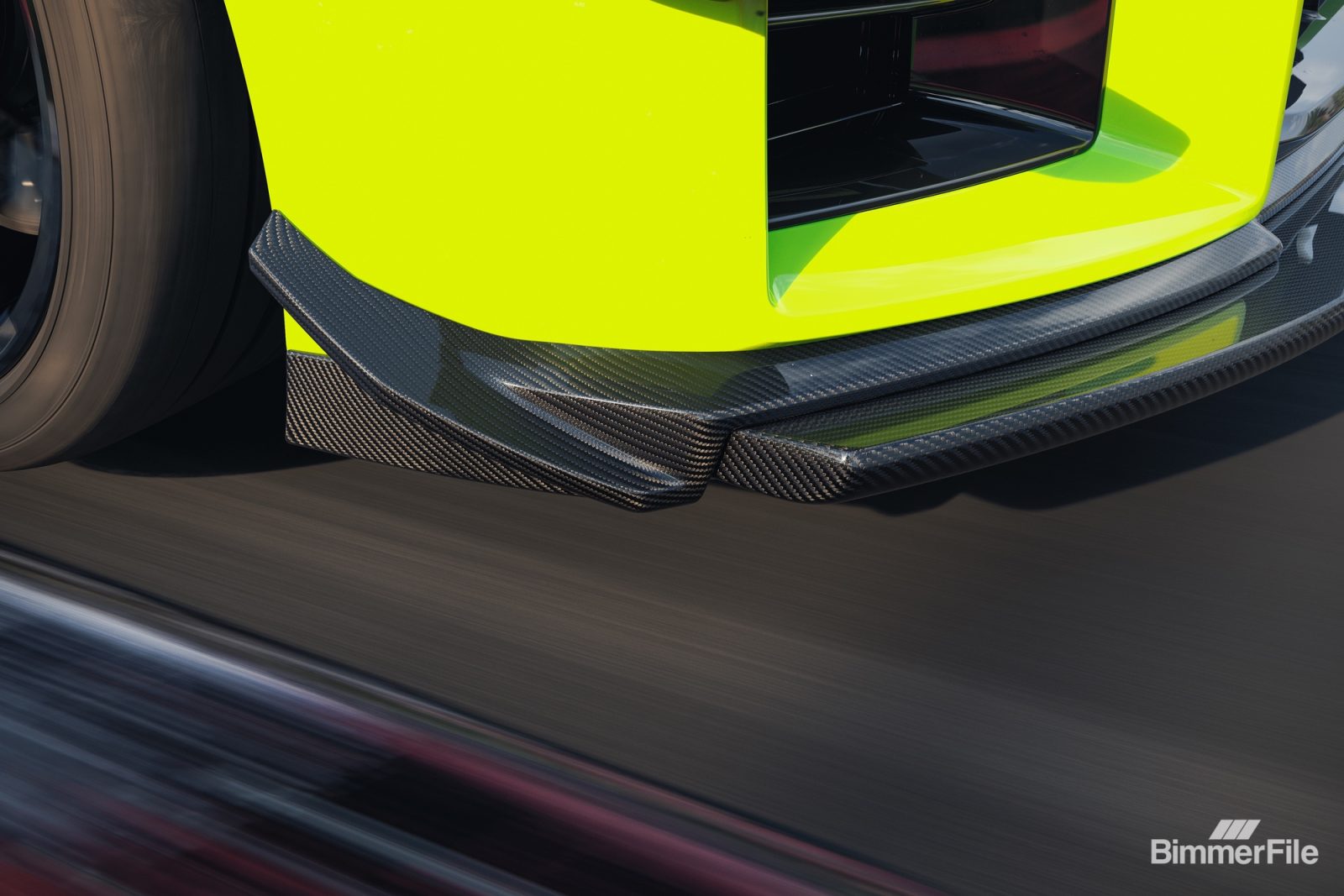
At the front, the Track Kit introduces a manually adjustable splitter that forms a single aerodynamic unit with the front diffuser. Fixed wheel arch diffusers and a scoop beneath the upstream oil cooler complete the package. Together, they significantly increase front-axle downforce.

That added aero load should improve high-speed stability and front-end precision, particularly during corner entry where the G87’s mass and mechanical grip can occasionally overwhelm its stock aero balance on faster circuits.

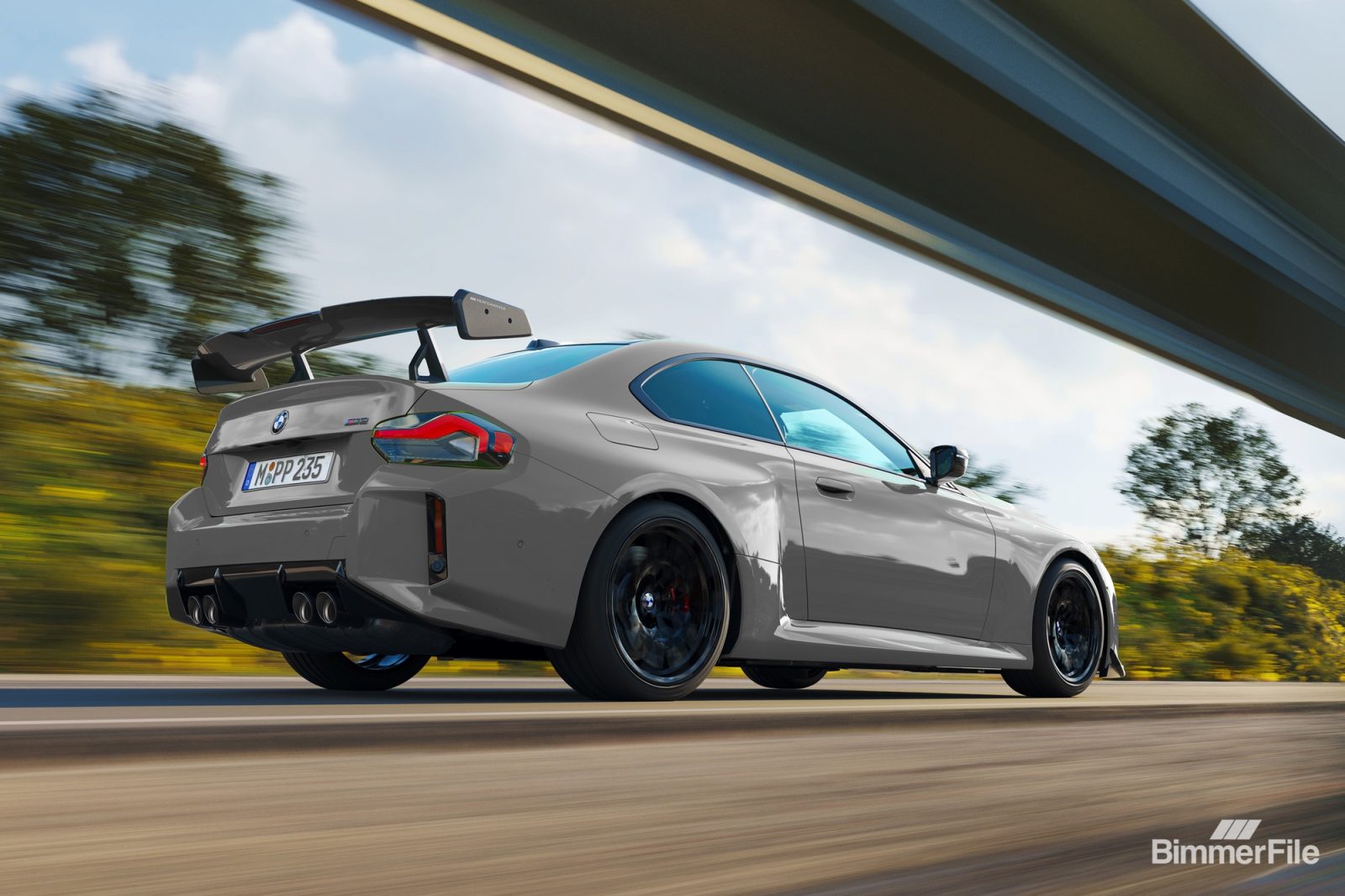
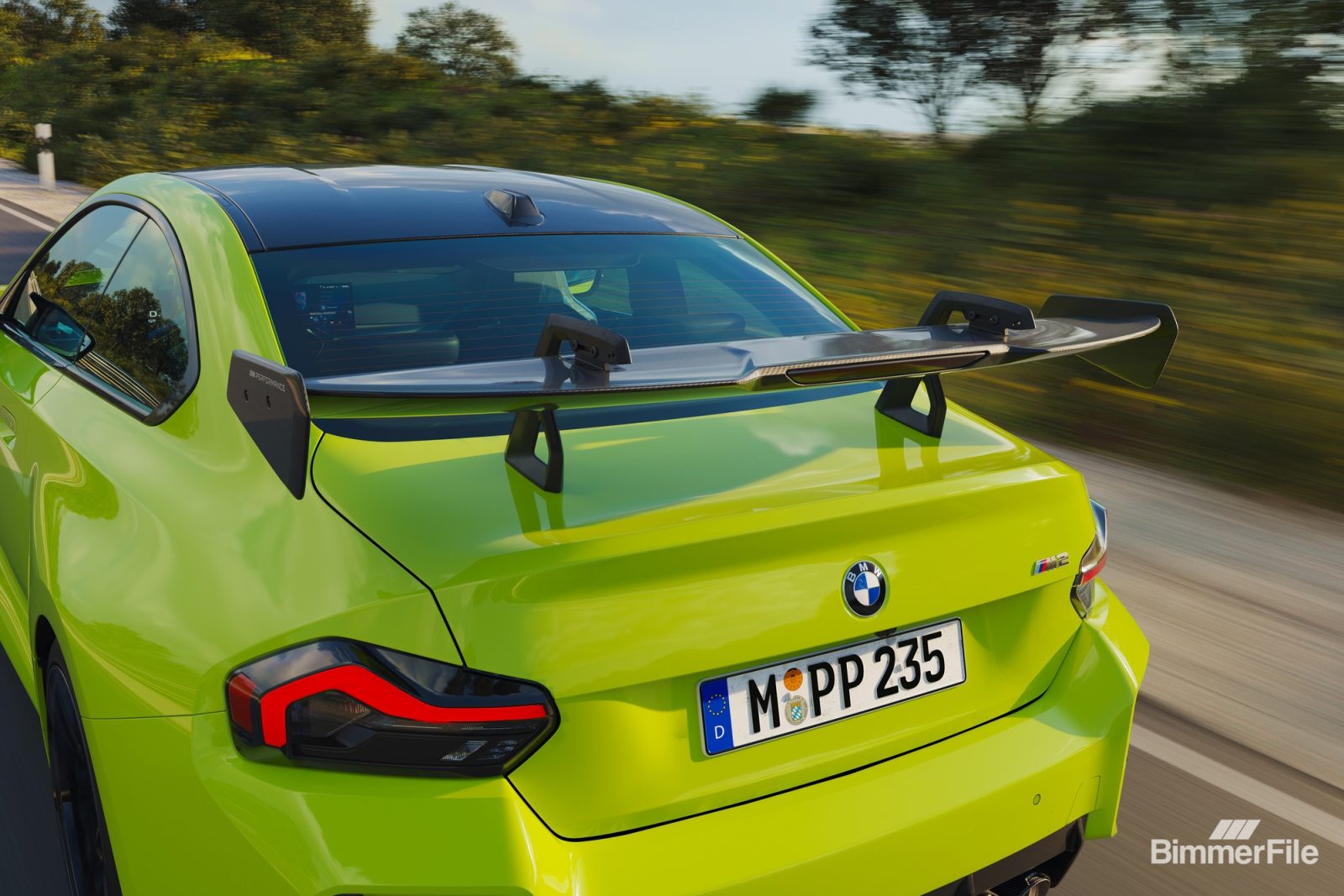
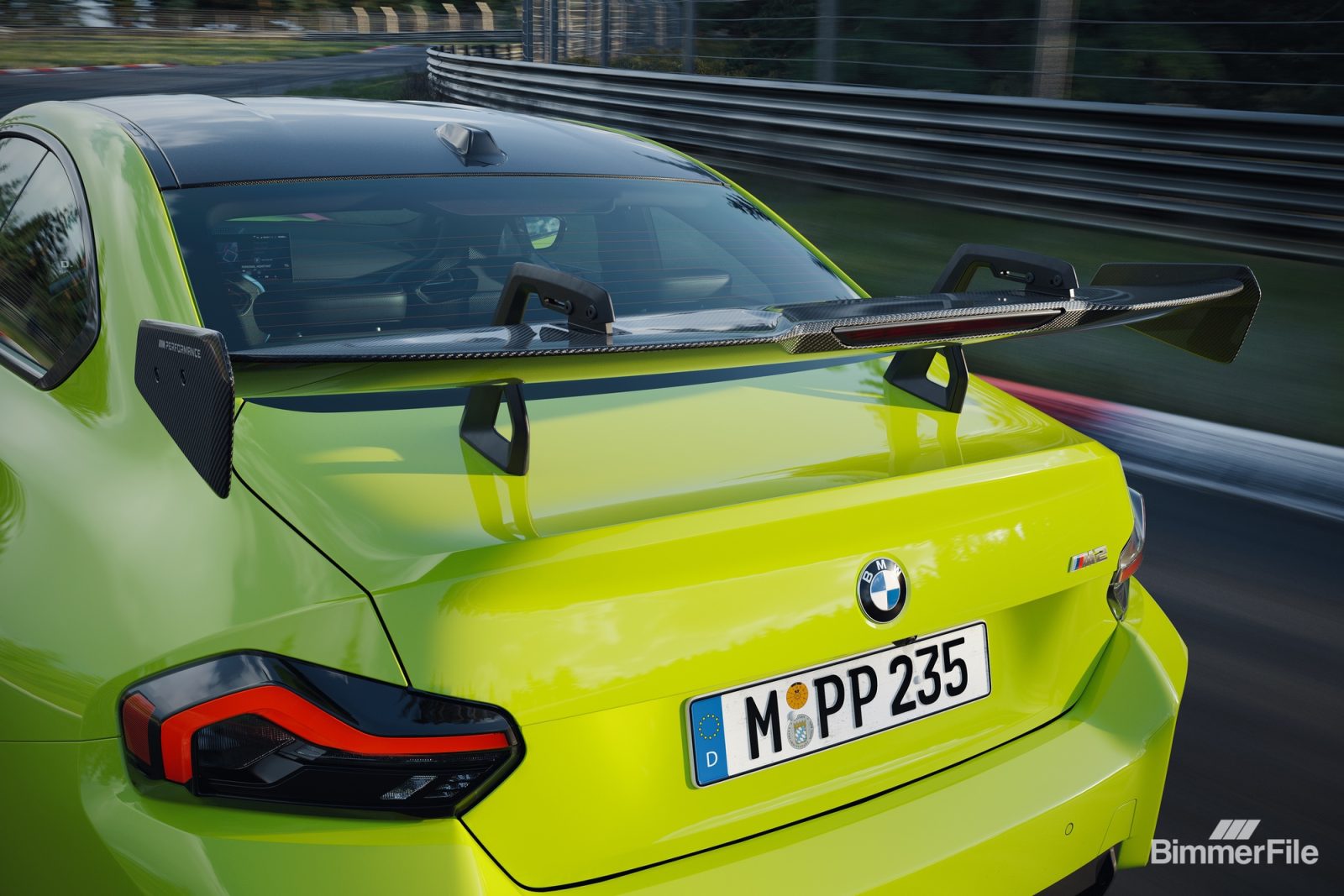
Out back, BMW fits a manually adjustable swan neck rear wing derived from the customer racing programs of the BMW M4 GT4 and BMW M4 GT3. Two angle-of-attack settings allow drivers to tailor rear downforce depending on track characteristics.

More interesting is what BMW calls “Race Mode.” In this configuration, the rear wing moves 50 millimeters rearward, increasing its aerodynamic leverage and effectiveness. Functionally, this behaves like a BMW interpretation of DRS, a drag reduction concept popularized in Formula 1 and adapted in various forms by Porsche for its GT models. Rather than electronically flattening the wing, BMW adjusts its position to alter aerodynamic efficiency and balance.

The result is greater flexibility in tuning rear grip without compromising road legality. The integrated brake light within the wing underscores that dual-purpose philosophy.

The Suspension Is the Story

If the aero sharpens the edges, the suspension is likely the transformative element.

The Track Kit includes a threaded coilover chassis with 4-way adjustable rebound and compression damping, adjustable support bearings, and infinitely variable ride height adjustment up to 20 millimeters front and rear. BMW describes it as the first special motorsport damper system it has offered that remains fully road-legal.

For the G87 platform, this matters.

The current BMW M2 has been praised for its rigidity, traction, and composure. It has also been critiqued by some enthusiasts who compare it to the previous BMW M2 and the iconic BMW 1 Series M Coupe, both of which felt lighter on their feet. While outright mass is only one variable, suspension tuning plays a central role in how that mass is perceived.

With 4-way adjustability, drivers can meaningfully alter:

  • Low-speed compression for sharper transitional response
  • High-speed compression for stability over curbing
  • Rebound characteristics to better control weight transfer
  • Camber settings through adjustable support bearings for increased front-end bite

Lowering the center of gravity and reducing roll moment should enhance responsiveness and rotation. In practical terms, this is where the BMW M2 G87 stands to gain the most. A properly tuned damper setup can make a car feel more agile, more precise, and more communicative without changing a single pound on the scale.

Development was overseen by BMW M test engineer and Nürburgring record driver Jörg Weidinger. The components were aerodynamically optimized in BMW’s wind tunnel and calibrated as a cohesive system rather than a collection of parts. That integration is critical. The G87’s electronics, stability systems, and chassis geometry are deeply intertwined, and factory-level tuning ensures harmony rather than compromise.

A Factory Answer to the Track-Day Boom

Track days continue to grow in popularity, and BMW M is clearly positioning itself to support that culture with OEM-backed solutions. Instead of pushing owners toward the aftermarket, the M Performance Track Kit offers a factory-engineered path to sharper handling while maintaining road legality and system compatibility.

For many BMW M2 G87 owners, the platform’s potential has never been in question. The car’s stiffness, wide track, and S58 powertrain form an exceptionally capable foundation. The Track Kit appears designed to extract more precision and adjustability from that base.

Orders open in Q3 2026, with pricing to be announced closer to launch.

The headline may focus on the wing and splitter, but the adjustable suspension is likely the defining feature. Aerodynamics can enhance performance at speed. A properly engineered damper system reshapes the car everywhere.

For the G87 M2, that distinction could make all the difference.


Source link

Tesla Superchargers now open to non-Teslas EVs in Malaysia – selected locations, RM1.80/kWh

0
Tesla Superchargers now open to non-Teslas EVs in Malaysia – selected locations, RM1.80/kWh


Tesla Superchargers now open to non-Teslas EVs in Malaysia – selected locations, RM1.80/kWh

Tesla Superchargers can now be used to charge non-Tesla EVs in Malaysia. This open access is limited to four locations at the moment, all in the Klang Valley.

The following is the list of locations:

  • Shah Alam – i-City Finance Avenue
  • Kuala Lumpur – Pavilion KL
  • Putrajaya – IOI City Mall
  • Dengkil – Gamuda Cove

According to the pricing currently on the app, non-Tesla EV owners will have to pay RM1.80 per kWh to charge their car. There is also a congestion fee of up to RM 2.00/min if the site is busy.

The Tesla Supercharger is typically rated at 250 kW and use the CCS2 connector. To access the Superchargers, non-Tesla EV users will have to download the Tesla app (iOS, Android) and sign up for a Tesla account.

How to charge with the Tesla app

  • Download and install the Tesla app
  • Sign up for a Tesla account
  • Select ‘Charge Your EV’ and find your Supercharger site.
  • Add your payment method.
  • Plug-in your vehicle.
  • Select a stall and tap ‘Start Charging.’
  • Select ‘Stop Charging’ to complete your session.

If you also currently own a Tesla vehicle and you want to charge your other non-Tesla EV, open the Tesla app and tap the menu in the top-right to find the ‘Charge Your Other EV’ option.

There is also an ongoing “Get Supercharged” promo where if you participate in a contest, you can win 1,500 km worth of Supercharging credits just by participating.

One of the requirements for Tesla’s AP exemption when its approval was secured under the BEV Global Leaders program was that it has to install at least 50 units of DC fast chargers with a minimum charging power of 180 kW, with at least 30% of these being open to the public and for use by EVs from other brands.

Looking to sell your car? Sell it with Carro.


Source link

Holy Hotrods Batman – Stance Is Everything

0
Holy Hotrods Batman – Stance Is Everything


For a province that doesn’t exist within the DC Universe, Ontario has a peculiar number of 1:1 Batmobiles. There are at least two Keaton/Burton Era Batmobiles on the road, and soon, thanks to Fugitive Custom Cars, two West Era/Barris cars.

Contributing two to the local streets one might Fugtive is known for building “Star Cars”.

Jason Roberts is a hot rod guy, not a nerd like me, and when he started Fugitive Customs, his goal was to be involved in building as many high-quality vehicles as possible.

Jason Roberts is a hot rod guy, not a nerd like me, and when he started Fugitive Customs, his goal was to be involved in building as many high-quality vehicles as possible.

His friend Ian McIntosh however, he’s a nerd and the one that has commisioned Fugitive to build rowdy versions of popular cars.

I was first introduced to Fugitive Custom Cars on Instagram via a photo one of the two Batmobiles early on in the build process. I desperately tried to find more information about it and, at the time, not a lot more was to be found.

Last year at Motorama 2025 I learned what I saw as an earlier version of the car now known as ‘Bat-Gas’.


Done by another party, the first hand-formed aluminum body, wasn’t quite up to Fugitive standards. However, it was still very much a Batmobile, so the choice was made do something no one else would think to do. Build a 632-cubic-inch, 1000+ horsepower big block powered, Batmobile-shaped, ‘drag’ car.

There’s currently no intention to take Bat-Gas down the strip, but it does run, drive and burnout with ease.

Think of the car as a “fairground cruiser,” a concept popularized by the over-the-top Pro Street movement of the 80s and early 90s.

After the custom chassis was complete and the body was mounted, Fugtive commissioned Rollie Guertin to pinstripe the vehicle, and Bat-Gas was easily one of the most talked about and photographed builds of the Motorama 2025.

The black car, ‘Bruce’s Tow Vehicle’, is everything Bat Gas was originally intended to be: black, clean, low and fast.

Looking more like the screen car, on steroids, the Tow vehicle features a second hand-fabricated body, this time done by Vintage Tin and painted by Rich Refinishing.

Another custom chassis is employed, this one featuring Corvette front and rear sub-frames. Air suspension brings the flared fenders down over Radir wheels that hide a Wilwood brake setup.

The motor is a stroked Chevrolet LS1 V8 fit with a D-1SC Procharger dyoned at 853.7 HP.

While Bat Gas is generally considered finished, the black car still needed some buttoning up. I’m not totally sure if either will be at Motorama 2026, but considering the reception they received in 2025, I wouldn’t count them out.

Guess we’ll just have to tune in same Bat Time, same Bat channel March 13th, 14th and 15th.


Source link