15.6 C
London
Tuesday, May 12, 2026
Home Blog Page 26

100% Electric Vehicles = 20% Of New Car Sales In Europe In January

0
100% Electric Vehicles = 20% Of New Car Sales In Europe In January


Support CleanTechnica’s work through a Substack subscription or on Stripe.


The European passenger plugin vehicle market scored 298,000 registrations in January, a progression of 22% YoY. Positively, BEVs (195,000 units, +16% YoY) continued to grow despite the drop in EV incentives in certain markets. But the highlight of the month was plugin hybrids (PHEVs), as they jumped 33% year over year (YoY) to some 102,000 units, or 10% share of the total market, which is their highest growth rate in January since 2021. A good omen for the rest of the year?

While plugins were up, the overall market had a slow month (-4% YoY, to a little less than one million units), starting 2026 BEV share at a strong 20%, higher than the 17% of last year, the 12% of January 2024, and the 10% of the previous year. This means that the BEV share doubled in just three years. So … will we see 40% BEV share in January 2029? And 80% in January 2032? One can only dream….

Regarding other powertrains, while petrol (-26% YoY) and diesel (-22% YoY) are in freefall (at this pace, expect diesel new car sales to end around 2029…), plugless hybrids are (still) rising, going up from 35% share in January 2025, to their current 39% share.

Also, this meant that 69% of all passenger vehicles sold in January in Europe were electrified (to some degree), robust growth from the 59% score of a year ago. At this pace, expect all new car sales in Europe to be electrified, in some form, by 2030.

Still, expect the 20% BEV share to be a baseline, with the BEV market increasing its share throughout the year and ending the year close to 25% share.

In January, we got a very diverse top 5, with five different OEMs represented, coming from five different countries. A sign of things to come?

Bring on the popcorn, because the next few months will surely be fun to watch!

Looking at the monthly model ranking:

#1 Renault 5 / Alpine A290 — After a thrilling race with the #2 Skoda Elroq and #3 BYD Seal U (all three ended separated by just 102 units), the French twins started the year with a win, scoring 8,165 registrations last month, which allowed them to start in the lead. Sure, do not expect this lead to last — besides the threat of the aforementioned Czech and Chinese models, in March, expect the Tesla Model Y coming all guns blazing into #1. BUT. A podium result is surely on the cards in 2025, and maybe the French EVs could have a shot at displacing the Skoda Elroq from the runner-up spot, improving on its bronze medal achieved in 2025.

#2 Skoda Elroq — The 8,103 deliveries of January didn’t allow it to start the year in the leadership spot, but this is nevertheless a good score. But with the upcoming sibling, the very promising Epiq small crossover, landing in the second half of the year, one wonders if the Czech model will continue to be a frequent presence on the podium. Having been second place in 2025, Skoda’s crossover will have to work hard to stay on the podium, not only because of the Epiq’s internal competition, but also because the external competition is becoming ever more fierce.

#3 BYD Seal U (BEV+PHEV) — The Chinese SUV hit 8,063 registrations last month, meaning that while the BYD veteran star is already fading in China (it was only 9th in its home market this month), in Europe it is still podium material (a bit like when veteran football/soccer players #ahem# Cristiano Ronaldo #ahem# leave the top leagues and semi-retire in less competitive leagues…). January’s third place finish was much thanks to generous discounts, but still, with the model’s development costs now well behind it, BYD can afford to go into hard discount territory with this one.

#4 Tesla Model Y — The made-in-Germany crossover was 4th in January, with 6,941 registrations, up 19% YoY (but down 39% compared to January ’24). With the refreshed version still fresh, the Model Y is still hanging on, something that the Model 3 cannot say (with 1,041 units, it had its worst result since July ’22). Tesla will try to keep its crossover in the top positions for as long as it can. However, while the Model Y should keep its best seller crown this year, the Model 3 will have a hard time staying in the top 5.

#5 BMW X1 PHEV / iX1 — With the Neue Klasse BEVs high on BMW’s priorities list, one could be forgiven for forgetting that BMW already has a couple of volume selling EV models. And the best of them are the X1 PHEV / iX1 duo, both based on the X1 ICE model. The truth is that the compact SUV twins hit 6,678 registrations last month, allowing them to join the top 5. With a deep, Neue-Klasse-inspired refresh coming this year, expect the twins to continue selling in large numbers. How large? Hard to say at the moment, but if the refresh is anything as successful as the upcoming iX3, then we might be talking about podium material, or at least a top 5 presence.
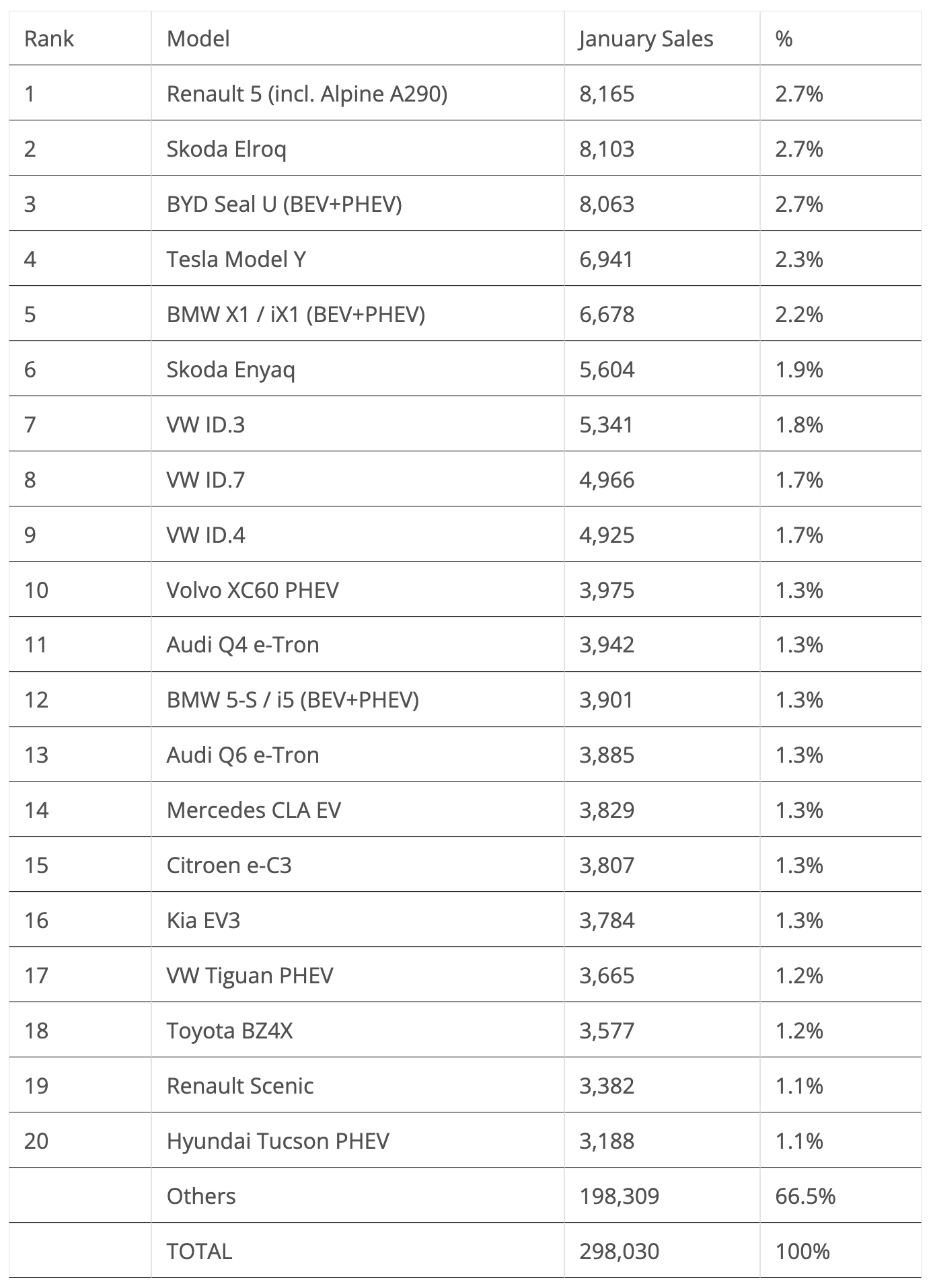
Just outside the top 5, a mention is due for the Volkswagen Group train behind the frontrunners, with four representatives (Skoda Enyaq, VW ID.3, VW ID.7, and VW ID.4) between the 6th position and the 9th position, as well as the Audi Q4 in 11th and the Audi Q6 in 13th — which, added to the 2nd position of the Skoda Elroq, places 7 Volkswagen Group models in the top 13 spots. Wow. That’s BYD level of domination there….

The other highlights are the BMW 5 Series PHEV/i5 twins, which jumped into the 12th position, winning the full size category. All while the Mercedes CLA EV continued to ride its wave of success, collecting another top 20 spot, this time in 14th.

Regarding new faces, the Citroen e-C3 EV is back on the table, at #15, as it seems that Stellantis now actually wants to sell the model. The refreshed Toyota BZ4X joined the top 20, in 18th. (Is the Japanese giant waking up in Europe?). Also, as a bit of a surprise, this time Renault placed a second model on the table, with the Scenic crossover sneaking in at #19. Is the success virus spreading in Renault’s lineup?

Outside the top 20, the highlight was the Chinese Jaecoo 7 PHEV, which ended the month in 21st, only some 30 units behind the #20 Hyundai Tucson PHEV. This proves that it’s not only MG, BYD, and Geely that are winning in the European market. Other, smaller Chinese players are gaining ground in Europe as well, and with overall sales stagnating, these conquest sales are at the expense of someone….

Looking at the highlights from the mainstream brands ranking, the best performer was #20 BYD, which grew 173% YoY to close to 18,000 sales. While the Shenzhen OEM is faltering in its domestic market, in Europe the picture is quite different, ending the month fewer than 1,000 units behind MG, China’s longstanding sales champion in Europe, and 10,000 units ahead of #27 Tesla(!), which dropped by 17% YoY.

Expect BYD to beat both brands this year, becoming Europe’s biggest market disruptor.

On the losers side, we have three surprises, with #14 Dacia dropping by 35% YoY (already a victim of an ICE melting event?), and the Koreans Kia (9th, down 19% YoY) and Hyundai (10th, down 20%) dropping as well. These changes do not seem to have an easy explanation. Is this a blip? Something to check out in the coming months.
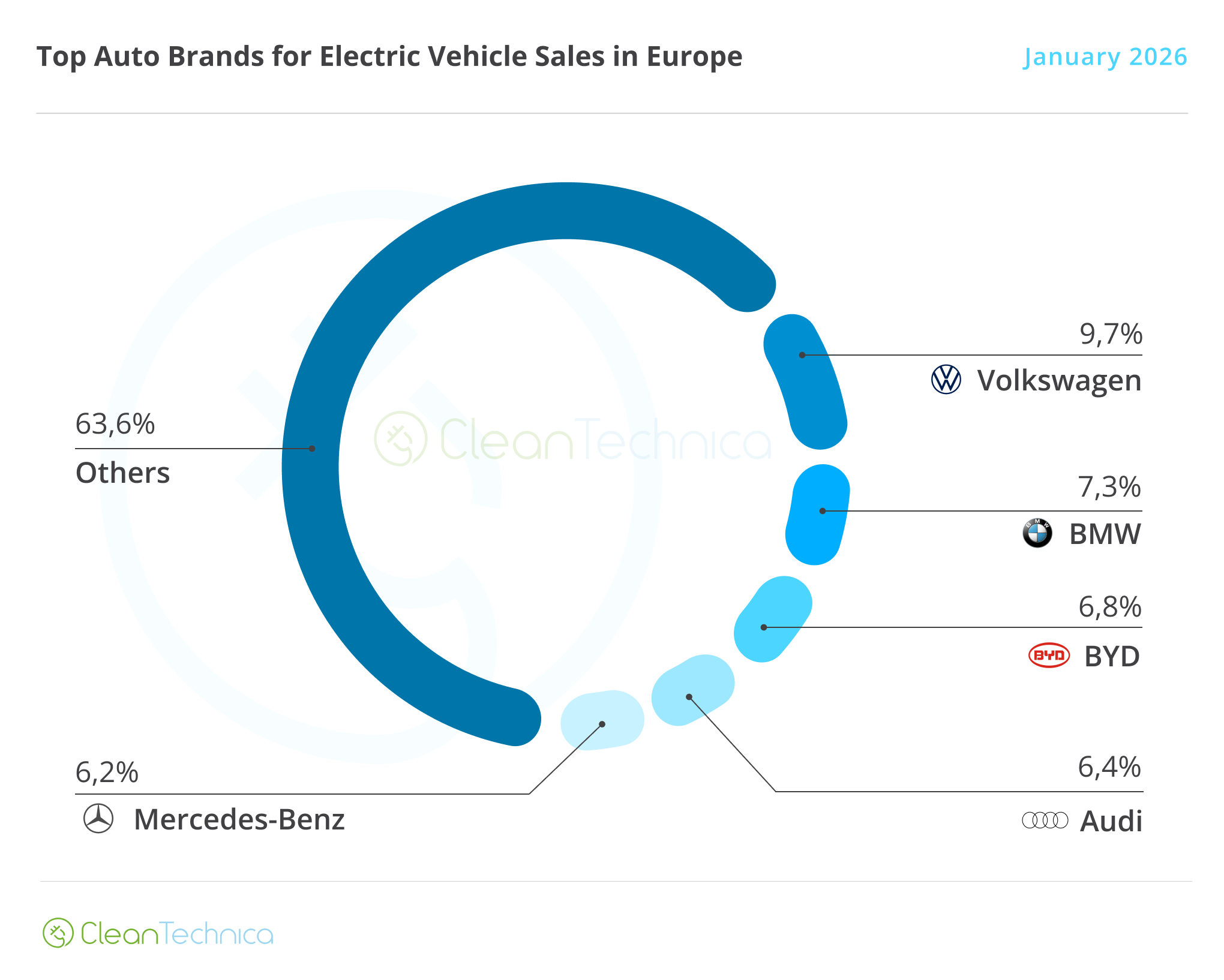
In the EV manufacturer ranking, Volkswagen has kept the leadership position, but it has started out from a lower base than 12 months ago. In January 2025, it had 11.1% share. This January it was at 9.7%. I mean, it’s still good, but the VW ID.Tiguan and ID.Polo are needed to ramp up volumes if the German make wants to end this year with the same share it ended 2025 (11%).

BMW (7.3%) started the year in its usual position, the runner-up spot, followed by the biggest surprise of the top 5. BYD seemingly came out of nowhere and jumped into 3rd place! Germans (and everyone else), beware. BYD has officially became a force to be reckoned with in Europe, succeeding Tesla in that role.

Speaking of the Texan make, Tesla (2.7% share, down from 4% in January ’25) continues to slide into irrelevance, to the point that it’s no longer even the #1 US EV maker in Europe! A slowly progressing Ford (3.6% share in January) has managed to overtake it! Sure, Tesla should bounce big in March and should surpass Ford by then, but … currently, Tesla has been relegated to competing with Ford for a position in the pack. Leadership positions are now a distant memory for the US brand.

Outside the top 5, the highlight is #7 Renault (5.4%, up from 4% in January ’25), which is looking to surpass an also progressing #6 Skoda (5.7%) to try to join the top 5 sometime this year.

As for OEMs, Volkswagen Group started the year in front (unsurprising, really) with 26.4% market share. With almost all brands from Volkswagen Group posting strong results in the EV category, Volkswagen Group will try to keep its market share between 25–30%…. Do you think this will be possible?

Stellantis (10.4%, up from 9.5% in January ’25) is the new #2, having replaced BMW Group (8.9%) in that position. The German OEM is waiting for volume deployment of its new iX3 to have another shot at the second spot.

With Stellantis all over the place, trying on one hand to actively sell its EVs while at the same time (re)introducing diesel versions of a few of its models (that brand new, and growing, technology…), BMW is set to recover runner-up status from the multinational conglomerate.

Hyundai–Kia (8%) started the year in 4th, but it will need to keep a close eye on #5 BYD (6.9%). Thanks to success stories in less media-friendly markets (in January alone, it had 1,000 sales in Azerbaijan, 1,000 in Ireland, 600 in Poland, 500 in Portugal, 500 in Ukraine, and 400 in Albania), it is jumping positions and could become a podium candidate already this year!

Below those OEMs, and in a reverse scenario of what is happening in China, Geely (6.7%, down from 8.6% in January ’25) is experiencing the opposite dynamic as BYD. It is losing significant share in Europe. In January, Geely suffered from Volvo’s slow start, but regardless of that, Geely needs a volume brand to shore up its market share. The namesake brand will need to be quickly deployed in Europe, and its lineup expanded — namely with models like the small Xingyuan, set to be called the EX2 in Europe.


Sign up for CleanTechnica’s Weekly Substack for Zach and Scott’s in-depth analyses and high level summaries, sign up for our daily newsletter, and follow us on Google News!


Advertisement


Have a tip for CleanTechnica? Want to advertise? Want to suggest a guest for our CleanTech Talk podcast? Contact us here.


Sign up for our daily newsletter for 15 new cleantech stories a day. Or sign up for our weekly one on top stories of the week if daily is too frequent.


CleanTechnica uses affiliate links. See our policy here.

CleanTechnica’s Comment Policy



Source link

BMW M2 xDrive Is Closer Than Ever — And the Haters Are Wrong About the Weight

0
BMW M2 xDrive Is Closer Than Ever — And the Haters Are Wrong About the Weight


Article Summary

  • An alleged BMW leak has put the long-rumored M2 xDrive back in the spotlight, with BMW declining to comment — a telling non-denial that suggests the car is real.
  • Before you panic about weight: the M2 already isn’t a lightweight at 3,745 lbs, and xDrive would add roughly 100 lbs — an amount most drivers would never feel in everyday driving.
  • The M3 and M4 xDrive have already proven that all-wheel drive and M driving dynamics are not mutually exclusive, making a strong case for an M2 that works year-round.

A recent leak — which BMW has declined to comment on — has put the long-rumored M2 xDrive squarely back in the spotlight. For anyone who has been paying attention, this is hardly a surprise. Over the past few years, a steady drip of insider whispers and carefully worded hints from BMW M executives have kept the rumor alive. The all-wheel-drive M2 has been an open secret in enthusiast circles for some time now. What is new is that people are finally starting to believe it’s actually happening — and the reaction has been predictably divisive. Some are celebrating. Others are sharpening their pitchforks.

The Purist Objection — and Why It’s Overblown

BMW M2 CS in the snow

The M2 xDrive isn’t a bolt from the blue. It’s a car that makes sense today. And the recent alleged leak simply crystallized what many already suspected: that BMW M is serious about bringing all-wheel drive to its most accessible M car.

So far, the loudest criticism from the community goes something like this: the M2, with its rear-wheel drive and available manual gearbox, represents the purest expression of the M philosophy. Adding xDrive, the argument goes, dilutes the experience, adds weight, and turns a driver’s car into a comfortable, all-season daily driver.

It’s a fair emotional argument. But it doesn’t quite hold up under scrutiny.

First, let’s talk weight. Some detractors have predicted the xDrive M2 could tip the scales at 4,000 lbs — a number that sounds alarming. But look at the actual data: an M4 xDrive weighs somewhere in the range of 3,800 to 3,900 lbs. Given that the M2 is a slightly smaller, lighter car built on a shorter wheelbase, we’d expect an M2 xDrive to come in just slightly below that figure. For reference, the current M2 in rear-wheel-drive configuration already weighs 3,745 lbs. We’re realistically talking about an additional 100 lbs, give or take.

Does 100 lbs make a car feel fundamentally different to drive? In most real-world conditions, no. Not significantly. We’re not talking about strapping a piano to the roof.

The M3 and M4 xDrive Precedent

BMW M4 xDrive in the winter

Here’s the thing — we already have a very clear picture of what BMW M all-wheel drive looks like in practice, because the M3 xDrive and M4 xDrive have been on sale for a few years now. And the verdict from enthusiasts and the automotive press alike has been overwhelmingly positive.

Rather than numbing the experience, xDrive in M cars has proven to be a genuine performance asset. The grip it provides allows the car to put down power more effectively, especially in mixed or wet conditions. Many drivers who initially approached the M3 and M4 xDrive with skepticism came away converted — impressed not just by the outright performance, but by how engaging and adjustable the cars remain, particularly with stability control dialed back. BMW M has been careful to tune xDrive in its performance models so that it adds capability without sacrificing character.

Sales figures don’t lie, either. The M3 and M4 xDrive variants have been strong sellers, particularly in markets where winter driving is a reality. BMW wouldn’t be considering xDrive for the M2 if the formula wasn’t working.

The Case for an All-Season M2

BMW M2 WITH M PERFORMANCE PARTS 5

This brings us to perhaps the most compelling argument for an M2 xDrive: the use case it unlocks. The M2 already occupies a unique space in BMW’s lineup. It’s more approachable than the M3, more fun and focused than the M240i, and priced at a level where buyers often use it as a daily driver rather than a weekend toy. For someone who lives in Boston, Denver, or Montreal — or frankly, anywhere that sees a proper winter — a rear-wheel-drive sports car requires a second set of winter tires, some extra caution, or occasionally, a second car. xDrive changes that equation entirely.

An M2 xDrive becomes a car you can enjoy 365 days a year, in virtually any weather, without compromising on the performance DNA that makes the M2 special in the first place. That’s not a dilution of the product — that’s an expansion of its appeal to a broader audience of genuine enthusiasts who happen to live where weather is a factor.

And crucially, the rear-wheel-drive M2 isn’t going away. The purists will still have their car.

It’s Likely Coming and It Will Likely Be Very Successful

The BMW M2 xDrive is coming — or at least, it’s close enough to reality that BMW isn’t denying it. The weight worries are granted, but the precedent set by the M3 and M4 xDrive is genuinely encouraging, and the real-world use case for an all-wheel-drive M2 is easy to understand.

Not every M car has to be a track-focused, rear-wheel-drive purist machine to be worth building. Sometimes, a great car gets better when more people can actually use it to its full potential. If the M2 xDrive delivers anything close to what its bigger siblings have achieved, the pitchforks will be back in the shed before the first snowflake falls.

What do you think — would you opt for an M2 xDrive? Let us know in the comments below.


Source link

How virtualization is transforming automotive software development

0
How virtualization is transforming automotive software development


Software-defined vehicles demand a virtualization-first approach to enable global collaboration, earlier testing, and faster innovation. By Rolf Schaefer

The automotive industry is in the middle of one of the most profound transformations in its history. Vehicles are no longer defined primarily by mechanical excellence, but by software.

Rolf Schaefer, General Manager / Division Head – Automotive Software Development, Panasonic Automotive Systems Europe

The rise of software-defined vehicles (SDVs) has fundamentally reshaped how cars are designed, developed, tested, and maintained. At the heart of this shift lies virtualization – an enabling technology that allows automotive software teams to cope with unprecedented complexity, global collaboration, and the demand for faster, higher-quality innovation.

The new reality of software-defined vehicles

Modern SDV architectures rely heavily on virtualized Electronic Control Units (ECUs). Where traditional vehicles used dozens of tightly coupled, hardware-specific ECUs, today’s platforms consolidate functionality into fewer, more powerful computing units running flexible software stacks. This architectural change dramatically increases system complexity, integration effort, and testing requirements.

As a result, automotive software teams are growing rapidly and are often distributed across continents. Development is no longer confined to a single location or synchronized with physical prototype availability. Instead, teams must collaborate globally, work in parallel, and iterate continuously – conditions that traditional hardware-centric development models can no longer support efficiently.

Shifting left: Software first, quality early

One of the most important consequences of SDV development is the shift from a “hardware-first” to a “software-first” mindset. In the past, software development was often gated by hardware availability. Quality assurance activities typically took place late in the project, when sufficient physical ECUs were finally available in volume.

Today, this approach is no longer viable. Software development lifecycles are shifting left, meaning that integration, testing, and validation must happen much earlier in the project. Detecting issues at an early stage dramatically reduces the cost of fixing them and significantly improves end-product quality.

However, this early validation is only possible if software teams can work independently of physical hardware constraints.

Virtualization as the key enabler

This is where virtualization becomes essential. Once a virtualized ECU or system is developed, it can be duplicated, scaled, and reused almost effortlessly. Virtual environments allow multiple developers, testers, and integrators to work in parallel without competing for limited hardware resources.

Cloud technology amplifies these benefits. Virtualized systems can be deployed globally and accessed from anywhere with an internet connection. With the increasing availability of ARM-based servers and hardware-agnostic standards such as VirtIO, even traditionally embedded automotive workloads are moving closer to cloud-native paradigms.

Compared to the cost of producing, shipping, and maintaining physical hardware, cloud hosting offers remarkable economic advantages – especially in early development phases.


A fully virtualized digital analog remote tuner

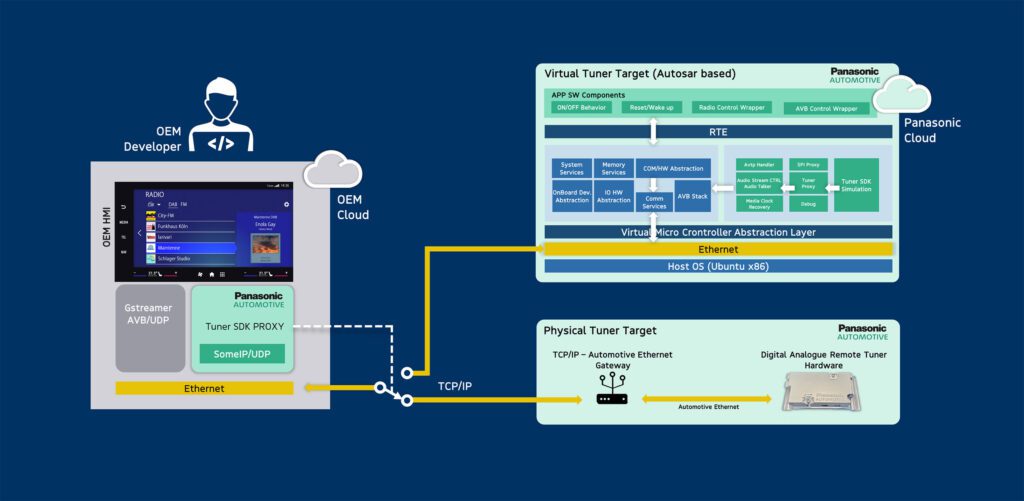
A practical example of this approach is Panasonic Automotive Systems Europe’s fully virtualized Digital Analog Remote Tuner. The system runs in the Amazon cloud and can be accessed worldwide through a standard web browser, while still offering the option to run on a local server if required.

The host operating system is Ubuntu x86. On top of this, a simulation of the TunerSDK stack runs connected to a level 3 virtualized AUTOSAR environment, enabling early software integration without physical tuner hardware.

For the graphical user interface, Android Automotive Cuttlefish is used to virtualize the TunerSDK GUI. This GUI communicates with the tuner software stack via a proxy mechanism, ensuring clean separation between presentation and functional layers.

All communication between the individual virtual instances is based on standard TCP/IP protocols, making the system modular, scalable, and well aligned with modern IT infrastructure.

Simulation: Powerful, but not always enough

To support early development and testing, a simulation environment provides audio and metadata via the TunerSDK to the In-Vehicle Infotainment (IVI) system. This allows developers to validate user interfaces, signal flows, and system behavior long before real radio signals are involved.

However, simulations are only as good as the models behind them. Radio technology is particularly challenging because broadcasting standards differ across countries and are often interpreted differently by service providers. Subtle regional differences may not be fully captured by a generic simulation.

For this reason, stepping back from full virtualization and reintroducing real hardware into the development loop can be essential.

Bringing real hardware into the cloud

Fortunately, virtualization does not exclude physical hardware. Real remote tuner hardware can also be deployed in the cloud – or at least connected to it – making it accessible to distributed teams worldwide. This hybrid approach combines the flexibility of virtual environments with the authenticity of real-world signals.

Access to real hardware located in different countries is a major advantage when developing robust radio software. It allows teams to validate behavior against real broadcasts, regional standards, and live network conditions, significantly reducing the risk of late-stage integration surprises.

Unified interfaces through the TunerSDK proxy

A key element in this architecture is the TunerSDK proxy. By implementing this proxy, the same standardized TunerSDK interface can be exposed regardless of whether the backend is a fully virtualized tuner or real hardware. Communication is provided via SOME/IP or UDP, ensuring compatibility with automotive middleware standards.

For IVI developers, this abstraction is crucial. The IVI system can connect to a virtual tuner during early development and seamlessly switch to real hardware later – without changing the application interface. Detailed API documentation supports a quick development start and reduces onboarding effort for new teams.

Demonstration: Remote access to real remote tuner hardware

To demonstrate this concept, Panasonic Automotive Systems Europe operates a remote tuner hardware setup in one of its offices. The system is connected to the internet and can be accessed globally. At the center of the setup is the remote tuner hardware itself, connected to a house antenna for receiving live radio signals. Alternatively, it can be linked to a generator network that provides test signals recorded during worldwide test drives.

For software updates and advanced analysis, the hardware is connected to a debugger. This enables remote on-chip debugging, real-time performance measurements, and application-specific insights – without requiring engineers to be physically present.

Connectivity is achieved via Automotive Ethernet, which is converted to standard Ethernet using a media converter. This allows the system to be accessed from a regular PC using standard network drivers, bridging the gap between automotive and IT environments.

Conclusion: The future is virtual – and real

Virtualization is no longer optional in automotive software development – it is mandatory. As SDVs continue to grow in complexity, only virtualized, cloud-enabled approaches can provide the scalability, flexibility, and speed required. At the same time, smart integration of real hardware ensures authenticity and robustness where simulations reach their limits.

By combining virtual ECUs, cloud deployment, standardized interfaces, and selective hardware access, automotive companies can achieve the best of both worlds: faster development cycles, lower costs, and higher software quality – ultimately delivering better vehicles to customers worldwide.


About the author: Rolf Schaefer is General Manager / Division Head – Automotive Software Development at Panasonic Automotive Systems Europe.

Sponsored Content: This article was produced in collaboration with Panasonic Automotive Systems Europe.


Source link

Easiest and Hardest States to Full-Time RV In (2026 Guide)

0
Easiest and Hardest States to Full-Time RV In (2026 Guide)


Full-time RVing can truly unlock a travel lifestyle unlike any other. Whether you’re retired or lucky enough to work from the road, living in your RV can make following the sun, never seeing snow, and waking up each day to a new view if you want to. But it is true that some states are easier than others for full-timers, at least when it comes to your residency. 

If you’re looking for the easiest states to full-time RV — and the most difficult ones, so you can avoid them — you’ve come to the right place. Below, we’ll break down which states are contenders for setting up your residency so you can drive away (and back again) in peace, and which states you might only want to visit.

The easiest states to full-time RV in typically have:

  • No state income tax (there are currently nine of these in the nation.)
  • RV-friendly vehicle registration (by which we mean you can register your RV affordably)
  • Large campground availability so you have somewhere to hang your hat when you’re not traveling
  • Mild year-round weather so you don’t have to worry about running your RV furnace ragged
  • Flexible residency laws that make it easier to sort of live somewhere, as most full-time RVers do.

The most difficult states often have:

  • High registration fees (‘nuff said)
  • Strict residency requirements that can get tricky when you travel often
  • Limited camping access that makes it more difficult to find a place to park
  • Harsh seasonal weather that keeps your RV constantly winterized
  • High insurance costs (again, ‘nuff said)

What Makes a State “Easy” or “Difficult” for Full-Time RV Living?

At first glance, it may seem random to say that Florida’s an easy state for full-time RVers while California’s a difficult one. After all, both are warm and filled with sunny beaches. What’s not to love?

But we’re not (just) talking about surroundings and weather. To evaluate where a state stacks up for a full-timer, we looked into the finer details, including legal and financial considerations you likely don’t want to have to do intense research on. (That’s why we already did it for you.)

Key Factors We Evaluated

So, what factors went into our evaluation of the following easiest and most difficult states?

  • State income tax. An “easy” state for a full-time RVer doesn’t assess one — or at least not a big one.
  • RV registration fees. It shouldn’t be exorbitantly expensive to keep your rig legally ready for the road.
  • Insurance requirements. No matter where you call home, you need insurance, but it doesn’t have to be extra complicated or expensive. 
  • Domicile and residency laws. These are the real “fine print” that can turn a state that seemed like a great idea to call home into a nightmare. 
  • Campground supply. Yes, you’ll drive away from time to time — but you’ll surely want a place to set up camp when you come home.
  • Boondocking access. Because resort campground life is only one side of the full-time RV experience!
  • Weather extremes. (Or more specifically, a lack of them.) 
  • Cost of living. In this case, lower is, obviously, better.

Easiest States To Full-Time RV In

Without further ado: If you’re planning to start full-time RVing, here are the easiest states to start from.

1. South Dakota

South Dakota is one of the most common domicile states for full-time RVers. That’s because its laws seem almost custom-designed to help full-timers do their thing with as little hassle as possible. Along with a residency requirement of just a single night’s stay (really), the state also offers low vehicular registration fees, mail forwarding support, and more. (Plus, Badlands National Park and Mount Rushmore, among other exquisite must-sees.) 

Why It’s Easy:

  • No state income tax. 0% is as low as it gets, and that’s what South Dakota charges.
  • Insanely low residency requirement. Seriously, a one-night stay can make you a legal South Dakotan
  • Low vehicle registration fees. Cars range from about $50 to $75 to register; because the fee is weight-based, larger RVs may cost more (but smaller ones are quite affordable)
  • Popular mail forwarding services. Mail can be one of the trickiest parts of living on the road! But South Dakota is home to several popular and well-regarded mail forwarding services, such as America’s Mailbox and DakotaPost
  • RV-friendly insurance structure where smaller travel trailers may cost less than $1,000 per year to keep insured (and even larger rigs are unlikely to cost more than $2,000 per year for top-tier insurance)

Best For: Budget-conscious full-timers

Watch Out For: Not-so-mild winters

2. Florida

The Sunshine State has been a classic among RVers of all stripes for just about ever — but it’s an especially prime choice for full-timers. Another no-state-income-tax state, Florida also boasts a massive campground network, low registration fees, and, of course, balmy temperatures year-round. (Do keep in mind that insurance rates are higher than they’ve been before after the last few active hurricane seasons, but with all the other savings, you’ll still likely net out in the black.)

Why It’s Easy:

  • No state income tax. Again, 0% is the best percent in this regard.
  • Strong RV infrastructure including status as home base for many beloved RV manufacturers like Coach House and Tiny Camper Company, along with the host state for massive annual RV events like the Florida RV SuperShow
  • Florida is home to a massive campground network, including luxurious resort-style sites as well as many hidden-gem state parks and even a few BLM boondocking options (harder to find on the east coast)
  • Florida’s vehicle registration fees are low, especially once you’ve established residency and are renewing; even larger RVs typically only cost about $400 to register the first time (and can be under $100 going forward)
  • Florida is, of course, one of the most popular winter snowbird destinations in the world, which is to say you’ll likely find plenty of full-time RVer company and community

Best For: Relaxed campers who love fun in the sun and good company

Watch Out For: Hurricane season and high seasonal demand

3. Texas

Everything’s bigger in Texas, they say — including your opportunity to do it your own way. Yet another no-state-income-tax state, Texas also offers RV-friendly vehicle and residency laws (namely, it’s totally legal to live in an RV year-round there), plenty of wonderful campgrounds, and systems in place to help ease the domicile process for full-time RVers. Plus, come on: what other state can offer extremes as varied as Big Bend National Park and the Texas Gulf shore?

Why It’s Easy:

  • No state income tax. You know the drill by now! Don’t pay taxes in a state whose public services you’re likely not using much anyway! 
  • RV-friendly vehicle laws mean it’s totally legal to live year-round in your RV, even in your own backyard
  • A well-established domicile process that’s simple to combine with mail forwarding (Escapees can set you up with a physical address to point to in Livingston)
  • The state also has extensive RV park availability, including resorts and long-term campgrounds as well as a plethora of state parks and plenty of wide open spaces (i.e., BLM land for boondocking in Texas)

Best For: Adventurous campers who want to combine big skies with proximity to east-coast cities

Watch Out For: Extreme summer heat

4. Arizona

Another beloved and popular spot for full-time RVers to set up domicile, Arizona is known for its mild winters as well as its large swaths of desert land perfect for boondocking and getting away from it all. Plus, each January, the state is home to the Quartzsite Sports, Vacation & RV Show (aka the “Big Tent” show), one of the premier RV events in the entire country, and a great way to make like-minded friends. While there is a state income tax here, it’s relatively low, as is the overall cost of living (at least relative to the rest of the west).

Why It’s Easy:

  • Abundant BLM land for boondocking means you can save money and also wake up in some of the most beautiful natural landscapes on earth (talk about a win-win)
  • Strong snowbird infrastructure translates to like-minded companions who are likely to be home at the same time you are and on the road at the same time you are
  • The cost of living is relatively low for a western state, especially if you stay outside of the major cities
  • Mild winters are likely the state’s biggest draw — and the summers are perfect time to hit the road for cooler climes

Best For: The west-coast-minded camper who wants to get away from it all — but maintain community

Watch Out For: Summer temperatures

Most Difficult States To Full-Time RV In

We’ve covered the easiest states to full-time RV in. Now, let’s change directions and look at the states you may want to avoid when you’re setting up your domicile or state residency as a full-timer.

1. California

Beautiful? Yes. Warm? Yes. But while California is a great state to visit in an RV, it may not be the best state to set up your residency in. Here’s why.

Why It’s Challenging:

  • High state income taxes. While you could be avoiding paying any state income tax whatsoever, in California, you’ll pay up to 13.3% depending on your tax brackets
  • High cost of living. Groceries, gas, you name it — everything you need to make your lifestyle work is more expensive in California
  • Limited long-term campground availability. Yes, California has plenty of great resort-style campgrounds, and even great state parks and BLM land. But it’s lacking in long-term campgrounds where you can settle down for months on end, favoring shorter-term options for their larger earning potential
  • Strict emissions requirements. Like many progressive states, vehicles registered in California must undergo an emissions test periodically — one that may be difficult for larger or older RVs to pass

2. New York

It may be home to the “concrete jungle where dreams are made of,” as Jay-Z put it, but New York is not exactly the most RV friendly state. (Yes, even outside of the city.) Along with an overall high cost of living and state income taxes, this state also features harsh winter weather and limited year-round camping options (in part because of, well, the harsh winter weather). Which is to say, again: definitely come visit, but maybe don’t call it your permanent home.

Why It’s Challenging:

  • Again: high state income tax and cost of living. According to the Missouri Economic Research and Information Center, New York state’s cost of living is more than 25% higher than the national average — and the state’s highest tax bracket is more than 10%
  • If you’re like most RVers, you’re probably seeing a winter climate that isn’t best described by words like “frigid,” “bitter,” or “raw”
  • The state also has limited year-round camping options, even with its abundance of beautiful state parks (many of which do close for those bitter winters)
  • Insurance isn’t affordable. Class A motorhomes in New York can easily cost more than $4,000 to insure

3. Illinois

Many midwestern states boast friendly faces and relatively low costs of living. But Illinois is a bit of an exception — and not in a way that makes it more attractive as a potential place to set up state residency.

Why It’s Challenging:

  • This is another state with relatively higher insurance costs than you might find a few states over in, say, South Dakota
  • Illinois is another state that’s not exactly known for its mild climate — and in fact is often inundated with snow during the winters
  • Limited boondocking access means you’ll need to shell out for campgrounds whenever you’re in your domicile state

4. Massachusetts

Another northeastern state that may be great to be a homeowner in, but not necessarily the best plan for a full-time RVer, Massachusetts combines high cost of living with harsh winter weather and limited RV infrastructure. Short version: Not the best!

Why It’s Challenging:

  • Massachusetts is another high-cost-of-living state, with a top-tier personal income tax bracket of 9%
  • It’s also home to strict vehicle regulations that can make it more difficult for older or non-traditional RVs (like bus conversions) to pass muster
  • The state also offers limited RV infrastructure as far as campgrounds, events, resources and mail forwarding services

Comparison Table: Easiest vs Hardest States

Let’s see how the easiest and hardest states for full-time RVers stack up at a glance — with the easiest states toward the top and the hardest states toward the bottom.

State Income Tax Rate Registration Cost Long-term Campground Access Climate Overall RV-Friendliness
South Dakota 0% $120–$750 per year High Difficult winters possible High
Florida 0% First year $400+; renewals $27–$60 per year High Mild year-round High
Texas 0% $110–$850 per year High Mild in many areas year-round High
Arizona 2.5% $250–$2,000 per year  High Mild winters, hot summers High
California 13.3% $200–$1,800 per year Low–Moderate Mild in many areas year-round Moderate
New York 10.9% $35–$70 per year (after first-time fees) Moderate Difficult winters Low
Illinois 4.95% $78–$102 per year (after first-time fees) Medium Difficult winters Low–Moderate
Massachusetts 9% $50–$150 per year Low–Moderate Difficult winters Low

Best States for RV Domicile (If You Don’t Stay in One Place)

So what’s the big deal about setting up domicile, anyway?

Even if you’re traveling full-time, you still need a permanent address for things like taxes, voting, and receiving mail. And where that address is can have a big impact on, well, just about everything, from your tax bracket to how difficult it is to establish residency.

South Dakota, Texas, and Florida are often the top-listed states for full-time RVers setting up domicile precisely because they make so many of the common hiccups people face way easier. None of them charge a state income tax at all, let alone a high one, and all of them have relatively affordable RV registration, lots of long-term campgrounds, and achievable residency requirements. (Especially South Dakota — that one-night stay thing is unprecedented!)

But if you’re looking to go it on your own and choose a different state than one we’ve highlighted, here’s what you need to look into to understand ahead of time how challenging (or not) it might be to set up and maintain domicile in the state you’re considering.

  • What’s the residency requirement? To get official identification like a driver’s license, the state may require you to have a permanent address (more on that in just a moment) or to stay for a set amount of time (often several months). It’s important to understand what’s required so you can understand whether or not it’s realistic for your travel goals
  • How will this affect your finances? States with high personal income tax brackets, higher vehicle registration fees, and higher insurance costs can run up your bottom line quickly — and it’s hardly worth it if you’re not going to be staying there year-round, anyway
  • What are the mail forwarding services like? As we mentioned above, state residency usually requires a permanent address — and if you’re not parking your RV on an actual plot of your own property, that may be tricky. (Even long-term campgrounds often don’t allow you to list their address as yours.) Mail forwarding services can not only forward your mail, but also set you up with a permanent address for your driver’s license and other official documentation, and some states (like South Dakota and Texas) have more options than others

Keep in mind that your state of residence will be the state in which you’re registered to vote, as well as the state whose driver’s license you’ll carry. These factors may also play in for some campers.

How to Choose the Right State for Full-Time RV Living

Now that you’ve got some options to ponder, here are a few more considerations to keep in mind when you’re choosing a state for full-time RVing.

Consider:

  • Are you staying mostly in one region? Choosing a state that gives you easier access to the places you usually travel to can save you time and resources
  • Do you need healthcare access? Certain states are better set up for people with more complex medical needs — as well as certain cities within those states
  • Are you working remotely? If so, your place of employment may have certain rules and restrictions as far as which states you can live in, and you’ll likely also want robust internet infrastructure
  • Do you plan to homeschool? This is the default for many full-timers, since traveling makes it difficult to stay in the traditional school system — but if you do have kids in school, the state’s school system is likely to factor into your choice (or the state’s homeschool requirements, if you go that route)
  • Are you retired? Some states tax Social Security, while others do not. It’s worth looking into ahead of time so you can keep as much of your money as possible

Along with the more lifestyle-specific considerations we’ve listed above, there are also legal factors to keep in mind. 

Zoning Laws

Each state (and even each municipality) has its own zoning laws, some of which may render it illegal to live in an RV outside of a licensed RV park — even if you’re parked on your own property. While rural areas tend to be more permissive than urban ones, this can be something to look into if you’re planning to actually buy property in the state (but is less important if you’re truly planning to travel full time).

Zoning may also come packaged with private land regulations that require you to install electricity and sewer hookups for the RV on your property, for instance, or navigate tricky minimum dwelling codes that may make it more challenging to state your case that your RV is a legal home.

Long-Term RV Parking Restrictions

States and individual parks may also have restrictions on how long you can park in one place, which may be limited to 14 days, 60 days, or a series of months depending on the park or the city. States with snow, especially, may prohibit long-term RV parking anywhere during the winter, when many RV campgrounds also close down for the season.

HOA Limitations

Finally, even at the HOA level, restrictions can get you. You may own your own property, but if that property is within the purview of an HOA, they may say you can’t park your RV on the property long-term or live in an RV on the property.

FAQs

What is the best state to register an RV?

Three of the most common states that full-time RVers register their vehicles in (and claim as domicile) are South Dakota, Texas, and Florida. All three states don’t charge state income tax, have relatively affordable insurance and registration fees, and offer mail forwarding for full-time travelers.

What state has the lowest RV registration fees?

Registration fees change regularly and can vary based on the weight, value, and age of your vehicle. That said, South Dakota and Montana are known to have relatively low registration costs, along with Missouri, Alaska, and Mississippi.

Can you live in an RV full-time legally?

Yes — but it does depend on where you’re parked. Certain states and cities have restrictions on how long you can inhabit an RV and/or park it in one place, especially if you’re parking on city streets or private land.

What state has no income tax for RVers?

There are currently nine U.S. states that don’t assess a personal income tax on money you earn from working: Alaska, Florida, Nevada, New Hampshire, South Dakota, Tennessee, Texas, Washington and Wyoming.

What states allow the most boondocking?

States that have a lot of land available for boondocking are largely out west, including Arizona, Nevada, Utah, Idaho, New Mexico, Montana and Wyoming.

Is South Dakota still the best state for RV domicile?

Many long-term RVers and full-timers do find South Dakota to be an excellent choice for domicile, thanks to its easy-to-meet residency requirement, robust mail forwarding options, 0% state income tax and more. Other popular states include Florida, Texas, and Arizona.

Which states are hardest for RV insurance?

States like California, Louisiana, and Colorado can have higher-than-average insurance rates because of their vulnerability to weather events. Places like Florida have also seen insurance rates creep up in recent years, though other factors mean Florida is still a popular place for RVers to set up domicile.

In Summary

If you want the easiest full-time RV experience, South Dakota, Florida, Texas, and Arizona are all popular options. But if you’re going to shop for a home state yourself, look for:

  • No income tax
  • RV-friendly registration fees
  • Strong campground supply
  • And, if you’re like most RVers, a mild climate to enjoy during the winter.

If you live in a high-tax, high-regulation state, consider establishing domicile elsewhere before going full-time. Psst — Interested in renting out your RV? Learn more about how you can earn rental income when you aren’t using your rig.


Source link

Driving Habits Influence Insurance Rates in the Age of Connected Cars

0
Driving Habits Influence Insurance Rates in the Age of Connected Cars


This article may contain affiliate links.

Do you want to save money on car insurance by driving safely?

Connected cars are revolutionizing how insurers price their policies. Forget about age, location and credit-based scoring. Drivers want rates that actually reflect their individual risk. But there’s a big catch.

Drivers who embrace these new models could save thousands over time. Drivers who don’t participate will likely pay even more than today’s rates.

In this article we’ll cover:

  • Connected Cars & Insurance Pricing
  • What Insurers Are Monitoring When You Drive
  • Paying for Car Insurance On-Demand
  • Usage Based Insurance (& How to Reduce Rates)
  • Privacy Concerns With Telematics

Connected Cars & Insurance Pricing

Connected cars are automobiles that can connect to the internet and communicate wirelessly. They can share data on driving habits such as speed, braking habits, acceleration and location in real time.

Insurance companies are harnessing the data from these devices to price customers based on actual driving behavior.

This trend is just getting started. Where insurers once relied primarily on static information like age, home ZIP code and claims history, connected cars allow them to track real-world behavior behind the wheel. Companies offering on-demand car insurance services are jumping at the opportunity to offer cutting edge technology paired with cheaper rates for good drivers. Services like Hugo car insurance are great examples.

Telematics, as the technology is known, is rapidly gaining popularity across the auto insurance industry. By 2024, the global insurance telematics market was valued at $6.8 billion. By 2034, it’s expected to reach $43.3 billion. That’s an annual growth rate of 18.9%.

How Driving Habits Influence Insurance Rates in the Age of Connected Cars

What Insurers Are Monitoring When You Drive

Insurers are tracking more than you think. Speeding, hard braking and rapid acceleration are some of the more obvious data points. But cell phone usage, time of day and mileage are tracked as well.

All of these habits build a score that insurers use to decide if you’re a safe driver. Good scores equal lower premiums. Bad scores mean insurers think you’re higher risk and premiums increase.

The catch? Since telematics devices provide a record of your driving moment-by-moment, you can’t argue with the data. Safe drivers will literally save money by driving safely.

Paying for Car Insurance On-Demand

Usage based insurance (UBI) is one of the biggest benefits to drivers that embrace telematics. Rather than pay a flat annual price determined by estimated risk, some car insurance companies allow drivers to pay for coverage on an as-you-drive-it basis. And that usage can refer to how often you drive as well as how you drive.

There are a few different ways insurers offer UBI:

  • Pay How You Drive (PHYD): Mileage is monitored as well as driving behavior such as harsh braking, acceleration and speed.
  • Pay As You Drive (PAYD): Insured pay based on miles traveled regardless of behavior.
  • Manage How You Drive (MHYD): Insured receive real-time feedback with gamified challenges to improve driving behavior over time.

A Consumer Affairs survey found that drivers can save 10-25% with telematics programs. Many top tier insurers even offer low-mileage drivers discounts as high as 40%. So if you’re a low-mileage worker (remote job) or consider yourself a safe driver, then this model was made for you. The less you drive, the less risk you pose. Simple as that.

Plus, everyone wins. Drivers save money and insurance companies collect massive amounts of driving data.

Usage Based Insurance (& How to Reduce Rates)

OK. Let’s talk about actually saving money. If you’re reading this article, you’re probably already a safe driver. That’s great! You have the most to gain by participating in your provider’s telematics program.

Here are some of the basics.

  • No hard braking or rapid acceleration. Aggressive driving is bad for your wallet.
  • Put your phone down. Distracted driving isn’t worth the cost.
  • Drive less, when you can. Lower mileage equals lower costs when it comes to UBI.
  • Don’t drive late at night. Staying off the road when statistics prove you’re at higher risk will help your score.
  • Keep your car maintained. Connected cars will also notify you of maintenance issues. Drive safe, and keep your car safe.

The key is consistency. Telematics apps and devices take time to calculate your average driving score. A few weeks of data is needed to form an accurate rating. One week of bad driving won’t ruin your score. But continue doing these things for a few months and you’ll start to see lower renewal costs.

Privacy Concerns with Telematics

Drivers have one big concern with telematics. Privacy. Aren’t you slightly creeped out that your insurer knows where you are and how you drive every second of the day?

You’re not alone. However, over 21 million U.S. drivers shared their telematics data with insurers in 2024. That represents a compound annual growth rate of 28% since 2018. More and more drivers are saying, “How you drive is how you’ll pay.”

If the idea of insurers tracking your location and driving behavior doesn’t comfort you, take a closer look at each provider’s privacy policy. Some promise they will never raise your rates based on telematics. Others will only raise your rate if bad habits are detected. Policies change from state-to-state and insurance provider-to-provider, so make sure you understand the ins and outs before signing up. If you already drive safe, there’s nothing to lose and everything to gain by signing up for telematics.

The Takeaway

The technology in connected cars, paired with insurance companies’ aggressive push into telematics, will make traditional car insurance a thing of the past. Instead of pricing everyone mostly the same, car insurance rates of the future will reward drivers for safe driving.

Remember…

  • Connected cars allow insurers to track driving habits in real time.
  • Speeding, braking, phone use and mileage impact insurance rates.
  • Insurers now offer on-demand insurance that charges drivers based on mileage and driving behavior.
  • Safe drivers who consistently drive safely stand to save the most money.
  • Driving telematics do pose some privacy concerns. However, drivers are opting into these programs by the millions.

Drivers who jump on these new programs and technologies now will save money. Those who resist change could pay higher rates in the future.

The future is here. Ready your driving habits accordingly.


Source link

First new world record of riding!

0
First new world record of riding!


Gas: 3.432 gal/90 octane E0 @ $3.359/gal; total $11.53 @ Royal Farms. Couldn’t gauge MPG because I lost the previous receipt.

End @ 64,829 (104 miles) – NEW WORLD RECORD!

Longest day on the bike so far. Went to Morton’s BMW in Fredericksburg , about 50 miles each way. Took US 1 to get there, came home via VA 2 and US 301. Mostly 4th & 5th gears once away from stoplights, speed limits at 55 so ran the bike pretty hard most of the time. Lots of vibration, but not miserable.

Tried securing the tool roll in the right pannier with an adhesive strip of velcro; the adhesive held, but the tool roll’s velcro strap didn’t stay stuck to it on the way north, but did on the way south. The straps I got to try to secure a quart of oil were WAY WAY too long. Returning them, getting a cut-to-length kit to do the trick.

Temps were in the mid to upper 40s on the way up, in the low 50s for the ride home. I chose my gloves poorly; hands cold both ways. Also didn’t layer particularly well; cold torso both ways but not as bad on the way home. There’s no heated grips on the R 90/6 and no small fairing or windshield! I’m not sure why I have to keep learning this lesson. Stubborn, I guess.

Went to Morton’s to discuss three things with Charles Buchanan, he’s an MOA member and now the GM there. First idea was a 50th birthday party for the R 90/6, which was built 10/75 (confirmed that with BMW Classic). Chuck was a big fan of that idea, wants to turn it into a “vintage day” event at the shop for everybody to attend. It’ll be fun!

Obligatory “this is what I ate” shot from a taqueria down the plaza from Morton’s.

Second idea was using their shop space to do videos. He connected me with his counterpart in the shop, James, who was immediately amenable, but I can’t take my lift, as they just bought three new ones. I’ll have to trade video work for the space to seal the deal. No idea how it will go, but it could work. I can take my tools there, but I’ll likely have to find a place in the shed at home for my parts (need to get those into bins, too, and organize them better. Glad I got rid of all my early 2000s R 1200 GS parts!)

Since George sold the shop to the first swinging dick that walked through the door—which is awesome, don’t get me wrong—he has to be out by the end of June if everything goes right with the sale. Way less time than I thought I’d have. Dale is going to try to pick up some of George’s Airhead business. Discussed buying one of George’s hydraulic lifts or trading mine plus cash. He’s thinking about it, I guess.

Got stopped by a rando in the parking lot while trying to leave Morton’s. He liked my bike—I’m getting used to that—but wanted to tell me his life story of motorcycles. It took about 10 minutes and all I wanted to do was leave. I had ear plugs in and my helmet on (but flipped up, I’m not a monster) so I was clearly in GO MODE. Trying to learn to be patient, but it’s not my strong suit. I hope the dude didn’t notice how antsy I was. To my credit, I didn’t try to rush him.

Hit construction on 301 well south of Bowling Green, when the highway goes back to two lanes total. Long stretch of road repairs, had to wait for a lead/follow vehicle. The slow/stop dude wanted to chat about the bike too. We sat there about 10 or 15 minutes with the bike off, waiting for the lead/follow truck. It didn’t suck.

I’m almost to 500 miles on the bike since starting to ride it. I got an oil filter kit and the bevy of crush rings necessary to do a full oil change service—engine, transmission, final drive & swing arm. Trying to get close to 65,000 so it’s a round number, then doing it again every 2,500 miles after that. Not sure I want to stretch the interval to 5,000 miles like I do with my 21st-century bikes. Some Airhead riders say they use the oil filters for two oil changes, but I’m not going to do that. Oil filters are not expensive. I’ll use the Valvoline VR1 “racing” oil George recommended in 20W50. Maybe 10W40 since it’s still cold, but I’m not riding when it’s 20 degrees so I guess that oil is OK.

One Year Later Update: Dale did indeed pick up some of George’s Airhead work—you can find his business online at motorcycleservicesllc.com. Give him a buzz if you’re in central Virginia.


Source link

Xiaomi Vision GT Concept leaked ahead of 2026 MWC

0
Xiaomi Vision GT Concept leaked ahead of 2026 MWC


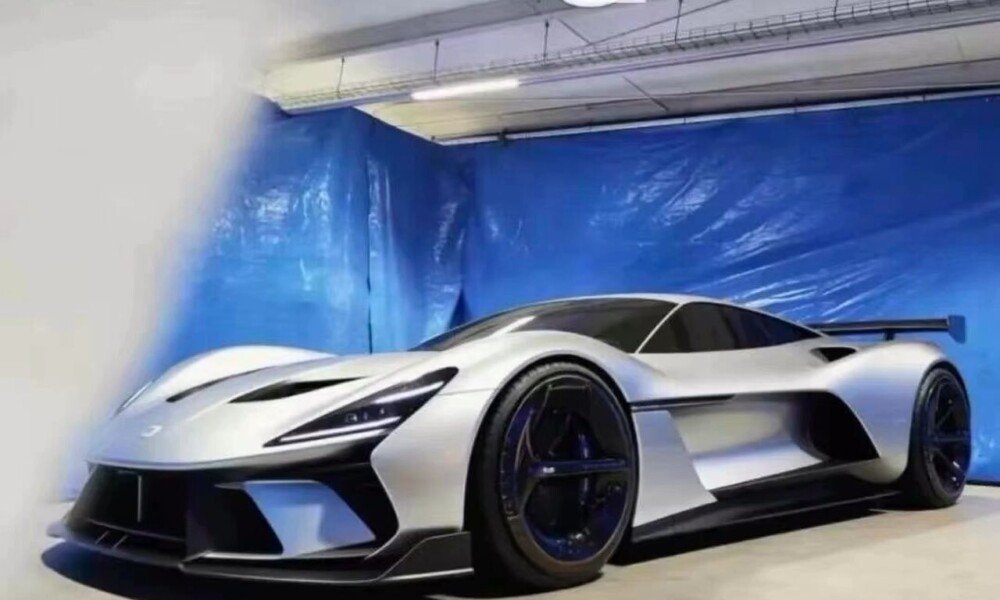
China’s Xiaomi has brought something special to the 2026 Mobile World Congress (MWC) in Barcelona, Spain. It’s a new Vision Gran Turismo concept that will soon feature in the Gran Turismo racing game on PlayStation.

Images of the electric supercar concept had recently surfaced online. The images revealed a sleek and radical design, with a low roofline and muscular fenders. The low-slung nose section features intricate vents, cooling ducts and a pair of nostrils on the bonnet. It has an aggressive front splitter, massive vents on the sides, and a large, fixed rear wing.

We know that Xiaomi can build a high-performance electric car. Last year, the SU7 Ultra went on to set a Nurburgring lap time of 7 min 04.957 seconds, becoming the fastest production EV to lap the legendary circuit.

The Xiaomi Vision GT concept will be officially unveiled at the Fira Gran Via exhibition centre in Barcelona on March 2, 2026.

Source: @drivegreen_livegreen


Source link

Zion 2026 Large Vehicle Rules: What RVers Need to Know

0
Zion 2026 Large Vehicle Rules: What RVers Need to Know


Heading to Zion National Park this summer? If you are planning to drive a motorhome, tow a trailer, or travel in a larger vehicle, here is what you need to know.

Beginning June 7, 2026, Zion National Park will fully enforce vehicle size and weight limits on the Zion-Mount Carmel Highway (Utah State Route 9) between Canyon Junction and the East Entrance. Vehicles that exceed the posted limits will no longer be allowed to travel this section of SR-9.

These restrictions apply to the entire stretch of highway between Canyon Junction and the East Entrance, not just the historic 1.1-mile-long Zion-Mount Carmel Tunnel.

What’s Changing?

Currently, certain oversized vehicles can purchase a tunnel permit and travel through the Zion-Mount Carmel Tunnel with ranger escort during limited hours. However, that is set to change later this year.

Beginning June 7, 2026:

  • The tunnel permit option will be eliminated.
  • Any vehicle that exceeds the established size or weight limits will be required to reroute.
  • Oversized vehicles will not be permitted past Canyon Junction toward the East Entrance.

The changes are based on safety studies and federal highway validation. The road includes tight curves, narrow lanes, historic bridges, and infrastructure that was not designed for modern oversized vehicles.

Will You Be Affected?

Use the following information to determine whether your vehicle can legally travel the Zion-Mount Carmel Highway between Canyon Junction and the East Entrance.

Measure Your Vehicle

Measurements include mirrors, tires, rooftop A/C units, bike racks, satellite dishes, and all attachments. Pay particular attention to the overall width, including mirrors. That is where the majority of RVers will be affected. Another common hurdle will be the trailer length, measured from the hitch to the rear axle.

Single Vehicle Limits

Tow vehicle without a trailer, a motorhome, or a dinghy vehicle

Limit Type Maximum Allowed
Length 35 feet 9 inches
Width 7 feet 10 inches
Height 11 feet 4 inches
Weight 50,000 pounds

If your vehicle exceeds any one of the above limits, you must reroute.

Combined Vehicle Limits

Tow vehicle and trailer, a motorhome and dinghy vehicle, or any other towing setup

Limit Type Maximum Allowed
Total Length 50 feet
Trailer Length 26 feet from hitch to rear axle
Width 7 feet 10 inches
Height 11 feet 4 inches
Weight 50,000 pounds

Again, exceeding any single limit found above means you cannot travel this section of SR-9.

Important

If your vehicle exceeds any of the limits above and you arrive at the South or East Entrance, park staff will direct you to turn around safely.

Exceptions at the South Entrance may apply only if you are:

  • Parking in the large vehicle lot at the Visitor Center and space is available
  • Staying at Zion Lodge with a valid pass
  • Driving during shuttle off season
  • Camping at Watchman Campground or South Campground when open

Oversized vehicles will not be permitted beyond Canyon Junction toward the East Entrance.

Over the Limit(s)? What Are Your Options?

If your RV or towing setup exceeds the limits, you still have access to Zion National Park. You simply need to plan your approach differently.

Option 1: Use the South Entrance and Park

If space allows, you may:

  • Park at the Zion Canyon Visitor Center large vehicle lot
  • Camp at Watchman or South Campground
  • Use the shuttle, bike, or walk to explore Zion Canyon during shuttle season

This allows you to enjoy the park without traveling the restricted highway.

Option 2: Take a Paved Alternate Route

Oversized vehicles must bypass the Zion-Mount Carmel Highway using state highways.

South of Zion Route

Route: Take SR-59 east of Hurricane, then continue on Arizona SR-389 and US-89 to reach the east side of SR-9.

  • Distance: 80 miles
  • Drive time: 1.5–2 hours
  • Road type: Fully paved

This is a good option if you’d like to add stops in Kanab or the North Rim of the Grand Canyon.

Note: Avoid Sheep Bridge Road (see below). Some navigation apps may suggest it. It is a dirt road with steep sections and is NOT recommended for large vehicles.

North of Zion Route

Route: Take I-15 north from Anderson Junction to SR-20, and then from SR-20 head south on US-89.

  • Distance: 161 miles
  • Drive time: 3–4 hours
  • Road type: Fully paved

This is a good option for adding stops to Bryce Canyon or Cedar City.

Note: Avoid SR-14 and SR-143 as alternate shortcuts. These roads have steep grades and sharp curves that are NOT recommended for large vehicles.

Unpaved Routes to Avoid

These are NOT recommended for large or low clearance vehicles:

Road Where Conditions
Sheep Bridge Road Connects SR-59 east of Hurricane and SR-9 in Virgin. Dirt, steep sections, 1,000-foot elevation change
Smithsonian Butte Road Smithsonian Butte Road and Bench Road connect SR-9 in Rockville and SR-59 in Apple Valley. Rough dirt, steep grades, can become impassable when wet

What Happens if You Ignore the Restrictions?

If your vehicle exceeds limits and you attempt to travel the restricted section:

  • You will be turned around at the entrance station
  • You may need to add significant drive time to reroute
  • You could encounter narrow curves and bridge weight limits that pose safety risks

The highway includes tight switchbacks, narrow lanes, historic bridges, and infrastructure built in 1930 for smaller vehicles. Planning ahead prevents stress and protects your rig, other travelers, and the park.

Safe Travel Planning

Even if your RV meets the size requirements, careful planning is still important.

1. Confirm Your Rig’s True Measurements

Do not rely on brochure specs alone. Many RVs sit higher or are longer than expected once fully equipped. Be sure to measure:

  • Total length including bike racks
  • Total height including everything on the roof: A/C units, vent covers, solar panels, etc.
  • Width including mirrors
  • Actual loaded weight

2. Be Aware of Seasonal Closures

Always check current conditions before arrival.

  • Zion Canyon Scenic Drive is closed to private vehicles from early March through late November. Shuttle required.
  • Upper Kolob Terrace Road and Lava Point Road often close in winter.
  • SR-9 may temporarily close during peak congestion, rockslides, flooding, or wildfire events.

3. Set Up Safe Routing with RV LIFE

To avoid routing issues:

Step 1: Update RV Garage in Your Profile

RV LIFE Garage lets you manage important information about your RV. It provides a convenient place to view and update your vehicle information and record important details like your RV’s measurements, fuel info, mileage and more to help you stay organized and keep your RV information up to date.

You can access your RV Garage through your RV LIFE Profile. You can do this via profile.rvlife.com, RV LIFE Trip Wizard, RV LIFE Campgrounds or the RV LIFE Mobile app. Begin by clicking on Account Settings.

Under the Profile, Garage, & Preferences Heading, click Your RV Garage:

RV LIFE RV Garage screenshot.RV LIFE RV Garage screenshot.

This opens the RV Garage screen, where you can edit the details of your RV.

RV LIFE RV Garage screenshot.RV LIFE RV Garage screenshot.
  • Enter accurate height of the RV
  • Enter total length of the RV
  • Enter weight of the RV and tow vehicle
  • Enter additional information if applicable

Note: When accessing via the RV LIFE Mobile app, you’ll skip the Account Settings step. Tapping your Profile icon will take you directly to that screen.

Step 2: Use RV Safe Routing

RV LIFE’s RV Safe routing considers:

  • Height clearances
  • Weight limits
  • Road grades
  • Large vehicle restrictions

Unlike a standard automotive GPS app, RV LIFE will create an RV Safe route to avoid sending you onto dirt roads like Sheep Bridge Road or steep grade routes not suitable for RV travel.

The Bottom Line for RVers

Beginning June 7, 2026:

  • Oversized vehicles will no longer be allowed on the Zion-Mount Carmel Highway between Canyon Junction and the East Entrance.
  • Tunnel permits for large vehicles will end.
  • RVs that meet the limits may continue to transit the route.
  • RVs that exceed the limits can still access Zion through the South Entrance and by using paved alternate highways.

Before you go:

  1. Confirm your RV setup’s exact dimensions
  2. Choose a compliant route
  3. Avoid unpaved shortcuts
  4. Check seasonal closures
  5. Set up RV Safe routing with RV LIFE

Zion National Park remains accessible to RVers. With the right preparation, you can enjoy the park safely while staying within the new requirements.


Source link

Tesla’s Megawatt Chargers Are Coming Soon. Here’s Where The First Ones Will Go

0
Tesla’s Megawatt Chargers Are Coming Soon. Here’s Where The First Ones Will Go


  • Tesla confirms it’s turning Semi charging from a tiny pilot program into a real long-haul Megacharger network.
  • The Megacharger map lists 64 new locations showing actual usable corridors for trucks to take.
  • Tesla’s Semi push is not limited to the United States; Europe is clearly in the plans too.

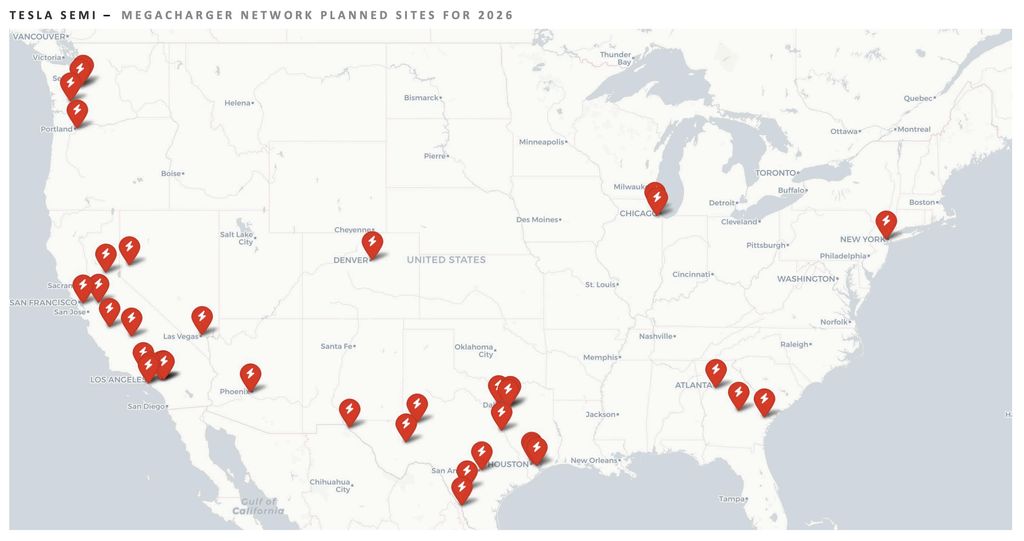
There are currently just two Tesla Megachargers charging Tesla Semi trucks. One near Stockton, California, and another near Reno, Nevada. But their number will increase rapidly now that Tesla has added 64 additional Megacharger locations listed as “coming soon.”

The manufacturer hasn’t provided an exact timeline for the Megacharger rollout, but its Q4 shareholder report contained a map showing 37 locations that would enter service in 2026. Previously, in April of 2025, Tesla’s Semi program boss, Dan Priestly, said at the ACT Expo that the company aimed to have 46 Megachargers online by early 2027.


screenshot-2026-02-28-at-114431

Photo by: Tesla

Tesla could have added more chargers to its 2027 rollout plan or the remaining 18 locations will be built at a later date. California and Texas will have over 50% of these new Megachargers, with 18 and 17 locations, respectively, and important hubs are also coming to Washington state, Georgia and Florida, as well as the city of Chicago, which has four locations planned. The goal of the expansion is to create corridors that enable viable routes across the United States.

The news of the Megacharger network expansion comes from Jason Gies, who works for Tesla’s business development department for the Semi truck. He said in a LinkedIn post that “You can see Megachargers and coming soon sites forming a backbone across the country. Chicago is becoming a real anchor. The Southeast is filling in. Corridors are starting to connect, not just scatter pins.”

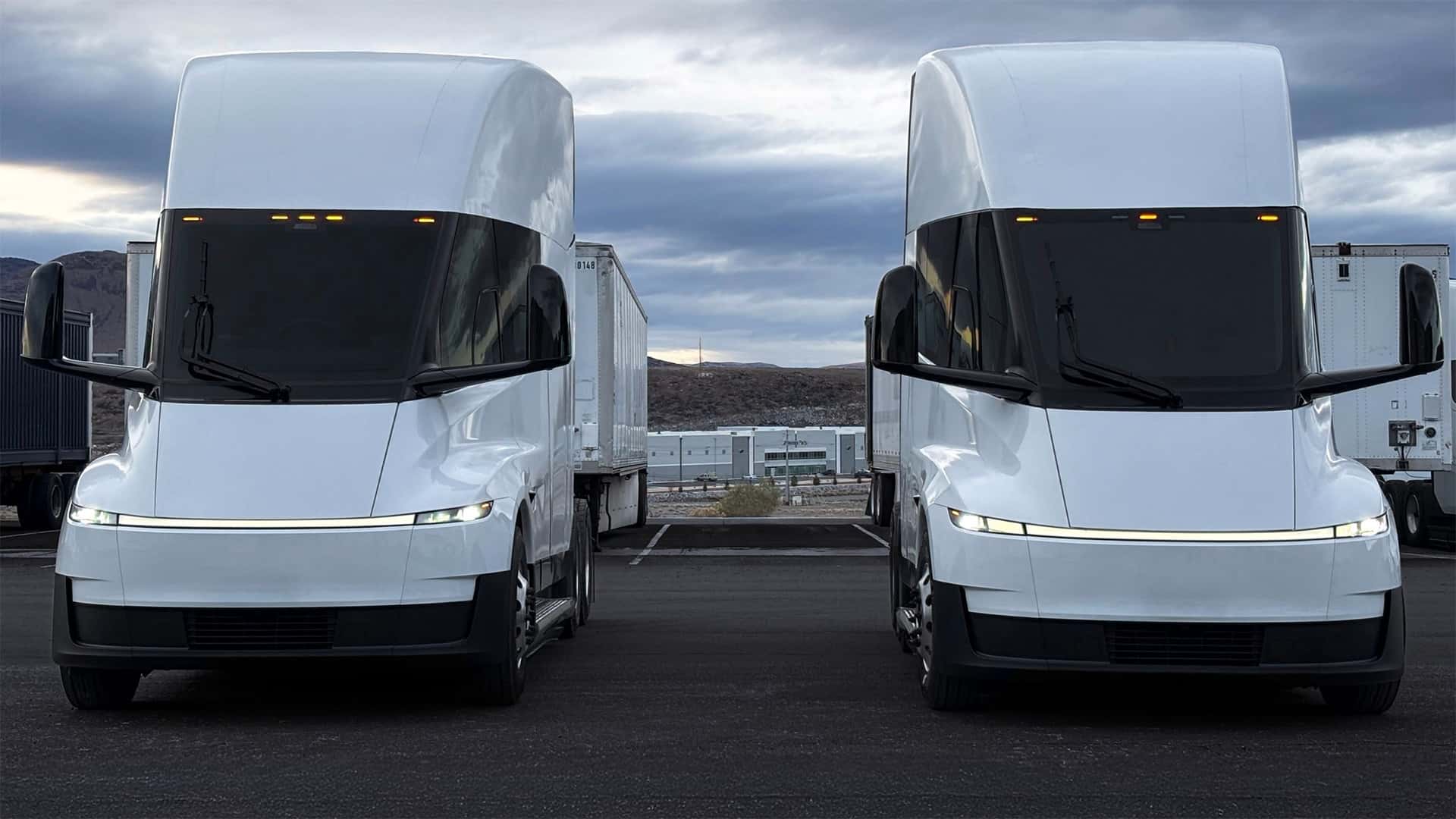
After missing the original plan to start production of the Semi in 2019, it is finally starting in 2026. Tesla has given the truck a refresh, updated its specs, and confirmed it can charge at 1.2 megawatts. In late December, Tesla published a video on X showing a live charging session of a Semi topping up from a Megacharger and reaching over 1.2 MW (1,206 kW).

The Semi will be available in Standard Range form with up to 325 miles of range, fully loaded, or in the bigger-battery Long Range model, which pushes the range to 500 miles. Tesla doesn’t state the battery sizes for either version, but they should be around 550 kW and 875 kW, respectively, and both can charge to 60% in around 30 minutes.

Tesla is also looking to establish a Megacharger network in Europe, where it plans to launch the Semi at some point in the near future. We don’t have details yet, and all we know now is that David Forer, a senior project developer for charging at Tesla, mentioned Megachargers in Europe when discussing a job listing on LinkedIn.

In an interview posted yesterday on X, Elon Musk confirmed that a European version of the Semi is also planned and it should arrive “hopefully next year.” This confirms the need for a European Megachager network, although that’s likely further in the future, and it may initially be one or two locations, just like it is right now in the U.S., before the planned expansion.


Source link

2026 BMW X3 Interior Design, Technology, & Safety Highlights

0
2026 BMW X3 Interior Design, Technology, & Safety Highlights


2026 BMW X3 Interior Design, Technology, & Safety Highlights

The 2026 BMW X3 is bold, beautiful, and brimming with luxurious amenities. Its roomy cabin envelopes you in opulence and puts state-of-the-art technology at your fingertips. Come talk to the friendly team at Fields BMW Northfield to learn how this SUV will elevate your driving experience.

Spacious, Opulent Cabin

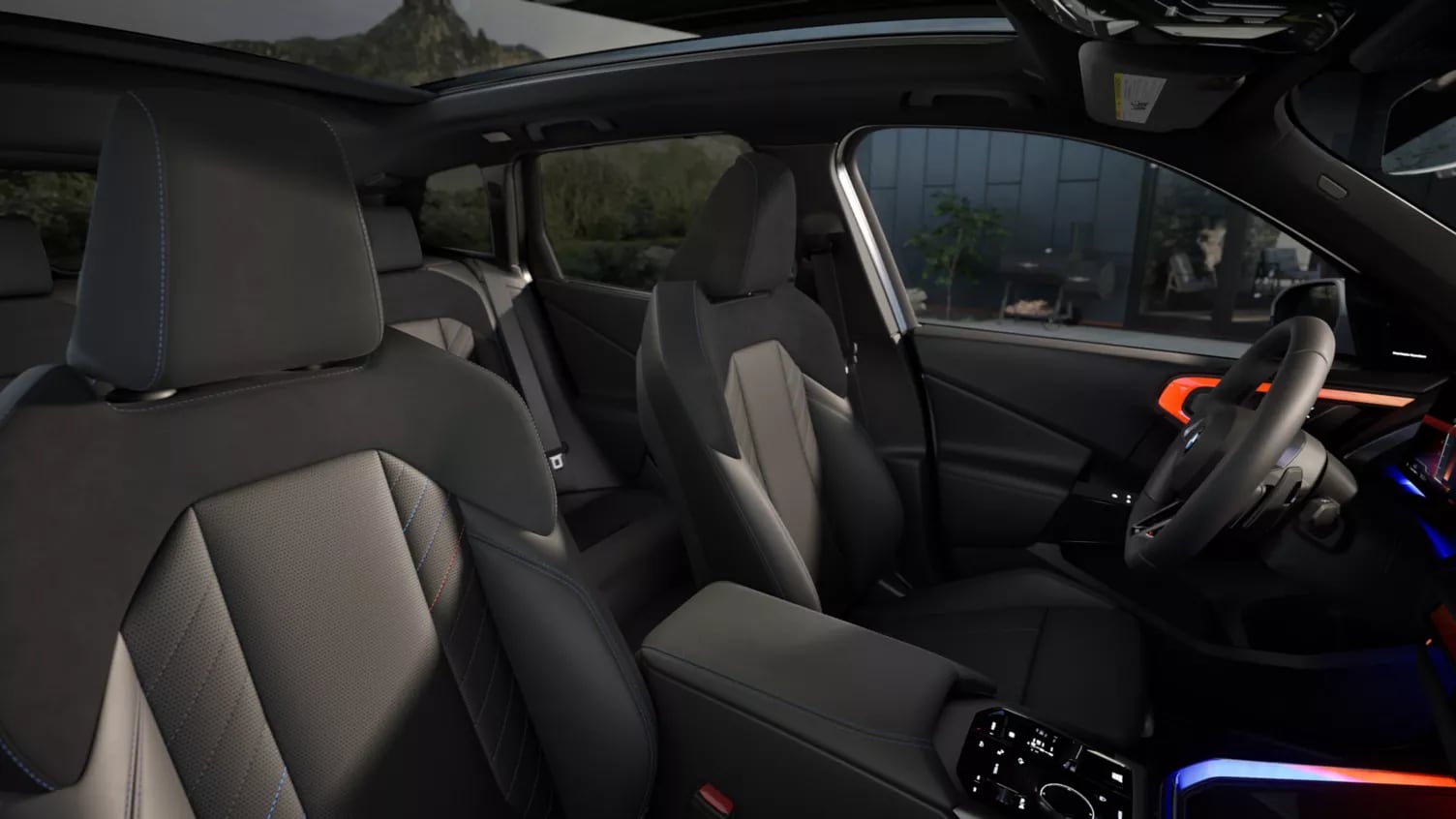
Inside the 2026 BMW X3, you’ll find 31.5 cubic feet of cargo space behind the second row, along with a wide selection of Veganza and Extended Merino Leather upholstery options. Multi‑color adjustable ambient lighting enhances the cabin’s atmosphere, while available amenities such as a heated steering wheel add extra comfort. With thoughtful materials and flexible space for passengers and gear, the SUV’s interior is designed to feel both modern and inviting.

Cutting-Edge Technology

A 14.9-inch BMW Curved Display™ with a 12.3-inch instrument cluster and 14.9-inch central information display stretches across the dashboard of the 2026 BMW X3 — but we know that’s not enough technology. You’ll also have wireless charging, Apple CarPlay®, Android Auto™, and a Hi-Fi sound system at your disposal.

Innovative Safety Features

For your protection and peace of mind, the 2026 BMW X3 includes a long list of impressive safety and driver assistance technologies. Standard features include active blind spot detection, active driving assistant, frontal collision warning with city collision mitigation, and lane departure warning. Add the Premium Package for a head-up display and Parking View with 3D View (Surround View).

Get Behind the Wheel of the 2026 BMW X3 Near Chicago, IL 

These are only a sample of this model’s interior highlights — just wait until you see more. Stop by our BMW dealership near Chicago, IL, to experience the 2026 BMW X3 in person. We’ll show you the options and help you take home the luxury SUV you’ve always dreamed of!


Source link