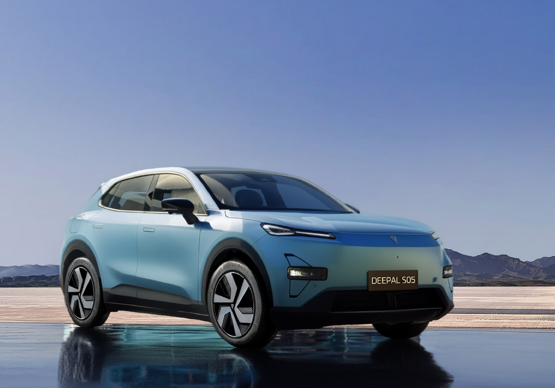
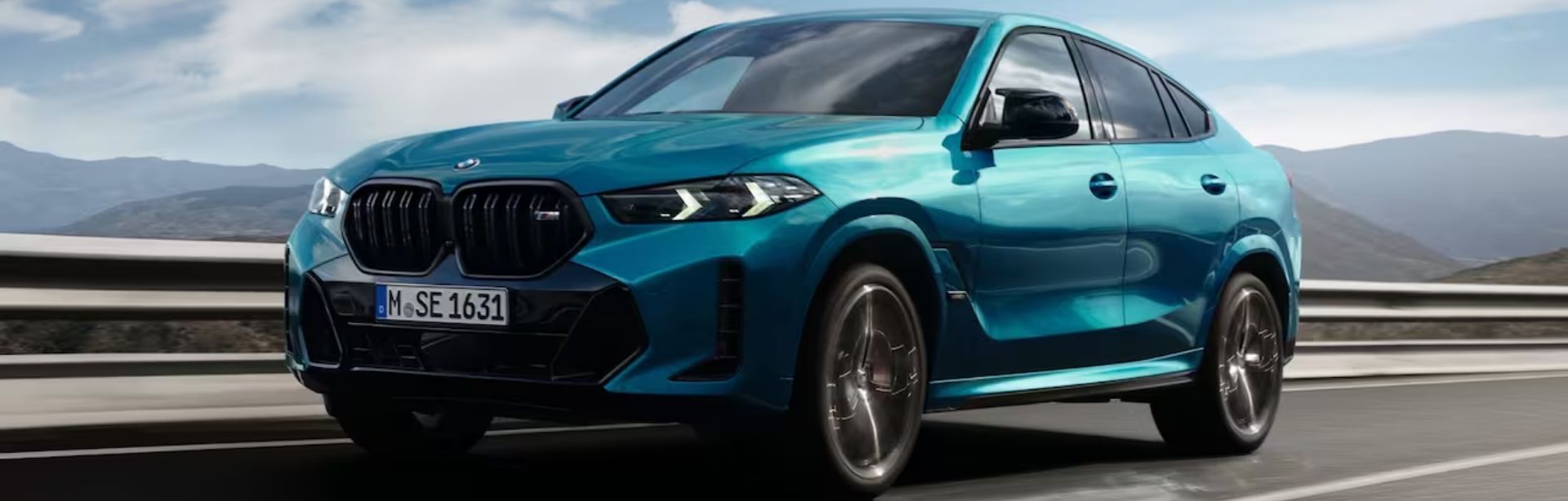
Changan UK has launched the Deepal S05 electric C-SUV, priced from £37,990 with up to 303 miles of WLTP range.
The five-door model joins the brand’s expanding UK EV line-up and is available to order from March 1 through a dealer network set to grow to 60 sites by the end of Q1.
The Deepal S05 is offered in rear-wheel drive and all-wheel drive configurations, each in a single trim level.
Pricing is £37,990 for the RWD MAX and £39,990 for the AWD MAX.
Both variants use a 68.8kWh lithium iron phosphate battery.
The RWD version delivers a WLTP range of up to 303 miles, while the AWD offers up to 278 miles.
The RWD powertrain produces 200kW and 290Nm of torque, with 0-62mph in 7.5 seconds. The AWD adds an asynchronous front motor, taking output to 320kW and 502Nm, reducing the 0-62mph time to 5.5 seconds. Both have a top speed of 112mph.
DC rapid charging is supported at up to 200kW, enabling a 30 to 80% charge in 15 minutes. AC charging is available at up to 11kW. A vehicle-to-load function provides up to 6kW of external power.
Further spec details for the Deepal S05
Inside, the S05 features a 15.4-inch rotating central touchscreen, a 50-inch projected augmented reality head-up display, wireless Apple CarPlay and Android Auto, and a 14-speaker audio system.
Heated and ventilated ‘vegan leather’ front seats are standard, with a reclining ‘zero gravity’ style passenger seat.
Boot capacity is 492 litres, rising to 1,250 litres with the rear seats folded flat. A 159-litre front trunk is also provided.
The S05 has achieved a five-star Euro NCAP rating and is equipped with 17 driver assistance systems supporting Level 2 autonomous driving, including a 540-degree surround-view camera system.
The vehicle has been engineered with input from Changan’s UK R&D centre in Birmingham and is produced in Thailand at a facility focused on right-hand-drive markets.
Changan said around 60% of components are sourced locally.
Warranty cover is seven years or 100,000 miles for the vehicle and eight years or 124,000 miles for the battery.
Optional extras include a panoramic roof priced at £1,000 and a detachable tow bar costing £600, with towing capacity of up to 1,600kg. Standard exterior colours include Mercury Silver, Moonlight White, Deep Space Black, Ganymede Grey and Andromeda Blue. Interior options are Orange or Black.
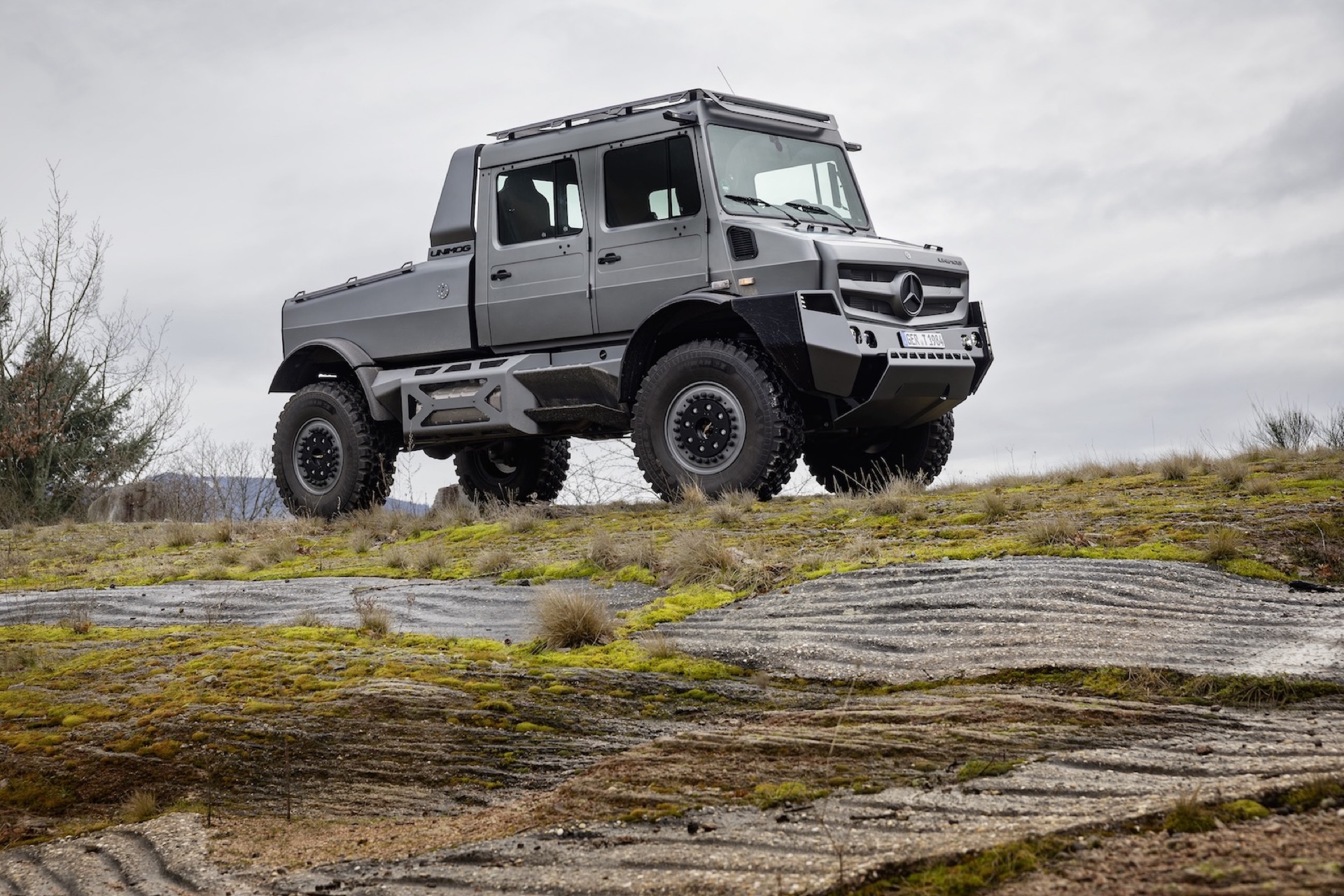
The Unimog has always been the ultimate all-round workhorse. Yet, to mark its 80th anniversary, the legendary utility machine shows a very different side. This one-off transforms the rugged icon into a luxury off-roader for those who already have everything for rough terrain.
Built for extremes. That is how Daimler Truck describes the Unimog. Whether serving with fire brigades, disaster relief units, winter services, mining operations or as an expedition vehicle in remote regions, it steps in when conventional transport fails and even serious off-roaders reach their limits. It has done so for eight decades.
Now those extremes extend beyond harsh weather and challenging terrain. The universal motor device enters the world of luxury. This special vehicle is effectively a celebratory statement for the model’s 80th birthday. To realise it, Daimler Truck collaborated with German Unimog specialist Hellgeth in Wurzbach. For years, the company has created bespoke Unimog conversions ranging from expedition vehicles to specialist commercial solutions. Demand is global, and discussions are already underway about turning this one-off into a limited series for clients who want something truly different.
Picture the scene. Instead of a Bentley or an AMG G-Class, a silver Unimog arrives at a Monaco hotel or casino. If it is allowed in, that is. The Unimog remains a commercial vehicle with a gross weight of 7.5 tonnes and stands nearly 2.9 metres tall, ruling out many urban streets and car parks. Even stepping out requires effort. Climbing down is no less dramatic than exiting a low supercar, only in reverse. There are no retractable steps here, just traditional grab handles and high-mounted footholds.
Mercedes-Benz Special Trucks Luxus Unimog Mercedes-Benz Special Trucks luxury Unimog
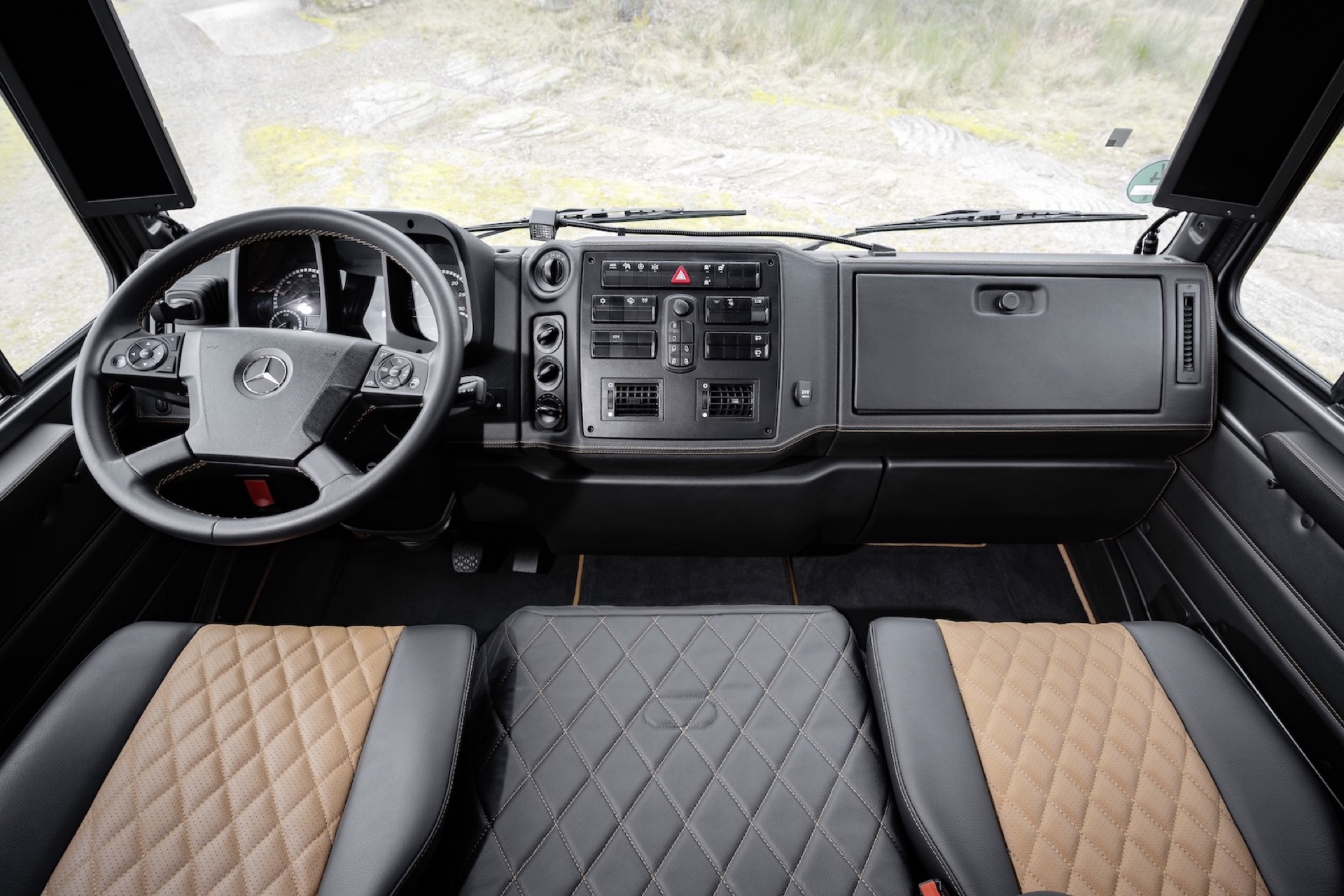
Inside, however, the experience is transformed. The double cab, normally seating seven, now features four air-suspended heated individual seats trimmed in quilted leather with decorative stitching. The wide centre console and split headliner match the same elegant finish, creating an ambience reminiscent of Maybach craftsmanship. Fully digital exterior mirrors enhance visibility, supported by mandatory blind spot cameras. The elevated seating position offers a commanding view over surrounding traffic.
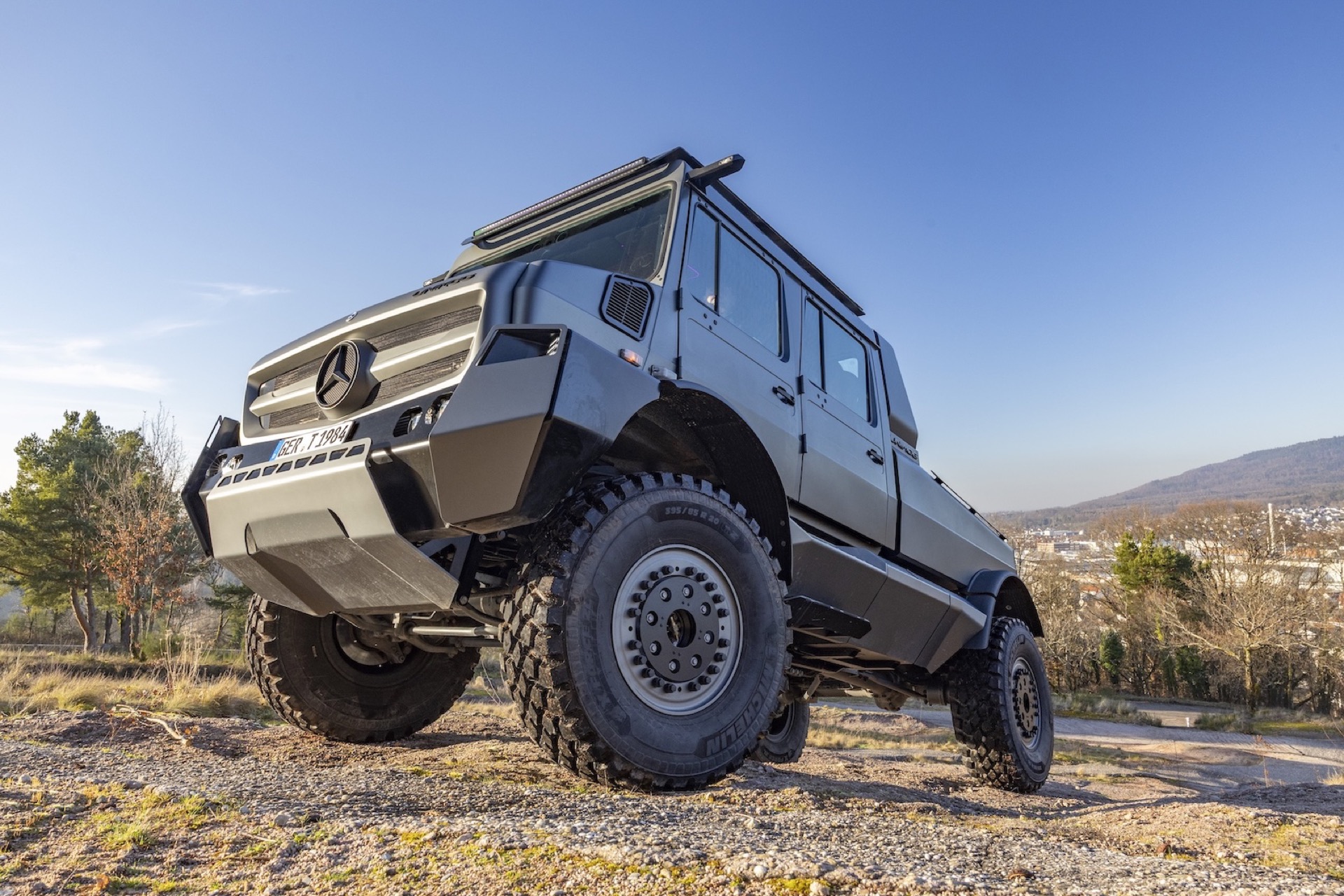
The exterior also receives a bespoke treatment. Revised bodywork, contemporary LED lighting and a matte metallic finish give the Unimog a distinctive presence, complemented by a sculpted rear bed. Practicality is not the priority here. This is about statement and capability.
Mercedes-Benz Special Trucks Luxus Unimog Mercedes-Benz Special Trucks luxury Unimog
And capability remains intact. Beneath the luxury lies authentic Unimog engineering. A new 7.7-litre inline six-cylinder engine produces 300 PS and 1,200 Nm of torque, more than typical for this highly capable series. The output prompted engineers to adopt permanent all-wheel drive rather than the usual selectable system. An automated hydraulic gearbox manages the eight forward gears, which can be split into 16 ratios with low range. Drivers can still intervene manually, even deploying a fold-out clutch pedal when terrain demands precise control.
With adjustable tyre pressure systems, beadlock wheels and three differential locks, the Unimog continues to conquer sand, mud and rock with ease. Its limits are few. Perhaps only the price sets a boundary. The base vehicle alone starts well beyond €250,000.
In the world of high-end real estate, luxury has long been defined by the tactile and the visible: the weight of a solid mahogany door, the gleam of bespoke brass hardware, or the meticulous landscaping that frames a grand entrance. However, as our homes evolve into integrated ecosystems of convenience, the definition of prestige is shifting toward ‘intelligent stewardship.’
True luxury today is found in the seamless removal of daily frictions. It is the ability to move through your world with effortless grace, knowing that your sanctuary is governed by technology that is as invisible as it is invincible. The front door, once a static barrier, is now the frontline of this digital transformation.
The New Standard of Entry
For decades, the traditional lock and key remained a charming, if somewhat archaic, ritual of homeownership. But in an era of instant connectivity, the inconvenience of fumbling for keys or worrying about spare copies has become a relic of the past.
To truly elevate your home’s entrance, your next manual hardware should be a smart deadbolt lock that marries classic structural integrity with modern intuition. This transition isn’t merely about tech for tech’s sake; it’s about refining the very first interaction you have with your home. By integrating smart technology into your architecture, you replace a mechanical chore with a sophisticated digital welcome.
Biometric Elegance and Precision
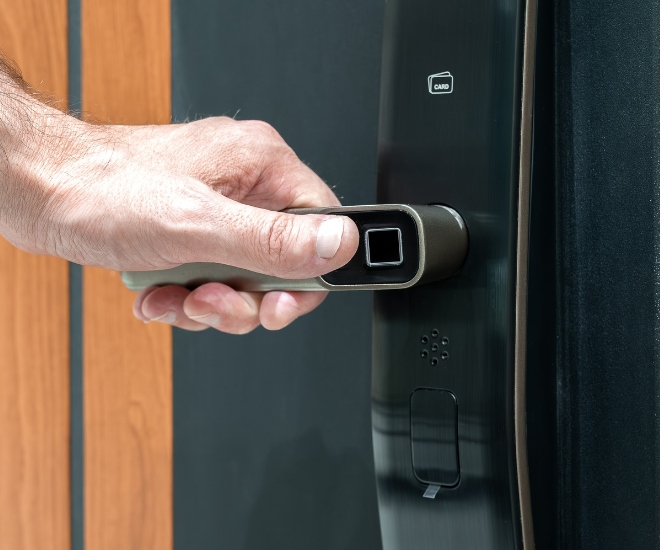
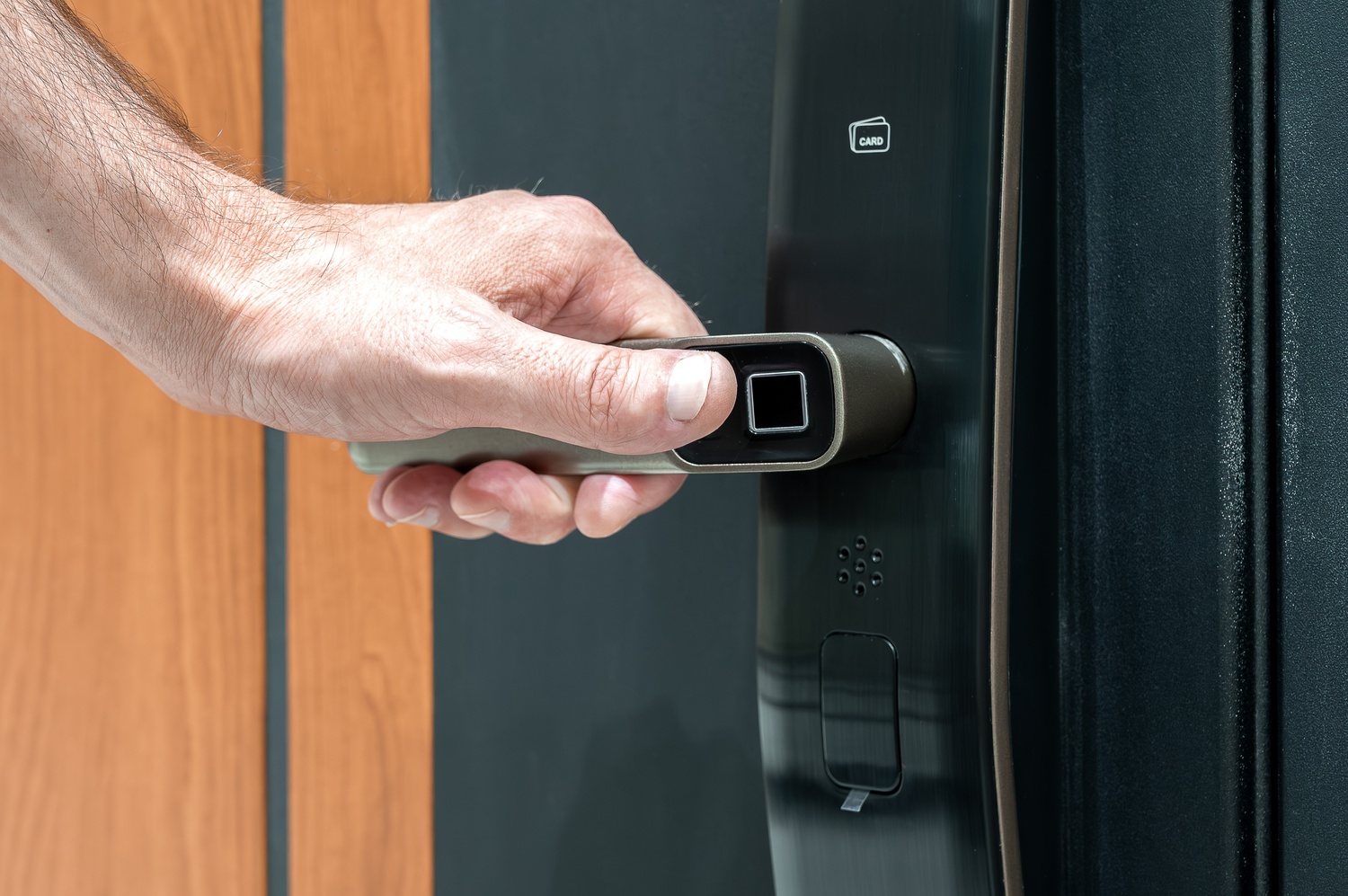
The most compelling advancement in modern entry systems is the move toward the personal. Forget codes that can be forgotten or cards that can be lost; the most secure key is one you already carry. Modern high-end locks now feature fingerprint access that utilizes 3D biometric sensors, often capable of recognizing a print in less than half a second. It’s a quiet, efficient nod to the ‘quiet luxury’ movement—where the most powerful features are those that don’t scream for attention but perform flawlessly every time you touch the handle.
Seamless Integration with the Digital Ecosystem
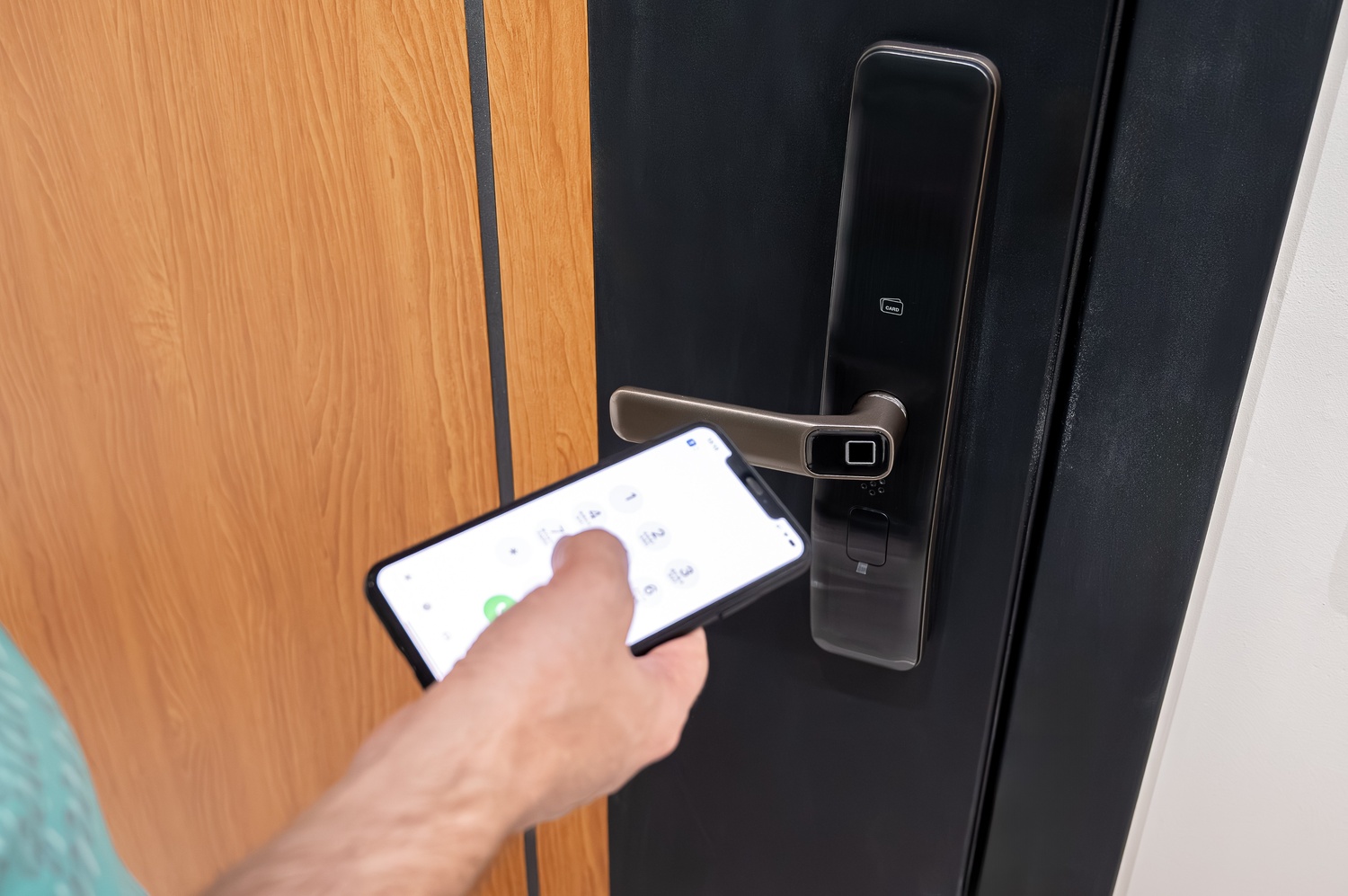
A luxury home is only as smart as its ability to communicate. The modern homeowner likely already manages their environment through an Apple Watch or a centralized tablet, and the front door should be no exception. High-performance locks now offer full compatibility with Apple Home, allowing your security to sit alongside your lighting and climate control. Whether you are checking the lock status via a voice assistant while finishing dinner or setting ‘Welcome Home’ scenes that activate the moment you cross the threshold, the lock becomes a vital node in your broader smart home network.
Hospitality Through Virtual Access
Luxury is often synonymous with hospitality, and a smart entry system allows you to extend that spirit to guests without the awkwardness of physical handovers. Through the use of virtual guest keys, you can grant temporary access to personal chefs, interior designers, or visiting family members directly from your smartphone. This eliminates the need for ‘hidden’ keys and provides a higher level of home security by ensuring that access is precisely timed and easily revoked. It transforms the way we host, making the arrival of a guest as smooth as a concierge-managed check-in at a five-star resort.
Monitoring with Discretion
For the discerning homeowner, information is the ultimate tool for peace of mind. You don’t need to be physically present to know that your estate is secure. Advanced smart lock features now include a comprehensive activity log, providing a digital breadcrumb trail of every entry and exit.
When paired with smart alerts, you receive instant notifications the moment a door is opened or if a mechanical jam occurs. It allows you to maintain a watchful eye on your property with total discretion, ensuring that the ‘stewardship’ of your home is data-driven and always under your control.
Design and Sustainability
The aesthetic of the smart lock has finally caught up to its intelligence. Gone are the bulky, plastic-heavy units of the early 2000s. Today’s premium deadbolts are crafted from high-grade alloys with finishes like satin nickel or matte black that complement contemporary architecture.
Furthermore, the move toward sustainability means many of these units now utilize a high-capacity rechargeable battery, reducing waste and ensuring that the lock remains powered for months on end. It is a thoughtful approach to design that respects both the environment and the visual harmony of your home’s exterior.
The Threshold of Modern Living
Ultimately, upgrading your front door is an investment in your quality of life. The shift toward a smarter entrance is a reflection of how we live now — valuing time, security, and the beauty of a frictionless existence. By choosing a system that prioritizes both form and function, you aren’t just installing a piece of hardware; you are setting the tone for the rest of your home. In the modern age, the most welcoming door is the one that recognises you, protects you, and disappears into the background of your lifestyle. It is, quite simply, the smartest kind of luxury.
The US residential clean energy market just went through one of its wildest six‑month stretches ever, according to EnergySage’s latest Home Electrification Marketplace Report.
For the first time, EnergySage’s flagship analysis report looks at whole‑home electrification, including EV chargers and heat pumps, using millions of homeowner shopping data points collected between July and December 2025.
The timing wasn’t random. After the One Big Beautiful Bill Act passed in July 2025 and eliminated the 30% federal tax credit for purchased residential solar systems installed after December 31, homeowners raced to lock in installations before the deadline. EnergySage reports a 205% year‑over‑year surge in homeowners actively working with installers, plus a record spike in inquiries. Many installers say they reached their annual capacity by October, forcing contractors and customers alike to make unusual decisions to finish projects on time.
Prices stayed steady despite massive demand
Even with the rush, prices stayed surprisingly stable. Solar costs rose just 0.4% to $2.49 per watt in the second half of 2025, while battery prices increased 3.6% to $1,074 per kilowatt‑hour. Most of those increases happened late in the year, after installer capacity tightened. EnergySage says transparent marketplace pricing helped keep costs from spiking, as they often do when demand suddenly outpaces supply.
Advertisement – scroll for more content
Equipment choices shifted as inventory ran tight
Supply constraints didn’t just affect timelines – they changed what equipment people installed. Higher‑wattage solar panels became harder to get, so installers leaned on whatever inventory was available. Quotes for 450–460-watt panels dropped from 33% to 26%, while the 430–440-watt range jumped from 8% to 30%. REC, previously the most quoted panel brand on the platform, fell from 43% market share to 20%.
In other words, homeowners prioritized installing solar before the tax credit deadline over choosing their ideal hardware.
Battery add‑ons dipped, but not because interest fell
Battery attachment rates slipped nationwide from 41% to 38%, even though interest barely changed, dropping only from 74% to 73%. The pattern was stronger in major storage markets: California fell from 79% to 71%, Texas from 61% to 53%, and Hawaii from 100% to 85%.
The takeaway is that many homeowners chose to install solar first and delay adding storage so they wouldn’t miss the federal incentive cutoff. That meant a large wave of new solar households could still add batteries later.
Solar installers are becoming electrification providers
The report also shows how contractor business models are changing. Among EV charger installers surveyed, 55% said chargers make up less than a quarter of their revenue. That signals that many companies are expanding into multiple electrification products rather than focusing on a single offering.
Homeowners appear to be thinking the same way. Instead of shopping for solar, storage, or EV charging individually, they’re increasingly planning coordinated home energy systems designed to control costs and improve resilience.
What happens now that incentives are gone?
With the tax credit gone for purchased systems, the market is shifting toward third‑party ownership models like leases and power purchase agreements, which remain eligible for the incentive through 2028 and are already gaining share on EnergySage’s platform. The company says future reports will track how that transition unfolds.
The bigger trend, though, is structural. Rising electricity demand, higher utility rates, extreme weather, and grid reliability concerns are pushing homeowners toward energy independence. That combination – cost savings plus resilience and control – is becoming the new driver of home electrification adoption.
Electrek’s Take
The late‑2025 solar rush is a case study in how looming tax credit cancellation deadlines can supercharge clean energy adoption practically overnight. Kill a tax credit, and you don’t necessarily kill demand – you just move it forward in time. (That doesn’t mean killing the solar tax credit wasn’t an utterly ridiculous decision, though; it was.)
As for what happens next, the report suggests the market isn’t slowing down so much as evolving. Instead of buying single products, homeowners are starting to think in systems: solar paired with storage, EV charging tied into rate‑optimized electricity schedules, and HVAC electrification bundled into the same plan. Plus, if a homeowner still wants the incentive, it’s still on the table if they lease.
The companies that succeed won’t just sell solar panels or batteries; they’ll be the ones that can design and manage whole home energy ecosystems. And if the past six months showed anything, it’s that homeowners are ready for a design-and-build level of control.
Read more: EIA: 62% more renewable energy capacity is coming in 2026
If you’ve ever considered going solar, make it easy by finding a trusted, reliable solar installer near you that offers competitive pricing by checking out EnergySage. It has hundreds of pre-vetted solar installers competing for your business, ensuring you get high-quality solutions and save 20-30% compared to going it alone. Plus, it’s free to use, and you won’t get sales calls until you select an installer and share your phone number with them.
Your personalized solar quotes are easy to compare online and you’ll get access to unbiased Energy Advisors to help you every step of the way. Get started here.
FTC: We use income earning auto affiliate links. More.
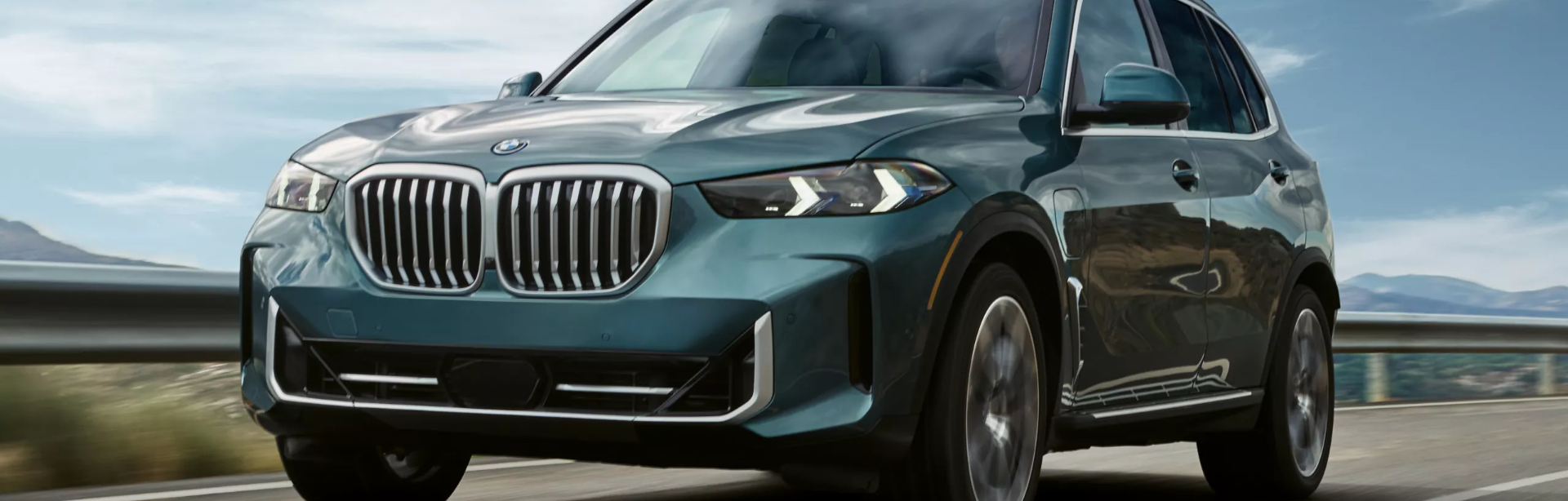
For drivers in Camp Springs, MD, and nearby areas like Alexandria, Upper Marlboro, and Waldorf, the choice between a new or a pre-owned BMW is significant and often daunting. At Passport BMW, we understand the local landscape, from the bustling traffic along the Capital Beltway to the quieter streets of Fort Washington. With our extensive experience helping residents navigate their options, we’re here to provide the guidance you need. Whether you’re looking for the latest features or the reliability of a certified pre-owned model, it’s essential to consider your budget and driving needs. Let us help you make an informed decision that aligns with your lifestyle and financial goals.
Why Should You Consider a New BMW for Life in Camp Springs?
A new BMW is a remarkable choice for those living in Camp Springs, offering cutting-edge technology, comprehensive warranty coverage, and the unique experience of being the first owner. These features are particularly appealing for drivers navigating the local landscape, whether commuting to Washington, D.C., or enjoying leisurely drives to nearby attractions.
What Are the Advantages of a New BMW for Local Commuters?
One of the standout benefits of a new BMW is its impressive performance and efficiency. Whether you’re navigating the busy Capital Beltway or making your way along Allentown Road, models like the BMW 3 Series and X3 provide exhilarating driving dynamics paired with fuel-efficient engines. This translates to fewer stops at the pump and a more enjoyable commute, especially during rush hours.
X3 30 xDrive provide exhilarating driving dynamics. The 2026 X3, for instance, delivers a refined 255 horsepower while achieving an impressive 33 MPG on the highway, ensuring fewer stops at the pump during rush hour.
Moreover, every new BMW comes with a comprehensive protection package that ensures peace of mind during your daily travels to Joint Base Andrews or the Camp Springs Shopping Center:
BMW New Vehicle Limited Warranty: Your vehicle is protected against defects in materials or workmanship for 4 years or 50,000 miles.
BMW Ultimate Care: Included at no cost, this program covers all factory-recommended scheduled maintenance for the first 3 years or 36,000 miles. This includes essential services such as:
Engine oil and filter changes
Brake fluid replacement
Engine air filter and cabin microfilter service
Spark plug replacement
Unlimited-Mileage Roadside Assistance: For the first 4 years, you enjoy 24/7 roadside support with no mileage restrictions, providing a safety net for every local commute or long-distance trip.
By combining cutting-edge engineering with standard maintenance coverage, a new BMW allows you to focus on the joy of driving rather than the cost of upkeep.
How Do New BMW Vehicles Handle MD’s Weather?
Maryland’s climate can range from hot, humid summers to rainy winters, with occasional icy conditions. Fortunately, new BMWs are designed to tackle these challenges effectively. For example, the BMW X5 and X3 feature intelligent all-wheel drive systems that enhance traction on slippery roads, making them reliable options for winter driving in neighborhoods like Suitland-Silver Hill.
Advanced Safety Features: Many new BMWs come equipped with the latest safety technology, such as Active Driving Assistant, which includes features like lane departure warning and collision detection. These systems offer an extra layer of security, especially during sudden downpours on the Capital Beltway or when navigating local highways.
All-Weather Capability: Models like the BMW X1 and X5 are designed with performance in mind, providing stability and control in varying weather conditions. Whether you’re heading to Oxon Cove Park on a sunny day or dealing with wet roads during a winter storm, these vehicles are built to maintain confidence on the road. For more information on BMW’s latest models and features, visit BMW USA.
Is a Pre-Owned BMW a Smarter Choice for Camp Springs Drivers?
For many buyers in Camp Springs, a pre-owned BMW strikes the perfect balance between value, reliability, and modern features. With BMW’s reputation for engineering excellence, selecting a well-maintained pre-owned model can offer a rewarding driving experience for years to come.
How Does a Pre-Owned BMW Maximize Your Budget?
Choosing a pre-owned BMW can significantly enhance your financial flexibility. New vehicles typically face the most drastic depreciation during their first few years, meaning that by opting for a pre-owned car, you benefit from the initial drop in value. Websites like Kelley Blue Book highlight that this choice can save you a substantial amount compared to purchasing new.
This financial advantage allows you to:
Upgrade Your Model: With the same budget, you might trade a new base-model X1 for a pre-owned X3, gaining added space and features that enhance your driving experience.
Access Higher Trims: You could elevate your choice to a higher trim like the X5 with amenities such as advanced driver-assist systems, premium sound, and luxurious interiors—ideal for weekend trips to National Harbor or drives along the Capital Beltway.
Lower Ownership Costs: A lower purchase price typically translates into smaller loan amounts and more manageable monthly payments, allowing you to allocate your budget towards other essentials or leisure activities.
Can You Still Get Modern Features and Reliability?
Absolutely! Choosing a BMW Certified Pre-Owned (CPO) vehicle ensures you receive a “like-new” experience without the new-car price tag. To qualify for this prestigious distinction, late-model vehicles must have more than 300 miles but fewer than 60,000 miles on the odometer. Each vehicle undergoes a rigorous 360° inspection conducted by factory-trained BMW technicians, ensuring it meets strict standards for safety, performance, and wear.
BMW CPO vehicles come with a comprehensive suite of benefits designed for total peace of mind:
BMW Certified Limited Warranty: Once your 4-year/50,000-mile New Vehicle Limited Warranty expires, the CPO warranty provides an additional 1 year of comprehensive coverage with unlimited miles. This factory-backed protection ensures you are covered for major components including the engine, transmission, and electrical systems.
24/7 Roadside Assistance: You are protected for up to 6 years from the vehicle’s original in-service date with no mileage restrictions. Whether you’re commuting along Allentown Road or exploring Henson Creek, help with towing, jump-starts, or lockout service is always a call away.
Reconditioned with Genuine BMW Parts: Every CPO vehicle is restored using only Genuine BMW Parts, maintaining the integrity and high-performance standards of “The Ultimate Driving Machine.”
Vehicle History Report: You will receive a detailed CARFAX™ or AutoCheck® report, providing a transparent look at the vehicle’s service history and previous ownership before you sign.
Complimentary Trial of SiriusXM: Enjoy three months of commercial-free music, sports, and talk radio to enhance your drives around the Capital Beltway.
Which BMW Model is Right for Your Camp Springs Lifestyle?
Whether you opt for a new or pre-owned vehicle, BMW has a model that perfectly aligns with the diverse needs of drivers in Camp Springs and surrounding areas.
For the Daily Commuter and Small Family
The BMW 3 Series and BMW X1 make excellent choices for daily commuters and small families navigating the busy roads of Camp Springs. The 3 Series sedan boasts agile handling and impressive fuel efficiency, making it ideal for the daily slog along the Capital Beltway or Allentown Road. Meanwhile, the X1, with its compact SUV versatility, offers additional cargo space for family outings to nearby Henson Creek Park or the Camp Springs Shopping Center, ensuring comfort and practicality for every drive.
For the Adventurous Family
Active families will find the BMW X5 and BMW X3 to be perfect companions for weekend adventures. Both models offer ample cargo space and available all-wheel drive, which is essential for navigating winter roads or heading out for outdoor activities at Oxon Cove Park. Whether you’re loading up for a camping trip or planning a fun day at the National Harbor, the X5 and X3 provide the versatility and comfort needed for family fun.
For Hauling and Tough Jobs
For those requiring hauling and towing capabilities or job-site versatility, the BMW X5 stands out with its excellent towing capacity and spacious interior. Its smooth ride provides comfort on long trips along US-301, while still being rugged enough for your work needs. Equipped with advanced safety features, the X5 ensures confidence whether you’re transporting gear for a project or heading to a tailgate. To learn more about different models and their features, visit Consumer Reports.
Frequently Asked Questions (FAQs)
How do I begin the process of buying a BMW?
Start by identifying what you need in a vehicle, considering your daily drives around Camp Springs and nearby areas. Explore BMW’s website to find models that fit your lifestyle, then visit a local dealership to learn more and schedule a test drive.
What should I consider when determining my budget for a new BMW?
Using an online auto loan calculator can help you estimate monthly payments based on the vehicle price, down payment, and interest rate. Don’t forget to include costs like insurance, fuel, and maintenance, and getting pre-approved for a loan can clarify your budget range for shopping.
What’s the difference between lower and higher trims in BMW models?
Trim levels offer varying features and amenities. For example, the base trim of the BMW X3 provides essential tech, while higher trims like the M Sport offer enhanced performance features and luxury upgrades, perfect for drivers seeking a more premium experience on the Capital Beltway.
How many miles is considered “too many” for a pre-owned BMW?
While BMWs are built for longevity and can exceed 200,000 miles with proper care, focus on maintenance history and overall condition rather than just mileage. A well-maintained higher-mileage BMW might be a better option than a low-mileage car with an unclear service record.
What should I pay attention to during a test drive of a BMW?
During your test drive, observe how the car accelerates, brakes, and handles on roads similar to your usual routes, like Allentown Road or Suitland Road. Also, check the comfort of the seats, visibility, and the functionality of tech features to ensure a good fit for your daily needs.
Is leasing or buying a BMW a better option for me?
If you plan to keep your car long-term and want to build equity, buying is often the way to go. Leasing can offer lower monthly payments and the chance to drive a new car more frequently, but it comes with mileage restrictions and no ownership at the end, so consider your driving habits and financial goals.
About Passport BMW
Since 1991, our family-owned team at Passport BMW has been dedicated to serving our community with a superior car-buying experience. Our commitment to excellence has earned us the prestigious Center of Excellence Award multiple times, highlighting our expertise in all things BMW. We offer unique benefits like no-haggle pricing, home delivery, and mobile service vans to make your life easier. As experts, we provide detailed information and a transparent process so you can feel confident in your decisions. Trust our award-winning team to deliver the quality and care you deserve for your automotive needs.
Related Articles:
A DC Driver’s Guide to Choosing the Right BMW Dealership
The Definitive Guide to Selecting Your BMW in the Washington DC Metro Area
Posted in
Uncategorized |
Comments Off on Should You Buy a New or Used BMW in Camp Springs, MD
Last week, we had reported that Ferrari was planning to roll out the Amalfi Spider in the first half of next month. Well, we can now confirm that the new convertible will be revealed on March 12, 2026.
The Ferrari Amalfi made its global debut in July last year, as the successor to the Roma. We will see the same evolutionary design on the Spider, except for the fixed roof, which will be replaced with a retractable fabric roof.
The Amalfi Spider will feature the shark-nose-style front end with a long hood, muscular fenders and sleek taillights. While the rear decklid will be modified to accommodate the roof mechanism, the rear fascia is likely to remain unchanged. It will also get the same upgraded interior as the coupe.
The Amalfi Spider will be powered by the same 3.9-liter twin-turbo V8 engine, which makes 631 hp and 561 lb-ft of torque. It comes paired with an 8-speed dual-clutch automatic. It will be equipped with Ferrari’s new brake-by-wire system, an active rear spoiler and Side Slip Control 6.1.
“What’s my RV worth?” It’s the critical question every owner faces before selling or trading in a camper—and one every savvy buyer asks when looking for a fair deal. Knowing the answer, or as close as possible, empowers you to get the best RV value when selling, or avoid overpaying for a used RV.
This guide explores the most respected valuation tools available online, which use real-time market data and key factors like brand, condition, and mileage to help you determine an accurate value for your RV—and, in some cases, a direct option to sell, trade, or consign your RV.
Full disclosure: The Good Sam RV Valuator is part of the Camping World family of brands. We’ll explain how it works alongside other respected tools like NADA Guides / J.D. Power Vehicle Valuation, so you can evaluate your options and choose what’s right for you.
How Are RV Values Determined?
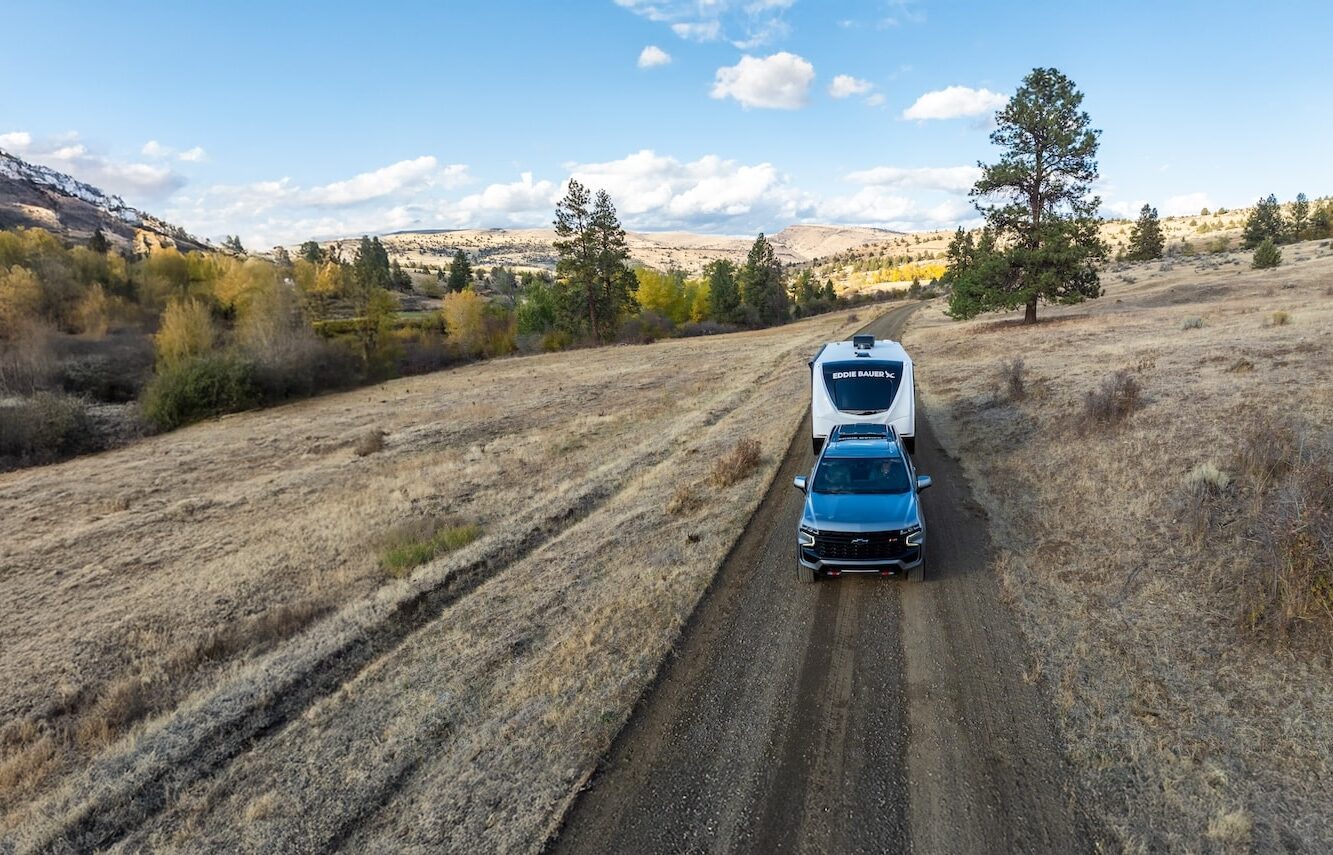
Image by Camping World
Before diving into specific tools, it helps to understand how RV values are calculated.
Most RV valuation tools use a combination of:
Recent sales of comparable models
Wholesale and retail transaction data
Current market demand
Geographic trends
Model year, trim level, and options
Reported condition and mileage (for motorized RVs)
Dealers also factor in reconditioning costs, transportation, warranty eligibility, and local resale demand when determining trade-in values. Because of those added expenses and risks, trade-in offers are typically lower than the prices you see advertised for resale.
Understanding that distinction can help set realistic expectations when comparing private-sale pricing to a dealer’s trade-in offer.
How RV Depreciation Works
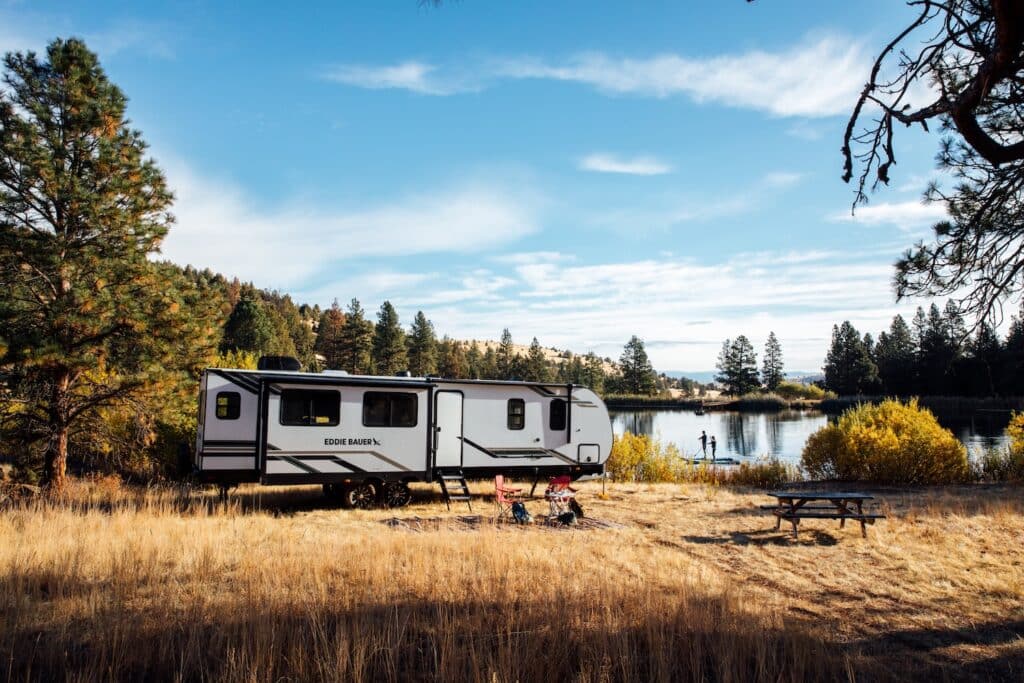
Image by The Outbound Life
RVs depreciate over time, like other vehicles. Just like a car, the steepest depreciation occurs the moment you drive it off the lot, when it becomes used, and then over the first few years of ownership. After that initial period, the RV depreciation schedule generally slows and becomes more gradual.
Several factors influence how quickly an RV depreciates:
RV type (motorhomes often depreciate differently than travel trailers or fifth wheels)
Brand reputation and long-term durability
Overall condition and maintenance history
Mileage (for motorized models)
Market demand and seasonality
Well-maintained RVs with documented service history and desirable floor plans often retain value better than comparable models without those advantages. Market conditions also play a role—values may fluctuate based on supply levels and buyer demand in a given season.
Considering depreciation provides important context when reviewing valuation estimates. It helps explain why your RV’s current market value may differ from its original purchase price—and why multiple tools may produce slightly different figures.
What Is My Used RV Value?
There are several RV value estimation tools that can help you find an accurate used RV value. Most work by providing your VIN or the RV’s year, make, and model. At a basic level, these RV value calculators account for recent sales to see what others have paid for a similar RV in similar condition.
Perhaps you know Kelley Blue Book as a trusted resource for automobile valuation. This tool works in a similar way to RV value calculators, but you won’t find a Kelley Blue Book for RVs—at least, not by that name. Instead, there are RV-specific valuation tools that provide similar real-time market value by sourcing thousands of previous transactions and market factors.
For example, Good Sam’s RV Value Calculator and the J.D. Power Vehicle Valuation Tool (formerly NADA, National Automobile Dealers Association valuator) are two of the most widely used and respected calculators.
Depending on your situation, each tool offers specific advantages. In fact, it’s smart to consider several valuation tools to get a well-rounded understanding of your RV’s value and what might affect it.
Below is a quick chart comparing the Good Sam Valuator tool with the NADA RV value tool.
Feature
Good Sam RV Valuator
NADA Guides (from J.D. Power)
Best For
A quick, accurate, streamlined estimate and a direct connection to a sales specialist.
A detailed, granular valuation where you can add or remove specific options.
Process
Simple, 3-step process to get an initial offer.
Multi-screen process that allows for deep customization.
Result
Provides a direct offer and specialist follow-up for trade-in or sale.
Shows suggested list price, low retail, and average retail values.
Data
Proprietary dataset from the RV industry.
Data from the National Automobile Dealers Association.
How the Good Sam RV Valuator Works
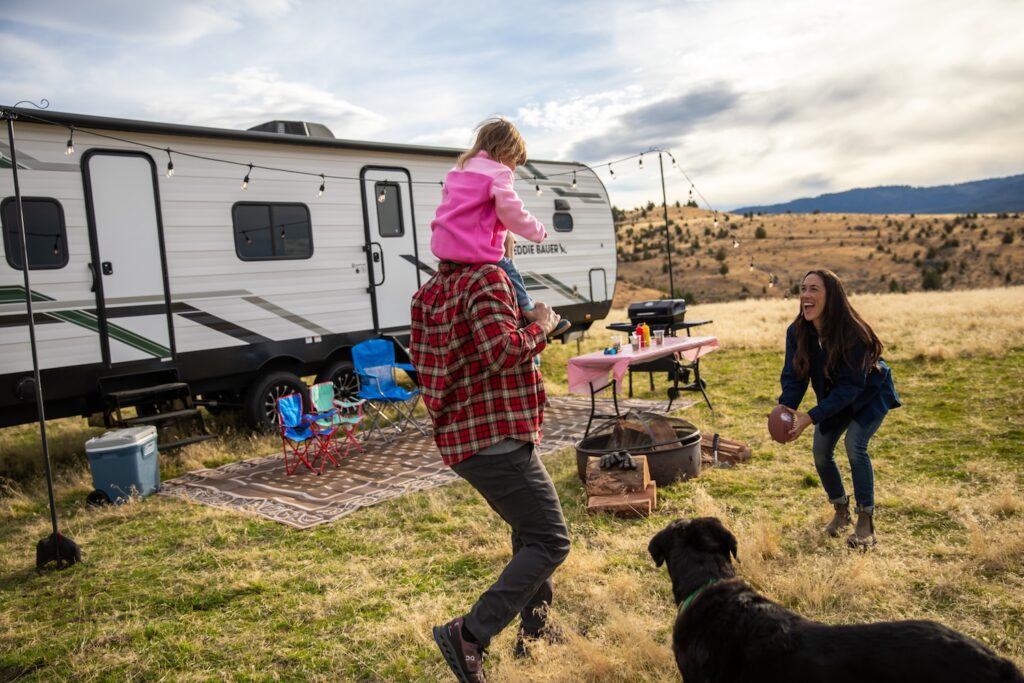
Image by Camping World
The Good Sam RV Valuator is designed specifically for RV owners looking to trade in, sell to a dealership, sell through a dealer — or even sell privately. Some of its advantages include:
Made specifically for the RV industry
Pulls from the largest proprietary RV dataset
Incorporates real-time local marketplace demand trends
Accesses new and used wholesale and retail RV pricing
Accounts for unique, vintage, and customized RVs
Is an easy-to-use, ad-free platform
To begin the process, you’ll need the following information. Be as accurate as possible, as these factors will help determine what your RV may go for.
RV Information
Year
Make
Model
Trim
Condition
You’ll also select its condition (Excellent, Good, Average, or Fair) and answer Yes or No to a series of questions. Finally, you’ll select the nature of your inquiry.
Personal Information
First and Last Name
Email Address
Phone Number
Zip Code
You may be asked to provide additional details, such as completing a quick self-inspection to showcase more about your RV’s condition. Shortly thereafter, you will receive a price range for your RV’s value. If you are looking to sell, an RV sales specialist will contact you with an official offer that remains good for seven days. You can then easily arrange for drop-off or pick-up and choose a payment method if selling.
How to Find NADA Values
The National Automobile Dealers Association (NADA) has represented new car dealers for over 100 years. While its primary focus has always been the automotive industry, NADA Guides has also become a widely recognized source for used RV values.
In 2015, J.D. Power acquired the NADA Used Car Guide business. Today, vehicle valuations formerly known as “NADA values” are provided through J.D. Power, though many consumers and dealers still use the NADA name out of habit.
For RVs specifically, J.D. Power valuations typically include a suggested list price, low retail value, and average retail value. One advantage of the platform is the ability to research base pricing and adjust for factory-installed features and options, allowing for a more tailored valuation.
When you arrive, you’ll find a Get A Value link for consumers. Follow that link; it will take you to the JD Power RV Value website. From there, these are the required steps:
Select RVs from the header to ensure you’re searching the proper database
Select your RV type
Choose from the dropdown of the Top 50 manufacturers or their complete dropdown of all RV manufacturers
Input the make and year
Enter your zip code
Select RV options or choose to see Base Pricing
If you choose Base Pricing, you’ll see the suggested RV list price, the low retail price, and the average retail price. If you select RV options, you’ll see an itemized list with those three prices and how your chosen options impact the suggested NADA RV value for your used RV.
While the pricing information can be useful for research, it does not provide a direct offer or connect you with a buyer.
What Is My RV Trade-In Value?
Image by Camping World
Your RV’s trade-in value is the amount a dealer is willing to offer to purchase your RV directly. Unlike retail listing prices, which reflect what a seller hopes to receive on the open market, a trade-in offer reflects wholesale market value and accounts for inspection, reconditioning, resale demand, and market risk.
As a result, trade-in values are typically lower than private-sale asking prices. However, they also eliminate the time, uncertainty, and potential complications of selling on your own. There’s no need to create listings, meet with buyers, negotiate financing, or handle paperwork independently.
For many owners, the convenience, speed, and certainty of a trade-in offer outweigh the possibility of securing a slightly higher price through a private sale—especially when upgrading to a new RV.
If you’re considering trading in your RV, using a valuation tool that connects you directly with a dealer can provide a realistic starting point and a clear path forward.
What Affects RV Value?
Image by Camping World
The valuation tools above provide a strong starting point. However, real-world market conditions and individual buyer preferences can still influence the final sale price.
Reviewing comparable listings offers helpful context, but asking prices do not guarantee what an RV will ultimately sell for. They simply show what other sellers are hoping to receive in the current market.
Beyond broad market data, consider what makes your RV stand out. Certain features may increase buyer interest—even if they don’t dramatically change the estimated book value.
Factors that can influence buyer perception include:
Upgrades — Did you recently update any appliances or make improvements? New appliances or improvements may influence the price.
Warranty/Extended Warranty — Certain warranties and extended warranties may transfer to a second owner.
Brand — Choosing a reputable RV brand may help minimize depreciation over time, preserving more of your RV’s value from the moment of purchase.
Service History — Detailed service and maintenance records show the RV has been properly cared for, reducing the risk for potential buyers.
Regional Preferences — Certain RV types or brands may be more popular in specific regions, influenced by regional climates and terrain.
Seasonal Demand — RV values can fluctuate with the seasons, with higher demand and potentially better resale value in spring and summer.
Ultimately, understanding your RV’s market value puts you in control—whether you plan to sell privately or trade toward your next upgrade.
If convenience, speed, and certainty matter most, start your RV sale or trade online today.
For owners who prefer managing a private sale, marketplaces like RVs.com can also help connect you with potential buyers.
If you’re preparing to buy a used RV, sell, or trade in, here are a few additional resources:
Do you have any questions about how to find out what your RV is worth? Let us know in the comments below.
Shielded cables are often used in electric vehicles to prevent the effects of high shield currents, such as cable fires. Detailed measurements of the shield currents—especially during test drives help to verify whether the cables are properly designed.
Join this webinar at our March Virtual Conference on EV Engineering, presented by Vector, to learn how the HV BM 1.2+S simultaneously acquires inner conductor and shield currents at a data rate of 1 MHz via EtherCAT®, with a robust design that is ideal for harsh environments.
Mar 11, 2026, 11:45 am EDT Register now—it’s free!
See the complete session list for the Virtual Conference on EV Engineering here.
Broadcast live from March 9 to 12, 2026, the conference content will encompass the entire EV engineering supply chain and ecosystem, including motor and power electronics design and manufacturing, cell development, battery systems, testing, powertrains, thermal management, circuit protection, wire and cable, EMI/EMC and more.
This post may contain affiliate links. See our affiliate disclaimer here.
Alyssa here this sunny afternoon sharing some big news + what I’ve decided is my new favorite video of our time in Japan.
Watching it, I burst out laughing at least 20 times and also cried at Eli speaking Japanese. Or, at least, as much Japanese as an 18-month-old can muster.
Highly recommend you end your week with some giggles and gorgeous scenery in our latest video driving the forgotten coastline of Japan.
OKAY ONTO THE BIG NEWS…
But first, the wind-up, because this story dates back three years.
2020 was a particularly crazy year for us.
Heath raised big money to keep Campground Booking growing.
We were searching for—and found—property to build a campground.
We bought a house near said property so that we could have our own space while we were under construction and while we were hopefully growing baby #2.
Plus it was 2020.
It was a year of major life decisions.
Well, you may know how all those things worked out.
But if you don’t… TL;DR, we sold everything so we could spend time traveling together as a family of four.
Last year we spent four months traveling abroad and barely spent half of the year actually in our house.
Which had me asking Heath…
Why do we live in a house again? 🤔
After a lot of back and forth, we decided in traditional Padgett fashion to blow up our life plans and start from scratch.
We’re already taking multiple months out of the year to go abroad. Why not sell the house, pocket the money, and travel the world?
So the day before leaving for Japan in April, we met with a realtor and listed our house for sale.
Then interest rates skyrocketed so we pivoted and found renters for our house instead.
This was one of those moments where we could say “No one is buying houses right now. We shouldn’t sell. Let’s just stay home.”
Or we could say “How can we still make this travel dream happen?” and go for it anyway.
Heath sends me potential Airbnbs from Zillow basically daily so this killed two birds with one stone. Heath can have his “rental investment property” and I don’t have to ever say things like “babe we really need to weed eat over here.”
So behind the scenes, while we’ve been sharing videos of Japan and stories behind how we’re growing our new business, I’ve been packing up the house.
And in a few weeks, we’ll become full-time nomads again…this time, with two kids in tow!
In so many ways, the past year of our lives has felt like undoing and revisiting all the decisions we made in the tumultuous year that was 2020. It’s been our year of selling off the old businesses, shedding the house, and chasing after the things we love most in life.
It feels like hitting the play button after having life on pause for a bit. Well, not on pause, but just after a slower season.
Heath and I both have fears about what we’re stepping into. Having a home to come back to after travels has felt incredibly comfortable for us. However, we’ve always dreamt of spending extended time abroad, so why not do it now?
Our plans are relatively fluid, but we do have two major commitments for the upcoming season of our lives:
1. Two weeks in a motorhome in the UK.
We’re SO pumped about this trip. We’ll be doing a trip partnered with Brit Stops (think Harvest Hosts but in England 🍻 ) where we’ll be touring around the backcountry of London and overeating fish and chips (Heath especially is excited about the last part).
2. Spending our fall in Portugal with a program called Boundless Life.
A year ago, some of our friends spent three months with their kids in a program called Boundless. It’s for digital nomad families. There’s a school for the kids, a coworking space for us, and lots of community events with other families.
We did our diligence on the school and decided to give it a try, so we’ll be living in Portugal for 3 months this fall. 😬
This is not the first or (probably) the last time Heath and I have blown up our life plans in favor of adventure.
Life is short.
We want to take full advantage of traveling while we have our health and the ability to spend quality time together as a family.
If you’re still here at the end, thank you so much for being a part of our little online community. The emails we receive from you all mean the world 💜
A Theme Tuesday post in 2026? I know, weird, right? However, as I mentioned in my previous post, a lot of my Motorama 2025 content got lost in the vortex of a sinking (now sunk) ship.
With this year’s event just around the corner, I’ve decided to liberate many of these photos. Think of this post as a multi-part version of the event preview posts I used to do way back in 2010/2012.
Now I’m humbly aware that I’m known for three photo types: straight-on engine bay shots, rear three-quarter shots and profile shots.
Unimaginative? Perhaps, but I think those shots are mandatory to properly present a car to someone who can’t see it firsthand.
For everything that needs to co-exist under the hood of a functioning vehicle, it’s very easy for an engine bay to look cluttered, and I’ve always appreciated those who go the extra mile to make them look presentable.
On his show Bitchin’ Rides, Dave Kindig has often referred to the engine bay as the ‘jewelry box’, and I agree. If you choose to keep it open at a show, it should set the stage for the motor sitting in the middle.
I also think a good head-scratcher of a build is worth some love in a post like this too. Like this Detroit Diesel-powered extended Ford Model A known as the Screamin’ Jimmy.
It was parked darn near right next to my truck, and I got to take a look at it a few times as well as have some great conversations with the owner and builder.
So, with all that being said, here are a few of the engine bays from Motorama 2025 that stood out to me.
The clean, the wild, the creative and everything in between. Questions about anything you see here? Let me know. I still have all of my notes from 2025, and I can definitely help out. One or two will be in follow-up posts I have planned as well!