A judge has given permission for around 15,000 Scottish drivers to pursue a US-style class action compensation claim against AM100 dealership group Arnold Clark over a dark web data breach in 2023.
Lord Sandison has allowed thousands of consumers to bring group proceedings at the Court of Session, Scotland’s highest civil court, after hearing evidence earlier this year over how the Scottish car dealership had failed to protect customers’ personal information.
Court backs Scottish claims route
In the latest case, a man called Robert Adamson applied to the Court of Session to raise the action for himself and the other drivers following the cyber attack on Arnold Clark’s IT systems in December 2022. The details held by the firm are believed to include copies of passports and drivers’ licences. Names, dates of birth, vehicle details, contact details and National Insurance numbers could also have been taken.
Arnold Clark’s lawyer, Roddy Dunlop KC, had asked for permission not to be granted to the drivers to proceed, telling Lord Sandison that a similar action was being heard at the High Court in London involving other customers. He argued that it would be more appropriate for the Scottish drivers to join in the English action.
However, in a written judgment published by the court on April 16, Lord Sandison rejected the arguments made to him by Arnold Clark’s legal team.
“The application of those legal principles in order to determine the natural forum for the ventilation and determination of the case which the applicant wishes to bring before this case is very straightforward,” he wrote.
“Over 95% of the group members in the proposed litigation are domiciled in Scotland. They entered into a contractual relationship in Scotland with a company registered here, which was governed by Scots law.
“As a consequence of their domicile, the loss and damage for which they seek compensation was suffered, on the hypothesis upon which their case proceeds, in Scotland. Nothing about their situation has any nexus whatsoever with England. The forum with the most real and substantial connection to the dispute, and that which is clearly more appropriate to deal with it, is this court.”
Scale of breach raises concerns
Data protection laws state that people can claim compensation from any organisation that breaches those laws, including for any damage or distress caused.
Solicitors Thompsons told The Sunday Post newspaper it had been approached by more than 5,000 people who had received a letter from Arnold Clark advising them that their personal data had been compromised.
Patrick McGuire, a partner at the firm, told the newspaper: “I think this is the tip of the iceberg. The most financially sensitive data has been posted on the dark web and certainly includes data that would allow criminals to steal people’s identities and open fraudulent bank accounts. Our clients are understandably very worried.”
Solicitors Jones Whyte, which has its headquarters in Glasgow, said it had also been contacted by more than 1,000 people who may have been affected and that this number was “continuing to rise by the day”.
Customers were emailed in late January about the UK-wide hack that happened on December 23 which forced the business to close down its entire computer network on Christmas Eve.
Ensure you always receive AM insights. Make us a preferred source of news on Google
Motorhomes come in all different types, shapes, and sizes — but at baseline, they can be separated into three distinct categories: Class A, Class B, and Class C. Class A RVs are large, bus-shaped motorcoaches, whereas Class B RVs are smaller and more nimble (sometimes known as camper vans). Class Cs are somewhere in the middle: they can be large, but they’re built into a traditional pickup truck chassis, making them relatively easy to drive for beginners.
Of course, the real question isn’t just what the differences are between these styles of motorhomes. It’s how to determine which of these different types of RVs might work best for your travel needs. (Psst: One of the best things about renting an RV on the peer-to-peer market is that you can choose from a wide variety of styles and classes, so you can try out all the different classes.)
Class A vs. Class B. vs. Class C RVs: At A Glance
While we’ll dive deeper into the specific differences between these types of rigs below, here’s a quick at-a-glance comparison table to get you oriented.
RV Type
Class A
Class B
Class C
Size
26–45 feet
17–24 feet
20–33 feet
Sleeping Capacity
6–10+
1–2 (maybe plus one or two small children)
4–8
Mileage
6–10 MPG
15–22 MPG
8V13 MPG
Unique Features
Largest and most luxurious motorhomes, often with multiple slideouts and features like fireplaces, bath tubs, etc
Smallest drivable RVs, making it easier to navigate down narrow, rugged roads or stealth camp in cities
Cab-over sleeping or storage area; built into a regular truck chassis
Best For
RVers looking to enjoy all the comforts of home from the road
Solo campers, couples or very small families who don’t mind cramped quarters for access to adventure
Families or couples looking for space and comfort without driving challenges
What is a Class A RV?
Class A RVs are large, often luxurious motorcoaches (meaning you can drive them rather than tow them). They generally measure between about 26 feet and 45 feet long, though they’re most commonly between 35 and 40 feet.
Class A RVs are usually built into commercial truck or bus chassis, which means they have lots of power to haul around the weight of all their luxurious features. (And we do mean luxurious: Class A RVs have been known to offer multiple bedrooms, granite countertops, working fireplaces, full-sized bath tubs, king-sized master beds, and more.)
However, vehicles this large can sometimes be challenging or intimidating to learn to drive for some RVers. They also may not be able to navigate into certain campgrounds, where space is limited or access roads are too narrow for a turnaround.
But for campers who are mostly looking to enjoy luxurious, private accommodations in developed RV campgrounds with hookups, Class A RVs are the top pick for comfort. They also make it easy to travel with a family with older children, where some privacy and separation could be a comfort. They’re a good pick for big traveling parties of friends, too, and can sometimes sleep up to 10 campers or more (if you’re willing to share beds).
When is a Class A RV Best?
Class A RVs are for campers who want to pack a punch in terms of luxury and comfort — for travelers who truly want to feel as though they’re road tripping with their whole home along for the ride.
On the other hand, if you’re hoping to explore remote, off-grid locations that may only be accessible via unpaved, narrow roads, a Class A RV may cut off your access. Many undeveloped campgrounds and boondocking sites simply can’t accommodate such large vehicles.
What is a Class B RV?
A Class B RV is a smaller motorhome, often otherwise known as a camper van or sleeper van. These RVs are, as their alternate names suggest, often built onto commercial van chassis, or converted from an existing van like a VW van, Mercedes Sprinter, Ford Transit, or Ram ProMaster.
Class B RVs are, perhaps obviously, small. Many of them don’t contain onboard bathroom facilities, and there isn’t room for lots of fancy extra features, necessitating a more rugged experience. But for solo travelers, couples, or families with one or two small children, a Class B RV can make it possible to get out into the wilder parts of the country relatively easily and affordably. They are also popular among young, solo full-timers who favor a more adventurous lifestyle, camping in and around state and national parks.
When is a Class B RV Best?
Class B RVs are best for solo travelers, couples, and small families that don’t mind cramped quarters. They’re also good for shorter-term trips and those that require navigating down narrow or unpaved roads, or camping in remote, off-grid locations (such as boondocking on BLM lands).
What is a Class C RV?
Class C RVs are something like a happy medium between Class As and Class Bs. They’re large-ish, often measuring up to 33 feet long, and they often have some luxury features, such as queen-sized beds with plush mattresses, full kitchens, onboard bathroom and shower facilities, and more.
However, Class C RVs are usually built into a traditional pickup truck chassis, making them relatively easy to drive for beginners. They also have a handy (and iconic) over-cab area that is often set up for either extra sleeping space (perfect for kids) or storage.
When is a Class C RV Best?
Along with the other ways they land in the middle between Class A and Class B RVs, Class C RVs are also a perfect middle-way choice for camping trips that can benefit from the creature comforts of home but also require a vehicle with a little bit more capacity to get out there, so to speak. In other words, they’re really adaptable to most travel styles.
Class C RVs are, therefore, a common choice for a first RV for younger families, and are also often more affordable than Class A RVs to rent or own.
What Other Types of RVs Are There?
The classes we’ve described above pertain specifically to motorhomes, which are drivable RVs. There’s a whole ‘nother category of RVs, too: towable RVs, otherwise known as travel trailers.
While almost all towable RVs can be referred to simply as travel trailers, there are also some specific types, such as fifth wheel travel trailers (the largest and most luxurious of the bunch — sometimes even larger and nicer than Class A motorhomes!). However, trailers run the gamut from tiny, soft-sided pop-up trailers to sprawling towable mansions on wheels.
How Much Does it Cost to Rent Different RV Classes?
Along with their other differences, it’s true that there are cost differences between the RV classes. As you might expect, Class A RVs tend to be the most expensive, while Class B and Class C RVs are sometimes available more affordably. (However, there are some fancy Sprinter Vans out there that break the mold in this regard!)
Not every traditional rental outfit offers access to all the different RV classes, but on RVshare, you can find Class A, Class B, and Class C RVs for rent, all at affordable prices. You may find that the most luxurious Class As come at a higher price than a more modest Class C, but it’s usually possible to find any of these RVs for rent on our platform for between $150 and $300 per night.
How Do You Choose Which Class of RV is Right for a Trip?
Every trip is different, as is every traveler. Each RV is best suited for specific types of adventures — and adventurers. But here are some quick guidelines.
If you’re most interested in luxurious accommodations or traveling with a lot of people, a Class A RV may be the best bet — provided you’re not hoping to travel into rugged or off-grid territory.
If you’re looking for a middle-of-the-road option perfect for families and adaptable to many different travel destinations, a Class C RV could be the right option for you.
Finally, if you’re interested in more adventurous, stealthy, or out-there travel and are traveling either solo or as a couple, a Class B RV might make sense.
Key Takeaways
Class A RVs are the biggest and most luxurious motorhomes, built onto commercial truck or bus chassis
Class B RVs are also known as camper vans, and are built onto van chassis (or converted from existing vans)
Class C RVs are the middle of the road between the two extremes, and are built onto heavy-duty pickup truck chassis
All three types make excellent vacation vehicles. It’s all about choosing what’s right for you in the moment — so shop around for the perfect rental RV in your area today!
Class A vs. Class B vs. Class C RVs: Frequently Asked Questions
Which type of RV is easier to drive for beginners?
Many campers find a Class C or Class B RV easiest to learn to drive, as these RVs are built into the chassis of vehicles they may have already driven (heavy-duty pickup trucks, for Class C, and vans, for Class B).
Are Class B or Class C RVs better for off-grid camping?
While both Class B and Class C motorhomes can work for off-grid camping, Class B motorhomes, otherwise known as camper vans, are often smaller, lighter, and more agile, making it easier to navigate them into remote locations for boondocking.
Which RV type holds its value better over time?
Class B RVs often retain their value well due to high demand and their versatility as both a camper and daily driver. Class C RVs can depreciate more quickly, though this trend varies widely depending on brand, condition, market trends, and more.
The funky, retro-looking Renault 4 electric crossover is getting a new feature that harks back to the original.
The addition is part of a minor technical upgrade that comes just one year after the car went on sale in Europe.
New stuff includes a water-to-water heat exchanger that can significantly reduce charging times in freezing weather.
The Renault 4 is one of the happiest EVs out there, with its unashamedly retro looks that hark back to the original do-it-all hatchback of the 1960s. And now, the French automaker is giving the Renault 4 EV a new feature that makes it even cooler–literally and figuratively.
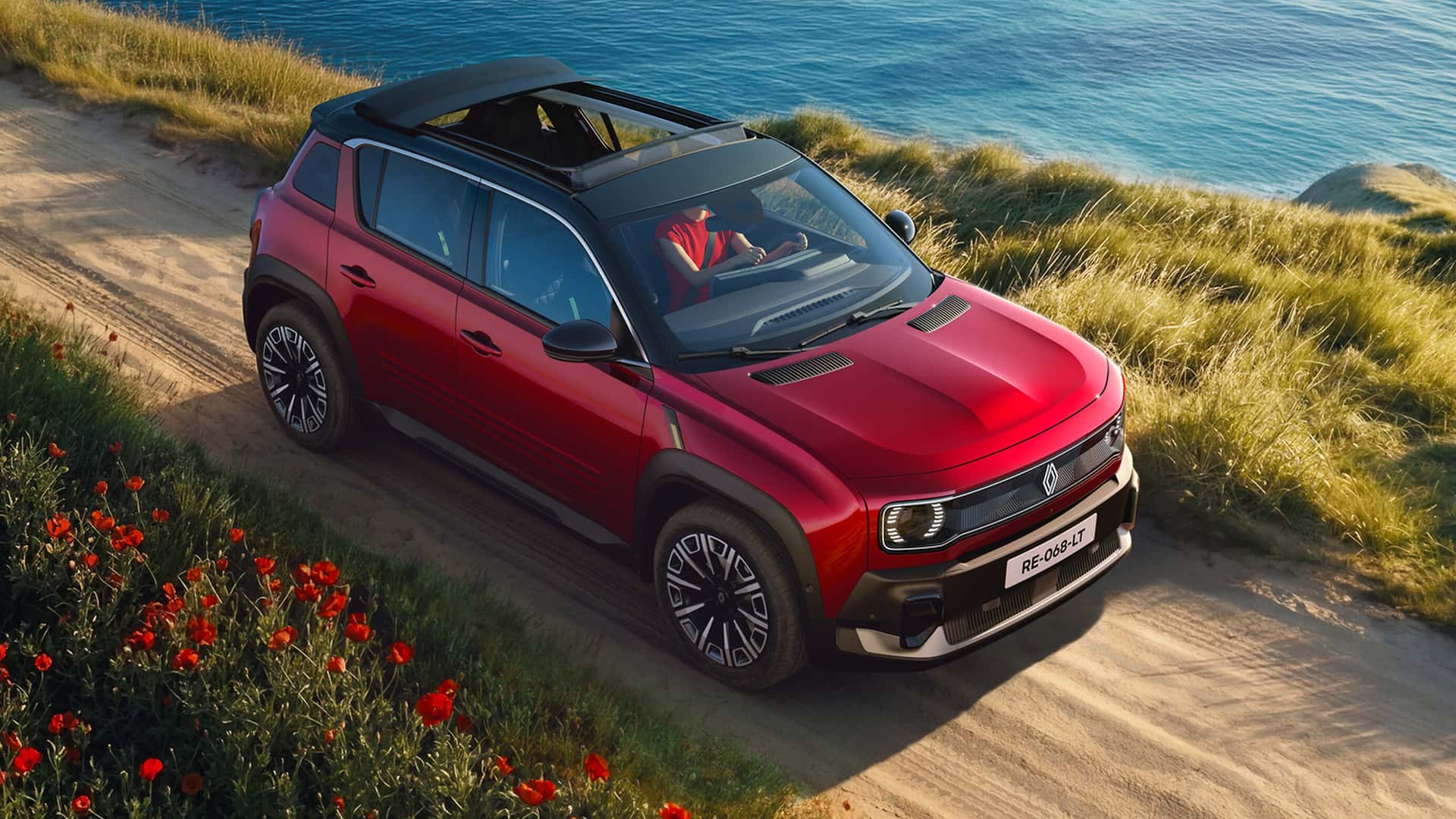
Just like its predecessor, the Renault 4 E-Tech Electric can now be specced with a retractable fabric roof that transforms the battery-powered hatchback into a cut-price convertible at the push of a button. Renault has even launched a special trim called Plein Sud, which means “due south,” that is obviously inspired by the historic Renault 4’s Plein Air variant that was offered in Europe in the late 1960s.
11
Source: Renault
That said, the Plein Air didn’t have doors, a roof, or a tailgate, while the electric Plein Sud has to settle for a more toned-down approach. (Blame those pesky safety regulations, I guess.) If buying a special edition car just for a soft top isn’t your cup of tea, then you should know that Renault also offers the retractable roof on the regular versions of the R4 EV, too, except for the entry-level trim.
The roof’s opening is 36 inches (92 centimeters) long and 31 in (80 cm) wide, and it increases the headroom for the driver and front passenger. However, because the mechanism itself takes up extra space compared to the fixed-roof car, rear passengers get roughly 1.5 in (4 cm) less headroom.
Renault says the roof can be partially or completely opened, and that the load-bearing parts are made of plastic to save weight.
Besides the new soft top, every new Renault 4 sold in Europe gets a revised driver monitoring system that detects fatigue and distraction, and will brake to a standstill if needed. A new water-to-water heat exchanger is also part of the pack, which is said to significantly reduce charging times at freezing temperatures.
With Watches and Wonders Geneva well underway, we go to Patek Philippe – briefly – to understand what is going on with the Nautilus, as we teased yesterday. More importantly, we also have to see one of our personal highlights, a brand new astronomical complication. Patek Philippe refers to the new Ref. 6105-001G as a grand complication and it represents several firsts for the brand. Least obviously, this is Patek Philippe’s first wristwatch with the indication of sunset and sunrise times. Even less obvious is the watch’s ability to handle the bugbear that is daylight savings time, which while not relevant to us near the equator is nevertheless a significant challenge and deeply consequential to this watch.
Patek Philippe Ref. 6105-001G
On the other hand, the watch makes its presence felt because it is an unrestrained 47mm large lad, with a solid caseback featuring a very large Calatrava motif and nods to unspecified spacecraft. The contrast between this and the celestial complication might seem stark, but the rotating display of the night sky needs space to show us space as seen from Geneva. Of course, the sunrise and sunset times are meant for Geneva, or anywhere else on Central European Time.
Patek Philippe Ref. 5840P-001
In a break from our usual style here, we will address two more Patek Philippe references, one that will make a lot of noise and one that was unfairly buried in the press materials. Starting with the latter, it is an interpretation of a heritage pocket watch that may not have ever been made, with hours and minutes on demand, via an automaton. The original was a Louis Cottier mechanism and you can find it in the Patek Philippe Museum. This one requires a bit of an explanation and a history lesson so for now, we will simply say that it is that rarest thing in fine watchmaking: seriously technical but also fun and beautiful to look at. If Patek Philippe supremo Thierry Stern really aims to surprise collectors, he has hit the mark here because we cannot imagine anyone saw this coming.
Patek Philippe Ref. 5840P-001
Now, there is a watch that makes a bit of a squeak; if chiming action can be addressed in this way, but by far the loudest new model must be Ref. 5840P-001, otherwise known as the Cubitus Perpetual Calendar. If you have been waiting for a sign that the Cubitus will get a shaped movement befitting of its pedigree, Ref. 5840 is the watch you want to pay close attention to. The skeletonized automatic calibre with micro-rotor is a paragon of industrial beauty, although it does exhibit those Patek Philippe hand-finishing touches. We will be returning to this watch and the other references in this story for a more in-depth look later.
Patek Philippe Ref. 5840P-001
Overall, the mood at Patek Philippe seems jubilant and it has not much to do with the Nautilus, which is celebrating its 50th birthday this year. A surface-level scan shows that things are far less sporty than some might like, and there is a lot of depth in complexity. This is all surprising (see above) but also refreshing because the Geneva watchmaker is clearly looking forward. Speaking of surface-level development, we must turn our attention now to Grand Seiko. The watchmaker-of-the-enthusiasts revealed a fully engraved SBGZ011; this the most highly textured watch of the fair so far for us, with hand-engraved touches covering every micrometer of it.
Grand Seiko Ref. SBGZ011
Unusually though, Grand Seiko actually showed its watches in multiple batches, a fact that tripped us up a bit on the first day. Happily, there is more than one of us covering the fair this year so we will have a shot at all of them. Returning to SBGZ011, it is affectionately named “Mystic Waterfall,” and is powered by the manually wound spring drive calibre 9R02. Being that this is a manual-winder from the Micro Artist Studio, there is a surfeit of hand-finishing here, including all the interior angles you could ask for…there is more to delight the eye here than that so book some time with SBGZ011 if you can. The watch is limited to just 50 pieces and, for those who care about such things, the name is a reference to Tateshina Otaki waterfall and continues a long tradition of Grand Seiko nature-themed watches.
Grand Seiko Ref. SBGZ011
Finally, we must return to one of our first day highlights, namely the Rolex Oyster Perpetual Yacht-Master II. No corrections to issue here but it occurred to us later that this is perhaps the exact right chronograph for people who engage in high-pressure cooking. Such are the thoughts of journalists who may or may not be starving themselves to feast upon novelties…
For more on the latest in luxury watch reads, click here.
Shopping for a new RV does not have to mean stretching your budget to the limit. These lightweight 2026 travel trailers under $30,000 prove you can still get practical floorplans, useful features, and real-world camping capabilities without overspending. Better yet, many of these affordable travel trailers are easy to tow, making them especially appealing for first-time buyers and RVers who want a simpler way to hit the road.
Whether you are looking for a compact couples camper, a starter trailer, or a bunkhouse travel trailer for the family, these five 2026 models offer strong value at an approachable price point.
How We Chose These Affordable Lightweight 2026 Travel Trailers
For this roundup, we focused on travel trailers with an MSRP under $30,000, relatively low towing weights, practical floorplans, and standout features that make everyday camping easier. We also looked for a variety of layouts, including couples trailers, family bunkhouses, and compact entry-level campers. Remember that MSRPs and specs should always be verified with the manufacturer or dealer before purchase.
Quick Comparison
Casita Liberty 17′
Photo and floorplan courtesy Casita Trailers.
The Casita Liberty brings a different type of appeal than the other trailers in this roundup. Rather than maximizing floor space, the fiberglass trailer focuses on simplicity and a compact footprint that’s easier to tow, easier to store, and less intimidating for buyers who do not want to tow a large trailer. Casita highlights the Liberty’s three large screened picture windows. The trailer is compact, but it is designed to feel open and airy rather than closed in. And, it sleeps up to six people.
Casita offers the Liberty in Standard and Deluxe versions, with the Standard sleeping up to six and the Deluxe sleeping up to four (and adding a spacious bathroom). That gives the Liberty a little more flexibility than its small footprint might suggest, while still keeping the focus on simple, lightweight travel.
What stands out: Casita’s coolest surprise is not just the panoramic window setup. It is the new fully encased composite flooring, which Casita says replaces the previous OSB subfloor and is now waterproof and rot-proof. Plus, a 90Ah deep-cycle AGM battery is standard (300Ah optional), giving owners a stronger starting point for off-grid camping.
MSRP: $22,999
GVWR: 3,500 lbs
Dry Weight: 1,950 lbs
Exterior Length: 17′
Exterior Height: 8’ 11”
Fresh/Gray/Black Cap: 16 gal/32 gal/15 gal (Deluxe only)
Heartland Prowler 2600BH
Photo and floorplan courtesy Heartland RV.
If you’re looking for a true family-friendly floorplan without busting your budget, the Heartland Prowler 2600BH makes a strong first impression. This is a traditional bunkhouse with a layout that works because it is familiar and useful: a front queen bedroom, double bunks in the rear, a central living and kitchen area, and enough sleeping space to make weekend trips enjoyable instead of cramped.
The Prowler 2600BH doesn’t feel like a stripped-down entry model. Heartland gives it features that matter in everyday use, including MORryde Step Above entry steps, a TrussTXL roof system, a PVC roofing membrane, a fully integrated A-frame, tankless water heater, and residential-style cabinet details. The queen bed, bunks, and vinyl flooring throughout all reinforce the idea that this is meant to be lived in by real families.
What stands out: The Prowler 2600BH already earns marks for its extensive list of practical features, but one extra detail gives it even more appeal: CPAP-prepped bedroom power on both sides of the bed. That matters for RVers who need overnight power support without improvising cords or adapters. Add in the TrussTXL roof system, a large freshwater tank, and standard tankless hot water, and this trailer feels thoughtfully equipped rather than simply affordable.
MSRP: $25,868
GVWR: 6,500 lbs
Dry Weight: 4,805 lbs
Exterior Length: 29′ 5″
Exterior Height: 9′ 10 1/2″
Fresh/Gray/Black Cap: 52 gal/39 gal/39 gal
Jayco Jay Flight SLX 170BH Sport Edition
Photo and floorplan courtesy Jayco RV.
The Jayco Jay Flight SLX 170BH Sport Edition features a simple, proven formula: front bed, bunk beds, compact kitchen, and just enough room to make short trips with the whole family comfortable. It is the kind of floorplan that appeals immediately to first-time buyers because you can take a quick look at the layout and know exactly how a weekend away would work.
But Jayco goes well beyond the bare minimum here. The 170BH Sport Edition includes a large fresh-water capacity, hardwood cabinet doors, and a number of small-but-meaningful touches (like residential-style countertops and LED lighting) that make this entry-level trailer feel more polished. For young families, occasional campers, or shoppers who want a trusted name brand without overspending, this Jay Flight is a strong and very approachable option.
What stands out: Jayco’s industry-leading bunk capacity: 300 pounds for single bunks and 600 pounds for double bunks. That is useful for families, of course, but it also helps weekend campers who use bunks for extra gear or outdoor equipment. Add a tankless water heater, 12-volt refrigerator, and MORryde entry steps, and the 170BH Sport Edition delivers more substance than many shoppers expect at this price.
MSRP: $18,218
GVWR: 3,750 lbs
Dry Weight: 3,025 lbs
Exterior Length: 21′ 3″
Exterior Height: 9′ 5″
Fresh/Gray/Black Cap: 30 gal/20 gal/20 gal
Keystone Coleman 13R
Photo and floorplan courtesy Keystone RV.
The Keystone Coleman 13R is the smallest and least expensive trailer in this group. But it truly earns attention because it takes a very compact footprint and still makes the space feel welcoming.
The Coleman 13R is considered a starter trailer for one or two people who want something simple, affordable, and easy to manage. Keystone helps it feel less bare than expected by including a stainless-steel sink, induction cooktop, and dedicated trash can storage. These conveniences truly matter in a tiny floorplan. The Coleman 13R doesn’t try to be everything. It is a smart, low-cost, ready-to-camp option, and that laser-focused approach works.
What stands out: A few thoughtful touches in the Coleman 13R are surprising in such an affordable trailer. The coolest one has to be the standard electric fireplace. Keystone also includes blackout night shades, bedside outlets, a walkable roof, and an extra-large window to bring the outside in.
MSRP: $13,256
GVWR: 3,500 lbs
Dry Weight: 2,483 lbs
Exterior Length: 15′ 11″
Exterior Height: 9′ 10″
Fresh/Gray/Black Cap: 28 gal/34 gal/34 gal
KZ Sportsmen Classic 160QB
The KZ Sportsmen Classic 160QB makes sense for couples who want a manageable first RV. It is compact without feeling too minimal, and its straightforward queen-bed layout gives it a more familiar, comfortable feel than some ultra-small trailers. This is not a flashy floorplan, but that is part of the appeal. It’s focused on the basics most couples actually use: a real bed, a usable kitchen, a proper bathroom, and enough interior space to make a rainy day enjoyable.
The 160QB includes an 8-cubic-foot refrigerator and tankless water heater, in addition to a fully walkable roof and seamless Tufflex roofing. This is a trailer that’s easy to tow and easy to live with. For buyers who want a no-frills couples coach with enough amenities for an enjoyable stay, the 160QB earns its spot in our roundup.
What stands out: One notable feature is the exterior Leash Latch with bonus beverage opener, proof that KZ thought about how people actually use these trailers. Add the optional Off Grid Package with a 200-watt roof-mounted solar panel, inverter, and controller, and this compact couples trailer really shines.
Floorplan courtesy KZ RV.
MSRP: $20,594
GVWR: 3,850 lbs
Dry Weight: 3,160 lbs
Exterior Length: 21′ 8″
Exterior Height: 8′ 11″
Fresh/Gray/Black Cap: 20 gal/26 gal/26 gal
What to Look for in an Affordable Lightweight Travel Trailer
Price is only one part of the equation when shopping for a lightweight travel trailer. Before buying, it is worth comparing a few key factors:
Dry weight and GVWR: Make sure your tow vehicle can handle the trailer comfortably.
Floorplan: A compact trailer is nice, but the right layout matters more than overall size.
Sleeping capacity: Look beyond the number and think about who will realistically use the beds.
Tank sizes: Larger tanks can make a big difference for longer trips or off-grid camping.
Bathroom setup: Wet bath, dry bath, or no bath all affect the camping experience.
Storage and cargo capacity: Lightweight does not always mean generous storage.
Your camping style: Couples, families, and occasional weekend campers all need different things from a trailer.
Final Thoughts
What makes these lightweight 2026 travel trailers under $30,000 so appealing is not just the price. It’s also the variety of layouts and versatility of each floorplan. From compact fiberglass campers to family-friendly bunkhouses, this group shows that affordable travel trailers can still deliver practical features, easy towability, and enjoyable camping experiences.
So, which one would you choose? And if you think there is another lightweight 2026 travel trailer under $30,000 that belongs on this list, please share it in the comments.
FAQs
What size vehicle do I need to tow a lightweight travel trailer?
Many lightweight trailers are designed to be towed by midsize trucks and some SUVs, though towing capacity should always be verified before purchase.
Can an SUV tow a lightweight travel trailer?
Some SUVs can tow lightweight travel trailers, but it depends on the trailer’s dry weight, GVWR, hitch weight, and your vehicle’s towing and payload ratings. Buyers should always verify compatibility before towing.
Can I really buy a new fully equipped lightweight travel trailer for under $30,000?
Yes! There are many new travel trailers under $30,000, especially among compact trailers, couples campers, and entry-level bunkhouse models.
This article was originally published on Speedhunters October 29th 2018
I’m sure I’m not the only one who’s had a large part of their life shaped by a love of cars. The connections, encounters and experiences that I’ve had on my journey as a car enthusiast have been incredible, and the people I’ve met equally so.
Yes, this can be said about almost any hobby, but I’m sure you’d rather have me talk about cars than needlepoint.
I met Ken, the owner of the car we’re looking at here, a few years ago at a local Cars n’Coffee Toronto event. Outside of cars, we share a lot of similar interests: BMX, hockey, and parenthood, to name a few. We also have family a few blocks apart.
Realistically, we may have eventually crossed paths outside of cars. Still, it’s much easier to introduce yourself to the guy poking his camera inside your car than it is to the stranger with a BMX shirt and headphones on.
At the time we first met, Ken owned a Toyota Celsior. I thought the car was absolutely stunning, which is why I’ve included photos of it in this post. Done in a very traditional, some might say ‘old school’ VIP style, it was classy, timeless and mature.
As good as I thought the car was, Ken assured me he could do better. His sights were set on a more exclusive platform, the platform he said he should have bought immediately when changing gears from tuner builds to VIP.
That car was a JDM Toyota Century – he just had to find one available for import.
Japanese Rolls-Royce
The Century remains Toyota’s flagship car, a top-of-the-line personal limousine rarely seen outside of Japan. In Japan, its use is often reserved for dignitaries, including high-ranking government officials and CEOs.
The second-generation model was produced, nearly unchanged, from 1997 through 2016. Despite being produced for so long, very few exist outside of Japan, and as we cruised from spot to spot, ushered along by the eerily quiet V12 up front, several onlookers pulled up alongside to ask what it was. ‘Is it some kind of Rolls-Royce?’ seemed to be the most common question.
As a car you’re meant to be driven in, Ken’s Century has amenities not found in many of the vehicles I’ve photographed – and especially so for one built in 1997. The Toyota features front and rear CRT GPS screens, front and rear audio controls, and even a factory ottoman built into the passenger front seat. The seats themselves are extremely plush wool cloth, and front and rear recline.
It might be more comfortable inside the Century than it is in my own living room.
Late Nights on Yahoo! Auctions
When Ken’s Century arrived via boat from Japan, he had already collected the prerequisite wheels and a drop. Always intended to be a VIP build, a properly laid-out stance was fundamental.
Air Lift Performance suspension can be found at all four corners, with a neatly executed Air Lift 3P setup in the trunk. In the current VIP realm, the 20-inch Enkei Classic wheels might have a conservative width and offset, but Ken wanted to avoid fussing around with the factory fenders, or worse, the factory paint. Stretched tires and excessive ride height camber are also not for him.
Playing off the subtle wheel choice, Ken added an equally subdued Freedom Legion lip to the front end, and out back, you’ll find SilkBlaze exhaust tips. The factory headlights and taillights have been replaced with later OEM GZG50 units, and Ken also has a set of authentic illuminating Japanese license plates, reserved only for show or photoshoot use.
Like most VIP builds, Ken has opted to leave the V12 stock. Given how rare and unusual the engine is, I can’t say I blame him.
Ken’s currently mulling over the idea of adding a body kit to the Century, though it’s not a priority by any means. While he’s considering his options, he’s focused attention on accessorizing the interior.
The collection of OEM GZG50 Toyota Century factory-option parts he’s gathered is pretty phenomenal. So far, it extends to a cassette player, a shaver, and a car phone – items (often made by Sony) that Toyota had branded just for the Century.
One item that is not specific to the Century, but incredibly interesting nonetheless, is a Toyota-branded facsimile machine. Ken doesn’t know what model it was made for, but it totally suits the interior he’s put together.
I’d love to tell you whether or not it works, but I’ve never really been important enough to need to send or receive a fax, let alone from the back of a moving vehicle.
The lace you see on the top of the seats is typical of taxis and limos in Japan, and its purpose is to keep the seats and headrests clean. Similar lace makes up the curtains fitted to the rear windows. Again, everything is fashioned around luxury and the travelling experience.
To celebrate the realization of his dream to own and modify a Toyota Century, Ken is currently embarking on a journey from the Toronto area to Las Vegas, stopping in at several different events along the way. In Vegas, he’s graciously offered to pick up yours truly before we both head to SEMA.
The car isn’t in the big show this year, but if Ken does follow through with some of the body modifications, who’s to say what the future might hold?
Volvo is expanding its electric trucking lead with the launch of new and improved line of FH, FM, and FMX Electric HD and semi trucks with up to 700 km (~430 miles) of range.
The next-generation Volvo FH, FM, and FMX Electric trucks feature Volvo’s new e-axle driveline technology, which the company says offers major improvements in flexibility, productivity, and driving comfort – along with enough increased efficiency to offer more than 400 miles of range in long-haul highway trim.
“This long-haul electric truck is the best in the industry,” says Roger Alm, President Volvo Trucks. “It offers an outstanding range in combination with high payload, fast charging and great riding comfort. With this truck, our customers can drive the really long distances and throughout an entire working day with the same productivity as diesel trucks.”
The headliner
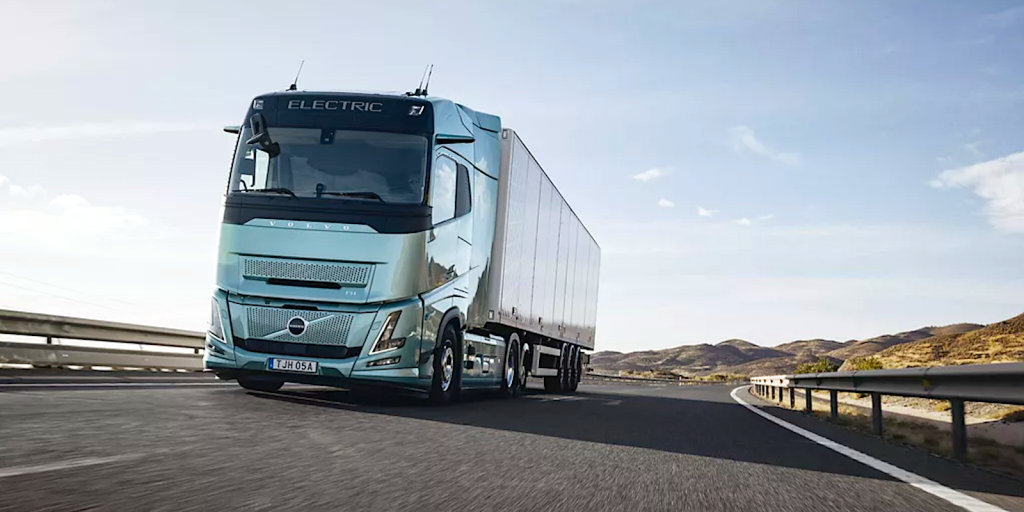
Volvo FH Aero Electric; via Volvo Trucks.
At the heart of the lineup’s new updates is the new, compact Volvo e-axle that integrates a pair of electric motors and a six-speed, efficiency-enhancing gearbox into the trucks’ drive axles. The tech frees up chassis space for more batteries while, at the same time, putting out an impressive 460 kW of power (~625 hp). That’s good enough to haul up to 28 tonnes of payload.
Advertisement – scroll for more content
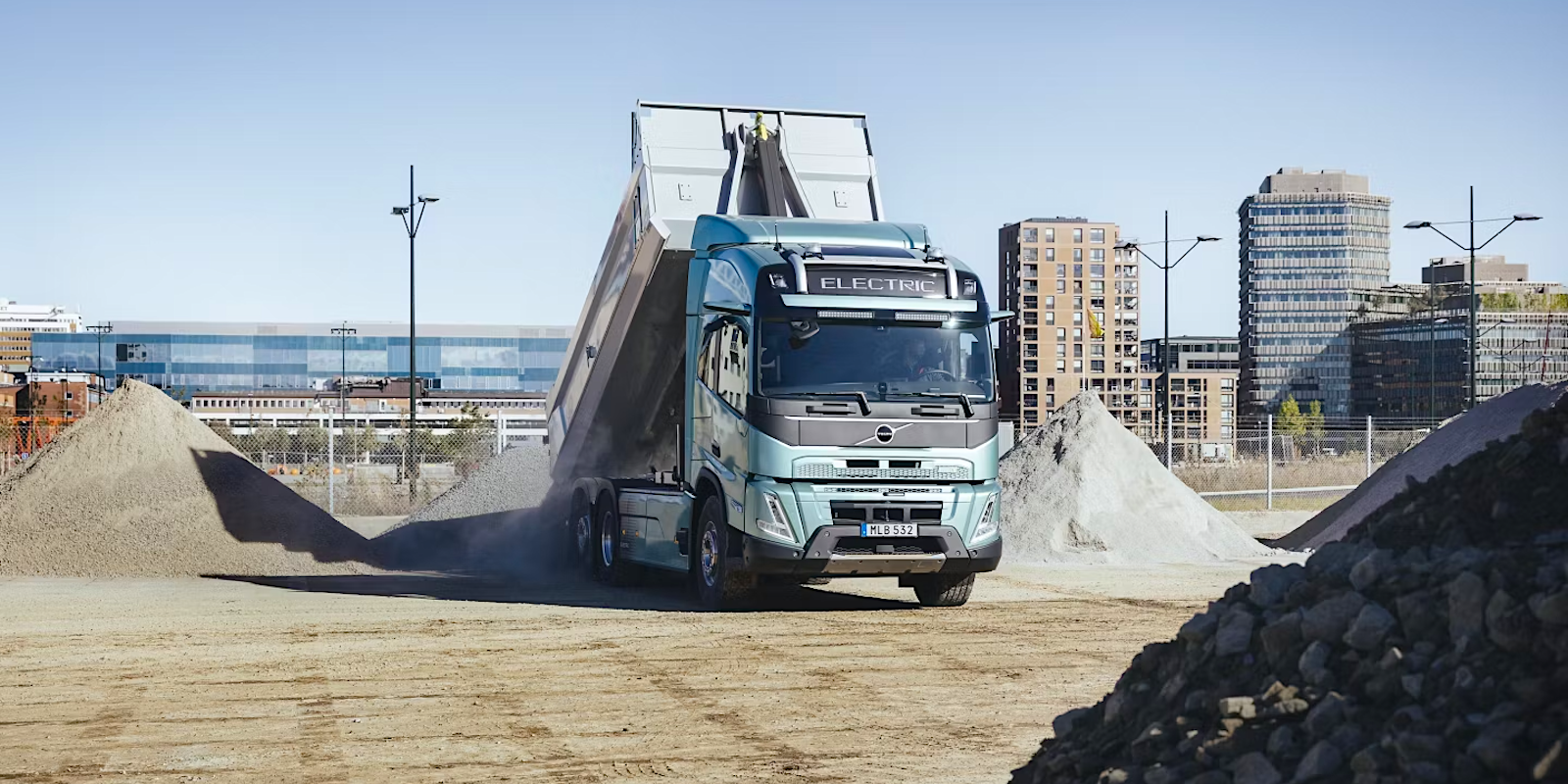
For construction, regional distribution, urban logistics, utilities, refuse, and heavy special or vocational applications, Volvo offers a more powerful 540 kW of power (~730 hp) e-axle with an eight-speed gearbox. Those trucks, by the way, can be specified with a pair of e-axles for maximum power and job site flexibility
Charging speed on all those models can reach 700 kW on MCS, which works out to a 20-80% charge in approximately 45 minutes, or 350 kW on CCS for a 20-80% in under 90 minutes.
“We’re really sharpening our offering here. We are broadening it and making electric solutions possible for an even wider range of transport assignments, and also adding a cutting‑edge electric truck with a range of up to 700 km (~430 miles),” adds Alm. “This means we can fully match the business needs of our customers. It has never been easier to replace diesel trucks with electric ones.”
Volvo’s new, updated HDEVs will be rolling out to dealers later this year.
SOURCE | IMAGES: Volvo Trucks.
If you’re considering going solar, it’s always a good idea to get quotes from a few installers. To make sure you find a trusted, reliable solar installer near you that offers competitive pricing, check out EnergySage, a free service that makes it easy for you to go solar. It has hundreds of pre-vetted solar installers competing for your business, ensuring you get high-quality solutions and save 20-30% compared to going it alone. Plus, it’s free to use, and you won’t get sales calls until you select an installer and share your phone number with them.
Your personalized solar quotes are easy to compare online and you’ll get access to unbiased Energy Advisors to help you every step of the way. Get started here.
FTC: We use income earning auto affiliate links. More.
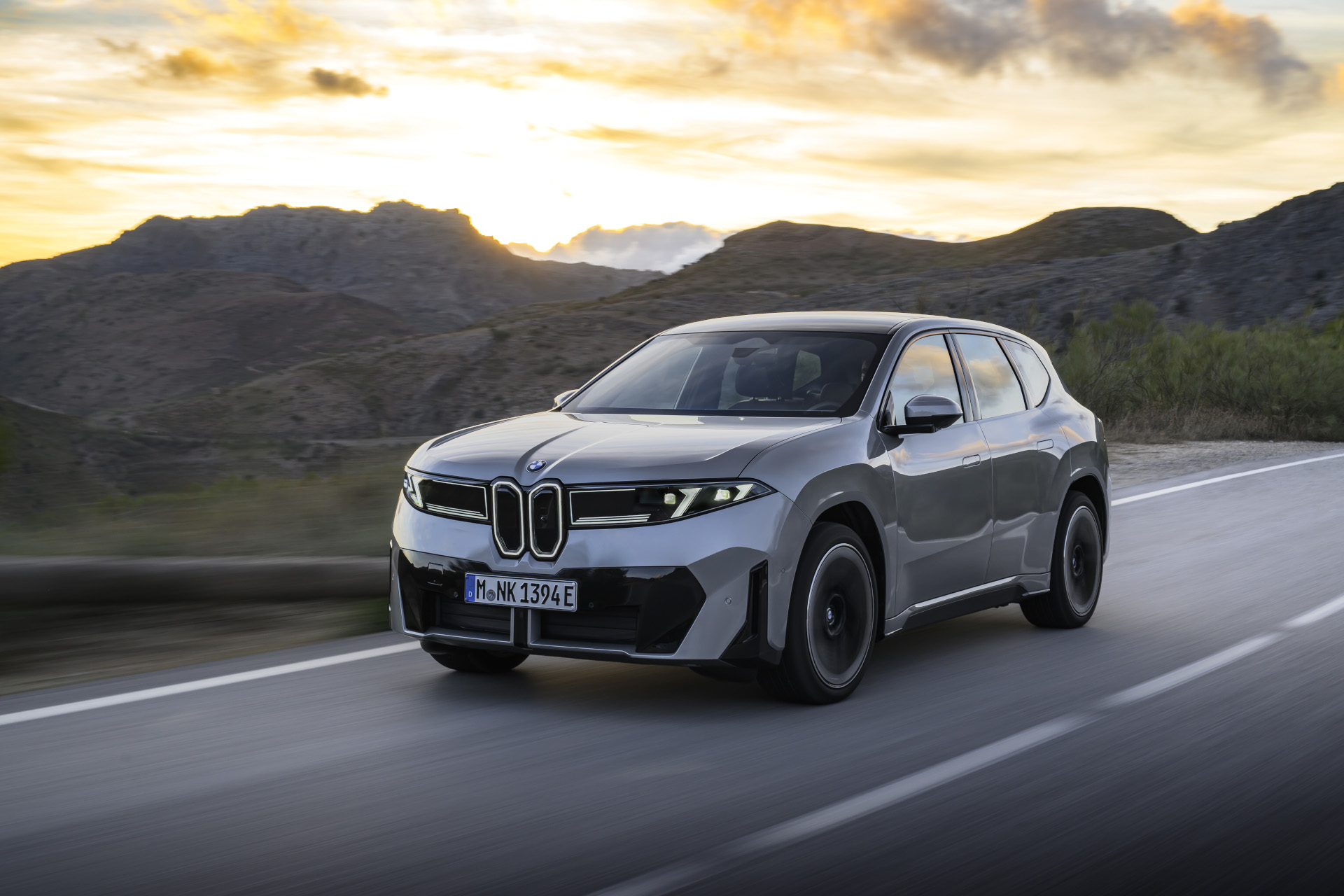
BMW is entering a new phase, and you can feel it in the way the brand is approaching its most important models. This is no longer about experimenting with electric vehicles on the side. It’s about rethinking what core BMWs should be in an electric era.
Two models stand out in this transition: the next-generation BMW iX3 and the fully electric 3 Series, often referred to as the i3. These aren’t niche cars. They sit right in the middle of BMW’s lineup, where expectations are high and mistakes are hard to hide.
A New Foundation for Electric Driving
Both the new iX3 and the electric 3 Series are expected to be built on BMW’s Neue Klasse platform. This is a big deal. Instead of adapting combustion-engine platforms, BMW is designing these cars from the ground up as electric vehicles.
That shift changes everything. Packaging becomes more efficient, interiors gain space, and weight distribution can be optimized in ways that weren’t possible before. It also allows BMW to rethink design without being tied to traditional engine constraints.
The goal is simple on paper but hard in practice: keep the driving feel BMW is known for while taking full advantage of electric technology.
The BMW iX3: Familiar Shape, New Thinking
The iX3 will likely feel the most familiar at first glance. It follows the shape of a midsize SUV, a segment that continues to dominate global sales. But under that familiar silhouette, the changes are significant.
BMW is expected to push range and efficiency further than before. With newer battery technology and improved energy management, the iX3 should deliver a more usable real-world range, not just an impressive number on paper.
Charging is another focus. Faster charging speeds mean less waiting and more flexibility for longer trips. For many drivers, that’s still one of the biggest concerns when switching to electric.
Inside, the iX3 is likely to reflect BMW’s latest thinking on digital interfaces. Expect a cleaner layout, fewer physical buttons, and a stronger emphasis on software. Over-the-air updates will play a bigger role, allowing the car to improve over time instead of feeling outdated after a few years.
The Electric 3 Series (i3): Reinventing an Icon
If the iX3 is about evolution, the electric BMW i3 Series is closer to a reinvention.
The 3 Series has always been about balance. It’s the car people point to when they talk about driving dynamics, everyday usability, and understated design. Turning that into a fully electric vehicle is not as simple as swapping out the engine.
Electric motors deliver instant torque, which changes how the car accelerates. The battery pack adds weight, which affects handling. BMW’s challenge is to take those differences and turn them into strengths.
Early expectations suggest the electric 3 Series will offer sharper performance than its gasoline counterparts. Acceleration will be quicker, and the low center of gravity from the battery pack could actually improve stability in corners.
Still, numbers alone won’t define it. The real test will be whether it feels like a 3 Series when you drive it. That connection between driver and car is what BMW can’t afford to lose.
Design: A Clean Break Without Losing Identity
BMW’s design language has been evolving rapidly, and these new models will likely push it further.
The Neue Klasse approach leans toward cleaner surfaces, simpler lines, and a more modern look overall. Grilles may become more symbolic than functional, and lighting will play a bigger role in defining the car’s character.
At the same time, BMW knows it can’t completely abandon its identity. Elements like the Hofmeister kink and the general proportions of its sedans and SUVs are part of what makes a BMW recognizable at a glance.
The challenge is finding that balance between looking new and still feeling familiar.
Technology That Feels Useful
One of the risks with modern cars is adding technology just for the sake of it. Screens get bigger, menus get deeper, and the experience can become more distracting instead of more helpful.
BMW seems aware of that. The focus with these upcoming models is expected to be on simplifying the interaction between driver and car.
Voice control will likely improve, reducing the need to tap through multiple menus. Driver assistance systems will become more advanced, but ideally less intrusive. The goal is to support the driver, not replace them.
This is also where software matters more than ever. Cars like the iX3 and electric 3 Series won’t just be defined by their hardware at launch. Updates will shape how they feel months and even years down the line.
Performance and Everyday Usability
Electric cars often get judged on extremes. Either they’re praised for instant acceleration or criticized for charging times. But most owners care about something simpler: how the car fits into daily life.
BMW seems to be focusing on that middle ground. The iX3 should offer enough space and comfort for families, along with the practicality expected from an SUV. The electric 3 Series, on the other hand, will aim to stay versatile enough for commuting, road trips, and everything in between.
Range, charging infrastructure, and efficiency all play a role here. Improvements in these areas will make the transition to electric feel less like a compromise and more like a natural step forward.
Why Content Quality Still Matters in Automotive Writing
As interest in EVs grows, so does the amount of content around them. Reviews, comparisons, and technical breakdowns are everywhere. But not all of it is reliable or original.
For writers and publishers in the automotive space, maintaining authenticity is important. Readers can tell when something feels generic or copied. Tools like a Plagiarism Checker help ensure that content stays original and trustworthy.
That matters not just for credibility, but for building long-term trust with an audience that’s trying to make informed decisions.
The Bigger Picture for BMW
The iX3 and electric 3 Series are more than just new models. They represent a shift in how BMW sees its future.
Instead of treating electric cars as a separate category, BMW is integrating them into its core lineup. That approach suggests confidence. It also raises expectations.
If these models succeed, they’ll show that electric cars can carry forward the same qualities that made BMW popular in the first place. If they fall short, it will be harder to convince loyal customers to make the switch.
Final Thoughts
BMW is stepping into a space where tradition and innovation collide. The new iX3 and electric 3 Series sit right at that intersection.
They have to deliver modern technology, strong range, and competitive performance. But more importantly, they have to feel right from behind the wheel.
That’s the part that can’t be measured on a spec sheet. And it’s the part that will ultimately decide whether BMW’s next chapter lives up to its past.
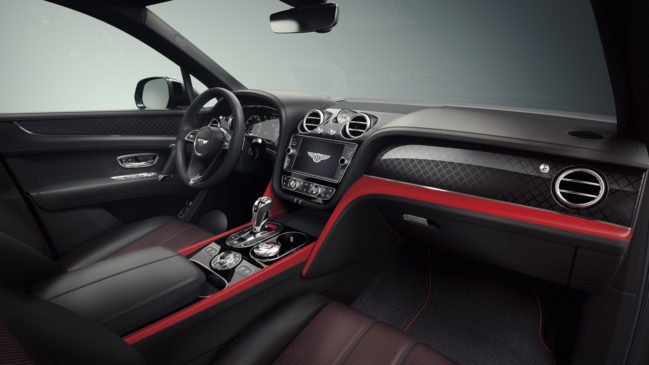
The next chapter of the Bentley Bentayga is shaping up to be a decisive one. Slated for a 2028 debut, the new model of the luxury SUV won’t go fully electric as once planned. Instead, it will be a high-performance PHEV.
Originally intended to be based on the Volkswagen Group’s advanced SSP architecture, delays (largely tied to Porsche pushing its ‘61’ platform into the next decade) forced Bentley to rethink its strategy. Hence, the new Bentayga will use the PPC platform, shared with the latest Porsche Cayenne and upcoming Audi Q9.
The 2028 Bentley Bentayga is expected to feature a sophisticated plug-in hybrid setup built around a 3.0-litre V6 engine, delivering performance similar to today’s 456 bhp Bentayga PHEV but with an improved electric-only range.
Design cues will draw heavily from the EXP 15 concept, hinting at a sharper, more progressive styling. Other advanced features that would be offered in the new PHEV luxury SUV include air suspension, active ride control, and next-gen driver aids.
O the irony! US automakers insist that nobody wants to buy EVs, and one of the reasons cited is that there isn’t enough charging infrastructure.
Well, the folks who actually build and operate EV charging infrastructure have a different perspective. The number of DC fast charging ports in the US is growing at over 1,000 stalls per month, and the total recently surpassed 71,000.
Around 3,500 new stalls were added in the first quarter of this year, a substantial increase over the 2,700+ added in Q1 2025.
According to the Alternative Fuels Data Center (AFDC), as of April 1, 2026, there were 71,398 public DC fast charging ports in the US, at 15,121 charging sites (including 883 ports, or 1.2% of the total, that were temporarily out of service at the time of the survey).
AFDC notes that the number of sites may be somewhat misleading, as adjacent sites belonging to different networks may be counted as separate stations.
In fact, all these numbers should be taken with a gram or two of lithium salt, because the definition of a “network” is somewhat fluid. For example, Chargepoint, listed as the fourth largest network, doesn’t actually own most of its charging points. Other networks may have similar arrangements.
Charging sites are getting larger—AFDC found that the average number of ports per location increased to over 4.7 stalls, compared to 4.1 a year ago.
A few large players dominate the industry—the top 10 largest DC fast charging networks account for roughly 85% of the total number of ports. The remaining 15% belong to other networks, or are non-networked stations.
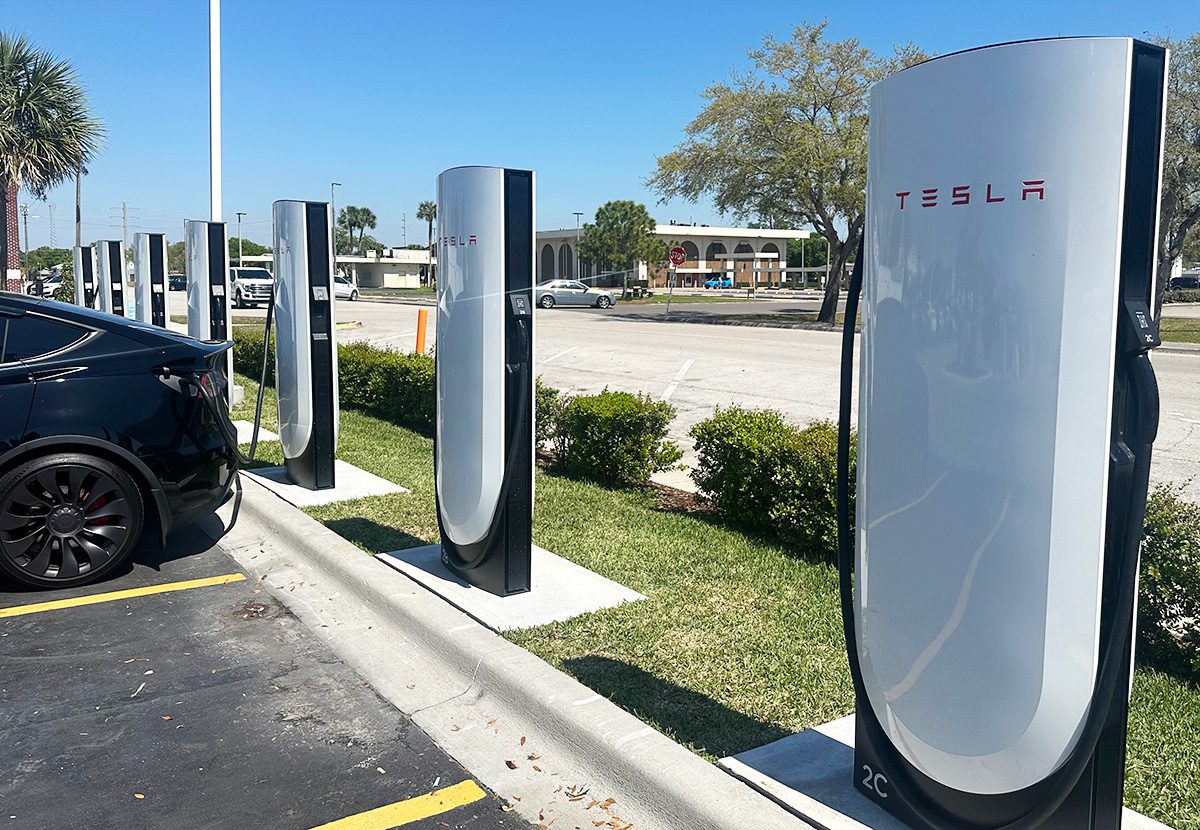
The Tesla Supercharger network remains the largest provider, with 36,877 ports. The company added almost 1,200 new ports in Q1. Despite this expansion, Tesla’s share of the charging decreased this quarter, to 51.6%, and AFDC predicts that it may soon fall below 50%.
More than two-thirds of Supercharger sites in North America are now open to non-Tesla EVs.
The largest DC fast charging networks (by number of charging ports):
Tesla Superchargers: 36,877 ports (51.6% market share)
Electrify America: 5,610 ports (7.9% share)
EVgo: 5,102 ports (7.1% share)
ChargePoint: 4,591 ports
Blink: 1,989 ports
EV Connect: 1,856 ports
Red E Charge: 1,694 ports
Ford Charge: 1,262 ports
IONNA: 1,030 ports
Rivian Adventure Network: 962 ports
Other notable networks that didn’t make the top ten: bp pulse, which now has over 700 ports; and Walmart’s new in-house network, which has rapidly expanded to over 200.