Jaecoo has added a self-charging hybrid to its J5 and J7, utilising a version of the Chery Tiggo Cross Hybrid’s powertrain. These cars, recently launched in the UK and the Philippines, augment the J7 PHEV and offer an alternative for buyers who want an electrified model but balk at the thought of having to charge it.
Like the new Omoda C4 Hybrid, the J5 and J7 Hybrid bear the new (and slightly silly) Super Hybrid System – Hybrid (SHS-H) moniker. This differentiates it from the original Super Hybrid System in the J7 PHEV, which itself has been renamed the Super Hybrid System – Plug-in hybrid (SHS-P).
Shown at the recent Chery International Business Summit (IBS) in Wuhu – held at the sidelines of the ongoing Auto China show – the J5 and J7 Hybrid add a turbocharger to the Tiggo Cross’ 1.5 litre Atkinson-cycle four-cylinder petrol engine. This is the same mill found in the J7 PHEV, producing 143 PS and 215 Nm of torque and delivering a thermal efficiency of 44.5%.
Jaecoo J5 Hybrid
The ICE juices the same 204 PS/310 Nm electric motor and 1.82 kWh battery found in the Tiggo Cross, but with a more powerful engine clutching in to help drive the front wheels at higher speeds through a single-speed dedicated hybrid transmission (DHT), total power rises to 224 PS – although oddly total torque actually drops to 295 Nm. The PHEV is still the champ, however, with a system output of 279 PS and 365 Nm.
So equipped, the J5 Hybrid sprints from zero to 100 km/h in 7.9 seconds – more than two seconds quicker than the petrol J5 – on its way to a top speed of 175 km/h. Jaecoo claims a fuel efficiency figure of 18.9 km per litre (5.3 litres per 100 km) and a total range of 980 km thanks to a 51 litre fuel tank.
The J7 version has the same powertrain but is of course heavier, meaning that its century sprint is completed nearly half a second slower at 8.3 seconds; its top speed, however, is higher at a quoted 180 km/h. Efficiency also drops only slightly to 18.8 km per litre (still 5.3 litres per 100 km), so expect its total range to be similarly close to the magic 1,000 km.
Jaecoo J5 Hybrid
From the outside, the J5 Hybrid is largely similar to the Range Rover Evoque-inspired petrol version, with the sole difference being the 18-inch aero-optimised turbine-style aero wheels from the EV version. Inside, the car takes after the J7 PHEV by ditching the electronic parking brake lever (its operation is now completely automatic, so you can’t move the car unless you put your seat belt on). But it otherwise retains a 13.2-inch portrait infotainment touchscreen and yes, even the calculator-style monochrome LCD instrument display.
The J7 Hybrid, meanwhile, is nigh-on indistinguishable from the J7 PHEV and includes that car’s streamlined mirrors and 19-inch aero wheels; you’d have to clock the single fuel filler door identify it. The same is true on the inside with its column-mounted shifter and cleaner centre console being shared with the PHEV.
However, the Hybrid gains the ruggedly-styled door cards of the petrol J7. This means pistol-grip grab handles on the three passenger doors and conventional window switches – rather than the PHEV’s fiddly reverse-direction ones – on the driver’s door, along with mirror controls that are physical (joy of joys!) instead of being buried in the 14.8-inch touchscreen. And yes, there’s still a 10.25-inch colour instrument display.
Jaecoo J7 Hybrid
Jaecoo also showed the J8 PHEV, a petrol-electric version of its three-row flagship. Beyond the obvious PHEV badging and dual flaps for fuel and charging, the car also gets the SHS-P powertrain under the bonnet – this time upgraded to the all-wheel-drive version also seen in the Omoda C9 PHEV.
This switches the single front motor with dual electric motors – a P2 integrated starter-generator making 102 PS and 170 Nm, as well as a P2.5 traction motor churning out 122 PS and 220 Nm. The J7’s single-speed dedicated hybrid transmission (DHT) has also been ditched in favour of a three-speed unit. This allows the combustion engine to help drive the wheels at lower speeds, increasing acceleration.
Finally, the rear wheels are driven by a 230 PS/310 Nm motor, providing all-wheel drive and a total system output of 537 PS and 650 Nm of torque. This enables it to sprint from zero to 100 km/h in 5.8 seconds – nearly a second slower than the five-seat C9 PHEV – although the top speed remains a bit low at 180 km/h.
Jaecoo J8 PHEV
With the same 34 kWh NMC battery, the J8 PHEV delivers a WLTP-rated pure electric range of 134 km (11 km less than the C9 PHEV), and with a 70 litre fuel tank, the claimed total range is over 1,100 km. By the way, the J8 you see here still gets the same design as the current model, and not the newly-revealed facelift that’s badged as the Chery Tiggo 9 (not the Tiggo 9 we’ll be getting soon – confused? Us too) in China.
The J8 PHEV was also recently launched in the UK, with Australia soon to get this and the J5 Hybrid. Malaysian Omoda & Jaecoo officials told us that the cars are being considered for our market. Would you like to see these three models come here? Let us know in the comments.
GALLERY: Jaecoo J5 Hybrid
GALLERY: Jaecoo J7 Hybrid
GALLERY: Jaecoo J8 PHEV
Looking to sell your car? Sell it with Carro.
AD: Drive the Omoda Jaecoo car of your dreams with the best deal. Submit your details and Carro’s Omoda Jaecoo dealership will get in touch with you.
You already know about the national parks. And don’t get us wrong, they’re well worth the effort. But underrated state parks make the perfect camping trip — and many of them rival national parks for views, to-dos, camping accommodations and more.
Along with being hidden gems, the state parks we’ll talk about below also offer several benefits over many national parks. For one thing, they’re often less crowded and cheaper to camp at. Many are also closer to cities for camping parties that want a balance of urban and outdoorsy adventures. And while it’s still always a good idea to book early, you might be able to plan your trip on the order of weeks or months rather than months or even years (as is often needed with the most popular national parks).
Read on to learn more about our favorite underrated state parks and how to enjoy them to the fullest in an RV.
Why Choose State Parks Over National Parks?
The national parks have always been high on the destination lists of serious travelers, but ever since the pandemic, they’ve been more popular than ever. That can translate to long lines, big crowds, and photos full of strangers, not to mention the difficulty of getting a reservation in the first place.
At the hidden-gem state parks we’ll name below, you’ll enjoy several advantages, including:
Easier reservation-making (even only a relatively short amount of time before the trip)
Lower costs for camping accommodations (and depending on the location, food and gas in surrounding cities)
Less crowding, so you can enjoy your exploration and photo-taking in peace
In some cases, closer access to cities so you can balance your outdoor recreation with the food and culture available in urban environments
Additionally, state parks are ideal for RV travelers because many of them have very well-appointed campgrounds at bargain-basement prices, and fun things to do for the whole family (playgrounds; fire pits for roasting s’mores). More campsite availability means you can be more flexible with your trip planning, and if something changes at the last minute, you won’t have to worry about never being able to score a reservation again.
What Makes a State Park “National Park Worthy”?
Keep in mind that not all national parks are created equally. We’re specifically highlighting the “national park worthy” state parks that rival their more famous cousins, but have all the advantages named above. We’re talking about parks that boast:
Scenic landscapes (mountains, coastlines, and canyons to name just a few)
Unique geology or ecosystems (for those whose appreciation of the outdoors goes beyond just the visual)
Outdoor recreation opportunities ranging from accessible hikes to challenging sports
Well-maintained infrastructure including roads and ranger stations
RV accessibility and high-quality campgrounds that make it easy to explore these destinations via the very best travel lifestyle there is — RVing!
10 Underrated State Parks That Rival National Parks
Enough preamble! Here are our top-10 favorite underrated, national park worthy state parks that’ll make you feel like a true travel insider.
1. Custer State Park, South Dakota
Granite peaks sparkle up from a landscape where the buffalo (literally) roam here at the western end of South Dakota. Pro tip: Custer State Park includes both an 18-mile Wildlife Loop and the famed Needles Highway, so it’s a great option for those who’d be more comfortable experiencing the outdoors from the comfort of the car.
Comparable to: Yellowstone National Park; Badlands National Park
RV highlights: Campgrounds that are large-RV-friendly and offer hookups (especially Blue Bell); scenic drives
2. Valley of Fire State Park, Nevada
Looping layers of Aztec sandstone make Valley of Fire State Park look totally otherworldly — and just like its name. And just 50 miles northeast of Las Vegas, this park is an easy one to add onto an urban adventure (or vice versa). You might even catch famed local Alex Honnold practicing some climbs along its rock formations.
Comparable to: Zion National Park; Arches National Park
RV highlights: RV-friendly on-site campgrounds with hookups; proximity to other RV destinations
3. Adirondack Park, New York
Okay, you caught us: This one technically isn’t a state park, but rather a National Historic Landmark. It’s also the largest protected area in the lower 48 United States, measuring 6 million acres of stunning New York state countryside. (For context, that’s more space than Yellowstone, Yosemite, Grand Canyon, Glacier, and the Great Smokies National Parks combined.
Comparable to: Great Smoky Mountains National Park
RV highlights: Numerous options ranging from dispersed camping to luxurious local RV resorts
4. Dead Horse Point State Park, Utah
Dramatic red-rock overlooks, winding rivers, and that beautifully alien American southwest landscape: Dead Horse Point State Park has it all. If you’re looking for a Grand Canyon experience with fewer crowds and clearer pictures, along with access to the nearby town of Moab for fun to-dos, this park has you covered.
Comparable to: Grand Canyon National Park
RV highlights: Campgrounds accommodate rigs up to 60 feet; electrical hookups (but no water — so pack it in!)
5. Silver Falls State Park, Oregon
Old-growth trees surround a meandering hiking trail that winds past (and sometimes behind) not one, not two, but ten waterfalls. Ferns reach out for your ankles and chipmunks, squirrels, and even the occasional deer keep watch. It’s not a fairy tail: It’s Oregon’s Silver Falls State Park.
Comparable to: Olympic National Park
RV highlights: RV-friendly campgrounds with electric and water hookups open year-round
6. Palo Duro Canyon State Park, Texas
No shade to the Grand Canyon, but Palo Duro Canyon State Park in Texas boasts the second-largest canyon in the U.S. with way fewer crowds and lower prices. It’s also just a stone’s throw from the town of Amarillo, where you can enjoy the Cadillac Ranch as well as a gigantic steak at the Big Texan.
Comparable to: Grand Canyon National Park; Big Bend National Park
RV highlights: Campgrounds with hookups, fire pits, and shower facilities; scenic drives
7. Letchworth State Park, New York
Known as the “Grand Canyon of the East,” Letchworth State Park is one of the best hidden gems in the state of New York, and a great opportunity for those who live in the northeast to experience some serious wilderness. Watch a rushing waterfall cascade down through shimmering fall foliage before retreating to the comfort of your RV. (The park offers a well-appointed onsite campground with hookups.)
Comparable to: Grand Canyon National Park meets Great Smoky Mountains National Park
RV highlights: Easy access from major northeastern population centers; 50-amp electrical hookups
8. Anza-Borrego Desert State Park, California
Towering palm trees peak out of a sprawling desert wilderness that’s somehow giving both wasteland and oasis at the same time. The largest state park in California, this preserve features 500 miles of unpaved roads and is a great opportunity for intrepid campers looking for an off-the-grid experience.
Comparable to: Joshua Tree National Park
RV highlights: This one is our top pick for those looking to try out boondocking (but maybe don’t go at the height of summer!)
9. Hocking Hills State Park, Ohio
Cliffs, caves, waterfalls, stunning autumn foliage: Hocking Hills State Park is only a hidden gem to those who don’t know Ohio well. But nationally, it’s still got best-kept-secret status, and its midwestern locale means you’ll encounter fewer crowds than you would at the national parks it rivals.
Comparable to: Shenandoah National Park; Great Smoky Mountains National Park
RV highlights: Easily accessible to many midwesterners; comfortable on-site campgrounds with hookups
10. Ecola State Park, Oregon
There just isn’t really anywhere on earth quite like the Pacific coast, especially where tall trees run right up to epic cliffsides washed by the sea. Ecola State Park is an incredible rival to Big Sur (which is not a national park, but still one of the most sought-after U.S. destinations) as well as Redwoods National Park — and a destination worth highlighting on its own.
Comparable to: Redwoods National Park
RV highlights: Easy to combine with other must-see Pacific-area destinations, like Portland or Astoria
RV Travel Tips for Visiting State Parks
Now that you know where to navigate your rig to, let’s dive into the top tips to best enjoy your RV travels.
Finding RV-Friendly Campgrounds
Most of the parks we’ve mentioned above have RV-friendly campgrounds right on-site, often with electric and water hookups. However, some of them are also open to dispersed camping or boondocking, which means camping without hookups (i.e., “roughing it” in the RV community).
While boondocking sites often don’t need reservations, they can fill up — and sites that you can reserve, you should reserve as early as you can (although again, they tend not to fill up in these places as quickly as they do in national parks). Traveling at peak season does mean you’ll see bigger crowds than you would otherwise, so keep that in mind when you’re planning.
Planning Your Route
Many of these parks are located within an easy distance of major population centers, so it’s often no big deal to just find your way there with Google Maps (or whatever navigation app you already use). However, it’s worth saying that many are also close to scenic byways, which could be worth the extra time and fuel for a more memorable vacation. If you’ll be linking several destinations or traveling for a longer period, be sure to plan out fuel stops and check ahead of time for RV accessibility.
What to Pack for State Park RV Trips
If you’ll be boondocking or if the campground at the state park doesn’t have water hookups, be sure to bring in the water you’ll need for your stay. (You’ll likely want to fill just before you reach your destination, since water is heavy — and carrying it around means more fuel costs!)
Leveling gear is also critical to ensure that your RV stays nice and flat, which is good for both sleeping and the onboard appliances. Finally, don’t forget any outdoor gear you need to enjoy your adventures, whether it’s hiking boots or some more specific piece of sporting gear.
When to Visit State Parks for the Best Experience
We always recommend people look to the shoulder seasons for the best travel experiences, where you won’t be battling crowds or finding reservations impossible. However, each season brings its own benefits, depending on the latitude of the park you’re considering. A basic breakdown:
Spring is a great time to visit for waterfalls and wildflowers, along with mild temperatures (though you may have to deal with a bit of rain)
Summer is the right time for mountain escapes that might otherwise be snowed under
Fall, of course, is leaf-peeping season, perfect for spots that glow red and gold as the days shorten
Finally, winteris actually an ideal time to enjoy desert parks — though some of them do get seriously cold, so be prepared!
Ready to Plan Your Hidden Gem State Park RV Trip?
You know where you’re going and you’re prepared with the tips you need to do it in style. All that’s left now is to actually plan the thing!
RV travel gives you the freedom to explore beyond the crowded parks in the privacy and comfort of your own home-away-from-home on wheels. And when you rent from RVshare, you can choose from a wider array of RV types and sizes. Find your RV today and explore state parks your way!
A Tesla auto parts shop owner in Sacramento spent about $40,000 and two years converting a 1966 Ford Mustang into a fully functional Tesla — complete with the Model 3’s dual-motor drivetrain, 15-inch touchscreen, and working “Full Self-Driving” (Supervised).
It’s likely the first non-Tesla vehicle to run FSD, and it achieves 258 Wh/mi — roughly matching the efficiency of an actual Model 3.
From Facebook Marketplace find to Tesla-powered classic
Yaro Shcherbanyuk, the owner of Calimotive Auto Recycling in Rancho Cordova, California, found the 1966 Mustang on Facebook Marketplace in the summer of 2022. Calimotive specializes in Tesla and Rivian parts, so Shcherbanyuk had access to the components — and the knowledge — needed for an ambitious build.
He worked on the project for roughly two years alongside his father Viktor and brother Daniel. The family initially considered fitting the Mustang with a Model S drivetrain, but once the car was stripped down, Shcherbanyuk realized the Model 3 battery was nearly a perfect fit.
Advertisement – scroll for more content
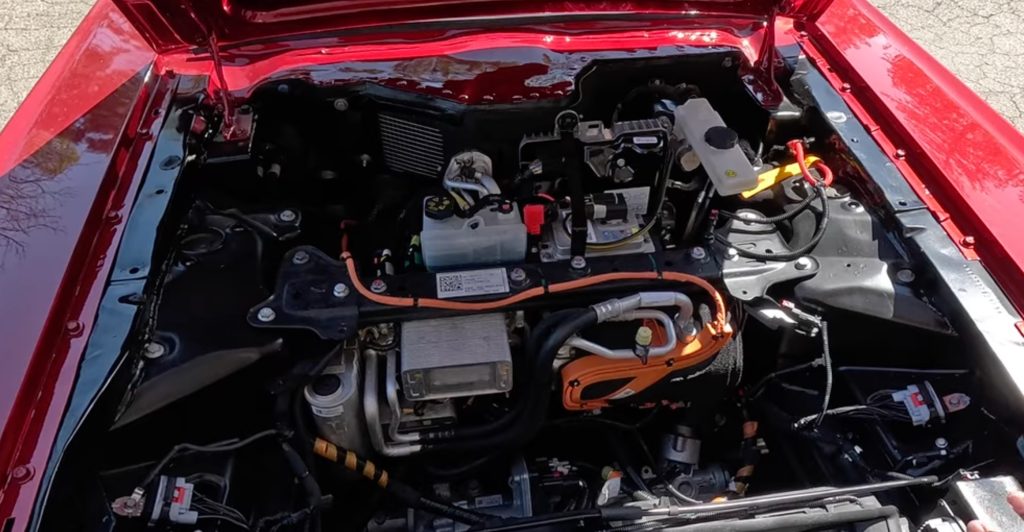
The team grafted three sections of the 2024 Tesla Model 3’s floor and seats into the Mustang’s body, shortening the battery case to fit without altering the car’s original dimensions. The result is a classic Mustang shell sitting on top of a Model 3 dual-motor setup good for roughly 400 horsepower and 471 lb-ft of torque — enough to push it from 0-60 mph in about 3.5 seconds.
‘Full Self-Driving’ in a 60-year-old car
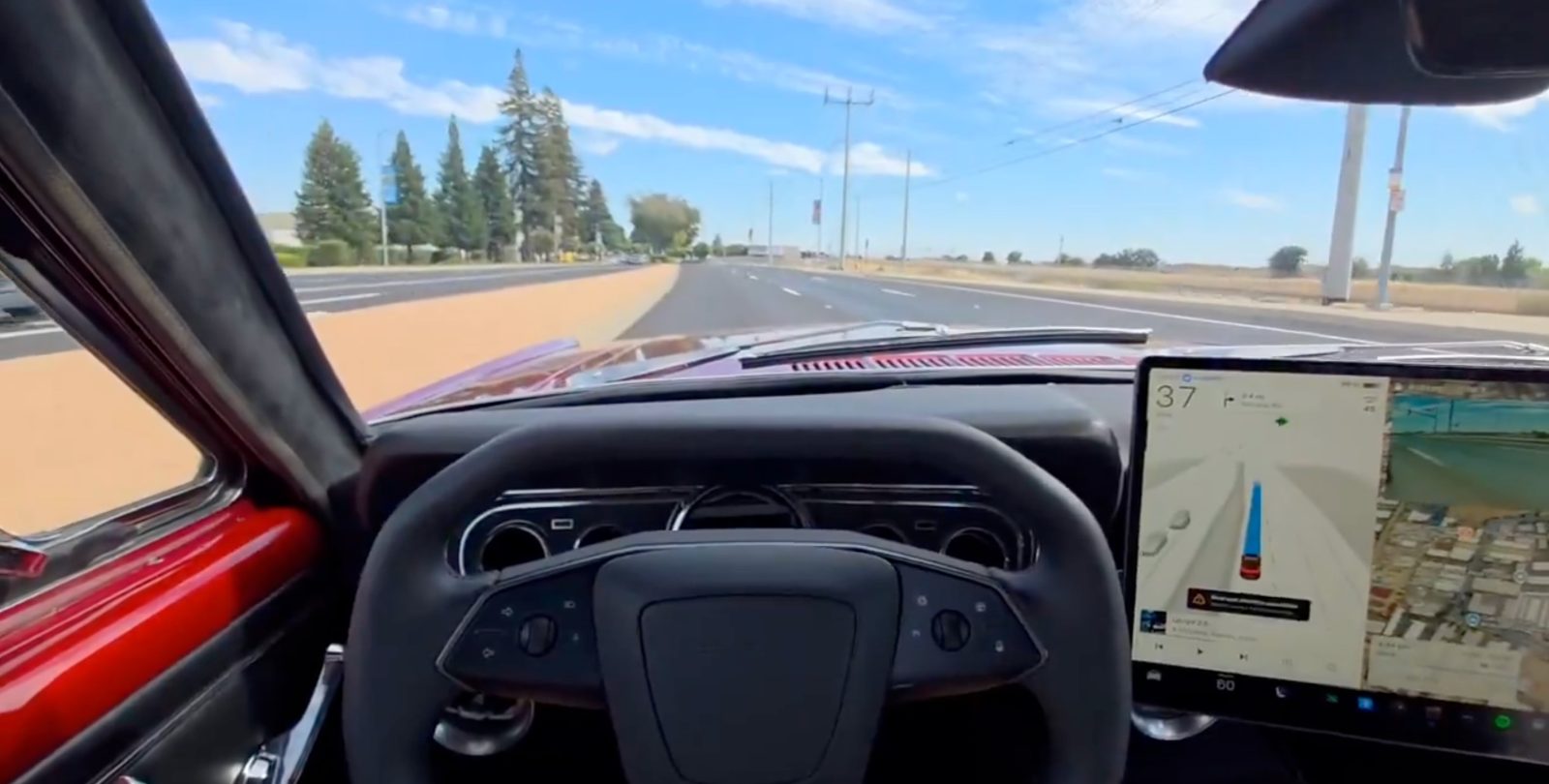
The most remarkable part of the build isn’t the drivetrain — it’s the software. Shcherbanyuk retrofitted Tesla’s camera array onto the Mustang, enabling Autopilot, Sentry Mode, and “Full Self-Driving” (Supervised). The system reportedly works, making this what appears to be the first non-Tesla vehicle to actually run FSD.
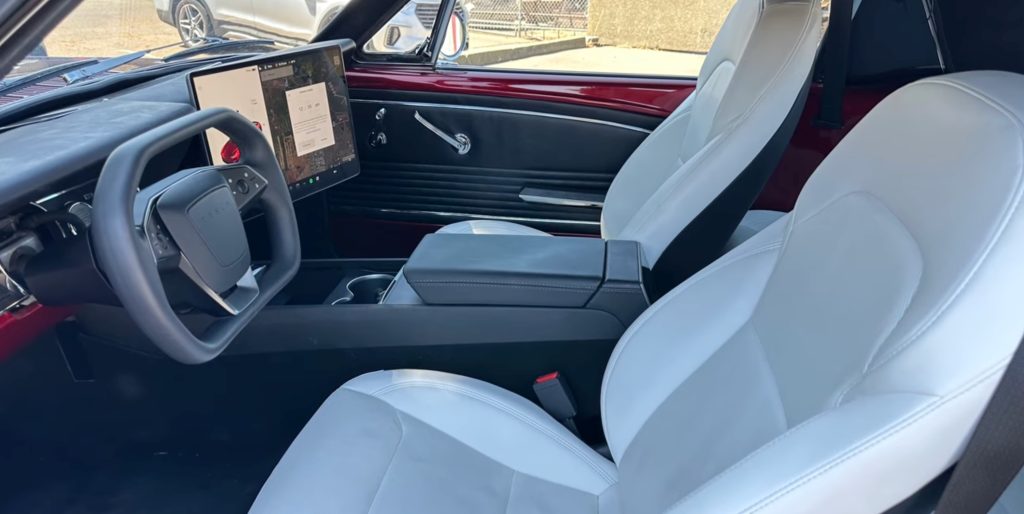
Inside, the Mustang features the Model 3’s 15-inch touchscreen controlling all vehicle functions and receiving firmware updates over the air. Shcherbanyuk also installed the Cybertruck’s yoke steering wheel and Tesla-sourced heated and cooled seats. The Tesla charging port sits where the original gas cap was at the rear of the car.
Here you can see the car using Tesla’s Summon feature:
During a test drive with Business Insider, the car showed 194 miles of range remaining at approximately 80% battery. Shcherbanyuk reported achieving 258 watt-hours per mile, which matches or beats the efficiency of a standard Model 3 — impressive given the Mustang’s less aerodynamic body.
Why this matters beyond the novelty
The build is a passion project, but it highlights a few things about the state of Tesla’s technology. Elon Musk has talked about licensing “Full Self-Driving” to other automakers for years, but no manufacturer has signed a deal. Ford CEO Jim Farley publicly shut down the idea, saying Waymo’s system is superior. Musk admitted last year that legacy automakers simply don’t want FSD.
Yet here’s a small auto parts shop in Sacramento running FSD on a non-Tesla vehicle for under $40,000 in total project costs. It demonstrates that Tesla’s hardware and software stack is more portable than the company’s licensing struggles would suggest.
The project also speaks to the growing EV conversion market, where Tesla drivetrains have become the go-to for classic car builds. Companies like Arc Motor Company offer Tesla-battery-based classic car conversions starting at $75,000, making this $40,000 DIY build look like a bargain by comparison. The global vehicle conversion market was valued at $5.9 billion in 2024 and is projected to grow at 9% annually through 2034.
Here’s a cool walkthrough of the car:
Electrek’s Take
This is one of the coolest EV conversion projects we’ve seen. Getting a Tesla Model 3 drivetrain into a classic car isn’t new — we’ve covered Tesla-powered builds ranging from Shelby Cobras to Honda Accords over the years — but getting “Full Self-Driving” working in a 1966 Mustang is a first, and it’s genuinely impressive.
The most impressive part, in my opinion, is getting Autopilot and FSD to actually work with what are inevitably different camera angles throughout the entire sensor suite. Tesla’s vision-based neural network was trained on data from cameras mounted in very specific positions on Tesla vehicles. The 1966 Mustang has a completely different body shape, roofline, and mounting surface geometry — meaning every single camera in the suite is sitting at a different angle and height than what the system was designed for. The fact that FSD still functions despite that is a testament to the robustness of the neural net, and it tells us something useful about how adaptable Tesla’s vision stack actually is to non-standard camera placements.
That’s relevant if Tesla ever does manage to license FSD to other automakers with different vehicle geometries – something it has tried to do for years, but it has yet to convince an automaker to get on board.
FTC: We use income earning auto affiliate links. More.
The dysfunction finding casts doubt on UAW President Shan Fain as he looks to ramp up his reformist agenda. By Stewart Burnett
A federally-appointed monitor overseeing the United Auto Workers (UAW) has found “multiple points of breakdown” in how the union managed roughly US$340m in funds liquidated to finance its landmark 2023 strike against the Detroit Three. The probe concluded that the money sat out of alignment with the UAW’s investment policy for more than a year after the six-week walkout ended.
The report was overseen by monitor Neil Barofsky, released on 30 April, and cited “significant dysfunction, supervisory shortcomings, communication failures, and governance weaknesses” across the union’s investment management chain. Barofsky was appointed by a federal judge not under the direct influence of President Donald Trump.
The UAW’s board voted in August 2023 to liquidate the funds to cover strike benefits and related costs, but the resolution did not specify a timeline for reinvestment. Almost none of the portfolio was reinvested in equities in the year that followed. The union subsequently calculated its forgone gains at approximately US$80m—a figure Barofsky disputed, concluding it was “based on deeply flawed and inaccurate assumptions that significantly exaggerated any loss amount”.
His report found the UAW had used fixed equity allocation targets rather than the broader policy ranges permitted under its investment guidelines. The union returned to compliance by June 2025, with a 22% equity allocation falling within approved boundaries. Federal oversight of this nature may strike some as excessive given the lack of comparable scrutiny given to private industry; such measures were implemented in the mid-20th century to mitigate mafia infiltration of labour unions.
Barofsky found no evidence of misconduct by Secretary-Treasurer Margaret Mock, whose office nevertheless bore the brunt of the governance findings for failing to notify UAW leadership that its investments were out of compliance. His report also addressed internal tensions, concluding that UAW President Shawn Fain’s attempts to assign blame to Mock constituted “retaliatory actions”—a finding that goes well beyond the investment question and implicates the conduct of the union’s most senior elected official.
UAW President Shawn delivered a raucous speech against President Trump at the 2024 DNC
Barofsky was appointed by a federal judge pursuant to a 2020 consent decree resolving a UAW corruption scandal predating the Fain era—making him an officer of the court rather than a political appointee. The Department of Justice enforces that consent decree, however, and that enforcement now sits with an administration that has, by and large, been openly hostile to organised labour, cutting National Labor Relations Board funding and pursuing policies the UAW is now contesting in court. The combination of a technically independent monitor and a politically adversarial DOJ gives the report’s publication a more complex backdrop than its procedural origins might suggest.
During his tenure of leadership at the UAW, Fain has cultivated a political profile that extends well beyond collective bargaining. He appeared at the 2024 Democratic National Convention in Chicago, and was among the most vocal labour voices backing Kamala Harris’s presidential campaign, framing the election in explicit terms of working-class survival against billionaire-class capture. That positioning made him a visible symbol of organised labour’s political re-engagement, and a direct irritant to an administration that has since moved aggressively against the institutional infrastructure unions rely on.
The UAW said it strongly disagreed with aspects of the report without specifying which, confirmed it had been in compliance with its investment policy for nearly a year, and committed to implementing Barofsky’s recommendations for strengthened governance and financial management training. Neither Fain nor Mock responded to requests for comment. The monitor recommended new policies to clarify roles and responsibilities over investments and mandatory annual financial training for the union’s investment committee and board.
The report’s timing sharpens its political weight. The UAW’s convention is scheduled for June 2026, when the framework for international officer elections will be set. A formal finding of dysfunction and internal retaliation at the leadership level, however carefully framed, is unavoidably a significant liability for Fain’s reform-aligned slate.
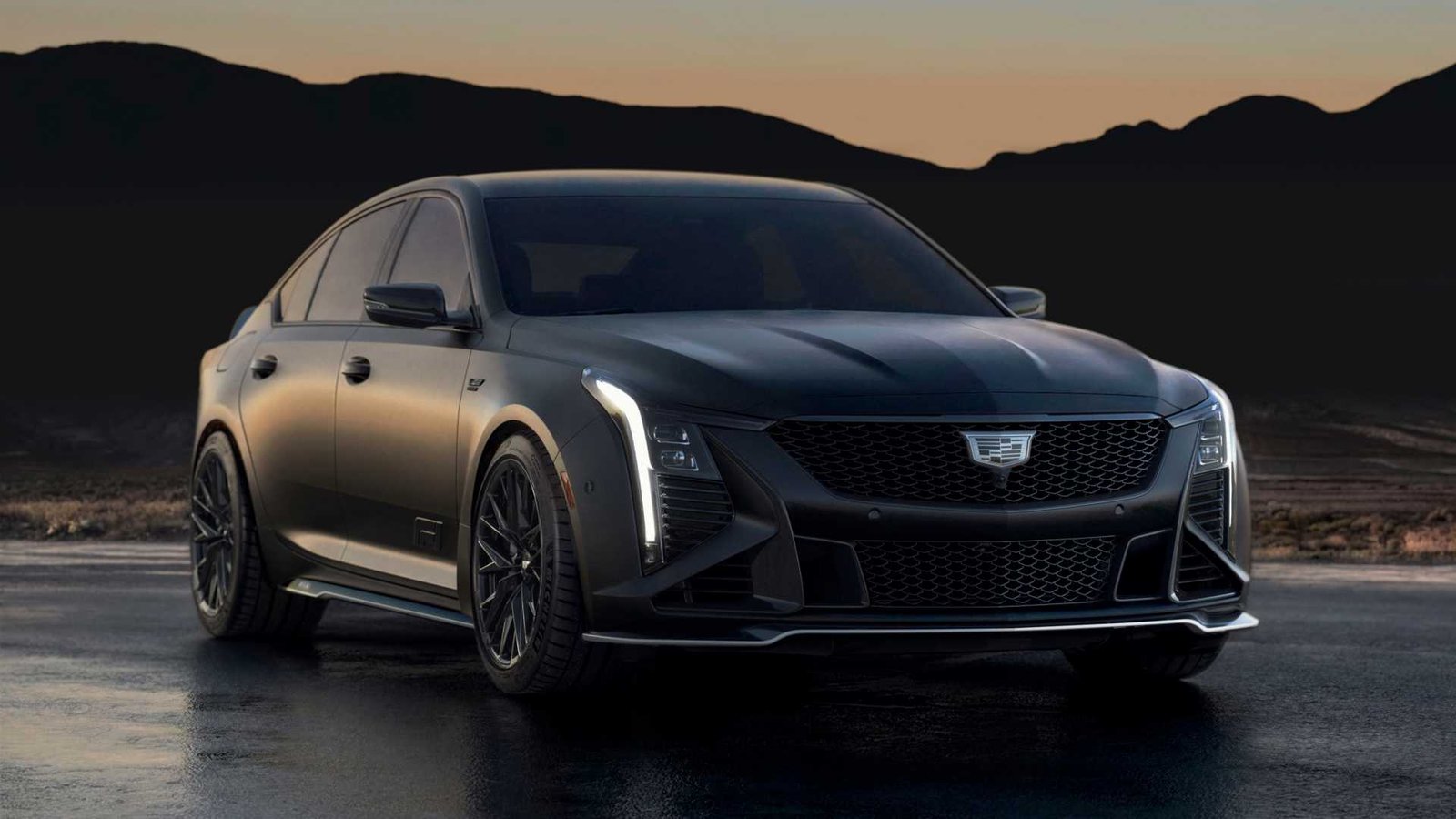
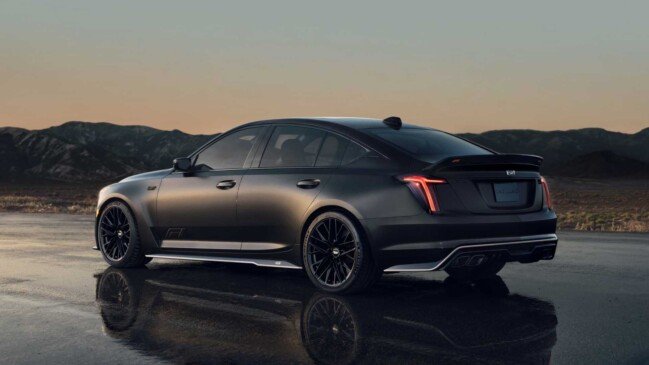
Cadillac has revealed its most powerful Blackwing yet. Called the 2026 CT5-V Blackwing F1 Collector Series, it is a limited-run model built to celebrate the brand’s Formula 1 debut on home soil at the Miami Grand Prix.
Draped in a sinister Midnight Stone Frost matte black finish, the 2026 Cadillac CT5-V Blackwing F1 Collector Series pairs beautifully with Carbon Flash wheels and subtle Harbour Grey brake calipers. There are glossy carbon fibre elements that run low across the body, and they are accented by a sharp silver pinstripe. There is also a prominent yet neatly integrated carbon rear lip spoiler.
F1 and FIA insignias are also tastefully integrated throughout – from the exterior panels to the cabin, where exclusive elements like embroidered headrests and a 3D-printed shift knob make this car that much more special.
But it’s what lies beneath that truly defines this machine. The supercharged 6.2-litre V8 now cranks out a staggering 685 horsepower and 673 lb-ft of torque, making it the most powerful internal combustion Cadillac ever built. Power is sent exclusively through a 6-speed manual transmission.
Limited to just 26 units globally, the 2026 Cadillac CT5-V Blackwing F1 Collector Series has been priced at $260,000.
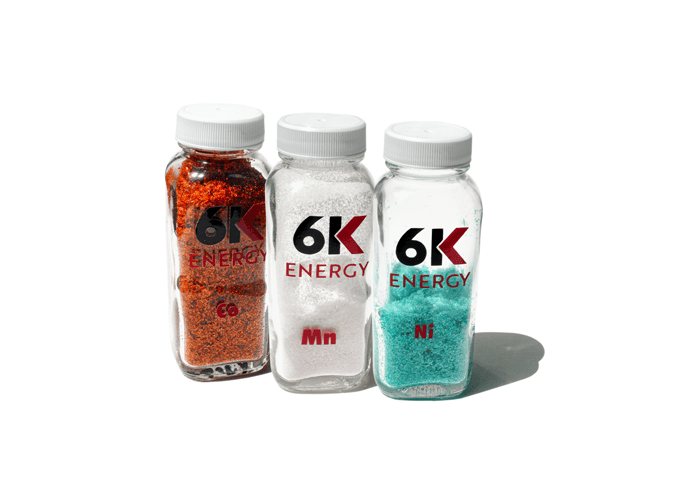
6K Energy and CRG Defense have entered a seven-year agreement to establish a domestic supply chain for cathode active materials (CAM) powering defense battery systems. Under the deal, CRG Defense will source single crystal NMC811 from 6K Energy’s North Andover, Massachusetts facility, with additional capacity coming online in late 2026.
When 6K Energy’s PlusCAM™ facility in Jackson, Tennessee comes online in early 2028, it will become the primary production source. The Jackson facility uses 6K Energy’s proprietary UniMelt platform—a microwave plasma-based process for manufacturing advanced materials—to produce NMC811 and other high-nickel cathode chemistries. The agreement includes a Quarterly Purchase Plan to maintain consistent supply for CRG Defense’s programs.
The timing is tied directly to federal mandates. The FCC’s December 2025 ban on foreign-produced UAS critical components and Section 842 of the FY 2026 National Defense Authorization Act—which prohibits the Department of Defense from procuring batteries from foreign entities of concern—have created urgent demand for compliant domestic supply chains. CRG Defense manufactures battery cells and packs at U.S. facilities for drone platforms and other defense applications.
“Rebuilding a resilient U.S. battery supply chain requires both early commitment and long-term partnerships,” said Saurabh Ullal, President of 6K Energy. “Our PlusCAM facility is designed to deliver sustainable, battery-cathode material at scale for the most demanding defense applications.” Patrick Hood, CEO of CRG Defense, said the deal means drone platforms “will now be powered by technology that is truly American made from the chemistry up.”
REGULAR CLEANING extends your RV’s life, helps retain its resale value, and keeps your camper in the best possible shape for continued adventures. Plus, post-trip RV cleaning lets you spot damage more easily and catch potential maintenance issues before they become costly problems. Here’s how to clean your RV after every trip — inside and out!
Expert Tip: If you RV as a family, post-trip RV cleaning offers an excellent opportunity to teach responsible ownership. Include everyone in your post-trip cleaning up by dividing and conquering. You can even amp up the fun with a friendly competition—just make sure you award points for cleaning quality, not speed!
Key Takeaways
Consistent Cleaning is Preventive Maintenance: Washing after every trip protects your resale value and helps you catch minor damage before it becomes an expensive repair.
Use Specialized, Non-Abrasive Products: Avoid bleach and harsh chemicals in favor of RV-safe, pH-neutral soaps and enzyme-based treatments to protect roofs, seals, and finishes.
Adopt a Top-Down Cleaning Strategy: Work from the roof to the wheels to prevent re-soiling lower areas and ensure all surfaces are bone-dry before storage.
What Cleaning Products Are Safe For Your RV?
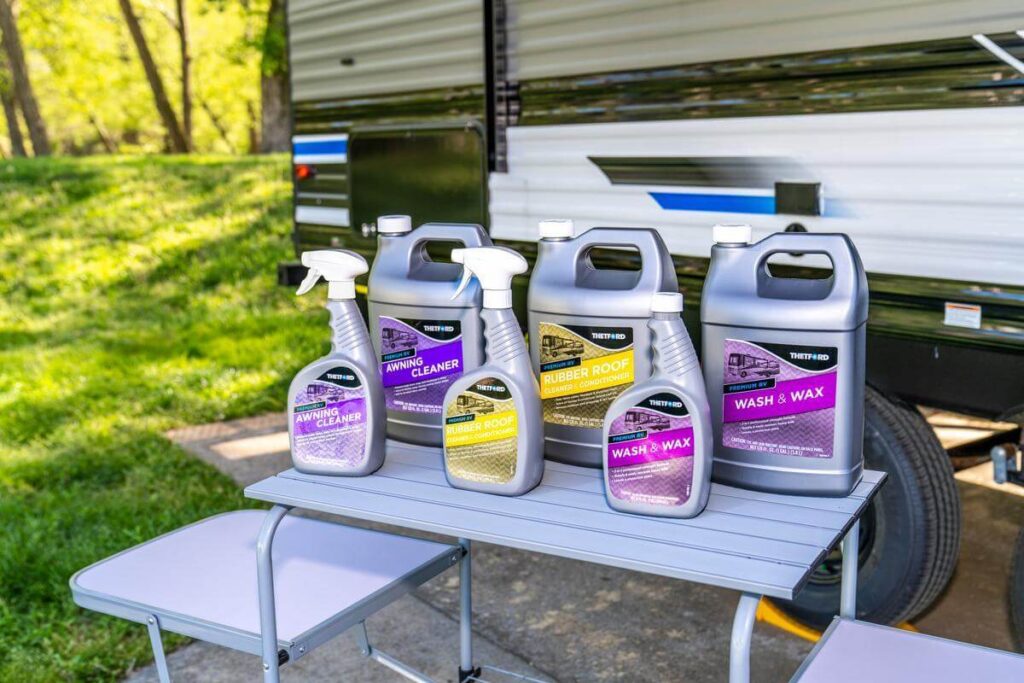
Image by Camping World
The safest answer is always to follow your RV manufacturer’s recommended cleaning products and guidelines, as different RV exterior materials (fiberglass vs aluminum vs rubber roofing, etc.) require different care. That said, here are general rules that apply to most RVs:
Use pH-neutral, non-abrasive soaps for exterior washing to protect your RV’s finish and decals.
Avoid bleach on rubber roofs — it accelerates degradation. Use a dedicated rubber roof cleaner instead.
For black and gray water tanks, enzyme-based tank treatments are safer for seals and sensors than bleach-based products.
For interior surfaces, look for non-abrasive, RV-safe multi-surface cleaners. Harsh chemicals can damage cabinetry finishes, upholstery, and countertops.
For disinfecting, use EPA-registered products proven to kill germs on contact on hard surfaces.
Our Guide to Green Camping also includes some eco-friendly RV maintenance products.
How Often Should You Clean an RV?
You should clean your RV after every trip — even short weekend outings. A basic post-trip clean prevents odors, mold, and grime buildup that compounds over time. A deeper detail (waxing the exterior, cleaning the roof, and professional interior cleaning) is worthwhile at least once a season.
To clean an RV after a trip, work through the interior and exterior in a logical order: dump and flush holding tanks first, then clean the RV interior from top to bottom, and finish with the exterior, including the roof. Use only manufacturer-recommended, RV-safe cleaning products throughout. The checklist below walks you through every step.
How To Clean RV Holding Tanks
Subscribe to the Camping World Tutorials YouTube channel and never miss a video.
It’s easier to empty holding tanks or a portable waste tank before leaving the campsite. Start with the black tank first, then the gray water.
After emptying the black tank, use an RV black tank cleaning wand or know how to use an RV black tank flush, if your camper is equipped. You can also use a sewer hose rinser kit for additional cleaning.
Keeping your tanks clean will keep your tank sensors working well and also help minimize odors. Consider using a tank sensor cleaner to remove unseen residue build-up on the inside of your black tank.
While your sewer accessories are out, check their storage area(s) and clean if needed. A portable waste hose container keeps this tool separate from other items in your RV’s basement storage, a sanitary consideration.
For RVs with a cassette toilet, check the housing area around the portable waste tank for water accumulation. Any water from rinse-off and flushing overrun can pool at the bottom and should be cleaned as soon as possible.
To avoid bacterial growth in your fresh water tank, we recommend fully sanitizing it every 6 months. However, you can do so more frequently if you’re a full-timer or during periods of heavier use. It’s easier to clean the fresh water tank at home, so you can let the cleaning solution work overnight.
Learn how to sanitize a camper’s fresh water tank.
How To Clean Your RV Interior
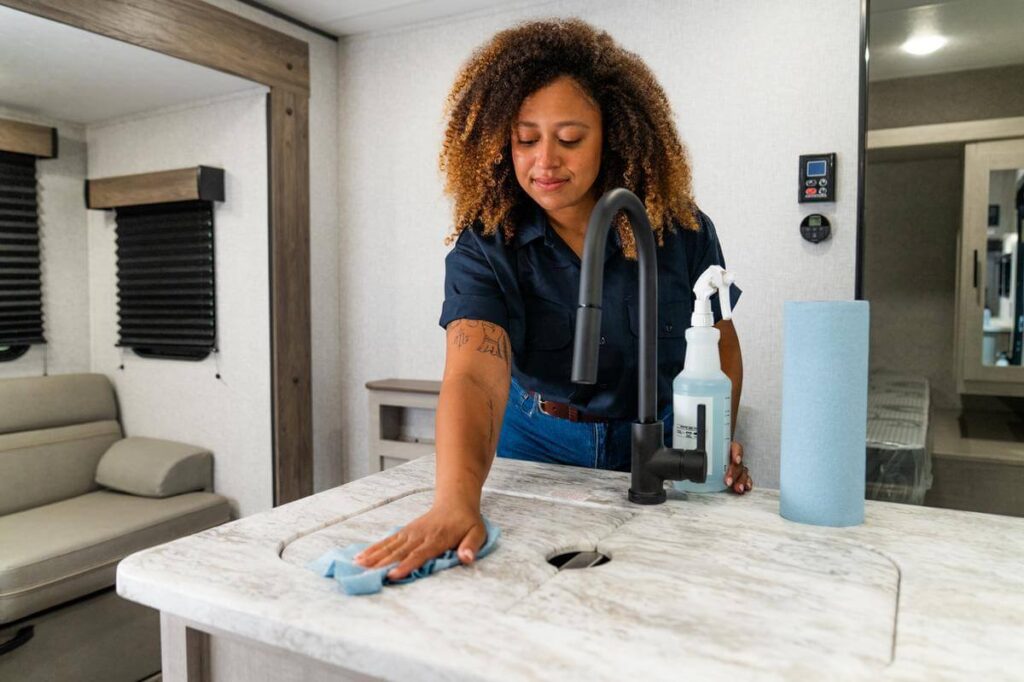
Image by Camping World
The best way to clean an RV interior starts with cleaning and progresses to disinfecting. They go hand-in-hand but aren’t the same thing. Cleaning removes germs, dirt, grease, and grime. Disinfecting kills germs.
The CDC sets guidelines for properly disinfecting surfaces using EPA-registered, germ-killing products. For hard surfaces, clean first, then disinfect with a CDC-approved disinfecting product. For soft, porous surfaces, vacuum visible debris, then launder on the hottest water setting allowed by the fabric care instructions.
Work from the top down, so anything that falls gets swept up at the end. Start by dusting ceiling vents, fans, and overhead surfaces; wipe down walls and windows; and finish with floors and carpets. Empty and clean the refrigerator, stovetop, and microwave, and launder all linens. Use only RV-safe, non-abrasive cleaners to protect interior finishes.
Technician Tip: As you clean, look for damage to fabrics, hinges, cabinetry, and other interior components. Note anything that needs attention before your next trip or before storage season.
Here’s an easy-to-follow RV interior cleaning checklist:
Ventilation
Open windows, vents, closets, and cupboard doors
Dust or vacuum ceiling vents, exhaust fans, and HVAC vents
Clean your RV’s air conditioning filter
Use a deodorizer, dehumidifier, baking soda, or eco-friendly charcoal packets to absorb odors and keep the interior dry
General Interior
Check ceilings and crevices for cobwebs and bugs
Dust entertainment electronics
Spot-clean splash zones: upholstery, window coverings, walls, and ceilings
Leave window shades open to reduce moisture accumulation and mold growth
Vacuum crumb-catching areas: couches, seat cushions, floors, and carpets
Rinse trash cans and wipe down trash collection areas
Kitchen
Unpack food items and clean the refrigerator, stovetop, oven, and microwave—inside and out. If so equipped, don’t forget the dishwasher and garbage disposal
Wipe down kitchen backsplash, pantry, countertops, and tables
Thoroughly wash any kitchenware you plan to keep inside
Clean condensation on water pipes under the counters
Check and clear the sink drain to remove soap and other residue
Bathroom & Bedroom
Clean toilets—inside, around the outside, and behind
Check and clear the shower drain to remove soap and other residue
Launder linens. Clean mattresses and under beds—including pull-out beds—to prevent bed bugs and dust mites
Cab/Cockpit(if applicable)
Wipe down cupholders, steering wheel, vents, and dashboard
Apply vinyl/leather protectant where applicable
How To Clean Your RV Exterior and Roof
Image by Camping World
Washing an RV after every trip prevents black streaks, fading, and other unsightly issues. Here’s a quick RV exterior cleaning guide:
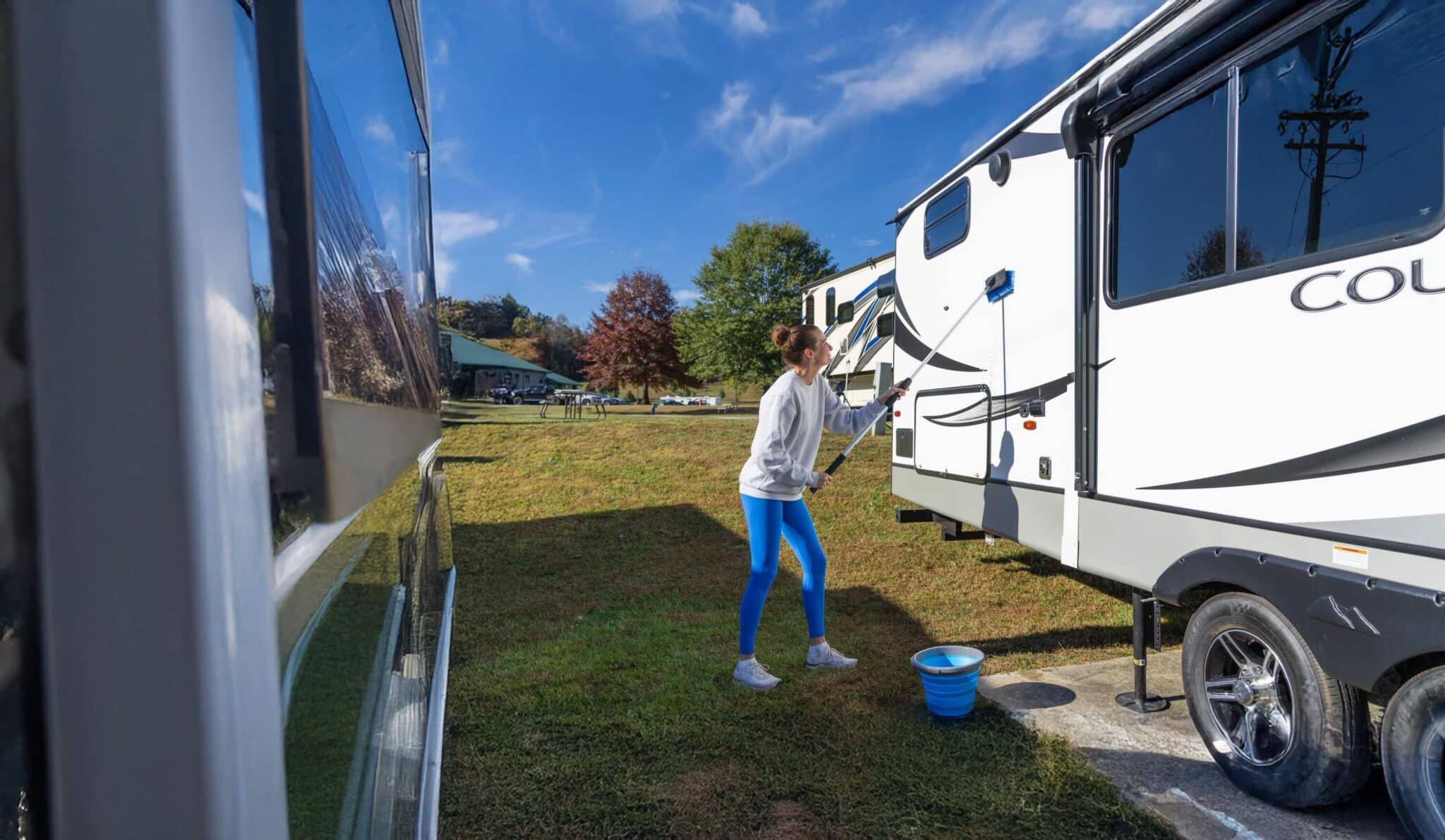
Use RV-safe cleaning products and wash your RV’s entire exterior from top to bottom, working in sections. Start with the roof, then the rear cap, the camp-side wall, the front cap, and then the off-camp wall. Don’t forget the windows on each wall, the tires and rims, and propane bottles (if they aren’t enclosed), which may all require specialized cleaning products, per your RV manufacturer’s recommendations.
Here are a few additional tips for washing the outside of your RV:
Allow RV awnings and slide toppers to dry completely before clothing and latching them securely to prevent moisture penetration and retention.
Consider waxing your RV exterior every 3-6 months to prevent UV damage and oxidation. Consult the manufacturer for recommended waxing products.
Use a squeegee to dry RV windows and prevent streaking.
Dry each section with a gentle, microfiber towel as you go for a more spot-free finish.
Regular post-trip washing and waxing prevent bug buildup, grime, and mold from baking on while your camper is in storage.
Technician Tip: As you’re washing your RV, note dents, missing sealant, and other exterior damage to create a checklist for offseason maintenance. Don’t forget to empty storage compartments and clean camping accessories, such as chairs, patio mats, and grills, to prevent mold and rust.
Can You Pressure Wash an RV?
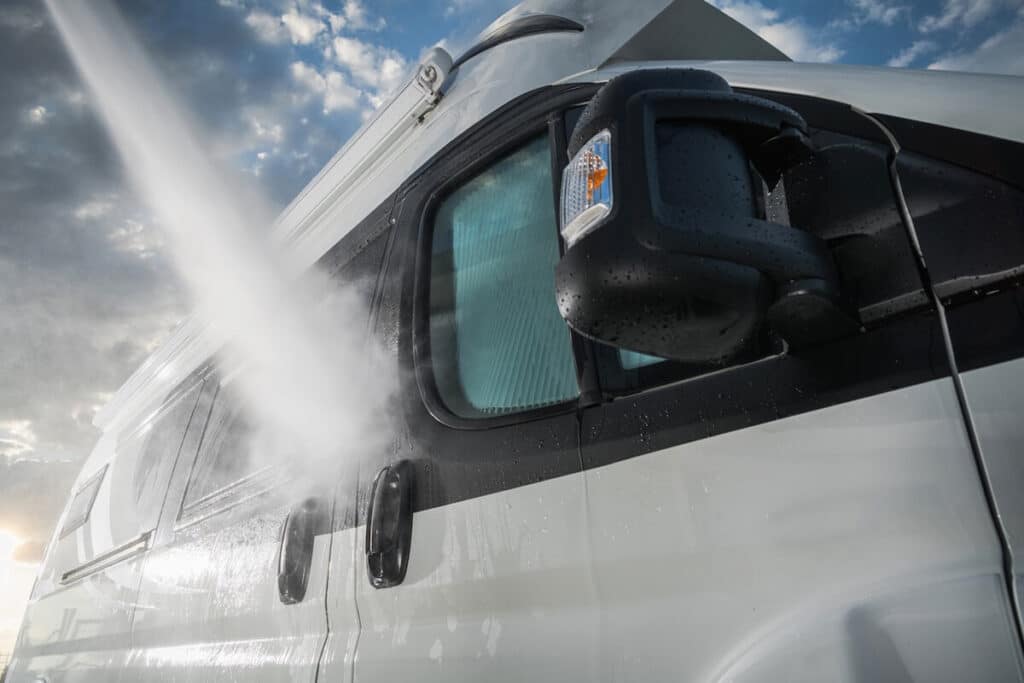
Image by welcomia via iStock
Pressure washing is a common question for RV owners, and the short answer is: with caution. A standard residential pressure washer on a low setting can be used on an RV’s exterior, but high pressure can damage decals, seals, paint, gelcoat, roof membranes, and other exterior components. You may also find portable pressure washers for RV cleaning, but the same cautions apply.
Always keep the spray wand moving — never hold it in one spot — and avoid directing water at windows, vents, or any seams and sealants. For the roof, a gentle garden hose rinse or a soft brush is usually safer than a pressure washer.
When in doubt, consult your RV’s owner’s manual or ask a service technician at your nearest Camping World Service Center.
Can You Take an RV Through a Car Wash?
Most standard car washes are too small to accommodate RVs. Some areas have commercial truck washes, though these typically offer only water and a hose—you’ll need to bring your own cleaning products. For a thorough exterior wash, hand washing at a designated rinse area (with proper drainage) is usually the best option.
Save Time With Professional RV Cleaning
Detailing the interior and exterior of your RV is worth the effort — but it takes time. Trained service professionals can wash, wax, remove oxidation, and completely clean your RV interior, including carpets. If you’d rather leave it to the pros, schedule an RV detailing and cleaning service at your nearest Camping World.
Use these additional resources to properly care for your RV investment:
What are your RV cleaning tips? Tell us in the comments below.
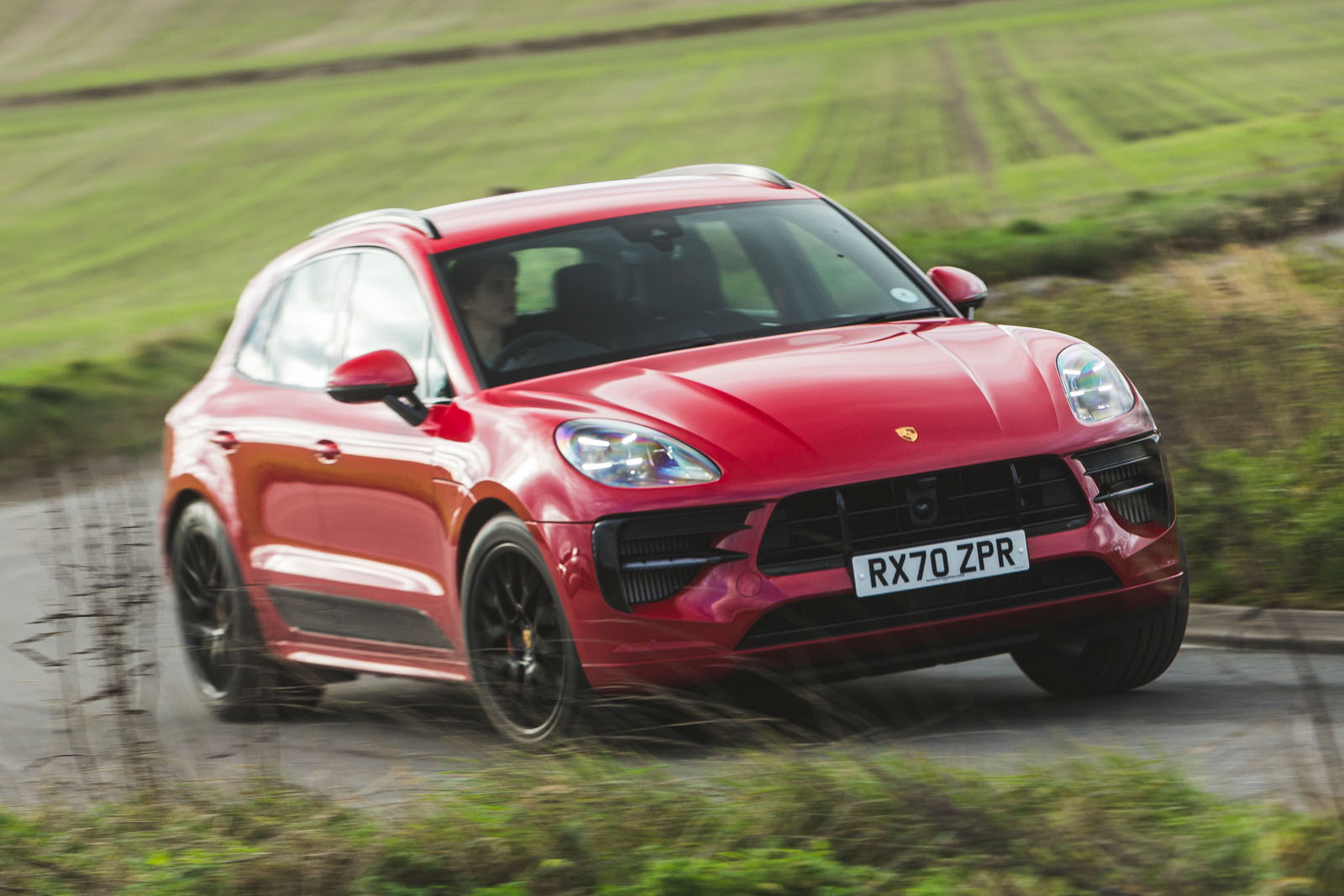
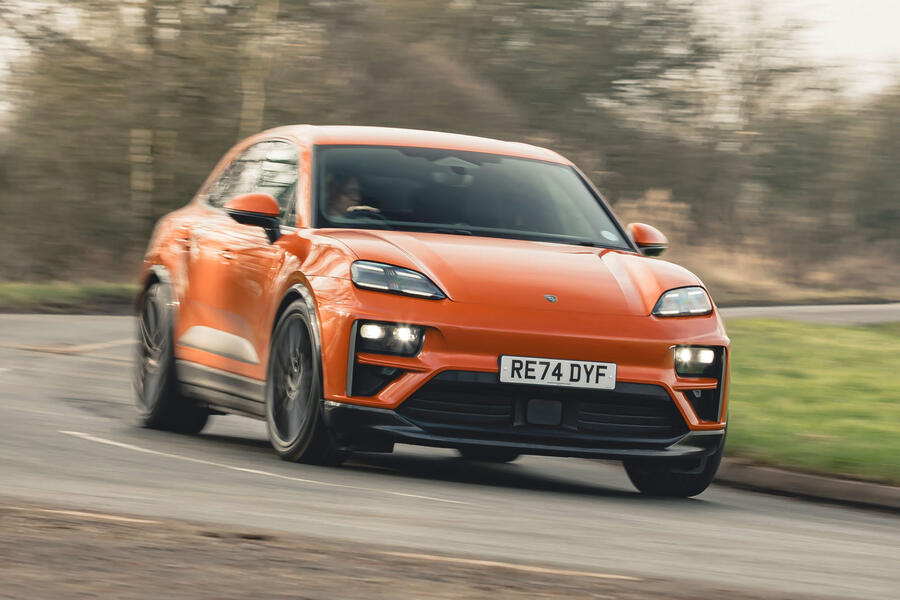
Porsche will end production of the combustion-engined Macan this summer, it has confirmed, although the model will remain available in the UK into next year.
Speaking on the company’s first-quarter earnings call, finance chief Jochen Breckner said: “We will produce the ICE Macan until mid-2026 and we will stock as much as we can based on the supplier parts that we have.”
According to Breckner, stock should last “over the months to come”. He added: “We will even see some sales in some regions in 2027.” Thereafter, only the electric version will remain available – although Porsche is also priming a spiritual successor to the combustion-powered Macan for launch in 2028.
Most of the remainder of the stock is expected to be diverted to regions with greater demand for combustion-engined vehicles. Porsche GB would not comment on how many cars the UK will receive, but confirmed to Autocar that the ICE Macan will be available here into 2027.
One of the key markets Porsche is targeting is the US, said Breckner. He explained: “In the United States, the ICE Macan really has a great demand so we are supplying that region with the cars that we produce. And that’s even more important based on the fact that tax incentives on electric vehicles have been stopped by the US government – those were $7500 per car – which is a substantial issue. Therefore there’s some pressure on the electric Macan in the United States and therefore we provide as many ICE Macans in the United States as we can.”
The combustion-engined Macan remains one of Porsche’s most popular models. The company sold 10,130 ICE Macans during the first quarter of 2026, which is up on the 9370 it recorded during the same period a year ago.
For reference, Porsche’s best-seller during the first quarter of 2026 was the Cayenne, recording 19,183 units, followed by the 911, at 13,889 units.
The Macan Electric sold 8079 units, notably fewer than the 14,185 recorded over the same period last year. This shortfall was “largely expected”, said Breckner, citing the “strong ramp-up” of Macan EVs during the first quarter of 2025 – as the firm pushed to get cars on the road soon after launch – as well as the subsequent removal of tax incentives in the US.
Breckner added that the ongoing conflict in Iran has affected supply of all models – with restrictions on key shipping lanes – and caused some customers “to be a bit more reluctant in going to a Porsche dealership and ordering a car”.
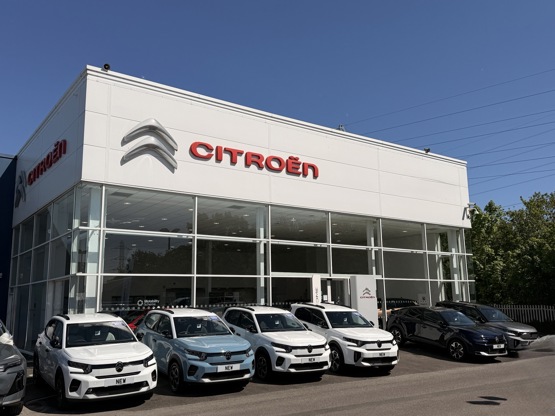
Lithia UK has expanded its South Wales footprint with the acquisition of Citroën and Peugeot retail operations in Newport from Stellantis &You.
The deal strengthens its Evans Halshaw trading division’s longstanding relationship with Stellantis and increases its representation of both brands, taking its Peugeot network to eight stores and Citroën to 12 nationwide.
Newport growth
As part of the acquisition, Evans Halshaw’s existing Vauxhall Newport operation will relocate into the newly acquired site on Newport Retail Park, creating a larger multi-brand retail destination.
The business has also secured additional land adjacent to the site and plans to invest in future development to enhance the customer experience at the store.
The acquisition builds on Evans Halshaw’s expansion across key UK regions and strengthens parent company Lithia UK’s presence in South Wales, following recent acquisitions of stores from Read Motor Group, Hatfields and Arden.
Gary Armstrong, managing director of Evans Halshaw, said: “This acquisition allows us to build on our existing presence in Newport and bring multiple brands together into a single, enhanced location. As part of the deal, we will be growing our team, while continuing to deliver a high standard of service to both new and existing customers.
Stellantis ties
Stellantis is a key OEM partner for Evans Halshaw, with the retailer representing Peugeot, Citroën, DS, Vauxhall, Fiat, Abarth, Jeep and Alfa Romeo.
Steve Spicer, group vice president at Lithia UK, said: “This is an important step in strengthening our presence in Wales and continuing to grow our representation across key volume brands. The Newport store presents a strong opportunity for us to invest, develop and create a compelling retail environment for both customers and colleagues alike.”
Further acquisition
Driveway Vehicle Solutions, Lithia UK’s fleet and leasing arm, earlier this week announced it had acquired Agility Fleet, the Bromsgrove-based contract hire and leasing business.
The deal, which completed on 29 April, will see Driveway Vehicle Solutions absorb Agility Fleet’s managed vehicle portfolio, FCA registration, and operational expertise.
The acquisition adds more than 1,200 vehicles to the Driveway Vehicle Solutions fleet overnight, and follows the recent rebrand of the business.
Ensure you always receive AM insights. Make us a preferred source of news on Google
This post may contain affiliate links. See our affiliate disclaimer here.
In 2023, we decided to stop talking about living abroad and try out Boundless Life in Sintra, Portugal. The program gave us the opportunity to live in Europe for three months with our family of four, and while our initial experience wasn’t the best, we were hooked on the lifestyle. Fast forward three years, and we’ve now tried six Boundless Life locations across Europe and South America.
We completed the 2024-2025 school year, traveling from Greece to Montenegro and then to Italy. For our second year around the world, we’ve done cohorts in Uruguay, Spain and we’re about to repeat our first cohort ever (more on that below).
Because we’ve tried so many Boundless Life locations and have seemingly committed to Boundless as our full-time life, we wanted to share an updated account of what the Boundless experience has been like.
In this post, I’ll share why we’ve opted to continue Boundless Life with our two kids, what some of our favorite (and least favorite) locations have been, and what we’d wish we’d known before we got started.
Note: We are not paid by Boundless Life to write about our experience and we’ve paid full price for all of our cohorts, but we do share our referral code at the bottom of this article. If you found this information helpful, using our code gets your family (and ours) a discount on your future booking.
Use the Table of Contents below to hop around this article to better access the location information your family is most interested in.
First, What is Boundless Life?
Boundless Life is an international program with an education center, co-working hub, and housing that allows families to experience living abroad. For a family of four, it’s been one of the easiest ways to move abroad and still have a sense of community and education for the kids.
As of today, there are Boundless Life locations in:
Sintra, Portugal
Bali, Indonesia
La Barra, Uruguay
Andalusia, Spain
Pistoia, Italy
Kamakura, Japan (new as of January 2026)
Syros, Greece
Kotor, Montenegro
Our kids started Boundless Life when they were one and three years old and are now four and nearly seven. It’s been the only school experience they’ve known! It will be a rude awakening when/if we enroll them in a “regular school” and they realize regular beach field trips and surf lessons are not always part of the curriculum.
Why We’ve Done 6+ Boundless Life Cohorts
If you read our first article on Boundless Life, you may be asking why we continued this journey (sad soccer story and all).
After our time in Sintra, we sat down to reflect on the life we wanted to give our kids and what we wanted them to learn before they turned 18. We made a list of things we wish we’d learned, such as financial literacy, how to be open-minded, public speaking, how to cook a meal, fluency in a second language, and many others.
As we made our way through this list, we realized that much of what we wanted to instill in our kids could be done from anywhere in the world. Further, we believed that Boundless Life offered a path to helping us instill these values (and more) into our kids.
While the program is still an early-stage startup (going on year five) and has ongoing improvements to be made, I wanted to share why we’ve signed up for so many cohorts (and have more planned).
1. We’ve made hundreds of amazing memories.
One hypothesis we had for signing up for Boundless Life was that it would make time feel like it was passing more slowly with our kids.
When you try new things, drive someplace different, meet a new person, start a job, your brain has to work harder to process that moment. As a result, when you try new things, time has the sensation of moving slower.
When we were deciding whether or not to sell our house in Colorado or play it safe and stay put, we chose travel for this reason. We aren’t making the same commute every day, going to the same office, same restaurant, same Target. We are in new countries, learning new languages, navigating new streets, and often meeting new people.
In a way, it feels like we are extending the precious time we have with our kids. Being able to make hundreds of memories as a family is one of the things I believe Boundless Life has given us most.
It’s impossible to recount all of them, but I wanted to share a few special ones that come to mind.
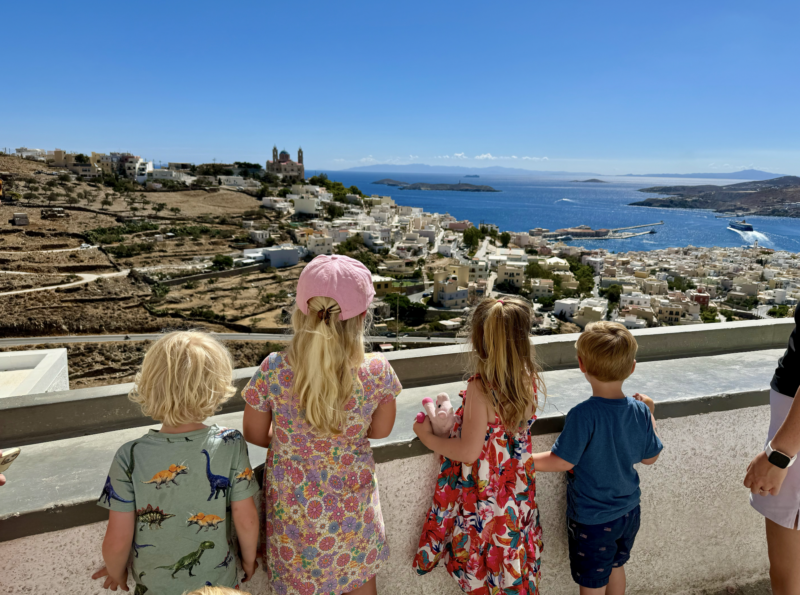
Beach days in Syros.
I mean, look at that water!
Shortly into our second cohort in Greece, we met a lovely family from New Zealand.
On several occasions, we found ourselves beach hopping while the kids played. One Saturday, we looked up and had spent six consecutive hours at the beach without meltdowns or naps or anything. Our two-year-old was happy as a clam, splashing and exploring the water and sand.
Syros is a small island, and you can access most of the beaches within 20 minutes. There were dozens of memories from this island, but this is one that fills my heart with joy every time I see these pictures.
Coastal town hopping in Montenegro.
Montenegro has so many adorable little towns on the water with long stretches of beaches. We explored so many of these during our winter in the country. The beauty of this country continues to astound us.
Farm stays in Italy.
Agriturismos in Italy, which is like staying at hotels on farms, wineries, etc., is maybe the best part of Italy. During our Tuscany cohort, we spent several weekends among the vines and olive trees. They are peaceful and quiet and have the best food. The best wine. The best olive oil. The best fresh bread. The best homemade pasta. The best pizza. The best risotto. When I look back at our three months in Italy, it’s these weekend getaways that I love the most.
I know, I know. Everyone goes to the cities in Italy! But after all those cities, you’ll want a break, and I recommend an agriturismo outside the very underrated San Marino.
2. Date nights around the world.
One of the best parts of Boundless Life is experiencing amazing parts of Europe and the world as a couple. Every month, the Boundless crew hosts a movie night, and we take those opportunities to experience whatever town we’re in. (They usually plan an event for the parents that night, but we almost always go on a double date with new friends or just go out together!)
Date night in Syros, Greece
It’s not just limited to date nights. Some of our favorite experiences are dropping the kids off at school and having an adventure day.
Mykonos, Greece: We took a day trip over to Mykonos for lunch and to walk around. It’s a ~30-minute ferry ride from SyrosLa Barra, Uruguay: Heath’s first experience rock climbing! Boundless will coordinate lots of experiences like this while the kids are in school.
3. The quality and passion of the Boundless Life teaching staff.
One thing I’ve been continually impressed with for Boundless Life is the quality of their teaching staff. In almost every country we’ve been to, the kids have built meaningful bonds with their teachers.
A unique and unexpected part of our full school year with Boundless last year was that one of the teachers traveled with us all year. While she was a traveling teacher for the older kids, it was unexpectedly nice having a consistent presence of someone the kids knew and trusted at every location. This same teacher will be with us in Montenegro and it will be the fourth cohort with her! In a life that is inconsistent and always changing, this is an amazing blessing.
The teaching staff is a great mix of educators from all over the world, with some who are local to each country/location.
4. Finding Padel, Heath’s new passion.
Heath jumping in to write this section.
Pronounced PAH-DELL (I’m 80% this pronunciation is correct but everyone I meet says it differently).
While this has nothing to do with schooling or family, I am slotting it into the win column. Before we started traveling with Boundless Life, I played pickup basketball 2-3 days per week. I loved it and planned my week around those times.
I knew I would miss those time slots of physical activity. However, within Boundless Life, padel is a common fixture in most cohorts. If you’ve never heard of it, it’s kind of a mixture between racquetball, tennis, and pickleball (think: if pickleball were actually physically challenging or gave you a workout).
Why I’ve loved padel:
Gives me the same kind of mental break as basketball did. Just a time to decompress.
A great communal activity. You need four people to play, so a great way to meet other people in your cohort (or locals, I’ve joined WhatsApp groups as we’ve traveled and met people outside of Boundless Life).
I’m competitive. Even though I’m not great, the occasional smashed point carries me through the week (looking at you, Brian).
Night time padel sesh
Oh, and even though padel has taken up most of my weekly physical activity slots, we still get to play a decent bit of basketball. In Italy, we had a weekly pickup game with adults and kids. I am still mentally recovering from a 12-year-old hitting 3-pointers in my face, but it was a highlight of the cohort for me.
Playing pickup basketball in Italy after school pickup
Fun fact: Kobe Bryant spent some of his childhood in Pistoia, Italy. The park featured below had a sweet Kobe mural painted on the wall, just a bit of motivation before I was schooled weekly by kids.
5. We’ve made new friendships around the globe.
One of my biggest fears before we embarked on this world schooling adventure was relationships. Would the kids be able to forge friendships? Would we? Would it be lonely?
On our last day of the cohort in Syros we went to our favorite coffee shop with a group of friends. We reminisced on our time on that magical island and hugged. We talked about how special this moment was and felt immediately nostalgic, even though the moment had barely passed.
Little did we know, almost everyone in this photo would meet up again in Italy and in Spain. Several of us would spend the entire year together in Boundless Life, traveling from Greece to Montenegro and then to Italy.
While our location changed, we all experienced an ongoing sense of community. In many ways, it felt similar to our full-time RV life back in the States. We left home and started traveling, and our community ended up becoming friends we met on the road. These were people we ended up spending life with, making memories with, and who are still great friends to this day.
We met these families in Boundless Life and have since traveled to more than five countries together. This has been one of the best parts of BL, making friends with kids who we can go on adventures with.
With Boundless Life, we came in not knowing anyone. What we’ve gained from the program has become a community of many like-minded families. Whether it was a family looking for a three-month adventure or crazy people like us who sold everything, we all have something in common. These are friends we will have for life.
Last night, my daughter said she wanted two friends she met in Greece to come to her birthday party. I asked her where she wanted the party to be. She said, “What country are they in? We can go there.” She’s only six, but she has such a concept of the world, and it feels small and accessible to her. I love that she is growing up feeling like anything is possible and that there’s nowhere she can’t go in life.
6. Our Kids Have Thrived
My best hope as a parent is to raise kids who are thoughtful, kind, and happy. Kids who see the world as a place filled with opportunities and adventures. This is something Boundless Life has given us in spades.
Like our kids learning Spanish and independence.
This school year, we’ve spent six months in Spanish-speaking countries. On our daily walks to school, we’ll pass bakeries and other shops where we’ll often send the kids in with a few euros and have them navigate the exchange. Not only does this help them develop confidence, but they’ve picked up so much Spanish this past year and are so proud of themselves when they can share it.
One thing that’s made Boundless Life sustainable for us is seeing our kids develop in their education. Each cohort we meet with their teachers, and they ask us what we hope our kids learn or work on during that cohort. While our answers have been a little different with each one (sometimes it may be kindness or specific like reading/writing), one of our overlapping themes is that we want our kids to develop a love of learning.
Each cohort, we’ve watched them develop in both their education and as humans.
Okay enough gushing abour kids. Now, moving on to the question we often get asked by friends and future Boundless Life families.
What is the Best Boundless Life Location?
This is the question everyone asks us, and after trying so many cohorts, we felt this would be a valuable question to answer (subjective as it is).
Before getting to our favorite (and least favorite) locations, I want to share a bit of a disclaimer:
If you’re considering Boundless Life, your experience can and will be 100% different than ours. Every cohort brings with it a different community and sometimes, new staff or leadership or changes. Our intent in sharing our list is simply to share our honest experiences of each location with some helpful tips or insights for each one.
The locations we’ve been to and review below are:
Pistoia, Italy
Kotor, Montenegro
Sintra, Portugal
Andalusia, Spain
La Barra, Uruguay
Syros, Greece
I’ll start with what was our least favorite cohort and work our way up to the absolute best Boundless location (everyone agrees) and the location that surprised us most.
For each location, I’ll rank our experience of the school, coworking space, and other factors that contribute to the cohort. Let’s dig in!
6. Tuscany, Italy: Ideal Location for Weekend Getaways
Spring Cohort April-June 2025
Exploring Lucca, which is a short train ride away from Pistoia
Italy will always have a special place in our hearts. It was the first place we visited in Europe as a family (Ellie was four months old!). We have countless memories in this country and will always hold them close.
However, our Boundless Life experience in Tuscany was our least enjoyable cohort for a multitude of reasons. Several of these reasons were Boundless-specific, but some were also personal (which I’ll share more about in a moment).
Before jumping into the specifics, I want to highlight what we most appreciated about our time at the Boundless Life location in Italy: proximity to many incredible places.
Pistoia (blue dot above) is located 30 minutes to Florence and in proximity to Siena, Pisa, San Marino, and countless incredible places all over Tuscany. Of all the cohorts we’ve done, this is the one where we traveled the most on the weekends. If you were to ever do one Boundless cohort and wanted to maximize how many places you could visit during a cohort, this may be a good option to consider.
We rented a car for the last six weeks we were in Pistoia and road tripped all over. We drove to San Marino for a day, stayed at agriturismos across Tuscany, and spent a weekend in Switzerland and Lake Como area. During our mid-cohort break, we flew to Sardinia which was an absolute dream. Plane tickets were so cheap we extended our stay by a few days to soak up more beach time.
View of the water in Sardinia. Yes, it was magical and I would live there.
The train is easily accessible in Pistoia and while you don’t need a car, we enjoyed the flexibility a car offered us for road trips to off the beaten path spots.
Okay, moving on to the specifics of our review of the Boundless Life in Pistoia.
Boundless Life Tuscany Review:
Education Center: ⭐️⭐️⭐️ (3/5 stars)
Realized we never took a photo of the EC building, but was able to snag one from Google Maps. This is the entrance to the EC/office building.
The Italy Boundless Life education center was the least impressive of all the cohorts we’ve attended.
It is split across two floors of an office building, with lawyers and accountants in neighboring offices. There was no outdoor space to play, so the kids walked to a nearby courtyard for recess.
For recess, the school lacked adequate sporting equipment. To address this, one of the older children organized a lemonade stand to raise money to buy toys and balls so they could have something to play with.
We all applauded his effort…while whispering among ourselves that for the price we pay for Boundless, how do they not provide equipment for the kids to play?
Education: ⭐️⭐️⭐️ (3/5 stars)
We had a poor experience with the educators at this location, primarily with the ECD (Education Center Director). Our five-year-old was put in the 6-7-year-old class, and the ECD refused to move her. She said it was “too much red tape”.
As a result, my daughter felt in over her head in the older class. Eventually, with some coaxing, the class teachers just started sending her down to the 4-5 class (where she belonged in the first place) during academic times, and then she spent the afternoon project time with the 6-7s. Sometimes she spent all day downstairs with the young class, sometimes she was back and forth multiple times. Sometimes they wanted us to drop her off in one place and pick her up in another.
I never knew where my daughter would be. She never knew where she would end up. She didn’t have a place where she felt she belonged. Moreover, when it comes to academics like reading, writing, and math, she made little progress.
The teachers were very sweet and did their best, but I’m still confused as to why the ECD wouldn’t just put my daughter in the proper classroom. I think our whole Italy ranking would be higher if we hadn’t had to deal with this.
Constructive note to any Boundless Team if you’re reading: This seems to be a consistent pain point among cohorts where students are nearing the age cut off for a group. In our current cohort another family is navigating the same issue, and local EC director is not able to easily move them into appropriate age class without what feels like a lot of escalation/process.
(⭐️⭐️⭐️⭐️⭐️ For the 1-3 classroom. The Giulias and Ilaria were amazing teachers, and we loved them!)
Housing: ⭐️⭐️ (2/5)
We booked what we felt was the the coolest, most beautiful Tuscan-vibe apartment we’d ever seen. We had plenty of space and a beautiful kitchen with red brick ceilings.
This apartment was spacious and beautiful.
However, upon arrival the first thing we discovered in the apartment was a ton of mold all around our room and bathroom.
This was cleaned within hours of us submitting a ticket to the maintenance team, but it was still an alarming welcome. The couch was also stained and dirty and smelled strongly of dog. We had to air out all the cushions for the smell.
In addition to the mold, our unit was not truly equipped to handle Tuscan summers.
Once spring turned to Summer, our apartment would not cool off below 80º. I have many photos of our thermostat showing 28.7º (84º F) throughout the day. June was brutal. We had no respite from the heat and found ourselves taking multiple cold showers throughout the day to cool off.
The local maintenance team did bring us a couple portable units, but there was really not a space for them (see pic below).
There is no way that this was the best way to cool off our apartment. 🫠
To have the AC hose flow out the window we needed to leave it open, which also let in a ton of mosquitos in the evenings.
All I remember of June was strategizing what meals I could cook without turning on the oven, which would both blow our breaker and further heat the house. We always had to turn off the A/C in the mornings to make coffee. Otherwise, the breaker would trip, and we would have to call maintenance because the breaker box was outside in a locked box that they eventually just gave us the key to because it was such a constant headache.
Italy is known for its heat, and we knew we would be there in early summer. But a barely helpful air conditioner against 100º days really ended the cohort on a sour note for us. A better A/C setup should be installed, but given how often our breaker tripped, I don’t think there is enough electrical capacity for it.
The Hub (Coworking Space): ⭐️ (1/5 stars)
The one star earned was because of the yoga room, which was amazing! (The yoga teacher was also my favorite of any location. That woman put us to WORK with some amazing power yoga. I miss her.)
Our first Boundless Connections where we met all the families.
The rest of the hub was frustrating because high ceilings and hard floors made the space very echo-y. Plus, they reconfigured this space halfway through our cohort into a family lounge + coworking space, all in one (very loud) building. This caused a lot of drama in our cohort, as many families worked American hours in the evening, while others would drop their kids off at the hub and then go off to dinner. It was a battle of loud kids versus people in meetings.
Eventually, it seemed like everyone gave up working at the hub and just stayed home. Which is a bummer because one of my favorite parts of Boundless is the spontaneous conversations you have with people you bump into at the hub.
Location: ⭐️⭐️ (2/5)
I love Italy, I really do. But Pistoia was not our favorite place, and not just because it has a reputation for people not picking up their dog poop (#poopstoia).
Pistoia feels a bit grungier and rougher around the edges than other Italian towns. We’ve spent time and explored lots of Italy (such as Napoli) and so are accustomed to the graffiti and roughness, but this felt different.
There are quite a few homeless people and beggars in the street. One very unstable homeless woman ran up to me in the park, yelling in my face and spitting at me—while I was sitting reading a book. The police intervened. I was alone and grateful my kids weren’t around, but it made me feel unsafe walking around town alone. Our kids also found a used syringe at their recess time in the outdoor square. Heath had locals flick a cigarette on him while walking to the hub (we heard many similar experiences of locals just being flat rude).
Local Food & Experiences: ⭐️⭐️⭐️⭐️ (4/5)
Because you are so close to Florence, which I’ve always held as one of my favorite European cities, there is so much to do in this area. We loved being able to hop on the train or hop on our bikes and explore Tuscany.
The trains always have a space for bikes, so we often brought them with us to Lucca or Florence.
As I mentioned, the biggest pro to Pistoia is its proximity to the rest of the country. We spent most of our weekends exploring around the country and made weekend trips to Switzerland and San Marino. (I highly recommend the tiny country of San Marino as a weekend trip. It is truly unique and absolutely stunning.)
Looking over Italy from San Marino
We rented a car for our last month and wished we had just booked it for the whole cohort. You can easily access Florence, Lucca, Viareggio, Montecatini, and other local places by train. But if you want to get to those Tuscan hill towns, visit wineries, or get further out of town, then a car is easier and faster.
Healthcare: ⭐️⭐️⭐️⭐️⭐️ (5/5)
Take everything I’ve said about Italy with a small grain of salt because while it’s all true, our experience is a bit colored by the number of times we visited the ER with our three-year-old.
While in the Boboli Gardens in Florence, our son tripped while running down the gravel path.
A stick (we assume) gouged his forehead, and he needed several stitches. We were deep in the gardens, and the nearest exit was at least a quarter mile away from his accident. Luckily, we were with other Boundless families. One dad called 112 (the EU version of 911), and another ran ahead to wave down the ambulance.
It was a dramatic 20 minutes filled with blood and tears as we carried him to the ambulance. They transported us to the children’s hospital, where my son was given a bag of goodies, which included pajamas, slippers, an activity book, a toothbrush, and other helpful little items. His shirt was soaked with blood, so we welcomed the fresh clothes, and my son calmed down greatly with the distraction.
The medical team was patient and efficient, and spoke great English. It took a few hours, mostly because after putting a numbing gel in his wound, they had to wait an hour to stitch him up.
This was our first ER visit. We would have another when his wound looked a little infected. And a third visit when, after 12 days of his stitches, he ran into the radiator in our apartment and busted them open again.
I mentioned earlier that the maintenance team in Italy was very good. And these ER visits are partially why.
For our 3rd ER visit, none of our phones would connect to 112 for some reason. No one was answering the Boundless emergency number. (They were in a meeting, we later found out.) We hopped into the WhatsApp chat for the Boundless parents and asked someone to help us call for help. His wound was swollen, bleeding profusely, and looked worse than the first time.
Within ten minutes, Blerina, the head of the maintenance team, Kristopher, the community host, and two ambulances pulled up. Only one adult could ride in the ambulance, so my husband went in the ambulance and Blerina drove me to the hospital. She stayed with us for the whole visit, even comforting my son while my husband, the nurses, and I pinned him down during his second round of stitches.
All of this is happening on my daughter’s birthday, by the way.
The Boundless community pulled together, somehow brought the snacks and cake from my house to another family’s house, and celebrated my daughter’s sixth birthday with a surprise party. I’m told she was completely unbothered that her parents and brother were missing and had the best time. 😂
For all of the fear and anxiety and pain we all felt during these traumatic ER visits, I’m so glad they happened in Boundless. Our daughter was cared for by other families both times. I didn’t even need to ask. We had someone from Boundless speaking fluent Italian, negotiating for us in the ER, and giving us a ride home. The community, the magic that is Boundless, was there for us when we needed it most.
And the real kicker, how much did all this cost?
Boundless also coordinated a doctor to come to our house and remove the stitches. This in-home doctor visit + 2 ambulance rides + 3 ER visits…
$100.
We’ve had healthcare experiences in pretty much every Boundless location, but Italy was the most extensive and the most affordable.
Community Experiences: ⭐️⭐️⭐️⭐️ (4/5)
And lastly, community. Community is the crux of Boundless. I think it’s what makes Boundless go from something really cool we did as a family to something that will continue to have ripple effects in our lives for years to come.
I loved the community we had in this cohort. Two couples in particular were fantastic at bringing this group together. They coordinated amazing dinners and wine tastings that made our time in Italy so special.
Photo Credit: Neri Gauthier
Boundless should’ve just had these families plan all of the calendar events, because they were better than what the BL team had planned. 🫣
Would I move here?
For every Boundless Life location, we ask ourselves, “Would we move here?”
Part of our reason for trying Boundless is not just to live abroad for a season, but to identify and locate a country where we want to raise our family long-term. Italy has always been on the list of places we thought we could live. What else could you want? Pizza? Wine? Pasta? Sunshine? Beaches? Mountains? Hiking? History? Culture? It has everything.
But, Pistoia is not on our list of places we desire to visit again.
Parting Thoughts on Pistoia:
We have friends currently at the Boundless Life Pistoia location and are loving it. With a different apartment, and if our son hadn’t gotten hurt, and if our daughter hadn’t been bounced around classes, we would have likely had a very different experience here.
Some of our weekend adventures around Italy were some of the highlights of our entire year and we all ate our fair share of gelato and pizza.
If you love or want to explore Italy, I would not steer anyone away from Pistoia. However, a list of favorites has to have a winner and a loser and for us, Pistoia lands at the bottom.
One last note that also impacted Pistoia’s place on our list was our experience (or lack thereof) with the Boundless General Manager.
In every cohort, the GM really helps to set the tone for the overall experience. You’re landing in a new country and in a way, this is the person setting the tone as a host and facilitator of the experience. In our other Boundless cohorts, we’ve had GMs who spend time with the families, chat with you, or even grilled out on the weekends (shoutout to Marko). In Pistoia, the GM rarely spoke to us, engaged, asked how we were doing, or even checked in with us when Eli was in and out of the hospital. This was the case with many other families as well, and it definitely impacted the overall experience.
5. Sintra, Portugal: The First Boundless Life Location Established
Fall Cohort September-November 2023
Portugal was our most middle-of-the-road experience with Boundless. And we’ve already shared all the details on that one!
But as I write this and think back to our time there, I’m very excited to go back later this year and give it another try.
School: ⭐️⭐️⭐️⭐️ (4/5)
We attended in 2023, before Boundless built its own school in Sintra, so I won’t waste time with this one. The old school was small, but functional, and the new space looks great. We will experience it for ourselves in December and update this 🙂
Education: ⭐️⭐️⭐️⭐️⭐️ (5/5)
Our kids were 1.5 and 4 when we arrived, and they loved this school. Our toddler fell in love with the Montessori-style tools and could expertly pour a glass of water before he turned two. Any time a two-year-old masters anything, it feels magical, but we were really impressed with his teachers and the love and care they put into the little kids.
Our four-year-old struggled more in class, mostly because she was in a class of 4- to 6-year-olds and she was the youngest. In future cohorts, they switched these classroom ranges to be 4-5 and 6-7, which is much better. The developmental gap between four and six-year-olds is huge!
Her teachers were amazing, and she had a crew of two other four-year-olds who were all best friends, so she loved going to school, which is all you can really ask for at that age!
Housing: ⭐️⭐️⭐️⭐️⭐️ (5/5)
We LOVED our Boundless apartment in Sintra. It was small, but plenty of space for our family of four, and the location was perfect. If we returned, we would happily book the same place. The space was recently renovated and felt modern and bright.
Bonus: We had multiple Boundless families as neighbors and could plan easy playdates!
Hub:⭐️⭐️⭐️ (3/5)
I loved this hub. It was beautiful, had great outdoor space, plenty of tables, and spaces for working, and we always did yoga out on the patio.
But the internet was awful. It worked intermittently at best. I assume this has been fixed by now. But for our cohort, it made the hub unusable. This was a huge bummer for us at the time and it felt like we only saw other Boundless parents at school drop-off and pick-up because we didn’t have that central meeting place.
Location: ⭐️⭐️⭐️ (3/5)
Sintra is a beautiful, unique town with plenty to see if you visit for a weekend. Every tourist visiting Portugal has heard this, so they flock to Sintra on a daily basis—even into late November. The crowds never slowed down, keeping certain parts of town busy and crowded all day.
This could be annoying when hiking up the hills to the hub, but they all filtered out by train so town was quiet again in the evenings.
Sintra is an interesting microclimate. It’s usually cooler and more foggy than the surrounding areas. There were foggy days in Sintra where we drove for five minutes and were greeted by a cloudless blue sky!
Local Food & Experiences: ⭐️⭐️ (2/5)
Portuguese food was not our favorite (a lot of cod fish and eggs, not our jam), but to each their own! There’s a reason you don’t see Portugese restaurants all around the US, we used to joke.
But if you venture down into Cascais, there is every food you can imagine and some really great restaurants.
Sintra is known for castles, and the castle experiences and hikes were all amazing! But we didn’t have too many other Boundless experiences during our cohort.
Access to Beaches: ⭐️⭐️⭐️⭐️ (4/5)
The beaches were amazing in Portugal, but a 20-minute Uber ride was necessary.
We spent most weekends enjoying the beach, even through the end of November, since the weather is pretty mild even in the fall. Above photo is from one of our last nights in Portugal, when all the families went to the beach to watch the sunset.
Healthcare: ⭐️⭐️⭐️⭐️⭐️ (5/5)
We were blessed with only one short ER visit for our daughter, which cost $110. My husband raved about the hospital for being efficient and great with kids. There was a kids’ waiting room with activities that made the whole experience painless.
There was a dad in our cohort who spent a couple of nights in the hospital for some health issues. He said at checkout that they told him, apologetically, that he had a large bill to pay. It was $250. 😂 Another win for European healthcare!
Would I move here?
I wouldn’t move to Sintra, but I would move to Cascais. It’s a little bigger, right on the beaches, and feels more livable and less touristy than Sintra. I would definitely go back to Sintra and hike back up to the Moorish Castle again. But I wouldn’t live there specifically.
4. Andalucia, Spain: The Most Longterm Livable Location
Winter Cohort January-March 2026
This may come in at #4, but really, these next three spots are all tied for second place. I would move to Estepona tomorrow. I would 100% return to this location and do Boundless here again. Spain is amazing. The others are just slightly better…but that may just be because of all the rain we had this winter!
School: ⭐️⭐️⭐️⭐️ (4/5)
The school building itself is right on the beach and near a giant playground. My kids have loved this school because they get to go to the beach most days and spend so much time outside. The classrooms are large and well-equipped.
Kevin, the ECD of the school, was incredible and one of the best in all of Boundless. We see him every day actively engaging with the kids, and he even teaches the PE class. The kids do PE once a week, and one of the classes is at the same time as my tennis lessons, so I get a sneak peek. Kevin had those eight-year-olds running suicides on the court and practicing hockey and all sorts of things today. He is responsive on Slack and keeps up communication, so we always know when there are field trips, bad weather, PE classes, etc.
The only reason I removed a star was because this was our biggest cohort to date. There were 16 kids in my son’s class. I recognize that for a typical US school, this would likely be considered small. However, many of our cohorts there were 10 students or less and we’ve gotten a bit spoiled.
However, sixteen four and five-year-olds in one room is still a lot for two teachers. The teachers were amazing, but it was hard on my son to be in such a big class after so many small cohorts (his fall Boundless class was only four kids with two teachers, for comparison).
Education: ⭐️⭐️⭐️⭐️⭐️ (5/5)
My daughter has learned more at this location than at any other location. She is reading without putting up a fight and feels confident enough to attempt even big words now. She is crushing her math and even learning multiplication. (Did we learn multiplication when we were six? It feels like she’s so young for that!)
We were nervous about this cohort because my daughter had her first male teacher and a class of 10 boys and three girls. It took her some time to adjust, but she has thrived in unexpected ways.
Meanwhile, my four-year-old just switched from the “baby class” to a class that actually requires him to sit and focus to learn math and phonics. He has struggled to focus and adjust to the academics, BUT he has learned so much Spanish. How can I be mad that he doesn’t know all the sounds of the English alphabet? He’s over here singing the days of the week in Spanish and counting to 15 like a pro. He also taught me how to say 16 in Spanish. I couldn’t be more proud.
Housing: ⭐️⭐️⭐️⭐️ (4/5)
We lived in Old Town, which is beautiful, vibrant, and very European. Our apartment was beautiful and modern, and I could take 20 steps and grab a glass of wine or a cappuccino.
But our place was small, on the ground floor with people smoking and drinking at the restaurant right outside our window, and it only had one window! This apartment always felt so dark with only one window letting in sunshine.
I so wish we had been able to book an apartment with a view or closer to the beach.
Our apartment in Estepona
Old Town is awesome, but it can be loud at night, and it is a decently long walk (almost a mile) to get the kids to school. With scooters or with older kids you’ll be fine, but it can be a trek for the younger ones.
Location: ⭐️⭐️⭐️⭐️⭐️ (5/5)
Estepona has everything you could possibly want (and it’s probably within walking distance).
A gym with a sauna and cold plunge? ✅
Thai, Indian, and Mexican food restaurants? ✅
A hypermarket with all your specialty grocery needs? ✅
Car rentals where you can walk to pick up the car? ✅
Bike rentals, charming plazas, castle ruins, great food, fantastic coffee, an Apple store (a taxi ride away), shopping, Amazon, stunning murals, nearby hiking, you can find everything you need to both experience the country and feel at home while you settle in for three months.
This slideshow requires JavaScript.
Also, you will walk a lot as everything is spread out. I averaged walking over 14,000 steps a day, and I often rent the Dott scooters to get home from the gym, which is over a mile from my house. You have everything you could ever want, but you will definitely be up and moving to go and get it. I love it…unless it’s raining! 🤪
The Hub/Family Lounge: ⭐️⭐️⭐️⭐️⭐️ (5/5)
One newer trend we’ve seen happen with Boundless is a coworking hub and a separate family lounge. In Italy it was a struggle because they tried to combine a family lounge and co-working (didn’t go well), but having two spaces in Spain was incredible.
The Family Lounge is spacious enough for our entire 39 family cohort to enjoy the welcome brunch. It’s also where we hold meetups and yoga classes. There are toys, books, and a play area for kids. There’s even a ping pong table. This is a great community space that gets used often. On Saturday, we stopped by on our way home for a bathroom break and we ended up hanging out with three other families, chatting and playing a board game.
The co-working Hub is surprisingly small, but there are areas to work in the Family Lounge to compensate for that. There are multiple booths for taking meetings and calls, and there are currently four external monitors.
The wifi works great in both locations, and we utilized both spaces almost every day.
However…at the end of our cohort they combined the hub and the family lounge all into one building. So I don’t know what that will look like going forward!
Local Food & Experiences: ⭐️⭐️⭐️⭐️⭐️ (5/5)
Tapas + patatas bravas + paella + cava + do not sleep on the shrimp pil pil. I will crave it for decades after leaving this place.
I love Spanish food, and there are endless great options in town. Boundless also arranged paella and tapas cooking classes, as well as connected us with a local bakery for kids to take cooking classes. The local food here is the best of any Boundless location in my opinion.
The Boundless Experiences have also been great. Over the weekend, we carpooled out to a cork farm for a family event. We toured the farm, met all the animals, my daughter rode a pony, and we ate great food. But by far the best Boundless experience—and by best I mean BEST of any experience I’ve paid for in the past three years of Boundless—was canyoning.
This was so unique and so fun! Was it 60º outside? Yep. Was the water freezing? Yep. Would I do it again right this second? Yep. Highly recommend. A group is also doing the Via Ferrata this week, which sold out too quickly for me to sign up. But I love all of the outdoor adventures Boundless is adding to their experiences!
Beaches: ⭐️⭐️⭐️⭐️ (4/5)
This may be the closest you can get to the beach of any Boundless location! This beach is great for seaglass and seashell hunting, and the entire coastline is beautiful. We’ve spent multiple Saturdays renting bikes and taking the beach pathway a few miles north toward Marbella.
Only four stars because I’m comparing them to other BL locations. The beaches in Greece and Uruguay are far better and the water in Montenegro is way prettier. But I’ll share those pics in a minute!
Healthcare: ⭐️⭐️⭐️⭐️⭐️ (5/5)
I don’t have any experience with the ER in Spain (YAY!), but I have booked a few checkups and a dermatologist visit.
This is an expat-heavy location, so many people, particularly in healthcare, speak English. We took care of dental appointments (I highly recommend Nature Dental), and they were all extremely affordable. I got X-rays. They charged me $0. My son got X-rays, a filling, and enamel treatments because his enamel is terrible (as confirmed by 3 different dentists, just in case they were messing with me). That was about $350.
A blood test cost me $40. The dermatologist cost me $120. A prescription cost me $40. A walk-in appointment for my daughter when she had a fever for six days was $0.
Parting notes on our Boundless Life Estepona experience:
We had 39 families in this cohort. In addition to classrooms being twice as large as those in every other cohort, I have not met all of the families here, and many others feel the same way. It lost some of the magic of Boundless because there are so many people.
While it’s great Boundless has grown in popularity, reasonable caps for a cohort would keep the intimate nature that make the experience special. (The cap is 45 families, from what I’ve heard, and is mostly necessary in Greece and Spain, as they seem to be the most popular European locations. Anything over 25 becomes harder to build a deep community).
Tip: With such a large cohort and WhatsApp channels out the wazoo, the best way I’ve stayed connected and made real friends is through signing up for regular classes like Spanish and tennis.
Would I move here?
Take my money, give me the visa, yes.
After writing down all of this, I’m genuinely wondering how on earth Spain is fourth on my list. But these next three spots are also incredible.
3. La Barra, Uruguay: The Most Chill
*My husband would say Uruguay is #2, but for me, it’s a very close #3!*
Fall Cohort September-November 2025 (Technically spring in the Southern Hemisphere)
School: ⭐️⭐️⭐️⭐️⭐️ (5/5)
Uruguay is the best school property of any Boundless location, hands down.
The property is completely fenced in and not visible from the road, instantly making it feel safe. When you walk through the gate, there’s a large courtyard with a climbing wall, a thousand-year-old olive tree, climbing structures, and giant windows and glass doors that peek into the classrooms. Around the corner, you would find a rope swing hanging from a tree, a wooden playhouse, and toys.
The view from my daughter’s classroom
The property was beautiful, and at pick-up time, we always had to pry our kids away. They were running around, playing with their friends, and were too happy to go home. This is not the case in every location, but was true every single day in La Barra. They simply didn’t want to leave.
This school had the same tables and chairs and books and toys as other Boundless locations, a consistency I will always appreciate. But it felt less Montessori and more forest school because every space seamlessly opened to the outside. The kids often took class outside (or to the beach), and my kids thrived.
Education: ⭐️⭐️⭐️⭐️⭐️ (5/5)
Latin American culture is so warm, and you feel that in this school. Isobel, the ECD, ties Kevin in Spain for the best. She and all the teachers are so welcoming. Watching her say goodbye to her teachers here was the hardest of any location because they all bonded so quickly.
I think this location had the best teachers of any Boundless location because of the warmth and love my kids felt there. Teachers are typically local to any Boundless location, and many here are from Uruguay or Argentina.
My three-year-old had the time of his life in a class with two other three-year-old boys and one two-year-old girl. The tiny class sizes of this cohort (we attended the second cohort after this location opened) were a huge blessing.
My six-year-old daughter was slow to get the hang of the academic side of Boundless, but thrived on the project side. Every cohort has an SEL theme and this particular cohort was on food waste and sustainable living. Anything food-related and my daughter is engaged and ready to learn. They pickled every vegetable you can imagine. They dehydrated foods. They made beet chips (I’m still hearing about these beet chips). They picked herbs from the garden. She was always gushing with excitement over their trips to the grocery store to learn about food preservation techniques.
When we gave feedback on our educational experience, I said please do more hands-on SELs like this. This is the experiential learning that makes Boundless an amazing education for the family.
Housing: ⭐️⭐️⭐️⭐️⭐️ (5/5)
Please note: At the time of our cohort, Boundless did not have/own any housing options. So this review is of a partner property.
We stayed at the Palcos de la Posta apartments on the beach, along with six other families. Families had varied experiences based on their landlord, but our property was just incredible (shoutout to Monica for being an amazing host). We had a corner unit, closest to the ocean. I listened to the waves while lying in bed. The view from my bathroom window looked like this:
You can now book a Palcos unit through Boundless on their portal. We didn’t have that luxury, so we had to find a landlord, communicate over WhatsApp, send contracts back and forth via email, wire her money with blind faith, and hope we’d get the keys when we arrived.
I will always prefer to book housing through Boundless and avoid the stress and hassle of that mess. But it was worth it because our unit was incredible. We did pay $500 at the end of our stay, $400 for our electricity usage over the course of three months, and $100 in an extra cleaning fee. This was for cleaning the marks put on the walls by little hands and feet. The landlord was actually very gracious about this and said it happens, no big deal, hope you had a great stay.
Other families had a very different experience, with two families being charged $2,000 in “damages.” This left a sour taste in everyone’s mouths and blew up our group chat. I feel like we were lucky to have an understanding and kind landlord. Meanwhile, others dealt with aggressive messages about small things like stains on sheets and marks on the walls. Another reason why I prefer Boundless housing when possible.
Location: ⭐️⭐️⭐️⭐️ (4/5)
Here is where I should have included a “Cost of Living” section in my review.
The downside of Uruguay is the cost. Everything is expensive, but I would compare it to living in SF, Vail, or other high-cost-of-living areas in the US. It’s not unlivable (though a $30 Rotisserie chicken meant we had to do without some things), but it is not the European prices we’ve grown accustomed to.
Eating out as a family of four usually costs around $100. Groceries across the board are all just a little pricier than in the States. We ended up cooking at home for many of our meals in La Barra because of this.
La Barra is also less walkable than other locations. While you can technically walk to school from most houses, it’s not the same as European walkability. The sidewalks are smaller, and things are more spread out, plus cars not tapping the brakes ready to stop for pedestrians.
Plus if you want to explore nearby, a car is just easier and more affordable than Uber or public transport.
We spent many Sundays in a nearby town called Jose Ignacio, hopping from beach to beach, after grabbing brunch at a nearby cafe. Or we’d drive into Punta del Este to shop at the big grocery store or try a new restaurant. (I’m still thinking about the dark chocolate mousse with pink Himalayan sea salt from Muelle 3…) Punta and Maldonado have most everything you need during the cohort and are a short 15-minute drive away.
But an even shorter 3 minutes from the school is the crown gem of La Barra (or at least that’s what Heath would tell you).
Padelside.
We played so much padel here. More than we ever played in Europe! My husband even played in a local tournament and befriended the court owner well enough to get into the local men’s chat. Frequently, he would dash off to play padel with strangers. (His ChatGPT history is a lot of questions like “how do you say XYZ in Uruguayan Spanish?”)
Almost every parent in the cohort joined for padel at some point before jumping into their workday. We would create our own tournaments, switch partners, and play for hours. We used an app to organize this all for us, which ranks all the players. So I can definitively say that, as the worst padel player in the cohort, I still had so much fun.
The other highlight of La Barra is Portal Bosque.
Portal Bosque is one of the most unique places I’ve ever seen in my travels. It looks like a forest school for kids, but it also offers painting, animation, robotics, ropes courses, karate, and other classes—for adults and kids. You need a membership to take advantage of this, except on Saturdays when it’s open to the public. We spent most of our Saturdays here. My daughter flocked to robotics class and animation with her friends, and my son earned his first karate belt.
For adults, it offers carpentry, yoga, dance, music, and other classes, but that’s for members. We almost became members, but getting a three-month membership was a little tricky. I wish we had pushed harder for it! (Now Boundless has a partnership with them so you can get a three-month pass!)
While the kids were in class, the adults enjoyed seriously delicious food at the farm-to-table cafe.
Just two three-year-olds heading to martial arts in a yurt in the forest, nbd.
Portal Bosque was incredible, and we all loved it. We were very tempted to extend our stay in Uruguay through December to try out their summer camps! It’s now on the bucket list.
One final rave about this location. The Boundless team here is top-notch. Catalina is a fabulous general manager and is so sweet. Laura, who was only hired during the second half of our cohort, was fantastic. If we wanted an activity, she made it happen. Tai, who I don’t even know what his exact job was other than just being the sweetest person ever, was my kids’ favorite. They watched him fix a window at the school once and talked about it for weeks afterward like he was a superhero.
I love all these people and this location so much that I’m talking myself into booking another cohort right now… (We actually did have a second cohort in Uruguay booked, but had to switch to attend a wedding in Europe in May.)
The Hub: ⭐️⭐️⭐️⭐️⭐️ (5/5)
This Hub is a former hotel transformed into a family and work space. Upstairs, rooms have been converted into offices with desks and booths. There was enough space for our cohort (16 families) to work.
Because of the convenient time zone, Uruguay attracts a different crowd. Most of the dads and around half of the moms in our group had jobs or businesses. (In European cohorts, on the other hand, I would say maybe 75% of the dads work and 25% of the moms. Many people quit their jobs after arriving or go on sabbatical, so the numbers are much lower by the end of a cohort!)
This meant that the hub was often full of people working. If you wanted a certain booth or a monitor, you needed to arrive early.
I heard a few comments about this, but since houses in Uruguay are larger and work hours overlap with school, many people preferred working from home. Heath worked from home since he could watch the surfers through his windows while on calls.
Downstairs in the hub is a more “family lounge” setup with couches, a full kitchen, a dining area, a kids’ playroom (with doors that close!), and a backyard with a pool. The heated pool is by far the star of the hub. We had so many great afternoons swimming after school!
In the Hub we hosted Halloween celebrations, Thanksgiving (complete with football on the big screen), and many, many asados. This is probably my favorite hub for all of the memories created here.
Local Food & Experiences: ⭐️⭐️⭐️⭐️ (4/5)
There is a huge grilling or asado culture in Uruguay. People will hang out for hours tending to the grill and Uruguay is known for its meat, particularly its beef.
Our fearless GM/asadora Catalina! She taught us a lot about how to grill the Uruguayan way.
We kicked off our cohort with an asado and the asados continued throughout our cohort. One thing we’ve missed in Europe is having a grill to cook dinner, and while an asado definitely takes longer, it’s a local experience we loved.
Other local flavors like chivitos (a steak sandwich) and alfajores (kind of like if your mom made homemade Oreos and put dulce de leche in the middle), and empanadas were hits with everyone in the family. And for one Boundless event, Laura gave us a presentation on local drinks like tannat, fernet (sin o con Coca), grappa, and, of course, mate alongside six different flavors of alfajor. It was the best destination discovery of any location!
The second half of our cohort was very different than the first, mostly because of when Laura was hired. Once she joined the team, we had Latin dance classes, a wine tasting at the fanciest winery I’ve ever seen, rock climbing, and so many fun events going on.
Check rock climbing on the coast of South America off my bucket list.
There is a decent bit to do in this area, however, as I said, many things are very expensive. That was the most expensive wine tasting I’ve ever done, hands down.
But La Barra is such a chill surf town that you don’t feel the need to go-go-go all the time. Everyone is incredibly relaxed. Someone described it “as if the whole town is on Valium,” which is hilarious and accurate. We could watch the sunset over the beach from our balcony, and every night, people would show up to stand watching the sunset. Life felt slow and peaceful.
I love a town where the traffic is because everyone had to stop to watch the sunset. View from our balcony.
Beaches: ⭐️⭐️⭐️⭐️⭐️ (5/5)
Soft, beautiful sand? ✅
Rock areas for climbing with tide pools and crabs to engage kids for hours? ✅
Surf? ✅
Crystal clear water? ❎
Bioluminescence? ✅
Wildlife sightings, like elephant seals and sea otters and whales? ✅
Photo Credit: Boundless Dad Philip Gillette
These beaches were an adventure every day, and I would spam you with a million photos if I could, but it would be a better use of your time to simply book your plane tickets down there.
We did have to cross a street to get to the beach, even though our apartment was so close. You can be on the beach without worrying about cars in Spain, but Uruguay is equally close!
Healthcare: ⭐️⭐️⭐️⭐️ (4/5)
My personal healthcare experience here is only taking my kids to the dentist. ($50 each per cleaning.)
Our neighbors did have a scary ER visit late one evening when their two-year-old smashed her finger in a door. They have a unique non-911 option, but paramedic-type healthcare program there called Cardio Móvil. The team can explain it to you better than I ever could, but they helped direct our friends to the right ER, and if necessary, can come to treat you. The toddler’s finger was fractured, so she needed X-rays and to see a plastic surgeon. She was taken care of in a few hours, and it cost a thousand bucks, if I recall correctly. Costs were on par with US prices and worth having travel medical insurance if you’re planning to spend three months there.
Would I move here?
Yep. I’ll happily save my pennies and spend a year or two here.
The biggest con to Uruguay is the cost of living, followed by the fact that no cafes serve decaf coffee, which is all I drink. My husband, who is a bona fide coffee snob, says La Barra has the best “good” coffee per capita compared to any other Boundless location. There are quite a few fantastic shops within walking distance.
The team, the location, the school, the hub—everything here is top notch. We are already planning a way back…
2. Kotor, Montenegro: The Most Underrated and Beautiful Location
Winter Cohort Jan-March 2025
This is the first Boundless location we are repeating! And I cannot wait to go back, it’s also the one we came in with the lowest expectations and left blown away. Many people we speak to cannot find the country of Montenegro on a map, and yet it’s one of the most beautiful places we’ve ever visited in Europe.
School: ⭐️⭐️⭐️⭐️⭐️ (5/5)
The most distinctive aspect of Kotor, as a location, is that the school is on the ground floor of the Scurda building, which has eight apartments. Our commute to school took less than 30 seconds. It took longer to get my kids’ shoes on in the morning than it took to take the stairs. (Or the elevator, because my kids loved that they could go in the elevator all by themselves!)
The school has a small playground, and we could see and hear the kids outside often. The classrooms are all huge, and my kids raved about the food. (Ironically, they loved the food in every school except Italy, which they complained wasn’t good.)
I’ve lost count of how many countries my son has played with this exact toy. Almost every location seems to have it!
Education: ⭐️⭐️⭐️⭐️⭐️ (5/5)
We booked our Montenegro cohort right before Christmas and landed in Montenegro three weeks later. Another family we met in Greece did the exact same thing! Both of us had five-year-olds, but since we booked so late, there was no five-year-old class arranged for the cohort. This didn’t discourage us from booking for some reason.
But we lucked out because on arrival, the ECD offered to teach the two five-year-olds for half days every day. She used to teach the 4- to 5-year-old class, so it was perfect. My daughter still had academic time and structure to her day, and we had the afternoons together to explore.
This is one of 100 possible stories I could tell you of the staff in Montenegro going above and beyond to accommodate families.
One thing I also loved about this location was that teachers use the school for their toddlers. My son was in class with the sons of some of the teachers, and it felt so special to have little Montenegrin buddies in class.
Housing: ⭐️⭐️⭐️⭐️⭐️ (5/5)
We stayed in Scurda 4, which is probably my favorite Boundless housing. Mainly because…
How can you not love starting your day watching the sunrise over the mountains with this view? This is the only Boundless House we’ve had where I cried as we said goodbye. It was only my daughter and me in the apartment, double-checking the cabinets while my husband loaded everything into the van. I couldn’t help but start to cry, feeling like I wasn’t ready to leave this magical place.
When we go back in a few weeks, we have booked the same apartment. Partially because I think it would be so weird for my kids to go play at a friend’s house and be like, “I used to live here.” And partially because it’s like coming home.
Plus, we all get extra sleep with the short walk down one flight of stairs to school in the mornings!
Location: ⭐️⭐️⭐️⭐️ (4/5)
Hands down, the team in Montenegro is the best across all of Boundless. The Markos both come from hospitality backgrounds, and it shows. They are the warmest, most welcoming duo!
Montenegro is easily the most stunning of the Boundless locations. Between the green waters of the bay and the rocky mountains, I could sit on a bench and soak up the beauty of it for hours. Then add in the fort and the hiking trails that you can access two minutes away from the school and it felt like we spent every day here outside. Even in the winter!
The Old Town of Kotor itself looks and feels a lot like Italy. These are the gorgeous little ancient streets that you think of when you picture Europe. Being the off-season, we loved roaming and getting lost on these little streets. It often felt like we had the whole town to ourselves!
The con I hear from other Boundless families about Montenegro is that it lacks a diverse range of restaurants. It’s a little harder for people who have food allergies or are vegan. Not impossible, but harder than in Western Europe, where I can get a GF version of anything I want. In Kotor, when I asked if something was gluten-free, I got many nods and “yes, it is very good!” replies.
For me, the hardest part of life in Montenegro was getting out of Kotor, since the town is only accessible by a two-lane road and surrounded by mountains.
I’m struggling to rate this location because, while Kotor itself wasn’t the absolute best destination Boundless offers, our actual Boundless experience here—the team, the events, the school, the house, the sense of community, all of it—was the best. (As a physical destination/infrastructure-wise, I think Estepona is actually #2.)
What Kotor lacks in size and offerings, it makes up for with hikes and panoramic views.
The Hub: ⭐️⭐️⭐️ (3/5)
Ignore this, because they moved hubs at the end of our cohort, and we got to enjoy only one day in the new hub! I’ll update this in a couple of months while I’m back in Kotor.
The Hub we had was tiny, but our winter cohort was tiny, so if everyone was in the hub at once, we had just enough seats for everyone. From what I saw of the new hub, it looks great, but is on the small side.
Update: We just arrived in Kotor and the hub is fantastic and 3X the size of the previous one. Updating this to ⭐️⭐️⭐️⭐️⭐️.
Local Food & Experiences: ⭐️⭐️⭐️⭐️ (4/5)
We visited in the winter, so many things were closed that we wished we could’ve experienced! The alpine coaster and cable car are at the top of my list for our next visit.
We spent our weekends exploring nearby towns like Tivat, Herceg Novi, Perast, Budva, and Sveti Stefan. Every town is more beautiful than the last, and Tivat feels like the Eastern European version of the French Riviera. Everything is yachts and name brands and palm trees.
We rented e-bikes, hiked, ate a ton of meat, drank wine in a hidden bunker from the Yugoslav war, found gorgeous waterfalls, drank wine on top of a mountain swearing we could see Italy off in the distance, freaked ourselves out in old abandoned forts that tested the limits of me declaring that I definitely don’t believe in ghosts, played a ton of basketball, and ate the best Indian food I’ve ever had in my life. (Which it says is now permanently closed on Google Maps, and I am praying so hard that it is wrong! I’ve been craving it for a year!)
I was nostalgic for this place before I ever left it, and I am counting down the days until we head back.
One of our favorite parts of this cohort was that it was a “wellness cohort.” This meant the whole cohort was focused around mental and physical well-being and included daily meditations and workouts. This was doubly perfect since we kicked off in January and set off the tone of 2025 for me. One of the empty apartments was converted into a small gym that we all used daily. We had weights, yoga mats, and bands.
I loved this, and I think just like the school does SELs for the kids, we adults should get one too.
Beaches: ⭐️⭐️⭐️ (3/5)
Montenegrin beaches are mostly pebble beaches (pack your water shoes), and we were there in the winter. I think we would’ve spent more time on the beaches if the weather had been better. But the water is absolutely stunning.
Not Italy. Not Greece. Montenegro.
Our apartment was about a two-minute walk from the closest beach. Not quite as close as homes in Spain or Uruguay, but still pretty close.
Even though we had rocky beaches and freezing cold water, these beaches are incredible simply because of the surrounding mountains. I loved taking the kids to play on the playgrounds right on the water, so I could just sit and enjoy the views.
Healthcare: ⭐️⭐️⭐️⭐️ (4/5)
When we arrived, the team told us to book any medical appointments we wanted while in town because healthcare is so affordable. My husband had a foot injury he sought out a doctor for and I got a full blood panel. We were actually able to do both appointments at the same time at the same clinic (all booked by the Boundless team for us), and it cost about $130 total.
Community: ⭐️⭐️⭐️⭐️⭐️ (5/5)
This was our smallest cohort with only seven families! And, unbeknownst to me at the time of booking any of these cohorts, three other families would travel with us from Greece to Montenegro and then to Italy. This was a happy accident and an amazing treasure. The four of us and our kids got so close, and three of us are all in Spain together now.
While seven families sounds and is too small for Boundless, having such a small group allowed us to build deeper bonds faster than in any other cohort. We all looked after each other’s kids, had potlucks, walked in and out of each other’s apartments like college kids living in dorms again. It was amazing. ❤️
The two community buildings and proximity of everything in town give this location the best community energy of any location! And the team—Marko and Marko—absolutely excel at creating opportunities for everyone to get together.
Would I move here?
If Montenegro gave me a path to an EU visit, I really would. My husband would need a lot more convincing, as he would prefer a Spanish-speaking country and Spain and Uruguay are such strong options!
No other location even compares to Montenegro in terms of physical beauty. Montenegro wins easily. (New Zealand only barely beats it! And also, Boundless… when are y’all opening a New Zealand location?!)
1. Syros, Greece: The Most Magical
Fall Cohort Sept-Nov 2024
Greece is the undisputed best Boundless Life location, and almost all other families we’ve met have agreed. There is something inherently magical about this island that is hard to put into words.
If you’ve been to Syros, you’ve loved Syros. Stairs, cats, and all. 🇬🇷
School: ⭐️⭐️⭐️⭐️⭐️ (5/5)
Many of the school buildings feel a little small. In Greece, the classrooms were large and there was a large outdoor area with a playground for recess. Only at the very end of the cohort did I realize that behind the school they even have a garden, which is common at many locations!
Greece was our second cohort and we were blown away by the welcoming nature of the teachers, who became fast favorites in our kids’ hearts. We often had to unpeel our daughter from Miss Fatima and Miss Vika!
Making chocolate chip cookies in class. “Sorry, Mama, we ate them all. I wanted to save you one!”
Education: ⭐️⭐️⭐️⭐️⭐️ (5/5)
In Greece, my daughter started learning phonics. My son started learning how to not have an accident in class.
It’s wild looking back on Greece because we were such different people then. The kids were not yet three and a fresh five. We were still getting into the rhythm of putting our kids into a consistent school and figuring out what we wanted their education to be like.
And now I can’t imagine an education unlike this one. A school where they are inside all day? Where they don’t bus over to the local beach to do a cleanup? Where they don’t cook their own snacks? Or learn how to make lemonade or how olive oil is made?
I want to keep my little kids in a Boundless Life school forever. It keeps them so engaged, curious, and happy.
Housing: ⭐️⭐️⭐️⭐️ (4/5)
Our Syros house was fine, but maybe my least favorite of any location.
Syros has some quirks, as ancient cities do. We had to manually turn the hot water heater on and off, which required advance planning before showering, and you could not flush toilet paper. It all goes in the trash can.
These two things alone are minor annoyances, but we had only one bathroom, and it was right next to our dining table in the kitchen. It was basically in the kitchen and had only one small window for ventilation.
Terrible placement. The smells. The awkwardness. The number of times your toddler tries to talk to you through the bathroom door while they sit and eat their oatmeal. My husband was going crazy by the end over this one tiny bathroom.
Other than the annoying bathroom setup, our house was lovely. We spent many mornings watching the sunrise over Mykonos while eating breakfast and many evenings watching the sunset over dinner. We opted to eat on the roof whenever we could and in those moments, life felt perfect.
Zero cares about one bathroom when you start and end your day with breakfast and dinner views like this.
Location: ⭐️⭐️⭐️⭐️⭐️ (5/5)
The team in Syros is incredible, and most, if not all, of the same staff is still there. They are friendly, efficient, and have everything dialed in.
But the magic of Syros is in the island itself.
I have never been a fan of Greek food—until I had real Greek food in Greece. Everything we ate was incredible! And not just because we ate almost every meal outside, often with views like this.
Local Food & Experiences: ⭐️⭐️⭐️⭐️ (4/5)
Boundless Life coordinates family and parent adventures like boat trips and olive picking and wine tastings. Doing an all-parents boat trip day is a must. Nothing will make you feel more like you’ve made great life choices quite like zipping around the Greek island you call home on a boat, only to land on a secluded beach for charcuterie and wine.
Most of our free days and afternoons were spent on the many beautiful beaches of Syros, which flaunt some of the best water I’ve seen anywhere in the world.
Beaches: ⭐️⭐️⭐️⭐️⭐️ (5/5)
There are no beaches in the town of Ermopouli, but taxis are cheap, and the beaches around the island are all postcard-perfect.
The water? Flawless and clear.
The sand? Lovely and warm.
The waves? Gentle enough for two year olds to wade in.
The swimming? That is the favored Greek pastime. Go join the cute Greek old ladies paddling around the waters.
The salt content of the water? So high that you can float easily. And if you, for example, take a plunge and then walk back to the hub to work for a couple of hours, you’ll find flakes of salt drying all over your skin and hair.
While there aren’t beaches in town, there are swimming platforms (three off the top of my head) where you can get in the water and swim. But the water can be rough, especially for little kids. My husband used the swimming platforms often, but on the weekends or after school, we would taxi to the beach.
Healthcare: ⭐️⭐️⭐️⭐️⭐️ (5/5)
We didn’t have any medical emergencies in Greece, but I did have a few elective appointments as well as one specialty appointment. I used a chiropractor, dermatologist, a physician, and an ultrasound tech.
Everyone spoke passable English, though the physician and I had to do a bit of Google translating. I think medical terms are confusing enough in English without having to also translate them into Greek and vice versa. I booked all of these appointments over the phone, except for the ultrasound, which the doctor booked for me.
Community: ⭐️⭐️⭐️⭐️⭐️ (5/5)
Oh, these people. There is a group of about eight families that has now met up in Greece, Italy, and Spain. Others of us have done Montenegro and Uruguay, and even traveled to Morocco together. We’re planning a trip to Norway soon. Our group chats stay active—over a year later.
These are people who I will always go out of my way to see and light up when I see messages from them on my phone screen. My screentime is always crazy high during Boundless and most of that is dedicated to WhatsApp. But it is worth it for friends like these!
Would I move here?
If Boundless were a long-term option for schooling, I absolutely would. But since there isn’t an international school on the island at the moment, it’s missing a big requirement for us as a family. We have talked about spending a year or two on the island or getting a visa… Time will tell!
Where to Visit and Other Boundless Life Information
We had wildly different experiences in each location, and yours will differ from mine. My hope in writing this blog post/short novel is to share our experience to help other families choose which location they might enjoy best.
As with our previous post, I would like to clarify that we’ve paid the full price for all of our Boundless Life cohorts and are not receiving compensation for this post. However, if this post helped you decide to book a Boundless Life cohort, you can use our referral code ALYPAD32 for a discount on your booking. This gives your family and ours a discount on our next Boundless Life cohort (which apparently we will continue booking!).
Grateful for giving this Boundless Life to my kids.
How much does Boundless Life cost?
A three-month Boundless Life cohort usually costs around $7,000-$8,000/month for an apartment, two kids in school, and two adults (though it can be more or less depending on your apartment/location/season). This includes a co-working space, local staff support, education center, housing, and several coordinated events throughout the cohort.
It’s a big financial commitment. We don’t have a house, utility bills, car payments, property taxes, or US health insurance costs taking up a large portion of our spending, so this has enabled us to try so many locations. Many families, particularly if they want to do more than one cohort, will rent out their house or put up their car on Turo to cut costs during Boundless.
We prefer to book a Boundless home if we can, even though they can be more expensive than Airbnb or other options. It brings simplicity and peace of mind to our time in each country. (Plus, in countries like Montenegro or Italy, you have the option of a community building, which is worth it!)
One caveat that will impact our longterm ability to do Boundless Life is whether the costs continue to rise. Last winter we booked a cohort in Montenegro and this year our same apartment is 3X the costs! Granted, it is spring instead of winter.
Also, our education costs in Greece for our second time around are €600 more per month, and our adult fee is €100 more per month. Boundless is a business and has costs and longterm expenses to pay, but we could see ourselves being priced out soon if pricing continues to go up.
Alas, if you are still reading this and with me and moving forward with your Boundless journey, I wanted to share a few things we’d wish we knew before starting Boundless Life.
7 Things We Wish We Knew Before Starting Boundless Life
1. If you’ve never lived abroad or this is your first time in Europe, enter this experience with an open mind.
I think the excitement and romanticism of living abroad can overshadow the major life change that comes with moving abroad. I know for most families you’re only abroad for around three months. And for the first month, you’re usually so excited to be in the new country that you treat it like a vacation. But after that initial excitement fades, it can be confusing or feel weird to settle into life abroad. Some families thrive here, some falter, some leave earlier than they expected to get back to the comforts of home.
I think the families that get the most out of the experience are the ones who value adaptability and embrace the challenge (or better yet, the adventure) as a family.
And remember that this is real life. Laundry, washing dishes, parenting, your marriage, financial problems, job stress—all of that stuff is (usually) still there. Going abroad doesn’t magically fix anything, but it has an amazing way of helping you align what matters most—experiencing life and slowing down as a family.
Of course, your job stress may disappear instantly if you join the hoards of parents who quit their jobs after landing in Europe and seeing the light… 😏
2. You’re not “extra” for packing your non-negotiables.
You’re moving abroad for (at least) three months, and that’s a lot on your mind and body. Just pack the stuff you can’t live without and figure out the suitcase weight!
I travel with a milk frother and a moka pot to make espresso. My husband has an Aeropress and a coffee grinder. We also travel with a digital picture frame, which felt extravagant but provides us so much joy. We love being able to display family photos without having to print or hang photos anywhere. We also travel with favorite toys of the kids and beach towels, which started becoming annoying to buy in each location!
But also know that most things will be available, like good shampoo and conditioners or amazing sunscreens (which is better quality in the EU anyway).
The one thing I will NEVER not pack—because this is real life—spices.
Curry powder. Garam masala. Cumin. Chili powder (which I swear is so much spicier if you find it in Europe compared to the States!). Thyme. Dill. All the random spices that I need to make a curry or my go-to chicken marinade go in the suitcase. This literal taste of home makes a huge difference when you’re abroad for a long stint—trust me!
If I was crazy I would also pack red curry paste and fish sauce which I’ve never found in a Boundless location…but there is a very high risk-reward to those leaking in a suitcase.
3. A small one, but buy EU-style chargers instead of full plug adapters.
This + an EU plug with multiple USB and USB-C ports is so much better than those big chunky adapters! You can use the extra free space in your suitcase to pack taco seasoning.
4. You do not need a visa.
You just need a strategic plan, particularly if you want to do a year around the world. For instance, we did Greece, Montenegro, and then Italy. Montenegro is out of Schengen so we were able to go to Greece for 90 days, then Montenegro for 90 days, and then back to Italy.
This year we did Uruguay, Spain and then Montenegro. Again, all without a visa.
5. If you don’t have a specific location in mind, ask about the ages of other kids signed up.
Having friends the right ages for your kids—or even better, a family with the same genders and ages as your kids—is a tone setter. We had this in Uruguay, and our kids made best friends before the first day of school.
Every location has pros and cons. What was our least favorite location (sorry Italy!) may be your favorite location. Community makes so much of the experience in each spot.
6. Do not expect to get much done during the first and last weeks (work-wise).
Welcome ceremony, meeting the teachers, a learning session about the area, meeting all the other parents, playground dates so your kids make friends—the first week is packed. I usually find that I have about two hours of downtime to myself during that first chaotic week. Even as a seasoned alum who has done this half a dozen times I am STILL always shocked by this!
The last week is similar, except instead of learning sessions and meeting everyone, you’re squeezing in all those last-minute things. One more padel tournament, one last hike, one last winery visit, plus packing, dinners out with friends, and the farewell celebration.
Reflecting on Two Years of Travel with Boundless Life
We did not set out to move abroad full-time. We decided to simply try out what felt like a once-in-a-lifetime experience in Portugal.
Once we’d gotten a taste, we opted to do a full year in Boundless Life. Then after that year, we signed up for another.
For us, Boundless Life has created a path to experience the world with our family while also providing our kids with an education and community. And while our parents and friends would probably appreciate seeing us more often back in the States, they’ve been able to come visit us in several countries.
Before we started our Boundless journey, Heath’s parents had never visited Europe. Now we’ve been to eleven countries (and three continents) together in the past three years!
Our goal with this article wasn’t to vent about the lack of AC in our apartment in Italy or convince you to sign up (or not) to Boundless Life, but to share the highs and lows of our two years with this program. And there have been way more highs than lows.
Boundless Life is an investment in both time, money and opportunity cost, so my hope is that this article is another data point that can support you and your family in making a more informed decision… And also if I see one more influencer post that Boundless Life starts at only $1,500 then I’m going to LOSE IT.
If you made it this far in this article and still have additional questions, feel free to drop them below or shoot us a message on Instagram here. I will reply to all of them.
If this article ended up being helpful for you in making a decision to move forward with Boundless Life, you can use our discount code ALYPAD32 when you sign up for your cohort. Currently, our code gets you €400 off your booking. Subject to change per Boundless’s policies, I’m sure.